EP4535271A1 - Parsing-engine für deduktionsanspruchdokumente - Google Patents
Parsing-engine für deduktionsanspruchdokumente Download PDFInfo
- Publication number
- EP4535271A1 EP4535271A1 EP24204453.5A EP24204453A EP4535271A1 EP 4535271 A1 EP4535271 A1 EP 4535271A1 EP 24204453 A EP24204453 A EP 24204453A EP 4535271 A1 EP4535271 A1 EP 4535271A1
- Authority
- EP
- European Patent Office
- Prior art keywords
- data
- information
- deduction
- tabular
- document
- Prior art date
- Legal status (The legal status is an assumption and is not a legal conclusion. Google has not performed a legal analysis and makes no representation as to the accuracy of the status listed.)
- Pending
Links
Images


Classifications
-
- G—PHYSICS
- G06—COMPUTING OR CALCULATING; COUNTING
- G06Q—INFORMATION AND COMMUNICATION TECHNOLOGY [ICT] SPECIALLY ADAPTED FOR ADMINISTRATIVE, COMMERCIAL, FINANCIAL, MANAGERIAL OR SUPERVISORY PURPOSES; SYSTEMS OR METHODS SPECIALLY ADAPTED FOR ADMINISTRATIVE, COMMERCIAL, FINANCIAL, MANAGERIAL OR SUPERVISORY PURPOSES, NOT OTHERWISE PROVIDED FOR
- G06Q30/00—Commerce
- G06Q30/04—Billing or invoicing
-
- G—PHYSICS
- G06—COMPUTING OR CALCULATING; COUNTING
- G06F—ELECTRIC DIGITAL DATA PROCESSING
- G06F40/00—Handling natural language data
- G06F40/10—Text processing
- G06F40/166—Editing, e.g. inserting or deleting
- G06F40/174—Form filling; Merging
-
- G—PHYSICS
- G06—COMPUTING OR CALCULATING; COUNTING
- G06Q—INFORMATION AND COMMUNICATION TECHNOLOGY [ICT] SPECIALLY ADAPTED FOR ADMINISTRATIVE, COMMERCIAL, FINANCIAL, MANAGERIAL OR SUPERVISORY PURPOSES; SYSTEMS OR METHODS SPECIALLY ADAPTED FOR ADMINISTRATIVE, COMMERCIAL, FINANCIAL, MANAGERIAL OR SUPERVISORY PURPOSES, NOT OTHERWISE PROVIDED FOR
- G06Q40/00—Finance; Insurance; Tax strategies; Processing of corporate or income taxes
- G06Q40/12—Accounting
-
- G—PHYSICS
- G06—COMPUTING OR CALCULATING; COUNTING
- G06V—IMAGE OR VIDEO RECOGNITION OR UNDERSTANDING
- G06V30/00—Character recognition; Recognising digital ink; Document-oriented image-based pattern recognition
- G06V30/40—Document-oriented image-based pattern recognition
- G06V30/41—Analysis of document content
- G06V30/412—Layout analysis of documents structured with printed lines or input boxes, e.g. business forms or tables
-
- G—PHYSICS
- G06—COMPUTING OR CALCULATING; COUNTING
- G06V—IMAGE OR VIDEO RECOGNITION OR UNDERSTANDING
- G06V30/00—Character recognition; Recognising digital ink; Document-oriented image-based pattern recognition
- G06V30/40—Document-oriented image-based pattern recognition
- G06V30/41—Analysis of document content
- G06V30/413—Classification of content, e.g. text, photographs or tables
Definitions
- the present disclosure relates to a document parsing engine. More specifically, the present disclosure relates to a deduction claim document parsing engine.
- a deduction claim can occur when there is a dispute or disagreement over the quality or quantity of goods or services provided or when there is an error or discrepancy in the invoice or billing statement.
- a customer requests that the seller reduce the amount owed to a supplier/seller for goods or services provided by issuing a deduction claim document.
- a deduction claim document typically includes information such as the amount being disputed, the reason for the deduction, invoice number and any supporting documentation or evidence, such as photographs, receipts, or contracts.
- the supplier/seller can then review the claim and either approve the deduction or dispute it, which may lead to further negotiations or legal action.
- Deduction claim documents come in a wide variety of formats (e.g., tabular data, non-tabular data, paragraphs, etc.) and file types (e.g., pdf, doc, spreadsheet, image etc.).
- formats e.g., tabular data, non-tabular data, paragraphs, etc.
- file types e.g., pdf, doc, spreadsheet, image etc.
- a seller or business receives a large number of deduction claim documents of a variety of formats and/or types.
- embodiments of the present invention provides machine learning-based methods and systems for automating the parsing and extraction of data from various documents, such as deduction claim documents.
- the present invention is related to data processing methods and systems thereof.
- the present invention provides a method of processing documents using a machine learning model. The process begins by accessing data files and extracting information from them, which is subsequently stored. This document information, along with the machine learning model trained on various document formats, is used to classify the data files and generate tabular data. From this tabular data, data objects are created and included in an output data file. The information from the output file is then used to update the data of the machine learning model, optimizing it for improved future document processing. There are other embodiments as well.
- a method for processing documents includes receiving a first document containing a deduction claim; extracting document information from the first document; classifying the document information using a first machine learning model, the first machine learning model being trained using a plurality of document formats; generating one or more data objects associated with the deduction claim based on the classification of the document information using the first machine learning model; providing an output data file comprising the one or more data objects; and updating the first machine learning model using at least the output data file.
- the document information comprises at least one of customer information, entity information, invoice information, deduction claim information, supporting information, contact information, signature information, or date information.
- classifying the document information using the first machine learning model comprises identifying within the document information at least one of tabular data or non-tabular data and classifying using the first machine learning model the document information based on an identification of at least one of tabular data or non-tabular data.
- the non-tabular data comprises at least one of key-value pairs or paragraph data.
- the document information comprises both tabular data and non-tabular data.
- Classifying the document information using the first machine learning model comprises identifying document information associated with the tabular data and the non-tabular data; extracting using a first extraction module the tabular data; and extracting using a second extraction module the non-tabular data.
- the method further includes generating a table using the one or more data objects, the table comprising one or more first data objects generated based on the extraction of the tabular data and one or more second data objects generated based on the extraction of the non-tabular data.
- the document information comprises at least one of tabular data or non-tabular data.
- generating the one or more data objects associated with the deduction claim based on the tabular data comprises processing the tabular data with two or more tabular data extraction modules, wherein the two or more tabular data extraction modules process the tabular data in parallel and generating the one or more data objects associated with the deduction claim based on the tabular data processed by the two or more tabular data extraction modules.
- generating the one or more data objects associated with the deduction claim based on the non-tabular data comprises processing the non-tabular data with two or more key-value pair data extraction modules, wherein the two or more key-value pair data extraction modules process the non-tabular data in parallel and generating the one or more data objects associated with the deduction claim based on the non-tabular data processed by the two or more key-value pair data extraction modules.
- the two or more tabular data extraction modules generate repeating or redundant first data objects
- the one or more repeating or redundant first data objects can be removed based on an order of preference associated with the two or more tabular data extraction modules.
- the two or more key-value pair data extraction modules generate repeating or redundant second data objects
- the one or more repeating or redundant second data objects can be removed based on an order of preference associated with the two or more key-value pair data extraction modules.
- classifying using the first machine learning model the document information further comprises classifying the document information into at least one of one or more keys or one or more values.
- generating the one or more data objects further comprises defining at least one data object of the one or more data objects as at least one of a key or a value.
- the method further comprises associating the at least one data object using a second machine learning model with one or more attributes of the data output file.
- Associating the one or more data objects with the one or more attributes of the data output file can further comprise associating the at least one data object with one or more attributes of the data output file based on whether the at least one data object is defined as at least one of the key or the value; based on a determination that the at least one data object is defined as the key, matching the key with a first header of the data output file using the second machine learning algorithm; and based on a determination that the at least one data object is defined as the value, determining a corresponding key using the second machine learning algorithm associated with the value from the document information or the one or more data objects, matching using the second machine learning algorithm the corresponding key with a corresponding header of the data output file, and adding using the second machine learning algorithm the value to the corresponding header of the data output file.
- the method further includes generating a table using the one or more data objects, the table comprising a header that is based at least on the document information.
- the header can be at least one of customer information, entity information, invoice information, deduction claim information, supporting information, contact information, signature information, or date information.
- a method for processing documents can include extracting document information from one or more deduction claim documents by a data extraction module; classifying the one or more deduction claim documents or the document information using a machine learning model, the machine learning model being trained using a plurality of document formats; generating one or more data objects associated with at least one corresponding deduction claim based on the classification of the document information using the machine learning model; providing an output data file comprising the data objects; providing an accuracy assessment for the at least one corresponding deduction claim by comparing the output data file to reference data or ground truth data; and modifying the machine learning model using at least the accuracy assessment.
- the method can further include identifying error patterns associated with the output data file, wherein the error patterns comprise at least one error pattern associated with at least one of customer information, entity information, invoice information, deduction claim information, supporting information, contact information, signature information, or date information for the at least one corresponding deduction claim.
- the method includes modifying the machine learning model using at least the error patterns or modifying the data extraction module using at least the error patterns.
- comparing the output data file to reference data or ground truth data comprises comparing one or more data objects in the output data file to at least one customer information, entity information, invoice information, deduction claim information, supporting information, contact information, signature information, or date information stored in a data storage and associated with the at least one corresponding deduction claim.
- the method includes classifying the document information into tabular data, key-value pair data, value data, or paragraph data.
- a method for processing documents can include accessing one or more deduction claims; extracting document information from the one or more deduction claims; classifying the document information using a first machine learning model to generate, the first machine learning model being trained using a plurality of document formats; generating one or more data objects associated with at least one corresponding deduction claim and based on the classification of the document information using the first machine learning model; associating the one or more data objects using a second machine learning model with one or more attributes of the data output file; and generating an output data file based on the second machine learning module comprising the one or more data objects associated with the one or more attributes of the data output file.
- the method can further include prioritizing or ordering two or more corresponding deduction claims in the output data file based on at least one of customer information, entity information, invoice information, deduction claim information, supporting information, contact information, signature information, or date information associated with the at least one corresponding deduction claim.
- embodiments of the present invention provide many advantages over conventional techniques. Among other features, embodiments of the present invention allow for accessing and extracting information from various data files and store it in different types of data storage systems provides extensive flexibility and adaptability. It can handle diverse document formats, making it useful across a wide range of applications and industries, including financial, academic, healthcare, legal, and more. It is to be appreciated that embodiments of the present invention are not restricted by the type of memory storage in use, whether it be a hard disk, non-volatile memory, a database, or a server connected to a network. This scalability ensures compatibility with various infrastructures, improving its adaptability in different contexts.
- Embodiments of the present invention use machine learning models for document classification to provide a significant advantage. These models, trained on a multitude of document formats, can accurately and efficiently generate tabular data from a vast array of documents.
- the machine learning model's ability to continually learn and update itself using output data files leads to continuous improvement in its performance, reducing the possibility of errors over time.
- This machine learning feature also facilitates automatic adaptation to new or changed document formats, reducing the need for manual intervention.
- the system's ability to remove noise from document information enhances the accuracy of data extraction. This feature is particularly crucial when dealing with vast volumes of data, where manual error correction would be time-consuming and resource-intensive. Additionally, the generation of data objects and subsequent creation of a table with a header based on tabular data facilitates easy interpretation and utilization of extracted data.
- Various embodiments also enable removal of non-tabular data from the table, ensuring that the extracted data is concise and relevant. Furthermore, the ability to determine table structure based on the tabular data is an innovative feature that increases the versatility of the system, enabling it to handle complex document structures.
- the capability to provide an accuracy assessment by comparing the output data file with reference or ground truth data is another crucial advantage.
- This feature allows for immediate error identification, enabling the machine learning model to be promptly modified for improved accuracy.
- the method's capacity to identify error patterns associated with the output data file and subsequently adjust the machine learning model or the data extraction module leads to improved system performance over time.
- Various embodiments' ability to produce an evaluation report, which highlights error patterns and distributions associated with the output data file offers a valuable tool for system improvement. This function enables the identification of recurring errors, allowing targeted modifications to enhance system performance.
- certain embodiments' capacity to format the output data file to fit a database structure, and its ability to classify data files into various categories provides users with more structured and usable outputs.
- the present invention is related to data processing methods and systems thereof.
- the present invention provides a method of processing documents (e.g., claim deduction documents or the like) using a machine learning model.
- the process begins by accessing data files (e.g., claim deduction documents) and extracting information from them, which is subsequently stored.
- the document information within the data files is the classified using a machine learning model and tabular data can be generated. From this tabular data, data objects are created and included in an output data file.
- the information from the output file is then used to update the data of the machine learning model, optimizing it for improved future document processing.
- FIG. 1 is a simplified diagram illustrating a data processing system 100 according to embodiments of the present invention.
- system 100 includes components of the machine learning based system for parsing and extracting tabular and non-tabular data are as follows: Stage Component/ Module Remarks Data Input Document Acquisition Module (110) •
- the document acquisition module is configured to handle the input of the data files (e.g., claim deduction documents or the like) from one or more sources including but not limited to financial databases, email, application programming interfaces (APIs), or the like.
- Pre-processing stage Document Scraper module (120) • The Document Scraper Module is configured for parsing and scraping data from the document. The Document Scraper Module can scrape words, phrases, numbers and special characters along with relevant metadata.
- Post-processing Tabular Data Extraction Rule Module (140) • The Tabular Data Extraction Rule Engine is configured to identify, extract and transform any tabular content present in this labeled content of the document into their columns, rows and corresponding headers or values.
- Key Value Pair Data Extraction Rule Module (142) • The Key Value Pair Data Extraction Rule Module is configured to identify and extract keys present in the labeled content and map them to their corresponding values in the document.
- Paragraph Extraction Module (144) • The Paragraph Extraction Module is configured to identify and extract data not identified as tabular data or key-value pair data.
- Associator Module (150) • The Associator Module 150 associates tabular keys, non-tabular keys, and paragraphs from the claim deduction document to appropriate attributes, headers, or keys of a claim output in data output module 160.
- Output Data Output Module (160) • Represents the extracted data to the users and updates other databases with the extracted information.
- Accuracy Assessment & Re-training Accuracy Assessment & Feedback Module (170) Evaluates the accuracy of data extraction from financial documents and provides feedback/re-training capabilities for continuous improvement.
- module and “stage” is understood to encompass a functional component of a system, which may be implemented in software, hardware, or a combination of both.
- a module implemented in software may include but is not limited to a subroutine, a function, a procedure, an object, a class, an instance, a sequence of instructions or a part of a software program.
- the software may be stored on a non-transitory computer-readable medium and may be executed by one or more processors of a computing device.
- a module implemented in hardware may include but is not limited to a circuit, an integrated circuit, a microcontroller, a microprocessor, a system-on-chip (SoC), a field-programmable gate array (FPGA), or other custom or commercially available hardware components or devices, or a combination thereof.
- SoC system-on-chip
- FPGA field-programmable gate array
- a module may also be implemented as a combination of software and hardware components, where the software controls, instructs, or otherwise interfaces with the hardware to perform the intended functionalities of the module. It will be appreciated that the decision as to whether to implement a module in hardware or software, or a combination thereof, would be driven by the cost and performance considerations that are well-known in the art.
- a “module” or a “stage” as used herein refers to an abstract functional component and may be distributed among different hardware and software components in various locations and systems, and is not limited to a single functional component located in a single location.
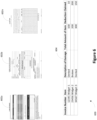
- document acquisition module 110 is configured to manage and facilitate the import of data files (e.g., claim deduction documents 602a-602n of Figure 6 , or the like).
- Deduction claim documents are a written record or form submitted by a customer or entity to a company or business, outlining the details of a deduction request in relation to an outstanding account receivable.
- a deduction claim refers to a customer's assertion or request for a reduction or adjustment in the amount owed to a seller business.
- a deduction claim typically arises when the customer believes there is a valid reason to reduce the outstanding balance, due to issues such as product defects, damaged goods, pricing discrepancies, or other issues that may impact the agreed-upon payment.
- a deduction claim document typically includes information associated with the deduction claim such as the customer's name, account number, reason for the claim, supporting documentation (such as invoices, receipts, or product photos), requested deduction amount, and any additional relevant details.
- the deduction claim document serves as a formal communication from the customer to the company, initiating the process of reviewing and resolving the deduction claim.
- the document acquisition module 110 may have the capability to support an extensive range of claim deduction documents in a variety of document formats (e.g., tabular data, non-tabular data, or the like) and in a variety of document types including, but not limited to, PDF, spreadsheets, text documents, images, JPG, PNG, GIG, TIFF, email, HTML, XML,, CSV files, and others commonly employed in financial systems. Module 110 can also process documents written in various Latin script languages such as English, French, Spanish, and more.
- document acquisition module 110 offers an interactive interface that enables manual document uploads by users. This user interface includes validation and error-checking mechanisms to ensure the uploaded files adhere to supported formats. The system provides users with immediate feedback if the uploaded document's format is incompatible.
- document acquisition module 110 can autonomously retrieve documents from an integrated database, like a financial data repository. Regardless of the format or language in which these documents are stored, the module can automatically identify and extract pertinent ones.
- the document acquisition module 110 can identify and extract documents associated with claim deductions. In order to search, find, and/or extract documents associated with claim deductions the document acquisition module 110 can look for documents with specific features. In a non-limiting example, the document acquisition module 110 can search for documents and extract documents comprising at least one of customer information, entity information, invoice information, deduction claim information, supporting information, contact information, signature information, or date information, or the like.
- the customer information or entity information can include, without limitation, at least one of a name, an address, contact details (e.g., phone number, email address, or the like) of the customer or entity making the claim, or the like.
- the invoice information can include, without limitation, at least one of an invoice number, a date, an amount related to the disputed transaction, or the like.
- the deduction claim information can include, without limitation, at least one of a reason for the claim, a description of an issue or error, dispute information, an amount being withheld, a claim document number, a claim number, a reference number, or the like.
- Supporting information can include any relevant documents, such as receipts, bills, statements, delivery records, or correspondence, which support the customer's claim, or the like.
- Contact information can include, without limitation, a name, phone number, email, address, or the like associated with a person or entity that can help resolve a deduction claim.
- Signature information can include a customer's signature.
- Date information can include a date a claim was submitted, a date goods were delivered, a date when an issue was found, or the like.
- the document acquisition module 110 can look for specific key words associated with deduction claims.
- these terms might include, without limitation, damage, defect, discrepancy, reduction, deduction, amount withheld, claim, dispute, or the like.
- document acquisition module 110 may be configured to pull documents from external databases via Application Programming Interfaces (APIs). It is designed to handle a wide variety of APIs used for accessing financial documents in diverse formats and languages. User authentication and secure document access are safeguarded during this process, and the document acquisition module 110 offers feedback if an incompatible document format is detected.
- APIs Application Programming Interfaces
- document acquisition module 110 may be configured for extracting documents from emails by monitoring a specific email account and processing attachments. It includes validation checks to verify the compatibility of document formats, and also maintains secure access protocols to ensure the confidentiality of the information contained within the emails. Document acquisition module 110 may be designed to provide feedback to the user if an attached document's format is not supported by the system.
- the document acquisition module 110 can monitor a specific email account for documents containing claim deductions.
- the document acquisition module 110 can monitor the email account, email messages (e.g., body or subject line of an email) attachments to the emails, or the like for specific information (e.g., at least one of customer information, entity information, invoice information, deduction claim information, supporting information, contact information, signature information, or date information, or the like) or specific key words (e.g., damage, defect, discrepancy, reduction, deduction, amount withheld, claim, dispute, or the like).
- specific information e.g., at least one of customer information, entity information, invoice information, deduction claim information, supporting information, contact information, signature information, or date information, or the like
- specific key words e.g., damage, defect, discrepancy, reduction, deduction, amount withheld, claim, dispute, or the like.
- document acquisition module 110 can be physically embodied in several different forms of hardware. This can include servers, which provide the necessary computational capacity and data storage capabilities required by document acquisition module 110. These servers could be single machines or form part of a distributed network, which can be located either on-premises or in a cloud environment. Various data storage devices may also be incorporated, such as Hard Disk Drives (HDDs), Solid-State Drives (SSDs), or Network-Attached Storage (NAS) devices. Document acquisition module 110 may be implemented with network equipment, including routers, switches, and firewalls, to enable network communication and data transfer protocols. These components assist in maintaining connectivity between document acquisition module 110, other modules in the system, databases, and external APIs, while also ensuring the secure transmission of data.
- HDDs Hard Disk Drives
- SSDs Solid-State Drives
- NAS Network-Attached Storage
- document acquisition module 110 For manual user interaction with document acquisition module 110, various input/output devices such as keyboards, mice, touchscreens, monitors, or printers may be utilized. These devices allow users to upload documents to document acquisition module 110 and receive feedback about the processing status. In situations where physical documents are to be digitized, scanner devices may be employed. Depending on the implementation, security may be a concern for document acquisition module 110, and as such, dedicated security hardware, such as hardware-based firewalls or secure servers, may be used to safeguard sensitive data. For certain applications, document acquisition module 110 interfaces with third-party APIs, and an API gateway device could be used to manage, route, and secure API calls effectively.
- third-party APIs such as hardware-based firewalls or secure servers
- the pre-processing stage includes, among other components, a document scraper module 120, which is configured for processing documents.
- Document scraper module 120 is configured to parse and extract data from the input document (e.g., one or more claim deduction documents obtained by document acquisition module 110).
- the type of data that document scraper module 120 can extract encompasses text (e.g., letters, words, phrases, paragraphs, etc.), numbers, special characters, and relevant metadata.
- general-purpose document parsing solutions such as open-source PDF parsers or Image OCR libraries in Python may be used to read the text characters from the document.
- These tools are also equipped to extract associated information with the text characters including, but not limited to, coordinates, encoding, font details (e.g., color, size, highlights, bolded, underlined, italicized, or the like), font styles (e.g., arial, times new roman, or the like), and text rotations.
- font details e.g., color, size, highlights, bolded, underlined, italicized, or the like
- font styles e.g., arial, times new roman, or the like
- text rotations e.g., arial, times new roman, or the like
- document scraper module 120 stores the acquired data in a configurable structured format, which could be a scraper document database or file that can be updated dynamically. This storage can take place in a relational or a NoSQL database, local or cloud-hosted, or in a flat file format such as CSV or JSON.
- the type of data that can be found in a file and extracted by document scraper module 120 is multitudinous, including textual data (e.g., textual data in multiple languages, textual data of different fonts, sizes, colors, styles, or the like), image data (e.g., images embedded within a document, images referenced within a document, images linked within a document, JPG, PNG, GIF, TIFF, or the like), annotations (e.g., comments, highlights, bookmarks, author of the comments, author of the highlights, author of the bookmarks, etc.), links (e.g., links to other documents, images, web pages, media files, or the like), and metadata.
- textual data e.g., textual data in multiple languages, textual data of different fonts, sizes, colors, styles, or the like
- image data e.g., images embedded within a document, images referenced within a document, images linked within a document, JPG, PNG, GIF, TIFF, or the like
- annotations
- each file's metadata varies, consisting of details such as font information (e.g., color, size, or the like), character encoding (e.g., Unicode or ASCII or the like), character and paragraph styles (e.g., bolded, underlined, italicized, numbered, or the like), word, line, and paragraph spacing (e.g., amount of space between words, lines, paragraphs, or the like), paragraph styles (e.g., indentation, justified, or the like), text positioning (e.g., location of text, words, letters, sentences, paragraphs, etc. on page, coordinates of text, words, letters, sentences, paragraphs, etc.
- font information e.g., color, size, or the like
- character encoding e.g., Unicode or ASCII or the like
- character and paragraph styles e.g., bolded, underlined, italicized, numbered, or the like
- word, line, and paragraph spacing e.g., amount of
- text flow e.g., direction of text such as right to left or left to right or the like
- language e.g., annotations or comments (e.g., notes, highlights, author of notes or highlights, or the like)
- tags e.g., header, footer, or the like
- hyperlinks e.g., links to other documents, images, web pages, media files, or the like
- bookmarks e.g., links to specific locations within a document, or the like
- the metadata may also consist of cell formatting (e.g., font size, color, alignment, cell size, etc.), cell styles (e.g., number, currency, header, title, text, etc.), worksheet metadata (e.g., name of worksheet, author, date created, date modified, etc.), data validation rules (e.g., one or more rules for each cell, specific data types, etc.), and formulas (e.g., formula itself, range of cells used in calculation, etc.).
- cell formatting e.g., font size, color, alignment, cell size, etc.
- cell styles e.g., number, currency, header, title, text, etc.
- worksheet metadata e.g., name of worksheet, author, date created, date modified, etc.
- data validation rules e.g., one or more rules for each cell, specific data types, etc.
- formulas e.g., formula itself, range of cells used in calculation, etc.
- the metadata could comprise information about image dimensions (e.g., height, width, etc.), image format (e.g., JPG, PNG, TIFF, etc.), color profile (e.g., black and white, color, color space used in image, sRGB, Adobe RGB, etc.), resolution (e.g., number of pixels per inch or per centimeter, etc.), and compression (lossless, lossy, etc.).
- image dimensions e.g., height, width, etc.
- image format e.g., JPG, PNG, TIFF, etc.
- color profile e.g., black and white, color, color space used in image, sRGB, Adobe RGB, etc.
- resolution e.g., number of pixels per inch or per centimeter, etc.
- compression lossless, lossy, etc.
- Document scraper module 120 is capable of parsing different file types, thereby extracting relevant textual data, image data, and metadata, making it an integral component in the document processing method.
- document scraper module 120 can be implemented across various hardware configurations based on the scale of operation and specific needs. For regular tasks, it can operate on standard personal computers equipped with a multicore CPU, ample RAM, and substantial storage. In high-volume scenarios, it could run on server clusters featuring multiprocessor systems, extensive RAM, and considerable storage capacities. For high-performance tasks, specialized hardware like high-performance GPUs, ASICs, or FPGAs can be utilized for their parallel processing capabilities.
- the content processing module 122 is configured to receive and process the scraped information from the preceding stages (e.g., document acquisition module 110 and document scraper module 120).
- the content processing module 122 may include a rule engine that has the capability to receive and store a variety of custom rules related to the processing of financial documents such as deduction claim documents.
- the custom rules assist in grouping or de-grouping words and phrases based on certain criteria such as the part of speech of the words and phrases, the relationship among them, and their semantic meaning.
- the rule engine applies these rules considering the distances and properties of characters, enabling the grouping of text characters into coherent words and phrases. For example, "Invoice Number” is considered a single phrase composed of two words, whereas "Vendor Item description” is partitioned into a word and a phrase, namely "Vendor” and "Item description”.
- the noise removal module 124 may be configured around a rule engine, which may be configured to receive and store a diverse set of custom rules for noise removal, specifically tailored to deduction claim documents.
- noise removal rules facilitate various operations, such as replacing each CID character in the content with its respective Unicode string value, eliminating all punctuation marks that precede any phrase in the content, and discarding recurring special characters which are typically used as section separators within the content.
- the noise removal module further comprises removing watermark text, text beyond page margins, or the like. Implementation of these rules by the noise removal module can help ensure that the output content is devoid of noise, thereby readying it for subsequent stages of processing.
- ML module 130 is configured to classify data received from the previous stage (e.g., document acquisition module 110, document scraper module 120, content processing module 122, and/or noise removal module 124) .
- ML module 130 incorporates a fine-tuned transformer-based natural language processing (NLP) model, specifically LayoutLM v1, which is trained to classify content entities such as words and phrases into tabular and non-tabular data and/or into non-tabular keys, tabular keys, and values.
- NLP transformer-based natural language processing
- LayoutLM v1 which is trained to classify content entities such as words and phrases into tabular and non-tabular data and/or into non-tabular keys, tabular keys, and values.
- This model may be implemented using established open-source Python libraries.
- the "LayoutLM v1" transformer-based model operates as the fundamental layer.
- the "LayoutLM v1" model modifies the BERT architecture to include 2-D positional information (x and y coordinates of words within the document) as additional input embedding layers.
- BERT is a multi-layer bidirectional transformer encoder that accepts a sequence of tokens and combines multiple layers to yield the final representations.
- the pre-training of "LayoutLM v1" ML model employs the IIT-CDIP Test Collection 1.02 which encompasses more than 6 million scanned documents and 11 million scanned document images from a diverse range of categories. This model may be, as an example, pre-trained on "Masked Visual-Language Model (MVLM)" and “Multi-label Document Classification (MDC)” tasks simultaneously.
- MVLM Motion-Language Model
- MDC Multi-label Document Classification
- the "LayoutLM v1" model uses the "WordPiece” tokenizer to generate tokens of words in the document.
- the fine-tuning of the base "LayoutLM v1" model may be carried out using 1000 unique document formats, including both text-based PDFs and images. These documents cover various domains such as deduction claims.
- the tokenizer used in the base model may be modified to more accurately represent the context of certain kinds of data frequently found in claim deduction documents. These modifications include the addition of a special token for interpreting currency characters (replacing symbols such as $, £, etc. with [CUR] token), and special tokens for interpreting amount strings (floating point values are replaced with [SFLT] for "Short float” type data and [LFLT] for "Long float” type data).
- an optimization of the model's learning for better capturing trends and patterns of claim deduction documents is carried out using the "AdamW" optimizer algorithm, configured at a learning rate of 5e-5, with the "cross-entropy" loss function.
- machine learning module 130 can be implemented on a variety of hardware, depending on computational needs.
- a multi-core CPU for parallel processing and substantial RAM for data handling may be used, while large storage capacities may be needed for handling extensive datasets and model outputs.
- high-performance servers or server clusters can be employed.
- Specialized hardware like Graphics Processing Units (GPUs) and Tensor Processing Units (TPUs) can considerably enhance the computational performance, especially for the LayoutLM v1 model's operations that benefit from parallel processing capabilities. These units are especially effective for ML tasks such as training and fine-tuning the model, accelerating these processes significantly.
- cloud-based platforms may be used, as they offer high-performance computing resources, including ML-specific hardware options that are especially beneficial for extensive ML tasks.
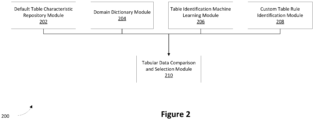
- FIG. 2 is a simplified diagram 200 illustrating one or more modules of the table extraction module 140 according to embodiments of the present invention.
- the table extraction module 140 is configured to extract data classified as tabular data or tabular keys by the machine learning module 130.
- This diagram is merely an example, which should not unduly limit the scope of the claims.
- One of ordinary skill in the art would recognize many variations, alternatives, and modifications.
- the table extraction module 140 might include at least one of a default table characteristic repository module 202, domain dictionary module 204, table identification learning module 206, or a custom table rule identification module 208. In some cases, all four modules can be used to extract the tabular data. Alternatively, in other cases one or more of the modules can be used to extract the tabular data. Each of the one or more modules can run independently of each other and in parallel to extract the tabular data of the claim deduction document.
- the default table characteristic repository module 202 is a rule module comprising a collection of mutually exclusive JSON rules defining characteristics of widely observed tables in claim deduction documents.
- the domain dictionary module 204 is a collection of mappings between claim fields and customer or claim deduction document observed claim format labels.
- Item_Description can be defined as "Line Description" in a claim document from a first customer while Item_Description is defined as "Description” in a claim document from a second customer.
- the table identification learning module 206 is described with respect to application number 18/480,741 in Figures 2 and 3 and it takes the claim document as an input and segregates its content into tabular keys, non-tabular keys, and values as the output.
- the custom table rule identification module 208 allows users to define rules for identifying one or more tables present in a deduction claim template of a specific business.
- the custom table rule identification module 208 is generally used for exceptional cases where the claim documents don't follow any documentation standard (e.g., the tables not having any border or distinction between header & item, or the like).
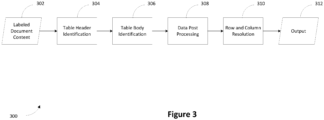
- Figure 3 is a flow diagram 300 illustrating a process for extracting tabular data of one or more deduction claim documents using at least one of a default table characteristic repository module 202, domain dictionary module 204, table identification learning module 206, or a custom table rule identification module 208 according to embodiments of the present invention.
- a parameter-driven rule-engine is employed for the identification, extraction, and transformation of any tabular content within the labeled document content 302 (e.g., content from the content processing module 122) of the one or more deduction claim documents. This conversion into their respective columns, rows, and corresponding values results in the final output 312, which can be generated in a JSON format.
- operation of a parameter-driven rule-engine involves multiple sub-steps.
- Table Header Identification 304 is performed using at least one of a default table characteristic repository module 202, domain dictionary module 204, table identification learning module 206, or a custom table rule identification module 208.
- the table headers are determined using one or more common rules for table headers.
- the default table characteristic repository module 202 can look for one or more words, phrases, or values that have a same horizontal or vertical alignment and are at least one of bolded, centered, underlined, italicized, or the like. These are only some of the rules that can be associated with table headers.
- the table headers can be determined by iterating through all the labels, words, phrases etc. of a claim deduction document and comparing them with customer or claim deduction defined headers. Once one or more deduction claim headers are found, the domain dictionary module 204 can label them as a table header. For example - Item_Description can be determined as a header of a claim deduction document. The domain dictionary module 204 can then search for the term "Item_Description" or any other related words (e.g., "Line Description,” "Description,” or the like and label the terms as table headers.
- a machine learning model can be used to identify table headers. This process is further described with respect to application number 18/480,741 in Figures 2 and 3 .
- the table identification machine learning module 206 can learn that a sequence of tabular key type entities with the same horizontal alignment or vertical alignment is considered to represent the tabular header
- table headers can be identified using user defined rules for a deduction claim template for a specific business.
- the custom table rule identification module 208 checks if any custom rule is present for the incoming claim template and then identifies the table headers by identifying the word or phrases satisfying the defined characteristic (e.g., name of the header, exact word or phrase of the header, position or alignment of header, data type of the header, format of the header, column or row number of the header, or the like).
- the defined characteristic e.g., name of the header, exact word or phrase of the header, position or alignment of header, data type of the header, format of the header, column or row number of the header, or the like.
- Table Body Identification process 306 (which can also be referred to as tabular value identification process) is initiated using at least one of a default table characteristic repository module 202, domain dictionary module 204, table identification learning module 206, or a custom table rule identification module 208.
- Table Body Identification process 306 include determining one or more words, phrases, values, numbers contained within a body of the tabular data.
- the table body or values associated with the identified headers can be determined using one or more common rules for a table body.
- the modules 202-208 can look for words, phrases, values, symbols, or the like following the identified table headers and having start and end coordinates in between the table header's coordinates and annotate them as table body or table value.
- the modules 202-208 can also determine the potential last row of the table in order to ensure each module 202-208 captures all the values within the table header's coordinates.
- the potential last row of the table can be identified based on content density and horizontal or vertical consistency of patterns within the table. These are only some of the rules that can be used to identify the table body and/or content within the table body.
- a Data Post-Processing step 308 is undertaken by at least one of a default table characteristic repository module 202, domain dictionary module 204, table identification learning module 206, or a custom table rule identification module 208.
- non-tabular key type entities are removed from within the identified table span. Entities such as "Summaries”, “Sub Totals", and others are examples of the content eliminated during this step.
- table headers with NULL items e.g., table headers without any data in a subsequent row or column
- Table headers with not-NULL items e.g., table headers with data in a subsequent row
- Table headers with not-NULL items can be classified as tabular data and be processed in the Column and Row Resolution step 310.
- the Column and Row Resolution step 310 is executed by at least one of a default table characteristic repository module 202, domain dictionary module 204, table identification learning module 206, or a custom table rule identification module 208.
- value type entities within the table span are assigned to their corresponding columns or rows and separated into individual rows.
- rules based on content density, vertical and horizontal alignment are leveraged to achieve this.
- two key thresholds may play a role in this process: (1) Stepwise Vertical Threshold, which indicates the maximum accepted distance between two vertically adjacent entities belonging to the same phrase, and (2) Stepwise Horizontal Threshold, which indicates the maximum accepted distance between two horizontally adjacent entities belonging to the same phrase.
- a parameter indicating the number of columns signifies the minimum number of tabular keys type entities with the same horizontal alignment needed to be recognized as a tabular header. Parameter values may be selected through a comprehensive statistical analysis performed on the annotated training data.
- each of the default table characteristic repository module 202, the domain dictionary module 204, the table identification learning module 206, or the custom table rule identification module 208 output a corresponding table.
- the one or more outputted tables are then sent to the tabular selection and comparison module 210 of Figure 2 , where the one or more tables are compared among each other to remove the redundant information or inconsistent information and to merge tables with the same headers but different items.
- priority is given to the custom rule module 208 then the domain dictionary module 204 then the default table characteristic repository module 202 then the table identification machine learning module 206.
- information from the custom rule-based module 208 is used first and considered to be more accurate while the information from the table identification machine learning module 206 is used last and is considered to be less accurate.
- the tabular selection and comparison module 210 of Figure 2 can then output 312 a corresponding table a configurable JSON file or update a database containing claim deduction information.
- the values marked as tabular data and contained within the output 312 do not need to be processed further.
- the values which are not identified as tabular data can be marked for further processing.
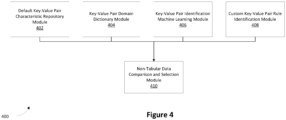
- FIG 4 is a simplified diagram illustrating one or more modules of the key value pair extraction module 142 according to embodiments of the present invention.
- the key value pair extraction module 142 is configured to extract data classified as non-tabular data or non-tabular keys by the machine learning module 130.
- This diagram is merely an example, which should not unduly limit the scope of the claims.
- One of ordinary skill in the art would recognize many variations, alternatives, and modifications.
- the key-value pair extraction module 142 might include at least one of a default key-value pair characteristic repository module 402, key-value pair domain dictionary module 404, key-value pair identification learning module 406, or a custom key-value pair rule identification module 408. In some cases, all four modules can be used to extract the non-tabular data. Alternatively, in other cases one or more of the modules can be used to extract the tabular data. Each of the one or more modules can run independently of each other and in parallel to extract the non-tabular data of the claim deduction document.
- the default key-value pair characteristic repository module 402 is a rule module comprising a collection of mutually exclusive JSON rules defining characteristics of widely observed non-tabular in claim deduction documents.
- the key-value pair domain dictionary module 404 is a collection of mappings between claim fields and customer or claim deduction document observed claim format labels. For example - Item_Description can be defined as "Line Description" in a claim document from a first customer while Item_Description is defined as "Description" in a claim document from a second customer.
- the key-value pair identification learning module 406 is described with respect to application number 18/480,741 in Figure 4 and it takes the claim document as an input and segregates its content into tabular keys, non-tabular keys and values as the output.
- the custom key-value pair rule identification module 408 allows users to define rules for identifying non-tabular key-value pairs present in a deduction claim template of a specific business.
- the custom key-value pair rule identification module 408 is generally used for exceptional cases where the claim documents don't follow any documentation standard (e.g., the tables not having any border or distinction between header & item, or the like).
- Figure 5 is a flow diagram 500 illustrating a process for extracting non-tabular data from one or more deduction claim documents using at least one of the default key-value pair characteristic repository module 402, the key-value pair domain dictionary module 404, the key-value pair identification learning module 406, or the custom key-value pair rule identification module 408 according to embodiments of the present invention.
- a parameter-driven rule-engine is employed for the identification, extraction, and transformation of any non-tabular content within the labeled document content 502 (e.g., content from the content processing module 122 and/or table extraction module 140) of the one or more deduction claim documents.
- the non-tabular data can then be converted into one or more columns, rows, and corresponding values results in the final output 512, which can be generated in a JSON format.
- operation of a parameter-driven rule-engine involves multiple sub-steps.
- Non-Tabular Key Identification 504 is performed using at least one of a default key-value pair characteristic repository module 402, key-value pair domain dictionary module 404, key-value pair identification learning module 406, or a custom key-value pair rule identification module 408.
- the non-tabular keys are determined using one or more common rules for non-tabular keys.
- the default key-value pair characteristic repository module 402 can look for one or more words, phrases, or values that are at least one of bolded, centered, underlined, italicized, or the like.
- the default key-value pair characteristic repository module 402 can look for one or more key words (e.g., total, amount, deduction, claim, explanation), phrases (e.g., invoice number, item description, etc.), sentences, or the like commonly associated with keys across one or more claim deduction documents. These are only some of the rules that can be associated with key of claim deduction documents.
- the keys can be determined by iterating through all the labels, words, phrases etc. of a claim deduction document and comparing them with customer or claim deduction defined keys. Once one or more deduction claim keys are found, the key-value pair domain dictionary module 404 can label them as a key. For example - Item_Description can be determined as a key of a claim deduction document. The key-value pair domain dictionary module 404 can then search for the term "Item_Description" or any other related words (e.g., "Line Description,” "Description,” or the like) and label the terms as keys.
- a machine learning model can be used to identify non-tabular keys. This process is further described with respect to application number 18/480,741 in Figure 4 .
- the key-value pair identification machine learning module 406 can learn that a sequence of non-tabular key type entities are typically at least one of bolded, centered, underlined, italicized, or the like and determine that one or more words or phrases that are at least one of bolded, centered, underlined, italicized, or the like are non-tabular keys.
- non-tabular keys can be identified using user defined rules for a deduction claim template for a specific business.
- the custom key-value pair rule identification module 408 checks if any custom rule is present for the incoming claim template and then identifies the keys by identifying the word or phrases satisfying the defined characteristic (e.g., name of the non-tabular key, exact word or phrase of the non-tabular key, position or alignment of non-tabular key, data type of the non-tabular key, format of the non-tabular key, or the like).
- the defined characteristic e.g., name of the non-tabular key, exact word or phrase of the non-tabular key, position or alignment of non-tabular key, data type of the non-tabular key, format of the non-tabular key, or the like.
- non-tabular value identification process 506 is initiated using at least one of the default key-value pair characteristic repository module 402, key-value pair domain dictionary module 404, key-value pair identification learning module 406, or a custom key-value pair rule identification module 408. In some cases, non-tabular value identification process 506 includes determining one or more values associated with the non-tabular keys.
- the values associated with the keys can be determined using one or more common rules for values.
- the modules 402-408 can look for words, phrases, values, numbers, symbols, or the like following, below, or within a predetermined distance of the identified key or grouped together with an identified key. These are only some of the rules that can be used to identify the values associated with an identified key.
- a Data Post-Processing step 508 is undertaken by at least one of a default key-value pair characteristic repository module 402, the key-value pair domain dictionary module 404, the key-value pair identification learning module 406, or the custom key-value pair rule identification module 408.
- non-tabular key type entities and non-key-value pair type entities are removed. Entities such as "Summaries", “Sub Totals", and others are examples of the content eliminated during this step.
- keys with NULL items e.g., keys without any data within a predetermined distance
- Keys with not-NULL items can be classified and be processed in the Column and Row Resolution step 510.
- the optional Column and Row Resolution step 510 can be executed by at least one of the default key-value pair characteristic repository module 402, the key-value pair domain dictionary module 404, the key-value pair identification learning module 406, or the custom key-value pair rule identification module 408.
- key-value pairs can be assigned to a corresponding column or row and/or separated into individual rows or columns of a table. However, in some cases, the key-value pairs can be outputted without using the Column and Row Resolution step 510 and without assigning them to one or more rows or columns.
- the corresponding one or more key-value pairs can be outputted individually or in a table format.
- the one or more outputted tables are then sent to the key-value pair selection and comparison module 410 of Figure 4 , where the one or more tables are compared among each other to remove the redundant information or inconsistent information and to merge tables with the same keys but different items.
- priority is given to the custom key-value pair rule module 408 then the key-value pair domain dictionary module 404 then the default key-value pair characteristic repository module 402 then the key-value pair identification machine learning module 406.
- information from the custom key-value pair rule-based module 408 is used first and considered to be more accurate while the information from the key-value pair identification machine learning module 406 is used last and is considered to be less accurate.
- the tabular selection and comparison module 410 of Figure 4 can then output 512 a corresponding table configurable JSON file or update a database containing claim deduction information.
- the values marked as key-value pair data and contained within the output 512 do not need to be processed further.
- the values which are not identified as tabular data or key-value pair data can be marked for further processing.
- Paragraph extraction module 144 can label the remaining data as paragraph data and then output the data labeled as paragraph data as a JSON file or update a database with the paragraph data.
- associator module 150 can take the tabular keys, tabular values, non-tabular keys, non-tabular values and paragraph data identified by tabular data extraction module 140, the key-value pair extraction module 142, and the paragraph extraction module 144 and associate the tabular keys, tabular values, non-tabular keys, non-tabular values and paragraph data identified from the document to appropriate attributes of a claim deduction or to appropriate attributes of the data output module 160.
- the Associator Module 150 can associate the values of the tabular keys, tabular values, non-tabular keys, non-tabular values and paragraph data to claim item level attributes and/or headers or keys in the data output module 160 or data output file.
- a header or key defined as "Desc” can be associated with or assigned to "Item description” of the output file and a header or key defined as "Price” can be associated with or assigned to "Unit Cost” of the output file.
- a header or key defined as "deduction number” can be associated with "Claim Number" of the data output module 160 or data output file.
- Corresponding values associated with the header or key can then be organized or positioned in association with the appropriate attributes of the data output module 160 or the data output file.
- values e.g., 123456, 234567, or the like
- Paragraph data can be associated with appropriate attributes of the data output module 160 as either header or keys or values associated with headers or keys.
- the associator module 150 can use the domain dictionary modules 204 and/or 404 to find associations between tabular keys, tabular values, non-tabular keys, non-tabular values and paragraph data and appropriate attributes of a claim deduction or to appropriate attributes of the data output module 160.
- the associator module 150 can also use Large Language Models (LLMs) to perform semantic analysis on the data identified in the data identifier module and find meaningful relationships or associations between the different categories of data.
- LLMs Large Language Models
- Some LLMs that can be used include, without limitation, GPT models, Claude, RoBERTa, LLaMA, and BERT models.
- GPT models are generative pre-trained transformer models that use the transformer architecture to learn from large amounts of text data. They have four variants: Ada, Babbage, Curie, and Davinci, which differ in the number of parameters, the amount of data they were trained on, and the types of tasks they can perform.
- BERT models are bidirectional encoder representations from transformers models that use the transformer architecture to learn from both left and right context of a given word. They can be fine-tuned for various natural language understanding tasks, such as classification, sentiment analysis, question answering, and named entity recognition.
- Data output module 160 is configured for classification and storage of the data, which may be saved in a JSON file. As an example, for data classified as tabular data, the data output module 160 generates a structured representation (e.g., shown in Figure 6 , table 604), which may be displayed as tables, spreadsheets, or other suitable formats that present the data in a clear and organized manner. Data output module 160 may be configured to provide formatting options, such as bolding, italics, colors, and other visual cues to highlight specific data or provide additional context. Data output module 160 can further generate metadata, such as column headers, row labels, data types, and other relevant information, to enhance user comprehension.
- a structured representation e.g., shown in Figure 6 , table 604
- Data output module 160 may be configured to provide formatting options, such as bolding, italics, colors, and other visual cues to highlight specific data or provide additional context.
- Data output module 160 can further generate metadata, such as column headers, row labels, data types, and other relevant information, to enhance user comprehension
- data output module 160 may generate a structured representation (e.g., shown in Figure 6 , table 604), which may be presented as paragraphs, bullet points, lists, tables, spreadsheets, or other formats that render the data readable and well-organized.
- data output module 160 may provide formatting options, including adjustments to font size, indentation, and line spacing. Additional features such as hyperlinking, inline definitions, or tooltips may also be incorporated to provide contextual information or facilitate navigation within the non-tabular data.
- Data output module 160 can further generate metadata, such as column headers, row labels, data types, and other relevant information, to enhance user comprehension.
- the structured representation (e.g., shown in Figure 6 , table 604) represents a cohesive view of the tabular data, non-tabular data, and paragraph data combined. For example, all the data can be combined in a table, spreadsheet, paragraph, bullet point, list, or other format configured to provide an overall picture of the tabular data, non-tabular data, and paragraph data.
- the structured representation (e.g., shown in Figure 6 , table 604) represents a cohesive view of at least one of the tabular data, non-tabular data, and paragraph data from multiple claim deduction documents. By combining information from multiple documents, a seller can obtain a comprehensive of pending or outstanding deduction claims and address the pending or outstanding deduction claims on one graphical user interface.
- Data output module 160 may provide customization and interactivity features, thereby allowing users to adjust the display of the output according to their preferences. This may include changing formatting options, choosing different visual themes, or applying filters to focus on specific subsets of data. Data output module 160, in some implementations, may provide interactive features like sorting, searching, and filtering to allow dynamic exploration and analysis of the displayed data. In some cases, data output module 160 can either automatically prioritize or order or allow a user to prioritize or order information extracted from one or more deduction claim documents.
- information from one or more deduction claim documents can be prioritized based on a date (e.g., older claims being more likely to shown at a top of a page, newer claims being more likely to shown at a top of a page, or the like) of the claim, based on an amount requested to be deducted (e.g., larger amounts being more likely to be shown at a top of a page, or the like), based on one or more goods or services associated with the claim, or the like.
- a date e.g., older claims being more likely to shown at a top of a page, newer claims being more likely to shown at a top of a page, or the like
- an amount requested to be deducted e.g., larger amounts being more likely to be shown at a top of a page, or the like
- Data output module 160 may be configured to facilitate export and sharing, thus enabling users to export the displayed output in various formats such as PDF, Excel, CSV, or HTML. For example, users can share the output with others, either in its original format or as an exported file, promoting collaboration and knowledge sharing.
- data output module 160 is configured for database integration and update, capable of integrating with third-party database systems through connections or appropriate application programming interface (APIs).
- data output module 160 can support various database types, including relational databases, NoSQL databases, document databases, among others. It is to be appreciated that data output module 160 may be configured to efficiently update the database with the extracted information, maintaining real-time synchronization and data consistency. Data output module 160 can also provide mechanisms for error handling, transaction management, and data logging to uphold data integrity and traceability.
- data output module 160 can be implemented on a multitude of hardware infrastructures tailored to a range of application and usage scenarios.
- Essential components of the hardware infrastructure for this data output module 160 comprise a processing unit and a memory unit.
- the processing unit which may be a Central Processing Unit (CPU) or a Graphics Processing Unit (GPU), carries out the execution of program instructions.
- the memory unit provides the storage for these program instructions, incoming data, and processed results.
- data output module 160 can be configured on a server or a cluster of servers. These servers could be designed with multi-core or multi-processor systems, extensive quantities of RAM, and significant storage capacities. They could be housed in a dedicated data center or utilized as part of a cloud computing platform. High-performance requirements may involve implementing data output module 160 on specialized hardware. This hardware could include high-performance GPUs, Application-Specific Integrated Circuits (ASICs), or Field-Programmable Gate Arrays (FPGAs). Such devices can expedite data processing tasks by carrying out specific operations in parallel. Data output module 160 may operate in a cloud-based environment, harnessing resources from providers, which provide a scalable solution adaptable to varying workloads, with the benefits of simplified maintenance and reduced upfront costs.
- ASICs Application-Specific Integrated Circuits
- FPGAs Field-Programmable Gate Arrays
- Retraining module 170 is configured to evaluate and enhance the accuracy of data extraction processes from structured and unstructured documents (e.g., one or more claim deduction documents).
- accuracy assessment process retraining module 170 compares the extracted data with ground truth or reference data to assess its accuracy. This comparison may utilize techniques including, but not limited to, exact matching, fuzzy matching, similarity metrics, or machine learning-based classification. For example, accuracy is quantified using suitable metrics such as precision, recall, or any other relevant measures, providing a comprehensive evaluation of the data extraction process.
- comparing the output data file to reference data or ground truth data comprises comparing one or more data objects in the output data file to at least one customer information, entity information, invoice information, deduction claim information, supporting information, contact information, signature information, or date information stored in a data storage and associated with the at least one corresponding deduction claim.
- an invoice number extracted from the one or more deduction claim documents can be compared to one or more invoice numbers associated with a seller to confirm that the deduction claim is associated with the seller.
- Retraining module 170 may also generate evaluation reports offering insights into the accuracy of the data extraction. These reports encapsulate information on error patterns and distributions across various document types or data elements, and identify the specific types and sources of errors. To facilitate a thorough understanding of the assessment results, these reports encompass visualizations, statistical summaries, and a detailed analysis of errors.
- a feedback generation process is built on the insights from the evaluation reports.
- Retraining module 170 identifies patterns or rules contributing to errors and provides actionable recommendations for refinement. This feedback can encompass suggestions for modifying machine learning model parameters, updating data preprocessing techniques, adjusting feature selection, or refining other aspects of the data extraction pipeline.
- Feedback incorporation is another function that may be performed by retraining module 170. This process facilitates the integration of feedback into the machine learning model and the data extraction pipeline, driving continuous improvement. Interfaces, APIs, or hooks may be used for seamless integration with the data extraction pipeline and facilitate the implementation of feedback. This process could involve retraining the machine learning model, updating preprocessing techniques, adjusting feature selection criteria, or modifying other parameters based on the feedback received.
- Retraining module 170 may provide real-time and automated feedback, operating in real-time or at regular intervals to provide ongoing feedback. It integrates with the data extraction pipeline, automatically assessing accuracy, generating reports, and providing feedback without manual intervention. This may be achieved through APIs, event triggers, or workflow integration, ensuring timely and automated feedback incorporation.
- the retraining module 170 is retrained after a predetermined amount of time passes (e.g., a week, a month, etc.) using an updated training dataset that additionally includes document samples for which predictions did not perform as expected.
- a predetermined amount of time passes e.g., a week, a month, etc.
- training data of the identified low performing samples is first collected and then appended to the training data set that was used originally. Fine-tuning of the model is then re-run using this updated training dataset so that the accuracy and coverage of captured trends/patterns is improved.
- Retraining module 170 may provide performance tracking and comparison. For example, this process tracks the performance of the data extraction pipeline over time, capturing changes in accuracy metrics and error patterns. Retraining module 170 may provide comparisons between different iterations or versions of the machine learning model or data extraction pipeline, assessing the impact of feedback and improvement efforts.
Landscapes
- Engineering & Computer Science (AREA)
- Business, Economics & Management (AREA)
- Theoretical Computer Science (AREA)
- Physics & Mathematics (AREA)
- General Physics & Mathematics (AREA)
- Computer Vision & Pattern Recognition (AREA)
- Development Economics (AREA)
- Accounting & Taxation (AREA)
- Finance (AREA)
- Artificial Intelligence (AREA)
- General Business, Economics & Management (AREA)
- Strategic Management (AREA)
- Marketing (AREA)
- Economics (AREA)
- Multimedia (AREA)
- General Engineering & Computer Science (AREA)
- General Health & Medical Sciences (AREA)
- Computational Linguistics (AREA)
- Audiology, Speech & Language Pathology (AREA)
- Health & Medical Sciences (AREA)
- Technology Law (AREA)
- Information Retrieval, Db Structures And Fs Structures Therefor (AREA)
Applications Claiming Priority (1)
| Application Number | Priority Date | Filing Date | Title |
|---|---|---|---|
| US18/480,783 US20250117833A1 (en) | 2023-10-04 | 2023-10-04 | Deduction claim document parsing engine |
Publications (1)
| Publication Number | Publication Date |
|---|---|
| EP4535271A1 true EP4535271A1 (de) | 2025-04-09 |
Family
ID=93011102
Family Applications (1)
| Application Number | Title | Priority Date | Filing Date |
|---|---|---|---|
| EP24204453.5A Pending EP4535271A1 (de) | 2023-10-04 | 2024-10-03 | Parsing-engine für deduktionsanspruchdokumente |
Country Status (2)
| Country | Link |
|---|---|
| US (1) | US20250117833A1 (de) |
| EP (1) | EP4535271A1 (de) |
Families Citing this family (3)
| Publication number | Priority date | Publication date | Assignee | Title |
|---|---|---|---|---|
| US20250124623A1 (en) * | 2023-10-12 | 2025-04-17 | Microsoft Technology Licensing, Llc | Generating editable templates for designs |
| US20250217601A1 (en) * | 2024-01-02 | 2025-07-03 | International Business Machines Corporation | Generation of synthetic documents for data augmentation |
| US12585706B2 (en) * | 2024-02-12 | 2026-03-24 | Highradius Technologies Private Limited | Machine-learning based (ML-based) system and method for automatically processing one or more documents |
Citations (5)
| Publication number | Priority date | Publication date | Assignee | Title |
|---|---|---|---|---|
| US20200125592A1 (en) * | 2018-10-18 | 2020-04-23 | Hitachi, Ltd. | Attribute extraction apparatus and attribute extraction method |
| CN113420116B (zh) * | 2021-06-23 | 2022-12-27 | 平安科技(深圳)有限公司 | 医疗文档的分析方法、装置、设备及介质 |
| US20230095673A1 (en) * | 2021-09-28 | 2023-03-30 | Oracle International Corporation | Extracting key information from document using trained machine-learning models |
| US20230113578A1 (en) * | 2021-10-12 | 2023-04-13 | American Express Travel Related Services Company, Inc. | Transaction and ownership information document extraction |
| US20230267273A1 (en) * | 2022-02-22 | 2023-08-24 | TAO Automation Services Private Limited | Machine learning methods and systems for extracting entities from semi-structured enterprise documents |
Family Cites Families (14)
| Publication number | Priority date | Publication date | Assignee | Title |
|---|---|---|---|---|
| US8049921B2 (en) * | 2007-04-16 | 2011-11-01 | Bottomline Technologies (De) Inc. | System and method for transferring invoice data output of a print job source to an automated data processing system |
| CA2866986A1 (en) * | 2013-10-15 | 2015-04-15 | The Toronto-Dominion Bank | Method and system for validating multiple documents associated with a mortgage application |
| US10853638B2 (en) * | 2018-08-31 | 2020-12-01 | Accenture Global Solutions Limited | System and method for extracting structured information from image documents |
| US10810420B2 (en) * | 2018-09-28 | 2020-10-20 | American Express Travel Related Services Company, Inc. | Data extraction and duplicate detection |
| EP3908971B1 (de) * | 2019-02-27 | 2025-07-23 | Google LLC | Identifizierung von schlüsselwertpaaren in dokumenten |
| US11704785B2 (en) * | 2020-03-18 | 2023-07-18 | Sas Institute Inc. | Techniques for image content extraction |
| US20220414328A1 (en) * | 2021-06-23 | 2022-12-29 | Servicenow Canada Inc. | Method and system for predicting field value using information extracted from a document |
| US12046063B2 (en) * | 2021-08-30 | 2024-07-23 | Bill Operations, Llc | Table information extraction and mapping to other documents |
| US11830264B2 (en) * | 2022-01-31 | 2023-11-28 | Intuit Inc. | End to end trainable document extraction |
| MX2025015118A (es) * | 2023-06-15 | 2026-02-03 | Innovative Logistics Llc | Sistemas y métodos para la ingesta automatizada de documentos. |
| US12579198B2 (en) * | 2023-08-23 | 2026-03-17 | Sas Institute, Inc. | Text string comparison for duplicate or near-duplicate text documents identified using automated near-duplicate detection for text documents |
| US20250191308A1 (en) * | 2023-12-12 | 2025-06-12 | Sap Se | Transition of physical process artifacts for mixed realty interactions |
| US20250348478A1 (en) * | 2024-05-12 | 2025-11-13 | Google Llc | Using generative models for analytic tasks |
| US12505027B2 (en) * | 2024-05-28 | 2025-12-23 | Distributional, Inc. | Systems, methods, and graphical user interfaces for detecting and explaining anomalous behavior in a deployed AI application |
-
2023
- 2023-10-04 US US18/480,783 patent/US20250117833A1/en active Pending
-
2024
- 2024-10-03 EP EP24204453.5A patent/EP4535271A1/de active Pending
Patent Citations (5)
| Publication number | Priority date | Publication date | Assignee | Title |
|---|---|---|---|---|
| US20200125592A1 (en) * | 2018-10-18 | 2020-04-23 | Hitachi, Ltd. | Attribute extraction apparatus and attribute extraction method |
| CN113420116B (zh) * | 2021-06-23 | 2022-12-27 | 平安科技(深圳)有限公司 | 医疗文档的分析方法、装置、设备及介质 |
| US20230095673A1 (en) * | 2021-09-28 | 2023-03-30 | Oracle International Corporation | Extracting key information from document using trained machine-learning models |
| US20230113578A1 (en) * | 2021-10-12 | 2023-04-13 | American Express Travel Related Services Company, Inc. | Transaction and ownership information document extraction |
| US20230267273A1 (en) * | 2022-02-22 | 2023-08-24 | TAO Automation Services Private Limited | Machine learning methods and systems for extracting entities from semi-structured enterprise documents |
Non-Patent Citations (1)
| Title |
|---|
| LIU HAO ET AL: "Show, Read and Reason Table Structure Recognition with Flexible Context Aggregator", PROCEEDINGS OF THE 45TH INTERNATIONAL ACM SIGIR CONFERENCE ON RESEARCH AND DEVELOPMENT IN INFORMATION RETRIEVAL, ACMPUB27, NEW YORK, NY, USA, 17 October 2021 (2021-10-17), pages 1084 - 1092, XP059240122, ISBN: 978-1-4503-8732-3, DOI: 10.1145/3474085.3481534 * |
Also Published As
| Publication number | Publication date |
|---|---|
| US20250117833A1 (en) | 2025-04-10 |
Similar Documents
| Publication | Publication Date | Title |
|---|---|---|
| KR102699233B1 (ko) | 문서 간 지능형 저작 및 처리 보조기 | |
| US10558746B2 (en) | Automated cognitive processing of source agnostic data | |
| US11481605B2 (en) | 2D document extractor | |
| US11816138B2 (en) | Systems and methods for parsing log files using classification and a plurality of neural networks | |
| EP4535235A1 (de) | Verfahren und systeme zur dokumentenverarbeitung auf der basis von maschinellem lernen | |
| US10482174B1 (en) | Systems and methods for identifying form fields | |
| EP4535271A1 (de) | Parsing-engine für deduktionsanspruchdokumente | |
| US11379690B2 (en) | System to extract information from documents | |
| US11899727B2 (en) | Document digitization, transformation and validation | |
| US12333236B2 (en) | System and method for automatically tagging documents | |
| US20220350814A1 (en) | Intelligent data extraction | |
| US12014561B2 (en) | Image reading systems, methods and storage medium for performing geometric extraction | |
| WO2024107396A1 (en) | System and methods for enabling user interaction with scan or image of document | |
| US12437154B1 (en) | Information extraction system for unstructured documents using retrieval augmentation providing source traceability and error control | |
| US20220179896A1 (en) | Organizing fragments of meaningful text | |
| EP3640861A1 (de) | Systeme und verfahren zum parsen von log-dateien unter verwendung einer klassifizierung und einer vielzahl von neuronalen netzwerken | |
| US11687578B1 (en) | Systems and methods for classification of data streams | |
| US20250029417A1 (en) | Data digitization via custom integrated machine learning ensembles | |
| US12386906B1 (en) | System and a method for determining hierarchical relationship in batches of documents | |
| CN115617951A (zh) | 合同信息提取方法、装置、计算机设备、介质和程序产品 | |
| US12437155B1 (en) | Information extraction system for unstructured documents using independent tabular and textual retrieval augmentation | |
| Bartoli et al. | Semisupervised wrapper choice and generation for print-oriented documents | |
| US20260093717A1 (en) | Identifying artifacts differences using graph neural networks | |
| KR102901386B1 (ko) | 문서 처리 시스템 | |
| US12591742B1 (en) | Information extraction from unstructured documents with hybrid retrieval augmentation using multi-modal language models |
Legal Events
| Date | Code | Title | Description |
|---|---|---|---|
| PUAI | Public reference made under article 153(3) epc to a published international application that has entered the european phase |
Free format text: ORIGINAL CODE: 0009012 |
|
| STAA | Information on the status of an ep patent application or granted ep patent |
Free format text: STATUS: THE APPLICATION HAS BEEN PUBLISHED |
|
| AK | Designated contracting states |
Kind code of ref document: A1 Designated state(s): AL AT BE BG CH CY CZ DE DK EE ES FI FR GB GR HR HU IE IS IT LI LT LU LV MC ME MK MT NL NO PL PT RO RS SE SI SK SM TR |
|
| STAA | Information on the status of an ep patent application or granted ep patent |
Free format text: STATUS: REQUEST FOR EXAMINATION WAS MADE |
|
| 17P | Request for examination filed |
Effective date: 20251007 |