EP4534633A1 - Schmierölzusammensetzungen und ihre verwendung zur verbesserung des verschleisses von gleitlagern in verbrennungsmotoren - Google Patents
Schmierölzusammensetzungen und ihre verwendung zur verbesserung des verschleisses von gleitlagern in verbrennungsmotoren Download PDFInfo
- Publication number
- EP4534633A1 EP4534633A1 EP24204454.3A EP24204454A EP4534633A1 EP 4534633 A1 EP4534633 A1 EP 4534633A1 EP 24204454 A EP24204454 A EP 24204454A EP 4534633 A1 EP4534633 A1 EP 4534633A1
- Authority
- EP
- European Patent Office
- Prior art keywords
- composition
- less
- lubricating oil
- ppm
- equal
- Prior art date
- Legal status (The legal status is an assumption and is not a legal conclusion. Google has not performed a legal analysis and makes no representation as to the accuracy of the status listed.)
- Pending
Links
Images


Classifications
-
- C—CHEMISTRY; METALLURGY
- C10—PETROLEUM, GAS OR COKE INDUSTRIES; TECHNICAL GASES CONTAINING CARBON MONOXIDE; FUELS; LUBRICANTS; PEAT
- C10M—LUBRICATING COMPOSITIONS; USE OF CHEMICAL SUBSTANCES EITHER ALONE OR AS LUBRICATING INGREDIENTS IN A LUBRICATING COMPOSITION
- C10M129/00—Lubricating compositions characterised by the additive being an organic non-macromolecular compound containing oxygen
- C10M129/02—Lubricating compositions characterised by the additive being an organic non-macromolecular compound containing oxygen having a carbon chain of less than 30 atoms
- C10M129/26—Carboxylic acids; Salts thereof
- C10M129/48—Carboxylic acids; Salts thereof having carboxyl groups bound to a carbon atom of a six-membered aromatic ring
- C10M129/52—Carboxylic acids; Salts thereof having carboxyl groups bound to a carbon atom of a six-membered aromatic ring polycarboxylic
-
- C—CHEMISTRY; METALLURGY
- C10—PETROLEUM, GAS OR COKE INDUSTRIES; TECHNICAL GASES CONTAINING CARBON MONOXIDE; FUELS; LUBRICANTS; PEAT
- C10M—LUBRICATING COMPOSITIONS; USE OF CHEMICAL SUBSTANCES EITHER ALONE OR AS LUBRICATING INGREDIENTS IN A LUBRICATING COMPOSITION
- C10M159/00—Lubricating compositions characterised by the additive being of unknown or incompletely defined constitution
- C10M159/12—Reaction products
- C10M159/20—Reaction mixtures having an excess of neutralising base, e.g. so-called overbasic or highly basic products
-
- C—CHEMISTRY; METALLURGY
- C10—PETROLEUM, GAS OR COKE INDUSTRIES; TECHNICAL GASES CONTAINING CARBON MONOXIDE; FUELS; LUBRICANTS; PEAT
- C10M—LUBRICATING COMPOSITIONS; USE OF CHEMICAL SUBSTANCES EITHER ALONE OR AS LUBRICATING INGREDIENTS IN A LUBRICATING COMPOSITION
- C10M169/00—Lubricating compositions characterised by containing as components a mixture of at least two types of ingredient selected from base-materials, thickeners or additives, covered by the preceding groups, each of these compounds being essential
- C10M169/04—Mixtures of base-materials and additives
- C10M169/042—Mixtures of base-materials and additives the additives being compounds of unknown or incompletely defined constitution only
-
- C—CHEMISTRY; METALLURGY
- C10—PETROLEUM, GAS OR COKE INDUSTRIES; TECHNICAL GASES CONTAINING CARBON MONOXIDE; FUELS; LUBRICANTS; PEAT
- C10M—LUBRICATING COMPOSITIONS; USE OF CHEMICAL SUBSTANCES EITHER ALONE OR AS LUBRICATING INGREDIENTS IN A LUBRICATING COMPOSITION
- C10M129/00—Lubricating compositions characterised by the additive being an organic non-macromolecular compound containing oxygen
- C10M129/02—Lubricating compositions characterised by the additive being an organic non-macromolecular compound containing oxygen having a carbon chain of less than 30 atoms
- C10M129/26—Carboxylic acids; Salts thereof
- C10M129/48—Carboxylic acids; Salts thereof having carboxyl groups bound to a carbon atom of a six-membered aromatic ring
- C10M129/54—Carboxylic acids; Salts thereof having carboxyl groups bound to a carbon atom of a six-membered aromatic ring containing hydroxy groups
-
- C—CHEMISTRY; METALLURGY
- C10—PETROLEUM, GAS OR COKE INDUSTRIES; TECHNICAL GASES CONTAINING CARBON MONOXIDE; FUELS; LUBRICANTS; PEAT
- C10M—LUBRICATING COMPOSITIONS; USE OF CHEMICAL SUBSTANCES EITHER ALONE OR AS LUBRICATING INGREDIENTS IN A LUBRICATING COMPOSITION
- C10M169/00—Lubricating compositions characterised by containing as components a mixture of at least two types of ingredient selected from base-materials, thickeners or additives, covered by the preceding groups, each of these compounds being essential
- C10M169/04—Mixtures of base-materials and additives
-
- C—CHEMISTRY; METALLURGY
- C10—PETROLEUM, GAS OR COKE INDUSTRIES; TECHNICAL GASES CONTAINING CARBON MONOXIDE; FUELS; LUBRICANTS; PEAT
- C10M—LUBRICATING COMPOSITIONS; USE OF CHEMICAL SUBSTANCES EITHER ALONE OR AS LUBRICATING INGREDIENTS IN A LUBRICATING COMPOSITION
- C10M169/00—Lubricating compositions characterised by containing as components a mixture of at least two types of ingredient selected from base-materials, thickeners or additives, covered by the preceding groups, each of these compounds being essential
- C10M169/04—Mixtures of base-materials and additives
- C10M169/045—Mixtures of base-materials and additives the additives being a mixture of compounds of unknown or incompletely defined constitution and non-macromolecular compounds
-
- C—CHEMISTRY; METALLURGY
- C10—PETROLEUM, GAS OR COKE INDUSTRIES; TECHNICAL GASES CONTAINING CARBON MONOXIDE; FUELS; LUBRICANTS; PEAT
- C10M—LUBRICATING COMPOSITIONS; USE OF CHEMICAL SUBSTANCES EITHER ALONE OR AS LUBRICATING INGREDIENTS IN A LUBRICATING COMPOSITION
- C10M169/00—Lubricating compositions characterised by containing as components a mixture of at least two types of ingredient selected from base-materials, thickeners or additives, covered by the preceding groups, each of these compounds being essential
- C10M169/04—Mixtures of base-materials and additives
- C10M169/047—Mixtures of base-materials and additives the additives being a mixture of compounds of unknown or incompletely defined constitution and macromolecular compounds
-
- C—CHEMISTRY; METALLURGY
- C10—PETROLEUM, GAS OR COKE INDUSTRIES; TECHNICAL GASES CONTAINING CARBON MONOXIDE; FUELS; LUBRICANTS; PEAT
- C10M—LUBRICATING COMPOSITIONS; USE OF CHEMICAL SUBSTANCES EITHER ALONE OR AS LUBRICATING INGREDIENTS IN A LUBRICATING COMPOSITION
- C10M171/00—Lubricating compositions characterised by purely physical criteria, e.g. containing as base-material, thickener or additive, ingredients which are characterised exclusively by their numerically specified physical properties, i.e. containing ingredients which are physically well-defined but for which the chemical nature is either unspecified or only very vaguely indicated
-
- C—CHEMISTRY; METALLURGY
- C10—PETROLEUM, GAS OR COKE INDUSTRIES; TECHNICAL GASES CONTAINING CARBON MONOXIDE; FUELS; LUBRICANTS; PEAT
- C10M—LUBRICATING COMPOSITIONS; USE OF CHEMICAL SUBSTANCES EITHER ALONE OR AS LUBRICATING INGREDIENTS IN A LUBRICATING COMPOSITION
- C10M171/00—Lubricating compositions characterised by purely physical criteria, e.g. containing as base-material, thickener or additive, ingredients which are characterised exclusively by their numerically specified physical properties, i.e. containing ingredients which are physically well-defined but for which the chemical nature is either unspecified or only very vaguely indicated
- C10M171/02—Specified values of viscosity or viscosity index
-
- F—MECHANICAL ENGINEERING; LIGHTING; HEATING; WEAPONS; BLASTING
- F16—ENGINEERING ELEMENTS AND UNITS; GENERAL MEASURES FOR PRODUCING AND MAINTAINING EFFECTIVE FUNCTIONING OF MACHINES OR INSTALLATIONS; THERMAL INSULATION IN GENERAL
- F16C—SHAFTS; FLEXIBLE SHAFTS; ELEMENTS OR CRANKSHAFT MECHANISMS; ROTARY BODIES OTHER THAN GEARING ELEMENTS; BEARINGS
- F16C33/00—Parts of bearings; Special methods for making bearings or parts thereof
- F16C33/02—Parts of sliding-contact bearings
- F16C33/04—Brasses; Bushes; Linings
- F16C33/06—Sliding surface mainly made of metal
- F16C33/10—Construction relative to lubrication
- F16C33/1025—Construction relative to lubrication with liquid, e.g. oil, as lubricant
- F16C33/109—Lubricant compositions or properties, e.g. viscosity
-
- F—MECHANICAL ENGINEERING; LIGHTING; HEATING; WEAPONS; BLASTING
- F16—ENGINEERING ELEMENTS AND UNITS; GENERAL MEASURES FOR PRODUCING AND MAINTAINING EFFECTIVE FUNCTIONING OF MACHINES OR INSTALLATIONS; THERMAL INSULATION IN GENERAL
- F16C—SHAFTS; FLEXIBLE SHAFTS; ELEMENTS OR CRANKSHAFT MECHANISMS; ROTARY BODIES OTHER THAN GEARING ELEMENTS; BEARINGS
- F16C9/00—Bearings for crankshafts or connecting-rods; Attachment of connecting-rods
- F16C9/02—Crankshaft bearings
-
- C—CHEMISTRY; METALLURGY
- C10—PETROLEUM, GAS OR COKE INDUSTRIES; TECHNICAL GASES CONTAINING CARBON MONOXIDE; FUELS; LUBRICANTS; PEAT
- C10M—LUBRICATING COMPOSITIONS; USE OF CHEMICAL SUBSTANCES EITHER ALONE OR AS LUBRICATING INGREDIENTS IN A LUBRICATING COMPOSITION
- C10M2207/00—Organic non-macromolecular hydrocarbon compounds containing hydrogen, carbon and oxygen as ingredients in lubricant compositions
- C10M2207/02—Hydroxy compounds
- C10M2207/023—Hydroxy compounds having hydroxy groups bound to carbon atoms of six-membered aromatic rings
-
- C—CHEMISTRY; METALLURGY
- C10—PETROLEUM, GAS OR COKE INDUSTRIES; TECHNICAL GASES CONTAINING CARBON MONOXIDE; FUELS; LUBRICANTS; PEAT
- C10M—LUBRICATING COMPOSITIONS; USE OF CHEMICAL SUBSTANCES EITHER ALONE OR AS LUBRICATING INGREDIENTS IN A LUBRICATING COMPOSITION
- C10M2207/00—Organic non-macromolecular hydrocarbon compounds containing hydrogen, carbon and oxygen as ingredients in lubricant compositions
- C10M2207/26—Overbased carboxylic acid salts
-
- C—CHEMISTRY; METALLURGY
- C10—PETROLEUM, GAS OR COKE INDUSTRIES; TECHNICAL GASES CONTAINING CARBON MONOXIDE; FUELS; LUBRICANTS; PEAT
- C10M—LUBRICATING COMPOSITIONS; USE OF CHEMICAL SUBSTANCES EITHER ALONE OR AS LUBRICATING INGREDIENTS IN A LUBRICATING COMPOSITION
- C10M2215/00—Organic non-macromolecular compounds containing nitrogen as ingredients in lubricant Compositions
- C10M2215/02—Amines, e.g. polyalkylene polyamines; Quaternary amines
-
- C—CHEMISTRY; METALLURGY
- C10—PETROLEUM, GAS OR COKE INDUSTRIES; TECHNICAL GASES CONTAINING CARBON MONOXIDE; FUELS; LUBRICANTS; PEAT
- C10M—LUBRICATING COMPOSITIONS; USE OF CHEMICAL SUBSTANCES EITHER ALONE OR AS LUBRICATING INGREDIENTS IN A LUBRICATING COMPOSITION
- C10M2219/00—Organic non-macromolecular compounds containing sulfur, selenium or tellurium as ingredients in lubricant compositions
- C10M2219/04—Organic non-macromolecular compounds containing sulfur, selenium or tellurium as ingredients in lubricant compositions containing sulfur-to-oxygen bonds, i.e. sulfones, sulfoxides
- C10M2219/046—Overbased sulfonic acid salts
-
- C—CHEMISTRY; METALLURGY
- C10—PETROLEUM, GAS OR COKE INDUSTRIES; TECHNICAL GASES CONTAINING CARBON MONOXIDE; FUELS; LUBRICANTS; PEAT
- C10M—LUBRICATING COMPOSITIONS; USE OF CHEMICAL SUBSTANCES EITHER ALONE OR AS LUBRICATING INGREDIENTS IN A LUBRICATING COMPOSITION
- C10M2223/00—Organic non-macromolecular compounds containing phosphorus as ingredients in lubricant compositions
- C10M2223/02—Organic non-macromolecular compounds containing phosphorus as ingredients in lubricant compositions having no phosphorus-to-carbon bonds
- C10M2223/04—Phosphate esters
- C10M2223/045—Metal containing thio derivatives
-
- C—CHEMISTRY; METALLURGY
- C10—PETROLEUM, GAS OR COKE INDUSTRIES; TECHNICAL GASES CONTAINING CARBON MONOXIDE; FUELS; LUBRICANTS; PEAT
- C10N—INDEXING SCHEME ASSOCIATED WITH SUBCLASS C10M RELATING TO LUBRICATING COMPOSITIONS
- C10N2010/00—Metal present as such or in compounds
- C10N2010/04—Groups 2 or 12
-
- C—CHEMISTRY; METALLURGY
- C10—PETROLEUM, GAS OR COKE INDUSTRIES; TECHNICAL GASES CONTAINING CARBON MONOXIDE; FUELS; LUBRICANTS; PEAT
- C10N—INDEXING SCHEME ASSOCIATED WITH SUBCLASS C10M RELATING TO LUBRICATING COMPOSITIONS
- C10N2030/00—Specified physical or chemical properties which is improved by the additive characterising the lubricating composition, e.g. multifunctional additives
- C10N2030/02—Pour-point; Viscosity index
-
- C—CHEMISTRY; METALLURGY
- C10—PETROLEUM, GAS OR COKE INDUSTRIES; TECHNICAL GASES CONTAINING CARBON MONOXIDE; FUELS; LUBRICANTS; PEAT
- C10N—INDEXING SCHEME ASSOCIATED WITH SUBCLASS C10M RELATING TO LUBRICATING COMPOSITIONS
- C10N2030/00—Specified physical or chemical properties which is improved by the additive characterising the lubricating composition, e.g. multifunctional additives
- C10N2030/04—Detergent property or dispersant property
-
- C—CHEMISTRY; METALLURGY
- C10—PETROLEUM, GAS OR COKE INDUSTRIES; TECHNICAL GASES CONTAINING CARBON MONOXIDE; FUELS; LUBRICANTS; PEAT
- C10N—INDEXING SCHEME ASSOCIATED WITH SUBCLASS C10M RELATING TO LUBRICATING COMPOSITIONS
- C10N2030/00—Specified physical or chemical properties which is improved by the additive characterising the lubricating composition, e.g. multifunctional additives
- C10N2030/06—Oiliness; Film-strength; Anti-wear; Resistance to extreme pressure
-
- C—CHEMISTRY; METALLURGY
- C10—PETROLEUM, GAS OR COKE INDUSTRIES; TECHNICAL GASES CONTAINING CARBON MONOXIDE; FUELS; LUBRICANTS; PEAT
- C10N—INDEXING SCHEME ASSOCIATED WITH SUBCLASS C10M RELATING TO LUBRICATING COMPOSITIONS
- C10N2030/00—Specified physical or chemical properties which is improved by the additive characterising the lubricating composition, e.g. multifunctional additives
- C10N2030/10—Inhibition of oxidation, e.g. anti-oxidants
-
- C—CHEMISTRY; METALLURGY
- C10—PETROLEUM, GAS OR COKE INDUSTRIES; TECHNICAL GASES CONTAINING CARBON MONOXIDE; FUELS; LUBRICANTS; PEAT
- C10N—INDEXING SCHEME ASSOCIATED WITH SUBCLASS C10M RELATING TO LUBRICATING COMPOSITIONS
- C10N2030/00—Specified physical or chemical properties which is improved by the additive characterising the lubricating composition, e.g. multifunctional additives
- C10N2030/40—Low content or no content compositions
- C10N2030/42—Phosphor free or low phosphor content compositions
-
- C—CHEMISTRY; METALLURGY
- C10—PETROLEUM, GAS OR COKE INDUSTRIES; TECHNICAL GASES CONTAINING CARBON MONOXIDE; FUELS; LUBRICANTS; PEAT
- C10N—INDEXING SCHEME ASSOCIATED WITH SUBCLASS C10M RELATING TO LUBRICATING COMPOSITIONS
- C10N2030/00—Specified physical or chemical properties which is improved by the additive characterising the lubricating composition, e.g. multifunctional additives
- C10N2030/40—Low content or no content compositions
- C10N2030/45—Ash-less or low ash content
-
- C—CHEMISTRY; METALLURGY
- C10—PETROLEUM, GAS OR COKE INDUSTRIES; TECHNICAL GASES CONTAINING CARBON MONOXIDE; FUELS; LUBRICANTS; PEAT
- C10N—INDEXING SCHEME ASSOCIATED WITH SUBCLASS C10M RELATING TO LUBRICATING COMPOSITIONS
- C10N2040/00—Specified use or application for which the lubricating composition is intended
- C10N2040/02—Bearings
-
- C—CHEMISTRY; METALLURGY
- C10—PETROLEUM, GAS OR COKE INDUSTRIES; TECHNICAL GASES CONTAINING CARBON MONOXIDE; FUELS; LUBRICANTS; PEAT
- C10N—INDEXING SCHEME ASSOCIATED WITH SUBCLASS C10M RELATING TO LUBRICATING COMPOSITIONS
- C10N2040/00—Specified use or application for which the lubricating composition is intended
- C10N2040/25—Internal-combustion engines
Definitions
- journal bearing durability in internal combustion engines is often seen as an underlying issue for the deployment of these low viscosity fluids ( ⁇ 0W-20) because the journal bearings in this system are non-ferrous materials (e.g., aluminum bimetal, SnCu and polymer coated), which are less resilient to wear compared iron and steel materials, and also respond differently to traditional lubricating oil additive components.
- the bearing system is seen as particularly susceptible to wear from the use of lower viscosity fluids and the deployment of start/stop technology due to the nature of the contact.
- the journal bearing relies on lubricant viscosity to keep contact between surfaces to a minimum and wear under control.
- the system is subjected to more boundary lubrication causing increased stresses to the contact, resulting in greater levels of wear of journal bearings in internal combustion engines.
- the present invention relates to lubricating oil compositions which exhibit improved engine wear characteristics. More specifically, the present invention relates to crankcase lubricating oil compositions for use in compression-ignited or spark-ignited internal combustion engines as well as hydrogen and natural gas engines, such compositions being referred to as crankcase lubricants; and to the use of specific additives in such lubricating oil compositions for reducing wear of journal bearings in the internal combustion engine.
- This invention relates to a lubricating oil composition
- a lubricating oil composition comprising or resulting from the admixing of: an oil of lubricating viscosity at greater than 50 wt.% of the composition comprising a Group I base oil, a Group II base oil, a Group III base oil, a Group IV base oil, or combinations thereof; an overbased or neutral calcium based detergent with a Total Base Number (KOH/g) greater than or equal to 9 and less than or equal to 500 and at treat level to deliver between 500 to 1300 ppm by weight of calcium to the composition; and an overbased or neutral magnesium based detergent with a Total Base Number (KOH/g) greater than or equal to 9 and less than or equal to 500 and at treat level to deliver between 500 to 1300 ppm by weight of magnesium to the composition; wherein the total weight of combined calcium and magnesium in the composition ranges from 1000 ppm to 1800 ppm; the lubricating oil composition having a total sulfated ash of less than or
- the lubricating oil composition provides a 5% to 60% decrease in journal bearing wear as measured by maximum average wear in microns using the TE-92 start/stop test method compared to a lubricating oil composition of comparable HTHS, but not including a mixture of an overbased or neutral calcium based detergent and an overbased or neutral magnesium based detergent at a combined calcium and magnesium loading in the composition ranging from 1000 ppm to 1800 ppm.
- a method of decreasing journal bearing wear in an internal combustion engine comprising: providing to the internal combustion engine a lubricating oil composition comprising or resulting from the admixing of: an oil of lubricating viscosity at greater than 50 wt.% of the composition comprising a Group I base oil, a Group II base oil, a Group III base oil, a Group IV base oil, or combinations thereof; an overbased or neutral calcium based detergent with a Total Base Number (KOH/g) greater than or equal to 9, such as an overbased calcium based detergent with a Total Base Number (KOH/g) greater than or equal to 150, and less than or equal to 500 and at treat level to deliver between 500 to 1300 ppm by weight of calcium to the composition; and an overbased or neutral magnesium based detergent with a Total Base Number (KOH/g) greater than or equal to 9, such as an overbased magnesium based detergent with a Total Base Number (KOH/g) greater than or equal to 150, and less than
- the lubricating oil composition provides a 5% to 60% decrease in journal bearing wear as measured by maximum average wear in microns using the TE-92 start/stop test method compared to a lubricating oil composition of comparable HTHS, but not including a mixture of an overbased or neutral calcium based detergent and an overbased or neutral magnesium based detergent at a combined calcium and magnesium loading in the composition ranging from 1000 ppm to 1800 ppm.
- a method of making a lubricating oil composition comprising combining or admixing: (i) an oil of lubricating viscosity at greater than 50 wt.% of the composition comprising a Group I base oil, a Group II base oil, a Group III base oil, a Group IV base oil, or combinations thereof; (ii) an overbased or neutral calcium based detergent with a Total Base Number (KOH/g) greater than or equal to 9 and less than or equal to 500 and at treat level to deliver between 500 to 1300 ppm by weight of calcium to the composition; and (iii) an overbased or neutral magnesium based detergent with a Total Base Number (KOH/g) greater than or equal to 9 and less than or equal to 500 and at treat level to deliver between 500 to 1300 ppm by weight of magnesium to the composition; wherein the total weight of combined calcium and magnesium in the composition ranges from 1000 ppm to 1800 ppm; the lubricating oil composition having
- the lubricating oil composition provides a 5% to 60% decrease in journal bearing wear as measured by maximum average wear in microns using the TE-92 start/stop test method compared to a lubricating oil composition of comparable HTHS, but not including a mixture of an overbased or neutral calcium based detergent and an overbased or neutral magnesium based detergent at a combined calcium and magnesium loading in the composition ranging from 1000 ppm to 1800 ppm.
- Alkali metals are group 1 metals (e.g., Li, Na, K, etc.) and Alkaline earth metals are group 2 metals (e.g., Mg, Ca, Ba, etc.).
- LOC lubricating oil composition
- major amount means more than 50 mass % of a composition, such as more than 60 mass % of a composition, such as more than 70 mass % of a composition, such as from 80 to 99.009 mass % of a composition, such as from 80 to 99.9 from 80 to 99.009 mass % of a composition, of a composition based upon the mass of the composition.
- minor amount means 50 mass % or less of a composition; such as 40 mass % or less of a composition; such as 30 mass % or less of a composition, such as from 20 to 0.001 mass %, such as from 20 to 0.1 mass %, based upon the mass of the composition.
- mass % means mass percent of a component, based upon the mass of the composition as measured in grams, unless otherwise indicated, and is alternately referred to as weight percent ("weight %", “wt %”, or "%w/w”).
- active ingredient also referred to as "a.i.” or “A.I.” refers to additive material that is neither diluent nor solvent. Unless otherwise indicated, amounts herein are described as active ingredient.
- oil-soluble and oil-dispersible do not necessarily indicate that the compounds or additives are soluble, dissolvable, miscible, or are capable of being suspended in the oil in all proportions. These do mean, however, that they are, for example, soluble or stably dispersible in oil to an extent sufficient to exert their intended effect in the environment in which the oil is employed. Moreover, the additional incorporation of other additives may also permit incorporation of higher levels of a particular additive, if desired.
- hydrocarbon means a compound of hydrogen and carbon atoms.
- a “heteroatom” is an atom other than carbon or hydrogen.
- the hydrocarbons may also contain one or more heteroatoms or heteroatom-containing groups (such as halo, especially chloro and fluoro, amino, alkoxyl, mercapto, alkylmercapto, nitro, nitroso, sulfoxy, etc.) in minor amounts (e.g., where the heteroatom(s) do not substantially alter the hydrocarbon properties of the hydrocarbon compound).
- hydrocarbyl means a radical that contains hydrogen and carbon atoms.
- the group consists essentially of, more preferably consists only of, hydrogen and carbon atoms, unless specified otherwise.
- the hydrocarbyl group comprises an aliphatic hydrocarbyl group.
- hydrocarbyl includes “alkyl,” “alkenyl,” “alkynyl,” and “aryl” as defined herein.
- Hydrocarbyl groups may contain one or more atoms/groups other than carbon and hydrogen provided they do not affect the essentially hydrocarbyl nature of the hydrocarbyl group.
- alkyl means a radical of carbon and hydrogen (such as a C 1 to C 30 , such as a C 1 to C 12 group). Alkyl groups in a compound are typically bonded to the compound directly via a carbon atom. Unless otherwise specified, alkyl groups may be linear ( i.e., unbranched) or branched, be cyclic, acyclic, or part cyclic/acyclic. Preferably, the alkyl group comprises a linear or branched acyclic alkyl group.
- alkyl groups include, but are not limited to, methyl, ethyl, n-propyl, iso-propyl, n-butyl, sec-butyl, iso-butyl, tert-butyl, n-pentyl, iso-pentyl, neo-pentyl, hexyl, heptyl, octyl, dimethyl hexyl, nonyl, decyl, undecyl, dodecyl, tridecyl, tetradecyl, pentadecyl, hexadecyl, heptadecyl, octadecyl, nonadecyl, icosyl and triacontyl.
- alkenyl means a radical of carbon and hydrogen (such as a C 2 to C 30 radical, such as a C 2 to C 12 radical) having at least one double bond.
- Alkenyl groups in a compound are typically bonded to the compound directly via a carbon atom.
- alkenyl groups may be linear ( i.e., unbranched) or branched, be cyclic, acyclic or part cyclic/acyclic.
- alkylene means a C 1 to C 20 , preferably a C 1 to C 10 , bivalent saturated aliphatic radical, which may be linear or branched.
- Representative examples of alkylene include methylene, ethylene, propylene, butylene, pentylene, hexylene, heptylene, octylene, nonylene, decylene, 1-methyl ethylene, 1-ethyl ethylene, 1-ethyl-2-methyl ethylene, 1,1-dimethyl ethylene and 1-ethyl propylene.
- an “olefin”, alternatively referred to as “alkene,” is a linear, branched, or cyclic compound of carbon and hydrogen having at least one double bond.
- alkene is a linear, branched, or cyclic compound of carbon and hydrogen having at least one double bond.
- a copolymer when a copolymer is said to have an "isoprene" content of 55 wt % to 95 wt %, it is understood that the mer unit in the copolymer is derived from isoprene in the polymerization reaction and said derived units are present at 55 wt % to 95 wt %, based upon the weight of the copolymer.
- a "polymer” has two or more of the same or different mer units.
- a “homopolymer” is a polymer having mer units that are the same.
- a “copolymer” is a polymer having two or more mer units that are different from each other.
- “Different” as used to refer to mer units indicates that the mer units differ from each other by at least one atom or are different isomerically.
- An "isoprene polymer” or “isoprene copolymer” is a polymer or copolymer comprising at least 50 mol % isoprene derived units
- a "butadiene polymer” or “butadiene copolymer” is a polymer or copolymer comprising at least 50 mol % butadiene derived units, and so on.
- a polymer is referred to as a "partially or fully saturated polymer comprising C 4-5 olefins”
- the C 4-5 olefin(s) present in such polymer or copolymer are the polymerized form of the olefin(s), and the polymer has been partially or fully saturated (such as by hydrogenation) after polymerization of the monomers.
- alkynyl means a C 2 to C 30 (such as a C 2 to C 12 ) radical, which includes at least one carbon-to-carbon triple bond.
- aryl means a group containing at least one aromatic ring, such a cyclopentadiene, phenyl, naphthyl, anthracenyl, and the like.
- Aryl groups are typically C 5 to C 40 (such as C 5 to C 18 , such as C 6 to C 14 ) aryl groups, optionally substituted by one or more hydrocarbyl groups, heteroatoms, or heteroatom-containing groups (such as halo, hydroxyl, alkoxy and amino groups).
- Preferred aryl groups include phenyl and naphthyl groups and substituted derivatives thereof, especially phenyl, and alkyl substituted derivatives of phenyl.
- substituted means that a hydrogen atom has been replaced with hydrocarbon group, a heteroatom, or a heteroatom-containing group.
- An alkyl substituted derivative means a hydrogen atom has been replaced with an alkyl group.
- An "alkyl substituted phenyl” is a phenyl group where a hydrogen atom has been replaced by an alkyl group, such as a C 1 to C 20 alkyl group, such as methyl, ethyl, n-propyl, iso-propyl, n-butyl, sec-butyl, iso-butyl, tert-butyl, n-pentyl, iso-pentyl, neo-pentyl, hexyl, heptyl, octyl, dimethyl hexyl, nonyl, decyl, undecyl, dodecyl, tridecyl, tetradecyl, pentade
- halogen or "halo" means a group 17 atom or a radical of group 17 atom, such as fluoro, chloro, bromo, and iodo.
- ashless in relation to an additive means the composition does not include a metal.
- ash-containing in relation to an additive means the composition includes a metal.
- an additive in respect of an additive means an amount of such an additive in a lubricating oil composition so that the additive provides the desired technical effect.
- an additive means an amount of such an additive of less than 50 mass % of the lubricating oil composition so that the additive provides the desired technical effect.
- an additive means an amount of such an additive of 50 mass % or more of the lubricating oil composition so that the additive provides the desired technical effect.
- ppm means parts per million by mass, based on the total mass of the lubricating oil composition, unless otherwise indicated.
- metal content of a lubricating oil composition or of an additive component for example, magnesium content, molybdenum content or total metal content (i.e., the sum of all individual metal contents), is measured by ASTM D5185.
- aliphatic hydrocarbyl fatty acid means a monocarboxylic acid having an aliphatic C 7 to C 29 , preferably a C 9 to C 27 , most preferably a C 11 to C 23 hydrocarbyl chain.
- Such compounds may be referred to herein as aliphatic (C 7 to C 29 ), more preferably (C 9 to C 27 ), most preferably (C 11 to C 23 ), hydrocarbyl monocarboxylic acid(s) or hydrocarbyl fatty acid(s) (wherein Cx to Cy designates the total number of carbon atoms in the aliphatic hydrocarbyl chain of the fatty acid, the fatty acid itself due to the presence of the carboxyl carbon atom includes a total of Cx+1 to Cy+1 carbon atoms).
- the aliphatic hydrocarbyl fatty acid inclusive of the carboxyl carbon atom, has an even number of carbon atoms.
- the aliphatic hydrocarbyl chain of the fatty acid may be saturated or unsaturated (i.e ., includes at least one carbon-to-carbon double bond); preferably, the aliphatic hydrocarbyl chain is unsaturated and includes at least one carbon-to-carbon double bond - such fatty acids may be obtained from natural sources (e.g ., derived from animal or vegetable oils) and/or by reduction of the corresponding saturated fatty acid.
- a proportion of the aliphatic hydrocarbyl chain(s) of the corresponding aliphatic hydrocarbyl fatty acid ester(s) is unsaturated ( i.e ., includes at least one carbon-to-carbon double bond) to permit reaction with other agents, such as sulfur, to form the corresponding functionalized, such as sulfurized, aliphatic hydrocarbyl fatty acid ester(s).
- aliphatic hydrocarbyl fatty acid ester means an ester obtainable by converting the monocarboxylic acid functional group of the corresponding aliphatic hydrocarbyl fatty acid into an ester group.
- the monocarboxylic acid functional group of the aliphatic hydrocarbyl fatty acid is converted to a hydrocarbyl ester, preferably a C 1 to C 30 aliphatic hydrocarbyl ester, such as an alkyl ester, preferably a C 1 to C 6 alkyl ester, especially a methyl ester.
- the monocarboxylic acid functional group of the aliphatic hydrocarbyl fatty acid may be in the form of the natural glycerol ester.
- aliphatic hydrocarbyl fatty acid ester embraces aliphatic hydrocarbyl fatty acid glycerol ester(s) and aliphatic hydrocarbyl fatty acid C 1 to C 30 aliphatic hydrocarbyl ester(s), [ e.g. , aliphatic hydrocarbyl fatty acid alkyl ester(s), more preferably aliphatic hydrocarbyl fatty acid C 1 to C 6 alkyl ester(s), especially aliphatic hydrocarbyl fatty acid methyl ester(s)].
- aliphatic hydrocarbyl fatty acid ester embraces aliphatic (C 7 to C 29 ) hydrocarbyl, more preferably aliphatic (C 9 to C 27 ) hydrocarbyl, most preferably aliphatic (C 11 to C 23 ) hydrocarbyl fatty acid glycerol ester(s) and aliphatic (C 7 to C 29 ) hydrocarbyl, more preferably aliphatic (C 9 to C 27 ) hydrocarbyl, most preferably aliphatic (C 11 to C 23 ) hydrocarbyl fatty acid C 1 to C 30 aliphatic hydrocarbyl ester(s).
- a proportion of the aliphatic hydrocarbyl chain(s) of the fatty acid ester(s) is unsaturated and includes at least one carbon-to-carbon double bond.
- sulfurized aliphatic hydrocarbyl fatty acid ester means a compound obtained by sulfurizing an aliphatic hydrocarbyl fatty acid ester as defined herein.
- absent or “substantially free” as it relates to components included within the lubricating oil compositions described herein and the claims thereto means that the particular component is present at 0 wt %, based upon the weight of the lubricating oil composition, or if present in the lubricating oil composition the component is present at levels that do not impact the lubricating oil composition properties, such as less than 10 ppm, or less than 1 ppm or less than 0.001 ppm.
- absent when used in relation to monomer reactants and/or to repeat units in (co)polymers described herein, it means present at 0 wt%, based upon the weight of all (co)monomers in the (co)polymer, or, if present at all, at levels so low that they do not substantially impact the physical properties of the (co)polymer, such as at 0.2 wt% or less or at 0.1 wt% or less.
- Mn is number average molecular weight
- Mw is weight average molecular weight
- Mz is z average molecular weight.
- Molecular weight distribution also referred to as polydispersity index (PDI)
- PDI polydispersity index
- Total Base Number also referred to as "TBN,” in relation to an additive component or of a lubricating oil composition (i.e., unused lubricating oil composition) means total base number as measured by ASTM D2896 and reported in units of mgKOH/g.
- TAN Total Acid Number
- Phosphorus, Boron, Calcium, Zinc, Molybdenum, Sodium, Silicon, and Magnesium content are measured by ASTM D5185.
- Sulfur content in oil formulations is measured by ASTM D5185.
- Sulfated ash (“SASH) content is measured by ASTM D874.
- KV100, KV40 Kinematic viscosity
- Viscosity index is determined according to ASTM D2270.
- Saponification number is determined by ASTM D94, and reported in units of mgKOH/g.
- HTCBT high temperature corrosion bench test
- the term "functionalized polymer” refers to f unctionalized h ydrogenated p olyiso p rene family of polymers for use in lubricating oil compositions, which are disclosed in commonly owned U.S. Provisional Application No. 63/379,006, filed October 11, 2022 , which in herein incorporated by reference in its entirety.
- Average Functionality also referred to as Average Functionality Value (Fv)
- Fd Functionality Distribution
- nucleic acids means carboxylic acids that exhibit highly branched structures in which the carboxylic acid functional group is attached to a quaternary carbon atom and where the other moieties bonded to the quaternary carbon are saturated linear, branched, or cyclic alkyl groups.
- Neodecanoic acid is a mixture of C 10 neo acids with the common structural formula C 10 H 20 O 2 .
- Components of the mixture are acids with the common property of three alkyl groups at carbon two, including, but not limited to: 2,2,3,5-tetramethylhexanoic acid, 2,4-dimethyl-2-isopropylpentanoic acid, 2,5-dimethyl-2-ethylhexanoic acid, 2,2-dimethyloctanoic acid, and 2,2-diethylhexanoic acid.
- the lubricating oil compositions of the disclosure comprise components that may or may not remain the same chemically before and after mixing with an oleaginous carrier (such as a base oil) and/or other additives.
- an oleaginous carrier such as a base oil
- This disclosure encompasses compositions which comprise the components before mixing, or after mixing, or both before and after mixing.
- the lubricating oil compositions of the disclosure are particularly suited for lubricating the journal bearings found in internal combustion engines.
- FIG 1 a cross sectional perspective view of an exemplary internal combustion engine 10 showing the location of the various bearings in the engine requiring lubrication is depicted.
- the engine 10 includes a conrod small end bearing/bushing 20 with a piston pin type journal.
- the engine 10 also includes a main bearing 30 for the crankshaft journal as well as a conrod big end bearing 40 for the crankshaft journal.
- the engine 10 further includes a camshaft bearing 50 and a rocker arm bushing 60.
- the inventive lubricating oil compositions of this disclosure are particularly suitable for lubricating and minimizing wear for each of these bearing/journal types depicted in Figure 1 .
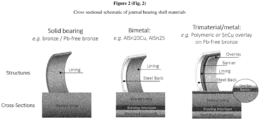
- the solid bearing may include bronze or lead free bronze.
- the bimetal bearings may include AlSn20Cu or AlSn25.
- the trimaterial /metal bearings may include polymeric or SuCu overlay on lead free bronze.
- the inventive lubricating oil compositions of this disclosure are particularly suitable for lubricating and minimizing wear for each of these bearing structures /materials depicted in Figure 2 .
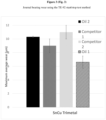
- inventive lubricating oil compositions of this disclosure have been surprisingly found to decrease wear for bimetals and trimaterials/metals when used in an internal combustion engine. More particularly, the inventive lubricating oil compositions of this disclosure have been surprisingly found to decrease wear for SnCu trimetals and polymeric trimaterials.
- lubricating oil compositions (also referred to as "LOC,” “lubricant compositions,” “lubricating compositions,” or “lubricant oil compositions”) comprising or resulting from the admixing of: an oil of lubricating viscosity at greater than 50 wt.% of the composition comprising a Group I base oil, a Group II base oil, a Group III base oil, a Group IV base oil, or combinations thereof; an overbased or neutral calcium based detergent with a Total Base Number (KOH/g) greater than or equal to 9, such as an overbased calcium based detergent with a Total Base Number (KOH/g) greater than or equal to 150, and less than or equal to 500 and at treat level to deliver between 500 to 1300 ppm by weight of calcium to the composition; and an overbased magnesium based detergent with a Total Base Number (KOH/g) greater than or equal to 9, such as an overbased magnesium based detergent with a Total Base Number (KOH/g) greater than or equal to 150, and less
- the lubricating oil composition may have a total sulfated ash of less than or equal to 1.0 wt.%, a high temperature high shear viscosity at 150°C (HTHS) as determined according to ASTM D4683-20 of greater than or equal to 1.8 mPa.s and less than or equal to 2.9 mPa.s, and a total phosphorous level of less than or equal to 0.080 wt.%.
- HTHS high temperature high shear viscosity at 150°C
- the lubricating oil composition provides a 5% to 60% decrease in journal bearing wear as measured by maximum average wear in microns using the TE-92 start/stop test method compared to a lubricating oil composition of comparable HTHS, but not including a mixture of an overbased calcium based detergent and an overbased magnesium based detergent at a combined calcium and magnesium loading in the composition ranging from 1000 ppm to 1800 ppm.
- the lubricating oil compositions disclosed herein may have a high temperature high shear viscosity at 150°C (HTHS or HTHS 150 ) as determined according to ASTM D4683-20 of greater than or equal to 1.8 to 2.9 mPa.s, or 1.9 to 2.8 mPa.s, or 2.0 to 2.7 mPa.s, or 2.1 to 2.6 mPa.s, or 2.2 to 2.5 mPa.s, or 2.3 to 2.4 mPa.s.
- HTHS or HTHS 150 high temperature high shear viscosity at 150°C
- the lubricating oil compositions disclosed herein may have a phosphorous level of less than or equal to 0.075 wt.%, or less than or equal to 0.070 wt.%, or less than or equal to 0.065 wt.%, or less than or equal to 0.060 wt.%, or less than or equal to 0.055 wt.%, or less than or equal to 0.050 wt.%.
- the lubricating oil composition of the instant disclosure may have a kinematic viscosity at 100°C of 5 to 20 cSt, or 8 to 18 cSt, or 10 to 16 cSt.
- the lubricating oil composition of the instant disclosure may have a total sulfur level of less than or equal to 0.35 wt.%, or less than or equal to 0.30 wt.%, or less than or equal to 0.25 wt.%, or less than or equal to 0.20 wt.%.
- the overbased magnesium based detergent of the lubricating oil composition may be a sulfonate, a salicylate, a phenate or combinations thereof.
- the overbased calcium based detergent of the lubricating oil composition may be a sulfonate, a salicylate, a phenate or combinations thereof.
- the overbased magnesium based detergent may deliver between 500 to 1300 ppm, or 600 to 1200 ppm, or 700 to 1100 ppm, or 800 to 1000 ppm by weight of magnesium to the composition.
- the overbased calcium based detergent may deliver between 500 to 1300 ppm, or 600 to 1200 ppm, or 700 to 1100 ppm, or 800 to 1000 ppm by weight of calcium to the composition.
- the lubricating oil composition of the instant disclosure is particularly suitable as a heavy-duty diesel oil, a light-duty diesel oil, a hydrogen engine oil, a spark ignition combustion engine oil, or a natural gas engine oil.
- the lubricating oil composition of the instant disclosure is particularly suitable as an SAE grade selected from the group consisting of 0W-8, 0W-12, 0W-16, 0W-20, 0W-30, 5W-20, 5W-30, 10W-30, 15W-40, 5W-40 and 10W-40. Still more particularly, the lubricating oil composition of the instant disclosure is suitable as an SAE grade selected from the group consisting of 0W-8, 0W-12, 0W-16, 0W-20 (low viscosity engine oils).
- the lubricating oil composition of instant disclosure is particularly suitable as a passenger vehicle lubricant (PVL) or a commercial vehicle lubricant (CVL) and provides a 5% to 60%, or 10 to 55%, or 15 to 50%, or 20 to 45%, or 25 to 40%, or 30 to 35% decrease in journal bearing wear as measured by maximum average wear in microns using the TE-92 start/stop test method compared to a lubricating oil composition of comparable HTHS, but not including a mixture of an overbased calcium based detergent and an overbased magnesium based detergent.
- PVL passenger vehicle lubricant
- CVL commercial vehicle lubricant
- the lubricating oil compositions disclosed herein are particularly suitable for lubricating and reducing the wear tendency of journal bearings for an internal combustion engine, wherein the journal bearing is a main bearing for a crankshaft, a conrod big end bearing for a crankshaft, or a conrod small end bearing/bushing for a piston pin.
- the journal bearing shell material may be a material selected from the group consisting of a bimetal, a trimaterial/metal and a solid material.
- the trimaterial/metal may be a polymeric coating or a SnCu overlay on lead free bronze.
- the bimetal may be AlSn20Cu or AlSn25.
- the solid material may be bronze or lead-free bronze.
- the inventive composition when used to lubricate a polymeric coated trimaterial journal bearing shell material, the inventive composition provides a 5% to 40%, or 10 to 35%, or 15 to 30%, or 20 to 25% decrease in journal bearing wear as measured by maximum average wear in microns using the TE-92 start/stop test method compared to a lubricating oil composition of comparable HTHS, but not including a mixture of an overbased calcium based detergent and an overbased magnesium based detergent.
- the lubricating oil composition of the instant disclosure may further include one or more of the following components: one or more functionalized polymers, one or more friction modifiers; one or more antioxidants; one or more pour point depressants; one or more anti-foaming agents; one or more viscosity modifiers; one or more dispersants; one or more inhibitors, one or more antirust agents; one or more seal swell agents; and/or one or more anti-wear agents.
- the lubricating oil composition of the instant disclosure further includes one or more dispersants, optionally borated, higher molecular weight polyisobutylene succinimide (PIBSA-PAM) dispersant (Mn 1600 g/mol or more), one or more, optionally borated, lower molecular weight polyisobutylene succinimide (PIBSA-PAM) dispersant (Mn less than 1600 g/mol), or a combination thereof, and wherein the treat level of the combination of the higher molecular weight PIBSA-PAM and lower molecular weight PIBSA-PAM is from 1.0 to 6.0 wt.%, or 2.0 to 5.0 wt.%, or 3.0 to 4.0 wt.% of the composition.
- PIBSA-PAM higher molecular weight polyisobutylene succinimide
- PIBSA-PAM lower molecular weight polyisobutylene succinimide
- the lubricating oil composition of the instant disclosure including the higher molecular weight PIBSA-PAM dispersant, the lower molecular weight PIBSA-PAM dispersant, or a combination thereof, and is/are included at a treat level to deliver from 20 ppm to 700 ppm, or 50 to 600 ppm, or 100 to 500 ppm, or 200 to 400 ppm by weight of boron to the lubricating oil composition.
- the lubricating oil composition of the instant disclosure further includes one or more antioxidants selected from one or more phenolic antioxidants, one or more sulfur based antioxidants, one or more aminic antioxidants, or a combination thereof, and wherein the one or more antioxidants comprise from 1.0 to 6.0 wt.%, or 1.5 to 5.5 wt.%, or 2.0 to 5.0 wt.%, or 2.5 to 4.5 wt.%, or 3.0 to 4.0 wt.% of the overall lubricating oil composition.
- the lubricating oil composition of the instant disclosure further includes one or more friction modifiers selected from a dimeric molybdenum dialkyldithiocarbamate (moly dimer), a trimeric molybdenum dialkyldithiocarbamate (moly trimer), or a combination thereof at a treat level to deliver from 12 ppm to 1000 ppm, or 20 ppm to 500 ppm, or 20 ppm to 200 ppm, by weight of molybdenum to the composition.
- a friction modifiers selected from a dimeric molybdenum dialkyldithiocarbamate (moly dimer), a trimeric molybdenum dialkyldithiocarbamate (moly trimer), or a combination thereof at a treat level to deliver from 12 ppm to 1000 ppm, or 20 ppm to 500 ppm, or 20 ppm to 200 ppm, by weight of molybdenum to the composition.
- the lubricating oil composition of the instant disclosure is substantially free of molybdenum.
- the lubricating oil composition of the instant disclosure further optionally includes one or more functionalized polymers at from 0.2 to 2.0 wt.%, or 0.4 to 1.8 wt.%, or 0.6 to 1.6 wt.%, or 0.8 to 1.4 wt.%, or 1.0 to 1.2 wt.% of the composition comprising an amide, imide, and/or ester functionalized partially or fully saturated polymer comprising C 4-5 olefins having:
- the functionalized polymer of the lubricating oil composition of the instant disclosure may include at least 50 %, or at least 60%, or at least 70% of 1,4-insertions of monomer. Furthermore, the functionalized polymer of the lubricating oil composition of the instant disclosure may include a partially or fully saturated homopolyisoprene containing one or more pendant amine groups and having an Mn of 25,000 to 100,000 g/mol, or 35,000 to 90,000 g/mol, or 45,000 to 80,000 g/mol, or 55,000 to 75,000 g/mol (GPC-PS) and at least 50%, or at least 60%, or at least 70% of 1,4-insertions prior to functionalization.
- GPC-PS 55,000 to 75,000 g/mol
- the functionalized polymer of the lubricating oil composition of the instant disclosure may be absent of styrene repeat units, or absent of butadiene repeat units, or is not a homo-polyisobutylene, or is not a copolymer of isoprene and butadiene.
- the lubricating oil composition of the instant disclosure is particularly suitable as a heavy-duty diesel oil, a light-duty diesel oil or a natural gas engine oil,
- the lubricating oil composition of the instant disclosure is particularly suitable as an SAE grade selected from the group consisting of 0W-8, 0W-12, 0W-20, 0W-30, 5W-20, 5W-30, 10W-30, 15W-40, 5W-40 and 10W-40.
- Also provided herein is a method of lubricating an internal combustion engine including supplying to the engine a lubricating oil composition according to the instant disclosure. Also provided herein is a method of providing a mogas to the engine and combusting the mogas in the engine, wherein the mogas is a non-renewable mogas, a renewable mogas or a combination thereof, and wherein the engine is a spark ignited combustion engine. Also provided herein is a method of providing a diesel fuel to the engine and combusting the diesel fuel in the engine, wherein the diesel fuel is a non-renewable diesel fuel, a renewable diesel fuel or a combination thereof, and wherein the engine is a diesel engine. Also provided herein is a method of providing a natural gas or hydrogen to the engine and combusting the natural gas or hydrogen in the engine, wherein the engine is a natural gas engine or a hydrogen engine.
- the lubricating oil composition of the instant disclosure is particularly suitable for improving journal bearing wear performance in an internal combustion engine and reducing emissions of the engine.
- a method of decreasing journal bearing wear in an internal combustion engine comprising supplying to the engine a lubricating oil composition according to the instant disclosure.
- a method of making a lubricating oil composition comprising combining or admixing the components of the lubricating oil composition of the instant disclosure.
- the lubricating oil compositions of the instant disclosure may have a total base number (TBN) of 4 to 16 mgKOH/g, preferably 5 to 14 mgKOH/g, such as 7 to 12 mgKOH/g, such as 8 to 12mgKOH/g, as measured by ASTM D2896.
- TBN total base number
- the lubricating oil compositions of the present disclosure may contain a ratio of atoms of Magnesium to atoms of Calcium based on the total mass of the lubricating compositions, as measured by ASTM D5185, of at least to 0.5, preferably at least 0.6, more preferably at least 0.65.
- the lubricating oil compositions may contain low levels of sulfur.
- the lubricating composition contains up to 0.35, more preferably up to 0.3, such as 0.1 to 0.35 mass % sulfur, based on the total mass of the lubricating oil composition, as measured by ASTM D5185.
- the lubricating oil compositions may contain low levels of sulfated ash, such as 1.0 mass or less %, or preferably 0.9 mass or less %, , alternately 0.0001 to 0.9 mass % or less sulfated ash, based on the total mass of the lubricating composition, as measured by ASTM D874-13a (2016).
- the lubricating oil compositions of the present disclosure may be a multigrade oil identified by the viscometric descriptor SAE 15W-X, SAE 10W-X, SAE 5W-X or SAE 0W-X, where X represents any one of 8, 12, 16, 20, 30, 40, and 50; the characteristics of the different viscometric grades can be found in the SAE J300 classification.
- the lubricating composition may be the form of viscosity grade SAE 15W-X, SAE 10W-X, SAE 5W-X or SAE 0W-X, such as in the form of SAE 15W-X or SAE 10W-X, wherein X represents any one of 8, 12, 16, 20, 30, 40, and 50.
- the lubricating oil composition may comprise less than 75 ppm boron, alternately less than 60 ppm boron, alternately from 1 to 70 ppm boron.
- the LOC may be absent or substantially free of boron.
- the lubricating oil composition may comprise less than or equal to 6 (such as less than 5, such as less than 4, such as less than 3, such as less than 2, such as less than 1) mass %, functionalized (such as aminated) polybutene (such as polyisobutylene), such as PIBSA-PAM.
- the lubricating oil composition may comprise, may be substantially free of, or may be absent, functionalized (such as aminated) polybutene (such as polyisobutylene), such as high molecular weight PIBSA-PAM.
- the lubricating oil composition may comprise acylated polymers, such as polyisobutylene succinic acid (PIBSA), optionally having an Mn of 500 to 50,000 g/mol, such as 600 to 5,000 g/mol, such as 700 to 3000 g/mol.
- PIBSA polyisobutylene succinic acid
- the lubricating oil composition may comprise acylated polymers, such as polyisobutylene succinic acid, having an Mn of 500 to 1600 g/mol, such as 700 to 1200 g/mol.
- the lubricating oil composition comprises more than 0.1 (such as 0.1 to 6, such as 0.5 to 4) mass %, functionalized (such as aminated) polybutene (such as polyisobutylene), such as PIBSA-PAM.
- the lubricating oil composition may comprise 20 (such as 15, such as 10, such as 5, such as 3, such as 1) mass % or less block copolymer, such as block, star, random, and/or tapered block copolymer).
- the lubricating oil composition may be substantially free of or may be absent block copolymer, such as block, star, random, and/or tapered block copolymer.
- the lubricating oil composition may comprise 20 (such as 15, such as 10, such as 5, such as 3, such as 1) mass % or less styrenic copolymer, such as block, star, random, and/or tapered styrenic block copolymer).
- the lubricating oil composition may be substantially free or absent styrenic copolymer, such as block, star, random, and/or tapered sytrenic block copolymer.
- the lubricating oil composition may comprise less than 20 (such as less than 15, such as less than 10, such as less than 5, such as less than 3, such as less than 1) mass % of functionalized diluent, such as functionalized oil.
- the lubricating oil composition may comprise, may be substantially free of, or may be absent functionalized diluent, such as functionalized oil.
- the lubricating oil composition may comprise less than 20 (such as less than 15, such as less than 10, such as less than 5, such as less than 3, such as less than 1) mass % of solvent, such as aromatic solvent.
- the lubricating oil composition may comprise less than 0.5 (such as 0.4, such as less than 0.3, such as less than 0.2, such as less than 0.1, substantially absent, or zero) wt %, based upon the weight of the LOC, of secondary hydrocarbyl amine compounds and tertiary hydrocarbyl amine compounds.
- the lubricating oil composition may be substantially absent, or may comprise no, secondary hydrocarbyl amine compounds and tertiary hydrocarbyl amine compounds.
- the lubricating compositions of the present disclosure may be a heavy-duty diesel oil, a light-duty diesel oil, or a passenger vehicle engine oil for a spark ignition combustion engine.
- the lubricating compositions of the present disclosure may be a natural gas engine oil or a hydrogen engine oil.
- the lubricating compositions disclosed herein may have a kinematic viscosity as measured by ASTM D-445 at 100°C of from 5 to 20 (such as 6 to 18, or 8 to 16, or 10 to 14) cSt (mm 2 /s) and a kinematic viscosity at 40° C of from 15 to 30 (such as 15 to 25) cSt (mm 2 /s).
- the lubricating oil composition may have a total sulfated ash of less than or equal to 1.0 wt.%, a high temperature high shear viscosity at 150°C (HTHS) as determined according to ASTM D4683-20 of greater than or equal to 1.8 mPa.s and less than or equal to 2.9 mPa.s, and a total phosphorous level of less than or equal to 0.080 wt.%.
- HTHS high temperature high shear viscosity at 150°C
- the method of decreasing journal bearing wear of the instant disclosure provides a 5% to 60% decrease in journal bearing wear as measured by maximum average wear in microns using the TE-92 start/stop test method compared to a lubricating oil composition of comparable HTHS, but not including a mixture of an overbased calcium based detergent and an overbased magnesium based detergent at a combined calcium and magnesium loading in the composition ranging from 1000 ppm to 1800 ppm.
- the lubricating oil compositions disclosed herein have surprisingly and unexpectedly been found to decrease journal bearing wear as measured by maximum average wear in microns using the TE-92 start/stop test method compared to a lubricating oil composition of comparable HTHS, but not including a mixture of an overbased calcium based detergent and an overbased magnesium based detergent at a combined calcium and magnesium loading in the composition ranging from 1000 ppm to 1800 ppm.
- the lubricating oil compositions may have a high temperature high shear viscosity at 150°C (HTHS) as determined according to ASTM D4683-20 of greater than or equal to 1.8 to 2.9 mPa.s, or 1.9 to 2.8 mPa.s, or 2.0 to 2.7 mPa.s, or 2.1 to 2.6 mPa.s, or 2.2 to 2.5 mPa.s, or 2.3 to 2.4 mPa.s.
- HTHS high temperature high shear viscosity at 150°C
- the lubricating oil compositions may have a total sulfated ash of less than or equal to 0.9 wt.%, or less than or equal to 0.8 wt.%, or less than or equal to 0.7 wt.%, or less than or equal to 0.6 wt.%, or less than or equal to 0.5 wt.%; and a phosphorous level of less than or equal to 0.075 wt.%, or less than or equal to 0.070 wt.%, or less than or equal to 0.065 wt.%, or less than or equal to 0.060 wt.%, or less than or equal to 0.055 wt.%, or less than or equal to 0.050 wt.%.
- the lubricating oil composition may have a kinematic viscosity at 100°C of 5 to 20 cSt, or 8 to 18 cSt, or 10 to 16 cSt; and a total sulfur level of less than or equal to 0.35 wt.%, or less than or equal to 0.30 wt.%, or less than or equal to 0.25 wt.%, or less than or equal to 0.20 wt.%.
- the oil of lubricating viscosity constitutes from 60 wt.% to 95 wt.%, or 70 to 90 wt.%, or 75 to 85 wt.% of the composition, and comprises a Group III base oil, a Group IV base oil, or a combination thereof.
- the method of decreasing journal bearing wear in an internal combustion engine of the instant disclosure with regard to the overbased magnesium based detergent of the lubricating oil composition, it may be a sulfonate, a salicylate, a phenate or combinations thereof.
- the overbased calcium based detergent of the lubricating oil composition may be a sulfonate, a salicylate, a phenate or combinations thereof.
- the overbased magnesium based detergent may deliver between 500 to 1300 ppm, or 600 to 1200 ppm, or 700 to 1100 ppm, or 800 to 1000 ppm by weight of magnesium to the composition.
- the overbased calcium based detergent may deliver between 500 to 1300 ppm, or 600 to 1200 ppm, or 700 to 1100 ppm, or 800 to 1000 ppm by weight of calcium to the composition.
- the lubricating oil composition may have a combined overbased magnesium based detergent and overbased calcium based detergent may deliver a total weight of combined calcium and magnesium in the composition ranging from 1000 to 1800 ppm, or 1100 to 1700 ppm, or 1200 to 1600 ppm, or 1300 to 1500 ppm.
- the ratio of calcium loading to magnesium loading in the composition may be from 30:70 to 70:30, or 35:65 to 65:35, or 40:60 to 60:40, or 45:55 to 55:45 based on weight % in the lubricating oil composition.
- the lubricating oil composition is particularly suitable as a heavy-duty diesel oil, a light-duty diesel oil, a hydrogen engine oil, a spark ignition combustion engine oil or a natural gas engine oil.
- the lubricating oil composition of the instant disclosure is particularly suitable as an SAE grade selected from the group consisting of 0W-8, 0W-12, 0W-16, 0W-20, 0W-30, 5W-20, 5W-30, 10W-30, 15W-40, 5W-40 and 10W-40.
- the lubricating oil composition is particularly suitable as a passenger vehicle lubricant (PVL) or a commercial vehicle lubricant (CVL) and provides a 5% to 60%, or 10 to 55%, or 15 to 50%, or 20 to 45%, or 25 to 40%, or 30 to 35% decrease in journal bearing wear as measured by maximum average wear in microns using the TE-92 start/stop test method compared to a lubricating oil composition of comparable HTHS, but not including a mixture of an overbased calcium based detergent and an overbased magnesium based detergent.
- PVL passenger vehicle lubricant
- CVL commercial vehicle lubricant
- the method of decreasing journal bearing wear in an internal combustion engine of the instant disclosure is particularly suitable for lubricating and reducing the wear tendency of journal bearings for an internal combustion engine, wherein the journal bearing is a main bearing for a crankshaft, a conrod big end bearing for a crankshaft, or a conrod small end bearing/bushing for a piston pin.
- the journal bearing shell material may be a material selected from the group consisting of a bimetal, a trimaterial/metal and a solid material.
- the trimaterial/metal may be a polymeric coating or a SnCu overlay on lead free bronze.
- the bimetal may be AlSn20Cu or AlSn25.
- the solid material may be bronze or lead-free bronze.
- the method of decreasing journal bearing wear in an internal combustion engine of the instant disclosure is particularly suitable when the lubricating oil compositions are used to lubricate a polymeric coated trimaterial journal bearing shell material, and the inventive compositions provide a 5% to 40%, or 10 to 35%, or 15 to 30%, or 20 to 25% decrease in journal bearing wear as measured by maximum average wear in microns using the TE-92 start/stop test method compared to a lubricating oil composition of comparable HTHS, but not including a mixture of an overbased calcium based detergent and an overbased magnesium based detergent.
- the method of decreasing journal bearing wear in an internal combustion engine of the instant disclosure is particularly suitable when the lubricating oil compositions are used to lubricate a SnCu overlay trimetal journal bearing shell material, and the inventive compositions provide a 10% to 60%, or 15 to 55%, or 20 to 50%, or 25 to 45%, or 30 to 40% decrease in journal bearing wear as measured by maximum average wear in microns using the TE-92 start/stop test method compared to a lubricating oil composition of comparable HTHS, but not including a mixture of an overbased calcium based detergent and an overbased magnesium based detergent.
- the lubricating oil composition may further include one or more of the following components: one or more functionalized polymers, one or more friction modifiers; one or more antioxidants; one or more pour point depressants; one or more anti-foaming agents; one or more viscosity modifiers; one or more dispersants; one or more inhibitors, one or more antirust agents; one or more seal swell agents; and/or one or more anti-wear agents.
- the lubricating oil composition further includes one or more dispersants, optionally borated, higher molecular weight polyisobutylene succinimide (PIBSA-PAM) dispersant (Mn 1600 g/mol or more), one or more, optionally borated, lower molecular weight polyisobutylene succinimide (PIBSA-PAM) dispersant (Mn less than 1600 g/mol), or a combination thereof, and wherein the treat level of the combination of the higher molecular weight PIBSA-PAM and lower molecular weight PIBSA-PAM is from 1.0 to 6.0 wt.%, or 2.0 to 5.0 wt.%, or 3.0 to 4.0 wt.% of the composition.
- PIBSA-PAM higher molecular weight polyisobutylene succinimide
- PIBSA-PAM lower molecular weight polyisobutylene succinimide
- the lubricating oil composition may include the higher molecular weight PIBSA-PAM dispersant, the lower molecular weight PIBSA-PAM dispersant, or a combination thereof, and is/are included at a treat level to deliver from 20 ppm to 700 ppm, or 50 to 600 ppm, or 100 to 500 ppm, or 200 to 400 ppm by weight of boron to the lubricating oil composition.
- the lubricating oil composition may further include one or more anti-wear agents comprising one or more zinc dialkyldithiophosphates (ZDDP) at a treat level to deliver less than or equal to 840 ppm, or less than or equal to 800 ppm, or less than or equal to 700 ppm, or less than or equal to 600 ppm by weight of phosphorous to the composition.
- ZDDP zinc dialkyldithiophosphates
- the lubricating oil composition may further include one or more antioxidants selected from one or more phenolic antioxidants, one or more sulfur based antioxidants, one or more aminic antioxidants, or a combination thereof, and wherein the one or more antioxidants comprise from 1.0 to 6.0 wt.%, or 1.5 to 5.5 wt.%, or 2.0 to 5.0 wt.%, or 2.5 to 4.5 wt.%, or 3.0 to 4.0 wt.% of the overall lubricating oil composition.
- the lubricating oil composition may further include one or more friction modifiers selected from a dimeric molybdenum dialkyldithiocarbamate (moly dimer), a trimeric molybdenum dialkyldithiocarbamate (moly trimer), or a combination thereof at a treat level to deliver from 12 ppm to 1000 ppm, or 20 ppm to 500 ppm, or 20 ppm to 200 ppm, by weight of molybdenum to the composition.
- a friction modifiers selected from a dimeric molybdenum dialkyldithiocarbamate (moly dimer), a trimeric molybdenum dialkyldithiocarbamate (moly trimer), or a combination thereof at a treat level to deliver from 12 ppm to 1000 ppm, or 20 ppm to 500 ppm, or 20 ppm to 200 ppm, by weight of molybdenum to the composition.
- the lubricating oil composition is substantially free of molybdenum.
- the lubricating oil composition may further optionally include one or more functionalized polymers at from 0.2 to 2.0 wt.%, or 0.4 to 1.8 wt.%, or 0.6 to 1.6 wt.%, or 0.8 to 1.4 wt.%, or 1.0 to 1.2 wt.% of the composition comprising an amide, imide, and/or ester functionalized partially or fully saturated polymer comprising C 4-5 olefins having:
- This disclosure also relates to methods of making lubricating oil compositions and in particular, a method of making lubricating oil compositions comprising combining or admixing: (i) an oil of lubricating viscosity at greater than 50 wt.% of the composition comprising a Group I base oil, a Group II base oil, a Group III base oil, a Group IV base oil, or combinations thereof; (ii) an overbased calcium based detergent with a Total Base Number (KOH/g) greater than or equal to 9, such as overbased calcium based detergent with a Total Base Number (KOH/g) greater than or equal to 150, and less than or equal to 500 and at treat level to deliver between 500 to 1300 ppm by weight of calcium to the composition; and (iii) an overbased magnesium based detergent with a Total Base Number (KOH/g) greater than or equal to 9, such as an overbased magnesium based detergent with a Total Base Number (KOH/g) greater than or equal to 150, and less than or equal to 500 and
- the lubricating oil composition may have a total sulfated ash of less than or equal to 1.0 wt.%, a high temperature high shear viscosity at 150°C (HTHS) as determined according to ASTM D4683-20 of greater than or equal to 1.8 mPa.s and less than or equal to 2.9 mPa.s, and a total phosphorous level of less than or equal to 0.080 wt.%.
- HTHS high temperature high shear viscosity at 150°C
- the method of making lubricating oil compositions of the instant disclosure provides a 5% to 60% decrease in journal bearing wear as measured by maximum average wear in microns using the TE-92 start/stop test method compared to a lubricating oil composition of comparable HTHS, but not including a mixture of an overbased calcium based detergent and an overbased magnesium based detergent at a combined calcium and magnesium loading in the composition ranging from 1000 ppm to 1800 ppm.
- the lubricating oil composition is particularly suitable as a heavy-duty diesel oil, a light-duty diesel oil, a hydrogen engine oil, a spark ignition combustion engine oil or a natural gas engine oil.
- the lubricating oil composition of the instant disclosure is particularly suitable as an SAE grade selected from the group consisting of 0W-8, 0W-12, 0W-16, 0W-20, 0W-30, 5W-20, 5W-30, 10W-30, 15W-40, 5W-40 and 10W-40.
- a concentrate also referred to as an additive package, adpak, or addpack
- adpak is a composition having less than 50 mass % (such as less than 40 mass %, such as less than 30 mass %, such as less than 25 mass %, such as less than 20 mass %) base oil and lubricant composition additives (such as described herein) which is typically then further blended with additional base oil to form a lubricating oil product.
- This disclosure relates to concentrate compositions comprising or resulting from the admixing of: from 1 to less than or equal to 50 wt.% of one or more base oils; from 2 to 25 wt.%, based upon the weight of the concentrate, of from 2 to 25 wt.% of an overbased magnesium based detergent with a Total Base Number (KOH/g) greater than or equal to 9, such as an overbased magnesium based detergent with a Total Base Number (KOH/g) greater than or equal to 150, and less than or equal to 500; and from 2 to 20 wt.% of an overbased calcium based detergent with a Total Base Number (KOH/g) greater than or equal to 9, such as overbased calcium based detergent with a Total Base Number (KOH/g) greater than or equal to 150, and less than or equal to 500.
- KOH/g Total Base Number
- Concentrates may be present in the lubricating oil compositions of the instant disclosure at from of 0.5 mass% to 35 mass%, such as 5 mass% to 30 mass%, such as 7.5 mass% to 25 mass%, such as 10 to 22.5 mass%, such as 15 to 20 mass%, based upon the mass of the lubricating oil composition.
- the concentrate may be absent functionalized oil.
- the concentrate composition may optionally be absent solvent (such as aliphatic or aromatic solvent) and/or absent functionalized base oil.
- the concentrate may be absent phenolic antioxidant.
- the concentrate may comprise less than 75 ppm boron, alternately less than 60 ppm boron, alternately from 1 to 70 ppm boron. Alternately, the concentrate may be absent boron.
- the concentrate may comprise less than or equal to 20 (such as 15, such as 10, such as 5, such as 3, such as 1) mass %, functionalized (such as aminated) polybutene (such as polyisobutylene), such as PIBSA-PAM.
- the concentrate comprises is substantially free or absent, functionalized (such as aminated) polybutene (such as polyisobutylene), such as PIBSA-PAM.
- the concentrate may further include one or more of the following components: one or more functionalized polymers, one or more friction modifiers; one or more antioxidants; one or more pour point depressants; one or more anti-foaming agents; one or more viscosity modifiers; one or more dispersants; one or more inhibitors, one or more antirust agents; one or more seal swell agents; and/or one or more anti-wear agents.
- the concentrate may comprise acylated polymers, such as polyisobutylene succinic acid, optionally, having an Mn of 500 to 50,000 g/mol, such as 600 to 5,000 g/mol, such as 700 to 3000 g/mol.
- the concentrate may comprise acylated polymers, such as polyisobutylene succinic acid, having an Mn of 500 1600 g/mol, such as 700 to 1200 g/mol.
- the concentrate may comprise 20 (such as 15, such as 10, such as 5, such as 3, such as 1) mass % or less block copolymer, such as block, star, random, and/or tapered block copolymer.
- the concentrate may be substantially free of or absent block copolymer, such as block, star, random, and/or tapered block copolymer.
- the concentrate may comprise 20 mass % or less (such as 15 mass % or less, such as 10 mass % or less, such as 5 mass % or less, such as 3 mass % or less, such as 1) mass % or less styrenic copolymer, such as block, star, random, and/or tapered styrenic block copolymer).
- the concentrate may be substantially free of or absent styrenic copolymer, such as block, star, random, and/or tapered sytrenic block copolymer).
- the concentrate may comprise less than 20 (such as less than 15, such as 10, such as less than 5, such as less than 3, such as 1) mass % of functionalized diluent, such as functionalized oil.
- the concentrate may substantially free of or absent functionalized diluent, such as functionalized oil.
- the concentrate may comprise less than 0.5 (such as less than 0.4, such as less than 0.3, such as less than 0.2, such as 0.1, substantially absent, no) wt %, based upon the weight of the concentrate, of secondary hydrocarbyl amine compounds and tertiary hydrocarbyl amine compounds.
- the concentrate may be substantially absent, or may comprise no, secondary hydrocarbyl amine compounds and tertiary hydrocarbyl amine compounds.
- the concentrate may have a kinematic viscosity at 100° C of less than 1000 cSt, such as less than 500 cSt, such as less than 200 cSt.
- This disclosure also relates to methods of making concentrate compositions comprising combining: from 1 to less than or equal to 50 wt.% of one or more base oils; from 2 to 25 wt.%, based upon the weight of the concentrate of an overbased magnesium based detergent with a Total Base Number (KOH/g) greater than or equal to 9, such as an overbased magnesium based detergent with a Total Base Number (KOH/g) greater than or equal to 150, and less than or equal to 500; and from 2 to 25 wt.% of an overbased calcium based detergent with a Total Base Number (KOH/g) greater than or equal to 9, such as overbased calcium based detergent with a Total Base Number (KOH/g) greater than or equal to 150, and less than or equal to 500.
- KOH/g Total Base Number
- KOH/g Total Base Number
- the base oil (also referred to as “base stock,” “lubricating oil basestock,” or “oil of lubricating viscosity”) useful herein may be a single oil or a blend of oils, and is typically a large liquid constituent of a lubricating composition, also referred to as a lubricant, into which additives and optional additional oils are blended, for example, to produce a lubricating composition, such as a final lubricant composition, a concentrate, or other lubricating composition.
- a base oil may be selected from vegetable, animal, mineral, and synthetic lubricating oils, and mixtures thereof. It may range in viscosity from light distillate mineral oils to heavy lubricating oils, such as those for gas engine oil, mineral lubricating oil, motor vehicle oil, and heavy-duty diesel oil.
- the kinematic viscosity at 100° C (“KV100”) of the base oil ranges from 1 to 30, such as 2 to 25 cSt, such as 5 to 20 cSt, as determined according to ASTM D445-19a, in particular, from 1.0 cSt to 10 cSt, from 1.5 cSt to 3.3 cSt, from 2.7 cSt to 8.1 cSt, from 3.0 cSt to 7.2 cSt, or from 2.5 cSt to 6.5 cSt.
- the high temperature high shear (HTHS) viscosity at 150° C of the base oil ranges from 0.5 to 20 cP such as 1 to 10 cP, such as 2 to 5 cP as determined according to ASTM D4683-20.
- lubricating oil basestock(s) when lubricating oil basestock(s) is used to make a concentrate, it may advantageously be present in a concentrate-forming amount to give a concentrate containing, from 5 wt % to 80 wt %, from 10 wt % to 70 wt %, or from 5 wt % to 50 wt % of active ingredient, based upon the weight of the concentrate.
- Common oils useful as base oils include animal and vegetable oils (e.g., castor and lard oil), liquid petroleum oils, and hydrorefined and/or solvent-treated mineral lubricating oils of the paraffinic, naphthenic, and mixed paraffinic-naphthenic types. Oils derived from coal or shale are also useful base oils. Base stocks may be manufactured using a variety of different processes including, but not limited to, distillation, solvent refining, hydrogen processing, oligomerization, esterification, and re-refining.
- Synthetic lubricating oils useful herein as base oils include hydrocarbon oils such as homopolymerized and copolymerized olefins, referred to as polyalphaolefins or PAO's or group IV base oils [according to the API EOLCS 1509 definition (American Petroleum Institute Publication 1509, see section E.1.3, 19th edition, January 2021, www.API.org)].
- PAO's useful as base oils include: poly(ethylenes), copolymers of ethylene and propylene, polybutylenes, polypropylenes, propylene-isobutylene copolymers, chlorinated polybutylenes, poly(1-hexenes), poly(1-octenes), poly(1-decenes), homo- or co-polymers of C 8 to C 20 alkenes, homo- or co-polymers of Ca, and/or C 10 , and/or C 12 alkenes, C 8 /C 10 copolymers, C 8 /C 10 /C 12 copolymers, and C 10 /C 12 copolymers, and the derivatives, analogues and homologues thereof.
- the base oil may comprise polyalphaolefins comprising oligomers of linear olefins having 6 to 14 carbon atoms, more preferably 8 to 12 carbon atoms, more preferably 10 carbon atoms having a Kinematic viscosity at 100° C of 10 or more (as measured by ASTM D445); and preferably having a viscosity index ("VI"), as determined by ASTM D2270, of 100 or more, preferably 110 or more, more preferably 120 or more, more preferably 130 or more, more preferably 140 or more; and/or having a pour point of -5° C or less (as determined by ASTM D97), more preferably -10° C or less, more preferably -20° C or less.
- VI viscosity index
- polyalphaolefin oligomers useful in the present disclosure may comprise C 20 to C 1500 paraffins, preferably C 40 to C 1000 paraffins, preferably C 50 to C 750 paraffins, preferably C 50 to C 500 paraffins.
- the PAO oligomers are dimers, trimers, tetramers, pentamers, etc., of C 5 to C 14 alpha-olefins in one embodiment, and C 6 to C 12 alpha-olefins in another embodiment, and C 8 to C 12 alpha-olefins in another embodiment.
- Suitable olefins include 1-pentene, 1-hexene, 1-heptene, 1-octene, 1-nonene, 1-decene, 1-undecene, and 1-dodecene.
- the olefin is a combination of 1-octene, 1-decene, and 1-dodecene, or alternately may be substantially 1-decene
- the PAO is a mixture of dimers, trimers, tetramers, and pentamers (and higher) thereof.
- Useful PAO's are described more particularly in, for example, US Patent Nos. 5,171,908 and 5,783,531 , and in Synthetic Lubricants and High-Performance Functional Fluids 1-52 (Leslie R. Rudnick & Ronald L. Shubkin, ed. Marcel Dekker, Inc. 1999 ).
- PAO's useful in the present disclosure typically possess a number average molecular weight of from 100 to 21,000 g/mol in one embodiment, and from 200 to 10,000 g/mol in another embodiment, and from 200 to 7,000 g/mol in yet another embodiment, and from 200 to 2,000 g/mol in yet another embodiment, and from 200 to 500 g/mol in yet another embodiment.
- Desirable PAO's are commercially available as SpectraSyn TM Hi-Vis, SpectraSyn TM Low-Vis, SpectraSyn TM plus, SpectraSyn TM Elite PAO's (ExxonMobil Chemical Company, Houston Texas) and Durasyn PAO's from Ineos Oligomers USA LLC.
- Synthetic lubricating oils useful as base oils also include hydrocarbon oils such as homopolymerized and copolymerized: alkylbenzenes (e.g., dodecylbenzenes, tetradecylbenzenes, dinonylbenzenes, di(2-ethylhexyl)benzenes); polyphenols ( e.g., biphenyls, terphenyls, alkylated polyphenols); and alkylated diphenyl ethers, and alkylated diphenyl sulfides; and the derivatives, analogues, and homologues thereof.
- alkylbenzenes e.g., dodecylbenzenes, tetradecylbenzenes, dinonylbenzenes, di(2-ethylhexyl)benzenes
- polyphenols e.g., biphenyls, terphenyls, alky
- Another suitable class of synthetic lubricating oils useful as base oils comprises the esters of dicarboxylic acids (e.g ., phthalic acid, succinic acid, alkyl succinic acids and alkenyl succinic acids, maleic acid, azelaic acid, suberic acid, sebasic acid, fumaric acid, adipic acid, linoleic acid dimer, malonic acid, alkylmalonic acids, alkenyl malonic acids) reacted with a variety of alcohols (e.g ., butyl alcohol, hexyl alcohol, dodecyl alcohol, 2-ethylhexyl alcohol, ethylene glycol, diethylene glycol monoether, propylene glycol).
- dicarboxylic acids e.g phthalic acid, succinic acid, alkyl succinic acids and alkenyl succinic acids, maleic acid, azelaic acid, suberic acid, sebasic acid, fumaric acid, adipic
- esters include dibutyl adipate, di(2-ethylhexyl) sebacate, di-n-hexyl fumarate, dioctyl sebacate, diisooctyl azelate, diisodecyl azelate, dioctyl phthalate, didecyl phthalate, dieicosyl sebacate, the 2-ethylhexyl diester of linoleic acid dimer, and the complex ester formed by reacting one mole of sebacic acid with two moles of tetraethylene glycol and two moles of 2-ethylhexanoic acid.
- Esters useful as synthetic oils herein also include those made from C 5 to C 12 monocarboxylic acids and polyols, and polyol ethers such as neopentyl glycol, trimethylolpropane, pentaerythritol, dipentaerythritol, and tripentaerythritol.
- Desirable ester base oils are commercially available as Esterex TM Esters (ExxonMobil Chemical Company, Houston, Texas).
- Silicon-based oils such as the polyalkyl-, polyaryl-, polyalkoxy- or polyaryloxysilicone oils and silicate oils comprise another useful class of synthetic lubricants useful herein; such oils include tetraethyl silicate, tetraisopropyl silicate, tetra-(2-ethylhexyl) silicate, tetra-(4-methyl-2-ethylhexyl)silicate, tetra-(p-tert-butyl-phenyl) silicate, hexa-(4-methyl-2-ethylhexyl)disiloxane, poly(methyl)siloxanes, and poly(methylphenyl)-siloxanes.
- oils include tetraethyl silicate, tetraisopropyl silicate, tetra-(2-ethylhexyl) silicate, tetra-(4-methyl-2-ethyl
- liquid esters of phosphorous-containing acids e.g., tricresyl phosphate, trioctyl phosphate, diethyl ester of decylphosphonic acid
- polymeric tetrahydrofurans e.g., polymeric tetrahydrofurans.
- Unrefined, refined, and re-refined oils can be used in the lubricating compositions of the present disclosure.
- Unrefined oils are those obtained directly from a natural or synthetic source without further purification treatment.
- a shale oil obtained directly from retorting operations a petroleum oil obtained directly from distillation, or an ester oil obtained directly from an esterification process and used without further treatment is considered an unrefined oil.
- Refined oils are similar to the unrefined oils except they have been further treated in one or more purification steps to improve one or more properties. Many such purification techniques, such as distillation, solvent extraction, acid or base extraction, filtration, and percolation are used by those in the art.
- Re-refined oils are oils obtained by processes similar to those used to obtain refined oils where the refining processes are applied to previously refined oils which have been previously used in service. Such re-refined oils are also referred to as reclaimed or reprocessed oils and often are additionally processed for removal of spent additive and oil breakdown products.
- a re-refined base oil is preferably substantially free from materials introduced through manufacturing, contamination, or previous use.
- oils from renewable sources i.e., based in part on carbon and energy captured from the environment, such as biological sources, are useful herein.
- the various base oils are often categorized as Group I, II, III, IV, or V according to the API EOLCS 1509 definition (American Petroleum Institute Publication 1509, see section E.1.3, 19th edition, January 2021, www.API.org).
- Group I base stocks have a viscosity index of between about 80 to 120 and contain greater than about 0.03 % sulfur and/or less than about 90 % saturates.
- Group II base stocks have a viscosity index of between about 80 to 120 and contain less than or equal to about 0.03 % sulfur and greater than or equal to about 90 % saturates.
- Group III base stocks have a viscosity index greater than about 120 and contain less than or equal to about 0.03 % sulfur and greater than about 90 % saturates.
- Group IV base stocks include polyalphaolefins (PAO).
- Group V base stocks include base stocks not included in Groups I-IV. (Viscosity index measured by ASTM D 2270, saturates is measured by ASTM D2007, and sulfur is measured by ASTM D5185, D2622, ASTM D4294, ASTM D4927, and ASTM D3120).
- Base oils for use in the formulated lubricating compositions useful in the present disclosure are any one, two, three, or more of the variety of oils described herein.
- base oils for use in the formulated lubricating compositions useful in the present disclosure are those described as API Group I(including Group I+), Group II (including Group II+), Group III (including Group III+), Group IV, and Group V oils and mixtures thereof, preferably API Group II, Group III, Group IV, and Group V oils and mixtures thereof.
- the base oil may be a Group III, Group III+, IV, and Group V base oils due to their exceptional volatility, stability, viscometric, and cleanliness features.
- Group I basestock such as the amount used to dilute additives for blending into formulated lube oil products, can be tolerated but are typically kept to a minimum, e.g ., amounts only associated with their use as diluent/carrier oil for additives used on an "as-received" basis.
- Group II stocks it is often more useful that the Group II base stock be in the higher quality range associated with that stock, i.e., a Group II stock having a viscosity index in the range from 100 to 120.
- the base oil useful herein may be selected from any of the synthetic, natural, or re-refined oils (such as those typically used as crankcase lubricating oils for spark-ignited and compression-ignited engines). Mixtures of synthetic and/or natural and/or re-refined base oils may be used if desired. Multi-modal mixtures (such as bi- or tri-modal mixtures) of Group I, II, III, IV, and/or V base stocks may be used if desired.
- the base oil or base oil blend used herein conveniently has a kinematic viscosity at 100° C (KV100, as measured according to ASTM D445-19a, and reported in units of centistoke (cSt) or it its equivalent, mm2/s), of about 2 to about 40 cSt, alternately of 3 to 30 cSt, alternately 4 to 20 cSt at 100° C, alternately 5 to 10 cSt, alternately the base oil or base oil blend may have a kinematic viscosity at 100° C of 2 to 20 cSt, of 2.5 to 2 cSt, and preferably of about 2.5 cSt to about 9 cSt.
- KV100 centistoke
- the base oil or base oil blend preferably has a saturate content of at least 65 mass %, more preferably at least 75 mass %, such as at least 85 mass %, such as at least than 90 mass % as determined by ASTM D2007.
- the base oil or base oil blend will have a sulfur content of less than 1 mass %, preferably less than 0.6 mass %, most preferably less than 0.4 mass %, such as less than 0.3 mass %, based on the total mass of the lubricating composition, as measured by ASTM D5185.
- the volatility of the base oil or base oil blend is less than or equal to 30 mass %, such as less than or equal to 25 mass %, such as less than or equal to 20 mass %, such as less than or equal to 16 mass %, such as less than or equal to 12 mass %, such as less than or equal to 10 mass %, based on the total mass of the lubricating composition.
- the viscosity index (VI) of the base oil is at least 95, preferably at least 110, more preferably at least 120, even more preferably at least 125, most preferably from about 130 to 240, in particular from about 105 to 140 (as determined by ASTM D2270).
- the base oil may be provided in a major amount, in combination with a minor amount of one or more additive components as described hereinafter, constituting a lubricant.
- This preparation may be accomplished by adding the additives directly to the oil or by adding the one or more additives in the form of a concentrate thereof to disperse or dissolve the additive(s).
- Additives may be added to the oil by any method known to those skilled in the art, either before, at the same time as, or after addition of other additives.
- the base oil may be provided in a minor amount, in combination with minor amounts of one or more additive components as described hereinafter, constituting an additive concentrate.
- This preparation may be accomplished by adding the additives directly to the oil or by adding the one or more additives in the form of a solution, slurry or suspension thereof to disperse or dissolve the additive(s) in the oil.
- Additives may be added to the oil by any method known to those skilled in the art, either before, at the same time as, or after addition of other additives.
- the base oil typically constitutes the major component of an engine oil lubricant composition of the present disclosure and typically is present in an amount ranging from about 50 to about 99 wt %, preferably from about 60 to about 95 wt %, preferably from about 70 to about 95 wt %, and more preferably from about 80 to about 95 wt %, based on the total weight of the composition.
- one or more base oils are present in the lubricating composition in an amount of 32 wt % or more, alternately 55 wt % or more, alternately 60 wt % or more, alternately 65 wt % or more, based on the total weight of the lubricating composition.
- one or more base oils are present in the lubricating composition at an amount of 98 wt % or less, more preferably 95 wt % or less, even more preferably 90 wt % or less.
- one or more base oils are present in the lubricating composition at from 1 to 99 mass %, alternately 50 to 97 mass %, alternately to 60 to 95 mass %, alternately 70 to 95 mass %, based upon the weight of the lubricating composition.
- base oils and blends thereof described above are also useful for making concentrates as well as for making lubricants therefrom.
- Concentrates constitute a convenient means of handling additives before their use, as well as facilitating solution or dispersion of additives in lubricants.
- additive components typically include additives, additives, and additives.
- each additive may be incorporated separately, each in the form of a concentrate.
- additive packages also referred to as an "addpack” comprising one or more additives/co-additives, such as described hereinafter, in a single concentrate.
- one or more base oils are present in the concentrate composition in an amount of 50 wt % or less, alternately 40 wt % or less, alternately 30 wt % or less, alternately 20 wt % or less, based on the total weight of the concentrate composition.
- one or more base oils are present in the concentrate composition at an amount of 0.1 to 49 mass %, alternately 1 to 40 mass %, alternately 5 to 40 mass %, alternately to 10 to 30 mass %, alternately 15 to 25 mass %, based upon the weight of the concentrate composition.
- the polymer prior to functionalization may have an Mw/Mn of less than 2 (such as less than 1.6, such as less than 1.5, such as 1.4 or less, such as from 1 to 1.3, such as from 1.0 to 1.25, such as from 1.0 to 1.2, such as 1.0 to 1.15, such as from 1.0 to 1.1 as determined by GPC-PS).
- the polymer prior to functionalization may comprise repeat units of one or more olefins having 4 to 5 carbon atoms (preferably conjugated dienes having 4 to 5 carbon atoms).
- the C 4-5 polymer Prior to functionalization the C 4-5 polymer is preferably fully or partially saturated (such as fully or partially hydrogenated).
- the functionalized polymer may be obtained by reacting the C 4-5 polymer with an acylating agent to form acylated polymer and then reacting acylated polymer with an amine or alcohol to form an amide, imide, ester, or combination thereof.
- the functionalized polymer may also be obtained by reacting an acylated C 4-5 polymer (such as a commercially available maleated fully or partially hydrogenated C 4-5 polymer) with an amine to form an amide, imide or combination thereof.
- This disclosure further relates to lubricating oil compositions including functionalized polymers including amide, imide, and/or ester functionalized saturated (such as hydrogenated) polymers of C 4-5 conjugated dienes described herein obtained by reacting fully or partially saturated (such as fully or partially hydrogenated) polymers of C 4-5 conjugated dienes having an Mw/Mn of less than 2, with an acylating agent, such as maleic acid or maleic anhydride and thereafter reacting the acylated polymer with an amine (such as a polyamine) to form an imide, amide or combination thereof.
- functionalized polymers including amide, imide, and/or ester functionalized saturated (such as hydrogenated) polymers of C 4-5 conjugated dienes described herein obtained by reacting fully or partially saturated (such as fully or partially hydrogenated) polymers of C 4-5 conjugated dienes having an Mw/Mn of less than 2, with an acylating agent, such as maleic acid or maleic anhydride and thereafter reacting the acylated polymer with an
- This disclosure relates to lubricating oil compositions including functionalized polymers containing one or more pendant amine groups and comprising or resulting from the admixing of: at least partially (preferably completely) hydrogenated C 4-5 olefin polymers with an acylating agent, such as maleic acid or maleic anhydride, and thereafter reacting the acylated polymer with a polyamine to form an imide, amide or combination thereof.
- an acylating agent such as maleic acid or maleic anhydride
- the functionalized polymer is not prepared in aromatic solvent (such as benzene or toluene), or aromatic solvent is present at 2 wt % or less (such as 1 wt % or less, such as 0.5 wt % or less), based upon the weight of solvent, diluent, and polymer.
- aromatic solvent such as benzene or toluene
- aromatic solvent is present at 2 wt % or less (such as 1 wt % or less, such as 0.5 wt % or less), based upon the weight of solvent, diluent, and polymer.
- the functionalized polymer is not prepared in an alkylated naphthylenic solvent, or alkylated naphthylenic solvent is present at 5 wt % or less (such as 3 wt % or less, such as 1 wt % or less), based upon the weight of solvent, diluent, and polymer.
- the polymer useful herein to prepare the functionalized polymer may be a homopolymer of butadiene, isoprene, or the like.
- the polymer useful herein to prepare the functionalized polymer may be a homopolymer of isoprene, or a copolymer of isoprene and less than 5 mol % (such as less than 3 mol %, such as less than 1 mol %, such as less than 0.1 mol %) comonomer.
- the polymer useful herein to prepare the functionalized polymer may be copolymer of isoprene and one or more of styrene, methyl-styrene, 2,3-dimethyl-butadiene, 2-methyl-1,3-pentadiene, myrcene, 3-methyl-1,3-pentadiene, 4-methyl-1,3-pentadiene, 2-phenyl-1,3-butadiene, 2-phenyl-1,3-pentadiene, 3-phenyl-1,3 pentadiene, 2,3-dimethyl-1,3-pentadiene, 2-hexyl-1,3-butadiene, 3-methyl-1,3-hexadiene, 2-benzyl-1,3-butadiene, 2-p-tolyl-1,3-butadiene 1,3-butadiene, 1,3-pentadiene, 1,3-hexadiene, 1,3-heptadiene, 2,4-heptadiene, 1,
- the polymerized conjugated diene polymer useful herein to prepare the functionalized polymer includes a mixture of 1,4- and 1,2-insertions ( a.k.a. 2,1-insertions; for butadiene, 1,2-insertions are the same as 3,4-insertions).
- the polymerized conjugated diene polymer useful herein to prepare the functionalized polymer contains at least about 50 % of 1,4-insertions, such as at least about 75 % of 1,4 insertions, such as at least about 80 % of 1,4 insertions, such as at least about 90 % of 1,4 insertions, such as at least about 95 % of 1,4 insertions, such as at least 98 % of 1,4 insertions, based upon the total of the 2,1 insertions, 1,4 insertions, and 3,4 insertions of isoprene.
- 1,4-insertions such as at least about 75 % of 1,4 insertions, such as at least about 80 % of 1,4 insertions, such as at least about 90 % of 1,4 insertions, such as at least about 95 % of 1,4 insertions, such as at least 98 % of 1,4 insertions, based upon the total of the 2,1 insertions, 1,4 insertions, and 3,4 insertions of isopren
- the phrase "1,4 insertion” includes 1,4 and 4,1 insertions
- the phrase “2,1 insertion” includes 2,1 and 1,2 insertions
- the phrase "3,4 insertion” includes 3,4 and 4,3 insertions.
- styrene repeat units may be absent in the polymer useful herein to prepare the functionalized polymer.
- styrene repeat units may be absent in the functionalized hydrogenated/saturated polymers.
- the polymer useful herein to prepare the functionalized polymer may be not homopolybutylene.
- the functionalized hydrogenated/saturated polymer may be not homopolybutylene.
- the polymer useful herein to prepare the functionalized polymer may not be a copolymer of isoprene and butadiene.
- the functionalized hydrogenated/saturated polymer may not be a copolymer of isoprene and butadiene.
- the polymer useful herein to prepare the functionalized polymer and/or the functionalized polymer may be homopolymer or copolymer.
- the copolymer may be a random copolymer, a tapered block copolymer, a star copolymer, or a block copolymer.
- Block copolymers are formed from a monomer mixture comprising one or more first monomers (such as isobutylene), wherein, for example, a first monomer forms a discrete block of the polymer joined to a second discrete block of the polymer formed from a second monomer (such as butadiene).
- a tapered block copolymer may be composed of, at one end, a relatively pure first monomer and, at the other end, a relatively pure second monomer.
- the middle of the tapered block copolymer may be more of a gradient composition of the two monomers.
- the polymer useful herein to prepare the functionalized polymer may typically have an Mn of 20,000 to 150,000 g/mol, alternately 20,000 to about 150,000 g/mol, alternately 30,000 to about 125,000 g/mol, alternately 35,000 to about 100,000 g/mol, alternately 40,000 to 80,000 g/mol (GPC-PS).
- Polymers useful herein to prepare the functionalized polymers may typically have an Mw/Mn (as determined by GPC-PS) of 1 to 2, alternately greater than 1 to less than 2, alternately 1.1 to 1.8, alternately 1.2 to 1.5.
- the polymers useful herein to prepare the functionalized polymers may typically have an Mw/Mn of 1 or greater than 1 to less than 2 (such as less than 1.8, such as less than 1.7, such as less than 1.6, such as less than 1.5, such as less than 1.4, such as less than 1.3, such as less than 1.2, such as less than 1.15, such as less than 1.12, such as less than 1.10).
- the polymers used to prepare the functionalized polymers may have an Mz (as determined by GPC-PS) of 20,000 to 150,000 g/mol, alternately 20,000 to about 150,000 g/mol, alternately 30,000 to about 125,000 g/mol, alternately 35,000 to about 100,000 g/mol, alternately 40,000 to 80,000 g/mol, alternately 40,000 to 60,000 g/mol (GPC-PS).
- Mz as determined by GPC-PS
- Polymers useful herein to prepare the functionalized polymers may have a glass transition temperature (Tg) of -25° C or less, such as -40° C or less, such as -50° C or less, as determined by Differential Scanning calorimetry (DSC) using a Perkin Elmer or TA Instrument Thermal Analysis System (sample is heated from ambient to 210° C at 10° C/minute and held at 210° C for 5 minutes, then cooled down to -40° C at 10° C/minute and held for 5 minutes.)
- Tg glass transition temperature of -25° C or less, such as -40° C or less, such as -50° C or less
- DSC Differential Scanning calorimetry
- Polymers useful herein to prepare the functionalized polymers typically have a residual unsaturation of less than 3 %, such less than 2 %, such less than 1 %, such as less than 0.5 %, such as less than 0.25 % based upon number of double bonds in the non-hydrogenated polymer.
- Polymers useful herein to prepare the functionalized polymers typically have a residual metal (such as Li, Co, and Al) content of less than 100 ppm, such less than 50 ppm, such as less than 25 ppm, such as less than 10 ppm, such as less than 5 ppm.
- a residual metal such as Li, Co, and Al
- the polymer is saturated (hydrogenated) at 50 % or more, such as 60 % or more, such as 70 % or more, such as 80 % or more, such as 90 % or more, such as 95 % or more, such as 98 % or more, such as 99 % or more, such as from 50 to 100 % saturated (hydrogenated), as determined by ozone adsorption method described in Martino N. Smits and Dirkman Hoefman, Quantative Determination of Olefinic Unsaturation by Measurement of Ozone Absorption Analytical Chemistry Vol 44, No. 9, pg. 1688, 1972 , Martino N. Smits.
- the hydrogenation reagent can be hydrogen in the presence of a hydrogenation catalyst.
- the hydrogenation catalyst is Pd, Pd/C, Pt, PtO2, Ru(PPh3)2CI2, Raney nickel, or a combination thereof.
- the catalyst is a Pd catalyst.
- the catalyst is 5 % Pd/C.
- the catalyst may comprise or be 10 % Pd/C in a high-pressure reaction vessel and the hydrogenation reaction is allowed to proceed until completion. Generally, after completion, the reaction mixture can be washed, concentrated, and dried to yield the corresponding hydrogenated product.
- the olefin polymer can be hydrogenated by treatment with hydrazine in the presence of a catalyst, such as 5-ethyl-3-methyllumiflavinium perchlorate, under an oxygen atmosphere to give the corresponding hydrogenated products.
- a catalyst such as 5-ethyl-3-methyllumiflavinium perchlorate
- the reduction reaction with hydrazine is disclosed in Imada et al., J Am. Chem. Soc., 127, pp. 14544-14545, (2005 ), which is incorporated herein by reference.
- the fully or partially saturated (hydrogenated) polymer may be chemically modified (functionalized) to provide a polymer having at least one polar functional group, such as, but not limited to, halogen, epoxy, hydroxy, amino, nitrilo, mercapto, imido, carboxy, and sulfonic acid groups of combinations thereof.
- the functionalized polymers can be further modified to give a more desired type of functionality.
- the fully or partially hydrogenated polymer is functionalized by a method, which includes reacting the fully or partially hydrogenated polymer with an unsaturated carboxylic acid (or derivative thereof, such as maleic anhydride) to provide an acylated polymer (which may then be further functionalized as described below).
- a carboxylic acid functionality or a reactive equivalent thereof is grafted onto the polymer to form an acylated polymer.
- An ethylenically unsaturated carboxylic acid material is typically grafted onto the polymer backbone.
- These materials which are attached to the polymer typically contain at least one ethylenic bond (prior to reaction) and at least one, such as two, carboxylic acid (or its anhydride) groups or a polar group which is convertible into said carboxyl groups by oxidation or hydrolysis.
- Maleic anhydride or a derivative thereof is suitable. It grafts onto the polymer, to give two carboxylic acid functionalities.
- additional unsaturated carboxylic materials include itaconic anhydride, or the corresponding dicarboxylic acids, such as maleic acid, fumaric acid and their esters, as well as cinnamic acid and esters thereof.
- the ethylenically unsaturated carboxylic acid material may be grafted onto the polymer in a number of ways. It may be grafted onto the polymer in solution or in essentially pure (molten) form with or without using a radical initiator. Free-radical induced grafting of ethylenically unsaturated carboxylic acid materials may also be conducted in solvents, such as hexane or mineral oil. It may be carried out at an elevated temperature in the range of 100° C to 250° C, e.g., 120° C to 190° C, or 150° C to 180° C, e.g., above 160° C.
- the free-radical initiators which may be used include peroxides, hydroperoxides, and azo compounds, typically those which have a boiling point greater than about 100° C and which decompose thermally within the grafting temperature range to provide free radicals.
- Representative of these free-radical initiators include azobisisobutyronitrile and 2,5-dimethyl-hex-3-yne-2,5-bis-tertiary-butyl peroxide.
- the initiator may be used in an amount of 0.005 % to 1 % by weight based on the weight of the reaction mixture solution.
- the grafting may be carried out in an inert atmosphere, such as under nitrogen blanketing.
- the resulting acylated polymer intermediate is characterized by having carboxylic acid acylating functions as a part of its structure.
- the acylated polymer may have 2 or more anhydride groups per polymer molecule and may exhibit less than 10 % gel. Alternately, the acylated polymer may have less than 2 anhydride groups per polymer molecule and may exhibit less than 10 % gel. (See also col 17, ln 14 -col 18, ln 11 of US Patent No. 5,429,758 ).
- the acylated polymer may have a gel content of less than about 5 wt %, less than 3 wt %, less than 2 wt %, less than 1 wt %, less than 0.5 wt %, less than 0.1 wt %, or 0 wt %, where the gel content is measured by determining the amount of material that is extractable from the polymer by using boiling xylene (or cyclohexane) as an extractant.
- the percent of soluble and insoluble (gel) material in a polymer composition is determined by soaking a nominally 0.5 mm thick thin film specimen of polymer for 48 hours in cyclohexane at 23° C or refluxing the thin film specimen in boiling xylene for one half hour, removing the solvent, weighing the dried residue and calculating the amount of soluble and insoluble (gel) material.
- This method is generally described in US Patent No. 4,311,628 , which is incorporated herein by reference.
- gel content is measured using boiling xylene, unless the sample is not soluble in xylene, then the cyclohexane method is used.
- the acylated polymer may have a Saponification Number (SAP) of 5 g/KOH or more, such as 10 g/KOH or more, such as 20 g/KOH or more, such as 30 g/KOH or more, such as 50 g/KOH or more, such as 10 to 60 g/KOH, such as 20 to 40 g/KOH as determined by ASTM D94.
- SAP Saponification Number
- the acylated polymer composition may have less than 5 wt % unreacted acylating agent (such as maleic anhydride), such as less than 4 wt %, such as less than 3 wt %, such as less than 1 wt %, such as less than 0.5 wt %, such as less than 0.25 wt %, such as less than 0.1 wt %, based upon the weight of the acylated polymer composition (i.e ., polymer, acylating agent, and diluent).
- acylating agent such as maleic anhydride
- one or more functionalized base oils such as acylated oil and/or reaction product of the acylated oil with an amine or alcohol to form an amide, imide, ester, or combination thereof, may be present in the lubricating oil composition at an amount of 0.01 to 40 mass %, alternately 0.1 to 20 mass %, alternately to 1 to 10 mass %, alternately 1.5 to 5 mass %, (such as at 3 mass % or less, preferably 2 mass % or less, preferably 1 mass % or less, preferably at 0.1 mass % or less, preferably at 0 mass %), based upon the weight of the lubricating oil composition.
- acylation reactions described herein take place in solvent containing media.
- acylated/functionalized solvent can be produced.
- acylated and/or functionalized solvent may be present in a concentrate composition at 3 mass % or less, preferably 2 mass % or less, preferably 1 mass % or less, preferably at 0.1 mass % or less, preferably at 0 mass %, based upon the weight of the concentrate composition.
- functionalized solvent may be present in a lubricating oil composition at 3 mass % or less, preferably 2 mass % or less, preferably 1 mass % or less, preferably at 0.1 mass % or less, preferably at 0 mass %, based upon the weight of the lubricating oil composition.
- the acylating agent may be added in such a way as to minimize side reactions (such as reaction with base oil or other diluent present in the reaction vessel).
- the acylating reaction may occur where the acylating agent (such as maleic acid or maleic anhydride) is added in a continuous or semi-continuous (such as intermittent) stream (such as, for example, in controlled relatively equal portions over the reaction time, or larger and/or smaller portions at different points in the reaction) to minimize functionalized base oil and other side reactions.
- the acylating agent may be added in a continuous fashion where the amounts of polymer and acylating agents are added in controlled stoichiometric amounts.
- the polymer may be added to a reaction vessel in batch fashion and the acylating agent added slowly or in a semi-continuous fashion (such as adding the acylating agent in 2 or more, such as 5 or more, such as 10 or more, such as 20 or more, such as 30 or more, such as 40 or more, such as 50 or more, such as 60 or more discrete amounts or portions).
- the polymer can be added to the reaction vessel in X number of portions and the acylating agent added in 1.5X or more (such as 2X or more, such as 5X or more, such as 10X or more, such as 20X or more, such as 30X or more, such as 40X or more, such as 50X or more, such as 60X or more) number of portions.
- 1.5X or more such as 2X or more, such as 5X or more, such as 10X or more, such as 20X or more, such as 30X or more, such as 40X or more, such as 50X or more, such as 60X or more
- the acylating agent may be added in such a way as to minimize side reactions, such as in a continuous or semi-continuous fashion.
- the reaction may also be run so as to minimize side reactions by using high concentrations of the polymer in diluent, such as 45 wt % or more, or 50 wt % or more, or 55 wt % or more, or 60 wt % or more in batch, semi-continuous, or continuous reactor operations.
- high concentrations of the polymer in diluent such as 45 wt % or more, or 50 wt % or more, or 55 wt % or more, or 60 wt % or more in batch, semi-continuous, or continuous reactor operations.
- the polymer such as a hydrogenated isoprene polymer, such as hydrogenated homo-polyisoprene
- solution or suspension such as a slurry
- diluent such as oil (e.g., base oil, such as a Group I, II, III, IV, and/or V base oil, such as a Group II and/or Group III base oil) or alkane solvent or diluent or a combination thereof)
- diluent such as oil (e.g., base oil, such as a Group I, II, III, IV, and/or V base oil, such as a Group II and/or Group III base oil) or alkane solvent or diluent or a combination thereof)
- the polymer may be present in the solution or suspension at 45 wt % or more (or 50 wt % or more, or 55 wt % or more, or 60 wt % or more), based upon the weight of the polymer and diluent.
- the side reactions may be minimized by: 1) adding the acylating agent in a continuous or semi-continuous fashion, and/or 2) the polymer is introduced into batch, semi-continuous or continuous reactor operations as solution or suspension in diluent where the polymer is present at 45 wt % or more, based upon the weight of the polymer and diluent.
- side reactions are minimized, optionally by adding the acylating agent in a continuous or semi-continuous fashion, and/or by introducing the fully or partially hydrogenated polymer (such as isoprene polymer) into batch, semi-continuous, or continuous reactor operations as solution or suspension in diluent, said solution or suspension comprising 45 wt % or more (or 50 wt % or more, or 55 wt % or more, or 60 wt % or more), of the fully or partially hydrogenated polymer, based upon the weight of the fully or partially hydrogenated polymer and diluent.
- the fully or partially hydrogenated polymer such as isoprene polymer
- side reactions are minimized, optionally by adding the acylating agent in a continuous or semi-continuous fashion, and by introducing the fully or partially hydrogenated polymer (such as isoprene polymer) into batch, semi-continuous, or continuous reactor operations as solution or suspension in diluent, said solution or suspension comprising 45 wt % or more (or 50 wt % or more, or 55 wt % or more, or 60 wt % or more), of the fully or partially hydrogenated polymer, based upon the weight of the fully or partially hydrogenated polymer and diluent.
- the fully or partially hydrogenated polymer such as isoprene polymer
- the acylated polymer may be reacted with an alcohol or an amine to form an amide, imide, ester or combinations thereof.
- the reaction may consist of condensation to form an imide, an amide, a half-amide, amide-ester, diester, or an amine salt.
- a primary amino group will typically condense to form an amide or, in the case of maleic anhydride, an imide. It is noted the amine may have a single primary amino group or multiple primary amino groups.
- Suitable amines may include one or more aromatic amines, such as amines wherein a carbon atom of the aromatic ring structure is attached directly to the amino nitrogen.
- the amine may also be aliphatic.
- aliphatic amines can be used alone or in combination with each other or in combination with aromatic amines.
- the amount of aromatic amine may, in some embodiments, be a major or minor amount compared with the amount of the non-aromatic amines, or in some instances, the composition may be substantially free of aromatic amine. Alternately, the composition may be substantially free of aliphatic amine.
- aromatic amines which may be used herein include one or more N-arylphenylenediamine(s) represented by the formula: wherein R 7 is H, - NHaryl, - NHalkaryl, or a branched or straight chain hydrocarbyl radical having from about 4 to about 24 carbon atoms selected from alkyl, alkenyl, alkoxyl, aralkyl or alkaryl; R 9 is - NH 2 , - (NH(CH 2 ) n ) m NH 2 , - NHalkyl, - NHaralkyl, - CH 2 -aryl-NH 2 , in which n and m each have a value from about 1 to about 10; and R 8 is hydrogen, or alkyl, alkenyl, alkoxyl, aralkyl, or alkaryl, having from about 4 to about 24 carbon atoms.
- R 7 is H, - NHaryl, - NHalkaryl, or a branche
- the amine reacted with the acylated polymer is an amine having at least 3 or 4 aromatic groups and may be represented by the following formula: wherein independently each variable, R 1 may be hydrogen or a C 1 to C 5 alkyl group (typically hydrogen); R 2 may be hydrogen or a C 1 to C 5 alkyl group (typically hydrogen); U may be an aliphatic, alicyclic or aromatic group, with the proviso that when U is aliphatic, the aliphatic group may be linear or branched alkylene group containing 1 to 5, or 1 to 2 carbon atoms; and w may be 1 to 10, or 1 to 4, or 1 to 2 (typically 1).
- aromatic amines include aniline, N-alkylanilines such as N-methyl aniline, and N-butylaniline, di-(para-methylphenyl)amine, naphthylamine, 4-aminodiphenylamine, N,N-dimethylphenylenediamine, 4-(4-nitro- phenylazo)aniline (disperse orange 3), sulfamethazine, 4-phenoxyaniline, 3-nitroaniline, 4-aminoacetanilide, 4-amino-2-hydroxy-benzoic acid phenyl ester (phenyl amino salicylate), N-(4-amino-5-methoxy-2-methyl-phenyl)-benzamide (fast violet B), N-(4-amino- 2,5-dimethoxy-phenyl)-benzamide (fast blue RR), N-(4-amino-2,5-diethoxy-phenyl)-benzamide (fast blue BB), N-(4-aminophenyl
- the compound condensing with the acylated polymer can be represented by the following formulas: wherein X is an alkylene group containing about 1 to about 4 carbon atoms; R 2 , R 3 and R 4 are hydrocarbyl groups. wherein X is an alkylene group containing about 1 to about 4 carbon atoms; R 3 and R 4 are hydrocarbyl groups.
- Examples of compounds capable of condensing with the acylating agent and further having a tertiary amino group can include but are not limited to: dimethylaminopropylamine, N,N-dimethyl-aminopropy-lamine, N,N-diethyl-aminopropylamine, N,N-dimethyl-aminoethylamine ethylenediamine, 1,2-propylenediamine, 1,3-propylenediamine, the isomeric butylenediamines, pentanediamines, hexanediamines, heptanediamines, diethylenetriamine, dipropylenetriamine, dibutylenetriamine, triethylenetetraamine, tetraethylene pentaamine, pentaethylenehexaamine, hexamethylenetetramine, and bis (hexamethylene) triamine, the diaminobenzenes, the diaminopyridines or mixtures thereof.
- the compounds capable of condensing with the acylating agent and further having a tertiary amino group can further include aminoalkyl substituted heterocyclic compounds such as 1-(3-aminopropyl)imidazole and 4-(3-aminopropyl)morpholine, 1-(2-aminoethyl)piperidine, 3,3-di-amino-N-methyldipropylamine, 3',3-aminobis(N,N-dimethylpropylamine).
- aminoalkyl substituted heterocyclic compounds such as 1-(3-aminopropyl)imidazole and 4-(3-aminopropyl)morpholine, 1-(2-aminoethyl)piperidine, 3,3-di-amino-N-methyldipropylamine, 3',3-aminobis(N,N-dimethylpropylamine).
- alkanolamines including, but not limited to, triethanolamine, trimethanolamine, N,N-dimethylaminopropanol, N,N-di-ethylaminopropanol, N,N-diethylaminobutanol, N,N,N-tris (hydroxyethyl)amine, N,N,N-tris(hydroxymethyl)amine.
- the polymer may be reacted with a polyether aromatic compound.
- the polyether aromatic compound will have at least two functional groups, each capable of reacting with a monocarboxylic acid or ester thereof, or dicarboxylic acid, anhydride or ester thereof, or mixtures thereof.
- the polyether aromatic compound is derived from an aromatic compound containing at least one amine group and wherein the poly ether is capable of reacting with a monocarboxylic acid or ester thereof, or dicarboxylic acid, anhydride or ester thereof.
- suitable polyether aromatic amines include compounds having the following structure: in which A represents an aromatic aminic moiety wherein the ether groups are linked through at least one amine group on the aromatic moiety; R 1 and R 6 are independently hydrogen, alkyl, alkaryl, aralkyl, or aryl or mixtures thereof; R 2 , R 3 , R 4 , and R 5 are independently hydrogen or alkyl containing from about 1 to about 6 carbon atoms of mixtures thereof; and a and x are independently integers from about 1 to about 50.
- the acylated polymer may be reacted with a polyether amine or polyether polyamine.
- Typical polyether amine compounds contain at least one ether unit and are chain terminated with at least one amine moiety.
- the polyether polyamines can be based on polymers derived from C 2 -C 6 epoxides such as ethylene oxide, propylene oxide, and butylene oxide. Examples of polyether polyamines are sold under the Jeffamine TM brand and are commercially available from Hunstman Corporation.
- Amines useful herein for combination with the acylated polymer include one or more of: N-phenyldiamines (such as N-phenyl-1,4-phenylenediamine, N-phenyl-p-phenylenediamine (a.k.a.
- nitroaniline such as 3-nitroaniline
- N-phenylethane-diamine such as N1-phenylethane-1,2-diamine
- N-aminophenylacetamide such as N-(4-aminophenyl)acetamide
- morpholinopropanamine such as 3-morpholinopropan-1-amine
- aminoethylpiperazine such as 1-(2-amin
- the reaction product of the acylated diluent (such as acylated oil) with an amine or alcohol to form an amide, imide, ester, or combination thereof, may be present in a concentrate in an amount of 40 wt % or less, alternately 20 wt % or less, alternately 10 wt % or less, alternately 5 wt % or less, alternately 3 mass % or less, preferably 2 mass % or less, preferably 1 mass % or less, preferably at 0.1 mass % or less, preferably at 0 mass % (such as 0 to 40 mass %, alternately 0.01 to 40 mass %, alternately 0.1 to 20 mass %, alternately to 1 to 10 mass %, alternately 1.5 to 5 mass %), based upon the weight of the concentrate composition.
- acylated diluent such as acylated oil
- an amide, imide, ester, or combination thereof may be present in a concentrate in an amount of 40 wt %
- one or more functionalized base oils such as the reaction product of the acylated diluent (such as acylated base oil) with an amine or alcohol to form an amide, imide, ester, or combination thereof, may be present in the lubricating oil composition at an amount of 0.01 to 40 mass %, alternately 0.1 to 20 mass %, alternately to 1 to 10 mass %, alternately 1.5 to 5 mass %, (such as at 3 mass % or less, preferably 2 mass % or less, preferably 1 mass % or less, preferably at 0.1 mass % or less, preferably at 0 mass %), based upon the weight of the lubricating oil composition.
- the functionalization (such as amination) reactions described herein may take place in solvent-containing media.
- functionalized solvent can be produced.
- the functionalized solvent may be present in a concentrate composition at 3 mass % or less, preferably 2 mass % or less, preferably 1 mass % or less, preferably at 0.1 mass % or less, preferably at 0 mass %, based upon the weight of the concentrate composition.
- functionalized solvent may be present in a lubricating oil composition at 3 mass % or less, preferably 2 mass % or less, preferably 1 mass % or less, preferably at 0.1 mass % or less, preferably at 0 mass %, based upon the weight of the lubricating oil composition.
- the acylated base oil/solvent may be removed prior to functionalization.
- the functionalized polymer may be a homopolymer of C 4 or C 5 olefins, such as butadiene and isoprene.
- the functionalized polymer may be a homopolymer of isoprene, or a copolymer of isoprene and less than 5 mol % (such as less than 3 mol %, such as less than 1 mol %, such as less than 0.1 mol %) comonomer.
- the functionalized polymer may comprise or be a copolymer of isoprene and one or more of styrene, methyl-styrene, 2,3-dimethyl-butadiene, 2-methyl-1,3-pentadiene, myrcene, 3-methyl-1,3-pentadiene, 4-methyl-1,3-pentadiene, 2-phenyl-1,3-butadiene, 2-phenyl-1,3-pentadiene, 3-phenyl-1,3 pentadiene, 2,3-dimethyl-1,3-pentadiene, 2-hexyl-1,3-butadiene, 3-methyl-1,3-hexadiene, 2-benzyl-1,3-butadiene, 2-p-tolyl-1,3-butadiene 1,3-butadiene, 1,3-pentadiene, 1,3-hexadiene, 1,3-heptadiene, 2,4-heptadiene, 1,3-oc
- the functionalized polymer comprises 10 (such as 9, such as 8, such as 7, such as 6, such as 5, such as 4, such as 3, such as 2, such as 1) wt %, or less, based upon the weight of the functionalized polymer, of styrene monomer.
- styrene repeat units may be absent in the functionalized polymer.
- the functionalized polymer may be a block or taperered block copolymer comprising (or consisting of or consisting essentially of) isoprene.
- the functionalized polymer may be a block or taperered block copolymer comprising 50 wt % or more isoprene, based upon the weight of the copolymer.
- the functionalized polymer may be a block or taperered block copolymer comprising (or consisting of or consisting essentially of) C 4-5 conjugated diene, preferably comprising 50 (such as 60, such as 70, such as 80, such as 90, such as 95, such as 98) wt % or more C 4-5 conjugated diene, based upon the weight of the copolymer.
- the functionalized polymer may be a copolymer comprising 50 (such as 60, such as 70, such as 80, such as 90, such as 95, such as 98) wt % or more isoprene, based upon the weight of the copolymer.
- the functionalized polymer may be a copolymer comprising 50 (such as 60, such as 70, such as 80, such as 90, such as 95, such as 98) wt % or more butadiene, based upon the weight of the copolymer.
- the functionalized polymer may be a copolymer comprising 50 (such as 60, such as 70, such as 80, such as 90, such as 95, such as 98) wt % or more butadiene and isoprene, based upon the weight of the copolymer.
- the functionalized polymer may be a di-block copolymer comprising at least one block of isoprene homo-or co- polymer.
- butadiene repeat units may be absent in the functionalized polymer.
- the functionalized polymer may be not homopolyisobutylene.
- the functionalized polymer may be not a copolymer of isoprene and butadiene.
- the polymerized conjugated diene in the functionalized polymer includes monomer units that have been inserted in the growing polymer chain by conjugated addition and non-conjugated addition
- the functionalized polymer contains at least about 50 % of by conjugated addition insertions, such as at least about 75 % of by conjugated addition insertions, such as about 80 % of by conjugated addition insertions, such as from about 85 % to about 100 % of by conjugated addition insertions, based upon the total number of by conjugated addition and non-conjugated insertions, as measured by 13 C NMR.
- the functionalized isoprene polymer contains at least about 50 % of 1,4-insertions, such as at least about 75 % of 1,4 insertions, such as at least about 80 % of 1,4 insertions, such as at least about 90 % of 1,4 insertions, such as at least about 95 % of 1,4 insertions, such as at least 98 % of 1,4 insertions, based upon the total of the 2,1 insertions, 1,4 insertions, and 3,4 insertions of isoprene.
- the phrase "1,4 insertion” includes 1,4 and 4,1 insertions
- the phrase “2,1 insertion” includes 2,1 and 1,2 insertions
- the phrase "3,4 insertion” includes 3,4 and 4,3 insertions.
- the functionalized polymer may be homopolymer or copolymer.
- the functionalized polymer comprises a homopolymer or copolymer of isoprene.
- the copolymer may be a random copolymer, a tapered block copolymer, a star copolymer, or a block copolymer.
- the functionalized polymer may typically have an Mn of 20,000 to 150,000 g/mol, alternately 20,000 to about 150,000 g/mol, alternately 30,000 to about 125,000 g/mol, alternately 35,000 to about 100,000 g/mol, alternately 40,000 to 80,000 g/mol (GPC-PS).
- the polymer prior to functionalization may typically have an Mn/Mw (GPC-PS) of 1.0 to 2, such as 1.1 to 1.5, such as 1.1 to 1.3, such as 1.1 to 1.2. As functionalization occurs, Mw/Mn broadening may occur.
- GPC-PS Mn/Mw
- the functionalized polymer may typically have an Mw/Mn (GPC-PS) of 1 to 3, alternately 1 to 2, alternately greater than 1 to less than 2, alternately 1.05 to 1.9, alternately 1.10 to 1.8, alternately 1.10 to 1.7, alternately 1.12 to 1.6, alternately 1.13 to 1.5, alternately 1.15 to 1.4, alternately 1.15 to 1.3.
- the functionalized polymer may typically have an Mw/Mn of 1 or greater than 1 to less than 2 (such as less than 1.8, such as less than 1.7, such as less than 1.6, such as less than 1.4, such as less than 1.2, such as less than 1.15, such as less than 1.12, such as less than 1.10).
- the functionalized polymer may have a Saponification Number (SAP) of 25 (such as 28, such as 30, such as 32, such as 34) mgKOH/g or more, as determined by ASTM D94.
- SAP Saponification Number
- the functionalized polymer may contribute 17% or more (such as 20 % or more, such as 17 to 40 %, such as 20 to 30 %) to the Saponification Number of the lubricating oil composition.
- the functionalized polymer may have an average functionality of 1.4 to 20 FG grafts/polymer chain, such as 1.4 to 15 FG grafts/polymer chain, such as 3 to 12.5 FG grafts/polymer chain, such as 4 to 10 FG grafts/polymer chain, as determined by GPC-PS.
- the functionalized polymer may have an average functionality of 15 (such as 14, 13, 12,11, 10, 9, 8, 7, or 6) or less FG grafts/polymer chain, as determined by GPC-PS.
- the functionalized polymer may have an average functionality of 1 (such as 1.1, 1.2, 1.3, 1.4, 1.5, 1.6, 1.7, 1.8, 1.9, 2.0, 2.1, 2.2, 2.3, 2.4, 2.5, 2.6, 2.7, 2.8, 2.9, 3.0, 3.1, 3.2, 3.3, 3.4, 3.5, 3.6, 3.7, 3.8, 3.9, or 4.0) or more FG grafts/polymer chain, as determined by GPC-PS.
- 1 such as 1.1, 1.2, 1.3, 1.4, 1.5, 1.6, 1.7, 1.8, 1.9, 2.0, 2.1, 2.2, 2.3, 2.4, 2.5, 2.6, 2.7, 2.8, 2.9, 3.0, 3.1, 3.2, 3.3, 3.4, 3.5, 3.6, 3.7, 3.8, 3.9, or 4.0
- the functionalized polymer may have an average functionality from 1 (such as 1.1, 1.2, 1.3, 1.4, 1.5, 1.6, 1.7, 1.8, 1.9, 2.0, 2.1, 2.2, 2.3, 2.4, 2.5, 2.6, 2.7, 2.8, 2.9, 3.0, 3.1, 3.2, 3.3, 3.4, 3.5, 3.6, 3.7, 3.8, 3.9, or 4.0) to 15 (such as 14, 13, 12 ,11, 10, 9, 8, 7, or 6) FG grafts/polymer chain, as determined by GPC-PS.
- 1 such as 1.1, 1.2, 1.3, 1.4, 1.5, 1.6, 1.7, 1.8, 1.9, 2.0, 2.1, 2.2, 2.3, 2.4, 2.5, 2.6, 2.7, 2.8, 2.9, 3.0, 3.1, 3.2, 3.3, 3.4, 3.5, 3.6, 3.7, 3.8, 3.9, or 4.0
- the functionalized polymer may have an aromatic content of 5 % or less, such as 3 % or less, such as 1 % or less, such as 0 %, based upon the weight of the polymer.
- the functionalized polymer may comprise acylated polymers of branched C 4-5 monomers having an Mn of 20,000 to 500,000 g/mol having an Mw/Mn of 2 or less, such as from 1 to 2.0, as determined by GPC-PS.
- the functionalized polymer may have a number average molecular weight (Mn) of 20,000 (such as 25,000, such as 30,000, such as 35,000 such as 40,000) g/mol or more, as determined by GPC-PS.
- Mn number average molecular weight
- the functionalized polymer may have a weight average molecular weight (Mw) of 50,000 (such as 40,000, such as 35,000) g/mol or less, as determined by GPC-PS. In embodiments, the functionalized polymer may have a weight average molecular weight (Mw) of 1000 to 50,000 g/mol, such as 5000 to 40,000 g/mol as determined by GPC-PS.
- the functionalized polymer may have a gel content of less than about 5 wt %, less than 3 wt %, less than 2 wt %, less than 1 wt %, less than 0.5 wt %, less than 0.1 wt %, or 0 wt %, where the gel content is measured by determining the amount of material that is extractable from the polymer by using boiling xylene (or cyclohexane) as an extractant. The percent of soluble and insoluble (gel) material in a polymer composition is determined as described herein.
- the functionalized polymer may have a Functionality Distribution (Fd) value of 3.5 or less (such as 3.4 or less, such as from 1 to 3.3, such as from 1.1 to 3.2, such as from 1.2 to 3.0, such as 1.4 to 2.9, as determined by GPC-PS).
- Functionality Distribution (Fd) value is determined as set out in the Example section below and an average functionality of 1.4 to 20 FG grafts/polymer chain, such as 1.4 to 15 FG grafts/polymer chain, such as 3 to 12.5 FG grafts/polymer chain, such as 4 to 10 FG grafts/polymer chain, as determined by GPC-PS.
- This disclosure relates to amide, imide, and/or ester functionalized hydrogenated/saturated polymers comprising (consisting essentially of or consisting of) C 4-5 olefins having an Mw/Mn of less than 2, a Functionality Distribution (Fd) value of 3.5 or less (such as 3.4 or less, such as from 1 to 3.3, such as from 1.1 to 3.2, such as from 1.2 to 3.0, such as 1.4 to 2.9, as determined by GPC-PS), and wherein, if the polymer prior to functionalization is a C 4 olefin polymer such as polyisobutylene, polybutadiene, or a copolymer thereof (preferably a polyisobutylene or a copolymer of isobutylene and butadiene), then the C 4 olefin polymer has an Mn of 10,000 g/mol or more (GPC-PS), and if the polymer prior to functionalization is a C 4 /C 5 copolymer
- This disclosure also relates to amide, imide, and/or ester functionalized hydrogenated/saturated polymers comprising 90 mol % or more isoprene repeat units, having an Mw/Mn of less than 2, a Functionality Distribution (Fd) value of 3.5 or less (such as 3.4 or less, such as from 1 to 3.3, such as from 1.1 to 3.2, such as from 1.2 to 3.0, such as 1.4 to 2.9, as determined by GPC-PS), and wherein the polymer prior to functionalization has an Mn of 30,000 g/mol or more (GPC-PS).
- Fd Functionality Distribution
- This disclosure also relates to amide, imide, and/or ester functionalized hydrogenated/saturated homopolymers of isoprene having an Mw/Mn of less than 2, a Functionality Distribution (Fd) value of 3.5 or less (such as 3.4 or less, such as from 1 to 3.3, such as from 1.1 to 3.2, such as from 1.2 to 3.0, such as 1.4 to 2.9, as determined by GPC-PS), and wherein the polymer prior to functionalization has an Mn of 30,000 g/mol or more (as determined by GPC-PS).
- Fd Functionality Distribution
- the lubricating composition according to the present disclosure may further comprise one or more additives such as detergents, friction modifiers, antioxidants, pour point depressants, anti-foam agents, viscosity modifiers, dispersants, corrosion inhibitors, antiwear agents, extreme pressure additives, demulsifiers, seal compatibility agents, seal swell agents, additive diluent base oils, etc.
- additives such as detergents, friction modifiers, antioxidants, pour point depressants, anti-foam agents, viscosity modifiers, dispersants, corrosion inhibitors, antiwear agents, extreme pressure additives, demulsifiers, seal compatibility agents, seal swell agents, additive diluent base oils, etc.
- additives such as detergents, friction modifiers, antioxidants, pour point depressants, anti-foam agents, viscosity modifiers, dispersants, corrosion inhibitors, antiwear agents, extreme pressure additives, demulsifiers, seal compatibility agents, seal swell agents, additive diluent base
- the lubricating oil compositions and concentrate compositions may comprise one or more additional metal detergents (such as blends of metal detergents) also referred to as a "detergent additive" in addition to the combination or mixture of the overbased calcium based detergent and overbased magnesium based detergent described above.
- Metal detergents typically function both as detergents to reduce or remove deposits and as acid neutralizers or rust inhibitors, thereby reducing wear and corrosion and extending engine life.
- Detergents generally comprise a polar head with a long hydrophobic tail, with the polar head comprising a metal salt of an acidic organic compound.
- the salts may contain a substantially stoichiometric amount of the metal in which case they are usually described as normal or neutral salts, and would typically have a total base number ("TBN" as measured by ASTM D2896) of up to 150 mgKOH/g, such as from 0 to 80 (or 5-30) mgKOH/g.
- TBN total base number
- a large amount of a metal base may be incorporated by reacting excess metal compound (e.g., an oxide or hydroxide) with an acidic gas (e.g., carbon dioxide).
- Such detergents may have a TBN of 100 mgKOH/g or more (such as 200 mgKOH/g or more), and typically will have a TBN of 250 mgKOH/g or more, such as 300 mgKOH/g or more, such as from 200 to 800 mgKOH/g, 225 to 700 mgKOH/g, 250 to 650 mgKOH/g, or 300 to 600 mgKOH/g, such as 150 to 650 mgKOH/g.
- Suitable detergents include, oil-soluble neutral and overbased sulfonates, phenates, sulfurized phenates, thiophosphonates, salicylates, naphthenates and other oil-soluble carboxylates of a metal, particularly the alkali metals (Group 1 metals, e.g ., Li, Na, K, Rb) or alkaline earth metals (Group 2 metals, e.g., Be, Mg, Ca, Sr, Ba), particularly, sodium, potassium, lithium, calcium, and magnesium, such as Ca and/or Mg.
- alkali metals Group 1 metals, e.g ., Li, Na, K, Rb
- Group 2 metals e.g., Be, Mg, Ca, Sr, Ba
- sodium, potassium, lithium, calcium, and magnesium such as Ca and/or Mg.
- the detergent may comprise a hybrid detergent comprising any combination of sodium, potassium, lithium, calcium, or magnesium salts of sulfonates, phenates, sulfurized phenates, thiophosphonates, salicylates, and naphthenates or other oil-soluble carboxylates of a Group 1 and/or 2 metal.
- the detergent additive(s) useful in the present disclosure comprises calcium and/or magnesium metal salts.
- the detergent may be a calcium and/or magnesium carboxylate (e.g., salicylates), sulfonate, or phenate detergent. More preferably, the detergent additives are selected from magnesium salicylate, calcium salicylate, magnesium sulfonate, calcium sulfonate, magnesium phenate, calcium phenate, and hybrid detergents comprising two, three, four, or more of more of these detergents and/or combinations thereof.
- the metal-containing detergent may also include "hybrid" detergents formed with mixed surfactant systems including phenate and/or sulfonate components, e.g., phenate/salicylates, sulfonate/phenates, sulfonate/salicylates, sulfonates/phenates/salicylates, as described, for example, in US Patent Nos. 6,429,178 ; 6,429,179 ; 6,153,565 ; and 6,281,179 .
- phenate/salicylates e.g., phenate/salicylates, sulfonate/phenates, sulfonate/salicylates, sulfonates/phenates/salicylates, as described, for example, in US Patent Nos. 6,429,178 ; 6,429,179 ; 6,153,565 ; and 6,281,179 .
- hybrid detergent would be considered equivalent to amounts of distinct phenate and sulfonate detergents introducing like amounts of phenate and sulfonate soaps, respectively.
- the overbased metal-containing detergent may be sodium salts, calcium salts, magnesium salts, or mixtures thereof of the phenates, sulfur-containing phenates, sulfonates, salixarates, and salicylates.
- Overbased phenates and salicylates typically have a total base number of 180 to 650 mgKOH/g, such as 200 to 450 TBN mgKOH/g.
- Overbased sulfonates typically have a total base number of 250 to 600 mgKOH/g, or 300 to 500 mgKOH/g.
- the sulfonate detergent may be predominantly a linear alkylbenzene sulfonate detergent having a metal ratio of at least 8 as is described in paragraphs [0026] to [0037] of US Patent Application Publication No. 2005/065045 (and granted as US Patent No. 7,407,919 ).
- the overbased detergent may be present at 0 wt % to 15 wt %, or 0.1 wt % to 10 wt %, or 0.2 wt % to 8 wt %, or 0.2 wt % to 3 wt %, based upon of the lubricating composition.
- the detergent in a heavy-duty diesel engine, may be present at 2 wt % to 3 wt % of the lubricating composition.
- the detergent may be present at 0.2 wt % to 1 wt % of the lubricating composition.
- the detergent additive(s) may comprise one or more magnesium sulfonate detergents.
- the magnesium detergent may be a neutral salt or an overbased salt.
- the magnesium detergent is an overbased magnesium sulfonate having a TBN of from of from 5 to 700 mgKOH/g (ASTM D2896), or from 7 to 600 mgKOH/g, or from 9 to 500 mgKOH/g, or 80 to 650 mgKOH/g, such as 200 to 500 mgKOH/g, such as 240 to 450 mgKOH/g.
- the detergent additive(s) is a magnesium salicylate.
- the magnesium detergent is a magnesium salicylate having TBN of from 5 to 700 mgKOH/g (ASTM D2896), or from 7 to 600 mgKOH/g, or from 9 to 500 mgKOH/g, 30 to 650 mgKOH/g, such as 50 to 500 mgKOH/g, such as 200 to 500 mgKOH/g, such as 240 to 450 mgKOH/g or alternately of 150 mgKOH/g or less, such as 100 mgKOH/g or less.
- the detergent additive(s) is a combination of magnesium salicylate and magnesium sulfonate.
- the magnesium detergent provides the lubricating composition thereof with from 200-4000 ppm of magnesium atoms, suitably from 200-2000 ppm, from 300 to 1500 or from 450-1200 ppm of magnesium atoms (ASTM D5185).
- the detergent composition may comprise (or consist of) a combination of one or more magnesium sulfonate detergents and one or more calcium salicylate detergents.
- the combination of one or more magnesium sulfonate detergents and one or more calcium salicylate detergents provides the lubricating composition thereof with: 1) from 200-4000 ppm of magnesium atoms, suitably from 200-2000 ppm, from 300 to 1500 ppm or from 450-1200 ppm of magnesium atoms (ASTM D5185), and 2) at least 500 ppm, preferably at least 750 ppm, more preferably at least 900 ppm of atomic calcium, such as from 500-4000 ppm, preferably from 750-3000 ppm, more preferably from 900-2000 ppm atomic calcium (ASTM D5185).
- the detergent may comprise one or more calcium detergents such as calcium carboxylate (e.g., salicylate), sulfonate, or phenate detergent.
- calcium carboxylate e.g., salicylate
- sulfonate e.g., phenate detergent.
- the calcium detergent has a TBN of from 30 to 1400 mgKOH/g (ASTM D2896), such as 80 to 1200 mgKOH/g, such as 100 to 1000 mgKOH/g, such as 150 to 800 mgKOH/g, such as 200 to 600 mgKOH/g, such as 240 to 550 mgKOH/g, or alternately of 150 mgKOH/g or less, such as 100 mgKOH/g or less, or 200 mgKOH/g or more, or 300 mgKOH/g or more, or 350 mgKOH/g or more.
- the calcium detergent preferably has a TBN of greater than or equal 500, or 600, or 700, or 800, or 1000, or 1200, or 1300, or 1400 mgKOH/g.
- the calcium detergent is a calcium salicylate, sulfonate, or phenate having a TBN of from 30 to 1400 mgKOH/g, 30 to 1200 mgKOH/g (ASTM D2896), such as 50 to 1000 mgKOH/g, such as 200 to 800 mgKOH/g, such as 240 to 600 mgKOH/g or alternately of 150 mgKOH/g or less, such as 100 mgKOH/g or less, or 200 mgKOH/g or more, or 300 mgKOH/g or more, or 350 mgKOH/g or more, or 500 mgKOH/g or more, or 700 mgKOH/g or more, or 900 mgKOH/g or more, or 1100 mgKOH/g or more, or 1300 mgKOH/g or more.
- Calcium detergent is typically present in amount sufficient to provide at least 500 ppm, preferably at least 750 more, preferably at least 900 ppm atomic calcium to the lubricating oil composition (ASTM D5185). If present, any calcium detergent is suitably present in amount sufficient to provide no more than 4000 ppm, preferably no more than 3000 ppm, more preferably no more than 2000 ppm atomic calcium to the lubricating oil composition (ASTM D5185). If present, any calcium detergent is suitably present in amount sufficient to provide at from 500-4000 ppm, preferably from 750-3000 ppm more preferably from 900-2000 ppm atomic calcium to the lubricating oil composition (ASTM D5185).
- the total atomic amount of metal from detergent in the lubrication composition according to all aspects of the disclosure is no more than 5000 ppm, preferably no more than 4000 pm and more preferably no more than 2000 ppm (ASTM D5185).
- the total amount of atomic metal from detergent in the lubrication oil composition according to all aspects of the disclosure is suitably at least 500 ppm, preferably at least 800 ppm and more preferably at least 1000 ppm (ASTM D5185).
- the total amount of atomic metal from detergent in the lubrication oil composition according to all aspects of the disclosure is suitably from 500 to 5000 ppm, preferably from 500 to 3000 ppm and more preferably from 500 to 2000 ppm (ASTM D5185).
- Sulfonate detergents may be prepared from sulfonic acids which are typically obtained by the sulfonation of alkyl substituted aromatic hydrocarbons, such as those obtained from the fractionation of petroleum or by the alkylation of aromatic hydrocarbons. Examples include those obtained by alkylating benzene, toluene, xylene, naphthalene, diphenyl, or their halogen derivatives such as chlorobenzene, chlorotoluene, and chloronaphthalene.
- the alkylation may be carried out in the presence of a catalyst with alkylating agents having from about 3 to more than 70 carbon atoms.
- the alkaryl sulfonates usually contain from about 9 to about 80 or more carbon atoms, preferably from about 16 to about 60 carbon atoms per alkyl substituted aromatic moiety.
- the oil soluble sulfonates or alkaryl sulfonic acids may be neutralized with oxides, hydroxides, alkoxides, carbonates, carboxylate, sulfides, hydrosulfides, nitrates, borates and ethers of the metal.
- the amount of metal compound is chosen having regard to the desired TBN of the final product, but typically ranges from about 100 to 220 mass % (preferably at least 125 mass %) of that stoichiometrically required.
- Metal salts of phenols and sulfurized phenols are prepared by reaction with an appropriate metal compound such as an oxide or hydroxide and neutral or overbased products may be obtained by methods well known in the art.
- Sulfurized phenols may be prepared by reacting a phenol with sulfur or a sulfur-containing compound such as hydrogen sulfide, sulfur monohalide, or sulfur dihalide, to form products which are generally mixtures of compounds in which 2 or more phenols are bridged by sulfur-containing bridges.
- Carboxylate detergents e.g., salicylates
- an aromatic carboxylic acid such as a C 5 - 100 , C 9 - 30 , C 14 - 24 alkyl-substituted hydroxy-benzoic acid
- an appropriate metal compound such as an oxide or hydroxide and neutral or overbased products may be obtained by methods well known in the art.
- the aromatic moiety of the aromatic carboxylic acid can contain heteroatoms, such as nitrogen and oxygen. Preferably, the moiety contains only carbon atoms; more preferably the moiety contains six or more carbon atoms; for example, benzene is a preferred moiety.
- the aromatic carboxylic acid may contain one or more aromatic moieties, such as one or more benzene rings, either fused or connected via alkylene bridges.
- Preferred substituents in oil-soluble salicylic acids are alkyl substituents.
- the alkyl groups advantageously contain 5 to 100, preferably 9 to 30, especially 14 to 20, carbon atoms. Where there is more than one alkyl group, the average number of carbon atoms in all of the alkyl groups is preferably at least 9 to ensure adequate oil solubility.
- the ratio of atomic detergent metal to atomic molybdenum in the lubricating oil composition may be less than 3:1, such as less than 2:1.
- salicylate detergents can be used and the lubricating composition herein may comprise one or more salicylate detergents (said detergents are preferably used in amounts in the range of 0.05 to 20.0 wt %, more preferably from 1.0 to 10.0 wt % and most preferably in the range of from 2.0 to 5.0 wt %, based on the total weight of the lubricating composition).
- the total sulfated ash content of the lubricating composition herein is typically not greater than 2.0 wt %, alternately at a level of not greater than 1.0 wt % and alternately at a level of not greater than 0.8 wt %, based on the total weight of the lubricating composition as determined by ASTM D874.
- each of the detergents independently, have a TBN (total base number) value in the range of from 10 to 700 mgKOH/g, 10 to 500 mgKOH/g, alternately in the range of from 100 to 650, alternately in the range of from 10 to 500 mgKOH/g, alternately in the range of from 30 to 350 mgKOH/g, and alternately in the range of from 50 to 300 mgKOH/g, as measured by ISO 3771.
- TBN total base number
- the sulfonate detergents may be present in an amount to deliver 0.1 wt % to 1.5 wt %, or 0.15 to 1.2 wt %, or 0.2 wt % to 0.9 wt % sulfonate soap to the lubricant composition.
- the salicylate detergents (such as Ca and/or Mg salicylate detergents) are present in an amount to deliver 0.3 wt % to 1.4 wt %, or 0.35 wt % to 1.2 wt %, or 0.4 wt % to 1.0 wt % salicylate soap to the lubricant composition.
- the sulfonate soap may be present in an amount 0.2 wt % to 0.8 wt % of the lubricant composition, and the salicylate soap may be present in an amount 0.3 wt % to 1.0 wt % of the lubricant composition.
- the total of all alkaline earth metal detergent soap may be present in an amount 0.6 wt % to 2.1 wt %, or 0.7 wt % to 1.4 wt % of the lubricant composition.
- lubricating compositions formulated for use in heavy-duty diesel engines comprise detergents at from about 0.1 to about 10 mass %, alternately from about 0.5 to about 7.5 mass %, alternately from about 1 to about 6.5 mass %, based on the lubricating composition.
- lubricating compositions formulated for use in a passenger-car engines comprise detergents at from about 0.1 to about 10 mass %, alternately from about 0.5 to about 7.5 mass %, alternately from about 1 to about 6.5 mass %, based on the lubricating composition.
- lubricating compositions formulated for use in a drive train comprise detergents at from about 0.1 to about 10 mass %, alternately from about 0.5 to about 7.5 mass %, alternately from about 2 to about 6.5 mass %, based on the lubricating composition.
- a friction modifier is any material or materials that can alter the coefficient of friction of a surface lubricated by any lubricant or fluid-containing such material(s).
- Friction modifiers also known as friction reducers, or lubricity agents or oiliness agents, and other such agents that change the ability of base oils, formulated lubricating compositions, concentrate compositions or functional fluids, to modify the coefficient of friction of a lubricated surface may be effectively used in combination with the base oils or lubricating compositions of the present disclosure if desired. Friction modifiers that lower the coefficient of friction are particularly advantageous in combination with the base oils and lubricating compositions of this disclosure.
- Illustrative friction modifiers may include, for example, organometallic compounds or materials, or mixtures thereof.
- organometallic friction modifiers useful in the lubricating oil formulations of this disclosure include, for example, tungsten and/or molybdenum compounds, such as molybdenum amine, molybdenum diamine, an organotungstenate, a molybdenum dithiocarbamate, molybdenum dithiophosphates, molybdenum amine complexes, molybdenum carboxylates, and the like, and mixtures thereof.
- useful molybdenum-containing compounds may conveniently include molybdenum dithiocarbamates, trinuclear molybdenum compounds, for example, as described in PCT Publication No. WO 98/26030 , sulfides of molybdenum and molybdenum dithiophosphate.
- Other known friction modifiers comprise oil-soluble organo-molybdenum compounds.
- organo-molybdenum friction modifiers may also provide antioxidant and antiwear credits to a lubricating oil composition.
- oil-soluble organo-molybdenum compounds include dithiocarbamates, dithiophosphates, dithiophosphinates, xanthates, thioxanthates, sulfides, and the like, and mixtures thereof.
- Particularly preferred are molybdenum dithiocarbamates, dialkyldithiophosphates, alkyl xanthates and alkylthioxanthates.
- the molybdenum compound may be an acidic molybdenum compound. These compounds will react with a basic nitrogen compound as measured by ASTM test D664 or D2896 titration procedure and are typically hexavalent. Included are molybdic acid, ammonium molybdate, sodium molybdate, potassium molybdate, and other alkali metal molybdates and other molybdenum salts, e.g., hydrogen sodium molybdate, MoOC 14 , MoO 2 Br2, Mo 2 O 3 C 16 , molybdenum trioxide or similar acidic molybdenum compounds.
- organo-molybdenum compounds useful in the lubricating compositions of this disclosure are trinuclear molybdenum compounds, especially those of the formula Mo3SkLnQz and mixtures thereof wherein the L are independently selected ligands having organo groups with a sufficient number of carbon atoms to render the compound soluble or dispersible in the oil, n is from 1 to 4, k varies from 4 to 7, Q is selected from the group of neutral electron-donating compounds such as water, amines, alcohols, phosphines, and ethers, and z ranges from 0 to 5 and includes non-stoichiometric values. At least 21 carbon atoms should be present among all the ligand/organo groups, such as at least 25, at least 30, or at least 35, carbon atoms.
- Lubricating oil compositions useful in all aspects of the present disclosure preferably contain at least 10 ppm, or at least 12 ppm, or at least 20 ppm molybdenum.
- lubricating oil compositions useful in all aspects of the present disclosure contain no more than 1000 ppm, no more than 750 ppm, no more than 500 ppm, no more than 350 ppm, or more preferably no more than 200 ppm of molybdenum.
- Lubricating oil compositions useful in all aspects of the present disclosure preferably contain from 12 to 350 ppm, such as 12 to 500 ppm, or 20 to 200 ppm of molybdenum (measured as atoms of molybdenum).
- friction modifiers containing Mo For more information or useful friction modifiers containing Mo, please see US Patent No. 10,829,712 (col 8, ln 58 to col 11, ln 31). Particularly preferred friction modifiers containing Mo of the instant disclosure are dimeric molybdenum dialkyldithiocarbamate (moly dimer), a trimeric molybdenum dialkyldithiocarbamate (moly trimer), or a combination thereof.
- Ashless friction modifiers may be present in the lubricating oil compositions of the present disclosure and are known generally and include esters formed by reacting carboxylic acids and anhydrides with alkanols and amine-based friction modifiers.
- Other useful friction modifiers generally include a polar terminal group (e.g., carboxyl or hydroxyl) covalently bonded to an oleophilic hydrocarbon chain.
- Esters of carboxylic acids and anhydrides with alkanols are described in US Patent No. 4,702,850 . Examples of other conventional organic friction modifiers are described by M. Belzer in the "Journal of Tribology" (1992), Vol. 114, pp. 675-682 and M. Belzer and S.
- the total amount of organic ashless friction modifier in a lubricant according to the present disclosure does not exceed 5 mass %, based on the total mass of the lubricating oil composition and preferably does not exceed 2 mass % and more preferably does not exceed 0.5 mass %.
- Illustrative friction modifiers useful in the lubricating compositions described herein include, for example, alkoxylated fatty acid esters, alkanolamides, polyol fatty acid esters, borated glycerol fatty acid esters, fatty alcohol ethers, and mixtures thereof.
- Illustrative alkoxylated fatty acid esters include, for example, polyoxyethylene stearate, fatty acid polyglycol ester, and the like. These can include polyoxypropylene stearate, polyoxybutylene stearate, polyoxyethylene isosterate, polyoxypropylene isostearate, polyoxyethylene palmitate, and the like.
- Illustrative alkanolamides include, for example, lauric acid diethylalkanolamide, palmic acid diethylalkanolamide, and the like. These can include oleic acid diethyalkanolamide, stearic acid diethylalkanolamide, oleic acid diethylalkanolamide, polyethoxylated hydrocarbylamides, polypropoxylated hydrocarbylamides, and the like.
- Illustrative polyol fatty acid esters include, for example, glycerol monooleate, saturated mono-, di-, and tri-glyceride esters, glycerol monostearate, and the like. These can include polyol esters, hydroxyl-containing polyol esters, and the like.
- Illustrative borated glycerol fatty acid esters include, for example, borated glycerol monooleate, borated saturated mono-, di-, and tri-glyceride esters, borated glycerol monosterate, and the like.
- these can include trimethylolpropane, pentaerythritol, sorbitan, and the like.
- These esters can be polyol monocarboxylate esters, polyol dicarboxylate esters, and on occasion polyoltricarboxylate esters.
- Preferred can be the glycerol monooleates, glycerol di-oleates, glycerol tri-oleates, glycerol mono-oleates, glycerol di-stearates, and glycerol tri-stearates and the corresponding glycerol mono-palmitates, glycerol di-palmitates, and glycerol tri-palmitates, and the respective isostearates, linoleates, and the like.
- Ethoxylated, propoxylated, and/or butoxylated fatty acid esters of polyols, especially using glycerol as underlying polyol are useful herein.
- Illustrative fatty alcohol ethers include, for example, stearyl ether, myristyl ether, and the like. Alcohols, including those that have carbon numbers from C 3 to C 50 , can be ethoxylated, propoxylated, or butoxylated to form the corresponding fatty alkyl ethers.
- the underlying alcohol portion can preferably be stearyl, myristyl, C 11 -C 13 hydrocarbon, oleyl, isosteryl, and the like.
- Useful concentrations of friction modifiers may range from 0.01 wt % to 5 wt %, or about 001 wt % to about 2.5 wt %, or about 0.05 wt % to about 1.5 wt %, or about 0.051 wt % to about 1 wt %.
- Concentrations of molybdenum-containing materials are often described in terms of Mo metal concentration.
- Advantageous concentrations of Mo may range from 12 ppm to 350 ppm or more, and often with a preferred range of 20 to 200 ppm. Friction modifiers of all types may be used alone or in mixtures with the materials of this disclosure.
- mixtures of two or more friction modifiers, or mixtures of friction modifier(s) with alternate surface-active material(s), are also desirable.
- combinations of Mo-containing compounds with polyol fatty acid esters, such as glycerol mono-oleate are useful herein.
- Useful antioxidants include hindered phenols. These phenolic antioxidants may be ashless (metal-free) phenolic compounds or neutral or basic metal salts of certain phenolic compounds. Typical phenolic antioxidant compounds are the hindered phenolics, which contain a sterically hindered hydroxyl group, and these include those derivatives of dihydroxy aryl compounds in which the hydroxyl groups are in the o- or p-position to each other. Typical phenolic antioxidants include the hindered phenols substituted with C 6+ alkyl groups and the alkylene coupled derivatives of these hindered phenols.
- phenolic materials of this type 2-t-butyl-4-heptyl phenol; 2-t-butyl-4-octyl phenol; 2-t-butyl-4-dodecyl phenol; 2,6-di-t-butyl-4-heptyl phenol; 2,6-di-t-butyl-4-dodecyl phenol; 2-methyl-6-t-butyl-4-heptyl phenol; and 2-methyl-6-t-butyl-4-dodecyl phenol.
- Other useful hindered mono-phenolic antioxidants may include, for example, hindered 2,6-di-alkyl-phenolic proprionic ester derivatives.
- Bisphenolic antioxidants may also be advantageously used herein.
- ortho-coupled phenols examples include: 2,2'-bis(4-heptyl-6-t-butyl-phenol); 2,2'-bis(4-octyl-6-t-butyl-phenol); and 2,2'-bis(4-dodecyl-6-t-butyl-phenol).
- Para-coupled bisphenols include, for example, 4,4'-bis(2,6-di-t-butyl-phenol) and 4,4'-methylene-bis(2,6-di-t-butyl-phenol).
- catalytic antioxidants comprise an effective amount of a) one or more oil soluble polymetal organic compounds; and effective amounts of b) one or more substituted N,N'-diaryl-o-phenylenediamine compounds or c) one or more hindered phenol compounds; or a combination of both b) and c).
- Catalytic antioxidants useful herein are more fully described in US Patent No. 8,048,833 .
- the aliphatic group R 8 may contain from 1 to about 20 carbon atoms, and preferably contains from about 6 to 12 carbon atoms.
- the aliphatic group is typically a saturated aliphatic group.
- both R 8 and R 9 are aromatic or substituted aromatic groups, and the aromatic group may be a fused ring aromatic group such as naphthyl.
- Aromatic groups R 8 and R 9 may be joined together with other groups such as S.
- Typical aromatic amines antioxidants have alkyl substituent groups of at least about 6 carbon atoms.
- Examples of aliphatic groups include hexyl, heptyl, octyl, nonyl, and decyl. Generally, the aliphatic groups will not contain more than about 14 carbon atoms.
- the general types of amine antioxidants useful in the present compositions include diphenylamines, phenyl naphthylamines, phenothiazines, imidodibenzyls and diphenyl phenylene diamines. Mixtures of two or more aromatic amines are also useful. Polymeric amine antioxidants can also be used.
- aromatic amine antioxidants useful in the present disclosure include: p,p'-dioctyldiphenylamine; t-octylphenyl-alpha-naphthylamine; phenyl-alpha-naphthylamine; and p-octylphenyl-alpha-naphthylamine.
- Sulfur-containing antioxidants are also useful herein.
- one or more oil-soluble or oil-dispersible sulfur-containing antioxidant(s) can be used as an antioxidant additive.
- sulfurized alkyl phenols and alkali or alkaline earth metal salts thereof also are useful antioxidants herein.
- the lubricating oil composition(s) of the present disclosure may include the one or more sulfur-containing antioxidant(s) in an amount to provide the lubricating oil composition with from 0.02 to 0.2, preferably from 0.02 to 0.15, even more preferably 0.02 to 0.1, even more preferably 0.04 to 0.1, mass % sulfur based on the total mass of the lubricating oil composition.
- oil-soluble or oil-dispersible sulfur-containing antioxidant(s) are selected from sulfurized C 4 to C 25 olefin(s), sulfurized aliphatic (C 7 to C 29 ) hydrocarbyl fatty acid ester(s), ashless sulfurized phenolic antioxidant(s), sulfur-containing organo-molybdenum compound(s), and combinations thereof.
- sulfurized materials useful as antioxidants herein please see US Patent No. 10,731,101 (col 15, ln 55 to col 22, ln 12).
- Antioxidants useful herein include hindered phenols and/or arylamines. These antioxidants may be used individually by type or in combination with one another.
- Typical antioxidants include: Irganox TM L67, Irganox TM L135, Ethanox TM 4702, Lanxess Additin TM RC 7110; Ethanox TM 4782J; Irganox TM 1135, Irganox TM 5057, sulfurized lard oil and palm oil fatty acid methyl ester.
- Antioxidant additives may be used in an amount of about 0.01 to 10 (alternately 0.01 to 5, alternately 0.01 to 3 wt %, alternately 1 to 6 wt %, alternately 2 to 5 wt %, alternately 3 to 4 wt %, alternately about 0.03 to 5 wt %, alternately 0.05 to less than 3 wt %, based upon the weight of the lubricating composition.
- compositions according to the present disclosure may contain an additive having a different enumerated function that also has secondary effects as an antioxidant (for example, phosphorus-containing antiwear agents (such as ZDDP) may also have antioxidant effects). These additives are not included as antioxidants for purposes of determining the amount of antioxidant in a lubricating oil composition or concentrate herein.
- an additive having a different enumerated function that also has secondary effects as an antioxidant (for example, phosphorus-containing antiwear agents (such as ZDDP) may also have antioxidant effects).
- phosphorus-containing antiwear agents such as ZDDP
- pour point depressants also known as lube oil flow improvers
- pour point depressants may be added to lubricating compositions of the present disclosure to lower the minimum temperature at which the fluid will flow or can be poured.
- suitable pour point depressants include polymethacrylates, polyacrylates, polyarylamides, condensation products of haloparaffin waxes and aromatic compounds, vinyl carboxylate polymers, and terpolymers of dialkylfumarates, vinyl esters of fatty acids and allyl vinyl ethers.
- Anti-foam agents may advantageously be added to lubricant compositions described herein. These agents prevent or retard the formation of stable foams. Silicones and/organic polymers are typical anti-foam agents. For example, polysiloxanes, such as silicon oil or polydimethyl siloxane, provide anti-foam properties.
- Anti-foam agents are commercially available and may be used in minor amounts such as 5 wt % or less, 3 wt % or less, 1 wt % or less, 0.1 wt % or less, such as from 5 to wt % to 0.1 ppm such as from 3 wt % to 0.5 ppm, such as from 1 wt % to 10 ppm.
- the lubricating oil composition comprises an anti-foam agent comprising polyalkyl siloxane, such as a polydialkyl siloxane, for example, wherein the alkyl is a C 1 -C 10 alkyl group, e.g., a polydimethylsiloxane (PDMS), also known as a silicone oil.
- the siloxane is a poly(R 3 )siloxane, wherein R 3 is one or more same or different linear branched or cyclic hydrocarbyls, such as alkyls or aryls, typically having 1 to 20 carbon atoms.
- the lubricating oil composition comprises a polymeric siloxane compound according to Formula 1 below wherein R 1 and R 2 are independently methyl, ethyl, propyl, butyl, pentyl, hexyl, heptyl, octyl, nonyl or decyl, phenyl, naphthyl, alkyl substituted phenyl, or isomers thereof (such as methyl, phenyl) and n is from 2 to 1000, such as 50 to 450, alternately such as 40 to 100.
- R 1 and R 2 are independently methyl, ethyl, propyl, butyl, pentyl, hexyl, heptyl, octyl, nonyl or decyl, phenyl, naphthyl, alkyl substituted phenyl, or isomers thereof (such as methyl, phenyl) and n is from 2 to 1000, such as 50 to 450,
- the lubricating oil composition comprises an organo-modified siloxane (OMS), such as a siloxane modified with an organo group such as a polyether ( e.g., ethylene-propyleneoxide copolymer), long chain hydrocarbyl ( e.g ., C 11 -C 100 alkyl), or aryl ( e.g., C 6 -C 14 aryl).
- OMS organo-modified siloxane
- the lubricating oil composition comprises an organo-modified siloxane compound according to Formula 1, wherein n is from 2 to 2000, such as 50 to 450 (alternately such as 40 to 100), and wherein R 1 and R 2 are the same or different, optionally wherein each of R 1 and R 2 is, independently an organo group, such as an organo group selected from polyether ( e.g., ethylene-propyleneoxide copolymer), long chain hydrocarbyl ( e.g., C 11 -C 100 alkyl), or aryl ( e.g., C 6 -C 14 aryl).
- one of R 1 and R 2 is CH 3 .
- the siloxane according to Formula 1 is incorporated so as to provide about 0.1 to less than about 30 ppm Si, or about 0.1 to about 25 ppm Si, or about 0.1 to about 20 ppm Si, or about 0.1 to about 15 ppm Si, or about 0.1 to about 10 ppm Si. More preferably, it is in the range of about 3-10 ppm Si.
- silicone anti-foam agents useful herein are available from Dow Corning Corporation and Union Carbide Corporation, such as Dow Corning FS-1265 (1000 centistokes), Dow Corning DC-200, and Union Carbide UC-L45.
- Silicone anti-foamants useful herein include polydimethylsiloxane, phenyl-methyl polysiloxane, linear, cyclic or branched siloxanes, silicone polymers and copolymers, and/organo-silicone copolymers.
- a siloxane polyether copolymer Anti-foamant available from OSI Specialties, Inc. of Farmington Hills, Michigan and may be substituted or included.
- One such material is sold as SILWET-L-7220.
- Acrylate polymer anti-foam agent can also be used herein.
- Typical acrylate anti-foamants include polyacrylate anti-foamant available from Monsanto Polymer Products Co. known as PC-1244.
- a preferred acrylate polymer anti-foam agent useful herein is PX TM 3841 ( i.e., an alkyl acrylate polymer), commercially available from Dorf Ketl, also referred to as Mobilad TM C402.
- a combination of sililcone anti-foamant and acrylate anti-foamant can be used, such as at a weight ratio of the silicone anti-foamant to the acrylate anti-foamant of from about 5:1 to about 1:5, see, for example, US Patent Application Publication No. 2021/0189283 .
- Viscosity modifiers can be included in the lubricating compositions and concentrate compositions described herein. Viscosity modifiers provide lubricants with high and low temperature operability. These additives impart shear stability at elevated temperatures and acceptable viscosity at low temperatures. Suitable viscosity modifiers include high molecular weight hydrocarbons, polyesters, and viscosity modifier dispersants that can function as both a viscosity modifier and a dispersant. Typical molecular weights of these polymers are between about 10,000 to 1,500,000 g/mol, more typically about 20,000 to 1,200,000 g/mol, and even more typically between about 50,000 and 1,000,000 g/mol.
- suitable viscosity modifiers are linear or star-shaped polymers and copolymers of methacrylate, butadiene, olefins, or alkylated styrenes.
- Polyisobutylene is a commonly used viscosity modifier.
- Another suitable viscosity modifier is polymethacrylate (copolymers of various chain length alkyl methacrylates, for example), some formulations of which also serve as pour point depressants.
- Other suitable viscosity modifiers include copolymers of ethylene and propylene, hydrogenated block copolymers of styrene and isoprene, and polyacrylates (copolymers of various chain length acrylates, for example). Specific examples include styrene-isoprene or styrene-butadiene based polymers of 50,000 to 200,000 g/mol molecular weight.
- Copolymers useful as viscosity modifiers include those commercially available from Chevron Oronite Company LLC under the trade designation "PARATONE TM " (such as “PARATONE TM 8921,” “PARATONE TM 68231,” and “PARATONE TM 8941”); from Afton Chemical Corporation under the trade designation “HiTEC TM “ (such as HiTEC TM 5850B, and HiTEC TM 5777); and from The Lubrizol Corporation under the trade designation “Lubrizol TM 7067C”.
- Hydrogenated polyisoprene star polymers useful as viscosity modifiers herein include those commercially available from Infineum International Limited, e.g., under the trade designation “SV200 TM “ and “SV600 TM ".
- Hydrogenated diene-styrene block copolymers useful as viscosity modifiers herein are commercially available from Infineum International Limited, e.g., under the trade designation "SV 50 TM ".
- Polymers useful as viscosity modifiers herein include polymethacrylate or polyacrylate polymers, such as linear polymethacrylate or polyacrylate polymers, such as those available from Evnoik Industries under the trade designation “Viscoplex TM” ( e.g., Viscoplex TM 6-954) or star polymers which are available from Lubrizol Corporation under the trade designation Asteric TM ( e.g., Lubrizol TM 87708 and Lubrizol TM 87725).
- Viscoplex TM linear polymethacrylate or polyacrylate polymers
- Asteric TM e.g., Lubrizol TM 87708 and Lubrizol TM 87725.
- Vinyl aromatic-containing polymers useful as viscosity modifiers herein may be derived from vinyl aromatic hydrocarbon monomers, such as styrenic monomers, such as styrene.
- Illustrative vinyl aromatic-containing copolymers useful herein may be represented by the following general formula: A-B wherein A is a polymeric block derived predominantly from vinyl aromatic hydrocarbon monomer (such as styrene), and B is a polymeric block derived predominantly from conjugated diene monomer (such as isoprene).
- Vinyl aromatic-containing polymers useful as viscosity modifiers may have a Kinematic viscosity at 100° C of 20 cSt or less, such as 15 cSt or less, such as 12 cSt or less, but may be diluted (such as in Group I, II, and/or III basestock) to higher Kinematic viscosities at 100° C, such as to 40 cSt or more, such as 100 cSt or more, such as 1000 cSt or more, such as 1000 to 2000 cSt.).
- the viscosity modifiers may be used in an amount of about 0.01 to about 10 wt %, such as about 0.1 to about 7 wt %, such as 0.1 to about 4 wt %, such as about 0.2 to about 2 wt %, such as about 0.2 to about 1 wt %, and such as about 0.2 to about 0.5 wt %, based on the total weight of the formulated lubricant composition.
- Viscosity modifiers are typically added as concentrates, in large amounts of diluent oil.
- the "as delivered" viscosity modifier typically contains from 20 wt % to 75 wt % of an active polymer for polymethacrylate or polyacrylate polymers, or from 8 wt % to 20 wt % of an active polymer for olefin copolymers, hydrogenated polyisoprene star polymers, or hydrogenated diene-styrene block copolymers, in the "as delivered" polymer concentrate.
- Dispersants help keep these byproducts in solution, thus diminishing their deposition on metal surfaces.
- Dispersants used in the formulation of the lubricating compositions herein may be ashless or ash-forming in nature.
- the dispersant is ashless.
- So called ashless dispersants are organic materials that form substantially no ash upon combustion.
- non-metal-containing or borated metal-free dispersants are considered ashless.
- metal-containing detergents tend to form ash upon combustion.
- Dispersants useful herein typically contain a polar group attached to a relatively high molecular weight hydrocarbon chain.
- the polar group typically contains at least one element of nitrogen, oxygen, or phosphorus.
- Typical hydrocarbon chains contain 40 to 500, such as 50 to 400 carbon atoms.
- a particularly useful class of dispersants includes the (poly)alkenylsuccinic derivatives, typically produced by the reaction of a long chain hydrocarbyl-substituted succinic compound, usually a hydrocarbyl-substituted succinic anhydride, with a polyhydroxy or polyamino compound.
- the long chain hydrocarbyl group constituting the oleophilic portion of the molecule which confers solubility in the oil is often a polyisobutylene group (typically the long chain hydrocarbyl group, such as a polyisobutylene group, has an Mn of 400 to 3000 g/mol, such as 450 to 2500 g/mol).
- Hydrocarbyl-substituted succinic acid and hydrocarbyl-substituted succinic anhydride derivatives are useful dispersants.
- succinimide, succinate esters, or succinate ester amides prepared by the reaction of a hydrocarbon-substituted succinic acid or anhydride compound (typically having at least 25 carbon atoms, such as 28 to 400 carbon atoms, in the hydrocarbon substituent), with at least one equivalent of a polyhydroxy or polyamino compound (such as an alkylene amine) are particularly useful herein.
- Hydrocarbyl-substituted succinic acid and hydrocarbyl-substituted succinic anhydride derivatives may have a number average molecular weight of at least 400 g/mol, such as at least 900 g/mol, such as at least 1500 g/mol, such as from 400 to 4000 g/mol, such as from 800 to 3000, such as from 2000 to 2800 g/mol, such from about 2100 to 2500 g/mol, and such as from about 2200 to about 2400 g/mol.
- Succinimides which are particularly useful herein, are formed by the condensation reaction between: 1) hydrocarbyl-substituted succinic anhydrides, such as polyisobutylene succinic anhydride (PIBSA); and 2) polyamine (PAM).
- suitable polyamines include: polyhydrocarbyl polyamines, polyalkylene polyamines, hydroxy-substituted polyamines, polyoxyalkylene polyamines, and combinations thereof.
- polyamines examples include tetraethylene pentamine, pentaethylene hexamine, tetraethylenepentamine (TEPA), pentaethylenehaxamine (PEHA), N-phenyl-p-phenylenediamine (ADPA), and other polyamines having an average of 5, 6, 7, 8, or 9 nitrogen atoms per molecule.
- TEPA tetraethylene pentamine
- PEHA pentaethylenehaxamine
- ADPA N-phenyl-p-phenylenediamine
- H-PAMs heavy polyamines
- hydroxy-substituted polyamines include N-hydroxyalkyl-alkylene polyamines such as N-(2-hydroxyethyl)ethylene diamine, N-(2-hydroxyethyl)piperazine, and/or N-hydroxyalkylated alkylene diamines of the type described, for example, in US Patent No. 4,873,009 .
- polyoxyalkylene polyamines include polyoxyethylene and/or polyoxypropylene diamines and triamines (as well as co-oligomers thereof) having an average Mn from about 200 to about 5000 g/mol. Products of this type are commercially available under the tradename Jeffamine TM . Representative examples of useful succinimides are shown in US Patent Nos.
- the dispersants may comprise one or more, optionally borated, higher molecular weight (Mn 1600 g/mol or more, such as 1800 to 3000 g/mol) succinimides and one or more, optionally borated, lower molecular weight (Mn less than 1600 g/mol) succinimides, where the higher molecular weight may be 1600 to 3000 g/mol, such as 1700 to 2800 g/mol, such as 1800 to 2500 g/mol, such as 1850 to 2300 g/mol; and the lower molecular weight may be 600 to less than 1600 g/mol, such as 650 to 1500 g/mol, such as 700 to 1400 g/mol, such as 800 to 1300 g/mol, such as 850 to 1200 g/mol such as 900 to 1150 g/mol, such as 900 to 1000 g/mol.
- Mn 1600 g/mol or more such as 1800 to 3000 g/mol
- Mn less than 1600 g/mol succinimides
- the higher molecular weight succinimide dispersant may be present in the lubricating composition in an amount of from 0.5 to 10 wt %, or from 0.8 to 6 wt %, or from 1.0 to 5 wt %, or from 1.5 to 5 wt %, or from 1.5 to 4.0 wt %; and the lower molecular weight succinimides dispersant may be present in the lubricating composition in an amount of from 1 to 5 wt %, or from 1.5 to 4.8 wt %, or from 1.8 to 4.6 wt %, or from 1.9 to 4.6 wt %, or at 2 wt % or more, such as 2 to 5 wt %.
- the lower molecular weight succinimides may differ from the higher molecular weight succinimides, by 500 g/mol or more, such as by 750 g/mol or more, such as by 1000 g/mol or more, such as by 1200 g/mol or more, such as by 500 to 3000 g/mol, such as by 750 to 2000 g/mol, such as by 1000 to 1500 g/mol.
- Succinate esters useful as dispersants include those formed by the condensation reaction between hydrocarbyl-substituted succinic anhydrides and alcohols or polyols.
- the condensation product of a hydrocarbyl-substituted succinic anhydride and pentaerythritol is a useful dispersant.
- Succinate ester amides useful herein are formed by a condensation reaction between hydrocarbyl-substituted succinic anhydrides and alkanol amines.
- Suitable alkanol amines include ethoxylated polyalkylpolyamines, propoxylated polyalkylpolyamines, and polyalkenylpolyamines such as polyethylene polyamines and/or propoxylated hexamethylenediamine. Representative examples are shown in US Patent No. 4,426,305 .
- the molecular weight of the hydrocarbyl-substituted succinic anhydrides used in the preceding paragraphs will typically range from 350 to 4000 g/mol, such as 400 to 3000 g/mol, such as 450 to 2800 g/mol, such as 800 to 2500 g/mol.
- the above (poly)alkenylsuccinic derivatives can be post-reacted with various reagents such as sulfur, oxygen, formaldehyde, carboxylic acids such as oleic acid.
- the dispersants may be present in the lubricant in an amount 0.1 mass % to 20 mass % of the composition, such as 0.2 to 15 mass %, such as 0.25 to 10 mass %, such as 0.3 to 5 mass %, such as 1.0 mass % to 3.0 mass %, of the lubricating oil composition.
- Dispersants useful herein include borated succinimides, including those derivatives from mono-succinimides, bis-succinimides, and/or mixtures of mono- and bis-succinimides, wherein the hydrocarbyl succinimide is derived from a hydrocarbylene group such as polyisobutylene having an Mn of from about 300 to about 5000 g/mol, or from about 500 to about 3000 g/mol, or about 1000 to about 2000 g/mol, or a mixture of such hydrocarbylene groups, often with high terminal vinylic groups.
- a hydrocarbylene group such as polyisobutylene having an Mn of from about 300 to about 5000 g/mol, or from about 500 to about 3000 g/mol, or about 1000 to about 2000 g/mol, or a mixture of such hydrocarbylene groups, often with high terminal vinylic groups.
- the boron-containing dispersant may be present at 0.01 wt % to 20 wt %, or 0.1 wt % to 15 wt %, or 0.1 wt % to 10 wt %, or 0.5 wt % to 8 wt %, or 1.0 wt % to 6.5 wt %, or 0.5 wt % to 2.2 wt % of the lubricating composition.
- the boron-containing dispersant may be present in an amount to deliver boron to the composition at 15 ppm to 2000 ppm, or 25 ppm to 1000 ppm, or 40 ppm to 600 ppm, or 80 ppm to 350 ppm.
- the borated dispersant may be used in combination with non-borated dispersant and may be the same or different compound as the non-borated dispersant.
- the lubricating composition may include one or more boron-containing dispersants and one or more non-borated dispersants, wherein the total amount of dispersant may be 0.01 wt % to 20 wt %, or 0.1 wt % to 15 wt %, or 0.1 wt % to 10 wt %, or 0.5 wt % to 8 wt %, or 1.0 wt % to 6.5 wt %, or 0.5 wt % to 2.2 wt % of the lubricating composition and wherein the ratio of borated dispersant to non-boroated dispersant may be 1:10 to 10:1 (weight:weight) or 1:5 to 3:1 or 1:3 to 2:1.
- the dispersant may comprise one or more borated or unborated poly(alkenyl)succinimides, where the polyalkyenyl is derived from polyisobutylene and the imide is derived from a polyamine ("PIBSA-PAM").
- the dispersant may be borated, typically at levels of up to 4 mass % such as from 1 to 3 mass %.
- the dispersant may comprise one or more borated and one or more non-borated PIBSA-PAM's.
- the dispersant may comprise one or more borated PIBSA-PAM's derived from a PIB having an Mn of 700 to 1800 g/mol (such as 800 to 1500 g/mol) and one or more non-borated PIBSA-PAM's derived from a PIB having an Mn of more than 1800 to 5000 g/mol (such as 2000 to 3000 g/mol).
- the dispersant may comprise one or more non-borated PIBSA-PAM's derived from a PIB having an Mn of 700 to 1800 g/mol (such as 800 to 1500 g/mol) and one or more borated PIBSA-PAM's derived from a PIB having an Mn of more than 1800 to 5000 g/mol (such as 2000 to 3000 g/mol).
- the dispersant may comprise PIBSA derived from a PIB having an Mn of 700 to 5000 g/mol (such as 800 to 3000 g/mol) and one or more borated or non-borated PIBSA-PAM's derived from a PIB having an Mn of 700 to 5000 g/mol.
- the dispersant may comprise PIBSA derived from a PIB having an Mn of 700 to 5000 g/mol (such as 800 to 3000 g/mol) and one or more borated PIBSA-PAM's derived from a PIB having an Mn of 700 to 1800 g/mol (such as 800 to 1500 g/mol) and one or more non-borated PIBSA-PAM's derived from a PIB having an Mn of more than 1800 to 5000 g/mol (such as 2000 to 3000 g/mol).
- the dispersant may comprise PIBSA derived from a PIB having an Mn of 700 to 5000 g/mol (such as 800 to 3000 g/mol) one or more non-borated PIBSA-PAM's derived from a PIB having an Mn of 700 to 1800 g/mol (such as 800 to 1500 g/mol) and one or more borated PIBSA-PAM's derived from a PIB having an Mn of more than 1800 to 5000 g/mol (such as 2000 to 3000 g/mol).
- the dispersant may comprise one or more borated or non-borated PIBSA-PAM's and one or more PIBSA-esters of hydrocarbyl bridged aryloxy alcohols.
- the dispersant may comprise one or more borated and one or more non-borated PIBSA-PAM's.
- the dispersant may comprise one or more, optionally borated, higher molecular weight (Mn 1600 g/mol or more, such as 1800 to 3000 g/mol) PIBSA-PAM's and one or more, optionally borated, lower molecular weight (Mn less than 1600 g/mol) PIBSA-PAM's, where the higher molecular weight may be 1600 to 3000 g/mol, such as 1700 to 2800 g/mol, such as 1800 to 2500 g/mol, such as 1850 to 2300 g/mol; and the lower molecular weight may be 600 to less than 1600 g/mol, such as 650 to 1500 g/mol, such as 700 to 1400 g/mol, such as 800 to 1300 g/mol, such as 850 to 1200 g/mol, such as 900 to 11500 g/mol, such as 900 to 100 g/mol.
- the higher molecular weight PIBSA-PAM dispersant may be present in the lubricating composition in an amount of from 0.5 to 10 wt %, or from 0.8 to 6 wt %, or from 1.0 to 5 wt %, or from 1.5 to 5 wt % or from 1.5 to 4.0 wt %; and the lower molecular weight PIBSA-PAM dispersant may be present in the lubricating composition in an amount of from 1 to 5 wt %, or from 1.5 to 4.8 wt %, or from 1.8 to 4.6 wt %, or from 1.9 to 4.6 wt %, or at 2 wt % or more, such as 2 to 5 wt %.
- Mannich base dispersants useful herein are typically made from the reaction of an amine component, a hydroxy aromatic compound (substituted or unsubstituted, such as alkyl substituted), such as alkylphenols, and an aldehyde, such as formaldehyde. See US Patent Nos. 4,767,551 and 10,899,986 . Process aids and catalysts, such as oleic acid and sulfonic acids, can also be part of the reaction mixture. Representative examples are shown in US Patent Nos.
- Polymethacrylate or polyacrylate derivatives are another class of dispersants useful herein. These dispersants are typically prepared by reacting a nitrogen-containing monomer and a methacrylic or acrylic acid esters containing 5-25 carbon atoms in the ester group. Representative examples are shown in US Patent Nos. 2,100,993 , and 6,323,164 . Polymethacrylate and polyacrylate dispersants are typically lower molecular weights.
- compositions according to the present disclosure may contain an additive having a different enumerated function that also has secondary effects as a dispersant (for example, Component B Functionalized Polymer described above, may also have dispersant effects). These additives are not included as dispersants for purposes of determining the amount of dispersant in a lubricating oil composition or concentrate herein.
- Corrosion inhibitors may be used to reduce the corrosion of metals and are often alternatively referred to as metal deactivators or metal passivators. Some corrosion inhibitors may alternatively be characterized as antioxidants.
- Suitable corrosion inhibitors may include nitrogen and/or sulfur-containing heterocyclic compounds such as triazoles (e.g., benzotriazoles), substituted thiadiazoles, imidazoles, thiazoles, tetrazoles, hydroxyquinolines, oxazolines, imidazolines, thiophenes, indoles, indazoles, quinolines, benzoxazines, dithiols, oxazoles, oxatriazoles, pyridines, piperazines, triazines and derivatives of any one or more thereof.
- triazoles e.g., benzotriazoles
- substituted thiadiazoles substituted thiadiazoles
- imidazoles imidazoles
- thiazoles tetrazoles
- hydroxyquinolines oxazolines
- imidazolines imidazolines
- thiophenes indoles
- indazoles indazoles
- quinolines
- a particular corrosion inhibitor is a benzotriazole represented by the structure: wherein R 8 is absent (hydrogen) or is a C 1 to C 20 hydrocarbyl or substituted hydrocarbyl group which may be linear or branched, saturated or unsaturated. It may contain ring structures that are alkyl or aromatic in nature and/or contain heteroatoms such as N, O, or S.
- suitable compounds may include benzotriazole, alkyl-substituted benzotriazoles (e.g., tolyltriazole, ethylbenzotriazole, hexylbenzotriazole, octylbenzotriazole, etc.), aryl substituted benzotriazole, alkylaryl- or arylalkyl-substituted benzotriazoles, and the like, as well as combinations thereof.
- the triazole may comprise or be a benzotriazole and/or an alkylbenzotriazole in which the alkyl group contains from 1 to about 20 carbon atoms or from 1 to about 8 carbon atoms.
- Non-limiting examples of such corrosion inhibitors may comprise or be benzotriazole, tolyltriazole, and/or optionally, substituted benzotriazoles such as Irgamet TM 39, which is commercially available from BASF of Ludwigshafen, Germany.
- a preferred corrosion inhibitor may comprise or be benzotriazole and/or tolyltriazole.
- the corrosion inhibitor may include one or more substituted thiadiazoles represented by the structure: wherein R 15 and R 16 are independently hydrogen or a hydrocarbon group, which group may be aliphatic or aromatic, including cyclic, alicyclic, aralkyl, aryl and alkaryl, and wherein each w is independently 1, 2, 3, 4, 5, or 6 (preferably 2, 3, or 4, such as 2).
- R 15 and R 16 are independently hydrogen or a hydrocarbon group, which group may be aliphatic or aromatic, including cyclic, alicyclic, aralkyl, aryl and alkaryl, and wherein each w is independently 1, 2, 3, 4, 5, or 6 (preferably 2, 3, or 4, such as 2).
- DMTD 2,5-dimercapto-1,3,4-thiadiazole
- Many derivatives of DMTD have been described in the art, and any such compounds may be included in the fluid used in the present disclosure.
- the corrosion inhibitor may include one or more other derivatives of DMTD, such as a carboxylic ester in which R 15 and R 16 may be joined to the sulfide sulfur atom through a carbonyl group.
- a carboxylic ester in which R 15 and R 16 may be joined to the sulfide sulfur atom through a carbonyl group.
- Preparation of these thioester-containing DMTD derivatives is described, for example, in US Patent No. 2,760,933 .
- DMTD derivatives produced by condensation of DMTD with alpha-halogenated aliphatic carboxylic acids having at least 10 carbon atoms are described, for example, in US Patent No. 2,836,564 . This process produces DMTD derivatives wherein R 15 and R 16 are HOOC-CH(R 19 )-(R 19 being a hydrocarbyl group).
- DMTD derivatives further produced by amidation or esterification of these terminal carboxylic acid groups may also be useful.
- a class of DMTD derivatives may include mixtures of a 2-hydrocarbyldithio-5-mercapto-1,3,4-thiadiazole and a 2,5-bis-hydrocarbyldithio-1,3,4-thiadiazole. Such mixtures may be sold under the tradename HiTEC TM 4313 and are commercially available from Afton Chemical Company.
- a class of DMTD derivatives may include mixtures of a 2-hydrocarbyldithio-5-mercapto-1,3,4-thiadiazole and a 2,5-bis-hydrocarbyldithio-1,3,4-thiadiazole. Such mixtures may be sold under the tradename HiTEC TM 4313 and are commercially available from Afton Chemical Company.
- the corrosion inhibitor may include a trifunctional borate having the structure, B(OR 46 ) 3 , in which each R 46 may be the same or different.
- each R 46 may, in particular, comprise or be a hydrocarbyl C 1 -C 8 moiety.
- the non-aqueous medium comprises or is a lubricating oil basestock, for example, better compatibility can typically be achieved when the hydrocarbyl moieties are each at least C 4 .
- Non-limiting examples of such corrosion inhibitors thus include, but are not limited to, triethylborate, tripropylborates such as triisopropylborate, tributylborates such as tri-tert-butylborate, tripentylborates, trihexylborates, trioctylborates such as tri-(2-ethylhexyl)borate, monohexyl dibutylborate, and the like, as well as combinations thereof.
- a corrosion inhibitor may comprise a substituted thiadiazole, a substituted benzotriazole, a substituted triazole, a trisubstituted borate, or a combination thereof.
- 3,4-oxypyridinone-containing compositions may contain substantially no (e.g., 0, or less than 0.001 wt %, 0.0005 wt % or less, not intentionally added, and/or absolutely no) triazoles, benzotriazoles, substituted thiadiazoles, imidazoles, thiazoles, tetrazoles, hydroxyquinolines, oxazolines, imidazolines, thiophenes, indoles, indazoles, quinolines, benzoxazines, dithiols, oxazoles, oxatriazoles, pyridines, piperazines, triazines, derivatives thereof, combinations thereof, or all corrosion inhibitors.
- compositions according to the present disclosure may contain an additive having a different enumerated function that also has secondary effects as a corrosion inhibitor (for example, Component B Functionalized Polymer described above, may also have corrosion inhibitor effects). These additives are not included as corrosion inhibitor for purposes of determining the amount of corrosion inhibitor in a lubricating oil composition or concentrate herein.
- the lubricating oil compositions and concentrate compositions of the present disclosure can contain one or more antiwear agents that can reduce friction and excessive wear.
- Any antiwear agent known by a person of ordinary skill in the art may be used in the lubricating oil composition.
- suitable antiwear agents include zinc dithiophosphate, metal ( e.g., Pb, Sb, Mo, and the like) salts of dithiophosphates, metal ( e.g., Zn, Pb, Sb, Mo, and the like) salts of dithiocarbamates, metal ( e.g., Zn, Pb, Sb, and the like) salts of fatty acids, boron compounds, phosphate esters, phosphite esters, amine salts of phosphoric acid esters or thiophosphoric acid esters, reaction products of dicyclopentadiene and thiophosphoric acids and combinations thereof.
- the amount of the antiwear agent may vary from about 0.01 wt % to about 5 wt %, from about 0.05 wt % to about 3 wt %, or from about 0.1 wt % to about 1 wt %, based on the total weight of the lubricating oil composition.
- the antiwear agent is or comprises a dihydrocarbyl dithiophosphate metal salt, such as zinc dialkyl dithiophosphate compounds.
- the metal of the dihydrocarbyl dithiophosphate metal salt may be an alkali or alkaline earth metal, or aluminum, lead, tin, molybdenum, manganese, nickel, or copper. In some embodiments, the metal is zinc.
- the alkyl group of the dihydrocarbyl dithiophosphate metal salt has from about 3 to about 22 carbon atoms, from about 3 to about 18 carbon atoms, from about 3 to about 12 carbon atoms, or from about 3 to about 8 carbon atoms. In further embodiments, the alkyl group is linear or branched.
- Useful antiwear agents also include substituted or unsubstituted thiophosphoric acids, and salts thereof include zinc-containing compounds such as zinc dithiophosphate compounds selected from zinc dialkyl-, diaryl- and/or alkylaryl-dithiophosphates.
- a metal alkylthiophosphate and more particularly a metal dialkyl dithio phosphate in which the metal constituent is zinc, or zinc dialkyl dithio phosphate can be a useful component of the lubricating compositions of this disclosure.
- ZDDP can be derived from primary alcohols, secondary alcohols or mixtures thereof.
- ZDDP compounds generally are of the formula Zn[SP(S)(OR 1 )(OR 2 )] 2 where R 1 and R 2 are C 1 -C 18 alkyl groups, preferably C 2 -C 12 alkyl groups. These alkyl groups may be straight chain or branched.
- Alcohols used in the ZDDP can be 2-propanol, butanol, secondary butanol, pentanols, hexanols such as 4-methyl-2-pentanol, n-hexanol, n-octanol, 2-ethyl hexanol, alkylated phenols, and the like. Mixtures of secondary alcohols or of primary and secondary alcohol can be used. Alkyl aryl groups may also be used.
- Useful zinc dithiophosphates include secondary zinc dithiophosphates such as those available from The Lubrizol Corporation under the trade designations "LZ 677A”, “LZ 1095” and “LZ 1371”, from Chevron Oronite under the trade designation “OLOA 262” and from Afton Chemical under the trade designation "HiTEC TM 7169".
- the zinc compound can be a zinc dithiocarbamate complex, such as the zinc dithiocarbamates represented by the formula: where each R I is independently a linear, cyclic, or branched, saturated or unsaturated, aliphatic hydrocarbon moiety having from 1 to about 10 carbon atoms, n is 0, 1, or 2, L is a ligand that saturates the coordination sphere of zinc, and x is 0, 1, 2, 3, or 4.
- the ligand, L is selected from the group consisting of water, hydroxide, ammonia, amino, amido, alkylthiolate, halide, and combinations thereof.
- the antiwear additives such as ZDDP and/or the zinc carbamates, are typically used in amounts of from about 0.4 wt % to about 1.2 wt %, preferably from about 0.5 wt % to about 1.0 wt %, and more preferably from about 0.6 wt % to about 0.8 wt %, based on the total weight of the lubricating composition, although more or less can often be used advantageously.
- the antiwear additive is ZDDP, preferably a secondary ZDDP, and is present in an amount of from about 0.6 to 1.0 wt % of the total weight of the lubricating composition.
- the lubricating oil compositions of the instant disclosure preferably include one or more ZDDPs at a treat level to deliver less than or equal to 1200 ppm, or 1000 ppm, or 800 ppm, or 600 ppm, or 400 ppm, or 200 ppm, or 0 ppm by weight of phosphorous to the composition.
- Antiwear additives useful herein also include boron-containing compounds, such as borate esters, borated fatty amines, borated epoxides, alkali metal (or mixed alkali metal or alkaline earth metal) borates and borated overbased metal salts.
- boron-containing compounds such as borate esters, borated fatty amines, borated epoxides, alkali metal (or mixed alkali metal or alkaline earth metal) borates and borated overbased metal salts.
- compositions according to the present disclosure may contain an additive having a different enumerated function that also has secondary effects as an antiwear agent (for example, Component B Functionalized Polymer described above, may also have antiwear effects). These additives are not included as antiwear agents for purposes of determining the amount of antiwear agents in a lubricating oil composition or concentrate herein.
- Demulsifiers useful herein include those described in U.S. Patent No. 10,829,712 (col 20, ln 34-40). Typically, a small amount of a demulsifying component may be used herein.
- a preferred demulsifying component is described in European Patent No. 330 522 . It is obtained by reacting an alkylene oxide with an adduct obtained by reacting a bis-epoxide with a polyhydric alcohol. Such additives may be used in an amount of about 0.001 to 5 wt %, preferably about 0.01 to 2 wt %.
- seal compatibility agents such as organic phosphates, aromatic esters, aromatic hydrocarbons, esters (butylbenzyl phthalate, for example), and polybutenyl succinic anhydride.
- seal compatibility agents such as organic phosphates, aromatic esters, aromatic hydrocarbons, esters (butylbenzyl phthalate, for example), and polybutenyl succinic anhydride.
- Such additives may be used in an amount of about 0.001 to 5 wt %, preferably about 0.01 to 2 wt %.
- the seal compatibility agents are sea swell agents, such as PIBSA (polyisobutenyl succinic anhydride).
- the lubricating oil compositions and concentrate compositions of the present disclosure can contain one or more extreme pressure agents that can prevent sliding metal surfaces from seizing under conditions of extreme pressure.
- Any extreme pressure agent known by a person of ordinary skill in the art may be used in the lubricating oil composition.
- the extreme pressure agent is a compound that can combine chemically with a metal to form a surface film that prevents the welding of asperities in opposing metal surfaces under high loads.
- Non-limiting examples of suitable extreme pressure agents include sulfurized animal or vegetable fats or oils, sulfurized animal or vegetable fatty acid esters, fully or partially esterified esters of trivalent or pentavalent acids of phosphorus, sulfurized olefins, dihydrocarbyl polysulfides, sulfurized Diels-Alder adducts, sulfurized dicyclopentadiene, sulfurized or co-sulfurized mixtures of fatty acid esters and monounsaturated olefins, co-sulfurized blends of fatty acid, fatty acid ester and alpha-olefin, functionally substituted dihydrocarbyl polysulfides, thia-aldehydes, thia-ketones, epithio compounds, sulfur-containing acetal derivatives, co-sulfurized blends of terpene and acyclic olefins, and poly sulfide olefin products, amine salts of phosphoric acid esters
- the amount of the extreme pressure agent may vary from about 0.01 wt % to about 5 wt %, from about 0.05 wt % to about 3 wt %, or from about 0.1 wt % to about 1 wt %, based on the total weight of the lubricating oil composition.
- the lubricating oil compositions and concentrate compositions of the present disclosure can contain one or more unsaturated hydrocarbons.
- unsaturated hydrocarbons are distinct from any baseoils (lubricating oil basestocks of Group I, II, III, IV and/or V) and/or viscosity modifiers that may be present in the compositions and always have at least one (and typically only one, in the case of linear alpha-olefins, or LAOs) unsaturation per molecule.
- the unsaturation(s) may provide an antioxidation functionality and/or a sulfur-trapping functionality that may supplement and/or replace one or more antioxidant additives and/or one or more corrosion inhibitor additives, but unsaturated hydrocarbons (LAOs) will typically not provide the only antioxidant nor the only corrosion inhibition functionality in lubrication oil compositions.
- unsaturated hydrocarbons can include one or more unsaturated C 12 -C 60 hydrocarbons (such as C 12 -C 48 hydrocarbons, C 12 -C 36 hydrocarbons, C 12 -C 30 hydrocarbons, or C 12 -C 24 hydrocarbons).
- additives When lubricating oil compositions contain one or more of the additives discussed above, the additive(s) are typically blended into the composition in an amount sufficient for it to perform its intended function. Typical amounts of such additives useful in the present disclosure, especially for use in crankcase lubricants, are shown in the Table below.
- the weight amounts in the table below, as well as other amounts mentioned herein, are directed to the amount of active ingredient (that is the non-diluent portion of the ingredient).
- the weight percent (mass %) indicated below is based on the total weight of the lubricating oil composition.
- additives are typically commercially available materials. These additives may be added independently, but are usually pre-combined in packages, which can be obtained from suppliers of lubricant oil additives. Additive packages with a variety of ingredients, proportions and characteristics are available and selection of the appropriate package will take the use of the ultimate composition into account.
- This disclosure also relates to a method of lubricating a passenger or commercial vehicle internal combustion engine during operation of the engine comprising:
- the lubricating compositions of the instant disclosure may be used to lubricate mechanical engine components, particularly in internal combustion engines, e.g., spark-ignited or compression-ignited, two- or four-stroke reciprocating engines, by adding the lubricant thereto.
- they are crankcase lubricants, such as passenger car motor oils or heavy-duty or light-duty diesel engine lubricants.
- the lubricating compositions of the disclosure may also be used to lubricate mechanical engine components of hydrogen and natural gas engines.
- the lubricating compositions of the present disclosure are suitably used in the lubrication of the crankcase of a spark-ignited, internal combustion engine, such as a passenger vehicle engine.
- the lubricating compositions of the present disclosure are suitably used in the lubrication of the crankcase of a spark-ignited turbo charged internal combustion engine.
- the lubricating compositions of the present disclosure are suitably used in the lubrication of the crankcase of a natural gas engine or a hydrogen engine.
- the lubricating oils of this disclosure are used in spark-assisted high compression internal combustion engines and, when used in high compression spark ignition internal combustion engines the lubricating oil compositions of this disclosure are useful in lubricating high compression spark ignition engines.
- the lubricating compositions of the present disclosure are suitably used in the lubrication of the crankcase of an engine for a heavy-duty diesel vehicle (i.e., a heavy-duty diesel vehicle having a gross vehicle weight rating of 10,000 pounds or more.)
- a heavy-duty diesel vehicle i.e., a heavy-duty diesel vehicle having a gross vehicle weight rating of 10,000 pounds or more.
- the lubricating compositions of the present disclosure are suitably used in the lubrication of the crankcase of a passenger car diesel or gasoline engine.
- the invention further relates to:
- KV100 is Kinematic viscosity measured at 100° C according to ASTM D445-19a.
- KV40 is Kinematic viscosity measured at 40° C according to ASTM D445-19a.
- Sulfur content in oil is measured by ASTM D5185.
- Sulfated ash (“SASH) content is measured by ASTM D874.
- Phosphorus, Boron, Calcium, Zinc, Molybdenum, and Magnesium content are measured by ASTM D5185.
- MTM-R Test Method uses a Mini-Traction Machine (MTM) manufactured by PCS Instruments of London, United Kingdom.
- MTM-R method utilizes a Mini-Traction Machine with reciprocating function (MTM-R) and the machine employs a 19 mm diameter ball as an upper specimen which is reciprocated under an applied load against a lower specimen in the form of a disc.
- the ball is made from AISI52100 grade steel and was uncoated.
- the disc was made of steel which had been coated with either Al bimetal, a polymeric trimaterial or uncoated (steel) with a coating depth of around 2 ⁇ m.
- the contact between the ball and the disc was thus between a ferrous (steel) surface and a surface coated with a coating or uncoated in order to measure wear scar volume in ⁇ m 3 .
- the test conditions are given in the table below for each of the disc materials tested with the lubricating oil compositions.
- the test discs were of 46 mm AISI 52100 steel with a surface finish of ⁇ 0.02 ⁇ m Ra and a hardness of 720-780 Hv, and test balls of 19.05 mm AISI 52100 steel with a surface finish of ⁇ 0.02 ⁇ m Ra and a hardness of 800-920 Hv.
- TE-92 Start/Stop Test Method includes a test rig and test procedure for measuring the journal bearing wear as measured by maximum average wear in microns.
- the test procedure is included in the following journal article, which is herein incorporated by reference in its entirety for the TE-92 Start/Stop test method: Summer, F., Grün, F., & Ravenhill, E. R.
- the test duration varied according to the number of stop start ramps.
- the test is run for 10k cycles.
- the test is run for 40k cycles. The test is run for more cycles with the polymeric trimetal material than the SnCu trimetal material because of decreased propensity for stop/start wear.
- PDSC Pressure Differential Scanning Calorimetry
- HTHS High Temperature High Shear Viscosity
- Table 1 below shows the formulation for a 0W-16 and a 0W-12 lubricating oil (inventive examples 1 and 2) including a combination of overbased magnesium based detergent and overbased calcium based detergent.
- Examples 1 and 2 had HTHS 150 values of 2.30 and 2.13 respectively.
- Comparative Examples 1-3 which include only a calcium based detergent and no magnesium based detergent. Comparative Examples 1-3 were either a 0W-16 or a 0W-20 SAE grade engine oil.
- Additives used in the formulation are shown in Table 1 as weight %. Also provided in Table 1 are the viscometric properties of the inventive oils and one of the comparative oils.
- Example Comparative Example 1 Comparative Example 2 Comparative Example 3 Example 1 Example 2 Description Oil 2 Competitor 1 Competitor 2 Oil 1 Oil 3 Magnesium Salicylate (350 TBN) 0 1.07 1.07 Calcium Salicylate (350 TBN) 0.75 0 0 Calcium Salicylate (220 TBN) 1.15 1.15 1.15 Baseline Package / wt% 13.12 13.45 13.45 PPD / wt% 0.2 0.2 0.2 VM/wt% 3.0 3 0 Base Oil / wt% Balance Balance Balance Oil Total / wt% 100 100 100 SAE Grade 0W-16 0W-20 0W-20 0W-16 0W-12 HTHS150 / mPa 2.3 2.6 2.3 2.3 2.1 Ca / ppm 1860 1700 1700 940 940 Mg / ppm 0 0 0 800 800 Total SASH / % 0.8 0.8 0.8 0.8
- Inventive Oil 1 in Figure 3 which is a 0W-16 grade oil with 940 ppm of calcium and 800 ppm of magnesium provided significantly less (about 40% less) start/stop conrod bearing wear on a SnCu trimetal compared to comparative engine oil formulations of the same or higher viscosity including only calcium and no magnesium.
- This improvement in start/stop conrod bearing wear on SnCu trimetal for the inventive engine oils including a combination of calcium and of magnesium is surprising and unexpected because one skilled in the art would not expect that the combination of the two metals (Ca and Mg) would decrease journal bearing wear.
- Inventive Oil 3 in Figure 4 which is a 0W-12 grade oil with 940 ppm of calcium and 800 ppm of magnesium provided significantly less (about 10% less) start/stop conrod bearing wear on a polymeric trimaterial compared to two comparative engine oil formulations of higher viscosity (0W-16 and 0W-20) including only calcium and no magnesium.
- journal bearing wear performance with non-ferrous wear materials of low viscosity engine oils for use with internal combustion engines may be significantly improved by utilizing in the formulation a combination of an overbased or neutral calcium based detergent with a Total Base Number (KOH/g) greater than or equal to 9 and less than or equal to 500 and at treat level to deliver between 500 to 1300 ppm by weight of calcium to the composition; and an overbased or neutral magnesium based detergent with a Total Base Number (KOH/g) greater than or equal to 9 and less than or equal to 500 and at treat level to deliver between 500 to 1300 ppm by weight of magnesium to the composition; and wherein the total weight of combined calcium and magnesium in the composition ranges from 1000 ppm to 1800 ppm.
- the journal bearing wear improvement was measured and verified using the TE-92 Start/Stop Test Method, it is expected that similar improvements would be seen with other wear test methods, such as the MTM-R wear test method.
- compositions, an element, or a group of elements are preceded with the transitional phrase “comprising,” it is understood that we also contemplate the same composition or group of elements with transitional phrases “consisting essentially of,” “consisting of,” “selected from the group of consisting of,” or “is” preceding the recitation of the composition, element, or elements and vice versa.
Landscapes
- Chemical & Material Sciences (AREA)
- Oil, Petroleum & Natural Gas (AREA)
- Chemical Kinetics & Catalysis (AREA)
- General Chemical & Material Sciences (AREA)
- Organic Chemistry (AREA)
- Engineering & Computer Science (AREA)
- General Engineering & Computer Science (AREA)
- Mechanical Engineering (AREA)
- Lubricants (AREA)
Applications Claiming Priority (1)
| Application Number | Priority Date | Filing Date | Title |
|---|---|---|---|
| US202363588238P | 2023-10-05 | 2023-10-05 |
Publications (1)
| Publication Number | Publication Date |
|---|---|
| EP4534633A1 true EP4534633A1 (de) | 2025-04-09 |
Family
ID=93010975
Family Applications (1)
| Application Number | Title | Priority Date | Filing Date |
|---|---|---|---|
| EP24204454.3A Pending EP4534633A1 (de) | 2023-10-05 | 2024-10-03 | Schmierölzusammensetzungen und ihre verwendung zur verbesserung des verschleisses von gleitlagern in verbrennungsmotoren |
Country Status (6)
| Country | Link |
|---|---|
| US (1) | US20250115821A1 (de) |
| EP (1) | EP4534633A1 (de) |
| JP (1) | JP2025069074A (de) |
| KR (1) | KR20250050753A (de) |
| CN (1) | CN119776051A (de) |
| CA (1) | CA3247640A1 (de) |
Citations (93)
| Publication number | Priority date | Publication date | Assignee | Title |
|---|---|---|---|---|
| US1815022A (en) | 1930-05-03 | 1931-07-14 | Standard Oil Dev Co | Hydrocarbon oil and process for manufacturing the same |
| US2015748A (en) | 1933-06-30 | 1935-10-01 | Standard Oil Dev Co | Method for producing pour inhibitors |
| US2100993A (en) | 1934-12-14 | 1937-11-30 | Rohm & Haas | Process for preparing esters and products |
| US2191498A (en) | 1935-11-27 | 1940-02-27 | Socony Vacuum Oil Co Inc | Mineral oil composition and method of making |
| US2387501A (en) | 1944-04-04 | 1945-10-23 | Du Pont | Hydrocarbon oil |
| US2655479A (en) | 1949-01-03 | 1953-10-13 | Standard Oil Dev Co | Polyester pour depressants |
| US2666746A (en) | 1952-08-11 | 1954-01-19 | Standard Oil Dev Co | Lubricating oil composition |
| US2719126A (en) | 1952-12-30 | 1955-09-27 | Standard Oil Co | Corrosion inhibitors and compositions containing same |
| US2719125A (en) | 1952-12-30 | 1955-09-27 | Standard Oil Co | Oleaginous compositions non-corrosive to silver |
| US2721877A (en) | 1951-08-22 | 1955-10-25 | Exxon Research Engineering Co | Lubricating oil additives and a process for their preparation |
| US2721878A (en) | 1951-08-18 | 1955-10-25 | Exxon Research Engineering Co | Strong acid as a polymerization modifier in the production of liquid polymers |
| US2760933A (en) | 1952-11-25 | 1956-08-28 | Standard Oil Co | Lubricants |
| US2836564A (en) | 1954-10-28 | 1958-05-27 | Standard Oil Co | Corrosion inhibitors and compositions containing the same |
| US3036003A (en) | 1957-08-07 | 1962-05-22 | Sinclair Research Inc | Lubricating oil composition |
| US3087937A (en) | 1961-03-22 | 1963-04-30 | Tesi Giorgio | Bis (perfluoromethyl) phosphinic nitride |
| US3087936A (en) | 1961-08-18 | 1963-04-30 | Lubrizol Corp | Reaction product of an aliphatic olefinpolymer-succinic acid producing compound with an amine and reacting the resulting product with a boron compound |
| US3172892A (en) | 1959-03-30 | 1965-03-09 | Reaction product of high molecular weight succinic acids and succinic anhydrides with an ethylene poly- amine | |
| US3200107A (en) | 1961-06-12 | 1965-08-10 | Lubrizol Corp | Process for preparing acylated amine-cs2 compositions and products |
| US3250715A (en) | 1964-02-04 | 1966-05-10 | Lubrizol Corp | Terpolymer product and lubricating composition containing it |
| US3272746A (en) | 1965-11-22 | 1966-09-13 | Lubrizol Corp | Lubricating composition containing an acylated nitrogen compound |
| US3275554A (en) | 1963-08-02 | 1966-09-27 | Shell Oil Co | Polyolefin substituted polyamines and lubricants containing them |
| US3316177A (en) | 1964-12-07 | 1967-04-25 | Lubrizol Corp | Functional fluid containing a sludge inhibiting detergent comprising the polyamine salt of the reaction product of maleic anhydride and an oxidized interpolymer of propylene and ethylene |
| US3322670A (en) | 1963-08-26 | 1967-05-30 | Standard Oil Co | Detergent-dispersant lubricant additive having anti-rust and anti-wear properties |
| US3329658A (en) | 1962-05-14 | 1967-07-04 | Monsanto Co | Dispersency oil additives |
| US3413347A (en) | 1966-01-26 | 1968-11-26 | Ethyl Corp | Mannich reaction products of high molecular weight alkyl phenols, aldehydes and polyaminopolyalkyleneamines |
| US3438757A (en) | 1965-08-23 | 1969-04-15 | Chevron Res | Hydrocarbyl amines for fuel detergents |
| US3444170A (en) | 1959-03-30 | 1969-05-13 | Lubrizol Corp | Process which comprises reacting a carboxylic intermediate with an amine |
| US3449250A (en) | 1962-05-14 | 1969-06-10 | Monsanto Co | Dispersency oil additives |
| US3454607A (en) | 1969-02-10 | 1969-07-08 | Lubrizol Corp | High molecular weight carboxylic compositions |
| US3454555A (en) | 1965-01-28 | 1969-07-08 | Shell Oil Co | Oil-soluble halogen-containing polyamines and polyethyleneimines |
| US3519565A (en) | 1967-09-19 | 1970-07-07 | Lubrizol Corp | Oil-soluble interpolymers of n-vinylthiopyrrolidones |
| US3541012A (en) | 1968-04-15 | 1970-11-17 | Lubrizol Corp | Lubricants and fuels containing improved acylated nitrogen additives |
| US3630904A (en) | 1968-07-03 | 1971-12-28 | Lubrizol Corp | Lubricating oils and fuels containing acylated nitrogen additives |
| US3632511A (en) | 1969-11-10 | 1972-01-04 | Lubrizol Corp | Acylated nitrogen-containing compositions processes for their preparationand lubricants and fuels containing the same |
| US3652616A (en) | 1969-08-14 | 1972-03-28 | Standard Oil Co | Additives for fuels and lubricants |
| US3663561A (en) | 1969-12-29 | 1972-05-16 | Standard Oil Co | 2-hydrocarbyldithio - 5 - mercapto-1,3,4-thiadiazoles and their preparation |
| US3687849A (en) | 1968-06-18 | 1972-08-29 | Lubrizol Corp | Lubricants containing oil-soluble graft polymers derived from degraded ethylene-propylene interpolymers |
| US3697574A (en) | 1965-10-22 | 1972-10-10 | Standard Oil Co | Boron derivatives of high molecular weight mannich condensation products |
| US3702300A (en) | 1968-12-20 | 1972-11-07 | Lubrizol Corp | Lubricant containing nitrogen-containing ester |
| US3703536A (en) | 1967-11-24 | 1972-11-21 | Standard Oil Co | Preparation of oil-soluble boron derivatives of an alkylene polyamine-substituted phenol-formaldehyde addition product |
| US3704308A (en) | 1965-10-22 | 1972-11-28 | Standard Oil Co | Boron-containing high molecular weight mannich condensation |
| US3725480A (en) | 1968-11-08 | 1973-04-03 | Standard Oil Co | Ashless oil additives |
| US3726882A (en) | 1968-11-08 | 1973-04-10 | Standard Oil Co | Ashless oil additives |
| US3751365A (en) | 1965-10-22 | 1973-08-07 | Standard Oil Co | Concentrates and crankcase oils comprising oil solutions of boron containing high molecular weight mannich reaction condensation products |
| US3756953A (en) | 1965-10-22 | 1973-09-04 | Standard Oil Co | Vatives of high molecular weight mannich reaction condensation concentrate and crankcase oils comprising oil solutions of boron deri |
| US3787374A (en) | 1971-09-07 | 1974-01-22 | Lubrizol Corp | Process for preparing high molecular weight carboxylic compositions |
| US3798165A (en) | 1965-10-22 | 1974-03-19 | Standard Oil Co | Lubricating oils containing high molecular weight mannich condensation products |
| US3803039A (en) | 1970-07-13 | 1974-04-09 | Standard Oil Co | Oil solution of aliphatic acid derivatives of high molecular weight mannich condensation product |
| US3948800A (en) | 1971-07-01 | 1976-04-06 | The Lubrizol Corporation | Dispersant compositions |
| US4100082A (en) | 1976-01-28 | 1978-07-11 | The Lubrizol Corporation | Lubricants containing amino phenol-detergent/dispersant combinations |
| US4231759A (en) | 1973-03-12 | 1980-11-04 | Standard Oil Company (Indiana) | Liquid hydrocarbon fuels containing high molecular weight Mannich bases |
| US4234435A (en) | 1979-02-23 | 1980-11-18 | The Lubrizol Corporation | Novel carboxylic acid acylating agents, derivatives thereof, concentrate and lubricant compositions containing the same, and processes for their preparation |
| CA1094044A (en) | 1977-02-25 | 1981-01-20 | Norman A. Meinhardt | Carboxylic acid acylating agents, derivatives thereof, concentrate and lubricant compositions containing the same, and processes for their preparation |
| US4311628A (en) | 1977-11-09 | 1982-01-19 | Monsanto Company | Thermoplastic elastomeric blends of olefin rubber and polyolefin resin |
| US4426305A (en) | 1981-03-23 | 1984-01-17 | Edwin Cooper, Inc. | Lubricating compositions containing boronated nitrogen-containing dispersants |
| US4454059A (en) | 1976-11-12 | 1984-06-12 | The Lubrizol Corporation | Nitrogenous dispersants, lubricants and concentrates containing said nitrogenous dispersants |
| US4702850A (en) | 1980-10-06 | 1987-10-27 | Exxon Research & Engineering Co. | Power transmitting fluids containing esters of hydrocarbyl succinic acid or anhydride with thio-bis-alkanols |
| US4767551A (en) | 1985-12-02 | 1988-08-30 | Amoco Corporation | Metal-containing lubricant compositions |
| US4798684A (en) | 1987-06-09 | 1989-01-17 | The Lubrizol Corporation | Nitrogen containing anti-oxidant compositions |
| EP0330522A2 (de) | 1988-02-26 | 1989-08-30 | Exxon Chemical Patents Inc. | Demulgierte Schmieröle |
| US4873009A (en) | 1982-03-29 | 1989-10-10 | Amoco Corporation | Borated lube oil additive |
| EP0451380A1 (de) | 1990-04-10 | 1991-10-16 | Ethyl Petroleum Additives Limited | Bernsteinsäureimid-Zusammensetzungen |
| US5084197A (en) | 1990-09-21 | 1992-01-28 | The Lubrizol Corporation | Antiemulsion/antifoam agent for use in oils |
| EP0471071A1 (de) | 1990-02-23 | 1992-02-19 | Lubrizol Corp | Bei hoher temperatur wirksame funktionelle flüssigkeiten. |
| US5171908A (en) | 1991-11-18 | 1992-12-15 | Mobil Oil Corporation | Synthetic polyolefin lubricant oil |
| US5429758A (en) | 1985-12-19 | 1995-07-04 | The Lubrizol Corporation | Graft copolymers prepared from solvent-free reactions and dispersant derivatives thereof |
| US5705458A (en) | 1995-09-19 | 1998-01-06 | The Lubrizol Corporation | Additive compositions for lubricants and functional fluids |
| WO1998026030A1 (en) | 1996-12-13 | 1998-06-18 | Exxon Research And Engineering Company | Lubricating oil compositions containing organic molybdenum complexes |
| US5783531A (en) | 1997-03-28 | 1998-07-21 | Exxon Research And Engineering Company | Manufacturing method for the production of polyalphaolefin based synthetic greases (LAW500) |
| US6153565A (en) | 1996-05-31 | 2000-11-28 | Exxon Chemical Patents Inc | Overbased metal-containing detergents |
| WO2001042399A1 (en) | 1999-12-13 | 2001-06-14 | Ethyl Corporation | Fuels compositions for direct injection gasoline engines containing mannich detergents |
| US6281179B1 (en) | 1996-05-31 | 2001-08-28 | Infineum Usa L.P. | Process for preparing an overbased metal-containing detergents |
| US6323164B1 (en) | 2000-11-01 | 2001-11-27 | Ethyl Corporation | Dispersant (meth) acrylate copolymers having excellent low temperature properties |
| US6429179B1 (en) | 1996-05-31 | 2002-08-06 | Infineum U.S.A. L.P. | Calcium overbased metal-containing detergents |
| US6429178B1 (en) | 1996-05-31 | 2002-08-06 | Infineum Usa L.P. | Calcium overbased metal-containing detergents |
| US6821307B2 (en) | 1997-05-15 | 2004-11-23 | Infineum International Ltd. | Oil composition |
| US20050065045A1 (en) | 2001-11-05 | 2005-03-24 | Wilk Melody A. | Sulfonate detergent system for improved fuel economy |
| EP1518920A1 (de) * | 2001-05-11 | 2005-03-30 | Infineum International Limited | Schmierölzusammensetzungen |
| US7485603B2 (en) | 2005-02-18 | 2009-02-03 | Infineum International Limited | Soot dispersants and lubricating oil compositions containing same |
| US7491248B2 (en) | 2003-09-25 | 2009-02-17 | Afton Chemical Corporation | Fuels compositions and methods for using same |
| US7790661B2 (en) | 2004-07-30 | 2010-09-07 | The Lubrizol Corporation | Dispersant viscosity modifiers containing aromatic amines |
| US8048833B2 (en) | 2007-08-17 | 2011-11-01 | Exxonmobil Research And Engineering Company | Catalytic antioxidants |
| EP2401348A1 (de) | 2009-02-26 | 2012-01-04 | The Lubrizol Corporation | Schmiermittelzusammensetzungen, enthaltend das reaktionsprodukt eines aromatischen amins und eines carboxylfunktionalisierten polymers und dispergiermittel |
| US20170073606A1 (en) | 2014-03-12 | 2017-03-16 | The Lubrizol Corporation | Method of lubricating an internal combustion engine |
| US9938479B2 (en) | 2002-12-02 | 2018-04-10 | Basf Se | Use of amines and/or Mannich adducts in fuel and lubricant compositions for direct-injection spark ignition engines |
| EP3626805A1 (de) * | 2017-05-19 | 2020-03-25 | JXTG Nippon Oil & Energy Corporation | Schmierölzusammensetzung für verbrennungsmotor |
| US10731101B2 (en) | 2017-10-12 | 2020-08-04 | Infineum International Limited | Lubricating oil compositions |
| US10781397B2 (en) | 2014-12-30 | 2020-09-22 | Exxonmobil Research And Engineering Company | Lubricating oil compositions with engine wear protection |
| US10829712B2 (en) | 2016-06-30 | 2020-11-10 | Infineum International Limited | Lubricating oil compositions |
| US10899986B2 (en) | 2016-08-25 | 2021-01-26 | Evonik Operations Gmbh | Substituted Mannich base fuel additives, compositions, and methods |
| US10913916B2 (en) | 2014-11-04 | 2021-02-09 | Shell Oil Company | Lubricating composition |
| US20210189283A1 (en) | 2019-12-18 | 2021-06-24 | Exxonmobil Research And Engineering Company | Lubricating oil compositions and methods of use |
| EP3878931A1 (de) * | 2018-11-07 | 2021-09-15 | ENEOS Corporation | Schmiermittelzusammensetzung |
Family Cites Families (2)
| Publication number | Priority date | Publication date | Assignee | Title |
|---|---|---|---|---|
| US7163913B2 (en) * | 2003-07-01 | 2007-01-16 | Infineum International Limited | Viscosity index improvers for lubricating oil compositions |
| AT511196B1 (de) * | 2011-06-14 | 2012-10-15 | Miba Gleitlager Gmbh | Mehrschichtlagerschale |
-
2024
- 2024-09-06 US US18/826,880 patent/US20250115821A1/en active Pending
- 2024-09-29 CN CN202411370171.3A patent/CN119776051A/zh active Pending
- 2024-10-03 EP EP24204454.3A patent/EP4534633A1/de active Pending
- 2024-10-04 JP JP2024175133A patent/JP2025069074A/ja active Pending
- 2024-10-04 KR KR1020240134807A patent/KR20250050753A/ko active Pending
- 2024-10-04 CA CA3247640A patent/CA3247640A1/en active Pending
Patent Citations (100)
| Publication number | Priority date | Publication date | Assignee | Title |
|---|---|---|---|---|
| US1815022A (en) | 1930-05-03 | 1931-07-14 | Standard Oil Dev Co | Hydrocarbon oil and process for manufacturing the same |
| US2015748A (en) | 1933-06-30 | 1935-10-01 | Standard Oil Dev Co | Method for producing pour inhibitors |
| US2100993A (en) | 1934-12-14 | 1937-11-30 | Rohm & Haas | Process for preparing esters and products |
| US2191498A (en) | 1935-11-27 | 1940-02-27 | Socony Vacuum Oil Co Inc | Mineral oil composition and method of making |
| US2387501A (en) | 1944-04-04 | 1945-10-23 | Du Pont | Hydrocarbon oil |
| US2655479A (en) | 1949-01-03 | 1953-10-13 | Standard Oil Dev Co | Polyester pour depressants |
| US2721878A (en) | 1951-08-18 | 1955-10-25 | Exxon Research Engineering Co | Strong acid as a polymerization modifier in the production of liquid polymers |
| US2721877A (en) | 1951-08-22 | 1955-10-25 | Exxon Research Engineering Co | Lubricating oil additives and a process for their preparation |
| US2666746A (en) | 1952-08-11 | 1954-01-19 | Standard Oil Dev Co | Lubricating oil composition |
| US2760933A (en) | 1952-11-25 | 1956-08-28 | Standard Oil Co | Lubricants |
| US2719126A (en) | 1952-12-30 | 1955-09-27 | Standard Oil Co | Corrosion inhibitors and compositions containing same |
| US2719125A (en) | 1952-12-30 | 1955-09-27 | Standard Oil Co | Oleaginous compositions non-corrosive to silver |
| US2836564A (en) | 1954-10-28 | 1958-05-27 | Standard Oil Co | Corrosion inhibitors and compositions containing the same |
| US3036003A (en) | 1957-08-07 | 1962-05-22 | Sinclair Research Inc | Lubricating oil composition |
| US3341542A (en) | 1959-03-30 | 1967-09-12 | Lubrizol Corp | Oil soluble acrylated nitrogen compounds having a polar acyl, acylimidoyl or acyloxy group with a nitrogen atom attached directly thereto |
| US3444170A (en) | 1959-03-30 | 1969-05-13 | Lubrizol Corp | Process which comprises reacting a carboxylic intermediate with an amine |
| US3172892A (en) | 1959-03-30 | 1965-03-09 | Reaction product of high molecular weight succinic acids and succinic anhydrides with an ethylene poly- amine | |
| US3219666A (en) | 1959-03-30 | 1965-11-23 | Derivatives of succinic acids and nitrogen compounds | |
| US3087937A (en) | 1961-03-22 | 1963-04-30 | Tesi Giorgio | Bis (perfluoromethyl) phosphinic nitride |
| US3200107A (en) | 1961-06-12 | 1965-08-10 | Lubrizol Corp | Process for preparing acylated amine-cs2 compositions and products |
| US3254025A (en) | 1961-08-18 | 1966-05-31 | Lubrizol Corp | Boron-containing acylated amine and lubricating compositions containing the same |
| US3087936A (en) | 1961-08-18 | 1963-04-30 | Lubrizol Corp | Reaction product of an aliphatic olefinpolymer-succinic acid producing compound with an amine and reacting the resulting product with a boron compound |
| US3449250A (en) | 1962-05-14 | 1969-06-10 | Monsanto Co | Dispersency oil additives |
| US3329658A (en) | 1962-05-14 | 1967-07-04 | Monsanto Co | Dispersency oil additives |
| US3275554A (en) | 1963-08-02 | 1966-09-27 | Shell Oil Co | Polyolefin substituted polyamines and lubricants containing them |
| US3322670A (en) | 1963-08-26 | 1967-05-30 | Standard Oil Co | Detergent-dispersant lubricant additive having anti-rust and anti-wear properties |
| US3250715A (en) | 1964-02-04 | 1966-05-10 | Lubrizol Corp | Terpolymer product and lubricating composition containing it |
| US3316177A (en) | 1964-12-07 | 1967-04-25 | Lubrizol Corp | Functional fluid containing a sludge inhibiting detergent comprising the polyamine salt of the reaction product of maleic anhydride and an oxidized interpolymer of propylene and ethylene |
| US3454555A (en) | 1965-01-28 | 1969-07-08 | Shell Oil Co | Oil-soluble halogen-containing polyamines and polyethyleneimines |
| US3438757A (en) | 1965-08-23 | 1969-04-15 | Chevron Res | Hydrocarbyl amines for fuel detergents |
| US3565804A (en) | 1965-08-23 | 1971-02-23 | Chevron Res | Lubricating oil additives |
| US3756953A (en) | 1965-10-22 | 1973-09-04 | Standard Oil Co | Vatives of high molecular weight mannich reaction condensation concentrate and crankcase oils comprising oil solutions of boron deri |
| US3798165A (en) | 1965-10-22 | 1974-03-19 | Standard Oil Co | Lubricating oils containing high molecular weight mannich condensation products |
| US3697574A (en) | 1965-10-22 | 1972-10-10 | Standard Oil Co | Boron derivatives of high molecular weight mannich condensation products |
| US3751365A (en) | 1965-10-22 | 1973-08-07 | Standard Oil Co | Concentrates and crankcase oils comprising oil solutions of boron containing high molecular weight mannich reaction condensation products |
| US3704308A (en) | 1965-10-22 | 1972-11-28 | Standard Oil Co | Boron-containing high molecular weight mannich condensation |
| US3272746A (en) | 1965-11-22 | 1966-09-13 | Lubrizol Corp | Lubricating composition containing an acylated nitrogen compound |
| US3413347A (en) | 1966-01-26 | 1968-11-26 | Ethyl Corp | Mannich reaction products of high molecular weight alkyl phenols, aldehydes and polyaminopolyalkyleneamines |
| US3725277A (en) | 1966-01-26 | 1973-04-03 | Ethyl Corp | Lubricant compositions |
| US3666730A (en) | 1967-09-19 | 1972-05-30 | Lubrizol Corp | Oil-soluble interpolymers of n-vinylthiopyrrolidones |
| US3519565A (en) | 1967-09-19 | 1970-07-07 | Lubrizol Corp | Oil-soluble interpolymers of n-vinylthiopyrrolidones |
| US3703536A (en) | 1967-11-24 | 1972-11-21 | Standard Oil Co | Preparation of oil-soluble boron derivatives of an alkylene polyamine-substituted phenol-formaldehyde addition product |
| US3541012A (en) | 1968-04-15 | 1970-11-17 | Lubrizol Corp | Lubricants and fuels containing improved acylated nitrogen additives |
| US3687849A (en) | 1968-06-18 | 1972-08-29 | Lubrizol Corp | Lubricants containing oil-soluble graft polymers derived from degraded ethylene-propylene interpolymers |
| US3630904A (en) | 1968-07-03 | 1971-12-28 | Lubrizol Corp | Lubricating oils and fuels containing acylated nitrogen additives |
| US3726882A (en) | 1968-11-08 | 1973-04-10 | Standard Oil Co | Ashless oil additives |
| US3725480A (en) | 1968-11-08 | 1973-04-03 | Standard Oil Co | Ashless oil additives |
| US3702300A (en) | 1968-12-20 | 1972-11-07 | Lubrizol Corp | Lubricant containing nitrogen-containing ester |
| US3454607A (en) | 1969-02-10 | 1969-07-08 | Lubrizol Corp | High molecular weight carboxylic compositions |
| US3652616A (en) | 1969-08-14 | 1972-03-28 | Standard Oil Co | Additives for fuels and lubricants |
| US3632511A (en) | 1969-11-10 | 1972-01-04 | Lubrizol Corp | Acylated nitrogen-containing compositions processes for their preparationand lubricants and fuels containing the same |
| US3663561A (en) | 1969-12-29 | 1972-05-16 | Standard Oil Co | 2-hydrocarbyldithio - 5 - mercapto-1,3,4-thiadiazoles and their preparation |
| US3803039A (en) | 1970-07-13 | 1974-04-09 | Standard Oil Co | Oil solution of aliphatic acid derivatives of high molecular weight mannich condensation product |
| US3948800A (en) | 1971-07-01 | 1976-04-06 | The Lubrizol Corporation | Dispersant compositions |
| US3787374A (en) | 1971-09-07 | 1974-01-22 | Lubrizol Corp | Process for preparing high molecular weight carboxylic compositions |
| US4231759A (en) | 1973-03-12 | 1980-11-04 | Standard Oil Company (Indiana) | Liquid hydrocarbon fuels containing high molecular weight Mannich bases |
| US4100082A (en) | 1976-01-28 | 1978-07-11 | The Lubrizol Corporation | Lubricants containing amino phenol-detergent/dispersant combinations |
| US4454059A (en) | 1976-11-12 | 1984-06-12 | The Lubrizol Corporation | Nitrogenous dispersants, lubricants and concentrates containing said nitrogenous dispersants |
| CA1094044A (en) | 1977-02-25 | 1981-01-20 | Norman A. Meinhardt | Carboxylic acid acylating agents, derivatives thereof, concentrate and lubricant compositions containing the same, and processes for their preparation |
| US4311628A (en) | 1977-11-09 | 1982-01-19 | Monsanto Company | Thermoplastic elastomeric blends of olefin rubber and polyolefin resin |
| US4234435A (en) | 1979-02-23 | 1980-11-18 | The Lubrizol Corporation | Novel carboxylic acid acylating agents, derivatives thereof, concentrate and lubricant compositions containing the same, and processes for their preparation |
| US4702850A (en) | 1980-10-06 | 1987-10-27 | Exxon Research & Engineering Co. | Power transmitting fluids containing esters of hydrocarbyl succinic acid or anhydride with thio-bis-alkanols |
| US4426305A (en) | 1981-03-23 | 1984-01-17 | Edwin Cooper, Inc. | Lubricating compositions containing boronated nitrogen-containing dispersants |
| US4873009A (en) | 1982-03-29 | 1989-10-10 | Amoco Corporation | Borated lube oil additive |
| US4767551A (en) | 1985-12-02 | 1988-08-30 | Amoco Corporation | Metal-containing lubricant compositions |
| US5429758A (en) | 1985-12-19 | 1995-07-04 | The Lubrizol Corporation | Graft copolymers prepared from solvent-free reactions and dispersant derivatives thereof |
| US4798684A (en) | 1987-06-09 | 1989-01-17 | The Lubrizol Corporation | Nitrogen containing anti-oxidant compositions |
| EP0330522A2 (de) | 1988-02-26 | 1989-08-30 | Exxon Chemical Patents Inc. | Demulgierte Schmieröle |
| EP0471071A1 (de) | 1990-02-23 | 1992-02-19 | Lubrizol Corp | Bei hoher temperatur wirksame funktionelle flüssigkeiten. |
| EP0451380A1 (de) | 1990-04-10 | 1991-10-16 | Ethyl Petroleum Additives Limited | Bernsteinsäureimid-Zusammensetzungen |
| US5084197A (en) | 1990-09-21 | 1992-01-28 | The Lubrizol Corporation | Antiemulsion/antifoam agent for use in oils |
| US5171908A (en) | 1991-11-18 | 1992-12-15 | Mobil Oil Corporation | Synthetic polyolefin lubricant oil |
| US5705458A (en) | 1995-09-19 | 1998-01-06 | The Lubrizol Corporation | Additive compositions for lubricants and functional fluids |
| US6281179B1 (en) | 1996-05-31 | 2001-08-28 | Infineum Usa L.P. | Process for preparing an overbased metal-containing detergents |
| US6153565A (en) | 1996-05-31 | 2000-11-28 | Exxon Chemical Patents Inc | Overbased metal-containing detergents |
| US6429179B1 (en) | 1996-05-31 | 2002-08-06 | Infineum U.S.A. L.P. | Calcium overbased metal-containing detergents |
| US6429178B1 (en) | 1996-05-31 | 2002-08-06 | Infineum Usa L.P. | Calcium overbased metal-containing detergents |
| WO1998026030A1 (en) | 1996-12-13 | 1998-06-18 | Exxon Research And Engineering Company | Lubricating oil compositions containing organic molybdenum complexes |
| US5783531A (en) | 1997-03-28 | 1998-07-21 | Exxon Research And Engineering Company | Manufacturing method for the production of polyalphaolefin based synthetic greases (LAW500) |
| US6821307B2 (en) | 1997-05-15 | 2004-11-23 | Infineum International Ltd. | Oil composition |
| WO2001042399A1 (en) | 1999-12-13 | 2001-06-14 | Ethyl Corporation | Fuels compositions for direct injection gasoline engines containing mannich detergents |
| US6323164B1 (en) | 2000-11-01 | 2001-11-27 | Ethyl Corporation | Dispersant (meth) acrylate copolymers having excellent low temperature properties |
| EP1518920A1 (de) * | 2001-05-11 | 2005-03-30 | Infineum International Limited | Schmierölzusammensetzungen |
| US7407919B2 (en) | 2001-11-05 | 2008-08-05 | The Lubrizol Corporation | Sulfonate detergent system for improved fuel economy |
| US20050065045A1 (en) | 2001-11-05 | 2005-03-24 | Wilk Melody A. | Sulfonate detergent system for improved fuel economy |
| US9938479B2 (en) | 2002-12-02 | 2018-04-10 | Basf Se | Use of amines and/or Mannich adducts in fuel and lubricant compositions for direct-injection spark ignition engines |
| US7491248B2 (en) | 2003-09-25 | 2009-02-17 | Afton Chemical Corporation | Fuels compositions and methods for using same |
| US7790661B2 (en) | 2004-07-30 | 2010-09-07 | The Lubrizol Corporation | Dispersant viscosity modifiers containing aromatic amines |
| US7485603B2 (en) | 2005-02-18 | 2009-02-03 | Infineum International Limited | Soot dispersants and lubricating oil compositions containing same |
| US8048833B2 (en) | 2007-08-17 | 2011-11-01 | Exxonmobil Research And Engineering Company | Catalytic antioxidants |
| EP2401348A1 (de) | 2009-02-26 | 2012-01-04 | The Lubrizol Corporation | Schmiermittelzusammensetzungen, enthaltend das reaktionsprodukt eines aromatischen amins und eines carboxylfunktionalisierten polymers und dispergiermittel |
| US20170073606A1 (en) | 2014-03-12 | 2017-03-16 | The Lubrizol Corporation | Method of lubricating an internal combustion engine |
| US10913916B2 (en) | 2014-11-04 | 2021-02-09 | Shell Oil Company | Lubricating composition |
| US10781397B2 (en) | 2014-12-30 | 2020-09-22 | Exxonmobil Research And Engineering Company | Lubricating oil compositions with engine wear protection |
| US10829712B2 (en) | 2016-06-30 | 2020-11-10 | Infineum International Limited | Lubricating oil compositions |
| US10899986B2 (en) | 2016-08-25 | 2021-01-26 | Evonik Operations Gmbh | Substituted Mannich base fuel additives, compositions, and methods |
| EP3626805A1 (de) * | 2017-05-19 | 2020-03-25 | JXTG Nippon Oil & Energy Corporation | Schmierölzusammensetzung für verbrennungsmotor |
| US10731101B2 (en) | 2017-10-12 | 2020-08-04 | Infineum International Limited | Lubricating oil compositions |
| EP3878931A1 (de) * | 2018-11-07 | 2021-09-15 | ENEOS Corporation | Schmiermittelzusammensetzung |
| US20210189283A1 (en) | 2019-12-18 | 2021-06-24 | Exxonmobil Research And Engineering Company | Lubricating oil compositions and methods of use |
Non-Patent Citations (9)
| Title |
|---|
| "American Petroleum Institute Publication", vol. 1509, January 2021 |
| "Lubricants and Related Products", 1984, WILEY VCH |
| "Synthetic Lubricants and High-Performance Functional Fluids", vol. 1, 1999, MARCEL DEKKER, INC, pages: 52 |
| CHEMICAL AND ENGINEERING NEWS, vol. 63, no. 5, 1985, pages 27 |
| IMADA ET AL., J AM. CHEM. SOC., vol. 127, 2005, pages 14544 - 14545 |
| M. BELZER, JOURNAL OF TRIBOLOGY, vol. 114, 1992, pages 675 - 682 |
| M. BELZERS. JAHANMIR, LUBRICATION SCIENCE, vol. 1, 1988, pages 3 - 26 |
| MARTINO N. SMITSDIRKMAN HOEFMANMARTINO N. SMITS: "Analytical Chemistry", vol. 44, 1972, article "Quantative Determination of Olefinic Unsaturation by Measurement of Ozone Absorption", pages: 1688 |
| SUMMER, F., GRÜN, F., & RAVENHILL, E. R.: "Friction and Wear Performance of Various Polymer Coatings for Journal Bearings under Stop Start Sliding", LUBRICANTS, vol. 8, no. 1, 2020, Retrieved from the Internet <URL:https://doi.org/10.3390/lubricants8010001> |
Also Published As
| Publication number | Publication date |
|---|---|
| CN119776051A (zh) | 2025-04-08 |
| US20250115821A1 (en) | 2025-04-10 |
| CA3247640A1 (en) | 2025-06-02 |
| JP2025069074A (ja) | 2025-04-30 |
| KR20250050753A (ko) | 2025-04-15 |
Similar Documents
| Publication | Publication Date | Title |
|---|---|---|
| EP4353804A1 (de) | Funktionalisierte c4 bis c5 olefinpolymere und diese enthaltende schmiermittelzusammensetzungen | |
| US20250101334A1 (en) | Lubricating oil compositions with improved wear performance and engine cleanliness | |
| EP4574932A1 (de) | Schmiermittelzusammensetzungen für ventiltriebverschleissschutz | |
| EP4357443B1 (de) | Schmierölzusammensetzungen | |
| EP4534633A1 (de) | Schmierölzusammensetzungen und ihre verwendung zur verbesserung des verschleisses von gleitlagern in verbrennungsmotoren | |
| EP4534634A1 (de) | Schmierölzusammensetzungen und ihre verwendung zur verbesserung der lagerbeständigkeit von zapfen in verbrennungsmotoren | |
| US20250320425A1 (en) | Formulating with functional polymers for improved retained fuel economy performance | |
| US20250188379A1 (en) | Fused-ring polycyclic amine functionalized olefinic polymers for lubricating oil compositions | |
| WO2025215048A1 (en) | Lubricating oil compositions with improved wear performance and soot dispersancy | |
| US20250197762A1 (en) | Lubricant Compositions For Reduced Pre-ignition In Hydrogen Fueled Engines | |
| US20250197764A1 (en) | Lubricant Compositions Containing Detergent For Reduced Pre-ignition In Hydrogen Fueled Engines | |
| US20250197761A1 (en) | Lubricant Compositions Containing Magnesium Detergent For Reduced Pre-ignition In Hydrogen Fueled Engines | |
| WO2025215052A1 (en) | Formulating with functional polymers for improved retained fuel economy performance | |
| US20250197755A1 (en) | Lubricant Compositions Containing Molybdenum For Reduced Pre-ignition In Hydrogen Fueled Engines | |
| US20250197763A1 (en) | Lubricant Compositions Containing Silicon For Reduced Pre-ignition In Hydrogen Fueled Engines | |
| CA3255774A1 (en) | LUBRICANT FORMULATIONS CONTAINING FUNCTIONALIZED OLEFIN POLYMERS AND REDUCED TRADITIONAL DISPERSANT | |
| CA3261106A1 (en) | Lubricant compositions containing low phosphorus and low sulphated ash | |
| US20250223509A1 (en) | Lubricant Compositions Containing Low Phosphorus and Low Sulphated Ash | |
| WO2025191545A2 (en) | Lubricating oil compositions for hydrogen fueled engines for reduced pre-ignition | |
| US20250320424A1 (en) | Lubricating oil compositions for hydrogen fueled engines for reduced pre-ignition | |
| WO2025126135A1 (en) | Lubricant compositions containing borated dispersant and/or other boron containing compounds for reduced abnormal combustion events in hydrogen fueled engines | |
| WO2025120367A1 (en) | Fused-ring polycyclic amine functionalized olefinic polymers for lubricating oil compositions | |
| CA3249121A1 (en) | LUBRICATING COMPOSITIONS WITH A MATTE OIL VISCOSITY |
Legal Events
| Date | Code | Title | Description |
|---|---|---|---|
| PUAI | Public reference made under article 153(3) epc to a published international application that has entered the european phase |
Free format text: ORIGINAL CODE: 0009012 |
|
| STAA | Information on the status of an ep patent application or granted ep patent |
Free format text: STATUS: REQUEST FOR EXAMINATION WAS MADE |
|
| STAA | Information on the status of an ep patent application or granted ep patent |
Free format text: STATUS: EXAMINATION IS IN PROGRESS |
|
| 17P | Request for examination filed |
Effective date: 20241003 |
|
| AK | Designated contracting states |
Kind code of ref document: A1 Designated state(s): AL AT BE BG CH CY CZ DE DK EE ES FI FR GB GR HR HU IE IS IT LI LT LU LV MC ME MK MT NL NO PL PT RO RS SE SI SK SM TR |
|
| 17Q | First examination report despatched |
Effective date: 20250402 |