EP4534632A1 - Viscosity index improver composition and lubricating oil composition - Google Patents
Viscosity index improver composition and lubricating oil composition Download PDFInfo
- Publication number
- EP4534632A1 EP4534632A1 EP23819587.9A EP23819587A EP4534632A1 EP 4534632 A1 EP4534632 A1 EP 4534632A1 EP 23819587 A EP23819587 A EP 23819587A EP 4534632 A1 EP4534632 A1 EP 4534632A1
- Authority
- EP
- European Patent Office
- Prior art keywords
- oil
- copolymer
- meth
- viscosity index
- index improver
- Prior art date
- Legal status (The legal status is an assumption and is not a legal conclusion. Google has not performed a legal analysis and makes no representation as to the accuracy of the status listed.)
- Pending
Links
Classifications
-
- C—CHEMISTRY; METALLURGY
- C10—PETROLEUM, GAS OR COKE INDUSTRIES; TECHNICAL GASES CONTAINING CARBON MONOXIDE; FUELS; LUBRICANTS; PEAT
- C10M—LUBRICATING COMPOSITIONS; USE OF CHEMICAL SUBSTANCES EITHER ALONE OR AS LUBRICATING INGREDIENTS IN A LUBRICATING COMPOSITION
- C10M145/00—Lubricating compositions characterised by the additive being a macromolecular compound containing oxygen
- C10M145/02—Macromolecular compounds obtained by reactions only involving carbon-to-carbon unsaturated bonds
- C10M145/10—Macromolecular compounds obtained by reactions only involving carbon-to-carbon unsaturated bonds containing monomers having an unsaturated radical bound to a carboxyl radical, e.g. acrylate
- C10M145/12—Macromolecular compounds obtained by reactions only involving carbon-to-carbon unsaturated bonds containing monomers having an unsaturated radical bound to a carboxyl radical, e.g. acrylate monocarboxylic
- C10M145/14—Acrylate; Methacrylate
-
- C—CHEMISTRY; METALLURGY
- C10—PETROLEUM, GAS OR COKE INDUSTRIES; TECHNICAL GASES CONTAINING CARBON MONOXIDE; FUELS; LUBRICANTS; PEAT
- C10M—LUBRICATING COMPOSITIONS; USE OF CHEMICAL SUBSTANCES EITHER ALONE OR AS LUBRICATING INGREDIENTS IN A LUBRICATING COMPOSITION
- C10M149/00—Lubricating compositions characterised by the additive being a macromolecular compound containing nitrogen
- C10M149/02—Macromolecular compounds obtained by reactions only involving carbon-to-carbon unsaturated bonds
- C10M149/06—Macromolecular compounds obtained by reactions only involving carbon-to-carbon unsaturated bonds containing monomers having an unsaturated radical bound to an amido or imido group
-
- C—CHEMISTRY; METALLURGY
- C10—PETROLEUM, GAS OR COKE INDUSTRIES; TECHNICAL GASES CONTAINING CARBON MONOXIDE; FUELS; LUBRICANTS; PEAT
- C10M—LUBRICATING COMPOSITIONS; USE OF CHEMICAL SUBSTANCES EITHER ALONE OR AS LUBRICATING INGREDIENTS IN A LUBRICATING COMPOSITION
- C10M101/00—Lubricating compositions characterised by the base-material being a mineral or fatty oil
- C10M101/02—Petroleum fractions
-
- C—CHEMISTRY; METALLURGY
- C10—PETROLEUM, GAS OR COKE INDUSTRIES; TECHNICAL GASES CONTAINING CARBON MONOXIDE; FUELS; LUBRICANTS; PEAT
- C10M—LUBRICATING COMPOSITIONS; USE OF CHEMICAL SUBSTANCES EITHER ALONE OR AS LUBRICATING INGREDIENTS IN A LUBRICATING COMPOSITION
- C10M169/00—Lubricating compositions characterised by containing as components a mixture of at least two types of ingredient selected from base-materials, thickeners or additives, covered by the preceding groups, each of these compounds being essential
- C10M169/04—Mixtures of base-materials and additives
-
- C—CHEMISTRY; METALLURGY
- C10—PETROLEUM, GAS OR COKE INDUSTRIES; TECHNICAL GASES CONTAINING CARBON MONOXIDE; FUELS; LUBRICANTS; PEAT
- C10M—LUBRICATING COMPOSITIONS; USE OF CHEMICAL SUBSTANCES EITHER ALONE OR AS LUBRICATING INGREDIENTS IN A LUBRICATING COMPOSITION
- C10M169/00—Lubricating compositions characterised by containing as components a mixture of at least two types of ingredient selected from base-materials, thickeners or additives, covered by the preceding groups, each of these compounds being essential
- C10M169/04—Mixtures of base-materials and additives
- C10M169/041—Mixtures of base-materials and additives the additives being macromolecular compounds only
-
- C—CHEMISTRY; METALLURGY
- C10—PETROLEUM, GAS OR COKE INDUSTRIES; TECHNICAL GASES CONTAINING CARBON MONOXIDE; FUELS; LUBRICANTS; PEAT
- C10M—LUBRICATING COMPOSITIONS; USE OF CHEMICAL SUBSTANCES EITHER ALONE OR AS LUBRICATING INGREDIENTS IN A LUBRICATING COMPOSITION
- C10M2203/00—Organic non-macromolecular hydrocarbon compounds and hydrocarbon fractions as ingredients in lubricant compositions
- C10M2203/10—Petroleum or coal fractions, e.g. tars, solvents, bitumen
- C10M2203/102—Aliphatic fractions
- C10M2203/1025—Aliphatic fractions used as base material
-
- C—CHEMISTRY; METALLURGY
- C10—PETROLEUM, GAS OR COKE INDUSTRIES; TECHNICAL GASES CONTAINING CARBON MONOXIDE; FUELS; LUBRICANTS; PEAT
- C10M—LUBRICATING COMPOSITIONS; USE OF CHEMICAL SUBSTANCES EITHER ALONE OR AS LUBRICATING INGREDIENTS IN A LUBRICATING COMPOSITION
- C10M2205/00—Organic macromolecular hydrocarbon compounds or fractions, whether or not modified by oxidation as ingredients in lubricant compositions
- C10M2205/17—Fisher Tropsch reaction products
- C10M2205/173—Fisher Tropsch reaction products used as base material
-
- C—CHEMISTRY; METALLURGY
- C10—PETROLEUM, GAS OR COKE INDUSTRIES; TECHNICAL GASES CONTAINING CARBON MONOXIDE; FUELS; LUBRICANTS; PEAT
- C10M—LUBRICATING COMPOSITIONS; USE OF CHEMICAL SUBSTANCES EITHER ALONE OR AS LUBRICATING INGREDIENTS IN A LUBRICATING COMPOSITION
- C10M2209/00—Organic macromolecular compounds containing oxygen as ingredients in lubricant compositions
- C10M2209/02—Macromolecular compounds obtained by reactions only involving carbon-to-carbon unsaturated bonds
- C10M2209/08—Macromolecular compounds obtained by reactions only involving carbon-to-carbon unsaturated bonds containing monomers having an unsaturated radical bound to a carboxyl radical, e.g. acrylate type
- C10M2209/084—Acrylate; Methacrylate
-
- C—CHEMISTRY; METALLURGY
- C10—PETROLEUM, GAS OR COKE INDUSTRIES; TECHNICAL GASES CONTAINING CARBON MONOXIDE; FUELS; LUBRICANTS; PEAT
- C10N—INDEXING SCHEME ASSOCIATED WITH SUBCLASS C10M RELATING TO LUBRICATING COMPOSITIONS
- C10N2020/00—Specified physical or chemical properties or characteristics, i.e. function, of component of lubricating compositions
- C10N2020/01—Physico-chemical properties
- C10N2020/02—Viscosity; Viscosity index
-
- C—CHEMISTRY; METALLURGY
- C10—PETROLEUM, GAS OR COKE INDUSTRIES; TECHNICAL GASES CONTAINING CARBON MONOXIDE; FUELS; LUBRICANTS; PEAT
- C10N—INDEXING SCHEME ASSOCIATED WITH SUBCLASS C10M RELATING TO LUBRICATING COMPOSITIONS
- C10N2020/00—Specified physical or chemical properties or characteristics, i.e. function, of component of lubricating compositions
- C10N2020/01—Physico-chemical properties
- C10N2020/04—Molecular weight; Molecular weight distribution
-
- C—CHEMISTRY; METALLURGY
- C10—PETROLEUM, GAS OR COKE INDUSTRIES; TECHNICAL GASES CONTAINING CARBON MONOXIDE; FUELS; LUBRICANTS; PEAT
- C10N—INDEXING SCHEME ASSOCIATED WITH SUBCLASS C10M RELATING TO LUBRICATING COMPOSITIONS
- C10N2030/00—Specified physical or chemical properties which is improved by the additive characterising the lubricating composition, e.g. multifunctional additives
- C10N2030/02—Pour-point; Viscosity index
-
- C—CHEMISTRY; METALLURGY
- C10—PETROLEUM, GAS OR COKE INDUSTRIES; TECHNICAL GASES CONTAINING CARBON MONOXIDE; FUELS; LUBRICANTS; PEAT
- C10N—INDEXING SCHEME ASSOCIATED WITH SUBCLASS C10M RELATING TO LUBRICATING COMPOSITIONS
- C10N2030/00—Specified physical or chemical properties which is improved by the additive characterising the lubricating composition, e.g. multifunctional additives
- C10N2030/68—Shear stability
-
- C—CHEMISTRY; METALLURGY
- C10—PETROLEUM, GAS OR COKE INDUSTRIES; TECHNICAL GASES CONTAINING CARBON MONOXIDE; FUELS; LUBRICANTS; PEAT
- C10N—INDEXING SCHEME ASSOCIATED WITH SUBCLASS C10M RELATING TO LUBRICATING COMPOSITIONS
- C10N2030/00—Specified physical or chemical properties which is improved by the additive characterising the lubricating composition, e.g. multifunctional additives
- C10N2030/70—Soluble oils
Definitions
- the present invention relates to viscosity index improver compositions and lubricating oil compositions.
- grade 0W-20 oil as having a high temperature high shear (HTHS) viscosity at 150°C (ASTM D4683 or D5481) of 2.6 mPa ⁇ s or higher and grade 0W-16 oil as having an HTHS viscosity at 150°C of 2.3 mPa ⁇ s or higher.
- HTHS high temperature high shear
- hybrid vehicles and plug-in hybrid vehicles which use both electricity and gasoline, and other hardware approaches are also being developed to lower fuel consumption.
- such hybrid vehicles have low engine oil temperatures during driving.
- the engine oil temperature during normal driving is usually 80°C to 100°C in gasoline-driven vehicles, while it is 40°C to 80°C in hybrid vehicles.
- engine oils used in hybrid or similar vehicles require even lower viscosity in the range of 40°C to 80°C.
- Viscosity index improvers that have been used include methacrylate copolymers (Patent Literatures 1 to 3) and comb copolymers (Patent Literatures 4 to 6).
- Comb copolymers are particularly known to have high modifying effect on the temperature dependence of the viscosity.
- viscosity index improvers are generally distributed in the form of viscosity index improver compositions containing high concentrations of copolymers in base oils.
- viscosity index improver compositions containing high concentrations of comb copolymers may form gels when exposed to high-temperature environments in summer or to low-temperature environments in winter or in cold regions.
- the present invention aims to provide a viscosity index improver composition that is less likely to form gels.
- R 1 is a hydrogen atom or a methyl group
- -X 1 - is a group represented by -O-, -O(AO) m -, or - NH-
- A is a C2-C4 alkylene group
- m is an integer of 1 to 10, and each A may be the same or different when m is 2 or greater
- R 2 is a residue after removal of one hydrogen atom from a hydrocarbon polymer containing a 1,2-butylene group as a structural unit
- p represents a number of 0 or 1.
- the viscosity index improver composition of the present invention is advantageously less likely to form gels.
- the viscosity index improver composition of the present invention contains a copolymer (A) containing, as essential constituent monomers, a polyolefin-based monomer (a) represented by the following formula (1) and an alkyl (meth)acrylate (b) having a C1-C4 alkyl group, and a Fischer-Tropsch derived base oil (B) having a kinematic viscosity at 100°C of 4.0 mm 2 /s or less, the copolymer (A) containing the monomer (a) in an amount of 1 to 20 wt% and the alkyl (meth)acrylate (b) in an amount of 45 to 85 wt% based on the total weight of the monomers constituting the copolymer (A).
- A a copolymer containing, as essential constituent monomers, a polyolefin-based monomer (a) represented by the following formula (1) and an alkyl (meth)acrylate (b) having a C1-C4 al
- the copolymer (A) in the present invention contains, as essential constituent monomers, a polyolefin-based monomer (a) represented by the formula (1) and an alkyl (meth)acrylate (b) having a C1-C4 alkyl group.
- the polyolefin-based monomer (a) in the present invention is a monomer obtained by modifying the later-described hydrocarbon polymer and reacting the modified hydrocarbon polymer with (meth)acrylic acid.
- (meth)acrylic means methacrylic or acrylic.
- R 1 in the formula (1) is a hydrogen atom or a methyl group. Of these, a methyl group is preferred in terms of viscosity index improving effect.
- Examples of the C2-C4 alkylene group include an ethylene group, a 1,2- or 1,3-propylene group, and a 1,2-, 1,3-, or 1,4-butylene group.
- n is an integer of 1 to 10, and it is preferably an integer of 1 to 4, more preferably an integer of 1 to 2 in terms of HTHS viscosity in the effective temperature range (80°C to 150°C).
- -X 1 - is preferably a group represented by -O- or -O(AO) m -, more preferably a group represented by -O- or -O(CH 2 CH 2 O)-.
- p represents a number of 0 or 1.
- R 2 in the formula (1) is a residue after removal of one hydrogen atom from a hydrocarbon polymer containing a 1,2-butylene group (-CH 2 CH(CH 2 CH 3 )- or CH(CH 2 CH 3 )CH 2 -) as a structural unit.
- hydrocarbon polymer containing a 1,2-butylene group as a structural unit examples include a polymer containing 1-butene as a constituent monomer and a polymer obtained by hydrogenating a terminal carbon-carbon double bond of a poly(1,3-butadiene), which is a product of 1,2-addition of 1,3-butadiene.
- the monomer (a) can be obtained by esterification of a polymer (Y) having a hydroxy group at one end with (meth)acrylic acid.
- the polymer (Y) can be obtained by introducing a hydroxy group to one end of a hydrocarbon polymer.
- the monomer (a) can be obtained by transesterification of a polymer (Y) having a hydroxy group at one end with an alkyl (preferably C1-C4 alkyl) (meth)acrylate such as methyl (meth)acrylate.
- polymer (Y) having a hydroxy group at one end include the following (Y1) to (Y4).
- Maleic anhydride-ene-amino alcohol adduct examples include a product obtained by amino alcohol-mediated imidization of a reaction product obtained by an ene reaction of a hydrocarbon polymer of an unsaturated hydrocarbon (x) having a double bond at one end with maleic anhydride.
- the monomer (a) is a compound represented by the formula (1) in which -X 1 - is -O- and p is 1.
- Hydroformylated-hydrogenated product (Y4) examples include a product obtained by hydroformylation of a hydrocarbon polymer of an unsaturated hydrocarbon (x) having a double bond at one end, followed by hydrogenation (e.g., those disclosed in JP S63-175096 A ).
- the monomer (a) is a compound represented by the formula (1) in which -X 1 - is -O- and p is 0.
- alkylene oxide adducts Y1
- hydroborated products Y2
- alkylene oxide adducts Y1
- the proportion of butadiene of all monomers constituting R 2 in the formula (1) is preferably 50 wt% or more, more preferably 75 wt% or more, still more preferably 85 wt% or more, particularly preferably 90 wt% or more.
- the total amount of the isobutylene group and the 1,2-butylene group is preferably 30 mol% or more, more preferably 40 mol% or more, still more preferably 50 mol% or more based on the total number of moles of the constituent monomers of the hydrocarbon polymer.
- the following methods can be employed to increase the proportion of the total amount of the isobutylene group and the 1,2-butylene group in the hydrocarbon polymer.
- the proportion of the total amount of the isobutylene group and the 1,2-butylene group in the hydrocarbon polymer can be increased by, in anionic polymerization using 1,3-butadiene, setting the reaction temperature to be low ⁇ e.g., lower than or equal to the boiling temperature (-4.4°C) of 1,3-butadiene ⁇ and adding a polymerization initiator in an amount smaller than that of 1,3-butadiene.
- the proportion of the 1,2-butylene group can be measured by 13 C-NMR. Specifically, for example, when only C4 monomers are used, the proportion can be determined by analyzing the hydrocarbon polymer by 13 C-NMR and calculating the molar percentage of the 1,2-butylene group based on the total number of moles of the structural units of the hydrocarbon polymer by the following equation (1).
- 13 C-NMR a peak derived from the tertiary carbon atom (-CH 2 CH(CH 2 CH 3 )-) of the 1,2-butylene group appears at an integral value of 26 to 27 ppm (integral value B).
- the total proportion can be determined from the integral value of the peak and an integral value (integral value C) of all carbon peaks of the hydrocarbon polymer.
- Proportion of 1,2-butylene group (mol%) ⁇ (integral value B) ⁇ 4 ⁇ /(integral value C) ⁇ 100
- the proportion of the 1,2-butylene group can be adjusted as follows: for example, in the case of anionic polymerization using 1,3-butadiene, the proportion of the 1,2-butylene group can be increased by setting the reaction temperature to a temperature lower than or equal to the boiling point (-4.4°C) of 1,3-butadiene and adding a polymerization initiator in an amount smaller than that of 1,3-butadiene, whereas the proportion of the 1,2-butylene group can be decreased by setting the reaction temperature to a temperature higher than or equal to the boiling point of 1,3-butadiene and adding a polymerization initiator in an amount larger than that of 1,3-butadiene.
- the total amount of the isobutylene group and the 1,2-butylene group can be measured by 13 C-NMR.
- the proportion can be determined by analyzing the hydrocarbon polymer by 13 C-NMR and calculating the total molar percentage of the isobutylene group and the 1,2-butylene group based on the total number of moles of the structural units of the hydrocarbon polymer by the following equation (2).
- the hydrocarbon polymer in R 2 contains butadiene as a constituent monomer or butadiene and 1-butene as constituent monomers, in terms of viscosity index improving effect and copolymerizability with other monomers, the molar ratio of a 1,2-adduct to a 1,4-adduct (1,2-adduct/1,4-adduct) in a structure derived from butadiene or from butadiene and 1-butene constituting a part or the whole of R 2 in the formula (1) is preferably 5/95 to 95/5, more preferably 20/80 to 80/20, still more preferably 30/70 to 70/30.
- the SP tends to be smaller when R 2 has a higher degree of branching and a greater carbon number, while it tends to be greater when R 2 has a lower degree of branching and a smaller carbon number.
- the SP in the present invention means a value calculated by the Fedors method ( Polymer Engineering and Science, February 1974, vol. 14, No. 2, pp. 147 to 154 ) by substituting numerical values (heat of vaporization and molar volume of atoms or functional groups at 25°C) on page 152 (Table 5) into formula (28) on page 153 of the same journal.
- the SP can be calculated by substituting, into the equation below, the numerical values corresponding to the types of atoms and groups in the molecular structure among the numerical values of ⁇ e i and v i (Fedors' parameters) in Table 1 below.
- the SP of the structural unit derived from the monomer (a) can be calculated using the parameters described above based on the molecular structure of the structural unit derived from the monomer (a).
- the SP can be adjusted to a desired range by suitably adjusting the monomers (unsaturated hydrocarbons (x)) to be used and the weight fractions of the monomers.
- ethyl (meth)acrylate preferred among these are ethyl (meth)acrylate, n-butyl (meth)acrylate, and isobutyl (meth)acrylate. More preferred are ethyl (meth)acrylate and n-butyl (meth)acrylate. Particularly preferred is n-butyl (meth)acrylate.
- the copolymer (A) may contain a (meth)acryloyl monomer (c) having a C9-C36 alkyl group and/or a monomer (d) represented by the following formula (2) as constituent monomer(s).
- R 4 in the formula (2) is a C2-C4 alkylene group.
- R 4 O is a C2-C4 alkyleneoxy group. Examples include an ethyleneoxy group, a 1,2- or 1,3-propyleneoxy group, and a 1,2-, 1,3-, or 1,4-butyleneoxy group.
- the monomer (d) include methoxyethyl (meth)acrylate, ethoxyethyl (meth)acrylate, propoxyethyl (meth)acrylate, butoxyethyl (meth)acrylate ⁇ e.g., 2-(n-butyloxy)ethyl (meth)acrylate, 2-(tert-butyloxy)ethyl (meth)acrylate, 2-(sec-butyloxy)ethyl (meth)acrylate, and 2-(isobutyloxy)ethyl (meth)acrylate ⁇ , phenoxyethyl (meth)acrylate, benzyl oxyethyl (meth)acrylate, methoxypropyl (meth)acrylate, ethoxypropyl (meth)acrylate, propoxypropyl (meth)acrylate, butoxypropyl (meth)acrylate ⁇ e.g., 2-(n-butyloxy)propyl (meth
- Preferred among the monomers (d) in terms of viscosity index improving effect and reduction of HTHS viscosity at 100°C are ethoxyethyl (meth)acrylate and butoxyethyl (meth)acrylate. More preferred is n-butoxyethyl (meth)acrylate.
- One or more of each of monomers (e) to (m) may be used.
- nitrogen atom-containing monomer (e) examples include the following monomers (e1) to (e4), excluding the monomers (a) to (d).
- Examples include (meth)acrylamides, N-(N'-monoalkylaminoalkyl) (meth)acrylamides (those having an aminoalkyl group (C2-C6) in which one C1-C4 alkyl group is bonded to a nitrogen atom, such as N-(N'-methylaminoethyl) (meth)acrylamide, N-(N'-ethylaminoethyl) (meth)acrylamide, N-(N'-isopropylamino-n-butyl) (meth)acrylamide, N-(N'-n-butylamino-n-butyl) (meth)acrylamide, and N-(N'-isobutylamino-n-butyl) (meth)acrylamide); dialkyl (meth)acrylamides (those in which two C1-C4 alkyl groups are bonded to a nitrogen atom, such as N,N-dimethyl (meth)acrylamide, N,
- Examples include 4-nitrostyrene.
- Examples include primary amino group-containing monomers ⁇ C3-C6 alkenylamines (e.g., (meth)allylamine and crotylamine) and aminoalkyl (C2-C6) (meth)acrylates (e.g., aminoethyl (meth)acrylate) ⁇ ; secondary amino group-containing monomers ⁇ monoalkylaminoalkyl (meth)acrylates (e.g., those having an aminoalkyl group (C2-C6) in which one C1-C6 alkyl group is bonded to a nitrogen atom, such as N-t-butylaminoethyl (meth)acrylate and N-methylaminoethyl (meth)acrylate), and C6-C12 dialkenylamines (e.g., di(meth)allylamine) ⁇ ; tertiary amino group-containing monomers ⁇ dialkylaminoalkyl (meth)acrylates (e.g., those having an aminoalkyl group
- Examples include (meth)acrylonitrile.
- the monomers (e) are the amide group-containing monomers (e1) and the primary to tertiary amino group-containing monomers (e3). More preferred are N-(N',N'-diphenylaminoethyl) (meth)acrylamide, N-(N',N'-dimethylaminoethyl) (meth)acrylamide, N-(N',N'-diethylaminoethyl) (meth)acrylamide, N-(N',N'-dimethylaminopropyl) (meth)acrylamide, N,N-dimethylaminoethyl (meth)acrylate, and N,N-diethylaminoethyl (meth)acrylate.
- Examples include hydroxy group-containing aromatic monomers (e.g., p-hydroxystyrene), hydroxyalkyl (C2-C6) (meth)acrylates (e.g., 2-hydroxyethyl (meth)acrylate and 2- or 3-hydroxypropyl (meth)acrylate), mono- or bis-hydroxyalkyl (C1-C4) substituted (meth)acrylamides (e.g., N,N-bis(hydroxymethyl) (meth)acrylamide, N,N-bis(hydroxypropyl) (meth)acrylamide, and N,N-bis(2-hydroxybutyl) (meth)acrylamide), vinyl alcohol, C3-C12 alkenols (e.g., (meth)allyl alcohol, crotyl alcohol, isocrotyl alcohol, 1-octenol, and 1-undecenol), C4-C12 alkene monools or alkene diols (e.g., 1-buten-3-ol, 2-buten
- Examples also include mono(meth)acrylates of polyoxyalkylene glycols (carbon number of the alkylene group: C2-C4; polymerization degree: 2 to 50), polyoxyalkylene polyols (polyoxyalkylene ethers (carbon number of the alkylene group: C2-C4; polymerization degree: 2 to 100) of the tri- to octahydric alcohols), or alkyl (C1-C4) ethers of polyoxyalkylene glycols or polyoxyalkylene polyols (e.g., polyethylene glycol (Mn: 100 to 300) mono(meth)acrylate, polypropylene glycol (Mn: 130 to 500) mono(meth)acrylate, methoxy polyethylene glycol (Mn: 110 to 310) (meth)acrylate, lauryl alcohol ethylene oxide adduct (2 to 30 moles) (meth)acrylate, and polyoxyethylene (Mn: 150 to 230) sorbitan mono(meth)acrylate).
- Examples of the phosphorus atom-containing monomer (g) include the following monomers (g1) and (g2).
- Examples include styrene, ⁇ -methylstyrene, vinyltoluene, 2,4-dimethylstyrene, 4-ethylstyrene, 4-isopropylstyrene, 4-butylstyrene, 4-phenylstyrene, 4-cyclohexylstyrene, 4-benzylstyrene, 4-crotylbenzene, indene, and 2-vinylnaphthalene.
- Preferred among the monomers (h) are styrene and ⁇ -methylstyrene. More preferred is styrene.
- Examples include divinylbenzene, C4-C12 alkadienes (e.g., butadiene, isoprene, 1,4-pentadiene, 1,6-heptadiene, and 1,7-octadiene), (di)cyclopentadiene, vinylcyclohexene, ethylidenebicycloheptene, limonene, ethylene di(meth)acrylate, polyalkylene oxide glycol di(meth)acrylate, pentaerythritol triallyl ether, pentaerythritol tri(meth)acrylate, pentaerythritol tetra(meth)acrylate, trimethylolpropane tri(meth)acrylate, and esters disclosed in WO 01/009242 such as an ester of an unsaturated carboxylic acid having a Mn of 500 or more and glycol and an ester of an unsaturated alcohol and a carboxylic acid.
- Vinyl esters, vinyl ethers, vinyl ketones (j) (sometimes abbreviated as the monomer (j)):
- Examples include vinyl esters of C2-C12 saturated fatty acids (e.g., vinyl acetate, vinyl propionate, vinyl butyrate, and vinyl octanoate), C1-C12 alkyl, aryl, or alkoxyalkyl vinyl ethers (e.g., methyl vinyl ether, ethyl vinyl ether, propyl vinyl ether, butyl vinyl ether, 2-ethylhexyl vinyl ether, phenyl vinyl ether, vinyl-2-methoxyethyl ether, and vinyl-2-butoxyethyl ether), and C1-C8 alkyl or aryl vinyl ketones (e.g., methyl vinyl ketone, ethyl vinyl ketone, and phenyl vinyl ketone).
- C2-C12 saturated fatty acids e.g., vinyl acetate, vinyl propionate, vinyl butyrate, and vinyl octanoate
- C1-C12 alkyl aryl,
- Epoxy group-containing monomer (k) (sometimes abbreviated as the monomer (k)):
- Examples include glycidyl (meth)acrylate and glycidyl (meth)allyl ether.
- the weight percentage of the monomer (b) among the constituent monomers of the copolymer (A) is 45 to 85 wt%, preferably 50 to 85 wt%, more preferably 55 to 80 wt% based on the total weight of the monomers constituting the copolymer (A).
- a weight percentage of the monomer (b) of less than 45 wt% tends to lead to easy gelation of the viscosity index improver composition.
- a weight percentage of the monomer (b) of more than 85 wt% tends to lead to poor solubility of the copolymer (A) in base oil (Fischer-Tropsch derived base oil (B) and other base oils).
- the total weight percentage of the monomers (e) to (m) among the constituent monomers of the copolymer (A) is preferably 5 wt% or less, more preferably 1 wt% or less based on the total weight of the monomers constituting the copolymer (A).
- the copolymer (A) preferably has an Mw of 5,000 to 2,000,000. More preferred ranges vary depending on the application of the viscosity index improver composition and the lubricating oil composition containing the viscosity index improver composition. Table 2 shows the ranges.
- Conditions for measuring the Mw and molecular weight distribution (Mw/Mn) of the copolymer (A) are the same as the conditions for measuring the Mw and Mn of the monomer (a).
- the copolymer (A) preferably has a SP of 8.0 to 10.0 (cal/cm 3 ) 1/2 , more preferably 9.0 to 9.5 (cal/cm 3 ) 1/2 .
- the SP of the copolymer (A) means a value obtained by calculating the SPs of the structural units (structures in which vinyl groups have polymerized to form a single bond) derived from the monomers constituting the copolymer (A) using the SP calculation method described above, and calculating a weighted arithmetic mean based on the weight fractions of the constituent monomers at the time of preparation.
- the structural unit derived from methyl methacrylate consists of two CH 3 groups, one CH 2 group, one C atom, and one CO 2 group.
- the SP of the structural unit derived from methyl methacrylate is determined from the following equations to be 9.933 (cal/cm 3 ) 1/2 .
- the SP of a structural unit derived from ethyl methacrylate is determined to be 9.721 (cal/cm 3 ) 1/2 .
- the SP of the copolymer is determined by calculating a weighted arithmetic mean of the SPs of the monomer-derived structural units based on the weight fractions as shown below.
- the SP of the copolymer (A) can be adjusted to a desired range by suitably adjusting the monomers to be used or the weight fractions. Specifically, use of many monomers having a high-carbon number alkyl group can result in a lower SP, and use of many monomers having a low-carbon number alkyl group can result in a higher SP.
- the viscosity index improver composition of the present invention can be obtained by a known production method. Specific examples include a method involving solution polymerization of the monomers described above in a base oil (e.g., Fischer-Tropsch derived base oil (B) and/or a base oil other than the Fischer-Tropsch derived base oil (B) described later) in the presence of a polymerization catalyst.
- a base oil e.g., Fischer-Tropsch derived base oil (B) and/or a base oil other than the Fischer-Tropsch derived base oil (B) described later
- polymerization catalyst examples include azo catalysts (e.g., 2,2'-azobis(2-methylbutyronitrile) and 2,2'-azobis(2,4-dimethylvaleronitrile)), peroxide catalysts (e.g., benzoyl peroxide, cumyl peroxide, and lauryl peroxide), and redox catalysts (e.g., mixtures of benzoyl peroxide and tertiary amines).
- azo catalysts e.g., 2,2'-azobis(2-methylbutyronitrile) and 2,2'-azobis(2,4-dimethylvaleronitrile)
- peroxide catalysts e.g., benzoyl peroxide, cumyl peroxide, and lauryl peroxide
- redox catalysts e.g., mixtures of benzoyl peroxide and tertiary amines.
- a known chain transfer agent e.g., C2-C20 alkylmer
- the polymerization temperature is preferably 25°C to 140°C, more preferably 50°C to 120°C.
- the viscosity index improver composition can also be obtained by preparing the copolymer (A) by bulk polymerization, emulsion polymerization, or suspension polymerization instead of the solution polymerization in the base oil, and then dissolving the copolymer (A) in the base oil including the Fischer-Tropsch derived base oil (B) as necessary.
- the polymerization form of the copolymer (A) in the viscosity index improver composition may be a random addition polymer, or an alternating copolymer, and may be a graft copolymer, or a block copolymer.
- the viscosity index improver composition of the present invention contains a Fischer-Tropsch derived base oil (B) having a kinematic viscosity at 100°C of 4.0 mm 2 /s or less.
- Fischer-Tropsch derived means that the base oil is a synthetic product obtained by the Fischer-Tropsch process or the base oil is derived from a synthetic product obtained by the Fischer-Tropsch process.
- the Fischer-Tropsch process first produces synthesis gas (or "syngas”) containing carbon monoxide and hydrogen and then converts the gas into hydrocarbons using Fischer-Tropsch catalysts.
- oils obtained by producing synthesis gas from natural gas and converting it into hydrocarbons using Fischer-Tropsch catalysts are called gas-to-liquids (GTL) oils.
- Oils obtained by producing synthesis gas from coal and converting it into hydrocarbons using Fischer-Tropsch catalysts are called coal-to-liquids (CTL) oils.
- Oils obtained by producing synthesis gas from biomass and converting it into hydrocarbons using Fischer-Tropsch catalysts are called biomass-to-liquids (BTL) oils.
- the Fischer-Tropsch derived base oil (B) may be at least one base oil selected from the group consisting of a GTL oil, a CTL oil, and a BTL oil.
- the Fischer-Tropsch derived base oil (B) may be a GTL oil and/or a CTL oil or may be a GTL oil.
- the Fischer-Tropsch derived base oil (B) has a kinematic viscosity at 100°C (measured according to JIS-K2283 (2000)) (unit: mm 2 /s, hereinafter omitted) of 4.0 or less. With the kinematic viscosity at 100°C of the Fischer-Tropsch derived base oil (B) being 4.0 or less, the resulting viscosity index improver composition is less likely to form gels.
- the kinematic viscosity at 100°C of the Fischer-Tropsch derived base oil (B) is preferably 2.0 to 3.9, more preferably 2.4 to 3.5, particularly preferably 2.7 to 3.5.
- the Fischer-Tropsch derived base oil (B) preferably has a viscosity index (measured according to JIS-K2283 (2000)) of 100 or greater.
- the amount of the copolymer (A) in the viscosity index improver composition of the present invention is preferably 10 to 30 wt%, more preferably 15 to 25 wt% based on the weight of the viscosity index improver composition.
- the amount of the base oil other than the Fischer-Tropsch derived base oil (B) in the viscosity index improver composition of the present invention is preferably 78 wt% or less, more preferably 68 wt% or less based on the weight of the viscosity index improver composition.
- the ratio of the weight of the copolymer (A) to the weight of the Fischer-Tropsch derived base oil (B) ⁇ (A)/(B) ⁇ in the viscosity index improver composition of the present invention is preferably 0.05 to 10, more preferably 0.1 to 4.0, still more preferably 0.1 to 2.5, particularly preferably 0.1 to 1.1, most preferably 0.1 to 1.0.
- the amount of the (co)polymer (C) in the viscosity index improver composition of the present invention is preferably 0.01 to 30 wt%, more preferably 0.01 to 10 wt% based on the weight of the copolymer (A).
- the viscosity index improver composition of the present invention is less likely to form gels.
- a lubricating oil composition containing the viscosity index improver composition of the present invention can be suitably used in gear oils (e.g., differential oil and industrial gear oil), MTF, transmission fluids (e.g., ATF, DCTF, and belt-CVTF), traction fluids (e.g., toroidal-CVTF), shock absorber fluids, power steering fluids, hydraulic oils (e.g., construction machinery hydraulic oil and industrial hydraulic oil), and engine oils (for gasoline and diesel), particularly suitably used as a lubricating oil composition for internal combustion engines, particularly a lubricating oil composition for hybrid vehicles.
- gear oils e.g., differential oil and industrial gear oil
- MTF transmission fluids
- ATF, DCTF, and belt-CVTF traction fluids
- shock absorber fluids e.g., toroidal-CVTF
- shock absorber fluids e.g., toroidal-CVTF
- the components present in the Fischer-Tropsch derived base oil (B) are considered to affect the dimensions of the side chains derived from the monomer (a), a constituent monomer of the copolymer (A), and thereby further increases the viscosity index of the lubricating oil composition.
- the amount of the viscosity index improver composition in the lubricating oil composition is preferably 1.5% to 30 wt%, more preferably 2 to 20 wt% based on the weight of the lubricating oil composition.
- the amount of the copolymer (A) in the lubricating oil composition of the present invention is preferably 0.1 wt% or more and less than 10 wt%, more preferably 0.5 to 3 wt% based on the weight of the lubricating oil composition.
- the amount of the Fischer-Tropsch derived base oil (B) in the lubricating oil composition is preferably 0.4% to 27 wt%, more preferably 1 to 20 wt% based on the weight of the lubricating oil composition.
- the amount of the (co)polymer (C) in the lubricating oil composition of the present invention is preferably 0.01 to 5 wt% based on the weight of the lubricating oil composition.
- the amount of the base oil other than the Fischer-Tropsch derived base oil (B) in the lubricating oil composition is preferably 43% to 94 wt%, more preferably 57 to 93 wt% based on the weight of the lubricating oil composition.
- Examples of the additives in the present invention include the following.
- Examples include basic, overbased, or neutral metal salts (e.g., overbased metal salts or alkaline earth metal salts of sulfonates such as petroleum sulfonate, alkylbenzene sulfonate, and alkylnaphthalene sulfonate), salicylates, phenates, naphthenates, carbonates, phosphonates, and mixtures of detergents.
- basic, overbased, or neutral metal salts e.g., overbased metal salts or alkaline earth metal salts of sulfonates such as petroleum sulfonate, alkylbenzene sulfonate, and alkylnaphthalene sulfonate
- salicylates e.g., phenates, naphthenates, carbonates, phosphonates, and mixtures of detergents.
- Examples include long-chain fatty acids and their esters (e.g., oleic acid and its ester), long-chain amines and their amides (e.g., oleylamine and oleylamide).
- esters e.g., oleic acid and its ester
- long-chain amines and their amides e.g., oleylamine and oleylamide.
- Examples include silicone oils, metallic soap, fatty acid esters, and phosphate compounds.
- additives Only one of these additives may be added, or two or more additives may be added if necessary.
- a mixture of these additives which may be referred to as a performance additive or a package additive, may be added.
- the amount of each of these additives is preferably 0.1 to 15 wt% based on the total amount of the lubricating oil composition.
- the total amount of the additives is preferably 0.1 to 30 wt%, more preferably 0.3 to 20 wt%, still more preferably 3 to 10 wt% based on the total amount of the lubricating oil composition.
- the lubricating oil composition when used as an engine oil (0W-16), in terms of fuel economy, preferably has a viscosity index (measured according to JIS-K2283 (2000)) of 250 to 290, more preferably 260 to 280.
- the lubricating oil composition When the lubricating oil composition is used as an engine oil (0W-20), in terms of fuel economy, the lubricating oil composition preferably has a viscosity index (measured according to JIS-K2283 (2000)) of 300 to 330, more preferably 310 to 325.
- 0W-16 and 0W-20 mean that the oil has a viscosity corresponding to 0W-16 and 0W-20 respectively in the SAE standards ⁇ "0W” denotes a viscosity index under low-temperature/cold conditions (at start of engine) (winter grade), and “16" and “20” denote the viscosity of the engine oil when the engine has warmed up ⁇ .
- the lubricating oil composition when used as an engine oil (0W-16), in terms of fuel economy, preferably has a HTHS viscosity (100°C) (according to ASTM D4683) of 3.50 to 4.50 mPa ⁇ s, more preferably 3.60 to 4.30 mPa ⁇ s.
- the lubricating oil composition when used as an engine oil (0W-16), in terms of fuel economy, preferably has a kinematic viscosity (100°C) (measured according to JIS-K2283 (2000)) of 6.00 to 6.70 mm 2 /s, more preferably 6.10 to 6.60 mm 2 /s.
- the lubricating oil composition when used as an engine oil (0W-20), in terms of fuel economy, preferably has a kinematic viscosity (100°C) (measured according to JIS-K2283 (2000)) of 7.40 to 7.80 mm 2 /s, still more preferably 7.50 to 7.70 mm 2 /s.
- a kinematic viscosity 100°C (measured according to JIS-K2283 (2000)) of 7.40 to 7.80 mm 2 /s, still more preferably 7.50 to 7.70 mm 2 /s.
- the lubricating oil composition when used as an engine oil (0W-16), in terms of fuel economy, preferably has a kinematic viscosity (40°C) (measured according to JIS-K2283 (2000)) of 21.0 to 23.5 mm 2 /s, more preferably 21.2 to 23.0 mm 2 /s.
- the lubricating oil composition When the lubricating oil composition is used as an engine oil (0W-20), in terms of fuel economy, the lubricating oil composition preferably has a kinematic viscosity (40°C) (measured according to JIS-K2283 (2000)) of 22.0 to 25.0 mm 2 /s, more preferably 22.2 to 24.5 mm 2 /s.
- a kinematic viscosity 40°C
- the lubricating oil composition of the present invention is suitably used in gear oils (e.g., differential oil and industrial gear oil), MTF, transmission fluids (e.g., ATF, DCTF, and belt-CVTF), traction fluids (e.g., toroidal-CVTF), shock absorber fluids, power steering fluids, hydraulic oils (e.g., construction machinery hydraulic oil and industrial hydraulic oil), and engine oils (for gasoline and diesel), particularly suitably used as a lubricating oil composition for internal combustion engines, particularly a lubricating oil composition for hybrid vehicles.
- gear oils e.g., differential oil and industrial gear oil
- MTF transmission fluids
- ATF, DCTF, and belt-CVTF traction fluids
- shock absorber fluids e.g., toroidal-CVTF
- shock absorber fluids e.g., toroidal-CVTF
- power steering fluids e.g., hydraulic oils (e.g., construction machinery hydraulic oil and industrial hydraulic oil), and engine oils (for gasoline
- the disclosure (5) relates to the viscosity index improver composition according to the disclosure (4), wherein the copolymer (A) is a copolymer containing a monomer (d) represented by the following formula (2) as a constituent monomer: wherein R 3 is a hydrogen atom or a methyl group; -X 2 - is a group represented by -O- or -NH-; R 4 is a C2-C4 alkylene group; R 5 is a C1-C18 alkyl group or a C6-C20 aryl group; and q is an integer of 1 to 20, and each R 4 may be the same or different when q is 2 or greater.
- the copolymer (A) is a copolymer containing a monomer (d) represented by the following formula (2) as a constituent monomer: wherein R 3 is a hydrogen atom or a methyl group; -X 2 - is a group represented by -O- or -NH-; R 4 is a C
- the disclosure (7) relates to the viscosity index improver composition according to any one of the disclosures (1) to (6), wherein the copolymer (A) has a weight average molecular weight of 5,000 to 2,000,000.
- the disclosure (8) relates to the viscosity index improver composition according to any one of the disclosures (1) to (7), further comprising a base oil of API Groups I to V other than the Fischer-Tropsch derived base oil (B).
- a SUS pressure-resistant reaction vessel equipped with a temperature adjuster and a stirrer was charged with degassed and dehydrated hexane (400 parts by weight), tetrahydrofuran (1 part by weight), 1,3-butadiene (75 parts by weight), and n-butyllithium (2 parts by weight), followed by polymerization at a polymerization temperature of 70°C.
- ethylene oxide (2 parts by weight) was added.
- the mixture was reacted at 50°C for three hours.
- water 50 parts by weight
- a 1N aqueous hydrochloric acid solution 25 parts by weight
- the organic phase of the reaction solution was collected using a separating funnel, and heated to 70°C. Then, the solvent was removed under reduced pressure of 0.027 to 0.040 MPa over two hours.
- the resulting polybutadiene having a hydroxy group at one end was transferred to a reaction vessel equipped with a temperature adjuster, a stirrer, and a hydrogen inlet tube, and tetrahydrofuran (150 parts by weight) was added to uniformly dissolve the polybutadiene therein.
- tetrahydrofuran 150 parts by weight
- To the resulting solution was added a suspension obtained in advance by mixing palladium on carbon (10 parts by weight) and tetrahydrofuran (50 parts by weight). Then, the mixture was reacted at room temperature for eight hours while hydrogen was supplied at a flow rate of 30 mL/min through the hydrogen inlet tube into the solution. Subsequently, the palladium on carbon was filtered out.
- a hydrogenated polybutadiene polymer having a hydroxy group at one end (Y1-1) (total proportion of the isobutylene group and the 1,2-butylene group: 45 mol%; 1,2-adduct/1,4-adduct (molar ratio): 45/55; hydroxy value: 8.0 mgKOH/g; crystallization temperature: -60°C or lower) was obtained.
- a reaction vessel was charged with the hydrogenated polybutadiene polymer having a hydroxy group at one end (Y1-1) (245 parts by weight), methacrylic acid (245 parts by weight), and a sulfonic acid group-carrying inorganic porous material (acid value 45 mgKOH/g; particle size: 240 ⁇ m) (98 parts by weight), followed by esterification at 120°C. Then, the sulfonic acid group-carrying inorganic porous material was filtered out, and excess methacrylic acid was removed from the reaction solution under reduced pressure (0.027 to 0.040 MPa). Thus, a monomer (a-1) was obtained.
- the molecular weight of the resulting monomer (a-1) was measured by GPC, and the proportion of the 1,2-butylene group was measured by 13 C-NMR.
- a 1-L SUS pressure-resistant reaction vessel equipped with a temperature adjuster and a stirrer was charged with degassed and dehydrated hexane (400 parts by weight), tetrahydrofuran (1 part by weight), and n-butyllithium (0.4 parts by weight), followed by cooling to -40°C.
- 1,3-Butadiene (90 parts by weight) liquefied at -40°C was added thereto, and the mixture was polymerized at a polymerization temperature of -40°C.
- Example 1 a viscosity index improver composition (R-1) shown in Table 4, containing a copolymer (A-1) shown in Table 3, was obtained by the following method. First, a reaction vessel equipped with a stirrer, a heating and cooling device, a thermometer, and a nitrogen inlet tube was charged with a monomer blend for copolymer (A) production (100 parts by weight in total) shown in Table 3 and a base oil for polymerization (200 parts by weight in total) shown in Table 4.
- Viscosity index improver compositions (R-2 to R-17, S-1 to S-13) containing copolymers (A) were obtained as in Example 1, except that the amounts of the monomer blends and the polymerization catalysts were as shown in Table 3, and that the amounts of the base oils for polymerization and the diluent base oils were as shown in Table 4 to 12.
Landscapes
- Chemical & Material Sciences (AREA)
- Oil, Petroleum & Natural Gas (AREA)
- Chemical Kinetics & Catalysis (AREA)
- General Chemical & Material Sciences (AREA)
- Organic Chemistry (AREA)
- Engineering & Computer Science (AREA)
- Lubricants (AREA)
- Addition Polymer Or Copolymer, Post-Treatments, Or Chemical Modifications (AREA)
Abstract
Description
- The present invention relates to viscosity index improver compositions and lubricating oil compositions.
- In recent years, there has been an increasing demand for lower fuel consumption of vehicles in order to reduce CO2 emissions and protect petroleum resources. One approach to reduce fuel consumption is to lower the viscosity of engine oil. However, too low viscosity, especially at high temperatures, may cause problems such as oil leakage and seizure. Regarding these problems, the standard for engine oil viscosity (SAE J300) by SAE International (USA) specifies the minimum guaranteed viscosity. The standard defines grade 0W-20 oil as having a high temperature high shear (HTHS) viscosity at 150°C (ASTM D4683 or D5481) of 2.6 mPa·s or higher and grade 0W-16 oil as having an HTHS viscosity at 150°C of 2.3 mPa·s or higher.
- Nowadays, hybrid vehicles and plug-in hybrid vehicles, which use both electricity and gasoline, and other hardware approaches are also being developed to lower fuel consumption. Unlike traditional gasoline-driven vehicles, such hybrid vehicles have low engine oil temperatures during driving. Specifically, the engine oil temperature during normal driving is usually 80°C to 100°C in gasoline-driven vehicles, while it is 40°C to 80°C in hybrid vehicles. Thus, engine oils used in hybrid or similar vehicles require even lower viscosity in the range of 40°C to 80°C. Thus, it is a common practice to add a viscosity index improver to a lubricating oil to modify the temperature dependence of the viscosity. Viscosity index improvers that have been used include methacrylate copolymers (Patent Literatures 1 to 3) and comb copolymers (Patent Literatures 4 to 6). Comb copolymers are particularly known to have high modifying effect on the temperature dependence of the viscosity.
- Considering handleability, viscosity index improvers are generally distributed in the form of viscosity index improver compositions containing high concentrations of copolymers in base oils. However, viscosity index improver compositions containing high concentrations of comb copolymers may form gels when exposed to high-temperature environments in summer or to low-temperature environments in winter or in cold regions.
-
- Patent Literature 1:
JP 2732187 B - Patent Literature 2:
JP 2754343 B - Patent Literature 3:
JP 3831203 B - Patent Literature 4:
JP 3474918 B - Patent Literature 5:
JP 2008-546894 A - Patent Literature 6:
JP 2010-532805 A - The present invention aims to provide a viscosity index improver composition that is less likely to form gels.
- As a result of extensive studies, the present inventors devised the present invention.
- Specifically, the present invention relates to a viscosity index improver composition containing a copolymer (A) containing, as essential constituent monomers, a polyolefin-based monomer (a) represented by the following formula (1) and an alkyl (meth)acrylate (b) having a C1-C4 alkyl group, and a Fischer-Tropsch derived base oil (B) having a kinematic viscosity at 100°C of 4.0 mm2/s or less, the copolymer (A) containing the monomer (a) in an amount of 1 to 20 wt% and the alkyl (meth)acrylate (b) in an amount of 45 to 85 wt% based on the total weight of the monomers constituting the copolymer (A); and a lubricating oil composition containing the viscosity index improver composition and at least one additive selected from the group consisting of a detergent, a dispersant, an antioxidant, an oiliness improver, a pour point depressant, a friction and wear modifier, an extreme pressure agent, a defoamer, a demulsifier, a metal deactivator, and a corrosion inhibitor.

- In the formula (1), R1 is a hydrogen atom or a methyl group; -X1- is a group represented by -O-, -O(AO)m-, or - NH-, A is a C2-C4 alkylene group, m is an integer of 1 to 10, and each A may be the same or different when m is 2 or greater; R2 is a residue after removal of one hydrogen atom from a hydrocarbon polymer containing a 1,2-butylene group as a structural unit; and p represents a number of 0 or 1.
- The viscosity index improver composition of the present invention is advantageously less likely to form gels.
- The viscosity index improver composition of the present invention contains a copolymer (A) containing, as essential constituent monomers, a polyolefin-based monomer (a) represented by the following formula (1) and an alkyl (meth)acrylate (b) having a C1-C4 alkyl group, and a Fischer-Tropsch derived base oil (B) having a kinematic viscosity at 100°C of 4.0 mm2/s or less, the copolymer (A) containing the monomer (a) in an amount of 1 to 20 wt% and the alkyl (meth)acrylate (b) in an amount of 45 to 85 wt% based on the total weight of the monomers constituting the copolymer (A).

- In the formula (1), R1 is a hydrogen atom or a methyl group; -X1- is a group represented by -O-, -O(AO)m-, or - NH-, A is a C2-C4 alkylene group, m is an integer of 1 to 10, and each A may be the same or different when m is 2 or greater; R2 is a residue after removal of one hydrogen atom from a hydrocarbon polymer containing a 1,2-butylene group as a structural unit; and p represents a number of 0 or 1.
- The copolymer (A) in the present invention contains, as essential constituent monomers, a polyolefin-based monomer (a) represented by the formula (1) and an alkyl (meth)acrylate (b) having a C1-C4 alkyl group.
- The polyolefin-based monomer (a) in the present invention is a monomer obtained by modifying the later-described hydrocarbon polymer and reacting the modified hydrocarbon polymer with (meth)acrylic acid. The term "(meth)acrylic" means methacrylic or acrylic.
- R1 in the formula (1) is a hydrogen atom or a methyl group. Of these, a methyl group is preferred in terms of viscosity index improving effect.
- -X1- in the formula (1) is a group represented by - O-, -O(AO)m-, or -NH-.
- A is a C2-C4 alkylene group.
- Examples of the C2-C4 alkylene group include an ethylene group, a 1,2- or 1,3-propylene group, and a 1,2-, 1,3-, or 1,4-butylene group.
- m is an integer of 1 to 10, and it is preferably an integer of 1 to 4, more preferably an integer of 1 to 2 in terms of HTHS viscosity in the effective temperature range (80°C to 150°C).
- Each A may be the same or different when m is 2 or greater, and each AO in the (AO)m moiety may be bonded in a random form or a block form.
- In terms of HTHS viscosity in the effective temperature range (80°C to 150°C), -X1- is preferably a group represented by -O- or -O(AO)m-, more preferably a group represented by -O- or -O(CH2CH2O)-.
- p represents a number of 0 or 1.
- R2 in the formula (1) is a residue after removal of one hydrogen atom from a hydrocarbon polymer containing a 1,2-butylene group (-CH2CH(CH2CH3)- or CH(CH2CH3)CH2-) as a structural unit.
- Examples of the hydrocarbon polymer containing a 1,2-butylene group as a structural unit include a polymer containing 1-butene as a constituent monomer and a polymer obtained by hydrogenating a terminal carbon-carbon double bond of a poly(1,3-butadiene), which is a product of 1,2-addition of 1,3-butadiene.
- The hydrocarbon polymer may be a block polymer or a random polymer.
- The hydrocarbon polymer containing a 1,2-butylene group as a structural unit may further contain a structural unit other than the 1,2-butylene group.
- Examples of constituent monomers constituting the hydrocarbon polymer include (1) aliphatic unsaturated hydrocarbons, (2) alicyclic unsaturated hydrocarbons, and (3) aromatic-group containing unsaturated hydrocarbons. When the hydrocarbon polymer has double bonds, the double bonds may be partially or completely hydrogenated by adding hydrogen.
- Examples of constituent monomers constituting the hydrocarbon polymer include the following. (1) Aliphatic unsaturated hydrocarbons (e.g., C2-C36 olefins (e.g., ethylene, propylene, isobutene, 1-butene, 2-butene, pentene, heptene, diisobutylene, octene, dodecene, octadecene, triacontene, and hexatriacontene) and C2-C36 dienes (e.g., 1,2-butadiene, 1,3-butadiene, isoprene, 1,4-pentadiene, 1,5-hexadiene, and 1,7-octadiene)) (2) Alicyclic unsaturated hydrocarbons (e.g., cyclohexene, (di)cyclopentadiene, pinene, limonene, indene, vinylcyclohexene, and ethylidenebicycloheptene) (3) Aromatic group-containing unsaturated hydrocarbons (e.g., styrene, α-methylstyrene, vinyltoluene, 2,4-dimethylstyrene, ethylstyrene, isopropylstyrene, butylstyrene, phenylstyrene, cyclohexylstyrene, benzylstyrene, crotylbenzene, vinylnaphthalene, divinylbenzene, divinyltoluene, divinylxylene, and trivinylbenzene)
- The hydrocarbon polymer composed of any of these monomers may be a block polymer or a random polymer. When the hydrocarbon polymer has double bonds, the double bond may be partially or completely hydrogenated by adding hydrogen. In one embodiment, the hydrocarbon polymer in R2 may be a hydrocarbon polymer containing only a C4 monomer as a constituent monomer. The C4 monomer may be at least one selected from the group consisting of 1-butene and 1,3-butadiene or a combination of isobutene and at least one selected from the group consisting of 1-butene and 1,3-butadiene.
- The monomer (a) preferably has a number average molecular weight (hereinafter abbreviated as Mn) of 800 to 10,000, more preferably 1,000 to 9,500, still more preferably 1,200 to 9,000, particularly preferably 2,000 to 8,700. An Mn of the monomer (a) of 800 or greater tends to lead to good solubility in the Fischer-Tropsch derived base oil (B). An Mn of the monomer (a) of 10,000 or less tends to lead to good copolymerizability with other monomers.
- The weight average molecular weight (hereinafter abbreviated as Mw) and Mn can be measured by gel permeation chromatography (hereinafter abbreviated as GPC) under the following conditions.
-
- Device: "HLC-8320GPC" (available from Tosoh Corporation)
- Column: "TSKgel GMHXL" (available from Tosoh Corporation), two columns
- "TSKgel Multipore HXL-M", one column
- Measurement temperature: 40°C
- Sample solution: 0.25 wt% tetrahydrofuran solution
- Volume of solution injected: 10.0 µl
- Detecting device: refractive index detector
- Reference material: standard polystyrene (TS reference material: standard polystyrene (TSKstandard POLYSTYRENE)) 12 samples (molecular weight: 589, 1,050, 2,630, 9,100, 19,500, 37,900, 96,400, 190,000, 355,000, 1,090,000, 2,110,000, 4,480,000) (available from Tosoh Corporation)
- The monomer (a) can be obtained by esterification of a polymer (Y) having a hydroxy group at one end with (meth)acrylic acid. The polymer (Y) can be obtained by introducing a hydroxy group to one end of a hydrocarbon polymer. Alternatively, the monomer (a) can be obtained by transesterification of a polymer (Y) having a hydroxy group at one end with an alkyl (preferably C1-C4 alkyl) (meth)acrylate such as methyl (meth)acrylate.
- Specific examples of the polymer (Y) having a hydroxy group at one end include the following (Y1) to (Y4).
- Alkylene oxide adduct (Y1): Examples include a product obtained by addition of an alkylene oxide (e.g., ethylene oxide or propylene oxide) to a hydrocarbon polymer obtained by polymerizing an unsaturated hydrocarbon (x) in the presence of an ionic polymerization catalyst (e.g., sodium catalyst). In this case, the monomer (a) is a compound represented by the formula (1) in which -X1- is - (AO)m- and p is 0.
- Hydroborated product (Y2): Examples include a product obtained by hydroboration of a hydrocarbon polymer of an unsaturated hydrocarbon (x) having a double bond at one end (e.g., those disclosed in
U.S. Patent No. 4,316,973 ). In this case, the monomer (a) is a compound represented by the formula (1) in which -X1- is -O- and p is 0. - Maleic anhydride-ene-amino alcohol adduct (Y3): Examples include a product obtained by amino alcohol-mediated imidization of a reaction product obtained by an ene reaction of a hydrocarbon polymer of an unsaturated hydrocarbon (x) having a double bond at one end with maleic anhydride. In this case, the monomer (a) is a compound represented by the formula (1) in which -X1- is -O- and p is 1.
- Hydroformylated-hydrogenated product (Y4): Examples include a product obtained by hydroformylation of a hydrocarbon polymer of an unsaturated hydrocarbon (x) having a double bond at one end, followed by hydrogenation (e.g., those disclosed in
JP S63-175096 A - In terms of viscosity index improving effect, preferred among these polymers (Y) having a hydroxy group at one end are alkylene oxide adducts (Y1) and hydroborated products (Y2). More preferred are alkylene oxide adducts (Y1).
- In terms of viscosity index improving effect, the proportion of butadiene of all monomers constituting R2 in the formula (1) (weight percentage of 1,3-butadiene among all constituent monomers of the hydrocarbon polymer containing a 1,2-butylene group as a structural unit) is preferably 50 wt% or more, more preferably 75 wt% or more, still more preferably 85 wt% or more, particularly preferably 90 wt% or more.
- In terms of viscosity index improving effect, the hydrocarbon polymer containing a 1,2-butylene group as a structural unit in the formula (1) may contain an isobutylene group.
- In terms of viscosity index improving effect, the total amount of the isobutylene group and the 1,2-butylene group is preferably 30 mol% or more, more preferably 40 mol% or more, still more preferably 50 mol% or more based on the total number of moles of the constituent monomers of the hydrocarbon polymer.
- For example, the following methods can be employed to increase the proportion of the total amount of the isobutylene group and the 1,2-butylene group in the hydrocarbon polymer. In the case of the alkylene oxide adduct (Y1), for example, the proportion of the total amount of the isobutylene group and the 1,2-butylene group in the hydrocarbon polymer can be increased by, in anionic polymerization using 1,3-butadiene, setting the reaction temperature to be low {e.g., lower than or equal to the boiling temperature (-4.4°C) of 1,3-butadiene} and adding a polymerization initiator in an amount smaller than that of 1,3-butadiene. In the case of the hydroborated product (Y2), the maleic anhydride-ene-amino alcohol adduct (Y3), and the hydroformylated-hydrogenated product (Y4), the proportion can be increased by increasing the degree of polymerization of the hydrocarbon polymer having a double bond at one end.
- Regarding the structure derived from 1-butene and/or 1,3-butadiene in the hydrocarbon polymer in the formula (1), the proportion of the 1,2-butylene group based on the total number of moles of the constituent monomers of the hydrocarbon polymer (number of moles of 1,2-butylene groups/total number of moles of constituent monomers × 100) is preferably 30 mol% or more, more preferably 30 to 70 mol% in terms of viscosity index improving effect and copolymerizability with other monomers.
- The proportion of the 1,2-butylene group can be measured by 13C-NMR. Specifically, for example, when only C4 monomers are used, the proportion can be determined by analyzing the hydrocarbon polymer by 13C-NMR and calculating the molar percentage of the 1,2-butylene group based on the total number of moles of the structural units of the hydrocarbon polymer by the following equation (1). In 13C-NMR, a peak derived from the tertiary carbon atom (-CH2CH(CH2CH3)-) of the 1,2-butylene group appears at an integral value of 26 to 27 ppm (integral value B). The total proportion can be determined from the integral value of the peak and an integral value (integral value C) of all carbon peaks of the hydrocarbon polymer.
Proportion of 1,2-butylene group (mol%) = {(integral value B) × 4}/(integral value C) × 100 - The proportion of the 1,2-butylene group can be adjusted as follows: for example, in the case of anionic polymerization using 1,3-butadiene, the proportion of the 1,2-butylene group can be increased by setting the reaction temperature to a temperature lower than or equal to the boiling point (-4.4°C) of 1,3-butadiene and adding a polymerization initiator in an amount smaller than that of 1,3-butadiene, whereas the proportion of the 1,2-butylene group can be decreased by setting the reaction temperature to a temperature higher than or equal to the boiling point of 1,3-butadiene and adding a polymerization initiator in an amount larger than that of 1,3-butadiene.
- In the hydrocarbon polymer containing a 1,2-butylene group as a structural unit in the formula (1), the total amount of the isobutylene group and the 1,2-butylene group can be measured by 13C-NMR. Specifically, for example, when only C4 monomers are used, the proportion can be determined by analyzing the hydrocarbon polymer by 13C-NMR and calculating the total molar percentage of the isobutylene group and the 1,2-butylene group based on the total number of moles of the structural units of the hydrocarbon polymer by the following equation (2). In 13C-NMR, a peak derived from the methyl groups of the isobutylene group appears at an integral value of 30 to 32 ppm (integral value A), and a peak derived from the branched methylene groups (-CH2CH(CH2CH3)- or -CH(CH2CH3)CH2-) of the 1,2-butylene group appears at an integral value of 26 to 27 ppm (integral value B). The total molar percentage (mol%) of the isobutylene group and the 1,2-butylene group based on the total number of moles of the structural units of the hydrocarbon polymer can be determined from the integral values of the above peaks and an integral value (integral value C) of all carbon peaks of the hydrocarbon polymer.
Total amount of isobutylene group and 1,2-butylene group (mol%) = 100 × {(integral value A) × 2 + (integral value B) × 4}/(integral value C) - When the hydrocarbon polymer in R2 contains butadiene as a constituent monomer or butadiene and 1-butene as constituent monomers, in terms of viscosity index improving effect and copolymerizability with other monomers, the molar ratio of a 1,2-adduct to a 1,4-adduct (1,2-adduct/1,4-adduct) in a structure derived from butadiene or from butadiene and 1-butene constituting a part or the whole of R2 in the formula (1) is preferably 5/95 to 95/5, more preferably 20/80 to 80/20, still more preferably 30/70 to 70/30.
- When the hydrocarbon polymer in R2 contains 1,3-butadiene as a constituent monomer or 1,3-butadiene and 1-butene as constituent monomers, the molar ratio of a 1,2-adduct to a 1,4-adduct in a structure derived from 1,3-butadiene or from 1,3-butadiene and 1-butene constituting a part or the whole of R2 in the formula (1) can be measured by 1H-NMR, 13C-NMR, Raman spectroscopy, or the like.
- In terms of an appropriate solubility parameter (hereinafter abbreviated as SP) of the copolymer (A) and the solubility in the Fischer-Tropsch derived base oil (B), the SP of a structural unit derived from the monomer (a) (structure in which the (meth)acryloyl group of the monomer (a) has reacted to form a single bond) is preferably 7.0 to 9.0 (cal/cm3)1/2, more preferably 7.3 to 8.5 (cal/cm3)1/2.
- For example, the SP tends to be smaller when R2 has a higher degree of branching and a greater carbon number, while it tends to be greater when R2 has a lower degree of branching and a smaller carbon number.
- The SP in the present invention means a value calculated by the Fedors method (Polymer Engineering and Science, February 1974, vol. 14, No. 2, pp. 147 to 154) by substituting numerical values (heat of vaporization and molar volume of atoms or functional groups at 25°C) on page 152 (Table 5) into formula (28) on page 153 of the same journal. Specifically, the SP can be calculated by substituting, into the equation below, the numerical values corresponding to the types of atoms and groups in the molecular structure among the numerical values of Δei and vi (Fedors' parameters) in Table 1 below.

[Table 1] Fedors' parameters Atom or group ei [cal/mol]
vi [cm3/mol] CH3 1125 33.5 CH2 1180 16.1 CH 820 -1.0 C 350 -19.2 H,C= 1030 28.5 -CH= 1030 13.5 C= 1030 -5.5 HC≡ 920 27.4 -C≡ 1690 6.5 Pheny I 7630 71.4 Pheny I ene (o.m.p) 7630 52.4 Pheny I (trisubstituted) 7630 33.4 Pheny I (tetrasubstituted) 7630 14.4 Pheny I (pentasubstituted) 7630 -4.6 Pheny I (hexasubstituted) 7630 -23.6 Ring closure 5 or more atoms 250 16 Ring closure 3 or 4 atoms 750 18 CO3 (carbonate) 4200 22.0 COOH 6600 28.5 CO2 4300 18.0 CO 4150 10.8 CHO (aldehyde) 5100 22.3 CO2CO2 (oxalate) 6400 37.3 C2O3 (anhydride) 7300 30.0 HCOO (formate) 4300 32.5 CONH2 10000 17.5 CONH 8000 9.5 CON 7050 -7.7 HCON 6600 11.3 HCONH 10500 27.0 COCl 5000 38.0 NH2 3000 19.2 NH 2000 4.5 N 1000 -9.0 -N= 2800 5.0 CN 6100 24.0 NO2 (aliphatic) 7000 24.0 NO2 (aromatic) 3670 32.0 NO3 5000 33.5 NO2 (nitrite) 2800 33.5 CSN 4800 37.0 NCO 6800 35.0 NF2 1830 33.1 NF2 1210 24.5 O 800 3.8 OH 7120 10.0 OH (disubstituted or on adjacent C atoms) 5220 13.0 - The SP of the structural unit derived from the monomer (a) can be calculated using the parameters described above based on the molecular structure of the structural unit derived from the monomer (a). The SP can be adjusted to a desired range by suitably adjusting the monomers (unsaturated hydrocarbons (x)) to be used and the weight fractions of the monomers.
- When the copolymer (A) contains two or more types of monomers (a) in combination, the SP of each of the structural units derived from the monomers (a) is calculated by the above method, and the SPs of the structural units derived from the monomers (a) are used to determine a weighted arithmetic mean based on the weight fractions of the constituent monomers. The resulting weighted arithmetic mean preferably satisfies the above SP range for the structural unit derived from the monomer (a).
- Examples of the alkyl (meth)acrylate (b) having a C1-C4 alkyl group (hereinafter also abbreviated as monomer (b)) include methyl (meth)acrylate, ethyl (meth)acrylate, n-propyl (meth)acrylate, isopropyl (meth)acrylate, isobutyl (meth)acrylate, n-butyl (meth)acrylate, 1-methylpropyl (meth)acrylate, 2-methylpropyl (meth)acrylate, and 1,1-dimethylethyl (meth)acrylate.
- In terms of viscosity index improving effect, preferred among these are ethyl (meth)acrylate, n-butyl (meth)acrylate, and isobutyl (meth)acrylate. More preferred are ethyl (meth)acrylate and n-butyl (meth)acrylate. Particularly preferred is n-butyl (meth)acrylate.
- In the present invention, the copolymer (A) may contain a (meth)acryloyl monomer (c) having a C9-C36 alkyl group and/or a monomer (d) represented by the following formula (2) as constituent monomer(s).

- In the formula (2), R3 is a hydrogen atom or a methyl group; -X2- is a group represented by -O- or -NH-; R4 is a C2-C4 alkylene group; R5 is a C1-C18 alkyl group or a C6-C20 aryl group; and q is an integer of 1 to 20, and each R4 may be the same or different when q is 2 or greater.
- Examples of the (meth)acryloyl monomer (c) having a C9-C36 alkyl group include alkyl (meth)acrylates having a straight-chain alkyl group {e.g., n-nonyl (meth)acrylate, n-decyl (meth)acrylate, n-dodecyl (meth)acrylate, n-tridecyl (meth)acrylate, n-tetradecyl (meth)acrylate, n-pentadecyl (meth)acrylate, n-hexadecyl (meth)acrylate, n-heptadecyl (meth)acrylate, n-octadecyl (meth)acrylate, n-icosyl (meth)acrylate, n-docosyl (meth)acrylate, n-tetracosyl (meth)acrylate, n-triacontyl (meth)acrylate, and n-hexatriacontyl (meth)acrylate}, (meth)acrylamides having a straight-chain alkyl group {e.g., N-nonyl (meth)acrylamide, N-decyl (meth)acrylamide, N-dodecyl (meth)acrylamide, N-tridecyl (meth)acrylamide, N-tetradecyl (meth)acrylamide, N-pentadecyl (meth)acrylamide, and N-hexadecyl (meth)acrylamide}, alkyl (meth)acrylates having a branched alkyl group {e.g., 2-methylundecyl (meth)acrylate, isododecyl (meth)acrylate, 2-methyldodecyl (meth)acrylate, isotridecyl (meth)acrylate, 2-methyltridecyl (meth)acrylate, isotetradecyl (meth)acrylate, 2-methyltetradecyl (meth)acrylate, isopentadecyl (meth)acrylate, 2-methylpentadecyl (meth)acrylate, isohexadecyl (meth)acrylate, 2-octyldecyl (meth)acrylate, an ester of ethylene glycol mono-2-octylpentadecyl ether and (meth)acrylic acid, 2-n-octyldodecyl (meth)acrylate, 2-n-decyltetradecyl (meth)acrylate, 2-n-dodecylhexadecyl (meth)acrylate, 2-n-tetradecyloctadecyl (meth)acrylate, 2-n-dodecylpentadecyl (meth)acrylate, 2-n-tetradecylheptadecyl (meth)acrylate, 2-n-hexadecylheptadecyl (meth)acrylate, 2-n-heptadecylicosyl (meth)acrylate, 2-n-hexadecyldocosyl (meth)acrylate, 2-n-eicosyldocosyl (meth)acrylate, and 2-n-tetracosylhexacosyl (meth)acrylate}, (meth)acrylamides having a branched alkyl group {e.g., N-2-methylundecyl (meth)acrylamide, N-isododecyl (meth)acrylamide, N-2-methyldodecyl (meth)acrylamide, N-isotridecyl (meth)acrylamide, N-2-methyltridecyl (meth)acrylamide, N-isotetradecyl (meth)acrylamide, N-2-methyltetradecyl (meth)acrylamide, N-isopentadecyl (meth)acrylamide, N-2-methylpentadecyl (meth)acrylamide, and N-isohexadecyl (meth)acrylamide}, and an ester of (meth)acrylic acid and an adduct of 1 to 20 moles of an alkylene oxide (C2-C4) to a C9-C36 alkyl alcohol.
- In terms of viscosity index improving effect, preferred as the monomer (c) are straight-chain alkyl (meth)acrylates (alkyl (meth)acrylates having a straight-chain alkyl group) and branched alkyl (meth)acrylates (alkyl (meth)acrylates having a branched alkyl group).
- The monomer (c) may be a (meth)acrylate of an alkyl alcohol mixture, such as Neodol® 23 (mixture of C12-C13 straight-chain and branched alkyl alcohols, available from SHELL) or Neodol® 45 (mixture of C14-C15 straight-chain and branched alkyl alcohols, available from SHELL).
- R3 in the formula (2) is a hydrogen atom or a methyl group. Of these, a methyl group is preferred in terms of viscosity index improving effect and reduction of HTHS viscosity at 100°C.
- -X2- in the formula (2) is a group represented by -O- or -NH-. Of these, a group represented by -O- is preferred in terms of viscosity index improving effect and reduction of HTHS viscosity at 100°C.
- R4 in the formula (2) is a C2-C4 alkylene group.
- Examples of the C2-C4 alkylene group include an ethylene group, an isopropylene group, a 1,2- or 1,3-propylene group, an isobutylene group, and a 1,2-, 1,3-, or 1,4-butylene group.
- R4O is a C2-C4 alkyleneoxy group. Examples include an ethyleneoxy group, a 1,2- or 1,3-propyleneoxy group, and a 1,2-, 1,3-, or 1,4-butyleneoxy group.
- q in the formula (2) is an integer of 1 to 20. In terms of reduction of HTHS viscosity at 100°C, preferably, it is an integer of 1 to 5, more preferably 1 to 2.
- Each R4O may be the same or different when q is 2 or greater, and each R4O in the (R4O)q moiety may be bonded in a random form or a block form.
- R5 in the formula (2) is a C1-C18 alkyl group or a C6-C20 aryl group. Examples of R5 include C1-C4 alkyl groups (C1-C4 straight-chain or branched alkyl groups) {e.g., methyl, ethyl, n-propyl, isopropyl, n-butyl, isobutyl, s-butyl, and t-butyl groups}, C5-C18 alkyl groups {e.g., pentyl, hexyl, heptyl, octyl, 2-ethylhexyl, nonyl, decyl, dodecyl, tetradecyl, hexadecyl, and octadecyl groups}, and C6-C20 aryl groups {e.g., phenyl, benzyl, phenylethyl, toluyl, naphthyl, naphthylmethyl, anthracenyl, phenanthrenyl, and fluorenyl groups}.
- Preferred among these in terms of reduction of HTHS viscosity at 100°C are C1-C4 straight-chain alkyl groups, more preferred is a C4 straight-chain alkyl group (n-butyl group).
- Specific examples of the monomer (d) include methoxyethyl (meth)acrylate, ethoxyethyl (meth)acrylate, propoxyethyl (meth)acrylate, butoxyethyl (meth)acrylate {e.g., 2-(n-butyloxy)ethyl (meth)acrylate, 2-(tert-butyloxy)ethyl (meth)acrylate, 2-(sec-butyloxy)ethyl (meth)acrylate, and 2-(isobutyloxy)ethyl (meth)acrylate}, phenoxyethyl (meth)acrylate, benzyl oxyethyl (meth)acrylate, methoxypropyl (meth)acrylate, ethoxypropyl (meth)acrylate, propoxypropyl (meth)acrylate, butoxypropyl (meth)acrylate {e.g., 2-(n-butyloxy)propyl (meth)acrylate, 2-(tert-butyloxy)propyl (meth)acrylate, 2-(sec-butyloxy)propyl (meth)acrylate, and 2-(isobutyloxy)propyl (meth)acrylate}, phenoxypropyl (meth)acrylate, benzyloxypropyl (meth)acrylate, methoxybutyl (meth)acrylate, ethoxybutyl (meth)acrylate, propoxybutyl (meth)acrylate, butoxybutyl (meth)acrylate, phenoxybutyl (meth)acrylate, benzyloxybutyl (meth)acrylate, as well as esters of (meth)acrylic acid and an adduct of 2 to 20 moles of at least one selected from the group consisting of ethylene oxide, propylene oxide, and butylene oxide to a C1-C18 straight-chain or branched alkyl alcohol or a hydroxy group-containing aromatic compound (e.g., phenol or benzyl alcohol).
- Preferred among the monomers (d) in terms of viscosity index improving effect and reduction of HTHS viscosity at 100°C are ethoxyethyl (meth)acrylate and butoxyethyl (meth)acrylate. More preferred is n-butoxyethyl (meth)acrylate.
- The copolymer (A) in the present invention may further contain, as constituent monomers, other monomers such as a nitrogen atom-containing monomer (e), a hydroxy group-containing monomer (f), a phosphorus atom-containing monomer (g), an aromatic ring-containing vinyl monomer (h), and monomers (i) to (m), in addition to the monomers (a) to (d) .
- One or more of each of monomers (e) to (m) may be used.
- Examples of the nitrogen atom-containing monomer (e) include the following monomers (e1) to (e4), excluding the monomers (a) to (d).
- Examples include (meth)acrylamides, N-(N'-monoalkylaminoalkyl) (meth)acrylamides (those having an aminoalkyl group (C2-C6) in which one C1-C4 alkyl group is bonded to a nitrogen atom, such as N-(N'-methylaminoethyl) (meth)acrylamide, N-(N'-ethylaminoethyl) (meth)acrylamide, N-(N'-isopropylamino-n-butyl) (meth)acrylamide, N-(N'-n-butylamino-n-butyl) (meth)acrylamide, and N-(N'-isobutylamino-n-butyl) (meth)acrylamide); dialkyl (meth)acrylamides (those in which two C1-C4 alkyl groups are bonded to a nitrogen atom, such as N,N-dimethyl (meth)acrylamide, N,N-diethyl (meth)acrylamide, N,N-diisopropyl (meth)acrylamide, and N,N-di-n-butyl (meth)acrylamide); N-(N',N'-dialkylaminoalkyl) (meth)acrylamides (those having an aminoalkyl group (C2-C6) in which two C1-C4 alkyl groups are bonded to a nitrogen atom of an aminoalkyl group, such as N-(N',N'-dimethylaminoethyl) (meth)acrylamide, N-(N',N'-diethylaminoethyl) (meth)acrylamide, N-(N',N'-dimethylaminopropyl) (meth)acrylamide, and N-(N',N'-di-n-butylaminobutyl) (meth)acrylamide); and N-vinyl carboxylic acid amides, such as N-vinylformamide, N-vinylacetamide, N-vinyl-n- or isopropionic acid amide, and N-vinylhydroxyacetamide.
- Examples include primary amino group-containing monomers {C3-C6 alkenylamines (e.g., (meth)allylamine and crotylamine) and aminoalkyl (C2-C6) (meth)acrylates (e.g., aminoethyl (meth)acrylate)}; secondary amino group-containing monomers {monoalkylaminoalkyl (meth)acrylates (e.g., those having an aminoalkyl group (C2-C6) in which one C1-C6 alkyl group is bonded to a nitrogen atom, such as N-t-butylaminoethyl (meth)acrylate and N-methylaminoethyl (meth)acrylate), and C6-C12 dialkenylamines (e.g., di(meth)allylamine)}; tertiary amino group-containing monomers {dialkylaminoalkyl (meth)acrylates (e.g., those having an aminoalkyl group (C2-C6) in which two C1-C6 alkyl groups are bonded to a nitrogen atom, such as N,N-dimethylaminoethyl (meth)acrylate and N,N-diethylaminoethyl (meth)acrylate), alicyclic (meth)acrylates having a nitrogen atom such as morpholinoethyl (meth)acrylate, and aromatic monomers such as N-(N',N'-diphenylaminoethyl) (meth)acrylamide, N,N-dimethylaminostyrene, 4-vinylpyridine, 2-vinylpyridine, N-vinylpyrrole, N-vinylpyrrolidone, and N-vinylthiopyrrolidone}; and hydrochlorides, sulfates, phosphates, and lower alkyl (C1-C8) monocarboxylic acid (e.g., acetic acid and propionic acid) salts of these monomers.
- Preferred among the monomers (e) are the amide group-containing monomers (e1) and the primary to tertiary amino group-containing monomers (e3). More preferred are N-(N',N'-diphenylaminoethyl) (meth)acrylamide, N-(N',N'-dimethylaminoethyl) (meth)acrylamide, N-(N',N'-diethylaminoethyl) (meth)acrylamide, N-(N',N'-dimethylaminopropyl) (meth)acrylamide, N,N-dimethylaminoethyl (meth)acrylate, and N,N-diethylaminoethyl (meth)acrylate.
- Examples include hydroxy group-containing aromatic monomers (e.g., p-hydroxystyrene), hydroxyalkyl (C2-C6) (meth)acrylates (e.g., 2-hydroxyethyl (meth)acrylate and 2- or 3-hydroxypropyl (meth)acrylate), mono- or bis-hydroxyalkyl (C1-C4) substituted (meth)acrylamides (e.g., N,N-bis(hydroxymethyl) (meth)acrylamide, N,N-bis(hydroxypropyl) (meth)acrylamide, and N,N-bis(2-hydroxybutyl) (meth)acrylamide), vinyl alcohol, C3-C12 alkenols (e.g., (meth)allyl alcohol, crotyl alcohol, isocrotyl alcohol, 1-octenol, and 1-undecenol), C4-C12 alkene monools or alkene diols (e.g., 1-buten-3-ol, 2-buten-1-ol, and 2-butene-1,4-diol), hydroxyalkyl (C1-C6) alkenyl (C3-C10) ethers (e.g., 2-hydroxyethylpropenyl ether), and alkenyl (C3-C10) ethers or (meth)acrylates of polyhydric (tri- to octahydric) alcohols (e.g., glycerol, pentaerythritol, sorbitol, sorbitan, diglycerol, sugars, and sucrose) (e.g., (meth)allylether of sucrose). Examples also include mono(meth)acrylates of polyoxyalkylene glycols (carbon number of the alkylene group: C2-C4; polymerization degree: 2 to 50), polyoxyalkylene polyols (polyoxyalkylene ethers (carbon number of the alkylene group: C2-C4; polymerization degree: 2 to 100) of the tri- to octahydric alcohols), or alkyl (C1-C4) ethers of polyoxyalkylene glycols or polyoxyalkylene polyols (e.g., polyethylene glycol (Mn: 100 to 300) mono(meth)acrylate, polypropylene glycol (Mn: 130 to 500) mono(meth)acrylate, methoxy polyethylene glycol (Mn: 110 to 310) (meth)acrylate, lauryl alcohol ethylene oxide adduct (2 to 30 moles) (meth)acrylate, and polyoxyethylene (Mn: 150 to 230) sorbitan mono(meth)acrylate).
- Examples of the phosphorus atom-containing monomer (g) include the following monomers (g1) and (g2).
- Examples include (meth)acryloyloxyalkyl (C2-C4) phosphate esters ((meth)acryloyloxyethyl phosphate and (meth)acryloyloxy isopropyl phosphate) and alkenyl phosphate esters (e.g., vinyl phosphate, allyl phosphate, propenyl phosphate, isopropenyl phosphate, butenyl phosphate, pentenyl phosphate, octenyl phosphate, decenyl phosphate, and dodecenyl phosphate). The term "(meth)acryloyloxy" means acryloyloxy or methacryloyloxy.
- Examples include (meth)acryloyloxy alkyl (C2-C4) phosphonic acids (e.g., (meth)acryloyloxyethyl phosphonic acid) and alkenyl (C2-C12) phosphonic acids (e.g., vinylphosphonic acid, allylphosphonic acid, and octenylphosphonic acid).
- Preferred among the monomers (g) are the monomers (g1). More preferred is (meth)acryloyloxyalkyl (C2-C4) phosphate esters. Particularly preferred is (meth)acryloyloxyethyl phosphate.
- Examples include styrene, α-methylstyrene, vinyltoluene, 2,4-dimethylstyrene, 4-ethylstyrene, 4-isopropylstyrene, 4-butylstyrene, 4-phenylstyrene, 4-cyclohexylstyrene, 4-benzylstyrene, 4-crotylbenzene, indene, and 2-vinylnaphthalene.
- Preferred among the monomers (h) are styrene and α-methylstyrene. More preferred is styrene.
- Examples include divinylbenzene, C4-C12 alkadienes (e.g., butadiene, isoprene, 1,4-pentadiene, 1,6-heptadiene, and 1,7-octadiene), (di)cyclopentadiene, vinylcyclohexene, ethylidenebicycloheptene, limonene, ethylene di(meth)acrylate, polyalkylene oxide glycol di(meth)acrylate, pentaerythritol triallyl ether, pentaerythritol tri(meth)acrylate, pentaerythritol tetra(meth)acrylate, trimethylolpropane tri(meth)acrylate, and esters disclosed in
WO 01/009242 - Examples include vinyl esters of C2-C12 saturated fatty acids (e.g., vinyl acetate, vinyl propionate, vinyl butyrate, and vinyl octanoate), C1-C12 alkyl, aryl, or alkoxyalkyl vinyl ethers (e.g., methyl vinyl ether, ethyl vinyl ether, propyl vinyl ether, butyl vinyl ether, 2-ethylhexyl vinyl ether, phenyl vinyl ether, vinyl-2-methoxyethyl ether, and vinyl-2-butoxyethyl ether), and C1-C8 alkyl or aryl vinyl ketones (e.g., methyl vinyl ketone, ethyl vinyl ketone, and phenyl vinyl ketone).
- Examples include glycidyl (meth)acrylate and glycidyl (meth)allyl ether.
- Examples include vinyl chloride, vinyl bromide, vinylidene chloride, (meth)allyl chloride, and halogenated styrenes (e.g., dichlorostyrene).
- Examples include alkyl, cycloalkyl, or aralkyl esters of unsaturated polycarboxylic acids (C1-C8 alkyl diesters (dimethyl maleate, dimethyl fumarate, diethyl maleate, and dioctylmaleate) of unsaturated dicarboxylic acids (e.g., maleic acid, fumaric acid, and itaconic acid)).
- In the copolymer (A), in terms of gelation prevention, the weight percentage of the monomer (a) among the constituent monomers of the copolymer (A) is 1 to 20 wt%, preferably 5 to 20 wt%, more preferably 8 to 18 wt%, particularly preferably 10 to 17 wt% based on the total weight of the monomers constituting the copolymer (A). A weight percentage of the monomer (a) of less than 1 wt% tends to lead to a lower viscosity index improving effect. A weight percentage of the monomer (a) of more than 20 wt% tends to lead to easy gelation of the viscosity index improver composition.
- In the copolymer (A), in terms of gelation prevention and solubility in base oil, the weight percentage of the monomer (b) among the constituent monomers of the copolymer (A) is 45 to 85 wt%, preferably 50 to 85 wt%, more preferably 55 to 80 wt% based on the total weight of the monomers constituting the copolymer (A). A weight percentage of the monomer (b) of less than 45 wt% tends to lead to easy gelation of the viscosity index improver composition. A weight percentage of the monomer (b) of more than 85 wt% tends to lead to poor solubility of the copolymer (A) in base oil (Fischer-Tropsch derived base oil (B) and other base oils).
- In the copolymer (A), in terms of reduction of HTHS viscosity at 100°C and viscosity index improving effect, the weight percentage of the monomer (c) among the constituent monomers of the copolymer (A) is preferably 1 to 54 wt%, more preferably 1 to 53 wt%, further preferably 1 to 45 wt%, even further preferably 1 to 37 wt%, still more preferably 1 to 35 wt%, particularly preferably 2 to 30 wt% based on the total weight of the monomers constituting the copolymer (A).
- In the copolymer (A), in terms of reduction of HTHS viscosity at 100°C and viscosity index improving effect, the weight percentage of the monomer (d) among the constituent monomers of the copolymer (A) is preferably 1 to 35 wt%, more preferably 1 to 20 wt%, particularly preferably 5 to 15 wt% based on the total weight of the monomers constituting the copolymer (A).
- In the copolymer (A), in terms of reduction of HTHS viscosity at 100°C and viscosity index improving effect, the total weight percentage of the monomers (e) to (m) among the constituent monomers of the copolymer (A) is preferably 5 wt% or less, more preferably 1 wt% or less based on the total weight of the monomers constituting the copolymer (A).
- The weight percentage of each of the monomers (b) to (m) in the copolymer (A) can be measured by a method such as pyrolysis GC/MS. The weight percentage of the monomer (a) in the copolymer (A) can be determined, for example, as the weight percentage of the remainder after subtracting the weight of monomers other than monomer (a) measured by a method such as pyrolysis GC/MS from the weight of the entire copolymer (A).
- In terms of HTHS viscosity in the effective temperature range and low-temperature viscosity, the copolymer (A) preferably has an Mw of 5,000 to 2,000,000. More preferred ranges vary depending on the application of the viscosity index improver composition and the lubricating oil composition containing the viscosity index improver composition. Table 2 shows the ranges.
[Table 2] Application More preferably Still more preferably Particularly preferably Engine oil 150,000 to 1,000,000 230,000 to 1,000,000 300,000 to 800,000 ATF* 5,000 to 150,000 10,000 to 80,000 12,000 to 55,000 (most preferably 15,000 to 50,000) Belt-CVTF** Gear oil, MFT*** Traction fluids 10,000 to 600,000 12,000 to 230,000 15,000 to 150,000 *: Automatic transmission fluid
**: Belt-continuously variable transmission fluid
***: Manual transmission fluid - The copolymer (A) preferably has a molecular weight distribution (Mw/Mn) of 1.0 to 4.0, more preferably 1.5 to 3.5 in terms of shear stability.
- Conditions for measuring the Mw and molecular weight distribution (Mw/Mn) of the copolymer (A) are the same as the conditions for measuring the Mw and Mn of the monomer (a).
- In terms of solubility in base oil (Fischer-Tropsch derived base oil (B) and other base oils) and viscosity index improving effect, the copolymer (A) preferably has a SP of 8.0 to 10.0 (cal/cm3)1/2, more preferably 9.0 to 9.5 (cal/cm3)1/2.
- The SP of the copolymer (A) means a value obtained by calculating the SPs of the structural units (structures in which vinyl groups have polymerized to form a single bond) derived from the monomers constituting the copolymer (A) using the SP calculation method described above, and calculating a weighted arithmetic mean based on the weight fractions of the constituent monomers at the time of preparation. For example, when the monomer is methyl methacrylate, the structural unit derived from methyl methacrylate consists of two CH3 groups, one CH2 group, one C atom, and one CO2 group. Thus, the SP of the structural unit derived from methyl methacrylate is determined from the following equations to be 9.933 (cal/cm3)1/2. By a similar calculation, the SP of a structural unit derived from ethyl methacrylate is determined to be 9.721 (cal/cm3)1/2.


- When the copolymer is a polymer of 50 wt% methyl methacrylate and 50 wt% ethyl methacrylate, the SP of the copolymer is determined by calculating a weighted arithmetic mean of the SPs of the monomer-derived structural units based on the weight fractions as shown below.

- The SP of the copolymer (A) can be adjusted to a desired range by suitably adjusting the monomers to be used or the weight fractions. Specifically, use of many monomers having a high-carbon number alkyl group can result in a lower SP, and use of many monomers having a low-carbon number alkyl group can result in a higher SP.
- The viscosity index improver composition of the present invention can be obtained by a known production method. Specific examples include a method involving solution polymerization of the monomers described above in a base oil (e.g., Fischer-Tropsch derived base oil (B) and/or a base oil other than the Fischer-Tropsch derived base oil (B) described later) in the presence of a polymerization catalyst.
- When the base oil for polymerization includes the Fischer-Tropsch derived base oil (B), in terms of gelation prevention, the weight percentage of the Fischer-Tropsch derived base oil (B) in the base oil is preferably 20 to 100 wt%, more preferably 50 to 100 wt% based on the weight of the base oil.
- Examples of the polymerization catalyst include azo catalysts (e.g., 2,2'-azobis(2-methylbutyronitrile) and 2,2'-azobis(2,4-dimethylvaleronitrile)), peroxide catalysts (e.g., benzoyl peroxide, cumyl peroxide, and lauryl peroxide), and redox catalysts (e.g., mixtures of benzoyl peroxide and tertiary amines). A known chain transfer agent (e.g., C2-C20 alkylmercaptans) can also be used in order to further adjust the molecular weight, if necessary.
- The polymerization temperature is preferably 25°C to 140°C, more preferably 50°C to 120°C. The viscosity index improver composition can also be obtained by preparing the copolymer (A) by bulk polymerization, emulsion polymerization, or suspension polymerization instead of the solution polymerization in the base oil, and then dissolving the copolymer (A) in the base oil including the Fischer-Tropsch derived base oil (B) as necessary.
- The polymerization form of the copolymer (A) in the viscosity index improver composition may be a random addition polymer, or an alternating copolymer, and may be a graft copolymer, or a block copolymer.
- The viscosity index improver composition of the present invention contains a Fischer-Tropsch derived base oil (B) having a kinematic viscosity at 100°C of 4.0 mm2/s or less. "Fischer-Tropsch derived" means that the base oil is a synthetic product obtained by the Fischer-Tropsch process or the base oil is derived from a synthetic product obtained by the Fischer-Tropsch process. The Fischer-Tropsch process first produces synthesis gas (or "syngas") containing carbon monoxide and hydrogen and then converts the gas into hydrocarbons using Fischer-Tropsch catalysts. For example, oils obtained by producing synthesis gas from natural gas and converting it into hydrocarbons using Fischer-Tropsch catalysts are called gas-to-liquids (GTL) oils. Oils obtained by producing synthesis gas from coal and converting it into hydrocarbons using Fischer-Tropsch catalysts are called coal-to-liquids (CTL) oils. Oils obtained by producing synthesis gas from biomass and converting it into hydrocarbons using Fischer-Tropsch catalysts are called biomass-to-liquids (BTL) oils. These are all hydrocarbons with narrow molecular weight distributions produced by rearranging the molecular structure of synthesis gas, and have in common that they contain very low amounts of aromatics, nitrogen- or sulfur-based compounds, and other compounds found in oils such as mineral oils.
- In the present invention, the viscosity index improver composition contains the copolymer (A) in the base oil including the aforementioned Fischer-Tropsch derived base oil (B) that has a relatively low viscosity (low carbon number). The components in the Fischer-Tropsch derived base oil (B) are considered to reduce the formation of gels derived from the copolymer (A) in the viscosity index improver composition.
- The Fischer-Tropsch derived base oil (B) may be at least one base oil selected from the group consisting of a GTL oil, a CTL oil, and a BTL oil. The Fischer-Tropsch derived base oil (B) may be a GTL oil and/or a CTL oil or may be a GTL oil.
- The Fischer-Tropsch derived base oil (B) has a kinematic viscosity at 100°C (measured according to JIS-K2283 (2000)) (unit: mm2/s, hereinafter omitted) of 4.0 or less. With the kinematic viscosity at 100°C of the Fischer-Tropsch derived base oil (B) being 4.0 or less, the resulting viscosity index improver composition is less likely to form gels.
- In terms of gelation prevention, the kinematic viscosity at 100°C of the Fischer-Tropsch derived base oil (B) is preferably 2.0 to 3.9, more preferably 2.4 to 3.5, particularly preferably 2.7 to 3.5.
- In terms of gelation prevention, the Fischer-Tropsch derived base oil (B) preferably has a kinematic viscosity at 40°C (measured according to JIS-K2283 (2000)) (unit: mm2/s, hereinafter omitted) of 5.0 to 15.0, more preferably 6.0 to 12.0.
- In terms of viscosity index and low-temperature fluidity of the lubricating oil composition, the Fischer-Tropsch derived base oil (B) preferably has a viscosity index (measured according to JIS-K2283 (2000)) of 100 or greater.
- The fact that the viscosity index improver composition contains a Fischer-Tropsch derived base oil (B) can be confirmed by the following method, for example.
- First, only the base oil is isolated from the viscosity index improver composition by membrane separation, column treatment, or other processes. The isolated base oil is then analyzed using a mass spectrometer and NMR to determine the amounts of paraffin, naphthene, aromatic compounds, and the like therein, whereby whether the base oil is a Fischer-Tropsch derived base oil or a base oil other than a Fischer-Tropsch derived base oil, such as a mineral oil, can be determined. The kinematic viscosity at 100°C of the Fischer-Tropsch derived base oil isolated by the above method is measured according to the method of JIS-K2283 (2000), and whether the kinematic viscosity at 100°C is 4.0 mm2/s or less is determined, whereby the fact that the viscosity index improver composition contains a Fischer-Tropsch derived base oil (B) can be confirmed.
- The viscosity index improver composition of the present invention may contain, in addition to the copolymer (A) and the Fischer-Tropsch derived base oil (B), a base oil other than the Fischer-Tropsch derived base oil (e.g., hydrocarbon oils {e.g., mineral oils (e.g., solvent refined oils, paraffin oils, isoparaffin-containing high-viscosity-index oils, high-viscosity-index oils obtained by hydrocracking isoparaffins, and naphthene oils), poly α-olefin-based synthetic lubricating oils}, and ester oils), an alkyl (meth)acrylate (co)polymer (C) other than copolymer (A), or the like.
- In terms of solubility of the copolymer (A), the base oil other than the Fischer-Tropsch derived base oil (B) is preferably a base oil of API (the American Petroleum Institute) Groups I to V.
- In terms of viscosity index and HTHS viscosity at the effective temperature, the base oil other than the Fischer-Tropsch derived base oil (B) preferably has a kinematic viscosity at 100°C (measured according to JIS-K2283 (2000)) (unit: mm2/s, hereinafter omitted) of 1.5 to 6.0, more preferably 2.0 to 5.0.
- In terms of HTHS viscosity in the effective temperature range, the base oil other than the Fischer-Tropsch derived base oil (B) preferably has a viscosity index (measured according to JIS-K2283 (2000)) of 100 or greater, more preferably 110 or greater.
- In terms of viscosity index and HTHS viscosity at the effective temperature, the base oil other than the Fischer-Tropsch derived base oil (B) preferably has a kinematic viscosity at 40°C (measured according to JIS-K2283 (2000)) (unit: mm2/s, hereinafter omitted) of 5.0 to 38.0, more preferably 7.0 to 25.0.
- When the viscosity index improver composition contains a base oil other than the Fischer-Tropsch derived base oil (B), in terms of gelation prevention, the entire base oil (entire base oil including the Fischer-Tropsch derived base oil (B) and the base oil other than the Fischer-Tropsch derived base oil (B)) in the viscosity index improver composition preferably has a kinematic viscosity at 100°C (measured according to JIS-K2283 (2000)) (unit: mm2/s, hereinafter omitted) of 1.5 to 5.0, more preferably 2.0 to 4.5, particularly preferably 2.4 to 4.3.
- When the viscosity index improver composition contains a base oil other than the Fischer-Tropsch derived base oil (B), in terms of gelation prevention, the entire base oil (entire base oil including the Fischer-Tropsch derived base oil (B) and the base oil other than the Fischer-Tropsch derived base oil (B)) in the viscosity index improver composition preferably has a kinematic viscosity at 40°C (measured according to JIS-K2283 (2000)) (unit: mm2/s, hereinafter omitted) of 5.0 to 15.0, more preferably 6.0 to 12.0.
- In terms of reduction of low-temperature viscosity, the viscosity index improver composition preferably contains an alkyl (meth)acrylate (co)polymer (C).
- Examples of the (co)polymer (C) include a (co)polymer containing no monomer (a), for example, a (co)polymer containing, as an essential constituent monomer, the (meth)acryloyl monomer (c) having a C9-C36 alkyl group. Specific examples include a n-dodecyl (meth)acrylate/n-tetradecyl (meth)acrylate/n-hexadecyl (meth)acrylate/n-octadecyl (meth)acrylate copolymer, a n-octadecyl (meth)acrylate/n-dodecyl (meth)acrylate (molar ratio of 10-30/90-70) copolymer, a n-tetradecyl (meth)acrylate/n-dodecyl (meth)acrylate (molar ratio: 10-30/90-70) copolymer, a n-hexadecyl (meth)acrylate/n-dodecyl (meth)acrylate/methyl (meth)acrylate (molar ratio: 20-40/55-75/0-10)copolymer, and a n-dodecyl acrylate/n-dodecyl methacrylate (molar ratio: 10-40/90-60) copolymer. These may be used alone or in combination of two or more.
- In terms of lower pour point temperature, the (co)polymer (C) preferably has an Mw of 5,000 to 100,000, more preferably 10,000 to 80,000.
- In terms of solubility in the Fischer-Tropsch derived base oil (B), the (co)polymer(C) preferably has a SP of 7.0 to 10, more preferably 8.0 to 9.5.
- Conditions for measuring the Mw of the (co)polymer (C) are the same as the conditions for measuring the Mw of the monomer (a).
- The viscosity index improver composition of the present invention contains the copolymer (A) and the Fischer-Tropsch derived base oil (B) having a kinematic viscosity at 100°C of 4.0 mm2/s or less.
- In terms of handleability, the amount of the copolymer (A) in the viscosity index improver composition of the present invention is preferably 10 to 30 wt%, more preferably 15 to 25 wt% based on the weight of the viscosity index improver composition.
- In terms of handleability, the amount of the Fischer-Tropsch derived base oil (B) in the viscosity index improver composition of the present invention is preferably 2 wt% or more, more preferably 5 wt% or more, still more preferably 20 wt% or more, particularly preferably 25 wt% or more based on the weight of the viscosity index improver composition. The upper limit of the amount is preferably 90 wt% or less, more preferably 85 wt% or less. The amount is preferably in the range of 2 to 90 wt%, more preferably 5 to 90 wt%, still more preferably 20 to 90 wt%, particularly preferably 25 to 90 wt%.
- In terms of handleability, the amount of the base oil other than the Fischer-Tropsch derived base oil (B) in the viscosity index improver composition of the present invention is preferably 78 wt% or less, more preferably 68 wt% or less based on the weight of the viscosity index improver composition.
- In terms of handleability, the ratio of the weight of the copolymer (A) to the weight of the Fischer-Tropsch derived base oil (B) {(A)/(B)} in the viscosity index improver composition of the present invention is preferably 0.05 to 10, more preferably 0.1 to 4.0, still more preferably 0.1 to 2.5, particularly preferably 0.1 to 1.1, most preferably 0.1 to 1.0.
- In terms of handleability, the amount of the Fischer-Tropsch derived base oil (B) in the viscosity index improver composition of the present invention is preferably 5 wt% or more, more preferably 25 wt% or more, particularly preferably 50 wt% or more based on the total weight of the base oils in the viscosity index improver composition.
- In terms of handleability, the amount of the base oil other than the Fischer-Tropsch derived base oil (B) in the viscosity index improver composition of the present invention is preferably 95 wt% or less, more preferably 75 wt% or less, particularly preferably 50 wt% or less based on the total weight of the base oils in the viscosity index improver composition.
- In terms of reduction of the low-temperature viscosity, the amount of the (co)polymer (C) in the viscosity index improver composition of the present invention is preferably 0.01 to 30 wt%, more preferably 0.01 to 10 wt% based on the weight of the copolymer (A).
- The viscosity index improver composition of the present invention is less likely to form gels. A lubricating oil composition containing the viscosity index improver composition of the present invention can be suitably used in gear oils (e.g., differential oil and industrial gear oil), MTF, transmission fluids (e.g., ATF, DCTF, and belt-CVTF), traction fluids (e.g., toroidal-CVTF), shock absorber fluids, power steering fluids, hydraulic oils (e.g., construction machinery hydraulic oil and industrial hydraulic oil), and engine oils (for gasoline and diesel), particularly suitably used as a lubricating oil composition for internal combustion engines, particularly a lubricating oil composition for hybrid vehicles.
- The lubricating oil composition of the present invention contains the viscosity index improver composition of the present invention and at least one additive selected from the group consisting of a detergent, a dispersant, an antioxidant, an oiliness improver, a pour point depressant, a friction and wear modifier, an extreme pressure agent, a defoamer, a demulsifier, a metal deactivator, and a corrosion inhibitor.
- With the use of the viscosity index improver composition of the present invention, the components present in the Fischer-Tropsch derived base oil (B) are considered to affect the dimensions of the side chains derived from the monomer (a), a constituent monomer of the copolymer (A), and thereby further increases the viscosity index of the lubricating oil composition.
- In terms of viscosity index and HTHS viscosity, the amount of the viscosity index improver composition in the lubricating oil composition is preferably 1.5% to 30 wt%, more preferably 2 to 20 wt% based on the weight of the lubricating oil composition.
- In terms of viscosity index improving effect and cost, the amount of the copolymer (A) in the lubricating oil composition of the present invention is preferably 0.1 wt% or more and less than 10 wt%, more preferably 0.5 to 3 wt% based on the weight of the lubricating oil composition.
- In terms of reduction of fuel consumption and cost, the amount of the Fischer-Tropsch derived base oil (B) in the lubricating oil composition is preferably 0.4% to 27 wt%, more preferably 1 to 20 wt% based on the weight of the lubricating oil composition.
- In terms of reduction of the low-temperature viscosity, the amount of the (co)polymer (C) in the lubricating oil composition of the present invention is preferably 0.01 to 5 wt% based on the weight of the lubricating oil composition.
- In terms of reduction of fuel consumption and cost, the amount of the base oil other than the Fischer-Tropsch derived base oil (B) in the lubricating oil composition is preferably 43% to 94 wt%, more preferably 57 to 93 wt% based on the weight of the lubricating oil composition.
- Examples of the additives in the present invention include the following.
- Examples include basic, overbased, or neutral metal salts (e.g., overbased metal salts or alkaline earth metal salts of sulfonates such as petroleum sulfonate, alkylbenzene sulfonate, and alkylnaphthalene sulfonate), salicylates, phenates, naphthenates, carbonates, phosphonates, and mixtures of detergents.
- Examples include succinimides (bis- or mono-polybutenyl succinimides), Mannich condensates, and borates.
- Examples include hindered phenols and aromatic secondary amines.
- Examples include long-chain fatty acids and their esters (e.g., oleic acid and its ester), long-chain amines and their amides (e.g., oleylamine and oleylamide).
- Examples include polyalkylmethacrylates and ethylenevinyl acetate copolymers.
- Examples include molybdenum-based compounds and zinc-based compounds (e.g., molybdenum dithiophosphate, molybdenum dithiocarbamate, and zinc dialkyldithiophosphate).
- Examples include sulfur-based compounds (mono- or disulfide, sulfoxide, and sulfur phosphide compounds), phosphide compounds, and chlorinated compounds (e.g., chlorinated paraffin).
- Examples include silicone oils, metallic soap, fatty acid esters, and phosphate compounds.
- Examples include quaternary ammonium salts (e.g., tetraalkyl ammonium salt), sulfonated oil and phosphates (e.g., phosphates of polyoxyethylene-containing nonionic surfactant), and hydrocarbon-based solvents (toluene, xylene, and ethyl benzene).
- Examples include nitrogen atom-containing compounds (e.g., benzotriazole), nitrogen atom-containing chelate compounds (e.g., N,N'-disalicylidene-1,2-diaminopropane), and nitrogen/sulfur atom-containing compounds (e.g., 2-(n-dodecylthio)benzimidazole).
- Examples include nitrogen-containing compounds (e.g., benzotriazole and 1,3,4-thiadiazolyl-2,5-bisdialkyldithiocarbamate).
- Only one of these additives may be added, or two or more additives may be added if necessary. A mixture of these additives, which may be referred to as a performance additive or a package additive, may be added.
- The amount of each of these additives is preferably 0.1 to 15 wt% based on the total amount of the lubricating oil composition. The total amount of the additives is preferably 0.1 to 30 wt%, more preferably 0.3 to 20 wt%, still more preferably 3 to 10 wt% based on the total amount of the lubricating oil composition.
- When the lubricating oil composition is used as an engine oil (0W-16), in terms of fuel economy, the lubricating oil composition preferably has a viscosity index (measured according to JIS-K2283 (2000)) of 250 to 290, more preferably 260 to 280.
- When the lubricating oil composition is used as an engine oil (0W-20), in terms of fuel economy, the lubricating oil composition preferably has a viscosity index (measured according to JIS-K2283 (2000)) of 300 to 330, more preferably 310 to 325.
- Here, "0W-16" and "0W-20" mean that the oil has a viscosity corresponding to 0W-16 and 0W-20 respectively in the SAE standards {"0W" denotes a viscosity index under low-temperature/cold conditions (at start of engine) (winter grade), and "16" and "20" denote the viscosity of the engine oil when the engine has warmed up}.
- When the lubricating oil composition is used as an engine oil (0W-16), in terms of fuel economy, the lubricating oil composition preferably has a HTHS viscosity (100°C) (according to ASTM D4683) of 3.50 to 4.50 mPa·s, more preferably 3.60 to 4.30 mPa·s.
- When the lubricating oil composition is used as an engine oil (0W-20), in terms of fuel economy, the lubricating oil composition preferably has a HTHS viscosity (100°C) (according to ASTM D4683) of 4.00 to 5.00 mPa·s, more preferably 4.10 to 4.70 mPa·s.
- When the lubricating oil composition is used as an engine oil (0W-16), in terms of fuel economy, the lubricating oil composition preferably has a kinematic viscosity (100°C) (measured according to JIS-K2283 (2000)) of 6.00 to 6.70 mm2/s, more preferably 6.10 to 6.60 mm2/s.
- When the lubricating oil composition is used as an engine oil (0W-20), in terms of fuel economy, the lubricating oil composition preferably has a kinematic viscosity (100°C) (measured according to JIS-K2283 (2000)) of 7.40 to 7.80 mm2/s, still more preferably 7.50 to 7.70 mm2/s.
- When the lubricating oil composition is used as an engine oil (0W-16), in terms of fuel economy, the lubricating oil composition preferably has a kinematic viscosity (40°C) (measured according to JIS-K2283 (2000)) of 21.0 to 23.5 mm2/s, more preferably 21.2 to 23.0 mm2/s.
- When the lubricating oil composition is used as an engine oil (0W-20), in terms of fuel economy, the lubricating oil composition preferably has a kinematic viscosity (40°C) (measured according to JIS-K2283 (2000)) of 22.0 to 25.0 mm2/s, more preferably 22.2 to 24.5 mm2/s.
- The lubricating oil composition of the present invention is suitably used in gear oils (e.g., differential oil and industrial gear oil), MTF, transmission fluids (e.g., ATF, DCTF, and belt-CVTF), traction fluids (e.g., toroidal-CVTF), shock absorber fluids, power steering fluids, hydraulic oils (e.g., construction machinery hydraulic oil and industrial hydraulic oil), and engine oils (for gasoline and diesel), particularly suitably used as a lubricating oil composition for internal combustion engines, particularly a lubricating oil composition for hybrid vehicles.
- The following matters are disclosed herein.
- The disclosure (1) relates to a viscosity index improver composition containing: a copolymer (A) containing, as essential constituent monomers, a polyolefin-based monomer (a) represented by the following formula (1) and an alkyl (meth)acrylate (b) having a C1-C4 alkyl group; and a Fischer-Tropsch derived base oil (B) having a kinematic viscosity at 100°C of 4.0 mm2/s or less, the copolymer (A) containing the monomer (a) in an amount of 1 to 20 wt% and the alkyl (meth)acrylate (b) in an amount of 45 to 85 wt% based on the total weight of the monomers constituting the copolymer (A):

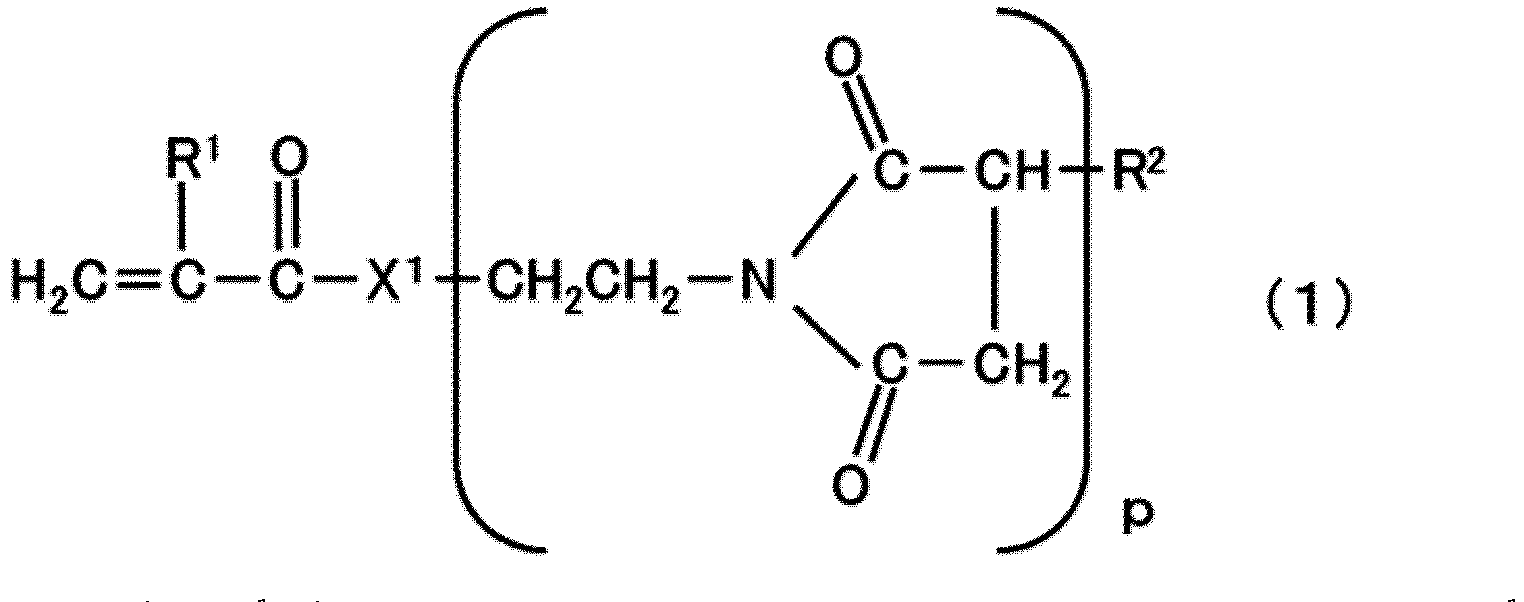
- The disclosure (2) relates to the viscosity index improver composition according to the disclosure (1), wherein a ratio {(A)/(B)} of the weight of the copolymer (A) to the weight of the Fischer-Tropsch derived base oil (B) in the viscosity index improver composition is 0.05 to 10.
- The disclosure (3) relates to the viscosity index improver composition according to the disclosure (1) or (2), wherein the copolymer (A) has a solubility parameter of 8.0 to 10.0 (cal/cm3)1/2.
- The disclosure (4) relates to the viscosity index improver composition according to any one of the disclosures (1) to (3), wherein the copolymer (A) is a copolymer containing, as a constituent monomer, a (meth)acryloyl monomer (c) having a C9-C36 alkyl group.
- The disclosure (5) relates to the viscosity index improver composition according to the disclosure (4), wherein the copolymer (A) is a copolymer containing a monomer (d) represented by the following formula (2) as a constituent monomer:

- The disclosure (6) relates to the viscosity index improver composition according to the disclosure (5), wherein the copolymer (A) is a copolymer containing, as constituent monomers, the monomer (c) in an amount of 1 to 53 wt% and the monomer (d) in an amount of 1 to 35 wt% based on the total weight of the monomers constituting the copolymer (A).
- The disclosure (7) relates to the viscosity index improver composition according to any one of the disclosures (1) to (6), wherein the copolymer (A) has a weight average molecular weight of 5,000 to 2,000,000.
- The disclosure (8) relates to the viscosity index improver composition according to any one of the disclosures (1) to (7), further comprising a base oil of API Groups I to V other than the Fischer-Tropsch derived base oil (B).
- The disclosure (9) relates to a lubricating oil composition containing: the viscosity index improver composition according to any one of the disclosures (1) to (8); and at least one additive selected from the group consisting of a detergent, a dispersant, an antioxidant, an oiliness improver, a pour point depressant, a friction and wear modifier, an extreme pressure agent, a defoamer, a demulsifier, a metal deactivator, and a corrosion inhibitor.
- The present invention is described in further detail below with reference to examples and comparative examples, but the present invention should not be limited to these examples.
- A SUS pressure-resistant reaction vessel equipped with a temperature adjuster and a stirrer was charged with degassed and dehydrated hexane (400 parts by weight), tetrahydrofuran (1 part by weight), 1,3-butadiene (75 parts by weight), and n-butyllithium (2 parts by weight), followed by polymerization at a polymerization temperature of 70°C.
- After the polymerization proceeded to almost 100%, ethylene oxide (2 parts by weight) was added. The mixture was reacted at 50°C for three hours. To terminate the reaction, water (50 parts by weight) and a 1N aqueous hydrochloric acid solution (25 parts by weight) were added to the mixture, followed by stirring at 80°C for one hour. The organic phase of the reaction solution was collected using a separating funnel, and heated to 70°C. Then, the solvent was removed under reduced pressure of 0.027 to 0.040 MPa over two hours.
- The resulting polybutadiene having a hydroxy group at one end was transferred to a reaction vessel equipped with a temperature adjuster, a stirrer, and a hydrogen inlet tube, and tetrahydrofuran (150 parts by weight) was added to uniformly dissolve the polybutadiene therein. To the resulting solution was added a suspension obtained in advance by mixing palladium on carbon (10 parts by weight) and tetrahydrofuran (50 parts by weight). Then, the mixture was reacted at room temperature for eight hours while hydrogen was supplied at a flow rate of 30 mL/min through the hydrogen inlet tube into the solution. Subsequently, the palladium on carbon was filtered out.
- The resulting filtrate was heated to 70°C, and tetrahydrofuran was removed under reduced pressure of 0.027 to 0.040 MPa. Thus, a hydrogenated polybutadiene polymer having a hydroxy group at one end (Y1-1) (total proportion of the isobutylene group and the 1,2-butylene group: 45 mol%; 1,2-adduct/1,4-adduct (molar ratio): 45/55; hydroxy value: 8.0 mgKOH/g; crystallization temperature: -60°C or lower) was obtained.
- A reaction vessel was charged with the hydrogenated polybutadiene polymer having a hydroxy group at one end (Y1-1) (245 parts by weight), methacrylic acid (245 parts by weight), and a sulfonic acid group-carrying inorganic porous material (acid value 45 mgKOH/g; particle size: 240 µm) (98 parts by weight), followed by esterification at 120°C. Then, the sulfonic acid group-carrying inorganic porous material was filtered out, and excess methacrylic acid was removed from the reaction solution under reduced pressure (0.027 to 0.040 MPa). Thus, a monomer (a-1) was obtained. The molecular weight of the resulting monomer (a-1) was measured by GPC, and the proportion of the 1,2-butylene group was measured by 13C-NMR. The results were as follows: Mw = 6,900, Mn = 6,800, the proportion of the 1,2-butylene group = 45 mol%, -X1- in the formula (1) was a group represented by -O(CH2CH2O)1-, and p = 0.
- A 1-L SUS pressure-resistant reaction vessel equipped with a temperature adjuster and a stirrer was charged with degassed and dehydrated hexane (400 parts by weight), tetrahydrofuran (1 part by weight), and n-butyllithium (0.4 parts by weight), followed by cooling to -40°C. 1,3-Butadiene (90 parts by weight) liquefied at -40°C was added thereto, and the mixture was polymerized at a polymerization temperature of -40°C. The rest of the process was performed as in Production Example 1, whereby a hydrogenated polybutadiene polymer having a hydroxy group at one end (Y1-2) (total proportion of the isobutylene group and the 1,2-butylene group: 65 mol%; 1,2-adduct/1,4-adduct (molar ratio): 65/35; hydroxy value: 13.1 mgKOH/g; crystallization temperature: -60°C or lower) was obtained. The polymer (Y1-2) and methacrylic acid were esterified to give a monomer (a-2). The molecular weight of the resulting monomer (a-2) was measured by GPC, and the proportion of the 1,2-butylene group was measured by 13C-NMR. The results were as follows: Mw = 6,900, Mn = 6,800, the proportion of the 1,2-butylene group = 65 mol%, -X1- in the formula (1) was a group represented by -O(CH2CH2O)1-, and p = 0.
- In Example 1, a viscosity index improver composition (R-1) shown in Table 4, containing a copolymer (A-1) shown in Table 3, was obtained by the following method. First, a reaction vessel equipped with a stirrer, a heating and cooling device, a thermometer, and a nitrogen inlet tube was charged with a monomer blend for copolymer (A) production (100 parts by weight in total) shown in Table 3 and a base oil for polymerization (200 parts by weight in total) shown in Table 4. After purging with nitrogen (gas phase oxygen concentration: 100 ppm), the mixture was heated to 76°C with stirring under hermetically sealed conditions, and a polymerization catalyst (2,2'-azobis(2-methylbutyronitrile)) in an amount shown in Table 3 was added, whereby the mixture was polymerized at the same temperature for four hours. The mixture was heated to 90°C and reacted for two hours, and then heated to 120°C to 130°C. To the mixture was added a diluent base oil shown in Table 4, whereby a viscosity index improver composition (R-1) containing a copolymer (A-1) was obtained. The SP of the obtained copolymer (A-1) was calculated according to the method described above, and the Mw and the Mn were measured according to the methods described above. Table 4 shows the results. Here, KV 100 in Tables 4 to 12 denotes the kinematic viscosity at 100°C.
- Viscosity index improver compositions (R-2 to R-17, S-1 to S-13) containing copolymers (A) were obtained as in Example 1, except that the amounts of the monomer blends and the polymerization catalysts were as shown in Table 3, and that the amounts of the base oils for polymerization and the diluent base oils were as shown in Table 4 to 12.
[Table 3] Copolymer (A) SP of structural unit A-1 A-2 A-3 A-4 A-5 Monomer blend for copolymer (A) production (a-1): Methacrylic acid ester of (Y1-1) 8.41 7.5 6 8 5 11 (a-2): Methacrylic acid ester of (Y1-2) 8.33 7.5 6 8 5 11 (b-1): Methyl methacrylate 9.93 - - - 10 - (b-2): Ethyl methacrylate 9.72 - - - 10 - (b-3): n-Butyl methacrylate 9.45 63 60 76 30 40 (c-1): n-Dodecyl methacrylate 9.02 - 11 6 27 - (c-2): Methacrylate of Neodol 23 8.99 10 - - 10 20 (parts by weight) (c-3): Methacrylate of Neodol 45 8.94 2 - - - 8 (c-4): n-Hexadecyl methacrylate 8.93 - 4 1 - - (c-5): n-Octadecyl methacrylate 8.90 - 1 1 - - (d-1): n-Butoxy ethyl methacrylate 9.43 10 12 - 3 10 Total 100 100 100 100 100 Polymerization catalyst (parts by weight) 2,2-Azobis(2,4-dimethylvaleronitrile) - - - 0.03 - 2,2'-Azobis(2-methylbutyronitrile) 0.12 0.10 0.12 0.12 0.12 [Table 4] Example 1 Example 2 Example 3 Example 4 Example 5 Comparative Example 1 Comparative Example 2 Comparative Example 3 Type of copolymer (A) A-1 A-1 A-1 A-1 A-1 A-1 A-1 A-1 Copolymer (A) (parts by weight) 100.0 100.0 100.0 100.0 100.0 100.0 100.0 100.0 Hydrocarbon oil-1 KV100 = 4.21 mm2/s 200.0 15.0 - 15.0 200.0 - - - Hydrocarbon oil-2 KV100 = 3.06 mm2/s - - - - - - - 200.0 Hydrocarbon oil-3 KV100 = 2.28 mm2/s - - - - - - - - GTL oil-1 KV100 = 4.08 mm2/s - - - - - 200.0 120.0 - Base oil for polymerization (parts by weight) Base oil GTL oil-2 KV100 = 2.70 mm2/s - 185.0 200.0 - - - - - GTL oil-3 KV100 = 2.05 mm2/s - - - - - - - - GTL oil-4 KV100 = 1.32 mm2/s - - - - - - - - CTL oil-1 KV100 = 2.96 mm2/s - - - 185.0 - - - - Ester oil-1 KV100 = 3.23 mm2/s - - - - - - - - Hydrocarbon oil-1 KV100 = 4.21 mm2/s - - - - - - - - Hydrocarbon oil-2 KV100 = 3.06 mm2/s - - - - - - - 30.0 Hydrocarbon oil-3 KV100 = 2.28 mm2/s - - - - - - 280.0 170.0 GTL oil-1 KV100 = 4.08 mm2/s - - - - - 200.0 - - Diluent base oil (parts by weight) Base oil GTL oil-2 KV100 = 2.70 mm2/s - 200.0 200.0 - - - - - GTL oil-3 KV100 = 2.05 mm2/s 200.0 - - - - - - - GTL oil-4 KV100 = 1.32 mm2/s - - - - - - - - CTL oil-1 KV100 = 2.96 mm2/s - - - 200.0 200.0 - - - Ester oil-1 KV100 = 3.23 mm2/s - - - - - - - - Total charge 500.0 500.0 500.0 500.0 500.0 500.0 500.0 500.0 Viscosity index improver composition R-1 R-2 R-3 R-4 R-5 S-1 S-2 S-3 Copolymer (A) 20.0 20.0 20.0 20.0 20.0 20.0 20.0 20.0 Hydrocarbon oil-1 KV100 = 4.21 mm2/s 40.0 3.0 0.0 3.0 40.0 0.0 0.0 0.0 Hydrocarbon oil-2 KV100 = 3.06 mm2/s 0.0 0.0 0.0 0.0 0.0 0.0 0.0 46.0 Hydrocarbon oil-3 KV100 = 2.28 mm2/s 0.0 0.0 0.0 0.0 0.0 0.0 56.0 34.0 Amount in viscosity index improver composition (wt%) GTL oil-1 KV100 = 4.08 mm2/s 0.0 0.0 0.0 0.0 0.0 80.0 24.0 0.0 Base oil GTL oil-2 KV100 = 2.70 mm2/s 0.0 77.0 80.0 0.0 0.0 0.0 0.0 0.0 GTL oil-3 KV100 = 2.05 mm2/s 40.0 0.0 0.0 0.0 0.0 0.0 0.0 0.0 GTL oil-4 KV100 = 1.32 mm2/s 0.0 0.0 0.0 0.0 0.0 0.0 0.0 0.0 CTL oil-1 KV100 = 2.96 mm2/s 0.0 0.0 0.0 77.0 40.0 0.0 0.0 0.0 Ester oil-1 KV100 = 3.23 mm2/s 0.0 0.0 0.0 0.0 0.0 0.0 0.0 0.0 Total 100.0 100.0 100.0 100.0 100.0 100.0 100.0 100.0 Copolymer (A) Amount of monomer (a) in copolymer (A) (wt%) 15.0 15.0 15.0 15.0 15.0 15.0 15.0 15.0 Amount of monomer (b) in copolymer (A) (wt%) 63.0 63.0 63.0 63.0 63.0 63.0 63.0 63.0 SP (cal/cm3)1/2 of copolymer (A) 9.23 9.23 9.23 9.23 9.23 9.23 9.23 9.23 Mw of copolymer (A) (×104) 51 51 51 51 51 51 51 51 Mw/Mn of copolymer (A) 2.62 2.62 2.62 2.62 2.62 2.62 2.62 2.62 Base oil Amount of Fischer-Tropsch derived base oil (B) having kinematic viscosity at 100°C of 4.0 mm2/s or less in entire viscosity index improver composition (wt%) 40.0 77.0 80.0 77.0 40.0 0.0 0.0 0.0 Properties of entire base oil in composition Kinematic viscosity at 100°C (mm2/s) 2.94 2.75 2.70 3.00 3.53 4.08 2.71 2.70 Kinematic viscosity at 40°C (mm2/s) 10.73 10.05 9.80 11.43 14.63 18.22 10.05 10.11 Weight ratio (A)/(B) in viscosity index improver composition 0.50 0.26 0.25 0.26 0.50 - - - Property evaluation of viscosity index improver composition DissoMng time of sample after gelation test (min) 30 15 15 15 30 255 240 255 [Table 5] Example 6 Example 7 Comparative Example 4 Type of copolymer (A) A-1 A-1 A-1 Copolymer (A) (parts by weight) 100.0 100.0 100.0 Hydrocarbon oil-1 KV100 = 4.21 mm2/s - - - Hydrocarbon oil-2 KV100 = 3.06 mm2/s - - 100.0 Hydrocarbon oil-3 KV100 = 2.28 mm2/s - - 100.0 GTL oil-1 KV100 = 4.08 mm2/s - - - Base oil for polymerization (parts by weight) Base oil GTL oil-2 KV100 = 2.70 mm2/s - 150.0 - GTL oil-3 KV100 = 2.05 mm2/s 200.0 - - GTL oil-4 KV100 = 1.32 mm2/s - - - CTL oil-1 KV100 = 2.96 mm2/s - - - Ester oil-1 KV100 = 3.23 mm2/s - - - Hydrocarbon oil-1 KV100 = 4.21 mm2/s 100.0 - - Hydrocarbon oil-2 KV100 = 3.06 mm2/s - - - Hydrocarbon oil-3 KV100 = 2.28 mm2/s - - 100.0 GTL oil-1 KV100 = 4.08 mm2/s - - 50.0 Diluent base oil (parts by weight) Base oil GTL oil-2 KV100 = 2.70 mm2/s - 200.0 - GTL oil-3 KV100 = 2.05 mm2/s 50.0 - - GTL oil-4 KV100 = 1.32 mm2/s - - - CTL oil-1 KV100 = 2.96 mm2/s - - - Ester oil-1 KV100 = 3.23 mm2/s 50.0 50.0 50.0 Total charge 500.0 500.0 500.0 Viscosity index improver composition R-6 R-7 S-4 Copolymer (A) 20.0 20.0 20.0 Hydrocarbon oil-1 KV100 = 4.21 mm2/s 20.0 0.0 0.0 Hydrocarbon oil-2 KV100 = 3.06 mm2/s 0.0 0.0 20.0 Hydrocarbon oil-3 KV100 = 2.28 mm2/s 0.0 0.0 40.0 GTL oil-1 KV100 = 4.08 mm2/s 0.0 0.0 10.0 Amount in viscosity index improver composition (wt%) Base oil GTL oil-2 KV100 = 2.70 mm2/s 0.0 70.0 0.0 GTL oil-3 KV100 = 2.05 mm2/s 50.0 0.0 0.0 GTL oil-4 KV100 = 1.32 mm2/s 0.0 0.0 0.0 CTL oil-1 KV100 = 2.96 mm2/s 0.0 0.0 0.0 Ester oil-1 KV100 = 3.23 mm2/s 10.0 10.0 10.0 Total 100.0 100.0 100.0 Copolymer (A) Amount of monomer (a) in copolymer (A) (wt%) 15.0 15.0 15.0 Amount of monomer (b) in copolymer (A) (wt%) 63.0 63.0 63.0 SP of copolymer (A) (cal/cm3)1/2 9.23 9.23 9.23 Mw of copolymer (A) (×104) 51 51 51 Mw/Mn of copolymer (A) 2.62 2.62 2.62 Base oil Amount of Fischer-Tropsch derived base oil (B) having kinematic viscosity at 100°C of 4.0 mm2/s or less in entire viscosity index improver composition (wt%) 50.0 70.0 0.0 Properties of entire base oil in composition Kinematic viscosity at 100°C (mm2/s) 2.31 2.45 2.44 Kinematic viscosity at 40°C (mm2/s) 8.72 100.0 10.19 Weight ratio (A)/(B) in viscosity index improver composition 0.40 0.29 - Property evaluation of viscosity index improver composition Dissolving time of sample after gelation test (min) 30 30 270 [Table 6] Example 8 Example 9 Comparative Example 5 Type of copolymer (A) A-1 A-1 A-1 Copolymer (A) (parts by weight) 100.0 100.0 100.0 Hydrocarbon oil-1 KV100 = 4.21 mm2/s 15.0 177.0 - Hydrocarbon oil-2 KV100 = 3.06 mm2/s - - - Hydrocarbon oil-3 KV100 = 2.28 mm2/s - - - GTL oil-1 KV100 = 4.08 mm2/s - - 177.0 Base oil for polymerization (parts by weight) Base oil GTL oil-2 KV100 = 2.70 mm2/s - - - GTL oil-3 KV100 = 2.05 mm2/s - - - GTL oil-4 KV100 = 1.32 mm2/s - - - CTL oil-1 KV100 = 2.96 mm2/s 162.0 - - Ester oil-1 KV100 = 3.23 mm2/s - - - Hydrocarbon oil-1 KV100 = 4.21 mm2/s - - - Hydrocarbon oil-2 KV100 = 3.06 mm2/s - - - Hydrocarbon oil-3 KV100 = 2.28 mm2/s - - - GTL oil-1 KV100 = 4.08 mm2/s - - 177.0 Diluent base oil (parts by weight) Base oil GTL oil-2 KV100 = 2.70 mm2/s - - - GTL oil-3 KV100 = 2.05 mm2/s - - - GTL oil-4 KV100 = 1.32 mm2/s - - - CTL oil-1 KV100 = 2.96 mm2/s 177.0 177.0 - Ester oil-1 KV100 = 3.23 mm2/s - - - Total charge 454.0 454.0 454.0 Viscosity index improver composition R-8 R-9 S-5 Copolymer (A) 22.0 22.0 22.0 Hydrocarbon oil-1 KV100 = 4.21 mm2/s 3.3 39.0 0.0 Hydrocarbon oil-2 KV100 = 3.06 mm2/s 0.0 0.0 0.0 Hydrocarbon oil-3 KV100 = 2.28 mm2/s 0.0 0.0 0.0 GTL oil-1 KV100 = 4.08 mm2/s 0.0 0.0 78.0 Amount in viscosity index improver composition (wt%) Base oil GTL oil-2 KV100 = 2.70 mm2/s 0.0 0.0 0.0 GTL oil-3 KV100 = 2.05 mm2/s 0.0 0.0 0.0 GTL oil-4 KV100 = 1.32 mm2/s 0.0 0.0 0.0 CTL oil-1 KV100 = 2.96 mm2/s 74.7 39.0 0.0 Ester oil-1 KV100 = 3.23 mm2/s 0.0 0.0 0.0 Total 100.0 100.0 100.0 Copolymer (A) Amount of monomer (a) in copolymer (A) (wt%) 15.0 15.0 15.0 Amount of monomer (b) in copolymer (A) (wt%) 63.0 63.0 63.0 SP of copolymer (A) (cal/cm3)1/2 9.23 9.23 9.23 Mw of copolymer (A) (×104) 51 51 51 Mw/Mn of copolymer (A) 2.62 2.62 2.62 Base oil Amount of Fischer-Tropsch derived base oil (B) having kinematic viscosity at 100°C of 4.0 mm2/s or less in entire viscosity index improver composition (wt%) 74.7 39.0 0.0 Properties of entire base oil in composition Kinematic viscosity at 100°C (mm2/s) 3.00 3.53 4.08 Kinematic viscosity at 40°C (mm2/s) 11.46 14.63 18.22 Weight ratio (A)/(B) in viscosity index improver composition 0.29 0.56 - Property evaluation of viscosity index improver composition Dissolving time of sample after gelation test (min) 17 35 360 [Table 7] Example 10 Example 11 Comparative Example 6 Type of copolymer (A) A-1 A-1 A-1 Copolymer (A) (parts by weight) 100.0 100.0 100.0 Hydrocarbon oil-1 KV100 = 4.21 mm2/s 15.0 158.0 - Hydrocarbon oil-2 KV100 = 3.06 mm2/s - - - Hydrocarbon oil-3 KV100 = 2.28 mm2/s - - - GTL oil-1 KV100 = 4.08 mm2/s - - 158.0 Base oil for polymerization (parts by weight) Base oil GTL oil-2 KV100 = 2.70 mm2/s - - - GTL oil-3 KV100 = 2.05 mm2/s - - - GTL oil-4 KV100 = 1.32 mm2/s - - - CTL oil-1 KV100 = 2.96 mm2/s 143.0 - - Ester oil-1 KV100 = 3.23 mm2/s - - - Hydrocarbon oil-1 KV100 = 4.21 mm2/s - - - Hydrocarbon oil-2 KV100 = 3.06 mm2/s - - - Hydrocarbon oil-3 KV100 = 2.28 mm2/s - - - GTL oil-1 KV100 = 4.08 mm2/s - - 158.0 Diluent base oil (parts by weight) Base oil GTL oil-2 KV100 = 2.70 mm2/s - - - GTL oil-3 KV100 = 2.05 mm2/s - - - GTL oil-4 KV100 = 1.32 mm2/s - - - CTL oil-1 KV100 = 2.96 mm2/s 158.0 158.0 - Ester oil-1 KV100 = 3.23 mm2/s - - - Total charge 416.0 416.0 416.0 Viscosity index improver composition R-10 R-11 S-6 Copolymer (A) 24.0 24.0 24.0 Hydrocarbon oil-1 KV100 = 4.21 mm2/s 3.6 38.0 0.0 Hydrocarbon oil-2 KV100 = 3.06 mm2/s 0.0 0.0 0.0 Hydrocarbon oil-3 KV100 = 2.28 mm2/s 0.0 0.0 0.0 GTL oil-1 KV100 = 4.08 mm2/s 0.0 0.0 76.0 Amount in viscosity index improver composition (wt%) Base oil GTL oil-2 KV100 = 2.70 mm2/s 0.0 0.0 0.0 GTL oil-3 KV100 = 2.05 mm2/s 0.0 0.0 0.0 GTL oil-4 KV100 = 1.32 mm2/s 0.0 0.0 0.0 CTL oil-1 KV100 = 2.96 mm2/s 72.4 38.0 0.0 Ester oil-1 KV100 = 3.23 mm2/s 0.0 0.0 0.0 Total 100.0 100.0 100.0 Copolymer (A) Amount of monomer (a) in copolymer (A) (wt%) 15.0 15.0 15.0 Amount of monomer (b) in copolymer (A) (wt%) 63.0 63.0 63.0 SP of copolymer (A) (cal/cm3)1/2 9.23 9.23 9.23 Mw of copolymer (A) (×104) 51 51 51 Mw/Mn of copolymer (A) 2.62 2.62 2.62 Base oil Amount of Fischer-Tropsch derived base oil (B) having kinematic viscosity at 100°C of 4.0 mm2/s or less in entire viscosity index improver composition (wt%) 72.4 38.0 0.0 Properties of entire base oil in composition Kinematic viscosity at 100°C (mm2/s) 3.01 3.53 4.08 Kinematic viscosity at 40°C (mm2/s) 11.49 14.63 18.22 Weight ratio (A)/(B) in viscosity index improver composition 0.33 0.63 - Property evaluation of viscosity index improver composition Dissolving time of sample after gelation test (min) 19 40 400 [Table 8] Example 12 Example 13 Comparative Example 7 Type of copolymer (A) A-1 A-1 A-1 Copolymer (A) (parts by weight) 100.0 100.0 100.0 Hydrocarbon oil-1 KV100 = 4.21 mm2/s - 30.0 - Hydrocarbon oil-2 KV100 = 3.06 mm2/s - 140.0 150.0 Hydrocarbon oil-3 KV100 = 2.28 mm2/s - 30.0 50.0 GTL oil-1 KV100 = 4.08 mm2/s - - - Base oil for polymerization (parts by weight) Base oil GTL oil-2 KV100 = 2.70 mm2/s 200.0 - - GTL oil-3 KV100 = 2.05 mm2/s - - - GTL oil-4 KV100 = 1.32 mm2/s - - - CTL oil-1 KV100 = 2.96 mm2/s - - - Ester oil-1 KV100 = 3.23 mm2/s - - - Hydrocarbon oil-1 KV100 = 4.21 mm2/s - - - Hydrocarbon oil-2 KV100 = 3.06 mm2/s - - - Hydrocarbon oil-3 KV100 = 2.28 mm2/s - - 70.0 GTL oil-1 KV100 = 4.08 mm2/s - - 30.0 Diluent base oil (parts by weight) Base oil GTL oil-2 KV100 = 2.70 mm2/s 100.0 30.0 - GTL oil-3 KV100 = 2.05 mm2/s - 60.0 - GTL oil-4 KV100 = 1.32 mm2/s - 10.0 - CTL oil-1 KV100 = 2.96 mm2/s - - - Ester oil-1 KV100 = 3.23 mm2/s - - - Total charge 400.0 400.0 400.0 Viscosity index improver composition R-12 R-13 S-7 Copolymer (A) 25.0 25.0 25.0 Hydrocarbon oil-1 KV100 = 4.21 mm2/s 0.0 7.5 0.0 Hydrocarbon oil-2 KV100 = 3.06 mm2/s 0.0 35.0 37.5 Hydrocarbon oil-3 KV100 = 2.28 mm2/s 0.0 7.5 30.0 GTL oil-1 KV100 = 4.08 mm2/s 0.0 0.0 7.5 Amount in viscosity index improver composition (wt%) Base oil GTL oil-2 KV100 = 2.70 mm2/s 75.0 7.5 0.0 GTL oil-3 KV100 = 2.05 mm2/s 0.0 15.0 0.0 GTL oil-4 KV100 = 1.32 mm2/s 0.0 2.5 0.0 CTL oil-1 KV100 = 2.96 mm2/s 0.0 0.0 0.0 Ester oil-1 KV100 = 3.23 mm2/s 0.0 0.0 0.0 Total 100.0 100.0 100.0 Copolymer (A) Amount of monomer (a) in copolymer (A) (wt%) 15.0 15.0 15.0 Amount of monomer (b) in copolymer (A) (wt%) 63.0 63.0 63.0 SP of copolymer (A) (cal/cm3)1/2 9.23 9.23 9.23 Mw of copolymer (A) (×104) 51 51 51 Mw/Mn of copolymer (A) 2.62 2.62 2.62 Base oil Amount of Fischer-Tropsch derived base oil (B) having kinematic viscosity at 100°C of 4.0 mm2/s or less in entire viscosity index improver composition (wt%) 75.0 25.0 0.0 Properties of entire base oil in composition Kinematic viscosity at 100°C (mm2/s) 2.70 2.72 2.80 Kinematic viscosity at 40°C (mm2/s) 9.80 9.95 10.64 Weight ratio (A)/(B) in viscosity index improver composition 0.33 1.00 - Property evaluation of viscosity index improver composition Dissolving time of sample after gelation test (min) 20 50 360 [Table 9] Example 14 Comparative Example 8 Type of copolymer (A) A-1 A-1 Copolymer (A) (parts by weight) 100.0 100.0 Hydrocarbon oil-1 KV100 = 4.21 mm2/s - - Hydrocarbon oil-2 KV100 = 3.06 mm2/s - 200.0 Hydrocarbon oil-3 KV100 = 2.28 mm2/s - - GTL oil-1 KV100 = 4.08 mm2/s - - Base oil for polymerization (parts by weight) Base oil GTL oil-2 KV100 = 2.70 mm2/s 150.0 - GTL oil-3 KV100 = 2.05 mm2/s - - GTL oil-4 KV100 = 1.32 mm2/s - - CTL oil-1 KV100 = 2.96 mm2/s - - Ester oil-1 KV100 = 3.23 mm2/s 50.0 - Hydrocarbon oil-1 KV100 = 4.21 mm2/s - - Hydrocarbon oil-2 KV100 = 3.06 mm2/s - 255.6 Hydrocarbon oil-3 KV100 = 2.28 mm2/s - - GTL oil-1 KV100 = 4.08 mm2/s - - Diluent base oil (parts by weight) Base oil GTL oil-2 KV100 = 2.70 mm2/s 255.6 - GTL oil-3 KV100 = 2.05 mm2/s - - GTL oil-4 KV100 = 1.32 mm2/s - - CTL oil-1 KV100 = 2.96 mm2/s - - Ester oil-1 KV100 = 3.23 mm2/s - - Total charge 555.6 555.6 Viscosity index improver composition R-14 S-8 Copolymer (A) 18.0 18.0 Hydrocarbon oil-1 KV100 = 4.21 mm2/s 0.0 0.0 Hydrocarbon oil-2 KV100 = 3.06 mm2/s 0.0 82.0 Hydrocarbon oil-3 KV100 = 2.28 mm2/s 0.0 0.0 GTL oil-1 KV100 = 4.08 mm2/s 0.0 0.0 Amount in viscosity index improver composition (wt%) Base oil GTL oil-2 KV100 = 2.70 mm2/s 73.0 0.0 GTL oil-3 KV100 = 2.05 mm2/s 0.0 0.0 GTL oil-4 KV100 = 1.32 mm2/s 0.0 0.0 CTL oil-1 KV100 = 2.96 mm2/s 0.0 0.0 Ester oil-1 KV100 = 3.23 mm2/s 9.0 0.0 Total 100.0 100.0 Copolymer (A) Amount of monomer (a) in copolymer (A) (wt%) 15.0 15.0 Amount of monomer (b) in copolymer (A) (wt%) 63.0 63.0 SP of copolymer (A) (cal/cm3)1/2 9.23 9.23 Mw of copolymer (A) (×104) 51 51 Mw/Mn of copolymer (A) 2.62 2.62 Base oil Amount of Fischer-Tropsch derived base oil (B) having kinematic viscosity at 100°C of 4.0 mm2/s or less in entire viscosity index improver composition (wt%) 73.0 0.0 Properties of entire base oil in composition Kinematic viscosity at 100°C (mm2/s) 2.48 3.06 Kinematic viscosity at 40°C (mm2/s) 9.98 12.25 Weight ratio (A)/(B) in viscosity index improver composition 0.25 - Property evaluation of viscosity index improver composition Dissolving time of sample after gelation test (min) 30 270 [Table 10] Example 15 Comparative Example 9 Type of copolymer (A) A-2 A-2 Copolymer (A) (parts by weight) 100.0 100.0 Hydrocarbon oil-1 KV100 = 4.21 mm2/s - 200.0 Hydrocarbon oil-2 KV100 = 3.06 mm2/s - - Hydrocarbon oil-3 KV100 = 2.28 mm2/s - - GTL oil-1 KV100 = 4.08 mm2/s - - Base oil for polymerization (parts by weight) Base oil GTL oil-2 KV100 = 2.70 mm2/s 150.0 - GTL oil-3 KV100 = 2.05 mm2/s 50.0 - GTL oil-4 KV100 = 1.32 mm2/s - - CTL oil-1 KV100 = 2.96 mm2/s - - Ester oil-1 KV100 = 3.23 mm2/s - - Hydrocarbon oil-1 KV100 = 4.21 mm2/s 200.0 - Hydrocarbon oil-2 KV100 = 3.06 mm2/s - 100.0 Hydrocarbon oil-3 KV100 = 2.28 mm2/s - 100.0 GTL oil-1 KV100 = 4.08 mm2/s - - Diluent base oil (parts by weight) Base oil GTL oil-2 KV100 = 2.70 mm2/s - - GTL oil-3 KV100 = 2.05 mm2/s - - GTL oil-4 KV100 = 1.32 mm2/s - - CTL oil-1 KV100 = 2.96 mm2/s - - Ester oil-1 KV100 = 3.23 mm2/s - - Total charge 500.0 500.0 Viscosity index improver composition R-15 S-9 Copolymer (A) 20.0 20.0 Hydrocarbon oil-1 KV100 = 4.21 mm2/s 40.0 40.0 Hydrocarbon oil-2 KV100 = 3.06 mm2/s 0.0 20.0 Hydrocarbon oil-3 KV100 = 2.28 mm2/s 0.0 20.0 GTL oil-1 KV100 = 4.08 mm2/s 0.0 0.0 Amount in viscosity index improver composition (wt%) Base oil GTL oil-2 KV100 = 2.70 mm2/s 30.0 0.0 GTL oil-3 KV100 = 2.05 mm2/s 10.0 0.0 GTL oil-4 KV100 = 1.32 mm2/s 0.0 0.0 CTL oil-1 KV100 = 2.96 mm2/s 0.0 0.0 Ester oil-1 KV100 = 3.23 mm2/s 0.0 0.0 Total 100.0 100.0 Copolymer (A) Amount of monomer (a) in copolymer (A) (wt%) 12.0 12.0 Amount of monomer (b) in copolymer (A) (wt%) 60.0 60.0 SP of copolymer (A) (cal/cm3)1/2 9.24 9.24 Mw of copolymer (A) (×104) 55 55 Mw/Mn of copolymer (A) 2.55 2.55 Base oil Amount of Fischer-Tropsch derived base oil (B) having kinematic viscosity at 100°C of 4.0 mm2/s or less in entire viscosity index improver composition (wt%) 40.0 0.0 Properties of entire base oil in composition Kinematic viscosity at 100°C (mm2/s) 3.26 3.33 Kinematic viscosity at 40°C (mm2/s) 12.88 13.67 Weight ratio (A)/(B) in viscosity index improver composition 0.50 - Property evaluation of viscosity index improver composition Dissolving time of sample after gelation test (min) 45 300 [Table 11] Example 16 Comparative Example 10 Type of copolymer (A) A-3 A-3 Copolymer (A) (parts by weight) 100.0 100.0 Hydrocarbon oil-1 KV100 = 4.21 mm2/s - 200.0 Hydrocarbon oil-2 KV100 = 3.06 mm2/s 100.0 - Hydrocarbon oil-3 KV100 = 2.28 mm2/s 100.0 - GTL oil-1 KV100 = 4.08 mm2/s - - Base oil for polymerization (parts by weight) Base oil GTL oil-2 KV100 = 2.70 mm2/s - - GTL oil-3 KV100 = 2.05 mm2/s - - GTL oil-4 KV100 = 1.32 mm2/s - - CTL oil-1 KV100 = 2.96 mm2/s - - Ester oil-1 KV100 = 3.23 mm2/s - - Hydrocarbon oil-1 KV100 = 4.21 mm2/s 100.0 200.0 Hydrocarbon oil-2 KV100 = 3.06 mm2/s - - Hydrocarbon oil-3 KV100 = 2.28 mm2/s - - GTL oil-1 KV100 = 4.08 mm2/s - - Diluent base oil (parts by weight) Base oil GTL oil-2 KV100 = 2.70 mm2/s 50.0 - GTL oil-3 KV100 = 2.05 mm2/s 50.0 - GTL oil-4 KV100 = 1.32 mm2/s - - CTL oil-1 KV100 = 2.96 mm2/s - - Ester oil-1 KV100 = 3.23 mm2/s - - Total charge 500.0 500.0 Viscosity index improver composition R-16 S-10 Copolymer (A) 20.0 20.0 Hydrocarbon oil-1 KV100 = 4.21 mm2/s 20.0 80.0 Hydrocarbon oil-2 KV100 = 3.06 mm2/s 20.0 0.0 Hydrocarbon oil-3 KV100 = 2.28 mm2/s 20.0 0.0 GTL oil-1 KV100 = 4.08 mm2/s 0.0 0.0 Amount in viscosity index improver composition (wt%) Base oil GTL oil-2 KV100 = 2.70 mm2/s 10.0 0.0 GTL oil-3 KV100 = 2.05 mm2/s 10.0 0.0 GTL oil-4 KV100 = 1.32 mm2/s 0.0 0.0 CTL oil-1 KV100 = 2.96 mm2/s 0.0 0.0 Ester oil-1 KV100 = 3.23 mm2/s 0.0 0.0 Total 100.0 100.0 Copolymer (A) Amount of monomer (a) in copolymer (A) (wt%) 16.0 16.0 Amount of monomer (b) in copolymer (A) (wt%) 76.0 76.0 SP of copolymer (A) (cal/cm3)1/2 9.24 9.24 Mw of copolymer (A) (×104) 51 51 Mw/Mn of copolymer (A) 2.62 2.62 Base oil Amount of Fischer-Tropsch derived base oil (B) having kinematic viscosity at 100°C of 4.0 mm2/s or less in entire viscosity index improver composition (wt%) 20.0 0.0 Properties of entire base oil in composition Kinematic viscosity at 100°C (mm2/s) 2.88 4.21 Kinematic viscosity at 40°C (mm2/s) 10.88 19.12 Weight ratio (A)/(B) in viscosity index improver composition 1.00 - Property evaluation of viscosity index improver composition Dissolving time of sample after gelation test (min) 60 340 [Table 12] Example 17 Comparative Example 11 Comparative Example 12 Comparative Example 13 Type of copolymer (A) A-4 A-4 A-5 A-5 Copolymer (A) (parts by weight) 100.0 100.0 100.0 100.0 Hydrocarbon oil-1 KV100 = 4.21 mm2/s - - 200.0 - Hydrocarbon oil-2 KV100 = 3.06 mm2/s - 150.0 - - Hydrocarbon oil-3 KV100 = 2.28 mm2/s - 50.0 - - GTL oil-1 KV100 = 4.08 mm2/s - - - 200.0 Base oil for polymerization (parts by weight) Base oilBase oil GTL oil-2 KV100 = 2.70 mm2/s 200.0 - - - GTL oil-3 KV100 = 2.05 mm2/s - - - - GTL oil-4 KV100 = 1.32 mm2/s - - - - CTL oil-1 KV100 = 2.96 mm2/s - - - - Ester oil-1 KV100 = 3.23 mm2/s - - - - Hydrocarbon oil-1 KV100 = 4.21 mm2/s - - - - Hydrocarbon oil-2 KV100 = 3.06 mm2/s - - - - Hydrocarbon oil-3 KV100 = 2.28 mm2/s - 70.0 - - GTL oil-1 KV100 = 4.08 mm2/s - 30.0 - 200.0 Diluent base oil (parts by weight) Base oil GTL oil-2 KV100 = 2.70 mm2/s 100.0 - - - GTL oil-3 KV100 = 2.05 mm2/s - - 200.0 - GTL oil-4 KV100 = 1.32 mm2/s - - - - CTL oil-1 KV100 = 2.96 mm2/s - - - - Ester oil-1 KV100 = 3.23 mm2/s - - - - Total charge 400.0 400.0 500.0 500.0 Viscosity index improver composition R-17 S-11 S-12 S-13 Copolymer (A) 25.0 25.0 20.0 20.0 Hydrocarbon oil-1 KV100 = 4.21 mm2/s 0.0 0.0 40.0 0.0 Hydrocarbon oil-2 KV100 = 3.06 mm2/s 0.0 37.5 0.0 0.0 Hydrocarbon oil-3 KV100 = 2.28 mm2/s 0.0 30.0 0.0 0.0 GTL oil-1 KV100 = 4.08 mm2/s 0.0 7.5 0.0 80.0 Amount in viscosity index improver composition (wt%) Base oil GTL oil-2 KV100 = 2.70 mm2/s 75.0 0.0 0.0 0.0 GTL oil-3 KV100 = 2.05 mm2/s 0.0 0.0 40.0 0.0 GTL oil-4 KV100 = 1.32 mm2/s 0.0 0.0 0.0 0.0 CTL oil-1 KV100 = 2.96 mm2/s 0.0 0.0 0.0 0.0 Ester oil-1 KV100 = 3.23 mm2/s 0.0 0.0 0.0 0.0 Total 100.0 100.0 100.0 100.0 Copolymer (A) Amount of monomer (a) in copolymer (A) (wt%) 10.0 10.0 22.0 22.0 Amount of monomer (b) in copolymer (A) (wt%) 50.0 50.0 40.0 40.0 SP of copolymer (A) (cal/cm3)1/2 9.25 9.25 9.08 9.08 Mw of copolymer (A) (×104) 45 45 51 51 Mw/Mn of copolymer (A) 2.55 2.55 2.62 2.62 Base oil Amount of Fischer-Tropsch derived base oil (B) having kinematic viscosity at 100°C of 4.0 mm2/s or less in entire viscosity index improver composition (wt%) 75.0 0.0 40.0 0.0 Properties of entire base oil in composition Kinematic viscosity at 100°C (mm2/s) 2.70 2.80 2.94 4.08 Kinematic viscosity at 40°C (mm2/s) 9.80 10.64 10.73 18.22 Weight ratio (A)/(B) in viscosity index improver composition 0.33 - 0.50 - Property evaluation of viscosity index improver composition Dissolving time of sample after gelation test (min) 75 390 390 405 - The monomers (a) to (d) in Table 3 are as follows.
- (a-1): Methacrylic acid ester (Mn: 6800) of (Y1-1)
- (a-2): Methacrylic acid ester (Mn: 6800) of (Y1-2)
- (b-1): Methyl methacrylate
- (b-2): Ethyl methacrylate
- (b-3): n-Butyl methacrylate
- (c-1): n-Dodecyl methacrylate
- (c-2): C12-C13 straight-chain and branched alkyl methacrylate mixture (ester of methacrylic acid and Neodol 23 (mixture with weight ratio = straight-chain C12:branched C12:straight-chain C13:branched C13 = 40:10:40:10) available from SHELL)
- (c-3): C14-C15 straight-chain and branched alkyl methacrylate mixture (ester of methacrylic acid and Neodol 45 (mixture with weight ratio = straight-chain C14:branched C14:straight-chain C15:branched C15 = 40:10:40:10) available from SHELL)
- (c-4): n-Hexadecyl methacrylate
- (c-5): n-Octadecyl methacrylate
- (d-1): n-Butoxy ethyl methacrylate
- The SPs of the structural units (structures in which carbon-carbon double bonds have reacted to form a single bond) derived from the monomers (a-1), (a-2), (c-2), and (c-3) were calculated based on the following formulas. Structural unit derived from (a-1)
- ΣΔei = 1125 (CH3) + 1180 (CH2) + 350 (C) + 4300 (CO2) = 6955
- Σvi = 33.5 (CH3) + 16.1 (CH2) - 19.2 (C) + 18.0 (CO2) = 48.4
- ΣΔei = 1180 (CH2) × 2 + 800 (O) = 3160
- Σvi = 16.1 (CH2) × 2 + 3.8 (O) = 36
- ΣΔei = 1180 (CH2) × 2 + 1125 (CH3) + 820 (CH) = 4305
- Σvi = 16.1 (CH2) × 2 + 33.5 (CH3) - 1.0 (CH) = 64.7
- ΣΔei = 1180 (CH2) × 4 = 4720
- Σvi = 16.1 (CH2) × 4 = 64.4
- Here, the total number of 1,2-butylene and 1,4-butylene groups is as follows.
Total number of 1,2-butylene and 1,4-butylene groups = (6800 - 85 - 44)/56 = 119.125 - Accordingly, the parameters of the structural unit derived from (a-1) are as follows.
ΣΔei = 6955 + 3160 + 4305 × 119.125 × 0.45 + 4720 × 119.125 × 0.55 = 550138.4 Σvi = 48.4 + 36 + 64.7 × 119.125 × 0.45 + 64.4 × 119.125 × 0.55 = 7772.132 
- Structural unit derived from (a-2)
Total number of 1,2-butylene and 1,4-butylene groups = (6800 - 85 - 44)/56 = 119.125 ΣΔei = 6955 + 3160 + 4305 × 119.125 × 0.65 + 4720 × 119.125 × 0.35 = 540251 Σvi = 48.4 + 36 + 64.7 × 119.125 × 0.65 + 64.4 × 119.125 × 0.35 = 7779.279 
- Structural unit derived from (c-2)
- Straight-chain C12


- Branched C12


- Straight-chain C13


- Branched C13



SP of structural unit derived from (c-2) = (9.017 × 40 + 8.923 × 10 + 8.991 × 40 + 8.902 × 10)/100 = 8.986 - Structural unit derived from (c-3)
- Straight-chain C14


- Branched C14


- Straight-chain C15


- Branched C15



SP of structural unit derived from (c-3) = (8.968 × 40 + 8.884 × 10 + 8.947 × 40 + 8.867 × 10)/100 = 8.941 - The base oils shown in Tables 4 to 12 are as follows.
- Hydrocarbon oil-1: available from SK Lubricants, product name "Yubase 4", API Group III (kinematic viscosity at 100°C: 4.21 mm2/s, kinematic viscosity at 40°C: 19.12 mm2/s)
- Hydrocarbon oil-2: available from SK Lubricants, product name "Yubase 3", API Group III (kinematic viscosity at 100°C: 3.06 mm2/s, kinematic viscosity at 40°C: 12.25 mm2/s)
- Hydrocarbon oil-3: available from S-OIL, product name "Ultra S-2", API Group II (kinematic viscosity at 100°C: 2.28 mm2/s, kinematic viscosity at 40°C: 7.79 mm2/s)
- GTL oil-1: available from Shell, XHVI4, kinematic viscosity at 100°C: 4.08 mm2/s, kinematic viscosity at 40°C: 18.22 mm2/s
- GTL oil-2: available from Shell, Ondina X415, kinematic viscosity at 100°C: 2.70 mm2/s, kinematic viscosity at 40°C: 9.80 mm2/s
- GTL oil-3: available from Shell Chemicals, GS310, kinematic viscosity at 100°C: 2.05 mm2/s, kinematic viscosity at 40°C: 6.02 mm2/s
- GTL oil-4: available from Shell Chemicals, GS270, kinematic viscosity at 100°C: 1.32 mm2/s, kinematic viscosity at 40°C: 3.38 mm2/s
- CTL oil-1: available from Shanxi Lu'an Taihang Lubricant Technology, ICCSYN3, kinematic viscosity at 100°C: 2.96 mm2/s, kinematic viscosity at 40°C: 11.20 mm2/s
- Ester oil-1: API Group V (bis(2-ethylhexyl) sebacate, kinematic viscosity at 100°C: 3.23 mm2/s, kinematic viscosity at 40°C: 11.53 mm2/s)
- Of the base oils shown in Tables 4 to 12, GTL oil-2, GTL oil-3, GTL oil-4, and CTL oil-1 fall within the category of the Fischer-Tropsch derived base oil (B) having a kinematic viscosity at 100°C of 4.0 mm2/s or less. In Table 4 to 12, "Amount (wt%) of Fischer-Tropsch derived base oil (B) having kinematic viscosity at 100°C of 4.0 mm2/s or less in entire viscosity index improver composition" refers to the total amount of GTL oil-2, GTL oil-3, GTL oil-4, and CTL oil-1.
- For each of the viscosity index improver compositions of Examples 1 to 17 and Comparative Examples 1 to 13, a base oil blend was separately prepared by mixing only the base oil for polymerization and the diluent base oil. The kinematic viscosity at 40°C and 100°C of the base oil blend were measured according to the method of JIS-K2283 (2000). Similarly, the viscosity index was calculated according to the method of JIS-K2283 (2000).
- The gelation test of the viscosity index improver compositions herein was performed using a rheometer ("Physica MCR302" available from Anton paar) under the following conditions.
- Measurement fixture: parallel plates (diameter 50 mm)
- Temperature control: Peltier system
- Gap: 0.5 mm
- Strain: 1%
- Frequency: 1 Hz
- Heating rate 5°C/min (from 10°C to 100°C)
- Cooling rate 2°C/min (from 100°C to 10°C)
- Heating/cooling pattern before determination of gelation: heating → cooling → heating → cooling
- Tables 4 to 12 show the ratio of the weight of the copolymer (A) to the weight of the Fischer-Tropsch derived base oil (B) in each of the viscosity index improver compositions.
- A reaction vessel equipped with a stirrer, a heating and cooling device, and a thermometer was charged with the sample (30.0 g) after the gelation test and hydrocarbon oil-1 (Yubase 4, kinematic viscosity at 100°C: 4.21 mm2/s, kinematic viscosity at 40°C: 19.12 mm2/s). The stirring rate was 50 rpm, and the temperature was adjusted to 50°C. The mixture was sampled at 15-minute intervals (3 g). The kinematic viscosity (40°C) of each sample was measured, and the time when the difference between two measurements was within 0.5% was defined as the end of dissolution. The time from the start of stirring to sampling of the first of the two samples with a kinematic viscosity difference within 0.5% was defined as the sample dissolving time after the gelation test. Tables 4 to 12 show the dissolving time. A shorter sample dissolving time after the gelation test is considered to indicate less gel formation in the viscosity index improver composition.
- The kinematic viscosity (40°C) was measured according to the method of ASTM D 7042 using a Stabinger viscometer (SVM3001) available from Anton Paar.
- A stainless steel vessel equipped with a stirrer was charged with Yubase 4 (kinematic viscosity at 100°C: 4.21 mm2/s, kinematic viscosity at 40°C: 19.12 mm2/s)), Yubase 3 (3.06 mm2/s, kinematic viscosity at 40°C: 12.25 mm2/s), and an engine oil package additive (Infineum P-5741, 10 wt% of the entire lubricating oil composition) in accordance with the formulation shown in Table 13. One of the viscosity index improver compositions (R-1) to (R-9), (R-12), and (S-1) was added to the mixture such that the resulting lubricating oil composition had a kinematic viscosity at 100°C of 6.5 mm2/s and a NOACK evaporation loss of 22%. In this manner, lubricating oil compositions (V-1) to (V-8) and (W-1) were obtained.
- The lubricating oil compositions (V-1) to (V-8) and (W-1) were subjected to measurements of shear stability, HTHS viscosity (150°C, 100°C), kinematic viscosity (40°C, 100°C), viscosity index, and solubility in additive-containing base oil by the following methods. Table 13 shows the results.
- The NOACK evaporation loss was measured according to the method of ASTM D 5800 (measurement conditions: 250°C, one hour).
- The HTHS viscosity was measured at 150°C and 100°C according to the method of ASTM D 4683.
- The kinematic viscosity at 40°C and 100°C was measured according to the method of JIS-K2283 (2000). The viscosity index was calculated according to the method of JIS-K2283 (2000). A higher viscosity index indicates a higher viscosity index improving effect.
- The shear stability was measured according to the method of ASTM D 6278 and calculated according to the method of ASTM D 6022. A lower value indicates a higher shear stability.
- The appearance of the lubricating oil compositions (V-1) to (V-8) and (W-1) was visually observed, and the solubility in base oil was evaluated according to the following criteria.
-
- ∘ (Good): The appearance was uniform, and no undissolved matter was observed.
- × (Poor): The appearance was not uniform, and undissolved matter was observed.
- As obvious from the results in Tables 4 to 12, the following viscosity index improver composition is less likely to form gels and dissolves fast in preparation of a lubricating oil: a viscosity index improver composition containing a copolymer (A) containing, as essential constituent monomers, a polyolefin-based monomer (a) represented by the formula (1) and an alkyl (meth)acrylate (b) having a C1-C4 alkyl group, and a Fischer-Tropsch derived base oil (B) having a kinematic viscosity at 100°C of 4.0 mm2/s or less, the copolymer (A) containing the monomer (a) in an amount of 1 to 20 wt% and the monomer (b) in an amount of 45 to 85 wt%.
- Moreover, the results in Table 13 show that the viscosity index improver composition of the present invention has a high viscosity index improving effect when added to a lubricating oil composition, and thus is highly excellent as a viscosity index improver composition.
- The viscosity index improver composition of the present invention is less likely to form gels. A lubricating oil composition containing the viscosity index improver composition of the present invention can be suitably used in gear oils (e.g., differential oil and industrial gear oil), MTF, transmission fluids (e.g., ATF, DCTF, and belt-CVTF), traction fluids (e.g., toroidal-CVTF), shock absorber fluids, power steering fluids, hydraulic oils (e.g., construction machinery hydraulic oil and industrial hydraulic oil), and engine oils (for gasoline and diesel), particularly suitably used as a lubricating oil composition for internal combustion engines, particularly a lubricating oil composition for hybrid vehicles.
| Example | Comparative Example | |||||||||
| 18 | 19 | 20 | 21 | 22 | 23 | 24 | 25 | 14 | ||
| Lubricating oil composition | V-1 | V-2 | V-3 | V-4 | V-5 | V-6 | V-7 | V-8 | W-1 | |
| Viscosity index improver composition | R-1 | R-2 | R-3 | R-6 | R-7 | R-8 | R-9 | R-12 | S-1 | |
| Composition of lubricating oil composition (wt%) | Viscosity index improver composition | 11.0 | 11.2 | 11.2 | 10.7 | 11.0 | 10.2 | 10.1 | 9.0 | 11.0 |
| Yubase 4 | 50.0 | 52.1 | 52.4 | 51.9 | 51.4 | 47.3 | 45.8 | 52.3 | 42.7 | |
| Yubase 3 | 29.0 | 26.7 | 26.4 | 27.4 | 27.6 | 32.5 | 34.1 | 28.7 | 36.3 | |
| Package additive for engine oil | 10.0 | 10.0 | 10.0 | 10.0 | 10.0 | 10.0 | 10.0 | 10.0 | 10.0 | |
| Evaluation results | HTHS viscosity (150°C) (mPa·s) | 2.41 | 2.40 | 2.40 | 2.35 | 2.40 | 2.40 | 2.41 | 2.41 | 2.39 |
| HTHS viscosity (100°C) (mPa·s) | 4.23 | 4.21 | 4.20 | 4.23 | 4.19 | 4.19 | 4.21 | 4.22 | 4.29 | |
| Kinematic viscosity at 100°C (mm2/s) | 6.50 | 6.50 | 6.50 | 6.50 | 6.50 | 6.50 | 6.50 | 6.50 | 6.50 | |
| Kinematic viscosity at 40°C (mm2/s) | 22.9 | 22.4 | 22.3 | 22.6 | 22.1 | 22.0 | 22.6 | 22.5 | 23.9 | |
| Viscosity index | 265 | 274 | 275 | 270 | 279 | 281 | 270 | 272 | 250 | |
| Shear stability (%) | 1 | 1 | 1 | 1 | 1 | 1 | 1 | 1 | 2 | |
| Solubility of copolymer in additive-containing base oil | ∘ | ∘ | ∘ | ∘ | ∘ | ∘ | ∘ | ∘ | ∘ | |
Claims (9)
- A viscosity index improver composition comprising:a copolymer (A) containing, as essential constituent monomers, a polyolefin-based monomer (a) represented by the following formula (1) and an alkyl (meth)acrylate (b) having a C1-C4 alkyl group; anda Fischer-Tropsch derived base oil (B) having a kinematic viscosity at 100°C of 4.0 mm2/s or less,the copolymer (A) containing the monomer (a) in an amount of 1 to 20 wt% and the alkyl (meth)acrylate (b) in an amount of 45 to 85 wt% based on the total weight of the monomers constituting the copolymer (A):

- The viscosity index improver composition according to claim 1,
wherein a ratio {(A)/(B)} of the weight of the copolymer (A) to the weight of the Fischer-Tropsch derived base oil (B) in the viscosity index improver composition is 0.05 to 10. - The viscosity index improver composition according to claim 1 or 2,
wherein the copolymer (A) has a solubility parameter of 8.0 to 10.0 (cal/cm3)1/2. - The viscosity index improver composition according to claim 1 or 2,
wherein the copolymer (A) is a copolymer containing, as a constituent monomer, a (meth)acryloyl monomer (c) having a C9-C36 alkyl group. - The viscosity index improver composition according to claim 4,
wherein the copolymer (A) is a copolymer containing a monomer (d) represented by the following formula (2) as a constituent monomer:
- The viscosity index improver composition according to claim 5,
wherein the copolymer (A) is a copolymer containing, as constituent monomers, the monomer (c) in an amount of 1 to 53 wt% and the monomer (d) in an amount of 1 to 35 wt% based on the total weight of the monomers constituting the copolymer (A). - The viscosity index improver composition according to claim 1 or 2,
wherein the copolymer (A) has a weight average molecular weight of 5,000 to 2,000,000. - The viscosity index improver composition according to claim 1 or 2, further comprising a base oil of API Groups I to V other than the Fischer-Tropsch derived base oil (B).
- A lubricating oil composition comprising:the viscosity index improver composition according to claim 1 or 2; andat least one additive selected from the group consisting of a detergent, a dispersant, an antioxidant, an oiliness improver, a pour point depressant, a friction and wear modifier, an extreme pressure agent, a defoamer, a demulsifier, a metal deactivator, and a corrosion inhibitor.
Applications Claiming Priority (2)
| Application Number | Priority Date | Filing Date | Title |
|---|---|---|---|
| JP2022094224 | 2022-06-10 | ||
| PCT/JP2023/018073 WO2023238603A1 (en) | 2022-06-10 | 2023-05-15 | Viscosity index improver composition and lubricating oil composition |
Publications (2)
| Publication Number | Publication Date |
|---|---|
| EP4534632A1 true EP4534632A1 (en) | 2025-04-09 |
| EP4534632A4 EP4534632A4 (en) | 2026-04-08 |
Family
ID=89118232
Family Applications (1)
| Application Number | Title | Priority Date | Filing Date |
|---|---|---|---|
| EP23819587.9A Pending EP4534632A4 (en) | 2022-06-10 | 2023-05-15 | Viscosity index improver composition and lubricant composition |
Country Status (5)
| Country | Link |
|---|---|
| EP (1) | EP4534632A4 (en) |
| JP (1) | JPWO2023238603A1 (en) |
| KR (1) | KR20250022036A (en) |
| CN (1) | CN119343434A (en) |
| WO (1) | WO2023238603A1 (en) |
Family Cites Families (13)
| Publication number | Priority date | Publication date | Assignee | Title |
|---|---|---|---|---|
| US4316973A (en) | 1979-09-10 | 1982-02-23 | The University Of Akron | Novel telechelic polymers and processes for the preparation thereof |
| DE3700363A1 (en) | 1987-01-08 | 1988-07-21 | Basf Ag | FUEL OR LUBRICANT COMPOSITION AND USE OF POLYBUTYL OR POLYISOBUTYL DERIVATIVES IN THE SAME |
| CA2090200C (en) | 1992-03-20 | 2005-04-26 | Chung Y. Lai | Ashless dispersant polymethacrylate polymers |
| DE4312715A1 (en) | 1993-04-20 | 1994-10-27 | Roehm Gmbh | Comb polymers |
| JP2754343B2 (en) | 1994-08-11 | 1998-05-20 | 三洋化成工業株式会社 | New viscosity index improver |
| WO2001009242A1 (en) | 1999-07-30 | 2001-02-08 | Sanyo Chemical Industries, Ltd. | Polymer polyol composition, process for producing the same, and process for producing polyurethane resin |
| JP3831203B2 (en) | 2001-04-06 | 2006-10-11 | 三洋化成工業株式会社 | Viscosity index improver and lubricating oil composition |
| DE102005031244A1 (en) | 2005-07-01 | 2007-02-15 | Rohmax Additives Gmbh | Oil-soluble comb polymers |
| CA2693461C (en) | 2007-07-09 | 2015-11-17 | Evonik Operations Gmbh | Use of comb polymers for reducing fuel consumption |
| SG11201901623TA (en) * | 2016-08-31 | 2019-03-28 | Evonik Oil Additives Gmbh | Comb polymers for improving noack evaporation loss of engine oil formulations |
| US11008528B2 (en) * | 2017-03-23 | 2021-05-18 | Sanyo Chemical Industries, Ltd. | Viscosity index improver and lubricating oil composition |
| JP2022022996A (en) * | 2020-06-24 | 2022-02-07 | Emgルブリカンツ合同会社 | Lubricant composition |
| JP2022120328A (en) * | 2021-02-05 | 2022-08-18 | Emgルブリカンツ合同会社 | lubricating oil composition |
-
2023
- 2023-05-15 KR KR1020247040668A patent/KR20250022036A/en active Pending
- 2023-05-15 JP JP2024526323A patent/JPWO2023238603A1/ja active Pending
- 2023-05-15 EP EP23819587.9A patent/EP4534632A4/en active Pending
- 2023-05-15 CN CN202380045892.4A patent/CN119343434A/en active Pending
- 2023-05-15 WO PCT/JP2023/018073 patent/WO2023238603A1/en not_active Ceased
Also Published As
| Publication number | Publication date |
|---|---|
| WO2023238603A1 (en) | 2023-12-14 |
| EP4534632A4 (en) | 2026-04-08 |
| KR20250022036A (en) | 2025-02-14 |
| JPWO2023238603A1 (en) | 2023-12-14 |
| CN119343434A (en) | 2025-01-21 |
Similar Documents
| Publication | Publication Date | Title |
|---|---|---|
| US11008528B2 (en) | Viscosity index improver and lubricating oil composition | |
| EP2009074A1 (en) | Viscosity index improver and lubricant composition | |
| EP3093334A1 (en) | Viscosity index improver and lubricating oil composition | |
| CN116848163B (en) | Viscosity index improver and lubricating oil composition | |
| JP2015007225A (en) | Viscosity index improver and lubricating oil composition | |
| EP3992271B1 (en) | Viscosity index-improving composition and lubricating oil composition | |
| JP2023004932A (en) | Lubricant composition | |
| JP2020076056A (en) | Viscosity index improver and lubricating oil composition | |
| EP4534632A1 (en) | Viscosity index improver composition and lubricating oil composition | |
| JP7195717B2 (en) | Viscosity index improver and lubricating oil composition | |
| CN116057091B (en) | Viscosity index improver and lubricating oil composition | |
| EP4621034A1 (en) | Wear inhibitor and lubricating oil composition | |
| JP7506712B2 (en) | Viscosity index improver and lubricating oil composition | |
| JP7513658B2 (en) | Lubricating Oil Composition | |
| WO2023167037A1 (en) | Viscosity index improver composition and lubricating oil composition | |
| EP4610337A1 (en) | Friction modifier and lubricant composition | |
| JP2025003360A (en) | Viscosity index improver and lubricating oil composition | |
| JP2023163137A (en) | Lubricating oil additives and lubricating oil compositions |
Legal Events
| Date | Code | Title | Description |
|---|---|---|---|
| STAA | Information on the status of an ep patent application or granted ep patent |
Free format text: STATUS: THE INTERNATIONAL PUBLICATION HAS BEEN MADE |
|
| PUAI | Public reference made under article 153(3) epc to a published international application that has entered the european phase |
Free format text: ORIGINAL CODE: 0009012 |
|
| STAA | Information on the status of an ep patent application or granted ep patent |
Free format text: STATUS: REQUEST FOR EXAMINATION WAS MADE |
|
| 17P | Request for examination filed |
Effective date: 20250103 |
|
| AK | Designated contracting states |
Kind code of ref document: A1 Designated state(s): AL AT BE BG CH CY CZ DE DK EE ES FI FR GB GR HR HU IE IS IT LI LT LU LV MC ME MK MT NL NO PL PT RO RS SE SI SK SM TR |
|
| DAV | Request for validation of the european patent (deleted) | ||
| DAX | Request for extension of the european patent (deleted) | ||
| A4 | Supplementary search report drawn up and despatched |
Effective date: 20260305 |
|
| RIC1 | Information provided on ipc code assigned before grant |
Ipc: C10M 145/14 20060101AFI20260227BHEP Ipc: C10M 101/02 20060101ALI20260227BHEP Ipc: C10M 105/04 20060101ALI20260227BHEP Ipc: C10M 105/32 20060101ALI20260227BHEP Ipc: C10M 107/02 20060101ALI20260227BHEP Ipc: C10M 149/06 20060101ALI20260227BHEP Ipc: C10N 20/00 20060101ALI20260227BHEP Ipc: C10N 20/02 20060101ALI20260227BHEP Ipc: C10N 20/04 20060101ALI20260227BHEP Ipc: C10N 30/00 20060101ALI20260227BHEP Ipc: C10N 40/04 20060101ALI20260227BHEP Ipc: C10N 40/06 20060101ALI20260227BHEP Ipc: C10N 40/08 20060101ALI20260227BHEP Ipc: C10N 40/25 20060101ALI20260227BHEP |