EP4534263A2 - Schneidköpfe, damit ausgestattete schneidmaschinen und betriebsverfahren - Google Patents
Schneidköpfe, damit ausgestattete schneidmaschinen und betriebsverfahren Download PDFInfo
- Publication number
- EP4534263A2 EP4534263A2 EP25159048.5A EP25159048A EP4534263A2 EP 4534263 A2 EP4534263 A2 EP 4534263A2 EP 25159048 A EP25159048 A EP 25159048A EP 4534263 A2 EP4534263 A2 EP 4534263A2
- Authority
- EP
- European Patent Office
- Prior art keywords
- cutting head
- camming
- support
- knife
- pins
- Prior art date
- Legal status (The legal status is an assumption and is not a legal conclusion. Google has not performed a legal analysis and makes no representation as to the accuracy of the status listed.)
- Pending
Links
Images















Classifications
-
- B—PERFORMING OPERATIONS; TRANSPORTING
- B26—HAND CUTTING TOOLS; CUTTING; SEVERING
- B26D—CUTTING; DETAILS COMMON TO MACHINES FOR PERFORATING, PUNCHING, CUTTING-OUT, STAMPING-OUT OR SEVERING
- B26D1/00—Cutting through work characterised by the nature or movement of the cutting member or particular materials not otherwise provided for; Apparatus or machines therefor; Cutting members therefor
- B26D1/01—Cutting through work characterised by the nature or movement of the cutting member or particular materials not otherwise provided for; Apparatus or machines therefor; Cutting members therefor involving a cutting member which does not travel with the work
- B26D1/02—Cutting through work characterised by the nature or movement of the cutting member or particular materials not otherwise provided for; Apparatus or machines therefor; Cutting members therefor involving a cutting member which does not travel with the work having a stationary cutting member
- B26D1/03—Cutting through work characterised by the nature or movement of the cutting member or particular materials not otherwise provided for; Apparatus or machines therefor; Cutting members therefor involving a cutting member which does not travel with the work having a stationary cutting member with a plurality of cutting members
-
- B—PERFORMING OPERATIONS; TRANSPORTING
- B26—HAND CUTTING TOOLS; CUTTING; SEVERING
- B26D—CUTTING; DETAILS COMMON TO MACHINES FOR PERFORATING, PUNCHING, CUTTING-OUT, STAMPING-OUT OR SEVERING
- B26D1/00—Cutting through work characterised by the nature or movement of the cutting member or particular materials not otherwise provided for; Apparatus or machines therefor; Cutting members therefor
- B26D1/01—Cutting through work characterised by the nature or movement of the cutting member or particular materials not otherwise provided for; Apparatus or machines therefor; Cutting members therefor involving a cutting member which does not travel with the work
- B26D1/12—Cutting through work characterised by the nature or movement of the cutting member or particular materials not otherwise provided for; Apparatus or machines therefor; Cutting members therefor involving a cutting member which does not travel with the work having a cutting member moving about an axis
- B26D1/25—Cutting through work characterised by the nature or movement of the cutting member or particular materials not otherwise provided for; Apparatus or machines therefor; Cutting members therefor involving a cutting member which does not travel with the work having a cutting member moving about an axis with a non-circular cutting member
- B26D1/34—Cutting through work characterised by the nature or movement of the cutting member or particular materials not otherwise provided for; Apparatus or machines therefor; Cutting members therefor involving a cutting member which does not travel with the work having a cutting member moving about an axis with a non-circular cutting member moving about an axis parallel to the line of cut
-
- B—PERFORMING OPERATIONS; TRANSPORTING
- B26—HAND CUTTING TOOLS; CUTTING; SEVERING
- B26D—CUTTING; DETAILS COMMON TO MACHINES FOR PERFORATING, PUNCHING, CUTTING-OUT, STAMPING-OUT OR SEVERING
- B26D7/00—Details of apparatus for cutting, cutting-out, stamping-out, punching, perforating, or severing by means other than cutting
- B26D7/06—Arrangements for feeding or delivering work of other than sheet, web, or filamentary form
- B26D7/0691—Arrangements for feeding or delivering work of other than sheet, web, or filamentary form by centrifugal force
-
- B—PERFORMING OPERATIONS; TRANSPORTING
- B26—HAND CUTTING TOOLS; CUTTING; SEVERING
- B26D—CUTTING; DETAILS COMMON TO MACHINES FOR PERFORATING, PUNCHING, CUTTING-OUT, STAMPING-OUT OR SEVERING
- B26D7/00—Details of apparatus for cutting, cutting-out, stamping-out, punching, perforating, or severing by means other than cutting
- B26D7/26—Means for mounting or adjusting the cutting member; Means for adjusting the stroke of the cutting member
- B26D7/2614—Means for mounting the cutting member
-
- B—PERFORMING OPERATIONS; TRANSPORTING
- B26—HAND CUTTING TOOLS; CUTTING; SEVERING
- B26D—CUTTING; DETAILS COMMON TO MACHINES FOR PERFORATING, PUNCHING, CUTTING-OUT, STAMPING-OUT OR SEVERING
- B26D7/00—Details of apparatus for cutting, cutting-out, stamping-out, punching, perforating, or severing by means other than cutting
- B26D7/26—Means for mounting or adjusting the cutting member; Means for adjusting the stroke of the cutting member
- B26D7/2628—Means for adjusting the position of the cutting member
-
- B—PERFORMING OPERATIONS; TRANSPORTING
- B26—HAND CUTTING TOOLS; CUTTING; SEVERING
- B26D—CUTTING; DETAILS COMMON TO MACHINES FOR PERFORATING, PUNCHING, CUTTING-OUT, STAMPING-OUT OR SEVERING
- B26D2210/00—Machines or methods used for cutting special materials
- B26D2210/02—Machines or methods used for cutting special materials for cutting food products, e.g. food slicers
Definitions
- the present invention generally relates to machines for cutting products, including but not limited to slicing, strip cutting, shredding, and/or granulating food products.
- the invention particularly relates to clamping and adjustment units for assembling, securing, and adjusting various components of a cutting machine in a manner that promotes sanitary operation and maintenance of the machine, as a nonlimiting example, if the product being cut is a food product.
- Model CC ® machines are centrifugal-type machines capable of cutting a wide variety of products at high production capacities.
- the Model CC ® line of machines is particularly adapted to produce uniform slices, strip cuts, shreds, and granulations. Certain configurations and aspects of Model CC ® machines are represented in U.S. Patent Nos.
- FIG. 1 schematically depicts a machine 10 representative of a Model CC ® machine.
- the machine 10 includes a generally annular-shaped cutting head 12 equipped with cutting knives (not shown) mounted at its inner circumference.
- An impeller 14 is coaxially mounted within the cutting head 12 and has an axis 17 of rotation that coincides with an axis of the cutting head 12.
- the impeller 14 is rotationally driven about its axis 17 through a shaft that is enclosed within a housing 18 and coupled to a gear box 16.
- the cutting head 12 is mounted on a support ring 15 above the gear box 16 and remains stationary as the impeller 14 rotates. Products are delivered to the cutting head 12 and impeller 14 through a feed hopper 11 located above the impeller 14.
- the hopper 11 delivers products to the impeller 14, whose rotation generates centrifugal forces that cause the products to move outward into engagement with the knives of the cutting head 12.
- the impeller 14 comprises generally radially-oriented paddles 13, each having a face that engages and directs the products radially outward toward and against the knives of the cutting head 12 as the impeller 14 rotates.
- FIG. 2 is an isolated view of a nonlimiting embodiment of the cutting head 12 of FIG. 1
- FIG. 3 is a fragmentary bottom view of the cutting head 12 of FIG. 2
- the cutting head 12 is generally annular-shaped with cutting knives 20 mounted at its perimeter. Each knife 20 projects radially inward in a direction generally opposite the direction of rotation of the impeller 14, and defines a cutting edge at its radially innermost extremity.
- the cutting head 12 further comprises a lower support ring 22, an upper support ring 24, and circumferentially-spaced support segments, also referred to herein as shoes 26, to which the knives 20 of the cutting head 12 are individually secured with clamping assemblies 28.
- the shoes 26 are represented as secured with fasteners 30 to the support rings 22 and 24, such that the rings 22 and 24 and shoes 26 define a rigid structural unit or frame of the cutting head 12 to which the clamping assemblies 28 and other components of the cutting head 12 are assembled and secured.
- Each clamping assembly 28 includes a knife holder 28A mounted with fasteners 29 to the radially inward-facing side of a shoe 26, and a clamp 28B mounted on the radially outward-facing side of a shoe 26 to secure a knife 20 to the knife holder 28A.
- FIGS. 2 and 3 further represent the trailing edge of each shoe 26 as defined by a removable component, referred to herein as a gate 34, that defines a replaceable interior transition surface secured with fasteners 35 to the shoe 26.
- a food product crosses a gate 34 prior to encountering the trailing knife 20 mounted to the succeeding shoe 26, and the trailing edge defined by each gate 34 cooperates with the cutting edge of the trailing knife 20 to define a cutting gap (or gate opening) therebetween.
- Each shoe 26 is equipped with coaxial pivot pins (not shown) that engage holes in the support rings 22 and 24.
- the orientation of a shoe 26 can be adjusted to alter the radial location of the cutting edge of its knife 20 with respect to the axis of the cutting head 12 and with respect to the trailing edge defined by the gate 34 of the preceding shoe 26, thereby controlling the gate opening between the cutting and trailing edges that determines the thickness of the cut food product.
- adjustment can be achieved with an adjusting screw and/or pin 32 located circumferentially behind the pivot pins.
- FIGS. 2 and 3 show the knives 20 and clamps 28B secured to their respective knife holders 28A with fasteners 36. Alignment of the knife 20 and clamp 28B of each assembly 28 is achieved with pins 38 that protrude from the support surface of the knife holder 26B. As better understood through the detail view of FIG. 4 , the opposing surfaces of the knife holder 28A and clamp 28B result in the clamp 28B applying a force to the knife 20 adjacent its cutting edge.
- Model CC ® machines have performed extremely well for use in a wide variety of cutting applications, further improvements are continuously desired and sought for cutting machines.
- the present invention provides cutting heads and machines equipped therewith for cutting products, including but not limited to slicing, strip cutting, shredding, and/or granulating food products.
- annular-shaped cutting head includes annular-shaped first and second structural members spaced apart in an axial direction of the cutting head, and circumferentially-spaced support segments between the first and second structural members.
- Each support segment has a leading edge and an oppositely-disposed trailing edge, an inner surface region facing in a radially inward direction of the cutting head, an outer surface region facing in a radially outward direction of the cutting head, a knife support surface defined on the inner surface region adjacent the leading edge of the support segment, and a gate located adjacent the trailing edge of the support segment.
- the cutting head further has knife assemblies located adjacent the leading edge of each support segment.
- Each knife assembly comprises a holder opposing one of the knife support surfaces of the support segments and adapted to clamp a knife between the holder and knife support surface.
- the cutting head further comprises at least one of the following: first camming units engaging the first and second structural members and adapted to draw the first and second structural members together to releasably secure the support segments therebetween; second camming units located at the outer surface regions of the support segments and adapted to draw the holders of the knife assemblies toward a corresponding one of the knife support surfaces to clamp a knife between the holder and knife support surface; and/or adjustment pins engaging the first and second structural members and having a camming portion adapted to cam against the outer surface regions of the support segments adjacent the trailing edges of the support segments to deflect the gates of the support segments in the radially inward direction of the cutting head.
- a cutting machine in which an annular-shaped cutting head as described above is installed.
- the cutting machine includes an impeller coaxially mounted within the cutting head for rotation about an axis of the cutting head in a rotational direction relative to the cutting head.
- aspects of the invention include methods of assembling and disassembling a cutting head as described above by operating the first and/or second camming units, and methods of adjusting a cutting head as described above by rotating the adjustment pins to deflect the gates of the support segments.
- machines described above preferably include the ability to utilize clamping and/or adjustment units that can reduce the number of threaded fasteners, seals, etc., that might otherwise be used or required to assemble and secure components of a cutting machine. In so doing, the number of locations in which food particles and residues might accumulate is reduced, resulting in a design that is capable of promoting sanitary operation and maintenance of the machine by making components of the machine more readily accessible for cleaning.
- FIGS. 5 and 23 represent fragmentary portions of, respectively, first and second embodiments of cutting heads 40 that are capable of use with a variety of cutting machines, including the centrifugal cutting machine 10 depicted in FIG. 1 , and in some instances may be a modification or retrofit for such a machine.
- FIGS. 6 through 22 and FIGS. 24 through 40 contain various views of nonlimiting aspects of the cutting heads 40 of FIGS. 5 and 23 , respectively, in which clamping and/or adjustment units are employed to reduce the number of threaded fasteners, seals, etc., often used or required to assemble and secure components of a cutting head, such as the cutting head 12 of FIGS. 2 through 4 .
- the cutting heads 40 will be described hereinafter in reference to the cutting machine 10 of FIG.
- trailing refers to a position on a cutting head that follows or succeeds another in the direction of rotation of an impeller assembled with the cutting head
- leading refers to a position on a cutting head that is ahead of or precedes another in the direction opposite the impeller's rotation. All such relative terms are intended to indicate the construction and relative orientations of components and features of the cutting heads 40, and therefore are relative terms that are useful to describe the illustrated embodiments but should not be otherwise interpreted as limiting the scope of the invention.
- the cutting head 40 of FIG. 5 has a generally annular-shape, similar to the cutting head 12 of FIG. 2 .
- the cutting head 40 is depicted as having two cutting units 42, though as evident from FIG. 2 the cutting head 40 would typically have additional cutting units 42 circumferentially mounted along its entire perimeter.
- the cutting units 42 are mounted between first and second annular-shaped structural members, referred to herein as upper and lower support rings 44 and 46 based on their represented shapes and typical positions within the machine 10 of FIG. 1 .
- the rings 44 and 46 are axially spaced apart from each other in an axial direction of the cutting head 40.
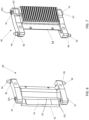
- Each cutting unit 42 comprises a support segment, referred to herein as a shoe 48, mounted to and between the rings 44 and 46, and a knife assembly 50 mounted at a leading edge of the shoe 48 and securing an individual knife 52 to the cutting unit 42.
- Each knife 52 is mounted to and supported by a radially inner surface of the shoe 48, referred to herein as a knife support surface 54 that is visible in FIG. 7 .
- the knives 52 are mounted to project in a radially inward direction of the cutting head 40 and in a direction that is generally opposite the direction of rotation of an impeller within the cutting head 40.
- Each knife 52 defines a cutting edge at its radially innermost extremity that engages products propelled within the cutting head 52 by an impeller rotating within the cutting head 40.
- slices, strip cuts, shreds and granulations may be produced with the cutting head 40 as a result of products engaging the knives 52.
- the knives 52 are represented as corrugated and adjacent knives 52 are offset 180 degrees from each other in the axial direction of the cutting head 40, so that peaks of a knife 52 are aligned with valleys of a knife 52 of an adjacent cutting unit 42, such that the resulting products produced by the cutting head 40 are shreds. Further details relating to the manner in which the knives 52 are secured within their respective knife assemblies 50 will be discussed below in reference to FIGS. 15 and 17 through 19 .
- FIG. 5 represents the shoes 48 as mounted to and secured between the rings 44 and 46 with camming units 56.
- Each camming unit 56 comprises a pin 58 that spans the axial distance between the rings 44 and 46.
- a lower end of each pin 58 protrudes through a hole 98 in the lower ring 44, and has an enlarged head 60 that prevents the pin 58 from being withdrawn upward through the hole 98.
- FIG. 9 depicts an oppositely-disposed upper end of the pin 58 as protruding through a hole 104 in the upper ring 44.
- the upper end of the pin 58 has an enlarged feature 62 (represented as a fragment of a sphere) adjacent the upper end of the pin 58 and an enlarged feature 64 (represented as roughly one-half of a disk) disposed at the upper end of the pin 58.
- the feature 62 is configured to pivotally engage a slot 68 in a camming member 66, depicted in FIGS. 10 through 14 as assembled with the upper end of the pin 58.
- the camming member 66 is located at the upper ring 44, and utilizes an over-center or toggle operation in which a camming surface 67 of the camming member 66 bears against a surface of the upper ring 44 to achieve a bistable pivoting action for the member 66, which displaces the upper end of the pin 58 away from the upper ring 44 to draw the rings 44 and 46 toward each other and thereby releasably secure the shoes 48 therebetween. More particularly, FIG.
- FIGS. 11 and 12 represent the position of the camming member 66 in an unlocking position in which the pin 58 releases the rings 44 and 46 and shoes 48, enabling these components of the cutting head 40 to be disassembled.
- FIGS. 13 and 14 represent the position of the camming member 66 in an unlocking position in which a narrower slot 70 of the camming member 66 has captured the feature 64 of the pin 58.
- the feature 64 and slot 70 are complementary in shape, such that the camming member 66 is not only operable to draw the pin 58 upward to lock the rings 44 and 46 and shoe 48 together, but is also operable to rotate the pin 58 about its axis of rotation.
- This aspect can be utilized to enable the pins 58 to not only serve as locking pins for the rings 44 and 46 and shoes 48 as part of the camming units 56, but also as adjustment pins for the knife assemblies 50 of the shoes 48 as part of an adjustment unit associated with each shoe 48.
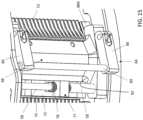
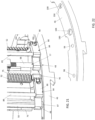
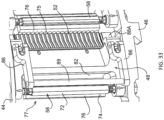
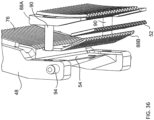
- FIGS. 15 and 16 depict one of the pins 58 as having a wedge-shaped camming portion 72 axially disposed between the rings 44 and 46 and adapted to cam against an inclined surface 74 ( FIGS. 6 and 16 ) formed on an outer surface region of the shoe 48 adjacent its trailing edge, such that the camming portion 72 is operable to deflect a gate 76 of the shoe 48 ( FIGS. 5 , 6 , 7 , and 16 ) in a radially inward direction of the cutting head 40.
- the pin 58 and its camming portion 72 in cooperation with the surface 74 (together constituting an adjustment unit 77) move the radial location of the trailing edge of the gate 76 relative to the cutting edge of the knife 52 (not shown) that trails the gate 76 on the cutting head 40, thereby controlling a gate opening 75 ( FIG. 15 ) between the cutting and trailing edges that determines the thickness of a product cut with the knife 52.
- the adjustment unit 77 serves as a replacement for the adjusting screw/pin 32 shown in FIG. 2 .
- the cutting head 40 could lack the adjustment unit 77 or any other adjustment feature adapted to alter the gate opening 75, and instead operate with a fixed gate opening 75.
- FIGS. 6 and 15 represent the shoe 48 as having a relief 82 in its outer surface region, extending in the axial direction of the cutting head 40 between the gate 76 and the leading edge of the shoe 48.
- the relief 82 creates a reduced-thickness section of the shoe 48 that promotes the ability of the gate 76 and its trailing edge to pivot or flex relative to the remainder of the shoe 48, including the knife 52 at its leading edge, so that the gate opening 75 defined by and between the trailing edge of the gate 76 and the cutting edge of a knife 52 immediately trailing the gate 76 can be selectively varied with the adjustment unit 77.
- the camming portion 72 is threadably engaged with threads 78 on the pin 58, so that rotation of the pin 58 about its axis of rotation causes the camming portion 72 to move in the axial direction of the cutting head 40 between the rings 44 and 46.
- the camming portion 72 and the surface 74 against which it cams are further depicted as comprising complementary features that in combination define a gage 80 with gage markings to indicate how far the gate 76 has been deflected by the camming portion 72.
- the graduation marks and accuracy of the gage 80 can be sufficient for producing shredded products.
- FIG. 20 represents an alternative embodiment in which the camming portion 72 is an eccentric camming surface formed directly on the surface of the pin 58, so that rotation of the pin 58 about its axis of rotation causes the camming portion 72 to cam against surfaces 74 on an outer surface region of the shoe 48 adjacent the trailing edge of the shoe 48.
- the camming portion 72 is operable to deflect the gate 76 in a radially inward direction of the cutting head 40 to alter the gate opening (not shown) defined by and between the trailing edge of the gate 76 and the cutting edge of the knife 52 (not shown) immediately trailing the gate 76.
- FIG. 5 represents the cutting head 40 as further comprising an additional set of camming units 84 adapted to secure the knives 52 of the cutting units 42 within their respective knife assemblies 50.
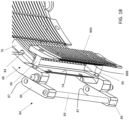
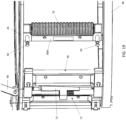
- each camming unit 84 comprises camming members 86 located at the outer surface region of each shoe 48 and adapted to draw a knife holder 88A of the knife assembly 50 toward the knife support surface 54 of the shoe 48 to clamp the knife 52 between the knife holder 88A and a clamp 88B ( FIG. 18 ) positioned between the knife 52 and knife support surface 54.
- Each camming unit 84 further comprises at least two clamping pins 90 ( FIGS.
- each clamping pin 90 engages the knife holder 88A and an opposite second end 92 ( FIG. 19 ) of each pin 90 protruding from the shoe 48 and engaging one of the camming members 86.
- Each camming member 86 pivotally engages the second end 92 of its respective clamping pin 90 and is adapted to displace the second end 92 away from the shoe 48 when pivoted relative to the clamping pin 90 so as to draw the knife holder 88A toward the shoe 48 and thereby releasably secure the knife 52 and clamp 88B between the knife holder 88A and the knife support surface 54 on the inner surface region of the shoe 48, as represented in FIGS. 15 and 17 .
- FIG. 18 depicts the camming members 86 as having been pivoted in the opposite direction to an unlocking position, thereby releasing the knife holder 88A from the knife support surface 54 to allow removal of the knife 52 (not shown).
- the camming members 86 are located adjacent outer surface regions of the shoe 48 and, similar to the camming members 66 of the camming units 56, the locking and unlocking actions of the members 86 are derived from an over-center or toggle action in which a camming surface 87 of each camming member 86 bears against an outer surface region of the shoe 48 to achieve a bistable pivoting action for the member 86.
- the camming unit 84 shown in FIGS. 15 , 17 and 18 further includes a connecting bar 89 that rigidly interconnects the camming members 86 to each other.
- the camming units 84 of the cutting head 40 serve as replacements for fasteners 36 shown in FIGS. 2 and 3 as securing the knives 20 and clamps 28B to the knife holders 28A.
- FIGS. 6, 7 , 21, and 22 represent additional nonlimiting aspects of the invention.
- each shoe 48 has axially aligned pairs of pins 94 located at the leading edge thereof and adapted for engaging the rings 44 and 46 to positively locate the leading edges of the shoes 48 relative to the rings 44 and 46.
- Spacers 96 surround the pins 94, and additional spacers 97 are located near the trailing edge of the shoe 48.
- FIG. 22 is an isolated view of the lower ring 46, but is representative of the upper ring 44 as well.
- the rings 44 and 46 each comprise alternating sets of first and second holes 98 and 100, with the former having smaller diameters than the latter as a result of the latter being counterbored.
- the pins 94 are sized to be received within the smaller holes 98 and the spacers 96 and 97 are sized to be received in the larger counterbored holes 100 but not the smaller holes 98.
- Through-holes 104 pass through the counterbored holes 100 and, when the shoe 48 is assembled with the rings 44 and 46 with the lower pin 94 and associated spacer 96 received in one of the counterbored holes 100 of the lower ring 46, the through-hole 104 of the other counterbored hole 100 is axially aligned with one of the holes 102 formed within the spacers 97 on the shoe 48, creating a series of holes 102 and 104 through which the pin 58 passes, thereby positively locating the trailing edge of the shoe 48 relative to the rings 44 and 46.
- the shoe 48 is positioned on the lower ring 46 so that its lower pin 94 and spacers 96 and 97 are received in the larger counterbored holes 100, such that the lower surface of the shoe 48 is in direct contact with the lower ring 46.
- the shoe 48 can be selectively positioned on the lower ring 46 so that its lower pin 94 (but not its corresponding spacer 96) is received in one of the smaller holes 98 and the hole 102 through the other spacer 97 on the shoe 48 is coaxially aligned with the other smaller hole 98 of the same set on the lower ring 46, such that the spacers 96 and 97 space the lower surface of the shoe 48 apart from the lower ring 46, as shown for the lefthand shoe 48 of FIG. 21 .
- the upper ring 44 can be assembled with the same shoe 48 so that the upper pin 94 and its corresponding spacer 96 are received in one of the larger counterbored holes 100 and the other spacer 97 is received in the other counterbored hole 100 of the same set on the upper ring 44, such that the upper surface of the shoe 48 is in direct contact with the upper ring 44.
- any shoe 48 of the cutting head 40 can be axially offset between the rings 44 and 46, as evident from the two shoes 48 seen in FIG. 21 .
- Such an offset is desirable for offsetting the knives 52 to produce shredded products, and eliminates the need for shims to obtain the offset.
- FIGS. 23 through 40 In view of similarities between the first and second embodiments of the cutting heads 40 represented in FIGS. 5 through 22 and FIGS. 23 through 40 , respectively, the following discussion of the second embodiment will focus primarily on aspects of the second embodiment that differ from the first embodiment in some notable or significant manner. Other aspects of the second embodiment not discussed in any detail can be, in terms of structure, function, materials, etc., essentially as was described for the first embodiment. For convenience, identical reference numerals are used in FIGS. 23 through 40 to denote the same or functionally related/equivalent elements described for the cutting head 40 of FIGS. 5 through 22 .
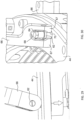
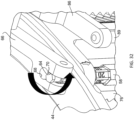
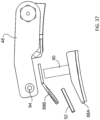
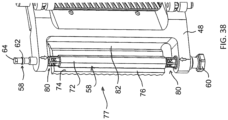
- the cutting head 40 represented in FIGS. 23 through 40 primarily differs from the cutting head 40 of FIGS. 5 through 22 as a result of having modified locking/adjustment pins 58 (visible in FIGS. 23 , 26-35 , and 37-39 ) utilized by the camming and adjustment units 56 and 77, and the use of steps formed in the rings 44 and 46 ( FIG. 40 ) instead of the holes 98, 100 and 104 and spacers 96 and 97 of FIGS. 6, 7 , and 22 to achieve an offset function.
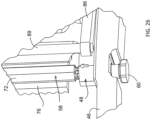
- the head 60 ( FIG. 8 ) and feature 64 ( FIGS. 9-14 ) have been modified to have hexagonal forms (visible in FIGS. 26-32 ), which enable the pins 58 to be rotated with the camming members 66 when not locked, but prevent rotation when the pins 58 are being tightened to prevent unintended adjustment changes.
- the camming portions 72 of the pins 58 shown in FIGS. 23 , 26-35 , and 37-39 correspond to that shown in FIG. 20 , namely, an eccentric camming surface formed directly on each adjustment pin 58.
- the gages 80 used to indicate how far the gate 76 has been deflected by the camming portion 72 are now present on the circumferences of the pins 58, with the deflection indicated by the numbers on each pin 58 aligned with arrows embossed on the shoes 48.
- the steps formed in the rings 44 and 46 in FIG. 40 are defined by recessed surfaces 106 circumferentially spaced apart on each ring 44 and 46.
- Each recessed surface 106 is circumferentially between two of the raised surfaces 108, and both surfaces 106 and 108 are sized to accommodate the circumferential length of a shoe 48.
- adjacent shoes 48 mounted to adjacent recessed and raised surfaces 106 and 108 will be axially offset from each other, as evident from the two shoes 48 seen in FIG. 39 , to produce shredded products.
Landscapes
- Life Sciences & Earth Sciences (AREA)
- Forests & Forestry (AREA)
- Engineering & Computer Science (AREA)
- Mechanical Engineering (AREA)
- Details Of Cutting Devices (AREA)
- Crushing And Pulverization Processes (AREA)
- Processing And Handling Of Plastics And Other Materials For Molding In General (AREA)
Applications Claiming Priority (3)
| Application Number | Priority Date | Filing Date | Title |
|---|---|---|---|
| US201962787568P | 2019-01-02 | 2019-01-02 | |
| EP20736211.2A EP3906141B1 (de) | 2019-01-02 | 2020-01-02 | Schneidköpfe, damit ausgerüstete schneidmaschinen und verfahren zum betrieb |
| PCT/US2020/012015 WO2020142582A1 (en) | 2019-01-02 | 2020-01-02 | Cutting heads, cutting machines equipped therewith, and methods of operation |
Related Parent Applications (2)
| Application Number | Title | Priority Date | Filing Date |
|---|---|---|---|
| EP20736211.2A Division EP3906141B1 (de) | 2019-01-02 | 2020-01-02 | Schneidköpfe, damit ausgerüstete schneidmaschinen und verfahren zum betrieb |
| EP20736211.2A Division-Into EP3906141B1 (de) | 2019-01-02 | 2020-01-02 | Schneidköpfe, damit ausgerüstete schneidmaschinen und verfahren zum betrieb |
Publications (2)
| Publication Number | Publication Date |
|---|---|
| EP4534263A2 true EP4534263A2 (de) | 2025-04-09 |
| EP4534263A3 EP4534263A3 (de) | 2025-07-16 |
Family
ID=71122447
Family Applications (3)
| Application Number | Title | Priority Date | Filing Date |
|---|---|---|---|
| EP25159048.5A Pending EP4534263A3 (de) | 2019-01-02 | 2020-01-02 | Schneidköpfe, damit ausgestattete schneidmaschinen und betriebsverfahren |
| EP25158959.4A Pending EP4603241A1 (de) | 2019-01-02 | 2020-01-02 | Schneidköpfe, damit ausgestattete schneidmaschinen und betriebsverfahren |
| EP20736211.2A Active EP3906141B1 (de) | 2019-01-02 | 2020-01-02 | Schneidköpfe, damit ausgerüstete schneidmaschinen und verfahren zum betrieb |
Family Applications After (2)
| Application Number | Title | Priority Date | Filing Date |
|---|---|---|---|
| EP25158959.4A Pending EP4603241A1 (de) | 2019-01-02 | 2020-01-02 | Schneidköpfe, damit ausgestattete schneidmaschinen und betriebsverfahren |
| EP20736211.2A Active EP3906141B1 (de) | 2019-01-02 | 2020-01-02 | Schneidköpfe, damit ausgerüstete schneidmaschinen und verfahren zum betrieb |
Country Status (6)
| Country | Link |
|---|---|
| US (1) | US11027450B2 (de) |
| EP (3) | EP4534263A3 (de) |
| AU (1) | AU2020204650B2 (de) |
| CA (1) | CA3122777C (de) |
| MX (1) | MX2021008120A (de) |
| WO (1) | WO2020142582A1 (de) |
Families Citing this family (2)
| Publication number | Priority date | Publication date | Assignee | Title |
|---|---|---|---|---|
| EP3527342A1 (de) | 2018-02-20 | 2019-08-21 | Fam | Messeranordnung und damit ausgestattetes schneidsystem |
| US11173622B2 (en) * | 2019-01-09 | 2021-11-16 | Frito-Lay North America, Inc. | Apparatus and method for adjusting the cutting thickness of a food cutting apparatus |
Citations (11)
| Publication number | Priority date | Publication date | Assignee | Title |
|---|---|---|---|---|
| US3139128A (en) | 1963-02-14 | 1964-06-30 | Joe R Urschel | Machine for slicing a food product |
| US3139129A (en) | 1959-06-29 | 1964-06-30 | Joe R Urschel | Method of slicing a food product |
| US5694824A (en) | 1994-04-18 | 1997-12-09 | Urschel Laboratories Incorporated | Cutting head for slicing a food product |
| US6968765B2 (en) | 2003-05-29 | 2005-11-29 | Urschel Laboratories Inc. | Cutting head for cutting a food product |
| US7658133B2 (en) | 2006-04-18 | 2010-02-09 | Urschel Laboratories, Inc. | Apparatus for cutting food product |
| US8161856B2 (en) | 2006-04-18 | 2012-04-24 | Urschel Laboratories, Inc. | Apparatus for cutting food product |
| US9193086B2 (en) | 2013-04-02 | 2015-11-24 | Urschel Laboratories, Inc. | Apparatus for cutting food products |
| US9469041B2 (en) | 2012-04-23 | 2016-10-18 | Urschel Laboratories, Inc. | Methods and equipment for cutting food products |
| US20160361831A1 (en) | 2015-06-12 | 2016-12-15 | Urschel Laboratories, Inc. | Machines and methods for cutting products |
| US20180126581A1 (en) | 2016-11-08 | 2018-05-10 | Urschel Laboratories, Inc. | Knife assembly for slicing machines and machines equipped therewith |
| US10456943B2 (en) | 2014-12-03 | 2019-10-29 | Urschel Laboratories, Inc. | Machines and methods for cutting products and impellers therefor |
Family Cites Families (13)
| Publication number | Priority date | Publication date | Assignee | Title |
|---|---|---|---|---|
| US4523503A (en) * | 1983-08-22 | 1985-06-18 | Lamb-Weston, Inc. | Apparatus for making waffle-cut potato |
| US5095875A (en) * | 1989-06-21 | 1992-03-17 | Carl Morris | Knife for producing waffle and lattice cuts |
| US6314849B1 (en) * | 1997-09-19 | 2001-11-13 | Urschel Laboratories Inc. | Dicing machine with improved cutting squareness |
| US6536691B2 (en) | 2001-02-23 | 2003-03-25 | Leprino Foods Company | Apparatus for and method of shredding a product |
| US8109188B2 (en) * | 2008-07-18 | 2012-02-07 | Frito-Lay Trading Company Gmbh | Modified slicing shoes and method for making food product shavings |
| US8714068B2 (en) * | 2012-09-28 | 2014-05-06 | Frito-Lay North America, Inc. | Tailored slicing |
| JP6538049B2 (ja) * | 2013-11-21 | 2019-07-03 | ファム | 波形切刃の刃組立体及びそれを備える切断システム |
| US20160067877A1 (en) * | 2014-09-05 | 2016-03-10 | Frito-Lay North America, Inc. | Cutting Head Assembly For Slicing Food |
| JP6167161B2 (ja) * | 2015-12-18 | 2017-07-19 | 菱和株式会社 | 連鎖状食品切断装置 |
| US10807268B2 (en) * | 2017-02-10 | 2020-10-20 | Urschel Laboratories, Inc. | Modular units, clamping assemblies, and slicing machines equipped therewith |
| US10786922B2 (en) * | 2017-05-16 | 2020-09-29 | Urschel Laboratories, Inc. | Modular units, clamping assemblies, and slicing machines equipped therewith |
| IT201700063874A1 (it) * | 2017-06-09 | 2018-12-09 | Pizzoli S P A | Macchina perfezionata per il taglio di prodotti alimentari |
| US10780602B2 (en) * | 2018-04-25 | 2020-09-22 | Urschel Laboratories, Inc. | Clamping assemblies and slicing machines equipped therewith |
-
2020
- 2020-01-02 CA CA3122777A patent/CA3122777C/en active Active
- 2020-01-02 MX MX2021008120A patent/MX2021008120A/es unknown
- 2020-01-02 EP EP25159048.5A patent/EP4534263A3/de active Pending
- 2020-01-02 WO PCT/US2020/012015 patent/WO2020142582A1/en not_active Ceased
- 2020-01-02 EP EP25158959.4A patent/EP4603241A1/de active Pending
- 2020-01-02 EP EP20736211.2A patent/EP3906141B1/de active Active
- 2020-01-02 US US16/732,478 patent/US11027450B2/en active Active
- 2020-01-02 AU AU2020204650A patent/AU2020204650B2/en active Active
Patent Citations (11)
| Publication number | Priority date | Publication date | Assignee | Title |
|---|---|---|---|---|
| US3139129A (en) | 1959-06-29 | 1964-06-30 | Joe R Urschel | Method of slicing a food product |
| US3139128A (en) | 1963-02-14 | 1964-06-30 | Joe R Urschel | Machine for slicing a food product |
| US5694824A (en) | 1994-04-18 | 1997-12-09 | Urschel Laboratories Incorporated | Cutting head for slicing a food product |
| US6968765B2 (en) | 2003-05-29 | 2005-11-29 | Urschel Laboratories Inc. | Cutting head for cutting a food product |
| US7658133B2 (en) | 2006-04-18 | 2010-02-09 | Urschel Laboratories, Inc. | Apparatus for cutting food product |
| US8161856B2 (en) | 2006-04-18 | 2012-04-24 | Urschel Laboratories, Inc. | Apparatus for cutting food product |
| US9469041B2 (en) | 2012-04-23 | 2016-10-18 | Urschel Laboratories, Inc. | Methods and equipment for cutting food products |
| US9193086B2 (en) | 2013-04-02 | 2015-11-24 | Urschel Laboratories, Inc. | Apparatus for cutting food products |
| US10456943B2 (en) | 2014-12-03 | 2019-10-29 | Urschel Laboratories, Inc. | Machines and methods for cutting products and impellers therefor |
| US20160361831A1 (en) | 2015-06-12 | 2016-12-15 | Urschel Laboratories, Inc. | Machines and methods for cutting products |
| US20180126581A1 (en) | 2016-11-08 | 2018-05-10 | Urschel Laboratories, Inc. | Knife assembly for slicing machines and machines equipped therewith |
Also Published As
| Publication number | Publication date |
|---|---|
| CA3122777C (en) | 2023-10-10 |
| US20200206964A1 (en) | 2020-07-02 |
| EP4603241A1 (de) | 2025-08-20 |
| EP3906141A1 (de) | 2021-11-10 |
| US11027450B2 (en) | 2021-06-08 |
| EP3906141A4 (de) | 2022-08-24 |
| EP3906141B1 (de) | 2026-03-18 |
| WO2020142582A1 (en) | 2020-07-09 |
| AU2020204650A1 (en) | 2021-06-17 |
| AU2020204650B2 (en) | 2022-03-31 |
| MX2021008120A (es) | 2021-08-05 |
| CA3122777A1 (en) | 2020-07-09 |
| EP4534263A3 (de) | 2025-07-16 |
Similar Documents
| Publication | Publication Date | Title |
|---|---|---|
| US12083699B2 (en) | Modular units, clamping assemblies, and slicing machines equipped therewith | |
| US10786922B2 (en) | Modular units, clamping assemblies, and slicing machines equipped therewith | |
| US10780602B2 (en) | Clamping assemblies and slicing machines equipped therewith | |
| EP3538331B1 (de) | Messeranordnung für aufschnittmaschinen und hiermit ausgestattete maschinen | |
| AU2020204650B2 (en) | Cutting heads, cutting machines equipped therewith, and methods of operation | |
| EP4592045B1 (de) | Messeranordnungen von aufschnittschneidemaschinen, verfahren zum spannen und lösen von messern daraus und damit ausgestattete aufschnittschneidemaschinen | |
| US11590671B2 (en) | Knife holders, cutting heads and slicing machines equipped therewith, and processes of manufacture | |
| US20260077530A1 (en) | Cutting heads, cutting machines equipped therewith, and methods of operation |
Legal Events
| Date | Code | Title | Description |
|---|---|---|---|
| PUAI | Public reference made under article 153(3) epc to a published international application that has entered the european phase |
Free format text: ORIGINAL CODE: 0009012 |
|
| STAA | Information on the status of an ep patent application or granted ep patent |
Free format text: STATUS: REQUEST FOR EXAMINATION WAS MADE |
|
| 17P | Request for examination filed |
Effective date: 20250220 |
|
| AC | Divisional application: reference to earlier application |
Ref document number: 3906141 Country of ref document: EP Kind code of ref document: P |
|
| AK | Designated contracting states |
Kind code of ref document: A2 Designated state(s): AL AT BE BG CH CY CZ DE DK EE ES FI FR GB GR HR HU IE IS IT LI LT LU LV MC MK MT NL NO PL PT RO RS SE SI SK SM TR |
|
| REG | Reference to a national code |
Ref country code: DE Ref legal event code: R079 Free format text: PREVIOUS MAIN CLASS: B26D0003280000 Ipc: B26D0001360000 |
|
| PUAL | Search report despatched |
Free format text: ORIGINAL CODE: 0009013 |
|
| AK | Designated contracting states |
Kind code of ref document: A3 Designated state(s): AL AT BE BG CH CY CZ DE DK EE ES FI FR GB GR HR HU IE IS IT LI LT LU LV MC MK MT NL NO PL PT RO RS SE SI SK SM TR |
|
| RIC1 | Information provided on ipc code assigned before grant |
Ipc: B26D 1/36 20060101AFI20250611BHEP Ipc: B26D 1/62 20060101ALI20250611BHEP Ipc: B26D 1/00 20060101ALI20250611BHEP Ipc: B26D 7/26 20060101ALI20250611BHEP Ipc: B26D 3/26 20060101ALI20250611BHEP Ipc: B26D 3/28 20060101ALI20250611BHEP |
|
| RAP3 | Party data changed (applicant data changed or rights of an application transferred) |
Owner name: URSCHEL LABORATORIES, INC. |