EP4531485A2 - Verfahren und vorrichtung zur signalisierung von systeminformationen - Google Patents
Verfahren und vorrichtung zur signalisierung von systeminformationen Download PDFInfo
- Publication number
- EP4531485A2 EP4531485A2 EP25151023.6A EP25151023A EP4531485A2 EP 4531485 A2 EP4531485 A2 EP 4531485A2 EP 25151023 A EP25151023 A EP 25151023A EP 4531485 A2 EP4531485 A2 EP 4531485A2
- Authority
- EP
- European Patent Office
- Prior art keywords
- minimum
- random access
- system information
- broadcasted
- message
- Prior art date
- Legal status (The legal status is an assumption and is not a legal conclusion. Google has not performed a legal analysis and makes no representation as to the accuracy of the status listed.)
- Pending
Links
Images




Classifications
-
- H—ELECTRICITY
- H04—ELECTRIC COMMUNICATION TECHNIQUE
- H04L—TRANSMISSION OF DIGITAL INFORMATION, e.g. TELEGRAPHIC COMMUNICATION
- H04L5/00—Arrangements affording multiple use of the transmission path
- H04L5/003—Arrangements for allocating sub-channels of the transmission path
- H04L5/0048—Allocation of pilot signals, i.e. of signals known to the receiver
-
- H—ELECTRICITY
- H04—ELECTRIC COMMUNICATION TECHNIQUE
- H04W—WIRELESS COMMUNICATION NETWORKS
- H04W36/00—Hand-off or reselection arrangements
- H04W36/0005—Control or signalling for completing the hand-off
- H04W36/0055—Transmission or use of information for re-establishing the radio link
-
- H—ELECTRICITY
- H04—ELECTRIC COMMUNICATION TECHNIQUE
- H04W—WIRELESS COMMUNICATION NETWORKS
- H04W4/00—Services specially adapted for wireless communication networks; Facilities therefor
- H04W4/06—Selective distribution of broadcast services, e.g. multimedia broadcast multicast service [MBMS]; Services to user groups; One-way selective calling services
-
- H—ELECTRICITY
- H04—ELECTRIC COMMUNICATION TECHNIQUE
- H04W—WIRELESS COMMUNICATION NETWORKS
- H04W48/00—Access restriction; Network selection; Access point selection
- H04W48/08—Access restriction or access information delivery, e.g. discovery data delivery
- H04W48/10—Access restriction or access information delivery, e.g. discovery data delivery using broadcasted information
-
- H—ELECTRICITY
- H04—ELECTRIC COMMUNICATION TECHNIQUE
- H04W—WIRELESS COMMUNICATION NETWORKS
- H04W48/00—Access restriction; Network selection; Access point selection
- H04W48/08—Access restriction or access information delivery, e.g. discovery data delivery
- H04W48/12—Access restriction or access information delivery, e.g. discovery data delivery using downlink control channel
-
- H—ELECTRICITY
- H04—ELECTRIC COMMUNICATION TECHNIQUE
- H04W—WIRELESS COMMUNICATION NETWORKS
- H04W48/00—Access restriction; Network selection; Access point selection
- H04W48/08—Access restriction or access information delivery, e.g. discovery data delivery
- H04W48/14—Access restriction or access information delivery, e.g. discovery data delivery using user query or user detection
-
- H—ELECTRICITY
- H04—ELECTRIC COMMUNICATION TECHNIQUE
- H04W—WIRELESS COMMUNICATION NETWORKS
- H04W72/00—Local resource management
- H04W72/20—Control channels or signalling for resource management
-
- H—ELECTRICITY
- H04—ELECTRIC COMMUNICATION TECHNIQUE
- H04W—WIRELESS COMMUNICATION NETWORKS
- H04W74/00—Wireless channel access
- H04W74/002—Transmission of channel access control information
- H04W74/006—Transmission of channel access control information in the downlink, i.e. towards the terminal
Definitions
- the present disclosure is directed to a method and apparatus for signaling on a wireless network. More particularly, the present disclosure is directed a method and apparatus for signaling of system information on a wireless wide area network.
- 5th generation New Radio (NR) wireless systems offer improved wireless network technologies.
- 5G NR includes such technologies as millimeter wave bands, such as 26, 28, 38, and 60 GHz and can offer theoretical throughput as high as 20 gigabits per second, with median bandwidth being approximately 3.5 gigabits.
- 5G NR can utilize Multiple Input Multiple Output (MIMO), for example 64-256 antennas, to provide up to ten times the performance of 4 th generation (4G) networks.
- MIMO Multiple Input Multiple Output
- 4G NR aims to reduce signaling overhead.
- One such reduction occurs during initial interaction between a wireless device and a network entity within a cell.
- SI System Information
- minimum System Information The minimum System Information (SI) can contain basic information for initial access to the cell.
- Embodiments provide a method and apparatus for signaling of system information.
- minimum system information including at least cell access information to establish access with a cell can be received, the minimum system information also including at least one indication indicating whether particular system information listed in scheduling information in the minimum system information is being broadcasted or not being broadcasted.
- a system information request message requesting transmission of non-minimum system information if the at least one indication indicates the non-minimum system information is not being broadcasted can be transmitted, where the non-minimum system information is not included in the minimum system information.
- the non-minimum system information either in response to the transmitting of the system information request message or in response to the at least one indication indicating whether particular system information is being broadcasted can be received.
- FIG. 1 is an example block diagram of a system 100, according to a possible embodiment.
- the system 100 can include a User Equipment (UE) 110, at least one of network entities 120 and 125, such as a base station, and a network 130.
- the UE 110 can be a wireless wide area network device, a user device, wireless terminal, a portable wireless communication device, a smartphone, a cellular telephone, a flip phone, a personal digital assistant, a personal computer, a selective call receiver, an Internet of Things (IoT) device, a tablet computer, a laptop computer, or any other user device that is capable of sending and receiving communication signals on a wireless network.
- IoT Internet of Things
- the at least one of network entities 120 and 125 can be wireless wide area network base stations, can be NodeBs, can be enhanced NodeBs (eNBs), can be New Radio NodeBs (gNBs), such as 5G NodeBs, can be unlicensed network base stations, can be access points, can be base station controllers, can be network controllers, can be Transmission/Reception Points (TRPs), can be different types of base stations from each other, and/or can be any other network entities that can provide wireless access between a UE and a network.
- eNBs enhanced NodeBs
- gNBs New Radio NodeBs
- 5G NodeBs 5G NodeBs
- TRPs Transmission/Reception Points
- the network 130 can include any type of network that is capable of sending and receiving wireless communication signals.
- the network 130 can include a wireless communication network, a cellular telephone network, a Time Division Multiple Access (TDMA)-based network, a Code Division Multiple Access (CDMA)-based network, an Orthogonal Frequency Division Multiple Access (OFDMA)-based network, a Long Term Evolution (LTE) network, a 3rd Generation Partnership Project (3GPP)-based network, a satellite communications network, a high altitude platform network, the Internet, and/or other communications networks.
- the network entity 120 and the UE 110 can be included in a cell 135, the network entity 125 can be included in another cell 155, and the network entities 120 and 125 can be coupled via the network 130.
- the UE 110 can communicate with the network 130 via the network entity 120.
- the UE 110 can send and receive control signals on a control channel and user data signals on a data channel.
- the system 100 can reduce the signaling load for the provisioning of System Information, the concept of so-called "minimum System Information" which has been introduced for New Radio (NR).
- the minimum System Information (SI) 140 can contain basic information for initial access to the cell 135 and can include such information as Management Information Base (MIB) and can include SIB 1 information, such as Subframe Number (SFN), list of Public Land Mobile Network (PLMN), cell camping parameters, and Random Access Channel (RACH) parameters.
- MIB Management Information Base
- SIB 1 information such as Subframe Number (SFN), list of Public Land Mobile Network (PLMN), cell camping parameters, and Random Access Channel (RACH) parameters.
- the minimum SI 140 can be broadcast periodically in the cell 135, whereas other "non-minimum" SI 150 does not necessarily need to be periodically broadcast, and the network 130 can decide whether such information is to be periodically broadcast.
- the UE 110 can transmit an SI request message 145 to the network 130, via the network entity 120, to request the non-minimum SI 150.
- the network 130 can transmit, via the network entity 120, the non-minimum SI 150 to the UE 110.
- the non-minimum SI 150 can be provided on-demand to the UE 110, that is the UE 110 can request the non-minimum SI 150 via the SI request message 145. Delivery of the non-minimum SI 150 can also be done by broadcast or unicast manner.
- the minimum SI 140 can include system information scheduling information and can indicate whether a specific system information, such as an SI block (SIB) that can be periodically broadcasted or provided on-demand.
- SIB SI block
- the non-minimum SI 150 can include multiple SIBs.
- the particular system information (not SI) can be broadcast at least in a SIB and can also be broadcast in an SI message including at least one SIB.
- one SI message can include one or more SIBs.
- the system information can be provided in a SIB or other system information message, such as a message that includes at least one SIB.
- UE 110 can initiate an on-demand SI acquisition procedure. For SI required by the UE 110, the UE 110 can know whether it is available in the cell 135 and whether the SI is broadcast or not before the UE 110 can send the SI request message 145, that is the UE 110 can first acquire the minimum SI 140. Scheduling information for other SI can be provided by the minimum SI 140, such as in a SIB1, can include SIB type, validity information, periodicity, and an SI-window information.
- the UE 110 in idle and an inactive state can transmit the SI request message 145 requesting the non-minimum SI 150 without state transition using an MSG1 and/or MSG3-based approach.
- RRC Radio Resource Control
- the UE 110 can transmit the SI request message 145 in physical layer Random Access Preamble (RAP), in a Medium Access Control (MAC), or in an RRC message, for example as an MSG1 and/or MSG3, such as when the UE 110 is in the idle state, or when the UE 110 is in the connected state.
- RAP physical layer Random Access Preamble
- MAC Medium Access Control
- RRC message for example as an MSG1 and/or MSG3
- MSG1 based signaling can rely on association between one or more reserved preambles and a corresponding set(s) of SIB(s).
- the UE 110 can transmit/initiate corresponding MSG1 transmissions.
- the system 100 can provide a signaling-structure for requesting SIBs using an MSG3 and dedicated signaling.
- a poorly designed signaling-structure can run a risk of misinterpretation if certain SIBs' scheduling changes in-between the UE 110 transmission and the network 130 reception of the signaling-structure requesting the SIBs. This may not only delay the acquisition of certain SIB(s) in the UE 110 but also the network 130 can unnecessarily broadcast certain SIB(s) that were actually not even requested.
- Another fallout of a poorly designed signaling-structure could be that the signaling-structure itself is quite inefficient/ big and thereby result in a reduction of chances of a quick and successful transmission.
- FIG. 2 is an example scenario 200 showing transmission of SI messages, according to a possible embodiment.
- system information except MIB and SIB1 can be transmitted in so called SI messages.
- the SI messages can be transmitted within periodically occurring time domain windows, which can be referred to as SI-windows, using dynamic scheduling.
- Each SI message can be associated with an SI-window and the SI-windows of different SI messages may not overlap. That is, within one SI-window only the corresponding SI can be transmitted.
- the length of the SI-window can be common for all SI messages and can be configurable.
- the corresponding SI message can be transmitted a number of times.
- the UE 110 can acquire detailed time-domain scheduling, and can acquire other information, e.g. frequency-domain scheduling, used transport format, from decoding SI-Radio Network Temporary Identifier (RNTI) on a Physical Downlink Control Channel (PDCCH).
- RNTI SI-Radio Network Temporary Identifier
- PDCCH Physical Downlink Control Channel
- the scheduling information for SI can be provided by the minimum SI 140, such as in SIB1, and may include SIB type, validity information, periodicity, SI-window information and an indication whether the particular SIB-type is broadcasted or not.
- SIB the minimum SI 140
- validity information such as in SIB1
- SI-window information an indication whether the particular SIB-type is broadcasted or not.
- the embodiments reference a SIB
- the actual network may provide them in SI-messages, such as in LTE.
- Two schemes can be available as follows:
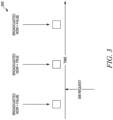
- FIG. 3 is an example scenario 300 showing toggling of a "Broadcast Now” Boolean Flag, according to a possible embodiment.
- the network 130 can toggle the Boolean Flag back when the network 130 has provided/ broadcasted the SIB for a sufficiently long time, for example until an end of a current modification period as described by 3GPP TS 36.331-e30 section 5.2.1.3, such as by resetting the Broadcasted Now flag to False.
- an indication can be used to indicate if a SIB or SI message is being broadcasted now in the current modification period. If the indication indicates that a particular SIB/SI message is broadcasted now, the network shall broadcast that SIB/SI until the end of the current modification period and the UE 110 thereby can have opportunities until the end of current modification period to acquire the SIB/SI.
- one indicator in SIB 1 can indicate whether an SI message is currently being broadcast or not. The indication shall be valid until an end of the current modification period.
- the network 130 can guarantee to the UE 110 that when a particular non-minimum SI is indicated as being broadcasted, the particular non-minimum SI 150 can be broadcasted until an end of the current modification period in which it is indicated as being broadcasted.
- FIG. 4 is an example signaling structure 400 for requesting SIBs, such as a SIB or SI request, according to a possible embodiment.
- the UE 110 can request SIBs by listing each SIB-type separately, such as illustrated in signaling solution 400.
- the system information can comprise a system information message, where the system information request message can comprise a list of one or more of a unique system information message for the requested non-minimum system information, such as the list illustrated in the signaling structure 400.
- the SI request message 145 can include this signaling solution 400.
- another signaling structure that can be included within the SI request message 145 for non-minimum SI 150 can include use of a BITMAP.
- the UE 110 can send the SI request message 145 that includes the BITMAP to the network 130.
- bits in the BITMAP can represent either SIBs or SI messages.
- the bits of the BITMAP can represent SI messages and these bits can be the SI messages indicated in the scheduling information in SIB1 of the current cell.
- the UE 110 can determine the SI message(s) based for the SIB(s) that it needs based on the corresponding scheduling information in SIB1.
- the bits of the BITMAP can represent SIBs, sequentially.
- no indication is required in a broadcast message to indicate whether the other/non-minimum SIBs are provided via periodic broadcast basis or only on-demand basis.
- bits in the BITMAP represent SIBs sequentially starting with a first bit for the first SIB that is carried in SI Messages, such as SIB2, a second bit for the second SIB that is carried next in the same or next SI messages, such as SIB3, and so on.
- the bits of the BITMAP can represent SIBs, sequentially, where the SIBs as numbered in the 3GPP specification 38.331 of future versions.
- BIT1 of the BITMAP can represent SIB2
- BIT2 of the BITMAP can represent SIB3...
- BIT24 of the BITMAP can represent SIB25.
- bits in the BITMAP can represent SIBs sequentially starting with a first bit for a first SIB that can be indicated as being provided on on-demand basis in the current cell, then a second bit for a second SIB that can be indicated as being provided on on-demand basis in the cell 135, and so on.
- a length of the BITMAP can be set to a maximum number of specified SIBs or to the number of SI messages broadcasted in the cell 135.
- the BITMAP can be a same length as number of SIBs defined in NR, can be a same length as number of SIBs supported in the cell 135, can be the number of SI messages broadcasted in the cell 135 or can be a longer value, such as 40 bits to account for future SIBs and/ or SI messages. If the BITMAP is 40 bits but we only have a total of 25 SIBs in NR or 25 SI messages broadcasted in the cell, then BIT1 of the BITMAP represents SIB2/SI message1, BIT2 of the BITMAP represents SIB3/ SI message2..., BIT24 of the BITMAP represents SIB25/SI message24.
- the remaining bits, if any in the BITMAP, such as BIT25 to BIT40 in a 40-bit BITMAP, can be set to '0' or ⁇ 1' by the UE 110 and can be ignored by the network entity 120 in any of the embodiments.
- the network 130 may configure the length of the BITMAP based on the SIB-types the network 130 can broadcast.
- the BITMAP length may have provision for some additional bits for future use.
- One bit in the BITMAP can correspond to one SIB request.
- the BITMAP may be interpreted by the network 130 from the left to right, or right to left, such that the first bit in the BITMAP can correspond to the lowest SIB-type being requested, a next bit in the BITMAP can correspond to a next higher SIB-type being requested, and so on.
- the BITMAP may be interpreted by the network 130 from the left to right, or right to left, such that the first bit in the BITMAP can correspond to the highest SIB-type being requested, a next bit in the BITMAP can correspond to a next lower SIB-type being requested, and so on.
- the following three sub-solutions can be implemented by the network 130.
- BITMAP-Solution A One bit can be included within the BITMAP for each SI-message irrespective of if particular SI messages are "regularly" broadcasted or transmitted on-demand by the network 130.
- BITMAP-Solution B One bit can be included within the BITMAP only for each of those SI-messages that are indicated as to be provided on-demand, for example statically, such as irrespective of if these SI-messages are being provided/ broadcasted at a moment by the network 130.
- BITMAP-Solution C One bit can be included within the BITMAP only for each of those SI-messages that are indicated as to be provided on-demand by the network 130 but are NOT being provided/ broadcasted at the moment, such as dynamic toggling of bits, by the network 130.
- the UE can request again BITMAP-Solution B Not - applicable Not-applicable BITMAP-Solution C Can use 2 bits and request the SIBs that this UE needs.
- Bit 1 can represent SIB2
- Bit 2 can represent SIB3 Interpretation at T2 can be changed Table 3 Scheme-2 First-Bit Second-Bit: @time-instant T1 Second-Bit: @time-instant T2 SIB1 Broadcasted Regularly - - SIB2 On-demand Not Broadcasted Now Broadcasted Now SIB3 On-demand Not Broadcasted Now Not Broadcasted Now SIB4 On-demand Broadcasted Now Not Broadcasted Now Table 4 Scheme 2 using 2 bits First-bit (Regularly Broadcasted or On-Demand) Second-Bit: Broadcasted Now (Y or No) BITMAP-Solution A Can use 4 bits but the UE may not request the SIBs that are "Regularly Broadcasted” OR SIBs that are "Broadcasted Now” Interpretation at T2 is un-changed.
- the BITMAP-Solution A can avoid misinterpretation due to a time lag between initial transmission by the UE 110 and actual reception time at the network 130 after possibly more than 1 Hybrid Automatic Repeat Request. (HARQ) (re)transmissions and also can need only 1 Broadcast bit, for example, Scheme-1 is sufficient.
- HARQ Hybrid Automatic Repeat Request.
- SIB1 to SIB10 can be provided by the network 130 in SI messages from the 3GPP perspective.
- the cell 135 may only provide/support SIBs 2, 4, 6, 8 and 10. This means that SIBs 3, 5, 7, 9 may not be provided/supported by the cell 135. Therefore, in the scheduling info in SIB1 only SIBs 2, 4, 6, 8 and 10 are listed.
- SIBs 2, 4 and 6 can be indicated as being broadcasted or guaranteed to be broadcasted until the current modification period boundary and SIBs 8 and 10 can be indicated as not being broadcasted, such as when the flag-indication for both these is FALSE.
- the UE 110 may only request SIB 8 and SIB 10.
- the UE 110 may not be allowed/supposed to request any of SIBs 3, 5, 7, 9.
- the network 130 can regularly broadcast certain SIBs and the SI request message 145 can show these SIBs as "required”. Then the SI request message 145 for such SIBs can be ignored by the network 130 since the network 130 may continue to regularly broadcast these SIBs.
- the on-demand SIBs including the non-minimum SI 150 that are not broadcasted can now be broadcasted subsequently.
- SIBs A to H are provided on an on-demand basis and the network 130 configures four preambles to request the SIBs as follows:
- FIG. 5 is an example first option 500 for a UE 110 to request its needed SIBs, according to a possible embodiment.
- the first option 500 includes transmission of one SI request message 145 at a time from the UE 110.
- the UE 110 can then look to receive a feedback message, such as a Random Access Response (RAR), to its request for non-minimum SI 150.
- RAR Random Access Response
- One preamble can be used by the UE 110 for a group of SIBs, with no further optimization of the non-minimum SI 150.
- FIG. 6 is an example illustration of a second option 600 for a UE 110 to request its needed SIBs, according to a possible embodiment.
- the feedback message such as the RAR
- the RAR is scheduled on one single common RNTI, such as a Random Access (RA)-RNTI, and carries a list of received preambles to indicate the corresponding SIBs that the network 130 is going to provide in response to possibly more than one requesting UE 110.
- RA Random Access
- the UE 110 need not send separate SI-requests/Preambles to request SI-messages grouped separately, saving uplink (UL) transmission/battery and optimizing UL interference/collisions.
- the network 130 need not send a feedback/response to each of the requests, saving downlink (DL) transmission/resources.
- the second option 600 saves RNTIs space and further, RA-RNTI calculation may not be required.
- none of the fields in MAC RAR payload are required, that is none of timing advance command, UL grant, or temporary Cell (C)-RNTI.
- the system 100 can eliminate transmission of the MAC RAR and allows for DL signaling reduction.
- the MSG2, that is feedback from MSG1, can consist of only Extension (E)/Type (T)/ Random Access Preamble IDentitfier (RAPID) MAC sub-header and some of reserved Preambles, such as RAPIDs, that are configured by the network 130 to be associated with a corresponding MAC RAR.
- PDSCH Physical Downlink Shared Channel
- This MAC RAR can contain part or whole of either/both SIBs G, H. The "part" could correspond to the new changes in that SIB compared to a previous transmitted version.
- an explicit indication in the MAC sub-header itself can be used, such as a one-bit Boolean flag.
- This Boolean flag indicating if a MAC RAR is transmitted, signals the UE 110 to receive a corresponding MAC RAR, such as a PDSCH transmission.
- This MAC RAR can contain part or whole of the any one or more SIBs A to SIB H.
- FIG. 7 is an example flowchart 700 illustrating operation of an apparatus such as a wireless communication device, for example the UE 110, according to a possible embodiment.
- the minimum SI 140 including at least cell access information to establish access with a cell can be received.
- the minimum SI 140 can also include at least one indication indicating whether particular system information listed in scheduling information in the minimum SI 140 is being broadcasted or not being broadcasted.
- the at least one indication can be a Boolean flag.
- the at least one indication can include a first indication, where the minimum system information can further include a second indication indicating whether the particular system information listed in the scheduling information in the minimum system information is regularly broadcast or provided to the user equipment on-demand.
- Transmitting the system information request message can include transmitting the system information request message in response to the second indication indicating that the particular on-demand system information not being currently broadcast and the second indication indicating the particular system information is provided on-demand.
- the system information can include a system information message, where the system information request message can include a list of one or more of a unique system information message for the requested non-minimum system information.
- the SI request message 145 can include a BITMAP, where each bit in the BITMAP can each correspond to a unique system information message for the requested non-minimum system information.
- each bit of the BITMAP can indicate a different system information message or a different system information block.
- a leftmost bit of the BITMAP can correspond to a lowest valued unique system information message type requested
- a rightmost bit of the BITMAP can correspond to a highest valued unique system information message type requested
- bits ordered from the leftmost bit to the rightmost bit can be ordered in accordance with increased valued minimum information requested.
- each bit in the BITMAP can correspond to particular system information irrespective of if the particular system information is regularly broadcasted or on-demand. In a possible embodiment, each bit in the BITMAP can correspond to only particular system information that is indicated as being provided on-demand. In a possible embodiment, each bit in the BITMAP can correspond to only particular system information that is indicated as being provided on-demand and not being currently provided to the user equipment. In a possible embodiment, only selected bits of the BITMAP, where the selected bits indicate system information that is not being broadcast and required by the user equipment, can be set by the UE 110.
- the SI request message 145 requesting transmission of the non-minimum SI 150 can be transmitted. According to a possible embodiment, this transmission can occur if the at least one indication indicates the non-minimum SI 150 is not being broadcasted, where the non-minimum SI 150 is not included in the minimum SI 140.
- the non-minimum SI 150 can be received either in response to the transmission of the SI request message 145 at 720 or in response to the at least one indication indicating whether particular SI is being broadcasted.
- FIG. 8 is an example flowchart 800 illustrating operation of an apparatus such as a network entity, for example the network entity 120, according to a possible embodiment.
- the minimum SI 140 including at least cell access information to establish access with a cell can be transmitted.
- the minimum SI 140 can also include at least one indication indicating whether particular SI listed in the scheduling information in the minimum SI 140 is being broadcasted or not being broadcasted.
- the at least one indication can be a Boolean flag as described above and in 710.
- the SI request message 145 can comprise a BITMAP, as described above and in element 710 above.
- the SI request message 145 requesting transmission of the non-minimum SI 150 can be received. According to a possible implementation, this reception by the network entity 120 can occur if the at least one indication indicates the non-minimum SI 150 is not being broadcasted, where the non-minimum SI 150 is not included in the minimum SI 140.
- the non-minimum SI 150 can be transmitted either in response to the receiving of the SI request message 145 at 820 or in response to the at least one indication indicating whether particular SI listed in the scheduling information in the minimum SI 140 is being broadcasted.
- FIG. 9 is an example flowchart 900 illustrating another operation of the wireless communication device, for example the UE 110, according to a possible embodiment.
- the minimum SI 140 including at least cell access information to establish access with a cell can be received .
- the SI request message 145 requesting transmission of the non-minimum SI 150 can be transmitted, where the SI request message 145 can include a BITMAP.
- each bit in the BITMAP can correspond to a unique SI message for the requested non-minimum SI 150, where the non-minimum SI 150 is not included in the minimum SI 140.
- the BITMAP can include the features described above and in 710.
- the non-minimum SI 150 can be received in response to the transmission of the SI request message including the BITMAP at 920.
- FIG. 10 is another example flowchart 1000 illustrating another operation of a network entity, for example the network entity 120, according to a possible embodiment.
- the minimum SI 140 including at least cell access information to establish access with the cell 135 can be transmitted.
- the minimum SI 140 can also include at least one indication indicating whether particular SI listed in scheduling information in the minimum SI 140 is being broadcasted or not being broadcasted.
- the SI request message 145 requesting transmission of the non-minimum SI 150 can be received.
- the SI request message 145 can include a BITMAP where each bit in the BITMAP corresponds to a unique SI message for the requested non-minimum SI 150, where the non-minimum SI 150 is not included in the minimum SI 140.
- the BITMAP can include the features described above and in 710.
- the non-minimum SI 150 can be transmitted in response to the receiving of the SI request message 145 including the BITMAP at 1020.
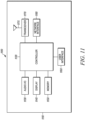
- FIG. 11 is an example block diagram of an apparatus 1100, such as the UE 110, the network entity 120, the network entity 125, any of the entities within the network 130, and/or any other wireless or non-wireless communication device disclosed herein, according to a possible embodiment.
- the apparatus 1100 can include a housing 1110, a controller 1120 coupled to the housing 1110, audio input and output circuitry 1130 coupled to the controller 1120, a display 1140 coupled to the controller 1120, a transceiver 1170 coupled to the controller 1120, at least one antenna 1115 coupled to the transceiver 1170, a user interface 1160 coupled to the controller 1120, a memory 1150 coupled to the controller 1120, and a network interface 1180 coupled to the controller 1120.
- the apparatus 1100 may not necessarily include all of the illustrated elements for different embodiments of the present disclosure.
- the apparatus 1100 can perform the methods described in all the embodiments.
- the display 1140 can be a viewfinder, a Liquid Crystal Display (LCD), a Light Emitting Diode (LED) display, an Organic Light Emitting Diode (OLED) display, a plasma display, a projection display, a touch screen, or any other device that displays information.
- the transceiver 1170 can be one or more transceivers that can include a transmitter and/or a receiver.
- the audio input and output circuitry 1130 can include a microphone, a speaker, a transducer, or any other audio input and output circuitry.
- the user interface 1160 can include a keypad, a keyboard, buttons, a touch pad, a joystick, a touch screen display, another additional display, or any other device useful for providing an interface between a user and an electronic device.
- the network interface 1180 can be a Universal Serial Bus (USB) port, an Ethernet port, an infrared transmitter/receiver, an IEEE 1394 port, a wireless transceiver, a WLAN transceiver, or any other interface that can connect an apparatus to a network, device, and/or computer and that can transmit and receive data communication signals.
- the memory 1150 can include a Random Access Memory (RAM), a Read Only Memory (RON), an optical memory, a solid state memory, a flash memory, a removable memory, a hard drive, a cache, or any other memory that can be coupled to an apparatus.
- the apparatus 1100 or the controller 1120 may implement any operating system, such as Microsoft Windows ® , UNIX ® , or LINUX ® , Android TM , or any other operating system.
- Apparatus operation software may be written in any programming language, such as C, C++, Java or Visual Basic, for example.
- Apparatus software may also run on an application framework, such as, for example, a Java ® framework, a .NET ® framework, or any other application framework.
- the software and/or the operating system may be stored in the memory 1150 or elsewhere on the apparatus 1100.
- the apparatus 1100 or the controller 1120 may also use hardware to implement disclosed operations.
- the controller 1120 may be any programmable processor.
- Disclosed embodiments may also be implemented on a general-purpose or a special purpose computer, a programmed microprocessor or microprocessor, peripheral integrated circuit elements, an application-specific integrated circuit or other integrated circuits, hardware/electronic logic circuits, such as a discrete element circuit, a programmable logic device, such as a programmable logic array, field programmable gate-array, or the like.
- the controller 1120 may be any controller or processor device or devices capable of operating an apparatus and implementing the disclosed embodiments. Some or all of the additional elements of the apparatus 1100 can also perform some or all of the operations of the disclosed embodiments.
- the transceiver 1170 can transmit and receive the various signals described above.
- the transceiver 1170 can receive the minimum SI 140 including at least cell access information to establish access with the cell 135.
- the minimum SI can also include at least one indication indicating whether particular SI listed in scheduling information in the minimum SI 140 is being broadcasted or not being broadcasted.
- the transceiver 1170 can transmit the SI request message 145 requesting transmission of non-minimum SI150 to the UE 110 if the at least one indication indicates the non-minimum SI 150 is not being broadcasted.
- the transceiver 1170 can either in response to the transmission of the SI request message 145 or in response to the at least one indication indicating whether particular SI is being broadcasted receive the requested non-minimum SI 150.
- the transceiver 1170 can transmit and receive the various signals described above.
- the transceiver 1170 can transmit the minimum SI 140 including at least cell access information to establish access with a cell of the network entity 120.
- the minimum SI 140 can also include at least one indication indicating whether particular SI listed in the scheduling information in the minimum SI 140 is being broadcasted or not being broadcasted.
- the transceiver 1170 can receive the SI request message 145 requesting transmission of the non-minimum SI 150 to the UE 110. According to a possible implementation, this reception by the network entity 120 can occur if the at least one indication indicates the non-minimum SI 150 is not being broadcasted, where the non-minimum SI 150 is not included in the minimum SI 140.
- the transceiver 1170 can transmit the non-minimum SI 150 either in response to the receiving of the SI request message 145 or in response to the at least one indication indicating whether particular SI listed in the scheduling information in the minimum SI 140 is being broadcasted.
- the transceiver 1170 can receive the minimum SI 140 including at least cell access information to establish access with a cell of the network entity.
- the transceiver 1170 can transmit the SI request message 145 requesting transmission of the non-minimum SI 150 to the UE 110 can be transmitted by the UE 110, the SI request message 145 including a BITMAP.
- each bit in the BITMAP can correspond to a unique SI message for the requested non-minimum SI 150, where the non-minimum SI 150 is not included in the minimum SI 140.
- the transceiver 1170 can receive the non-minimum SI 150 in response to the transmission of the SI request message including the BITMAP at 920.
- the transceiver 1170 can transmit the minimum SI 140 including at least cell access information to establish access with the cell 135 of the network entity 120.
- the minimum SI 140 can also include at least one indication indicating whether particular SI listed in scheduling information in the minimum SI 140 is being broadcasted or not being broadcasted.
- the transceiver 1170 can receive the SI request message 145 requesting transmission of non-minimum SI 150 to the UE 110.
- the SI request message 145 including a BITMAP where each bit in the BITMAP corresponds to a unique SI message for the requested non-minimum SI 150, where the non-minimum SI 150 is not included in the minimum SI 140.
- the transceiver 1170 can transmit the non-minimum SI 150 in response to the receiving of the SI request message 145 including the BITMAP at 1020.
- the method of this disclosure can be implemented on a programmed processor.
- the controllers, flowcharts, and modules may also be implemented on a general purpose or special purpose computer, a programmed microprocessor or microcontroller and peripheral integrated circuit elements, an integrated circuit, a hardware electronic or logic circuit such as a discrete element circuit, a programmable logic device, or the like.
- any device on which resides a finite state machine capable of implementing the flowcharts shown in the figures may be used to implement the processor functions of this disclosure.
Landscapes
- Engineering & Computer Science (AREA)
- Signal Processing (AREA)
- Computer Networks & Wireless Communication (AREA)
- Computer Security & Cryptography (AREA)
- Multimedia (AREA)
- Mobile Radio Communication Systems (AREA)
Applications Claiming Priority (3)
| Application Number | Priority Date | Filing Date | Title |
|---|---|---|---|
| US201762502445P | 2017-05-05 | 2017-05-05 | |
| PCT/US2018/030999 WO2018204728A1 (en) | 2017-05-05 | 2018-05-03 | Method and apparatus for signaling of system information |
| EP18729812.0A EP3619963B1 (de) | 2017-05-05 | 2018-05-03 | Verfahren und vorrichtung zur signalisierung von systeminformationen |
Related Parent Applications (2)
| Application Number | Title | Priority Date | Filing Date |
|---|---|---|---|
| EP18729812.0A Division-Into EP3619963B1 (de) | 2017-05-05 | 2018-05-03 | Verfahren und vorrichtung zur signalisierung von systeminformationen |
| EP18729812.0A Division EP3619963B1 (de) | 2017-05-05 | 2018-05-03 | Verfahren und vorrichtung zur signalisierung von systeminformationen |
Publications (2)
| Publication Number | Publication Date |
|---|---|
| EP4531485A2 true EP4531485A2 (de) | 2025-04-02 |
| EP4531485A3 EP4531485A3 (de) | 2025-06-25 |
Family
ID=62555150
Family Applications (2)
| Application Number | Title | Priority Date | Filing Date |
|---|---|---|---|
| EP25151023.6A Pending EP4531485A3 (de) | 2017-05-05 | 2018-05-03 | Verfahren und vorrichtung zur signalisierung von systeminformationen |
| EP18729812.0A Active EP3619963B1 (de) | 2017-05-05 | 2018-05-03 | Verfahren und vorrichtung zur signalisierung von systeminformationen |
Family Applications After (1)
| Application Number | Title | Priority Date | Filing Date |
|---|---|---|---|
| EP18729812.0A Active EP3619963B1 (de) | 2017-05-05 | 2018-05-03 | Verfahren und vorrichtung zur signalisierung von systeminformationen |
Country Status (7)
| Country | Link |
|---|---|
| US (4) | US10548065B2 (de) |
| EP (2) | EP4531485A3 (de) |
| KR (2) | KR102772030B1 (de) |
| CN (2) | CN110574434B (de) |
| BR (1) | BR112019023169A2 (de) |
| ES (1) | ES3018382T3 (de) |
| WO (1) | WO2018204728A1 (de) |
Families Citing this family (15)
| Publication number | Priority date | Publication date | Assignee | Title |
|---|---|---|---|---|
| CN118215103A (zh) * | 2016-08-09 | 2024-06-18 | 华为技术有限公司 | 一种系统消息的发送方法和设备 |
| KR102362403B1 (ko) * | 2017-06-05 | 2022-02-14 | 삼성전자 주식회사 | 차세대 이동통신 시스템에서 프리엠블을 이용하여 시스템 정보를 요청하는 방법 및 장치 |
| CN109429566B (zh) * | 2017-06-26 | 2019-11-01 | 北京小米移动软件有限公司 | 系统消息传输方法及装置、系统消息接收方法及装置 |
| CN109309556B (zh) * | 2017-07-27 | 2022-03-29 | 夏普株式会社 | 系统信息请求方法、相应的用户设备以及计算机可读介质 |
| WO2019068795A1 (en) * | 2017-10-05 | 2019-04-11 | Sony Corporation | BASIC STATIONS AND USER EQUIPMENTS CONFIGURED TO MANAGE SYSTEM INFORMATION ON DEMAND IN NEW 5G RADIO |
| JP7059395B2 (ja) * | 2018-04-04 | 2022-04-25 | 中興通訊股▲ふん▼有限公司 | 情報要求に対するランダムアクセスチャネルリソースの割り当て |
| US10660023B2 (en) | 2018-05-10 | 2020-05-19 | Sharp Kabushiki Kaisha | Apparatus and method for acquisition of on-demand system information in wireless communications |
| US11019557B2 (en) * | 2018-05-10 | 2021-05-25 | Sharp Kabushiki Kaisha | Apparatus and method for acquisition of periodically broadcasted system information in wireless communication |
| US11140616B2 (en) | 2019-04-03 | 2021-10-05 | Apple Inc. | On demand system information block acquisition |
| US10904862B2 (en) | 2019-05-16 | 2021-01-26 | Sprint Communications Company L.P. | Wireless access point assistance to wireless user devices for wireless communication network selection |
| CN112055370A (zh) * | 2019-06-06 | 2020-12-08 | 大唐移动通信设备有限公司 | 一种按需系统信息获取方法和装置 |
| CN112825584B (zh) * | 2019-11-20 | 2022-06-14 | 上海华为技术有限公司 | 一种空闲态终端设备检测方法以及相关设备 |
| EP4162724A1 (de) * | 2020-06-04 | 2023-04-12 | Lenovo (Singapore) Pte. Ltd. | Systeminformationsblockgrössenbestimmung |
| WO2022006824A1 (zh) * | 2020-07-09 | 2022-01-13 | 北京小米移动软件有限公司 | 其它系统信息的请求方法、装置、设备及介质 |
| US20240129095A1 (en) * | 2020-11-19 | 2024-04-18 | Beijing Xiaomi Mobile Software Co., Ltd. | Method for requesting system information block, and communication device |
Family Cites Families (27)
| Publication number | Priority date | Publication date | Assignee | Title |
|---|---|---|---|---|
| CN101052206B (zh) * | 2006-04-04 | 2010-09-29 | 华为技术有限公司 | 一种移动终端网络附着方法 |
| CN101212799B (zh) * | 2006-12-29 | 2011-02-02 | 华为技术有限公司 | 一种指示系统消息变化的方法、获取系统消息的方法及装置 |
| KR20110039186A (ko) * | 2009-10-09 | 2011-04-15 | 엘지전자 주식회사 | 무선 통신 시스템상에서 단말의 불필요한 msi 수신을 최소화 하는 방법 |
| EP2533576B1 (de) * | 2010-02-03 | 2018-02-28 | Nec Corporation | Basisstation, mobilkommunikationssystem und verfahren zum empfangen von systeminformationen |
| US20130039309A1 (en) * | 2011-08-14 | 2013-02-14 | Industrial Technology Research Institute | Method for renewing indication of system information and base station and user equipment using the same |
| US8971275B2 (en) * | 2011-12-31 | 2015-03-03 | Ofinno Technologies, Llc | Almost blank subframe indication in wireless networks |
| CN109327822B (zh) * | 2012-10-05 | 2022-10-25 | 交互数字专利控股公司 | 增强机器类型通信(mtc)设备覆盖的方法和装置 |
| US8958349B2 (en) * | 2012-10-25 | 2015-02-17 | Blackberry Limited | Method and apparatus for dynamic change of the TDD UL/DL configuration in LTE systems |
| AU2015231128A1 (en) * | 2014-03-19 | 2016-10-06 | Interdigital Patent Holdings, Inc. | Method and apparatus for system information block (SIB) acquisition for wireless transmit/receive units (WTRUS) in non-CE and coverage enhanced (CE) modes |
| US10200920B2 (en) * | 2015-02-10 | 2019-02-05 | Qualcomm Incorporated | On-demand system information |
| EP3281475A4 (de) * | 2015-04-07 | 2018-10-10 | Sierra Wireless, Inc. | Verfahren und vorrichtung zur kommunikation von systeminformationen und direktzugriff in einem drahtlosen system |
| EP3634039B1 (de) * | 2015-04-10 | 2022-06-01 | Panasonic Intellectual Property Corporation of America | Systeminformationsplanung in einer maschinenkommunikation |
| KR102399944B1 (ko) * | 2015-06-11 | 2022-05-18 | 애플 인크. | 무선 통신을 위한 낮은 오버헤드 시스템 정보 취득 |
| US10440522B2 (en) * | 2015-09-25 | 2019-10-08 | Telefonaktiebolaget Lm Ericsson (Publ) | Radio network node, a wireless device and methods therein |
| US20180255606A1 (en) | 2015-10-06 | 2018-09-06 | Lg Electronics Inc. | Method for updating system information in wireless communication system and apparatus therefor |
| US9971418B2 (en) * | 2015-12-24 | 2018-05-15 | Intel Corporation | Tracker for cursor navigation |
| JP2019057750A (ja) * | 2016-02-04 | 2019-04-11 | シャープ株式会社 | 端末装置、基地局装置、通信方法、および、集積回路 |
| KR102677234B1 (ko) * | 2016-02-29 | 2024-06-21 | 삼성전자 주식회사 | 시스템 정보를 시그널링하는 장치 및 방법 |
| JPWO2017195478A1 (ja) * | 2016-05-12 | 2019-03-07 | 株式会社Nttドコモ | ユーザ装置、及び基地局 |
| EP3520492B1 (de) * | 2016-11-04 | 2023-03-01 | Samsung Electronics Co., Ltd. | Verfahren und benutzergerät zur bereitstellung von minimalen systeminformationen in einem drahtloskommunikationssystem |
| CN110249699B (zh) * | 2017-02-01 | 2023-07-07 | Lg电子株式会社 | 用于请求系统信息的方法和装置 |
| SG11201908506PA (en) * | 2017-03-16 | 2019-10-30 | Guangdong Oppo Mobile Telecommunications Corp Ltd | Method, apparatus, and system for acquiring system information |
| US10505799B2 (en) * | 2017-03-20 | 2019-12-10 | Motorola Mobility Llc | System information for changing a configuration |
| US11647543B2 (en) * | 2017-03-23 | 2023-05-09 | Comcast Cable Communications, Llc | Power control for random access |
| US20180302843A1 (en) * | 2017-03-31 | 2018-10-18 | Telefonaktiebolaget Lm Ericsson (Publ) | Wireless Communication Device and Method for Managing System Information Provided by a Wireless Communication Network |
| CN110832907B (zh) * | 2017-05-04 | 2021-05-25 | 诺基亚技术有限公司 | 通信系统 |
| US11224074B2 (en) * | 2018-08-08 | 2022-01-11 | Lenovo (Singapore) Pte. Ltd. | Bandwidth part configuration based on a clear channel assessment |
-
2018
- 2018-05-03 CN CN201880028329.5A patent/CN110574434B/zh active Active
- 2018-05-03 EP EP25151023.6A patent/EP4531485A3/de active Pending
- 2018-05-03 KR KR1020237041704A patent/KR102772030B1/ko active Active
- 2018-05-03 ES ES18729812T patent/ES3018382T3/es active Active
- 2018-05-03 WO PCT/US2018/030999 patent/WO2018204728A1/en not_active Ceased
- 2018-05-03 US US15/970,611 patent/US10548065B2/en active Active
- 2018-05-03 EP EP18729812.0A patent/EP3619963B1/de active Active
- 2018-05-03 KR KR1020197032324A patent/KR102610841B1/ko active Active
- 2018-05-03 BR BR112019023169-2A patent/BR112019023169A2/pt unknown
- 2018-05-03 CN CN202210180371.7A patent/CN114697881B/zh active Active
-
2019
- 2019-12-20 US US16/723,165 patent/US11006350B2/en active Active
-
2021
- 2021-03-22 US US17/208,956 patent/US11653290B2/en active Active
-
2023
- 2023-04-08 US US18/132,366 patent/US12047868B2/en active Active
Also Published As
| Publication number | Publication date |
|---|---|
| KR102610841B1 (ko) | 2023-12-07 |
| US20230247531A1 (en) | 2023-08-03 |
| EP3619963C0 (de) | 2025-03-12 |
| US10548065B2 (en) | 2020-01-28 |
| KR102772030B1 (ko) | 2025-02-26 |
| US20180324679A1 (en) | 2018-11-08 |
| CN114697881B (zh) | 2023-11-17 |
| KR20200004803A (ko) | 2020-01-14 |
| EP3619963B1 (de) | 2025-03-12 |
| WO2018204728A1 (en) | 2018-11-08 |
| CN110574434A (zh) | 2019-12-13 |
| BR112019023169A2 (pt) | 2020-06-02 |
| US11006350B2 (en) | 2021-05-11 |
| KR20230169461A (ko) | 2023-12-15 |
| EP4531485A3 (de) | 2025-06-25 |
| US12047868B2 (en) | 2024-07-23 |
| US11653290B2 (en) | 2023-05-16 |
| ES3018382T3 (es) | 2025-05-16 |
| US20200128475A1 (en) | 2020-04-23 |
| US20210211971A1 (en) | 2021-07-08 |
| CN114697881A (zh) | 2022-07-01 |
| EP3619963A1 (de) | 2020-03-11 |
| CN110574434B (zh) | 2022-03-11 |
Similar Documents
| Publication | Publication Date | Title |
|---|---|---|
| US12047868B2 (en) | Method and apparatus for signaling of system information | |
| US12382404B2 (en) | Method and apparatus for random access on a wireless communication network | |
| EP4221417B1 (de) | Uplink-trägerauswahl für prach-übertragung zwischen einem dedizierten nr-träger und einem gemeinsam genutzten lte/nr-träger | |
| US11595854B2 (en) | Use of wait period to obtain on-demand system information for wireless networks | |
| US10375737B2 (en) | Method and apparatus for sending and receiving information on a wireless network | |
| US12452814B2 (en) | Preconfigured uplink resources—configuration for TA validity in entire cell | |
| CN111246591B (zh) | 一种信息传输方法、装置及相关设备 | |
| EP3429273B1 (de) | Verfahren zur übertragung von kommunikationsnachrichten und vorrichtung | |
| WO2023124823A1 (zh) | 一种通信方法及装置 | |
| EP4535909A2 (de) | Verfahren und vorrichtung für direktzugriff | |
| US20220287101A1 (en) | Method and apparatus for data transmission | |
| WO2025156260A1 (en) | User equipment (ue) request for system information block type1 (sib1) | |
| WO2025208542A1 (zh) | 随机接入方法、装置以及通信系统 | |
| CN121002915A (zh) | 早期用户设备能力指示递送 |
Legal Events
| Date | Code | Title | Description |
|---|---|---|---|
| PUAI | Public reference made under article 153(3) epc to a published international application that has entered the european phase |
Free format text: ORIGINAL CODE: 0009012 |
|
| STAA | Information on the status of an ep patent application or granted ep patent |
Free format text: STATUS: THE APPLICATION HAS BEEN PUBLISHED |
|
| AC | Divisional application: reference to earlier application |
Ref document number: 3619963 Country of ref document: EP Kind code of ref document: P |
|
| AK | Designated contracting states |
Kind code of ref document: A2 Designated state(s): AL AT BE BG CH CY CZ DE DK EE ES FI FR GB GR HR HU IE IS IT LI LT LU LV MC MK MT NL NO PL PT RO RS SE SI SK SM TR |
|
| REG | Reference to a national code |
Ref country code: DE Ref legal event code: R079 Free format text: PREVIOUS MAIN CLASS: H04W0074080000 Ipc: H04W0048120000 |
|
| PUAL | Search report despatched |
Free format text: ORIGINAL CODE: 0009013 |
|
| AK | Designated contracting states |
Kind code of ref document: A3 Designated state(s): AL AT BE BG CH CY CZ DE DK EE ES FI FR GB GR HR HU IE IS IT LI LT LU LV MC MK MT NL NO PL PT RO RS SE SI SK SM TR |
|
| RIC1 | Information provided on ipc code assigned before grant |
Ipc: H04W 74/08 20240101ALN20250521BHEP Ipc: H04W 74/00 20090101ALN20250521BHEP Ipc: H04W 48/12 20090101AFI20250521BHEP |
|
| STAA | Information on the status of an ep patent application or granted ep patent |
Free format text: STATUS: REQUEST FOR EXAMINATION WAS MADE |