EP4531379A1 - Vorrichtungen, vorrichtungen, verfahren und nichttransitorische computerlesbare medien für einen gruppenführer und ein gruppenmitglied einer gruppe von knoten - Google Patents
Vorrichtungen, vorrichtungen, verfahren und nichttransitorische computerlesbare medien für einen gruppenführer und ein gruppenmitglied einer gruppe von knoten Download PDFInfo
- Publication number
- EP4531379A1 EP4531379A1 EP24196543.3A EP24196543A EP4531379A1 EP 4531379 A1 EP4531379 A1 EP 4531379A1 EP 24196543 A EP24196543 A EP 24196543A EP 4531379 A1 EP4531379 A1 EP 4531379A1
- Authority
- EP
- European Patent Office
- Prior art keywords
- group
- nodes
- blockchain
- computational activity
- leader
- Prior art date
- Legal status (The legal status is an assumption and is not a legal conclusion. Google has not performed a legal analysis and makes no representation as to the accuracy of the status listed.)
- Pending
Links
Images




Classifications
-
- H—ELECTRICITY
- H04—ELECTRIC COMMUNICATION TECHNIQUE
- H04L—TRANSMISSION OF DIGITAL INFORMATION, e.g. TELEGRAPHIC COMMUNICATION
- H04L9/00—Cryptographic mechanisms or cryptographic arrangements for secret or secure communications; Network security protocols
- H04L9/50—Cryptographic mechanisms or cryptographic arrangements for secret or secure communications; Network security protocols using hash chains, e.g. blockchains or hash trees
-
- G—PHYSICS
- G06—COMPUTING OR CALCULATING; COUNTING
- G06Q—INFORMATION AND COMMUNICATION TECHNOLOGY [ICT] SPECIALLY ADAPTED FOR ADMINISTRATIVE, COMMERCIAL, FINANCIAL, MANAGERIAL OR SUPERVISORY PURPOSES; SYSTEMS OR METHODS SPECIALLY ADAPTED FOR ADMINISTRATIVE, COMMERCIAL, FINANCIAL, MANAGERIAL OR SUPERVISORY PURPOSES, NOT OTHERWISE PROVIDED FOR
- G06Q20/00—Payment architectures, schemes or protocols
- G06Q20/08—Payment architectures
- G06Q20/14—Payment architectures specially adapted for billing systems
- G06Q20/145—Payments according to the detected use or quantity
-
- G—PHYSICS
- G06—COMPUTING OR CALCULATING; COUNTING
- G06Q—INFORMATION AND COMMUNICATION TECHNOLOGY [ICT] SPECIALLY ADAPTED FOR ADMINISTRATIVE, COMMERCIAL, FINANCIAL, MANAGERIAL OR SUPERVISORY PURPOSES; SYSTEMS OR METHODS SPECIALLY ADAPTED FOR ADMINISTRATIVE, COMMERCIAL, FINANCIAL, MANAGERIAL OR SUPERVISORY PURPOSES, NOT OTHERWISE PROVIDED FOR
- G06Q20/00—Payment architectures, schemes or protocols
- G06Q20/38—Payment protocols; Details thereof
- G06Q20/382—Payment protocols; Details thereof insuring higher security of transaction
- G06Q20/3821—Electronic credentials
- G06Q20/38215—Use of certificates or encrypted proofs of transaction rights
-
- G—PHYSICS
- G06—COMPUTING OR CALCULATING; COUNTING
- G06Q—INFORMATION AND COMMUNICATION TECHNOLOGY [ICT] SPECIALLY ADAPTED FOR ADMINISTRATIVE, COMMERCIAL, FINANCIAL, MANAGERIAL OR SUPERVISORY PURPOSES; SYSTEMS OR METHODS SPECIALLY ADAPTED FOR ADMINISTRATIVE, COMMERCIAL, FINANCIAL, MANAGERIAL OR SUPERVISORY PURPOSES, NOT OTHERWISE PROVIDED FOR
- G06Q50/00—Information and communication technology [ICT] specially adapted for implementation of business processes of specific business sectors, e.g. utilities or tourism
- G06Q50/06—Energy or water supply
-
- H—ELECTRICITY
- H04—ELECTRIC COMMUNICATION TECHNIQUE
- H04L—TRANSMISSION OF DIGITAL INFORMATION, e.g. TELEGRAPHIC COMMUNICATION
- H04L67/00—Network arrangements or protocols for supporting network services or applications
- H04L67/01—Protocols
- H04L67/10—Protocols in which an application is distributed across nodes in the network
- H04L67/104—Peer-to-peer [P2P] networks
- H04L67/1044—Group management mechanisms
- H04L67/1051—Group master selection mechanisms
-
- H—ELECTRICITY
- H04—ELECTRIC COMMUNICATION TECHNIQUE
- H04L—TRANSMISSION OF DIGITAL INFORMATION, e.g. TELEGRAPHIC COMMUNICATION
- H04L67/00—Network arrangements or protocols for supporting network services or applications
- H04L67/01—Protocols
- H04L67/10—Protocols in which an application is distributed across nodes in the network
- H04L67/104—Peer-to-peer [P2P] networks
- H04L67/1044—Group management mechanisms
- H04L67/1053—Group management mechanisms with pre-configuration of logical or physical connections with a determined number of other peers
- H04L67/1057—Group management mechanisms with pre-configuration of logical or physical connections with a determined number of other peers involving pre-assessment of levels of reputation of peers
-
- H—ELECTRICITY
- H04—ELECTRIC COMMUNICATION TECHNIQUE
- H04L—TRANSMISSION OF DIGITAL INFORMATION, e.g. TELEGRAPHIC COMMUNICATION
- H04L9/00—Cryptographic mechanisms or cryptographic arrangements for secret or secure communications; Network security protocols
- H04L9/08—Key distribution or management, e.g. generation, sharing or updating, of cryptographic keys or passwords
- H04L9/0816—Key establishment, i.e. cryptographic processes or cryptographic protocols whereby a shared secret becomes available to two or more parties, for subsequent use
- H04L9/0819—Key transport or distribution, i.e. key establishment techniques where one party creates or otherwise obtains a secret value, and securely transfers it to the other(s)
- H04L9/0822—Key transport or distribution, i.e. key establishment techniques where one party creates or otherwise obtains a secret value, and securely transfers it to the other(s) using key encryption key
-
- H—ELECTRICITY
- H04—ELECTRIC COMMUNICATION TECHNIQUE
- H04L—TRANSMISSION OF DIGITAL INFORMATION, e.g. TELEGRAPHIC COMMUNICATION
- H04L9/00—Cryptographic mechanisms or cryptographic arrangements for secret or secure communications; Network security protocols
- H04L9/32—Cryptographic mechanisms or cryptographic arrangements for secret or secure communications; Network security protocols including means for verifying the identity or authority of a user of the system or for message authentication, e.g. authorization, entity authentication, data integrity or data verification, non-repudiation, key authentication or verification of credentials
- H04L9/3218—Cryptographic mechanisms or cryptographic arrangements for secret or secure communications; Network security protocols including means for verifying the identity or authority of a user of the system or for message authentication, e.g. authorization, entity authentication, data integrity or data verification, non-repudiation, key authentication or verification of credentials using proof of knowledge, e.g. Fiat-Shamir, GQ, Schnorr, ornon-interactive zero-knowledge proofs
-
- H—ELECTRICITY
- H04—ELECTRIC COMMUNICATION TECHNIQUE
- H04W—WIRELESS COMMUNICATION NETWORKS
- H04W12/00—Security arrangements; Authentication; Protecting privacy or anonymity
- H04W12/60—Context-dependent security
- H04W12/66—Trust-dependent, e.g. using trust scores or trust relationships
-
- H—ELECTRICITY
- H04—ELECTRIC COMMUNICATION TECHNIQUE
- H04W—WIRELESS COMMUNICATION NETWORKS
- H04W4/00—Services specially adapted for wireless communication networks; Facilities therefor
- H04W4/70—Services for machine-to-machine communication [M2M] or machine type communication [MTC]
-
- H—ELECTRICITY
- H04—ELECTRIC COMMUNICATION TECHNIQUE
- H04L—TRANSMISSION OF DIGITAL INFORMATION, e.g. TELEGRAPHIC COMMUNICATION
- H04L67/00—Network arrangements or protocols for supporting network services or applications
- H04L67/01—Protocols
- H04L67/10—Protocols in which an application is distributed across nodes in the network
- H04L67/104—Peer-to-peer [P2P] networks
- H04L67/1044—Group management mechanisms
- H04L67/1046—Joining mechanisms
-
- H—ELECTRICITY
- H04—ELECTRIC COMMUNICATION TECHNIQUE
- H04L—TRANSMISSION OF DIGITAL INFORMATION, e.g. TELEGRAPHIC COMMUNICATION
- H04L67/00—Network arrangements or protocols for supporting network services or applications
- H04L67/01—Protocols
- H04L67/10—Protocols in which an application is distributed across nodes in the network
- H04L67/104—Peer-to-peer [P2P] networks
- H04L67/1044—Group management mechanisms
- H04L67/1048—Departure or maintenance mechanisms
Definitions
- ZKP zero-knowledge proof
- Blockchain validators run computations that verify if a proof is correct and, if so, apply state changes without learning the data that was verified.
- ZKP is a key technology for blockchain based Web 3.0, with the inherent attractive properties of privacy preservation and avoiding redundant computations for Vert3ion, making web3.0 transactions less expensive.
- the terms "operating”, “executing”, or “running” as they pertain to software or firmware in relation to a system, device, platform, or resource are used interchangeably and can refer to software or firmware stored in one or more computer-readable storage media accessible by the system, device, platform, or resource, even though the instructions contained in the software or firmware are not actively being executed by the system, device, platform, or resource.
- Fig. 1a shows a schematic diagram of an example of an apparatus 10 or device 10 for a group leader 100-L (L stands for Leader) of a group of nodes 100 of a blockchain network 105, and of a computer system 100-L (the computer system 100-L implementing the group leader) comprising such an apparatus 10 or device 10.
- Fig. 1a further shows a system, e.g., the group of nodes 100, comprising the group leader 100-L and one or more group members 100-M (M stands for member), 100-D (D stands for Delegate).
- M stands for member
- D stands for Delegate
- the blockchain network 105 is a network of nodes that participate or use the same blockchain, e.g., a public blockchain such as Ethereum (a trademark of Stainless Ethereum/Ethereum Foundation) or Solana (a trademark of Solana Foundation), or a private blockchain.
- a public blockchain such as Ethereum (a trademark of Stainless Ethereum/Ethereum Foundation) or Solana (a trademark of Solana Foundation)
- Solana a trademark of Solana Foundation
- the apparatus 10 comprises circuitry to provide the functionality of the apparatus 10.
- the circuitry of the apparatus 10 may be configured to provide the functionality of the apparatus 10.
- the apparatus 10 of Fig. 1a comprises interface circuitry 12, processor circuitry 14, and (optional) memory/storage circuitry 16.
- the processor circuitry 14 may be coupled with the interface circuitry 12 and/or with the memory/storage circuitry 16.
- the processor circuitry 14 may provide the functionality of the apparatus, in conjunction with the interface circuitry 12 (for communicating with other group members 100-M, 100-D of the group of nodes 100, and/or for communicating with nodes 200-L of another group of nodes 200), and the memory/storage circuitry 16 (for storing information, such as machine-readable instructions).
- the device 10 may comprise means for providing the functionality of the device 10.
- the means may be configured to provide the functionality of the device 10.
- the components of the device 10 are defined as component means, which may correspond to, or implemented by, the respective structural components of the apparatus 10.
- the device 10 of Fig. 1b comprises means for processing 14, which may correspond to or be implemented by the processor circuitry 14, means for communicating 12, which may correspond to or be implemented by the interface circuitry 12, (optional) means for storing information 16, which may correspond to or be implemented by the memory or storage circuitry 16.
- the functionality of the processor circuitry 14 or means for processing 14 may be implemented by the processor circuitry 14 or means for processing 14 executing machine-readable instructions.
- any feature ascribed to the processor circuitry 14 or means for processing 14 may be defined by one or more instructions of a plurality of machine-readable instructions.
- the apparatus 10 or device 10 may comprise the machine-readable instructions 16a, e.g., within the memory or storage circuitry 16 or means for storing information 16.
- the processor circuitry 14 or means for processing 14 is to manage a membership of nodes of the blockchain network in the group of nodes.
- the processor circuitry 14 or means for processing 14 is to perform or delegate blockchain-related computational activity on behalf of the group of nodes according to an energy criterion.
- Fig. 1b shows a flow chart of an example of a corresponding method for the group leader 100-L of the group of nodes.
- the method comprises managing 130 a membership of nodes of the blockchain network in the group of nodes.
- the method comprises performing 140 or delegating 150 blockchain-related computational activity on behalf of the group of nodes according to an energy criterion.
- the method may be performed by the group leader 100-L of the group nodes, e.g., by a computer system 100-L, apparatus 10 or device 10 implementing the group leader 100-L.
- Various examples of the present disclosure are based on the finding, that blockchain operations can be computationally expensive, putting a burden on computationally lower-power devices, such as IoT (Internet-of-Things) devices.
- IoT Internet-of-Things
- multiple devices are grouped into groups of nodes, such as the group of nodes 100.
- the computational activity related to activities on the blockchain can be delegated among the members, with a group leader (i.e., the group leader 100-L discussed in connection with Figs. 1a and 1b ) both controlling distribution of the computational activity and communicating with other nodes outside the group of nodes.
- both the average and overall computational load on the group members is reduced (as the blockchain-related computational is only performed once within the group), which enables use of blockchain technology even by interconnected low-power devices.
- the distribution of the computational activity and, optionally, leadership of the group are determined according to an energy criterion.
- one of the tasks of the group leader is to distribute the work (or perform the work itself), while another task is communication with nodes 200-L outside the group of nodes 105, e.g., a group leader 200-L of another group of nodes or other nodes outside the group of nodes, such as an external validator.
- the processor circuitry may assume, by the node, leadership of the group of nodes according to the energy criterion.
- the method may comprise assuming 110, by the node, leadership of the group of nodes according to the energy criterion.
- the group leader of the group of nodes has different duties.
- One of the duties lie in the communication of the group of nodes.
- the processor circuitry may communicate, as group leader, with one or more further nodes outside the group of nodes on behalf of the group of nodes.
- the method may comprise communicating 120, by the group leader, with one or more further nodes outside the group of nodes on behalf of the group of nodes.
- Another duty is managing a membership of nodes of the blockchain network in the group of nodes.
- the processor circuitry may decide over admission of nodes into the group of nodes.
- the processor circuitry may provide a join request to potential group members and include a node as group member if the node responds with a join response.
- membership in the group of nodes may be managed via a so-called Enhanced Privacy Identifier (EPID, an Intel ® technology), and the corresponding EPID join protocol.
- EPID Enhanced Privacy Identifier
- the processor circuitry is to perform or delegate blockchain-related computational activity on behalf of the group of nodes according to the energy criterion.
- the blockchain-related computational activity may relate to any activity related to participation in the blockchain network 105.
- the blockchain-related computational activity may relate to at least one of creation of a zero-knowledge proof, verification of a zero-knowledge proof and proof of creation to be published on a blockchain.
- Zero-knowledge proof is a protocol that allows one person, the prover, to convince another person, the verifier, that they know a particular piece of information without revealing any additional information about it. In other words, the prover can prove knowledge of something without revealing anything else about it, including its contents.
- Creation of a zero-knowledge proof relates to the creation of a code, such as a decentralized application, that can be used to perform a zero-knowledge proof.
- Verification of a zero-knowledge proof relates to the creation of a proof of verification, that indicates to others that a zero-knowledge proof has been verified by the entity providing the proof of verification. All of these tasks are computationally expensive, which makes sharing the computational load among the group of nodes desirable.
- the computational activity is performed or delegated according to the energy criterion.
- the group leader three courses of action are possible - the group leader can perform all of the computational activity, the group leader can perform some of the computational activity and delegate the rest of the computational activity, or the group leader can delegate all of the computational activity.
- One of the criteria is the load of the group leader - the group leader can only do so much work, so some computational activity might have to be delegated in either case.
- the other criterion is the energy-related criterion.
- the energy-related criterion is a criterion that relates to the energy-use of the node performing the computational activity.
- the energy criterion may be based on an amount of energy required by a node for performing blockchain-related computational activity.
- the computational activity may be performed by the node that is most efficient and thus uses the least energy for performing the computational activity, e.g., through the use of a modern instruction set, efficient semiconductor process or use of a specialized accelerator card.
- the amount of carbon dioxide emissions caused by the respective nodes for performing the computational activity may be taken into account.
- the energy criterion may be based on a use of renewable energy (e.g., e.g., the emission or lack of emission of carbon dioxide) by a node of the group of nodes.
- the processor circuitry may obtain suitable information from the group members to evaluate the group members according to the energy criterion.
- the processor circuitry may obtain, from the group members, information on at least one of an energy efficiency of the group member in performing blockchain-related computational activity, information on a use of renewable energy by the group member and information on a transient network reliability (which may be relevant for the purpose of finding a successor for group leadership) from the group members.
- Fig. 6 shows the different nodes 621-623 reporting such information to the group leader 610.
- the use of renewable energy by a node varies over time, e.g., as the energy mix that applies in a geographic region fluctuates. For example, during daytime, the amount of solar energy may be higher than during nighttime. Similarly, at some times, wind energy may be plentiful, while, at other times, the lack of wind may impede availability of wind power. Therefore, the distribution of the computational activity may be adapted to the changing use of renewable energy. For example, the act of performing or delegating blockchain-related computational activity on behalf of the group of nodes may be performed based on a current or predicted use (in the future) of renewable energy by the respective node.
- the group leader performs all or some of the computational activity.
- the computational activity is documented on the blockchain, e.g., by publishing the newly created zero-knowledge proof, the proof of verification of the zero-knowledge proof or the proof of creation on the blockchain (e.g., on the blockchain of the blockchain network or a private Layer 2 blockchain that is private to the members of the group of nodes).
- the act of performing the blockchain-related computational activity may comprise documenting 145 (shown in Fig. 1b ) the blockchain-related computational activity on a block-chain accessible by the group of nodes.
- each group of nodes may have at least one key-encryption key that is used to write data to the blockchain, and that can be traced back to the group of nodes.
- a key encryption key is a symmetric encryption key that is used to encrypt other keys, such as data encryption keys (DEKs) or communication encryption keys (CEKs).
- DEKs data encryption keys
- CEKs communication encryption keys
- the idea behind using a KEK is to create an additional layer of security in the encryption process and to make it more difficult for unauthorized users to access sensitive information.
- the processor circuitry may document the blockchain-related computational activity on a blockchain (e.g., the public blockchain or group-specific blockchain) using a key encryption key for documenting the blockchain-related computational activity.
- the method may comprise documenting 145 the blockchain-related computational activity on a blockchain using a key encryption key for documenting the blockchain-related computational activity.
- the processor circuitry may delegate blockchain-related computational activity to another member of the group of nodes based on a load of the group leader. Additionally, or alternatively, the processor circuitry may delegate blockchain-related computational activity to another member if the other group member surpasses the group leader according to the energy criterion, e.g., if the other group member uses less energy for the computational activity, or of the other group member uses a higher proportion of renewable energy (i.e., causes emission of a lower amount of carbon dioxide).
- the member the computational activity is delegated to is shown in Fig.
- the delegate may then also document the activity on a blockchain.
- the group leader may share the KEK with the group member performing the computational activity, so the group member can write, in the name of the group, to the blockchain (e.g., the public or a group-specific blockchain).
- the act of delegating the blockchain-related computational activity may comprise sharing the key encryption key for documenting the blockchain-related computational activity with the node of the group of nodes the verification is delegated to.
- the act of delegating the blockchain-related computational activity may comprise sharing 155 the key encryption key for documenting the blockchain-related computational activity with the node of the group of nodes the verification is delegated to.
- the energy criterion is not only relevant for the purpose of assigning the computational activity.
- the energy criterion can also be used to determine one or more possible successors for the group leader.
- the processor circuitry may nominate a successor for group leader among the members of the group of nodes according to the energy criterion.
- the method may comprise nominating 160 a successor for group leader among the members of the group of nodes according to the energy criterion.
- a group member of the group of nodes may be nominated based on the amount of energy required by a node for performing blockchain-related computational activity and/or based on a use of renewable energy (e.g., e.g., the emission or lack of emission of carbon dioxide) by the node.
- renewable energy e.g., e.g., the emission or lack of emission of carbon dioxide
- Another criterion for group leadership is the reliability of the different group members, and in particular the network reliability, to avoid making a node a group leader that is frequently unreachable.
- the processor circuitry may nominate a successor for group leader among the members of the group of nodes further according to a transient network reliability criterion.
- Managing the membership of the group members may include various tasks, such as admitting nodes as group members, but also removing group members.
- the processor circuitry may manage membership of the nodes in the group of nodes, e.g., by admitting one or more nodes into the group of nodes, and/or by removing one or more nodes from the group of nodes.
- the group leader may remove nodes from the group of nodes according to the criterion.
- the processor circuitry may remove a group member from the group of nodes according to a criterion.
- the method may comprise removing a group member from the group of nodes according to the criterion.
- the criterion may be one of the energy criterion (e.g., to remove nodes that are not energy-efficient enough), a transient network reliability criterion (e.g., to remove nodes that are not consistently available via the network) and a group participation reliability criterion (e.g., to remove nodes that have been shown not to be trustworthy).
- the energy criterion e.g., to remove nodes that are not energy-efficient enough
- a transient network reliability criterion e.g., to remove nodes that are not consistently available via the network
- group participation reliability criterion e.g., to remove nodes that have been shown not to be trustworthy
- the group leader may decide to abdicate group leadership, e.g., based on the group leader's load, or according to a schedule.
- the processor circuitry may abdicate the node as group leader, and transfer group leadership to the successor.
- the method may comprise abdicating 170 the node as group leader and transferring 175 group leadership to the successor.
- a group leader may be forced to abdicate.
- the processor circuitry may abdicate the node as group leader according to an audit of activities of the group leader on at least one blockchain by one or more other members of the group.
- the method may comprise abdicating 170 the node as group leader according to an audit of activities of the group leader on at least one blockchain by one or more other members of the group.
- the activities of the group leader being audited may be previous computational activities being performed by the group leader, and/or adherence of the group leader to a schedule for abdicating as group leader.
- group membership may be managed via a direct anonymous attestation protocol, e.g., a direct anonymous attestation protocol that is based on a group public key and based on member-specific membership private keys.
- Enhanced Privacy Identification is an implementation of a direct attestation protocol developed by Intel ® .
- group membership in the group of nodes is attested using enhanced privacy identification, EPID, and wherein group members join the group of nodes using the EPID join protocol and/or are removed from the group of nodes using EPID membership revocation.
- group membership (of a node) in the group of nodes is attested based on a group public key and based on a member-specific membership private key (of the node).
- the group public key is linked with a plurality of membership private keys held by the group members.
- the group public key can be used to verify the membership private keys, by verifying signatures generated using the membership private keys using the group public keys.
- a revocation list is being used, with the signatures being verified further being checked using the revocation list.
- the processor circuitry may generate a new membership private key (or obtain an unused membership private key from a storage) when admitting a new member node to the group, and put a group members membership private key on the revocation list if the group member is removed from the group of nodes.
- some transactions might only be performed by group members that use green energy, by group members that are energy-efficient according to the energy criterion, or by group members that are selected according to another criterion, such as transient network reliability or trustworthiness.
- at least one of the group leader and one or more group members may be excluded from one or more pre-defined transactions (i.e., types of transactions) based on a policy.
- the policy may be based on the energy criterion or on another criterion.
- the interface circuitry 12 or means for communicating 12 may correspond to one or more inputs and/or outputs for receiving and/or transmitting information, which may be in digital (bit) values according to a specified code, within a module, between modules or between modules of different entities.
- the interface circuitry 12 or means for communicating 12 may comprise circuitry configured to receive and/or transmit information.
- the processor circuitry 14 or means for processing 14 may be implemented using one or more processing units, one or more processing devices, any means for processing, such as a processor, a computer or a programmable hardware component being operable with accordingly adapted software.
- any means for processing such as a processor, a computer or a programmable hardware component being operable with accordingly adapted software.
- the described function of the processor circuitry 14 or means for processing may as well be implemented in software, which is then executed on one or more programmable hardware components.
- Such hardware components may comprise a general-purpose processor, a Digital Signal Processor (DSP), a micro-controller, etc.
- DSP Digital Signal Processor
- the memory or storage circuitry 16 or means for storing information 16 may a volatile memory, e.g., random access memory, such as dynamic random-access memory (DRAM), and/or comprise at least one element of the group of a computer readable storage medium, such as a magnetic or optical storage medium, e.g., a hard disk drive, a flash memory, Floppy-Disk, Random Access Memory (RAM), Programmable Read Only Memory (PROM), Erasable Programmable Read Only Memory (EPROM), an Electronically Erasable Programmable Read Only Memory (EEPROM), or a network storage.
- a volatile memory e.g., random access memory, such as dynamic random-access memory (DRAM)
- DRAM dynamic random-access memory
- a computer readable storage medium such as a magnetic or optical storage medium, e.g., a hard disk drive, a flash memory, Floppy-Disk, Random Access Memory (RAM), Programmable Read Only Memory (PROM), Erasable Programmable Read Only Memory (EPROM), an Electronically Er
- the apparatus 10, the device 10, the group leader 100-L, the group of nodes 100, the method, and the corresponding computer program are mentioned in connection with the proposed concept, or one or more examples described above or below (e.g., Fig. 2a to 6 ).
- the apparatus 10, the device 10, the group leader 100-L, the group of nodes 100, the method, and the corresponding computer program may comprise one or more additional optional features corresponding to one or more aspects of the proposed concept, or one or more examples described above or below.
- Fig. 2a shows a schematic diagram of an example of an apparatus 20 or device 20 of a group member 100-M, 100-D of a group of nodes 100 (e.g., the group of nodes 100 discussed in connection with Figs. 1a and/or 1b) of the blockchain network 105 (i.e., network of nodes participating in/using the same blockchain), and of a computer system 100-M/100-D (the computer system 100-D/100-L implementing the group member/group delegate) comprising such an apparatus 20 or device 20.
- Fig. 2a further shows a system, e.g., the group of nodes 100, comprising a group leader 100-L and the group member 100-D, 100-L.
- the apparatus 20 comprises circuitry to provide the functionality of the apparatus 20.
- the circuitry of the apparatus 20 may be configured to provide the functionality of the apparatus 20.
- the apparatus 20 of Fig. 2a comprises interface circuitry 22, processor circuitry 24, and/or (optional) memory/storage circuitry 26.
- the processor circuitry 24 may be coupled with the interface circuitry 22 and/or with the memory/storage circuitry 26.
- the processor circuitry 24 may provide the functionality of the apparatus, in conjunction with the interface circuitry 22 (for communicating with other group members of the group of nodes 100, such as the group leader 100-L), and the memory/storage circuitry 26 (for storing information, such as machine-readable instructions).
- the device 20 may comprise means for providing the functionality of the device 20.
- the means may be configured to provide the functionality of the device 20.
- the components of the device 20 are defined as component means, which may correspond to, or implemented by, the respective structural components of the apparatus 20.
- the device 20 of Fig. 2b comprises means for processing 24, which may correspond to or be implemented by the processor circuitry 24, means for communicating 22, which may correspond to or be implemented by the interface circuitry 22, (optional) means for storing information 26, which may correspond to or be implemented by the memory or storage circuitry 26.
- the functionality of the processor circuitry 24 or means for processing 24 may be implemented by the processor circuitry 24 or means for processing 24 executing machine-readable instructions.
- any feature ascribed to the processor circuitry 24 or means for processing 24 may be defined by one or more instructions of a plurality of machine-readable instructions.
- the apparatus 20 or device 20 may comprise the machine-readable instructions 26a, e.g., within the memory or storage circuitry 26 or means for storing information 26.
- the processor circuitry 24 or means for processing 24 is to obtain information on a blockchain-related computational activity being performed or delegated by a group leader of the group of nodes.
- the processor circuitry 24 or means for processing 24 is to obtain information on documentation of the blockchain-related computational activity by a group leader 100-L or delegate 100-D of the group of nodes.
- the processor circuitry 24 or means for processing 24 is to trust the blockchain-related computational activity based on the documentation.
- Figs. 2b to 2d show flow charts of examples of aspects of a corresponding method for the group member of a group of nodes.
- the method comprises obtaining 210 information on a blockchain-related computational activity being performed or delegated by a group leader of the group of nodes.
- the method comprises obtaining 212 information on documentation of the blockchain-related computational activity by a group leader 100-L or delegate 100-D of the group of nodes.
- the method comprises trusting 214 the blockchain-related computational activity based on the documentation.
- Figs. 1a to 1b relate to the group leader of the group of nodes
- Figs. 2a to 2b relate to the individual group member (i.e., the group members not being the group leader). These group members benefit from the computational activity being performed or delegated by the group leader. In particular, they, by default, trust the computational activity being performed by the group leader or delegate.
- the processor circuitry when the processor circuitry obtains information on a blockchain-related computational activity being performed or delegated by a group leader of the group of nodes and information on documentation of the blockchain-related computational activity by a group leader 100-L or delegate 100-D of the group of nodes (e.g., documentation stored on the public blockchain or a groups-specific blockchain), the processor circuitry, by default, trusts the blockchain-related computational activity based on the documentation.
- the group leader may request the group member to perform a blockchain-related computational task.
- the processor circuitry may obtain information on further blockchain-related computational activity to be performed (e.g., by gaining the information on further blockchain-related computational activity to be performed from the (public or group-specific) blockchain, or by receiving the information from the group leader.
- the method may comprise obtaining 230 the information on further block-chain-related computational activity to be performed.
- the group member may further obtain a request or instruction for performing the computational activity.
- the processor circuitry may obtain an instruction to perform the further blockchain-related computational activity from the group leader and perform the further blockchain-related computational activity according to the instruction.
- the method may comprise obtaining 232 the instruction to perform the further blockchain-related computational activity from the group leader and performing 234 the further blockchain-related computational activity according to the instruction.
- the group member becomes a delegate (100-D) for that specific blockchain-related activity.
- the group member may then document the computational activity, e.g., on the public or group-specific blockchain.
- this may be done with the help of a group-specific key encryption key.
- the processor circuitry may obtain a key encryption key for documenting blockchain-related computational activity from the group leader and document the blockchain-related computational activity on a blockchain using the key encryption key for documenting the blockchain-related computational activity.
- the method may comprise obtaining 236 a key encryption key for documenting blockchain-related computational activity from the group leader and documenting 238 the blockchain-related computational activity on a blockchain using the key encryption key for documenting the blockchain-related computational activity.
- the computational activity is delegated based on an energy criterion, to have a node perform the computational activity that is more energy-efficient or causes less carbon dioxide emissions than other group members.
- the group member may provide the group leader with information that is relevant with respect to the energy-related criterion (and, with respect to being considered as successor, with respect to a reliability of the group member).
- the processor circuitry may provide information on at least one of an energy efficiency of the group member in performing blockchain-related computational activity, information on a use of renewable energy by the group member and information on a transient network reliability of the group member to the group leader.
- the method may comprise providing 220 the information on at least one of the energy efficiency of the group member in performing blockchain-related computational activity, the information on the use of renewable energy by the group member and the information on the transient network reliability of the group member to the group leader.
- the processor circuitry may obtain the information on at least one of the energy efficiency of the group member from a storage (e.g., the memory or storage circuitry 26) of the group member (if the information on at least one of the energy efficiency of the group member is static) or determine the information on at least one of the energy efficiency of the group member using a benchmark application.
- the processor circuitry may determine the information on the use of renewable energy by the group based on a (periodically or sporadically updated) data source representing a (current and/or future) composition of the energy provided by an energy provider of the group member.
- the processor circuitry may determine the information on the transient network reliability of the group member by monitoring the transient network reliability of the group member, e.g., using periodic messages, requests or pings to other group members or web servers.
- the instruction to perform the further blockchain-related computational activity may be obtained in response to the provided information.
- the group member may be nominated as group leader in response to the provided information.
- the processor circuitry may obtain information on the group node being nominated as successor of the group leader (based on the energy criterion, and/or based on the transient network reliability). Accordingly, as shown in Fig. 2d , the method comprise obtaining 240 information on the group member being nominated as successor of the group leader. Once the current group leader abdicates (or is unreachable), the group member may take over as group leader. In other words, the processor circuitry may assume, by the member of the group, leadership of the group of nodes. Accordingly, as further shown in Fig.
- the method may comprise assuming 260, by the member of the group, leadership of the group of nodes.
- the processor circuitry may assume, by the member of the group, leadership of the group of nodes according to the energy criterion and/or according to the transient network reliability of the group member (e.g., compared to other members).
- a group leader to abdicate as group leader is when the other group members do not trust the group leader anymore. For example, if the group leader is caught performing computational activity in an erroneous or malicious manner, the group members can decide to confront the group leader. For example, a random group member may be selected to occasionally (e.g., according to a random (and spurious) schedule) audit a subset of the computational activity of the group leader, and to share information on the audit with other members of the group.
- the processor circuitry may audit activities of the group leader on at least one blockchain and share information on the audit with other members of the group of nodes. Accordingly, as further shown in Fig.
- the method may comprise auditing 250 activities of the group leader on at least one blockchain and sharing information on the audit with other members of the group of nodes. For example, if the information on the audit indicates, that the group leader has performed prior computational activity in an erroneous or malicious manner, the group leader may be forced to abdicate.
- the interface circuitry 22 or means for communicating 22 may correspond to one or more inputs and/or outputs for receiving and/or transmitting information, which may be in digital (bit) values according to a specified code, within a module, between modules or between modules of different entities.
- the interface circuitry 22 or means for communicating 22 may comprise circuitry configured to receive and/or transmit information.
- the processor circuitry 24 or means for processing 24 may be implemented using one or more processing units, one or more processing devices, any means for processing, such as a processor, a computer or a programmable hardware component being operable with accordingly adapted software.
- any means for processing such as a processor, a computer or a programmable hardware component being operable with accordingly adapted software.
- the described function of the processor circuitry 24 or means for processing may as well be implemented in software, which is then executed on one or more programmable hardware components.
- Such hardware components may comprise a general-purpose processor, a Digital Signal Processor (DSP), a micro-controller, etc.
- DSP Digital Signal Processor
- the memory or storage circuitry 26 or means for storing information 26 may a volatile memory, e.g., random access memory, such as dynamic random-access memory (DRAM), and/or comprise at least one element of the group of a computer readable storage medium, such as a magnetic or optical storage medium, e.g., a hard disk drive, a flash memory, Floppy-Disk, Random Access Memory (RAM), Programmable Read Only Memory (PROM), Erasable Programmable Read Only Memory (EPROM), an Electronically Erasable Programmable Read Only Memory (EEPROM), or a network storage.
- a volatile memory e.g., random access memory, such as dynamic random-access memory (DRAM)
- DRAM dynamic random-access memory
- a computer readable storage medium such as a magnetic or optical storage medium, e.g., a hard disk drive, a flash memory, Floppy-Disk, Random Access Memory (RAM), Programmable Read Only Memory (PROM), Erasable Programmable Read Only Memory (EPROM), an Electronically Er
- the apparatus 20, the device 20, the group member 100-M (or group delegate 100-D), the group of nodes 100, the method, and the corresponding computer program are mentioned in connection with the proposed concept, or one or more examples described above or below (e.g., Fig. 1a to 1b , 3 to 6 ).
- the apparatus 20, the device 20, the group member 100-M (or group delegate 100-D), the group of nodes 100, the method, and a corresponding computer program may comprise one or more additional optional features corresponding to one or more aspects of the proposed concept, or one or more examples described above or below.
- EAZKP Energy Aware Zero-knowledge of Proof
- the present disclosure relates generally to Web3.0 Decentralized App (dApps), Zero-knowledge proofs (ZKP), ZKP Proof of Creation & Verification, Proof of Creation as service, Blockchain, Software Security, Monetization and/or Software-as-a-Service.
- the disruption, by the Web3.0, of centralized infrastructures provides great opportunities in terms of significant acceleration of client & IoT (Internet of Things) devices, so the data generation, processing, and management can be moved from a centralized cloud to edge/IoT devices.
- Web3 zero proof of knowledge as well as proof of work involved in transactions on blockchains is considered very expensive in terms of compute, power, energy, which does not help earlier adoption of Web3 due to sustainability goals across the globe.
- the proposed concept of Energy & Power Aware ZKP platforms may provide a step towards sustainable and scalable Web3.0 adoption, e.g., to address the aforementioned challenges.
- nodes are grouped into groups, such as the group of nodes 100 discussed in connection with Figs. 1a to 2b .
- Group formation may be performed using the EPID (Enhanced Privacy Identifier, an Intel ® technology) join protocol for off-block-chain Proof of Creation (PoC) and Verification.
- EPID Enhanced Privacy Identifier
- PoC off-block-chain Proof of Creation
- Verification Verification.
- the proposed concept allows a system of constrained devices to form a group where the group identity and credentials for interacting with external entities including other EPID groups may be shared among the various group members but where group member actions are not visible externally through use of any of the group credentials including EPID and KEK (key encryption keys) keys.
- Policy based leader selection may be done, for example, based on the node with the highest residual energy or with most the efficient crypto acceleration for Web3 blockchain proof of creation (i.e., according to an energy criterion).
- leader nodes can be rotated.
- leader selection may be based on the capability of the volume of transactions a node can contribute to or based on the pace at which ZKP can be generated.
- the group leader may be trusted by all group members to manage addition and removal of group members (i.e., group management).
- the group leader is also a group member. Group leader can be periodically audited by a randomly selected member to force rotation based on findings.
- a green power source bias factor can be incorporated while selecting the policy leader as described earlier. Given that such green power typically varies with time of day, etc. - predictive means to estimate the bias factor can also be incorporated.
- Decentralized Web3 Apps on individual client/IoT devices can use the KEK keys provisioned by the group leader to perform full ZKP Creation or perform ZKP Creation (as examples of blockchain-related computational activity) once every N (configurable) transaction based on provisioned policies based on individual power/energy levels.
- the group leader is the single point of contact to external off-chain or block chain bridge for "batched" PoC (Proof of Creation) to be published, verified, and tracked in block chain transactions.
- PoC Proof of Creation
- Power-aware zero proof of knowledge and proof of work may be done in a hierarchical manner, wherein pre-authorized participants can all perform EPID type group and approve Tx (transmissions) with a confidence-based heuristic reputation score from the group.
- Platform TEE Trusted Execution Environment
- Platform TEE Trusted Execution Environment
- Hetero block chain scalability via layer 2 interoperability across the different domains and sub-nets may be provided for both centralized and distributed approach.
- the group leader may establish a list of trusted successors that may act as transient or permanent leaders in case of transient or permanent failure.
- the overall group may work together to identify potential attacks if there is an infrequent rotation of group leaders.
- the successors may need to keep some consistent state with the current lead.
- the selection of the successor can be based on carbon-aware (i.e., energy aware) criteria to reduce the impact in terms of carbon emission.
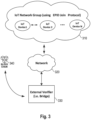
- Fig. 3 shows a schematic diagram of a high-level use case supported by the proposed system architecture involving Web 3.0 DApp across pre-authorized participants within a EPID group with Web 3.0 block chain support.
- Fig. 3 shows an IoT network group 310 (which is grouped using the EPID Join Protocol) with IoT Devices 1...N as nodes.
- the group of nodes 310 communicates, via a network 320, with an external verifier (i.e., a bridge) 340, and, via the bridge, with a blockchain 340.
- the EPID group 310 is an off-block-chain group.
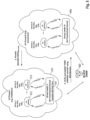
- Fig. 4 shows a schematic diagram of energy-aware leader-based proof-of-creation publication.
- dashed lines (such as dashed lines 440) show information that is published across groups.
- Fig. 4 shows groups 1 to N.
- Each group includes a broker 410-1, 410-N (with a revision list and a group key database), a publisher 420-1, 420-N, and IoT devices being supplied by the respective publisher.
- an external identifier comprising a revision list and a group management database
- the members of the groups use the same EPID/RSA key pair.
- Fig. 5 shows a schematic diagram of an example of Layer 2 enhancements for off-chain Proof-of-Creation publishing as batched transactions across one or many EPID groups and heterogeneous blockchains.
- Fig. 5 shows two groups 1, N (510, 5N0) of IoT devices.
- group 1 510 are publishers, while group N 5N0 are consumers.
- the IoT groups each include a group leader 511 (which is an IoT constrained device) and group members 512, 513 (also IoT devices).
- the group leader invites the group members to join the groups (via join requests), which are answered by the group members using join responses.
- Each device includes key encryption keys 1... N.
- Fig. 5 shows a schematic diagram of an example of Layer 2 enhancements for off-chain Proof-of-Creation publishing as batched transactions across one or many EPID groups and heterogeneous blockchains.
- Fig. 5 shows two groups 1, N (510, 5N0) of IoT devices.
- group 1 510 are
- the group leader 511 of group 510 has a publication certificate (GN.Pub.Cert) for publishing to group N.
- GN.Pub.Cert publication certificate
- IoT group N requests group 1 to provide content according to a topic (using key ⁇ GN.KEK.TOPIC ⁇ EPID SIGN )
- IoT group N verifies and publishes, via blockchain 500, content according to the topic and key using GN.Pub.Cert.
- the proposed concept may leverage energy-aware low-cost off-blockchain offline transactions for efficiency and support for heterogeneous block chain schemes.
- Fig. 6 shows a schematic diagram of a failover mechanism for group leadership using carbon-aware principles, providing carbon-aware scalable reliability support.
- Fig. 6 shows a group leader 610 and group member nodes 621-623 which obtain their respective energy from different energy sources 631-633.
- Group member 621 obtains its energy from energy source 631, which is a green energy source
- group member 622 obtains its energy from energy source 632, which is not known/not green
- group member 623 obtains its energy from energy source 633, which is a green energy source.
- the different candidates to be leader successors i.e., the group members 621-623
- Telemetry could include one or more of an amount of green energy, an energy efficiency, and an amount of network transient failures.
- the leader 610 may determine (e.g., select) over time what the best candidates to success the leader are in case of failure.
- the leader may perform some level of synchronization over time with the successor(s). In Fig. 6 , this is done with group members 621, 623, which use green energy sources.
- the synchronization may be useful in case there is some state that is to be propagated to a new leader.
- the next in command may take ownership (i.e., leaderships) and the rest of the peers of the node maybe notified. In case that the previous leader becomes available again, it may be notified by the rest of the peers that the previous leader is not a leader anymore.
- Various examples of the present disclosure may have an impact on power utilization, e.g., overall and/or of the individual nodes.
- An example relates to an apparatus (10) for a group leader (100-L) of a group of nodes (100) of a blockchain network (105), the apparatus comprising interface circuitry (12), machine-readable instructions (16a), and processor circuitry (14) to execute the machine-readable instructions to manage a membership of nodes of the blockchain network in the group of nodes, and to perform or delegate blockchain-related computational activity on behalf of the group of nodes according to an energy criterion.
- Another example relates to a previously described example (e.g., example 1) or to any of the examples described herein, further comprising that the processor circuitry is to execute the machine-readable instructions to assume, by the node, leadership of the group of nodes according to the energy criterion.
- Another example (e.g., example 3) relates to a previously described example (e.g., one of the examples 1 to 2) or to any of the examples described herein, further comprising that the energy criterion is based on at least one of an amount of energy required by a node for performing blockchain-related computational activity and a use of renewable energy by a node of the group of nodes.
- Another example (e.g., example 4) relates to a previously described example (e.g., example 3) or to any of the examples described herein, further comprising that the use of renewable energy by a node varies over time, with the act of performing or delegating blockchain-related computational activity on behalf of the group of nodes is performed based on a current or predicted use of renewable energy by the respective node.
- Another example (e.g., example 5) relates to a previously described example (e.g., one of the examples 1 to 4) or to any of the examples described herein, further comprising that the block-chain-related computational activity relates to at least one of creation of a zero-knowledge proof, verification of a zero-knowledge proof and proof of creation to be published on a block-chain.
- Another example (e.g., example 6) relates to a previously described example (e.g., one of the examples 1 to 5) or to any of the examples described herein, further comprising that the processor circuitry is to execute the machine-readable instructions to delegate blockchain-related computational activity to another member of the group of nodes based on a load of the group leader.
- Another example (e.g., example 7) relates to a previously described example (e.g., one of the examples 1 to 6) or to any of the examples described herein, further comprising that the processor circuitry is to execute the machine-readable instructions to delegate blockchain-related computational activity to another member if the other group member surpasses the group leader according to the energy criterion.
- Another example (e.g., example 8) relates to a previously described example (e.g., one of the examples 1 to 7) or to any of the examples described herein, further comprising that the act of performing the blockchain-related computational activity comprises documenting the block-chain-related computational activity on a blockchain accessible by the group of nodes.
- Another example (e.g., example 9) relates to a previously described example (e.g., example 8) or to any of the examples described herein, further comprising that the processor circuitry is to execute the machine-readable instructions to document the blockchain-related computational activity on a blockchain using a key encryption key for documenting the blockchain-related computational activity.
- Another example (e.g., example 10) relates to a previously described example (e.g., one of the examples 1 to 9) or to any of the examples described herein, further comprising that the act of delegating the blockchain-related computational activity comprises sharing a key encryption key for documenting the blockchain-related computational activity with the node of the group of nodes the blockchain-related computational activity is delegated to.
- Another example relates to a previously described example (e.g., one of the examples 1 to 10) or to any of the examples described herein, further comprising that the processor circuitry is to execute the machine-readable instructions to nominate a successor for group leader among the members of the group of nodes according to the energy criterion.
- Another example relates to a previously described example (e.g., example 11) or to any of the examples described herein, further comprising that the processor circuitry is to execute the machine-readable instructions to abdicate the node as group leader, and to transfer group leadership to the successor.
- Another example relates to a previously described example (e.g., one of the examples 11 to 12) or to any of the examples described herein, further comprising that the processor circuitry is to execute the machine-readable instructions to nominate a successor for group leader among the members of the group of nodes further according to a transient network reliability criterion.
- Another example relates to a previously described example (e.g., one of the examples 1 to 13) or to any of the examples described herein, further comprising that the processor circuitry is to execute the machine-readable instructions to remove a group member from the group of nodes according to a criterion.
- Another example relates to a previously described example (e.g., example 14) or to any of the examples described herein, further comprising that the criterion is one of the energy criterion, a transient network reliability criterion and a group participation reliability criterion.
- Another example relates to a previously described example (e.g., one of the examples 1 to 15) or to any of the examples described herein, further comprising that the processor circuitry is to execute the machine-readable instructions to abdicate the node as group leader according to an audit of activities of the group leader on at least one blockchain by one or more other members of the group.
- Another example relates to a previously described example (e.g., one of the examples 1 to 16) or to any of the examples described herein, further comprising that the processor circuitry is to execute the machine-readable instructions to communicate with one or more further nodes outside the group of nodes on behalf of the group of nodes.
- Another example relates to a previously described example (e.g., one of the examples 1 to 17) or to any of the examples described herein, further comprising that group membership in the group of nodes is attested based on a group public key and based on a member-specific membership private key.
- Another example relates to a previously described example (e.g., example 18) or to any of the examples described herein, further comprising that group membership in the group of nodes is attested using enhanced privacy identification, EPID, and wherein group members join the group of nodes using the EPID join protocol and/or are removed from the group of nodes using EPID membership revocation.
- EPID enhanced privacy identification
- Another example (e.g., example 20) relates to a previously described example (e.g., one of the examples 1 to 19) or to any of the examples described herein, further comprising that at least one of the group leader and one or more group members are excluded from one or more pre-defined transactions based on a policy.
- Another example relates to a previously described example (e.g., example 20) or to any of the examples described herein, further comprising that the policy is based on the energy criterion.
- An example relates to an apparatus (20) for a group member (100-X) of a group of nodes (100) of a blockchain network (105), the apparatus comprising interface circuitry (22), machine-readable instructions (26a), and processor circuitry (24) to execute the machine-readable instructions to obtain information on a blockchain-related computational activity being performed or delegated by a group leader of the group of nodes, to obtain information on documentation of the blockchain-related computational activity by a group leader (100-L) or delegate (100-D) of the group of nodes, and to trust the blockchain-related computational activity based on the documentation.
- Another example relates to a previously described example (e.g., example 22) or to any of the examples described herein, further comprising that the processor circuitry is to execute the machine-readable instructions to obtain information on further blockchain-related computational activity to be performed, obtain an instruction to perform the further blockchain-related computational activity from the group leader, and perform the further blockchain-related computational activity according to the instruction.
- Another example relates to a previously described example (e.g., example 23) or to any of the examples described herein, further comprising that the processor circuitry is to execute the machine-readable instructions to provide information on at least one of an energy efficiency of the group member in performing blockchain-related computational activity, information on a use of renewable energy by the group member and information on a transient network reliability of the group member to the group leader, and to obtain the instruction to perform the further blockchain-related computational activity in response to the provided information.
- Another example (e.g., example 25) relates to a previously described example (e.g., one of the examples 23 to 24) or to any of the examples described herein, further comprising that the processor circuitry is to execute the machine-readable instructions to obtain a key encryption key for documenting blockchain-related computational activity from the group leader, and to document the blockchain-related computational activity on a blockchain using the key encryption key for documenting the blockchain-related computational activity.
- Another example relates to a previously described example (e.g., one of the examples 22 to 25) or to any of the examples described herein, further comprising that the processor circuitry is to execute the machine-readable instructions to obtain information on the group node being nominated as successor of the group leader, and to assume, by the member of the group, leadership of the group of nodes.
- Another example relates to a previously described example (e.g., example 26) or to any of the examples described herein, further comprising that the processor circuitry is to execute the machine-readable instructions to assume, by the member of the group, leadership of the group of nodes according to an energy criterion.
- Another example (e.g., example 28) relates to a previously described example (e.g., one of the examples 22 to 27) or to any of the examples described herein, further comprising that the processor circuitry is to execute the machine-readable instructions to audit activities of the group leader on at least one blockchain, and to share information on the audit with other members of the group of nodes.
- Another example (e.g., example 29) relates to a previously described example (e.g., one of the examples 22 to 28) or to any of the examples described herein, further comprising that group membership in the group of nodes is attested based on a group public key and based on a member-specific membership private key.
- Another example relates to a previously described example (e.g., example 29) or to any of the examples described herein, further comprising that group membership in the group of nodes is attested using enhanced privacy identification, EPID, and wherein group members join the group of nodes using the EPID join protocol and/or are removed from the group of nodes using EPID membership revocation.
- EPID enhanced privacy identification
- Another example (e.g., example 31) relates to a previously described example (e.g., one of the examples 22 to 30) or to any of the examples described herein, further comprising that at least one of the group leader and one or more group members are excluded from one or more pre-defined transactions based on a policy.
- Another example relates to a previously described example (e.g., example 31) or to any of the examples described herein, further comprising that the policy is based on the energy criterion.
- An example relates to an apparatus (10) for a group leader (100-L) of a group of nodes (100) of a blockchain network (105), the apparatus comprising processor circuitry configured to manage a membership of nodes of the blockchain network in the group of nodes.
- the processor circuitry is configured to perform or delegate blockchain-related computational activity on behalf of the group of nodes according to an energy criterion.
- An example relates to an apparatus (20) for a group member (100-X) of a group of nodes (100) of a blockchain network (105), the apparatus comprising processor circuitry (24) configured to obtain information on a blockchain-related computational activity being performed or delegated by a group leader of the group of nodes.
- the processor circuitry is configured to obtain information on documentation of the blockchain-related computational activity by a group leader (100-L) or delegate (100-D) of the group of nodes.
- the processor circuitry is configured to trust the blockchain-related computational activity based on the documentation.
- An example (e.g., example 35) relates to a device (10) for a group leader (100-L) of a group of nodes (100) of a blockchain network (105), the device comprising means for processing (14) for managing a membership of nodes of the blockchain network in the group of nodes.
- the device (10) comprises means for processing for performing or delegating blockchain-related computational activity on behalf of the group of nodes according to an energy criterion.
- An example relates to a device (20) for a group member (100-X) of a group of nodes (100) of a blockchain network (105), the device comprising means for processing (24) for obtaining information on a blockchain-related computational activity being performed or delegated by a group leader of the group of nodes.
- the means for processing is for obtaining information on documentation of the blockchain-related computational activity by a group leader (100-L) or delegate (100-D) of the group of nodes.
- the means for processing is for trusting the blockchain-related computational activity based on the documentation.
- An example relates to a method for a group leader (100-L) of a group of nodes (100) of a blockchain network (105), the method comprising managing (130) a membership of nodes of the blockchain network in the group of nodes.
- the method comprises performing (140) or delegating (150) blockchain-related computational activity on behalf of the group of nodes according to an energy criterion.
- Another example relates to a previously described example (e.g., example 37) or to any of the examples described herein, further comprising that the method comprises assuming (110), by the node, leadership of the group of nodes according to the energy criterion.
- Another example relates to a previously described example (e.g., one of the examples 37 to 38) or to any of the examples described herein, further comprising that the method comprises delegating (150) blockchain-related computational activity to another member of the group of nodes based on a load of the group leader.
- Another example relates to a previously described example (e.g., one of the examples 37 to 39) or to any of the examples described herein, further comprising that the method comprises delegating (150) blockchain-related computational activity to another member if the other group member surpasses the group leader according to the energy criterion.
- Another example relates to a previously described example (e.g., one of the examples 37 to 40) or to any of the examples described herein, further comprising that the act of performing the blockchain-related computational activity comprises documenting (145) the blockchain-related computational activity on a blockchain accessible by the group of nodes.
- Another example relates to a previously described example (e.g., example 41) or to any of the examples described herein, further comprising that the method comprises documenting (145) the blockchain-related computational activity on a blockchain using a key encryption key for documenting the blockchain-related computational activity.
- Another example relates to a previously described example (e.g., one of the examples 37 to 42) or to any of the examples described herein, further comprising that the act of delegating the blockchain-related computational activity comprises sharing (155) a key encryption key for documenting the blockchain-related computational activity with the node of the group of nodes the blockchain-related computational activity is delegated to.
- Another example relates to a previously described example (e.g., one of the examples 37 to 43) or to any of the examples described herein, further comprising that the method comprises nominating (160) a successor for group leader among the members of the group of nodes according to the energy criterion.
- Another example relates to a previously described example (e.g., example 44) or to any of the examples described herein, further comprising that the method comprises abdicating (170) the node as group leader and transferring (175) group leadership to the successor.
- Another example relates to a previously described example (e.g., one of the examples 44 to 45) or to any of the examples described herein, further comprising that the method comprises nominating (160) a successor for group leader among the members of the group of nodes further according to a transient network reliability criterion.
- Another example relates to a previously described example (e.g., one of the examples 37 to 46) or to any of the examples described herein, further comprising that the method comprises abdicating (170) the node as group leader according to an audit of activities of the group leader on at least one blockchain by one or more other members of the group.
- Another example relates to a previously described example (e.g., one of the examples 37 to 47) or to any of the examples described herein, further comprising that the method comprises removing (180) a group member from the group of nodes according to a criterion.
- Another example relates to a previously described example (e.g., example 48) or to any of the examples described herein, further comprising that the criterion is one of the energy criterion, a transient network reliability criterion and a group participation reliability criterion.
- Another example relates to a previously described example (e.g., one of the examples 37 to 49) or to any of the examples described herein, further comprising that the method comprises communicating (120) with one or more further nodes outside the group of nodes on behalf of the group of nodes.
- An example relates to a method for a group member (100-X) of a group of nodes (100) of a blockchain network (105), the method comprising obtaining (210) information on a blockchain-related computational activity being performed or delegated by a group leader of the group of nodes.
- the method comprises obtaining (212) information on documentation of the blockchain-related computational activity by a group leader (100-L) or delegate (100-D) of the group of nodes.
- the method comprises trusting (214) the blockchain-related computational activity based on the documentation.
- Another example relates to a previously described example (e.g., example 51) or to any of the examples described herein, further comprising that the method comprises obtaining (230) information on further blockchain-related computational activity to be performed, obtaining (232) an instruction to perform the further blockchain-related computational activity from the group leader, and performing (234) the further blockchain-related computational activity according to the instruction.
- Another example relates to a previously described example (e.g., example 52) or to any of the examples described herein, further comprising that the method comprises providing (220) information on at least one of an energy efficiency of the group member in performing blockchain-related computational activity, information on a use of renewable energy by the group member and information on a transient network reliability of the group member to the group leader, and obtaining (232) the instruction to perform the further block-chain-related computational activity in response to the provided information.
- Another example relates to a previously described example (e.g., one of the examples 52 to 53) or to any of the examples described herein, further comprising that the method comprises obtaining (236) a key encryption key for documenting blockchain-related computational activity from the group leader, and documenting (238) the blockchain-related computational activity on a blockchain using the key encryption key for documenting the blockchain-related computational activity.
- Another example relates to a previously described example (e.g., one of the examples 51 to 54) or to any of the examples described herein, further comprising that the method comprises obtaining (240) information on the group member being nominated as successor of the group leader, and assuming (260), by the member of the group, leadership of the group of nodes.
- An example e.g., example 59
- a computer system 100 being configured to perform the method of one of the examples 37 to 50 (or according to any other example), wherein the computer system is the group leader of the group of nodes.
- An example (e.g., example 61) relates to a computer system (200) being configured to perform the method of one of the examples 51 to 57 (or according to any other example), wherein the computer system is the group leader of the group of nodes.
- An example (e.g., example 63) relates to a non-transitory machine-readable storage medium including program code, when executed, to cause a machine to perform the method of one of the examples 37 to 50 (or according to any other example) or the method of one of the examples 51 to 57 (or according to any other example).
- An example (e.g., example 64) relates to a computer program having a program code for performing the method of one of the examples 37 to 50 (or according to any other example) or the method of one of the examples 51 to 57 (or according to any other example) when the computer program is executed on a computer, a processor, or a programmable hardware component.
- Examples may further be or relate to a (computer) program including a program code to execute one or more of the above methods when the program is executed on a computer, processor, or other programmable hardware component.
- steps, operations, or processes of different ones of the methods described above may also be executed by programmed computers, processors, or other programmable hardware components.
- Examples may also cover program storage devices, such as digital data storage media, which are machine-, processor- or computer-readable and encode and/or contain machine-executable, processor-executable or computer-executable programs and instructions.
- Program storage devices may include or be digital storage devices, magnetic storage media such as magnetic disks and magnetic tapes, hard disk drives, or optically readable digital data storage media, for example.
- Other examples may also include computers, processors, control units, (field) programmable logic arrays ((F)PLAs), (field) programmable gate arrays ((F)PGAs), graphics processor units (GPU), application-specific integrated circuits (ASICs), integrated circuits (ICs) or system-on-a-chip (SoCs) systems programmed to execute the steps of the methods described above.
- FPLAs field programmable logic arrays
- F field) programmable gate arrays
- GPU graphics processor units
- ASICs application-specific integrated circuits
- ICs integrated circuits
- SoCs system-on-a-chip
- aspects described in relation to a device or system should also be understood as a description of the corresponding method.
- a block, device or functional aspect of the device or system may correspond to a feature, such as a method step, of the corresponding method.
- aspects described in relation to a method shall also be understood as a description of a corresponding block, a corresponding element, a property or a functional feature of a corresponding device or a corresponding system.
- module refers to logic that may be implemented in a hardware component or device, software or firmware running on a processing unit, or a combination thereof, to perform one or more operations consistent with the present disclosure.
- Software and firmware may be embodied as instructions and/or data stored on non-transitory computer-readable storage media.
- circuitry can comprise, singly or in any combination, non-programmable (hardwired) circuitry, programmable circuitry such as processing units, state machine circuitry, and/or firmware that stores instructions executable by programmable circuitry.
- Modules described herein may, collectively or individually, be embodied as circuitry that forms a part of a computing system. Thus, any of the modules can be implemented as circuitry.
- a computing system referred to as being programmed to perform a method can be programmed to perform the method via software, hardware, firmware, or combinations thereof.
- any of the disclosed methods can be implemented as computer-executable instructions or a computer program product. Such instructions can cause a computing system or one or more processing units capable of executing computer-executable instructions to perform any of the disclosed methods.
- the term "computer” refers to any computing system or device described or mentioned herein.
- the term "computer-executable instruction” refers to instructions that can be executed by any computing system or device described or mentioned herein.
- the computer-executable instructions can be part of, for example, an operating system of the computing system, an application stored locally to the computing system, or a remote application accessible to the computing system (e.g., via a web browser). Any of the methods described herein can be performed by computer-executable instructions performed by a single computing system or by one or more networked computing systems operating in a network environment. Computer-executable instructions and updates to the computer-executable instructions can be downloaded to a computing system from a remote server.
- implementation of the disclosed technologies is not limited to any specific computer language or program.
- the disclosed technologies can be implemented by software written in C++, C#, Java, Perl, Python, JavaScript, Adobe Flash, C#, assembly language, or any other programming language.
- the disclosed technologies are not limited to any particular computer system or type of hardware.
- any of the software-based examples can be uploaded, downloaded, or remotely accessed through a suitable communication means.
- suitable communication means include, for example, the Internet, the World Wide Web, an intranet, cable (including fiber optic cable), magnetic communications, electromagnetic communications (including RF, microwave, ultrasonic, and infrared communications), electronic communications, or other such communication means.
Landscapes
- Engineering & Computer Science (AREA)
- Business, Economics & Management (AREA)
- Computer Security & Cryptography (AREA)
- Signal Processing (AREA)
- Computer Networks & Wireless Communication (AREA)
- Accounting & Taxation (AREA)
- Physics & Mathematics (AREA)
- Theoretical Computer Science (AREA)
- General Business, Economics & Management (AREA)
- General Physics & Mathematics (AREA)
- Economics (AREA)
- Finance (AREA)
- Strategic Management (AREA)
- Health & Medical Sciences (AREA)
- Mathematical Physics (AREA)
- Computing Systems (AREA)
- Development Economics (AREA)
- Public Health (AREA)
- Water Supply & Treatment (AREA)
- General Health & Medical Sciences (AREA)
- Human Resources & Organizations (AREA)
- Marketing (AREA)
- Primary Health Care (AREA)
- Tourism & Hospitality (AREA)
- Management, Administration, Business Operations System, And Electronic Commerce (AREA)
- Developing Agents For Electrophotography (AREA)
- Supply And Distribution Of Alternating Current (AREA)
Applications Claiming Priority (1)
| Application Number | Priority Date | Filing Date | Title |
|---|---|---|---|
| US18/474,278 US20240013181A1 (en) | 2023-09-26 | 2023-09-26 | Apparatuses, Devices, Methods and Non-Transitory Computer-Readable Media for a Group Leader and a Group Member of a Group of Nodes |
Publications (1)
| Publication Number | Publication Date |
|---|---|
| EP4531379A1 true EP4531379A1 (de) | 2025-04-02 |
Family
ID=89431490
Family Applications (1)
| Application Number | Title | Priority Date | Filing Date |
|---|---|---|---|
| EP24196543.3A Pending EP4531379A1 (de) | 2023-09-26 | 2024-08-26 | Vorrichtungen, vorrichtungen, verfahren und nichttransitorische computerlesbare medien für einen gruppenführer und ein gruppenmitglied einer gruppe von knoten |
Country Status (3)
| Country | Link |
|---|---|
| US (1) | US20240013181A1 (de) |
| EP (1) | EP4531379A1 (de) |
| CN (1) | CN119728073A (de) |
Families Citing this family (1)
| Publication number | Priority date | Publication date | Assignee | Title |
|---|---|---|---|---|
| US20260011238A1 (en) * | 2024-07-03 | 2026-01-08 | Get Buzzed Inc. | Alert system for use in a limited decentralized point to point network environment |
Citations (4)
| Publication number | Priority date | Publication date | Assignee | Title |
|---|---|---|---|---|
| US20170180122A1 (en) * | 2015-12-17 | 2017-06-22 | Intel Corporation | Privacy Preserving Group Formation with Distributed Content Key Generation |
| WO2020016700A1 (en) * | 2018-07-17 | 2020-01-23 | nChain Holdings Limited | Computer-implemented systems and methods for an accumulator-based protocol for the distribution of tasks across a computer network |
| CN112053152A (zh) * | 2020-08-21 | 2020-12-08 | 铭数科技(青岛)有限公司 | 一种基于绿色权益共识机制的分布式能源并网认证与交易方法 |
| CN112218290A (zh) * | 2020-09-18 | 2021-01-12 | 燕山大学 | 一种基于能量感知区块链的多AUVs协同控制系统 |
-
2023
- 2023-09-26 US US18/474,278 patent/US20240013181A1/en active Pending
-
2024
- 2024-08-23 CN CN202411164579.5A patent/CN119728073A/zh active Pending
- 2024-08-26 EP EP24196543.3A patent/EP4531379A1/de active Pending
Patent Citations (4)
| Publication number | Priority date | Publication date | Assignee | Title |
|---|---|---|---|---|
| US20170180122A1 (en) * | 2015-12-17 | 2017-06-22 | Intel Corporation | Privacy Preserving Group Formation with Distributed Content Key Generation |
| WO2020016700A1 (en) * | 2018-07-17 | 2020-01-23 | nChain Holdings Limited | Computer-implemented systems and methods for an accumulator-based protocol for the distribution of tasks across a computer network |
| CN112053152A (zh) * | 2020-08-21 | 2020-12-08 | 铭数科技(青岛)有限公司 | 一种基于绿色权益共识机制的分布式能源并网认证与交易方法 |
| CN112218290A (zh) * | 2020-09-18 | 2021-01-12 | 燕山大学 | 一种基于能量感知区块链的多AUVs协同控制系统 |
Non-Patent Citations (1)
| Title |
|---|
| BARBHAYA UMANG RAJENDRA ET AL: "ETradeChain: Blockchain-Based Energy Trading in Local Energy Market (LEM) Using Modified Double Auction Protocol", IEEE TRANSACTIONS ON GREEN COMMUNICATIONS AND NETWORKING, IEEE, vol. 8, no. 1, 19 August 2023 (2023-08-19), pages 559 - 571, XP011960204, DOI: 10.1109/TGCN.2023.3307360 * |
Also Published As
| Publication number | Publication date |
|---|---|
| US20240013181A1 (en) | 2024-01-11 |
| CN119728073A (zh) | 2025-03-28 |
Similar Documents
| Publication | Publication Date | Title |
|---|---|---|
| Yun et al. | DQN-based optimization framework for secure sharded blockchain systems | |
| Sultan et al. | Conceptualizing blockchains: characteristics & applications | |
| Mahmoud et al. | Research challenges and opportunities in blockchain and cryptocurrencies | |
| KR102361224B1 (ko) | 블록체인 기반으로 검증된 노드와 비검증된 노드를 이용한 클라우드 서비스 제공 방법 및 시스템 | |
| Yuan et al. | CoopEdge+: Enabling decentralized, secure and cooperative multi-access edge computing based on blockchain | |
| CN111294379B (zh) | 区块链网络服务平台及其权限托管方法、存储介质 | |
| Xu et al. | A scalable two-layer blockchain system for distributed multicloud storage in IIoT | |
| CN114168913B (zh) | 基于智能合约众包结果评估与奖励分配方法和系统 | |
| CN112765642B (zh) | 数据处理方法、数据处理装置、电子设备及介质 | |
| EP4531379A1 (de) | Vorrichtungen, vorrichtungen, verfahren und nichttransitorische computerlesbare medien für einen gruppenführer und ein gruppenmitglied einer gruppe von knoten | |
| Zhou et al. | Enforcing trustworthy cloud sla with witnesses: A game theory–based model using smart contracts | |
| Song et al. | Smart contract-based computing resources trading in edge computing | |
| Park et al. | BAPS-DITS: Blockchain-enabled accountable privacy-preserving scheme for decentralized intelligent transportation systems | |
| Xu et al. | SmartLLM: a new oracle system for smart contracts calling large language models | |
| Li et al. | Blockchain-based privacy-preserving and accountable mobile edge outsourcing computing framework for the metaverse | |
| Vijayakumar et al. | Security for resource selection in grid computing based on trust and reputation responsiveness | |
| Cao et al. | A framework for QoS-guaranteed fast access services in blockchain radio access network | |
| Ziegler et al. | Designing a security incident response process for self-sovereign identities | |
| US20200258020A1 (en) | A method for resource allocation in a utility service network | |
| CN117319836A (zh) | 用于微服务的遥测中枢的概念 | |
| US12287845B2 (en) | Operation of a distributed deterministic network | |
| Fkaier et al. | Secure distributed power trading protocol for networked microgrids based on blockchain and elliptic curve cryptography | |
| Garcia et al. | Soft-Trust Based Architecture for NextG IIoT/IoET Security, Authentication and Authorization | |
| EP4479868A1 (de) | Computersysteme mit zentralisierter beglaubigungsvorrichtung | |
| Zhang et al. | Zkfhed: A Verifiable and Scalable Blockchain-Enhanced Federated Learning System |
Legal Events
| Date | Code | Title | Description |
|---|---|---|---|
| PUAI | Public reference made under article 153(3) epc to a published international application that has entered the european phase |
Free format text: ORIGINAL CODE: 0009012 |
|
| STAA | Information on the status of an ep patent application or granted ep patent |
Free format text: STATUS: THE APPLICATION HAS BEEN PUBLISHED |
|
| AK | Designated contracting states |
Kind code of ref document: A1 Designated state(s): AL AT BE BG CH CY CZ DE DK EE ES FI FR GB GR HR HU IE IS IT LI LT LU LV MC ME MK MT NL NO PL PT RO RS SE SI SK SM TR |
|
| STAA | Information on the status of an ep patent application or granted ep patent |
Free format text: STATUS: REQUEST FOR EXAMINATION WAS MADE |
|
| 17P | Request for examination filed |
Effective date: 20251002 |