EP4531373A1 - Verfahren und vorrichtung zur verkehrssteuerung, elektronische vorrichtung und lesbares speichermedium - Google Patents
Verfahren und vorrichtung zur verkehrssteuerung, elektronische vorrichtung und lesbares speichermedium Download PDFInfo
- Publication number
- EP4531373A1 EP4531373A1 EP23811019.1A EP23811019A EP4531373A1 EP 4531373 A1 EP4531373 A1 EP 4531373A1 EP 23811019 A EP23811019 A EP 23811019A EP 4531373 A1 EP4531373 A1 EP 4531373A1
- Authority
- EP
- European Patent Office
- Prior art keywords
- user
- bandwidth resources
- resource allocation
- different priorities
- allocation cycle
- Prior art date
- Legal status (The legal status is an assumption and is not a legal conclusion. Google has not performed a legal analysis and makes no representation as to the accuracy of the status listed.)
- Pending
Links
Images


Classifications
-
- H—ELECTRICITY
- H04—ELECTRIC COMMUNICATION TECHNIQUE
- H04L—TRANSMISSION OF DIGITAL INFORMATION, e.g. TELEGRAPHIC COMMUNICATION
- H04L47/00—Traffic control in data switching networks
- H04L47/50—Queue scheduling
- H04L47/62—Queue scheduling characterised by scheduling criteria
- H04L47/6215—Individual queue per QOS, rate or priority
-
- H—ELECTRICITY
- H04—ELECTRIC COMMUNICATION TECHNIQUE
- H04L—TRANSMISSION OF DIGITAL INFORMATION, e.g. TELEGRAPHIC COMMUNICATION
- H04L47/00—Traffic control in data switching networks
- H04L47/50—Queue scheduling
- H04L47/62—Queue scheduling characterised by scheduling criteria
- H04L47/625—Queue scheduling characterised by scheduling criteria for service slots or service orders
- H04L47/6265—Queue scheduling characterised by scheduling criteria for service slots or service orders past bandwidth allocation
-
- H—ELECTRICITY
- H04—ELECTRIC COMMUNICATION TECHNIQUE
- H04L—TRANSMISSION OF DIGITAL INFORMATION, e.g. TELEGRAPHIC COMMUNICATION
- H04L47/00—Traffic control in data switching networks
- H04L47/70—Admission control; Resource allocation
-
- H—ELECTRICITY
- H04—ELECTRIC COMMUNICATION TECHNIQUE
- H04L—TRANSMISSION OF DIGITAL INFORMATION, e.g. TELEGRAPHIC COMMUNICATION
- H04L47/00—Traffic control in data switching networks
- H04L47/70—Admission control; Resource allocation
- H04L47/78—Architectures of resource allocation
- H04L47/781—Centralised allocation of resources
-
- H—ELECTRICITY
- H04—ELECTRIC COMMUNICATION TECHNIQUE
- H04L—TRANSMISSION OF DIGITAL INFORMATION, e.g. TELEGRAPHIC COMMUNICATION
- H04L47/00—Traffic control in data switching networks
- H04L47/70—Admission control; Resource allocation
- H04L47/80—Actions related to the user profile or the type of traffic
- H04L47/805—QOS or priority aware
-
- H—ELECTRICITY
- H04—ELECTRIC COMMUNICATION TECHNIQUE
- H04L—TRANSMISSION OF DIGITAL INFORMATION, e.g. TELEGRAPHIC COMMUNICATION
- H04L47/00—Traffic control in data switching networks
- H04L47/70—Admission control; Resource allocation
- H04L47/80—Actions related to the user profile or the type of traffic
- H04L47/808—User-type aware
-
- H—ELECTRICITY
- H04—ELECTRIC COMMUNICATION TECHNIQUE
- H04L—TRANSMISSION OF DIGITAL INFORMATION, e.g. TELEGRAPHIC COMMUNICATION
- H04L47/00—Traffic control in data switching networks
- H04L47/70—Admission control; Resource allocation
- H04L47/82—Miscellaneous aspects
- H04L47/821—Prioritising resource allocation or reservation requests
-
- H—ELECTRICITY
- H04—ELECTRIC COMMUNICATION TECHNIQUE
- H04L—TRANSMISSION OF DIGITAL INFORMATION, e.g. TELEGRAPHIC COMMUNICATION
- H04L47/00—Traffic control in data switching networks
- H04L47/70—Admission control; Resource allocation
- H04L47/82—Miscellaneous aspects
- H04L47/822—Collecting or measuring resource availability data
-
- H—ELECTRICITY
- H04—ELECTRIC COMMUNICATION TECHNIQUE
- H04L—TRANSMISSION OF DIGITAL INFORMATION, e.g. TELEGRAPHIC COMMUNICATION
- H04L47/00—Traffic control in data switching networks
- H04L47/70—Admission control; Resource allocation
- H04L47/82—Miscellaneous aspects
- H04L47/826—Involving periods of time
-
- H—ELECTRICITY
- H04—ELECTRIC COMMUNICATION TECHNIQUE
- H04L—TRANSMISSION OF DIGITAL INFORMATION, e.g. TELEGRAPHIC COMMUNICATION
- H04L47/00—Traffic control in data switching networks
- H04L47/70—Admission control; Resource allocation
- H04L47/82—Miscellaneous aspects
- H04L47/828—Allocation of resources per group of connections, e.g. per group of users
-
- H—ELECTRICITY
- H04—ELECTRIC COMMUNICATION TECHNIQUE
- H04L—TRANSMISSION OF DIGITAL INFORMATION, e.g. TELEGRAPHIC COMMUNICATION
- H04L47/00—Traffic control in data switching networks
- H04L47/70—Admission control; Resource allocation
- H04L47/83—Admission control; Resource allocation based on usage prediction
Definitions
- Embodiments of the present disclosure relate to the field of cloud service technology, and in particular, to a flow control method, an apparatus, and an electronic device and a readable storage medium.
- cloud services to store data in the cloud, which can not only solve the problem of insufficient remaining storage space of users' electronic devices, but also help the users to realize data sharing among multiple electronic devices, and prevent users' data from being accidentally lost.
- a NAS (Network Attached Storage, NAS) server can provide cloud services for a large number of users at the same time to access data in a shared resource pool.
- NAS Network Attached Storage
- one or more embodiments of the present disclosure provide a flow control method, an apparatus, and an electronic device and a readable storage medium to address problems existing in the prior art.
- a flow control method is provided, which is applied to a cloud server, where the cloud server stores data provided to users with different priorities to access, and bandwidth resources on the cloud server are periodically allocated to the user sets; the method includes:
- a flow control method is provided, which is applied to a client, where the method includes:
- a flow control apparatus which is applied to a cloud server, where the cloud server stores data provided to users with different priorities to access, and bandwidth resources on the cloud server are periodically allocated to the user sets; the apparatus includes:
- a flow control apparatus which is applied to a client, where the apparatus includes:
- an electronic device which includes a communication interface, a processor, a memory and a bus, where the communication interface, the processor and the memory are interconnected through the bus; the memory stores machine readable instructions, and the processor calls the machine readable instructions to execute the above method.
- a machine readable storage medium stores machine readable instructions, when the machine readable instructions are called and executed by the processor, the above method is implemented.
- the first quantity of the bandwidth resources allocated to the user sets with different priorities in the current resource allocation period can be readjusted based on the allocation in the previous resource allocation cycle.
- the second quantity of the bandwidth resources allocated to each user in each priority can be further calculated according to the first quantity, and access control can be performed based on the second quantity corresponding to the user when the user accesses the data.
- the steps of the method are not necessarily performed in the order indicated and described in the present disclosure.
- the method may include more or fewer steps than described in the present disclosure.
- a single step described in the present disclosure may be described by breaking down into multiple steps in other embodiments; the multiple steps described in the present disclosure may also be combined into a single step description in other embodiments.
- cloud service providers When selling bandwidth resources, cloud service providers usually divide the sold bandwidth resources into two forms of best effort and must guarantee, and configures different isolation strategies to provide different guarantee level for these two types of sold resources, so as to ensure that stable and reliable cloud services can be provided to some users when physical bandwidth resources are limited.
- a QoS (Quality of Service, Quality of Service) strategy is configured to distinguish flow of different services, flow is divided based on a quintuple matching flow classification rule, and bandwidth of critical service flow is ensured based on a configured rate limiting rule to improve network quality.
- the present disclosure provides a periodic dynamic allocation strategy, bandwidth resources allocated to user sets with different priorities to access data in a current cycle are determined based on allocation of a previous cycle, and allocable bandwidth resources are further determined for different users in user sets with the same priority, and a technical solution of precise flow control is achieved.
- FIG. 1 is a schematic diagram of a user interacting with a cloud server provided by an illustrative embodiment of the present disclosure.
- user A1 to user An belongs to a user set with priority A
- user B1 to user Bn belong to a user set with priority B
- user C1 to user Cn belongs to a user set with priority C. All user sets with different priorities can access data stored on the cloud server.
- bandwidth resources on the cloud server can be periodically allocated to the user sets.
- bandwidth resources when bandwidth resources are allocated for the first time, a different allocation ratio can be preset for three user sets in FIG. 1 and bandwidth resources can be allocated according to the ratio.
- a first quantity of allocable bandwidth resources corresponding to the user sets with different priorities is calculated respectively in the current resource allocation cycle according to a quantity of bandwidth resources allocated to the user sets with different priorities in the previous resource allocation cycle.
- quantities of resource bandwidth allocated to user sets of three priorities shown in FIG. 1 in the previous resource allocation cycle can be calculated, and then quantities of allocable bandwidth resources corresponding to the user sets of the three priorities in the current resource allocation cycle are determined based on a statistics result and a preset calculation formula.
- a second quantity of allocable bandwidth resources corresponding to each user in the user sets with different priorities can be further calculated according to the first quantity.
- a quantity of the allocable bandwidth resources corresponding to user A1 in the user set with priority A can be further calculated according to a preset algorithm. The same process is performed on the other two user sets in FIG. 1 .
- access control can be performed for the access request based on the second quantity of the allocable bandwidth resources corresponding to the user.
- access control can be performed for the access request according to 1 GB/S as a flow threshold speed when the access request for data initiated by the user A1 is received in the current resource allocation cycle.
- the first quantity of the bandwidth resources allocated to the user sets with different priorities in the current resource allocation period can be readjusted based on the allocation in the previous resource allocation cycle.
- the second quantity of the bandwidth resources allocated to each user in each priority can be further calculated according to the first quantity, and access control can be performed based on the second quantity corresponding to the user when the user accesses the data.
- FIG. 2 is a flow diagram of a flow control method provided by an illustrative embodiment of the present disclosure, applied to a cloud server, where the cloud server stores data provided to users with different priorities to access, and bandwidth resources on the cloud server are periodically allocated to the user sets.
- the method includes the following execution steps:
- Each user in the user sets with different priorities can perform read operation or write operation when accessing data stored on the cloud server, which is not limited in the present disclosure.
- the bandwidth resources on the cloud server refers to a quantity of datum that can be transmitted at a fixed time, which is used to represent ability of a communication line to transmit data, that is, a quantity of data that can be transmitted on the line per unit time, and a commonly used unit thereof is bps (bit per second).
- the bandwidth resources allocated by the cloud server to the user can be an upload rate of a user or a download rate of a user, which is not limited in the present disclosure.
- bandwidth resources on the cloud server can be periodically allocated oriented to the user sets with different priorities accessing the data based on a preset resource allocation cycle, thus it is necessary to specify the resource allocation cycle and the bandwidth resources allocated to the user sets with different priorities at initialization.
- the bandwidth resources can be allocated to the user sets with different priorities according to a preset ratio between the different priorities at initialization.
- the user set with priority A has 6 Gbps of the bandwidth resources
- the user set with priority B has 4 Gbps of the bandwidth resources
- the user set with priority C has 0 Gbps of the bandwidth resources.
- the first quantity of the allocable bandwidth resources corresponding to the user sets with different priorities can be calculated respectively in the current resource allocation cycle according to the quantity of the bandwidth resources allocated to the user sets with different priorities in the previous resource allocation cycle.
- a quantity of the bandwidth resources allocated to the user sets with different priorities in FIG. 1 in the previous resource allocation cycle can be obtained, and then, quantities of the allocable bandwidth resources respectively corresponding to the user sets with priorities A, B, and C in the current resource allocation cycle are calculated according to quantities of the bandwidth resources allocated to the user sets with the three priorities respectively in the previous resource allocation cycle.
- the priority includes high priority, medium priority and low priority
- H 2 MIN H 1 , MAX a * S
- a preset a is 0.6, it means that the maximum quantity of the bandwidth resources allocated to the user sets of high-priority and medium-priority is 6 Gbps and 4 Gbps, respectively.
- the bandwidth resources of the high priority are under large pressure (H1>6 Gbps) and the bandwidth resources of the medium priority are under small pressure (M1 ⁇ 4 Gbps), the high priority needs to take precedence over the low priority to seize the remaining bandwidth resources of the medium priority.
- the bandwidth resources of the high priority are under low pressure (H1 ⁇ 6 Gbps) and the bandwidth resources of the medium priority are under high pressure (M1>4 Gbps)
- the medium priority needs to take precedence over the low priority to seize the remaining bandwidth resources of the high priority.
- the bandwidth resource of the low priority need to be occupied.
- the bandwidth resources of the high priority and the medium priority is under small pressure, the low priority can use the remaining bandwidth resources.
- the reasoning process is the same, which is not repeated here.
- the second quantity of the allocable bandwidth resources corresponding to each user in the user sets with different priorities can be further calculated according to the first quantity.
- a quantity of the allocable bandwidth resources corresponding to each user in the user sets can be determined by calculating each user in the user set with priority A, that is, user A1- user An, and determining a quantity of the allocable bandwidth resources corresponding to the each user. The same process is performed on the user sets with other two priority in FIG. 1 , which are not repeated here.
- the following processes can be performed for different priorities respectively: performing following processes for different priorities respectively:
- bandwidth resources occupied by user A in the user set with high priority is 2Gbps
- bandwidth resources occupied by the user set with high priority is 5Gbps
- allocable bandwidth resources corresponding to the user set with high priority in the current resource allocation cycle is 8Gbps.
- the above calculation process can be used to calculate the quantity of the allocable bandwidth resources corresponding to each user in FIG. 1 .
- the ratio of the bandwidth resources occupied by each user to the bandwidth resources occupied by the user set with the current priority can be calculated based on a quantity of the bandwidth resources in the previous resource allocation cycle or based on a mean value of the bandwidth resources counted in the last N resource allocation cycles, which is not limited in the present disclosure.
- the above cloud server can control the user's permission to use bandwidth resources by allocating tokens, a quantity of the resource bandwidth allocated to the user, that is, a quantity of allocated tokens, then when calculating the quantity of the allocable bandwidth resources, it is equivalent to calculating the quantity of the allocable tokens.
- a quantity H3 of tokens allocated to the user set with high priority, a quantity M3 of tokens allocated to the user set with medium priority, and a quantity L3 of tokens allocated to the user set with low priority in the previous resource allocation cycle can be counted;
- the bandwidth resources occupied by the user A to access data through these 200 tokens is 2Gbps
- a total bandwidth resources occupied by each user in the user set with high priority is 5Gbps
- the allocable bandwidth resources corresponding to the user set with high priority in the current resource allocation cycle is 8Gbps.
- the access control in response to the access request for the data initiated by the user received in the current resource allocation cycle, can be performed for the access request based on the second quantity of the allocable bandwidth resources corresponding to the user.
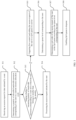
- FIG. 3 is a schematic diagram of a cloud server provided by an illustrative embodiment of the present disclosure, as shown in FIG. 3 , the following steps is included:
- the second quantity of the allocable bandwidth resources corresponding to the user calculated based on step 202 in the current resource cycle is 3Gbps
- the first quantity of the allocable bandwidth resources corresponding to the user set with high priority calculated based on step 201 is 7Gbps. But now there is only 2 Gbps left for the user set with high priority.
- step 305 is performed to trigger flow control and add the access request of the user to the QoS queue corresponding to the user set with high priority.
- Step 306 determining a queue level corresponding to the user.
- the cloud server can be further divided into three queue levels of high, medium and low for each user in the user sets with different priorities in advance.
- each user in the user set with high priority can be further divided into three queue levels of high, medium and low, and the same process is performed on the medium priority and low priority.
- Step 307 determining a sort order of the access request of the user in the QoS queue according to the queue level corresponding to the user.
- the access request of the user can be added to a portion of the QoS queue with a proportion of 60% according to the queue level corresponding to the user.
- Step 308 enabling the QoS queue to dequeue.
- the bandwidth resources can be allocated to each access request according to the sort order of the QoS queue, and the access request is processed based on the allocated bandwidth resources.
- a user whitelist can also be set, so that users in the whitelist can be sent directly to the queue without sorting in the queue, or a user blacklist can be set, so that users in the blacklist will not be sent directly to the queue, which is not limited in the present disclosure.
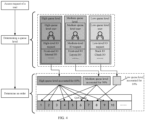
- FIG. 4 is a schematic diagram of adding an access request of a user to a QoS queue provided by an illustrative embodiment of the present disclosure. As shown in FIG. 4 , in the QoS queue, a corresponding proportion of queues of high, medium and low levels in the whole QoS queue is 6:3: 1.
- the queue to be added when adding the access request of the user to the QoS queue, the queue to be added can be determined according to the queue level corresponding to the user.
- the access request of the user can be added to the high-level queue shown in FIG. 4 .
- the access request of the user can be added to the medium-level queue shown in FIG. 4 .
- the access request of the user can also be divided into different levels.
- different types of IO requests can be divided into a high-level IO request, a medium-level IO request and a low-level IO request.
- the access request of the user is added to the high-level queue shown in FIG. 4 .
- the access request need to be sorted to determine the sort order of different access requests in the QoS queue.
- the positions corresponding to the high, medium and low queue levels are allocated respectively, and an order is set for these ten positions, that is, the positions of the high queue level are 1, 2, 4, 5, 7 and 9, the positions of the medium queue level are 3, 6 and 10, and the position of the low queue level is 8.
- the QoS queue in FIG. 4 when is enabled to dequence, ejects access requests from the queue in the order of positions 1 to 10, allocates bandwidth resources for each access request, and processes the access requests based on the allocated bandwidth resources.
- the cloud server is used for access control, there are usually multiple nodes in a cluster.
- a central node In order to ensure the accuracy of flow control, a central node generally needs to collect and allocate cluster resources in a unified manner, and the central node judges the flow control. However, when other nodes send queues to the central node, a path will be increased, resulting in delay.
- the access control can be judged by the client side to reduce the delay.
- the cloud server can send the second quantity of the allocable bandwidth resources corresponding to each user in the user sets with different priorities to the client where each user is located, and then when the user initiates the access request for the data in the current resource allocation cycle, the client performs access control for the access request of the user according to the second quantity of the allocable bandwidth resources corresponding to the user sent by the cloud server.
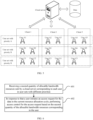
- FIG. 5 is a schematic diagram of a user interacting with a cloud server through a client provided by an illustrative embodiment of the present disclosure.
- A, B, and C are used to represent different priorities respectively, and different clients can send access requests of users with different priorities to the cloud server.
- user A1, user B1, user B2, user C1, and user C2 can initiate access requests for data through client 1; user A2, user A3, user B3, user C3, and user C4 can initiate access requests for data through client 2; user A4, user A5, user B4, user B3, and user C5 can initiate access requests for data through client 3.
- FIG. 6 is a flow diagram of another flow control method provided by an illustrative embodiment of the present disclosure, applied to the client, where the method includes the following steps:
- the cloud server can send the second quantity of the allocable bandwidth resources corresponding to each user in the user sets with different priorities to client 1, client 2, and client 3.
- client 1 in FIG. 5 assuming that the cloud server send a quantity M of allocable bandwidth resources corresponding to user A1 in the user sets with priority A to client 1 used by user A1, and then client 1 can, in response to that the user A1 initiates the access request for the data in the current resource allocation cycle, performs access control for the access request of the user A1 according to the quantity M of the allocable bandwidth resources corresponding to the user A1.
- the client when performing step 602, may, in response to that the user initiates the access request for the data in the current resource allocation cycle, determine the second quantity of the allocable bandwidth resources corresponding to the user;
- each user in the user sets with different priorities is further divided into three queue levels of high, medium and low; further, the client, when performing step 602, may add the access request of the user to a QoS queue corresponding to the user set to which the user belongs, and determine a sort order of the access request of the user in the QoS queue according to a queue level corresponding to the user.
- the above client can, in response to that the cloud server redistributes the bandwidth resources, allocate the bandwidth resources for each access request in turn according to the sort order of the QoS queue, and send the access request to the cloud server for processing based on the allocated bandwidth resources.
- FIG. 7 is a schematic diagram of a client performing access control for an access request provided by an illustrative embodiment of the present disclosure, as shown in FIG. 7 , the following steps is included:
- the quantity of the allocable bandwidth resources corresponding to the user in the current resource cycle is 3Gbps
- the first quantity of the allocable bandwidth resources corresponding to the user set with high priority is 7Gbps. But now there is only 2 Gbps left for the user set with high priority.
- step 706 is performed to trigger flow control and add the access request of the user to the QoS queue corresponding to the user set with high priority.
- Step 707 determining a queue level corresponding to the use.
- the client can be further divided into three queue levels of high, medium and low for each user in the user sets with different priorities in advance.
- each user in the user set with high priority can be further divided into three queue levels of high, medium and low, and the same process is performed on the medium priority and low priority.
- Step 708 determining a sort order of the access request of the user in the QoS queue according to the queue level corresponding to the user.
- the access request of the user can be added to a portion of the QoS queue with a proportion of 60% according to the queue level corresponding to the user.
- Step 709 enabling the QoS queue to dequeue.
- the bandwidth resources can be allocated to each access request according to the sort order of the QoS queue, and the access request is sent to the cloud server on order based on the allocated bandwidth resources.
- a user whitelist can also be set, so that users in the whitelist can be sent directly to the queue without sorting in the queue, or a user blacklist can be set, so that users in the blacklist will not be sent directly to the queue, which is not limited in the present disclosure.
- the client side performs access control based on the quantity of the allocable bandwidth resources corresponding to each user in the user sets with different priorities delivered by the cloud server, so that the client side can directly judge the access request without passing judgment by a central node of the cloud server, which can reduce a quantity of network interactions and reduce the delay, and thus achieve a set of flow control logic that is judged locally by the client, and updated asynchronous by the cloud server.
- the first quantity of the bandwidth resources allocated to the user sets with different priorities in the current resource allocation period can be readjusted based on the allocation in the previous resource allocation cycle.
- the second quantity of the bandwidth resources allocated to each user in each priority can be further calculated according to the first quantity, and access control can be performed based on the second quantity corresponding to the user when the user accesses the data.
- a device capable of implementing the above method is also provided in an illustrative embodiment of the present disclosure.
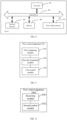
- FIG. 8 is a schematic structure diagram of a device provided by an illustrative embodiment.
- the device includes a processor 802, an internal bus 804, a network interface 806, a memory 808, and a non-volatile memory 810, and of course may include other hardware required by a business.
- the processor 802 reads a corresponding computer program from non-volatile memory 810 into memory 809 and then runs it.
- one or more embodiments in the present disclosure do not exclude other implementation methods, such as logic devices or hardware and software combination methods, etc., that is, an execution body of the following processing flow is not limited to each logical unit, but can also be hardware or logic devices.
- a flow control apparatus 900 is provided, applied to a cloud server, where the cloud server stores data provided to users with different priorities to access; where bandwidth resources on the cloud server are periodically allocated to user sets; the apparatus the cloud server stores data provided to users with different priorities to access, and bandwidth resources on the cloud server are periodically allocated to the user sets; the apparatus includes:
- the apparatus 900 also includes: an initialization module 904, configured to allocate the bandwidth resources to the user sets with different priorities according to a preset ratio between the different priorities at initialization.
- an initialization module 904 configured to allocate the bandwidth resources to the user sets with different priorities according to a preset ratio between the different priorities at initialization.
- the priority includes high priority, medium priority and low priority;
- the first computing module 901 further:
- the second computing module 902 further: perform following processes for different priorities respectively:
- the data is accessed by the user via a token allocated by the cloud server; the first computing module 901, further:
- the first control module 903, further: send the second quantity of the allocable bandwidth resources corresponding to each user in the user sets with different priorities to a client to which each user is located, so that the client, in response to that the user initiates the access request for the data in the current resource allocation cycle, performs access control for the access request based on the second quantity of the allocable bandwidth resources corresponding to the user.
- FIG. 10 in a software implementation, another flow control apparatus 1000 is provided, applied to a client, where the apparatus includes:
- the second control module 1002 further:
- each user in the user sets with different priorities is further divided into three queue levels of high, medium and low; the second control module 1002, further: add the access request of the user to a QoS queue corresponding to the user set to which the user belongs, and determining a sort order of the access request of the user in the QoS queue according to a queue level corresponding to the user.
- the apparatus 1000 also includes: an allocation module 1003, configured to, in response to that the cloud server redistributes the bandwidth resources, allocate the bandwidth resources for each access request in turn according to the sort order of the QoS queue, and sending the access request to the cloud server for processing based on the allocated bandwidth resources.
- an allocation module 1003 configured to, in response to that the cloud server redistributes the bandwidth resources, allocate the bandwidth resources for each access request in turn according to the sort order of the QoS queue, and sending the access request to the cloud server for processing based on the allocated bandwidth resources.
- the system, apparatus, module or unit described in the above embodiments may be implemented specifically by a computer chip or entity, or by a product having a certain function.
- a typical implementation device is a computer, which may take the form of a personal computer, laptop computer, cellular phone, camera phone, smart phone, personal digital assistant, media player, navigation device, E-mail receiver, game console, tablet computer, wearable device, or any combination of these devices.
- a computer includes one or more central processing units (CPU), input/output interfaces, network interfaces, and memory.
- CPU central processing units
- input/output interfaces input/output interfaces
- network interfaces network interfaces
- memory volatile and non-volatile memory
- a memory may include non-permanent memory in computer readable medium, random access memory (RAM) and/or non-volatile memory in the form of read-only memory (ROM) or flash memory (flash RAM).
- RAM random access memory
- ROM read-only memory
- flash RAM flash memory
- Computer readable medium including permanent and non-permanent, removable and non-removable medium, can be stored by any method or technology.
- Information can be computer-readable instructions, data structures, modules of programs, or other data.
- Examples of computer storage medium include, but not limited to phase change random access memory (PRAM), static random access memory (SRAM), dynamic random access memory (DRAM), other types of random access memory (RAM), read-only memory (ROM), electrically erasable programmable read-only memory (EEPROM), flash memory or other memory technology, compact disc read-only memory (CD-ROM), digital video disk (DVD) or other optical storage, magnetic cassette tape, disk storage, quantum memory, graphene-based storage medium or other magnetic storage device or any other non-transmission medium, which can be used to store information that can be accessed by computing devices.
- computer-readable medium does not include transitory media (transitory media), such as modulated data signals and carriers.
- first, second and third classes may be used to describe various information in one or more embodiments of the present application, such information should not be limited to these terms. These terms are used only to distinguish the same type of information from one another.
- first information may also be referred to as second information, and likewise second information may be referred to as first information.
- word “if” as used here can be interpreted as "at time of York or "when" or "in response to determination of”.
Landscapes
- Engineering & Computer Science (AREA)
- Computer Networks & Wireless Communication (AREA)
- Signal Processing (AREA)
- Data Exchanges In Wide-Area Networks (AREA)
Applications Claiming Priority (2)
| Application Number | Priority Date | Filing Date | Title |
|---|---|---|---|
| CN202210563387.6A CN114666284B (zh) | 2022-05-23 | 2022-05-23 | 一种流量控制方法、装置、电子设备及可读存储介质 |
| PCT/CN2023/095622 WO2023226948A1 (zh) | 2022-05-23 | 2023-05-22 | 一种流量控制方法、装置、电子设备及可读存储介质 |
Publications (2)
| Publication Number | Publication Date |
|---|---|
| EP4531373A1 true EP4531373A1 (de) | 2025-04-02 |
| EP4531373A4 EP4531373A4 (de) | 2025-08-06 |
Family
ID=82038071
Family Applications (1)
| Application Number | Title | Priority Date | Filing Date |
|---|---|---|---|
| EP23811019.1A Pending EP4531373A4 (de) | 2022-05-23 | 2023-05-22 | Verfahren und vorrichtung zur verkehrssteuerung, elektronische vorrichtung und lesbares speichermedium |
Country Status (4)
| Country | Link |
|---|---|
| US (1) | US20250337695A1 (de) |
| EP (1) | EP4531373A4 (de) |
| CN (1) | CN114666284B (de) |
| WO (1) | WO2023226948A1 (de) |
Families Citing this family (3)
| Publication number | Priority date | Publication date | Assignee | Title |
|---|---|---|---|---|
| CN114666284B (zh) * | 2022-05-23 | 2022-11-15 | 阿里巴巴(中国)有限公司 | 一种流量控制方法、装置、电子设备及可读存储介质 |
| CN115378879A (zh) * | 2022-08-22 | 2022-11-22 | Oppo广东移动通信有限公司 | 数据控制方法及相关装置 |
| CN116302406A (zh) * | 2023-02-10 | 2023-06-23 | 阿里巴巴(中国)有限公司 | 流量控制与数据复制方法、节点、系统及存储介质 |
Family Cites Families (19)
| Publication number | Priority date | Publication date | Assignee | Title |
|---|---|---|---|---|
| US8095620B2 (en) * | 2002-06-13 | 2012-01-10 | Elbit Systems Land and C41-Tadiran Ltd. | System and method for dynamic allocation of a resource |
| CN101419579B (zh) * | 2008-12-10 | 2011-11-16 | 中国科学院计算技术研究所 | 一种在动态随机存储器上提供服务质量的装置和方法 |
| US8159953B2 (en) * | 2009-09-24 | 2012-04-17 | Alcatel Lucent | Method and apparatus for managing allocation of resources in a network |
| CN102487515A (zh) * | 2010-12-03 | 2012-06-06 | 中国移动通信集团设计院有限公司 | 一种lte网络规划仿真方法及装置 |
| US9807773B2 (en) * | 2013-08-19 | 2017-10-31 | Verizon Patent And Licensing Inc. | Tier-based admission control for user equipment |
| US10616134B1 (en) * | 2015-03-18 | 2020-04-07 | Amazon Technologies, Inc. | Prioritizing resource hosts for resource placement |
| US20170149690A1 (en) * | 2015-11-20 | 2017-05-25 | Dell Products L.P. | Resource Aware Classification System |
| CN109510715B (zh) * | 2017-09-14 | 2022-02-08 | 中国电信股份有限公司 | 带宽分配方法、装置、数据中心以及存储介质 |
| CN110213620B (zh) * | 2018-02-28 | 2021-10-19 | 阿里巴巴(中国)有限公司 | 带宽分配方法及装置 |
| CN109189563B (zh) * | 2018-07-25 | 2020-01-24 | 腾讯科技(深圳)有限公司 | 资源调度方法、装置、计算设备及存储介质 |
| CN111400022A (zh) * | 2019-01-02 | 2020-07-10 | 中国移动通信有限公司研究院 | 一种资源调度方法、装置及电子设备 |
| CN111488135A (zh) * | 2019-01-28 | 2020-08-04 | 珠海格力电器股份有限公司 | 高并发系统的限流方法、装置、存储介质及设备 |
| US11805065B2 (en) * | 2019-02-27 | 2023-10-31 | Intel Corporation | Scalable traffic management using one or more processor cores for multiple levels of quality of service |
| CN112887228B (zh) * | 2019-11-29 | 2024-02-02 | 阿里巴巴集团控股有限公司 | 云资源管理方法、装置、电子设备及计算机可读存储介质 |
| CN113038609B (zh) * | 2019-12-25 | 2023-04-18 | 北京东土科技股份有限公司 | 一种基于通信需求的带宽资源分配方法、装置及设备 |
| CN111352736B (zh) * | 2020-02-28 | 2025-09-16 | 中国平安人寿保险股份有限公司 | 大数据资源的调度方法、装置、服务器及存储介质 |
| CN111629028B (zh) * | 2020-04-10 | 2022-02-25 | 清华大学 | 面向分布式多云存储的数据传输调度系统 |
| CN114157673A (zh) * | 2021-11-30 | 2022-03-08 | 北京知道创宇信息技术股份有限公司 | Cdn系统节点管理方法、装置、存储介质及电子设备 |
| CN114666284B (zh) * | 2022-05-23 | 2022-11-15 | 阿里巴巴(中国)有限公司 | 一种流量控制方法、装置、电子设备及可读存储介质 |
-
2022
- 2022-05-23 CN CN202210563387.6A patent/CN114666284B/zh active Active
-
2023
- 2023-05-22 WO PCT/CN2023/095622 patent/WO2023226948A1/zh not_active Ceased
- 2023-05-22 US US18/855,600 patent/US20250337695A1/en active Pending
- 2023-05-22 EP EP23811019.1A patent/EP4531373A4/de active Pending
Also Published As
| Publication number | Publication date |
|---|---|
| CN114666284A (zh) | 2022-06-24 |
| EP4531373A4 (de) | 2025-08-06 |
| WO2023226948A1 (zh) | 2023-11-30 |
| CN114666284B (zh) | 2022-11-15 |
| US20250337695A1 (en) | 2025-10-30 |
Similar Documents
| Publication | Publication Date | Title |
|---|---|---|
| EP4531373A1 (de) | Verfahren und vorrichtung zur verkehrssteuerung, elektronische vorrichtung und lesbares speichermedium | |
| US12107769B2 (en) | Throttling queue for a request scheduling and processing system | |
| US9225668B2 (en) | Priority driven channel allocation for packet transferring | |
| US20210288910A1 (en) | Network interface device with support for hierarchical quality of service (qos) | |
| US20050047425A1 (en) | Hierarchical scheduling for communications systems | |
| US20070070895A1 (en) | Scaleable channel scheduler system and method | |
| CN114257559B (zh) | 一种数据报文的转发方法及装置 | |
| KR20020079894A (ko) | 동적 클래스-기반 패킷 스케쥴링 방법 및 장치 | |
| US8479219B2 (en) | Allocating space in message queue for heterogeneous messages | |
| US20200076742A1 (en) | Sending data using a plurality of credit pools at the receivers | |
| US11729119B2 (en) | Dynamic queue management of network traffic | |
| EP3461085B1 (de) | Verfahren und vorrichtung zur warteschlangenverwaltung | |
| US20170293578A1 (en) | QoS-CLASS BASED SERVICING OF REQUESTS FOR A SHARED RESOURCE | |
| CN103685062A (zh) | 缓存管理方法及装置 | |
| CN108768898A (zh) | 一种片上网络传输报文的方法及其装置 | |
| EP4348943B1 (de) | Nichtlinearer verkehrsformer mit automatisch einstellbaren kostenparametern | |
| CN114884823A (zh) | 流量拥塞控制方法、装置、计算机可读介质及电子设备 | |
| CN109905331A (zh) | 队列调度方法及装置、通信设备、存储介质 | |
| CN112684988A (zh) | 基于分布式存储的QoS方法及系统 | |
| CN118678306A (zh) | 短信发送方法、装置、设备、存储介质和程序产品 | |
| CN117938778A (zh) | 以太网虚拟门限队列控制方法、装置及电子设备 | |
| CN117749726A (zh) | Tsn交换机输出端口优先级队列混合调度方法和装置 | |
| CN116366573A (zh) | 队列管理和调用方法、网卡设备以及存储介质 | |
| KR101850749B1 (ko) | 멀티 코어 기반 nic에서 동적 패킷 버퍼 할당 방법 | |
| US12489715B1 (en) | Variable buffer size in communication networks |
Legal Events
| Date | Code | Title | Description |
|---|---|---|---|
| STAA | Information on the status of an ep patent application or granted ep patent |
Free format text: STATUS: THE INTERNATIONAL PUBLICATION HAS BEEN MADE |
|
| PUAI | Public reference made under article 153(3) epc to a published international application that has entered the european phase |
Free format text: ORIGINAL CODE: 0009012 |
|
| STAA | Information on the status of an ep patent application or granted ep patent |
Free format text: STATUS: REQUEST FOR EXAMINATION WAS MADE |
|
| 17P | Request for examination filed |
Effective date: 20241219 |
|
| AK | Designated contracting states |
Kind code of ref document: A1 Designated state(s): AL AT BE BG CH CY CZ DE DK EE ES FI FR GB GR HR HU IE IS IT LI LT LU LV MC ME MK MT NL NO PL PT RO RS SE SI SK SM TR |
|
| A4 | Supplementary search report drawn up and despatched |
Effective date: 20250707 |
|
| RIC1 | Information provided on ipc code assigned before grant |
Ipc: H04L 47/62 20220101AFI20250701BHEP Ipc: H04L 47/625 20220101ALI20250701BHEP Ipc: H04L 47/78 20220101ALI20250701BHEP Ipc: H04L 47/80 20220101ALI20250701BHEP Ipc: H04L 47/70 20220101ALI20250701BHEP Ipc: H04L 47/83 20220101ALI20250701BHEP |
|
| DAV | Request for validation of the european patent (deleted) | ||
| DAX | Request for extension of the european patent (deleted) |