EP4531352A2 - Schnelle umleitung für virtuelle private ethernet-netzwerke - virtuelles erweiterbares lokales netzwerk - Google Patents
Schnelle umleitung für virtuelle private ethernet-netzwerke - virtuelles erweiterbares lokales netzwerk Download PDFInfo
- Publication number
- EP4531352A2 EP4531352A2 EP25150551.7A EP25150551A EP4531352A2 EP 4531352 A2 EP4531352 A2 EP 4531352A2 EP 25150551 A EP25150551 A EP 25150551A EP 4531352 A2 EP4531352 A2 EP 4531352A2
- Authority
- EP
- European Patent Office
- Prior art keywords
- tunnel endpoint
- endpoint address
- reroute
- address
- packet
- Prior art date
- Legal status (The legal status is an assumption and is not a legal conclusion. Google has not performed a legal analysis and makes no representation as to the accuracy of the status listed.)
- Pending
Links
Images


Classifications
-
- H—ELECTRICITY
- H04—ELECTRIC COMMUNICATION TECHNIQUE
- H04L—TRANSMISSION OF DIGITAL INFORMATION, e.g. TELEGRAPHIC COMMUNICATION
- H04L45/00—Routing or path finding of packets in data switching networks
- H04L45/22—Alternate routing
-
- H—ELECTRICITY
- H04—ELECTRIC COMMUNICATION TECHNIQUE
- H04L—TRANSMISSION OF DIGITAL INFORMATION, e.g. TELEGRAPHIC COMMUNICATION
- H04L12/00—Data switching networks
- H04L12/28—Data switching networks characterised by path configuration, e.g. LAN [Local Area Networks] or WAN [Wide Area Networks]
- H04L12/46—Interconnection of networks
- H04L12/4633—Interconnection of networks using encapsulation techniques, e.g. tunneling
-
- H—ELECTRICITY
- H04—ELECTRIC COMMUNICATION TECHNIQUE
- H04L—TRANSMISSION OF DIGITAL INFORMATION, e.g. TELEGRAPHIC COMMUNICATION
- H04L12/00—Data switching networks
- H04L12/28—Data switching networks characterised by path configuration, e.g. LAN [Local Area Networks] or WAN [Wide Area Networks]
- H04L12/46—Interconnection of networks
- H04L12/4641—Virtual LANs, VLANs, e.g. virtual private networks [VPN]
-
- H—ELECTRICITY
- H04—ELECTRIC COMMUNICATION TECHNIQUE
- H04L—TRANSMISSION OF DIGITAL INFORMATION, e.g. TELEGRAPHIC COMMUNICATION
- H04L12/00—Data switching networks
- H04L12/28—Data switching networks characterised by path configuration, e.g. LAN [Local Area Networks] or WAN [Wide Area Networks]
- H04L12/46—Interconnection of networks
- H04L12/4641—Virtual LANs, VLANs, e.g. virtual private networks [VPN]
- H04L12/4675—Dynamic sharing of VLAN information amongst network nodes
-
- H—ELECTRICITY
- H04—ELECTRIC COMMUNICATION TECHNIQUE
- H04L—TRANSMISSION OF DIGITAL INFORMATION, e.g. TELEGRAPHIC COMMUNICATION
- H04L41/00—Arrangements for maintenance, administration or management of data switching networks, e.g. of packet switching networks
- H04L41/06—Management of faults, events, alarms or notifications
- H04L41/0654—Management of faults, events, alarms or notifications using network fault recovery
- H04L41/0668—Management of faults, events, alarms or notifications using network fault recovery by dynamic selection of recovery network elements, e.g. replacement by the most appropriate element after failure
-
- H—ELECTRICITY
- H04—ELECTRIC COMMUNICATION TECHNIQUE
- H04L—TRANSMISSION OF DIGITAL INFORMATION, e.g. TELEGRAPHIC COMMUNICATION
- H04L45/00—Routing or path finding of packets in data switching networks
- H04L45/28—Routing or path finding of packets in data switching networks using route fault recovery
-
- H—ELECTRICITY
- H04—ELECTRIC COMMUNICATION TECHNIQUE
- H04L—TRANSMISSION OF DIGITAL INFORMATION, e.g. TELEGRAPHIC COMMUNICATION
- H04L45/00—Routing or path finding of packets in data switching networks
- H04L45/50—Routing or path finding of packets in data switching networks using label swapping, e.g. multi-protocol label switch [MPLS]
-
- H—ELECTRICITY
- H04—ELECTRIC COMMUNICATION TECHNIQUE
- H04L—TRANSMISSION OF DIGITAL INFORMATION, e.g. TELEGRAPHIC COMMUNICATION
- H04L45/00—Routing or path finding of packets in data switching networks
- H04L45/50—Routing or path finding of packets in data switching networks using label swapping, e.g. multi-protocol label switch [MPLS]
- H04L45/507—Label distribution
Definitions
- the disclosure relates to computer networks and, more particularly, to forwarding traffic within computer networks.
- a computer network is a collection of interconnected computing devices that can exchange data and share resources.
- Example network devices include switches or other layer two (“L2") devices that operate within the second layer of the Open Systems Interconnection ("OSI") reference model, i.e., the data link layer, and routers or other layer three (“L3") devices that operate within the third layer of the OSI reference model, i.e., the network layer.
- L2 Layer two
- OSI Open Systems Interconnection
- L3 layer three
- Network devices within computer networks often include a control unit that provides control plane functionality for the network device and forwarding units for routing or switching data units.
- An Ethernet Virtual Private Network may be used to extend two or more remote L2 customer networks through an intermediate L3 network (usually referred to as a "provider network” or “core network”), in a transparent manner, i.e., as if the intermediate L3 network does not exist.
- the EVPN transports L2 communications, such as Ethernet packets or "frames," between customer networks connected by an IP infrastructure in which case IP/GRE tunneling or other IP tunneling can be used within the provider network to carry encapsulated L2 communications as if these customer networks were directly attached to the same local area network (“LAN").
- a customer edge (“CE”) device of a customer network is said to be multi-homed when it is coupled to two or more physically different provider edge (“PE”) devices on the same EVPN instance when the PE devices are resident on the same physical Ethernet segment.
- the PE devices on the Ethernet segment provide transport services through the intermediate network to a remote PE device, and each of the PE devices on the Ethernet segment may forward Ethernet frames in the Ethernet segment for the CE device.
- a CE device is multi-homed to two or more PE devices, either one or all of the multi-homed PE devices are used to reach the customer network depending on the multi-homing mode of operation.
- VXLAN Virtual eXtenstible Local Area Network
- VXLAN provides a tunneling scheme to overlay L2 networks on top of L3 networks.
- VXLANs establish tunnels for communicating traffic over common physical IP infrastructure between the PE devices. That is, VXLAN overlay networks are designated for each customer network and operated over the existing LAN infrastructure of a data center, for example.
- Devices that support VXLANs are called virtual tunnel endpoints (VTEPs) (also known as "VXLAN tunnel endpoints").
- VTEPs can be end hosts or network switches or routers.
- VTEPs encapsulate VXLAN traffic and de-encapsulate that traffic when it leaves the VXLAN tunnel.
- An EVPN implementing VXLAN is referred to herein as "EVPN-VXLAN.”
- network devices e.g., PE devices
- a PE device may implement fast reroute by pre-installing in its data plane a backup path that leads to a backup network device for handling traffic.
- a first PE device (“primary PE device”) of an Ethernet segment may be inhibited from establishing a backup path over the core network to a second PE device (e.g., "backup PE device”) of the Ethernet segment due to an EVPN "split-horizon filtering" rule.
- the split-horizon filtering rule prevents a network device from forwarding traffic that is received from a tunnel (e.g., VXLAN tunnel) of a given split-horizon group over the core network from being forwarded back into the core network on another tunnel belonging to the same split-horizon group.
- the backup PE device is configured with an additional tunnel endpoint address (referred to herein as “reroute tunnel endpoint address”) for the backup path that is associated with a split-horizon group (referred to herein as “second split-horizon group”) that is different than a tunnel endpoint address and first split-horizon group for another path used for normal traffic forwarding.
- the backup PE device sends the reroute tunnel endpoint address to the primary PE device.
- the backup PE device may advertise an EVPN route including the reroute tunnel endpoint address, such as including the reroute tunnel endpoint address in an Egress Endpoint sub-type-length-value (sub-TLV) of a BGP tunnel encapsulation attribute carried in an Ethernet Auto-Discovery route (e.g., EVPN Type 1 route), and/or including the reroute tunnel endpoint address in an extended community (e.g., BGP transitive extended community) of an Ethernet AD route or MAC/IP Advertisement route (e.g., EVPN Type 2 route).
- an Ethernet Auto-Discovery route e.g., EVPN Type 1 route
- an extended community e.g., BGP transitive extended community
- MAC/IP Advertisement route e.g., EVPN Type 2 route
- the primary PE device may use the reroute tunnel endpoint address to configure a backup path to the backup PE device over the core network.
- a routing component of the primary PE device may configure a forwarding component of the primary PE device by installing the reroute tunnel endpoint address within the forwarding plane and one or more operations to cause the forwarding component to encapsulate a VXLAN header including the reroute tunnel endpoint address to a packet received from the core network when rerouting the packet back into the core network along the backup path to the backup PE device.
- the primary PE device may reroute the packet back into the core network to the backup PE device, which in turn may forward the packet on the Ethernet segment to the local CE device.
- the techniques may provide one or more technical advantages. For example, by configuring a backup PE device of the Ethernet segment with a reroute tunnel endpoint address associated with a second split-horizon group that is different than a tunnel endpoint address associated with a first split-horizon group for another path used for normal traffic forwarding and sending the reroute tunnel endpoint address to the primary PE device, the primary PE device may install a backup path using the reroute tunnel endpoint address to reroute packets to the backup PE device without being inhibited by the split-horizon filtering rule. In this way, the PE devices may provide fast reroute for traffic in EVPN-VXLAN, and thus provide faster convergence (e.g., sub-second convergence) in the event an egress access link failure occurs.
- convergence e.g., sub-second convergence
- a method includes receiving, by a first provider edge (PE) device of an Ethernet segment and from a second PE device of the Ethernet segment that provides a customer edge (CE) device multi-homed to the first PE device and the second PE device with reachability to an Ethernet Virtual Private Network (EVPN) instance, a reroute tunnel endpoint address of the second PE device for a backup path to the second PE device, wherein the reroute tunnel endpoint address of the second PE device is associated with a second split-horizon group that is different than a tunnel endpoint address and a first split-horizon group of the second PE device for another path to the second PE device.
- PE provider edge
- CE customer edge
- EVPN Ethernet Virtual Private Network
- the method also includes configuring, by a routing component of the first PE device and within a forwarding component of the first PE device, a backup path to the second PE device over a core network, wherein configuring the backup path comprises installing the reroute tunnel endpoint address within the forwarding component and one or more operations causing the forwarding component to encapsulate, to a packet received from the core network, a Virtualized eXtensible Local Area Network (VXLAN) header including the reroute tunnel endpoint address as a destination tunnel endpoint address of the VXLAN header.
- VXLAN Virtualized eXtensible Local Area Network
- the method further includes receiving, by the forwarding component of first PE device, a packet from the core network.
- the method includes rerouting, by the forwarding component of the first PE device and when an access link from the first PE device to the CE device has failed, the packet on the backup path by encapsulating the VXLAN header including the reroute tunnel endpoint address and forwarding the packet including the reroute tunnel endpoint address on the backup path to the second PE device over the core network.
- a method in another example, includes configuring a first provider edge (PE) device of an Ethernet segment with a reroute tunnel endpoint for a backup path to the first PE device, wherein the Ethernet segment provides a customer edge (CE) device that is multi-homed to the first PE device and a second PE device with reachability to an Ethernet Virtual Private Network (EVPN) instance, and wherein the reroute tunnel endpoint address of the first PE device is associated with a second split-horizon group that is different than a tunnel endpoint address and a first split-horizon group of the first PE device for another path to the first PE device.
- the method also includes sending, by the first PE device, the reroute tunnel endpoint address to a second PE device.
- the method also includes receiving, by the first PE device, a packet encapsulated with a Virtualized eXtensible Local Area Network (VXLAN) header including the reroute tunnel endpoint address as a destination tunnel endpoint address of the VXLAN header.
- the method further includes sending, by the first PE device, the packet on the Ethernet segment to the CE device.
- VXLAN Virtualized eXtensible Local Area Network
- a first provider edge (PE) device of an Ethernet segment comprises: a forwarding component; and a routing component configured to: receive, from a second PE device of the Ethernet segment, a reroute tunnel endpoint address of the second PE device for a backup path to the second PE device, wherein the Ethernet segment provides a customer edge (CE) device that is multi-homed to the first PE device and the second PE device with reachability to an Ethernet Virtual Private Network (EVPN) instance, and wherein the reroute tunnel endpoint address of the second PE device is associated with a second split-horizon group that is different than a tunnel endpoint address and a first split-horizon group of the second PE device for another path to the second PE device; and configure, within a forwarding component of the first PE device, a backup path to the second PE device over a core network, wherein configuring the backup path comprises installing the reroute tunnel endpoint address within the forwarding component and one or more operations causing the forwarding component to encapsulate, to a packet received from the core network,
- CE customer edge
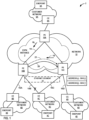
- FIG. 1 is a block diagram illustrating a network system 2 configured to provide fast reroute for traffic in EVPN-VXLAN, in accordance with one or more aspects of the techniques described in this disclosure.
- network system 2 includes customer networks 6A-6D ("customer networks 6") connected to an intermediate network 12.
- Intermediate network 12 may represent a public network that is owned and operated by a service provider to interconnect a plurality of edge networks, such as customer networks 6.
- Intermediate network 12 is a layer 3 (“L3”) network in the sense that it natively supports L3 operations as described in the OSI model. Common L3 operations include those performed in accordance with L3 protocols, such as the Internet protocol ("IP").
- IP Internet protocol
- Each of endpoints 4 may represent one or more non-edge switches, routers, hubs, gateways, security devices such as firewalls, intrusion detection, and/or intrusion prevention devices, servers, computer terminals, laptops, tablets, printers, databases, wireless mobile devices such as cellular phones or personal digital assistants, wireless access points, bridges, cable modems, application accelerators, or other network devices.
- security devices such as firewalls, intrusion detection, and/or intrusion prevention devices
- servers computer terminals, laptops, tablets, printers, databases
- wireless mobile devices such as cellular phones or personal digital assistants, wireless access points, bridges, cable modems, application accelerators, or other network devices.
- network system 2 may include any number of customer networks. Nonetheless, for ease of description, only customer networks 6A-6D are illustrated in FIG. 1 .
- additional network devices are not shown for ease of explanation, it should be understood that network system 2 may comprise additional network and/or computing devices such as, for example, one or more additional switches, routers, hubs, gateways, security devices such as firewalls, intrusion detection, and/or intrusion prevention devices, servers, computer terminals, laptops, printers, databases, wireless mobile devices such as cellular phones or personal digital assistants, wireless access points, bridges, cable modems, application accelerators, or other network devices.
- additional network and/or computing devices such as, for example, one or more additional switches, routers, hubs, gateways, security devices such as firewalls, intrusion detection, and/or intrusion prevention devices, servers, computer terminals, laptops, printers, databases, wireless mobile devices such as cellular phones or personal digital assistants, wireless access points, bridges, cable modems, application accelerators, or other network devices.
- Intermediate network 12 may provide a number of residential and business services, including residential and business class data services (which are often referred to as "Internet services” in that these data services permit access to the collection of publicly accessible networks referred to as the Internet), residential and business class telephone and/or voice services, and residential and business class television services.
- residential and business class data services which are often referred to as "Internet services” in that these data services permit access to the collection of publicly accessible networks referred to as the Internet
- residential and business class telephone and/or voice services and residential and business class television services.
- One such business class data service offered by a service provider intermediate network 12 includes layer 2 ("L2") EVPN service.
- Intermediate network 12 represents an L2/L3 switch fabric for one or more customer networks that may implement an L2 EVPN service.
- PE device 10C sends the reroute tunnel endpoint address to a primary PE device, e.g., PE device 10B (404).
- PE device 10C may advertise an Ethernet AD route including the reroute tunnel endpoint address.
- PE device 10C may advertise the reroute tunnel endpoint address in a Tunnel Egress Endpoint sub-TLV of a BGP tunnel encapsulation attribute that is carried in an Ethernet AD route.
- PE device 10C may advertise the reroute tunnel endpoint address (e.g., an IPv4 or IPv6 address) in an extended community (e.g., BGP Transitive Extended Community (type 0x06)) of an EVPN AD route or EVPN MAC route (e.g., EVPN Type 2 route).
- an extended community e.g., BGP Transitive Extended Community (type 0x06)
- the techniques of this disclosure may be implemented in a wide variety of devices or apparatuses, including a network device, an integrated circuit (IC) or a set of ICs (i.e., a chip set). Any components, modules or units have been described provided to emphasize functional aspects and does not necessarily require realization by different hardware units. The techniques described herein may also be implemented in hardware or any combination of hardware and software and/or firmware. Any features described as modules, units or components may be implemented together in an integrated logic device or separately as discrete but interoperable logic devices. In some cases, various features may be implemented as an integrated circuit device, such as an integrated circuit chip or chipset.
Landscapes
- Engineering & Computer Science (AREA)
- Computer Networks & Wireless Communication (AREA)
- Signal Processing (AREA)
- Computer Security & Cryptography (AREA)
- Data Exchanges In Wide-Area Networks (AREA)
Applications Claiming Priority (2)
| Application Number | Priority Date | Filing Date | Title |
|---|---|---|---|
| US17/301,351 US11546253B2 (en) | 2021-03-31 | 2021-03-31 | Fast reroute for ethernet virtual private networks—virtual extensible local area network |
| EP21180926.4A EP4068697B1 (de) | 2021-03-31 | 2021-06-22 | Schnelles umleiten für virtuelle private ethernet-netzwerke - virtuelles erweiterbares lokales netzwerk |
Related Parent Applications (1)
| Application Number | Title | Priority Date | Filing Date |
|---|---|---|---|
| EP21180926.4A Division EP4068697B1 (de) | 2021-03-31 | 2021-06-22 | Schnelles umleiten für virtuelle private ethernet-netzwerke - virtuelles erweiterbares lokales netzwerk |
Publications (2)
| Publication Number | Publication Date |
|---|---|
| EP4531352A2 true EP4531352A2 (de) | 2025-04-02 |
| EP4531352A3 EP4531352A3 (de) | 2025-05-21 |
Family
ID=76553631
Family Applications (2)
| Application Number | Title | Priority Date | Filing Date |
|---|---|---|---|
| EP25150551.7A Pending EP4531352A3 (de) | 2021-03-31 | 2021-06-22 | Schnelle umleitung für virtuelle private ethernet-netzwerke - virtuelles erweiterbares lokales netzwerk |
| EP21180926.4A Active EP4068697B1 (de) | 2021-03-31 | 2021-06-22 | Schnelles umleiten für virtuelle private ethernet-netzwerke - virtuelles erweiterbares lokales netzwerk |
Family Applications After (1)
| Application Number | Title | Priority Date | Filing Date |
|---|---|---|---|
| EP21180926.4A Active EP4068697B1 (de) | 2021-03-31 | 2021-06-22 | Schnelles umleiten für virtuelle private ethernet-netzwerke - virtuelles erweiterbares lokales netzwerk |
Country Status (3)
| Country | Link |
|---|---|
| US (2) | US11546253B2 (de) |
| EP (2) | EP4531352A3 (de) |
| CN (2) | CN115225568B (de) |
Families Citing this family (8)
| Publication number | Priority date | Publication date | Assignee | Title |
|---|---|---|---|---|
| US11570086B2 (en) | 2021-02-22 | 2023-01-31 | Juniper Networks, Inc. | Fast reroute for BUM traffic in ethernet virtual private networks |
| US11546253B2 (en) | 2021-03-31 | 2023-01-03 | Juniper Networks, Inc | Fast reroute for ethernet virtual private networks—virtual extensible local area network |
| CN116032690B (zh) * | 2022-12-12 | 2023-11-03 | 北京秒如科技有限公司 | 一种边缘计算场景下的虚拟网络调度方法 |
| US12452213B2 (en) * | 2022-12-14 | 2025-10-21 | Hewlett Packard Enterprise Development Lp | Update of firewall tables using ethernet virtual private network (EVPN) route type |
| US12003414B1 (en) | 2023-02-17 | 2024-06-04 | Arista Networks, Inc. | Traffic handling for EVPN E-tree |
| US12015544B1 (en) * | 2023-05-01 | 2024-06-18 | Arista Networks, Inc. | Backup route for network devices in multihoming configuration |
| CN116708081B (zh) * | 2023-06-25 | 2025-09-26 | 中国电信股份有限公司 | 固移结合的网络通信系统及方法 |
| CN120151138B (zh) * | 2025-03-25 | 2025-10-31 | 北京联广通网络科技有限公司 | 基于vxlan的数据传输方法、装置、设备及系统 |
Citations (2)
| Publication number | Priority date | Publication date | Assignee | Title |
|---|---|---|---|---|
| US7990993B1 (en) | 2008-02-20 | 2011-08-02 | Juniper Networks, Inc. | Platform-independent control plane and lower-level derivation of forwarding structures |
| US8806058B1 (en) | 2011-07-29 | 2014-08-12 | Juniper Networks, Inc. | Packet forwarding path programming using a high-level description language |
Family Cites Families (33)
| Publication number | Priority date | Publication date | Assignee | Title |
|---|---|---|---|---|
| CN100531136C (zh) | 2006-06-08 | 2009-08-19 | 华为技术有限公司 | 在虚拟专用网的链路故障时传送报文的方法及系统 |
| CN101483558B (zh) | 2008-01-10 | 2012-07-04 | 华为技术有限公司 | 网络设备接入分组交换网络的方法、系统及装置 |
| CN102195822B (zh) | 2010-03-01 | 2014-05-07 | 杭州华三通信技术有限公司 | 一种故障检测的方法和服务提供商边缘设备 |
| CN104253759B (zh) | 2013-06-30 | 2017-08-29 | 华为技术有限公司 | 报文转发方法、装置及系统 |
| US9794180B2 (en) | 2014-07-18 | 2017-10-17 | Cisco Technology, Inc. | Reducing transient packet duplication and improving split-horizon filtering |
| US9948472B2 (en) * | 2014-10-22 | 2018-04-17 | Juniper Networks, Inc. | Protocol independent multicast sparse mode (PIM-SM) support for data center interconnect |
| US9929940B2 (en) | 2015-03-05 | 2018-03-27 | Juniper Networks, Inc. | Update of MAC routes in EVPN single-active topology |
| US9900250B2 (en) * | 2015-03-26 | 2018-02-20 | Cisco Technology, Inc. | Scalable handling of BGP route information in VXLAN with EVPN control plane |
| US20170063600A1 (en) | 2015-08-31 | 2017-03-02 | Juniper Networks, Inc. | Egress protection for bum traffic with link failures in evpn |
| US9923781B2 (en) | 2015-11-18 | 2018-03-20 | Telefonaktiebolaget Lm Ericsson (Publ) | Designated forwarder (DF) election and re-election on provider edge (PE) failure in all-active redundancy topology |
| WO2017118880A1 (en) | 2016-01-08 | 2017-07-13 | Telefonaktiebolaget Lm Ericsson (Publ) | Faster convergence on primary provider edge (pe) failure in a single-active redundancy topology |
| US10148566B2 (en) | 2016-02-26 | 2018-12-04 | Juniper Networks, Inc. | Split-horizon packet forwarding in a multi-home PBB-EVPN network |
| US10666500B2 (en) * | 2016-03-30 | 2020-05-26 | Juniper Networks, Inc. | Failure handling for active-standby redundancy in EVPN data center interconnect |
| US10050873B2 (en) | 2016-05-17 | 2018-08-14 | Juniper Networks, Inc. | Egress node protection for broadcast, unknown unicast, or multicast traffic in EVPN topologies |
| CN106161253B (zh) | 2016-06-23 | 2020-12-25 | 新华三技术有限公司 | 一种报文处理方法及装置 |
| US11032185B2 (en) | 2016-09-09 | 2021-06-08 | Nec Corporation | Communication system, edge node, communication method and program |
| CN107846342B (zh) * | 2016-09-20 | 2020-11-06 | 华为技术有限公司 | 一种vxlan报文的转发方法、设备及系统 |
| US10320658B2 (en) * | 2016-10-18 | 2019-06-11 | Cisco Technology, Inc. | Method and system for asymmetric redundancy mechanisms in multi-homed network access topologies |
| CN106878166B (zh) * | 2017-01-22 | 2020-04-03 | 新华三技术有限公司 | 路由通告方法及装置 |
| CN108574616B (zh) * | 2017-03-14 | 2021-02-12 | 华为技术有限公司 | 一种处理路由的方法、设备及系统 |
| US10382332B2 (en) * | 2017-05-12 | 2019-08-13 | Juniper Networks, Inc. | Route signaling and convergence in EVPN of port extenders |
| US11405238B2 (en) * | 2018-01-02 | 2022-08-02 | Telefonaktiebolaget Lm Ericsson (Publ) | Controlling device and method implemented thereon for ethernet virtual private netwok |
| CN110391951B (zh) | 2018-04-17 | 2022-11-08 | 中兴通讯股份有限公司 | 以太网段标识邻接检测处理方法及装置、存储介质 |
| CN111064659B (zh) * | 2018-10-17 | 2022-07-19 | 瞻博网络公司 | 多宿主节点故障的bum流量的节点保护 |
| US10924332B2 (en) * | 2018-10-17 | 2021-02-16 | Juniper Networks, Inc. | Node protection for bum traffic for multi-homed node failure |
| US11349749B2 (en) * | 2018-10-17 | 2022-05-31 | Juniper Networks, Inc. | Node protection for bum traffic for multi-homed node failure |
| EP3641240B1 (de) | 2018-10-17 | 2023-11-15 | Juniper Networks, Inc. | Knotenschutz für bum-verkehr bei ausfall eines multi-homed-knotens |
| US11316777B2 (en) | 2019-11-18 | 2022-04-26 | Cisco Technology, Inc. | Method and system for network traffic diversion |
| US11057295B1 (en) * | 2020-01-07 | 2021-07-06 | Juniper Networks, Inc. | Loop avoidance and egress link protection with ethernet virtual private network (EVPN) fast reroute (FRR) |
| US11438193B2 (en) | 2020-01-28 | 2022-09-06 | Arista Networks, Inc. | EVPN multihoming optimizations for ethernet segment connection interruptions |
| US11303474B1 (en) * | 2020-03-13 | 2022-04-12 | Juniper Networks, Inc. | Split-horizon filtering for EVPN-VXLAN |
| US11570086B2 (en) | 2021-02-22 | 2023-01-31 | Juniper Networks, Inc. | Fast reroute for BUM traffic in ethernet virtual private networks |
| US11546253B2 (en) | 2021-03-31 | 2023-01-03 | Juniper Networks, Inc | Fast reroute for ethernet virtual private networks—virtual extensible local area network |
-
2021
- 2021-03-31 US US17/301,351 patent/US11546253B2/en active Active
- 2021-06-22 EP EP25150551.7A patent/EP4531352A3/de active Pending
- 2021-06-22 CN CN202110692300.0A patent/CN115225568B/zh active Active
- 2021-06-22 EP EP21180926.4A patent/EP4068697B1/de active Active
- 2021-06-22 CN CN202410641012.6A patent/CN118353825A/zh active Pending
-
2022
- 2022-11-30 US US18/060,521 patent/US12010011B2/en active Active
Patent Citations (2)
| Publication number | Priority date | Publication date | Assignee | Title |
|---|---|---|---|---|
| US7990993B1 (en) | 2008-02-20 | 2011-08-02 | Juniper Networks, Inc. | Platform-independent control plane and lower-level derivation of forwarding structures |
| US8806058B1 (en) | 2011-07-29 | 2014-08-12 | Juniper Networks, Inc. | Packet forwarding path programming using a high-level description language |
Non-Patent Citations (2)
| Title |
|---|
| E. ROSEN ET AL.: "IANA Registries for BGP Extended Communities", REQUEST FOR COMMENTS, March 2014 (2014-03-01), pages 7153 |
| K. PATEL ET AL.: "The BGP Tunnel Encapsulation Attribute", INTERNET-DRAFT, DRAFT-IETF-IDR-TUNNEL-ENCAPS-22, 7 January 2021 (2021-01-07) |
Also Published As
| Publication number | Publication date |
|---|---|
| EP4068697B1 (de) | 2025-01-08 |
| US12010011B2 (en) | 2024-06-11 |
| EP4068697A1 (de) | 2022-10-05 |
| US20220321458A1 (en) | 2022-10-06 |
| US20230095253A1 (en) | 2023-03-30 |
| EP4531352A3 (de) | 2025-05-21 |
| CN118353825A (zh) | 2024-07-16 |
| US11546253B2 (en) | 2023-01-03 |
| CN115225568A (zh) | 2022-10-21 |
| CN115225568B (zh) | 2024-06-04 |
Similar Documents
| Publication | Publication Date | Title |
|---|---|---|
| US12010011B2 (en) | Fast reroute for ethernet virtual private networks—virtual extensible local area network | |
| US11539619B1 (en) | Local-bias forwarding of L2 multicast, unknown unicast, and broadcast traffic for an ethernet VPN | |
| US11349749B2 (en) | Node protection for bum traffic for multi-homed node failure | |
| US10142129B1 (en) | Bum packet filtering in multi-homed EVPN overlay networks | |
| US9992154B2 (en) | Layer 3 convergence for EVPN link failure | |
| US10237163B2 (en) | Static route advertisement | |
| EP3809641B1 (de) | Verbesserte portspiegelung über evpn vxlan | |
| US20170373973A1 (en) | Signaling ip address mobility in ethernet virtual private networks | |
| EP3301861A1 (de) | Evpn-designierte weiterleiterstatusverbreitung für edge-vorrichtungen von kunden unter verwendung von konnektivitätsstörungsverwaltung | |
| US10924332B2 (en) | Node protection for bum traffic for multi-homed node failure | |
| US12143293B2 (en) | Fast reroute for BUM traffic in ethernet virtual private networks | |
| EP3641240B1 (de) | Knotenschutz für bum-verkehr bei ausfall eines multi-homed-knotens | |
| US11575541B1 (en) | Mapping of virtual routing and forwarding (VRF) instances using ethernet virtual private network (EVPN) instances | |
| CN111064659B (zh) | 多宿主节点故障的bum流量的节点保护 | |
| US11303474B1 (en) | Split-horizon filtering for EVPN-VXLAN |
Legal Events
| Date | Code | Title | Description |
|---|---|---|---|
| PUAI | Public reference made under article 153(3) epc to a published international application that has entered the european phase |
Free format text: ORIGINAL CODE: 0009012 |
|
| STAA | Information on the status of an ep patent application or granted ep patent |
Free format text: STATUS: THE APPLICATION HAS BEEN PUBLISHED |
|
| AC | Divisional application: reference to earlier application |
Ref document number: 4068697 Country of ref document: EP Kind code of ref document: P |
|
| AK | Designated contracting states |
Kind code of ref document: A2 Designated state(s): AL AT BE BG CH CY CZ DE DK EE ES FI FR GB GR HR HU IE IS IT LI LT LU LV MC MK MT NL NO PL PT RO RS SE SI SK SM TR |
|
| PUAL | Search report despatched |
Free format text: ORIGINAL CODE: 0009013 |
|
| AK | Designated contracting states |
Kind code of ref document: A3 Designated state(s): AL AT BE BG CH CY CZ DE DK EE ES FI FR GB GR HR HU IE IS IT LI LT LU LV MC MK MT NL NO PL PT RO RS SE SI SK SM TR |
|
| RIC1 | Information provided on ipc code assigned before grant |
Ipc: H04L 12/46 20060101AFI20250411BHEP |
|
| STAA | Information on the status of an ep patent application or granted ep patent |
Free format text: STATUS: REQUEST FOR EXAMINATION WAS MADE |
|
| 17P | Request for examination filed |
Effective date: 20251119 |