EP4531277A2 - System und verfahren zur vorhersage des ausfalls von komponenten unter verwendung von zeitlichem scoping von sensordaten - Google Patents
System und verfahren zur vorhersage des ausfalls von komponenten unter verwendung von zeitlichem scoping von sensordaten Download PDFInfo
- Publication number
- EP4531277A2 EP4531277A2 EP24210992.4A EP24210992A EP4531277A2 EP 4531277 A2 EP4531277 A2 EP 4531277A2 EP 24210992 A EP24210992 A EP 24210992A EP 4531277 A2 EP4531277 A2 EP 4531277A2
- Authority
- EP
- European Patent Office
- Prior art keywords
- failure
- data
- anomaly
- sensor data
- historical data
- Prior art date
- Legal status (The legal status is an assumption and is not a legal conclusion. Google has not performed a legal analysis and makes no representation as to the accuracy of the status listed.)
- Pending
Links
Images




Classifications
-
- G—PHYSICS
- G06—COMPUTING OR CALCULATING; COUNTING
- G06N—COMPUTING ARRANGEMENTS BASED ON SPECIFIC COMPUTATIONAL MODELS
- G06N5/00—Computing arrangements using knowledge-based models
- G06N5/02—Knowledge representation; Symbolic representation
-
- F—MECHANICAL ENGINEERING; LIGHTING; HEATING; WEAPONS; BLASTING
- F03—MACHINES OR ENGINES FOR LIQUIDS; WIND, SPRING, OR WEIGHT MOTORS; PRODUCING MECHANICAL POWER OR A REACTIVE PROPULSIVE THRUST, NOT OTHERWISE PROVIDED FOR
- F03D—WIND MOTORS
- F03D17/00—Monitoring or testing of wind motors, e.g. diagnostics
-
- G—PHYSICS
- G06—COMPUTING OR CALCULATING; COUNTING
- G06N—COMPUTING ARRANGEMENTS BASED ON SPECIFIC COMPUTATIONAL MODELS
- G06N20/00—Machine learning
-
- G—PHYSICS
- G06—COMPUTING OR CALCULATING; COUNTING
- G06N—COMPUTING ARRANGEMENTS BASED ON SPECIFIC COMPUTATIONAL MODELS
- G06N7/00—Computing arrangements based on specific mathematical models
- G06N7/01—Probabilistic graphical models, e.g. probabilistic networks
-
- H—ELECTRICITY
- H02—GENERATION; CONVERSION OR DISTRIBUTION OF ELECTRIC POWER
- H02S—GENERATION OF ELECTRIC POWER BY CONVERSION OF INFRARED RADIATION, VISIBLE LIGHT OR ULTRAVIOLET LIGHT, e.g. USING PHOTOVOLTAIC [PV] MODULES
- H02S50/00—Monitoring or testing of PV systems, e.g. load balancing or fault identification
-
- F—MECHANICAL ENGINEERING; LIGHTING; HEATING; WEAPONS; BLASTING
- F05—INDEXING SCHEMES RELATING TO ENGINES OR PUMPS IN VARIOUS SUBCLASSES OF CLASSES F01-F04
- F05B—INDEXING SCHEME RELATING TO WIND, SPRING, WEIGHT, INERTIA OR LIKE MOTORS, TO MACHINES OR ENGINES FOR LIQUIDS COVERED BY SUBCLASSES F03B, F03D AND F03G
- F05B2260/00—Function
- F05B2260/82—Forecasts
- F05B2260/821—Parameter estimation or prediction
-
- F—MECHANICAL ENGINEERING; LIGHTING; HEATING; WEAPONS; BLASTING
- F05—INDEXING SCHEMES RELATING TO ENGINES OR PUMPS IN VARIOUS SUBCLASSES OF CLASSES F01-F04
- F05B—INDEXING SCHEME RELATING TO WIND, SPRING, WEIGHT, INERTIA OR LIKE MOTORS, TO MACHINES OR ENGINES FOR LIQUIDS COVERED BY SUBCLASSES F03B, F03D AND F03G
- F05B2260/00—Function
- F05B2260/84—Modelling or simulation
-
- Y—GENERAL TAGGING OF NEW TECHNOLOGICAL DEVELOPMENTS; GENERAL TAGGING OF CROSS-SECTIONAL TECHNOLOGIES SPANNING OVER SEVERAL SECTIONS OF THE IPC; TECHNICAL SUBJECTS COVERED BY FORMER USPC CROSS-REFERENCE ART COLLECTIONS [XRACs] AND DIGESTS
- Y02—TECHNOLOGIES OR APPLICATIONS FOR MITIGATION OR ADAPTATION AGAINST CLIMATE CHANGE
- Y02E—REDUCTION OF GREENHOUSE GAS [GHG] EMISSIONS, RELATED TO ENERGY GENERATION, TRANSMISSION OR DISTRIBUTION
- Y02E10/00—Energy generation through renewable energy sources
- Y02E10/50—Photovoltaic [PV] energy
Definitions
- Embodiments of the present invention(s) relate generally to forecast congestion in electrical networks.
- the present invention(s) relate to forecasting congestion in electrical networks by reducing complexity of the network and utilizing historical data to create a model to forecast congestion to enable proactive solutions.
- a path or a collection of conductors within the electrical network of a power company is congested when one or multiple current-carrying elements (e.g., conductors, transformers, AC lines, and the like) are operationally carrying an amount of power which exceeds a specific threshold, for a specific time-period.
- current-carrying elements e.g., conductors, transformers, AC lines, and the like
- Congestion control approaches are, at present, rarely proactive, and utilities react to congestion using after-the-fact mechanisms such as re-dispatch and controlling line flows by using phase-shifting transformers.
- Utilities approach unknown future congestion by simply oversizing conductors which is not economical. Power companies do not adopt proactive congestion management for many reasons including:
- An example nontransitory computer readable medium comprises executable instructions, the executable instructions being executable by one or more processors to perform a method, the method comprising receiving first historical data of a first time period and failure data of the first time period, the historical data including sensor data from one or more sensors of a renewable energy asset, the failure data indicating at least one first failure associated with the renewable energy asset during the first time period, identifying at least some sensor data of the first historical data that was or potentially was generated during the first failure indicated by the failure data, removing the at least some sensor data from the first historical data to create filtered historical data, training a classification model using the filtered historical data, the classification model indicating at least one first classified state of the renewable energy asset at a second period of time prior to the first failure indicated by the failure data, applying the classification model to second sensor data to identify a first potential failure state based on the at least one first classified state, the second sensor data being from the one or more sensors of the renewable energy asset during a subsequent time period after the first time period, generating an alert if the first
- the renewable energy asset may be a wind turbine or a solar panel.
- the one classified state of the renewable energy asset may be based on a subset of sensor readings generated prior to the failure and not all of the sensor readings of the first historical data generated prior to the failure.
- the second period of time is a desired number of days before a predicted failure associated with the first potential failure state.
- the alert may be provided at the desired number of days.
- the method may further comprise training a classification model using the filtered historical data, the classification model indicating at least one second classified state of the renewable energy asset at the second period of time prior to a third failure indicated by the failure data, applying the classification model to second sensor data to identify a second potential failure state based on the at least one second classified state, the second sensor data being from the one or more sensors of the renewable energy asset during the subsequent time period after the first time period, wherein the first potential failure state is associated with a failure of a first component of the renewable energy asset and the second potential failure state is associated with a failure of a second component of the renewable energy asset, and generating an alert if the second potential failure state is identified based on at least a second subset of sensor signals generated during the subsequent time period, the first subset of sensor signals not including at least one sensor signal of the second subset of sensor signals.
- identifying the at least some sensor data of the first historical data that was or potentially was generated during the first failure indicated by the failure data comprises scanning at least some of the first historical data and comparing at least some of the sensor data of the first historical data to a failure threshold to identify at least some of the sensor data that was or potentially was generated during the first failure.
- Identifying the at least some sensor data of the first historical data that was or potentially was generated during the first failure indicated by the failure data may comprise identifying an amount of downtime based on the failure data, scanning at least some of the first historical data, and comparing at least some of the sensor data of the first historical data to a failure threshold to identify at least some of the sensor data that was or potentially was generated during the first failure until the amount of sensor data identified as failure or potentially as failure based on the comparison is at least equal to the amount of downtime, wherein removing the at least some sensor data comprises removing the sensor data that was or potentially was generated during the first failure.
- the method may further comprise generating a probability score based on a probability of the second sensor data fitting into the at least one classified state, wherein generating the alert comprises comparing the probability score to a threshold score.
- Providing the alert may comprise providing a message indicating at least one component associated with the second sensor data may potentially fail.
- An example system may comprise at least one processor and memory containing instructions, the instructions being executable by the at least one processor to: receive first historical data of a first time period and failure data of the first time period, the historical data including sensor data from one or more sensors of a renewable energy asset, the failure data indicating at least one first failure associated with the renewable energy asset during the first time period, identify at least some sensor data of the first historical data that was or potentially was generated during the first failure indicated by the failure data, remove the at least some sensor data from the first historical data to create filtered historical data, train a classification model using the filtered historical data, the classification model indicating at least one first classified state of the renewable energy asset at a second period of time prior to the first failure indicated by the failure data, apply the classification model to second sensor data to identify a first potential failure state based on the at least one first classified state, the second sensor data being from the one or more sensors of the renewable energy asset during a subsequent time period after the first time period, generate an alert if the first potential failure state is identified based on at least a first
- An example method may comprise receiving first historical data of a first time period and failure data of the first time period, the historical data including sensor data from one or more sensors of a renewable energy asset, the failure data indicating at least one first failure associated with the renewable energy asset during the first time period, identifying at least some sensor data of the first historical data that was or potentially was generated during the first failure indicated by the failure data, removing the at least some sensor data from the first historical data to create filtered historical data, training a classification model using the filtered historical data, the classification model indicating at least one first classified state of the renewable energy asset at a second period of time prior to the first failure indicated by the failure data, applying the classification model to second sensor data to identify a first potential failure state based on the at least one first classified state, the second sensor data being from the one or more sensors of the renewable energy asset during a subsequent time period after the first time period, generating an alert if the first potential failure state is identified based on at least a first subset of sensor signals generated during the subsequent time period, and providing the alert.
- Some embodiments described herein utilize machine learning algorithms to build a sophisticated forecasting model based on multi-variate sensor data to forecast component failures.
- systems and methods described herein overcome limitations of the prior art including scalability, proactive warnings, and computational efficiency while providing improved accuracy.
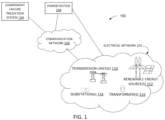
- FIG. 1 depicts a block diagram 100 of an example of an electrical network 100 in some embodiments.
- FIG. 1 includes an electrical network 102, a component failure prediction system 104, a power system 106, in communication over a communication network 108.
- the electrical network 102 includes any number of transmission lines 110, renewable energy sources 112, substations 114, and transformers 116.
- the electrical network 102 may include any number of electrical assets including protective assets (e.g., relays or other circuits to protect one or more assets), transmission assets (e.g., lines, or devices for delivering or receiving power), and/or loads (e.g., residential houses, commercial businesses, and/or the like).
- protective assets e.g., relays or other circuits to protect one or more assets
- transmission assets e.g., lines, or devices for delivering or receiving power
- loads e.g., residential houses, commercial businesses, and/or the like.
- Components of the electrical network 102 such as the transmission line(s) 110, the renewable energy source(s) 112, substation(s) 114, and/or transformer(s) 106 may inject energy or power (or assist in the injection of energy or power) into the electrical network 102.
- Each component of the electrical network 102 may be represented by any number of nodes in a network representation of the electrical network.
- Renewable energy sources 112 may include solar panels, wind turbines, and/or other forms of so called "green energy.”
- the electrical network 102 may include a wide electrical network grid (e.g., with 40,000 assets or more).
- Each component of the electrical network 100 may represent one or more elements of their respective components.
- the transformer(s) 116, as shown in FIG. 1 may represent any number of transformers which make up electrical network 100.
- the congestion mitigation system 104 provides real-time congestion-forecasting on any number of path(s) (or path equivalents) of the electrical network 102 to the power system 106.
- the congestion mitigation system 104 may identify a bus, path, and/or combination of assets of the electrical network 102 which have a significant influence on congestion as a path of interest.
- the congestion mitigation system 104 may compute power flow on the identified bus, path, and/or combination of assets of the electrical network 102.
- the congestion mitigation system 104 may compare the computed power flow to thresholds (e.g., which may be pre-set by the power system 106) to assist in forecasting congestions.
- communication network 108 represents one or more computer networks (e.g., LAN, WAN, and/or the like). Communication network 108 may provide communication between any of the congestion mitigation system 104, the power system 106,and/or the electrical network 102. In some implementations, communication network 108 comprises computer devices, routers, cables, uses, and/or other network topologies. In some embodiments, communication network 108 may be wired and/or wireless. In various embodiments, communication network 108 may comprise the Internet, one or more networks that may be public, private, IP-based, non-IP based, and so forth.
- the component failure prediction system 104 may include any number of digital devices configured to forecast component failure of any number of components and/or generators (e.g., wind turbine or solar power generator) of the renewable energy sources 112.
- components and/or generators e.g., wind turbine or solar power generator
- the component failure prediction system104 may reduce computational burden of forecasting failure of any number of components and/or generators by applying machine learning tools on historical data after the historical data has been scoped to remove overfitting or other overly weighting features.
- the component failure prediction system104 may forecast failure up through the next 3 hours, 6 hours, 8 hours, 12 hours, 16 hours, 20 hours, 24 hours, 28 hours, 32 hours, 36 hours, 40 hours, 44 hours, 48 hours, or more. It will be appreciated that the system is not limited to forecasting only the examples above, but may be any amount of time.
- the power system 106 may include any number of digital devices configured to control distribution and/or transmission of energy.
- the power system 106 may, in one example, be controlled by a power company, utility, and/or the like.
- a digital device is any device with at least one processor and memory. Examples of systems, environments, and/or configurations that may be suitable for use with system include, but are not limited to, personal computer systems, server computer systems, thin clients, thick clients, handheld or laptop devices, multiprocessor systems, microprocessor-based systems, set top boxes, programmable consumer electronics, network PCs, minicomputer systems, mainframe computer systems, and distributed cloud computing environments that include any of the above systems or devices, and the like.
- a computer system may be described in the general context of computer system executable instructions, such as program modules, being executed by a computer system.
- program modules may include routines, programs, objects, components, logic, data structures, and so on that perform particular tasks or implement particular abstract data types.
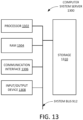
- a digital device, such as a computer system, is further described with regard to FIG. 13 .
- FIG. 2 depicts components that often produce failures of wind turbines and components that often produce failures in solar panel generators. Failures in wind turbines often occur as a result of failures in a main bearing 202, gearbox 204, generator 206, or anemometer 208. Failures in solar panel generators often occur as a result of failures in an inverter 210, panel degradation 212, and an IGBT 214.
- a wind turbine has many potential components of failure. Different sensors may provide different readings for one or more different components or combinations of components. Given the number of wind turbines in a wind farm, the amount of data to be assessed may be untenable using prior art methods. For example, data analytics systems of the prior art do not scale, sensors provide too much data to be assessed by the prior art systems, and there is a lack of computational capacity in prior art systems to effectively assess data from wind farms in a time sensitive manner. As a result, prior art systems are reactive to existing failures rather than proactively providing reports or warnings of potential future failure of one or more components.
- various embodiments regarding a wind turbine described herein may identify potential failure of a main bearing 202, gearbox 204, generator 206, or anemometer 208 of one or more wind turbines.
- many bearings may be utilized in a wind turbine (e.g., yaw and pitch bearings)
- the main shaft and gearbox of the wind turbine tend to be the most problematic.
- a main bearing 202 may fail due to high thrust load or may fail due to inadequate lubricant film generation.
- Trends in redesign of a main shaft 202 and/or gearbox 204 of a single wind turbine have been driven by unexpected failures in these units.
- the unplanned replacement of main-shaft bearing 202 can cost operators up to $450,000 and have an obvious impact on financial performance.
- Gearbox 204 failures are one of the largest sources of unplanned maintenance costs. Gearbox 204 failures can be caused by design issues, manufacturing defects, deficiencies in the lubricant, excessive time at standstill, high loading, and other reasons. There may be many different modes of gearbox 204 failure and, as such, it may be important to identify the type of failure mode in addressing the failure.
- One mode is micropitting which occurs when lubricant film between contacting surfaces in a gearbox 204 is not thick enough. Macropitting occurs when contact stress in a gear or breaking exceeds the fatigue strength of the material. Bending fatigue a failure mode that affects gear teeth and axial cracking may occur in bearings of a gearbox; the cracks develop in the axial direction, perpendicular to the direction of rolling.
- the generator 206 typically converts the wind energy to electrical energy. Failures often occur in bearings, stator, rotor, or the like which can lead to inconsistent voltage to total failure. Generator 206 failure may be difficult to detect as a result of inconsistent weather, lack of motion, and/or partial failure of the anemometer 208.
- the anemometer 208 uses moving parts as sensors.
- Anemometers 208 often include "cups” for wind speed measurements and a wind vane that uses a “vane tail” for measuring vector change, or wind direction. Freezing weather has caused the "cups" and "vane tail” to lock. If an anemometer 208 under-reports wind speed because of a partial failure, there is an increase in rotor acceleration that indicates a large amount of wind energy is not converted into electrical engineering. Rolling resistance in an anemometer 208 bearings typically increase over time until they seize. Further, if the anemometer 208 is not accurate, the wind turbine will not control blade pitch and rotor speed as needed. Poor or inaccurate measurements by the anemometer 208 will lead to incorrect adjustments and increased fatigue.
- various embodiments regarding a solar panel generator described herein may identify potential failure of a inverter 210, solar panel 212, and IGBT 214 in one or more solar panels of a solar farm.
- a solar inverter 210 is an electrical converter to convert variable direct current from a photovoltaic solar panel 212 into a utility frequency alternating current that can be fed to an electrical grid. Production loses are often attributable to poor performance of inverters 210. Solar inventers 210 may overheat (caused by weather, use, or failure of cooling systems) which can reduce production. Moisture may cause a short circuit which can cause complete or partial failure (e.g., to a minimum "required" isolation level). Further, failure of the solar inverter 210 to restart after gird fault may require manual restarting of the equipment.
- the panel 212 refers to the solar or photovoltaic panel.
- the photovoltaic panel 212 may degrade due to weather, poor cleaning, thermal cycling, damp heat, humidity freezing, and UV exposure. Thermal cycling can cause solder bond failures and cracks. Damp heat has been associated with delamination of encapsulants and corrosion of cells. Humidity freezing can cause junction box adhesion to fail. UV exposure contributes to discoloration and backsheet degradation.
- IGBT insulated gate bipolar transistors
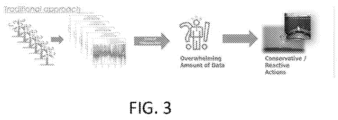
- FIG. 3 depicts a common problem of detecting possible failure of one or more components of a wind farm.
- there may be any number of wind turbines in a wind farm. Sensors of each wind turbine in a wind farm may generate its own data.
- timeseries data which is overwhelming for prior art systems and prior art methods of assessment.
- monitoring hundreds of assets with hundreds of sensor inputs is time-consuming and overwhelming for operators to test.
- Existing prior art systems receive too much timeseries data to be effectively assessed in a scalable and/or computationally efficient manner.
- there is a conservative and or reactive response to component and wind turbine failure In other words, action is typically taken well after failure is detected or when failure is both immanent and unmistakable.
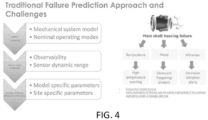
- FIG. 4 depicts traditional failure prediction approaches of main shaft bearing failure in wind turbines as well as challenges.
- main shaft bearing failure may be caused by any number of components.
- challenges include identifying the correct mechanical systems model and nominal operating modes of that mechanical system model.
- Prior art approaches may also fail due to incorrect sensor data mapping. Mapping of sensor data may be based on observability and take into account sensor dynamic range.
- sensor data regarding temperature, noise, and/or vibration may be taken into account.
- the sensor data related to temperature, noise, and/or vibration is observed against the background of other sensor data readings, and the sensor dynamic range of each individual sensor or combination of sensors should be recognized.
- Prior art systems often fail in tuning a failure detection threshold for a sensor reading.
- Prior art systems typically must identify model specific parameters and site-specific parameters.
- the temperature sensor data may indicate a high temperature warning relative to some high temperature threshold.
- the noise data may be utilized for resonant frequency analysis to detect residents within a component or device.
- the vibration data may be assessed to determine excessive vibration relative to some vibration threshold.
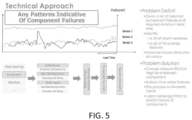
- FIG. 5 characterizes problems and propose solutions in some embodiments.
- the graph in figure 5 depicts sensor readings from multiple sensors over a period of time leading up to failure. The time before the failure is indicated as "lead time.”
- One goal is to improve lead time such that alerts may be issued and/or actions taken to mitigate consequences of failure or avoid failure prior to that failure occurring.
- the three sensors with sensor readings indicated in the graph are part of a generator of the wind turbine.
- Each of the three sensors include an active power sensor, a generator winding temperature sensor, and a rotor speed sensor. It will be appreciated that there may be any number of sensors provide any number of data. A subset of sensor readings may indicate a failure while the other sensors may not provide data related to the failure. As a result, in some embodiments, systems and methods described herein may identify subsets of sensor readings (from a much larger set of sensor readings) that identify possible failure conditions.
- Some embodiments of systems and methods described herein address a problem of providing warnings a possible failure data before a minimum lead time given a list of historical component failures and readings from sensors of a number of renewable energy devices (e.g., wind turbines of a wind farm and or solar panel generators of a solar farm).
- Those systems and methods described herein may identify a list of latent variables, and a set of timeseries features and may maximize (or improve) failure detection accuracy.
- systems and methods described herein may choose relevant SCADA (supervisory control and data acquisition) tags for one or more relevant components.
- the systems may extract timeseries features and preset process multivariate inputs. Based on all or some of the foregoing, the system may learn rules (e.g., algorithms) to predict failure of components.
- systems and/or components after a gradual degradation of one or more components may be very difficult to detect. Given time, historical data may normalize to the degraded performance of those components thereby making detection of ultimate failure more difficult. Further, in the prior art systems, overwhelming amounts of data from any number of components from any number of devices of a wind or solar farm may make gradual changes in performance or sensor readings difficult to detect. In some embodiments, systems and methods described herein may proactively predict failure of components or systems that have gradual degradation.
- systems and methods described herein may receive sensor information from active power sensors, generator winding temperature sensors, and rotor speed sensor, apply deep learning for anomaly detection, mine latent variables from the data after deep learning, and apply supervised learning to the results to generate a model for future systems.
- Example systems are discussed herein.
- FIG. 6 is a block diagram of a component failure prediction system 104 in some embodiments.
- the component failure prediction system 104 may predict a component failure ahead of the actual failure.
- the component failure production system 104 may, in some embodiments, apply a multi-variate anomaly detection algorithm to sensors that are monitoring operating conditions of any number of renewable assets (e.g., wind turbines and or solar generators).
- the component failure production system 104 may remove data associated with a past, actual failure of the system (e.g. of any number of components and or devices), therefore highlighting subtle anomalies from normal operational conditions that lead to actual failures.
- the component failure production system 104 may fine-tune the model by applying dimensionality reduction techniques to remove noise from irrelevant sensor data (e.g., apply principal component analysis to generate a model using linearly uncorrelated data and/or features from the data). For example, the component failure production system 104 may utilize factor analysis to identify the importance of features within the data. The component failure production system 104 may also utilize or more weighting vectors to highlight a portion or subset of sensor data that has high impact on the failure.
- the component failure production system 104 may further scope the time series data by removing sensor data from the actual failure time period. In various embodiments, the component failure production system 104 may optionally utilize curated data features to improve the accuracy of detection. Gearbox failure detection, for example, may utilize temperature rise in the gearbox with regards to power generation, reactive power, and ambient temperature.
- the component failure production system 104 may utilize a set of classification algorithms based on features that are fed from the raw sensor data, derived features, anomaly score, and fault score.
- the fault score can be computed based on the dimensionality reduction technique such as PCA and ICA.
- the Anomaly score can be computed based on multi-variate anomaly detection.
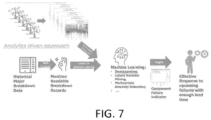
- FIG. 7 describes an analytics driven approach that may be utilized by the component failure prediction system 104 in some embodiments.
- the component failure prediction system 104 may receive historical data regarding renewable energy sources (e.g., wind turbines, solar panels, wind farms, solar farms, electrical grants, and/or the like).
- the component failure prediction system 104 may break down the data in order to identify important features and remove noise of past failures that may impact model building.
- the historical data may be curated to further identify important features and remove noise.
- the component failure prediction system 104 may further identify labels or categories for machine learning. It will be appreciated that component failure prediction system 104 may, in some embodiments, identify labels for machine learning with or without data generation from other sources.
- the component failure prediction system 104 may receive sensor data regarding any number of components from any number of devices, such as wind turbines from a wind farm.
- the multivariate timeseries data in combination with the labels or categories for machine learning, may assist for deep learning, latent variable mining, multivariate anomaly detection to assist and provide insights for component failure indication. These insights, which may predict upcoming failures, may effectively enable responses to upcoming failures with sufficient lead time before failure impacts other components of energy generation.
- the component failure prediction system 104 may comprise the communication module 602, an anomaly based scoping module 604, a factor analysis based scoping module 606, a training data preparation module 608, a model training module 610, a model scoring module 612, an evaluation module 614, and a report and alert generation module 616.
- the component failure prediction system 104 may further comprise data storage 618.
- the communication module 602 may be configured to transmit and receive data between two or more modules in component failure prediction system 104.
- the communication module 602 is configured to receive information regarding assets of the electrical network 102 (e.g., from the power system 106, sensors within components of the electrical network 102 such as the renewable energy sources 112, third-party systems such as government entities, other utilities, and/or the like).
- the communication module 602 may be configured to receive historical data regarding electrical assets either individually or in combination (e.g., wind turbines, solar panels, windfarms, solar farms, components of devices, components of wind turbines, components of solar panels, substations 114, transformers 116, and/or transmission lines 110).
- the communication module 602 may further receive sensor data from one or more sensors of any number of electrical assets such as those described above.
- the anomaly based scoping module 604 may receive historical data including sensor data from any number of sensors of renewable energy assets.
- the sensor data may be from any number of sensors over a predetermined period of time.
- the anomaly based scoping module 604 normalizes and extracts derived features from that sensor data.
- such features may include a ratio between active power and windspeed measurement or temperature difference between a control room and ambient temperatures.
- the anomaly based scoping module 604 may receive any amount of historical data regarding any number of wind turbines and/or wind turbine farms.
- the historical data may include sensor data from any number of wind turbines in a wind farm over a length of time (e.g., over one year).
- historical data may include sensor data from any number of wind turbines any number of windfarms over different lengths of time.
- the sensor data may be from any number of sensor including sensors that measure different conditions.
- the sensor data may include data from main bearing sensors, generator sensors, vibration sensors, anemometer sensors, and the like.
- the anomaly based scoping module 604 may remove anomaly data points from a list of prior failure events during the time to perform 1st level data scoping. For example, the anomaly based scoping module 604 may receive historical data including sensor data of a wind farm that extends through a first time period as well as failure data that indicates failures within the wind farm within that first time period. In some embodiments, if the failure data indicates the type of failure, time of failure, and the specific turbine(s) and/or type of failures, the anomaly based scoping module 604 may remove the historical data of that failure from the historical data.
- the anomaly based scoping module 604 may remove sensor data from the historical data of sensors linked to the failure (e.g., of the failing wind turbine and/or failing components of the wind turbine) from the time the failure was detected through to the time that failure correction was determined or detected.
- the anomaly based scoping module 604 may subsequently rerun the multivariate anomaly model to set a second layer baseline to perform primary unsupervised learning.
- the anomaly based scoping module 604 may subsequently store multivariate timeseries data along with anomaly status for a predetermined period of the time when failures are excluded.
- the anomaly based scoping module 604 may store the multivariate timeseries data within the data storage 618.
- the anomaly based scoping module 604 may generate different models for different types of failures.
- the anomaly based scoping module 604 may train a multivariate anomaly model (e.g., such as an isolation forest or random forest) to set a baseline for initial unsupervised learning.
- a multivariate anomaly model e.g., such as an isolation forest or random forest
- the factor analysis based scoping module 606 may run a factor analysis of a combination of previous features to extract secondary data.
- the factor analysis based scoping module 606 can identify the top factors (e.g., most significant factors relative to other factors) that contribute into the historical failure of data. As a result, the factor analysis based scoping module 606 may create a weighting vector for high importance for particular modes of failures.
- the factor analysis based scoping module 606 may perform initial scoping of sensor variable values by applying the weight vector.
- the factor analysis based scoping module 606 may apply the weighting vector on some input sensor data of the historical data.
- the anomaly based scoping module 604 may exclude the time period from the list of actual failure data for primary scoping of the data.
- the training data preparation module 608 may build a predictive model based on the second layer baseline from the anomaly based scoping module 604 and the primary scoping of data from the factor analysis based scoping module 606.
- training data is prepared as a tuple of anomaly score timeseries, fault score timeseries, an indicator variable showing particular mode of fault that occurred in the desired time period (e.g., 45 day lead time).
- the model training module 610 may utilize classification algorithms for model training.
- the classifications may include for example SVM, DeepLeaming (such as CNN or CHAID).
- the training model input may include balanced input such as, for example, scoped anomaly time series, scoped weighted sensor timeseries, and failure indications.
- the timeseries data is a matrix where the start time the end time of the timeseries include maximum lead time, minimum lead time, and per desired time horizon (e.g., 45 days to 10 days before an event).
- the balanced input may require a minimum of failure history (e.g., 20%) which can be copied by subsampling the non-failure history and by boosting the failure history data (e.g., sliding window for the failure history data).
- a minimum of failure history e.g. 20%
- boosting the failure history data e.g., sliding window for the failure history data
- the model scoring module 612 may provide a probability of failure within the predefined lead time interval using the second layer baseline from the anomaly based scoping module 604, the primary scoping of data from the factor analysis based scoping module 606, and inputting the tuple of scoped anomaly timeseries, scoped weighted timeseries, and failure indication.
- the model scoring module 612 may provide a probability of failure within the predefined lead time interval.
- Further computation of the failure can be accomplished by counting down the time from the first date of the failure prediction.
- the evaluation module 614 may be configured to apply a model generated by the model training module 610 to sensor data received from the same wind turbine or renewable asset equipment that was used to produce the sensor data of the previous received historical data. In various embodiments, the evaluation module 614 may compare new sensor data to classified and/or categorized states identified by the model of the model training module 610 to identify when sensor data indicates a failure state or a state associated with potential failure is reached. In some embodiments, the evaluation module 614 may score the likelihood or confidence of such estate being reached. The evaluation module 614 may compare the confidence or score against a threshold in order to trigger an alert or report. In another example, the evaluation module 614 may compare the fit of sensor data to a failure state or state associate with potential failure that has been identified by the model of the model training module 610 in order to trigger or not trigger an alert or report. Further examples are discussed regarding figure 8 .
- Each categorized state may be associated with a different type of failure including mode of failure, component of failure, and/or the like.
- the report and alert generation module 616 may generate an alert based on the evaluation of the evaluation module 614.
- An alert may be a message indicating a failure or type of failure as well as the specific renewable energy asset (e.g., wind turbine or solar panel) that may be at risk of failure. Since the state identified by the model is a state that is in advance of a potential failure, the alert should be triggered in advance of the potential failure such that corrective action may take place. In some embodiments, different alerts may be generated based on different possible failure and or different failure states.
- failure states may be more serious than others, as such more alerts and/or additional detailed alerts may be provided to a larger number of digital devices (e.g., cell phones, operators, utility companies, service computers, or the like) depending on the seriousness, significance, and/or imminence of failure.
- digital devices e.g., cell phones, operators, utility companies, service computers, or the like
- the report and alert generation module 616 may generate a report indicating any number of potential failures, the probability of such failure, and the justification or reasoning based on the model and the fit of previously identified states associated with future failure of components.
- the data storage 618 may be any type of data storage including tables databases or the like.
- the data store 618 may store models, historical data, current sensor data, states indicating possible future failure, alerts, reports, and/or the like.
- a module may be hardware (e.g., circuitry and/or programmable chip), software, or a combination of hardware and software.
- FIG. 8 is a flowchart for predicting failures and/or potential failures of renewable energy assets.
- prediction failures and/or potential failures of wind turbines is discussed.
- the anomaly based scoping module 604 performs anomaly based scoping on historical data regarding a wind farm.
- the anomaly based scoping module 604 may receive historical data including sensor data from any number of sensors of any number of wind turbines in the wind farm over a first period of time. Subsequently, the anomaly based scoping module 604 may filter out sensor data generated during a known failure or generated during a statistical likelihood of failure.
- the anomaly based scoping module 604 may receive historical data generated by sensors during the first period of time and failure data indicating failures during that first period of time.
- the historical data may include sensor data regarding any number of components of any number of wind turbines.
- the historical data may be received from any number of sources including, for example, an operator of a wind farm, utility, manufacturer, surface provider, or the like.
- the failure data may be received from any number of sources including, for example, an operator of a wind farm, utility, manufacturer, surface provider, or the like. All or some of the historical data may be from the same sources or different sources that provide the failure data.
- all or some of the sensor data of the historical data may be receive from any number of sensors and/or a sensor aggregator.
- the failure data may include different data indicating failure.
- the failure data may only include a percentage of downtime during the first period of time of one or more wind turbines.
- the failure data may include additional information or different information including, for example, indications when specific wind turbines failed and/or the type of component that failed (e.g., generator failure).
- the anomaly based scoping module 604 may remove and/or filter sensor data generated by sensors of that particular specific wind turbine during the period of the detected failure. If the failure data indicates the time of failure, the specific wind turbine(s) that failed, and the type of failure, the anomaly based scoping module 604 may remove and/or filter sensor data generated by sensors related to that specific type of failure (e.g., generator sensor data during a time of a generator fault of a particular wind turbine) of the particular specific wind turbine during the period of the detected failure.
- the specific type of failure e.g., generator sensor data during a time of a generator fault of a particular wind turbine
- the anomaly based scoping module 604 may remove and/or filter sensor data generated by sensors of components that may be impacted by the failure (e.g., vibration sensor data may be removed if the wind turbine blades stopped moving due to a bearing failure).
- the failure data only indicates a percentage or amount of downtime of the wind farm and/or any number of wind turbines during the first period of time of the historical data.
- the anomaly based scoping module 604 may review the data for sensor data indicating failures and possible failures.
- the anomaly based scoping module 604 may identify the strongest sensor data indicating failures of components and/or turbines in the historical data.
- the anomaly based scoping module 604 may compare different sensor data of different components to different component thresholds (e.g., data from generator sensors is compared against a generator failure threshold to determine failure).
- the anomaly based scoping module 604 tracks an amount of time where failure (e.g., failure or potential failure) is detected in the sensor data of the historical period. If the amount of time where failure is detected in the sensor data of the historical period is equal to the amount of time / percentage of time identified in the failure data, then the anomaly based scoping module 604 may remove that particular sensor data from the historical data.
- failure e.g., failure or potential failure
- the anomaly based scoping module 604 may remove, from the historical data, sensor data that includes the strongest indications of failure relative to the other sensor data until the amount of time or percentage of amount of time of the first period of time is satisfied.
- the anomaly based scoping module 604 may identify additional sensor data from the historical data (e.g., compare against higher thresholds) to remove until the amount of time or percentage of amount of time of the first period of time is satisfied.
- the anomaly based scoping module 604 may remove additional sensor data immediately before and/or after failure.
- the anomaly based scoping module 604 removes a predetermined amount of sensor data immediately before and/or after a detected failure when it is unknown when the failure specifically began and/or ended.
- the anomaly based scoping module 604 removes a predetermined amount of sensor data immediately before and/or after a detected failure to remove data that may unduly influence the analysis.
- the anomaly based scoping module 604 removes 10 seconds of sensor data before and/or after a failure (e.g., 10 seconds of generator sensor data before and/or after a generator failure is detected).
- the anomaly based scoping module 604 generates filtered historical data after removing sensor data from the originally received (e.g., initial) historical data.
- the anomaly based scoping module 604 may filter out different information depending on the failure data received. As such, the anomaly based scoping module 604 may filter out different data from different sets of historical time periods based on the different sets of failure data.
- FIG. 9 is one example of removing sensor data from historical data associated with known or possible failure of a renewable energy asset in some embodiments.
- the anomaly based scoping module 604 receives sensor data (e.g., multivariate data) from equipment during a first time period.
- the anomaly based scoping module 604 and/or the factor analysis based scoping module 606 may optionally normalize and/or extract derived features from the received sensor data.
- the factor analysis based scoping module 606 may train a multi-variate anomaly model to set a baseline.
- the anomaly based scoping module 604 receives failure data and uses the failure data to set the baseline in order to identify sensor data at the time of known or possible failure. In step 908, the anomaly based scoping module 604 may remove anomaly data points (e.g., sensor data generated during failure) from list of prior failure events during time period.
- anomaly data points e.g., sensor data generated during failure
- the anomaly based scoping module 604 may re-run multi-variate anomaly model to set a second baseline.
- the anomaly based scoping module 604 may optionally store multi-variate time-series data along with anomaly status for period when known or possible failures are excluded.
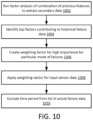
- FIG. 10 is another example of removing sensor data from historical data associated with known or possible failure of a renewable energy asset in some embodiments.
- the anomaly based scoping module 604 and/or the factor analysis based scoping module 606 may optionally run factor analysis of combination of previous features to extract secondary data.
- the anomaly based scoping module 604 may identify top factors contributing to the historical failure data (e.g., failures or potential failures identified in the failure data).
- the anomaly based scoping module 604 may create a weighting factor for high importance for particular modes of failures to identify particularly relevant or significant failures and/or modes of failures.
- the anomaly based scoping module 604 may apply weighting vector on received sensor data from the historical data.
- the anomaly based scoping module 604 excludes (e.g., removes) time series data from list of actual failures or potential failures (e.g., from the failure data).
- the factor analysis based scoping module 606 may optionally perform factor analysis based scoping on the filtered historical data from the anomaly based scoping module 604.
- the factor analysis based scoping module 606 may run a factor analysis of a combination of previous features to extract secondary data.
- the factor analysis based scoping module 606 may identify the top factors (e.g., most significant factors relative to other factors) that contribute to the failure indicated in the failure data.
- the factor analysis based scoping module 606 may create a weighting vector for high importance for particular modes of failures.
- the factor analysis based scoping module 606 may perform initial scoping of sensor variable values by applying the weight vector.
- the factor analysis based scoping module 606 may apply the weighting vector on some sensor data of the filtered historical data.
- the factor analysis based scoping module 606 may apply component analysis (e.g., principal component analysis), sample variance, or the like.
- the factor analysis based scoping module 606 may apply mean value clustering.
- the factor analysis based scoping module 606 may assess data from a vibration sensor to determine zero crossing data and aggregate the information over time.
- the factor analysis based scoping module 606 may identify components / features of the data using different methods for different data of different sensors.
- the training data preparation module 608 may optionally build a predictive model based on the second layer baseline from the anomaly based scoping module 604 and the primary scoping of data from the factor analysis based scoping module 606.
- training data is prepared as a tuple of anomaly score timeseries, fault score timeseries, an indicator variable showing particular mode of fault that occurred in the desired time period (e.g., 45 day lead time).
- the model training module 610 may utilize classification algorithms for model training.
- the classifications may include for example SVM, DeepLearning (such as CNN or CHAID).
- the training model input may include balanced input such as, for example, scoped anomaly time series, scoped weighted sensor timeseries, and failure indications.
- the timeseries data is a matrix where the start time the end time of the timeseries include maximum lead time, minimum lead time, and per desired time horizon (e.g., 45 days to 10 days before an event).
- model training module 610 utilizes a random forest or isolation forest to classify different sensor data of the filtered historical data (e.g., the historical data without the sensor data at the time of failures that was previously removed).
- the model training module 610 may utilize the random forest or isolation forest to classify or categorize a state associated with an identified failure from the failure data. Different states may be associated with different failures. In some embodiments, the model training module 610 classifies or categorizes states (e.g., one or more sensor data readings) at a time (e.g., predetermined or undetermined time) before a known failure. The classified state may indicate a combination of features and/or sensor readings that signal an upcoming failure or a possible upcoming failure. Different classified states may include different features, different combination of features, sensors, and/or sensor readings based on the type of failure (e.g., the component that is failing) and/or how the component is failing.
- states e.g., one or more sensor data readings
- the classified state may indicate a combination of features and/or sensor readings that signal an upcoming failure or a possible upcoming failure.
- Different classified states may include different features, different combination of features, sensors, and/or sensor readings based on the
- the model scoring module 612 may provide a probability of failure within the predefined lead time interval (e.g., a state of sensor readings at a time before a potential failure as discussed regarding the model training module 610).
- a distribution may be generated based on the fit of one or more sensor readings (e.g., the sensor data from one or more sensors) to the state identified by the model training module. This may generate a function to be applied to later data.
- the evaluation module 614 may receive new sensor data after the models have been trained.
- the evaluation module 614 may assess all or some of the new sensor data using any number of the models generated by the model training module 610 to determine if a state is present.
- the evaluation module 614 and/or the model scoring module 612 may apply the scoring function to determine a degree of fit or confidence of fit and/or a likelihood of the failure based on the state of the sensor readings.
- the report and alert generation module 616 may generate an alert.
- the alert may be a message or other signal that may indicate the type of failure that may occur, the wind turbine associated with the failure, the lead time before the expected failure, and/or any other information.
- the report and alert generation module 616 may generate a report indicating any number of possible failures, scores indicating likelihood of failure or confidence of sensor data fit to a previously identified state, and/or the like.
- the model may be periodically updated. For example a predetermined intervals and/or times, updated historical data failure data may be received or previously received data may be used to retrain existing models or create new models. In one example, an older subset of previously received historical data may be removed and replaced with recently received sensor data. Some data associated with known failures (e.g., from new failure data) may be removed, new data features may be optionally re-identified, and states re-identified so that new models may be created with new categories to apply to new data.
- renewable energy assets such as wind turbines and solar panel energy generators
- any systems and methods used herein may be applied to any energy assets, renewable energy assets, or any hardware systems that generate data associated with performance over a period of time.
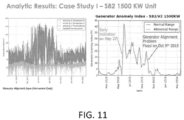
- FIG. 11 depicts analytic results including a case study using some embodiments.
- the generator alignment issue in graph 1102 depicts raw data of a non-severe case.
- the Y axis of graph 1102 is in temperature (C) and the X axis is over time (e.g., March 2015-March 2016).
- the graph includes sensor readings of temperatures of three different windings as well as outdoor temperature (the outdoor temperature is consistently below 40 ° C).
- Graph 1104 is a generator anomaly index (e.g., generated by the report in alert generation module 316) with an X axis indicating a percentage of generator anomaly index and a Y axis of time (e.g., March, 2015 - March, 2016).
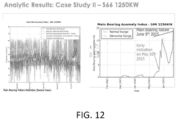
- FIG. 12 depicts analytic results including a case study using some embodiments.
- the main bearing failure issue in graph 1202 depicts raw data of a severe case.
- the Y axis of graph 1202 is in temperature (C) and the X axis is over time (e.g., February 2015- June 2015).
- the graph 1202 includes sensor readings of temperatures of generator drive and temperature, generator nondriving temperature, gearbox high-speed shaft Drive temperature, gearbox high-speed shaft nondriving temperature, and outdoor temperature. In graph 1202, the outdoor temperature is below 40°C.
- Graph 1204 is a main bearing anomaly index (e.g., generated by the report in alert generation module 316) with an X axis indicating a percentage of main bearing warning index and a Y axis of time (e.g., February 2015- June 2015).
- X axis indicating a percentage of main bearing warning index
- Y axis of time e.g., February 2015- June 2015.
- FIG. 13 depicts a block diagram of an example computer system server 1300 according to some embodiments.
- Computer system server 1300 is shown in the form of a general-purpose computing device.
- Computer system server 1300 includes processor 1302, RAM 1304, communication interface 1306, input/output device 1308, storage 1310, and a system bus 1312 that couples various system components including storage 1310 to processor 1302.
- System bus 1312 represents one or more of any of several types of bus structures, including a memory bus or memory controller, a peripheral bus, an accelerated graphics port, and a processor or local bus using any of a variety of bus architectures.
- bus architectures include Industry Standard Architecture (ISA) bus, Micro Channel Architecture (MCA) bus, Enhanced ISA (EISA) bus, Video Electronics Standards Association (VESA) local bus, and Peripheral Component Interconnect (PCI) bus.
- Computer system server 1300 typically includes a variety of computer system readable media. Such media may be any available media that is accessible by congestion mitigation system 1304 and it includes both volatile and nonvolatile media, removable and non-removable media.
- processor 1302 is configured to execute executable instructions (e.g., programs).
- processor 1004 comprises circuitry or any processor capable of processing the executable instructions.
- RAM 1304 stores data.
- working data is stored within RAM 1306. The data within RAM 1306 may be cleared or ultimately transferred to storage 1310.
- communication interface 1306 is coupled to a network via communication interface 1306. Such communication can occur via Input/Output (I/O) device 1308. Still yet, congestion mitigation system 1304 can communicate with one or more networks such as a local area network (LAN), a general wide area network (WAN), and/or a public network (e.g., the Internet).
- networks such as a local area network (LAN), a general wide area network (WAN), and/or a public network (e.g., the Internet).
- input/output device 1308 is any device that inputs data (e.g., mouse, keyboard, stylus) or outputs data (e.g., speaker, display, virtual reality headset).
- inputs data e.g., mouse, keyboard, stylus
- outputs data e.g., speaker, display, virtual reality headset
- storage 1310 can include computer system readable media in the form of volatile memory, such as read only memory (ROM) and/or cache memory. Storage 1310 may further include other removable/non-removable, volatile/non-volatile computer system storage media.
- storage 1310 can be provided for reading from and writing to a non-removable, non-volatile magnetic media (not shown and typically called a "hard drive”).
- a magnetic disk drive for reading from and writing to a removable, non-volatile magnetic disk (e.g., a "floppy disk")
- an optical disk drive for reading from or writing to a removable, non-volatile optical disk such as a CDROM, DVD-ROM or other optical media can be provided.
- storage 1310 may include at least one program product having a set (e.g., at least one) of program modules that are configured to carry out the functions of embodiments of the invention.
- RAM 1304 is found within storage 1310.
- Program/utility having a set (at least one) of program modules, such as congestion mitigation system 1304, may be stored in storage 1310 by way of example, and not limitation, as well as an operating system, one or more application programs, other program modules, and program data. Each of the operating system, one or more application programs, other program modules, and program data or some combination thereof, may include an implementation of a networking environment.
- Program modules generally carry out the functions and/or methodologies of embodiments of the invention as described herein.
- congestion mitigation system 1304. includes, but are not limited to: microcode, device drivers, redundant processing units, and external disk drive arrays, RAID systems, tape drives, and data archival storage systems, etc.
- aspects of one or more embodiments may be embodied as a system, method or computer program product. Accordingly, aspects may take the form of an entirely hardware embodiment, an entirely software embodiment (including firmware, resident software, micro-code, etc.) or an embodiment combining software and hardware aspects that may all generally be referred to herein as a "circuit,” “module” or “system.” Furthermore, aspects may take the form of a computer program product embodied in one or more computer readable medium(s) having computer readable program code embodied thereon.
- the computer readable medium may be a computer readable signal medium or a computer readable storage medium.
- a computer readable storage medium may be, for example, but not limited to, an electronic, magnetic, optical, electromagnetic, infrared, or semiconductor system, apparatus, or device, or any suitable combination of the foregoing.
- a computer readable storage medium may be any tangible medium that can contain, or store a program for use by or in connection with an instruction execution system, apparatus, or device.
- a computer readable signal medium may include a propagated data signal with computer readable program code embodied therein, for example, in baseband or as part of a carrier wave. Such a propagated signal may take any of a variety of forms, including, but not limited to, electro-magnetic, optical, or any suitable combination thereof.
- a computer readable signal medium may be any computer readable medium that is not a computer readable storage medium and that can communicate, propagate, or transport a program for use by or in connection with an instruction execution system, apparatus, or device.
- Program code embodied on a computer readable medium may be transmitted using any appropriate medium, including but not limited to wireless, wireline, optical fiber cable, RF, etc., or any suitable combination of the foregoing.
- Computer program code for carrying out operations for aspects of the present invention may be written in any combination of one or more programming languages, including an object oriented programming language such as Java, Smalltalk, C++ or the like and conventional procedural programming languages, such as the "C" programming language or similar programming languages.
- the program code may execute entirely on the user's computer, partly on the user's computer, as a stand-alone software package, partly on the user's computer and partly on a remote computer or entirely on the remote computer or server.
- the remote computer may be connected to the user's computer through any type of network, including a local area network (LAN) or a wide area network (WAN), or the connection may be made to an external computer (for example, through the Internet using an Internet Service Provider).
- LAN local area network
- WAN wide area network
- Internet Service Provider for example, AT&T, MCI, Sprint, EarthLink, MSN, GTE, etc.
- These computer program instructions may also be stored in a computer readable medium that can direct a computer, other programmable data processing apparatus, or other devices to function in a particular manner, such that the instructions stored in the computer readable medium produce an article of manufacture including instructions which implement the function/act specified in the flowchart and/or block diagram block or blocks.
- the computer program instructions may also be loaded onto a computer, other programmable data processing apparatus, or other devices to cause a series of operational steps to be performed on the computer, other programmable apparatus or other devices to produce a computer implemented process such that the instructions which execute on the computer or other programmable apparatus provide processes for implementing the functions/acts specified in the flowchart and/or block diagram block or blocks.
Landscapes
- Engineering & Computer Science (AREA)
- Theoretical Computer Science (AREA)
- Physics & Mathematics (AREA)
- General Engineering & Computer Science (AREA)
- General Physics & Mathematics (AREA)
- Software Systems (AREA)
- Mathematical Physics (AREA)
- Computing Systems (AREA)
- Data Mining & Analysis (AREA)
- Evolutionary Computation (AREA)
- Artificial Intelligence (AREA)
- Life Sciences & Earth Sciences (AREA)
- Sustainable Development (AREA)
- Mechanical Engineering (AREA)
- Combustion & Propulsion (AREA)
- Chemical & Material Sciences (AREA)
- Sustainable Energy (AREA)
- Computational Linguistics (AREA)
- Probability & Statistics with Applications (AREA)
- Mathematical Analysis (AREA)
- Pure & Applied Mathematics (AREA)
- Algebra (AREA)
- Mathematical Optimization (AREA)
- Computational Mathematics (AREA)
- Computer Vision & Pattern Recognition (AREA)
- Medical Informatics (AREA)
- Remote Monitoring And Control Of Power-Distribution Networks (AREA)
- Testing And Monitoring For Control Systems (AREA)
- Alarm Systems (AREA)
Applications Claiming Priority (4)
| Application Number | Priority Date | Filing Date | Title |
|---|---|---|---|
| US201862623713P | 2018-01-30 | 2018-01-30 | |
| US16/231,160 US11663496B2 (en) | 2018-01-30 | 2018-12-21 | System and method for predicting failure of components using temporal scoping of sensor data |
| PCT/US2019/015915 WO2019152559A1 (en) | 2018-01-30 | 2019-01-30 | System and method for predicting failure of components using temporal scoping of sensor data |
| EP19748416.5A EP3752796B1 (de) | 2018-01-30 | 2019-01-30 | System und verfahren zur vorhersage des ausfalls von komponenten unter verwendung von temporärem scoping von sensordaten |
Related Parent Applications (1)
| Application Number | Title | Priority Date | Filing Date |
|---|---|---|---|
| EP19748416.5A Division EP3752796B1 (de) | 2018-01-30 | 2019-01-30 | System und verfahren zur vorhersage des ausfalls von komponenten unter verwendung von temporärem scoping von sensordaten |
Publications (2)
| Publication Number | Publication Date |
|---|---|
| EP4531277A2 true EP4531277A2 (de) | 2025-04-02 |
| EP4531277A3 EP4531277A3 (de) | 2025-06-18 |
Family
ID=67393566
Family Applications (2)
| Application Number | Title | Priority Date | Filing Date |
|---|---|---|---|
| EP24210992.4A Pending EP4531277A3 (de) | 2018-01-30 | 2019-01-30 | System und verfahren zur vorhersage des ausfalls von komponenten unter verwendung von zeitlichem scoping von sensordaten |
| EP19748416.5A Active EP3752796B1 (de) | 2018-01-30 | 2019-01-30 | System und verfahren zur vorhersage des ausfalls von komponenten unter verwendung von temporärem scoping von sensordaten |
Family Applications After (1)
| Application Number | Title | Priority Date | Filing Date |
|---|---|---|---|
| EP19748416.5A Active EP3752796B1 (de) | 2018-01-30 | 2019-01-30 | System und verfahren zur vorhersage des ausfalls von komponenten unter verwendung von temporärem scoping von sensordaten |
Country Status (4)
| Country | Link |
|---|---|
| US (3) | US11663496B2 (de) |
| EP (2) | EP4531277A3 (de) |
| ES (1) | ES2993037T3 (de) |
| WO (1) | WO2019152559A1 (de) |
Families Citing this family (24)
| Publication number | Priority date | Publication date | Assignee | Title |
|---|---|---|---|---|
| US11663496B2 (en) * | 2018-01-30 | 2023-05-30 | Utopus Insights, Inc. | System and method for predicting failure of components using temporal scoping of sensor data |
| US10956632B2 (en) | 2018-12-27 | 2021-03-23 | Utopus Insights, Inc. | Scalable system and engine for forecasting wind turbine failure |
| CN112696313B (zh) * | 2019-10-22 | 2025-02-25 | 通用电气可再生能源西班牙有限公司 | 用于减轻作用于风力涡轮的转子叶片的负载的系统和方法 |
| US11261846B2 (en) * | 2019-11-01 | 2022-03-01 | General Electric Company | System and method for designing and operating a wind turbine power system based on statistical analysis of operational and/or grid data thereof |
| CN113048009B (zh) * | 2019-12-27 | 2022-11-29 | 新疆金风科技股份有限公司 | 风力发电机组的变桨控制方法、装置及系统 |
| US11509136B2 (en) | 2019-12-30 | 2022-11-22 | Utopus Insights, Inc. | Scalable systems and methods for assessing healthy condition scores in renewable asset management |
| CN111539550B (zh) * | 2020-03-13 | 2023-08-01 | 远景智能国际私人投资有限公司 | 光伏阵列工作状态的确定方法、装置、设备及存储介质 |
| DE102020111142A1 (de) | 2020-04-23 | 2021-10-28 | fos4X GmbH | Verfahren zum Überwachen einer Windenergieanlage, System zum Überwachen einer Windenergieanlage, Windenergieanlagen und Computerprogrammprodukt |
| US11703424B2 (en) * | 2020-05-21 | 2023-07-18 | General Electric Company | System and method for training anomaly detection analytics to automatically remove outlier data |
| US12047029B2 (en) * | 2020-09-10 | 2024-07-23 | Eric Robert ANDERSON | Electricity generation system and method |
| WO2022162663A1 (en) | 2021-01-28 | 2022-08-04 | Scoutcam Ltd. | Systems and methods for monitoring potential failure in a machine or a component thereof |
| US11761427B2 (en) | 2021-06-29 | 2023-09-19 | Aspentech Corporation | Method and system for building prescriptive analytics to prevent wind turbine failures |
| CN114035120A (zh) * | 2021-11-04 | 2022-02-11 | 合肥工业大学 | 基于改进cnn的三电平逆变器开路故障诊断方法及系统 |
| EP4194687A1 (de) * | 2021-12-08 | 2023-06-14 | Siemens Gamesa Renewable Energy A/S | Windturbinensteuerungsanordnung |
| CN114562431B (zh) * | 2022-02-28 | 2024-12-20 | 北京金风慧能技术有限公司 | 监测风力发电机组湿度的方法及装置 |
| CN114738204B (zh) * | 2022-04-15 | 2024-11-15 | 华能酒泉风电有限责任公司 | 一种风力发电机组智能预警方法及系统 |
| WO2023209717A1 (en) | 2022-04-27 | 2023-11-02 | Odysight.Ai Ltd | Monitoring a mechanism or a component thereof |
| EP4311934A1 (de) * | 2022-07-28 | 2024-01-31 | Fundación Tecnalia Research & Innovation | Computerimplementiertes verfahren zum optimieren des betriebs eines antriebsstrangs einer windturbine |
| US20240176878A1 (en) * | 2022-11-28 | 2024-05-30 | Juniper Networks, Inc. | Machine learning assisted root cause analysis for computer networks |
| CN115859092B (zh) * | 2022-12-01 | 2023-11-17 | 南京天洑软件有限公司 | 一种基于主成分分解的发电机绕组温度预警方法及装置 |
| CN116428124A (zh) * | 2023-03-29 | 2023-07-14 | 朗坤智慧科技股份有限公司 | 一种基于同型号设备数量较多的故障诊断方法 |
| CN119122754B (zh) * | 2024-08-28 | 2025-10-21 | 华能新能源股份有限公司河北分公司 | 一种风电机组传动链的安全防护与监测方法及系统 |
| CN119966084B (zh) * | 2025-03-05 | 2025-10-10 | 国网四川省电力公司信息通信公司 | 一种基于大数据的电网设备状态异常监测方法 |
| JP7739651B1 (ja) * | 2025-06-05 | 2025-09-16 | 株式会社JERA Cross | 情報処理装置、情報処理システムおよび情報処理方法 |
Family Cites Families (9)
| Publication number | Priority date | Publication date | Assignee | Title |
|---|---|---|---|---|
| US7895016B2 (en) * | 2009-08-31 | 2011-02-22 | General Electric Company | System and method for wind turbine health management |
| US20120053984A1 (en) * | 2011-08-03 | 2012-03-01 | Kamal Mannar | Risk management system for use with service agreements |
| US8326577B2 (en) * | 2011-09-20 | 2012-12-04 | General Electric Company | System and method for predicting wind turbine component failures |
| ES3046836T3 (en) * | 2014-08-20 | 2025-12-02 | Hitachi Energy Ag | Malfunction prediction for components and units of technical entities |
| US20170308802A1 (en) * | 2016-04-21 | 2017-10-26 | Arundo Analytics, Inc. | Systems and methods for failure prediction in industrial environments |
| CN106059496B (zh) | 2016-05-18 | 2018-03-16 | 华北电力大学 | 一种光伏组件阵列性能监测和故障识别的方法及系统 |
| CN106712713B (zh) | 2017-03-13 | 2018-01-12 | 广西大学 | 一种光伏电站的监测系统以及监测和异常定位方法 |
| US11663496B2 (en) * | 2018-01-30 | 2023-05-30 | Utopus Insights, Inc. | System and method for predicting failure of components using temporal scoping of sensor data |
| US10867250B2 (en) * | 2018-12-27 | 2020-12-15 | Utopus Insights, Inc. | System and method for fault detection of components using information fusion technique |
-
2018
- 2018-12-21 US US16/231,160 patent/US11663496B2/en active Active
-
2019
- 2019-01-30 EP EP24210992.4A patent/EP4531277A3/de active Pending
- 2019-01-30 WO PCT/US2019/015915 patent/WO2019152559A1/en not_active Ceased
- 2019-01-30 ES ES19748416T patent/ES2993037T3/es active Active
- 2019-01-30 EP EP19748416.5A patent/EP3752796B1/de active Active
-
2023
- 2023-04-18 US US18/302,208 patent/US12229688B2/en active Active
-
2025
- 2025-01-16 US US19/026,260 patent/US20250328778A1/en active Pending
Also Published As
| Publication number | Publication date |
|---|---|
| ES2993037T3 (en) | 2024-12-20 |
| EP3752796C0 (de) | 2024-11-06 |
| EP3752796A1 (de) | 2020-12-23 |
| US12229688B2 (en) | 2025-02-18 |
| US11663496B2 (en) | 2023-05-30 |
| EP4531277A3 (de) | 2025-06-18 |
| EP3752796A4 (de) | 2022-03-30 |
| WO2019152559A1 (en) | 2019-08-08 |
| US20190236456A1 (en) | 2019-08-01 |
| EP3752796B1 (de) | 2024-11-06 |
| US20230252307A1 (en) | 2023-08-10 |
| US20250328778A1 (en) | 2025-10-23 |
Similar Documents
| Publication | Publication Date | Title |
|---|---|---|
| US12229688B2 (en) | System and method for predicting failure of components using temporal scoping of sensor data | |
| US12288012B2 (en) | System and method for evaluating models for predictive failure of renewable energy assets | |
| US11188691B2 (en) | Scalable system and method for forecasting wind turbine failure using SCADA alarm and event logs | |
| US11977375B2 (en) | Scalable systems and methods for assessing healthy condition scores in renewable asset management | |
| US12333222B2 (en) | Scalable system and engine for forecasting wind turbine failure | |
| US20240288859A1 (en) | System and method for proactive handling of multiple faults and failure modes in an electrical network of energy assets | |
| US20200210824A1 (en) | Scalable system and method for forecasting wind turbine failure with varying lead time windows |
Legal Events
| Date | Code | Title | Description |
|---|---|---|---|
| PUAI | Public reference made under article 153(3) epc to a published international application that has entered the european phase |
Free format text: ORIGINAL CODE: 0009012 |
|
| STAA | Information on the status of an ep patent application or granted ep patent |
Free format text: STATUS: THE APPLICATION HAS BEEN PUBLISHED |
|
| AC | Divisional application: reference to earlier application |
Ref document number: 3752796 Country of ref document: EP Kind code of ref document: P |
|
| AK | Designated contracting states |
Kind code of ref document: A2 Designated state(s): AL AT BE BG CH CY CZ DE DK EE ES FI FR GB GR HR HU IE IS IT LI LT LU LV MC MK MT NL NO PL PT RO RS SE SI SK SM TR |
|
| REG | Reference to a national code |
Ref country code: DE Ref legal event code: R079 Free format text: PREVIOUS MAIN CLASS: H02S0050000000 Ipc: G01D0018000000 |
|
| PUAL | Search report despatched |
Free format text: ORIGINAL CODE: 0009013 |
|
| AK | Designated contracting states |
Kind code of ref document: A3 Designated state(s): AL AT BE BG CH CY CZ DE DK EE ES FI FR GB GR HR HU IE IS IT LI LT LU LV MC MK MT NL NO PL PT RO RS SE SI SK SM TR |
|
| RIC1 | Information provided on ipc code assigned before grant |
Ipc: H02S 50/00 20140101ALI20250512BHEP Ipc: G01D 18/00 20060101AFI20250512BHEP |
|
| STAA | Information on the status of an ep patent application or granted ep patent |
Free format text: STATUS: REQUEST FOR EXAMINATION WAS MADE |
|
| 17P | Request for examination filed |
Effective date: 20251217 |