EP4530998A1 - Mise en correspondance de modèles tensoriels - Google Patents
Mise en correspondance de modèles tensoriels Download PDFInfo
- Publication number
- EP4530998A1 EP4530998A1 EP23315374.1A EP23315374A EP4530998A1 EP 4530998 A1 EP4530998 A1 EP 4530998A1 EP 23315374 A EP23315374 A EP 23315374A EP 4530998 A1 EP4530998 A1 EP 4530998A1
- Authority
- EP
- European Patent Office
- Prior art keywords
- template
- tensorial
- tomogram
- target
- target particle
- Prior art date
- Legal status (The legal status is an assumption and is not a legal conclusion. Google has not performed a legal analysis and makes no representation as to the accuracy of the status listed.)
- Pending
Links
Images


Classifications
-
- G—PHYSICS
- G06—COMPUTING OR CALCULATING; COUNTING
- G06V—IMAGE OR VIDEO RECOGNITION OR UNDERSTANDING
- G06V10/00—Arrangements for image or video recognition or understanding
- G06V10/70—Arrangements for image or video recognition or understanding using pattern recognition or machine learning
- G06V10/74—Image or video pattern matching; Proximity measures in feature spaces
- G06V10/75—Organisation of the matching processes, e.g. simultaneous or sequential comparisons of image or video features; Coarse-fine approaches, e.g. multi-scale approaches; using context analysis; Selection of dictionaries
- G06V10/751—Comparing pixel values or logical combinations thereof, or feature values having positional relevance, e.g. template matching
-
- G—PHYSICS
- G06—COMPUTING OR CALCULATING; COUNTING
- G06V—IMAGE OR VIDEO RECOGNITION OR UNDERSTANDING
- G06V20/00—Scenes; Scene-specific elements
- G06V20/60—Type of objects
- G06V20/69—Microscopic objects, e.g. biological cells or cellular parts
Definitions
- the present invention relates to an improved method of template matching in image analysis.
- the present invention relates to template matching of target molecules in cellular cryogenic electron tomography that may be performed faster than before.
- the present invention relates to template matching where a scan is performed of an image to determine matches to a target template.
- the present invention can be applied to 2D images and 3D images (volumetric images or tomograms), although this invention is considerably advantageous in the case of 3D images.
- the present invention may be used in template matching of a target that is present many times in an image, for example a particle within an image, e.g., ribosomes or proteasomes. More generally, template matching is widely used in the industry e.g., for image registration, alignment, object detection, counting, tracking, defect detection, volume reconstruction, etc. It is often used in such applications due its ease of use and interpretation.
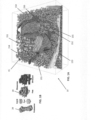
- a particular application of the present invention is cellular cryogenic electron tomography (Cryo-ET) which is a label-free imaging technique that provides 3D images (or tomograms) of organelles and protein complexes at nanometre resolution. This is done by opening windows into the cell with focused ion beam milling of a cryogenically frozen cell. A series of 2D images is taken of this thinned cellular sample from varying angles. The 2D images are then reconstructed into a 3D tomogram. This technique provides 3D snapshots of proteins at work within their functional environment, and provides a window into understanding how they, and other molecules, work together to carry out major processes in a cell.
- Cryo-ET serves two main purposes, namely protein structures discovery and functional cellular behaviour. In both cases, particles of interest are automatically picked to get their position, orientation, and class, usually using template matching.
- Template matching is a brute force algorithm that computes correlation with a template of a target particle at every voxel of a tomogram. Voxels showing the highest correlation values correspond to instances of template positions in the tomogram having the best match to a particle recorded in the tomogram.
- every instance of a template position may have any rotation of the target particle, the whole space of rotations of the target particle must be sampled and the correlation must be computed for all the rotations to find the optimal rotation at every voxel in the tomogram.
- This approach is computationally intensive and requires a significant amount of time to be computed even after algorithmic optimization, usage of the Fourier transform, parallelization, and down-sampling of the data. This leads to a strong bottleneck in the Cryo-ET analysis workflow.
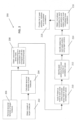
- a method of generating a tensorial template for template matching to determine instances of a target within an image comprising: generating a tensorial template of the target, wherein the tensorial template describes the shape over all rotations of the target with a tensor field.
- the tensorial template comprises a tensor field of multiple tensors.
- the tensors may be of any order and any dimension according to a compromise between rotation accuracy and computational complexity required for the targeted application. For example, tensors of order 4 and dimension 4 may be used.
- all tensors and all tensor powers have the same number of components, and each component of each tensor that represents one element of the target comprises the integral over all rotations of the product of the corresponding component of the tensor power for one rotation and a value of the one element of the template of the target for the one rotation.
- the value of each element may denote an intensity of that element.
- the image may comprise a surface model of the target that used intensity values for each element to describe the shape of the surface of the target.
- the method comprises masking the model using an operator that bounds the model of the target prior to generating the components of the tensors thereby setting the size of the array of elements.
- the operator may be a symmetric positive semidefinite linear operator.
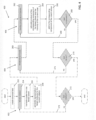
- a method of tensorial template matching to identify instances of a target within an image comprising: generating a tensorial template of the target according to any of the methods described above; and using the tensorial template to identify instances of that target within an image.
- using the tensorial template to identify instances of the target within an image comprises: convolving the tensorial template with the image to obtain a convolved tensor field that provides information on the correlation of the tensorial template with the image at all positions and at all rotations within the image.
- Using the tensorial template to identify instances of the target within an image may comprise determining the best correlation value for each of the positions within the image by . calculating a scalar map of the convolved tensor field at each position. The values populating the scalar map may be a measure of the best correlation value at each position.
- Each position may correspond to an element of the image, for example pixels in a two-dimensional image or voxels in a three-dimensional image.
- Calculating a scalar map of the convolved tensor field at each position may comprise calculating a scalar map of the total energy of the convolved tensor field at each position.
- the method may comprise calculating a scalar map of the total energy of the convolved tensor field at each position using a norm of the convolved tensor field at each position.
- a Frobenius norm may be used.
- Calculating the Frobenius norm of the convolved tensor field at each position may comprise calculating the square root of the absolute squares of the components of the tensors of the tensorial template at each position.
Landscapes
- Engineering & Computer Science (AREA)
- Theoretical Computer Science (AREA)
- Multimedia (AREA)
- Health & Medical Sciences (AREA)
- General Health & Medical Sciences (AREA)
- Computer Vision & Pattern Recognition (AREA)
- Physics & Mathematics (AREA)
- General Physics & Mathematics (AREA)
- Life Sciences & Earth Sciences (AREA)
- Biomedical Technology (AREA)
- Molecular Biology (AREA)
- Artificial Intelligence (AREA)
- Computing Systems (AREA)
- Databases & Information Systems (AREA)
- Evolutionary Computation (AREA)
- Medical Informatics (AREA)
- Software Systems (AREA)
- Analysing Materials By The Use Of Radiation (AREA)
Priority Applications (3)
| Application Number | Priority Date | Filing Date | Title |
|---|---|---|---|
| EP23315374.1A EP4530998A1 (fr) | 2023-09-29 | 2023-09-29 | Mise en correspondance de modèles tensoriels |
| CN202480062035.XA CN121970093A (zh) | 2023-09-29 | 2024-09-23 | 张量模板匹配 |
| PCT/IB2024/059232 WO2025068851A1 (fr) | 2023-09-29 | 2024-09-23 | Mise en correspondance de modèles tensoriels |
Applications Claiming Priority (1)
| Application Number | Priority Date | Filing Date | Title |
|---|---|---|---|
| EP23315374.1A EP4530998A1 (fr) | 2023-09-29 | 2023-09-29 | Mise en correspondance de modèles tensoriels |
Publications (1)
| Publication Number | Publication Date |
|---|---|
| EP4530998A1 true EP4530998A1 (fr) | 2025-04-02 |
Family
ID=88511613
Family Applications (1)
| Application Number | Title | Priority Date | Filing Date |
|---|---|---|---|
| EP23315374.1A Pending EP4530998A1 (fr) | 2023-09-29 | 2023-09-29 | Mise en correspondance de modèles tensoriels |
Country Status (1)
| Country | Link |
|---|---|
| EP (1) | EP4530998A1 (fr) |
-
2023
- 2023-09-29 EP EP23315374.1A patent/EP4530998A1/fr active Pending
Non-Patent Citations (1)
| Title |
|---|
| HENRIK SKIBBE ET AL: "3D Object Detection Using a Fast Voxel-Wise Local Spherical Fourier Tensor Transformation", 22 September 2010, PATTERN RECOGNITION, SPRINGER BERLIN HEIDELBERG, BERLIN, HEIDELBERG, PAGE(S) 412 - 421, ISBN: 978-3-642-15985-5, XP019153326 * |
Similar Documents
| Publication | Publication Date | Title |
|---|---|---|
| Dufour et al. | Template matching based object recognition with unknown geometric parameters | |
| US9141871B2 (en) | Systems, methods, and software implementing affine-invariant feature detection implementing iterative searching of an affine space | |
| Liu et al. | Local frequency representations for robust multimodal image registration | |
| US8478051B2 (en) | Generalized statistical template matching under geometric transformations | |
| Spiclin et al. | Groupwise registration of multimodal images by an efficient joint entropy minimization scheme | |
| Chang et al. | Gaussreg: Fast 3d registration with gaussian splatting | |
| CN111798453B (zh) | 用于无人驾驶辅助定位的点云配准方法及其系统 | |
| CA2277308C (fr) | Systeme intelligent de traitement a hyperdetecteurs (ihps) | |
| K. Alilou et al. | Exemplar-based image inpainting using svd-based approximation matrix and multi-scale analysis | |
| Bedkowski et al. | General purpose computing on graphics processing units for robotic applications | |
| KR20150002157A (ko) | 단일 깊이 영상을 이용한 내용기반 3차원 모델 검색 방법, 이를 수행하는 3차원 모델 검색 서버 및 컴퓨터로 판독 가능한 기록매체 | |
| Heitz et al. | Statistical shape model generation using nonrigid deformation of a template mesh | |
| Garding | Surface orientation and curvature from differential texture distortion | |
| Joshi et al. | A computationally efficient approach to the estimation of two-and three-dimensional hidden Markov models | |
| WO2025068851A1 (fr) | Mise en correspondance de modèles tensoriels | |
| Takeishi et al. | Evaluation of interest-region detectors and descriptors for automatic landmark tracking on asteroids | |
| EP4530998A1 (fr) | Mise en correspondance de modèles tensoriels | |
| EP2672425A1 (fr) | Méthode et dispositif avec adaptation de modèles deformables utilisant une approximation de haute précision | |
| Shamai et al. | Efficient inter-geodesic distance computation and fast classical scaling | |
| US12374043B2 (en) | Utilizing machine learning models for patch retrieval and deformation in completing three-dimensional digital shapes | |
| EP4086849A1 (fr) | Procédé de détection de la symétrie réflectionnelle d'objets géométriques | |
| Kushnir et al. | Algorithms for adjustment of symmetry axis found for 2D shapes by the skeleton comparison method | |
| Steuernagel et al. | Point cloud registration based on Gaussian mixtures and pairwise Wasserstein distances | |
| Attia et al. | 3D point cloud coarse registration based on convex hull refined by ICP and NDT | |
| Akselrod-Ballin et al. | Accelerating image registration with the johnson–lindenstrauss lemma: Application to imaging 3-d neural ultrastructure with electron microscopy |
Legal Events
| Date | Code | Title | Description |
|---|---|---|---|
| PUAI | Public reference made under article 153(3) epc to a published international application that has entered the european phase |
Free format text: ORIGINAL CODE: 0009012 |
|
| STAA | Information on the status of an ep patent application or granted ep patent |
Free format text: STATUS: THE APPLICATION HAS BEEN PUBLISHED |
|
| AK | Designated contracting states |
Kind code of ref document: A1 Designated state(s): AL AT BE BG CH CY CZ DE DK EE ES FI FR GB GR HR HU IE IS IT LI LT LU LV MC ME MK MT NL NO PL PT RO RS SE SI SK SM TR |
|
| STAA | Information on the status of an ep patent application or granted ep patent |
Free format text: STATUS: REQUEST FOR EXAMINATION WAS MADE |
|
| 17P | Request for examination filed |
Effective date: 20250826 |
|
| RIC1 | Information provided on ipc code assigned before grant |
Ipc: G06V 10/75 20220101AFI20251031BHEP Ipc: G06V 20/69 20220101ALI20251031BHEP |
|
| GRAP | Despatch of communication of intention to grant a patent |
Free format text: ORIGINAL CODE: EPIDOSNIGR1 |
|
| STAA | Information on the status of an ep patent application or granted ep patent |
Free format text: STATUS: GRANT OF PATENT IS INTENDED |
|
| INTG | Intention to grant announced |
Effective date: 20251218 |
|
| GRAS | Grant fee paid |
Free format text: ORIGINAL CODE: EPIDOSNIGR3 |
|
| GRAA | (expected) grant |
Free format text: ORIGINAL CODE: 0009210 |
|
| STAA | Information on the status of an ep patent application or granted ep patent |
Free format text: STATUS: THE PATENT HAS BEEN GRANTED |