EP4530996A1 - Verfahren und vorrichtung zur bildsegmentierung - Google Patents
Verfahren und vorrichtung zur bildsegmentierung Download PDFInfo
- Publication number
- EP4530996A1 EP4530996A1 EP24185128.6A EP24185128A EP4530996A1 EP 4530996 A1 EP4530996 A1 EP 4530996A1 EP 24185128 A EP24185128 A EP 24185128A EP 4530996 A1 EP4530996 A1 EP 4530996A1
- Authority
- EP
- European Patent Office
- Prior art keywords
- image
- objects
- probability
- deep learning
- learning model
- Prior art date
- Legal status (The legal status is an assumption and is not a legal conclusion. Google has not performed a legal analysis and makes no representation as to the accuracy of the status listed.)
- Withdrawn
Links
Images




Classifications
-
- G—PHYSICS
- G06—COMPUTING OR CALCULATING; COUNTING
- G06V—IMAGE OR VIDEO RECOGNITION OR UNDERSTANDING
- G06V10/00—Arrangements for image or video recognition or understanding
- G06V10/20—Image preprocessing
- G06V10/26—Segmentation of patterns in the image field; Cutting or merging of image elements to establish the pattern region, e.g. clustering-based techniques; Detection of occlusion
-
- G—PHYSICS
- G06—COMPUTING OR CALCULATING; COUNTING
- G06V—IMAGE OR VIDEO RECOGNITION OR UNDERSTANDING
- G06V10/00—Arrangements for image or video recognition or understanding
- G06V10/20—Image preprocessing
- G06V10/26—Segmentation of patterns in the image field; Cutting or merging of image elements to establish the pattern region, e.g. clustering-based techniques; Detection of occlusion
- G06V10/267—Segmentation of patterns in the image field; Cutting or merging of image elements to establish the pattern region, e.g. clustering-based techniques; Detection of occlusion by performing operations on regions, e.g. growing, shrinking or watersheds
-
- G—PHYSICS
- G06—COMPUTING OR CALCULATING; COUNTING
- G06T—IMAGE DATA PROCESSING OR GENERATION, IN GENERAL
- G06T7/00—Image analysis
- G06T7/10—Segmentation; Edge detection
- G06T7/11—Region-based segmentation
-
- G—PHYSICS
- G06—COMPUTING OR CALCULATING; COUNTING
- G06T—IMAGE DATA PROCESSING OR GENERATION, IN GENERAL
- G06T7/00—Image analysis
- G06T7/10—Segmentation; Edge detection
- G06T7/143—Segmentation; Edge detection involving probabilistic approaches, e.g. Markov random field [MRF] modelling
-
- G—PHYSICS
- G06—COMPUTING OR CALCULATING; COUNTING
- G06V—IMAGE OR VIDEO RECOGNITION OR UNDERSTANDING
- G06V10/00—Arrangements for image or video recognition or understanding
- G06V10/70—Arrangements for image or video recognition or understanding using pattern recognition or machine learning
- G06V10/77—Processing image or video features in feature spaces; using data integration or data reduction, e.g. principal component analysis [PCA] or independent component analysis [ICA] or self-organising maps [SOM]; Blind source separation
- G06V10/774—Generating sets of training patterns; Bootstrap methods, e.g. bagging or boosting
-
- G—PHYSICS
- G06—COMPUTING OR CALCULATING; COUNTING
- G06V—IMAGE OR VIDEO RECOGNITION OR UNDERSTANDING
- G06V10/00—Arrangements for image or video recognition or understanding
- G06V10/70—Arrangements for image or video recognition or understanding using pattern recognition or machine learning
- G06V10/77—Processing image or video features in feature spaces; using data integration or data reduction, e.g. principal component analysis [PCA] or independent component analysis [ICA] or self-organising maps [SOM]; Blind source separation
- G06V10/776—Validation; Performance evaluation
-
- G—PHYSICS
- G06—COMPUTING OR CALCULATING; COUNTING
- G06V—IMAGE OR VIDEO RECOGNITION OR UNDERSTANDING
- G06V10/00—Arrangements for image or video recognition or understanding
- G06V10/94—Hardware or software architectures specially adapted for image or video understanding
- G06V10/945—User interactive design; Environments; Toolboxes
-
- G—PHYSICS
- G06—COMPUTING OR CALCULATING; COUNTING
- G06V—IMAGE OR VIDEO RECOGNITION OR UNDERSTANDING
- G06V20/00—Scenes; Scene-specific elements
- G06V20/50—Context or environment of the image
-
- G—PHYSICS
- G06—COMPUTING OR CALCULATING; COUNTING
- G06V—IMAGE OR VIDEO RECOGNITION OR UNDERSTANDING
- G06V40/00—Recognition of biometric, human-related or animal-related patterns in image or video data
- G06V40/10—Human or animal bodies, e.g. vehicle occupants or pedestrians; Body parts, e.g. hands
-
- G—PHYSICS
- G06—COMPUTING OR CALCULATING; COUNTING
- G06V—IMAGE OR VIDEO RECOGNITION OR UNDERSTANDING
- G06V2201/00—Indexing scheme relating to image or video recognition or understanding
- G06V2201/03—Recognition of patterns in medical or anatomical images
Definitions
- the disclosure relates to an image segmentation method and apparatus, and more particularly, to a method and an apparatus capable of segmenting a plurality of objects in an image through a deep learning model.
- Deep learning is a learning method that combines and analyzes data by using an artificial neural network. Deep learning models are used in various fields such as image recognition. For example, deep learning models may be used to diagnose lesions from medical images or segment human organ regions in medical images. In order to segment a specific region in an image by using a deep learning model, a process of training a deep learning model by using training data obtained by labeling (or annotating) a specific region is necessary. For example, in order to segment a liver region in medical images, a deep learning model needs to be trained by using training data with the labeled liver region, and in order to segment a lung region, a deep learning model needs to be trained by using training data with the labeled lung region.
- the learning time increases because the deep learning model should be trained for each region.
- training data for labeling the plurality of regions is required, and it is difficult to use, as training data, images in which only some of the plurality of regions are labeled.
- the disclosure provides an image segmentation method and apparatus for identifying a plurality of objects in an image using a single deep learning model without using a plurality of deep learning models to segment the plurality of objects in the image.
- the disclosure provides an image segmentation method and apparatus configured to generate a single deep learning model for performing segmentation of a plurality of objects in an image.
- an image segmentation method performed by an image segmentation apparatus, the image segmentation method including obtaining a plurality of probability maps by inputting an image into a deep learning model, and identifying a plurality of objects from the image, based on the plurality of probability maps, wherein the plurality of probability maps include prediction values of the deep learning model indicating a probability that each pixel of the image belongs to a plurality of combinations defined as regions of at least two objects among the plurality of objects.
- an image segmentation method performed by an image segmentation apparatus, the image segmentation method including defining a plurality of true masks obtained by combining regions of at least two objects among the plurality of objects in a training image, obtaining a plurality of probability maps indicating a probability that each pixel of the training image belongs to each true mask, by inputting the training image into a deep learning model, obtaining a value of a loss function indicating a difference between the plurality of true masks and the plurality of probability maps, and training the deep learning model so that the value of the loss function is minimized.
- an image segmentation apparatus includes a map generating unit configured to generate a plurality of probability maps by inputting an image into a deep learning model, and a segmentation unit configured to segment a plurality of objects from the image based on the plurality of probability maps, wherein the plurality of probability maps include prediction values of the deep learning model indicating a probability that each pixel of the image belongs to a plurality of combinations defined as regions of at least two objects among the plurality of objects.
- FIG. 1 is a diagram illustrating an example of an image segmentation apparatus according to an embodiment.
- the image segmentation apparatus 100 identifies or segments a plurality of objects in an image 110.
- the image segmentation apparatus may output a segmented image 120 in which a plurality of objects in the image 110 are respectively segmented, or a segmented image 120 in which regions of the plurality of objects in the image 110 are segmented by color, brightness, or boundary lines.
- the image 110 may be a medical image captured by medical equipment.
- the image 110 may be a 3D medical image (i.e., tomography image) such as Computed Tomography (CT) or Magnetic Resonance Imaging (MRI) or a 2D medical image such as X-ray.
- CT Computed Tomography
- MRI Magnetic Resonance Imaging
- 2D medical image such as X-ray.
- the image 110 may be various types of images including pixels, and is not limited to a specific type.
- the object is an object capable of distinguishing a region in the image 110.
- the object in an image 110 capturing an animal, the object may be the animal.
- the object in the case of a medical image, the object may be a human body part (such as various organs or tissues) represented in the medical image.
- objects in a medical image obtained by capturing a chest may be various human parts such as bones, muscles, fat, lungs, heart, and arteries.
- the background may be further included in the type of object.
- the image segmentation apparatus 100 identifies or segments a plurality of objects in the image 110 using a single deep learning model.
- the deep learning model is a kind of multi-label model that separates and outputs a plurality of classes.
- the deep learning model is implemented as an artificial neural network and generated through a predetermined learning process.
- the segmentation target object and the class classified by the deep learning model may have a one-to-one correspondence.
- the deep learning model may be implemented as a model that classifies and outputs each pixel in an image into five classes.
- a deep learning model that classifies 50 classes is required. Since the number of objects to be segmented is directly proportional to the number of classes, identifying or segmenting a large number of objects at once with a single deep learning model has the disadvantage of increasing the computational amount of the deep learning model and taking a lot of learning time.
- the correspondence relationship between the object to be segmented and the class classified by the deep learning model is made N : M (N>M where N and M are natural numbers).
- N M
- One class corresponds to multiple objects.
- the deep learning model may classify each pixel in the image into three classes rather than eight classes.
- a method of segmenting a plurality of objects in an image using such a deep learning model will be described in detail below with reference to FIG. 2 .
- a method of generating a deep learning model of this embodiment through a learning process will be described again in FIG. 6 .
- FIG. 2 is a flowchart illustrating an example of an image segmentation method according to an embodiment.
- an image segmentation apparatus 100 obtains a plurality of probability maps by inputting an image into a deep learning model (S200).
- a deep learning model S200
- the plurality of probability maps include prediction values of the deep learning model indicating a probability that each pixel of the image belongs to a plurality of combinations defined as regions of at least two objects among the plurality of objects.
- each probability map does not represent the probability that each pixel in the image belongs to any one object, but represents the probability that each pixel belongs to a combination including regions of a plurality of objects.
- the probability map may represent, as a vector, a probability value of each pixel in the image.
- the probability map may represent data in various formats. An example of a combination defined as a plurality of object regions and a probability map output by a deep learning model is shown in FIG. 3 .
- the image segmentation apparatus 100 identifies a plurality of objects in an image based on a plurality of probability maps (S210). For example, if there are a first probability map and a second probability map for a first combination and a second combination, respectively, the image segmentation apparatus may determine whether each pixel belongs to a region of the first combination and/or a region of the second combination based on a probability value of each pixel present in the first probability map and the second probability map.
- the image segmentation apparatus 100 may determine that the first pixel belongs to the regions of both the first combination and the second combination. In addition, when the probability values of the first probability map and the second probability map for the second pixel in the image are 0.8 and 0.1, respectively, the image segmentation apparatus 100 may determine that the second pixel belongs to the region of the first combination but not the region of the second combination.
- the image segmentation apparatus 100 may determine that the second pixel belongs to the second object. In this way, it is possible to determine to which object region each pixel belongs using a plurality of probability maps for a plurality of combinations. This will be specifically described again with reference to FIG. 4 .
- the image segmentation apparatus 100 may visually provide a result obtained by segmenting a region of an object corresponding to the segmentation target object in the image.
- the image segmentation apparatus 100 may vary a range of segmentation results provided according to a user rating. For example, when the image segmentation apparatus 100 segments 100 objects from an image, the image segmentation apparatus 100 may provide a first user with 5 object segmentation results at a time and a second user with 10 object segmentation results at a time.
- FIG. 3 is a diagram illustrating an example of a deep learning model according to an embodiment.
- a deep learning model 300 is a model that outputs a plurality of probability maps 330 when receiving an image 310 as an input.
- Each probability map 330 represents a probability that each pixel in the image belongs to each predefined combination 320.
- a first probability map is data indicating a probability that each pixel in the image belongs to a region defined in a first combination
- a second probability map is data indicating a probability that each pixel in the image belongs to a region defined in a second combination
- an N-th probability map is data indicating a probability that each pixel in the image belongs to a region defined in an N-th combination.
- Each combination 320 is defined as two or more object regions.
- the total number of objects to be segmented is N
- various combinations including regions of at least two objects among the N objects are possible.
- the first combination may include regions of the first and second objects in the image 310
- the second combination may include regions of the first, second, and third objects in the image 310
- the N-th combination may include regions of the fifth, sixth, and seventh objects in the image 310.
- the number and regions of objects included in each combination may vary.
- Each probability map 330 output by the deep learning model 300 of the present embodiment does not correspond to each object on a one-to-one correspondance, but corresponds to each combination 320 on a one-to-one correspondance.
- the deep learning model 300 that defines three combinations and outputs three probability maps for the three combinations may be used.
- four or more combinations may be defined for eight objects.
- the number of combinations 320 increases, the number of probability maps 330 generated by the deep learning model 300 increases accordingly, so that the optimal number of combinations may be defined and used in consideration of the amount of calculation. A method of generating an optimal combination will be described with reference to FIG. 4 .
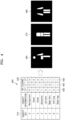
- FIG. 4 is a diagram illustrating an example of a combination generation method according to an embodiment.
- the total number of objects 400 to be segmented is eight (8) including a background.
- the background may be excluded from the object.
- the type of object is defined with a head, an arm, a leg, and the like to help understanding.
- respective objects may include various human body parts such as lungs and liver.
- the image segmentation apparatus 100 assigns a bit string 420 including a plurality of bits to each object as an identifier for distinguishing the plurality of objects.
- the minimum length of the bit string 420 required to distinguish a total of eight objects is three (3).
- the minimum length of the bit string may be obtained as "[log 2 (the total number of target objects to be segmented)".
- the symbol "[A]” represents the smallest natural number greater than A.
- the image segmentation apparatus 100 may assign object numbers 410 to each object sequentially from 0, and assign, to each object, a bit string 420 indicating each object number 410 as a binary number of a predefined bit length (e.g., log 2 (the total number of objects to be segmented). For example, "000" may be assigned to object No. 0 and "001" may be assigned to object No. 1.
- bit strings are displayed in the order of 2 0 , 2 1 , and 2 2 digits.
- the identifier of the object is expressed with the bit string 420 of the minimum length, but this is only an example, and a bit string of 4 or more bits instead of 3 bits may be assigned as the identifier of each object.
- the image segmentation apparatus 100 defines a plurality of combinations including regions of objects with a same bit value, based on each digit of the bit string 420 of each object. For example, the image segmentation apparatus 100 generates a first combination 460 based on a first digit (2° digits) 430 of the bit string 420, generates a second combination 470 based on a second digit (2 1 digits) 440, and generates a third combination 480 based on a third digit (2 2 digits) 450. Since the length of the bit string in the present embodiment is 3 bits, three combinations 460, 470, and 480 are generated. In another embodiment, when the identifier for distinguishing each object includes a 4-bit bit string, the image segmentation apparatus may generate a total of four combinations.
- the image segmentation apparatus 100 generates a combination including regions of objects where the bit value of each digit is a same. For example, since objects in which the first digit 430 of the bit string has a value of "1" are objects Nos. 1, 3, 5, and 7, the first combination 460 includes regions of the head, abdomen, right arm, and right leg. Since objects in which the second digit 440 of the bit string has a value of "1" are objects Nos. 2, 3, 6, and 7, the second combination 470 includes areas of the chest, abdomen, left leg, and right leg. Similarly, the third combination 480 includes regions of a left arm, a right arm, a left leg, and a right leg.
- each of the combinations 460, 470, and 480 may be in the form of a binary image in which pixels belonging to a region of an object are represented by "1" and pixels belonging to regions other than the object are represented by "0".
- various data formats indicating object regions belonging to each of the combinations 460, 470, and 480 may be used.
- object regions in each of the combinations 460, 470, and 480 are shown as white, and other regions are shown as black.
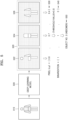
- FIG. 5 is a diagram illustrating an example of a method of identifying a plurality of objects using a probability map of a deep learning model according to an embodiment.
- a deep learning model 500 is a model that outputs three probability maps 520 for three combinations 460, 470, and 480 to identify the eight objects 400 of FIG. 4 .
- the deep learning model 500 when receiving the image 510 as an input, the deep learning model 500 outputs a first probability map 522 indicating a probability that each pixel of the image 510 belongs to the object regions defined in the first combination 460, a second probability map 524 indicating a probability that belongs to the object regions defined in the second combination 470, and a third probability map 526 indicating a probability that belongs to the object regions defined in the third combination 480.
- the probability values 530 of three probability maps 520 for any one pixel (x, y) are 0.6, 0.7, and 0.4, respectively.
- the image segmentation apparatus 100 binarizes the probability values 530 of the pixel (x, y) into binarized values 540 of (1, 1, 0), based on a predefined threshold (for example, 0.5). That is, the image segmentation apparatus 100 may convert the probability value to "1" if it is greater than or equal to 0.5, and may convert the probability value to "0" if it is less than 0.5.
- the threshold value may be defined as various values according to embodiments, but is not necessarily limited to 0.5.
- the image segmentation apparatus 100 compares the bit string "110" generated by binarizing the probability value of the pixel (x, y) with the bit string 420 assigned to each object in FIG. 4 to identify an object to which the pixel (x, y) belongs. Since the binarized value of the pixel ( x, y) is "110", it is a same as the bit string "110" assigned to the object No. 3 of FIG. 4 . Accordingly, the image segmentation apparatus 100 may classify the pixel (x, y) as pixels belonging to the abdomen 550 of the object No. 3. In this way, the image segmentation apparatus 100 may determine to which object each pixel in the image belongs.
- the image segmentation apparatus 100 may segment regions of a plurality of objects in an image by distinguishing regions including pixels belonging to a same object. For example, in FIG. 4 , a region of pixels corresponding to the head of object No. 1 may be detected, and a region of pixels corresponding to the chest of object No. 2 may be detected. Each pixel in the image 510 may be displayed in a different color or contrast for each object, or a plurality of object regions in the image 510 may be visually displayed by adding a boundary line between the objects.
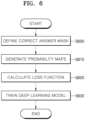
- FIG. 6 is a flowchart illustrating an example of a method of training a deep learning model according to an embodiment.
- the image segmentation apparatus 100 defines a plurality of true masks obtained by combining regions of at least two objects among a plurality of objects in a training image (S600).
- the training image may be an image obtained by labeling at least one region among a plurality of objects. Since the present embodiment does not train the deep learning model using any one object region, but trains the deep learning model using a region obtained by combining regions of several objects, the training image used for training may be an image in which different regions are labeled.
- a first training image is an image obtained by labeling the liver and lung regions
- a second training image is an image obtained by labeling the liver and heart regions
- a third training image is an image obtained by labeling the lung and bone regions.
- the image segmentation apparatus 100 may generate a first true mask including regions of the liver and lungs from the first training image, generate a second true mask including regions of the liver and heart from the second training image, and generate a third true mask including regions of the lungs and bones from the third training image.
- a plurality of true masks including regions of at least two objects among the plurality of objects may be generated from one training image.
- the image segmentation apparatus 100 may use the stored training data as it is without a process of defining the true mask.
- the image segmentation apparatus 100 may assign bit strings to a plurality of objects using the method described with reference to FIG. 4 and define a true mask including regions of objects included in each combination based on the bit strings. That is, each combination of FIG. 4 may be the true mask according to the present embodiment.
- the image segmentation apparatus 100 may generate a true mask in which regions of objects corresponding to each combination is defined as a mask region.
- the image segmentation apparatus 100 inputs the training image into the deep learning model to obtain a plurality of probability maps indicating a probability that each pixel of the training image belongs to each true mask (S610).
- Each of the probability maps output by the deep learning model is a value representing the probability that each pixel of the training image belongs to the mask region of the true mask.
- the image segmentation apparatus 100 calculates a value of a loss function indicating a difference between the plurality of true masks and the plurality of probability maps (S620). For example, when three probability maps are generated, the image segmentation apparatus obtains a first loss between a first probability map and a first true mask, obtains a second loss between a second probability map and a second true mask, obtains a third loss between a third probability map and a third true mask, and obtains a value of the loss function by summing the first, second, and third losses (e.g., statistical sum of various methods such as total sum, average, etc.).
- a loss function indicating a difference between the plurality of true masks and the plurality of probability maps
- the image segmentation apparatus 100 trains the deep learning model so that the value of the loss function is minimized (S630). There are a plurality of training images in training data, and the image segmentation apparatus may repeatedly train the deep learning model by applying the method of the present embodiment to the plurality of training images.
- the training method itself which adjusts various parameters of the deep learning model to minimize the value of the loss function, is already a widely known method, so further explanation thereof is omitted.
Landscapes
- Engineering & Computer Science (AREA)
- Theoretical Computer Science (AREA)
- Physics & Mathematics (AREA)
- General Physics & Mathematics (AREA)
- Multimedia (AREA)
- Computer Vision & Pattern Recognition (AREA)
- Software Systems (AREA)
- Health & Medical Sciences (AREA)
- Medical Informatics (AREA)
- General Health & Medical Sciences (AREA)
- Databases & Information Systems (AREA)
- Evolutionary Computation (AREA)
- Computing Systems (AREA)
- Artificial Intelligence (AREA)
- Human Computer Interaction (AREA)
- Probability & Statistics with Applications (AREA)
- Image Analysis (AREA)
- Nuclear Medicine, Radiotherapy & Molecular Imaging (AREA)
- Radiology & Medical Imaging (AREA)
- Quality & Reliability (AREA)
- Image Processing (AREA)
Applications Claiming Priority (1)
| Application Number | Priority Date | Filing Date | Title |
|---|---|---|---|
| KR1020230129566A KR102662401B1 (ko) | 2023-09-26 | 2023-09-26 | 영상분할방법 및 그 장치 |
Publications (1)
| Publication Number | Publication Date |
|---|---|
| EP4530996A1 true EP4530996A1 (de) | 2025-04-02 |
Family
ID=91077116
Family Applications (1)
| Application Number | Title | Priority Date | Filing Date |
|---|---|---|---|
| EP24185128.6A Withdrawn EP4530996A1 (de) | 2023-09-26 | 2024-06-27 | Verfahren und vorrichtung zur bildsegmentierung |
Country Status (3)
| Country | Link |
|---|---|
| US (1) | US20250104385A1 (de) |
| EP (1) | EP4530996A1 (de) |
| KR (1) | KR102662401B1 (de) |
Families Citing this family (1)
| Publication number | Priority date | Publication date | Assignee | Title |
|---|---|---|---|---|
| CN118470057B (zh) * | 2024-07-11 | 2024-11-05 | 南京先维信息技术有限公司 | 一种基于动态阈值的三维图像分割方法、装置及电子设备 |
Citations (1)
| Publication number | Priority date | Publication date | Assignee | Title |
|---|---|---|---|---|
| KR20230129566A (ko) | 2014-12-16 | 2023-09-08 | 비자 유럽 리미티드 | 거래 승인 |
Family Cites Families (10)
| Publication number | Priority date | Publication date | Assignee | Title |
|---|---|---|---|---|
| KR102338372B1 (ko) * | 2015-09-30 | 2021-12-13 | 삼성전자주식회사 | 영상으로부터 객체를 분할하는 방법 및 장치 |
| KR101893557B1 (ko) * | 2017-12-29 | 2018-08-30 | (주)제이엘케이인스펙션 | 영상 처리 장치 및 방법 |
| JP6918255B1 (ja) * | 2018-06-27 | 2021-08-11 | グーグル エルエルシーGoogle LLC | 局所的なテキスト応答マップを利用する、ユーザの口頭発話への応答のレンダリング |
| US12106225B2 (en) * | 2019-05-30 | 2024-10-01 | The Research Foundation For The State University Of New York | System, method, and computer-accessible medium for generating multi-class models from single-class datasets |
| KR102228087B1 (ko) * | 2019-06-25 | 2021-03-15 | 서울여자대학교 산학협력단 | 의료영상에서의 특정연골 분할 방법 및 장치 |
| KR102349515B1 (ko) * | 2019-08-16 | 2022-01-10 | 서울여자대학교 산학협력단 | 의료 영상에서 딥러닝에 기반한 종양 자동분할 방법 |
| IL310195A (en) * | 2021-07-23 | 2024-03-01 | Leonardo Spa | Illumination optical device comprising a collimator having low intrinsic noise |
| US11907070B2 (en) * | 2021-07-30 | 2024-02-20 | Advanced Micro Devices, Inc. | Methods and apparatus for managing register free lists |
| JP7794426B2 (ja) * | 2021-07-30 | 2026-01-06 | 国立研究開発法人宇宙航空研究開発機構 | 発電機、モータ及び航空機 |
| KR102796118B1 (ko) * | 2022-02-25 | 2025-04-18 | 서울대학교병원 | 의료영상으로부터 혈액을 전달하는 신체 구성요소에 관한 질환의 병변을 검출하는 장치 및 방법 |
-
2023
- 2023-09-26 KR KR1020230129566A patent/KR102662401B1/ko active Active
-
2024
- 2024-06-27 EP EP24185128.6A patent/EP4530996A1/de not_active Withdrawn
- 2024-07-07 US US18/765,318 patent/US20250104385A1/en active Pending
Patent Citations (1)
| Publication number | Priority date | Publication date | Assignee | Title |
|---|---|---|---|---|
| KR20230129566A (ko) | 2014-12-16 | 2023-09-08 | 비자 유럽 리미티드 | 거래 승인 |
Non-Patent Citations (5)
| Title |
|---|
| ASHWATH V. A. ET AL: "TS-CNN: A Three-Tier Self-Interpretable CNN for Multi-Region Medical Image Classification", IEEE ACCESS, vol. 11, 1 January 2023 (2023-01-01), USA, pages 78402 - 78418, XP093215059, ISSN: 2169-3536, Retrieved from the Internet <URL:https://ieeexplore.ieee.org/iel7/6287639/6514899/10197361.pdf> DOI: 10.1109/ACCESS.2023.3299850 * |
| CHEN ZHANGBAO ET AL: "Research on Identification of Sick Chicken Based on Multi Region Deep Features Fusion", 2021 6TH INTERNATIONAL CONFERENCE ON COMPUTATIONAL INTELLIGENCE AND APPLICATIONS (ICCIA), IEEE, 11 June 2021 (2021-06-11), pages 174 - 179, XP034052847, DOI: 10.1109/ICCIA52886.2021.00041 * |
| GIDARIS SPYROS ET AL: "Object Detection via a Multi-region and Semantic Segmentation-Aware CNN Model", 2015 IEEE INTERNATIONAL CONFERENCE ON COMPUTER VISION (ICCV), IEEE, 7 December 2015 (2015-12-07), pages 1134 - 1142, XP032866440, DOI: 10.1109/ICCV.2015.135 * |
| LIN TSUNG-YI ET AL: "Microsoft COCO: Common Objects in Context", 1 January 2014, SPRINGER, PAGE(S) 740 - 755, XP047529588 * |
| PEMASIRI AKILA ET AL: "Semantic Segmentation Of Hands In Multimodal Images: A Region New-Based CNN Approach", 2019 IEEE 16TH INTERNATIONAL SYMPOSIUM ON BIOMEDICAL IMAGING (ISBI 2019), IEEE, 8 April 2019 (2019-04-08), pages 819 - 823, XP033576390, DOI: 10.1109/ISBI.2019.8759215 * |
Also Published As
| Publication number | Publication date |
|---|---|
| US20250104385A1 (en) | 2025-03-27 |
| KR102662401B1 (ko) | 2024-05-03 |
Similar Documents
| Publication | Publication Date | Title |
|---|---|---|
| EP3511942B1 (de) | Domänenübergreifende bildanalyse unter verwendung von tiefgehenden bild-zu-bild-netzwerken und gegnerischen netzwerken | |
| US11055847B2 (en) | Adversarial and dual inverse deep learning networks for medical image analysis | |
| US11593943B2 (en) | RECIST assessment of tumour progression | |
| Mori et al. | Automated anatomical labeling of the bronchial branch and its application to the virtual bronchoscopy system | |
| EP2901419B1 (de) | Knochen-mehrfachsegmentierung für 3d-computertomografie | |
| Pauly et al. | Fast multiple organ detection and localization in whole-body MR Dixon sequences | |
| CN119487545A (zh) | 分析医学图像 | |
| JP3110045B2 (ja) | 医用コンピュータ断層撮影スキャンで病変を検出するための自動化された方法およびシステム | |
| KR102387928B1 (ko) | 의료영상을 기초로 인체 조직을 분석하는 방법 및 그 장치 | |
| CN111210897A (zh) | 处理医学图像 | |
| JP2002529825A (ja) | 4D再構築(reconstruction)及び可視化(visualization)のためのシステム及び方法 | |
| EP3705047A1 (de) | Auf künstlicher intelligenz basierende materialzerlegung in der medizinischen bildgebung | |
| JP7813573B2 (ja) | 情報処理装置及び情報処理方法 | |
| JP7004829B2 (ja) | 類似度決定装置、方法およびプログラム | |
| US20250104385A1 (en) | Image segmentation method and apparatus | |
| CN118470043B (zh) | 基于认知深度学习医疗影像自动分割方法 | |
| CN119762765A (zh) | 医学图像处理 | |
| Guo et al. | Double U-Nets for image segmentation by integrating the region and boundary information | |
| Kancherla et al. | Pneumothorax: Lung Segmentation and Disease Classification Using Deep Neural Networks | |
| CN116310627B (zh) | 模型训练方法、轮廓预测方法、装置、电子设备及介质 | |
| CN116012269A (zh) | 图像处理装置、模型训练装置以及模型训练方法 | |
| CN117058464B (zh) | 对生成健康血管表面的生成模型进行训练的方法及设备 | |
| EP4462358A1 (de) | Verfahren und vorrichtung zur verbesserung der leistung eines tiefenlernmodells | |
| CN117974689B (zh) | 医学图像分割方法、装置及电子设备 | |
| EP4712018A1 (de) | Computerimplementiertes verfahren zum bereitstellen eines trainierten maschinenlernmodells und zum bewerten eines medizinischen eingabebildes, datenverarbeitungssystem, medizinische bildgebungsvorrichtung, computerprogramm und computerlesbares medium |
Legal Events
| Date | Code | Title | Description |
|---|---|---|---|
| PUAI | Public reference made under article 153(3) epc to a published international application that has entered the european phase |
Free format text: ORIGINAL CODE: 0009012 |
|
| STAA | Information on the status of an ep patent application or granted ep patent |
Free format text: STATUS: REQUEST FOR EXAMINATION WAS MADE |
|
| 17P | Request for examination filed |
Effective date: 20240627 |
|
| AK | Designated contracting states |
Kind code of ref document: A1 Designated state(s): AL AT BE BG CH CY CZ DE DK EE ES FI FR GB GR HR HU IE IS IT LI LT LU LV MC ME MK MT NL NO PL PT RO RS SE SI SK SM TR |
|
| STAA | Information on the status of an ep patent application or granted ep patent |
Free format text: STATUS: THE APPLICATION IS DEEMED TO BE WITHDRAWN |
|
| 18D | Application deemed to be withdrawn |
Effective date: 20251003 |