EP4530985A1 - Datenverarbeitungsvorrichtung und computerimplementiertes verfahren - Google Patents
Datenverarbeitungsvorrichtung und computerimplementiertes verfahren Download PDFInfo
- Publication number
- EP4530985A1 EP4530985A1 EP24199471.4A EP24199471A EP4530985A1 EP 4530985 A1 EP4530985 A1 EP 4530985A1 EP 24199471 A EP24199471 A EP 24199471A EP 4530985 A1 EP4530985 A1 EP 4530985A1
- Authority
- EP
- European Patent Office
- Prior art keywords
- joints
- joint
- encoder
- input
- matrix
- Prior art date
- Legal status (The legal status is an assumption and is not a legal conclusion. Google has not performed a legal analysis and makes no representation as to the accuracy of the status listed.)
- Pending
Links
Images

Classifications
-
- G—PHYSICS
- G06—COMPUTING OR CALCULATING; COUNTING
- G06T—IMAGE DATA PROCESSING OR GENERATION, IN GENERAL
- G06T7/00—Image analysis
- G06T7/70—Determining position or orientation of objects or cameras
- G06T7/73—Determining position or orientation of objects or cameras using feature-based methods
-
- G—PHYSICS
- G06—COMPUTING OR CALCULATING; COUNTING
- G06N—COMPUTING ARRANGEMENTS BASED ON SPECIFIC COMPUTATIONAL MODELS
- G06N3/00—Computing arrangements based on biological models
- G06N3/02—Neural networks
- G06N3/04—Architecture, e.g. interconnection topology
- G06N3/045—Combinations of networks
-
- G—PHYSICS
- G06—COMPUTING OR CALCULATING; COUNTING
- G06V—IMAGE OR VIDEO RECOGNITION OR UNDERSTANDING
- G06V10/00—Arrangements for image or video recognition or understanding
- G06V10/70—Arrangements for image or video recognition or understanding using pattern recognition or machine learning
- G06V10/74—Image or video pattern matching; Proximity measures in feature spaces
- G06V10/75—Organisation of the matching processes, e.g. simultaneous or sequential comparisons of image or video features; Coarse-fine approaches, e.g. multi-scale approaches; using context analysis; Selection of dictionaries
- G06V10/757—Matching configurations of points or features
-
- G—PHYSICS
- G06—COMPUTING OR CALCULATING; COUNTING
- G06V—IMAGE OR VIDEO RECOGNITION OR UNDERSTANDING
- G06V10/00—Arrangements for image or video recognition or understanding
- G06V10/70—Arrangements for image or video recognition or understanding using pattern recognition or machine learning
- G06V10/82—Arrangements for image or video recognition or understanding using pattern recognition or machine learning using neural networks
-
- G—PHYSICS
- G06—COMPUTING OR CALCULATING; COUNTING
- G06V—IMAGE OR VIDEO RECOGNITION OR UNDERSTANDING
- G06V40/00—Recognition of biometric, human-related or animal-related patterns in image or video data
- G06V40/10—Human or animal bodies, e.g. vehicle occupants or pedestrians; Body parts, e.g. hands
- G06V40/103—Static body considered as a whole, e.g. static pedestrian or occupant recognition
-
- G—PHYSICS
- G06—COMPUTING OR CALCULATING; COUNTING
- G06T—IMAGE DATA PROCESSING OR GENERATION, IN GENERAL
- G06T2207/00—Indexing scheme for image analysis or image enhancement
- G06T2207/10—Image acquisition modality
- G06T2207/10016—Video; Image sequence
-
- G—PHYSICS
- G06—COMPUTING OR CALCULATING; COUNTING
- G06T—IMAGE DATA PROCESSING OR GENERATION, IN GENERAL
- G06T2207/00—Indexing scheme for image analysis or image enhancement
- G06T2207/20—Special algorithmic details
- G06T2207/20081—Training; Learning
-
- G—PHYSICS
- G06—COMPUTING OR CALCULATING; COUNTING
- G06T—IMAGE DATA PROCESSING OR GENERATION, IN GENERAL
- G06T2207/00—Indexing scheme for image analysis or image enhancement
- G06T2207/20—Special algorithmic details
- G06T2207/20084—Artificial neural networks [ANN]
-
- G—PHYSICS
- G06—COMPUTING OR CALCULATING; COUNTING
- G06T—IMAGE DATA PROCESSING OR GENERATION, IN GENERAL
- G06T2207/00—Indexing scheme for image analysis or image enhancement
- G06T2207/30—Subject of image; Context of image processing
- G06T2207/30196—Human being; Person
Definitions
- the present disclosure relates to a data processing apparatus and computer-implemented method.
- 3D (three-dimensional) human pose estimation is a fundamental problem in computer vision and has many applications including, for example, robotics, virtual reality, sports analytics and video surveillance. Accurate 3D pose estimation is essential for many of these applications, as it enables understanding of human motion, behaviour and interaction with the environment.
- existing multi-view 3D human pose reconstruction techniques work following a two-step pipeline. They first estimate 2D (two-dimensional) poses from the different views and recover the 3D poses via triangulation [5] [14] [19] [9] [3] [1] or using Pictorial Structure Models [13] [20]. As the second step depends on the accuracy of the 2D pose estimation from the first step, which may suffer from motion blur, occlusions, self-occlusions or the like, many approaches have focused on enhancing 2D pose estimation by fusing information from the views at different stages of the pose detection model. This requires transmitting the images or intermediate high-dimensional features from all cameras to a centralized processing unit to perform the fusion, which may not be desirable or feasible in a distributed real-time system (e.g. due to the high processing and/or bandwidth requirements).
- the present technique addresses how to reconstruct 3D human poses from multiple views using only 2D skeletons as input, which can be estimated at edge nodes near the cameras and efficiently transmitted to a fusing node.
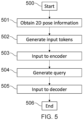
- Multi-view 3D pose reconstruction is treated as a regression problem and a transformer-based model (implemented at the fusing node) is trained to predict the 3D coordinates of the body joints directly.
- a transformer-based model implemented at the fusing node
- any suitable known (off-the-shelf) 2D human pose detector (such as that described in [16]) is used to extract 2D skeletons from a sequence of multi-view images capturing the same scene from different angles.
- These 2D poses are decomposed into individual joints (e.g. right elbow, left elbow, hip, left knee, right knee, etc.) represented as rays originating from each camera and projected independently to a higher dimensional representation space.
- This set of joint feature vectors are refined via self-attention in a transformer encoder to obtain a global set-latent representation.
- Output 3D poses are then predicted in a transformer decoder by querying the global set-latent representation with a set of target feature vectors describing the semantics of the points to decode.
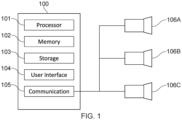
- Fig. 1 schematically shows an example data processing apparatus / device 100 for implementing the transformer-based model. It comprises a processor 101 for executing electronic instructions, a memory 102 for storing the electronic instructions to be executed and electronic input and output information associated with the electronic instructions, a storage medium 103 (e.g. a hard disk drive or solid state drive) for long term storage of information, a user interface 104 (e.g. a touch screen, a non-touch screen, buttons, a keyboard and/or a mouse) for receiving commands from and/or outputting information to a user and a communication interface 105 for sending electronic information to and/or receiving electronic information from one or more other apparatuses.
- a processor 101 for executing electronic instructions
- a memory 102 for storing the electronic instructions to be executed and electronic input and output information associated with the electronic instructions
- a storage medium 103 e.g. a hard disk drive or solid state drive
- a user interface 104 e.g. a touch screen, a non-touch screen, buttons,
- the one or more other apparatuses include a plurality of cameras 106A to 106C which are positioned to capture images of the same scene (in particular, the same person whose pose is to be estimated) from different angles.
- Each image includes an image of a person 227 whose pose is to be estimated.
- the 2D human pose detector 202 obtains 2D pose predictions 203 for each image, yielding a sequence S ⁇ R T in ⁇ C ⁇ J ⁇ 3 of 2D joint positions and corresponding detection confidence scores.
- J is the number of joints of the detected poses
- T in is the number of input frames.
- Each joint at each camera at each input frame is associated with 3 values, the 2D joint position (two values) and the confidence score.
- the 2D joint positions are passed to the ray determiner 204, which uses the extrinsic and intrinsic matrices of the cameras to transform the 2D joint positions into 3D rays passing through the 2D joint positions and corresponding camera centres
- the Plücker representation for the rays [12] [6] [15] [18] is used for the rays, as this allows the ray representation to be decoupled from the positions of the camera centres along the rays, thus promoting generalization.
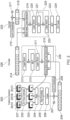
- the ray embedding is then output via a further linear layer 206 and augmented with a sinusoidal temporal embedding 207 (indicating the time the relevant image / frame was captured) and a joint embedding 208 (indicating the type of joint, e.g. right knee, left elbow, hip, etc.) to which the ray corresponds to form a feature vector.
- the feature vector is a token of the set of tokens 209 which is then input to the encoder 226.
- Each of the tokens in the set of tokens is a feature vector.
- an all-zero ray vector (or suitable learned encoding) is generated by the ray determiner 204 (that is, before ray embedding and temporal embedding). Missing joints may occur if, for example, at least a portion of a person is not visible in one or more of the camera views at one or more of the times T in .
- the encoder 226 (see e.g. [17]) consists of L e layers of global multi-head self-attention. All input feature vectors are tokens attending to one another. This allows to model long-range relationships between body joints, across views and along the time dimension simultaneously, providing global context to each token.
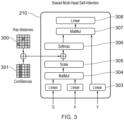
- a transformer learns what other tokens are important for a given token. With the present technique, the transformer is further guided during self-attention. This occurs via the biased multi-head self-attention operation 210, which is explained in more detail with reference to Fig. 3 .
- the matrix of the ray distances 300 (ray distance matrix) is populated with these values.
- the ray distance matrix and confidence matrix are added together and the resulting matrix added to the attention matrix output by the scaling layer 305. This generates the biased attention matrix.
- the biased attention matrix is then provided to the softmax layer 306.
- the output of the softmax layer 306 is input with the Value (V) of the input set of tokens to matrix multiplication layer 307.
- the output of the matrix multiplication layer 307 is then output to linear layer 308. It will be appreciated that performance (compared to where no bias is used) may be improved by biasing the attention matrix using only one of the ray distance matrix and confidence matrix. Performance is most improved, however, by using both the ray distance matrix and confidence matrix.
- the output of the linear layer 308 is added to the matrix representing the set of input tokens and the result provided to layer normalisation 211.
- the output of layer normalisation 211 is provided to MLP 212.
- the output of the MLP 212 is added to the output of the layer normalisation 211.
- the resulting matrix is then provided to layer normalisation 213.
- the output of the layer normalisation 213 (taking into account there are L e encoder layers) forms the encoding 214.
- the encoding 214 is a refined representation of the set of input tokens 209 taking into account how much each token attends to every other token (which, itself, takes into account the ray distances 300 and confidences 301).
- T out is the length of the sequence to decode.
- the transformer decoder 225 produces a set of T out x J joint representations by attending to the set of features with L d layers of multi-head cross-attention 219 using a predefined query Q and Key (K) and Value (V) corresponding to the encoding 214.
- the query Q provides the semantics of each joint to be decoded.
- the semantics are the joint ID (indicated by the joint embedding 215) and time (indicated by the sinusoidal temporal embedding 217).
- the query Q thus indicates J learned embedding vectors of size 1 ⁇ D (D being the length of the joint type embedding) corresponding to each joint of the body, repeated T out times, where T out is the desired time range to decode. This set of vectors is shown as 218.
- the output of the multi-head cross attention 219 is added to the query Q. This is then input to layer normalisation 220.
- the output of the layer normalisation is output to MLP 221.
- the output of MLP 221 is combined with the output of the layer normalisation 220. This is then input to layer normalisation 222.
- the output of the layer normalisation 222 (taking into account there are L d decoder layers, with the layers ) is then output to MLP 223.
- the output of MLP 223 provides the predicted 3D poses 224.
- the predicted 3D poses are defined in a predetermined world coordinate system (e.g. using canonical coordinates), for example.
- the predicted 3D pose at the current time step is predicted in a coordinate system centered on the predicted 3D pose of the previous time step and then translated to the world coordinate system.
- the predicted 3D pose at each time step comprises the predicted 3D position of each of the J joints at that time step.
- MSE Mean Squared Error
- scene centering and the generation of synthetic views may be used during training.
- the scene is centered (at least approximately) around the person during training and inference.
- a random ground-truth pose is selected at time t and the projection of the neck joint on the floor is set as the origin (random noise is added on the plane). All observation rays and ground-truth poses are transformed to a coordinate system centered on that point. Additionally, the scene is rotated around the vertical axis with a random angle.
- the 3D rays are centered around a point obtained by triangulation of the observations without rotating the scene.
- the coordinate system is centered around the predicted 3D pose obtained at the previous time step. Transforming the scene to a body-centric reference frame in this way allows the model to better generalize to scenes with unseen dimensions and camera configurations.
- the present technique has been evaluated on two large-scale multi-view datasets for multi-view 3D human pose estimation: Human3.6M [4] and CMU Panoptic [7]. A comprehensive comparison with current state-of-the-art methods has been performed and ablation studies to validate the effectiveness of the components of present technique have been conducted.
- Human 3.6M [4] consists of 3.6 million images of 11 subjects performing various activities in an indoor environment, with corresponding 3D poses. The images are captured at 50 Hz by 4 synchronized cameras, while the ground truth 3D pose annotations are obtained by a marker-based motion capture system. Following standard practice, 5 subjects were used for training (S1, S5, S6, S7, S8) and 2 subjects were used for testing (S9, S11).
- CMU Panoptic [7] contains multiple scenes in which people perform different activities in an indoor environment. Images are captured by hundreds of VGA cameras and 31 HD cameras installed on a dome structure, and the 3D pose annotations are obtained by triangulation. The same train / test sequences as [5] were used, consisting of scenes featuring a single person. Unless otherwise stated, 4 HD cameras (2,13,10,19) were used for testing and up to 27 HD cameras for training, with no overlap.
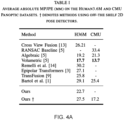
- the 3D pose reconstruction accuracy is evaluated using the Mean Per Joint Position Error (MPJPE), which is the average of the L2 distance between the prediction and the ground truth for each joint, measured in millimetres.
- MPJPE Mean Per Joint Position Error
- the images are undistorted using the camera parameters provided with the datasets and the 2D poses extracted with HRNet-W32 [16] with YoloX [2] box proposals.
- 9 time frames and 2 randomly sampled views are input and 9 time frames are output.
- 9 time frames and up to 4 views are input and only 1 frame is output, corresponding to the latest observation.
- the model is trained with the Adam optimizer [8] for 300000 iterations with a mini-batch size of 256.
- the initial learning rate is 10-4. After a warmup phase of 10000 steps, it is decayed over 300000 training steps.
- the table of Fig 4A is a comparison of the present technique (labelled "Ours") to previous work (including existing methods that use 2D detectors fine-tuned on target datasets without much occlusion (so triangulation will typically work well)).
- the table of Fig 4B demonstrates how the present technique (again, labelled "Ours") provides improved performance for a majority of different poses.
- improved performance is shown for all labelled pose sequences except the two sitting sequences "Sit” and "SitD" (which, this particular example, contain pose sequences not seen in the training dataset).
- the table of Fig. 4C shows an improvement in the accuracy of 3D pose determination according to the present technique (again, labelled "Ours") compared to existing methods (which, for example, work by adjusting 2D pose predictions and using simple triangulation).
- the improvement is particularly notable when there is a lower number of cameras (viewpoints).
- the usefulness of the components of the method may be evaluated by removing them in turn.
- the model is trained on the training set of CMU Panoptic and evaluated on the test set of CMU Panoptic as well as on H36M.
- removing both the geometry and confidence bias leads to a worse reconstruction accuracy.
- removing the synthetic views and use of scene centering results in a considerable drop in inter-dataset generalization performance.
Landscapes
- Engineering & Computer Science (AREA)
- Theoretical Computer Science (AREA)
- Physics & Mathematics (AREA)
- General Physics & Mathematics (AREA)
- Computer Vision & Pattern Recognition (AREA)
- Evolutionary Computation (AREA)
- Computing Systems (AREA)
- Artificial Intelligence (AREA)
- Multimedia (AREA)
- General Health & Medical Sciences (AREA)
- Health & Medical Sciences (AREA)
- Software Systems (AREA)
- Medical Informatics (AREA)
- Databases & Information Systems (AREA)
- Molecular Biology (AREA)
- Mathematical Physics (AREA)
- General Engineering & Computer Science (AREA)
- Life Sciences & Earth Sciences (AREA)
- Biomedical Technology (AREA)
- Computational Linguistics (AREA)
- Biophysics (AREA)
- Data Mining & Analysis (AREA)
- Human Computer Interaction (AREA)
- Image Processing (AREA)
Applications Claiming Priority (1)
| Application Number | Priority Date | Filing Date | Title |
|---|---|---|---|
| GB2314071.8A GB2633601A (en) | 2023-09-14 | 2023-09-14 | Data processing apparatus and computer-implemented method |
Publications (1)
| Publication Number | Publication Date |
|---|---|
| EP4530985A1 true EP4530985A1 (de) | 2025-04-02 |
Family
ID=88507456
Family Applications (1)
| Application Number | Title | Priority Date | Filing Date |
|---|---|---|---|
| EP24199471.4A Pending EP4530985A1 (de) | 2023-09-14 | 2024-09-10 | Datenverarbeitungsvorrichtung und computerimplementiertes verfahren |
Country Status (2)
| Country | Link |
|---|---|
| EP (1) | EP4530985A1 (de) |
| GB (1) | GB2633601A (de) |
Cited By (2)
| Publication number | Priority date | Publication date | Assignee | Title |
|---|---|---|---|---|
| CN120078349A (zh) * | 2025-04-27 | 2025-06-03 | 杭州电子科技大学 | 一种基于多模态数据联合的肠道组织辅助分析系统及方法 |
| CN121170191A (zh) * | 2025-11-20 | 2025-12-19 | 中国科学技术大学 | 基于大模型的深空4d动态场景重建方法与系统 |
Citations (2)
| Publication number | Priority date | Publication date | Assignee | Title |
|---|---|---|---|---|
| US11501462B2 (en) | 2019-12-13 | 2022-11-15 | Sony Group Corporation | Multi-view three-dimensional positioning |
| WO2022245281A1 (en) * | 2021-05-18 | 2022-11-24 | Garena Online Private Limited | Neural network system for 3d pose estimation |
Family Cites Families (1)
| Publication number | Priority date | Publication date | Assignee | Title |
|---|---|---|---|---|
| WO2022197367A1 (en) * | 2021-03-17 | 2022-09-22 | Qualcomm Technologies, Inc. | Keypoint-based sampling for pose estimation |
-
2023
- 2023-09-14 GB GB2314071.8A patent/GB2633601A/en active Pending
-
2024
- 2024-09-10 EP EP24199471.4A patent/EP4530985A1/de active Pending
Patent Citations (2)
| Publication number | Priority date | Publication date | Assignee | Title |
|---|---|---|---|---|
| US11501462B2 (en) | 2019-12-13 | 2022-11-15 | Sony Group Corporation | Multi-view three-dimensional positioning |
| WO2022245281A1 (en) * | 2021-05-18 | 2022-11-24 | Garena Online Private Limited | Neural network system for 3d pose estimation |
Non-Patent Citations (22)
| Title |
|---|
| "3rd International Conference on Learning Representations", 2015, article "Conference Track Proceedings" |
| A. VASWANIN. SHAZEERN. PARMARJ. USZKOREITL. JONESA. N. GOMEZL. U. KAISERI. POLOSUKHIN: "Advances in Neural Information Processing Systems", vol. 30, 2017, CURRAN ASSOCIATES, INC., article "Attention is all you need" |
| ANDREAS BAAK: "Retrieval-based Approaches for Tracking and Reconstructing Human Motions", 13 November 2012 (2012-11-13), pages 1 - 157, XP007922376, Retrieved from the Internet <URL:http://scidok.sulb.uni-saarland.de/volltexte/2013/5029/pdf/2012_Baak_Thesis.pdf> * |
| B. MILDENHALLP. P. SRINIVASANM. TANCIKJ. T. BARRONR. RAMAMOORTHIR. NG: "NeRF: Representing scenes as neural radiance fields for view synthesis", ECCV, 2020 |
| C. LONESCUD. PAPAVAV. OLARUC. SMINCHISESCU: "Human3.6M: Large scale datasets and predictive methods for 3D human sensing in natural environments", IEEE TRANS. PATTERN ANAL. MACH. INTELL., vol. 36, no. 7, July 2014 (2014-07-01), pages 1325 - 1339, XP011551855, DOI: 10.1109/TPAMI.2013.248 |
| E. REMELLIS. HANS. HONARIP. FUAR. WANG: "Lightweight Multi-View 3D Pose Estimation through Camera-Disentangled Representation", ARXIV, 5 April 2020 (2020-04-05) |
| G. PAVLAKOSX. ZHOUK. G. DERPANISK. DANIILIDIS: "Harvesting multiple views for marker-less 3D human pose annotations", 2017 IEEE CONFERENCE ON COMPUTER VISION AND PATTERN RECOGNITION (CVPR), July 2017 (2017-07-01) |
| H. JOOT. SIMONX. LIH. LIUL. TANL. GUIS. BANERJEET. GODISARTB. NABBEI. MATTHEWS: "Panoptic studio: A massively multiview system for social interaction capture", IEEE TRANSACTIONS ON, December 2016 (2016-12-01) |
| H. MA ET AL.: "TransFusion: Cross-view fusion with transformer for 3D human pose estimation", ARXIV, 18 October 2021 (2021-10-18), Retrieved from the Internet <URL:https://www.bmvc2021-virtuaIconference.com/assets/papers/0016.pd> |
| H. MAZ. WANGY. CHEND. KONGL. CHENX. LIUX. YANH. TANGX. XIE: "PPT: token-pruned pose transformer for monocular and multi-view human pose estimation", EUROPEAN CONFERENCE ON COMPUTER VISION, 2022 |
| H. QIUC. WANGJ. WANGN. WANGW. ZENG: "Cross View Fusion for 3D Human Pose Estimation", ICCV, 2019 |
| J. PLUCKER: "On a New Geometry of Space", ROYAL SOCIETY, 8 January 1965 (1965-01-08) |
| K. BARTOLD. BOJANIÉT. PETKOVIÉ: "Generalizable Human Pose Triangulation", 2022 IEEE/CVF CONFERENCE ON COMPUTER VISION AND PATTERN RECOGNITION (CVPR), June 2022 (2022-06-01), pages 11018 - 11027 |
| K. ISKAKOVE. BURKOVV. LEMPITSKYY. MALKOV: "Learnable Triangulation of Human Pose", 2019 IEEE/CVF INTERNATIONAL CONFERENCE ON COMPUTER VISION (ICCV), October 2019 (2019-10-01) |
| K. SUNB. XIAOD. LIUJ. WANG: "Deep high-resolution representation learning for human pose estimation", PROCEEDINGS OF THE IEEE/CVF CONFERENCE ON COMPUTER VISION AND PATTERN RECOGNITION, 2019, pages 5693 - 5703 |
| N. VENKATM. AGARWALM. SINGHS. TULSIANI, GEOMETRY-BIASED TRANSFORMERS FOR NOVEL VIEW SYNTHESIS, January 2023 (2023-01-01) |
| V. SITZMANNS. REZCHIKOVW. T. FREEMANJ. B. TENENBAUMF. DURAND: "Light field networks: Neural scene representations with Single-Evaluation rendering", PROC. NEURIPS, 2021 |
| Y. HER. YANK. FRAGKIADAKIS.-I. YU: "Epipolar transformers", PROCEEDINGS OF THE IEEE/CVF CONFERENCE ON COMPUTER VISION AND PATTERN RECOGNITION, 2020, pages 7779 - 7788 |
| Y.-B. JIA: "Plucker coordinates for lines in the space", PROBLEM SOLVER TECHNIQUES FOR APPLIED COMPUTER SCIENCE, COM-S-477/577 COURSE HANDOUT, vol. 3, pages 2020 |
| Z. GES. LIUF. WANGZ. LIJ. SUN, YOLOX: EXCEEDING YOLO SERIES IN, 2021 |
| Z. ZHANGC. WANGW. QIUW. QINW. ZENG: "AdaFuse: Adaptive Multiview Fusion for Accurate Human Pose Estimation in the Wild", ARXIV, 26 October 2020 (2020-10-26) |
| ZHANG BOWEI ET AL: "End-to-end 3D Human Pose Estimation with Transformer", 2022 26TH INTERNATIONAL CONFERENCE ON PATTERN RECOGNITION (ICPR), IEEE, 21 August 2022 (2022-08-21), pages 4529 - 4536, XP034237095, DOI: 10.1109/ICPR56361.2022.9956693 * |
Cited By (2)
| Publication number | Priority date | Publication date | Assignee | Title |
|---|---|---|---|---|
| CN120078349A (zh) * | 2025-04-27 | 2025-06-03 | 杭州电子科技大学 | 一种基于多模态数据联合的肠道组织辅助分析系统及方法 |
| CN121170191A (zh) * | 2025-11-20 | 2025-12-19 | 中国科学技术大学 | 基于大模型的深空4d动态场景重建方法与系统 |
Also Published As
| Publication number | Publication date |
|---|---|
| GB202314071D0 (en) | 2023-11-01 |
| GB2633601A (en) | 2025-03-19 |
Similar Documents
| Publication | Publication Date | Title |
|---|---|---|
| Petrovich et al. | Action-conditioned 3d human motion synthesis with transformer vae | |
| Baradel et al. | Multi-hmr: Multi-person whole-body human mesh recovery in a single shot | |
| Fieraru et al. | Three-dimensional reconstruction of human interactions | |
| Wang et al. | Hmor: Hierarchical multi-person ordinal relations for monocular multi-person 3d pose estimation | |
| Nazir et al. | SemAttNet: Toward attention-based semantic aware guided depth completion | |
| EP4530985A1 (de) | Datenverarbeitungsvorrichtung und computerimplementiertes verfahren | |
| Xie et al. | RPM 2.0: RF-based pose machines for multi-person 3D pose estimation | |
| Xu et al. | Multi-scale spatial attention-guided monocular depth estimation with semantic enhancement | |
| Lin et al. | Hdnet: Human depth estimation for multi-person camera-space localization | |
| WO2020233427A1 (zh) | 目标的特征的确定方法和装置 | |
| Liu et al. | GeometryMotion-Net: A strong two-stream baseline for 3D action recognition | |
| Carissimi et al. | Filling the gaps: Predicting missing joints of human poses using denoising autoencoders | |
| Mucha et al. | In my perspective, in my hands: Accurate egocentric 2d hand pose and action recognition | |
| Lin et al. | Overview of 3d human pose estimation | |
| Fieraru et al. | Reconstructing three-dimensional models of interacting humans | |
| Zhang et al. | Mask-aware hierarchical aggregation transformer for occluded person re-identification | |
| Han et al. | Occluded human pose estimation based on limb joint augmentation | |
| Zhang et al. | Frontal person image generation based on arbitrary‐view human images | |
| Zhang et al. | ASMGCN: Attention-based semantic-guided multistream graph convolution network for skeleton action recognition | |
| Ertugrul et al. | What will your future child look like? modeling and synthesis of hereditary patterns of facial dynamics | |
| Arthanari et al. | Exploring multi-level transformers with feature frame padding network for 3d human pose estimation | |
| Moliner et al. | Geometry-biased transformer for robust multi-view 3d human pose reconstruction | |
| Papadopoulos et al. | Deepvi: A novel framework for learning deep view-invariant human action representations using a single rgb camera | |
| Ghasemzadeh et al. | MPL: Lifting 3D Human Pose from Multi-view 2D Poses | |
| Wang et al. | A short survey on deep learning for skeleton-based action recognition |
Legal Events
| Date | Code | Title | Description |
|---|---|---|---|
| PUAI | Public reference made under article 153(3) epc to a published international application that has entered the european phase |
Free format text: ORIGINAL CODE: 0009012 |
|
| STAA | Information on the status of an ep patent application or granted ep patent |
Free format text: STATUS: REQUEST FOR EXAMINATION WAS MADE |
|
| 17P | Request for examination filed |
Effective date: 20240910 |
|
| AK | Designated contracting states |
Kind code of ref document: A1 Designated state(s): AL AT BE BG CH CY CZ DE DK EE ES FI FR GB GR HR HU IE IS IT LI LT LU LV MC ME MK MT NL NO PL PT RO RS SE SI SK SM TR |
|
| RAP3 | Party data changed (applicant data changed or rights of an application transferred) |
Owner name: SONY GROUP CORPORATION |