EP4530896A2 - Système et procédé de paiement par vue à l'aide d'un réseau de paiement - Google Patents
Système et procédé de paiement par vue à l'aide d'un réseau de paiement Download PDFInfo
- Publication number
- EP4530896A2 EP4530896A2 EP24202810.8A EP24202810A EP4530896A2 EP 4530896 A2 EP4530896 A2 EP 4530896A2 EP 24202810 A EP24202810 A EP 24202810A EP 4530896 A2 EP4530896 A2 EP 4530896A2
- Authority
- EP
- European Patent Office
- Prior art keywords
- content
- token
- server computer
- creator
- license
- Prior art date
- Legal status (The legal status is an assumption and is not a legal conclusion. Google has not performed a legal analysis and makes no representation as to the accuracy of the status listed.)
- Pending
Links
Images


Classifications
-
- G—PHYSICS
- G06—COMPUTING OR CALCULATING; COUNTING
- G06F—ELECTRIC DIGITAL DATA PROCESSING
- G06F21/00—Security arrangements for protecting computers, components thereof, programs or data against unauthorised activity
- G06F21/10—Protecting distributed programs or content, e.g. vending or licensing of copyrighted material ; Digital rights management [DRM]
-
- G—PHYSICS
- G06—COMPUTING OR CALCULATING; COUNTING
- G06Q—INFORMATION AND COMMUNICATION TECHNOLOGY [ICT] SPECIALLY ADAPTED FOR ADMINISTRATIVE, COMMERCIAL, FINANCIAL, MANAGERIAL OR SUPERVISORY PURPOSES; SYSTEMS OR METHODS SPECIALLY ADAPTED FOR ADMINISTRATIVE, COMMERCIAL, FINANCIAL, MANAGERIAL OR SUPERVISORY PURPOSES, NOT OTHERWISE PROVIDED FOR
- G06Q20/00—Payment architectures, schemes or protocols
- G06Q20/04—Payment circuits
- G06Q20/06—Private payment circuits, e.g. involving electronic currency used among participants of a common payment scheme
- G06Q20/065—Private payment circuits, e.g. involving electronic currency used among participants of a common payment scheme using e-cash
-
- H—ELECTRICITY
- H04—ELECTRIC COMMUNICATION TECHNIQUE
- H04L—TRANSMISSION OF DIGITAL INFORMATION, e.g. TELEGRAPHIC COMMUNICATION
- H04L63/00—Network architectures or network communication protocols for network security
- H04L63/10—Network architectures or network communication protocols for network security for controlling access to devices or network resources
- H04L63/108—Network architectures or network communication protocols for network security for controlling access to devices or network resources when the policy decisions are valid for a limited amount of time
-
- H—ELECTRICITY
- H04—ELECTRIC COMMUNICATION TECHNIQUE
- H04N—PICTORIAL COMMUNICATION, e.g. TELEVISION
- H04N21/00—Selective content distribution, e.g. interactive television or video on demand [VOD]
- H04N21/20—Servers specifically adapted for the distribution of content, e.g. VOD servers; Operations thereof
- H04N21/25—Management operations performed by the server for facilitating the content distribution or administrating data related to end-users or client devices, e.g. end-user or client device authentication, learning user preferences for recommending movies
- H04N21/254—Management at additional data server, e.g. shopping server, rights management server
- H04N21/2541—Rights Management
-
- H—ELECTRICITY
- H04—ELECTRIC COMMUNICATION TECHNIQUE
- H04N—PICTORIAL COMMUNICATION, e.g. TELEVISION
- H04N21/00—Selective content distribution, e.g. interactive television or video on demand [VOD]
- H04N21/20—Servers specifically adapted for the distribution of content, e.g. VOD servers; Operations thereof
- H04N21/25—Management operations performed by the server for facilitating the content distribution or administrating data related to end-users or client devices, e.g. end-user or client device authentication, learning user preferences for recommending movies
- H04N21/254—Management at additional data server, e.g. shopping server, rights management server
- H04N21/2543—Billing, e.g. for subscription services
-
- H—ELECTRICITY
- H04—ELECTRIC COMMUNICATION TECHNIQUE
- H04N—PICTORIAL COMMUNICATION, e.g. TELEVISION
- H04N21/00—Selective content distribution, e.g. interactive television or video on demand [VOD]
- H04N21/40—Client devices specifically adapted for the reception of or interaction with content, e.g. set-top-box [STB]; Operations thereof
- H04N21/45—Management operations performed by the client for facilitating the reception of or the interaction with the content or administrating data related to the end-user or to the client device itself, e.g. learning user preferences for recommending movies, resolving scheduling conflicts
- H04N21/462—Content or additional data management, e.g. creating a master electronic program guide from data received from the Internet and a Head-end, controlling the complexity of a video stream by scaling the resolution or bit-rate based on the client capabilities
- H04N21/4627—Rights management associated to the content
-
- H—ELECTRICITY
- H04—ELECTRIC COMMUNICATION TECHNIQUE
- H04N—PICTORIAL COMMUNICATION, e.g. TELEVISION
- H04N21/00—Selective content distribution, e.g. interactive television or video on demand [VOD]
- H04N21/40—Client devices specifically adapted for the reception of or interaction with content, e.g. set-top-box [STB]; Operations thereof
- H04N21/47—End-user applications
- H04N21/472—End-user interface for requesting content, additional data or services; End-user interface for interacting with content, e.g. for content reservation or setting reminders, for requesting event notification, for manipulating displayed content
- H04N21/47202—End-user interface for requesting content, additional data or services; End-user interface for interacting with content, e.g. for content reservation or setting reminders, for requesting event notification, for manipulating displayed content for requesting content on demand, e.g. video on demand
-
- H—ELECTRICITY
- H04—ELECTRIC COMMUNICATION TECHNIQUE
- H04N—PICTORIAL COMMUNICATION, e.g. TELEVISION
- H04N21/00—Selective content distribution, e.g. interactive television or video on demand [VOD]
- H04N21/40—Client devices specifically adapted for the reception of or interaction with content, e.g. set-top-box [STB]; Operations thereof
- H04N21/47—End-user applications
- H04N21/472—End-user interface for requesting content, additional data or services; End-user interface for interacting with content, e.g. for content reservation or setting reminders, for requesting event notification, for manipulating displayed content
- H04N21/47211—End-user interface for requesting content, additional data or services; End-user interface for interacting with content, e.g. for content reservation or setting reminders, for requesting event notification, for manipulating displayed content for requesting pay-per-view content
-
- G—PHYSICS
- G06—COMPUTING OR CALCULATING; COUNTING
- G06Q—INFORMATION AND COMMUNICATION TECHNOLOGY [ICT] SPECIALLY ADAPTED FOR ADMINISTRATIVE, COMMERCIAL, FINANCIAL, MANAGERIAL OR SUPERVISORY PURPOSES; SYSTEMS OR METHODS SPECIALLY ADAPTED FOR ADMINISTRATIVE, COMMERCIAL, FINANCIAL, MANAGERIAL OR SUPERVISORY PURPOSES, NOT OTHERWISE PROVIDED FOR
- G06Q2220/00—Business processing using cryptography
- G06Q2220/10—Usage protection of distributed data files
- G06Q2220/12—Usage or charge determination
-
- G—PHYSICS
- G06—COMPUTING OR CALCULATING; COUNTING
- G06Q—INFORMATION AND COMMUNICATION TECHNOLOGY [ICT] SPECIALLY ADAPTED FOR ADMINISTRATIVE, COMMERCIAL, FINANCIAL, MANAGERIAL OR SUPERVISORY PURPOSES; SYSTEMS OR METHODS SPECIALLY ADAPTED FOR ADMINISTRATIVE, COMMERCIAL, FINANCIAL, MANAGERIAL OR SUPERVISORY PURPOSES, NOT OTHERWISE PROVIDED FOR
- G06Q2220/00—Business processing using cryptography
- G06Q2220/10—Usage protection of distributed data files
- G06Q2220/18—Licensing
Definitions
- the present disclosure is directed to a pay-per-view media content tokenization system. More particularly, the present disclosure is directed to a pay-per-view media content tokenization system for content creators to monetize their media content.
- the present disclosure provides a pay-per-view system.
- the system comprising a token management server computer to receive an account credential from a content creator; and send a content creator token reference to a content delivery network; a content license server computer to receive a request for a content license key from a content player, wherein the request comprises the content creator token reference and a content player token reference; validate the content creator token reference; validate the content player token reference; receive a token validation response from the token management server computer; create a time bound license for content created by the content creator; and send the content license key to the content player.
- present disclosure provides a pay-per-view method.
- the method comprising receiving, by a token management server computer, an account credentials from a content creator; and sending, by the token management server computer, a content creator token reference to a content delivery network; receiving, by a content license server computer, a request for a content license key from a content player, wherein the request comprises the content creator token reference and a content player token reference; validating, by the content license server computer, the content creator token reference; validating, by the content license server computer, the content player token reference; receiving, by the content license server computer, a token validation response from the token management server computer; creating, by the content license server computer, a time bound license for content created by the content creator; and sending, by a content license server computer, the content license key to the content player.
- the present disclosure provides a content delivery system.
- the system comprising a content delivery server computer to receive an encrypted media content file; package the encrypted media content file with a manifest file comprising metadata information and creating a packaged encrypted media content file; send an account credential to a token management system; receive a content creator token reference from the token management system; update the content creator token reference in the manifest file metadata information; and deliver the packaged encrypted media content file and the manifest file to a content delivery network.
- the following disclosure may provide example systems, devices, and methods for conducting a financial transaction and related activities. Although reference may be made to such financial transactions in the examples provided below, aspects are not so limited. That is, the systems, methods, and apparatuses may be utilized for any suitable purpose.
- Account credential may refer to any suitable information that identifies an account or is associated with an account (e.g., a payment account and/or payment device associated with the account) that allows a payment processor to verify that a device, person, or entity has permission to access the account. Such information may be directly related to the account or may be derived from information related to the account.
- account credentials may include an account identifier (e.g., a primary account number [PAN]), a token (e.g., account identifier substitute), an expiration date, a cryptogram, a card verification value (CVV), dynamic card verification value (dCVV), card verification value 2 (CW2), personal information associated with an account (e.g., user name, address, expiration date, etc.), an account alias, or any combination thereof.
- Account credentials may be static or dynamic such that they change over time. Further, in some embodiments or aspects, the account credentials may include information that is both static and dynamic. For example, an account identifier and expiration date may be static but a cryptogram may be dynamic and change for each transaction.
- some or all of the account credentials may be stored in a secure memory of a user device.
- the secure memory of the user device may be configured such that the data stored in the secure memory may not be directly accessible by outside applications and a payment application associated with the secure memory may be accessed to obtain the credentials stored on the secure memory. Accordingly, a mobile application may interface with a payment application in order to gain access to payment credentials stored on the secure memory.
- Payment credentials may be any information that identifies or is associated with a payment account. Payment credentials may be provided in order to make a payment from a payment account. Payment credentials can also include a user name, an expiration date, a gift card number or code, and any other suitable information.
- Credential may be any suitable information that serves as reliable evidence of worth, ownership, identity, or authority.
- a credential may be a string of numbers, letters, or any other suitable characters that may be present or contained in any object or document that can serve as confirmation. Examples of credentials include value credentials, identification cards, certified documents, access cards, passcodes and other login information, etc.
- Primary account number (PAN) may be a variable length, (e.g., 13 to 19-digit) industry standard-compliant account number that is generated within account ranges associated with a BIN by an issuer.
- Account identifier may refer to one or more types of identifiers associated with an account (e.g., a unique identifier of an account, an account number, a PAN, a card number, a payment card number, a token, and/or the like) of a user.
- an issuer may provide an account identifier (e.g., a PAN, a token, a globally unique identifier (GUID), a universally unique identifier (UUID), and/or the like) to a user that uniquely identifies one or more accounts associated with that user.
- GUID globally unique identifier
- UUID universally unique identifier
- an account identifier may be embodied on a payment device (e.g., a portable financial instrument, a payment card, a credit card, a debit card, and/or the like) and/or may be electronic information communicated to the user that the user may use for electronic payment transactions.
- a payment device e.g., a portable financial instrument, a payment card, a credit card, a debit card, and/or the like
- an account identifier may be an original account identifier, where the original account identifier was provided to a user at the creation of the account associated with the account identifier.
- the account identifier may be an account identifier (e.g., a supplemental account identifier) that is provided to a user after the original account identifier was provided to the user.
- an account identifier may be directly or indirectly associated with an issuer such that an account identifier may be a token that maps to a PAN or other type of identifier.
- Account identifiers may be alphanumeric, any combination of characters and/or symbols, and/or the like.
- Account token may refer to an identifier that is used as a substitute or replacement identifier for an account identifier, such as a PAN.
- An account token may be used as a substitute or replacement identifier for an original account identifier, such as a PAN.
- Account tokens may be associated with a PAN or other original account identifier in one or more data structures (e.g., one or more databases and/or the like) such that they may be used to conduct a transaction without directly using the original account identifier.
- an original account identifier such as a PAN, may be associated with a plurality of account tokens for different individuals or purposes.
- account tokens may be associated with a PAN or other account identifiers in one or more data structures such that they can be used to conduct a transaction without directly using the account identifier, such as a PAN.
- an account identifier such as a PAN, may be associated with a plurality of account tokens for different uses or different purposes.
- Assigned token assurance level may refer to the actual (e.g., generated) value assigned by the token service provider to the token as the result of the identification and verification (ID&V) process performed by an entity within the tokenization ecosystem.
- the assigned token assurance level may be provided back to the token requestor in response to the token request message.
- the assigned token assurance level may be different than the requested token assurance level included in the token request message.
- Authentication is a process by which the credential of an endpoint (including but not limited to applications, people, devices, process, and systems) can be verified to ensure that the endpoint is who they are declared to be.
- Communication channel may refer to any suitable path for communication between two or more entities. Suitable communications channels may be present directly between two entities such as a payment processing network and a merchant or issuer computer, or may include a number of different entities. Any suitable communications protocols may be used for generating a communications channel.
- a communication channel may in some instances comprise a "secure communication channel” or a "tunnel,” either of which may be established in any known manner, including the use of mutual authentication and a session key and establishment of a secure communications session. However, any method of creating a secure communication channel may be used, and communication channels may be wired or wireless, as well as long-range, short-range, or medium-range. By establishing a secure channel, sensitive information related to a payment device (such as account number, CW values, expiration dates, etc.) may be securely transmitted between the two entities to facilitate a transaction.
- sensitive information related to a payment device such as account number, CW values, expiration dates, etc.
- Communication and “communicate” may refer to the reception, receipt, transmission, transfer, provision, and/or the like of information (e.g., data, signals, messages, instructions, calls, commands, and/or the like).
- a communication may use a direct or indirect connection and may be wired and/or wireless in nature.
- one unit e.g., a device, a system, a component of a device or system, combinations thereof, and/or the like
- to communicate with another unit means that the one unit is able to directly or indirectly receive information from and/or transmit information to the other unit.
- the one unit may communicate with the other unit even though the information may be modified, processed, relayed, and/or routed between the one unit and the other unit.
- a first unit may communicate with a second unit even though the first unit receives information and does not communicate information to the second unit.
- a first unit may be in communication with a second unit even though the first unit passively receives data and does not actively transmit data to the second unit.
- a first unit may communicate with a second unit if an intermediary unit (e.g., a third unit located between the first unit and the second unit) receives information from the first unit, processes the information received from the first unit to produce processed information, and communicates the processed information to the second unit.
- a message may refer to a packet (e.g., a data packet, a network packet, and/or the like) that includes data. It will be appreciated that numerous other arrangements are possible.
- “Comprising” is not intended to be limiting, but may be a transitional term synonymous with "including,” “containing,” or “characterized by.” The term “comprising” may thereby be inclusive or open-ended and does not exclude additional, unrecited elements or method steps when used in a claim. For instance, in describing a method, “comprising” indicates that the claim is open-ended and allows for additional steps. In describing a device, “comprising” may mean that a named element(s) may be essential for an embodiment or aspect, but other elements may be added and still form a construct within the scope of a claim. In contrast, the transitional phrase “consisting of” excludes any element, step, or ingredient not specified in a claim. This is consistent with the use of the term throughout the specification.
- Content creator may refer to an individual or entity that creates media content.
- Content is any information contained within communication media. This includes internet, cinema, television, radio, audio CDs, books, magazines, physical art, and live event content. It is directed at an end-user, audience, or content consumer utilizing a content player.
- Content consumer may refer to any individual or entity that consumes content created by a content creator over content delivery network.
- Content delivery network may refer to a geographically distributed network of proxy servers and their data centers. The goal is to provide high availability and performance by distributing the service spatially relative to end users.
- a content delivery network of interconnected servers speeds up webpage loading for data-heavy applications.
- the content delivery network, or content distribution network can store website content in servers that are geographically closer to the user or content consumer such that when a user visits a website, data from that website's server does not have to travel across the internet to reach the user's computer. If the user is located closer to that server, it will shorten the time to load a large file, such as a video or website image and reache their computers much faster.
- Content player may refer to player software or any type of application software for playing multimedia computer files like audio and video files.
- Media players commonly display standard media control icons known from physical devices such as tape recorders and CD players, such as play, pause, fast-forward, rewind, and stop buttons.
- Computer device may refer to one or more electronic devices that are configured to directly or indirectly communicate with or over one or more networks.
- a computing device may be a mobile device, a desktop computer, and/or the like.
- a mobile device may include a cellular phone (e.g., a smartphone or standard cellular phone), a portable computer, a wearable device (e.g., watches, glasses, lenses, clothing, and/or the like), a personal digital assistant (PDA), and/or other like devices.
- PDA personal digital assistant
- the computing device may not be a mobile device, such as a desktop computer.
- the term "computer” may refer to any computing device that includes the necessary components to send, receive, process, and/or output data, and normally includes a display device, a processor, a memory, an input device, a network interface, and/or the like.
- Cryptographic algorithm can be an encryption algorithm that transforms original data into an alternate representation, or a decryption algorithm that transforms encrypted information back to the original data.
- Examples of cryptographic algorithms may include triple data encryption standard (TDES), data encryption standard (DES), advanced encryption standard (AES), etc.
- Encryption techniques may include symmetric and asymmetric encryption techniques.
- Device may refer to a previously-recited device, server, or processor that is recited as performing a previous step or function, a different server or processor, and/or a combination of servers and/or processors.
- a first server or a first processor that is recited as performing a first step or a first function may refer to the same or different server or the same or different processor recited as performing a second step or a second function.
- Digital wallet may refer to an electronic device (e.g., a mobile device), a software application configured to initiate and/or conduct transactions (e.g., payment transactions, electronic payment transactions, and/or the like), an application program and server-side software and/or databases for maintaining and providing transaction data to the user device that allows an individual to conduct electronic commerce transactions.
- a digital, electronic, or mobile wallet may be designed to streamline the purchase and payment process.
- a digital, electronic, or mobile wallet may allow the user to load one or more payment cards onto the digital wallet so as to make a payment without having to enter an account number or present a physical card.
- a digital, electronic, or mobile wallet can store user profile information, payment information (including tokens), bank account information, and/or the like and can be used in a variety of transactions, such as but not limited to eCommerce, social networks, money transfer/personal payments, mobile commerce, proximity payments, gaming, and/or the like for retail purchases, digital goods purchases, utility payments, purchasing games or gaming credits from gaming websites, transferring funds between users, and/or the like.
- Gateway processing service may refer to a service that enables transaction processing via multiple payment processing networks through a single connection to the gateway processing service.
- the gateway processing service may include one or more servers, data processing subsystems, networks, and operations used to deliver authorization services, exception file services, and clearing and settlement services.
- An authorization request message received by the gateway processing service may be routed to one of a plurality of payment processing networks according to a routing priority list.
- the gateway processing service may assess network connectivity of payment processing networks and may use this information in the routing of authorization request messages.
- ID&V Identity and verification
- Examples of ID&V methods may include, but are not limited to, an account verification message, a risk score based on assessment of the primary account number (PAN) and use of one time password by the issuer or its agent to verify the account holder.
- Example ID&V methods may be performed using information such as a user signature, a password, an offline or online personal identification number (PIN), an offline or online enciphered PIN, a combination of offline PIN and signature, a combination of offline enciphered PIN and signature, user biometrics (e.g.
- a confidence level may be established with respect to the token to PAN binding.
- Interface may include any software module configured to process communications.
- an interface may be configured to receive, process, and respond to a particular entity in a particular communication format.
- a computer, device, and/or system may include any number of interfaces depending on the functionality and capabilities of the computer, device, and/or system.
- an interface may include an application programming interface (API) or other communication format or protocol that may be provided to third parties or to a particular entity to allow for communication with a device.
- API application programming interface
- an interface may be designed based on functionality, a designated entity configured to communicate with, or any other variable. For example, an interface may be configured to allow for a system to field a particular request or may be configured to allow a particular entity to communicate with the system.
- Key may refer to a piece of information that is used in a cryptographic algorithm to transform input data into another representation.
- An example encryption key may include a master derivation key (MDK) which may be used to generate a limited use key (LUK) that is provided to a computer device of a user.
- MDK master derivation key
- LUK limited use key
- An LUK can be an encryption key that is intended for limited use (e.g., a limited number of transactions or a limited time period) and is not intended to be used for the lifetime of an account. Further details regarding LUKs can be found in U.S. Published Patent Application No. 2015/0180836, which is herein incorporated by reference in its entirety and is assigned to the same assignee as the present application.
- the MDK may be used to generate and provision the token, as well as, authenticate the token when used in authorization processing by validating static and variable transaction data.
- Key check value may refer to value obtained by passing a data value through a non-reversible algorithm.
- the key check value may be calculated using a cryptographic algorithm which takes as input a secret key and an arbitrary string, and which gives a cryptographic check value as output. The computation of a correct check value without knowledge of the secret key is not feasible.
- Payment network may refer to an electronic payment system used to accept, transmit, or process transactions made by payment devices for money, goods, or services.
- the payment network may transfer information and funds among issuers, acquirers, merchants, and payment device users.
- One illustrative non-limiting example of a payment network is VisaNet, which is operated by Visa, Inc.
- Payment processing network may refer to a system that receives accumulated transaction information from the gateway processing service, typically at a fixed time each day, and performs a settlement process. Settlement may involve posting the transactions to the accounts associated with the payment devices used for the transactions and calculating the net debit or credit position of each user of the payment devices.
- An example payment processing network is Interlink ® .
- Processing network may include an electronic system used to accept, transmit, or process transactions made by devices.
- the processing network may transfer information among transacting parties (e.g., issuers, acquirers, merchants, device users, etc.).
- Server computer may typically be a powerful computer or cluster of computers.
- the server computer can be a large mainframe, a minicomputer cluster, or a group of servers functioning as a unit.
- the server computer may be associated with an entity such as a payment processing network, a wallet provider, a merchant, an authentication cloud, an acquirer or an issuer.
- the server computer may be a database server coupled to a Web server.
- the server computer may be coupled to a database and may include any hardware, software, other logic, or combination of the preceding for servicing the requests from one or more client computers.
- the server computer may comprise one or more computational apparatuses and may use any of a variety of computing structures, arrangements, and compilations for servicing the requests from one or more client computers.
- the server computer may provide and/or support payment network cloud service.
- System may refer to one or more computing devices or combinations of computing devices (e.g., processors, servers, client devices, software applications, components of such, and/or the like).
- Token or "payment token” may include an identifier for a payment account that is a substitute for an account identifier, such as a PAN.
- a token may include a series of numeric and/or alphanumeric characters that may be used as a substitute for an original account identifier.
- a token “4900 0000 0000 0001” may be used in place of a PAN "4147 0900 0000 1234.”
- a token may be "format preserving” and may have a numeric format that conforms to the account identifiers used in existing payment processing networks (e.g., ISO 8583 financial transaction message format).
- a token may be used in place of a PAN to initiate, authorize, settle or resolve a payment transaction or represent the original credential in other systems where the original credential would typically be provided.
- a token value may be generated such that the recovery of the original PAN or other account identifier from the token value may not be computationally derived.
- a token may have a random association with a particular real PAN so that the real PAN is not computationally derivable from the token.
- a lookup table may be used to associate a real PAN and a corresponding random token.
- the token format may be configured to allow the entity receiving the token to identify it as a token and recognize the entity that issued the token.
- a token may be associated with a token status.
- the token status may indicate, for example, that the token is a high quality token or a low quality token.
- the status of the token may be indicative of a level of restriction associated with the token. For example, no restrictions may be imposed on a high quality token whereas restrictions such as further identification requirements may be imposed on a low quality token.
- the status of the token may be based at least in part on the confidence level with which the token is generated.
- tokens may be device-specific such that each device associated with an account may be provisioned with a particular token. As such, if a transaction uses a token that is initiated by a different device than the device that the token was provisioned into, the transaction may be fraudulent. Accordingly, device information may be stored in the token vault and used to ensure that the device used in a transaction is associated with the token that is being used in the transaction. Additionally, because each token may be associated with a single device, one PAN or account may have multiple tokens associated with it, where each PAN may have a different token for the different devices that may be used to initiate a transaction associated with the PAN using a specific token.
- a number of tokens can include a number of dynamic tokens that can be requested for the same account identifier (e.g., PAN) and/or same device at one time.
- the number of tokens can be optionally provided to the token requestor at the time of a token generation request.
- tokens may be provided with overlapping time to live (TTL) so that one or more tokens may be active at any given time.
- the token format may allow entities in the payment system to identify the issuer associated with the token.
- the format of the token may include a token issuer identifier that allows an entity (e.g. the payment processing network) to identify an issuer of the token.
- the token issuer identifier may be associated with an issuer's BIN of the underlying PAN in order to support the existing payment flow.
- the token issuer identifier may be a different number than the issuer's BIN and may be static. For example, if the issuer's BIN for an issuer is 412345, the token issuer identifier may be a token BIN of 428325 and this number may be static for all tokens issued from or for that issuer.
- the token issuer identifier range (e.g., issuer token BIN range) may have the same attributes as the associated issuer card range and can be included in an issuer identifier routing table (e.g., BIN routing table).
- issuer identifier routing table may be provided to the relevant entities in the payment system (e.g., merchants and acquirers).
- User or “content consumer” may include an individual.
- a user may be associated with one or more personal accounts and/or mobile devices.
- the user may also be referred to as a cardholder, account holder, or consumer.
- the content creator economy is growing at an exponential rate and the consumption of video content has grown manifolds in the last decade.
- streaming platforms like YouTube, Twitch, Netflix, Prime Video, among others, which allow users (creators, production houses) to upload content and monetize the content.
- the present disclosure provides digital rights management (DRM) rails and the power of a payment network and tokenization to provide a system and method to enable a content creator to more effectively monetize their content.
- DRM digital rights management
- the proposed system and method facilitates the creation and packaging of the content by content creators in a way that allows the content creators to receive a fair share of revenue no matter which streaming platform is used to deliver the content.
- the system and method also employs DRM rails to facilitate the content creators in protecting their copyrights.
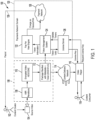
- FIG. 1 illustrates a pay-per-view system 100 without a video streaming service, according to at least one aspect of the present disclosure.
- the pay-per-view system 100 comprises a server computer 106 to receive the source video content 104 created by the content creator 102 and interfaces with a payments network domain 120 and a content delivery network 114.
- the server computer 106 may comprise an adaptive bit rate (ARB) module 108, and video encryption module 110, and a packaging module 112.
- the payments network domain 120 comprises a token management system 124, a content license server computer 126, a pay-per-view engine 122, and a payment network 128.
- the various computing devices of the pay-per-view system 100 are in communication and can communicate over a communication channel to deliver content from the content creator 102 to the content consumer 118 such that the content creator 102 receives revenue for the content from the content consumer 118.
- the content creator 102 creates th source video content 104 such as, for example, a video, image etc.
- the source video content 104 created by the content creator 102 is provided to a server computer 106 for rendition, encryption, and packaging.
- the server computer 106 can be a web server, for example.
- the ABR module 108 renders the source video content 104 in ARB format, which is widely used in streaming applications. This render allows the source video content 104 to be available in multiple compression levels.
- a video encryption module 110 converts the ABR video received from the ABR module 108 into an encrypted video stream.
- the encrypted video stream may be encrypted in a symmetric block cipher such as, for example, the advanced encryption standard (AES) simple or a common encryption scheme (CENC).
- AES advanced encryption standard
- CENC common encryption scheme
- the CENC encryption scheme specifies standard encryption and key mapping methods that can be utilized by one or more digital rights and key management.
- a packaging module 112 packages the encrypted video with a package manifest file comprising a metadata file (e.g., dynamic adaptive streaming over http [DASH], http live streaming [HLS]) and a payment network token.
- DASH is based on HTTP, thus any origin server can be set up to serve MPEG-DASH streams.
- MPEG-DASH is similar to HLS, another streaming protocol, in that it breaks videos down into smaller chunks and encodes those chunks at different quality levels.
- HLS is highly scalable for delivering live streams and video content across global content delivery networks (CDNs) using ordinary web servers.
- the metadata file comprises the following information:
- the packaging module 112 sends account credentials or an account identifier associated with the content creator 102 to a token management system 124.
- the account credentials may include a PAN or a PAN token, among others.
- the creator_token_reference is received by the packaging module 112 from the token management system 124.
- the creator_token_reference is then updated in the manifest file.
- the packaged content (e.g., video) along with the manifest file is delivered to a content delivery network 114 for efficient caching and delivery to a content player 116, such as, a video player, for example.
- the video is loaded or requested by the content player 116 from the content delivery network 114.
- a content consumer 118 can watch monetized content, such as the video, on a channel, such as YouTube, Udemy etc., by providing his/her payment card details or token to the content player 116.
- the content player 116 receives a player_token_reference from the content consumer 118.
- the content player 116 requires a license key to play the content, e.g., video.
- the content player 116 requests a license key from a content license server computer 126 by sending the following information:
- the content license server computer 126 validates the creator and player token references (creator_token_reference and player_token_reference) with the token management system 124 to ensure that both tokens are valid.
- the token management system 124 passes the token information to a pay-per-view engine 122 for billing/charging the content player 116 or the content consumer 118 for the viewed content and sending the money, or other measure of monetization, to the content creator 102.
- the pay-per-view engine 122 initiates a charge or payout 130 through the payment network 128.
- a token validation response is passed from the token management system 124 to the content license server computer 126.
- the content license server computer 126 creates a time bound license key for the content.
- the content player 116 uses the license key received from the content license server computer 126 to play the content for the content consumer 118.
- FIG. 2 is a logic flow diagram of a process 200 for the pay-per-view system 100 without a video streaming service shown in FIG. 1 , according to at least one aspect of the present disclosure.
- the content creator 102 creates 202 content referenced as the source video content 104.
- the ABR module 108 renders 204 the source video content 104 in ABR format.
- the video encryption module 110 encrypts 206 the ABR formatted content and the packaging module 112 packages 208 the ABR formatted encrypted content with a package manifest file comprising a metadata file.
- the metadata file comprises the following information:
- the packaging module 112 sends 210 the content creator's 102 account credential/account identifier (e.g., PAN number or PAN token) to the token management system 124.
- the packaging module 112 receives 212 a content creator 102 token reference from the token management system 124.
- the server computer 106 now delivers 214 the packaged encrypted content with the package manifest file to the content delivery network 114.
- the content consumer 118 employs the content player 116 to view the content.
- the content player 116 requests 216 content from the content delivery network 114.
- the content consumer 118 provides consumer card details or token to the content player 116.
- the content player 116 receives 218 the consumer card details or token from the content consumer 118 and requests 220 a license key from the content license server computer 126 to view the encrypted content received form the content delivery network 114.
- the content player 116 includes the following information in the license request:
- the content license server computer 126 validates 222 the content creator 102 and content player 116 token references received in the license key request submitted to the token management system 124.
- the token management system 124 then passes 224 the token information to the pay-per-view engine 122 for billing/charging the content player 116 or content consumer 118 and paying the content creator 102 for the source video content 104.
- the pay-per-view engine 122 initiates 226 a charge through the payment network 128, which sends a payout to the content creator 102.
- the token management system 124 passes 228 a token validation response to the content license server computer 126, which creates 230 a time bound license key for the content and enables the content player 116 to play 232 the content using the license key.
- FIG. 3 is a swimlane diagram 300 of an implementation of the process 200 shown in FIG. 2 , according to at least one aspect of the present disclosure.
- the content creator 102 sends 302 content to a server computer 106.
- the server computer 106 renders the content into an ABR format and encrypts the ABR formatted content file.
- the server computer 106 packages the ABR formatted and encrypted content with a manifest file comprising a metadata comprising the following information:
- the server computer 106 sends 304 a content creator 102 PAN or a PAN token to a token management system 124.
- the server computer 106 receives 306 a content creator 102 token reference from the token management system 124.
- the server computer 106 then sends 308 the rendered and encrypted version of the content along with the packaged manifest metadata file to a content delivery network 114.
- the content player 116 requests 310 or loads the content from the content delivery network 114. In order to view the content, however, the content player 116 receives 312 the content consumer 118 card details or token and requests 314 a license key for the content from the content license server computer 126.
- the content player 116 includes the following information in the request 314 for the license key:
- the content license server computer 126 sends 316 a request to the token management system 124 to validate the content creator and content player token references received in the license key request.
- the token management system 124 passes 318 the token information to the pay-per-view engine 122 for billing/charging the content player 116 or content consumer 118 and paying the content creator 102 for the source video content 104.
- the pay-per-view engine 122 initiates 320 a charge through the payment network 128, which sends 322 a payout to the content creator 102.
- the token management system 124 passes 324 a token validation response to the content license server computer 126, which creates 326 a time bound license for the content and enables the content player 116 to play 328 the content using the license for the content consumer 118.
- FIG. 4 illustrates a pay-per-view system 400 with a video streaming service provider 402, according to at least one aspect of the present disclosure.
- the pay-per-view system 400 comprises a media server computer 406 to receive the source video content 104 created by the content creator 102 and interfaces with a payments network domain 120 and a content delivery network 114.
- the media server computer 406 may comprise a video streaming service provider 402 (e.g., YouTube, Twitch), and video encryption module 110, and a packaging module 112.
- the payments network domain 120 comprises a token management system 124, a content license server computer 126, a pay-per-view engine 122, and a payment network 128.
- the content creator 102 creates the source video content 104 such as, for example, a video, image etc.
- the source video content 104 (e.g., source video) created by the content creator 102 is provided to a media server computer 406 for the video streaming service provider 402, encryption, and packaging.
- the media server computer 406 can be a media server, for example.
- a video encryption module 110 converts the streamed video received from the video streaming service provider 402 into an encrypted video stream.
- the encrypted video stream may be encrypted in a symmetric block cipher such as, for example, the advanced encryption standard (AES) simple or a common encryption scheme (CENC), for example.
- AES advanced encryption standard
- CENC common encryption scheme
- the CENC encryption scheme specifies standard encryption and key mapping methods that can be utilized by one or more digital rights and key management.
- a packaging module 112 packages the encrypted video with a package manifest file comprising a metadata file (e.g., dynamic adaptive streaming over http [DASH], http live streaming [HLS]) and a payment network token.
- DASH is based on HTTP, thus any origin server can be set up to serve MPEG-DASH streams.
- MPEG-DASH is similar to HLS, another streaming protocol, in that it breaks videos down into smaller chunks and encodes those chunks at different quality levels.
- HLS is highly scalable for delivering live streams and video content across global content delivery networks (CDNs) using ordinary web servers.
- the metadata file comprises the following information:
- the packaging module 112 sends a content creator 102 account credential/account identifier (e.g., PAN or a PAN token) to a token management system 124.
- a content creator 102 account credential/account identifier e.g., PAN or a PAN token
- the creator_token_reference and streaming_provider_token_reference is received by the packaging module 112 from the token management system 124.
- the creator_token_reference and streaming_provider_token_reference is then updated in the manifest file.
- the packaged content (e.g., video) along with the manifest file is delivered to a content delivery network 114 for efficient caching and delivery to the content player 408 such as for example YouTube or Twitch.
- the video is loaded or requested by the content player 408 from the content delivery network 114.
- a content consumer 118 can watch monetized content, such as the video, on a channel, such as YouTube, Twitch, etc., by providing his/her payment card details or token to the content player 408.
- the content player 408 receives a player_token_reference from the content consumer 118.
- the content player 408 requires a license key to play the content, e.g., video.
- the content player 408 makes a request to a content license server computer 126 by sending the following information:
- the content license server computer 126 validates the creator, streaming service provider, and player token references (creator_token_reference, streaming_provider token_reference, and player_token_reference) with the token management system 124 to check if these tokens are valid.
- the token management system 124 passes the token information to a pay-per-view engine 122 for billing/charging the content consumer 118 and send the money, or other measure of monetization, to the content creator 102 and the video streaming service provider 402.
- the pay-per-view engine 122 initiates a charge or payout 130 to the content creator 102 and initiates a charge or payout 404 to the video streaming service provider 402.
- a token validation response is passed from the token management system 124 to the content license server computer 126.
- the content license server computer 126 creates a time bound license key for the content.
- the content player 408 uses the license key received from the content license server computer 126 to play the content for the content consumer 118.
- FIG. 5 is a logic flow diagram of a process 500 for the pay-per-view system 400 without a video streaming service provider 402 shown in FIG. 4 , according to at least one aspect of the present disclosure.
- the content creator 102 creates 502 content referenced as the source video content 104.
- the content creator 102 uploads 504 the source video content 104 to a video streaming service provider 402.
- the video encryption module 110 encrypts 506 the source video content 104 and the packaging module 112 packages 508 the source video content 104 with a package manifest file comprising a metadata file.
- the metadata file comprises the following information:
- the packaging module 112 sends 510 the content creator's 102 PAN number or PAN token to the token management system 124.
- the packaging module 112 receives 512 a content creator 102 token reference and a streaming provider token reference from the token management system 124.
- the server computer 106 now delivers 514 the packaged encrypted content with the package manifest file to the content delivery network 114.
- the content consumer 118 employs the content player 408 to view the content.
- the content player 408 requests 516 content from the content delivery network 114.
- the content consumer 118 provides consumer card details or token to the content player 408.
- the content player 408 receives 518 the consumer card details or token from the content consumer 118 and requests 520 a license key from the content license server computer 126 to view the encrypted content received form the content delivery network 114.
- the content player 408 includes the following information in the license request:
- the content license server computer 126 validates 522 the content creator, streaming service provider, and content player token references received in the license key request with the token management system 124.
- the token management system 124 then passes 524 the token information to the pay-per-view engine 122 for billing/charging the content player 408 and paying the content creator 102 and the video streaming service provider 402 for the source video content 104.
- the pay-per-view engine 122 initiates 526 a charge through the payment network 128, which sends payout to the content creator 102 and the video streaming service provider 402.
- the token management system 124 passes 528 a token validation response to the content license server computer 126, which creates 530 a time bound license key for the content and enables the content player 408 to play 532 the content using the license key.
- FIG. 6 is a swimlane diagram 600 of an implementation of the process 500 shown in FIG. 5 , according to at least one aspect of the present disclosure.
- the content creator 102 sends 602 content to a media server computer 406.
- the media server computer 406 packages the content with a manifest file comprising a metadata comprising the following information:
- the media server computer 406 sends 604 a content creator 102 PAN or a PAN token to a token management system 124.
- the media server computer 406 receives 606 a content creator 102 token reference and a streaming provider token reference from the token management system 124.
- the media server computer 406 then sends 608 the encrypted version of the content along with the packaged manifest metadata file to a content delivery network 114.
- the content player 408 requests 610 or loads the content from the content delivery network 114. In order to view the content, however, the content player 408 receives 612 the content consumer 118 card details or token and requests 614 a license key for the content from the content license server computer 126.
- the content player 408 includes the following information in the request 614 for the license key:
- the content license server computer 126 sends 616 a request to the token management system 124 to validate the content creator, streaming service provider, and content player token references received in the license key request.
- the token management system 124 passes 618 the token information to the pay-per-view engine 122 for billing/charging the content player 116 or content consumer 118 and paying the content creator 102 and the video streaming service provider 402 for the source video content 104.
- the pay-per-view engine 122 initiates 620 a charge through the payment network 128, which sends 622 a payout to the content creator 102 and sends 624 a payout to the video streaming service provider 402 through the media server computer 406.
- the token management system 124 passes 626 a token validation response to the content license server computer 126, which creates 628 a time bound license key for the content and enables the content player 408 to play 630 the content using the license key for the content consumer 118.
- FIG. 7 illustrates a block diagram of a tokenization environment 700 portion of the token management system 124 shown in FIGS. 1 and 4 , according to at least one aspect of the present disclosure.
- FIG. 7 illustrates an example tokenization environment 700 including a token server computer 701 of a token service provider.
- the token server computer 701 may be in communication with a token requesting party 716 such as, for example, the packaging module 112 as shown in FIGS. 1 and 4 .
- the token requesting party 716 may operate a token requesting party computer.
- the token server computer 701 also may be in communication with a transaction processing network computer 714 such as, for example, the payment network 128 shown in FIGS. 1 and 4 .
- the token server computer 701 may part of the payment network 128.
- the token server computer 701 is in communication with a payment network token gateway server computer.
- the token server computer 701 may be responsible for provisioning a token to the packaging module 112 using a provisioning module 708 in conjunction with a data processor 703. Provisioning may include creating a token within a token vault 702 for an account, sending the token to the token requesting party 716 and sending the token to the packaging module 112.
- the token requesting party 716 may provide a set of account identifiers to the token server computer 701.
- the token server computer 701 may generate (or determine) a token for the account identifier received from the packaging module 112 operated by the token requesting party 716.
- the generated tokens may be stored at a token vault 702.
- the token vault 702 also may store a mapping between each token and the account identifier identifying the account represented by the token.
- the token vault 702 also may be used by the transaction processing network computer 714 to de-tokenize the token and convert the token to the account number represented by the token when a transaction authorization is processed through the transaction processing network computer 714.
- the token vault 702 also may manage all domain restrictions associated with each token provisioned.
- the token requesting party 716 also may select, with the data processor 703 executing the key management module 706 of the token server computer 701, an option associated with encryption keys. For example, the token requesting party 716 may choose to provide the encryption keys to the token server computer 701 via the key management module 706. In some embodiments, the token requesting party 716 may choose to leave the key generation to the token server computer 701.
- the token server computer 701 may generate (or determine) the tokens based on the option associated with the encryption keys.
- the token server computer 701 may generate a token associated with at least one encryption key for each account identifier of the set of account identifiers.
- the token server computer 701 may store the encryption keys along with the associated tokens in the token vault 702. The encryption keys may then be provided to a user device of the account holder.
- the tokens and corresponding encryption keys may be used in tokenized transactions processed by the transaction processing network computer.
- the token requesting party 716 also may initiate a request to receive a message when a token has been generated and/or provisioned for one of the accounts associated with the token requesting party 716.
- the token server computer 701 may generate a notification using the data processor 703 executing code in the notification module 710 based on the notification criteria (e.g., when a token satisfies the notification criteria) provided by the token requesting party 716. It also may send the notification to the token requesting party 716. For example, the token requesting party 716 may request a notification when a token is generated.
- the notification module 710 of the token server computer 701 may generate and send a notification to the token requesting party 716 when the token is generated.
- the token requesting party 716 may request a notification when a token is provisioned on a user device.
- the notification module 710 of the token server computer 701 may generate and send a notification to the token requesting party 716 when the token is provisioned on the user device.
- the notification module 710 may be informed by the provisioning module 708 that the token has been provisioned.
- the token server computer 701 also may include a risk management module 712 that can work in conjunction with the data processor 703 to set up rules for risk decisioning when the token server computer 701 receives the token provisioning request from the token requesting party 716.
- the token requesting party 716 may indicate rules for provisioning or processing the token based on a risk assessment associated with a transacting party, a device used in the transaction, or the account itself.
- the token requesting party 716 may provide a restriction that is placed on one or more of the generated tokens based on the risk decision making rules.
- the token server computer 701 shown in FIG. 7 is provided for illustration purposes and should not be construed as limiting.
- the token server computer 701 may include more or less components than those illustrated in FIG. 7 .
- the token server computer 701 may include additional software modules, such as a processing module, a lifecycle management module, etc.
- These and other modules may, in conjunction with the data processor 703, allow the token server computer 701 to perform one or more of the following functions: map an account identifier to a token and store the mapping in the token vault with relevant domain restrictions; provision a token from the token vault to a user device; manage (e.g., delete, suspend, resume, etc.) the token both at the token vault and on the user device; generate encryption keys based on the token requesting party's request; manage encryption keys based on predetermined criteria; process tokenized transactions including performing cryptogram validation, domain restriction checks, and validity checks; and perform post-transaction verification processing to verify that transactions and account updates are conducted on the user device after the transaction is processed by the transaction processing network.
- the token server computer 701 may support contactless payment use cases. This includes support for contactless payment methods using a secure element and Host Card Emulation (HCE)-based payment applications.
- HCE Host Card Emulation
- FIG. 8 shows a block diagram of a payment network computer 800, according to at least one aspect of the present disclosure.
- FIG. 8 illustrates components of the payment network computer 800, according to at least one aspect of the present disclosure.
- the payment network 128 shown in FIGS. 1 , 3 , 4 , and 6 may be implemented using or in a similar manner to the payment network computer 800.
- the payment network computer 800 may include a processor 802 communicatively coupled to a network interface 804, a memory 806, a database 808, and a computer readable medium 810.
- the network interface 804 may be configured to allow the payment network computer 800 to communicate with other entities such as the pay-per-view engine 122, token management system 124, or content license server computer 126, as shown in FIGS. 1 and 4 , an acquirer computer, a different payment processing network, an issuer computer, etc. using one or more communications networks.
- entities such as the pay-per-view engine 122, token management system 124, or content license server computer 126, as shown in FIGS. 1 and 4 , an acquirer computer, a different payment processing network, an issuer computer, etc. using one or more communications networks.
- the memory 806 may be used to store data.
- the memory 806 may be coupled to the processor 802 internally or externally (e.g., cloud based data storage) and may comprise any combination of volatile and/or non-volatile memory, for example, RAM, DRAM, ROM, flash, or any other suitable memory device.
- the database 808 may store data associated with a plurality of consumers such as consumer personal and payment account information.
- the computer readable medium 810 may be in the form of a memory (e.g., flash, ROM, etc.) and may comprise code, executable by the processor 802 for implementing methods described herein.
- the computer readable medium 810 may include an authorization module 812, an authentication module 814, a capture module 816, a clearing module 818, a settlement and reconciliation module 820, an interchange fee programs module 822, a regulations and exception processing module 824, a reporting module 826, and a value added services module 828.
- the authorization module 812 may comprise code, executable by the processor 802 to validate token data elements, to provide a token assurance level, to provide support for lost and stolen devices and for token exchange.
- the authorization module 812 may also comprise code, executable by the processor 802, to process an authorization request message comprising a token.
- the authorization module 812 in conjunction with the processor 802, may validate the token requestor identifier to determine if the transaction can be approved or declined.
- the token requestor identifier may be associated with a wallet application that may be used by a consumer to initiate a transaction using a consumer device.
- the token requestor identifier may be provided by the network token system to a wallet application during the onboarding process.
- the authorization module 812 may approve or decline the transaction using various data associated with the transaction such as a token presentment mode, token number, token timestamp, token expiration date, token assurance level, a determination that the account used to conduct the transaction is lost, stolen, or compromised, or any other suitable data.
- the aforementioned data may be determined from the contents of the authorization request message for a transaction, a token registry database, or any other suitable source.
- the authorization module 812 may provide support for token exchange. For example, the authorization module 812 may modify the authorization request message to replace the token with a PAN and send the modified authorization request message to an issuer. The authorization module 812 may also restore the token in the authorization response message received from the issuer before forwarding it to an acquirer computer.
- records of the authorization may be contained in an authorization log database that can be transmitted to the participating acquirers. The data contained in the authorization log database can be in a plurality of file formats.
- the authorization module 812 may be configured to process payment transactions that use a token associated with a different payment network. For example, in some embodiments, the authorization module 812 may be configured to generate and send a token verification request to a payment network associated with the token, or specifically to a network token system associated with a payment network. The authorization module 812 may be further configured to receive a token verification response including the original PAN associated with the token and a validation result. The issuer associated with the original PAN may be determined, and an authorization request message for the transaction including the original PAN and the validation result may be sent to the issuer computer.
- the authentication module 814 may comprise code that can be executed to the processor 802 to apply one or more authentication methods to authenticate token transactions based on the presentment modes.
- the authentication module 814 may comprise code for authenticating the QR TM code token transactions using existing authentication schemes (e.g., entering personal information into a keypad).
- the authentication module 814 may comprise code for authenticating contactless EMV token transactions based on dCWs that are formed with our without ATCs (Application Transaction Counters) or cryptograms.
- the capture module 816 may comprise code for processing a capture file.
- a merchant computer may send the token requestor identifier in the capture file that is sent to the acquirer computer.
- the payment network computer 800 can convert the token into a PAN and provide the PAN to the acquirer computer in the capture file to prepare clearing drafts pursuant to existing processing rules.
- the clearing module 818 may be configured to process clearing transactions with tokens.
- a clearing process may be performed to reconcile orders among the transacting entities such as the issuer computer and the acquirer computer/merchant computer.
- a token requestor identifier may be present in the appropriate data field.
- the clearing module 818 can substitute clearing draft messages received with a token with the PAN for related clearing processing.
- the token is replaced with a PAN in the authorization data files provided to the acquirer computer.
- the token number and expiration date can be processed pursuant to existing rules and can be provided in the clearing draft message (e.g., in the expiration date field).
- the clearing draft message may include a token assurance level.
- the token can be validated against the token requestor identifier to which the token was originally issued. If the validation fails, the payment processing network computer may return an appropriate code in the clearing draft message.
- the payment processing network computer may forward the token requestor identifier in the clearing draft message to the issuer computer.
- the acquirer computer may retain and return the token requestor identifier value used in the original transaction in all the subsequent transactions.
- the POS condition code and the POS entry mode code fields can reflect the applicable token presentment mode in the clearing draft message.
- the settlement and reconciliation module 820 may be configured to process settlement and reconciliation transactions with tokens.
- the settlement and reconciliation module 820 may provide support for the token requestor identifier and its validation in the reports and raw data files associated with the settlement and reconciliation processing of the transactions.
- the settlement and reconciliation module 820 may include the tokens and the token requestor identifier in the reports and raw data files destined to the acquirer computer.
- the settlement and reconciliation module 820 may include the real PAN and optionally the token requestor identifier in the reports and raw data files destined to the issuer computer.
- the interface for processing transaction files (e.g., edit package) may be enhanced to process tokens in place of the PANs.
- the interchange fee programs module 822 may comprise code for determining interchange rates and fees for token based transactions. Payment transactions conducted with tokens can qualify for existing fee programs and interchange rates applicable to the respective presentment modes and available card products.
- the regulations/exception processing module 824 may be configured to apply operating regulations and perform liability and dispute processing for token payment transactions. Payment transactions with tokens can qualify for existing liability rules applicable to the respective presentment modes and available card products. For example, acquires and issuers can qualify for existing chargeback rules based on the presentment modes. The regulations/exception processing module 824 can map the tokens used in the original transactions to facilitate dispute processing related to chargebacks.
- the reporting module 826 may be configured to provide reporting for token payment transactions.
- the reporting module 826 may provide reports for each country and regions based on token attributes such as the token number and token ranges, token requestor identifier, consumer token assurance level, token expiration date, COF (card on file) indicator and the token presentment mode.
- the value added services module 828 may comprise code for supporting value added services to support token transactions. For example, account update functions of merchant enquiry and setup of payment controls can be supported for tokens.
- the media server computers 106, 406, content license server computer 126, token management system 124, and pay-per-view engine 122 shown in FIGS. 1 and 4 may be implemented in accordance with the computer apparatus 900 shown in FIG. 9 and/or the example system 1000 shown in FIG. 10 .
- the computer apparatus 900 and the example system 1000 are described hereinbelow with respect to FIGS. 9 and 10 .
- FIG. 9 is a block diagram of a computer apparatus 900 with data processing subsystems or components, according to at least one aspect of the present disclosure.
- the subsystems shown in FIG. 9 are interconnected via a system bus 910. Additional subsystems such as a printer 918, keyboard 926, fixed disk 928 (or other memory comprising computer readable media), monitor 922, which is coupled to a display adapter 920, and others are shown.
- Peripherals and input/output (I/O) devices which couple to an I/O controller 912 (which can be a processor or other suitable controller), can be connected to the computer system by any number of means known in the art, such as a serial port 924.
- serial port 924 or external interface 930 can be used to connect the computer apparatus to a wide area network such as the Internet, a mouse input device, or a scanner.
- the interconnection via system bus allows the central processor 916 to communicate with each subsystem and to control the execution of instructions from system memory 914 or the fixed disk 928, as well as the exchange of information between subsystems.
- the system memory 914 and/or the fixed disk 928 may embody a computer readable medium.
- FIG. 10 is a diagrammatic representation of an example system 1000 that includes a host machine 1002 within which a set of instructions to perform any one or more of the methodologies discussed herein may be executed, according to at least one aspect of the present disclosure.
- the host machine 1002 operates as a standalone device or may be connected (e.g., networked) to other machines.
- the host machine 1002 may operate in the capacity of a server or a client machine in a server-client network environment, or as a peer machine in a peer-to-peer (or distributed) network environment.
- the host machine 1002 may be a computer or computing device, a personal computer (PC), a tablet PC, a set-top box (STB), a personal digital assistant (PDA), a cellular telephone, a portable music player (e.g., a portable hard drive audio device such as an Moving Picture Experts Group Audio Layer 3 (MP3) player), a web appliance, a network router, switch or bridge, or any machine capable of executing a set of instructions (sequential or otherwise) that specify actions to be taken by that machine.
- a portable music player e.g., a portable hard drive audio device such as an Moving Picture Experts Group Audio Layer 3 (MP3) player
- MP3 Moving Picture Experts Group Audio Layer 3
- web appliance e.g., a web appliance, a network router, switch or bridge, or any machine capable of executing a set of instructions (sequential or otherwise) that specify actions to be taken by that machine.
- machine shall also be taken to include any collection of machines that individually or jointly execute a set (or multiple
- the example system 1000 includes the host machine 1002, running a host operating system (OS) 1004 on a processor or multiple processor(s)/processor core(s) 1006 (e.g., a central processing unit (CPU), a graphics processing unit (GPU), or both), and various memory nodes 1008.
- the host OS 1004 may include a hypervisor 1010 which is able to control the functions and/or communicate with a virtual machine ("VM") 1012 running on machine readable media.
- the VM 1012 also may include a virtual CPU or vCPU 1014.
- the memory nodes 1008 may be linked or pinned to virtual memory nodes or vNodes 1016. When the memory node 1008 is linked or pinned to a corresponding vNode 1016, then data may be mapped directly from the memory nodes 1008 to their corresponding vNodes 1016.
- the host machine 1002 may further include a video display, audio device or other peripherals 1018 (e.g., a liquid crystal display (LCD), alphanumeric input device(s) including, e.g., a keyboard, a cursor control device, e.g., a mouse, a voice recognition or biometric verification unit, an external drive, a signal generation device, e.g., a speaker,) a persistent storage device 1020 (also referred to as disk drive unit), and a network interface device 1022.
- a video display e.g., a liquid crystal display (LCD), alphanumeric input device(s) including, e.g., a keyboard, a cursor control device, e.g., a mouse, a voice recognition or biometric verification unit, an external drive, a signal generation device, e.g., a speaker,
- a persistent storage device 1020 also referred to as disk drive unit
- network interface device 1022 e.g., a network interface
- the host machine 1002 may further include a data encryption module (not shown) to encrypt data.
- the components provided in the host machine 1002 are those typically found in computer systems that may be suitable for use with aspects of the present disclosure and are intended to represent a broad category of such computer components that are known in the art.
- the example system 1000 can be a server, minicomputer, mainframe computer, or any other computer system.
- the computer may also include different bus configurations, networked platforms, multi-processor platforms, and the like.
- Various operating systems may be used including UNIX, LINUX, WINDOWS, QNX ANDROID, IOS, CHROME, TIZEN, and other suitable operating systems.
- the disk drive unit 1024 also may be a Solid-state Drive (SSD), a hard disk drive (HDD) or other includes a computer or machine-readable medium on which is stored one or more sets of instructions and data structures (e.g., data/instructions 1026) embodying or utilizing any one or more of the methodologies or functions described herein.
- the data/instructions 1026 also may reside, completely or at least partially, within the main memory node 1008 and/or within the processor(s) 1006 during execution thereof by the host machine 1002.
- the data/instructions 1026 may further be transmitted or received over a network 1028 via the network interface device 1022 utilizing any one of several well-known transfer protocols (e.g., Hyper Text Transfer Protocol (HTTP)).
- HTTP Hyper Text Transfer Protocol
- the processor(s) 1006 and memory nodes 1008 also may comprise machine-readable media.
- the term "computer-readable medium” or “machine-readable medium” should be taken to include a single medium or multiple medium (e.g., a centralized or distributed database and/or associated caches and servers) that store the one or more sets of instructions.
- the term "computer-readable medium” shall also be taken to include any medium that is capable of storing, encoding, or carrying a set of instructions for execution by the host machine 1002 and that causes the host machine 1002 to perform any one or more of the methodologies of the present application, or that is capable of storing, encoding, or carrying data structures utilized by or associated with such a set of instructions.
- computer-readable medium shall accordingly be taken to include, but not be limited to, solid-state memories, optical and magnetic media, and carrier wave signals. Such media may also include, without limitation, hard disks, floppy disks, flash memory cards, digital video disks, random access memory (RAM), read only memory (ROM), and the like.
- RAM random access memory
- ROM read only memory
- the example aspects described herein may be implemented in an operating environment comprising software installed on a computer, in hardware, or in a combination of software and hardware.
- Internet service may be configured to provide Internet access to one or more computing devices that are coupled to the Internet service, and that the computing devices may include one or more processors, buses, memory devices, display devices, input/output devices, and the like.
- the Internet service may be coupled to one or more databases, repositories, servers, and the like, which may be utilized to implement any of the various aspects of the disclosure as described herein.
- the computer program instructions also may be loaded onto a computer, a server, other programmable data processing apparatus, or other devices to cause a series of operational steps to be performed on the computer, other programmable apparatus or other devices to produce a computer implemented process such that the instructions which execute on the computer or other programmable apparatus provide processes for implementing the functions/acts specified in the flowchart and/or block diagram block or blocks.
- Suitable networks may include or interface with any one or more of, for instance, a local intranet, a PAN (Personal Area Network), a LAN (Local Area Network), a WAN (Wide Area Network), a MAN (Metropolitan Area Network), a virtual private network (VPN), a storage area network (SAN), a frame relay connection, an Advanced Intelligent Network (AIN) connection, a synchronous optical network (SONET) connection, a digital T1, T3, E1 or E3 line, Digital Data Service (DDS) connection, DSL (Digital Subscriber Line) connection, an Ethernet connection, an ISDN (Integrated Services Digital Network) line, a dial-up port such as a V.90, V.34 or V.34bis analog modem connection, a cable modem, an ATM (Asynchronous Transfer Mode) connection, or an FDDI (Fiber Distributed Data Interface) or CDDI (Copper Distributed Data Interface) connection.
- PAN Personal Area Network
- LAN Local Area Network
- WAN Wide Area Network
- communications may also include links to any of a variety of wireless networks, including WAP (Wireless Application Protocol), GPRS (General Packet Radio Service), GSM (Global System for Mobile Communication), CDMA (Code Division Multiple Access) or TDMA (Time Division Multiple Access), cellular phone networks, GPS (Global Positioning System), CDPD (cellular digital packet data), RIM (Research in Motion, Limited) duplex paging network, Bluetooth radio, or an IEEE 802.11-based radio frequency network.
- WAP Wireless Application Protocol
- GPRS General Packet Radio Service
- GSM Global System for Mobile Communication
- CDMA Code Division Multiple Access
- TDMA Time Division Multiple Access
- cellular phone networks GPS (Global Positioning System)
- CDPD cellular digital packet data
- RIM Research in Motion, Limited
- Bluetooth radio or an IEEE 802.11-based radio frequency network.
- the server 1030 can further include or interface with any one or more of an RS-232 serial connection, an IEEE-1394 (Firewire) connection, a Fiber Channel connection, an IrDA (infrared) port, a SCSI (Small Computer Systems Interface) connection, a USB (Universal Serial Bus) connection or other wired or wireless, digital or analog interface or connection, mesh or Digi ® networking.
- an RS-232 serial connection an IEEE-1394 (Firewire) connection, a Fiber Channel connection, an IrDA (infrared) port, a SCSI (Small Computer Systems Interface) connection, a USB (Universal Serial Bus) connection or other wired or wireless, digital or analog interface or connection, mesh or Digi ® networking.
- a cloud-based computing environment is a resource that typically combines the computational power of a large grouping of processors (such as within web servers) and/or that combines the storage capacity of a large grouping of computer memories or storage devices.
- Systems that provide cloud-based resources may be utilized exclusively by their owners or such systems may be accessible to outside users who deploy applications within the computing infrastructure to obtain the benefit of large computational or storage resources.
- the cloud is formed, for example, by a network of web servers that comprise a plurality of computing devices, such as the host machine 1002, with each server 1030 (or at least a plurality thereof) providing processor and/or storage resources.
- These servers manage workloads provided by multiple users (e.g., cloud resource customers or other users).
- each user places workload demands upon the cloud that vary in real-time, sometimes dramatically. The nature and extent of these variations typically depends on the type of business associated with the user.
- Non-volatile media include, for example, optical or magnetic disks, such as a fixed disk.
- Volatile media include dynamic memory, such as system RAM.
- Transmission media include coaxial cables, copper wire and fiber optics, among others, including the wires that comprise one aspect of a bus.
- Transmission media can also take the form of acoustic or light waves, such as those generated during radio frequency (RF) and infrared (IR) data communications.
- RF radio frequency
- IR infrared
- Common forms of computer-readable media include, for example, a flexible disk, a hard disk, magnetic tape, any other magnetic medium, a CD-ROM disk, digital video disk (DVD), any other optical medium, any other physical medium with patterns of marks or holes, a RAM, a PROM, an EPROM, an EEPROM, a FLASH EPROM, any other memory chip or data exchange adapter, a carrier wave, or any other medium from which a computer can read.
- a bus carries the data to system RAM, from which a CPU retrieves and executes the instructions.
- the instructions received by system RAM can optionally be stored on a fixed disk either before or after execution by a CPU.
- Computer program code for carrying out operations for aspects of the present technology may be written in any combination of one or more programming languages, including an object oriented programming language such as Java, Smalltalk, C++, or the like and conventional procedural programming languages, such as the "C" programming language, Go, Python, or other programming languages, including assembly languages.
- the program code may execute entirely on the user's computer, partly on the user's computer, as a standalone software package, partly on the user's computer and partly on a remote computer or entirely on the remote computer or server.
- the remote computer may be connected to the user's computer through any type of network, including a local area network (LAN) or a wide area network (WAN), or the connection may be made to an external computer (for example, through the Internet using an Internet Service Provider).
- LAN local area network
- WAN wide area network
- Internet Service Provider for example, AT&T, MCI, Sprint, EarthLink, MSN, GTE, etc.
- An aspect of the method may include any one or more than one, and any combination of, the numbered clauses described below.
- a pay-per-view system comprising a token management server computer to receive an account credential from a content creator; and send a content creator token reference to a content delivery network; a content license server computer to receive a request for a content license key from a content player, wherein the request comprises the content creator token reference and a content player token reference; validate the content creator token reference; validate the content player token reference; receive a token validation response from the token management server computer; create a time bound license for content created by the content creator; and send the content license key to the content player.
- Clause 2 The pay-per-view system of clause 1, wherein the content license server computer is to send a validated content creator token reference to the token management server computer; and send a validated content player token reference to the token management server computer.
- Clause 3 The pay-per-view system of any one of clauses 1 or 2, comprising a pay-per-view engine to receive token information from the token management server computer; charge the content player or a content consumer; and initiate, on a payment network server computer, a payment to the content creator based on the token information.
- Clause 4 The pay-per-view system of clause 3, wherein the token information comprises a validated content creator token reference; and a validated content player token reference; initiate, by the pay-per-view engine on the payment network server computer, the payment to the content creator based on the validated content creator token reference and the validated content player token reference.
- Clause 5 The pay-per-view system of any one of clauses 3 or 4, wherein the payment network server computer is to submit a payout to the content creator.
- Clause 6 The pay-per-view system of any one of clauses 1 to 5, wherein the token management server computer is to send a content creator token reference and a streaming provider token reference to a content delivery network.
- Clause 7 The pay-per-view system of any one of clauses 1 to 6, wherein the content license server computer is to receive a request for a content license key from a video streaming service, wherein the request comprises the content creator token reference and a streaming provider token reference; send the content license key to the video streaming service; charge the video streaming service or a content consumer; and initiate a charge on a payment network server computer on the content creator token reference and the streaming provider token reference.
- Clause 8 The pay-per-view system of clause 7, wherein the payment network server computer is to submit a portion of payout to the content creator and another portion of payout to the video streaming service.
- a pay-per-view method comprising receiving, by a token management server computer, an account credentials from a content creator; and sending, by the token management server computer, a content creator token reference to a content delivery network; receiving, by a content license server computer, a request for a content license key from a content player, wherein the request comprises the content creator token reference and a content player token reference; validating, by the content license server computer, the content creator token reference; validating, by the content license server computer, the content player token reference; receiving, by the content license server computer, a token validation response from the token management server computer; creating, by the content license server computer, a time bound license for content created by the content creator; and sending, by a content license server computer, the content license key to the content player.
- Clause 10 The pay-per-view method of clause 9, comprising sending, by the content license server computer, a validated content creator token reference to the token management server computer; and sending, by the content license server computer, a validated content player token reference to the token management server computer.
- Clause 11 The pay-per-view method of any one of clauses 9 or 10, comprising receiving, by a pay-per-view engine, token information from the token management server computer; charging, by the pay-per-view engine on a payment network server computer, the content player or a content consumer; and initiating, by the pay-per-view engine on the payment network server computer, a payment to the content creator based on the token information.
- Clause 12 The pay-per-view method of clause 11, wherein receiving the token information comprises receiving, by the pay-per-view engine, a validated content creator token reference; and receiving, by the pay-per-view engine, a validated content player token reference; and initiating, by the pay-per-view engine on the payment network server computer, the payment to the content creator based on the validated content creator token reference and the validated content player token reference.
- Clause 13 The pay-per-view method of any one of clauses 9 to 12, wherein the method comprises submitting, by a payment network computer, a payout to the content creator.
- Clause 14 The pay-per-view method of any one of clause 9 to 13, wherein the method comprises sending, by a token management server computer, a content creator token reference and a streaming provider token reference to a content delivery network.
- Clause 15 The pay-per-view method of any one of clauses 9 to 14, wherein the method comprises receiving, by a content license server computer, a request for a content license key from a video streaming service, wherein the request comprises the content creator token reference and a streaming provider token reference; sending, by the content license server computer, the content license key to the video streaming service; charging, by the content license server computer, the video streaming service or a content consumer; and initiating, by the content license server computer, a charge on a payment network on the content creator token reference and the streaming provider token reference.
- Clause 16 The pay-per-view method of clause 15, wherein the method comprises submitting, by a payment network server computer, a portion of payout to the content creator and another portion of payout to the video streaming service.
- a content delivery system comprising a content delivery server computer to receive an encrypted media content file; package the encrypted media content file with a manifest file comprising metadata information and creating a packaged encrypted media content file; send an account credential to a token management system; receive a content creator token reference from the token management system; update the content creator token reference in the manifest file metadata information; and deliver the packaged encrypted media content file and the manifest file to a content delivery network.
- Clause 18 The content delivery system of clause 17, wherein the content delivery network is to receive a request for the packaged encrypted media content file from a media content player; and deliver the packaged encrypted media content file to the media content player based on the request.
- Clause 19 The content delivery system of clause 18, wherein the media content player is to receive from a media content user, either payment card details or a player token reference for viewing the packaged encrypted media content file; send license information associated with the packaged encrypted media content file to a license server; request a license key from a license server by sending license information to the license server to enable the media player to play the packaged encrypted media content file.
- Clause 20 The content delivery system of clause 19, wherein the license server is to validate the content creator and the player token reference; pass the token information to a pay-per-view engine for charging the media content player or the media content consumer and sending a payment to a content creator; and create a time bound license for the media content file to enable the media content player to play the packaged encrypted media content file; and wherein the pay-per-view engine is to initiate a charge on a payments network; and pass a token validation response to the license server.
- a machine-readable medium may include any mechanism for storing or transmitting information in a form readable by a machine (e.g., a computer), but is not limited to, floppy diskettes, optical disks, compact disc, read-only memory (CD-ROMs), and magneto-optical disks, read-only memory (ROMs), random access memory (RAM), erasable programmable read-only memory (EPROM), electrically erasable programmable read-only memory (EEPROM), magnetic or optical cards, flash memory, or a tangible, machine-readable storage used in the transmission of information over the Internet via electrical, optical, acoustical or other forms of propagated signals (e.g., carrier waves, infrared signals, digital signals, etc.). Accordingly, the non-
- Any of the software components or functions described in this application may be implemented as software code to be executed by a processor using any suitable computer language such as, for example, Python, Java, C++ or Perl using, for example, conventional or object-oriented techniques.
- the software code may be stored as a series of instructions, or commands on a computer readable medium, such as RAM, ROM, a magnetic medium such as a hard-drive or a floppy disk, or an optical medium such as a CD-ROM. Any such computer readable medium may reside on or within a single computational apparatus, and may be present on or within different computational apparatuses within a system or network.
- logic may refer to an app, software, firmware and/or circuitry configured to perform any of the aforementioned operations.
- Software may be embodied as a software package, code, instructions, instruction sets and/or data recorded on non-transitory computer readable storage medium.
- Firmware may be embodied as code, instructions or instruction sets and/or data that are hard-coded (e.g., nonvolatile) in memory devices.
- the terms "component,” “system,” “module” and the like can refer to a computer-related entity, either hardware, a combination of hardware and software, software, or software in execution.
- an “algorithm” refers to a self-consistent sequence of steps leading to a desired result, where a “step” refers to a manipulation of physical quantities and/or logic states which may, though need not necessarily, take the form of electrical or magnetic signals capable of being stored, transferred, combined, compared, and otherwise manipulated. It is common usage to refer to these signals as bits, values, elements, symbols, characters, terms, numbers, or the like. These and similar terms may be associated with the appropriate physical quantities and are merely convenient labels applied to these quantities and/or states.
- a network may include a packet switched network.
- the communication devices may be capable of communicating with each other using a selected packet switched network communications protocol.
- One example communications protocol may include an Ethernet communications protocol which may be capable of permitting communication using a Transmission Control Protocol/Internet Protocol (TCP/IP).
- TCP/IP Transmission Control Protocol/Internet Protocol
- the Ethernet protocol may comply or be compatible with the Ethernet standard published by the Institute of Electrical and Electronics Engineers (IEEE) titled "IEEE 802.3 Standard", published in December, 2008 and/or later versions of this standard.
- the communication devices may be capable of communicating with each other using an X.25 communications protocol.
- the X.25 communications protocol may comply or be compatible with a standard promulgated by the International Telecommunication Union-Telecommunication Standardization Sector (ITU-T).
- the communication devices may be capable of communicating with each other using a frame relay communications protocol.
- the frame relay communications protocol may comply or be compatible with a standard promulgated by Consultative Committee for International Circuit and Telephone (CCITT) and/or the American National Standards Institute (ANSI).
- the transceivers may be capable of communicating with each other using an Asynchronous Transfer Mode (ATM) communications protocol.
- ATM Asynchronous Transfer Mode
- the ATM communications protocol may comply or be compatible with an ATM standard published by the ATM Forum titled "ATM-MPLS Network Interworking 2.0" published August 2001, and/or later versions of this standard.
- ATM-MPLS Network Interworking 2.0 published August 2001
- One or more components may be referred to herein as “configured to,” “configurable to,” “operable/operative to,” “adapted/adaptable,” “able to,” “conformable/conformed to,” etc.
- “configured to” can generally encompass active-state components and/or inactive-state components and/or standby-state components, unless context requires otherwise.
- any reference to “one aspect,” “an aspect,” “an exemplification,” “one exemplification,” and the like means that a particular feature, structure, or characteristic described in connection with the aspect is included in at least one aspect.
- appearances of the phrases “in one aspect,” “in an aspect,” “in an exemplification,” and “in one exemplification” in various places throughout the specification are not necessarily all referring to the same aspect.
- the particular features, structures or characteristics may be combined in any suitable manner in one or more aspects.
Landscapes
- Engineering & Computer Science (AREA)
- Databases & Information Systems (AREA)
- Multimedia (AREA)
- Signal Processing (AREA)
- Business, Economics & Management (AREA)
- Computer Security & Cryptography (AREA)
- Theoretical Computer Science (AREA)
- Accounting & Taxation (AREA)
- General Physics & Mathematics (AREA)
- Physics & Mathematics (AREA)
- Computer Hardware Design (AREA)
- General Engineering & Computer Science (AREA)
- Human Computer Interaction (AREA)
- Software Systems (AREA)
- Finance (AREA)
- Strategic Management (AREA)
- General Business, Economics & Management (AREA)
- Computer Networks & Wireless Communication (AREA)
- Computing Systems (AREA)
- Technology Law (AREA)
- Management, Administration, Business Operations System, And Electronic Commerce (AREA)
- Information Transfer Between Computers (AREA)
Applications Claiming Priority (1)
| Application Number | Priority Date | Filing Date | Title |
|---|---|---|---|
| US18/474,369 US20250104027A1 (en) | 2023-09-26 | 2023-09-26 | System and method for pay-per-view using a payment network |
Publications (2)
| Publication Number | Publication Date |
|---|---|
| EP4530896A2 true EP4530896A2 (fr) | 2025-04-02 |
| EP4530896A3 EP4530896A3 (fr) | 2025-06-11 |
Family
ID=92926097
Family Applications (1)
| Application Number | Title | Priority Date | Filing Date |
|---|---|---|---|
| EP24202810.8A Pending EP4530896A3 (fr) | 2023-09-26 | 2024-09-26 | Système et procédé de paiement par vue à l'aide d'un réseau de paiement |
Country Status (2)
| Country | Link |
|---|---|
| US (1) | US20250104027A1 (fr) |
| EP (1) | EP4530896A3 (fr) |
Citations (1)
| Publication number | Priority date | Publication date | Assignee | Title |
|---|---|---|---|---|
| US20150180836A1 (en) | 2013-12-19 | 2015-06-25 | Erick Wong | Cloud-based transactions methods and systems |
Family Cites Families (15)
| Publication number | Priority date | Publication date | Assignee | Title |
|---|---|---|---|---|
| US5930777A (en) * | 1997-04-15 | 1999-07-27 | Barber; Timothy P. | Method of charging for pay-per-access information over a network |
| US6718328B1 (en) * | 2000-02-28 | 2004-04-06 | Akamai Technologies, Inc. | System and method for providing controlled and secured access to network resources |
| US8429081B1 (en) * | 2004-02-12 | 2013-04-23 | Novell, Inc. | Techniques for securely delivering media data |
| US20100250438A1 (en) * | 2004-07-01 | 2010-09-30 | Jan Hakan Hamnen | System and method for distributing electronic content utilizing electronic license keys |
| KR20100104314A (ko) * | 2009-03-17 | 2010-09-29 | 삼성전자주식회사 | 컨텐츠 거래 방법 및 시스템 |
| US8910295B2 (en) * | 2010-11-30 | 2014-12-09 | Comcast Cable Communications, Llc | Secure content access authorization |
| US20140081837A1 (en) * | 2012-09-14 | 2014-03-20 | Vuier, Inc. | Payment transaction gateway for a media player |
| US20150120535A1 (en) * | 2013-10-31 | 2015-04-30 | Damon Evans | Media distribution systems and methods |
| US11157633B1 (en) * | 2019-06-26 | 2021-10-26 | Amazon Technologies, Inc. | Digital content delivery system |
| TW202220449A (zh) * | 2020-11-02 | 2022-05-16 | 宏碁股份有限公司 | 視訊加密的方法及系統 |
| WO2022115143A1 (fr) * | 2020-11-30 | 2022-06-02 | Arris Enterprises Llc | Gestion évolutive de clés pour chiffrer des jetons d'autorisation de gestion de droits numériques |
| KR102690028B1 (ko) * | 2021-12-09 | 2024-07-30 | 경북대학교 산학협력단 | 대체 불가능한 토큰을 지원하는 블록체인 기반의 개인 주도적 유전체 데이터 거래 방법 및 시스템 |
| WO2023144500A1 (fr) * | 2022-01-26 | 2023-08-03 | Synamedia Limited | Procédés, systèmes et dispositifs pour un contrôle, par un serveur, d'une preuve de possession d'autorisation client |
| EP4270218A1 (fr) * | 2022-04-29 | 2023-11-01 | Utopia Music AG | Procédé, appareil et produit programme informatique permettant de fournir un contenu multimédia protégé |
| EP4346162A1 (fr) * | 2022-09-27 | 2024-04-03 | Nagravision Sàrl | Procédé de téléchargement de contenu dans un cdn |
-
2023
- 2023-09-26 US US18/474,369 patent/US20250104027A1/en active Pending
-
2024
- 2024-09-26 EP EP24202810.8A patent/EP4530896A3/fr active Pending
Patent Citations (1)
| Publication number | Priority date | Publication date | Assignee | Title |
|---|---|---|---|---|
| US20150180836A1 (en) | 2013-12-19 | 2015-06-25 | Erick Wong | Cloud-based transactions methods and systems |
Also Published As
| Publication number | Publication date |
|---|---|
| US20250104027A1 (en) | 2025-03-27 |
| EP4530896A3 (fr) | 2025-06-11 |
Similar Documents
| Publication | Publication Date | Title |
|---|---|---|
| Kim et al. | E-commerce payment model using blockchain | |
| AU2018202542B2 (en) | Automated account provisioning | |
| US10147076B2 (en) | Digital currency (virtual payment cards) issued by central bank for mobile and wearable devices | |
| US20240007284A1 (en) | Systems and methods for dynamically updating metadata during blockchain functions | |
| US12457096B2 (en) | Gateway agnostic tokenization | |
| US12141793B2 (en) | Systems and methods for generating variable non-fungible tokens linked to designated off-chain computer resources for use in secure encrypted, communications across disparate computer network | |
| US11716200B2 (en) | Techniques for performing secure operations | |
| US11887119B1 (en) | System and method for managing user digital assets while maintaining security and privacy | |
| US12256029B2 (en) | Systems and methods for integrating blockchain functions and external systems for use in secure encrypted, communications across disparate computer network | |
| CN118967130A (zh) | 验证加密货币交易所上的交易的账户的设备、系统和方法 | |
| WO2025170641A2 (fr) | Système et procédé de migration de portefeuille de jetons | |
| US20260004293A1 (en) | Devices, systems, and methods for enhancing transactions via a blockchain network | |
| US20250104075A1 (en) | Multilayer identity transaction control and verification for e-commerce transactions | |
| EP4530896A2 (fr) | Système et procédé de paiement par vue à l'aide d'un réseau de paiement | |
| US20250045732A1 (en) | System and methods for managing transfers of digital assets | |
| WO2024215307A1 (fr) | Dispositifs, systèmes et procédés d'intégration et de facilitation fluide de l'utilisation d'actifs fiduciaires et numériques | |
| EP4649439A1 (fr) | Expérience centralisée de paiement mobile intégré à un commerçant | |
| US20240370862A1 (en) | Mutual authentication of peer-to-peer payments | |
| US12548068B2 (en) | System and methods for managing transfers of digital assets | |
| US20260012348A1 (en) | Non-custodial cryptocurrency wallet | |
| WO2025071630A1 (fr) | Résolution automatisée de conflit préservant la confidentialité pour identification biométrique | |
| WO2025147250A1 (fr) | Technique de liaison de dispositif "tap to provision" | |
| WO2025071589A1 (fr) | Validation de jeton non fongible par association d'un jeton de liaison de paiement émetteur sur un dispositif mobile |
Legal Events
| Date | Code | Title | Description |
|---|---|---|---|
| PUAI | Public reference made under article 153(3) epc to a published international application that has entered the european phase |
Free format text: ORIGINAL CODE: 0009012 |
|
| STAA | Information on the status of an ep patent application or granted ep patent |
Free format text: STATUS: THE APPLICATION HAS BEEN PUBLISHED |
|
| AK | Designated contracting states |
Kind code of ref document: A2 Designated state(s): AL AT BE BG CH CY CZ DE DK EE ES FI FR GB GR HR HU IE IS IT LI LT LU LV MC ME MK MT NL NO PL PT RO RS SE SI SK SM TR |
|
| PUAL | Search report despatched |
Free format text: ORIGINAL CODE: 0009013 |
|
| AK | Designated contracting states |
Kind code of ref document: A3 Designated state(s): AL AT BE BG CH CY CZ DE DK EE ES FI FR GB GR HR HU IE IS IT LI LT LU LV MC ME MK MT NL NO PL PT RO RS SE SI SK SM TR |
|
| RIC1 | Information provided on ipc code assigned before grant |
Ipc: H04N 21/472 20110101ALI20250508BHEP Ipc: H04N 21/4627 20110101ALI20250508BHEP Ipc: H04N 21/2543 20110101ALI20250508BHEP Ipc: H04N 21/254 20110101ALI20250508BHEP Ipc: H04L 9/40 20220101ALI20250508BHEP Ipc: G06F 21/10 20130101AFI20250508BHEP |