EP4530891A1 - Verfahren und vorrichtung zur bestimmung eines parameters eines layoutqualitätsprüfwerkzeugs sowie vorrichtung und medium - Google Patents
Verfahren und vorrichtung zur bestimmung eines parameters eines layoutqualitätsprüfwerkzeugs sowie vorrichtung und medium Download PDFInfo
- Publication number
- EP4530891A1 EP4530891A1 EP23935627.2A EP23935627A EP4530891A1 EP 4530891 A1 EP4530891 A1 EP 4530891A1 EP 23935627 A EP23935627 A EP 23935627A EP 4530891 A1 EP4530891 A1 EP 4530891A1
- Authority
- EP
- European Patent Office
- Prior art keywords
- value
- quality
- indicator
- candidate
- values
- Prior art date
- Legal status (The legal status is an assumption and is not a legal conclusion. Google has not performed a legal analysis and makes no representation as to the accuracy of the status listed.)
- Pending
Links
Images


Classifications
-
- G—PHYSICS
- G06—COMPUTING OR CALCULATING; COUNTING
- G06F—ELECTRIC DIGITAL DATA PROCESSING
- G06F30/00—Computer-aided design [CAD]
- G06F30/30—Circuit design
- G06F30/39—Circuit design at the physical level
- G06F30/392—Floor-planning or layout, e.g. partitioning or placement
-
- G—PHYSICS
- G06—COMPUTING OR CALCULATING; COUNTING
- G06F—ELECTRIC DIGITAL DATA PROCESSING
- G06F18/00—Pattern recognition
- G06F18/20—Analysing
- G06F18/23—Clustering techniques
- G06F18/232—Non-hierarchical techniques
- G06F18/2321—Non-hierarchical techniques using statistics or function optimisation, e.g. modelling of probability density functions
- G06F18/23213—Non-hierarchical techniques using statistics or function optimisation, e.g. modelling of probability density functions with fixed number of clusters, e.g. K-means clustering
-
- G—PHYSICS
- G06—COMPUTING OR CALCULATING; COUNTING
- G06F—ELECTRIC DIGITAL DATA PROCESSING
- G06F30/00—Computer-aided design [CAD]
- G06F30/20—Design optimisation, verification or simulation
- G06F30/27—Design optimisation, verification or simulation using machine learning, e.g. artificial intelligence, neural networks, support vector machines [SVM] or training a model
-
- G—PHYSICS
- G06—COMPUTING OR CALCULATING; COUNTING
- G06F—ELECTRIC DIGITAL DATA PROCESSING
- G06F30/00—Computer-aided design [CAD]
- G06F30/30—Circuit design
- G06F30/39—Circuit design at the physical level
- G06F30/398—Design verification or optimisation, e.g. using design rule check [DRC], layout versus schematics [LVS] or finite element methods [FEM]
-
- G—PHYSICS
- G06—COMPUTING OR CALCULATING; COUNTING
- G06Q—INFORMATION AND COMMUNICATION TECHNOLOGY [ICT] SPECIALLY ADAPTED FOR ADMINISTRATIVE, COMMERCIAL, FINANCIAL, MANAGERIAL OR SUPERVISORY PURPOSES; SYSTEMS OR METHODS SPECIALLY ADAPTED FOR ADMINISTRATIVE, COMMERCIAL, FINANCIAL, MANAGERIAL OR SUPERVISORY PURPOSES, NOT OTHERWISE PROVIDED FOR
- G06Q10/00—Administration; Management
- G06Q10/06—Resources, workflows, human or project management; Enterprise or organisation planning; Enterprise or organisation modelling
- G06Q10/063—Operations research, analysis or management
- G06Q10/0639—Performance analysis of employees; Performance analysis of enterprise or organisation operations
-
- G—PHYSICS
- G06—COMPUTING OR CALCULATING; COUNTING
- G06Q—INFORMATION AND COMMUNICATION TECHNOLOGY [ICT] SPECIALLY ADAPTED FOR ADMINISTRATIVE, COMMERCIAL, FINANCIAL, MANAGERIAL OR SUPERVISORY PURPOSES; SYSTEMS OR METHODS SPECIALLY ADAPTED FOR ADMINISTRATIVE, COMMERCIAL, FINANCIAL, MANAGERIAL OR SUPERVISORY PURPOSES, NOT OTHERWISE PROVIDED FOR
- G06Q50/00—Information and communication technology [ICT] specially adapted for implementation of business processes of specific business sectors, e.g. utilities or tourism
- G06Q50/04—Manufacturing
-
- Y—GENERAL TAGGING OF NEW TECHNOLOGICAL DEVELOPMENTS; GENERAL TAGGING OF CROSS-SECTIONAL TECHNOLOGIES SPANNING OVER SEVERAL SECTIONS OF THE IPC; TECHNICAL SUBJECTS COVERED BY FORMER USPC CROSS-REFERENCE ART COLLECTIONS [XRACs] AND DIGESTS
- Y02—TECHNOLOGIES OR APPLICATIONS FOR MITIGATION OR ADAPTATION AGAINST CLIMATE CHANGE
- Y02P—CLIMATE CHANGE MITIGATION TECHNOLOGIES IN THE PRODUCTION OR PROCESSING OF GOODS
- Y02P90/00—Enabling technologies with a potential contribution to greenhouse gas [GHG] emissions mitigation
- Y02P90/30—Computing systems specially adapted for manufacturing
Definitions
- Embodiments of this application relate to the field of computer technologies, and in particular, to a method and an apparatus for determining a parameter of a quality detection tool (such as, layout quality detection tool), a device, and a medium.
- a quality detection tool such as, layout quality detection tool
- Layouts tend to have greatly varied quality, and therefore it is necessary to select a target layout from a plurality of candidate layouts.
- a plurality of candidate layouts may be inputted into a quality detection tool (such as, layout quality detection tool), and the quality detection tool determines quality indicators of the candidate layouts. If a quality indicator of one candidate layout is greater than an indicator threshold, the candidate layout is determined as a target layout.
- a quality detection tool such as, layout quality detection tool
- the accuracy of the quality detection tool is closely related to the accuracy of selecting the target layout, and a parameter of the quality detection tool determines the accuracy of the quality detection tool. Therefore, how to determine the parameter of the quality detection tool becomes a problem that needs to be resolved urgently.
- This application provides a method and an apparatus for determining a parameter of a quality detection tool (such as, layout quality detection tool), a device, and a medium, which can determine a value of a target parameter of a quality detection tool, thereby improving the accuracy of the quality detection tool.
- a quality detection tool such as, layout quality detection tool
- the technical solutions include the following content.
- a method for determining a parameter of a quality detection tool (such as, layout quality detection tool) is provided, the method being executable by an electronic device, the method including:
- an apparatus for determining a parameter of a quality detection tool including:
- an electronic device including a processor and a memory, the memory having at least one computer program stored therein, the at least one computer program being loaded and executed by the processor, to cause the electronic device to implement any foregoing method for determining a parameter of a quality detection tool.
- a non-volatile computer-readable storage medium having at least one computer program stored therein, the at least one computer program being loaded and executed by a processor, to cause an electronic device to implement any foregoing method for determining a parameter of a quality detection tool.
- a computer program is further provided, at least one computer program product being provided, the at least one computer program being loaded and executed by a processor, to cause an electronic device to implement any foregoing method for determining a parameter of a quality detection tool.
- a computer program product having at least one computer program stored therein, the at least one computer program being loaded and executed by a processor, to cause an electronic device to implement any foregoing method for determining a parameter of a quality detection tool.
- a target parameter of a quality detection tool includes first reference values, and a first quality detection is performed on an original layout by using the quality detection tool to obtain first quality indicators corresponding to the first reference values. If the first quality indicators corresponding to the first reference values do not meet a pre-defined quality condition, a first target candidate value is determined from a plurality of first candidate values of the target parameter based on the first quality indicators corresponding to the first reference values, and a plurality of second reference values of the target parameter are determined based on the plurality of first reference values and the first target candidate value. The second reference values are determined, so that the accuracy of a value space of the target parameter is improved.
- a second quality detection is performed on the original layout by using the quality detection tool to obtain second quality indicators corresponding to the second reference values.
- the accuracy of the value space of the target parameter is improved, in order to improve the accuracy of the quality detection tool, so that the accuracy of quality indicators is improved, and in a case that the second quality indicators corresponding to the second reference values meet the pre-defined quality condition, a target value of the target parameter can be accurately determined based on the second reference values, thereby ensuring the accuracy of the quality detection tool, facilitating to improve the accuracy of quality indicators of to-be-detected layouts determined by the quality detection tool, and more accurately selecting a layout with better quality from the to-be-detected layouts.
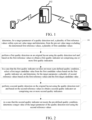
- FIG. 1 is a schematic diagram of an implementation environment of a method for determining a parameter of a quality detection tool (in all embodiments of the present disclosure, the quality detection tool can be a layout quality detection tool) according to an embodiment of this application.
- the implementation environment can includes a terminal device 101 and a server 102.
- the method for determining a parameter of a quality detection tool in the embodiments of this application may be performed by the terminal device 101, or may be performed by the server 102, or may be jointly performed by the terminal device 101 and the server 102.
- the terminal device 101 may be a smartphone, a video game console, a desktop computer, a tablet computer, a laptop portable computer, a smart TV, a smart in-vehicle device, a smart speech interaction device, a smart home appliance, or the like.
- the server 102 may be one server, or may be a server cluster formed by a plurality of servers, or may be any one of a cloud computing platform and a virtualization center. This is not limited in the embodiments of this application.
- the server 102 may be communicatively connected to the terminal device 101 by a wired network or a wireless network.
- the server 102 may have functions such as data processing, data storage, and data transmission and receiving. This is not limited in all embodiments of the present disclosure.
- a quantity of the terminal devices 101 and a quantity of the servers 102 are not limited, and one or more terminal devices or one or more servers may be used.
- a quality detection tool can usually determine quality indicators of candidate layouts. If a quality indicator of one candidate layout is greater than an indicator threshold, the candidate layout can be determined as a target layout.
- the accuracy of the quality detection tool is closely related to the accuracy of selecting the target layout, and a parameter of the quality detection tool can determine the accuracy of the quality detection tool. Therefore, how to determine the parameter of the quality detection tool becomes a problem that needs to be resolved urgently.
- a method for determining a parameter of a quality detection tool may be applied to the foregoing implementation environment.
- a value of a target parameter of a quality detection tool can be determined, thereby improving the accuracy of the quality detection tool.
- a flowchart of the method for determining a parameter of a quality detection tool according to an embodiment of this application in FIG. 2 can be used as an example.
- the terminal device 101 or the server 102 that performs the method for determining a parameter of a quality detection tool in the embodiments of this application can be referred to as an electronic device.
- the method may be performed by the electronic device.
- the method can include the following Operation 201 to Operation 205:
- the user may further input other information of the target parameter.
- the user may further input a parameter type of the target parameter.
- the electronic device may acquire a parameter type of a configured target parameter.
- the parameter type of the target parameter may be a continuous parameter or a discrete parameter.
- the electronic device may sample at least one first initial value from any first value interval according to the parameter type of the target parameter. The first initial value sampled in this manner is a value that meets the parameter type of the target parameter, thereby ensuring the reliability of the first initial value.
- the plurality of first initial values may be classified into the plurality of first reference values and the plurality of first candidate values in a random grouping manner.
- the first initial value may be randomly determined as one first reference value or one first candidate value.
- the first reference values and the first candidate values can be determined from the plurality of first initial values. The clustering manner is described below.
- the plurality of first initial values may be clustered by using any clustering algorithm to obtain a plurality of target clusters.
- the clustering algorithm is not limited in all embodiments of the present disclosure.
- the clustering algorithm includes any one of a K-means clustering algorithm, a density-based clustering algorithm, a model-based clustering algorithm, a probability-based clustering algorithm, and the like. An implementation of clustering the plurality of first initial values is described below by using the K-means clustering algorithm as an example.
- initial cluster centers of a set quantity M can be acquired, and the set quantity M is configured to indicate a quantity of target clusters.
- M is a positive integer
- the electronic device may acquire M inputted by the user, or the electronic device may randomly generate M, or the electronic device may acquire configured M.
- Any initial cluster center is a cluster center of an initial cluster.
- a manner of obtaining any initial cluster center is not limited in all embodiments of the present disclosure.
- the electronic device may acquire M initial cluster centers inputted by the user, or the electronic device may randomly generate M initial cluster centers.
- the plurality of first initial values can be clustered into M initial clusters.
- distances between the first initial value and the initial cluster centers can be calculated.
- a manner of determining the distances is not limited in all embodiments of the present disclosure. For example, any distance determination manner of a Euclidean distance, a Manhattan distance, a Chebyshev distance, and the like may be used. The smallest distance can be determined from the distances between the first initial value and the initial cluster centers, and the first initial value can be classified into an initial cluster to which an initial cluster center corresponding to the smallest distance belongs. In this manner, the first initial values may be classified into the M initial clusters.
- a cluster center of the initial cluster can be re-determined based on the first initial values included in the initial cluster.
- the re-determined cluster center is referred to as a first cluster center.
- a first threshold for example, the first threshold is 0 or 0.0001
- the cluster center of the initial cluster remains unchanged.
- the cluster center of the initial cluster has changed.
- the algorithm converges.
- the initial clusters can be used as the target clusters.
- the algorithm does not converge.
- the first cluster center is a cluster center of a first cluster
- the plurality of first initial values may be clustered into M first clusters based on M first cluster centers.
- distances between the first initial value and the first cluster centers can be calculated, the smallest distance can be determined from the distances between the first initial value and the first cluster centers, and the first initial value can be classified into an initial cluster to which a first cluster center corresponding to the smallest distance belongs. In this manner, the first initial values may be classified into the M first clusters.
- a cluster center of the first cluster can be re-determined based on the first initial values included in the first cluster.
- the re-determined cluster center is referred to as a second cluster center.
- the algorithm converges.
- the first clusters can be used as the target clusters.
- the algorithm does not converge.
- the second cluster center is a cluster center of a second cluster
- the plurality of first initial values may be clustered into M second clusters based on M second cluster centers.
- An implementation of clustering the plurality of first initial values into M second clusters is similar to the implementations of "clustering the plurality of first initial values into the M initial clusters" and "clustering the plurality of first initial values into the M first clusters" described above.
- the plurality of first initial values can keep being clustered until the algorithm converges and M target clusters are obtained.
- the clustering the plurality of first initial values by using the K-means clustering algorithm is equivalent to that according to a distance (for example, a Euclidean distance, a Manhattan distance, or a Chebyshev distance) between every two first initial values, the plurality of first initial values can be classified into M clusters, to minimize a distance between any two first initial values that belong to the same cluster and maximize a distance between any two first initial values that belong to different clusters.
- a distance for example, a Euclidean distance, a Manhattan distance, or a Chebyshev distance
- the K-means clustering algorithm converges, which is equivalent to minimizing a square error.
- the square error can be determined according to the following Formula (1).
- the square error represents a square of a distance between each first initial value and a cluster center of a cluster.
- the square error can be minimized by adjusting the cluster center continuously, so that the K-means clustering algorithm converges, to eventually obtain the M target clusters.
- Operation 2013 select at least one first initial value from the respective target cluster as the first reference values, and determine the first initial values other than the selected at least one first initial value in the respective target cluster as the first candidate values.
- At least one first initial value may be randomly selected from the first initial values included in the respective target cluster as the first reference values.
- the cluster center of the target cluster may be re-determined based on the first initial values included in any target cluster.
- the re-determined cluster center of the target cluster is referred to as a target cluster center.
- Distances between first initial values in the respective target cluster and a target cluster center of the target cluster can be calculated.
- At least one distance not greater than a second threshold can be determined from the distances between the first initial values in the respective target cluster and the target cluster center of the target cluster.
- First initial values corresponding to distances not greater than the second threshold can be determined as the first reference values.
- One or more first initial values can be selected from first initial values included in the respective target cluster as the first reference values. In other words, at least one first reference value can be determined from the first initial values included in the respective target cluster.
- the second threshold is not limited in all embodiments of the present disclosure.
- the second threshold can be a value determined empirically, or the second threshold can be the smallest value in the distances between the first initial values in the target cluster and the target cluster center of the target cluster.
- one first reference value may be determined based on one target cluster, and the first reference value is a first initial value closest to a target cluster center in the target cluster.
- a manner of selecting the at least one first initial value from the respective target clusters as the first reference values may be: calculating distances between first initial values in the respective target cluster and a target cluster center of the target cluster, and determining at least one distance not less than a third threshold from the distances between the first initial values in the respective target cluster and the target cluster center of the target cluster.
- First initial values corresponding to distances not less than the third threshold can be determined as the first reference values.
- the third threshold is a value determined empirically, or the third threshold is the largest value in the distances between the first initial values in the target cluster and the target cluster center of the target cluster.
- one first reference value may be determined based on one target cluster, and the first reference value is a first initial value farthest from a target cluster center in the target cluster.
- a mask complexity of the original layout may reflect the quality of the original layout.
- the respective first quality indicator corresponding to the respective first reference value may be a mask complexity corresponding to the first reference value.
- the quality of the original layout is described through the mask complexity.
- the mask complexity corresponding to the first reference value is negatively correlated with the original layout. To be specific, when the mask complexity corresponding to the first reference value is smaller, the quality of the original layout is higher.
- Operation 202 can include: processing the original layout according to the plurality of first reference values by using the quality detection tool to obtain predicted layouts corresponding to the first reference values, and determining the first quality indicator set corresponding to the first reference values based on the predicted layouts corresponding to the first reference values.
- the original layout in a case that the target parameter includes the respective first reference value, can be inputted into the quality detection tool, and the quality detection tool can process the original layout to obtain a predicted layout corresponding to the first reference value.
- the quality detection tool can include a photoresist model.
- the photoresist model may simulate a photolithography device in an actual scenario to perform photolithography on the original layout to obtain the predicted layout.
- the quality detection tool can perform photolithography on the chip layout.
- the quality detection tool can simulate a process of the photolithography device performing photolithography on a mask based on the chip layout to obtain a mask layout, and the mask layout is the predicted layout.
- the quality detection tool may perform photolithography on the mask layout.
- the quality detection tool can simulate a process of the photolithography device performing photolithography on a wafer based on the mask layout to obtain a wafer layout, and the wafer layout can be the predicted layout.
- the quality detection tool may analyze a pattern of a predicted layout corresponding to the respective first reference value, and an analysis result can be used as the first quality indicator of the original layout corresponding to the first reference value. Because of an interference effect and a diffraction effect in the process of photolithography, an error exists in the pattern of the predicted layout, so that the quality detection tool can analyze quality of the predicted layout based on the pattern of the predicted layout to obtain an analysis result.
- the analysis result can reflect the quality of the original layout and can reflect the quality of the predicted layout.
- a manner of analyzing the pattern by the quality detection tool is not limited in all embodiments of the present disclosure.
- the quality detection tool can determine an error between the original layout and the predicted layout corresponding to the first reference value.
- pixels in the predicted layout can correspond one-to-one to pixels in the original layout.
- the respective pixel in the predicted layout can have a corresponding pixel in the original layout.
- the quality detection tool can determine pixel differences between the pixels in the predicted layout and corresponding pixels in the original layout, and a sum value, an average value, or the like of these pixel differences can be determined as the error between the predicted layout and the original layout.
- the quality detection tool can extract a feature of the predicted layout and a feature of the original layout, and use a feature distance between the feature of the predicted layout and the feature of the original layout as the error between the predicted layout and the original layout.
- the error between the predicted layout and the original layout is smaller.
- the error between the predicted layout and the original layout may reflect the accuracy of the quality detection tool.
- the first quality indicators of the original layouts corresponding to the first reference values can be calculated through errors between the original layout and the predicted layouts corresponding to the first reference values, so that the first quality indicators of the original layouts corresponding to the first reference values can also reflect the accuracy of the quality detection tool. In this way, a value of the parameter of the quality detection tool can be adjusted to be more accurate based on the first quality indicators of the original layouts corresponding to the first reference values, thereby ensuring the accuracy of the quality detection tool.
- the quality detection tool can directly determine the quality indicators of the original layouts based on the original layouts without simulating a photolithography device in an actual scenario.
- the quality detection tool may analyze a pattern of an original layout to obtain a first quality indicator of the original layout corresponding to the first reference value.
- a manner of analyzing the pattern of the original layout by the quality detection tool is not limited in all embodiments of the present disclosure.
- Operation 203 In a case that the first quality indicator set does not meet a pre-defined quality condition, select a first target candidate value from the first candidate values based on the first quality indicator set, and determine, for the target parameter, a plurality of second reference values based on the first reference values and the first target candidate value.
- the first quality indicator set can correspond to the first reference values
- That the first quality indicators corresponding to the first reference values do not meet a pre-defined quality condition may be that a first quality indicator corresponding to at least one first reference value of the first reference values does not meet the pre-defined quality condition.
- that the first quality indicators corresponding to the first reference values do not meet a pre-defined quality condition may be that first quality indicators corresponding to some first reference values or all first reference values of the first reference values do not meet the pre-defined quality condition. That a first quality indicator corresponding to the respective first reference value does not meet the pre-defined quality condition is not limited in all embodiments of the present disclosure.
- the reference threshold can be set empirically, or can be flexibly adjusted according to an application scenario. This is not limited in all embodiments of the present disclosure.
- the quality indicator is negatively correlated with the quality of the original layout, for example, the quality indicator is a mask complexity, an edge distance error, or the like
- the quality indicator when a first quality indicator corresponding to the respective first reference value is greater than the reference threshold, it can be determined that a first quality indicator corresponding to the respective first reference value does not meet the pre-defined quality condition; and when a first quality indicator corresponding to the respective first reference value is not greater than the reference threshold, it can be determined that a first quality indicator corresponding to the respective first reference value meets the pre-defined quality condition.
- the first quality indicators corresponding to the first reference values can be determined in an iterative calculation manner.
- a quantity of iterations for determining the first quality indicators corresponding to the first reference values may be acquired. If the quantity of iterations is less than a quantity threshold, it can be determined that the first quality indicators corresponding to the first reference values do not meet the pre-defined quality condition. If the quantity of iterations is not less than the quantity threshold, it can be determined that the first quality indicators corresponding to the first reference values meet the pre-defined quality condition.
- the quantity threshold can be set empirically, or can be flexibly adjusted according to an application scenario. This is not limited in all embodiments of the present disclosure.
- a quantity of the first reference values is M
- a quantity of the first candidate values is L-M.
- First quality indicators corresponding to the M first reference values may be sequentially denoted as (y 1 , ..., y m , ..., y M ).
- the first target candidate value may be determined from the L-M first candidate values based on (y 1 , ..., y m , ..., y M ).
- M is an integer greater than 1
- L-M is an integer greater than 1.
- the "selecting a first target candidate value from the plurality of first candidate values based on the first quality indicator set corresponding to the first reference values" in Operation 203 can include Operation 2031 and Operation 2032 (not shown in the figure).
- One first target candidate value may be used, or a plurality of first target candidate values may be used.
- at least one first target candidate value can be used.
- at least one first target candidate value can be determined from the plurality of first candidate values based on the first quality indicator set corresponding to the first reference values, and the plurality of second reference values of the target parameter can be determined based on the plurality of first reference values and the at least one first target candidate value.
- Operation S1 Determine a first mapping relationship based on the respective first reference value and the at least one first quality indicator corresponding to the respective first reference value, the first mapping relationship being configured to describe a mapping relationship between the respective first reference value and statistical information of a statistical distribution in a case that the at least one quality indicators corresponding to the respective first reference values meets the statistical distribution.
- M Gaussian process (GP) regression models may be determined based on the M first reference values and the first quality indicators (y 1 , ..., y m , ..., y M ) corresponding to the M first reference values.
- An m th Gaussian process regression model can be configured to describe a mapping relationship between an m th first reference value and a mean value and a variance of a Gaussian distribution in a case that a first quality indicator y m corresponding to the m th first reference value meets the Gaussian distribution.
- the first mapping relationship can be described through the M Gaussian process regression models.
- exp represents an exponential function with the natural constant e as the base, ⁇ is a summation symbol, x i represents an i th first reference value of the target parameter x, x i ′ represents an i th value of another parameter, n is a dimension of x, and ⁇ i 2 is a hyperparameter obtained through maximum-likelihood estimation.
- Operation S2 For the respective first candidate value, determine statistical information corresponding to the respective first candidate value based on the respective first candidate value and the first mapping relationship, and determine the at least one evaluation indicator for the respective first candidate value based on the statistical information corresponding to the respective first candidate value.
- the first mapping relationship can reflect a mapping relationship between the first reference values and statistical information.
- the first mapping relationship may map the respective first reference value into corresponding statistical information. Based on this, through the first mapping relationship, the respective first candidate value may be mapped into statistical information corresponding to the respective first candidate value.
- At least one evaluation indicator of the respective first candidate value can be calculated by using the statistical information corresponding to the respective first candidate value.
- a calculation manner of the evaluation indicator of the first candidate value is not limited.
- the statistical information corresponding to the first candidate value can be weighted to obtain the evaluation indicator of the first candidate value, or the evaluation indicator of the first candidate value can be determined according to Operation S21 to Operation S23 discussed below.
- the statistical information corresponding to the respective first candidate value can include a mean value and a variance.
- the first mapping relationship can include a Gaussian process regression model.
- the model may predict a first candidate value to obtain a mean value ⁇ m (x) and a variance ⁇ m (x) corresponding to the first candidate value.
- the "determining the at least one evaluation indicator of the respective first candidate value based on the statistical information corresponding to the respective first candidate value" in Operation S2 can include Operation S21 to Operation S23 (not shown in the figure).
- Operation S21 Determine a reference quality indicator from the at least one first quality indicator corresponding to the respective first reference values.
- one first quality indicator can be randomly determined from the first quality indicators corresponding to the first reference values, or the reference quality indicator can be determined according to Implementation A1 or Implementation A2 discussed below.
- the respective first reference value can correspond to one first quality indicator.
- Operation S21 can include: determining the smallest quality indicator from the at least one first quality indicator corresponding to the first reference value, and determining the smallest quality indicator as the reference quality indicator.
- one quality indicator can be configured to describe an original layout.
- one first reference value can correspond to one first quality indicator.
- the quality indicator of the original layout can be a mask complexity of the original layout, and one first reference value can correspond to one mask complexity.
- the single-target minimization optimization is optimizing a quality indicator corresponding to an aspect obtained when the quality detection tool performs a quality detection on the original layout in the aspect. In other words, the single-target minimization optimization is optimizing a single quality indicator in the quality detection tool.
- the M first reference values can correspond to M first quality indicators, which are respectively (y 1 , ..., y m , ..., y M ).
- the smallest quality indicator may be determined from the first quality indicators corresponding to the first reference values, and the smallest quality indicator can be determined as the reference quality indicator.
- the respective first reference value can correspond to a plurality of quality indicators.
- Operation S21 can include Operation S211 to Operation S213 (not shown in the figure).
- a plurality of quality indicators can be configured to describe an original layout.
- one first reference value can correspond to a plurality of first quality indicators.
- the quality indicator of the original layout can include a mask complexity of the original layout and an edge distance error of the original layout, and one first reference value can correspond to one mask complexity and one edge distance error.
- the multiple-target minimization optimization is optimizing a quality indicator corresponding to a plurality of aspects obtained when the quality detection tool can perform a quality detection on the original layout in the aspects. In other words, the multiple-target minimization optimization is optimizing a plurality of quality indicators in the quality detection tool.
- the quality detection tool can have a large number of adjustable parameters. These adjustable parameters can affect a quality detection result of a layout.
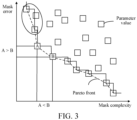
- a plurality of quality indicators are configured to represent layout quality, and a balance relationship exists between the quality indicators. For example, when a mask error is smaller, a mask complexity is higher, and manufacturing difficulty is higher. Therefore, the mask complexity and the mask error can balance out each other.
- a Pareto effect can be formed between the mask complexity and the mask error, and a Pareto optimal solution set needs to be determined.
- the Pareto optimal solution set is also referred to as a Pareto front. When the focus can be on a quality indicator, a solution inclining toward the quality indicator on the Pareto front may be determined.
- FIG. 3 is a schematic diagram of a Pareto front between a mask error and a mask complexity according to an embodiment of this application.
- a mask error A is greater than a mask error B
- a mask complexity A is less than a mask complexity B.
- a and B are data on the Pareto front.
- the data can include a mask error and a mask complexity.
- Operation S211 For the respective first quality indicator of the plurality of first quality indicators, determine a maximum value and a minimum value of the respective first quality indicator from the respective first quality indicators corresponding to the respective first reference values.
- each first reference value can correspond to M first quality indicators.
- a maximum value y m max of the m th first quality indicator and a minimum value y m min of the m th first quality indicator may be determined from the m th first quality indicators corresponding to the first reference values.
- Operation S212 For the respective quality indicator corresponding to the respective first reference value, determine a priority indicator of the respective first quality indicator corresponding to the respective first reference value based on a first selected quality indicator, a weight of the first selected quality indicator, and the maximum value and the minimum value of the first selected quality indicator, the first selected quality indicator being at least one of the plurality of first quality indicators corresponding to the respective first reference value, the first selected quality indicator including the respective first quality indicator corresponding to the respective first reference value.
- the electronic device may acquire a weight of any first quality indicator.
- the weight can be configured to describe the importance of the first quality indicator. In other words, when the weight of any quality indicator is larger, the first quality indicator is more important, and can better reflect the quality of the original layout.
- a manner of acquiring the weight of any first quality indicator is not limited in all embodiments of the present disclosure.
- the electronic device may acquire a weight of any inputted first quality indicator, or the electronic device may determine a weight of any first quality indicator according to a quantity of first quality indicators. For example, two first quality indicators can be used, and a weight of each first quality indicator can be 0.5.
- the first quality indicators can be sorted to obtain the sorted first quality indicators.
- the first quality indicators may be sorted in a manual sorting manner, or the first quality indicators may be sorted in a random sorting manner.
- calculation may be performed by using the first quality indicator and the first quality indicators sorted following the first quality indicator.
- the first quality indicators used to calculate the first priority indicator of the respective quality indicator corresponding to the respective first reference value are referred to as first selected quality indicators.
- the first selected quality indicator i.e., at least one first quality indicator of the plurality of first quality indicators corresponding to the respective first reference value
- the first selected quality indicator can include any first quality indicator corresponding to any first reference value.
- the first selected quality indicator i.e., at least one first quality indicator of the plurality of first quality indicators corresponding to any first reference value
- the first selected quality indicator can include any first quality indicator corresponding to any first reference value and first quality indicators sorted following any first quality indicator corresponding to any first reference value.
- each first reference value can correspond to M first quality indicators
- the respective first reference value is the i th first reference value and the respective first quality indicator is an m th quality indicator
- at least one first quality indicator in a plurality of first quality indicators corresponding to the i th first reference value can include an m th to an M th first quality indicators corresponding to the i th first reference value.
- One or more second target candidate values can be used.
- at least one second target candidate value can be used.
- at least one second target candidate value can be determined from the plurality of second candidate values based on the second quality indicator set corresponding to the second reference values, the plurality of third reference values can be determined based on the plurality of second reference values and the at least one second target candidate value, the plurality of second candidate values including first candidate values other than the at least one first target candidate value of the plurality of first candidate values.
- the reference quality indicator can be determined from the first quality indicator set corresponding to the first reference values, and the reference quality indicator may be determined as the determined first quality indicator.
- the determined second quality indicator can be acquired from the second quality indicator set corresponding to the second reference values according to the implementation principle in Operation S213. If the determined first quality indicator is less than the determined second quality indicator, the pre-set value range can be halved with the first reference value corresponding to the determined first quality indicator as the center or with the second reference value corresponding to the determined second quality indicator as the center. If the determined first quality indicator is greater than the determined second quality indicator, the pre-set value range can be doubled with the first reference value corresponding to the determined first quality indicator as the center or with the second reference value corresponding to the determined second quality indicator as the center.
- the target value can be determined in an iterative manner. Therefore, it may be determined, for every specific quantity of iterations, whether to reduce or expand a value range.
- N N is a positive integer, for example, N is 3
- a previous iteration can correspond to the determined first quality indicator in all embodiments of the present disclosure
- a next iteration can correspond to the determined second quality indicator in all embodiments of the present disclosure. If the determined first quality indicator is less than the determined second quality indicator in every two adjacent iterations, the value range can be reduced, and if the determined first quality indicator is greater than the determined second quality indicator in two adjacent iterations, the value range can be expanded.
- a length of the reduced value range is not less than a first length, and a length of an expanded value range is not greater than a second length.
- the value ranges before and after reduction and expansion need to be constrained to be appropriate, to avoid extreme cases.
- a length of the second value range is not less than the first length, and the length of the second value range is not greater than the second length.
- the first length is a minimum length of an appropriate value range
- the second length is a maximum length of the appropriate value range
- the first length and the second length may be set empirically, or flexibly adjusted according to an application scenario. This is not limited in all embodiments of the present disclosure.
- the reducing the value range is also referred to as reducing a mesh
- the expanding the value range is also referred to as expanding the mesh.
- a value space of the target parameter can be optimized by reducing and expanding the mesh.
- the accuracy of the second candidate values and the third reference values can be improved, and the efficiency of seeking a Pareto optimal solution can be improved, to be specific, the efficiency of determining the target value can be improved.
- the value can be kept from being increased blindly, to take both a calculation amount and calculation efficiency into consideration, thereby determining the target value with a small calculation amount and high calculation efficiency.
- Operation 2062 Divide the second value range into a plurality of second value intervals.
- an implementation principle of Operation 2062 is similar to the implementation principle of "dividing the first value range into a plurality of first value intervals", and refer to the description of Operation 201. Details are not described herein again.
- Operation 2063 Perform a sampling in the second value intervals to obtain a plurality of first supplementary values and a plurality of second supplementary values.
- a manner of determining the first supplementary values is similar to the manner of determining the first candidate value in Operation 201, and a manner of determining the second supplementary values is similar to the manner of determining the first reference values in Operation 201. Therefore, an implementation principle of Operation 2063 is similar to the implementation principle of "performing a sampling in the first value intervals to obtain the plurality of first reference values and the plurality of first candidate values", refer to the description of 201. Details can be not described herein again.
- Operation 2064 Determine the plurality of first supplementary values and first candidate values other than the first target candidate values among the plurality of first candidate values as the plurality of second candidate values, and determine a second target candidate value from the plurality of second candidate values based on the second quality indicator set corresponding to the second reference values.
- the plurality of second candidate values can include the plurality of first supplementary values and the first candidate values other than the first target candidate values among the plurality of first candidate values.
- the second target candidate value may be determined from the second candidate values according to the implementation principle similar to that of Operation 203.
- At least one first target candidate value and at least one second target candidate value can be used.
- the plurality of first supplementary values and the first candidate values other than the at least one first target candidate values of the plurality of first candidate values can be determined as the plurality of second candidate values, and the at least one second target candidate value can be determined from the plurality of second candidate values based on the second quality indicator set corresponding to the second reference values.
- Operation 2065 Determine the plurality of second supplementary values, the plurality of second reference values, and the second target candidate value as the plurality of third reference values.
- the third reference values include the second supplementary values, the second reference values, and the second target candidate value.
- At least one second target candidate value can be used.
- the plurality of second supplementary values, the plurality of second reference values, and the second target candidate values can be determined as the plurality of third reference values.
- Operation 207 Perform a third quality detection on the original layout according to the plurality of third reference values by using the quality detection tool to obtain a third quality indicator set comprising one or more third quality indicators corresponding to the third reference values.
- the quality detection tool can be determined with the target parameter including the respective third reference value, an original layout can be inputted into the quality detection tool, and the quality detection tool can perform a third quality detection on the original layout to obtain a third quality indicator set of the original layout corresponding to the third reference value.
- At least one third quality indicator can be used.
- the respective third reference value can correspond to at least one third quality indicator, and a result of performing the third quality detection on the original layout can include third quality indicators corresponding to the third reference values.
- the third quality indicator corresponding to the third reference value in this embodiment of this application is the third quality indicator of the original layout corresponding to the third reference value.
- Operation 207 is similar to the implementation of Operation 202, and refer to the description of Operation 202. Details are not described herein again.
- Operation 208 In a case that the third quality indicator set meets the pre-defined quality condition, determine the target value of the target parameter of the quality detection tool using the third reference values.
- the third quality indicator set can correspond to the third reference values.
- a third quality indicator corresponding to the respective third reference value meets the pre-defined quality condition is not limited in all embodiments of the present disclosure. For example, it may be determined, based on a third quality indicator corresponding to the respective third reference value and a reference threshold, whether the third quality indicator corresponding to the respective third reference value meets the pre-defined quality condition. Alternatively, a quantity of iterations for determining the third quality indicators corresponding to the third reference values can be acquired, and it can be determined, based on the quantity of iterations and the quantity threshold, whether the third quality indicators corresponding to the third reference values meet the pre-defined quality condition.
- Content of that the third quality indicator corresponding to the respective third reference value meets the pre-defined quality condition is similar to content of that the first quality indicator corresponding to the respective first reference value meets the pre-defined quality condition, and refer to the description of Operation 203. Details are not described herein again.
- the target value may be determined from the plurality of third reference values.
- the target value may be determined from the plurality of third reference values.
- the determining the target value of the target parameter can be equivalent to completing the adjustment of the parameter of the quality detection tool.
- a quality detection tool with the adjusted parameter can be used as a quality detection tool with a value of the target parameter being the target value, and the accuracy of the quality detection tool is high.
- any chip layout, any mask layout or any wafer layout may be used as the to-be-detected layout.
- a quality detection can be performed on the to-be-detected layout according to the target parameter by using the quality detection tool with the adjusted parameter to obtain the quality indicator of the to-be-detected layout.
- a photolithography device in an actual scenario can be simulated by using the quality detection tool with the adjusted parameter, photolithography can be performed on the to-be-detected layout to obtain a photolithography layout, and a pattern analysis can be performed on the photolithography layout to obtain the quality indicator of the to-be-detected layout.
- the photolithography layout may be at least one of a mask layout and a wafer layout.
- the photolithography layout may be a wafer layout.
- the photolithography layout may be a wafer layout.
- the photolithography layout may be a wafer layout.
- the quality indicator of the to-be-detected layout may be determined based on the to-be-detected layout and the photolithography layout by using the quality detection tool.
- a pattern of the to-be-detected layout may be analyzed according to the target value by using the quality detection tool to obtain the quality indicator of the to-be-detected layout.
- a manner of determining the quality indicator of the to-be-detected layout is similar to the manner of determining the quality indicator of the original layout, and refer to the description of Operation 202. Details are not described herein again.
- the to-be-detected layout is a base layout.
- the quality indicator is negatively correlated with the quality of the to-be-detected layout
- the quality indicator of the to-be-detected layout is not greater than the target threshold
- it can be determined that the to-be-detected layout is the base layout
- the quality indicator of the to-be-detected layout is greater than the target threshold
- the quality indicator is positively correlated with the quality of the to-be-detected layout
- the quality indicator of the to-be-detected layout is not less than the target threshold
- the quality indicator of the to-be-detected layout is less than the target threshold
- the determined to-be-detected layout is a base layout: If the base layout is a chip layout, the photolithography device in the actual scenario may be invoked first, and photolithography can be performed on a mask based on the chip layout to obtain the mask after photolithography. Next, the photolithography device in the actual scenario can be invoked again to perform photolithography on a wafer based on the mask after photolithography to obtain the wafer after photolithography. If the base layout is a mask layout, the photolithography device in the actual scenario may be invoked, and photolithography can be performed on a wafer based on a mask after photolithography corresponding to the mask layout to obtain the wafer after photolithography.
- the base layout may be a layout on the wafer after photolithography, i.e., a wafer layout.
- the wafer after photolithography is also referred to as an integrated circuit wafer, and is a product in a chip manufacturing process.
- a base layout of high quality can be selected, so that integrated circuit wafers of high quality can be manufactured based on the base layout, to reduce a defective rate of integrated circuit wafers, thereby reducing the production costs of integrated circuit wafers.
- the base layout is a wafer layout
- a base layout of high quality can be selected, so that integrated circuit wafers of high quality can be selected, to reduce a defective rate of integrated circuit wafers.
- Information including, but not limited to, device information of a user, and personal information of a user
- data including, but not limited to, data for analysis, stored data, and displayed data
- signals in all embodiments of the present disclosure can be all authorized by a user or fully authorized by all parties, and the collection, use, and processing of relevant data need to comply with the relevant laws, regulations, and standards of the relevant regions.
- the original layout, the first value range, and the like in this application can be all obtained with full authorization.
- a target parameter of a quality detection tool can include first reference values, and a first quality detection can be performed on an original layout by using the quality detection tool to obtain one or more first quality indicators corresponding to the first reference values. If the one or more first quality indicators corresponding to the first reference values do not meet a pre-defined quality condition, a first target candidate value can be determined from a plurality of first candidate values of the target parameter based on the one or more first quality indicators corresponding to the first reference values, and a plurality of second reference values of the target parameter can be determined based on the plurality of first reference values and the first target candidate value. The second reference values can be determined, so that the accuracy of a value space of the target parameter can be improved.
- a second quality detection can be performed on the original layout by using the quality detection tool to obtain one or more second quality indicators corresponding to the second reference values.
- the accuracy of the value space of the target parameter can be improved, to improve the accuracy of the quality detection tool, so that the accuracy of quality indicators can be improved, and in a case that the one or more second quality indicators corresponding to the second reference values meet the pre-defined quality condition, a target value of the target parameter can be accurately determined based on the second reference values, thereby ensuring the accuracy of the quality detection tool, helping to improve the accuracy of quality indicators of to-be-detected layouts determined by the quality detection tool, and more accurately selecting a layout with better quality from the to-be-detected layouts.
- a sampling can be performed in the plurality of first value intervals to obtain the first reference values and the first candidate values, which helps to improve the distribution uniformity of the first reference values and the first candidate values, thereby ensuring the comprehensiveness of the first reference values and the first candidate values.
- the first reference values can be determined in a clustering manner, to improve the accuracy of the first reference values, so that the efficiency of determining a target value can be increased.
- the first quality indicators of the original layouts corresponding to the first reference values can be calculated through errors between the original layout and the predicted layouts corresponding to the first reference values, so that the first quality indicators of the original layouts corresponding to the first reference values can reflect the accuracy of the quality detection tool. In this way, a value of the parameter of the quality detection tool can be adjusted to be more accurate based on the first quality indicators of the original layouts corresponding to the first reference values, thereby ensuring the accuracy of the quality detection tool.
- the evaluation indicator of the first candidate value can be determined by considering the statistical distribution and the statistical information, thereby ensuring the accuracy of the evaluation indicator of the first candidate value.
- the evaluation indicator of the first candidate value in consideration of different cases that the first reference value can correspond to one or more first quality indicators, in the different cases, the evaluation indicator of the first candidate value can be determined in different manners, so that the reliability of the manners of determining the evaluation indicator of the first candidate value is high, to further ensure the accuracy of the evaluation indicator of the first candidate value, thereby improving the accuracy of the eventually determined target value.
- the first target candidate value in consideration of different cases that the first candidate value can correspond to one or more evaluation indicators, in the different cases, the first target candidate value can be determined in different manners, so that the reliability of the manners of determining the first target candidate value is high, to further ensure the accuracy of the first target candidate value, thereby improving the accuracy of the eventually determined target value.
- a value space of the target parameter can be optimized by reducing and expanding the value range of the target parameter.
- the second candidate values and the third reference values can be determined based on the optimized value space, the accuracy of the second candidate values and the third reference values can be improved, and the efficiency of determining the target value can be improved.
- the value can be kept from being increased blindly, to take both a calculation amount and calculation efficiency into consideration, thereby determining the target value with a small calculation amount and high calculation efficiency.
- Two scenarios can be provided in all embodiments of the present disclosure.
- One is a scenario of determining a parameter of a quality detection tool for a single quality indicator
- the other is a scenario of determining a parameter of a quality detection tool for two quality indicators.
- the two scenarios can be separately described below.
- FIG. 4 is a schematic flowchart of determining a parameter of a quality detection tool for a single quality indicator according to an embodiment of the present disclosure.
- the procedure can include Operation 1 to Operation 4 below.
- Operation 1 Determine a reference value and a candidate value through a clustering algorithm.
- a plurality of initial values may be acquired, and the plurality of initial values can be clustered to obtain clusters.
- an initial value having the smallest distance from a cluster center of the respective cluster can be selected from the respective cluster, the selected initial value can be used as the reference value, and an unselected initial value can be used as the candidate value.
- the plurality of initial values can be classified into a plurality of reference values and a plurality of candidate values.
- Operation 1 refer to the description of Operation 201. Details are not described herein again.
- Operation 2 Perform a quality detection on an original layout by using a quality detection tool with a target parameter of the quality detection tool including a plurality of reference values to obtain errors of original layouts corresponding to the reference values.
- the quality detection tool can be determined by making the target parameter of the quality detection tool as the respective reference value.
- the original layout can be inputted into the quality detection tool, and a predicted layout corresponding to the reference value is outputted through the quality detection tool.
- the predicted layout corresponding to the reference value can be inputted into the quality detection tool, and the quality detection tool determines an error of the original layout corresponding to the reference value. In this manner, the errors corresponding to the reference values may be determined.
- Operation 2 refer to the description of Operation 202. Details are not described herein again.
- a target value can be determined based on the reference values. For a manner of determining the target value, refer to the description of Operation 205. Details are not described herein again. If the errors corresponding to the reference values are greater than the expected value, Operation 3 is performed.
- Operation 3 Determine a Gaussian process regression model based on the errors corresponding to the reference values.
- the errors corresponding to the reference values meet a Gaussian distribution.
- the Gaussian process regression model can be configured to describe a mapping relationship between a reference value and a mean value of a Gaussian distribution and a variance of the Gaussian distribution.
- Operation 3 refer to the description of Operation S1. Details are not described herein again.
- Operation 4 Determine, based on the Gaussian process regression model and a plurality of candidate values, evaluation indicators of the candidate values, and select the reference value from the plurality of candidate values based on the evaluation indicators of the candidate values.
- the Gaussian process regression model can be configured to describe a mapping relationship between a reference value and a mean value of a Gaussian distribution and a variance of the Gaussian distribution. Therefore, any candidate value can be mapped into a corresponding mean value and variance by using the Gaussian process regression model.
- an evaluation indicator of the candidate value is determined, and it can be determined, based on the evaluation indicator of the candidate value, whether the candidate value is a reference value. In this manner, the reference value can be selected from the plurality of candidate values.
- Operation 4 refer to the description of Operation S2, Implementation A1, and Implementation B1. Details are not described herein again.
- the reference value selected in Operation 4 and the reference value determined in Operation 1 can be considered as reference values in one set, and Operation 2 can be performed again based on these reference values to obtain the errors corresponding to the reference values. If the errors corresponding to the reference values can be less than or equal to the expected value, the target value can be determined based on the reference values. If the errors corresponding to the reference values can be greater than the expected value, Operation 3, Operation 4, and Operation 2 can be performed repeatedly, until the target value is determined.
- FIG. 5 is a schematic flowchart of determining a parameter of a quality detection tool for two quality indicators according to an embodiment of this application.
- the procedure can include Operation 1 to Operation 4 below.
- Operation 1 Determine a reference value and a candidate value through a clustering algorithm.
- a plurality of initial values may be acquired, and the plurality of initial values can be clustered to obtain clusters.
- an initial value having the smallest distance from a cluster center of the respective cluster can be selected from the respective cluster, the selected initial value can be used as the reference value, and an unselected initial value can be used as the candidate value.
- the plurality of initial values can be classified into a plurality of reference values and a plurality of candidate values.
- Operation 1 refer to the description of Operation 201. Details are not described herein again.
- Operation 2 Perform a quality detection on an original layout by using a quality detection tool with a target parameter of the quality detection tool including a plurality of reference values to obtain errors and complexities of original layouts corresponding to the reference values.
- the quality detection tool can be determined by making the target parameter of the quality detection tool as the respective reference value.
- the original layout can be inputted into the quality detection tool, and a predicted layout corresponding to the reference value can be outputted through the quality detection tool.
- the predicted layout corresponding to the reference value can be inputted into the quality detection tool.
- the quality detection tool can determine an error of the original layout corresponding to the reference value.
- the quality detection tool can determine a complexity of the original layout corresponding to the reference value. In this manner, the errors and complexities corresponding to the reference values may be determined.
- Operation 2 refer to the description of Operation 202. Details are not described herein again.
- a target value can be determined based on the reference values. For a manner of determining the target value, refer to the description of Operation 205. Details are not described herein again. If an error corresponding to a reference value can be greater than an expected value corresponding to the error, and/or a complexity corresponding to a reference value can be greater than an expected value corresponding to the complexity, Operation 3 can be performed.
- Operation 3 Determine, based on the errors corresponding to the reference values, a Gaussian process regression model corresponding to the errors, and determine, based on the complexities corresponding to the reference values, a Gaussian process regression model corresponding to the complexities.
- Operation 4 Determine, based on the Gaussian process regression model and a plurality of candidate values, evaluation indicators of the candidate values, and select the reference value from the plurality of candidate values based on the evaluation indicators of the candidate values.
- the Gaussian process regression model corresponding to the errors can be configured to describe a mapping relationship between a reference value and a mean value of a Gaussian distribution that the errors meet and a variance of the Gaussian distribution. Therefore, any candidate value can be mapped into a mean value and a variance that correspond to an error by using the Gaussian process regression model corresponding to the error. Based on the similar principle, any candidate value can be mapped into a mean value and a variance that correspond to a complexity by using the Gaussian process regression model corresponding to the complexity.
- an evaluation indicator corresponding to the error of the candidate value and an evaluation indicator corresponding to the complexity of the candidate value can be determined, to determine, based on the evaluation indicator corresponding to the error of the candidate value and the evaluation indicator corresponding to the complexity of the candidate value, whether the candidate value is a reference value.
- the reference value can be selected from the plurality of candidate values.
- the reference value selected in Operation 4 and the reference value determined in Operation 1 can be considered as reference values in one set, and Operation 2 can be performed again based on these reference values to obtain the errors and the complexities corresponding to the reference values. If the errors corresponding to the reference values can be less than or equal to an expected value corresponding to the errors and the complexities corresponding to the reference values can be less than or equal to an expected value corresponding to the complexities, a target value can be determined based on the reference values; or otherwise, Operation 3, Operation 4, and Operation 2 can be performed repeatedly, until the target value is determined.
- a parameter of the quality detection tool can be determined for an edge distance error. Statistics of a relationship between a quantity of iterations and an edge distance error can be collected to obtain a corresponding relationship line in FIG. 6 .
- the parameter of the quality detection tool can be further determined for the edge distance error by using four correlation algorithms. Statistics of relationships between a quantity of iterations and an edge distance error corresponding to various correlation algorithms can be collected to obtain relationship lines corresponding to Correlation algorithms 1 to 4 in FIG. 6 .
- Correlation algorithm 1 can be a random algorithm
- Correlation algorithm 2 can be a particle swarm optimization (PSO) algorithm
- Correlation algorithm 3 can be a social learning particle swarm optimization (SLPSO) algorithm
- Correlation algorithm 4 can be a random walking (RW) algorithm.
- the method in all embodiments of the present disclosure can determine a value of a target parameter of high accuracy with a small calculation amount, thereby improving the accuracy of the quality detection tool.
- a parameter of the quality detection tool may be determined for an edge distance error and a complexity.
- a data distribution corresponding to this application in FIG. 7 can be obtained by collecting statistics of a relationship between an edge distance error and a related complexity total variation.
- the parameter of the quality detection tool can be further determined for the edge distance error and the complexity by using Correlation algorithm 1.
- a data distribution corresponding to Correlation algorithm 1 in FIG. 7 can be obtained by collecting statistics of a relationship between an edge distance error and a related complexity total variation.
- each piece of data in FIG. 7 is a Pareto optimal solution.
- the data distribution of this application can correspond to 8 Pareto optimal solutions, and the data distribution of Correlation algorithm 1 can correspond to 5 Pareto optimal solutions, indicating that the method in all embodiments of the present disclosure can have more Pareto optimal solutions, making the accuracy of the quality detection tool higher.
- FIG. 8 is a schematic structural diagram of an apparatus for determining a parameter of a quality detection tool according to an embodiment of this application. As shown in FIG. 8 , the apparatus includes:
- the acquisition module 801 can be configured to: acquire a first value range of the target parameter as the pre-set value range; divide the first value range into a plurality of first value intervals; and perform a sampling in the first value intervals to obtain the plurality of first reference values and the plurality of first candidate values.
- the acquisition module 801 can be configured to: perform the sampling in the first value intervals to obtain a plurality of first initial values of the target parameter; cluster the plurality of first initial values to obtain a plurality of target clusters, each of the target clusters including at least one first initial value of the plurality of first initial values; and for the respective target cluster in the plurality of target clusters, select at least one first initial value from the respective target cluster as the first reference values, and determine the first initial values other than the selected first initial values in the respective target cluster as the first candidate values.
- the quality detection module 802 can be configured to: process the original layout according to the plurality of first reference values by using the quality detection tool to obtain predicted layouts corresponding to the first reference values, and determine the first quality indicator set corresponding to the first reference values based on the predicted layouts corresponding to the first reference values.
- the quality detection module 802 can be configured to: for the respective first reference value of the first reference values, determine an error between the original layout and a predicted layout corresponding to the respective first reference value; and determine at least one first quality indicator corresponding to the respective first reference value based on the error between the original layout and the predicted layout corresponding to the respective first reference value.
- the determination module 803 can be configured to: determine at least one evaluation indicator for the respective first candidate values based on at least one first quality indicator corresponding to the respective first reference values, the at least one evaluation indicator for the respective first candidate value being configured for describing a possibility that a quality indicator meets the pre-defined quality condition when a quality detection is performed on the original layout by using the quality detection tool in a case that the target parameter includes the respective first candidate value; and determine the first target candidate value from the plurality of first candidate values based on the at least one evaluation indicators for the respective first candidate values.
- the determination module 803 can be configured to: determine a first mapping relationship based on the respective first reference values and the at least one first quality indicators corresponding to the respective first reference values, the first mapping relationship being configured for describing a mapping relationship between the respective first reference values and statistical information of a statistical distribution in a case that the at least one first quality indicator corresponding to the respective first reference values meets the statistical distribution; and for the respective first candidate value of the first candidate values, determine statistical information corresponding to the respective first candidate value based on the respective first candidate value and the first mapping relationship, and determine the at least one evaluation indicator for the respective first candidate value based on the statistical information corresponding to the respective first candidate value.
- the statistical information corresponding to the respective first candidate value can include a mean value and a variance
- the determination module 803 can be configured to: determine a reference quality indicator from the at least one first quality indicator corresponding to the respective first reference values; determine a normal distribution function corresponding to the respective first candidate value based on the reference quality indicator and the mean value and the variance corresponding to the respective first candidate value; and determine the at least one evaluation indicator for the respective first candidate value based on the variance corresponding to the respective first candidate value, the normal distribution function corresponding to the respective first candidate value, and a cumulative density function and a probability density function of the normal distribution function corresponding to the respective first candidate value.
- the respective first reference value can correspond to one first quality indicator; and the determination module 803 can be configured to: determine the smallest first quality indicator from the at least one first quality indicator corresponding to the respective first reference value, and determine the smallest first quality indicator as the reference quality indicator.
- the respective first reference value can correspond to a plurality of first quality indicators; and the determination module 803 can be configured to: for the respective first quality indicator of the plurality of first quality indicators, determine a maximum value and a minimum value of the respective first quality indicator from the respective quality indicators corresponding to the respective first reference values; for the respective first quality indicator corresponding to the respective first reference value, determine a priority indicator of the respective first quality indicator corresponding to the respective first reference value based on a first selected quality indicator, a weight of the first selected quality indicator, and the maximum value and the minimum value of the first selected quality indicator, the first selected quality indicator being at least one of the plurality of first quality indicators corresponding to the respective first reference value, the first selected quality indicator including the respective first quality indicator corresponding to the respective first reference value; and determine the reference quality indicator from the respective first quality indicators corresponding to the respective first reference value based on the priority indicator of the respective first quality indicators corresponding to the respective first reference values.
- the determination module 803 can be configured to: determine a difference between the reference quality indicator and the mean value corresponding to the respective first candidate value; and use a quotient of the difference by the variance corresponding to the respective first candidate value as the normal distribution function corresponding to the respective first candidate value.
- the determination module 803 can be configured to: multiply the normal distribution function corresponding to the respective first candidate value by the cumulative density function of the normal distribution function corresponding to the respective first candidate value to obtain a multiplication result; add the multiplication result to the probability density function of the normal distribution function corresponding to the respective first candidate value to obtain an addition result; and multiply the addition result by the variance corresponding to the respective first candidate value to obtain the at least one evaluation indicator for the respective first candidate value.
- the respective first candidate value can correspond to one evaluation indicator
- the determination module 803 can be configured to select a first candidate value, which the evaluation indicator corresponding to is not less than a set indicator threshold, from the plurality of first candidate values based on the evaluation indicators corresponding to the respective first candidate values as the first target candidate value.
- the respective first candidate value can correspond to a plurality of evaluation indicators; and the determination module 803 can be configured to: for the respective evaluation indicator of the plurality of evaluation indicators, determine a maximum value and a minimum value of the respective evaluation indicator from the respective evaluation indicators corresponding to the respective first candidate values; for the respective evaluation indicator corresponding to the respective first candidate value, determine a priority indicator of the respective evaluation indicator corresponding to the respective first candidate value based on a selected evaluation indicator and the maximum value and the minimum value of the selected evaluation indicator, the selected evaluation indicator being at least one of the plurality of evaluation indicators corresponding to the respective first candidate value, the selected evaluation indicator including the respective evaluation indicator corresponding to the respective first candidate value; determine a target indicator from the respective evaluation indicators corresponding to the respective first candidate values based on the priority indicators of the respective evaluation indicators corresponding to the respective first candidate values; and determine a first candidate value corresponding to the target indicator as the first target candidate value.
- the determination module 803 can be further configured to: in a case that the second quality indicator set corresponding to the second reference values does not meet the pre-defined quality condition, select a second target candidate value from a plurality of second candidate values based on the second quality indicator set corresponding to the second reference values, and determine a plurality of third reference values based on the plurality of second reference values and the second target candidate value, the plurality of second candidate values including first candidate values other than the first target candidate values in the plurality of first candidate values;
- the determination module 803 can be configured to: adjust the pre-set value range of the target parameter to obtain a second value range of the target parameter; divide the second value range into a plurality of second value intervals; perform a sampling in the second value intervals to obtain a plurality of first supplementary values and a plurality of second supplementary values; determine the plurality of first supplementary values and first candidate values other than the first target candidate values among the plurality of first candidate values as the plurality of second candidate values; determine the second target candidate value from the plurality of second candidate values based on the second quality indicator set corresponding to the second reference values; and determine the plurality of second supplementary values, the plurality of second reference values, and the second target candidate value as the plurality of third reference values.
- the determination module 803 can be configured to: determine a first quality indicator not greater than a first indicator threshold from the first quality indicator set corresponding to the first reference values; determine a second quality indicator not greater than a second indicator threshold from the second quality indicator set corresponding to the second reference values; in a case that the determined first quality indicator is less than the determined second quality indicator, reduce the pre-set value range to obtain the second value range; and in a case that the determined first quality indicator is greater than the determined second quality indicator, expand the pre-set value range to obtain the second value range.
- a length of the second value range can be not less than a first length, and the length of the second value range can be not greater than a second length.
Landscapes
- Engineering & Computer Science (AREA)
- Physics & Mathematics (AREA)
- Theoretical Computer Science (AREA)
- Computer Hardware Design (AREA)
- General Physics & Mathematics (AREA)
- Evolutionary Computation (AREA)
- Business, Economics & Management (AREA)
- General Engineering & Computer Science (AREA)
- Geometry (AREA)
- Human Resources & Organizations (AREA)
- Data Mining & Analysis (AREA)
- Strategic Management (AREA)
- Economics (AREA)
- Architecture (AREA)
- Marketing (AREA)
- Computer Vision & Pattern Recognition (AREA)
- Artificial Intelligence (AREA)
- Entrepreneurship & Innovation (AREA)
- Educational Administration (AREA)
- Development Economics (AREA)
- General Business, Economics & Management (AREA)
- Tourism & Hospitality (AREA)
- Health & Medical Sciences (AREA)
- Life Sciences & Earth Sciences (AREA)
- Software Systems (AREA)
- Manufacturing & Machinery (AREA)
- Game Theory and Decision Science (AREA)
- Operations Research (AREA)
- Primary Health Care (AREA)
- Quality & Reliability (AREA)
- Medical Informatics (AREA)
- Probability & Statistics with Applications (AREA)
- Bioinformatics & Cheminformatics (AREA)
- Bioinformatics & Computational Biology (AREA)
- Evolutionary Biology (AREA)
- General Health & Medical Sciences (AREA)
- Design And Manufacture Of Integrated Circuits (AREA)
- General Factory Administration (AREA)
Applications Claiming Priority (2)
| Application Number | Priority Date | Filing Date | Title |
|---|---|---|---|
| CN202311022025.7A CN117216608A (zh) | 2023-08-14 | 2023-08-14 | 版图质量检测工具的参数确定方法、装置、设备及介质 |
| PCT/CN2023/131179 WO2025035626A1 (zh) | 2023-08-14 | 2023-11-13 | 版图质量检测工具的参数确定方法、装置、设备及介质 |
Publications (2)
| Publication Number | Publication Date |
|---|---|
| EP4530891A1 true EP4530891A1 (de) | 2025-04-02 |
| EP4530891A4 EP4530891A4 (de) | 2025-07-30 |
Family
ID=94609599
Family Applications (1)
| Application Number | Title | Priority Date | Filing Date |
|---|---|---|---|
| EP23935627.2A Pending EP4530891A4 (de) | 2023-08-14 | 2023-11-13 | Verfahren und vorrichtung zur bestimmung eines parameters eines layoutqualitätsprüfwerkzeugs sowie vorrichtung und medium |
Country Status (2)
| Country | Link |
|---|---|
| US (1) | US20250061258A1 (de) |
| EP (1) | EP4530891A4 (de) |
Family Cites Families (2)
| Publication number | Priority date | Publication date | Assignee | Title |
|---|---|---|---|---|
| US11762283B2 (en) * | 2019-12-13 | 2023-09-19 | Synopsys, Inc. | Inverse lithography and machine learning for mask synthesis |
| US12411405B2 (en) * | 2021-09-29 | 2025-09-09 | Siemens Industry Software Inc. | Optical proximity correction based on combining inverse lithography technology with pattern classification |
-
2023
- 2023-11-13 EP EP23935627.2A patent/EP4530891A4/de active Pending
-
2024
- 2024-07-11 US US18/770,482 patent/US20250061258A1/en active Pending
Also Published As
| Publication number | Publication date |
|---|---|
| EP4530891A4 (de) | 2025-07-30 |
| US20250061258A1 (en) | 2025-02-20 |
Similar Documents
| Publication | Publication Date | Title |
|---|---|---|
| US11216609B2 (en) | Generating integrated circuit placements using neural networks | |
| CN113448787B (zh) | 晶圆异常分析的方法、装置、电子设备及可读存储介质 | |
| US9147032B2 (en) | Machine-learning based datapath extraction | |
| CN112131322A (zh) | 时间序列分类方法及装置 | |
| EP3639163A1 (de) | Systeme und verfahren zur optimierung und simulation von webseitenrangordnung und -verkehr | |
| US10430536B1 (en) | Method and apparatus for yield calculation using statistical timing data that accounts for path and stage delay correlation | |
| WO2022193753A1 (zh) | 持续学习方法、装置、终端及存储介质 | |
| CN113901996A (zh) | 设备屏幕透图检测模型训练方法及设备屏幕透图检测方法 | |
| CN112420125A (zh) | 分子属性预测方法、装置、智能设备和终端 | |
| CN117576108B (zh) | 晶圆缺陷检测的可视化优化方法、装置和计算机设备 | |
| US11842130B1 (en) | Model-based simulation result predictor for circuit design | |
| CN108229572B (zh) | 一种参数寻优方法及计算设备 | |
| Francisco et al. | Multilayer CMP hotspot modeling through deep learning | |
| CN112597363B (zh) | 一种用户处理方法、装置、电子设备及存储介质 | |
| US20240135084A1 (en) | Optimizing machine learning classification models for resource constraints in electronic design automation (eda) computer aided design (cad) flows | |
| WO2025035626A1 (zh) | 版图质量检测工具的参数确定方法、装置、设备及介质 | |
| EP4530891A1 (de) | Verfahren und vorrichtung zur bestimmung eines parameters eines layoutqualitätsprüfwerkzeugs sowie vorrichtung und medium | |
| US20210264087A1 (en) | Automatic test pattern generation (atpg) for parametric faults | |
| RU2715024C1 (ru) | Способ отладки обученной рекуррентной нейронной сети | |
| US12423280B2 (en) | System and method for identifying poisoned data during data curation | |
| US12001973B2 (en) | Machine learning-based adjustments in volume diagnosis procedures for determination of root cause distributions | |
| CN119292599A (zh) | 页面组件的布局方法、装置、计算机设备及存储介质 | |
| US20250004908A1 (en) | Managing integration of new data for data pipelines | |
| Chen et al. | Optimized matrix ordering of sparse linear solver using a few-shot model for circuit simulation | |
| US12106550B2 (en) | Cell nuclei classification with artifact area avoidance |
Legal Events
| Date | Code | Title | Description |
|---|---|---|---|
| STAA | Information on the status of an ep patent application or granted ep patent |
Free format text: STATUS: UNKNOWN |
|
| STAA | Information on the status of an ep patent application or granted ep patent |
Free format text: STATUS: THE INTERNATIONAL PUBLICATION HAS BEEN MADE |
|
| PUAI | Public reference made under article 153(3) epc to a published international application that has entered the european phase |
Free format text: ORIGINAL CODE: 0009012 |
|
| STAA | Information on the status of an ep patent application or granted ep patent |
Free format text: STATUS: REQUEST FOR EXAMINATION WAS MADE |
|
| 17P | Request for examination filed |
Effective date: 20241107 |
|
| AK | Designated contracting states |
Kind code of ref document: A1 Designated state(s): AL AT BE BG CH CY CZ DE DK EE ES FI FR GB GR HR HU IE IS IT LI LT LU LV MC ME MK MT NL NO PL PT RO RS SE SI SK SM TR |
|
| A4 | Supplementary search report drawn up and despatched |
Effective date: 20250701 |
|
| RIC1 | Information provided on ipc code assigned before grant |
Ipc: G06F 18/23213 20230101AFI20250625BHEP Ipc: G06F 30/27 20200101ALI20250625BHEP Ipc: G06F 30/392 20200101ALI20250625BHEP Ipc: G06F 30/398 20200101ALI20250625BHEP Ipc: G06Q 10/0639 20230101ALI20250625BHEP Ipc: G06Q 50/04 20120101ALI20250625BHEP Ipc: G03F 1/36 20120101ALI20250625BHEP Ipc: G03F 1/70 20120101ALI20250625BHEP |