EP4530890A1 - Method and device for active learning from multimodal input - Google Patents
Method and device for active learning from multimodal input Download PDFInfo
- Publication number
- EP4530890A1 EP4530890A1 EP23200374.9A EP23200374A EP4530890A1 EP 4530890 A1 EP4530890 A1 EP 4530890A1 EP 23200374 A EP23200374 A EP 23200374A EP 4530890 A1 EP4530890 A1 EP 4530890A1
- Authority
- EP
- European Patent Office
- Prior art keywords
- input
- model
- learning
- mode
- depending
- Prior art date
- Legal status (The legal status is an assumption and is not a legal conclusion. Google has not performed a legal analysis and makes no representation as to the accuracy of the status listed.)
- Pending
Links
Images


Classifications
-
- G—PHYSICS
- G06—COMPUTING OR CALCULATING; COUNTING
- G06F—ELECTRIC DIGITAL DATA PROCESSING
- G06F18/00—Pattern recognition
- G06F18/20—Analysing
- G06F18/21—Design or setup of recognition systems or techniques; Extraction of features in feature space; Blind source separation
- G06F18/217—Validation; Performance evaluation; Active pattern learning techniques
-
- G—PHYSICS
- G06—COMPUTING OR CALCULATING; COUNTING
- G06V—IMAGE OR VIDEO RECOGNITION OR UNDERSTANDING
- G06V10/00—Arrangements for image or video recognition or understanding
- G06V10/70—Arrangements for image or video recognition or understanding using pattern recognition or machine learning
- G06V10/77—Processing image or video features in feature spaces; using data integration or data reduction, e.g. principal component analysis [PCA] or independent component analysis [ICA] or self-organising maps [SOM]; Blind source separation
- G06V10/778—Active pattern-learning, e.g. online learning of image or video features
-
- G—PHYSICS
- G06—COMPUTING OR CALCULATING; COUNTING
- G06F—ELECTRIC DIGITAL DATA PROCESSING
- G06F18/00—Pattern recognition
- G06F18/20—Analysing
- G06F18/21—Design or setup of recognition systems or techniques; Extraction of features in feature space; Blind source separation
- G06F18/217—Validation; Performance evaluation; Active pattern learning techniques
- G06F18/2178—Validation; Performance evaluation; Active pattern learning techniques based on feedback of a supervisor
- G06F18/2185—Validation; Performance evaluation; Active pattern learning techniques based on feedback of a supervisor the supervisor being an automated module, e.g. intelligent oracle
-
- G—PHYSICS
- G06—COMPUTING OR CALCULATING; COUNTING
- G06F—ELECTRIC DIGITAL DATA PROCESSING
- G06F18/00—Pattern recognition
- G06F18/20—Analysing
- G06F18/25—Fusion techniques
-
- G—PHYSICS
- G06—COMPUTING OR CALCULATING; COUNTING
- G06N—COMPUTING ARRANGEMENTS BASED ON SPECIFIC COMPUTATIONAL MODELS
- G06N20/00—Machine learning
-
- G—PHYSICS
- G06—COMPUTING OR CALCULATING; COUNTING
- G06N—COMPUTING ARRANGEMENTS BASED ON SPECIFIC COMPUTATIONAL MODELS
- G06N3/00—Computing arrangements based on biological models
- G06N3/02—Neural networks
- G06N3/04—Architecture, e.g. interconnection topology
- G06N3/044—Recurrent networks, e.g. Hopfield networks
-
- G—PHYSICS
- G06—COMPUTING OR CALCULATING; COUNTING
- G06N—COMPUTING ARRANGEMENTS BASED ON SPECIFIC COMPUTATIONAL MODELS
- G06N3/00—Computing arrangements based on biological models
- G06N3/02—Neural networks
- G06N3/04—Architecture, e.g. interconnection topology
- G06N3/045—Combinations of networks
-
- G—PHYSICS
- G06—COMPUTING OR CALCULATING; COUNTING
- G06N—COMPUTING ARRANGEMENTS BASED ON SPECIFIC COMPUTATIONAL MODELS
- G06N3/00—Computing arrangements based on biological models
- G06N3/02—Neural networks
- G06N3/08—Learning methods
-
- G—PHYSICS
- G06—COMPUTING OR CALCULATING; COUNTING
- G06N—COMPUTING ARRANGEMENTS BASED ON SPECIFIC COMPUTATIONAL MODELS
- G06N3/00—Computing arrangements based on biological models
- G06N3/02—Neural networks
- G06N3/08—Learning methods
- G06N3/091—Active learning
-
- G—PHYSICS
- G06—COMPUTING OR CALCULATING; COUNTING
- G06V—IMAGE OR VIDEO RECOGNITION OR UNDERSTANDING
- G06V10/00—Arrangements for image or video recognition or understanding
- G06V10/70—Arrangements for image or video recognition or understanding using pattern recognition or machine learning
- G06V10/77—Processing image or video features in feature spaces; using data integration or data reduction, e.g. principal component analysis [PCA] or independent component analysis [ICA] or self-organising maps [SOM]; Blind source separation
- G06V10/80—Fusion, i.e. combining data from various sources at the sensor level, preprocessing level, feature extraction level or classification level
-
- G—PHYSICS
- G06—COMPUTING OR CALCULATING; COUNTING
- G06V—IMAGE OR VIDEO RECOGNITION OR UNDERSTANDING
- G06V10/00—Arrangements for image or video recognition or understanding
- G06V10/70—Arrangements for image or video recognition or understanding using pattern recognition or machine learning
- G06V10/77—Processing image or video features in feature spaces; using data integration or data reduction, e.g. principal component analysis [PCA] or independent component analysis [ICA] or self-organising maps [SOM]; Blind source separation
- G06V10/80—Fusion, i.e. combining data from various sources at the sensor level, preprocessing level, feature extraction level or classification level
- G06V10/809—Fusion, i.e. combining data from various sources at the sensor level, preprocessing level, feature extraction level or classification level of classification results, e.g. where the classifiers operate on the same input data
- G06V10/811—Fusion, i.e. combining data from various sources at the sensor level, preprocessing level, feature extraction level or classification level of classification results, e.g. where the classifiers operate on the same input data the classifiers operating on different input data, e.g. multi-modal recognition
-
- G—PHYSICS
- G06—COMPUTING OR CALCULATING; COUNTING
- G06V—IMAGE OR VIDEO RECOGNITION OR UNDERSTANDING
- G06V10/00—Arrangements for image or video recognition or understanding
- G06V10/96—Management of image or video recognition tasks
-
- G—PHYSICS
- G06—COMPUTING OR CALCULATING; COUNTING
- G06V—IMAGE OR VIDEO RECOGNITION OR UNDERSTANDING
- G06V20/00—Scenes; Scene-specific elements
- G06V20/70—Labelling scene content, e.g. deriving syntactic or semantic representations
-
- G—PHYSICS
- G06—COMPUTING OR CALCULATING; COUNTING
- G06V—IMAGE OR VIDEO RECOGNITION OR UNDERSTANDING
- G06V10/00—Arrangements for image or video recognition or understanding
- G06V10/70—Arrangements for image or video recognition or understanding using pattern recognition or machine learning
- G06V10/82—Arrangements for image or video recognition or understanding using pattern recognition or machine learning using neural networks
Definitions
- the invention relates to a device and a method for active learning from multimodal input.
- Active learning approaches assume a fixed budget in terms of number of images acquired, and simulate this by learning in iterations and adding a certain number of the acquired images during each iteration.
- the images that are added are selected based on some criteria.
- the method and device for active learning from input according to the independent claims uses an acquisition function for selecting, from the input, the input to be labelled.
- Multimodal input in this context refers to sensor data of different modes, e.g., digital image, LiDAR image, radar image, ultrasound image, infrared image, sound, to the multimodal sensor data.
- the acquisition function leverages the modes from the multimodal input and their associated costs to minimize a total cost spent and to maximize network performance.
- different tasks from different modes can be complementary in the fusion setup, it may not be required to label the input of all modes of the multimodal input, and in fact it may be undesirable considering different annotation costs.
- the method for active learning from multimodal input comprises providing the input and learning a model depending on the input, wherein the input comprises input of different modes, and wherein learning the model comprises determining an input of a mode from the input of different modes depending on an acquisition function that comprises a measure for a cost for labelling the input of the mode, labelling the input of the mode with a label, and learning the model depending on the label.
- the acquisition function may comprise a measure of an uncertainty of the model with respect to the input of the mode.
- the method may comprise active learning the model for different tasks, wherein the acquisition function comprises a measure for a synergy of learning the different tasks with the input of the mode.
- the method may comprise determining inputs of different modes from the input of different modes depending on the acquisition function.
- Providing the input may comprise providing the input to comprise an input of the mode digital image, LiDAR image, radar image, ultrasound image, infrared image, or acoustic signal.
- Providing the input may comprise capturing the input with sensors, in particular a digital image sensor, a LiDAR image sensor, a radar image sensor, an ultrasound image sensor, an infrared image sensor, or an acoustic signal sensor.
- sensors in particular a digital image sensor, a LiDAR image sensor, a radar image sensor, an ultrasound image sensor, an infrared image sensor, or an acoustic signal sensor.
- the method may comprise learning the model to map the input with the model to an output, and actuating a technical system depending on the output.
- the device for active learning from multimodal input characterized in that the device comprises at least one processor and at least one memory that is configured to store instructions that when executed by the at least one processor cause the device to execute the method according to one of the claims 1 to 6, wherein the processor is configured to execute the instructions.
- the device may comprise sensors or an interface for sensors for capturing the input.
- the device may comprise an actuator or an interface for an actuator for actuating a technical system.
- a technical system that comprises the device has advantages that correspond to the advantages of the device.
- a computer program comprises that computer readable instructions that, when executed by a computer, cause the computer to execute the steps of the method has advantages that correspond to the advantages of the method.
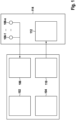
- Figure 1 schematically depicts a device 100 for active learning from multimodal input.
- the device 100 comprises at least one processor 102 and at least one memory 104.
- the at least one memory 104 is configured to store instructions that when executed by the at least one processor 102 cause the device 100to execute a method for active learning from multimodal input.
- the at least one processor 102 is configured to execute the instructions.
- the instructions may be computer readable instructions.
- a computer program my comprise the computer readable instructions.
- the computer readable instructions are configured to cause a computer to execute the steps of the method, when executed by the computer.
- the device 100 may comprise in interface 106 for sensors 108-1, ..., 108-n for capturing the input.
- the device 100 may comprise the sensors 108-1, ..., 108-n, e.g., a digital image sensor, a LiDAR image sensor, a radar image sensor, an ultrasound image sensor, an infrared image sensor, or an acoustic signal sensor.
- the device 100 may comprise an interface 110 for an actuator 112 for actuating a technical system 114.
- the device 100 may comprise the actuator 112.
- the technical system 114 may comprise the device 100.
- the technical system 114 may comprise the sensors 108-1, ..., 108-n and/or the actuator 112.
- Figure 2 schematically depicts a first embodiment of active learning comprising a fusion of sensor data.
- the sensor data in the example is input from the sensors 108-1, ..., 108-n.
- the input may comprise an input of the mode digital image, LiDAR image, radar image, ultrasound image, infrared image, or acoustic signal.
- the active learning comprises a signal processing 202, a fusion 204, a feature extraction 206 and a decision 208.
- the input is processed by the signal processing 202 to determine processed data of individual sensors.
- the processed data is processed in the fusion 204.
- the feature extraction 206 extracts information from the result of the fusion and an output 210 of the decision 208 is determined from a result of the feature extraction 206.
- Figure 3 schematically depicts a second embodiment of active learning comprising a fusion of feature vectors representing sensor data.
- the feature extraction 206 extracts features from the result of the signal processing 202 and the fusion 204 processes the result of the feature extraction 206.
- the output 210 of the decision 208 is determined from a result of the fusion 204.
- Figure 4 schematically depicts a third embodiment of active learning comprising a fusion of decisions resulting from sensor data.
- the feature extraction 206 extracts features from the result of the signal processing 202 and the decision 208 determines decisions from the result of the feature extraction 206.
- the fusion 204 processes the decisions to determine the output 210.
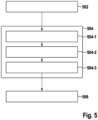
- Fig. 5 depicts a flowchart comprising steps of a method for active learning from multimodal input.
- the method comprises a step 502.
- step 502 the input is provided.
- the input comprises input of different modes.
- the input comprises for example an input of the mode digital image, LiDAR image, radar image, ultrasound image, infrared image, or acoustic signal.
- the input may be captured with the sensors 108-1,..., 108-n, in particular with the digital image sensor, the LiDAR image sensor, radar image sensor, the ultrasound image sensor, the infrared image sensor, or the acoustic signal sensor.
- the method comprises a step 504.
- step 504 a model F is learned depending on the input.
- the model F may comprise a neural network, in particular a deep neural network, that comprises weights.
- the model F may be adapted to map the input to an output of the model depending on the weights.
- Active learning the model F may comprise determining the weights.
- Active learning is described by way of example for one task and different modes.
- model F is trained on the different modes for the purpose of solving a single task.
- the task are classification, image segmentation (pixel-level classification), 2D object detection, 3D object detection, depth prediction, free-space detection.
- the model F comprises a backbone and a task-specific head.
- the backbone receives the input of different modes as input.
- the head outputs the output of the model.
- the method applies also for the model F that is configured for solving different tasks.
- the model F for solving different tasks may comprise the backbone and different task-specific heads. This allows to run the deep neural network in spite of hardware constraints on a resource-limited chip, e.g., in a car.
- the backbone may be trained jointly with the task-specific head or with the task-specific heads.
- the backbone may be a convolutional backbone.
- the head may be configured for two-dimensional road sign detection or two-dimensional object detection, or semantic segmentation, or three-dimensional vehicle detection.
- Learning the model F comprises a step 504-1.
- Step 504-1 comprises determining an input of a mode m or inputs of different modes from the input of different modes.
- active learning may comprise selecting the input of one mode m for labelling or selecting inputs of different modes for labelling. According to the example, at least one mode is not selected for labelling.
- the input of the mode m is determined depending on an acquisition function acq.
- the provided inputs of different modes are a pool of unlabeled data points X u .
- Active learning focuses on selecting new data points from the unlabeled pool of data to be annotated and added to a training set X.
- the cost may be in euros.
- the cost may be influenced by multiple factors when considering real-world annotation, such as the level of difficulty of providing an accurate annotation or the training required to annotate or the time required to provide an annotation. For example, selecting pixels in a digital image corresponding to a cat requires no training for a human, selecting pixels corresponding to a tumor in a brain scan requires extensive training of the human.
- the acquisition function acq may comprise a measure of an uncertainty Unc ( F,x u ) of the model M with respect to the input of the mode.
- the measure of the uncertainty enables selecting data points the trained network is uncertain about.
- the measure of the uncertainty Unc ( F,x u ) may be the entropy over the output of the model M .
- the output of the Model F for classification may be a SoftMax vector.
- the measure of the uncertainty Unc ( F,x u ) may be substituted with another measure, e.g., an acquisition function that disregards the cost mentioned above.
- the measure of the uncertainty Unc ( F,x u ) may be disregarded, e.g., set to Zero.
- the acquisition function may comprise a measure for a synergy of learning the different tasks with the input of the mode.
- This synergy can be either positive or negative, i.e., conflicting loss directions can result in slower convergence and reduced performance on individual tasks, or the presence of similar semantic content can result in better performance, i.e., individual tasks benefit from a shared, improved feature representation, resulting in increased performance on individual tasks.
- the activation function may be relu.
- the synergy function Syn p is suitable for different modes when assuming that there is a set of data points for which the training set X comprises an input of all of the different modes.
- the synergy function Syn p compares the activations of all of the shared weights for an unlabeled input on the trained model in question, and looks for situations where the same weight displays a high activation for both input modes.
- the input modes are of the same semantic scene.
- the constraint requiring the input modes to be of the same semantic scene may also be relaxed, e.g., the synergy could be determined pairwise with other input of the training data for a given mode. For example, the synergy of an unlabeled image and labeled images in the training set X is determined for a given mode.
- the input that minimizes the acquisition function is determined. This means that the input is selected for labelling that has the least cost for labelling and is expected to maximize the model performance.
- the method may comprise selecting an input that has less cost or a better expected model performance than another input.
- Step 504-2 Learning the model comprises a step 504-2.
- Step 504-2 comprises labelling the input of the mode with a label.
- the label may comprise a pixel-level annotation of the input of the mode m.
- Step 504-3 Learning the model comprises a step 504-3.
- the step 504-3 comprises learning the model depending on the label.
- the model F is configured to map the input with the model F to an output.
- the output may be the output 210 of the decision 208 or the output 210 of the fusion 204 that processes the decisions to determine the output 210.
- the model F is trained with the input to map the input to the output.
- the model F may be trained depending on a batch of inputs comprising the input.
- the batch of inputs may be determined in iterations of the steps 504-1 and 504-2.
- a certain number of inputs to be labeled is selected iteratively based on the output of the acquisition function.
- the selected input is then labeled and added to the training set X, either in actuality for a real system or simulated in an experimental setting.
- the task-specific loss function L t may be a cross-entropy or man-squared error.
- the model F may be retrained until some termination criterion is met. For example, the model F is trained until either a performance threshold, e.g., 99% accuracy, or a budget restriction, e.g., a total number of inputs, or money spent is met.
- a performance threshold e.g., 99% accuracy
- a budget restriction e.g., a total number of inputs, or money spent is met.
- the model F may be trained on the training set X and then an inference for a plurality of unlabeled data points x u may be conducted with the trained model F.
- the acquisition function acq may be used for the outputs of the inference to determine a score per unlabeled data point x u and the unlabeled data point x u with the highest score may be selected for labelling.
- the unlabeled data point may be sent for labeling to be annotated, and added to the training dataset X, Y.
- the model F may be retrained using the new, updated training dataset X, Y, and the process is repeated to acquire new datapoints, until a termination criterion is reached.
- the model F may comprise the signal processing 202, the fusion 204, the feature extraction 206 and the decision 208.
- the synergy function may work on only shared weights. Shared weights in the first embodiment may be fusion 204 and feature extraction 206. Shared weights in the second embodiment may be feature extraction 206 and fusion 204. Shared weights in the third embodiment may be fusion 204 of the decisions.
- the method may comprise a step 506.
- step 506 the technical system 114 may be actuated depending on the output.
- the step 502 may be executed afterwards.
Landscapes
- Engineering & Computer Science (AREA)
- Theoretical Computer Science (AREA)
- Physics & Mathematics (AREA)
- General Physics & Mathematics (AREA)
- Artificial Intelligence (AREA)
- Evolutionary Computation (AREA)
- Data Mining & Analysis (AREA)
- Software Systems (AREA)
- Computer Vision & Pattern Recognition (AREA)
- Computing Systems (AREA)
- Health & Medical Sciences (AREA)
- General Health & Medical Sciences (AREA)
- General Engineering & Computer Science (AREA)
- Life Sciences & Earth Sciences (AREA)
- Multimedia (AREA)
- Databases & Information Systems (AREA)
- Computational Linguistics (AREA)
- Medical Informatics (AREA)
- Mathematical Physics (AREA)
- Molecular Biology (AREA)
- Biophysics (AREA)
- Biomedical Technology (AREA)
- Bioinformatics & Cheminformatics (AREA)
- Bioinformatics & Computational Biology (AREA)
- Evolutionary Biology (AREA)
- Image Analysis (AREA)
- Feedback Control In General (AREA)
- Developing Agents For Electrophotography (AREA)
Abstract
Device and computer-implemented method for active learning from multimodal input, wherein the method comprises providing (502) the input and learning (504) a model depending on the input, wherein the input comprises input of different modes, and wherein learning (504) the model comprises determining (504-1) an input of a mode from the input of different modes depending on an acquisition function that comprises a measure for a cost for labelling the input of the mode, labelling (504-2) the input of the mode with a label, and learning (504-3) the model depending on the label. Technical system comprising the device.
Description
- The invention relates to a device and a method for active learning from multimodal input.
- Active learning approaches assume a fixed budget in terms of number of images acquired, and simulate this by learning in iterations and adding a certain number of the acquired images during each iteration. The images that are added are selected based on some criteria.
- The method and device for active learning from input according to the independent claims uses an acquisition function for selecting, from the input, the input to be labelled. Multimodal input in this context refers to sensor data of different modes, e.g., digital image, LiDAR image, radar image, ultrasound image, infrared image, sound, to the multimodal sensor data. In a sensor data fusion setup, the acquisition function leverages the modes from the multimodal input and their associated costs to minimize a total cost spent and to maximize network performance. As different tasks from different modes can be complementary in the fusion setup, it may not be required to label the input of all modes of the multimodal input, and in fact it may be undesirable considering different annotation costs.
- The method for active learning from multimodal input comprises providing the input and learning a model depending on the input, wherein the input comprises input of different modes, and wherein learning the model comprises determining an input of a mode from the input of different modes depending on an acquisition function that comprises a measure for a cost for labelling the input of the mode, labelling the input of the mode with a label, and learning the model depending on the label.
- The acquisition function may comprise a measure of an uncertainty of the model with respect to the input of the mode.
- The method may comprise active learning the model for different tasks, wherein the acquisition function comprises a measure for a synergy of learning the different tasks with the input of the mode.
- The method may comprise determining inputs of different modes from the input of different modes depending on the acquisition function.
- Providing the input may comprise providing the input to comprise an input of the mode digital image, LiDAR image, radar image, ultrasound image, infrared image, or acoustic signal.
- Providing the input may comprise capturing the input with sensors, in particular a digital image sensor, a LiDAR image sensor, a radar image sensor, an ultrasound image sensor, an infrared image sensor, or an acoustic signal sensor.
- The method may comprise learning the model to map the input with the model to an output, and actuating a technical system depending on the output.
- The device for active learning from multimodal input, characterized in that the device comprises at least one processor and at least one memory that is configured to store instructions that when executed by the at least one processor cause the device to execute the method according to one of the claims 1 to 6, wherein the processor is configured to execute the instructions.
- The device may comprise sensors or an interface for sensors for capturing the input.
- The device may comprise an actuator or an interface for an actuator for actuating a technical system.
- A technical system that comprises the device has advantages that correspond to the advantages of the device.
- A computer program comprises that computer readable instructions that, when executed by a computer, cause the computer to execute the steps of the method has advantages that correspond to the advantages of the method.
- Further advantageous embodiments are derivable from the following description and the drawing. In the drawing:
- Fig. 1
- schematically depicts a device for active learning from multimodal input,
- Fig. 2
- schematically depicts a first embodiment of active learning comprising a fusion of sensor data,
- Fig. 3
- schematically depicts a second embodiment of active learning comprising a fusion of feature vectors representing sensor data,
- Fig. 4
- schematically depicts a third embodiment of active learning comprising a fusion of decisions resulting from sensor data,
- Fig. 5
- depicts a flowchart comprising steps of a method for active learning from multimodal input.
-
Figure 1 schematically depicts a device 100 for active learning from multimodal input. - The device 100 comprises at least one
processor 102 and at least onememory 104. - The at least one
memory 104 is configured to store instructions that when executed by the at least oneprocessor 102 cause the device 100to execute a method for active learning from multimodal input. - The at least one
processor 102 is configured to execute the instructions. - The instructions may be computer readable instructions. A computer program my comprise the computer readable instructions. The computer readable instructions are configured to cause a computer to execute the steps of the method, when executed by the computer.
- The device 100 may comprise in
interface 106 for sensors 108-1, ..., 108-n for capturing the input. The device 100 may comprise the sensors 108-1, ..., 108-n, e.g., a digital image sensor, a LiDAR image sensor, a radar image sensor, an ultrasound image sensor, an infrared image sensor, or an acoustic signal sensor. - The device 100 may comprise an
interface 110 for anactuator 112 for actuating atechnical system 114. The device 100 may comprise theactuator 112. - The
technical system 114 may comprise the device 100. Thetechnical system 114 may comprise the sensors 108-1, ..., 108-n and/or theactuator 112. -
Figure 2 schematically depicts a first embodiment of active learning comprising a fusion of sensor data. The sensor data in the example is input from the sensors 108-1, ..., 108-n. The input may comprise an input of the mode digital image, LiDAR image, radar image, ultrasound image, infrared image, or acoustic signal. - The active learning comprises a
signal processing 202, afusion 204, afeature extraction 206 and adecision 208. - According to the first embodiment, the input is processed by the
signal processing 202 to determine processed data of individual sensors. The processed data is processed in thefusion 204. Thefeature extraction 206 extracts information from the result of the fusion and anoutput 210 of thedecision 208 is determined from a result of thefeature extraction 206. -
Figure 3 schematically depicts a second embodiment of active learning comprising a fusion of feature vectors representing sensor data. - In contrast to the active learning according to the first embodiment, the
feature extraction 206 extracts features from the result of thesignal processing 202 and thefusion 204 processes the result of thefeature extraction 206. Theoutput 210 of thedecision 208 is determined from a result of thefusion 204. -
Figure 4 schematically depicts a third embodiment of active learning comprising a fusion of decisions resulting from sensor data. - In contrast to the active learning according to the first embodiment, the
feature extraction 206 extracts features from the result of thesignal processing 202 and thedecision 208 determines decisions from the result of thefeature extraction 206. Thefusion 204 processes the decisions to determine theoutput 210. -
Fig. 5 depicts a flowchart comprising steps of a method for active learning from multimodal input. - The method comprises a
step 502. - In
step 502, the input is provided. - The input comprises input of different modes.
- The input comprises for example an input of the mode digital image, LiDAR image, radar image, ultrasound image, infrared image, or acoustic signal.
- The input may be captured with the sensors 108-1,..., 108-n, in particular with the digital image sensor, the LiDAR image sensor, radar image sensor, the ultrasound image sensor, the infrared image sensor, or the acoustic signal sensor.
- The method comprises a
step 504. - In
step 504, a model F is learned depending on the input. - The model F may comprise a neural network, in particular a deep neural network, that comprises weights. The model F may be adapted to map the input to an output of the model depending on the weights.
- Active learning the model F may comprise determining the weights.
- Active learning is described by way of example for one task and different modes.
- In the example the model F, is trained on the different modes for the purpose of solving a single task. Examples of the task are classification, image segmentation (pixel-level classification), 2D object detection, 3D object detection, depth prediction, free-space detection.
- By way of example, the model F comprises a backbone and a task-specific head. The backbone receives the input of different modes as input. The head outputs the output of the model.
- The method applies also for the model F that is configured for solving different tasks.
- The model F for solving different tasks may comprise the backbone and different task-specific heads. This allows to run the deep neural network in spite of hardware constraints on a resource-limited chip, e.g., in a car.
- The backbone may be trained jointly with the task-specific head or with the task-specific heads.
- The backbone may be a convolutional backbone. The head may be configured for two-dimensional road sign detection or two-dimensional object detection, or semantic segmentation, or three-dimensional vehicle detection.
- Learning the model F comprises a step 504-1.
- Step 504-1 comprises determining an input of a mode m or inputs of different modes from the input of different modes. This means, active learning may comprise selecting the input of one mode m for labelling or selecting inputs of different modes for labelling. According to the example, at least one mode is not selected for labelling.
- The input of the mode m is determined depending on an acquisition function acq.
- According to an example, the provided inputs of different modes are a pool of unlabeled data points Xu . Active learning focuses on selecting new data points from the unlabeled pool of data to be annotated and added to a training set X.
- An exemplary acquisition function acqt = -Ct (xu ) comprises a measure for a cost Ct for labelling the input of the mode xu , i.e., an unlabeled data point of the unlabeled data.
- The cost may be in euros. The cost may be influenced by multiple factors when considering real-world annotation, such as the level of difficulty of providing an accurate annotation or the training required to annotate or the time required to provide an annotation. For example, selecting pixels in a digital image corresponding to a cat requires no training for a human, selecting pixels corresponding to a tumor in a brain scan requires extensive training of the human.
- These factors can lead to different real costs when labeling an actual data point, resulting in potentially very different costs for labeling for different tasks and modalities. This is reflected in the active learning.
- The acquisition function acq may comprise a measure of an uncertainty Unc(F,xu ) of the model M with respect to the input of the mode. The measure of the uncertainty enables selecting data points the trained network is uncertain about. The measure of the uncertainty Unc(F,xu ) may be the entropy over the output of the model M. The output of the Model F for classification may be a SoftMax vector. The measure of the uncertainty Unc(F,xu ) may be substituted with another measure, e.g., an acquisition function that disregards the cost mentioned above. The measure of the uncertainty Unc(F,xu ) may be disregarded, e.g., set to Zero.
- In case of active learning for several tasks, the cost function works across the tasks.
- In case of active learning for several tasks, the acquisition function may comprise a measure for a synergy of learning the different tasks with the input of the mode.
- This synergy can be either positive or negative, i.e., conflicting loss directions can result in slower convergence and reduced performance on individual tasks, or the presence of similar semantic content can result in better performance, i.e., individual tasks benefit from a shared, improved feature representation, resulting in increased performance on individual tasks.
- For example, the synergy Synt (xu,T) is added to the acquisition function:

- An exemplary synergy function for a mode p is

- The synergy function Synp is suitable for different modes when assuming that there is a set of data points for which the training set X comprises an input of all of the different modes.
- Conceptually, the synergy function Synp compares the activations of all of the shared weights for an unlabeled input on the trained model in question, and looks for situations where the same weight displays a high activation for both input modes. Preferably, the input modes are of the same semantic scene. The constraint requiring the input modes to be of the same semantic scene may also be relaxed, e.g., the synergy could be determined pairwise with other input of the training data for a given mode. For example, the synergy of an unlabeled image and labeled images in the training set X is determined for a given mode.
- This is likely more expressive and useful, at the cost of increased computation or storage resources.
- According to the example, the input that minimizes the acquisition function is determined. This means that the input is selected for labelling that has the least cost for labelling and is expected to maximize the model performance. The method may comprise selecting an input that has less cost or a better expected model performance than another input.
- Learning the model comprises a step 504-2.
- Step 504-2 comprises labelling the input of the mode with a label.
- For a mode that comprises an image, the label may comprise a pixel-level annotation of the input of the mode m.
- Learning the model comprises a step 504-3.
- The step 504-3 comprises learning the model depending on the label.
- According to the example, the model F is configured to map the input with the model F to an output. The output may be the
output 210 of thedecision 208 or theoutput 210 of thefusion 204 that processes the decisions to determine theoutput 210. - The model F is trained with the input to map the input to the output.
- The model F may be trained depending on a batch of inputs comprising the input. The batch of inputs may be determined in iterations of the steps 504-1 and 504-2.
- For example, a certain number of inputs to be labeled is selected iteratively based on the output of the acquisition function.
- The selected input is then labeled and added to the training set X, either in actuality for a real system or simulated in an experimental setting.
- The model F is trained for example with a loss:

- The inputs X = [x1, ... , xt ] of a mode, e.g., a mode that comprises an image, is for example associated in a training dataset X, Y with a set of labels:

- The model F may be retrained until some termination criterion is met. For example, the model F is trained until either a performance threshold, e.g., 99% accuracy, or a budget restriction, e.g., a total number of inputs, or money spent is met.
- The model F may be trained on the training set X and then an inference for a plurality of unlabeled data points xu may be conducted with the trained model F. The acquisition function acq may be used for the outputs of the inference to determine a score per unlabeled data point xu and the unlabeled data point xu with the highest score may be selected for labelling.
- The unlabeled data point may be sent for labeling to be annotated, and added to the training dataset X, Y. The model F may be retrained using the new, updated training dataset X, Y, and the process is repeated to acquire new datapoints, until a termination criterion is reached.
- Referring to the examples describe in
figures 2 ,3 and4 , the model F may comprise thesignal processing 202, thefusion 204, thefeature extraction 206 and thedecision 208. The synergy function may work on only shared weights. Shared weights in the first embodiment may befusion 204 andfeature extraction 206. Shared weights in the second embodiment may befeature extraction 206 andfusion 204. Shared weights in the third embodiment may befusion 204 of the decisions. - The method may comprise a
step 506. - In
step 506 thetechnical system 114 may be actuated depending on the output. - The
step 502 may be executed afterwards.
Claims (12)
- Method for active learning from multimodal input, characterized in that the method comprises providing (502) the input and learning (504) a model depending on the input, wherein the input comprises input of different modes, and wherein learning (504) the model comprises determining (504-1) an input of a mode from the input of different modes depending on an acquisition function that comprises a measure for a cost for labelling the input of the mode, labelling (504-2) the input of the mode with a label, and learning (504-3) the model depending on the label.
- The method according to claim 1, characterized in that the method comprises and that the acquisition function comprises a measure of an uncertainty of the model with respect to the input of the mode.
- The method according to claim 1 or 2, characterized in that the method comprises active learning (504) the model for different tasks, wherein the acquisition function comprises a measure for a synergy of learning the different tasks with the input of the mode.
- The method according to one of the previous claims, characterized in that the method comprises determining (504-1) inputs of different modes from the input of different modes depending on the acquisition function.
- The method according to one of the previous claims, characterized in that the providing (502) the input comprises providing the input to comprise an input of the mode digital image, LiDAR image, radar image, ultrasound image, infrared image, or acoustic signal.
- The method according to one of the previous claims, characterized in that the providing (502) the input comprises capturing the input with sensors (108-1,..., 108-n), in particular a digital image sensor, a LiDAR image sensor, a radar image sensor, an ultrasound image sensor, an infrared image sensor, or an acoustic signal sensor.
- The method according to one of the previous claims, characterized in that the method comprises learning (504-3) the model to map the input with the model to an output, and wherein the method comprises actuating (506) a technical system depending on the output.
- Device (100) for active learning from multimodal input, characterized in that the device (100) comprises at least one processor (102) and at least one memory (104) that is configured to store instructions that when executed by the at least one processor (102) cause the device (100) to execute the method according to one of the claims 1 to 7, wherein the at least one processor (102) is configured to execute the instructions.
- The device (100) according to claim 8, wherein the device (100) comprises sensors (108-1, ..., 108-n) or an interface (106) for sensors (108-1, ..., 108-n) for capturing the input.
- The device (100) according to one of the claims 8 or 9, wherein the device (100) comprises an actuator (112) or an interface (110) for an actuator (112) for actuating a technical system (114).
- Technical system (114), characterized in that the technical system comprises the device (100).
- Computer program, characterized in that the computer program comprises computer readable instructions that, when executed by a computer, cause the computer to execute the steps of the method according to one of the claims 1 to 7.
Priority Applications (4)
| Application Number | Priority Date | Filing Date | Title |
|---|---|---|---|
| EP23200374.9A EP4530890A1 (en) | 2023-09-28 | 2023-09-28 | Method and device for active learning from multimodal input |
| JP2024141109A JP2025058921A (en) | 2023-09-28 | 2024-08-22 | Method and apparatus for active learning from multimodal inputs - Patents.com |
| CN202411290956.XA CN119721172A (en) | 2023-09-28 | 2024-09-14 | Method and apparatus for active learning from multimodal input |
| US18/888,596 US20250111658A1 (en) | 2023-09-28 | 2024-09-18 | Method and device for active learning from multimodal input |
Applications Claiming Priority (1)
| Application Number | Priority Date | Filing Date | Title |
|---|---|---|---|
| EP23200374.9A EP4530890A1 (en) | 2023-09-28 | 2023-09-28 | Method and device for active learning from multimodal input |
Publications (1)
| Publication Number | Publication Date |
|---|---|
| EP4530890A1 true EP4530890A1 (en) | 2025-04-02 |
Family
ID=88236681
Family Applications (1)
| Application Number | Title | Priority Date | Filing Date |
|---|---|---|---|
| EP23200374.9A Pending EP4530890A1 (en) | 2023-09-28 | 2023-09-28 | Method and device for active learning from multimodal input |
Country Status (4)
| Country | Link |
|---|---|
| US (1) | US20250111658A1 (en) |
| EP (1) | EP4530890A1 (en) |
| JP (1) | JP2025058921A (en) |
| CN (1) | CN119721172A (en) |
-
2023
- 2023-09-28 EP EP23200374.9A patent/EP4530890A1/en active Pending
-
2024
- 2024-08-22 JP JP2024141109A patent/JP2025058921A/en active Pending
- 2024-09-14 CN CN202411290956.XA patent/CN119721172A/en active Pending
- 2024-09-18 US US18/888,596 patent/US20250111658A1/en active Pending
Non-Patent Citations (4)
| Title |
|---|
| MARGINEANTU DRAGOS D: "Active Cost-Sensitive Learning", 30 July 2005 (2005-07-30), pages 1 - 2, XP093136841, Retrieved from the Internet <URL:https://www.ijcai.org/Proceedings/05/Papers/post-0525.pdf> [retrieved on 20240301] * |
| MENG SHEN ET AL: "Towards Balanced Active Learning for Multimodal Classification", ARXIV.ORG, CORNELL UNIVERSITY LIBRARY, 201 OLIN LIBRARY CORNELL UNIVERSITY ITHACA, NY 14853, 21 August 2023 (2023-08-21), XP091586806, DOI: 10.1145/3581783.3612463 * |
| RUIJIANG GAO ET AL: "Cost-Accuracy Aware Adaptive Labeling for Active Learning", ARXIV.ORG, CORNELL UNIVERSITY LIBRARY, 201 OLIN LIBRARY CORNELL UNIVERSITY ITHACA, NY 14853, 24 May 2021 (2021-05-24), XP081968961 * |
| SETTLES BURR ET AL: "Active Learning with Real Annotation Costs", 2008, pages 1 - 10, XP093136578, Retrieved from the Internet <URL:https://burrsettles.com/pub/settles.nips08ws.pdf> [retrieved on 20240229] * |
Also Published As
| Publication number | Publication date |
|---|---|
| CN119721172A (en) | 2025-03-28 |
| JP2025058921A (en) | 2025-04-09 |
| US20250111658A1 (en) | 2025-04-03 |
Similar Documents
| Publication | Publication Date | Title |
|---|---|---|
| US12373984B2 (en) | Multi-modal 3-D pose estimation | |
| EP3839822B1 (en) | Explainable artificial intelligence (ai) based image analytic, automatic damage detection and estimation system | |
| EP3881226B1 (en) | Object classification using extra-regional context | |
| EP3620980B1 (en) | Learning method, learning device for detecting lane by using cnn and testing method, testing device using the same | |
| EP3690741A2 (en) | Method for automatically evaluating labeling reliability of training images for use in deep learning network to analyze images, and reliability-evaluating device using the same | |
| US20240220848A1 (en) | Systems and methods for training video object detection machine learning model with teacher and student framework | |
| EP4254267A1 (en) | Methods and systems for object tracking | |
| CN113095351A (en) | Method for generating marked data by means of an improvement of the initial marking | |
| US20260100026A1 (en) | Sequence processing for a dataset with frame dropping | |
| CN118072278A (en) | Object detection method, object detection device and non-transitory storage medium thereof | |
| Danapal et al. | Sensor fusion of camera and LiDAR raw data for vehicle detection | |
| US20240378712A1 (en) | Device and method for analyzing defect in ultrasonic testing using three-dimensional deep learning model | |
| CN112465836B (en) | Thermal infrared semantic segmentation unsupervised field self-adaption method based on contour information | |
| EP3623991A1 (en) | Learning method, learning device for detecting lanes on the basis of cnn and testing method, testing device using the same | |
| EP4530890A1 (en) | Method and device for active learning from multimodal input | |
| US20250299458A1 (en) | Methods for object detection in image data | |
| CN117854028B (en) | Automatic driving multitasking scene analysis method and system | |
| JP7345680B2 (en) | Inference device, inference method, and inference program | |
| CN114418013B (en) | Hierarchical weighted noise-resistant deep metric learning method based on data distribution | |
| Maganti et al. | Object classification for autonomous vehicles using a one-stage detector algorithm | |
| Colling | Uncertainty Quantification and its Applications for Multimodal Semantic Segmentation | |
| Menon | Lidar Based 3D Object Detection Using Yolov8 | |
| US20260065154A1 (en) | Three-stage semi-supervised instance segmentation training method and system | |
| Hayashi | Object status detection in cluttered environment for robot grasping using mask-RCNN | |
| Vishal et al. | Performance Comparison of Differential Evolutionary Algorithm‐Based Contour Detection to Monocular Depth Estimation for Elevation Classification in 2D Drone‐Based Imagery |
Legal Events
| Date | Code | Title | Description |
|---|---|---|---|
| PUAI | Public reference made under article 153(3) epc to a published international application that has entered the european phase |
Free format text: ORIGINAL CODE: 0009012 |
|
| STAA | Information on the status of an ep patent application or granted ep patent |
Free format text: STATUS: THE APPLICATION HAS BEEN PUBLISHED |
|
| AK | Designated contracting states |
Kind code of ref document: A1 Designated state(s): AL AT BE BG CH CY CZ DE DK EE ES FI FR GB GR HR HU IE IS IT LI LT LU LV MC ME MK MT NL NO PL PT RO RS SE SI SK SM TR |
|
| STAA | Information on the status of an ep patent application or granted ep patent |
Free format text: STATUS: REQUEST FOR EXAMINATION WAS MADE |
|
| 17P | Request for examination filed |
Effective date: 20250902 |