EP4530886A1 - Bilderklärungssystem, bildanalysevorrichtung und bilderklärungsverfahren - Google Patents
Bilderklärungssystem, bildanalysevorrichtung und bilderklärungsverfahren Download PDFInfo
- Publication number
- EP4530886A1 EP4530886A1 EP24198483.0A EP24198483A EP4530886A1 EP 4530886 A1 EP4530886 A1 EP 4530886A1 EP 24198483 A EP24198483 A EP 24198483A EP 4530886 A1 EP4530886 A1 EP 4530886A1
- Authority
- EP
- European Patent Office
- Prior art keywords
- image
- explanatory sentence
- sentence
- explanatory
- explanation
- Prior art date
- Legal status (The legal status is an assumption and is not a legal conclusion. Google has not performed a legal analysis and makes no representation as to the accuracy of the status listed.)
- Pending
Links
Images








Classifications
-
- G—PHYSICS
- G06—COMPUTING OR CALCULATING; COUNTING
- G06F—ELECTRIC DIGITAL DATA PROCESSING
- G06F16/00—Information retrieval; Database structures therefor; File system structures therefor
- G06F16/50—Information retrieval; Database structures therefor; File system structures therefor of still image data
- G06F16/55—Clustering; Classification
-
- G—PHYSICS
- G06—COMPUTING OR CALCULATING; COUNTING
- G06F—ELECTRIC DIGITAL DATA PROCESSING
- G06F16/00—Information retrieval; Database structures therefor; File system structures therefor
- G06F16/30—Information retrieval; Database structures therefor; File system structures therefor of unstructured textual data
- G06F16/33—Querying
- G06F16/332—Query formulation
- G06F16/3329—Natural language query formulation
-
- G—PHYSICS
- G06—COMPUTING OR CALCULATING; COUNTING
- G06F—ELECTRIC DIGITAL DATA PROCESSING
- G06F16/00—Information retrieval; Database structures therefor; File system structures therefor
- G06F16/50—Information retrieval; Database structures therefor; File system structures therefor of still image data
- G06F16/58—Retrieval characterised by using metadata, e.g. metadata not derived from the content or metadata generated manually
- G06F16/583—Retrieval characterised by using metadata, e.g. metadata not derived from the content or metadata generated manually using metadata automatically derived from the content
-
- G—PHYSICS
- G06—COMPUTING OR CALCULATING; COUNTING
- G06F—ELECTRIC DIGITAL DATA PROCESSING
- G06F16/00—Information retrieval; Database structures therefor; File system structures therefor
- G06F16/50—Information retrieval; Database structures therefor; File system structures therefor of still image data
- G06F16/58—Retrieval characterised by using metadata, e.g. metadata not derived from the content or metadata generated manually
- G06F16/587—Retrieval characterised by using metadata, e.g. metadata not derived from the content or metadata generated manually using geographical or spatial information, e.g. location
-
- G—PHYSICS
- G06—COMPUTING OR CALCULATING; COUNTING
- G06V—IMAGE OR VIDEO RECOGNITION OR UNDERSTANDING
- G06V20/00—Scenes; Scene-specific elements
- G06V20/40—Scenes; Scene-specific elements in video content
- G06V20/41—Higher-level, semantic clustering, classification or understanding of video scenes, e.g. detection, labelling or Markovian modelling of sport events or news items
-
- G—PHYSICS
- G06—COMPUTING OR CALCULATING; COUNTING
- G06V—IMAGE OR VIDEO RECOGNITION OR UNDERSTANDING
- G06V20/00—Scenes; Scene-specific elements
- G06V20/50—Context or environment of the image
- G06V20/56—Context or environment of the image exterior to a vehicle by using sensors mounted on the vehicle
- G06V20/58—Recognition of moving objects or obstacles, e.g. vehicles or pedestrians; Recognition of traffic objects, e.g. traffic signs, traffic lights or roads
-
- H—ELECTRICITY
- H04—ELECTRIC COMMUNICATION TECHNIQUE
- H04W—WIRELESS COMMUNICATION NETWORKS
- H04W4/00—Services specially adapted for wireless communication networks; Facilities therefor
- H04W4/02—Services making use of location information
- H04W4/029—Location-based management or tracking services
-
- H—ELECTRICITY
- H04—ELECTRIC COMMUNICATION TECHNIQUE
- H04W—WIRELESS COMMUNICATION NETWORKS
- H04W4/00—Services specially adapted for wireless communication networks; Facilities therefor
- H04W4/30—Services specially adapted for particular environments, situations or purposes
- H04W4/40—Services specially adapted for particular environments, situations or purposes for vehicles, e.g. vehicle-to-pedestrians [V2P]
- H04W4/44—Services specially adapted for particular environments, situations or purposes for vehicles, e.g. vehicle-to-pedestrians [V2P] for communication between vehicles and infrastructures, e.g. vehicle-to-cloud [V2C] or vehicle-to-home [V2H]
Definitions
- the present invention relates to an image explanation system, an image analysis device, and an image explanation method.
- a surrounding object reflected in an image from an in-vehicle camera is recognized, and a text including a positional relationship between a vehicle and the surrounding object is output to be provided as a surrounding situation explanatory sentence.
- the invention has been made in consideration of such circumstances, and a main object thereof is to create a database of images associated with natural explanatory sentences matching a search sentence input by a human.
- an image explanation system of the invention has the following features.
- the invention provides an image explanation system including:
- FIG. 1 is a configuration diagram of an image explanation system 100.
- vehicles 91 to 93 are present as vehicles (connected cars) that can communicate with a vehicle image analysis device 1 via a communication line 8. Each of the vehicles 91 to 93 transmits various types of measurement data measured by the own vehicle to a traveling log DB 11 of the vehicle image analysis device 1 via the communication line 8.
- Each of the vehicles 91 to 93 is mounted with an in-vehicle camera that captures an image.
- the vehicle image analysis device 1 generates a situation explanatory sentence of an image captured by the in-vehicle camera.
- a general public line network for example, a fifth-generation mobile communication system, so-called 5th Generation (5G) that enables “multiple concurrent connections” and “ultra-low delay” can be used regardless of whether it is wired or wireless. Further, by taking advantage of features of a new mobile telephone system in or after 5G, effects such as generating online (real-time while traveling) explanatory sentence can also be expected.
- 5G fifth-generation mobile communication system
- FIG. 2 is a diagram showing details of the traveling log DB 11.
- the traveling log DB 11 stores the measurement data from the vehicles 91 to 93 by types of data as follows.
- the GPS is an example of a satellite positioning system.
- FIG. 3 is a diagram showing an example of still image data 111 that is a part of the vehicle traveling video data 11A.
- the still image data 111 is an example of data extracted from the vehicle traveling video data 11A obtained by imaging the vehicles 91 to 93 that travel on an expressway.
- FIG. 4 is a configuration diagram of the vehicle image analysis device 1.
- the vehicle image analysis device 1 includes an explanatory sentence generation unit 12, a large-scale language model unit 13, an explanation object setting unit 14, an explanatory sentence DB (image database) 15, a search unit 16, and an input and output unit 17 in addition to the traveling log DB 11 explained in FIG. 2 .
- the explanation object setting unit 14 includes a necessity table 14A and a recognition table 14B.
- the large-scale language model unit 13 includes a visual question answer (VQA) unit 13A and a summary generation unit 13B.
- the various types of data stored in the vehicle image analysis device 1 may be stored in a storage device (not shown) outside the vehicle image analysis device 1, and may be accessible from the vehicle image analysis device 1 via a network from the storage device.
- the explanatory sentence generation unit 12 analyzes a traveling situation of each vehicle by using the large-scale language model unit 13 and the explanation object setting unit 14 based on data in the traveling log DB 11, and generates a natural sentence for explaining the traveling situation of the vehicle according to an analysis result. Therefore, the explanatory sentence generation unit 12 analyzes whether the traveling situation of the vehicle corresponds to any one of pre-classified traffic scenes.
- the large-scale language model unit 13 is called out by the explanatory sentence generation unit 12.
- the large-scale language model unit 13 is implemented by a language vision (LAVIS) or the like that uses a natural language conversation method as an interface to exchange a question sentence and an answer sentence, and includes the following processing units.
- LAVIS language vision
- the explanation object setting unit 14 refers to the following tables to set an explanation object corresponding to a traffic scene in the explanatory sentence generation unit 12, and stores the explanation object in the explanatory sentence DB 15.
- the explanatory sentence DB 15 stores a traveling situation explanatory sentence generated by the explanatory sentence generation unit 12.
- the explanatory sentence generation unit 12 executes the following (Process 1) to (Process 3).
- a situation explanatory sentence of the image is generated based on the specified scene and the explanatory sentence for each object, and the situation explanatory sentence of the image and the image are stored in the explanatory sentence DB 15 in association with each other.
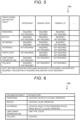
- FIG. 5 is a configuration diagram of the necessity table 14A.
- the explanation object setting unit 14 sets an explanation object for each traffic scene such as an expressway, a general road, and a parking lot.
- a combination of "expressway” as the traffic scene and “automobile” as the explanation object corresponds to "required/required”.
- the "required” in the recognition necessity information on a left side of the "required/required” expression indicates that it is necessary to recognize an explanation object from an image.
- the "required” in explanation necessity information on a right side of the "required/required” expression indicates that it is necessary to give an explanation in an explanatory sentence for an explanation object recognized or not recognized from the image.
- the explanatory sentence generation unit 12 when explanation necessity information on an object in an image is read from the necessity table 14A, and an object designated as requiring an explanation in the read explanation necessity information cannot be recognized from the image, the explanatory sentence generation unit 12 generates an explanatory sentence indicating that the object is absent in the image as the explanatory sentence for each object.
- an explanatory sentence can be generated only when an object normally absent in many cases is present, and an explanatory sentence can also be generated when an object normally present in many cases is absent. Therefore, there is an effect that a more natural traffic situation explanatory sentence can be generated, and search accuracy for a search sentence by a user is improved.
- FIG. 6 is a configuration diagram of the recognition table 14B.
- an item to be analyzed using the VQA unit 13A and an item to include an analysis result in an explanatory sentence are defined as detailed items for a recognized explanation object.
- the VQA unit 13A analyzes a location, a color of clothing, and an operation thereof.
- the explanatory sentence generation unit 12 reads detailed items of an object in an image from the recognition table 14B, and generates, as the explanatory sentence for each object, an explanatory sentence of the read detailed items of the object recognized from the image. Accordingly, information to be added by an explanation object can be individually set, and a natural traffic situation explanatory sentence can be generated. Therefore, the search accuracy for the search sentence by the user is improved.
- FIG. 7 is a flowchart of the explanatory sentence generation unit 12.
- the explanatory sentence generation unit 12 As an image explanatory sentence generation process (S21), the explanatory sentence generation unit 12 generates an image explanatory sentence by causing the VQA unit 13A to execute image analysis on the still image data 111 extracted from the vehicle traveling video data 11A.
- the process of extracting the still image data 111 is, for example, a process of extracting continuously captured images at a certain interval such as every 10 seconds, or extracting 10 images from a video file at an equal time interval.
- the explanatory sentence generation unit 12 As a GPS explanatory sentence generation process (S22), the explanatory sentence generation unit 12 generates a GPS explanatory sentence based on the vehicle traveling GPS data 11B. At this time, GPS data having a same time point as or GPS data having a closest time point to the still image data 111 in S21 is adopted as target GPS data (positioning data).
- the explanatory sentence generation unit 12 adds, to the situation explanatory sentence of the image, an explanatory sentence related to at least one piece of information of information on a time period during image capturing and information on a traveling position during the image capturing based on the GPS data read from the in-vehicle GPS of the vehicle 91.
- the explanatory sentence generation unit 12 As a control explanatory sentence generation process (S23), the explanatory sentence generation unit 12 generates a control explanatory sentence based on the vehicle traveling control data 11C. At this time, control data having a same time point as or closest to the still image data 111 in S21 is adopted as target control data.
- the explanatory sentence generation unit 12 adds, to the situation explanatory sentence of the image, an explanatory sentence related to at least one piece of information of speed information, acceleration and deceleration information, and steering angle information based on the vehicle traveling control data 11C read from the in-vehicle electronic control unit (ECU) of the vehicle 91.
- ECU electronice control unit
- the explanatory sentence generation unit 12 As a traveling situation explanatory sentence generation process (S24), the explanatory sentence generation unit 12 generates a traveling situation explanatory sentence by causing the summary generation unit 13B to summarize the image explanatory sentence generated in S21, the GPS explanatory sentence generated in S22, and the control explanatory sentence generated in S23.
- the explanatory sentence generation unit 12 associates the generated traveling situation explanatory sentence and the still image data 111 that is an explanation object of the traveling situation explanatory sentence with each other, and stores the associated data in the explanatory sentence DB 15.
- the summary generation unit 13B generates a summary sentence according to a received prompt.
- the explanatory sentence generation unit 12 generates the situation explanatory sentence of the image when a prompt including a generation instruction sentence of a situation explanatory sentence based on information included in the situation explanatory sentence, information excluded from the situation explanatory sentence, and information on an example sentence of the situation explanatory sentence and an explanatory sentence for each object is input to the summary generation unit 13B.
- FIG. 8 is a hardware configuration diagram of the vehicle image analysis device 1.
- the vehicle image analysis device 1 is implemented as a computer 900 including a CPU 901, a RAM 902, a ROM 903, an HDD 904, a communication I/F 905, an input and output I/F 906, and a medium I/F 907.
- the communication I/F 905 is connected to an external communication device 915.
- the input and output I/F 906 is connected to an input and output device 916.
- the medium I/F 907 reads and writes data from and to a storage medium 917.
- the CPU 901 improves control of the processing units by executing a program (also referred to as an application, or abbreviated as APP) read into the RAM 902.
- APP application, or abbreviated as APP
- the program can also be distributed via a communication line, or be distributed by being stored in the storage medium 917 such as a CD-ROM.
- FIG. 9 is a detailed flowchart of the image explanatory sentence generation process (S21 in FIG. 7 ).
- the explanatory sentence generation unit 12 classifies traffic scenes shown in the still image data 111 by making an inquiry to the VQA unit 13A (S211).
- the VQA unit 13A receives an input of the still image data 111 and an inquiry sentence regarding the traffic scene (for example, "where is this scene? for example, road, expressway, or parking lot?"), and responds to the explanatory sentence generation unit 12 with an answer sentence (for example, expressway) (Row A01 in FIG. 12 ). Since the explanatory sentence generation unit 12 reads the inquiry sentence regarding the traffic scene set in the vehicle image analysis device 1 by an administrator in advance, a user of the vehicle image analysis device 1 does not need to generate the inquiry sentence regarding the traffic scene by himself/herself.
- the explanatory sentence generation unit 12 executes a loop process in S212 to S217 by sequentially selecting explanation objects (a pedestrian, a bicycle, an automobile, and the like) registered in the necessity table 14A.
- explanation objects a pedestrian, a bicycle, an automobile, and the like
- the explanation objects selected in the current loop process are set as selected objects.
- the explanatory sentence generation unit 12 determines whether recognition of a selected object is required in the traffic scene specified in S211 with reference to the necessity table 14A (S212). In a case of Yes (required) in S212, the process proceeds to S213, and in a case of No, the process proceeds to S217.
- the explanatory sentence generation unit 12 inquires whether the selected object is present in the still image data 111 of the VQA unit 13A of the large-scale language model unit 13. This inquiry sentence is, for example, "pedestrian is present in this scene?" (Row A02 in FIG. 12 ).
- the explanatory sentence generation unit 12 recognizes an object designated as requiring recognition from the image based on an answer sentence to the inquiry sentence (a recognition result of the object). As the recognition result, the explanatory sentence generation unit 12 determines whether the selected object is present in the still image data 111 (S213). In a case of Yes (present) in S213, the process proceeds to S214, and in a case of No, the process proceeds to S215.
- the explanatory sentence generation unit 12 determines whether explanation (mention) of the selected object is required with reference to the necessity table 14A (S215). In a case of Yes (required) in S215, the process proceeds to S216, and in a case of No, the process proceeds to S217.
- the explanatory sentence generation unit 12 generates an explanatory sentence of the selected object by any one of the following (S216).
- the explanatory sentence generation unit 12 determines whether processes on all the selected objects are completed (S217). In a case of Yes (completed) in S217, the process is ended, and in a case of No, the process is returned to S212 by switching the current selected object to an unprocessed selected object.
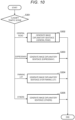
- FIG. 10 is a flowchart showing an example of a specific operation of the image explanatory sentence generation process explained in FIG. 9 .
- the explanatory sentence generation unit 12 executes a process for a corresponding traffic scene as follows (S301).
- FIG. 11 is a detailed flowchart of the general road image explanatory sentence generation process (S302 in FIG. 10 ).
- the explanatory sentence generation unit 12 generates a question sentence and an answer sentence regarding a traffic scene (S211 in FIG. 9 ), and a question sentence and an answer sentence regarding presence or absence of a traffic light (S311).
- the explanatory sentence generation unit 12 inquires whether a pedestrian is present in an image (S312), proceeds to S313 when the pedestrian is present, and proceeds to S314 when the pedestrian is absent.
- the explanatory sentence generation unit 12 As questions and answers about detailed items of the pedestrian (S214 in FIG. 9 ), the explanatory sentence generation unit 12 generates an answer sentence indicating that the pedestrian is present, a question sentence and an answer sentence regarding a location of the pedestrian, a question sentence and an answer sentence regarding a color of clothing of the pedestrian, and a question sentence and an answer sentence regarding an operation of the pedestrian (S313).
- the explanatory sentence generation unit 12 generates an answer sentence indicating that the pedestrian is absent (S314).
- the explanatory sentence generation unit 12 inquires whether an automobile is present in the image (S315), proceeds to S316 when the automobile is present, and proceeds to S317 when the automobile is absent.
- the explanatory sentence generation unit 12 As questions and answers about detailed items of the automobile (S214 in FIG. 9 ), the explanatory sentence generation unit 12 generates an answer sentence indicating that the automobile is present, a question sentence and an answer sentence regarding a location of the automobile, a question sentence and an answer sentence regarding a vehicle type of the automobile, a question sentence and an answer sentence regarding a color of the automobile, and a question sentence and an answer sentence regarding an operation of the automobile (S316).
- the explanatory sentence generation unit 12 inquires whether a bicycle is present in the image (S317), proceeds to S318 when the bicycle is present, and proceeds to S319 when the bicycle is absent.
- the explanatory sentence generation unit 12 As questions and answers about detailed items of the bicycle (S214 in FIG. 9 ), the explanatory sentence generation unit 12 generates an answer sentence indicating that the bicycle is present, a question sentence and an answer sentence regarding a location of the bicycle, a question sentence and an answer sentence regarding a color of the bicycle, and a question sentence and an answer sentence regarding an operation of the bicycle (S318).
- the explanatory sentence generation unit 12 inquires whether a crosswalk is present in the image (S319), proceeds to S320 when the crosswalk is present, and ends the process when the crosswalk is absent.
- the explanatory sentence generation unit 12 generates an answer sentence indicating that the crosswalk is present (S320).
- FIG. 12 is a table showing intermediate data as a result of executing the image explanatory sentence generation process (S21) on the still image data 111 in FIG. 3 .
- an image explanatory sentence is implemented by a combination of a question sentence and an answer sentence to the question sentence for each row.
- Row A01 is a result of the process (S211) of classifying the traffic scenes.
- Rows A02 to A04 are results of the process (S213) of determining whether a selected object is present in the still image data 111.
- Rows A05 to A13 are results of the process (S214) of acquiring detailed items of a selected object.
- FIG. 13 is a table showing output data as a result of the explanatory sentence generation unit 12 deleting unnecessary data from the intermediate data in FIG. 12 .
- an explanatory sentence regarding the pedestrian (Row A02), an explanatory sentence regarding the bicycle (Row A03), and an explanatory sentence regarding a tollgate (Row A13) whose explanations are not required when not recognized in the necessity table 14A of the explanation object setting unit 14 are deleted in FIG. 13 .
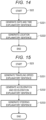
- FIG. 14 is a flowchart showing details of the GPS explanatory sentence generation process (S22).
- the explanatory sentence generation unit 12 generates an explanation in which an imaging time point for the still image data 111 is classified into morning, daytime, evening, night, and the like according to a time period of GPS information obtained from the vehicle traveling GPS data 11B (S221).
- the explanatory sentence generation unit 12 generates an explanation in which an imaging location of the still image data 111 is specified as a major road or a city name according to longitude and latitude of the GPS information obtained from the vehicle traveling GPS data 11B (S222).
- FIG. 15 is a flowchart showing details of the control explanatory sentence generation process (S23).
- the explanatory sentence generation unit 12 generates an explanatory sentence related to traveling speed control based on the vehicle traveling control data 11C (S231).
- the explanatory sentence is, for example, a low speed of 20 km/h or less, a medium speed of 20 km/h to 60 km/h, and a high speed of 60 km/h or more.
- the explanatory sentence generation unit 12 generates an explanatory sentence related to acceleration and deceleration control based on the vehicle traveling control data 11C (S232).
- the explanatory sentence is, for example, an acceleration state in a case of acceleration equal to or larger than a predetermined value, a deceleration state in a case of deceleration equal to or larger than a predetermined value, and a constant-speed state otherwise.
- the explanatory sentence generation unit 12 generates an explanatory sentence related to steering control based on the vehicle traveling control data 11C (S233).
- the explanatory sentence is, for example, a left-turn state or a right-turn state in a case of a steering angle equal to or larger than a predetermined value, and a straight traveling state in other cases.
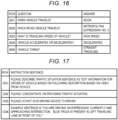
- FIG. 16 is a table showing an example of an explanatory sentence generated in FIGS. 14 and 15 .
- FIG. 17 is a table showing an instruction sentence to the large-scale language model unit 13 used in the traveling situation explanatory sentence generation process (S24).
- the explanatory sentence generation unit 12 generates a prompt that sequentially combines the following texts from (Item 1) to (Item 4). At least one of (Item 2) and (Item 3) may be omitted.
- the explanatory sentence generation unit 12 acquires a traffic situation explanatory sentence described in a natural sentence.
- the traffic situation explanatory sentence (corresponding to a situation explanatory sentence 732 in FIG. 21 to be described later) generated by the large-scale language model unit 13 from the prompt is exemplified.
- Traffic situation explanatory sentence "It's noon, and you're traveling straight down on the Metropolitan Expressway No. 5 while slowing down at a tremendous speed. In this scene, there is an orange solid lane on the expressway. Further, a white truck is driving forward on the road in front.”
- the search accuracy for the search sentence by the user is improved by generating a natural traffic situation explanatory sentence according to a use purpose and preference of the user.
- FIG. 18 is a table showing an example of the image explanatory sentence generated from an image different from that in FIG. 13 .
- An image explanatory sentence in FIG. 18 is intended for an image captured from a vehicle that travels on a general road. Therefore, since a combination of the general road and the pedestrian in the necessity table 14A "requires" an explanation, information indicating that "pedestrian is not recognized" is described in Row D07.
- a traffic situation explanatory sentence generated by the large-scale language model unit 13 by the traveling situation explanatory sentence generation process (S24) from a prompt including the image explanatory sentence in FIG. 18 is as follows.
- Traffic situation explanatory sentence "You are currently traveling at a slow and steady speed on a city road in Mito City at night, and preparing to turn left. In this scene, the pedestrian is not present.”
- FIG. 19 is a flowchart showing a process of the search unit 16.
- the search unit 16 searches images stored in the explanatory sentence DB 15 for an image matching a received search sentence. Specifically, the search unit 16 outputs images having a high similarity between the received search sentence and a situation explanatory sentence stored in the explanatory sentence DB 15 as a search result.
- the search unit 16 may, for example, list images in a descending order of similarity of a search result and output the images from the first rank to the X-th rank (similarity determination in a relatively descending order), or may output images of a search result having a similarity higher than a preset reference value (threshold Y) (absolute similarity determination) as the "images having a high similarity”.
- the search unit 16 receives a search sentence input by the user via the input and output unit 17 (S61).
- the user here is, for example, a presenter at a traffic control center that manages an expressway or the like.
- the search sentence is, for example, a content indicating that an image of a situation similar to an accident that occurs at a predetermined location on an expressway at a predetermined time point is collected from a database.
- the presenter plans to edit an image material acquired from the database and produce a news program about the accident that has occurred.
- the search unit 16 evaluates a similarity between the search sentence from the user and an explanatory sentence stored in the explanatory sentence DB 15 (S62), and acquires video information (image information) associated with an explanatory sentence having a high similarity from the explanatory sentence DB 15.
- similarity evaluation cosine similarity search based on document vectorization or the like may be used.
- the search unit 16 searches for and acquires related information on the traveling situation (weather information that is not present in the explanatory sentence DB 15 but can be acquired from a weather database by designating a location and date and time of a traveling situation explanatory sentence, or the like), and generates an answer sentence based on these results (S63).
- the search unit 16 may also output, as a search result, related information acquired from a database different from the explanatory sentence DB 15 based on information included in a situation explanatory sentence corresponding to the image having a high similarity.
- the search unit 16 transmits the answer sentence in S63 to the input and output unit 17 (S64).
- a target video when searching for video data including a traffic situation explanatory sentence similar to a search sentence in a natural language input by the user, a target video can be found in a short time.
- FIG. 20 is a diagram showing an image search interface 71 of the input and output unit 17.
- the image search interface 71 includes a search sentence input part 72 that is an input field of the search sentence in S61, and a search result display part 73 that is a display field of the answer sentence in S64.
- a plurality of search results (Scenes 1 to 4) are displayed as icons or thumbnail images.
- FIG. 21 shows a play screen when the search result (Scene 1) in FIG. 20 is clicked. On the play screen, the following information is displayed sequentially from the top.
- FIG. 22 shows a play screen when the search result (Scene 2) in FIG. 20 is clicked. Similar to FIG. 21 , an image 741 of a search result, a situation explanatory sentence 742 thereof, and additional information 743 are displayed on the play screen in a similar manner as in FIG. 21 .
- the explanatory sentence generation unit 12 when generating an explanatory sentence of a vehicle image, refers to the necessity table 14A, and generates a natural explanatory sentence including presence or absence of a surrounding object to be focused on based on a traffic scene in which the vehicle is placed. Accordingly, since a natural explanatory sentence that mentions a necessary surrounding object but does not mention an unnecessary surrounding object is compiled into a database, search accuracy in the database based on a search sentence input by a human is improved.
- the invention is not limited to the embodiment described above, and it goes without saying that various other applications and modifications can be made without departing from the gist of the invention as set forth in the claims.
- the embodiment described above explains the configuration of the vehicle image analysis device 1 in detail and specifically in order to explain the invention in an easy-to-understand manner, and is not necessarily limited to including all the explained components.
- a part of a configuration of a certain embodiment can be replaced with a component of another embodiment.
- a component of another embodiment can also be added to a configuration of a certain embodiment.
- addition, replacement, or deletion of another component can also be made to a part of a configuration of the embodiment.
- Some or all of the configurations, the functions, the processing units, and the like described above may be implemented by hardware by, for example, performing design with an integrated circuit.
- a processor device in a broad sense such as a field programmable gate array (FPGA) or an application specific integrated circuit (ASIC) may be used.
- FPGA field programmable gate array
- ASIC application specific integrated circuit
- each component of the vehicle image analysis device 1 may be mounted on any hardware as long as the hardware can transmit and receive information to and from each other via a network.
- a process executed by a certain processing unit may be implemented by one piece of hardware, or may be implemented by a distributed process by a plurality of pieces of hardware.
Landscapes
- Engineering & Computer Science (AREA)
- Theoretical Computer Science (AREA)
- Physics & Mathematics (AREA)
- General Physics & Mathematics (AREA)
- Data Mining & Analysis (AREA)
- General Engineering & Computer Science (AREA)
- Databases & Information Systems (AREA)
- Library & Information Science (AREA)
- Multimedia (AREA)
- Mathematical Physics (AREA)
- Computational Linguistics (AREA)
- Computer Networks & Wireless Communication (AREA)
- Signal Processing (AREA)
- Artificial Intelligence (AREA)
- Human Computer Interaction (AREA)
- Software Systems (AREA)
- Information Retrieval, Db Structures And Fs Structures Therefor (AREA)
- Image Processing (AREA)
- Two-Way Televisions, Distribution Of Moving Picture Or The Like (AREA)
- Traffic Control Systems (AREA)
- Image Analysis (AREA)
- Processing Or Creating Images (AREA)
Applications Claiming Priority (1)
| Application Number | Priority Date | Filing Date | Title |
|---|---|---|---|
| JP2023162954A JP7846656B2 (ja) | 2023-09-26 | 2023-09-26 | 説明文生成システム、および、説明文データベースの生産方法 |
Publications (1)
| Publication Number | Publication Date |
|---|---|
| EP4530886A1 true EP4530886A1 (de) | 2025-04-02 |
Family
ID=92675824
Family Applications (1)
| Application Number | Title | Priority Date | Filing Date |
|---|---|---|---|
| EP24198483.0A Pending EP4530886A1 (de) | 2023-09-26 | 2024-09-04 | Bilderklärungssystem, bildanalysevorrichtung und bilderklärungsverfahren |
Country Status (4)
| Country | Link |
|---|---|
| US (1) | US20250103626A1 (de) |
| EP (1) | EP4530886A1 (de) |
| JP (1) | JP7846656B2 (de) |
| CN (1) | CN119722858A (de) |
Families Citing this family (1)
| Publication number | Priority date | Publication date | Assignee | Title |
|---|---|---|---|---|
| JP7755363B1 (ja) * | 2024-10-18 | 2025-10-16 | 株式会社オプティム | 情報処理装置、方法、プログラム及びシステム |
Citations (1)
| Publication number | Priority date | Publication date | Assignee | Title |
|---|---|---|---|---|
| US20190382035A1 (en) * | 2018-06-13 | 2019-12-19 | Honda Motor Co., Ltd. | Recognition processing device, vehicle control device, recognition control method, and storage medium |
Family Cites Families (3)
| Publication number | Priority date | Publication date | Assignee | Title |
|---|---|---|---|---|
| JP7742858B2 (ja) * | 2023-04-27 | 2025-09-22 | Lineヤフー株式会社 | 情報処理装置、プログラム、情報処理方法 |
| JP7851276B2 (ja) * | 2023-08-18 | 2026-04-24 | Lineヤフー株式会社 | 情報処理装置、情報処理方法及び情報処理プログラム |
| JP7411137B1 (ja) * | 2023-09-22 | 2024-01-10 | Base株式会社 | プログラム、情報処理装置、方法及びシステム |
-
2023
- 2023-09-26 JP JP2023162954A patent/JP7846656B2/ja active Active
-
2024
- 2024-08-06 US US18/795,614 patent/US20250103626A1/en active Pending
- 2024-08-07 CN CN202411076736.7A patent/CN119722858A/zh active Pending
- 2024-09-04 EP EP24198483.0A patent/EP4530886A1/de active Pending
Patent Citations (1)
| Publication number | Priority date | Publication date | Assignee | Title |
|---|---|---|---|---|
| US20190382035A1 (en) * | 2018-06-13 | 2019-12-19 | Honda Motor Co., Ltd. | Recognition processing device, vehicle control device, recognition control method, and storage medium |
Also Published As
| Publication number | Publication date |
|---|---|
| CN119722858A (zh) | 2025-03-28 |
| JP2025053870A (ja) | 2025-04-07 |
| US20250103626A1 (en) | 2025-03-27 |
| JP7846656B2 (ja) | 2026-04-15 |
Similar Documents
| Publication | Publication Date | Title |
|---|---|---|
| Ćorović et al. | The real-time detection of traffic participants using YOLO algorithm | |
| US20220172606A1 (en) | Systems and Methods for Extracting Data From Autonomous Vehicles | |
| US20210247201A1 (en) | Method and System for Scene-Aware Interaction | |
| CN111033512A (zh) | 用于基于简单的二维平面摄像装置与自主行驶车辆通信的动作控制装置 | |
| JP2020173791A (ja) | インテリジェントな映像解析 | |
| Al-refai et al. | Road object detection using Yolov3 and Kitti dataset | |
| CN109271533A (zh) | 一种多媒体文件检索方法 | |
| CN110784523B (zh) | 一种目标物信息的推送方法及装置 | |
| CN112313137A (zh) | 行驶信息处理装置和处理方法 | |
| EP4530886A1 (de) | Bilderklärungssystem, bildanalysevorrichtung und bilderklärungsverfahren | |
| CN117173663A (zh) | 基于多源信息融合的行人过街意图识别方法 | |
| JP2019040175A (ja) | 地図情報を更新する方法、装置及び電子機器 | |
| CN111540222A (zh) | 基于无人车的智能交互方法、装置及无人车 | |
| DE112020003963T5 (de) | Informationsverarbeitungsvorrichtung, informationsverarbeitungsverfahren und programm | |
| Assemlali et al. | Deep learning-driven CNN model for detection and classification of dynamic obstacles | |
| WO2025177679A1 (ja) | 文章生成システム、文章生成プログラム、および、報告書データベースの生産方法 | |
| Dhalwar et al. | Image processing based traffic convex mirror detection | |
| CN111881792A (zh) | 一种移动微卡口系统及其工作方法 | |
| CN117573919A (zh) | 车端音乐推荐方法、装置、设备及存储介质 | |
| CN110659384B (zh) | 视频结构化分析方法及装置 | |
| CN120406796A (zh) | 一种基于车载监控影像的任务执行方法、装置及电子设备 | |
| CN120747483B (zh) | 基于深度学习的梯度直方图目标检测方法、装置、存储介质及嵌入式设备 | |
| US20250037490A1 (en) | Automatically captioning images using swipe gestures as inputs | |
| Divya et al. | Transit Vision: Automating Bus Announcements | |
| Nisha et al. | Robust Traffic Sign Recognition Using CNN YOLOv5 Model |
Legal Events
| Date | Code | Title | Description |
|---|---|---|---|
| PUAI | Public reference made under article 153(3) epc to a published international application that has entered the european phase |
Free format text: ORIGINAL CODE: 0009012 |
|
| STAA | Information on the status of an ep patent application or granted ep patent |
Free format text: STATUS: REQUEST FOR EXAMINATION WAS MADE |
|
| 17P | Request for examination filed |
Effective date: 20240904 |
|
| AK | Designated contracting states |
Kind code of ref document: A1 Designated state(s): AL AT BE BG CH CY CZ DE DK EE ES FI FR GB GR HR HU IE IS IT LI LT LU LV MC ME MK MT NL NO PL PT RO RS SE SI SK SM TR |