EP4530883A2 - Durch zustandsmaschine gestützte llm-agenten - Google Patents
Durch zustandsmaschine gestützte llm-agenten Download PDFInfo
- Publication number
- EP4530883A2 EP4530883A2 EP24195969.1A EP24195969A EP4530883A2 EP 4530883 A2 EP4530883 A2 EP 4530883A2 EP 24195969 A EP24195969 A EP 24195969A EP 4530883 A2 EP4530883 A2 EP 4530883A2
- Authority
- EP
- European Patent Office
- Prior art keywords
- agent
- llm
- data
- state
- state machine
- Prior art date
- Legal status (The legal status is an assumption and is not a legal conclusion. Google has not performed a legal analysis and makes no representation as to the accuracy of the status listed.)
- Pending
Links
Images






Classifications
-
- G—PHYSICS
- G06—COMPUTING OR CALCULATING; COUNTING
- G06F—ELECTRIC DIGITAL DATA PROCESSING
- G06F16/00—Information retrieval; Database structures therefor; File system structures therefor
- G06F16/90—Details of database functions independent of the retrieved data types
- G06F16/903—Querying
- G06F16/9032—Query formulation
- G06F16/90332—Natural language query formulation or dialogue systems
-
- G—PHYSICS
- G06—COMPUTING OR CALCULATING; COUNTING
- G06F—ELECTRIC DIGITAL DATA PROCESSING
- G06F9/00—Arrangements for program control, e.g. control units
- G06F9/06—Arrangements for program control, e.g. control units using stored programs, i.e. using an internal store of processing equipment to receive or retain programs
- G06F9/44—Arrangements for executing specific programs
- G06F9/448—Execution paradigms, e.g. implementations of programming paradigms
- G06F9/4498—Finite state machines
-
- G—PHYSICS
- G06—COMPUTING OR CALCULATING; COUNTING
- G06F—ELECTRIC DIGITAL DATA PROCESSING
- G06F16/00—Information retrieval; Database structures therefor; File system structures therefor
- G06F16/30—Information retrieval; Database structures therefor; File system structures therefor of unstructured textual data
- G06F16/33—Querying
- G06F16/332—Query formulation
- G06F16/3329—Natural language query formulation
- G06F16/33295—Natural language query formulation in dialogue systems
-
- G—PHYSICS
- G06—COMPUTING OR CALCULATING; COUNTING
- G06F—ELECTRIC DIGITAL DATA PROCESSING
- G06F40/00—Handling natural language data
- G06F40/30—Semantic analysis
Definitions
- the present disclosure relates to systems and techniques for utilizing computer-based models. More specifically, the present disclosure relates to computerized systems and techniques for solving problems using artificial intelligence powered agents including retrieval and processing of datasets.
- Computers can be programmed to perform calculations and operations utilizing one or more computer-based models.
- agents e.g., artificial intelligence (AI) powered agents
- AI artificial intelligence powered agents
- the present disclosure relates to systems and methods (generally collectively referred to herein as "an agent system” or simply a "system”) that can advantageously overcome various of the technical challenges mentioned above, among other technical challenges.
- the present disclosure further includes various processes, functionality, and interactive graphical user interfaces related to the system.
- the system and related processes, functionality, and interactive graphical user interfaces, can advantageously employ state machines to solve complex problems.
- a state machine may comprise a plurality of states each comprising a discrete set of information (e.g., tools available at that state, potential next states, etc.).
- the agent system executes a state machine to control interactions with an LLM which may reduce hallucinations, reduce the amount of time required to solve a problem, reduces the information that needs to be provided to the LLM since the complex process is broken down in independent steps, and/or reduce the number of interactions with an LLM.
- the system may provide user interface(s) that allow users to track or monitor problem solving processes went through by agents to evaluate the soundness of steps taken or decisions made by agents.
- the system may further allow users to configure agents and/or state machines based on various user objectives to enhance scalability and reusability of the system.
- the system may advantageously utilize state machine-backed agents to provide a guided framework to automatically solve more complex problems more efficiently and more accurately thereby improving performance of the system.
- Other technical benefits provided by various embodiments of the present disclosure include, for example, providing user interfaces to allow users to track or monitor problem solving processes went through by agents to facilitate efficient evaluation on performances of agents and/or to facilitate generating state machines for subsequent use.
- Embodiments of the disclosure provide efficient use of data storage during complex multi-stage processes by deleting previously processed data at suitable stages of a state machine.
- various embodiments of the present disclosure are inextricably tied to computer technology.
- Various embodiments rely on detection of user inputs via graphical user interfaces, calculation of updates to displayed electronic data based on those user inputs, automatic processing of related electronic data, application of language models and/or other artificial intelligence, and presentation of the updates to displayed information via interactive graphical user interfaces.
- Such features and others e.g., processing and analysis of large amounts of electronic data
- the interactions with displayed data described below in reference to various embodiments cannot reasonably be performed by humans alone, without the computer technology upon which they are implemented.
- the implementation of the various embodiments of the present disclosure via computer technology enables many of the advantages described herein, including more efficient interaction with, and presentation of, various types of electronic data.
- large amounts of data are automatically and dynamically calculated interactively in response to user inputs, and the calculated data is efficiently and compactly presented to a user by the system.
- the user interfaces described herein are more efficient as compared to previous user interfaces in which data is not dynamically updated and compactly and efficiently presented to the user in response to interactive inputs.
- the system may be configured and/or designed to generate user interface data useable for rendering the various interactive user interfaces described.
- the user interface data may be used by the system, and/or another computer system, device, and/or software program (for example, a browser program), to render the interactive user interfaces.
- the interactive user interfaces may be displayed on, for example, electronic displays (including, for example, touch-enabled displays).
- the present disclosure describes various implementations of interactive and dynamic user interfaces that are the result of significant development. This non-trivial development has resulted in the user interfaces described herein which may provide significant cognitive and ergonomic efficiencies and advantages over previous systems.
- the interactive and dynamic user interfaces include improved human-computer interactions that may provide reduced mental workloads, improved decision-making, reduced work stress, and/or the like, for a user.
- user interaction with the interactive user interface via the inputs described herein may provide an optimized display of, and interaction with, models and model-related data, and may enable a user to more quickly and accurately access, navigate, assess, and digest the model-related data than previous systems.
- the interactive and dynamic user interfaces described herein are enabled by innovations in efficient interactions between the user interfaces and underlying systems and components.
- disclosed herein are improved methods for employing agents to automatically solve complex problems through state machine-backed agents.
- the system enables an agent to execute a state machine to control interactions with an LLM which may reduce hallucinations, reduce the amount of time required to solve a problem, and/or reduce the number of interactions with an LLM.
- the system may provide user interface(s) that allow users to track or monitor problem solving processes went through by agents to evaluate the soundness of steps taken or decisions made by agents, or further allow users to configure agents based on various user objectives to enhance scalability and reusability of the system.
- various implementations of the present disclosure can provide improvements to various technologies and technological fields, and practical applications of various technological features and advancements.
- existing computer-based model management and integration technology is limited in various ways, and various implementations of the disclosure provide significant technical improvements over such technology.
- various implementations of the present disclosure are inextricably tied to computer technology.
- various implementations rely on operation of technical computer systems and electronic data stores, automatic processing of electronic data, and the like.
- Such features and others e.g., processing and analysis of large amounts of electronic data, management of data migrations and integrations, and/or the like
- systems and/or computer systems comprise a computer-readable storage medium having program instructions embodied therewith, and one or more processors configured to execute the program instructions to cause the systems and/or computer systems to perform operations comprising one or more aspects of the above- and/or below-described implementations (including one or more aspects of the appended claims).
- computer program products comprising a computer-readable storage medium
- the computer-readable storage medium has program instructions embodied therewith, the program instructions executable by one or more processors to cause the one or more processors to perform operations comprising one or more aspects of the above- and/or below-described implementations (including one or more aspects of the appended claims).
- agent can refer to a decision-making entity that is designed to be specialized at solving a class of problems.
- the class of problems that a particular agent can solve can include simple (e.g., sending a single request to a large language model (LLM) service) or more complex ones (e.g., chaining a set of tools behind each other in a dynamic fashion to solve a complex problem).
- LLM large language model
- a agent can be defined by a specific combination of building blocks including one or more of: (1) agent logic: a core programmatic definition on how this specific agent should interact with the available tools, configurations, and the user; (2) tools: a defined set of tools available for the specific agent; (3) guardrails: a core security mechanism to control the interaction of the agent with the system, such as permissions regarding ontology access; and (4) agent storage (herein also referred to as "agent memory”): a data store and/or memory space allowing an individual agent to keep track of relevant information (e.g., messages and accessories) during and across runs.
- agent logic a core programmatic definition on how this specific agent should interact with the available tools, configurations, and the user
- tools a defined set of tools available for the specific agent
- guardrails a core security mechanism to control the interaction of the agent with the system, such as permissions regarding ontology access
- agent storage herein also referred to as "agent memory”: a data store and/or memory space allowing an individual agent to keep
- configuration can refer to a version-controlled specification of pointers to the building blocks of an agent and/or versions of the building blocks.
- an agent can be configured to a specific configuration that associates the agent with a specific ontology, a LLM, one or more tools, one or more accessories, or the like.
- coordinator can refer to an entity that manages interactions among other entities.
- agent coordinator can refer to an entity that manages interactions among agents deployed by an agent system.
- the agent coordinator may serve a role similar to a control tower to ensure agents act in coordination with each other in an intentional manner.
- an agent coordinator may supervise handoffs of problems, tasks, or sub-tasks among agents to ensure handoffs are robustly performed and do not interfere with processing of other tasks or sub-tasks.
- tool can refer to a specific capability that is available to an agent to solve a given problem.
- a tool may be mostly responsible to perform a deterministic action.
- a tool may allow an agent to interact with the operational system, an ontology, internal databases and system, and/or external systems.
- a tool can be any set of logic or rules that can be provided to an agent for the agent's use, such as to obtain additional information by generating a request for access to additional data via a plug-in.
- a tool can be used by an agent to generate requests (that may be fulfilled by the system) to perform operations such as querying datasets, processing data including filtering or aggregating data, writing to datasets (e.g., adding or updating rows of a table, editing or updating an object type, updating parameter values for an object instance, generating a new object instance), implementing integrated applications (e.g., an email or SMS application), communicating with external application programming interfaces (APIs), and/or any other functions that communicate with other external or internal components.
- Example tools include ontology function tool, date/time tool, query objects tool, calculator tool, and apply action tool. Tools, or the set of logic they comprise for performing one or more operations, may be defined by a system, external database, ontology and/or a user.
- run can refer to a full interaction of a user with an agent system in performance of a task, such as one or more interactions with an LLM and/or external data source.
- An individual run can refer to a full interaction of the user with the agent system, or a user session operated by the user.
- Information associated with a run may be stored by an agent system to facilitate automation orientation and/or co-pilot orientation.
- the information related to the individual run may include the initial prompt and subsequent prompts received by the agent from the user, starting and end timestamps of the individual run, status (e.g., completed, succeeded, failed, or the like) of the individual run, timelines of occurrence of events while the agent executing the individual run, intermediate results generated by the agent, child-agents to which the agent handoffs tasks, number of errors committed by the agent when utilizing some tools, or the like.
- accessory can refer to any information may be useful or necessary for agents to process tasks.
- An accessory may be known to be correct to an agent system.
- Accessories may come in various forms and may include any types of electronic data, such as text, files, documents, books, manuals, emails, images, audio, video, databases, metadata, positional data (e.g., geo-coordinates), sensor data, web pages, time series data, and/or any combination of the foregoing and/or the like.
- An accessory may be permissioned and/or subject to various security constraints such that the accessory may be accessible to some agents but inaccessible to other agents.
- Accessories may be generated or created by agents during processing tasks, but may also be provided by users based on demands of users.
- Example accessories may include: (a) the calculated sum of items in an inventory, (b) an identification (ID) of a document containing needed information, (c) a result of a system operation, such as creation of a new user, (d) a result of execution of a tool, (e) an LLM output.
- Accessories may be stored as Objects in an ontology or in other data formats. Accessories may be multi-modal. Accessories can be of simple types, such as string, double, integer, or the like, and can also be of more complex types, such as images, dataframes, sound files, or the like. Accessories can be created by agents and/or by users of an agent system. For example, as part of executing a run, an agent may utilize a set of tools to create new accessories.
- users can select relevant existing accessories and/or create new accessories that contain relevant information for the specific problems to be solved.
- An agent system can track a lineage of an accessory to know, for example, which accessories were used by which tools to create the accessory.
- model can include any computer-based models of any type and of any level of complexity, such as any type of sequential, functional, or concurrent model. Models can further include various types of computational models, such as, for example, artificial neural networks ("NN"), language models (e.g., large language models (“LLMs”)), artificial intelligence (“AI”) models, machine learning (“ML”) models, multimodal models (e.g., models or combinations of models that can accept inputs of multiple modalities, such as images and text), and/or the like.
- NN artificial neural networks
- language models e.g., large language models (“LLMs”)
- AI artificial intelligence
- ML machine learning
- multimodal models e.g., models or combinations of models that can accept inputs of multiple modalities, such as images and text
- nondeterministic model is any model in which the output of the model is not determined solely based on an input to the model. Examples of nondeterministic models include language models such as LLMs, ML models, and the like.
- a " language model is any algorithm, rule, model, and/or other programmatic instructions that can predict the probability of a sequence of words.
- a language model may, given a starting text string (e.g., one or more words), predict the next word in the sequence.
- a language model may calculate the probability of different word combinations based on the patterns learned during training (based on a set of text data from books, articles, websites, audio files, etc.).
- a language model may generate many combinations of one or more next words (and/or sentences) that are coherent and contextually relevant.
- a language model can be an advanced artificial intelligence algorithm that has been trained to understand, generate, and manipulate language.
- a language model can be useful for natural language processing, including receiving natural language prompts and providing natural language responses based on the text on which the model is trained.
- a language model may include an n-gram, exponential, positional, neural network, and/or other type of model.
- LLM Large Language Model
- An LLM can understand more intricate patterns and generate text that is more coherent and contextually relevant due to its extensive training. Thus, an LLM may perform well on a wide range of topics and tasks. LLMs may work by taking an input text and repeatedly predicting the next word or token (e.g., a portion of a word, a combination of one or more words or portions of words, punctuation, and/or any combination of the foregoing and/or the like).
- An LLM may be of any type, including a Question Answer ("QA") LLM that may be optimized for generating answers from a context, a multimodal LLM/model, and/or the like.
- An LLM (and/or other models of the present disclosure) may include, for example, a NN trained using self-supervised learning and/or semi-supervised learning, a feedforward NN, a recurrent NN, and/or the like.
- An LLM (and/or other models of the present disclosure) may further include, for example, attention-based and/or transformer architecture or functionality.
- While certain aspects and implementations are discussed herein with reference to use of a language model, LLM, and/or AI, those aspects and implementations may be performed by any other language model, LLM, AI model, generative AI model, generative model, ML model, NN, multimodal model, and/or other algorithmic processes. Similarly, while certain aspects and implementations are discussed herein with reference to use of a ML model, language model, or LLM, those aspects and implementations may be performed by any other AI model, generative AI model, generative model, NN, multimodal model, and/or other algorithmic processes.
- the LLMs and/or other models (including ML models) of the present disclosure may be locally hosted, cloud managed, accessed via one or more Application Programming Interfaces ("APIs"), and/or any combination of the foregoing and/or the like. Additionally, in various implementations, the LLMs and/or other models (including ML models) of the present disclosure may be implemented in or by electronic hardware such application-specific processors (e.g., application-specific integrated circuits ("ASICs”)), programmable processors (e.g., field programmable gate arrays (“FPGAs”)), application-specific circuitry, and/or the like.
- ASICs application-specific integrated circuits
- FPGAs field programmable gate arrays
- Data that may be queried using the systems and methods of the present disclosure may include any type of electronic data, such as text, files, documents, books, manuals, emails, images, audio, video, databases, metadata, positional data (e.g., geo-coordinates), geospatial data, sensor data, web pages, time series data, and/or any combination of the foregoing and/or the like.
- electronic data such as text, files, documents, books, manuals, emails, images, audio, video, databases, metadata, positional data (e.g., geo-coordinates), geospatial data, sensor data, web pages, time series data, and/or any combination of the foregoing and/or the like.
- positional data e.g., geo-coordinates
- geospatial data e.g., sensor data, web pages, time series data, and/or any combination of the foregoing and/or the like.
- such data may comprise model inputs and/or outputs, model training data, modeled data, and/or the like
- models, language models, and/or LLMs that may be used in various implementations of the present disclosure include, for example, Bidirectional Encoder Representations from Transformers (BERT), LaMDA (Language Model for Dialogue Applications), PaLM (Pathways Language Model), PaLM 2 (Pathways Language Model 2), Generative Pre-trained Transformer 2 (GPT-2), Generative Pre-trained Transformer 3 (GPT-3), Generative Pre-trained Transformer 4 (GPT-4), LLaMA (Large Language Model Meta AI), and BigScience Large Open-science Open-access Multilingual Language Model (BLOOM).
- BLOOM Bidirectional Encoder Representations from Transformers
- LaMDA Lianguage Model for Dialogue Applications
- PaLM Pathways Language Model
- PaLM 2 Pathways Language Model 2
- GTT-2 Generative Pre-trained Transformer 3
- GTT-4 Generative Pre-trained Transformer 4
- LLaMA Large Open-science Open-access Multilingual Language Model
- a "user operation " can be any operations performed by one or more users to user interface(s) and/or other user input devices associated with a system (e.g., the data extraction system).
- User operations can include, for example, select, drag, move, group, or the like, nodes or edges of one or more interactive graphical representations for updating an ontology based on unmatched classified triples represented by the nodes or the edges.
- User operations can also include, for example, selecting an unmatched triple displayed in a list and identify one or more issues associated with the unmatched triple.
- User operations e.g., input a text data to the data extraction system
- a " prompt " (or " natural language prompt " or " model input ”) can be, for example, a term, phrase, question, and/or statement written in a human language (e.g., English, Chinese, Spanish, and/or the like), and/or other text string, that may serve as a starting point for a language model and/or other language processing.
- a prompt may include only a user input or may be generated based on a user input, such as by a prompt generation module (e.g., of a document search system) that supplements a user input with instructions, examples, and/or information that may improve the effectiveness (e.g., accuracy and/or relevance) of an output from the language model.
- a prompt may be predefined within a state machine.
- a prompt may be provided to an LLM which the LLM can use to generate a response (or "model output").
- An " ontology" can include stored information that provides a data model for storage of data in one or more databases and/or other data stores.
- the stored data may include definitions for data object types and respective associated property types.
- An ontology may also include respective link types/definitions associated with data object types, which may include indications of how data object types may be related to one another.
- An ontology may also include respective actions associated with data object types or data object instances. The actions may include defined changes to values of properties based on various inputs.
- An ontology may also include respective functions, or indications of associated functions, associated with data object types, which functions may be executed when a data object of the associated type is accessed.
- An ontology may constitute a way to represent things in the world.
- An ontology may be used by an organization to model a view on what objects exist in the world, what their properties are, and how they are related to each other.
- An ontology may be user-defined, computer-defined, or some combination of the two.
- An ontology may include hierarchical relationships among data object types.
- An ontology may be used by an organization to model a view of, or provide a template for, what objects exist in the world, what their properties are, and how they are related to each other.
- a "data object " can be a data container for information representing a specific thing in the world that has a number of definable properties.
- a data object can represent an interaction (e.g., recording events occurred during the interaction) between a user and an agent system.
- a data object can represent an entity such as a person, a place, an organization, a market instrument, or other noun.
- a data object can represent an event that happens at a point in time or for a duration.
- a data object can represent a document or other unstructured data source such as an e-mail message, a news report, or a written paper or article.
- Each data object may be associated with a unique identifier that uniquely identifies the data object.
- the object's attributes may be represented in one or more properties. Attributes may include, for example, metadata about an object, such as a geographic location associated with the item, a value associated with the item, a probability associated with the item, an event associated with the item, and so forth.
- a data object may be of a data object type, where the data object is stored in a database that is associated with an ontology that defines the data object type.
- a "data object type" can be a type of a data object (e.g., person, event, document, and/or the like).
- Data object types may be defined by an ontology and may be modified or updated to include additional object types.
- a data object definition (e.g., in an ontology) may include how the data object is related to other data objects, such as being a sub-data object type of another data object type (e.g., an agent may be a sub-data object type of a person data object type), and the properties the data object type may have.
- a “data store” can be any computer-readable storage medium and/or device (or collection of data storage mediums and/or devices). Examples of data stores include, but are not limited to, optical disks (e.g., CD-ROM, DVD-ROM, and the like), magnetic disks (e.g., hard disks, floppy disks, and the like), memory circuits (e.g., solid state drives, random-access memory (RAM), and the like), and/or the like.
- Another example of a data store is a hosted storage environment that includes a collection of physical data storage devices that may be remotely accessible and may be rapidly provisioned as needed (commonly referred to as "cloud" storage). According to various implementations, any data storage, data stores, databases, and/or the like described in the present disclosure may, in various implementations, be replaced by appropriate alternative data storage, data stores, databases, and/or the like.
- a database can be any data structure (and/or combinations of multiple data structures) for storing and/or organizing data, including, but not limited to, relational databases (e.g., Oracle databases, PostgreSQL databases, MySQL databases, and the like), non-relational databases (e.g., NoSQL databases, and the like), in-memory databases, spreadsheets, comma separated values (CSV) files, eXtensible markup language (XML) files, TeXT (TXT) files, flat files, spreadsheet files, and/or any other widely used or proprietary format for data storage. Databases are typically stored in one or more data stores.
- relational databases e.g., Oracle databases, PostgreSQL databases, MySQL databases, and the like
- non-relational databases e.g., NoSQL databases, and the like
- in-memory databases e.g., spreadsheets, comma separated values (CSV) files, eXtensible markup language (XML) files,
- each database referred to herein can be understood as being stored in one or more data stores.
- the present disclosure may show or describe data as being stored in combined or separate databases, in various implementations such data may be combined and/or separated in any appropriate way into one or more databases, one or more tables of one or more databases, and/or the like.
- any database(s) described in the present disclosure may be replaced by appropriate data store(s).
- data source(s) of the present disclosure may include one or more databases, one or more tables, one or more data sources, and/or the like, for example.
- An agent e.g., an artificial intelligence (AI) powered agent
- AI artificial intelligence powered agent
- Agents may have access to tools, prompts, and other information to complete a run and can determine how complete the run (e.g., what tools to implement, how to interact with an LLM, etc.).
- solving complex problems may be highly inefficient or not possible for existing agents. For example, providing the agent with all of the necessary information to complete the run (e.g., description of all of the available tools) may be difficult or not possible due to the volume of information.
- an error occurring during a run may propagate through subsequent interactions with the LLM during the run, which may result in hallucinations and/or may require inefficiently iterating through interactions repeatedly to avoid such errors until the run is successfully completed.
- agents may be configured to efficiently solve both simple and complex problems.
- the present disclosure describes example systems and methods (generally collectively referred to herein as “an agent system”, “agent”, or “system”) that can advantageously overcome various of the technical challenges mentioned above, among other technical challenges.
- the present disclosure further includes various processes, functionality, and interactive graphical user interfaces related to the system.
- the system and related processes, functionality, and interactive graphical user interfaces, can advantageously employ state machines to solve complex problems.
- a state machine may comprise a plurality of states each comprising a discrete set of information (e.g., tools available at that state, potential next states, etc.).
- the agent system executes a state machine to control interactions with an LLM which may reduce hallucinations, reduce the amount of time required to solve a problem, reduces the information that needs to be provided to the LLM since the complex process is broken down in independent steps, and/or reduce the number of interactions with an LLM.
- the system may provide user interface(s) that allow users to track or monitor problem solving processes went through by agents to evaluate the soundness of steps taken or decisions made by agents.
- the system may further allow users to configure agents and/or state machines based on various user objectives to enhance scalability and reusability of the system.
- Agents deployed in an agent system may be configurable based on various settings or parameters. Agents in the system may share one or more common building blocks (e.g., an agent logic that defines how agents operate and/or interact with each other, tools, and/or users) but may be configured to various configurations by the system and/or users. In some implementations, an agent can be configured or reconfigured to be associated with various ontologies, large language models (LLMs), tools, accessories, storages, or the like.
- LLMs large language models
- a first configuration of an agent may associate the agent with a first set of ontologies, LLMs, tools, accessories, and storages and a second configuration of the agent may associate the agent with a second set of ontologies, LLMs, tools, accessories, and storages.
- the system may flexibly (e.g., based on user demands) reconfigure an agent from one configuration to another configuration.
- reconfigurable agents enable the system to swap or switch agent configurations for achieving various objectives.
- the system may feed the same input(s) to two agents that are configured the same except LLMs utilized by the two agents to evaluate or benchmark performances of the LLMs.
- the system and/or users may reconfigure the agent to utilize an ontology that is created or updated based on the new subject matter.
- configurations of an agent can be version controlled by the system.
- the system may assign version numbers (e.g., a string of text) to corresponding configurations of agents and keep track of configurations of agents using version numbers. More specifically, a first configuration of an agent may be assigned or identified by a first version number and a second configuration of the agent may be assigned or identified by a second version number. Additionally and/or optionally, the system may assign identification numbers (IDs) to components (e.g., one or more ontologies, LLMs, tools, and storages) of configurations of agents.
- IDs identification numbers
- a first LLM and a first ontology in a first configuration of a first agent may be assigned a first LLM ID and a first ontology ID
- a second LLM and a second ontology in a second configuration of a second agent may be assigned a second LLM ID and a second ontology ID.
- version controlled configurations and/or IDs assigned to components of configurations may allow the system robustly and effectively track operations of agents, adapt agents among various configurations, or contrast strengths and weakness of an agent when operating under disparate configurations.
- the system may utilize pointers to access or point to an ontology, LLM(s), tool(s), accessory, storage(s), or one or more configurations associated with the agent.
- the system may generate and maintain a log to record events, timelines, received inputs, or generated outputs while an agent processes tasks.
- the log may describe events that occurred while the agent processes tasks and corresponding timestamps, inputs received from users and/or the system, and/or results generated by the agent while processing tasks.
- the log may record number of errors committed by the agent while processing tasks.
- the log may allow the system or users to effectively monitor or evaluate performances of agents for taking appropriate measures (e.g., re-train an agent for processing a particular type of task in response to monitoring a high error number from the agent while processing the particular type of task).
- Agents may be configured to coordinate with each other to process tasks collaboratively.
- agents may coordinate with other agents by handing off tasks (e.g., a partially completed task) to other agents that are suitable or specialized in performing a next step in the tasks For example, when an agent determines that a task which the agent is processing requires specialized capability, the agent may handoff some or all of the task to another agent that has been trained or tested to efficiently solve the task.
- tasks e.g., a partially completed task
- the agent may handoff some or all of the task to another agent that has been trained or tested to efficiently solve the task.
- an agent may handoff some (e.g., sub-tasks) or all of a task to one or more child agents which may be specialized in processing specific types of tasks or sub-tasks.
- the parent-child agent relationship can be configurable.
- an agent can be configured to have child agent(s) and the child agent(s) may be explicitly specified in a configuration of the agent, where a configuration of the child agent(s) may also explicitly specify the agent as a parent agent.
- the parent-child agent relationship(s) can be bi-directional.
- An agent can be a parent of another agent, and can also be a child of still another agent.
- handing off tasks to child agents provides multiple improvements over utilizing a single and large agent to process tasks.
- Handing off sub-tasks to child agents that have been proven to process the sub-tasks efficiently enables the system to effectively process requests from users to return accurate and reliable results.
- Handing off tasks may further reduce the update or maintenance cost of agents of the system because updates on or migration of agents can be targeted and tailored toward subsets of agents of the system.
- the agent may identify information to provide to the child agent to aid in performance of the sub-task. For example, an agent may select one or more accessories (e.g., pieces of information) that are useful for the child agent to process the sub-task, and share the one or more accessories with the child agent. The agent may determine whether an accessory can be shared with the child agent based on permission of users or the system. An accessory, once shared by the agent to the child agent, may provide useful information to the child agent in processing a task or a sub-task more efficiently without the need to discover, generate, or obtain the accessory by the child agent itself.
- accessories e.g., pieces of information
- the system may further allow various types of handoffs depending on use cases or tasks submitted by users. For example, the system may allow blocking handoffs, where an agent may handoff a task to a child agent, pauses until receiving a result from the child agent, and then proceeds after receiving the result. As another example, the system may allow parallel handoffs, where an agent may handoff tasks in parallel to multiple child agents, and, without waiting for results from the child agents, continues to process other tasks or sub-tasks that the agent is processing without handing off.
- various handoffs schemes enable the system to more flexibly and efficiently utilize agents to process tasks based on characteristics of the tasks. In various implementations, the system may limit number of handoffs associated with task(s) or sub-task(s).
- the system may limit the handoffs of the task that may occur at most twice (e.g., an agent can handoff the task to two child agents) or other numbers.
- limiting number of handoffs on some or all types of tasks may increase security of the system and reduce likelihood of extensive looping of tasks that could occur if a set of tasks are attempting to incrementally optimize an output.
- Accessories are information that may be useful or necessary for agents to process tasks.
- Accessories may come in various forms and may include any types of electronic data, such as text, files, documents, books, manuals, emails, images, audio, video, databases, metadata, positional data (e.g., geo-coordinates), sensor data, web pages, time series data, and/or any combination of the foregoing and/or the like.
- An accessory may be permissioned and/or subject to various security constraints such that the accessory may be accessible to some agents but inaccessible to other agents.
- Accessories may be generated or created by agents during processing tasks, but may also be provided by users based on demands of users.
- an agent when an agent is tasked to perform statistical analysis on sales data of an user to provide recommendation on how to increase sales volume, the user may provide a spreadsheet or other data files that include sales data as an accessory for the agent to process the task.
- accessories may be generated, discovered, synthesized, or created by agents while processing certain tasks. For example, while processing a task that needs to take into account particular information, an agent searched through on-line databases to identify a document containing the particular information and saved the particular information along with a document ID of the document as an accessory.
- accessories may be created by agents using tools while processing tasks. For example, an accessory may be a result generated by an agent while processing a task, where the result may be utilized by the agent or other agents for processing other tasks.
- agents may store accessories in memory (e.g., agent storages).
- agents may utilize pointers that point to locations in the memory where desired accessories are stored.
- accessories may be stored as data objects that are defined in one or more ontologies.
- An accessory can be multi-modal (e.g., including both textual and video information).
- An accessory can also come in different forms and types.
- an accessory may include strings, double integers, integers, images, data frames, sound files, or the like.
- An agent may share accessories with other agents if sharing is permitted under the permissioning of the system.
- the agent may grant other agents access to an accessory that is stored in a storage associated with the agent and provide a pointer to the accessory to other agents.
- accessories may enrich knowledge base of the agent or increase potency of the agent.
- the system can track a lineage of an accessory to track a basis for a generated accessory and/or whether the accessory is further utilized to generate other information.
- the system can record a lineage of an accessory, where the lineage shows what tool(s) are utilized to generate the accessory.
- the lineage of the accessory may include metadata that can enable users or the system to efficiently track from where the accessory comes into being and where the accessory is used, such as which agents or tasks use the accessory (which may be one or more versions of an accessory).
- lineages of accessories may be presented to users through interactive graphical representations that include nodes (e.g., representing accessories) and/or edges (e.g., representing connections between accessories) of graphical user interfaces (GUIs).
- GUIs graphical user interfaces
- the lineage of an accessory enables the system to more efficiently verify or evaluate the usefulness of the accessory.
- the system may further evaluate correctness or accuracy of information contained in the accessory. For example, if an agent or the system determines that the accessory contains accurate information, the agent or the system may keep the accessory in an agent storage. But if the agent or the system determines that the accessory contains inaccurate information, the agent or the system may update the accessory and/or delete the accessory from the agent storage.
- the system may impose a time-to-live constraint on an accessory based on characteristics of the accessory.
- an accessory that is solely useful for processing a specific task by a specific agent may have a shorter time-to-live, and may be deleted once the specific task has been processed.
- an accessory that may be useful for an agent to process various tasks or for other agents may have a longer time-to-live, and may persist after the agent completes tasks using the accessory.
- an accessory that is provided by a user may persist throughout or beyond an individual run, where the individual run is a full interaction of the user with the system.
- imposing time-to-live constraints on accessories may allow the system to more efficiently utilize storage resources by freeing up storage capacity that otherwise would be occupied by accessories that are no longer useful to users or the system.
- the system may utilize an agent coordinator to supervise handoffs of tasks or sub-tasks among agents to ensure handoffs are robustly performed and do not interfere with processing of other tasks or sub-tasks. For example, if an agent seeks to handoff a first task to a child agent which is processing a second task and the first task requires the child agent switches from a current configuration to a different configuration, the agent coordinator may determine the handoff may adversely impact performance of the child agent and intervene to redirect the handoff to another child agent that has immediate capacity (e.g., already configured to the different configuration) to process the first task. Additionally and/or optionally, the agent coordinator may manage handoffs among agents based on input(s) from user(s).
- the agent coordinator may instruct agents that are processing the task to pause and may block handoffs of sub-tasks of the task.
- more computing resources may be released to process tasks based on user needs.
- an agent coordinator may facilitate communications among agents, and communications between agents and users or the system.
- the agent coordinator may manage and monitor operations performed by agents. For example, the agent coordinator may pause an agent if the agent coordinator determines that the agent is committing more errors while processing a task. As another example, the agent coordinator may restart an agent in response to receiving input(s) from a user. As yet another example, the agent coordinator may prevent unexpected input from feeding into an agent if the agent coordinator determines that the unexpected input may mislead the agent to improperly process a task.
- the agent coordinator may allow bidirectional communications between agents and users or the system.
- an agent may request additional information from a user or the system after the agent starts processing a request from the user.
- the agent may request more user inputs from the user, such as a prompt or an accessory, through the agent coordinator.
- the agent may request the user to perform one or more actions on the system or other systems external to the system, such as requesting the user to enter entries in a system applications and products (SAP) ordering system before the agent can further proceed with a current task.
- SAP system applications and products
- the bidirectional communications facilitated by the agent coordinator allows users to more efficiently work with agents to meet demands of users.
- An agent storage may be utilized by an agent to store data and/or information (e.g., accessories, tools, messages, program code, data files, tables, or the like) for processing tasks.
- the system may allocate an agent storage, where an agent may store data and/or information used by the agent to process tasks.
- an agent may store accessories that are generated by the agent in an agent storage associated with the agent, and share pointers that pointed to the stored accessories to other agents such that other agents can access the stored accessories.
- the agent may generate or create new tools (e.g., a statistical analysis tool) for processing certain tasks to the agent storage.
- the agent may be tasked to write a program code (e.g., Python code).
- the agent may then utilize a tool to find an application programming interface (API) endpoint for generating the program code, and store the program code in the agent storage.
- API application programming interface
- an agent may have full access to an agent storage allocated to the agent but may have limited access to agent storages of other agents. Based on permissioning of the system, an agent or the system may grant another agent access to parts or all of the agent storage of the agent. For example, an agent may share accessories to a child agent to which the agent handoffs a task or a sub-task.
- an agent may have one or more retention policies that allow the agent to remove outdated data and/or information from the agent storage.
- the agent may have a message retention policy based on which the agent may determine some messages are outdated or no longer useful, and can be removed from the agent storage.
- the message retention policy or any other data retention policies of the agent may be configurable.
- the agent may configure its message retention policy to one of keep_initial_and_last_n, remove_by_drop, remove_and_add_summary, and the like.
- an agent may designate some of data and/or information stored in an agent storage to appropriate retention durations based on various criterion.
- the agent may determine that information contained in an accessory is true for a limited amount of time and assign a shorter time-to-live on the accessory stored in the agent storage. For example, the agent may determine that information contained in the accessory no longer holds true after a currently processed task is completed. Once completing the task, the agent may remove the accessory from the agent storage to release spaces of the agent storage. Removing outdated accessories, messages, and/or other data stored in the agent storages enables agents to more efficiently utilized available and constrained storage resources to preserve capacity for storing useful data and/or information in agent storages.
- the system may further allow users to interact with the system through one or more user interfaces (e.g., a graphical user interface ("GUI") or other types of user interfaces) to allow users to configure agents, interact with agents, and verify results generated by agents.
- GUI graphical user interface
- users may configure an ontology, a LLM, tools, accessories, an agent storage, a state machine, or other aspects of an agent through operating on a user interface.
- a user may configure a state machine the agent can utilize to process tasks.
- the user interface may further allow users to view and track various configurations of a state machine (e.g., through version control mechanisms).
- a user may preserve a specific configuration of an agent that is tested to be effective for solving a specific type of problems while experimenting new configurations based on minor or minimal adjustments to the specific configuration without losing the efficacy of the specific configuration. Additionally and/or optionally, the user may configure types of LLMs and/or machine learning (ML) models accessible to the agent through the user interface.
- LLMs and/or machine learning (ML) models
- a user may evaluate or verify results generated by agents through manipulating a user interface provided by the system.
- the user interface may present information related to an individual run.
- the information related to the individual run may include the initial prompt and subsequent prompts received by the agent from the user, starting and end timestamps of the individual run, status (e.g., completed, succeeded, failed, or the like) of the individual run, timelines of occurrence of events while the agent executing the individual run, intermediate results generated by the agent, states of a state machine executed by the agent, requests for user input from the agent, child-agents to which the agent handoffs tasks, number of errors committed by the agent when utilizing some tools, or the like.
- the system may allow users to more efficiently evaluate or verify performances of agents through, for example, reviewing steps or actions taken by an agent to process a task. Additionally and/or optionally, the system may allow a user to create one or more accessories by operating on user interface(s) provided by the system, where the created accessories may be passed to agents by the system for processing tasks submitted by the user.
- agents may employ one or more LLMs to provide various services.
- agents may receive user requests to process various types of tasks, such as automatically generating texts to summarize a set of documents, conducting analysis based on data contained in articles, tables, spreadsheets, or the like, scheduling distribution of materials based on supply chain constraints and requirements from demand sides, or the like.
- agents may allow users to query internal or third-party data using a LLM (e.g., a QA (question and answer) LLM) that is trained to generate answers from user queries.
- a LLM e.g., a QA (question and answer) LLM
- the LLMs utilized by the system and/or the agents may be locally hosted, cloud managed, accessed via one or more Application Programming Interfaces ("APIs"), and/or any combination of the foregoing and/or the like.
- Data that may be processed by agents through using the LLMs may include any type of electronic data, such as text, files, documents, books, manuals, emails, images, audio, video, databases, metadata, positional data (e.g., geo-coordinates), sensor data, web pages, time series data, and/or any combination of the foregoing and/or the like.
- the system may provide the flexibility of easily swapping between various language models employed by agents to provide various services through configuring agents.
- the system may swap a LLM (e.g., switching between GPT-2 to GPT-3) for analyzing information to provide recommendations (e.g., to which distribution centers shipment orders should be placed) based on analyses.
- LLM e.g., switching between GPT-2 to GPT-3
- recommendations e.g., to which distribution centers shipment orders should be placed
- model swapping flexibility provided by the system may be beneficial in various aspects, such as experimentation and adaptation to different models based on specific use cases or requirements, providing versatility and scalability associated with services rendered by the system.
- the system and/or agents of the system can incorporate and/or communicate with one or more LLMs to perform various functions, such as executing similarity searches to search for data.
- the communication between the system and the one or more LLMs may include, for example, a context associated with an aspect or analysis being performed by the system, a user-generated prompt, an engineered prompt, prompt and response examples, example or actual data, and/or the like.
- the system and/or agents may employ an LLM, via providing an input to, and receiving an output from, the LLM.
- the output from the LLM may be parsed and/or a format of the output may be updated to be usable for various aspects of the system.
- the system may employ database(s) that uses ontology and data objects to store, represent and/or organize data utilized by the system.
- the system may capture and synchronize data or information associated with a run (e.g., a full interaction of a user with the system) into an ontology associated with a database.
- data utilized by the system may be organized and linked to relevant context for providing a comprehensive knowledge base for evaluation, verification, and analysis.
- a body of data may be conceptually structured according to an object-centric data model represented by the ontology.
- the ontology may include stored information providing a data model for storage of data in the database.
- the ontology may be defined by one or more object types, which may each be associated with one or more property types.
- data object may be a container for information representing things in the world.
- data object can represent a document or other data source such as an e-mail message, a news report, or a written paper or article.
- data object can represent an entity such as a person, a place, an organization, a market instrument, or other noun.
- Data object can further represent an event that happens at a point in time or for a duration.
- Each data object may be associated with a unique identifier that uniquely identifies the data object within the database of the system.
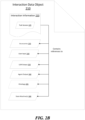
- the system may utilize an "interaction data object" to store information and/or data associated with a run of a user in a database of the system for various purposes.
- the interaction data object may include data objects or may be linked to data object(s) that represent documents, data sources, timestamps of events (e.g., when one or more user queries of the user are received and/or responded), profiles of the user, or the like that are associated with a user interaction. For example, initial and subsequent prompts from the user and/or steps taken by agents utilized to fulfill objectives of the user can be stored by the system using the interaction data object and/or data objects associated with the interaction data object for later evaluation.
- the system may utilize the interaction data object and/or additional data objects to automatically generate evaluation reports for various purposes, such as evaluating the performances of agents.
- interaction data objects stored in the database of the system may enable information associated with the user interaction to be easily reviewable.
- the system may further utilize information stored using the interaction data object and/or other data objects to evaluate if agents are not processing tasks efficiently.
- FIG. 1A illustrates an example computing environment 100 including an example agent system 102 in communication with various devices to respond to user inputs.
- the example computing environment 100 includes an agent system 102, a LLM 130a, a LLM 130b, a network 140, a data processing service 120, and a user 150.
- the agent system 102 comprises various modules, including a user interface module 104, a database module 108, and an agent service 106.
- the agent system 102 may include fewer or additional components.
- the various devices are in communication via a network 140, which may include any combination of networks, such as one or more personal area network, local area network, wide area network, over-the-air broadcast network (e.g., for radio or television), cable network, satellite network, cellular telephone network, or combination thereof.
- the network 140 may be a publicly accessible network of linked networks, possibly operated by various distinct parties, such as the Internet.
- the network 140 may be a private or semi-private network, such as a corporate or university intranet.
- the network 140 may include one or more wireless networks, such as a Global System for Mobile Communications (GSM) network, a Code Division Multiple Access (CDMA) network, a Long Term Evolution (LTE) network, or any other type of wireless network.
- GSM Global System for Mobile Communications
- CDMA Code Division Multiple Access
- LTE Long Term Evolution
- the network 140 can use protocols and components for communicating via the Internet or any of the other aforementioned types of networks.
- the protocols used by the network 140 may include Hypertext Transfer Protocol (HTTP), HTTP Secure (HTTPS), Message Queue Telemetry Transport (MQTT), Constrained Application Protocol (CoAP), and the like.
- modules of the illustrated components such as the user interface module 104, the database module 108, and the agent service 106, may communicate via an internal bus and/or via the network 140.
- the user interface module 104 is configured to generate user interface data that may be rendered on a user 150, such as to receive an initial user input, as well as later user input that may be used to initiate further data processing.
- user interface data may be rendered on a user 150, such as to receive an initial user input, as well as later user input that may be used to initiate further data processing.
- the functionality discussed with reference to the user interface module 104, and/or any other user interface functionality discussed herein may be performed by a device or service outside of the agent system 102 and/or the user interface module 104 may be outside the agent system 102.
- Example user interfaces are described in greater detail below.
- the database module 108 may be any types of data stores and can store any data, data objects of data object types, or the like.
- the database module 108 is configured to store data/information that may be utilized by the agent system 102 and/or accessed or manipulated by the user 150, as described herein.
- Data that may be stored in the database module 108 may include any type of electronic data, such as text, files, documents, books, manuals, emails, images, audio, video, databases, metadata, positional data (e.g., geo-coordinates), sensor data, web pages, time series data, and/or any combination of the foregoing and/or the like.
- the database module 108 can store one or more state machines.
- the user 150 (which generally refers to a computing device of any type that may be operated by a human user) may provide a user input to the agent system 102 indicating a natural language request for some data analysis to be performed or tasks and/or problems to be solved by the agent system 102.
- the user input along with other supplemental information or instructions, if any, may be provided through the user interface module 104 to the agent service 106.
- the user 150 may provide supplemental information (e.g., specifying some constraints on processing results to be generated by the agent service 106, selecting one or more object types to limit processing by the agent system 102 to only those selected object types, or the like) to increase speed and relevance of results provided by the agent service 106 and/or agent system 102, while in other embodiments the user 150 may not provide any information except an initial input.
- supplemental information e.g., specifying some constraints on processing results to be generated by the agent service 106, selecting one or more object types to limit processing by the agent system 102 to only those selected object types, or the like
- the agent system 102 may include and/or have access to one or more large language model (LLM) or other language model, and the LLM may be fine-tuned or trained on appropriate training data (e.g., annotated data showing correct or incorrect pairings of sample natural language queries and responses).
- LLM large language model
- the agent system 102 may generate and provide, through the agent service 106, one or more prompts to a LLM 130a, which may include one or more large language models trained to fulfill a modeling objective, such as task completion, text generation, summarization, or the like.
- the LLM 130a and various modules of the agent system 102, such as the agent service 106, may also communicate with one or more data processing services 120 in the course of fulfilling a user input.
- the data processing services 120 may include any quantity of services (or "plug-ins") and any available type of service.
- the data processing services 120 may include one or more search services (e.g., a table search service, an object search service, a text search service, or any other appropriate search service), indexing services, services for formatting text or visual graphics, services for generating, creating, embedding and/or managing interactive objects in a graphical user interface, services for caching data, services for writing to databases, an ontology traversing service (e.g., for traversing an ontology or performing search-arounds in the ontology to surface linked objects or other data items) or any other services.
- the agent service 106 may request for data processing services 120 to perform a specific process.
- the data processing services 120 may be a part of the agent system 102 (e.g., as part of a data processing services module of the agent system 102).
- the agent service 106 may receive user requests to process various types of tasks, such as automatically generating texts to summarize a set of documents, conducting analysis based on data contained in articles, tables, spreadsheets, or the like, scheduling distribution of materials based on supply chain constraints and requirements from demand sides, or the like.
- the agent service 106 may allow users to query internal or third-party data using the LLM 130a (e.g., a QA (question and answer) LLM) that is trained to generate answers from user queries.
- the LLM 130a utilized by the agent service 106 may be locally hosted, cloud managed, accessed via one or more Application Programming Interfaces ("APIs"), and/or any combination of the foregoing and/or the like.
- APIs Application Programming Interfaces
- Data that may be processed by the agent service 106 through using the LLM 130a may include any type of electronic data, such as text, files, documents, books, manuals, emails, images, audio, video, databases, metadata, positional data (e.g., geo-coordinates), sensor data, web pages, time series data, and/or any combination of the foregoing and/or the like.
- electronic data such as text, files, documents, books, manuals, emails, images, audio, video, databases, metadata, positional data (e.g., geo-coordinates), sensor data, web pages, time series data, and/or any combination of the foregoing and/or the like.
- the agent system 102 may be capable of interfacing with multiple LLMs. This allows for experimentation and adaptation to different models based on specific use cases or requirements, providing versatility and scalability to the system.
- the agent system 102 may interface with a second LLM 130b in order to, for example, solve a problem for the user 150, generate an input to a data processing service 120, or to generate some or all of a natural language prompt (e.g., generate a prompt for the first LLM 130a).
- the agent service 106 may include a plurality of agents that may be utilized by the agent system 102 to solve various problems or process various tasks received from the user 150.
- agents in the agent service 106 may coordinate with each other to solve problems or process tasks, thereby increasing the efficiency and accuracy of the agent system 102 in processing user inputs from the user 150.
- Agents employed by the agent service 106 may be configurable based on various settings or parameters. Additionally, configurations of agents can be version controlled by the agent service 106.
- the agent service 106 may generate and maintain a log to record events, timelines, received inputs, or generated outputs while agents process tasks or solve problems received from the user 150.
- agents employed by the agent service 106 may coordinate with other agents by handing off tasks to agents (e.g., child-agents) which are suitable or specialized in performing the tasks. If an agent determines to handoff a sub-task to a child agent, the agent may choose to share knowledge with the child agent. For example, the agent may share an accessory with the child agent, where the accessory may be useful in processing the sub-task.
- the agent service 106 may provide storage (e.g., agent storage) for agents to store accessories and/or other information useful for processing tasks or problems.
- the agent service 106 may further utilize an agent coordinator to supervise handoffs of tasks or sub-tasks among agents to ensure handoffs are robustly performed and do not interfere with processing of other tasks or sub-tasks.
- the agent coordinator of the agent service 106 may facilitate communications among agents, and communications between agents and users or the system.
- the agent service 106 enables agents to coordinate (e.g., handoff a task from one agent to another) with each other to effectively solve problems received from the user 150 in both time and resource efficient manners. Additionally, the agent service 106 allows agents to share information useful for processing tasks or solving problems effectively and reliably while respecting security and/or permissioning defined by the agent system 102 and/or the user 150. Further, through the assistance of the user interface module 104, the agent service 106 may allow the user 150 to track or monitor problem solving processes went through by agents employed by the agent service 106 to evaluate the soundness of steps taken or decisions made by agents. The agent service 106 may further allow the user 150 to configure agents based on various user objectives to enhance scalability and reusability of the agent system 102.
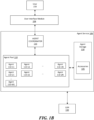
- FIG. 1B depicts example connections between various modules associated with the agent system 102 of FIG. 1A , including the user interface module 104, the agent service 106 that includes one or more agent coordinator 116, one or more agent storage 118, and a collaborative agent network 110, and the LLM 130.
- the agent system 102 and/or the agent service 106 may include fewer or additional connections.
- the indicated connections and/or data flows of FIG. 1B are exemplary of only certain processes performed by the agent system 102 and is not meant to include all possible blocks and participants.
- the user interface module 104 is configured to generate user interface data that may be rendered on the user 150 (which generally refers to a computing device of any type and/or a human user of the device), such as to receive an initial user input, as well as later user input that may be used to initiate further data processing.
- the functionality discussed with reference to the user interface module 104, and/or any other user interface functionality discussed herein may be performed by a device or service outside of the agent system 102 and/or the user interface module 104 may be outside the agent system 102.
- a user 150 may provide a user input to the user interface module 104 indicating a natural language request for some data analysis to be performed and/or tasks or problems to be solved by the agent system 102.
- the user input along with other supplemental information or instructions, if any, may be provided through the user interface module 104 to the agent service 106.
- the user 150 may provide supplemental information (e.g., specifying some constraints on processing results to be generated by the agent service 106, selecting one or more object types to limit processing by the agent system 102 to only those selected object types, or the like) to increase speed and relevance of results provided by the agent service 106 and/or agent system 102, while in other embodiments the user 150 may not provide any information except an initial input.
- the agent service 106 includes the agent coordinator 116, the agent storage 118 and the collaborative agent network 110.
- the collaborative agent network 110 includes the agent 110-11, the agent 110-21 through the agent 110-M1, where the agent 110-21 through the agent 110-M1 (M being any positive integer) are child-agents of the agent 110-11; the agent 110-12 and the agent 110-22, where the agent 110-22 is the child-agent of the agent 110-12; and the agent 110-1N (N being any positive integer) and the agent 110-2N, where the agent 110-2N is the child-agent of the agent 110-1N.
- Each of the agents 110-11, 110-21, 110-M1, 110-12, 110-22, 110-1N, or 110-2N may be configurable based on various settings.
- the agent 110-11 can be configured or reconfigured to be associated with various ontologies, large language models (LLMs), tools, accessories, storages, or the like.
- the agent service 106 may flexibly (e.g., based on user demands) reconfigure each of the agents 110-11, 110-21, 110-M1, 110-12, 110-22, 110-1N, or 110-2N from one configuration to another configuration.
- reconfigurable agents enable the agent service 106 to swap or switch agent configurations for achieving various objectives.
- the agent service 106 may feed the same input(s) to the agents 110-11 and 110-21 that are configured the same except LLMs utilized by the agents 110-11 and 110-21 to evaluate or benchmark performances of the LLMs.
- the agent service 106 and/or users may reconfigure the agent 110-1N to utilize an ontology that is created or updated based on the new subject matter.
- the agents 110-11, 110-21, 110-M1, 110-12, 110-22, 110-1N, or 110-2N in the collaborative agent network 110 may coordinate with each other to process tasks collaboratively.
- the agent 110-12 may coordinate with the agent 110-22 by handing off tasks to the agent 110-22, where the agent 110-22 is suitable or specialized in performing the tasks. More specifically, when the agent 110-12 determines that a task which the agent 110-22 is processing requires specialized capability, the agent 110-12 may handoff some or all of the task to the agent 110-22 that has been trained or tested to efficiently solve the task.
- agents 110-11, 110-12, 110-1N may handoff some (e.g., sub-tasks) or all of a task to one or more child agents which may be specialized in processing specific types of tasks or sub-tasks.
- the parent-child agent relationship can be configurable by the agent service 106.
- the agent 110-11 can be configured to have the agent 110-21 as a child agent, where the child agent (i.e., the agent 110-21) may be explicitly specified in a configuration of the agent 110-11.
- a configuration of the agent 110-21 may also explicitly specify the agent 110-11 as a parent agent.
- the parent-child agent relationship(s) can be bi-directional.
- handing off tasks from agents 110-11, 110-12 and 110-1N to corresponding child agents 110-21, 110-M1, 110-22, 110-2N provide multiple improvements over utilizing a single and large agent to process tasks. For example, handing off sub-tasks to child agents that have been proven to process the sub-tasks efficiently enables the agent service 106 to effectively process requests from the user 150 to return accurate and reliable results. Handing off tasks may further reduce the update or maintenance cost of agents employed by the agent service 106 because updates on or migration of agents can be targeted and tailored toward subsets of agents of the system.
- the agent service 106 may further utilize the agent storage 118 to store information useful for the collaborative agent network 110 to process tasks or solve problems received from the user 150.
- the agent storage 118 may store accessories 105 that may be useful or necessary for agents to process tasks.
- Accessories 105 may come in various forms and may include any types of electronic data, such as text, files, documents, books, manuals, emails, images, audio, video, databases, metadata, positional data (e.g., geo-coordinates), sensor data, web pages, time series data, and/or any combination of the foregoing and/or the like.
- Accessories 105 may be permissioned and/or subject to various security constraints such that the accessory may be accessible to some agents but inaccessible to other agents.
- Accessories 105 may be generated or created by agents in the collaborative agent network 110 during processing tasks, but may also be provided by users based on demands of users. For example, when the agent 110-11 is tasked to perform statistical analysis on sales data of the user 150 to provide recommendation on how to increase sales volume, the user 150 may provide a spreadsheet or other data files that include sales data as a part of the accessories 105 for the agent 110-11 to process the task. Alternatively and/or optionally, accessories 105 may be generated, discovered, synthesized, or created by agents while processing certain tasks.
- the agent 110-12 searched through on-line databases to identify a document containing the particular information and saved the particular information along with a document ID of the document in the agent storage 118 as a part of the accessories 105.
- accessories 105 may be created by agents in the collaborative agent network 110 using tools while processing tasks.
- a part of the accessories 105 may be a result generated by the agent 110-1N while processing a task, where the result may be utilized by the agent 110-1N or 110-2N for processing other tasks.
- the agent storage 118 may impose a time-to-live constraint on the accessories 105 based on characteristics of the accessories 105.
- an accessory that is solely useful for processing a specific task by a specific agent e.g., the agent 110-11
- may have a shorter time-to-live and may be deleted once the specific task has been processed.
- an accessory that may be useful for the agent 110-12 to process various tasks and also useful for another agent 110-IN may have a longer time-to-live, and may persist after the agent 110-12 completes tasks using the accessory.
- time-to-live constraints on accessories 105 may allow the agent storage 118 to more efficiently utilize storage resources by freeing up storage capacity that otherwise would be occupied by accessories 105 that are no longer useful to the user 150 or the agent system 102.
- agents in the collaborative agent network 110 may also store tools for processing certain tasks or generated results to the agent storage 118.
- the agent 110-12 may be tasked to write a program code (e.g., Python code). The agent 110-12 may then utilize a tool stored in the agent storage 118 to find an application programming interface (API) endpoint for generating the program code, and store the program code in the agent storage 118.
- the agent storage 118 may be partitioned and allocated to agents in the collaborative agent network 110.
- the agent 110-21 may have full access to a portion of the agent storage 118 allocated to the agent 110-21 but may have limited or no access to portions of the agent storage 118 allocated to other agents in the collaborative agent network 110.
- an agent or the agent system 102 may grant another agent access to parts or all of the agent storage 118 allocated to the agent.
- the agent 110-11 may share accessories 105 to a child agent (e.g., the agent 110-21) to which the agent 110-11 handoffs a task or a sub-task.
- the agent service 106 may utilize the agent coordinator 116 to supervise handoffs of tasks or sub-tasks among agents in the collaborative agent network 110 to ensure handoffs are robustly performed and do not interfere with processing of other tasks or sub-tasks. For example, if the agent 110-11 seeks to handoff a first task to the agent 110-21 that is processing a second task and the first task requires the agent 110-21 switches from a current configuration to a different configuration, the agent coordinator 116 may determine that the handoff may adversely impact performance of the agent 110-21 and intervene to redirect the handoff to the agent 110-M1 that has immediate capacity (e.g., already configured to the different configuration) to process the first task.
- immediate capacity e.g., already configured to the different configuration
- the agent coordinator 116 may mange handoffs among agents of the collaborative agent network 110 based on input(s) from the user 150. For example, upon receiving an input from the user 150 indicating that a task is to be terminated, the agent coordinator 116 may instruct agents (e.g., the agent 110-12 and the agent 110-22) that are processing the task to pause and may block handoffs of sub-tasks of the task. As such, more computing resources may be released to process tasks based on needs of the user 150.
- agents e.g., the agent 110-12 and the agent 110-22
- the agent coordinator 116 may facilitate communications among agents in the collaborative agent network 110, and communications between agents in the collaborative agent network 110 and the user 150 or the agent system 102.
- the agent coordinator 116 may manage and monitor operations performed by agents in the collaborative agent network 110. For example, the agent coordinator 116 may pause an agent (e.g., the agent 110-22) if the agent coordinator 116 determines that the agent is committing more errors while processing a task. As another example, the agent coordinator 116 may restart the agent 110-1N in response to receiving input(s) from the user 150. As yet another example, the agent coordinator 116 may prevent unexpected input from feeding into the agent 110-M1 if the agent coordinator determines that the unexpected input may mislead the agent 110-M1 to improperly process a task.
- an agent e.g., the agent 110-22
- the agent coordinator 116 may restart the agent 110-1N in response to receiving input(s) from the user 150.
- the agent coordinator 116 may prevent unexpected input from feeding into the agent 110-M1 if the agent
- the agent coordinator 116 may allow bidirectional communications between agents in the collaborative agent network 110 and the user 150 or the agent system 102.
- an agent e.g., the agent 110-1N
- the agent 110-1N may request additional information from the user 150 or the agent system 102 after the agent starts processing a request from the user 150.
- the agent 110-1N may request more user inputs from the user 150, such as a prompt or an accessory, through the agent coordinator 116.
- the agent 110-11 may request the user 150 to perform one or more actions on the agent system 102 or other systems external to the agent system 102, such as requesting the user 150 to enter entries in a system applications and products (SAP) ordering system before the agent 110-11 can further proceed with a current task.
- the bidirectional communications facilitated by the agent coordinator 116 allows the user 150 to more efficiently work with agents in the collaborative agent network 110 to meet demands of the user 150.
- the user interface module 104 allows the user 150 to configure agents, interact with agents, and verify results generated by agents in the collaborative agent network 110.
- the user 150 may configure an ontology, a LLM, tools, accessories 105, the agent storage 118, or other aspects of an agent through interacting with the user interface module 104.
- the user 150 may configure which tools (e.g., a calculator or other tools) the agent 110-11 can utilize to process tasks.
- the user 150 may also configure types of child-agents to which the agent 110-11 may handoff tasks or sub-tasks, and maximum number of handoffs that can be utilized by the agent 110-11.
- the user interface may further allow the user 150 to view and track various configurations (e.g., through version control mechanisms noted above) that are available to configure an agent or child-agents of the agent.
- the user 150 may preserve a specific configuration of an agent that is tested to be effective for solving a specific type of problems while experimenting new configurations based on minor or minimal adjustments to the specific configuration without losing the efficacy of the specific configuration.
- FIG. 2A illustrates an object-centric conceptual data model in the database module 108 of the agent system 102 according to various embodiments of the present disclosure.
- An ontology 205 may include stored information providing a data model for storage of data in the database 209.
- the ontology 205 may be defined by one or more object types, which may each be associated with one or more property types.
- data object 201 is a container for information representing things in the world.
- interaction data object 210 that will be described with greater detail below can store information and/or data associated with a run of the user 150 in the database 209 of the agent system 102 for various purposes.
- Data object 201 can also represent a document or other unstructured data source such as an e-mail message, a news report, or a written paper or article.
- Data object 201 can also represent a query submitted by the user 150 or an answer provided by the agent system 102 to the user 150 in response to the query.
- Data object 201 can also represent an entity such as a person, a place, an organization, a market instrument, or other noun.
- Data object 201 can also represent an event that happens at a point in time or for a duration.
- Each data object 201 is associated with a unique identifier that uniquely identifies the data object within the database module 108.
- FIG. 2B is a block diagram illustrating an example interaction data object 210 in accordance with various implementations of the present disclosure.
- the interaction data object 210 may be stored in the database 209 of the database module 108.
- the agent system 102 may utilize the interaction data object 210 to store information and/or data associated with a run of a user in a database of the system for various purposes.
- the interaction data object 210 may include data objects or may be linked to data object(s) that represent documents, data sources, timestamps of events (e.g., when one or more user queries of the user are received and/or responded), profiles of the user, or the like that are associated with a user interaction with the user 150.
- initial and subsequent prompts from the user 150 and/or steps taken by agents in the collaborative agent network 110 utilized to fulfill objectives of the user 150 can be stored by the agent system 102 using the interaction data object 210and/or data objects associated with the interaction data object 210 for later evaluation.
- the agent system 102 may utilize the interaction data object and/or additional data objects to automatically generate evaluation reports for various purposes, such as evaluating the performances of agents in the collaborative agent network 110.
- interaction data objects 210 stored in the database 209 of the agent system 102 may enable information associated with the user interaction to be easily reviewable.
- the agent system 102 may further utilize information stored using the interaction data object 210 and/or other data objects to evaluate if agents in the collaborative agent network 110 are not processing tasks efficiently.
- the interaction information 220 may include references to a portion of accessories 105, user input 240, LLM output 250, context 260, ontology 205, and/or state machine(s) 280.
- interaction information 220 may: (1) identify accessories 105 that are utilized by agents in the collaborative agent network 110 while processing tasks in a run of the user 150; (2) identify user input 240 that may be submitted by the user 150 in the run of the user 150; (3) identify LLM output 250 that may be generated by the LLM 130 in response to receiving a prompt from the collaborative agent network 110; (4) identify ontology 205 that the LLM 130 may traverse in fulfilling a user input 240 from the user 150; and/or (5) identify a state machine utilized by agents while processing tasks in a run of the user 150.
- FIG. 3 is a block diagram illustrating an example state machine 300 which may be executed by an agent when performing operations or interacting with an LLM.
- An agent can execute a state machine to control interactions with an LLM which can increase an efficiency of the agent in performing the operations and/or may increase an accuracy of results.
- a state machine may provide an agent with structured logic and available operations to guide the agent in making decisions about what operations to perform, which may prevent the agent from performing a series of incorrect or useless operations.
- limiting the number of options available to an agent when performing operations may further increase the agent's efficiency and/or accuracy when performing operations.
- a state machine can provide an agent with a focused set of available operations to perform, tools to use, or decisions to make which may prevent the agent from acting upon LLM hallucinations or attempting to perform useless actions.
- a state machine may comprise a finite number of defined states. Each state may comprise logic, such as rules for performing decisions, a set of tools available to be used at that state, a set of operations available to be performed at that state, and a set of available next states.
- state machine 300 includes three classes of states including event states 30, decision states 303, and tool states 305.
- Event states 301 may comprise states wherein one or more events occur, such as agent operations, user operations, or other actions taken by an agent system or data processing service.
- Decision states 303 may comprise states wherein an agent makes one or more decisions such as what operation to perform to perform, what tool to use, what data to access, or what subsequent state to execute.
- Decision states 303 may comprise a set of logic or rules by which an agent makes a decision.
- Tool states 305 may comprise states wherein an agent implements one or more tools such as by causing a data processing service to execute a tool.
- a state machine may be designed to prevent an agent from executing more than one state at a time. An agent may not execute each of the states of a state machine during a run.
- user may create a state machine as will be described in greater detail herein.
- a user may define one or more states of a state machine or may update a state machine.
- an agent system may automatically generate a state machine and/or update existing state machines.
- an agent system may promote agent operations to a state machine as will be described in greater detail herein.
- State machines such as example state machine 300, can be stored in a database accessible by an agent or agent service, such as database module 108 shown and/or described herein.
- a state machine may comprise a set of program instructions executable by hardware processors to cause a computing system, such as an agent system, to perform one or more operations.
- FIG. 4 is a flowchart illustrating an example process 400 for implementing a state-backed agent.
- This process in full or parts, can be executed by one or more hardware processors, whether they're associated with a singular or multiple computing devices, such as agent system 102, and even devices in remote or wireless communication.
- the implementation may vary.
- process 400 can involve modifications like omitting blocks, adding blocks, and/or rearranging the order of execution of the blocks.
- Process 400 serves as an example and isn't intended to limit the scope of present disclosure.
- the agent system can identify a dataset that will be the subject of a run. For example, an agent may identify a dataset or data object having a predetermined structure and generate new data objects that are consistent with the structure of the dataset. The new data objects may be based on source data input by a user or retrieved from a separate data source that is not structured in accordance with the predetermined structure. Creating the new data objects can include an agent performing one or more operations during a run such as applying one or more rules during one or more checkpoints.
- the one or more rules may include determining that no existing data object corresponding to the new data object exists in the data set, determining that properties of the new object as indicated by the source data comply with predetermined rules, or determining that relationships between the new object and the existing data structures comply with pre-existing rules.
- the new data object may represent machinery or a sensor in a representation of a technical system.
- the source data may include a description of the new data object, such as a natural language description of the object, a serial number, or an identifying code.
- the source data may further comprise an indication of the relationship between the new object and existing objects.
- the source data may include an indication that a sensor retrieves measurements of a first type from a first entity represented in the dataset by a first object and provides the measurements of the first type to a second entity represented in the dataset by a second object.
- the agent may determine, for example, that an object corresponding to the new object does not already exist in the dataset by determining that no object having a serial number indicated in the source data exists in the dataset.
- an agent may identify a dataset or data object representing a person or entity and the agent will perform a run to onboard the person or entity as a customer within an existing system.
- Onboarding a person or entity as a customer within a system can include an agent performing one or more operations during a run such as approving the person or entity with one or more validation checkpoints, performing an industry check, performing a background check, and checking whether the person or entity already exists as a customer within the system.
- Another example implementation includes identify a dataset representing a person or entity and generating a loan for the person or entity by performing a run with an agent including verifying the person's collateral, approving the person's credit, or sending the request to a credit agency.
- the agent may identify the dataset based on a user input. For example, a user may provide a dataset to the agent and/or indicate a dataset to be retrieved from storage. In some implementations, the agent system may automatically identify a dataset based on one or more criteria.
- the agent system can identify a state machine to execute during a run.
- the agent may identify the state machine based on a user input. For example, a user may provide a state machine to the agent and/or indicate a state machine to be retrieved from storage. In some implementations, the agent system may automatically identify a state machine based on one or more criteria.
- the agent system can access the state machine from storage associated with the agent system, such as database module 108.
- the agent can provide a prompt to the LLM indicating the state machine and/or the dataset.
- the state machine can be provided as context to the LLM.
- Providing the state machine to the LLM can include providing an entire state machine to the LLM, providing portions of a state machine, and/or providing metadata to the state machine useable to access the state machine (e.g., from storage).
- the agent can also indicate to the LLM (e.g., via the prompt) the initial dataset to retrieve, which can include indicating, an identifier of the dataset, a type of the dataset, and/or a location of the dataset in storage, by which the LLM can generate a tool call to retrieve the dataset from storage.
- the agent system (or agent of the system) can execute a state of the state machine.
- the agent may begin a run by executing an initial state of the state machine.
- executing an initial state may include performing operation of block 403, such as providing an initial prompt (or "initial state prompt") to the LLM.
- executing a state of the state machine whether an initial state or subsequent states, can include providing a prompt to an LLM, receiving an output from an LLM, and/or implementing a tool such as pursuant to an LLM output.
- the agent may retrieve the identified dataset pursuant to a tool call generated by the LLM (or "LLM tool call").
- the agent system can access the dataset or data object from storage associated with the agent system, such as database module 108.
- the agent can manage data in the agent storage.
- Managing data can include storing data such as LLM outputs, prompts, tools implemented by the agent, data from a data processing service, and/or user inputs.
- the agent can store the data as an accessory.
- the agent can subsequently access the agent storage to facilitate completing a run, such as to determine whether an LLM output is complete as described at block 406.
- the agent may access data in the agent storage to generate a subsequent prompt for an LLM and/or to perform one or more operations of a subsequent state.
- the agent storage may be partitioned by run such that a discrete portion of the storage corresponds to a unique run.
- Managing data in the agent storage can include deleting data from the agent storage such as based on a retention policy governed by a time-to-live measured by a number of LLM interactions and/or executed states. For example, the agent may delete data from the agent storage that is associated with a previously executed state if a number of intervening executed states exceeds a threshold (e.g., one intervening state, two intervening states, etc.). As another example, the agent may delete data from the agent storage that is associated with a previous LLM interaction if a number of intervening LLM interactions exceeds a threshold (e.g., one intervening interaction, two intervening interactions, etc.).
- a threshold e.g., one intervening state, two intervening states, etc.
- aspects of block 405 may comprise a state of state machine.
- block 405 may be executed as a unique state in a state machine.
- the agent e.g., by an LLM can determine whether an LLM output at the executed state is correct or is expected.
- An LLM output may be correct if the output appropriately corresponds to a prompt or is formatted correctly, for example.
- An LLM output may be incorrect if the output attempts to cause the agent to access or implement a non-existent or inappropriate database, data processing service, or tool.
- determining whether the output is correct includes determining whether the output is complete, such as if the output comprises an entire set of data that was requested or that is necessary to complete the run.
- the agent can determine whether the LLM output is correct based on at least comparing the LLM output with the agent storage, which may include information associated with the run, such as a history of LLM prompts and LLM outputs. For example, the agent may compare the LLM output with a prompt (or series of prompts) provided to the LLM to determine whether the output corresponds to the prompt, such as if the output includes data requested in the prompt, includes all the data requested in the prompt, and/or is formatted according to the prompt.
- a prompt or series of prompts
- the agent storage may comprise less than an entire history of data associated with a run, such as only the most recent LLM prompt and LLM output, which may advantageously, increase the likelihood of accurately determining the correctness of an LLM output by reducing the possibility for error by reducing the amount of data. Determining whether an LLM output is correct may advantageously reduce the processing requirements to complete a run such as by preventing an agent from performing one or more erroneous operations (e.g., pursuant to an incorrect LLM output).
- the determination at block 406 may, in some implementations, be performed by an LLM.
- the agent may provide data to the LLM for the LLM to determine whether an output is correct.
- aspects of block 406 may comprise a state of state machine.
- block 406 may be executed as a unique state in a state machine.
- an incorrect or unexpected or incomplete LLM output may correspond to a failed state.
- the agent may proceed to decision block 410. If the agent determines that the LLM output is not correct, the agent may proceed to block 408.
- the agent can optionally request user input. For example, if the agent determines that an LLM output is incomplete at block 406, the agent can request a user to input the missing data. Requesting user input can include generating a notification or message to a user, such as an email or text message, and providing a hyperlink whereby the user can access the data and/or provide the data to the agent. In some implementations, (e.g., depending on the logic of a state machine), the agent may wait at block 408 before performing other operations such as proceeding to a subsequent state. In some implementations, the agent may continue to subsequent states to complete the run regardless of whether a user has provided the input requested at block 408.
- aspects of block 408 may comprise a state of state machine.
- block 408 may be executed as a unique state in a state machine.
- the agent can determine whether a subsequent state exists in the state machine and/or which of a plurality of states to execute next.
- a state that is currently being executed by the agent may define one or more states as available options as subsequent states to be executed.
- the agent e.g., by the LLM accessing the state machine
- an LLM can determine a subsequent state to execute based on decision logic contained in the prompt provided to the LLM by the agent. Pursuant to requesting user input, the agent may determine to execute the same state again (e.g., if the user has provided the requested input).
- the agent may determine to proceed to a failed state, where the agent waits for user input or where the agent terminates the run entirely.
- the agent may determine a subsequent state based on state logic corresponding to when the output is correct.
- aspects of block 410 may comprise a state of state machine.
- block 410 may be executed as a unique state in a state machine.
- the agent can proceed to block 404 in response to determining a subsequent state to execute.
- the agent can proceed to block 414 in response to determining there are no subsequent states to execute and/or that the run is complete.
- the agent can complete the run which can include terminating execution of a state machine. Completing a run can include providing one or more run results to a user and/or saving results to storage.
- FIG. 5 illustrates an example user interface 500 for monitoring the operations of a state-machine backed LLM agent during a run.
- An agent system such user interface module 104 of agent system 102 shown and/or described herein, can generate user interface data for rendering user interface 500.
- User interface 500 displays a plurality of interactions 501-506 between an agent and an LLM. Interactions 501-506 may correspond to states of a state machine that are executed during the run. In this example, interactions 501-505 correspond to an initial state 510 and interaction 506 corresponds to a request data state 520.
- the agent system can generate the user interface 500 in real-time, for example as the run is occurring. For example, the agent system can generate user interface data and render the portion of the user interface 500 corresponding to interaction 501 immediately upon completion of interaction 501 which rendering may occur before completion of interaction 502 and/or before rendering the portion of the user interface 500 corresponding to interaction 502.
- Interactions 501-506 can include a date and/or time associated with performing the interaction.
- Interactions 501-506 can include a confidence score which may indicate a confidence associated with the interaction, such as a confidence that the LLM output is correct.
- Interactions 501-506 can include one or more of a payload, a thought, a chosen tool, and a response.
- a payload can indicate an input for a tool, such as a string for the agent to provide to a data processing service to implement a tool call.
- the LLM can generate the payload (e.g., with proper formatting based on prompts provided to the LLM) and provide the payload to the agent.
- a thought may comprise an output from an LLM that can indicate, in natural language form, one or more actions to be performed.
- the thought may indicate a reason for performing one or more actions.
- the chosen tool can indicate a tool selected (e.g., by the LLM) to perform one or more actions.
- the agent can implement the chosen tool by providing a tool call (e.g., payload) to a data processing service.
- the response may comprise an LLM output which may include natural language generated by the LLM and/or data corresponding to a tool output.
- the agent may provide a data output from a data processing service pursuant to a tool call to the LLM which the LLM can parse and format in a natural language and output as the response.
- the response can indicate a prompt provided to the LLM by the agent (e.g., which may be parsed and returned by the LLM as a response), such as may be shown at interaction 501.
- this run or series of interactions 501-506 relates to onboarding a customer, which is provided as an example.
- the initial prompt may indicate to the LLM to access data to complete the run (e.g., data associated with a person or entity that is to be onboarded as a customer) as well as a type of the data (e.g., "onboRequest"), a data identifier (e.g., primary_key: "b2b2b2”), and a location of the data (e.g., ontology_rid: "ri.ontology.main.ontology.123").
- the LLM indicates an action to be performed, including retrieving the specified data object (e.g., by implementing a tool call).
- the LLM can generate the payload which at this interactions includes a tool call to retrieve the specified data.
- the LLM can provide the payload to the agent which the agent can provide to a data processing service to implement as a tool call.
- the agent can return the results of the tool call to the LLM which the LLM can parse and return as the response which at this interaction shows properties of the specified data object that was retrieved. For example, the data object property "country” is "US” and the property "city” is "Philadelphia".
- the data object property "industry" is blank indicating that data is missing.
- the LLM can generate a tool call (e.g., payload) to store the data retrieved at interaction 502 to the accessories (e.g., to the agent storage).
- the LLM can read the data previously stored in the agent storage at interaction 503 to determine whether the data is complete.
- the LLM determines that the data is incomplete because the industry field is empty and can generate a tool call to cause the agent to transition to a subsequent state (e.g., request data state 520).
- the LLM can determine a subsequent state based on a set of possible subsequent states defined in the current state (e.g., initial state 510) as well as rules or logic defined in the current state (which can be included in a prompt provided to the LLM). For example, the LLM may determine to transition to the request data state 520 because the data is incomplete.
- the LLM can generate a tool call to cause a notification to send to a user relating to the incomplete data.
- the notification can include a summary of the missing data and a hyperlink where the missing data can be added by the user.
- the run can continue at subsequent interactions. For example, the LLM can determine a subsequent state to execute. In some implementations, the run may continue to subsequent states regardless of whether a user responds to the request for missing data. In some implementations, the run may wait to proceed to a subsequent state based on whether the user responds to the request for missing data. In some implementations, the run may terminate immediately pursuant to interaction 506.
- FIG. 6 illustrates an example user interface 600 for managing a state machine.
- An agent system such user interface module 104 of agent system 102 shown and/or described herein, can generate user interface data for rendering user interface 600.
- a user can interact with user interface 600 to create and/or edit state machines.
- the user interface 600 can include two portions such as an information portion 601 and a visualization portion 620.
- the information portion 601 may be positioned above the visualization portion 620.
- the information portion 601 can display information relating to a state machine or individual states of the state machine. For example, the information portion 601 can display one or more rows each associated with a state of a state machine. The information portion 601 can further display one or more columns to arrange the information associated with each state of the state machine. In this example, the information portion 601 displays a title column 602, a type column 604, a prompt column 606, a tools column 608, a next states column 610, and a state ID column 612. The title column 602 can display titles of states in the state machine. The type column 604 can display a type associated with each state. Possible state types include an initial type, an in-process type, and a final type.
- the prompt column 606 can display prompts associated with each state which can be provided by the agent to the LLM. Each state may be associated with one prompt.
- Tools column 608 can display one or more tools (or no tools) associated with each state. The tools associated with each state may be the closed set of tools available for implementation at the particular state. Advantageously, limiting the number of tools available at each state may reduce the possibility of errors when performing a run.
- the next states column 610 can display one or more states (or no states) available for subsequent execution (e.g., immediately after execution of the current state). The next states associated with each state may be the closed set of next states available for subsequent execution. Advantageously, limiting the number of next states available at each current state may reduce the possibility of errors when performing a run.
- the state ID column 612 can display an ID associated with each state which may comprise metadata for retrieving the state from storage.
- a user can create new states to add to a state machine by selecting button 614.
- a user can edit an existing state by selecting button 616.
- a user may edit the information of any of the states displayed in columns 602-612.
- a user may add or delete tools associated with a state, add or delete next states associated with a state, edit a prompt of a state, etc.
- a user can delete a state from a state machine by selecting button 618.
- the visualization portion 620 can display a visualization 622 of the state machine displayed in information portion 601.
- the visualization 622 can include nodes representing states and directed edges representing a process flow between the states.
- the visualization 622 may update based on information in the information portion 601 in real-time (e.g., as a user manipulates the information portion 601). For example, if the user adds a new state to the information portion 601 and adds that new state as one of the possible next states in the next state column 610 for the "process_new_onboarding_request" state, the visualization 622 can update to display a new node representing the new state with a directed edge proceeding from the "process_new_onboarding_request" node to the new node.
- interacting with the information portion 601 may cause the visualization portion 620 to update.
- interacting with the visualization portion 620 may cause the information portion 601 to update. For example, a user may add a new node in the visualization portion 620 and a new directed edge proceeding from the "process_new_onboarding_request" node to the new node which may cause the information portion 601 to display a new row with the new state and an indication of new state as one of the possible next states in the next state column 610 for the "process_new_onboarding_request" state.
- Creating a state machine can include creating a version of the state machine.
- a user may develop a state machine via user interface 600 and may create the state machine along with a version of that state machine.
- An agent system may store the state machine and its associated version such as in a database module. The agent system may then store any subsequent editing to the state machine (e.g., via user interface 600) as a different version while retaining the original state machine as the original version.
- multiple versions of a state machine may exist simultaneously (e.g., for editing and/or operation) which may facilitate state machine development.
- FIG. 7 is a flowchart illustrating an example process 700 for promoting agent operations to a state machine.
- This process in full or parts, can be executed by one or more hardware processors, whether they're associated with a singular or multiple computing devices, such as agent system 102, and even devices in remote or wireless communication.
- the implementation may vary.
- process 700 can involve modifications like omitting blocks, adding blocks, and/or rearranging the order of execution of the blocks.
- Process 700 serves as an example and isn't intended to limit the scope of present disclosure.
- an agent system can provide data or resources to a non-state machine-backed agent to perform a run.
- the data can include all of the tools, LLMs, accessible database, data processing services, sub-agents, prompts, etc. which are available for the agent to potentially use to perform the run.
- the agent can perform the run without the use of a state machine which may require the agent to iteratively decide on operations to perform during the run. For example, because the agent does not execute a state machine during the run, the path of operations to complete the run may be unknown and the agent can perform a series of operations with the LLM attempting to complete the run.
- the agent e.g., by the LLM
- the agent can recommence a different series of operations in a new attempt to complete the run.
- performing a run without a state machine may be inefficient, at least because the agent may perform more operations to complete the run because the agent does not have a structure process for performing the run.
- the agent system can maintain a history log as the agent performs the run.
- the history log can include information associated with performing the run, including LLM prompts, tools that were implemented, and LLM outputs including "thoughts" or "reasons” relating to performing an operation which can indicate errors and/or decisions.
- the agent system can provide the history log to a user.
- the user can review the history log which can indicate the process the agent took to complete the run including prompts and outputs as well as decisions (e.g., made by the LLM) regarding which operations to perform, which tools to use, etc.
- the history log may also include information relating to whether the run was completed successfully, a number of agent-LLM interactions required to complete to run, a time required to complete, and/or whether user input was required to complete the run.
- the agent system can output the history log via a user interface.
- the history log may be displayed as a user interface which may include similar aspects or features shown and/or described with reference to user interface 500, although user interface 500 represents information relating to operations of a state-backed agent.
- the agent system can generate a state machine based on at least the history log and/or user input which may be referred to as "promoting" a run to a state machine.
- the agent system may promote a run to a state machine responsive to a user indication.
- the agent system may automatically promote a run to a state machine based on one or more criteria. For example, the agent system may promote a run to a state machine if the agent successfully completed the run within a threshold number of agent-LLM interactions, within a threshold time, and/or without user input.
- the agent system can promote an entire run to a state machine, which can include user revisions. In some implementations, the agent system can promote portions of the run to aspects of a state machine.
- the agent system can promote agent-LLM interaction(s) within a run to state(s), whether or not they are promoted as a complete state machine.
- the agent system can generate as set of available tools defined within a state based on the tools that were implemented during the run.
- the agent system can generate a set of available next states defined within a state based on a series of operations or interactions performed during the run.
- the agent system can promote aspects of LLM outputs within a run, such as "thoughts" or "reasons", to decision logic relating to which operations to perform within a state machine and/or as prompts associated with a state.
- Such decision logic can be included in prompts associated with each state and an LLM can access the decision logic in the prompt it has been provided to determine a next state to execute.
- the agent system can promote revised aspects of LLM outputs. For example, a user may revise an LLM output to be reworded and/or reformatted as a prompt in a state machine. As another example, the agent system can provide an LLM output to an LLM to be reworded and/or reformatted as a prompt in a state machine.
- the system may comprise, or be implemented in, a "virtual computing environment".
- a virtual computing environment should be construed broadly to include, for example, computer-readable program instructions executed by one or more processors (e.g., as described in the example of FIG. 8 ) to implement one or more aspects of the modules and/or functionality described herein.
- one or more services/modules/engines and/or the like of the system may be understood as comprising one or more rules engines of the virtual computing environment that, in response to inputs received by the virtual computing environment, execute rules and/or other program instructions to modify operation of the virtual computing environment.
- a request received from a user computing device may be understood as modifying operation of the virtual computing environment to cause the request access to a resource from the system.
- Such functionality may comprise a modification of the operation of the virtual computing environment in response to inputs and according to various rules.
- Other functionality implemented by the virtual computing environment may further comprise modifications of the operation of the virtual computing environment, for example, the operation of the virtual computing environment may change depending on the information gathered by the system.
- Initial operation of the virtual computing environment may be understood as an establishment of the virtual computing environment.
- the virtual computing environment may comprise one or more virtual machines, containers, and/or other types of emulations of computing systems or environments.
- the virtual computing environment may comprise a hosted computing environment that includes a collection of physical computing resources that may be remotely accessible and may be rapidly provisioned as needed (commonly referred to as "cloud" computing environment).
- Implementing one or more aspects of the system as a virtual computing environment may advantageously enable executing different aspects or modules of the system on different computing devices or processors, which may increase the scalability of the system.
- Implementing one or more aspects of the system as a virtual computing environment may further advantageously enable sandboxing various aspects, data, or services/modules of the system from one another, which may increase security of the system by preventing, e.g., malicious intrusion into the system from spreading.
- Implementing one or more aspects of the system as a virtual computing environment may further advantageously enable parallel execution of various aspects or modules of the system, which may increase the scalability of the system.
- Implementing one or more aspects of the system as a virtual computing environment may further advantageously enable rapid provisioning (or de-provisioning) of computing resources to the system, which may increase scalability of the system by, e.g., expanding computing resources available to the system or duplicating operation of the system on multiple computing resources.
- the system may be used by thousands, hundreds of thousands, or even millions of users simultaneously, and many megabytes, gigabytes, or terabytes (or more) of data may be transferred or processed by the system, and scalability of the system may enable such operation in an efficient and/or uninterrupted manner.
- the present disclosure may be a system, a method, and/or a computer program product at any possible technical detail level of integration
- the computer program product may include a computer-readable storage medium (or mediums) having computer-readable program instructions thereon for causing a processor to carry out aspects of the present disclosure
- the functionality described herein may be performed as software instructions are executed by, and/or in response to software instructions being executed by, one or more hardware processors and/or any other suitable computing devices.
- the software instructions and/or other executable code may be read from a computer-readable storage medium (or mediums).
- Computer-readable storage mediums may also be referred to herein as computer-readable storage or computer-readable storage devices.
- the computer-readable storage medium can be a tangible device that can retain and store data and/or instructions for use by an instruction execution device.
- the computer-readable storage medium may be, for example, but is not limited to, an electronic storage device (including any volatile and/or non-volatile electronic storage devices), a magnetic storage device, an optical storage device, an electromagnetic storage device, a semiconductor storage device, or any suitable combination of the foregoing.
- a non-exhaustive list of more specific examples of the computer-readable storage medium includes the following: a portable computer diskette, a hard disk, a solid state drive, a random access memory (RAM), a read-only memory (ROM), an erasable programmable read-only memory (EPROM or Flash memory), a static random access memory (SRAM), a portable compact disc read-only memory (CD-ROM), a digital versatile disk (DVD), a memory stick, a floppy disk, a mechanically encoded device such as punch-cards or raised structures in a groove having instructions recorded thereon, and any suitable combination of the foregoing.
- RAM random access memory
- ROM read-only memory
- EPROM or Flash memory erasable programmable read-only memory
- SRAM static random access memory
- CD-ROM compact disc read-only memory
- DVD digital versatile disk
- memory stick a floppy disk
- a mechanically encoded device such as punch-cards or raised structures in a groove having instructions recorded thereon
- a computer-readable storage medium is not to be construed as being transitory signals per se, such as radio waves or other freely propagating electromagnetic waves, electromagnetic waves propagating through a waveguide or other transmission media (e.g., light pulses passing through a fiber-optic cable), or electrical signals transmitted through a wire.
- Computer-readable program instructions described herein can be downloaded to respective computing/processing devices from a computer-readable storage medium or to an external computer or external storage device via a network, for example, the Internet, a local area network, a wide area network and/or a wireless network.
- the network may comprise copper transmission cables, optical transmission fibers, wireless transmission, routers, firewalls, switches, gateway computers, and/or edge servers.
- a network adapter card or network interface in each computing/processing device receives computer-readable program instructions from the network and forwards the computer-readable program instructions for storage in a computer-readable storage medium within the respective computing/processing device.
- Computer-readable program instructions (as also referred to herein as, for example, "code,” “instructions,” “module,” “application,” “software application,” “service,” and/or the like) for carrying out operations of the present disclosure may be assembler instructions, instruction-set-architecture (ISA) instructions, machine instructions, machine dependent instructions, microcode, firmware instructions, state-setting data, configuration data for integrated circuitry, or either source code or object code written in any combination of one or more programming languages, including an object oriented programming language such as Smalltalk, C++, or the like, and procedural programming languages, such as the "C" programming language or similar programming languages.
- Computer-readable program instructions may be callable from other instructions or from itself, and/or may be invoked in response to detected events or interrupts.
- Computer-readable program instructions configured for execution on computing devices may be provided on a computer-readable storage medium, and/or as a digital download (and may be originally stored in a compressed or installable format that requires installation, decompression, or decryption prior to execution) that may then be stored on a computer-readable storage medium.
- Such computer-readable program instructions may be stored, partially or fully, on a memory device (e.g., a computer-readable storage medium) of the executing computing device, for execution by the computing device.
- the computer-readable program instructions may execute entirely on a user's computer (e.g., the executing computing device), partly on the user's computer, as a stand-alone software package, partly on the user's computer and partly on a remote computer or entirely on the remote computer or server.
- the remote computer may be connected to the user's computer through any type of network, including a local area network (LAN) or a wide area network (WAN), or the connection may be made to an external computer (for example, through the Internet using an Internet Service Provider).
- electronic circuitry including, for example, programmable logic circuitry, field-programmable gate arrays (FPGA), or programmable logic arrays (PLA) may execute the computer-readable program instructions by utilizing state information of the computer-readable program instructions to personalize the electronic circuitry, in order to perform aspects of the present disclosure.
- These computer-readable program instructions may be provided to a processor of a general-purpose computer, special purpose computer, or other programmable data processing apparatus to produce a machine, such that the instructions, which execute via the processor of the computer or other programmable data processing apparatus, create means for implementing the functions/acts specified in the flowchart and/or block diagram block or blocks.
- These computer-readable program instructions may also be stored in a computer-readable storage medium that can direct a computer, a programmable data processing apparatus, and/or other devices to function in a particular manner, such that the computer-readable storage medium having instructions stored therein comprises an article of manufacture including instructions which implement aspects of the function/act specified in the flowchart(s) and/or block diagram(s) block or blocks.
- the computer-readable program instructions may also be loaded onto a computer, other programmable data processing apparatus, or other device to cause a series of operational steps to be performed on the computer, other programmable apparatus or other device to produce a computer implemented process, such that the instructions which execute on the computer, other programmable apparatus, or other device implement the functions/acts specified in the flowchart and/or block diagram block or blocks.
- the instructions may initially be carried on a magnetic disk or solid-state drive of a remote computer.
- the remote computer may load the instructions and/or modules into its dynamic memory and send the instructions over a telephone, cable, or optical line using a modem.
- a modem local to a server computing system may receive the data on the telephone/cable/optical line and use a converter device including the appropriate circuitry to place the data on a bus.
- the bus may carry the data to a memory, from which a processor may retrieve and execute the instructions.
- the instructions received by the memory may optionally be stored on a storage device (e.g., a solid-state drive) either before or after execution by the computer processor.
- each block in the flowchart or block diagrams may represent a service, module, segment, or portion of instructions, which comprises one or more executable instructions for implementing the specified logical function(s).
- the functions noted in the blocks may occur out of the order noted in the Figures.
- two blocks shown in succession may, in fact, be executed substantially concurrently, or the blocks may sometimes be executed in the reverse order, depending upon the functionality involved.
- certain blocks may be omitted or optional in some implementations.
- the methods and processes described herein are also not limited to any particular sequence, and the blocks or states relating thereto can be performed in other sequences that are appropriate.
- any of the processes, methods, algorithms, elements, blocks, applications, or other functionality (or portions of functionality) described in the preceding sections may be embodied in, and/or fully or partially automated via, electronic hardware such application-specific processors (e.g., application-specific integrated circuits (ASICs)), programmable processors (e.g., field programmable gate arrays (FPGAs)), application-specific circuitry, and/or the like (any of which may also combine custom hard-wired logic, logic circuits, ASICs, FPGAs, and/or the like with custom programming/execution of software instructions to accomplish the techniques).
- ASICs application-specific integrated circuits
- FPGAs field programmable gate arrays
- any of the above-mentioned processors, and/or devices incorporating any of the above-mentioned processors may be referred to herein as, for example, "computers,” “computer devices,” “computing devices,” “hardware computing devices,” “hardware processors,” “processing units,” and/or the like.
- Computing devices of the above implementations may generally (but not necessarily) be controlled and/or coordinated by operating system software, such as Mac OS, iOS, Android, Chrome OS, Windows OS (e.g., Windows XP, Windows Vista, Windows 7, Windows 8, Windows 10, Windows 11, Windows Server, and/or the like), Windows CE, Unix, Linux, SunOS, Solaris, Blackberry OS, VxWorks, or other suitable operating systems.
- operating system software such as Mac OS, iOS, Android, Chrome OS, Windows OS (e.g., Windows XP, Windows Vista, Windows 7, Windows 8, Windows 10, Windows 11, Windows Server, and/or the like), Windows CE, Unix, Linux, SunOS, Solaris, Blackberry OS, VxWorks, or other
- the computing devices may be controlled by a proprietary operating system.
- Conventional operating systems control and schedule computer processes for execution, perform memory management, provide file system, networking, I/O services, and provide a user interface functionality, such as a graphical user interface ("GUI”), among other things.
- GUI graphical user interface
- FIG. 8 shows a block diagram that illustrates a computer system 800 upon which various implementations and/or aspects (e.g., one or more aspects of the computing environment 100, one or more aspects of the agent system 102, one or more aspects of the user 150, one or more aspects of the data processing service 120, one or more aspects of the LLMs 130a and 130b, and/or the like) may be implemented. Multiple such computer systems 800 may be used in various implementations of the present disclosure.
- Computer system 1100 includes a bus 802 or other communication mechanism for communicating information, and a hardware processor, or multiple processors, 1004 coupled with bus 802 for processing information.
- Hardware processor(s) 804 may be, for example, one or more general purpose microprocessors.
- Computer system 800 also includes a main memory 806, such as a random-access memory (RAM), cache and/or other dynamic storage devices, coupled to bus 802 for storing information and instructions to be executed by processor 804.
- Main memory 806 also may be used for storing temporary variables or other intermediate information during execution of instructions to be executed by processor 804. Such instructions, when stored in storage media accessible to processor 804, render computer system 800 into a special-purpose machine that is customized to perform the operations specified in the instructions.
- the main memory 806 may, for example, include instructions to implement server instances, queuing modules, memory queues, storage queues, user interfaces, and/or other aspects of functionality of the present disclosure, according to various implementations.
- Computer system 800 further includes a read only memory (ROM) 1008 or other static storage device coupled to bus 802 for storing static information and instructions for processor 804.
- ROM read only memory
- a storage device 810 such as a magnetic disk, optical disk, or USB thumb drive (Flash drive), and/or the like, is provided and coupled to bus 802 for storing information and instructions.
- Computer system 800 may be coupled via bus 802 to a display 812, such as a cathode ray tube (CRT) or LCD display (or touch screen), for displaying information to a computer user.
- a display 812 such as a cathode ray tube (CRT) or LCD display (or touch screen)
- An input device 814 is coupled to bus 802 for communicating information and command selections to processor 804.
- cursor control 816 is Another type of user input device, such as a mouse, a trackball, or cursor direction keys for communicating direction information and command selections to processor 804 and for controlling cursor movement on display 812.
- This input device typically has two degrees of freedom in two axes, a first axis (e.g., x) and a second axis (e.g., y), that allows the device to specify positions in a plane.
- the same direction information and command selections as cursor control may be implemented via receiving touches on a touch screen without a cursor.
- Computer system 800 may include a user interface module to implement a GUI that may be stored in a mass storage device as computer executable program instructions that are executed by the computing device(s).
- Computer system 800 may further, as described below, implement the techniques described herein using customized hard-wired logic, one or more ASICs or FPGAs, firmware and/or program logic which in combination with the computer system causes or programs computer system 800 to be a special-purpose machine.
- the techniques herein are performed by computer system 800 in response to processor(s) 804 executing one or more sequences of one or more computer-readable program instructions contained in main memory 806. Such instructions may be read into main memory 806 from another storage medium, such as storage device 810. Execution of the sequences of instructions contained in main memory 806 causes processor(s) 804 to perform the process steps described herein.
- hard-wired circuitry may be used in place of or in combination with software instructions.
- Various forms of computer-readable storage media may be involved in carrying one or more sequences of one or more computer-readable program instructions to processor 804 for execution.
- the instructions may initially be carried on a magnetic disk or solid-state drive of a remote computer.
- the remote computer can load the instructions into its dynamic memory and send the instructions over a telephone line using a modem.
- a modem local to computer system 800 can receive the data on the telephone line and use an infra-red transmitter to convert the data to an infra-red signal.
- An infra-red detector can receive the data carried in the infra-red signal and appropriate circuitry can place the data on bus 802.
- Bus 802 carries the data to main memory 806, from which processor 804 retrieves and executes the instructions.
- the instructions received by main memory 806 may optionally be stored on storage device 810 either before or after execution by processor 804.
- Computer system 800 also includes a communication interface 818 coupled to bus 802.
- Communication interface 818 provides a two-way data communication coupling to a network link 820 that is connected to a local network 822.
- communication interface 818 may be an integrated services digital network (ISDN) card, cable modem, satellite modem, or a modem to provide a data communication connection to a corresponding type of telephone line.
- ISDN integrated services digital network
- communication interface 818 may be a local area network (LAN) card to provide a data communication connection to a compatible LAN (or WAN component to communicated with a WAN).
- LAN local area network
- Wireless links may also be implemented.
- communication interface 818 sends and receives electrical, electromagnetic, or optical signals that carry digital data streams representing various types of information.
- Network link 820 typically provides data communication through one or more networks to other data devices.
- network link 820 may provide a connection through local network 822 to a host computer 824 or to data equipment operated by an Internet Service Provider (ISP) 826.
- ISP 826 in turn provides data communication services through the worldwide packet data communication network now commonly referred to as the "Internet" 1028.
- Internet 1028 The signals through the various networks and the signals on network link 820 and through communication interface 818, which carry the digital data to and from computer system 800, are example forms of transmission media.
- Computer system 800 can send messages and receive data, including program code, through the network(s), network link 820 and communication interface 818.
- a server 830 might transmit a requested code for an application program through Internet 828, ISP 826, local network 822 and communication interface 818.
- the received code may be executed by processor 804 as it is received, and/or stored in storage device 810, or other non-volatile storage for later execution.
- certain functionality may be accessible by a user through a web-based viewer (such as a web browser), or other suitable software program).
- the user interface may be generated by a server computing system and transmitted to a web browser of the user (e.g., running on the user's computing system).
- data e.g., user interface data
- the user interface may be generated (e.g., the user interface data may be executed by a browser accessing a web service and may be configured to render the user interfaces based on the user interface data).
- the user may then interact with the user interface through the web-browser.
- User interfaces of certain implementations may be accessible through one or more dedicated software applications.
- one or more of the computing devices and/or systems of the disclosure may include mobile computing devices, and user interfaces may be accessible through such mobile computing devices (for example, smartphones and/or tablets).
- a general-purpose computer comprising one or more processors should not be interpreted as excluding other computer components, and may possibly include such components as memory, input/output devices, and/or network interfaces, among others.
Landscapes
- Engineering & Computer Science (AREA)
- Theoretical Computer Science (AREA)
- Physics & Mathematics (AREA)
- General Engineering & Computer Science (AREA)
- General Physics & Mathematics (AREA)
- Software Systems (AREA)
- Mathematical Physics (AREA)
- Computational Linguistics (AREA)
- Artificial Intelligence (AREA)
- Databases & Information Systems (AREA)
- Data Mining & Analysis (AREA)
- General Health & Medical Sciences (AREA)
- Health & Medical Sciences (AREA)
- Audiology, Speech & Language Pathology (AREA)
- Human Computer Interaction (AREA)
- Information Retrieval, Db Structures And Fs Structures Therefor (AREA)
- Hardware Redundancy (AREA)
Applications Claiming Priority (3)
| Application Number | Priority Date | Filing Date | Title |
|---|---|---|---|
| US202363586729P | 2023-09-29 | 2023-09-29 | |
| US202363611047P | 2023-12-15 | 2023-12-15 | |
| US18/794,904 US20250110753A1 (en) | 2023-09-29 | 2024-08-05 | State machine backed llm agents |
Publications (2)
| Publication Number | Publication Date |
|---|---|
| EP4530883A2 true EP4530883A2 (de) | 2025-04-02 |
| EP4530883A3 EP4530883A3 (de) | 2025-04-30 |
Family
ID=92538564
Family Applications (1)
| Application Number | Title | Priority Date | Filing Date |
|---|---|---|---|
| EP24195969.1A Pending EP4530883A3 (de) | 2023-09-29 | 2024-08-22 | Durch zustandsmaschine gestützte llm-agenten |
Country Status (2)
| Country | Link |
|---|---|
| US (1) | US20250110753A1 (de) |
| EP (1) | EP4530883A3 (de) |
Family Cites Families (3)
| Publication number | Priority date | Publication date | Assignee | Title |
|---|---|---|---|---|
| US12111836B2 (en) * | 2022-10-26 | 2024-10-08 | Adobe Inc. | Generating consolidated visual representations for user journeys via profile tracing |
| US20240403086A1 (en) * | 2023-06-02 | 2024-12-05 | Dropbox, Inc. | Generating and providing morphing assistant interfaces that transform according to artificial intelligence signals |
| US20250005224A1 (en) * | 2023-06-28 | 2025-01-02 | Rockwell Automation Technologies, Inc. | Prompt engineering for artificial intelligence assisted industrial automation system design |
-
2024
- 2024-08-05 US US18/794,904 patent/US20250110753A1/en active Pending
- 2024-08-22 EP EP24195969.1A patent/EP4530883A3/de active Pending
Also Published As
| Publication number | Publication date |
|---|---|
| EP4530883A3 (de) | 2025-04-30 |
| US20250110753A1 (en) | 2025-04-03 |
Similar Documents
| Publication | Publication Date | Title |
|---|---|---|
| US12298975B2 (en) | Dynamic query planning and execution | |
| US20240354436A1 (en) | Data permissioned language model document search | |
| US20240403634A1 (en) | Saving production runs of a function as unit test and automatic output regeneration | |
| US10867209B2 (en) | Combining outputs of data processing services in a cloud-based collaboration platform | |
| US20260127063A1 (en) | Language model assisted error analysis system | |
| US12417341B2 (en) | Methods and systems for generating automations for organizing and displaying items in a collaboration platform | |
| US20240403194A1 (en) | Structuring and rich debugging of inputs and outputs to large language models | |
| US20250110786A1 (en) | Agent ops framework | |
| US9015118B2 (en) | Determining and presenting provenance and lineage for content in a content management system | |
| US20240403289A1 (en) | Large data set management with large language models | |
| EP4571511A1 (de) | Agentauswertungsrahmen | |
| US20260104905A1 (en) | Quick access content search in a workspace | |
| US20260072898A1 (en) | Ephemeral views for database query generator | |
| US20240403103A1 (en) | Framework for integration and management of computer-based models | |
| US20240403396A1 (en) | Securing large language model output by propagating permissions | |
| US9459939B2 (en) | In-memory approach to extend semantic event processing with domain insights | |
| US20250110753A1 (en) | State machine backed llm agents | |
| US20260017035A1 (en) | Interactive workflow graphical analysis | |
| US20250384290A1 (en) | Language model and ontology assisted machine learning service | |
| US20240420258A1 (en) | Framework for evaluation of computer-based models | |
| US20250298632A1 (en) | Graphical remote modification of a configuration file defining a computing environment configuration | |
| US12423317B1 (en) | Command search for an integrated application | |
| US20260017075A1 (en) | Command search and artificial intelligence (ai) assistant for an integrated application | |
| US12585661B1 (en) | User engagement quality estimation | |
| US20260087078A1 (en) | Ranking system for improved search relevance |
Legal Events
| Date | Code | Title | Description |
|---|---|---|---|
| PUAI | Public reference made under article 153(3) epc to a published international application that has entered the european phase |
Free format text: ORIGINAL CODE: 0009012 |
|
| STAA | Information on the status of an ep patent application or granted ep patent |
Free format text: STATUS: THE APPLICATION HAS BEEN PUBLISHED |
|
| PUAL | Search report despatched |
Free format text: ORIGINAL CODE: 0009013 |
|
| AK | Designated contracting states |
Kind code of ref document: A2 Designated state(s): AL AT BE BG CH CY CZ DE DK EE ES FI FR GB GR HR HU IE IS IT LI LT LU LV MC ME MK MT NL NO PL PT RO RS SE SI SK SM TR |
|
| AK | Designated contracting states |
Kind code of ref document: A3 Designated state(s): AL AT BE BG CH CY CZ DE DK EE ES FI FR GB GR HR HU IE IS IT LI LT LU LV MC ME MK MT NL NO PL PT RO RS SE SI SK SM TR |
|
| RIC1 | Information provided on ipc code assigned before grant |
Ipc: G06F 16/9032 20190101ALI20250321BHEP Ipc: G06F 16/3329 20250101AFI20250321BHEP |
|
| STAA | Information on the status of an ep patent application or granted ep patent |
Free format text: STATUS: REQUEST FOR EXAMINATION WAS MADE |
|
| 17P | Request for examination filed |
Effective date: 20251029 |
|
| RAP3 | Party data changed (applicant data changed or rights of an application transferred) |
Owner name: PALANTIR TECHNOLOGIES INC. |
|
| RAP3 | Party data changed (applicant data changed or rights of an application transferred) |
Owner name: PALANTIR TECHNOLOGIES INC. |