EP4530807A1 - Verbesserte mensch-maschine-schnittstelle für konversations-ai-agenten - Google Patents
Verbesserte mensch-maschine-schnittstelle für konversations-ai-agenten Download PDFInfo
- Publication number
- EP4530807A1 EP4530807A1 EP23200435.8A EP23200435A EP4530807A1 EP 4530807 A1 EP4530807 A1 EP 4530807A1 EP 23200435 A EP23200435 A EP 23200435A EP 4530807 A1 EP4530807 A1 EP 4530807A1
- Authority
- EP
- European Patent Office
- Prior art keywords
- subtask
- agent
- subtasks
- user
- information
- Prior art date
- Legal status (The legal status is an assumption and is not a legal conclusion. Google has not performed a legal analysis and makes no representation as to the accuracy of the status listed.)
- Granted
Links
Images




Classifications
-
- G—PHYSICS
- G06—COMPUTING OR CALCULATING; COUNTING
- G06F—ELECTRIC DIGITAL DATA PROCESSING
- G06F3/00—Input arrangements for transferring data to be processed into a form capable of being handled by the computer; Output arrangements for transferring data from processing unit to output unit, e.g. interface arrangements
- G06F3/01—Input arrangements or combined input and output arrangements for interaction between user and computer
- G06F3/048—Interaction techniques based on graphical user interfaces [GUI]
- G06F3/0481—Interaction techniques based on graphical user interfaces [GUI] based on specific properties of the displayed interaction object or a metaphor-based environment, e.g. interaction with desktop elements like windows or icons, or assisted by a cursor's changing behaviour or appearance
-
- G—PHYSICS
- G06—COMPUTING OR CALCULATING; COUNTING
- G06F—ELECTRIC DIGITAL DATA PROCESSING
- G06F9/00—Arrangements for program control, e.g. control units
- G06F9/06—Arrangements for program control, e.g. control units using stored programs, i.e. using an internal store of processing equipment to receive or retain programs
- G06F9/44—Arrangements for executing specific programs
- G06F9/451—Execution arrangements for user interfaces
Definitions
- the present disclosure generally relates to the field of artificial intelligence (Al) based agents, and more particularly to techniques for agent-assisted execution of tasks. Certain embodiments may provide for improved interaction between human users of a computer and AI based agents.
- Al artificial intelligence
- AI assistants have become increasingly integrated into various aspects of modern life.
- AI-driven voice assistants such as Siri (Apple), Google Assistant (Google), Alexa (Amazon), and Cortana (Microsoft)
- chatbots i.e., programs designed for natural language interaction, which nowadays play an important role in customer service, e-commerce, and various other sectors by providing automated responses to user queries.
- chatbots i.e., programs designed for natural language interaction, which nowadays play an important role in customer service, e-commerce, and various other sectors by providing automated responses to user queries.
- the advent of large language models, such as GPT, BERT, T5 and Falcon LLM has significantly advanced the capabilities of these AI assistants, empowering them with an unprecedented ability to understand and generate human-like text, thereby revolutionizing the landscape of human-computer interaction and information processing.
- AI assistants While the above-mentioned AI assistants primarily focus on answering questions, we are currently witnessing a paradigm shift towards more sophisticated AI agents that actively perform tasks and engage in complex interactions.
- These AI agents equipped with advanced machine learning and natural language understanding capabilities, are poised to transform how we navigate the digital realm in various application domains. For instance, in the field of personal productivity, Microsoft's Cortana can not only answer queries but also schedule meetings, set reminders, and automate various office tasks. In the field of autonomous vehicles, Tesla's "Autopilot" is said to be able to navigate roads, change lanes, and even park the vehicle. In the industrial field, AI agents are revolutionizing processes and operations by carrying out tasks that were previously labor-intensive and error-prone.
- AI-driven robots and agents are becoming increasingly adept at quality control, inspecting products for defects, and adjusting production parameters in real-time to maintain quality standards.
- AI agents are optimizing routes for delivery vehicles, managing inventory levels, and predicting demand to ensure efficient and cost-effective operations.
- AI agents are employed to monitor and control the distribution of electricity, optimizing grid stability and reducing energy wastage. This transition from passive AI assistants to proactive AI agents marks a pivotal moment in the integration of artificial intelligence into our daily lives, offering unparalleled convenience and efficiency across diverse domains.
- US 10,636,419 B2 discloses a chatbot that learns a person's related "intents" when asking for information and thereafter, in response to an initial query, which the chatbot answers, the chatbot generates a secondary dialogue, either providing the person with additional information or inquiring as to whether the person wishes to know more about a subject.
- the chatbot may use an external trigger such as time, event, etc. and automatically generate a query or give information to the person without any initial query from the person.
- EP 0 862 113 A2 discloses a system together with an autonomous agent.
- the agent includes an interaction management layer separate from a task management layer.
- the interaction management layer includes a service handler and a resource manager.
- the service handler determines whether service requests from other agents should be passed on to the task management layer.
- the resource manager maintains acquaintance information about resources, such as other agents, that are present in the system.
- the task management layer includes a task manager that allocates tasks among zero or more task threads. Each task thread includes a task processor that breaks tasks into primitive actions, a task scheduler that interacts with the resource manager to allocate the resources required to execute the actions, and a task executor that executes the actions.
- the various modules of the agent communicate through a shared task meta controller.
- US 2019/166069 A1 discloses a computer program that employs a drag-and-drop user interface for managing dialogue states, tracking dialogue context, understanding dialogue utterances, and managing dialogue sessions.
- Each dialogue element is defined in a "node" that can be dragged and dropped into a canvas of the user interface.
- An embodiment provides wiring mechanisms to freely link nodes.
- Dialogue utterances are contained in messages that flow through the wires linking different nodes until exiting the canvas to an end user.
- An executable image of a conversational agent is then generated by compiling the source code associated with the nodes based on their connections.
- a conversational agent can be deployed in an electronic device such as a home device, which configured to perform an action in response to a user verbal command or request using the conversational agent deployed therein.
- US 6,754,647 B1 discloses a method and apparatus for the development and implementation of virtual robot's (bot's) directed natural language interaction with computer users.
- Bots employing the present invention base natural language interaction on a predefined universe of discourse that is decomposed hierarchically into domains.
- a data structure provides a storage area for each domain.
- the data structure may reflect the hierarchical decomposition.
- Domain topics containing program code directing the bot's interaction are placed in domain storage areas. Pattern lists associate words expected to be "heard" by the bot with particular domain topics.
- Domain topics are provided, as appropriate, to direct a user's attention toward the instant domain's parent, siblings, or children, with lower topics in the hierarchy getting higher preference.
- Domain censoring and domain tiebreakers improve usability.
- Universes of discourse developed in accordance with the present invention may advantageously be stored on portable data storage media.
- the method may be performed by a conversational artificial intelligence (AI) agent.
- the method may comprise a step of receiving, from a user, a user request in natural language indicating a task to be performed.
- the method may comprise a step of determining one or more subtasks for completing the task to be performed.
- the method may comprise a step of executing the one or more determined subtasks.
- the step of executing the one or more subtasks may comprise a step of displaying, for at least one of the subtasks, an application window on a graphical user interface, GUI, comprising a visualization associated with the subtask.
- the GUI is a GUI displayed on a computing device associated with the user, in particular the computing device which was used to issue the user request.
- a novel advanced interaction paradigm between users and AI agents which offers a transparent way of following and understanding the actions performed by the AI agent.
- This is achieved by the AI agent not only performing the determined (sub-)task(s) but also providing a corresponding visualization.
- the user is presented with a graphical user interface (GUI) that offers an immersive and intuitive experience.
- GUI graphical user interface
- the AI agent can orchestrate tasks by opening application windows and then interacting with the corresponding applications, such as by inputting text, copying content between different windows, and the like.
- this approach mirrors a collaborative screen-sharing session akin to a video conference involving human users. Thanks to the advanced interaction paradigm, the user not only interacts with the AI agent but can also visually witness the agent's actions in real-time.
- This novel interface not only enhances the user's engagement but also significantly improves the human-machine interaction from a technical perspective. From a technical standpoint, this enriched interaction mode substantially enhances the transparency and traceability of the AI agent's actions. By providing users with a direct visual representation of the AI agent's activities, it fosters an environment where users can better comprehend, verify, and guide the agent's actions. This transparency leads to improved user control and oversight over complex tasks, promoting accuracy and reducing the chances of errors. Moreover, this innovative approach aligns with the notion that a feature defining the presentation of information can indeed produce a technical effect. It empowers users by enabling a continued and guided human-machine interaction process where the presentation of information is not merely passive but actively assists users in performing the tasks at hand.
- An additional technical advantage of the described user interface paradigm concerns real-time error detection and correction:
- the visual interface allows users to quickly identify errors or unexpected behaviour in the AI agent's actions. Users can then intervene promptly to correct any issues, reducing the likelihood of task failures and data inconsistencies.
- Another advantage concerns improved task customization: Users can provide real-time guidance and preferences to the AI agent by directly interacting with the GUI. This enables fine-tuning of tasks to meet specific requirements, increasing task accuracy and relevance. Yet another advantage concerns efficient troubleshooting: When issues arise during task execution, the visual interface simplifies the troubleshooting process. Users can pinpoint the source of problems more easily, leading to faster resolution and minimizing disruptions.
- a conversational AI agent may be understood as a computer-based system or software application that employs natural language processing (NLP) and machine learning techniques to engage in human-like conversations and interactions with users.
- NLP natural language processing
- An AI agent may be built upon, may use or may otherwise have access to, a large language model such as GPT, BERT, XLNet, or the like.
- An AI agent may be configured to understand and respond to spoken or written language in a conversational manner, enabling it to provide information, answer questions, perform tasks, and carry out complex interactions, all while simulating human conversational behaviours and understanding user intent.
- Conversational AI agents find applications in various domains, including customer support, virtual assistants, chatbots, and voice-activated systems, enhancing human-computer communication and task automation.
- An AI agent may be understood as a special case of an AI assistant, the latter being primarily focused on answering questions.
- An AI agent typically has the additional capability of performing tasks and engage in more complex interactions.
- causing the display may further comprise a step of causing, for each subtask of the one or more subtasks, a display of an application window on the GUI, each comprising a visualization associated with the corresponding subtask, wherein the displaying of each application window may be based on a processing order of the one or more subtask for completing the task to be performed.
- the visualization associated with the subtask may comprise an initiation visualization indicating a start of the subtask, a progress visualization indicating a progress of the subtask, a finalization visualization indicating a completion of the subtask and/or an overview visualization indicating a progress overview of the one or more subtasks.
- Adapting the visualization within the application to a current state of the (sub-)task(s) performed by the corresponding agent(s) provides a convenient way of observing the actions performed by the agent(s) as well as keeping track of the overall progress of the requested task.
- the method may further comprise a step of receiving a user input for modifying the application window.
- Modifying the application window may comprise modifying one or more characteristics of the application window, in particular a size of the window and/or a position of the window on the display.
- modifying the application window may comprise modifying content of the application window. This way, a user is not only able to modify the application window(s) but also the content of the application window (i.e., the way the agent is performing the corresponding (sub-)task). For example, the user may modify a position of the application window by dragging the application window to a different position, to the foreground, or the like.
- the user is able to reposition application windows according to his/her preferences. For example, if two subtasks are performed in parallel, the user may prefer to have both corresponding application windows positioned next to each other. For example, the user may modify a size of the application window by maximizing, minimizing, increasing or decreasing the size of the application window. This way, a user can for example minimize an application window in which a subtask is performed which is of no (current) interest for the user (e.g., in a subtask in which a search is currently conducted and for which the user is only interested in the search results but not in the search itself), hide an application behind another application window, or the like.
- the method may further comprise a step of automatically modifying one or more characteristics of the application window, in particular a size of the window and/or a position of the window on the display.
- a step of automatically modifying one or more characteristics of the application window in particular a size of the window and/or a position of the window on the display.
- the (automatic) modifying of one or more characteristics of an application window may comprise arranging the current application window relative to other application windows (which may be associated with other subtasks). For example, an ordering of multiple overlapping application windows may be modified, which is also referred to as the Z-order.
- Z-order should be understood as the order of application windows along the Z-axis. In coordinate geometry, X typically refers to the horizontal axis (left to right), Y to the vertical axis (up and down), and Z refers to the axis perpendicular to the other two (forward or backward).
- X typically refers to the horizontal axis (left to right)
- Y to the vertical axis (up and down)
- Z refers to the axis perpendicular to the other two (forward or backward).
- the application windows are therefore stacked along the Z-axis, and the Z-order information thus specifies the front-to-back ordering of the windows on the screen. It may be practicable to bring an application window to the foreground when it is the application window in which the current task is displayed.
- Another way of (automatically) modifying one or more characteristics of an application window may comprise arranging the application window at or near the center of the GUI as a main window (in particular if said application window is associated with the currently processed subtask) and, optionally, arranging other application windows which are supplementary to the current subtask near the main window.
- the step of executing a subtask of the one or more determined subtasks may comprise a step of performing one or more actions for progressing the subtask.
- the one or more actions may comprise at least an input action to a GUI element of the application window. This way, the input actions (e.g., clicking on certain GUI elements, filling out fields of the GUI etc.) are better traceable for the user.
- the step of executing a subtask of the one or more determined subtasks may comprise a step of receiving information associated with another subtask of the one or more subtasks from another AI agent. The information may be necessary for progressing and/or completing the subtask. Additionally or alternatively, the step of executing a subtask of the one or more determined subtasks may comprise a step of transmitting information associated with the subtask to another AI agent. The information may be necessary for progressing and/or completing another subtask of the one or more subtasks.
- communication between the agents performing the subtasks is enabled which improves the efficiency of the overall system architecture. This is because, rather than in a centralized system architecture in which all data/information traffic is routed over a central point, direct communication between agents overcomes issues associated with such a central point (e.g., single point of failure, bottleneck problem etc.).
- the step of transmitting the information associated with the subtask may be based on a user configuration, in particular a user preference and/or a user permission.
- a user configuration in particular a user preference and/or a user permission.
- links for communications between the agents can be adjusted based on the user's preferences or permission.
- behaviour of the agents e.g., with respect to the transmission and reception of information between each other and/or applications
- the user may additionally at a user configuration configuring that only open-source information or data (e.g., open-source images without copy right) are used for the presentation.
- the method may further comprise a step of modifying, before transmitting the information associated with the subtask to the other agent, the information according to an information policy. This way, undesired disclosure of relevant information (e.g., sensitive data) to third parties can be prevented.
- relevant information e.g., sensitive data
- the step of modifying the information according to the information policy may comprise a step of filtering, preferably using an AI model, user related, secret and/or internal information and/or information associated with a conversation between the user and the conversational AI agent such that the filtered information is not transmitted to the other AI agent.
- the step of modifying the information according to the information policy may comprise a step of rendering at least part of the information anonymous.
- the step of modifying the information according to the information policy may comprise a step of applying a traceability mark to the information associated with the subtask. Filtering the information results in only the filtered information (e.g., the information allowed to be disclosed to third parties) being transmitted resulting in increased system security.
- data utility i.e., the usefulness of the information
- Adding the traceability mark allows to track where the information is transmitted to which results in improved system transparency.
- the method may further comprise a step of instantiating an AI agent for each of the one or more subtasks.
- Each instantiated AI agent may be responsible for completing one subtask of the one or more subtasks. This way, even if the overall task requested by the user is of high complexity, an efficient way of processing the task is provided by dividing it into subtasks of lower complexity with each subtask being completed by a corresponding agent.
- the method may further comprise a step of releasing one or more of the instantiated AI agents upon completion of the corresponding subtask. This way, releasing an agent once the corresponding subtask is completed avoids potential issues with buffer overflows and thus improves the resource usage of the system (e.g., with respect to memory usage).
- the progress overview of the one or more subtasks may comprise one or more subtasks in progress, one or more upcoming subtasks, one or more completed subtasks or any combination thereof. This way, a user is able see at first glance what the current status of the task progress is.
- the user request may additionally comprise text, one or more data files or any combination thereof.
- a user can provide additional information about the requested task. For example, besides requesting a presentation about a certain topic, the user could provide certain data files (e.g., a general structure or agenda of the presentation, or images the user wants to have included in the presentation).
- the step of causing the display of the application window on the GUI comprising the visualization associated with the subtask may be similar to a screen-sharing session between two or more users.
- the user is able to follow the task progress of the agent(s) in a similar way as if the user would participate in an online screening sharing session.
- screen-sharing sessions between human users is a commonly used technique, utilizing this technique and adapting it two screen-sharing sessions between AI agents and human users does not represent a burden to the user with respect to user friendliness or settling-in period.
- the entire process may be started by a user on one data processing apparatus and maybe then resumed at another data processing apparatus.
- the user might order a certain task to be performed at the user's home computer.
- the user may shut down the home computer and resume observing the task progression on the user's smartphone.
- Another aspect of the present disclosure relates to a data processing apparatus comprising means for performing the method of any one of the aspects described herein.
- Another aspect of the present disclosure relates to a computer program or a computer-readable medium having stored thereon a computer program, the computer program comprising instructions which, when the program is executed by a computer, cause the computer to carry out the method of any one of the aspects described herein.
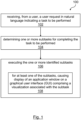
- Fig. 1 illustrates an overview of a method 100 in accordance with embodiments of the present disclosure.
- the method 100 may be performed by a conversational artificial intelligence (AI) agent.
- the method 100 may comprise a step 102 of receiving, from a user, a user request in natural language indicating a task to be performed.
- the user request may additionally comprise text, one or more data files or any combination thereof.
- the user request is a text-based prompt much like those known from chat-based language models such as Chat-GPT.
- the method may comprise a step 104 of determining one or more subtasks for completing the task to be performed.
- the AI agent relies on well-established techniques commonly employed in the field. This may involve an analysis of the requested task's parameters, user preferences, and/or system constraints, making use of available machine-learning models and/or established algorithmic decision-making approaches to evaluate and prioritize the necessary subtasks for optimal task completion.
- the AI agent may apply established natural language processing techniques to comprehend the user's intent and context, breaking down the requested task into its constituent elements. It may then employ established algorithms for assessing the computational complexity, resource requirements, and/or potential dependencies associated with each subtask. Additionally, the agent may reference user-specific preference models, historical interaction data, and/or pre-defined task templates to further fine-tune its subtask selection.
- the AI agent's adaptability may be rooted in established principles of reinforced learning and/or real-time feedback mechanisms, allowing it to continually refine its subtask determination strategy based on past interactions. This dynamic approach may ensure that the chosen subtasks align effectively with user expectations and system capabilities, ultimately enhancing the efficiency and user-centric nature of task execution.
- the AI agent is equipped to effectively discern, prioritize, and execute the most appropriate subtasks in response to a user's requested task. This approach contributes to the overall efficiency and effectiveness of task completion within the AI system and facilitates a seamless user experience.
- the method may comprise a step 106 of executing the one or more identified subtasks.
- the execution of a subtask by the AI agent may comprise a multifaceted process that incorporates various technical components and methodologies.
- the AI agent may employ one or more of the following steps and/or techniques to execute a subtask:
- the AI agent By orchestrating these steps and leveraging a combination of machine learning, data processing, resource management, and/or interaction with external systems, the AI agent effectively executes subtasks to accomplish user-defined objectives. This comprehensive process ensures the agent's ability to carry out a wide range of tasks and actions in a dynamic and user-centric manner.
- the step 106 of executing the one or more subtasks may comprise a step 108 of causing, for at least one of the subtasks, a display of an application window on a graphical user interface, GUI, comprising a visualization associated with the subtask.
- the method 100 may be implemented as a computer program.
- the computer program may relate to, or essentially provide, an operating system in which the agent(s) of the present disclosure are embedded.
- the agent(s) may have similar rights as users of traditional operating systems (e.g., accessing applications, installing applications, deinstalling applications, interaction with peripherals etc.).
- These interactions e.g., steps of method 100
- an interaction space e.g., application window(s)
- the agent is constructed in which the agent is able to perform interactions as well as corresponding visualizations to the user.
- the AI agent(s) may be executed remotely on one or more dedicated servers, while the user, situated at a different geographical location, interfaces with and observes the graphical user interface (GUI) from their local computer device.
- GUI graphical user interface
- the AI agent(s) may be locally instantiated and operated directly on the user's computer device, facilitating a more localized and immediate interaction experience.
- a hybrid configuration is conceivable, wherein certain AI agent(s) are executed on servers to harness computational scalability and efficiency, while others are deployed locally on the user's device to optimize responsiveness and/or address privacy concerns.
- the step 108 of causing the display may further comprise a step of causing, for each subtask of the one or more subtasks, a display of an application window on the GUI, each comprising a visualization associated with the corresponding subtask, wherein the displaying of each application window may be based on a processing order of the one or more subtask for completing the task to be performed.
- the displaying of the application window on the GUI comprising the visualization associated with the subtask may be similar to a screen-sharing session between two or more users.
- the visualization associated with the subtask may comprise an initiation visualization indicating a start of the subtask, a progress visualization indicating a progress of the subtask, a finalization visualization indicating a completion of the subtask and/or an overview visualization indicating a progress overview of the one or more subtasks.
- the progress overview of the one or more subtasks may comprises one or more subtasks in progress, one or more upcoming subtasks, one or more completed subtasks or any combination thereof.
- the method 100 may further comprise a step of receiving a user input for modifying the application window.
- Modifying the application window may comprise modifying one or more characteristics of the application window, in particular a size of the window and/or a position of the window on the display. Additionally or alternatively, modifying the application window may comprise modifying content of the application window.
- the step of executing a subtask of the one or more identified subtasks may comprise a step of performing one or more actions for progressing the subtask.
- the one or more actions may comprise at least an input action to a GUI element of the application window.
- the step of executing a subtask of the one or more determined subtasks may comprises a step of receiving information associated with another subtask of the one or more subtasks from another AI agent. The information may be necessary for progressing and/or completing the subtask.
- the step of executing a subtask of the one or more determined subtasks may comprise a step of transmitting information associated with the subtask to another AI agent. The information may be necessary for progressing and/or completing another subtask of the one or more subtasks.
- the step of transmitting the information associated with the subtask may be based on a user configuration, in particular a user preference and/or a user permission.
- the method 100 may further comprise a step of modifying, before transmitting the information associated with the subtask to the other agent, the information according to an information policy.
- the step of modifying the information according to the information policy may comprise a step of filtering, preferably using an AI model, user related, secret and/or internal information and/or information associated with a conversation between the user and the conversational AI agent such that the filtered information is not transmitted to the other AI agent.
- the step of modifying the information according to the information policy may comprise a step of rendering at least part of the information anonymous.
- the step of modifying the information according to the information policy may comprise a step of applying a traceability mark to the information associated with the subtask.
- the method 100 may further comprise a step of instantiating an AI agent for each of the one or more subtasks. Each instantiated AI agent may be responsible for completing one subtask of the one or more subtasks. The method 100 may further comprise a step of releasing one or more of the instantiated AI agents upon completion of the corresponding subtask.
- Fig. 2 illustrates an overview of an agent hierarchy 200 in accordance with embodiments of the present disclosure.
- the agent hierarchy 200 may comprise a parent agent 202 such as the conversational artificial intelligence (AI) agent according to the aspects of the present disclosure.
- the parent agent 202 represents the highest hierarchical level of the agent hierarchy 200 and may be responsible for the first interaction with a user (e.g., receiving a user request indicating a task to be performed), for determining one or more subtasks for completing the task to be performed, for executing the one or more identified subtasks, for causing, for at least one of the subtasks, the display of an application window on a GUI comprising a visualization associated with the subtask and/or for the last interaction (e.g., presenting, outputting and/or providing a result of the user request to the user).
- a parent agent 202 such as the conversational artificial intelligence (AI) agent according to the aspects of the present disclosure.
- the parent agent 202 represents the highest hierarchical level of the agent hierarchy 200 and
- an AI agent may be instantiated for each determined subtask, or at least for some of the subtasks.
- Fig. 2 illustrates exemplary child agents 204, 206 which may be instantiated by an agent of a higher hierarchy level.
- the parent agent 202 may receive the user request indicating a task to be performed and determine one or more subtasks for completing the task. Assuming the parent agent 202 has determined two subtasks, the parent agent 202 may execute these subtasks either by completing them itself or by instantiating one or more child agents 204 for one or both of the subtasks. For example, the parent agent 202 may instantiate two child agents 204, one for each of the two determined subtasks.
- the corresponding agent may be released. Releasing an agent may either be done by the agent instantiating the agent (e.g., child agent 1 204 instantiating the child agents 206 may also be the one releasing the child agents 206), by the parent agent 202 (e.g., if a more centralized architecture according to a master-slave principle is required) or by any other agent of the architecture 200.
- the child agents may also be conversational AI agents such as the parent agent 202.
- a first agent may determine whether a second agent can be released.
- a subtask with which the second agent was entrusted and instantiated for may be associated with a predefined duration. Accordingly, the first agent may release the second agent once the predefined duration is reached (e.g., determined using a timer started upon instantiating the second agent).
- the second agent may transmit in a predefined frequency (e.g., each millisecond) a keep-alive signal based on which the first agent can determine to not yet release the second agent. Once the first agent does no longer receive said keep-alive signal (e.g., because the second agent has completed the subtask or has crashed/frozen etc.) the first agent can determine to release the second agent.
- these options may also be combined.
- the advantage of the first option is that in a situation in which the second agent may have frozen or crashed (i.e., stopped working e.g., due to an error or bug) a deterministic option is provided for releasing the second agent.
- the advantage of the second option is that the agent is only released if the necessary information is received.
- the advantage of the third option is that based on the keep-alive signal it can be efficiently determined whether the agent can be released or is still working on a task.
- Each of the child agents 204 may then either execute the corresponding subtask by completing the subtask itself or determine one or more further (sub-)subtasks for completing the corresponding subtask. In case the child agent 204 determined one or more further (sub-)subtasks for completing the corresponding subtask, the child agent 204 may either complete the one or more (sub-)subtasks on its own to complete the corresponding subtask or instantiate one or more child agents 206 for completing one or more of the (sub-)subtask.
- This recursive way of splitting the task indicated by the user request into one or more task/agent levels may be repeated for a predefined number of times (e.g., a predefined recursion depth) or until a certain complexity of subtasks is reached (as explained with respect to Fig. 6 ).
- the agents may be able to communicate with each other.
- transmitting and receiving of information is possible between hierarchy levels (e.g., between parent agent 202 and child agent 1 204 or between child agent 1 204 and child agent 1 206, or also between parent agent 202 and child agent 1 206 etc.) as well as within hierarchy levels (e.g., between child agent 1 204 and child agent n 204 or between child agent 1 206 and child agent n 206).
- hierarchy levels e.g., between parent agent 202 and child agent 1 204 or between child agent 1 204 and child agent 1 206, or also between parent agent 202 and child agent 1 206 etc.
- communication between agents may be constrained, e.g., based on a user configuration, a user preference, a user permission and/or an information policy.
- These constrains may be implemented as a type of firewall surrounding each of the agents 202, 204, 206 (e.g., each agent may be associated with a firewall like privacy layer defining how to process and/or modify the information transmitted to and/or received from other agents).
- the firewall may be implemented hierarchy level wise (i.e., there may be one firewall between each of the hierarchy levels, e.g., a first firewall between the parent agent 202 and the child agents 204, a second firewall between the child agents 204 and the child agents 206 etc.) and/or within a hierarchy level (e.g., between child agent 1 204 and child agent n 204, etc.).
- Implementing the firewall may depend on the implementation of the inter-agent communication (e.g., whether communication between agents of different hierarchy levels and/or within the same hierarchy level is allowed).
- the firewall may also be applied with respect to the information processed by each agent within his own interaction space (e.g., if an agent is supposed to retrieve information from systems, such as the internet, the content of requests may be constrained e.g., with respect to allowed origin URLs).
- a history of conversation between the user and the agent(s) and/or between agents may be compressed and stored.
- a corresponding agent can decompress the compressed history allowing the agent to perform the task based on the history, which may enable the agent to provide a service customized to the preferences of the user.
- providing embeddings of said history compression has the advantage of less memory required for storing the history information.
- the embeddings may be stored in containers, wherein each container is associated with a unique identifier (e.g., a value of the embedding).
- the identifier may serve as an index for accessing the container (i.e., for saving and loading the corresponding embedding). This way, an efficient way of accessing the different embeddings (e.g., in terms of required time per request) is provided, because an agent can simply navigate/search through a plurality of different embeddings based on their corresponding identifiers (e.g., values) and the distance/difference between these identifiers.
- Running a certain number of agents in parallel and displaying their progress may be computationally intensive. To still be able to visualize their work/progress, it may thus be beneficial to configure the display of the one or more application windows of the one or more agents as follows. Instead of each agent displaying its own application window, the agents may communicate with each other as outlined above. Using this communication, it is possible that only the parent agent is the one displaying the application windows and that the other agents, which are working on the corresponding subtasks, merely provide the parent agent with the information which is to be displayed by the parent agent.
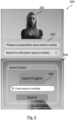
- Fig. 3 illustrates a first overview 300 of an interaction between a user and an agent 202 in accordance with embodiments of the present disclosure.
- the overview 300 illustrated in Fig. 3 may relate to a start screen (which represents the interaction space of the parent agent 202) upon booting a computer on which the operating system as explained with respect to Fig. 1 is deployed. This means, that upon starting the computer by the user, the agent 202, as indicated by an avatar, is booted as well and acts like an additional artificial user of the operating system.
- the overview 300 additionally comprises an input means 302 for receiving user requests.
- the input means 302 may be, as shown, a chat window.
- the input means 302 may comprise voice input (e.g., via a microphone) or computer files (e.g., documents, mails, chat messages (e.g., WhatsApp), pictures, videos etc., which may be entered by a user via drag-and-drop or other interaction ways such as a file editor, e-mail editor of the operating system etc.) or other input options (e.g., brain-computer interfaces such as Neuralink).
- the overview 300 additionally comprises a visualization and interaction area 304 such as a home screen of common operating systems. However, the area 304 may be used not only by the user but also by the parent agent 202 and other child agents 204, 206.
- Fig. 4 illustrates a second overview 400 of an interaction between a user and an agent 202 in accordance with embodiments of the present disclosure in which a user request 402 is entered into the input means 302 by a user.
- the user 302 requests from the agent 202 a presentation (e.g., a Power Point presentation) about electro-mobility (e-mobility).
- a presentation e.g., a Power Point presentation
- electro-mobility e-mobility
- app development e.g., a user enters a request to develop an app based on a API-documentation
- web development e.g., a user enters a request to develop a website for a given topic
- integrating the agent 202 into filesystems e.g., cloud drives such as Google Drive etc., hardware drives of the computer etc.
- enhancing an interaction space of an agent e.g., by adding a link of a website or by adding a browser plugin or other programs to the interaction space so that the agent is able to utilize the provided functionality
- agent 202 e.g., by adding a link of a website or by adding a browser plugin or other programs to the interaction space so that the agent is able to utilize the provided functionality
- a personal assistant e.g., for customer support by mail, or scheduling of meetings or responding to other enquiries such as social media enquiries by potential customers
- marketing management such as monitoring, placing and/or turning off online advertisements, customer questionnaires, creating company reports (e.g., about
- such an app or interaction space may be provided by an external entity to interface with functionality provided by that entity.
- a car manufacturer may provide a list of API interfaces and/or descriptions of the corresponding functions and/or parameters.
- An app may then be created to provide an interaction space specifically using these interfaces and/or descriptions, which can be conceptualized as a sub-space.
- One AI agent may then communicate in natural language with the app, e.g., by stating "adjust the temperature to 20°", as one example.
- the app may then select a corresponding function and makes a function call. Depending on the result, the app may respond with "The temperature was adjusted to 20°", “no connection to the car possible", or the like.
- Such a sub-space may also be pre-configured and packaged into an app. This way, whenever the app is invoked, a correspondingly pre-configured sub-space is spawned. Using this approach, it is possible to create arbitrarily complex app in a minimum amount of time. An AI within the app may even be trained separately to improve its performance.
- Fig. 5 illustrates a third overview 500 of an interaction between a user and an agent 202 in accordance with embodiments of the present disclosure.
- the agent 202 receives the user input 402 via the input means 302
- the agent 202 starts processing the request in order to determine one or more subtasks for completing the task to be performed (in this example preparing a presentation about e-mobility).
- the agent 202 determines for the given task a first subtask, namely "search for information about e-mobility" and starts executing the first subtask.
- display of an application window is caused on a GUI (e.g., the area 304).
- a first application window 502 is displayed which comprises a visualization associated with the task (i.e., preparing a presentation).
- the visualization of the application window 502 comprises an overview visualization indicating a progress overview comprising the identified subtask(s) (e.g., "search for information about e-mobility).
- a second application window 504 associated with the subtask "search for information about e-mobility” is displayed.
- the application window 504 comprises a progress visualization 506 indicating the progress of the "search for information about e-mobility").
- Said progress visualization 506 illustrates how a child agent (e.g., instantiated by the parent agent 202) opens a tab of a web browser, opens a search engine and searches for "facts about e-mobility".
- the fact that a child agent is working on the subtask e.g., "search for information about e-mobility" is additionally visualized within the first application window 502 by causing a display of an "in progress" icon (i.e., a circle of arrows)".
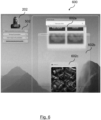
- Fig. 6 illustrates a fourth overview 600 of an interaction between a user and an agent 202 in accordance with embodiments of the present disclosure.
- the initial task of "prepare a presentation about electro mobility” is at an advanced stage.
- the task of "search for information about e-mobility" of a corresponding child agent has already been finished (i.e., the corresponding child agent may have been released).
- two further child agents are working on the subtasks "generate the presentation" and "create images for the presentation”.
- the corresponding visualization/application windows are illustrated at the right side of Fig. 6 (e.g., the area 304).
- application window 602 the results of the subtask "search for information about e-mobility" are displayed.
- the agent 202 may have placed the corresponding application window 602a in the background of area 304.
- the application window 602a was moved by the user (i.e., modified by the user).
- Application window 602b relates to the subtask of "generate the presentation".
- the fact that a child agent is currently working on said subtask is further illustrated by the "in progress" icon illustrated next to said subtask within the overview visualization in application window 502.
- the corresponding application window 602c visualizes the progress of searching/creating the images for the presentation.
- the example of the subtask "create images for the presentation" is chosen.
- a child agent is instantiated for said subtask.
- the child agent determines one or more (sub-)subtasks. For example, the child agent may determine three (sub-)subtasks, namely "creating an image for a first slide", “creating an image for a second slide” and "creating an image for a third slide". Accordingly, it may be determined that the complexity of these three (sub-)subtasks has reached a certain, low complexity (i.e., further splitting the task of creating one image is unreasonable). As a result, no further recursive iterations of instantiating child agents for identifying (sub-)subtasks may be conducted.
- Fig. 7 illustrates a fifth overview 700 of an interaction between a user and an agent in accordance with embodiments of the present disclosure.
- the overview 700 illustrates the completion of the task indicated by the user request (i.e., in the present example "prepare a presentation about e-mobility").
- the application window 502 comprising the progress overview visualization, each of the conducted subtasks as well as the indicated task was completed (as indicated by the corresponding (sub-)task being crossed out).
- application window 504 now illustrates the results of the completed task, namely a generated presentation about e-mobility.
- the agent 202 provides corresponding feedback about the completion of the task via the input means 302 (e.g., by issuing a chat message indicating the completion of the task).
- Fig. 8 illustrates a sixth overview 800 of a mobile version of a graphical user interface in accordance with embodiments of the present disclosure.
- Fig. 9 illustrates a seventh overview 900 of a graphical user interface in accordance with embodiments of the present disclosure.
- aspects have been described in the context of an apparatus, it is clear that these aspects also represent a description of the corresponding method, where a block or device corresponds to a method step or a feature of a method step. Analogously, aspects described in the context of a method step also represent a description of a corresponding block or item or feature of a corresponding apparatus.
- Embodiments of the present disclosure may be implemented on a computer system.
- the computer system may be a local computer device (e.g., personal computer, laptop, tablet computer or mobile phone) with one or more processors and one or more storage devices or may be a distributed computer system (e.g., a cloud computing system with one or more processors and one or more storage devices distributed at various locations, for example, at a local client and/or one or more remote server farms and/or data centers).
- the computer system may comprise any circuit or combination of circuits.
- the computer system may include one or more processors which can be of any type.
- processor may mean any type of computational circuit, such as but not limited to a microprocessor, a microcontroller, a complex instruction set computing (CISC) microprocessor, a reduced instruction set computing (RISC) microprocessor, a very long instruction word (VLIW) microprocessor, a graphics processor, a digital signal processor (DSP), multiple core processor, a field programmable gate array (FPGA), or any other type of processor or processing circuit.
- CISC complex instruction set computing
- RISC reduced instruction set computing
- VLIW very long instruction word
- DSP digital signal processor
- FPGA field programmable gate array
- circuits that may be included in the computer system may be a custom circuit, an application-specific integrated circuit (ASIC), or the like, such as, for example, one or more circuits (such as a communication circuit) for use in wireless devices like mobile telephones, tablet computers, laptop computers, two-way radios, and similar electronic systems.
- the computer system may include one or more storage devices, which may include one or more memory elements suitable to the particular application, such as a main memory in the form of random-access memory (RAM), one or more hard drives, and/or one or more drives that handle removable media such as compact disks (CD), flash memory cards, digital video disk (DVD), and the like.
- RAM random-access memory
- CD compact disks
- DVD digital video disk
- the computer system may also include a display device, one or more speakers, and a keyboard and/or controller, which can include a mouse, trackball, touch screen, voice-recognition device, or any other device that permits a system user to input information into and receive information from the computer system.
- a display device one or more speakers
- a keyboard and/or controller which can include a mouse, trackball, touch screen, voice-recognition device, or any other device that permits a system user to input information into and receive information from the computer system.
- Some or all of the method steps may be executed by (or using) a hardware apparatus, like for example, a processor, a microprocessor, a programmable computer or an electronic circuit. In some embodiments, some one or more of the most important method steps may be executed by such an apparatus.
- embodiments of the present disclosure can be implemented in hardware or in software.
- the implementation can be performed using a non-transitory storage medium such as a digital storage medium, for example a floppy disc, a DVD, a Blu-Ray, a CD, a ROM, a PROM, and EPROM, an EEPROM or a FLASH memory, having electronically readable control signals stored thereon, which cooperate (or are capable of cooperating) with a programmable computer system such that the respective method is performed. Therefore, the digital storage medium may be computer readable.
- Some embodiments according to the present disclosure comprise a data carrier having electronically readable control signals, which are capable of cooperating with a programmable computer system, such that one of the methods described herein is performed.
- embodiments of the present disclosure can be implemented as a computer program product with a program code, the program code being operative for performing one of the methods when the computer program product runs on a computer.
- the program code may, for example, be stored on a machine-readable carrier.
- inventions comprise the computer program for performing one of the methods described herein, stored on a machine-readable carrier.
- an embodiment of the present disclosure is, therefore, a computer program having a program code for performing one of the methods described herein, when the computer program runs on a computer.
- a further embodiment of the present disclosure is, therefore, a storage medium (or a data carrier, or a computer-readable medium) comprising, stored thereon, the computer program for performing one of the methods described herein when it is performed by a processor.
- the data carrier, the digital storage medium or the recorded medium are typically tangible and/or non-transitory.
- a further embodiment of the present disclosure is an apparatus as described herein comprising a processor and the storage medium.
- a further embodiment of the present disclosure is, therefore, a data stream or a sequence of signals representing the computer program for performing one of the methods described herein.
- the data stream or the sequence of signals may, for example, be configured to be transferred via a data communication connection, for example, via the internet.
- a further embodiment comprises a processing means, for example, a computer or a programmable logic device, configured to, or adapted to, perform one of the methods described herein.
- a processing means for example, a computer or a programmable logic device, configured to, or adapted to, perform one of the methods described herein.
- a further embodiment comprises a computer having installed thereon the computer program for performing one of the methods described herein.
- a further embodiment according to the present disclosure comprises an apparatus or a system configured to transfer (for example, electronically or optically) a computer program for performing one of the methods described herein to a receiver.
- the receiver may, for example, be a computer, a mobile device, a memory device or the like.
- the apparatus or system may, for example, comprise a file server for transferring the computer program to the receiver.
- a programmable logic device for example, a field programmable gate array
- a field programmable gate array may cooperate with a microprocessor in order to perform one of the methods described herein.
- the methods are preferably performed by any hardware apparatus.
- Machine learning is a subfield of artificial intelligence (AI) that encompasses a set of computational techniques and algorithms designed to enable computer systems to learn from and make predictions or decisions based on data, patterns, and experiences, without being explicitly programmed for each specific task.
- AI artificial intelligence
- Machine learning algorithms are capable of automatically improving their performance over time through exposure to new data, allowing them to adapt to changing circumstances and optimize their outputs. These algorithms often involve the use of statistical models, neural networks, and other mathematical constructs to analyze and derive insights from datasets, recognize patterns, classify information, and make data-driven predictions.
- Machine learning techniques encompass a broad spectrum of methodologies, including supervised learning, unsupervised learning, reinforcement learning, deep learning, and more, which can be employed in various embodiments described in this patent application to enhance the functionality, adaptability, and efficiency of the disclosed systems and methods.
- Conversational AI assistants and/or conversational AI agents may involve natural language processing, e.g., by way of large language models (LLMs).
- LLM large language model
- AI artificial intelligence
- a large language model is a type of artificial intelligence (AI) model that is designed to understand and generate human language. These models are characterized by their immense size, complexity, and capacity to process and generate text in a way that mimics human language understanding and production.
- a large language model is a deep learning-based neural network architecture that excels at natural language processing (NLP) tasks.
- NLP natural language processing
- Large language models have revolutionized the field of NLP and have enabled advancements in tasks like language translation, sentiment analysis, chatbots, and information retrieval. They continue to be a focal point of research and development in the AI community, with ongoing efforts to enhance their capabilities and address ethical and societal concerns related to their deployment. It is characterized by the following key features:
- LLMs are based on the above-mentioned transformer architecture or its variations.
- transformer-based architectures used for LLMs are:
- Typical components for implementing these models are:
Landscapes
- Engineering & Computer Science (AREA)
- Theoretical Computer Science (AREA)
- Software Systems (AREA)
- General Engineering & Computer Science (AREA)
- Human Computer Interaction (AREA)
- Physics & Mathematics (AREA)
- General Physics & Mathematics (AREA)
- User Interface Of Digital Computer (AREA)
Priority Applications (2)
| Application Number | Priority Date | Filing Date | Title |
|---|---|---|---|
| EP23200435.8A EP4530807B1 (de) | 2023-09-28 | 2023-09-28 | Verbesserte mensch-maschine-schnittstelle für konversations-ai-agenten |
| PCT/EP2024/076923 WO2025068280A1 (en) | 2023-09-28 | 2024-09-25 | Improved human-machine interface for conversational ai agents |
Applications Claiming Priority (1)
| Application Number | Priority Date | Filing Date | Title |
|---|---|---|---|
| EP23200435.8A EP4530807B1 (de) | 2023-09-28 | 2023-09-28 | Verbesserte mensch-maschine-schnittstelle für konversations-ai-agenten |
Publications (2)
| Publication Number | Publication Date |
|---|---|
| EP4530807A1 true EP4530807A1 (de) | 2025-04-02 |
| EP4530807B1 EP4530807B1 (de) | 2026-03-25 |
Family
ID=88295821
Family Applications (1)
| Application Number | Title | Priority Date | Filing Date |
|---|---|---|---|
| EP23200435.8A Active EP4530807B1 (de) | 2023-09-28 | 2023-09-28 | Verbesserte mensch-maschine-schnittstelle für konversations-ai-agenten |
Country Status (2)
| Country | Link |
|---|---|
| EP (1) | EP4530807B1 (de) |
| WO (1) | WO2025068280A1 (de) |
Citations (6)
| Publication number | Priority date | Publication date | Assignee | Title |
|---|---|---|---|---|
| EP0862113A2 (de) | 1997-02-27 | 1998-09-02 | Zuno Limited | Architektur mit selbstständigem Agent |
| US6754647B1 (en) | 2000-09-26 | 2004-06-22 | Verity, Inc. | Method and apparatus for hierarchically decomposed bot scripts |
| US20190012198A1 (en) * | 2017-07-07 | 2019-01-10 | Google Inc. | Invoking an automated assistant to perform multiple tasks through an individual command |
| US20190166069A1 (en) | 2017-11-27 | 2019-05-30 | Baidu Usa Llc | System and method for visually understanding and programming conversational agents of electronic devices |
| US10636419B2 (en) | 2017-12-06 | 2020-04-28 | Sony Interactive Entertainment Inc. | Automatic dialogue design |
| US20220101844A1 (en) * | 2020-09-29 | 2022-03-31 | Salesforce.Com, Inc. | Configurable conversation engine for executing customizable chatbots |
-
2023
- 2023-09-28 EP EP23200435.8A patent/EP4530807B1/de active Active
-
2024
- 2024-09-25 WO PCT/EP2024/076923 patent/WO2025068280A1/en active Pending
Patent Citations (6)
| Publication number | Priority date | Publication date | Assignee | Title |
|---|---|---|---|---|
| EP0862113A2 (de) | 1997-02-27 | 1998-09-02 | Zuno Limited | Architektur mit selbstständigem Agent |
| US6754647B1 (en) | 2000-09-26 | 2004-06-22 | Verity, Inc. | Method and apparatus for hierarchically decomposed bot scripts |
| US20190012198A1 (en) * | 2017-07-07 | 2019-01-10 | Google Inc. | Invoking an automated assistant to perform multiple tasks through an individual command |
| US20190166069A1 (en) | 2017-11-27 | 2019-05-30 | Baidu Usa Llc | System and method for visually understanding and programming conversational agents of electronic devices |
| US10636419B2 (en) | 2017-12-06 | 2020-04-28 | Sony Interactive Entertainment Inc. | Automatic dialogue design |
| US20220101844A1 (en) * | 2020-09-29 | 2022-03-31 | Salesforce.Com, Inc. | Configurable conversation engine for executing customizable chatbots |
Also Published As
| Publication number | Publication date |
|---|---|
| EP4530807B1 (de) | 2026-03-25 |
| WO2025068280A1 (en) | 2025-04-03 |
Similar Documents
| Publication | Publication Date | Title |
|---|---|---|
| Abrahão et al. | Model-based intelligent user interface adaptation: challenges and future directions | |
| Uzoka et al. | Leveraging AI-Powered chatbots to enhance customer service efficiency and future opportunities in automated support | |
| JP7851913B2 (ja) | テキスト分類についての説明を与えるための技術 | |
| US20210089860A1 (en) | Digital assistant with predictions, notifications, and recommendations | |
| Vashishth et al. | Artificial intelligence (AI)–powered chatbots: Providing instant support and personalized recommendations to guests 24/7 | |
| CA3017121C (en) | Systems and methods for dynamic prediction of workflows | |
| Hassan et al. | Chatgpt as your personal data scientist | |
| JP7692482B2 (ja) | ニューラルネットワークにおける過剰予測のための方法およびシステム | |
| EP4657312A1 (de) | Dynamische agenten mit echtzeitausrichtung | |
| US20250356313A1 (en) | Multi-agent task management guided by generative artificial intelligence | |
| Bandara et al. | A practical guide to agentic AI transition in organizations | |
| EP4657313A1 (de) | Dynamische agenten mit echtzeitausrichtung | |
| Huang | Ai agents and business workflow | |
| Yaeli et al. | Recommending next best skill in conversational robotic process automation | |
| EP4530807B1 (de) | Verbesserte mensch-maschine-schnittstelle für konversations-ai-agenten | |
| Dziembek et al. | A Model for Integrating Artificial Intelligence with ERP Systems–Towards Autonomous Business Management Systems | |
| US20260003874A1 (en) | Generating responses to queries using entity-specific generative artificial intelligence agents | |
| US20250190703A1 (en) | Intelligent Interface for Automation Multitasking | |
| WO2025090062A1 (en) | Generative ai appliance | |
| Rohitha | Agentic AI-Building Autonomous Intelligent Systems for Enterprise Applications | |
| EP4654004A1 (de) | Softwareentwicklungswerkzeug und verfahren zur verwendung davon | |
| Aswani et al. | Federated Learning by Contextual Model for Advanced AI Assistance | |
| EP4657315A1 (de) | Dynamische agenten mit echtzeitausrichtung | |
| EP4657314A1 (de) | Dynamische agenten mit echtzeitausrichtung | |
| US20260030567A1 (en) | Generating candidate subtasks for a task created by a user through a generative model and supplemental tasks previously created by the user |
Legal Events
| Date | Code | Title | Description |
|---|---|---|---|
| PUAI | Public reference made under article 153(3) epc to a published international application that has entered the european phase |
Free format text: ORIGINAL CODE: 0009012 |
|
| STAA | Information on the status of an ep patent application or granted ep patent |
Free format text: STATUS: THE APPLICATION HAS BEEN PUBLISHED |
|
| AK | Designated contracting states |
Kind code of ref document: A1 Designated state(s): AL AT BE BG CH CY CZ DE DK EE ES FI FR GB GR HR HU IE IS IT LI LT LU LV MC ME MK MT NL NO PL PT RO RS SE SI SK SM TR |
|
| STAA | Information on the status of an ep patent application or granted ep patent |
Free format text: STATUS: REQUEST FOR EXAMINATION WAS MADE |
|
| REG | Reference to a national code |
Ref country code: DE Ref legal event code: R079 Free format text: PREVIOUS MAIN CLASS: G06F0003048000 Ipc: G06F0003048100 Ref country code: DE Ref legal event code: R079 Ref document number: 602023013992 Country of ref document: DE Free format text: PREVIOUS MAIN CLASS: G06F0003048000 Ipc: G06F0003048100 |
|
| RAP3 | Party data changed (applicant data changed or rights of an application transferred) |
Owner name: WARMWIND AG |
|
| GRAP | Despatch of communication of intention to grant a patent |
Free format text: ORIGINAL CODE: EPIDOSNIGR1 |
|
| STAA | Information on the status of an ep patent application or granted ep patent |
Free format text: STATUS: GRANT OF PATENT IS INTENDED |
|
| 17P | Request for examination filed |
Effective date: 20250915 |
|
| RIC1 | Information provided on ipc code assigned before grant |
Ipc: G06F 3/0481 20220101AFI20250930BHEP Ipc: G06F 9/451 20180101ALI20250930BHEP |
|
| INTG | Intention to grant announced |
Effective date: 20251017 |
|
| GRAS | Grant fee paid |
Free format text: ORIGINAL CODE: EPIDOSNIGR3 |
|
| GRAA | (expected) grant |
Free format text: ORIGINAL CODE: 0009210 |
|
| STAA | Information on the status of an ep patent application or granted ep patent |
Free format text: STATUS: THE PATENT HAS BEEN GRANTED |
|
| AK | Designated contracting states |
Kind code of ref document: B1 Designated state(s): AL AT BE BG CH CY CZ DE DK EE ES FI FR GB GR HR HU IE IS IT LI LT LU LV MC ME MK MT NL NO PL PT RO RS SE SI SK SM TR |
|
| REG | Reference to a national code |
Ref country code: CH Ref legal event code: F10 Free format text: ST27 STATUS EVENT CODE: U-0-0-F10-F00 (AS PROVIDED BY THE NATIONAL OFFICE) Effective date: 20260325 Ref country code: GB Ref legal event code: FG4D |
|
| REG | Reference to a national code |
Ref country code: DE Ref legal event code: R096 Ref document number: 602023013992 Country of ref document: DE |
|
| REG | Reference to a national code |
Ref country code: IE Ref legal event code: FG4D |
|
| REG | Reference to a national code |
Ref country code: CH Ref legal event code: R17 Free format text: ST27 STATUS EVENT CODE: U-0-0-R10-R17 (AS PROVIDED BY THE NATIONAL OFFICE) Effective date: 20260427 |