EP4530805A1 - Optische artefaktverringerung und inhaltsanzeigeverbesserung - Google Patents
Optische artefaktverringerung und inhaltsanzeigeverbesserung Download PDFInfo
- Publication number
- EP4530805A1 EP4530805A1 EP24202616.9A EP24202616A EP4530805A1 EP 4530805 A1 EP4530805 A1 EP 4530805A1 EP 24202616 A EP24202616 A EP 24202616A EP 4530805 A1 EP4530805 A1 EP 4530805A1
- Authority
- EP
- European Patent Office
- Prior art keywords
- content item
- view
- environment
- determining
- brightness
- Prior art date
- Legal status (The legal status is an assumption and is not a legal conclusion. Google has not performed a legal analysis and makes no representation as to the accuracy of the status listed.)
- Pending
Links
Images






Classifications
-
- G—PHYSICS
- G09—EDUCATION; CRYPTOGRAPHY; DISPLAY; ADVERTISING; SEALS
- G09G—ARRANGEMENTS OR CIRCUITS FOR CONTROL OF INDICATING DEVICES USING STATIC MEANS TO PRESENT VARIABLE INFORMATION
- G09G3/00—Control arrangements or circuits, of interest only in connection with visual indicators other than cathode-ray tubes
- G09G3/001—Control arrangements or circuits, of interest only in connection with visual indicators other than cathode-ray tubes using specific devices not provided for in groups G09G3/02 - G09G3/36, e.g. using an intermediate record carrier such as a film slide; Projection systems; Display of non-alphanumerical information, solely or in combination with alphanumerical information, e.g. digital display on projected diapositive as background
-
- G—PHYSICS
- G06—COMPUTING OR CALCULATING; COUNTING
- G06F—ELECTRIC DIGITAL DATA PROCESSING
- G06F3/00—Input arrangements for transferring data to be processed into a form capable of being handled by the computer; Output arrangements for transferring data from processing unit to output unit, e.g. interface arrangements
- G06F3/01—Input arrangements or combined input and output arrangements for interaction between user and computer
- G06F3/011—Arrangements for interaction with the human body, e.g. for user immersion in virtual reality
-
- G—PHYSICS
- G02—OPTICS
- G02B—OPTICAL ELEMENTS, SYSTEMS OR APPARATUS
- G02B27/00—Optical systems or apparatus not provided for by any of the groups G02B1/00 - G02B26/00, G02B30/00
- G02B27/0093—Optical systems or apparatus not provided for by any of the groups G02B1/00 - G02B26/00, G02B30/00 with means for monitoring data relating to the user, e.g. head-tracking, eye-tracking
-
- G—PHYSICS
- G02—OPTICS
- G02B—OPTICAL ELEMENTS, SYSTEMS OR APPARATUS
- G02B27/00—Optical systems or apparatus not provided for by any of the groups G02B1/00 - G02B26/00, G02B30/00
- G02B27/01—Head-up displays
- G02B27/017—Head mounted
- G02B27/0172—Head mounted characterised by optical features
-
- G—PHYSICS
- G06—COMPUTING OR CALCULATING; COUNTING
- G06F—ELECTRIC DIGITAL DATA PROCESSING
- G06F3/00—Input arrangements for transferring data to be processed into a form capable of being handled by the computer; Output arrangements for transferring data from processing unit to output unit, e.g. interface arrangements
- G06F3/01—Input arrangements or combined input and output arrangements for interaction between user and computer
- G06F3/011—Arrangements for interaction with the human body, e.g. for user immersion in virtual reality
- G06F3/013—Eye tracking input arrangements
-
- G—PHYSICS
- G06—COMPUTING OR CALCULATING; COUNTING
- G06T—IMAGE DATA PROCESSING OR GENERATION, IN GENERAL
- G06T11/00—Two-dimensional [2D] image generation
-
- G—PHYSICS
- G06—COMPUTING OR CALCULATING; COUNTING
- G06T—IMAGE DATA PROCESSING OR GENERATION, IN GENERAL
- G06T19/00—Manipulating three-dimensional [3D] models or images for computer graphics
- G06T19/006—Mixed reality
-
- G—PHYSICS
- G06—COMPUTING OR CALCULATING; COUNTING
- G06T—IMAGE DATA PROCESSING OR GENERATION, IN GENERAL
- G06T7/00—Image analysis
- G06T7/0002—Inspection of images, e.g. flaw detection
-
- G—PHYSICS
- G02—OPTICS
- G02B—OPTICAL ELEMENTS, SYSTEMS OR APPARATUS
- G02B27/00—Optical systems or apparatus not provided for by any of the groups G02B1/00 - G02B26/00, G02B30/00
- G02B27/01—Head-up displays
- G02B27/0101—Head-up displays characterised by optical features
- G02B2027/0118—Head-up displays characterised by optical features comprising devices for improving the contrast of the display / brillance control visibility
- G02B2027/012—Head-up displays characterised by optical features comprising devices for improving the contrast of the display / brillance control visibility comprising devices for attenuating parasitic image effects
-
- G—PHYSICS
- G06—COMPUTING OR CALCULATING; COUNTING
- G06T—IMAGE DATA PROCESSING OR GENERATION, IN GENERAL
- G06T2207/00—Indexing scheme for image analysis or image enhancement
- G06T2207/10—Image acquisition modality
- G06T2207/10016—Video; Image sequence
-
- G—PHYSICS
- G06—COMPUTING OR CALCULATING; COUNTING
- G06T—IMAGE DATA PROCESSING OR GENERATION, IN GENERAL
- G06T2207/00—Indexing scheme for image analysis or image enhancement
- G06T2207/10—Image acquisition modality
- G06T2207/10024—Color image
-
- G—PHYSICS
- G06—COMPUTING OR CALCULATING; COUNTING
- G06T—IMAGE DATA PROCESSING OR GENERATION, IN GENERAL
- G06T2207/00—Indexing scheme for image analysis or image enhancement
- G06T2207/30—Subject of image; Context of image processing
- G06T2207/30168—Image quality inspection
-
- G—PHYSICS
- G09—EDUCATION; CRYPTOGRAPHY; DISPLAY; ADVERTISING; SEALS
- G09G—ARRANGEMENTS OR CIRCUITS FOR CONTROL OF INDICATING DEVICES USING STATIC MEANS TO PRESENT VARIABLE INFORMATION
- G09G2320/00—Control of display operating conditions
- G09G2320/02—Improving the quality of display appearance
- G09G2320/0238—Improving the black level
-
- G—PHYSICS
- G09—EDUCATION; CRYPTOGRAPHY; DISPLAY; ADVERTISING; SEALS
- G09G—ARRANGEMENTS OR CIRCUITS FOR CONTROL OF INDICATING DEVICES USING STATIC MEANS TO PRESENT VARIABLE INFORMATION
- G09G2320/00—Control of display operating conditions
- G09G2320/06—Adjustment of display parameters
- G09G2320/066—Adjustment of display parameters for control of contrast
-
- G—PHYSICS
- G09—EDUCATION; CRYPTOGRAPHY; DISPLAY; ADVERTISING; SEALS
- G09G—ARRANGEMENTS OR CIRCUITS FOR CONTROL OF INDICATING DEVICES USING STATIC MEANS TO PRESENT VARIABLE INFORMATION
- G09G2320/00—Control of display operating conditions
- G09G2320/06—Adjustment of display parameters
- G09G2320/0666—Adjustment of display parameters for control of colour parameters, e.g. colour temperature
-
- G—PHYSICS
- G09—EDUCATION; CRYPTOGRAPHY; DISPLAY; ADVERTISING; SEALS
- G09G—ARRANGEMENTS OR CIRCUITS FOR CONTROL OF INDICATING DEVICES USING STATIC MEANS TO PRESENT VARIABLE INFORMATION
- G09G2354/00—Aspects of interface with display user
Definitions
- the present disclosure generally relates to systems, methods, and devices that mitigate optical artifacts that may occur in the presentation of content items (e.g., movies, TV shows, etc.) within extended reality (XR) environments and/or provide other content display enhancements on electronic devices such as head-mounted devices (HMD).
- content items e.g., movies, TV shows, etc.
- XR extended reality
- HMD head-mounted devices
- Displaying content on electronic devices may result in various optical artifacts and other undesirable characteristics.
- a mirror layer may leak some light to produce ghosting artifacts.
- Existing techniques may not adequately, efficiently, or effectively mitigate for these and other optical artifacts and undesirable characteristics.
- Various implementations disclosed herein include devices, systems, and methods that present content items (e.g., movies, TV shows, home-made videos, etc.) on electronic devices such as HMDs. Some implementations adjust what is being displayed by the electronic devices to mitigate optical module-based artifacts (e.g., ghosting). For example, in an HMD with a catadioptric lens, a mirror layer may leak some light to produce ghosting artifacts that may be mitigated by adjusting brightness, dynamic range, contrast, light-spill, color, etc. Some implementations utilize adjustments that are based on content item awareness (e.g., adjustments based on the peak brightness of the scene in a movie that is being displayed within an extended reality (XR) environment, etc.).
- XR extended reality
- Some implementations provide adjustments based on environment awareness (e.g., how dark is the virtual surroundings or pass-through environment around a content item). Some implementations provide adjustments based on optical module modeling. Some implementations provide adjustments based on viewing circumstances such as where the user is gazing. The mitigating adjustments may change a particular content item and/or an environment in which it is presented. The adjustment may be determined to preserve artist intent, based on type of content, and/or using other criteria.
- environment awareness e.g., how dark is the virtual surroundings or pass-through environment around a content item.
- Some implementations provide adjustments based on optical module modeling. Some implementations provide adjustments based on viewing circumstances such as where the user is gazing.
- the mitigating adjustments may change a particular content item and/or an environment in which it is presented. The adjustment may be determined to preserve artist intent, based on type of content, and/or using other criteria.
- an HMD may have one or more eye tracking systems comprises emitters and/or sensors that capture sensor data used to determine eye pose (e.g., position and/or orientation relative to other components of the HMD).
- eye pose e.g., position and/or orientation relative to other components of the HMD.
- a tracking system produces a plurality of IR glints (e.g., in one or more patterns) that are captured or otherwise detected in IR images and used to determine eye pose.
- a gaze direction of the user is determined. Gaze direction may be determined based on determining gaze directions of one or both eyes.
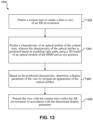
- the method 1400 involves identifying a portion of the view associated with peripheral vision based on the gaze direction.
- the gaze direction may be used to identify which portion (e.g., which pixel or group of pixels to which a user's gaze is directed). Identifying the portion of the view associated with peripheral vision may be based on determining a foveal gaze zone (FGZ) based on the gaze direction and identifying one or more portions of the view outside of the FGZ.
- FGZ foveal gaze zone
- the portion of the view associated with peripheral vision may be adjusted using a nonlinear curve defining an alpha multiplier to reduce pixel brightness of pixel based on distance from a foveal region of the view.
- the portion of the view associated with peripheral vision may be adjusted using an alpha multiplier to flatten contrast.
- the portion of the view associated with peripheral vision may be adjusted using both: (a) a nonlinear curve defining a first multiplier to reduce pixel brightness of pixel based on distance from a foveal region of the view; and using a second multiplier to flatten contrast.
- Some implementations adjust the view over time to provide a smooth transition between gaze-based dimming curves that are adjusted over time to change an amount of dimming applied to the portion of the view associated with peripheral vision. Some implementations adjust the view over time to account for detect blink or saccade user activity.
- the method 1400 may involve adjusting an amount of contrast flattening based on a user-specific characteristic.
- the user-specific characteristic is near-sightedness.
- the user-specific characteristic is eye-convergence inaccuracy.
- Figure 15 is a block diagram of an example device 1500.
- Device 1500 illustrates an exemplary device configuration for electronic devices 105 and 110 of Figure 1 . While certain specific features are illustrated, those skilled in the art will appreciate from the present disclosure that various other features have not been illustrated for the sake of brevity, and so as not to obscure more pertinent aspects of the implementations disclosed herein.
- the one or more displays 1512 are configured to present a view of a physical environment, a graphical environment, an extended reality environment, etc. to the user. In some implementations, the one or more displays 1512 are configured to present content (determined based on a determined user/object location of the user within the physical environment) to the user.
- the one or more displays 1512 correspond to holographic, digital light processing (DLP), liquid-crystal display (LCD), liquid-crystal on silicon (LCoS), organic light-emitting field-effect transitory (OLET), organic light-emitting diode (OLED), surface-conduction electron-emitter display (SED), field-emission display (FED), quantum-dot light-emitting diode (QD-LED), micro-electromechanical system (MEMS), and/or the like display types.
- the one or more displays 1512 correspond to diffractive, reflective, polarized, holographic, etc. waveguide displays.
- the device 1500 includes a single display.
- the device 1500 includes a display for each eye of the user.
- the one or more image sensor systems 1514 are configured to obtain image data that corresponds to at least a portion of the physical environment 100.
- the one or more image sensor systems 1514 include one or more RGB cameras (e.g., with a complimentary metal-oxide-semiconductor (CMOS) image sensor or a charge-coupled device (CCD) image sensor), monochrome cameras, IR cameras, depth cameras, event-based cameras, and/or the like.
- the one or more image sensor systems 1514 further include illumination sources that emit light, such as a flash.
- the one or more image sensor systems 1514 further include an on-camera image signal processor (ISP) configured to execute a plurality of processing operations on the image data.
- ISP on-camera image signal processor
- sensor data may be obtained by device(s) (e.g., devices 105 and 110 of Figure 1 ) during a scan of a room of a physical environment.
- the sensor data may include a 3D point cloud and a sequence of 2D images corresponding to captured views of the room during the scan of the room.
- the sensor data includes image data (e.g., from an RGB camera), depth data (e.g., a depth image from a depth camera), ambient light sensor data (e.g., from an ambient light sensor), and/or motion data from one or more motion sensors (e.g., accelerometers, gyroscopes, IMU, etc.).
- the sensor data includes visual inertial odometry (VIO) data determined based on image data.
- VIO visual inertial odometry
- the 3D point cloud may provide semantic information about one or more elements of the room.
- the 3D point cloud may provide information about the positions and appearance of surface portions within the physical environment.
- the 3D point cloud is obtained over time, e.g., during a scan of the room, and the 3D point cloud may be updated, and updated versions of the 3D point cloud obtained over time. For example, a 3D representation may be obtained (and analyzed/processed) as it is updated/adjusted over time (e.g., as the user scans a room).
- sensor data may be positioning information
- some implementations include a VIO to determine equivalent odometry information using sequential camera images (e.g., light intensity image data) and motion data (e.g., acquired from the IMU/motion sensor) to estimate the distance traveled.
- some implementations of the present disclosure may include a simultaneous localization and mapping (SLAM) system (e.g., position sensors).
- the SLAM system may include a multidimensional (e.g., 3D) laser scanning and range-measuring system that is GPS independent and that provides real-time simultaneous location and mapping.
- the SLAM system may generate and manage data for a very accurate point cloud that results from reflections of laser scanning from objects in an environment. Movements of any of the points in the point cloud are accurately tracked over time, so that the SLAM system can maintain precise understanding of its location and orientation as it travels through an environment, using the points in the point cloud as reference points for the location.
- the device 1500 includes an eye tracking system for detecting eye position and eye movements (e.g., eye gaze detection).
- an eye tracking system may include one or more infrared (IR) light-emitting diodes (LEDs), an eye tracking camera (e.g., near-IR (NIR) camera), and an illumination source (e.g., an NIR light source) that emits light (e.g., NIR light) towards the eyes of the user.
- the illumination source of the device 1500 may emit NIR light to illuminate the eyes of the user and the NIR camera may capture images of the eyes of the user.
- images captured by the eye tracking system may be analyzed to detect position and movements of the eyes of the user, or to detect other information about the eyes such as pupil dilation or pupil diameter.
- the point of gaze estimated from the eye tracking images may enable gaze-based interaction with content shown on the near-eye display of the device 1500.
- the memory 1520 includes high-speed random-access memory, such as DRAM, SRAM, DDR RAM, or other random-access solid-state memory devices.
- the memory 1520 includes non-volatile memory, such as one or more magnetic disk storage devices, optical disk storage devices, flash memory devices, or other non-volatile solid-state storage devices.
- the memory 1520 optionally includes one or more storage devices remotely located from the one or more processing units 1502.
- the memory 1520 includes a non-transitory computer readable storage medium.
- the memory 1520 or the non-transitory computer readable storage medium of the memory 1520 stores an optional operating system 1530 and one or more instruction set(s) 1540.
- the operating system 1530 includes procedures for handling various basic system services and for performing hardware dependent tasks.
- the instruction set(s) 1540 include executable software defined by binary information stored in the form of electrical charge.
- the instruction set(s) 1540 are software that is executable by the one or more processing units 1502 to carry out one or more of the techniques described herein.
- the instruction set(s) 1540 includes a video content presentation instruction set 1542.
- the instruction set(s) 1540 may be embodied as a single software executable or multiple software executables.
- the artifact mitigation and display enhancement instruction set 1542 is configured with instructions executable by a processor to analyze content and environment characteristics, perform optical module modeling, and/or otherwise determine mitigations and enhancements based various considerations, as described herein.
- Figure 15 is intended more as functional description of the various features which are present in a particular implementation as opposed to a structural schematic of the implementations described herein. As recognized by those of ordinary skill in the art, items shown separately could be combined and some items could be separated. The actual number of instructions sets and how features are allocated among them may vary from one implementation to another and may depend in part on the particular combination of hardware, software, and/or firmware chosen for a particular implementation.
- Embodiments of the subject matter and the operations described in this specification can be implemented in digital electronic circuitry, or in computer software, firmware, or hardware, including the structures disclosed in this specification and their structural equivalents, or in combinations of one or more of them.
- Embodiments of the subject matter described in this specification can be implemented as one or more computer programs, e.g., one or more modules of computer program instructions, encoded on computer storage medium for execution by, or to control the operation of, data processing apparatus.
- the program instructions can be encoded on an artificially generated propagated signal, e.g., a machine-generated electrical, optical, or electromagnetic signal, that is generated to encode information for transmission to suitable receiver apparatus for execution by a data processing apparatus.
- a computer storage medium can be, or be included in, a computer-readable storage device, a computer-readable storage substrate, a random or serial access memory array or device, or a combination of one or more of them. Moreover, while a computer storage medium is not a propagated signal, a computer storage medium can be a source or destination of computer program instructions encoded in an artificially generated propagated signal. The computer storage medium can also be, or be included in, one or more separate physical components or media (e.g., multiple CDs, disks, or other storage devices).
- data processing apparatus encompasses all kinds of apparatus, devices, and machines for processing data, including by way of example a programmable processor, a computer, a system on a chip, or multiple ones, or combinations, of the foregoing.
- the apparatus can include special purpose logic circuitry, e.g., an FPGA (field programmable gate array) or an ASIC (application specific integrated circuit).
- the apparatus can also include, in addition to hardware, code that creates an execution environment for the computer program in question, e.g., code that constitutes processor firmware, a protocol stack, a database management system, an operating system, a cross-platform runtime environment, a virtual machine, or a combination of one or more of them.
- the apparatus and execution environment can realize various different computing model infrastructures, such as web services, distributed computing and grid computing infrastructures.
- computing model infrastructures such as web services, distributed computing and grid computing infrastructures.
- discussions utilizing the terms such as “processing,” “computing,” “calculating,” “determining,” and “identifying” or the like refer to actions or processes of a computing device, such as one or more computers or a similar electronic computing device or devices, that manipulate or transform data represented as physical electronic or magnetic quantities within memories, registers, or other information storage devices, transmission devices, or display devices of the computing platform.
- a computing device can include any suitable arrangement of components that provides a result conditioned on one or more inputs.
- Suitable computing devices include multipurpose microprocessor-based computer systems accessing stored software that programs or configures the computing system from a general purpose computing apparatus to a specialized computing apparatus implementing one or more implementations of the present subject matter. Any suitable programming, scripting, or other type of language or combinations of languages may be used to implement the teachings contained herein in software to be used in programming or configuring a computing device.
- Implementations of the methods disclosed herein may be performed in the operation of such computing devices.
- the order of the blocks presented in the examples above can be varied for example, blocks can be re-ordered, combined, and/or broken into sub-blocks. Certain blocks or processes can be performed in parallel.
- the operations described in this specification can be implemented as operations performed by a data processing apparatus on data stored on one or more computer-readable storage devices or received from other sources.
- first means “first,” “second,” etc.
- these elements should not be limited by these terms. These terms are only used to distinguish one element from another.
- a first node could be termed a second node, and, similarly, a second node could be termed a first node, which changing the meaning of the description, so long as all occurrences of the "first node” are renamed consistently and all occurrences of the "second node” are renamed consistently.
- the first node and the second node are both nodes, but they are not the same node.
- the term “if' may be construed to mean “when” or “upon” or “in response to determining” or “in accordance with a determination” or “in response to detecting,” that a stated condition precedent is true, depending on the context.
- the phrase “if it is determined [that a stated condition precedent is true]” or “if [a stated condition precedent is true]” or “when [a stated condition precedent is true]” may be construed to mean “upon determining” or “in response to determining” or “in accordance with a determination” or “upon detecting” or “in response to detecting” that the stated condition precedent is true, depending on the context.
Landscapes
- Engineering & Computer Science (AREA)
- Physics & Mathematics (AREA)
- Theoretical Computer Science (AREA)
- General Physics & Mathematics (AREA)
- General Engineering & Computer Science (AREA)
- Human Computer Interaction (AREA)
- Computer Hardware Design (AREA)
- Optics & Photonics (AREA)
- Computer Vision & Pattern Recognition (AREA)
- Quality & Reliability (AREA)
- Computer Graphics (AREA)
- Software Systems (AREA)
- Controls And Circuits For Display Device (AREA)
- Transforming Electric Information Into Light Information (AREA)
Applications Claiming Priority (2)
| Application Number | Priority Date | Filing Date | Title |
|---|---|---|---|
| US202363540460P | 2023-09-26 | 2023-09-26 | |
| US18/828,527 US20250104580A1 (en) | 2023-09-26 | 2024-09-09 | Optical artifact mitigation and content display enhancement |
Publications (1)
| Publication Number | Publication Date |
|---|---|
| EP4530805A1 true EP4530805A1 (de) | 2025-04-02 |
Family
ID=92909487
Family Applications (1)
| Application Number | Title | Priority Date | Filing Date |
|---|---|---|---|
| EP24202616.9A Pending EP4530805A1 (de) | 2023-09-26 | 2024-09-25 | Optische artefaktverringerung und inhaltsanzeigeverbesserung |
Country Status (3)
| Country | Link |
|---|---|
| US (1) | US20250104580A1 (de) |
| EP (1) | EP4530805A1 (de) |
| CN (1) | CN119724127A (de) |
Families Citing this family (3)
| Publication number | Priority date | Publication date | Assignee | Title |
|---|---|---|---|---|
| US12512024B2 (en) * | 2024-05-02 | 2025-12-30 | Microsoft Technology Licensing, Llc | Utilizing environmental visibility condition for controlling display system on HMD devices |
| US20260003190A1 (en) * | 2024-07-01 | 2026-01-01 | Varjo Technologies Oy | Method and system for compensating for ghosting artifacts in display apparatus |
| US12388971B1 (en) * | 2025-04-28 | 2025-08-12 | DISTANCE TECHNOLOGIES Oy | Automated calibration of multiscopic displays |
Citations (2)
| Publication number | Priority date | Publication date | Assignee | Title |
|---|---|---|---|---|
| US20210003872A1 (en) * | 2019-07-05 | 2021-01-07 | Magic Leap, Inc. | Geometries for mitigating artifacts in see-through pixel arrays |
| WO2024254042A1 (en) * | 2023-06-04 | 2024-12-12 | Apple Inc. | Content brightness and tint adjustment |
-
2024
- 2024-09-09 US US18/828,527 patent/US20250104580A1/en active Pending
- 2024-09-24 CN CN202411334526.3A patent/CN119724127A/zh active Pending
- 2024-09-25 EP EP24202616.9A patent/EP4530805A1/de active Pending
Patent Citations (2)
| Publication number | Priority date | Publication date | Assignee | Title |
|---|---|---|---|---|
| US20210003872A1 (en) * | 2019-07-05 | 2021-01-07 | Magic Leap, Inc. | Geometries for mitigating artifacts in see-through pixel arrays |
| WO2024254042A1 (en) * | 2023-06-04 | 2024-12-12 | Apple Inc. | Content brightness and tint adjustment |
Non-Patent Citations (1)
| Title |
|---|
| HAO BING ET AL: "Ghost analysis of a polarized catadioptric system for virtual reality", 20230316, vol. 12449, 16 March 2023 (2023-03-16), pages 124490U - 124490U, XP060197757, ISSN: 0277-786X, ISBN: 978-1-5106-6003-8, DOI: 10.1117/12.2648497 * |
Also Published As
| Publication number | Publication date |
|---|---|
| US20250104580A1 (en) | 2025-03-27 |
| CN119724127A (zh) | 2025-03-28 |
Similar Documents
| Publication | Publication Date | Title |
|---|---|---|
| US12475637B2 (en) | Diffused light rendering of a virtual light source in a 3D environment | |
| EP4530805A1 (de) | Optische artefaktverringerung und inhaltsanzeigeverbesserung | |
| CN103988234B (zh) | 经由透视显示器来显示阴影 | |
| US11170578B1 (en) | Occlusion detection | |
| US11100659B2 (en) | Object detection using multiple three dimensional scans | |
| US11301966B2 (en) | Per-pixel filter | |
| US12335564B2 (en) | Parameter selection for media playback | |
| US11543655B1 (en) | Rendering for multi-focus display systems | |
| US20180025521A1 (en) | Dynamic modulation for near eye display | |
| US20240402802A1 (en) | Content brightness and tint adjustment | |
| US10867368B1 (en) | Foveated image capture for power efficient video see-through | |
| US20220366615A1 (en) | See-through display, method for operating a see-through display and computer program | |
| US12222506B1 (en) | Dimming of optical passthrough displays | |
| CN113330506A (zh) | 用于在亮度受控环境中进行局部调光的装置、系统和方法 | |
| US20250111589A1 (en) | Environment-modeling based camera adaptation for passthrough extended reality systems | |
| US12014472B1 (en) | Methods and devices for improved inverse iterative warping | |
| US11308652B2 (en) | Rendering objects to match camera noise | |
| US12524969B2 (en) | Method and device for dynamic determination of presentation and transitional regions | |
| EP4217831B1 (de) | Aufmerksamkeitsgetriebenes rendering für computergenerierte objekte | |
| Akhavan et al. | Solving challenges and improving the performance of automotive displays | |
| US20260094360A1 (en) | Content-based passthrough image processing | |
| US12495133B2 (en) | Mono to stereo image conversion and adjustment for viewing on a spatial computer | |
| US20240378822A1 (en) | Rendering virtual content with image signal processing tonemapping | |
| US12548178B1 (en) | Room scan refinements | |
| US12536737B1 (en) | Dynamic frame selection for scene understanding |
Legal Events
| Date | Code | Title | Description |
|---|---|---|---|
| PUAI | Public reference made under article 153(3) epc to a published international application that has entered the european phase |
Free format text: ORIGINAL CODE: 0009012 |
|
| STAA | Information on the status of an ep patent application or granted ep patent |
Free format text: STATUS: THE APPLICATION HAS BEEN PUBLISHED |
|
| AK | Designated contracting states |
Kind code of ref document: A1 Designated state(s): AL AT BE BG CH CY CZ DE DK EE ES FI FR GB GR HR HU IE IS IT LI LT LU LV MC ME MK MT NL NO PL PT RO RS SE SI SK SM TR |
|
| STAA | Information on the status of an ep patent application or granted ep patent |
Free format text: STATUS: REQUEST FOR EXAMINATION WAS MADE |
|
| 17P | Request for examination filed |
Effective date: 20251002 |