EP4530769A1 - Aktivitätsabbildung für prozessmining unter verwendung grosser sprachmodelle - Google Patents
Aktivitätsabbildung für prozessmining unter verwendung grosser sprachmodelle Download PDFInfo
- Publication number
- EP4530769A1 EP4530769A1 EP24202735.7A EP24202735A EP4530769A1 EP 4530769 A1 EP4530769 A1 EP 4530769A1 EP 24202735 A EP24202735 A EP 24202735A EP 4530769 A1 EP4530769 A1 EP 4530769A1
- Authority
- EP
- European Patent Office
- Prior art keywords
- activities
- mapping
- model
- execution
- instances
- Prior art date
- Legal status (The legal status is an assumption and is not a legal conclusion. Google has not performed a legal analysis and makes no representation as to the accuracy of the status listed.)
- Pending
Links
Images







Classifications
-
- G—PHYSICS
- G06—COMPUTING OR CALCULATING; COUNTING
- G06F—ELECTRIC DIGITAL DATA PROCESSING
- G06F9/00—Arrangements for program control, e.g. control units
- G06F9/06—Arrangements for program control, e.g. control units using stored programs, i.e. using an internal store of processing equipment to receive or retain programs
- G06F9/46—Multiprogramming arrangements
- G06F9/54—Interprogram communication
- G06F9/542—Event management; Broadcasting; Multicasting; Notifications
-
- G—PHYSICS
- G05—CONTROLLING; REGULATING
- G05B—CONTROL OR REGULATING SYSTEMS IN GENERAL; FUNCTIONAL ELEMENTS OF SUCH SYSTEMS; MONITORING OR TESTING ARRANGEMENTS FOR SUCH SYSTEMS OR ELEMENTS
- G05B19/00—Program-control systems
- G05B19/02—Program-control systems electric
- G05B19/04—Program control other than numerical control, i.e. in sequence controllers or logic controllers
- G05B19/042—Program control other than numerical control, i.e. in sequence controllers or logic controllers using digital processors
-
- G—PHYSICS
- G06—COMPUTING OR CALCULATING; COUNTING
- G06F—ELECTRIC DIGITAL DATA PROCESSING
- G06F11/00—Error detection; Error correction; Monitoring
- G06F11/30—Monitoring
- G06F11/34—Recording or statistical evaluation of computer activity, e.g. of down time, of input/output operation ; Recording or statistical evaluation of user activity, e.g. usability assessment
- G06F11/3466—Performance evaluation by tracing or monitoring
- G06F11/3495—Performance evaluation by tracing or monitoring for systems
-
- G—PHYSICS
- G06—COMPUTING OR CALCULATING; COUNTING
- G06F—ELECTRIC DIGITAL DATA PROCESSING
- G06F8/00—Arrangements for software engineering
- G06F8/30—Creation or generation of source code
- G06F8/35—Creation or generation of source code model driven
-
- G—PHYSICS
- G06—COMPUTING OR CALCULATING; COUNTING
- G06N—COMPUTING ARRANGEMENTS BASED ON SPECIFIC COMPUTATIONAL MODELS
- G06N20/00—Machine learning
-
- G—PHYSICS
- G06—COMPUTING OR CALCULATING; COUNTING
- G06N—COMPUTING ARRANGEMENTS BASED ON SPECIFIC COMPUTATIONAL MODELS
- G06N3/00—Computing arrangements based on biological models
- G06N3/02—Neural networks
- G06N3/04—Architecture, e.g. interconnection topology
- G06N3/044—Recurrent networks, e.g. Hopfield networks
-
- G—PHYSICS
- G06—COMPUTING OR CALCULATING; COUNTING
- G06N—COMPUTING ARRANGEMENTS BASED ON SPECIFIC COMPUTATIONAL MODELS
- G06N3/00—Computing arrangements based on biological models
- G06N3/02—Neural networks
- G06N3/04—Architecture, e.g. interconnection topology
- G06N3/045—Combinations of networks
-
- G—PHYSICS
- G06—COMPUTING OR CALCULATING; COUNTING
- G06N—COMPUTING ARRANGEMENTS BASED ON SPECIFIC COMPUTATIONAL MODELS
- G06N3/00—Computing arrangements based on biological models
- G06N3/02—Neural networks
- G06N3/08—Learning methods
-
- G—PHYSICS
- G06—COMPUTING OR CALCULATING; COUNTING
- G06N—COMPUTING ARRANGEMENTS BASED ON SPECIFIC COMPUTATIONAL MODELS
- G06N3/00—Computing arrangements based on biological models
- G06N3/02—Neural networks
- G06N3/08—Learning methods
- G06N3/084—Backpropagation, e.g. using gradient descent
-
- G—PHYSICS
- G06—COMPUTING OR CALCULATING; COUNTING
- G06Q—INFORMATION AND COMMUNICATION TECHNOLOGY [ICT] SPECIALLY ADAPTED FOR ADMINISTRATIVE, COMMERCIAL, FINANCIAL, MANAGERIAL OR SUPERVISORY PURPOSES; SYSTEMS OR METHODS SPECIALLY ADAPTED FOR ADMINISTRATIVE, COMMERCIAL, FINANCIAL, MANAGERIAL OR SUPERVISORY PURPOSES, NOT OTHERWISE PROVIDED FOR
- G06Q10/00—Administration; Management
- G06Q10/06—Resources, workflows, human or project management; Enterprise or organisation planning; Enterprise or organisation modelling
- G06Q10/063—Operations research, analysis or management
- G06Q10/0633—Workflow analysis
-
- G—PHYSICS
- G06—COMPUTING OR CALCULATING; COUNTING
- G06Q—INFORMATION AND COMMUNICATION TECHNOLOGY [ICT] SPECIALLY ADAPTED FOR ADMINISTRATIVE, COMMERCIAL, FINANCIAL, MANAGERIAL OR SUPERVISORY PURPOSES; SYSTEMS OR METHODS SPECIALLY ADAPTED FOR ADMINISTRATIVE, COMMERCIAL, FINANCIAL, MANAGERIAL OR SUPERVISORY PURPOSES, NOT OTHERWISE PROVIDED FOR
- G06Q10/00—Administration; Management
- G06Q10/10—Office automation; Time management
- G06Q10/103—Workflow collaboration or project management
-
- G—PHYSICS
- G06—COMPUTING OR CALCULATING; COUNTING
- G06Q—INFORMATION AND COMMUNICATION TECHNOLOGY [ICT] SPECIALLY ADAPTED FOR ADMINISTRATIVE, COMMERCIAL, FINANCIAL, MANAGERIAL OR SUPERVISORY PURPOSES; SYSTEMS OR METHODS SPECIALLY ADAPTED FOR ADMINISTRATIVE, COMMERCIAL, FINANCIAL, MANAGERIAL OR SUPERVISORY PURPOSES, NOT OTHERWISE PROVIDED FOR
- G06Q10/00—Administration; Management
- G06Q10/10—Office automation; Time management
- G06Q10/105—Human resources
-
- G—PHYSICS
- G06—COMPUTING OR CALCULATING; COUNTING
- G06Q—INFORMATION AND COMMUNICATION TECHNOLOGY [ICT] SPECIALLY ADAPTED FOR ADMINISTRATIVE, COMMERCIAL, FINANCIAL, MANAGERIAL OR SUPERVISORY PURPOSES; SYSTEMS OR METHODS SPECIALLY ADAPTED FOR ADMINISTRATIVE, COMMERCIAL, FINANCIAL, MANAGERIAL OR SUPERVISORY PURPOSES, NOT OTHERWISE PROVIDED FOR
- G06Q30/00—Commerce
- G06Q30/04—Billing or invoicing
-
- G—PHYSICS
- G06—COMPUTING OR CALCULATING; COUNTING
- G06Q—INFORMATION AND COMMUNICATION TECHNOLOGY [ICT] SPECIALLY ADAPTED FOR ADMINISTRATIVE, COMMERCIAL, FINANCIAL, MANAGERIAL OR SUPERVISORY PURPOSES; SYSTEMS OR METHODS SPECIALLY ADAPTED FOR ADMINISTRATIVE, COMMERCIAL, FINANCIAL, MANAGERIAL OR SUPERVISORY PURPOSES, NOT OTHERWISE PROVIDED FOR
- G06Q30/00—Commerce
- G06Q30/06—Buying, selling or leasing transactions
- G06Q30/0601—Electronic shopping [e-shopping]
- G06Q30/0633—Managing shopping lists, e.g. compiling or processing purchase lists
-
- G—PHYSICS
- G06—COMPUTING OR CALCULATING; COUNTING
- G06Q—INFORMATION AND COMMUNICATION TECHNOLOGY [ICT] SPECIALLY ADAPTED FOR ADMINISTRATIVE, COMMERCIAL, FINANCIAL, MANAGERIAL OR SUPERVISORY PURPOSES; SYSTEMS OR METHODS SPECIALLY ADAPTED FOR ADMINISTRATIVE, COMMERCIAL, FINANCIAL, MANAGERIAL OR SUPERVISORY PURPOSES, NOT OTHERWISE PROVIDED FOR
- G06Q40/00—Finance; Insurance; Tax strategies; Processing of corporate or income taxes
- G06Q40/03—Credit; Loans; Processing thereof
-
- G—PHYSICS
- G06—COMPUTING OR CALCULATING; COUNTING
- G06Q—INFORMATION AND COMMUNICATION TECHNOLOGY [ICT] SPECIALLY ADAPTED FOR ADMINISTRATIVE, COMMERCIAL, FINANCIAL, MANAGERIAL OR SUPERVISORY PURPOSES; SYSTEMS OR METHODS SPECIALLY ADAPTED FOR ADMINISTRATIVE, COMMERCIAL, FINANCIAL, MANAGERIAL OR SUPERVISORY PURPOSES, NOT OTHERWISE PROVIDED FOR
- G06Q40/00—Finance; Insurance; Tax strategies; Processing of corporate or income taxes
- G06Q40/12—Accounting
Definitions
- the present invention generally relates to process mining, and more specifically, to activity mapping for process mining using large language models.
- Processes are sequences of activities executed to perform various tasks.
- activities of a process model representing the expected execution of a process are mapped with activities extracted from an event log of the actual execution of the process to calculate various analytics.
- mapping is manually performed, which is a time-consuming task and requires a high degree of knowledge and experience.
- similarity measures have been utilized to facilitate such mapping.
- similarity measures measure the similarity between labels of the activities and are not able to consider the actual meaning of the activities. Accordingly, an improved and/or alternative approach may be beneficial.
- Certain embodiments of the present invention may provide alternatives or solutions to the problems and needs in the art that have not yet been fully identified, appreciated, or solved by current process mining technologies.
- some embodiments of the present invention pertain to activity mapping for process mining using large language models.
- systems and methods for determining a mapping between activities are provided.
- One or more prompts defining 1) instructions and 2) activities executed during one or more instances of execution of a process are received.
- a mapping between one or more activities extracted from a process model of the process and one or more of the activities executed during the one or more instances of execution is determined using a large language model based on the instructions. The mapping is output.
- the one or more prompts further define a textual description of the process model of the process.
- the activities extracted from the process model are extracted using the large language model based on the textual description of the process model and the instructions.
- a definition of the process model may be translated to the textual description of the process model.
- the one or more prompts further define the activities extracted from the process model of the process.
- a one-to-one mapping between the one or more activities extracted from the process model and the one or more activities executed during the one or more instances of execution is determined. In another embodiment, at least one of a one-to-many mapping or a many-to-one mapping is determined between the one or more activities extracted from the process model and the one or more activities executed during the one or more instances of execution.
- determining a mapping comprises at least one of determining at least one of the activities extracted from the process model that do not map to at least one of the activities executed during the one or more instances of execution and determining at least one of the activities executed during the one or more instances of execution that do not map to at least one of the activities extracted from the process model.
- the process is an RPA (robotic process automation) workflow executed by one or more RPA robots.
- RPA robot process automation
- Some embodiments pertain to activity mapping for process mining using large language models.
- FIG. 1 is an architectural diagram illustrating a computing system 100 configured to implement systems, methods, workflows, and processes described herein.
- computing system 100 may be one or more of the computing systems depicted and/or described herein.
- computing system 100 may be part of a hyper-automation system.
- Computing system 100 includes a bus 105 or other communication mechanism for communicating information, and processor(s) 110 coupled to bus 105 for processing information.
- Processor(s) 110 may be any type of general or specific purpose processor, including a Central Processing Unit (CPU), an Application Specific Integrated Circuit (ASIC), a Field Programmable Gate Array (FPGA), a Graphics Processing Unit (GPU), multiple instances thereof, and/or any combination thereof.
- CPU Central Processing Unit
- ASIC Application Specific Integrated Circuit
- FPGA Field Programmable Gate Array
- GPU Graphics Processing Unit
- Processor(s) 110 may also have multiple processing cores, and at least some of the cores may be configured to perform specific functions. Multi-parallel processing may be used in some embodiments.
- at least one of processor(s) 110 may be a neuromorphic circuit that includes processing elements that mimic biological neurons. In some embodiments, neuromorphic circuits may not require the typical components of a Von Neumann computing architecture.
- Computing system 100 further includes a memory 115 for storing information and instructions to be executed by processor(s) 110.
- Memory 115 can be comprised of any combination of random access memory (RAM), read-only memory (ROM), flash memory, cache, static storage such as a magnetic or optical disk, or any other types of non-transitory computer-readable media or combinations thereof.
- Non-transitory computer-readable media may be any available media that can be accessed by processor(s) 110 and may include volatile media, non-volatile media, or both. The media may also be removable, non-removable, or both.
- Computing system 100 includes a communication device 120, such as a transceiver, to provide access to a communications network via a wireless and/or wired connection.
- communication device 120 may include one or more antennas that are singular, arrayed, phased, switched, beamforming, beamsteering, a combination thereof, and or any other antenna configuration without deviating from the scope of the invention.
- Processor(s) 110 are further coupled via bus 105 to a display 125. Any suitable display device and haptic I/O may be used without deviating from the scope of the invention.
- a physical keyboard and mouse may not be present, and the user may interact with the device solely through display 125 and/or a touchpad (not shown). Any type and combination of input devices may be used as a matter of design choice.
- no physical input device and/or display is present. For instance, the user may interact with computing system 100 remotely via another computing system in communication therewith, or computing system 100 may operate autonomously.
- Memory 115 stores software modules that provide functionality when executed by processor(s) 110.
- the modules include an operating system 140 for computing system 100.
- the modules further include a mapping module 145 that is configured to perform all or part of the processes described herein or derivatives thereof.
- Computing system 100 may include one or more additional functional modules 150 that include additional functionality.
- a "computing system” could be embodied as a server, an embedded computing system, a personal computer, a console, a personal digital assistant (PDA), a cell phone, a tablet computing device, a quantum computing system, or any other suitable computing device, or combination of devices without deviating from the scope of the invention.
- Presenting the above-described functions as being performed by a “system” is not intended to limit the scope of the present invention in any way, but is intended to provide one example of the many embodiments of the present invention. Indeed, methods, systems, and apparatuses disclosed herein may be implemented in localized and distributed forms consistent with computing technology, including cloud computing systems.
- the computing system could be part of or otherwise accessible by a local area network (LAN), a mobile communications network, a satellite communications network, the Internet, a public or private cloud, a hybrid cloud, a server farm, any combination thereof, etc. Any localized or distributed architecture may be used without deviating from the scope of the invention.
- LAN local area network
- mobile communications network a mobile communications network
- satellite communications network the Internet
- public or private cloud a public or private cloud
- hybrid cloud a server farm, any combination thereof, etc.
- modules may be implemented as a hardware circuit comprising custom very large scale integration (VLSI) circuits or gate arrays, off-the-shelf semiconductors such as logic chips, transistors, or other discrete components.
- VLSI very large scale integration
- a module may also be implemented in programmable hardware devices such as field programmable gate arrays, programmable array logic, programmable logic devices, graphics processing units, or the like.
- a module may also be at least partially implemented in software for execution by various types of processors.
- An identified unit of executable code may, for instance, include one or more physical or logical blocks of computer instructions that may, for instance, be organized as an object, procedure, or function. Nevertheless, the executables of an identified module need not be physically located together, but may include disparate instructions stored in different locations that, when joined logically together, comprise the module and achieve the stated purpose for the module.
- modules may be stored on a computer-readable medium, which may be, for instance, a hard disk drive, flash device, RAM, tape, and/or any other such non-transitory computer-readable medium used to store data without deviating from the scope of the invention.
- a module of executable code could be a single instruction, or many instructions, and may even be distributed over several different code segments, among different programs, and across several memory devices.
- operational data may be identified and illustrated herein within modules, and may be embodied in any suitable form and organized within any suitable type of data structure. The operational data may be collected as a single data set, or may be distributed over different locations including over different storage devices, and may exist, at least partially, merely as electronic signals on a system or network.
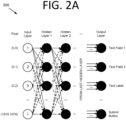
- FIG. 2A illustrates an example of a neural network 200 that has been trained to recognize graphical elements in an image.
- neural network 200 receives pixels of a screenshot image of a 1920 ⁇ 1080 screen as input for input "neurons" 1 to I of the input layer.
- I is 2,073,600, which is the total number of pixels in the screenshot image.
- Neural network 200 also includes a number of hidden layers. Both DLNNs and shallow learning neural networks (SLNNs) usually have multiple layers, although SLNNs may only have one or two layers in some cases, and normally fewer than DLNNs. Typically, the neural network architecture includes an input layer, multiple intermediate layers, and an output layer, as is the case in neural network 200.
- SLNNs shallow learning neural networks
- a DLNN often has many layers (e.g., 10, 50, 200, etc.) and subsequent layers typically reuse features from previous layers to compute more complex, general functions.
- a SLNN tends to have only a few layers and train relatively quickly since expert features are created from raw data samples in advance. However, feature extraction is laborious.
- DLNNs usually do not require expert features, but tend to take longer to train and have more layers.
- the layers are trained simultaneously on the training set, normally checking for overfitting on an isolated cross-validation set. Both techniques can yield excellent results, and there is considerable enthusiasm for both approaches.
- the optimal size, shape, and quantity of individual layers varies depending on the problem that is addressed by the respective neural network.
- pixels provided as the input layer are fed as inputs to the J neurons of hidden layer 1. While all pixels are fed to each neuron in this example, various architectures are possible that may be used individually or in combination including, but not limited to, feed forward networks, radial basis networks, deep feed forward networks, deep convolutional inverse graphics networks, convolutional neural networks, recurrent neural networks, artificial neural networks, long/short term memory networks, gated recurrent unit networks, generative adversarial networks, liquid state machines, auto encoders, variational auto encoders, denoising auto encoders, sparse auto encoders, extreme learning machines, echo state networks, Markov chains, Hopfield networks, Boltzmann machines, restricted Boltzmann machines, deep residual networks, Kohonen networks, deep belief networks, deep convolutional networks, support vector machines, neural Turing machines, or any other suitable type or combination of neural networks without deviating from the scope of the invention.
- Hidden layer 2 receives inputs from hidden layer 1
- hidden layer 3 receives inputs from hidden layer 2, and so on for all hidden layers until the last hidden layer provides its outputs as inputs for the output layer.
- numbers of neurons I, J, K, and L are not necessarily equal, and thus, any desired number of layers may be used for a given layer of neural network 200 without deviating from the scope of the invention. Indeed, in certain embodiments, the types of neurons in a given layer may not all be the same.
- Neural network 200 is trained to assign a confidence score to graphical elements believed to have been found in the image. In order to reduce matches with unacceptably low likelihoods, only those results with a confidence score that meets or exceeds a confidence threshold may be provided in some embodiments. For instance, if the confidence threshold is 80%, outputs with confidence scores exceeding this amount may be used and the rest may be ignored. In this case, the output layer indicates that two text fields, a text label, and a submit button were found. Neural network 200 may provide the locations, dimensions, images, and/or confidence scores for these elements without deviating from the scope of the invention, which can be used subsequently by an RPA robot or another process that uses this output for a given purpose.
- neural networks are probabilistic constructs that typically have a confidence score. This may be a score learned by the AI/ML model based on how often a similar input was correctly identified during training. For instance, text fields often have a rectangular shape and a white background. The neural network may learn to identify graphical elements with these characteristics with a high confidence. Some common types of confidence scores include a decimal number between 0 and 1 (which can be interpreted as a percentage of confidence), a number between negative ⁇ and positive ⁇ , or a set of expressions (e.g., "low,” “medium,” and “high”). Various post-processing calibration techniques may also be employed in an attempt to obtain a more accurate confidence score, such as temperature scaling, batch normalization, weight decay, negative log likelihood (NLL), etc.
- NLL negative log likelihood
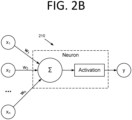
- Neurons in a neural network are mathematical functions that that are typically based on the functioning of a biological neuron. Neurons receive weighted input and have a summation and an activation function that governs whether they pass output to the next layer.
- This activation function may be a nonlinear thresholded activity function where nothing happens if the value is below a threshold, but then the function linearly responds above the threshold (i.e., a rectified linear unit (ReLU) nonlinearity).
- ReLU rectified linear unit
- Summation functions and ReLU functions are used in deep learning since real neurons can have approximately similar activity functions. Via linear transforms, information can be subtracted, added, etc. In essence, neurons act as gating functions that pass output to the next layer as governed by their underlying mathematical function. In some embodiments, different functions may be used for at least some neurons.
- FIG. 2B An example of a neuron 210 is shown in FIG. 2B .
- Inputs x 1 , x 2 , ... , x n from a preceding layer are assigned respective weights w 1 , w 2 , ... , w n .
- the collective input from preceding neuron 1 is w 1 x 1 .
- f ( x ) 1 if ⁇ wx + bias ⁇ 0 0 if ⁇ wx + bias ⁇ 0
- neuron 210 is a single-layer perceptron.
- any suitable neuron type or combination of neuron types may be used without deviating from the scope of the invention.
- the ranges of values of the weights and/or the output value(s) of the activation function may differ in some embodiments without deviating from the scope of the invention.
- the goal or "reward function” is often employed, such as for this case the successful identification of graphical elements in the image.
- a reward function explores intermediate transitions and steps with both short-term and long-term rewards to guide the search of a state space and attempt to achieve a goal (e.g., successful identification of graphical elements, successful identification of a next sequence of activities for an RPA workflow, etc.).
- various labeled data (in this case, images) are fed through neural network 200.
- Successful identifications strengthen weights for inputs to neurons, whereas unsuccessful identifications weaken them.
- a cost function such as mean square error (MSE) or gradient descent may be used to punish predictions that are slightly wrong much less than predictions that are very wrong. If the performance of the AI/ML model is not improving after a certain number of training iterations, a data scientist may modify the reward function, provide indications of where non-identified graphical elements are, provide corrections of misidentified graphical elements, etc.
- MSE mean square error
- gradient descent may be used to punish predictions that are slightly wrong much less than predictions that are very wrong.
- Backpropagation is a technique for optimizing synaptic weights in a feedforward neural network.
- Backpropagation may be used to "pop the hood" on the hidden layers of the neural network to see how much of the loss every node is responsible for, and subsequently updating the weights in such a way that minimizes the loss by giving the nodes with higher error rates lower weights, and vice versa.
- backpropagation allows data scientists to repeatedly adjust the weights so as to minimize the difference between actual output and desired output.
- the backpropagation algorithm is mathematically founded in optimization theory.
- training data with a known output is passed through the neural network and error is computed with a cost function from known target output, which gives the error for backpropagation.
- Error is computed at the output, and this error is transformed into corrections for network weights that will minimize the error.
- optimization in the form of a gradient descent procedure may be used to minimize the error by modifying the synaptic weights W i for each layer.
- the gradient descent procedure requires the computation of the output o given an input x corresponding to a known target output t, and producing an error o - t. This global error is then propagated backwards giving local errors for weight updates with computations similar to, but not exactly the same as, those used for forward propagation.
- ⁇ denotes a Hadamard product (i.e., the element-wise product of two vectors)
- T denotes the matrix transpose
- the learning rate ⁇ is chosen with respect to machine learning considerations.
- ⁇ is related to the neural Hebbian learning mechanism used in the neural implementation. Note that the synapses W and b can be combined into one large synaptic matrix, where it is assumed that the input vector has appended ones, and extra columns representing the b synapses are subsumed to W.
- the AI/ML model may be trained over multiple epochs until it reaches a good level of accuracy (e.g., 97% or better using an F2 or F4 threshold for detection and approximately 2,000 epochs). This accuracy level may be determined in some embodiments using an F1 score, an F2 score, an F4 score, or any other suitable technique without deviating from the scope of the invention.
- a good level of accuracy e.g. 97% or better using an F2 or F4 threshold for detection and approximately 2,000 epochs.
- This accuracy level may be determined in some embodiments using an F1 score, an F2 score, an F4 score, or any other suitable technique without deviating from the scope of the invention.
- the AI/ML model Once trained on the training data, the AI/ML model may be tested on a set of evaluation data that the AI/ML model has not encountered before. This helps to ensure that the AI/ML model is not "over fit" such that it identifies graphical elements in the training data well, but does not generalize
- the AI/ML model may not be known what accuracy level is possible for the AI/ML model to achieve. Accordingly, if the accuracy of the AI/ML model is starting to drop when analyzing the evaluation data (i.e., the model is performing well on the training data, but is starting to perform less well on the evaluation data), the AI/ML model may go through more epochs of training on the training data (and/or new training data). In some embodiments, the AI/ML model is only deployed if the accuracy reaches a certain level or if the accuracy of the trained AI/ML model is superior to an existing deployed AI/ML model.
- a collection of trained AI/ML models may be used to accomplish a task, such as employing an AI/ML model for each type of graphical element of interest, employing an AI/ML model to perform OCR, deploying yet another AI/ML model to recognize proximity relationships between graphical elements, employing still another AI/ML model to generate an RPA workflow based on the outputs from the other AI/ML models, etc. This may collectively allow the AI/ML models to enable semantic automation, for instance.
- Some embodiments may use transformer networks such as SentenceTransformers TM , which is a Python TM framework for state-of-the-art sentence, text, and image embeddings.
- Transformer networks learn associations of words and phrases that have both high scores and low scores. This trains the AI/ML model to determine what is close to the input and what is not, respectively. Rather than just using pairs of words/phrases, transformer networks may use the field length and field type, as well.
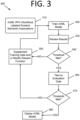
- FIG. 3 is a flowchart illustrating a process 300 for training AI/ML model(s), according to an embodiment of the present invention.
- the process begins with providing training data, for instance, labeled data as shown in FIG. 3 , such as labeled screens (e.g., with graphical elements and text identified), words and phrases, a "thesaurus" of semantic associations between words and phrases such that similar words and phrases for a given word or phrase can be identified, etc. at 310.
- labeled data e.g., with graphical elements and text identified
- words and phrases e.g., with graphical elements and text identified
- a "thesaurus" of semantic associations between words and phrases such that similar words and phrases for a given word or phrase can be identified, etc.
- the nature of the training data that is provided will depend on the objective that the AI/ML model is intended to achieve.
- the AI/ML model is then trained over multiple epochs at 320 and results are reviewed at 330.
- the training data is supplemented and/or the reward function is modified to help the AI/ML model achieve its objectives better at 350 and the process returns to step 320.
- the AI/ML model meets the confidence threshold at 340, the AI/ML model is tested on evaluation data at 360 to ensure that the AI/ML model generalizes well and that the AI/ML model is not over fit with respect to the training data.
- the evaluation data may include screens, source data, etc. that the AI/ML model has not processed before. If the confidence threshold is met at 370 for the evaluation data, the AI/ML model is deployed at 380. If not, the process returns to step 350 and the AI/ML model is trained further.
- Processes comprise a sequence of activities to perform various tasks for a number of different applications, such as, e.g., administrative applications (e.g., onboarding a new employee), procure-to-pay applications (e.g., purchasing, invoice management, and facilitating payment), and information technology applications (e.g., ticketing systems).
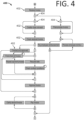
- An exemplary process graph (or process model) 400 is shown in FIG. 4 .
- Process graph 400 may be a computer process automatically or semi-automatically executed by one or more computing devices (e.g., computing system 100 of FIG. 1 ).
- process graph 400 may be implemented as a robotic process automation (RPA) workflow for automatically or semi-automatically performing a task using one or more RPA robots executing on one or more computing devices (e.g., computing system 100 of FIG. 1 ).
- RPA robotic process automation
- Process graph 400 comprises activities 402, which represent predefined sequences of steps in process graph 400. As shown in FIG. 4 , process graph 400 is modeled as a directed graph where each activity 402 is represented as a node and each transition between activities 402 is represented as edges linking the nodes. The transition between activities 402 represents the execution of process graph 400 from a source activity to a destination activity.
- Process graph 400 comprises gateways 404 representing diversions in the process. Gateways 404 control how the process flows during execution. Gateways 404 may be, for example, exclusive gateways or parallel gateways and may split a single path into multiple paths or join multiple paths into a single path.
- Process graph 400 may be represented as a process tree, a BPMN (business process model and notation) model, or in any other suitable form.
- BPMN business process model and notation
- Execution of process graph 400 is recorded in the form of an event log.
- Each instance of execution of process graph 400 corresponds to a case, identified by a case ID.
- Each case may have a number of attributes with corresponding values (referred to as attribute values).
- attribute values may be case type and attribute values may be services or catalog.
- an attribute may be supplier and attribute values may be the names of the suppliers.
- a mapping between activities of a process model representing the expected execution of a process and activities extracted from an event log of the actual execution of the process may be determined to calculate various analytics and perform other process mining tasks.
- Embodiments described herein utilize a large language model to process a textual description of the process model and provide intelligent mapping suggestions. As a result, a user may be informed of activities extracted from the event log that do not properly correspond to activities of the process model, along with a suggested mapping. This provides actionable results for the user, using the mapping as a guideline to transform the execution data or process model.
- embodiments described herein prevent unwanted comparison between activities, thus vastly increasing the power of model-data alignment techniques.
- FIG. 5 shows a method 500 for determining a mapping between activities extracted from a process model and executed activities using a large language model, in accordance with one or more embodiments.
- the steps and sub-steps of method 500 may be performed by one or more suitable computing devices, such as, e.g., computing system 100 of FIG. 1 .
- suitable computing devices such as, e.g., computing system 100 of FIG. 1 .
- activities extracted from the process model representing the expected execution of the process are referred to as "user activities” and executed activities extracted from an event log of the actual execution of the process are referred to as "data activities.”
- one or more prompts defining 1) instructions and 2) activities executed during one or more instances of execution of a process are received.
- a prompt refers to input text to a large language model for generating a response.
- a prompt is typically provided by a user to enable the user to interact with the large language model.
- the one or more prompts may be received from a computing device (e.g., computing system 100 of FIG. 1 ) with which a user is interacting.
- the instructions refer to guidelines or directions provided to guide the behavior and output of the large language model.
- the instructions may include, for example, commands, questions, constraints, requirements, contextual information, and/or any other guideline or direction guiding the behavior and output of the large language model.
- the instructions defined in the one or more prompts comprise instructions to extract activities from the process model (as shown in FIG. 6 ) and/or instructions to determine a mapping between the activities extracted from the process model and the activities executed during the one or more instances of execution (as shown in FIG. 7 ).
- FIG. 6 shows an interface 600 by which a user interacts with a large language model via one or more prompts comprising instructions to extract activities from a process model, in accordance with one or more embodiments.
- instructions 602 are submitted by a user and received by the large language model via one or more prompts.
- Instructions 602 are for extracting activities from a process model.
- instructions 602 may be the instructions for extracting activities from the process model received via the one or more prompts at step 502 of FIG. 5 .
- FIG. 7 shows an interface 700 by which a user interacts with a large language model via one or more prompts for determining a mapping between the activities extracted from the process model and the activities executed during the one or more instances of execution, in accordance with one or more embodiments.
- instructions 702 are submitted by a user and received by the large language model via one or more prompts.
- Instructions 702 are for determining a mapping between the activities extracted from the process model and the activities executed during the one or more instances of execution.
- instructions 702 may be the instructions for determining a mapping between the activities extracted from the process model and the activities executed during the one or more instances of execution received via the one or more prompts at step 502 of FIG. 5 .
- Instructions 702 allow for a one-to-many mapping, whereby a single data activity may be mapped to multiple user activities (or vice versa), or a many-to-one mapping, wherein multiple data activities may be mapped to a single user activity (or vice versa). However, in some embodiment, the instructions 702 may require a one-to-one mapping, where only a single data activity may be mapped to a single user activity. FIG. 7 will be further described below.
- the process may be any suitable process comprising a sequence of activities.
- the process is executed by one or more suitable computing devices (e.g., computing system 100 of FIG. 1 ) for the one or more instances of execution.
- the process may be a computer process automatically or semi-automatically executed by one or more computing devices (e.g., computing system 100 of FIG. 1 ) or an RPA workflow for automatically or semi-automatically performing a task using one or more RPA robots executing on one or more computing devices (e.g., computing system 100 of FIG. 1 ).
- the process is represented by process graph 400 of FIG. 4 .
- the process model of the process represents the expected execution of the process.
- the process model of the process may be, for example, mined automatically using any suitable process mining technique or manually derived by a user from user process definitions (e.g., BPMN).
- the activities executed during one or more instances of execution (also referred to as cases) of the process may be defined in the one or more prompts as a sequence of activities of the process executing during the one or more instances of execution.
- the activities executed during one or more instances of execution are defined in interface 700 of FIG. 7 as input activities 704.
- Input activities 704 may be manually identified from execution data (e.g., event logs) by a user or automatically identified from the execution data (e.g., by a computer program).
- Input activities 704 are submitted by a user and received by the large language model via one or more prompts.
- the one or more prompts further define a textual description of the process model of the process.
- the textual description of the process may be represented in any suitable form.
- An example of the textual description of the process model is shown in FIG. 8 , in accordance with one or more embodiments.
- FIG. 8 depicts an exemplary textual description 800 of a process model represented as a natural language representation.
- Textual description 800 may be generated by translating a raw representation (e.g., in JavaScript Object Notation, JSON) of the process model to a textual description.
- JSON JavaScript Object Notation
- a process tree is a tree-based representation of the process model, where the leaves are activities and the nodes are process operations: sequence (children happen in sequence), exclusive (only one of its children happens in one process execution), parallel (all children happen in parallel), or loop (the first child happens first and then the process returns by performing one of the other children).
- the process tree is translated to a textual description by walking over the process tree and converting each sub-tree into text. Each line represents either a single activity (where we include whether it can be repeated or not) or a process operation that determines how the following operations with a higher indentation level are performed. The level of indentation determines the position in the process tree.
- BPMN business process model and notation
- the one or more prompts further define the activities extracted from the process model of the process. Activities extracted from the process model may be manually identified from the process model by a user or automatically identified from the process model (e.g., by the large language model or a computer program). The activities extracted from the process model are submitted by a user and received by the large language model via one or more prompts.
- a mapping between one or more activities extracted from a process model of the process and one or more of the activities extracted during the one or more instances of execution is determined using a large language model based on the instructions.
- the mapping is determined in response to the instructions to determine a mapping between the activities extracted from the process model and the activities executed during the one or more instances of execution.
- the mapping provides for actional results for the user, using the mappings as a guide to transform the data or the process model.
- the activities extracted from the process model are first extracted using the large language model based on the textual description of the process model and the instructions.
- the large language model receives as input the one or more prompts comprising the instructions to extract activities from a process model and the textual description and generates as output the extracted activities.
- the activities extracted from the process model are represented by the large language model extracting the activities from the textual description of the process model.
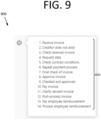
- FIG. 9 shows an interface 900 by which a large language model outputs activities extracted from a process model, in accordance with one or more embodiments.
- the large language model outputs extracted activities 902 extracted from textual description 800 of FIG. 8 in response to instruction 600 of FIG. 6 .
- extracted activities 902 are the activities extracted at step 504 of FIG. 5 .
- the large language model then extracts the activities extracted from the process model based on the textual description and the instructions.
- the large language model receives as input the one or more prompts comprising the instructions to determine a mapping between the activities extracted from the process model and the activities executed during the one or more instances of execution of the process and generates as output the mapping.
- the mapping is performed by the large language model receiving as input the one or more prompts comprising the instructions to determine a mapping between the activities extracted from the process model, the activities executed during the one or more instances of execution of the process, and the activities extracted from the process model and generates as output the mapping.
- a large language model is a deep learning model trained to, e.g., recognize, summarize, translate, predict, and generate content based on a very large training dataset.
- the large language model may be any suitable pre-trained deep learning based large language model.
- the large language model may be based on the transformer architecture, which uses a self-attention mechanism to capture long-range dependencies in text.
- transformer-based large language models include GPT (generative pre-training transformer), BLOOM (BigScience Large Open-science Open-access Multilingual Language Model), BERT (Bidirectional Encoder Representations from Transfers), LaMDA (language model for dialogue applications), and Llama (large language model Meta Al).
- the large language model is fine-tuned for process mining.
- the large language model determines that at least one of the activities extracted from the process model do not map to at least one of the activities executed during the one or more instances of execution and/or that at least one of the activities executed during the one or more instances of execution do not map to at least one of the activities extracted from the process model.
- mappings are shown in FIGS. 10-12 .
- FIG. 10 shows an interface 1000 by which a large language model outputs a one-to-many mapping between the user activities extracted from the process model and the data activities executed during the one or more instances of execution, in accordance with one or more embodiments.
- Mapping 1002 is a one-to-many mapping whereby a single data executed activity extracted from an event log is mapped to multiple user activities extracted from the process model. It should be understood that, in some embodiments, the one-to-many mapping may comprise a single user activity mapped to multiple data activities.
- Indication 1004 indicates that no logical mappings are found for certain activities (e.g., for data activities or user activities).
- FIG. 11 shows an interface 1100 by which a large language model outputs a one-to-one mapping between the activities extracted from the process model and the activities executed during the one or more instances of execution, in accordance with one or more embodiments.
- Mapping 1102 is a one-to-one mapping whereby a single executed activity extracted from an event log is mapped to a single activity extracted from the process model.
- Indication 1104 indicates that no logical mappings are found for certain activities.
- FIG. 12 shows an interface 1200 by which a large language model outputs a one-to-one mapping between the activities extracted from the process model and the activities executed during the one or more instances of execution, in accordance with one or more embodiments.
- Mapping 1202 is a one-to-one mapping whereby a single executed activity extracted from an event log is mapped to a single activity extracted from the process model.
- Indication 1204 indicates that no logical mappings are found for certain data activities.
- the mapping between the activities extracted from the process model and the activities extracted during the one or more instances of execution is output.
- the mapping can be output by displaying the mapping on a display device of a computer system (e.g., display 125 of computing system 100 of FIG. 1 ), storing the mapping on a memory or storage (e.g., memory 115 of computing system 100 of FIG. 1 ) of a computer system, or by transmitting the mapping to a remote computer system.
- Systems, methods, workflows, and processes described herein, including in FIGS. 3-5 may be performed by a computer program, encoding instructions for the processor(s) to perform at least part of the process(es) described in FIGS. 3-5 , in accordance with embodiments of the present invention.
- the computer program may be embodied on a non-transitory computer-readable medium.
- the computer-readable medium may be, but is not limited to, a hard disk drive, a flash device, RAM, a tape, and/or any other such medium or combination of media used to store data.
- the computer program may include encoded instructions for controlling processor(s) of a computing system (e.g., processor(s) 110 of computing system 100 of FIG. 1 ) to implement all or part of FIGS. 3-5 , which may also be stored on the computer-readable medium.
- the computer program can be implemented in hardware, software, or a hybrid implementation.
- the computer program can be composed of modules that are in operative communication with one another, and which are designed to pass information or instructions to display.
- the computer program can be configured to operate on a general purpose computer, an ASIC, or any other suitable device.
Landscapes
- Engineering & Computer Science (AREA)
- Business, Economics & Management (AREA)
- Theoretical Computer Science (AREA)
- Physics & Mathematics (AREA)
- General Physics & Mathematics (AREA)
- General Engineering & Computer Science (AREA)
- Strategic Management (AREA)
- Software Systems (AREA)
- Human Resources & Organizations (AREA)
- Economics (AREA)
- Marketing (AREA)
- Accounting & Taxation (AREA)
- Finance (AREA)
- Data Mining & Analysis (AREA)
- General Business, Economics & Management (AREA)
- Entrepreneurship & Innovation (AREA)
- Development Economics (AREA)
- Artificial Intelligence (AREA)
- Computing Systems (AREA)
- Mathematical Physics (AREA)
- Evolutionary Computation (AREA)
- Quality & Reliability (AREA)
- General Health & Medical Sciences (AREA)
- Molecular Biology (AREA)
- Life Sciences & Earth Sciences (AREA)
- Computational Linguistics (AREA)
- Biophysics (AREA)
- Biomedical Technology (AREA)
- Health & Medical Sciences (AREA)
- Operations Research (AREA)
- Tourism & Hospitality (AREA)
- Technology Law (AREA)
- Computer Hardware Design (AREA)
- Multimedia (AREA)
- Computer Vision & Pattern Recognition (AREA)
- Medical Informatics (AREA)
- Automation & Control Theory (AREA)
- Educational Administration (AREA)
- Game Theory and Decision Science (AREA)
- Devices For Executing Special Programs (AREA)
Applications Claiming Priority (1)
| Application Number | Priority Date | Filing Date | Title |
|---|---|---|---|
| US18/476,444 US20250110809A1 (en) | 2023-09-28 | 2023-09-28 | Activity mapping for process mining using large language models |
Publications (1)
| Publication Number | Publication Date |
|---|---|
| EP4530769A1 true EP4530769A1 (de) | 2025-04-02 |
Family
ID=92925861
Family Applications (1)
| Application Number | Title | Priority Date | Filing Date |
|---|---|---|---|
| EP24202735.7A Pending EP4530769A1 (de) | 2023-09-28 | 2024-09-26 | Aktivitätsabbildung für prozessmining unter verwendung grosser sprachmodelle |
Country Status (2)
| Country | Link |
|---|---|
| US (1) | US20250110809A1 (de) |
| EP (1) | EP4530769A1 (de) |
Citations (3)
| Publication number | Priority date | Publication date | Assignee | Title |
|---|---|---|---|---|
| WO2023059346A1 (en) * | 2021-10-05 | 2023-04-13 | UiPath, Inc. | Semantic matching between a source screen or source data and a target screen using semantic artificial intelligence |
| CN116562807A (zh) * | 2023-05-05 | 2023-08-08 | 科大讯飞股份有限公司 | 机器人流程自动化方法、装置、电子设备和存储介质 |
| CN116775183A (zh) * | 2023-05-31 | 2023-09-19 | 腾讯科技(深圳)有限公司 | 基于大语言模型的任务生成方法、系统、设备及存储介质 |
-
2023
- 2023-09-28 US US18/476,444 patent/US20250110809A1/en active Pending
-
2024
- 2024-09-26 EP EP24202735.7A patent/EP4530769A1/de active Pending
Patent Citations (3)
| Publication number | Priority date | Publication date | Assignee | Title |
|---|---|---|---|---|
| WO2023059346A1 (en) * | 2021-10-05 | 2023-04-13 | UiPath, Inc. | Semantic matching between a source screen or source data and a target screen using semantic artificial intelligence |
| CN116562807A (zh) * | 2023-05-05 | 2023-08-08 | 科大讯飞股份有限公司 | 机器人流程自动化方法、装置、电子设备和存储介质 |
| CN116775183A (zh) * | 2023-05-31 | 2023-09-19 | 腾讯科技(深圳)有限公司 | 基于大语言模型的任务生成方法、系统、设备及存储介质 |
Also Published As
| Publication number | Publication date |
|---|---|
| US20250110809A1 (en) | 2025-04-03 |
Similar Documents
| Publication | Publication Date | Title |
|---|---|---|
| US12293157B2 (en) | Semantic matching between a source screen or source data and a target screen using semantic artificial intelligence | |
| US12314017B2 (en) | Automatic data transfer between a source and a target using semantic artificial intelligence for robotic process automation | |
| US12099820B2 (en) | Training and using artificial intelligence (AI) / machine learning (ML) models to automatically supplement and/or complete code of robotic process automation workflows | |
| US20250054327A1 (en) | Using generative artificial intelligence to supplement automated information extraction | |
| EP4538889A1 (de) | Verwendung einer schicht der kognitiven künstlichen intelligenz zur reparatur eines roboters für roboterautomatisierung eines roboters für robotische prozesse | |
| US20260087245A1 (en) | Configuration-driven conversational artificial intelligence (ai) for task completion | |
| US20250252287A1 (en) | Extended long short-term memory neural networks | |
| US20250199510A1 (en) | Automatic annotations and technical specification generation for robotic process automation workflows using artificial intelligence (ai) | |
| US20240211836A1 (en) | Extracting features from screen images for task mining | |
| US20250111187A1 (en) | Generating rpa robots from process mining activity names | |
| Narayanan et al. | Introduction to deep learning | |
| TWI810549B (zh) | 可解釋的神經網路、相關的電腦實施方法、及用於實施可解釋的神經網路之系統 | |
| US20250110809A1 (en) | Activity mapping for process mining using large language models | |
| US20250111199A1 (en) | Conformance assistant for process mining using large language models | |
| US20250111200A1 (en) | Generating process names for process mining using large language models | |
| US20250111146A1 (en) | Detecting flawed activity names for process mining using large language models | |
| CN120170726A (zh) | 机器人过程自动化的智能设计时分析器和运行时处理程序 | |
| Dell’Aversana | Artificial neural networks and deep learning: A simple overview | |
| US20250377929A1 (en) | Identification of patterns in task execution data for task mining | |
| US20250307605A1 (en) | Graph-based interaction interfaces for generative pre-trained transforms | |
| US20260093457A1 (en) | Application template generation | |
| US20260064552A1 (en) | Inserting probabilistic models in deterministic workflows for automations and supervisor system | |
| US20260080700A1 (en) | Clipboard artificial intelligence system and applications for interpreting and processing content from mobile devices | |
| US20250322151A1 (en) | Assistant for providing insights on data across platforms using large language models |
Legal Events
| Date | Code | Title | Description |
|---|---|---|---|
| PUAI | Public reference made under article 153(3) epc to a published international application that has entered the european phase |
Free format text: ORIGINAL CODE: 0009012 |
|
| STAA | Information on the status of an ep patent application or granted ep patent |
Free format text: STATUS: THE APPLICATION HAS BEEN PUBLISHED |
|
| AK | Designated contracting states |
Kind code of ref document: A1 Designated state(s): AL AT BE BG CH CY CZ DE DK EE ES FI FR GB GR HR HU IE IS IT LI LT LU LV MC ME MK MT NL NO PL PT RO RS SE SI SK SM TR |
|
| STAA | Information on the status of an ep patent application or granted ep patent |
Free format text: STATUS: REQUEST FOR EXAMINATION WAS MADE |
|
| 17P | Request for examination filed |
Effective date: 20250922 |