EP4530762A1 - Systeme und verfahren zur llm-basierten standortsteuerung - Google Patents
Systeme und verfahren zur llm-basierten standortsteuerung Download PDFInfo
- Publication number
- EP4530762A1 EP4530762A1 EP24189968.1A EP24189968A EP4530762A1 EP 4530762 A1 EP4530762 A1 EP 4530762A1 EP 24189968 A EP24189968 A EP 24189968A EP 4530762 A1 EP4530762 A1 EP 4530762A1
- Authority
- EP
- European Patent Office
- Prior art keywords
- location
- user
- activity
- llm
- data
- Prior art date
- Legal status (The legal status is an assumption and is not a legal conclusion. Google has not performed a legal analysis and makes no representation as to the accuracy of the status listed.)
- Pending
Links
Images



Classifications
-
- G—PHYSICS
- G05—CONTROLLING; REGULATING
- G05B—CONTROL OR REGULATING SYSTEMS IN GENERAL; FUNCTIONAL ELEMENTS OF SUCH SYSTEMS; MONITORING OR TESTING ARRANGEMENTS FOR SUCH SYSTEMS OR ELEMENTS
- G05B15/00—Systems controlled by a computer
- G05B15/02—Systems controlled by a computer electric
-
- G—PHYSICS
- G05—CONTROLLING; REGULATING
- G05B—CONTROL OR REGULATING SYSTEMS IN GENERAL; FUNCTIONAL ELEMENTS OF SUCH SYSTEMS; MONITORING OR TESTING ARRANGEMENTS FOR SUCH SYSTEMS OR ELEMENTS
- G05B13/00—Adaptive control systems, i.e. systems automatically adjusting themselves to have a performance which is optimum according to some preassigned criterion
- G05B13/02—Adaptive control systems, i.e. systems automatically adjusting themselves to have a performance which is optimum according to some preassigned criterion electric
- G05B13/0265—Adaptive control systems, i.e. systems automatically adjusting themselves to have a performance which is optimum according to some preassigned criterion electric the criterion being a learning criterion
- G05B13/027—Adaptive control systems, i.e. systems automatically adjusting themselves to have a performance which is optimum according to some preassigned criterion electric the criterion being a learning criterion using neural networks only
-
- F—MECHANICAL ENGINEERING; LIGHTING; HEATING; WEAPONS; BLASTING
- F24—HEATING; RANGES; VENTILATING
- F24F—AIR-CONDITIONING; AIR-HUMIDIFICATION; VENTILATION; USE OF AIR CURRENTS FOR SCREENING
- F24F11/00—Control or safety arrangements
- F24F11/62—Control or safety arrangements characterised by the type of control or by internal processing, e.g. using fuzzy logic, adaptive control or estimation of values
- F24F11/63—Electronic processing
-
- G—PHYSICS
- G05—CONTROLLING; REGULATING
- G05B—CONTROL OR REGULATING SYSTEMS IN GENERAL; FUNCTIONAL ELEMENTS OF SUCH SYSTEMS; MONITORING OR TESTING ARRANGEMENTS FOR SUCH SYSTEMS OR ELEMENTS
- G05B19/00—Program-control systems
- G05B19/02—Program-control systems electric
- G05B19/04—Program control other than numerical control, i.e. in sequence controllers or logic controllers
- G05B19/042—Program control other than numerical control, i.e. in sequence controllers or logic controllers using digital processors
-
- G—PHYSICS
- G08—SIGNALLING
- G08B—SIGNALLING SYSTEMS, e.g. PERSONAL CALLING SYSTEMS; ORDER TELEGRAPHS; ALARM SYSTEMS
- G08B13/00—Burglar, theft or intruder alarms
-
- G—PHYSICS
- G08—SIGNALLING
- G08B—SIGNALLING SYSTEMS, e.g. PERSONAL CALLING SYSTEMS; ORDER TELEGRAPHS; ALARM SYSTEMS
- G08B25/00—Alarm systems in which the location of the alarm condition is signalled to a central station, e.g. fire or police telegraphic systems
- G08B25/14—Central alarm receiver or annunciator arrangements
-
- F—MECHANICAL ENGINEERING; LIGHTING; HEATING; WEAPONS; BLASTING
- F24—HEATING; RANGES; VENTILATING
- F24F—AIR-CONDITIONING; AIR-HUMIDIFICATION; VENTILATION; USE OF AIR CURRENTS FOR SCREENING
- F24F2120/00—Control inputs relating to users or occupants
- F24F2120/20—Feedback from users
-
- G—PHYSICS
- G05—CONTROLLING; REGULATING
- G05B—CONTROL OR REGULATING SYSTEMS IN GENERAL; FUNCTIONAL ELEMENTS OF SUCH SYSTEMS; MONITORING OR TESTING ARRANGEMENTS FOR SUCH SYSTEMS OR ELEMENTS
- G05B2219/00—Program-control systems
- G05B2219/20—Pc systems
- G05B2219/26—Pc applications
- G05B2219/2614—HVAC, heating, ventillation, climate control
-
- G—PHYSICS
- G05—CONTROLLING; REGULATING
- G05B—CONTROL OR REGULATING SYSTEMS IN GENERAL; FUNCTIONAL ELEMENTS OF SUCH SYSTEMS; MONITORING OR TESTING ARRANGEMENTS FOR SUCH SYSTEMS OR ELEMENTS
- G05B2219/00—Program-control systems
- G05B2219/20—Pc systems
- G05B2219/26—Pc applications
- G05B2219/2642—Domotique, domestic, home control, automation, smart house
Definitions
- the present disclosure is generally related to a location monitoring and control system, and more particularly, to a decision intelligence (DI)-based computerized framework for automatically and dynamically leveraging learned patterns at a location against current spatial, temporal, logical and user/device data at the location via a large language model (LLM) to control the location and/or devices operating therein.
- DI decision intelligence
- LLM large language model
- HVAC heating, ventilation and air conditioning
- security systems anti-intrusion security systems
- comfort systems and security systems are not configured with functionality and/or capabilities to accurately and efficiently predict human behaviors, and act in accordance to such predictions based on real-time events to effectuate control that addresses any expected and/or unexpected human need within a location.
- comfort systems are not configured to properly modify the climate and/or environment according to a user's current needs; rather, they are reactive to only detected sensor data and/or user inputs to modify the climate/environment.
- existing security systems are either armed/disarmed and/or provide security alerts only upon provided input and/or detected events that violate some static rule (e.g., a window has been broken, for example).
- the disclosed systems and methods provide a novel computerized framework that can execute to not only predict certain events within and/or around a location, but maximize the capabilities of an implemented control system (e.g., climate and/or security) to leverage such predictions via novel mechanisms to understand the current and/or future needs of a user(s) within such location.
- Such novel mechanisms can involve the integration and/or implementation of artificial intelligence (Al), machine learning (ML) and/or large language models (LLMs), such that predicted events as well as currently detected data related to current and/or ongoing events can be fed to the disclosed framework, whereby adaptive, personalized and/or customized responses can be output.
- Such output can enable automated responses to control a current environment of a location, as well as the desired environment of a user at and/or within the location.
- the disclosed framework can provide a dynamically adaptive, automated system that can leverage generative software to control how climate and/or security systems control an environment to comfort and protect a locations' resident users.
- the latest transformer-based LLMs have, among other features and capabilities, theory of mind, abilities to reason, abilities to make a list of tasks, abilities to plan and react to changes (via reviewing their own previous decisions), abilities to understand multiple data sources (and types of data - multimodal), abilities to have conversations with humans in natural language, abilities to adjust, abilities to interact with and/or control application program interfaces (APIs), abilities to remember information long term, abilities to use tools (e.g., read multiple schedules/calendars, command other systems, search for data, and the like), abilities to use other LLM and other types of AI/ML (e.g., neural networks to look for patterns, recognize humans, pets, and the like, for example), abilities to check whether reports, ability to talk to other devices over standard device-to-device protocols, abilities to improve itself, abilities to correct mistakes and learn using reflection, and the like.
- AI/ML e.g., neural networks to look for patterns, recognize humans, pets, and the like, for example
- the disclosed integration of such LLM technology together with control programs for location management provides an improved system for a location's control.
- this can lead to an improved environment for a user (e.g., improved user experience), as well as an improved operational efficiency, resource management and management of a location by the implemented control system(s).
- references a location can correspond to, but not be limited to, a home, office, building and/or any other type of definable structure and/or geographic location for which a control system (e.g., comfort/climate control and/or security system, for example) can be provided.
- a control system e.g., comfort/climate control and/or security system, for example
- a method for a DI-based computerized framework for an LLM-based, automated location control and management.
- the present disclosure provides a non-transitory computer-readable storage medium for carrying out the above-mentioned technical steps of the framework's functionality.
- the non-transitory computer-readable storage medium has tangibly stored thereon, or tangibly encoded thereon, computer readable instructions that when executed by a device cause at least one processor to perform a method for an LLM-based, automated location control and management.
- a system in accordance with one or more embodiments, includes one or more processors and/or computing devices configured to provide functionality in accordance with such embodiments.
- functionality is embodied in steps of a method performed by at least one computing device.
- program code or program logic executed by a processor(s) of a computing device to implement functionality in accordance with one or more such embodiments is embodied in, by and/or on a non-transitory computer-readable medium.
- terms, such as “a,” “an,” or “the,” again, may be understood to convey a singular usage or to convey a plural usage, depending at least in part upon context.
- the term “based on” may be understood as not necessarily intended to convey an exclusive set of factors and may, instead, allow for existence of additional factors not necessarily expressly described, again, depending at least in part on context.
- a non-transitory computer readable medium stores computer data, which data can include computer program code (or computer-executable instructions) that is executable by a computer, in machine readable form.
- a computer readable medium may include computer readable storage media, for tangible or fixed storage of data, or communication media for transient interpretation of code-containing signals.
- Computer readable storage media refers to physical or tangible storage (as opposed to signals) and includes without limitation volatile and non-volatile, removable and non-removable media implemented in any method or technology for the tangible storage of information such as computer-readable instructions, data structures, program modules or other data.
- Computer readable storage media includes, but is not limited to, RAM, ROM, EPROM, EEPROM, flash memory or other solid state memory technology, optical storage, cloud storage, magnetic storage devices, or any other physical or material medium which can be used to tangibly store the desired information or data or instructions and which can be accessed by a computer or processor.
- server should be understood to refer to a service point which provides processing, database, and communication facilities.
- server can refer to a single, physical processor with associated communications and data storage and database facilities, or it can refer to a networked or clustered complex of processors and associated network and storage devices, as well as operating software and one or more database systems and application software that support the services provided by the server. Cloud servers are examples.
- a "network” should be understood to refer to a network that may couple devices so that communications may be exchanged, such as between a server and a client device or other types of devices, including between wireless devices coupled via a wireless network, for example.
- a network may also include mass storage, such as network attached storage (NAS), a storage area network (SAN), a content delivery network (CDN) or other forms of computer or machine-readable media, for example.
- a network may include the Internet, one or more local area networks (LANs), one or more wide area networks (WANs), wire-line type connections, wireless type connections, cellular or any combination thereof.
- LANs local area networks
- WANs wide area networks
- wire-line type connections wireless type connections
- cellular or any combination thereof may be any combination thereof.
- sub-networks which may employ differing architectures or may be compliant or compatible with differing protocols, may interoperate within a larger network.
- a wireless network should be understood to couple client devices with a network.
- a wireless network may employ stand-alone ad-hoc networks, mesh networks, Wireless LAN (WLAN) networks, cellular networks, or the like.
- a wireless network may further employ a plurality of network access technologies, including Wi-Fi, Long Term Evolution (LTE), WLAN, Wireless Router mesh, or 2nd, 3rd, 4 th or 5 th generation (2G, 3G, 4G or 5G) cellular technology, mobile edge computing (MEC), Bluetooth, 802.11b/g/n, or the like.
- Network access technologies may enable wide area coverage for devices, such as client devices with varying degrees of mobility, for example.
- a wireless network may include virtually any type of wireless communication mechanism by which signals may be communicated between devices, such as a client device or a computing device, between or within a network, or the like.
- a computing device may be capable of sending or receiving signals, such as via a wired or wireless network, or may be capable of processing or storing signals, such as in memory as physical memory states, and may, therefore, operate as a server.
- devices capable of operating as a server may include, as examples, dedicated rack-mounted servers, desktop computers, laptop computers, set top boxes, integrated devices combining various features, such as two or more features of the foregoing devices, or the like.
- a client (or user, entity, subscriber or customer) device may include a computing device capable of sending or receiving signals, such as via a wired or a wireless network.
- a client device may, for example, include a desktop computer or a portable device, such as a cellular telephone, a smart phone, a display pager, a radio frequency (RF) device, an infrared (IR) device a Near Field Communication (NFC) device, a Personal Digital Assistant (PDA), a handheld computer, a tablet computer, a phablet, a laptop computer, a set top box, a wearable computer, smart watch, an integrated or distributed device combining various features, such as features of the forgoing devices, or the like.
- RF radio frequency
- IR infrared
- NFC Near Field Communication
- PDA Personal Digital Assistant
- a client device may vary in terms of capabilities or features. Claimed subject matter is intended to cover a wide range of potential variations, such as a web-enabled client device or previously mentioned devices may include a high-resolution screen (HD or 4K for example), one or more physical or virtual keyboards, mass storage, one or more accelerometers, one or more gyroscopes, global positioning system (GPS) or other location-identifying type capability, or a display with a high degree of functionality, such as a touch-sensitive color 2D or 3D display, for example.
- a high-resolution screen HD or 4K for example
- one or more physical or virtual keyboards mass storage
- accelerometers one or more gyroscopes
- GPS global positioning system
- display with a high degree of functionality such as a touch-sensitive color 2D or 3D display, for example.
- existing comfort systems can have room-level zoning, manual schedules, use occupancy analysis (typically using geofencing, system interaction and presence detect), and can historically record and analyze usage patterns for future prediction.
- occupancy analysis typically using geofencing, system interaction and presence detect
- the comfort system may fall back to local control with reduced efficiency. For example, this may involve the control of a conventional HVAC software control. Accordingly, such operation is sub-optimal.
- the primary goals of a security system are to keep people and property safe. Although they are technically complex, the basic operation mostly depends on relatively simple sensors and either making a local noise, or contacting a monitoring central station (or rarely security firm or police directly). Usually the central monitoring station will check with specific people to check if they expected an alarm.
- Some regions require more than one sensor activation to be classed as a "confirm” or “verified” alarm in order to take future action; and other places have verified video or audio where the central monitoring station will examine the video or audio to try to assess the alarm. Occasionally they will have a two-way audio path to the site to ask anyone on site for confirmation that they are meant to be here.
- Some security systems have cameras, and some can have automatic recognition - although this is rare in residential systems - and these tend to not be relied on for alarm activation.
- security systems have "arm modes" - where the system is set into a specific mode where alarms are generated. For example, there can be an away mode, stay mode (for instance to protect exterior doors), night modes (when people are only in part of the building), and the like. Even when a system is 'off", certain inputs might still generate a local or remote alarm - for instance a gun cabinet or a flood alarm.
- the disclosed systems and methods provide computerized mechanisms that can address such shortcomings, among others, by integrating LLMs (as well as, and/or in the alternative, AI/ML software algorithms) within such control systems to leverage the surplus of sensor data at a location (e.g., motion, temperature, location, for example), as well as personalized data for the resident users (e.g., calendar data, for example), to address and/or mitigate any situation that could impede on a user's enjoyment of the location.
- a location e.g., motion, temperature, location, for example
- personalized data for the resident users e.g., calendar data, for example
- the disclosed framework can provide a dynamically adaptive, automated system that can leverage generative software algorithms to control how climate and/or security systems control an environment to comfort and protect a locations' resident users.
- control system for a location
- system architecture and/or capabilities of the control system can be specifically configured for a comfort/climate system and/or security system without departing from the scope of the instant disclosure.
- system 100 is depicted which includes user equipment (UE) 102 (e.g., a client device, as mentioned above and discussed below in relation to FIG. 7 ), network 104, cloud system 106, database 108, sensors 110 and control engine 200.
- UE user equipment
- network 104 e.g., a client device, as mentioned above and discussed below in relation to FIG. 7
- cloud system 106 e.g., a server device, as mentioned above and discussed below in relation to FIG. 7
- database 108 e.g., a server device, as mentioned above and discussed below in relation to FIG. 7
- sensors 110 e.g., a control engine
- UE 102 can be any type of device, such as, but not limited to, a mobile phone, tablet, laptop, sensor, smart television (TV) Internet of Things (IoT) device, autonomous machine, wearable device, and/or any other device equipped with a cellular or wireless or wired transceiver.
- UE 102 can be a thermostat and/or security control panel.
- a peripheral device can be connected to UE 102, and can be any type of peripheral device, such as, but not limited to, a wearable device (e.g., smart ring or smart watch), printer, speaker, sensor, and the like.
- a peripheral device can be any type of device that is connectable to UE 102 via any type of known or to be known pairing mechanism, including, but not limited to, WiFi, Bluetooth TM , Bluetooth Low Energy (BLE), NFC, and the like.
- sensors 110 can correspond to any type of device, component and/or sensor associated with a location of system 100 (referred to, collectively, as "sensors").
- the sensors 110 can be any type of device that is capable of sensing and capturing data/metadata related to a user and/or activity of the location.
- the sensors 110 can include, but not be limited to, cameras, motion detectors, door and window contacts, temperature, heat and smoke detectors, passive infrared (PIR) sensors, time-of-flight (ToF) sensors, and the like.
- PIR passive infrared
- ToF time-of-flight
- the sensors 110 can be associated with devices associated with the location of system 100, such as, for example, lights, smart locks, garage doors, smart appliances (e.g., thermostat, refrigerator, television, personal assistants (e.g., Alexa ® , Nest ® , for example)), smart rings, smart phones, smart watches or other wearables, tablets, personal computers, and the like, and some combination thereof.
- the sensors 110 can include the sensors on UE 102 (e.g., smart phone) and/or peripheral device (e.g., a paired smart watch).
- network 104 can be any type of network, such as, but not limited to, a wireless network, cellular network, the Internet, and the like (as discussed above).
- Network 104 facilitates connectivity of the components of system 100, as illustrated in FIG. 1 .
- cloud system 106 may be any type of cloud operating platform and/or network based system upon which applications, operations, and/or other forms of network resources may be located.
- system 106 may be a service provider and/or network provider from where services and/or applications may be accessed, sourced or executed from.
- system 106 can represent the cloud-based architecture associated with a location monitoring and control system provider (e.g., climate and/or security system provided by Resideo ® ), which has associated network resources hosted on the internet or private network (e.g., network 104), which enables (via engine 200) the location management discussed herein.
- a location monitoring and control system provider e.g., climate and/or security system provided by Resideo ®
- cloud system 106 may include a server(s) and/or a database of information which is accessible over network 104.
- a database 108 of cloud system 106 may store a dataset of data and metadata associated with local and/or network information related to a user(s) of the components of system 100 and/or each of the components of system 100 (e.g., UE 102, sensors 110, and the services and applications provided by cloud system 106 and/or control engine 200).
- cloud system 106 can provide a private/proprietary management platform, whereby engine 200, discussed infra, corresponds to the novel functionality system 106 enables, hosts and provides to a network 104 and other devices/platforms operating thereon.
- the exemplary computer-based systems/platforms, the exemplary computer-based devices, and/or the exemplary computer-based components of the present disclosure may be specifically configured to operate in a cloud computing/architecture 120 such as, but not limiting to: infrastructure as a service (IaaS) 610, platform as a service (PaaS) 608, and/or software as a service (SaaS) 606 using a web browser, mobile app, thin client, terminal emulator or other endpoint 604.
- FIG. 5 and FIG. 6 illustrate schematics of non-limiting implementations of the cloud computing/architecture(s) in which the exemplary computer-based systems for administrative customizations and control of network-hosted application program interfaces (APIs) of the present disclosure may be specifically configured to operate.
- APIs application program interfaces
- database 108 may correspond to a data storage for a platform (e.g., a network hosted platform, such as cloud system 106, as discussed supra) or a plurality of platforms.
- Database 108 may receive storage instructions/requests from, for example, engine 200 (and associated microservices), which may be in any type of known or to be known format, such as, for example, standard query language (SQL).
- database 108 may correspond to any type of known or to be known storage, for example, a memory or memory stack of a device, a distributed ledger of a distributed network (e.g., blockchain, for example), a look-up table (LUT), and/or any other type of secure data repository.
- a distributed ledger of a distributed network e.g., blockchain, for example
- LUT look-up table
- Control engine 200 can include components for the disclosed functionality.
- control engine 200 may be a special purpose machine or processor, and can be hosted by a device on network 104, within cloud system 106 and/or on UE 102.
- engine 200 may be hosted by a server and/or set of servers associated with cloud system 106.
- control engine 200 may be configured to implement and/or control a plurality of services and/or microservices, where each of the plurality of services/microservices are configured to execute a plurality of workflows associated with performing the disclosed device management.
- Non-limiting embodiments of such workflows are provided below in relation to at least FIG. 3 and FIG. 4 .
- control engine 200 may function as an application provided by cloud system 106.
- engine 200 may function as an application installed on a server(s), network location and/or other type of network resource associated with system 106.
- engine 200 may function as an application installed and/or executing on UE 102 and/or sensors 110.
- such application may be a web-based application accessed by UE 102 and/or devices associated with sensors 110 over network 104 from cloud system 106.
- engine 200 may be configured and/or installed as an augmenting script, program or application (e.g., a plug-in or extension) to another application or program provided by cloud system 106 and/or executing on UE 102 and/or sensors 110.
- an augmenting script, program or application e.g., a plug-in or extension
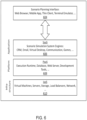
- control engine 200 includes identification module 202, analysis module 204, determination module 206 and output module 208. It should be understood that the engine(s) and modules discussed herein are non-exhaustive, as additional or fewer engines and/or modules (or sub-modules) may be applicable to the embodiments of the systems and methods discussed. More detail of the operations, configurations and functionalities of engine 200 and each of its modules, and their role within embodiments of the present disclosure will be discussed below.
- Process 300 provides non-limiting example embodiments for the disclosed location management framework. According to some embodiments, Process 300 provides non-limiting embodiments for determining corresponding patterns of behavior at a location for which the disclosed framework (e.g., via control engine 200) can control, manage and manipulate the operational status of a device (e.g., thermostat and/or security panel) at the location. As discussed below at least in relation to Process 400 of FIG. 4 , the leveraged and stored information can be utilized to perform the device management.
- a device e.g., thermostat and/or security panel
- the disclosed systems and methods can leverage known patterns and detected event data (e.g., related to activities by users and/or other users and/or items at a location) to control an environment of a location.
- the location can be a climate system and/or a security system.
- the disclosed framework can involve management of a climate system, via LLM functionality, via capabilities involving, but not limited to, control of heating or cooling sources (e.g., heat pumps, furnaces, boilers, solar, and the like), control of other information on room or location state (e.g., window or door contacts, and the like), status and control of energy sources and storage (e.g., solar, battery storage, water heating solar, and the like), control of other comfort items (e.g., air circulation fans, windows, binds, shades, and the like), integration with various voice assistants, mobile phone applications, web applications, and more types of user interfaces, and the like, and/or some combination thereof.
- heating or cooling sources e.g., heat pumps, furnaces, boilers, solar, and the like
- other information on room or location state e.g., window or door contacts, and the like
- status and control of energy sources and storage e.g., solar, battery storage, water heating solar, and the like
- control of other comfort items e.g.
- the management framework disclosed herein can have the capabilities to, but not limited to, communicate with users to ask for their needs (e.g., over text or voice or other means, in plain language), check work and home electronic calendars, access to sensors (e.g., temperature sensors, occupancy sensors, and the like), query users about any perceived variation in schedule, interact (e.g., via standard home automation protocols), and the like.
- systems may or may not have the ability to listen into conversations and/or identify users directly from internal external cameras or sensors (e.g. video doorbells, security system cameras, access control or door locks) in order to know who is inside the house or what their plans are without mandating direct programming of the system or for the system to be directly addressed. Accordingly, in some embodiments, this can be an optional feature - not everyone will feel comfortable with this type of functionality - at least initially.
- the framework can access weather reports to assess upcoming weather events, solar radiation, and local air quality, and the like; access geolocation data from users - either via mobile application, location services or other methods; access the Internet to check things like local school and local and national public holidays; have the ability to integrate status and control of new devices via communication protocols; receive input to any request to mitigate demands via any demand response program (and/or energy management program, platform and/or protocol), and the like, or some combination thereof.
- Processes 300 and 400 can operate to adapt and tailor a climate at a location based on ongoing changes, vary it's goals based on specific criteria it learns, and provide an improved user interface to the comfort system.
- the disclosed framework can adapt and adjust its reasoning for triggering alarms, arming the system, disarming the system and the like.
- a system can understand the users and property, and track authorized users of the property. Unauthorized users in areas can be challenged (e.g., using speech), and if they can answer, alarms can be raised (local or remote).
- the disclosed security system can have a set of predefined and/or dynamically determined rules it can comply with and reason against, whereby rules for inside, outside and/or certain areas in/around the location can be based on the requirements, context and/or current activity of a user(s) at the location.
- Processes 300 and 400 can operate to adapt and tailor security and monitoring of a location based on ongoing changes, and vary it's goals based on specific criteria it learns, and provide an improved user experience related to the safety it provides a user(s).
- Steps 302-304 of Process 300 can be performed by identification module 202 of control engine 200; Step 306 can be performed by analysis module 204; Step 308 can be performed by determination module 204; and Step 310 can be performed by output module 208.
- Process 300 begins with Step 302 where a set of devices associated with a user (and in some embodiments, associated with a location, for example, a user's home) are identified.
- the devices can be associated with any type of UE 102, sensors 110, and the like, discussed above in relation to FIG. 1 .
- the devices can at least include, but are not limited to, a user's smart phone, tablet devices in the home connected to the local network (e.g., Wi-Fi), televisions, routers/modems providing the network for the location, motion sensors, temperature sensors, door contacts, and the like. Additional, non-limiting examples of sensors and the types of collectable data are discussed above at least in relation to FIG. 1 .
- the identified devices can be paired and/or connected with another device (e.g., sensor 110, engine 200 and/or UE 102) via a cloud and/or cloud-to-cloud (C2C) connection (e.g., establish connection with a third party cloud, which connects with cloud system 106, for example).
- another device e.g., sensor 110, engine 200 and/or UE 102
- C2C cloud-to-cloud
- engine 200 can operate to trigger the identified devices to collect data about the location (e.g., referred to as sensor data).
- the sensor data can be collected continuously and/or according to a predetermined period of time or interval.
- sensor data may be collected based on detected events.
- type and/or quantity of sensor data may be directly tied to the type of device performing such data collection. For example, if a user is detected as walking into their house and the motion sensor captures such activity, then sensor data related to, but not limited to, a time, date, area of the location (e.g., which door), which direction, speed, user identity, device identity, and the like, or some combination thereof, can be captured.
- such sensor data may be derived and/or mined from stored sensor data within an associated or third party cloud.
- engine 200 can be associated with a cloud, which can store collected sensor data for the location in an associated account of a user and/or the location.
- Step 304 can involve querying the cloud for information about the location, which can be based on a criteria that can include, but is not limited to, a time, date, activity, event, other collected sensor data, and the like, or some combination thereof.
- the collected sensor data in Step 304 can be stored in database 108 in association with an identifier (ID) of a user, an ID of the device, an ID of the location and/or an ID of an account of the user/device/location.
- ID an identifier
- engine 200 can analyze the collected sensor data.
- engine 200 can implement any type of known or to be known computational analysis technique, algorithm, mechanism or technology to analyze the collected sensor data from Step 306.
- engine 200 may execute and/or include a specific trained artificial intelligence / machine learning model (AI/ML), a particular machine learning model architecture, a particular machine learning model type (e.g., convolutional neural network (CNN), recurrent neural network (RNN), autoencoder, support vector machine (SVM), and the like), or any other suitable definition of a machine learning model or any suitable combination thereof.
- AI/ML artificial intelligence / machine learning model
- CNN convolutional neural network
- RNN recurrent neural network
- SVM support vector machine
- engine 200 may leverage a large language model (LLM), whether known or to be known.
- LLM is a type of AI system designed to understand and generate human-like text based on the input it receives.
- the LLM can implement technology that involves deep learning, training data and natural language processing (NLP).
- NLP natural language processing
- Large language models are built using deep learning techniques, specifically using a type of neural network called a transformer. These networks have many layers and millions or even billions of parameters.
- LLMs can be trained on vast amounts of text data from the internet, books, articles, and other sources to learn grammar, facts, and reasoning abilities. The training data helps them understand context and language patterns.
- LLMs can use NLP techniques to process and understand text. This includes tasks like tokenization, part-of-speech tagging, and named entity recognition.
- LLMs can include functionality related to, but not limited to, text generation, language translation, text summarization, question answering, conversational Al, text classification, language understanding, content generation, and the like. Accordingly, LLMs can generate, comprehend, analyze and output human-like outputs (e.g., text, speech, audio, video, and the like) based on a given input, prompt or context. Accordingly, LLMs, which can be characterized as transformer-based LLMs, involve deep learning architectures that utilizes self-attention mechanisms and massive-scale pre-training on input data to achieve NLP understanding and generation. Such current and to-be-developed models can aid AI systems in handling human language and human interactions therefrom.
- engine 200 may be configured to utilize one or more AI/ML techniques chosen from, but not limited to, computer vision, feature vector analysis, decision trees, boosting, support-vector machines, neural networks, nearest neighbor algorithms, Naive Bayes, bagging, random forests, logistic regression, and the like.
- AI/ML techniques chosen from, but not limited to, computer vision, feature vector analysis, decision trees, boosting, support-vector machines, neural networks, nearest neighbor algorithms, Naive Bayes, bagging, random forests, logistic regression, and the like.
- engine 200 can implement an XGBoost algorithm for regression and/or classification to analyze the sensor data, as discussed herein.
- the AI/ML and LLM computational analysis algorithms implemented can be applied and/or executed in a time-based manner, in that collected sensor data for specific time periods can be allocated to such time periods so as to determine patterns of activity (or non-activity) according to a criteria.
- engine 200 can execute a Bayesian determination for a predetermined time span, at preset intervals (e.g., a 24 hour time span, every 8 hours, for example), so as to segment the day according to applicable patterns, which can be leveraged to determine, derive, extract or otherwise activities/non-activities in/around a location.
- a neural network technique may be one of, without limitation, feedforward neural network, radial basis function network, recurrent neural network, convolutional network (e.g., U-net) or other suitable network.
- an implementation of Neural Network may be executed as follows:
- the trained neural network model may specify a neural network by at least a neural network topology, a series of activation functions, and connection weights.
- the topology of a neural network may include a configuration of nodes of the neural network and connections between such nodes.
- the trained neural network model may also be specified to include other parameters, including but not limited to, bias values/functions and/or aggregation functions.
- an activation function of a node may be a step function, sine function, continuous or piecewise linear function, sigmoid function, hyperbolic tangent function, or other type of mathematical function that represents a threshold at which the node is activated.
- the aggregation function may be a mathematical function that combines (e.g., sum, product, and the like) input signals to the node.
- an output of the aggregation function may be used as input to the activation function.
- the bias may be a constant value or function that may be used by the aggregation function and/or the activation function to make the node more or less likely to be activated.
- engine 200 can determine a set of patterns for a user(s), a device(s) and/or the location. According to some embodiments, the determined patterns are based on the computational AI/ML and LLM analysis performed via engine 200, as discussed above.
- the set of patterns can correspond to, but are not limited to, types of events, types of detected activity, a time of day, a date, type of user, duration, amount of activity, quantity of activities, sublocations within the location (e.g., rooms in the house, for example), and the like, or some combination thereof. Accordingly, the patterns can be specific to a user, a device (e.g., a television in the living room, for example), and/or specific to the location (e.g., or room within a location - for example, the bedroom of the location).
- a device e.g., a television in the living room, for example
- the location e.g., or room within a location - for example, the bedroom of the location.
- Step 308 can involve engine 200 determining a set of real-world and digital patterns (e.g., which devices in the location are used by which users, and which activities are performed on such devices at such times/locations), which can correspond to a user(s), device(s) and/or the location.
- a set of real-world and digital patterns e.g., which devices in the location are used by which users, and which activities are performed on such devices at such times/locations
- Step 310 engine 200 can store the determined set of patterns in database 108, in a similar manner as discussed above.
- Step 310 can involve creating a data structure associated with each determined pattern, whereby each data structure can be stored in a proper storage location associated with an identifier of the user/device/location, as discussed above.
- a pattern can comprise a set of events, which can correspond to an activity and/or non-activity (e.g., sitting, sleeping, walking, talking, eating, watching, and the like, for example).
- the pattern's data structure can be configured with header (or metadata) that identifies a user, device and/or the location, and/or a time period/interval of analysis (as discussed above); and the remaining portion of the structure providing the data of the activity/non-activity and status of entry-points during such sequence(s).
- the data structure for a pattern can be relational, in that the events of a pattern can be sequentially ordered, and/or weighted so that the order corresponds to events with more or less activity.
- the structure of the data structure for a pattern can enable a more computationally efficient (e.g., faster) search of the pattern to determine if later detected events correspond to the events of the pattern, as discussed below in relation to at least Process 400 of FIG. 4 .
- the data structures of patterns can be, but are not limited to, files, arrays, lists, binary, heaps, hashes, tables, trees, and the like, and/or any other type of known or to be known tangible, storable digital asset, item and/or object.
- the sensor data can be identified and analyzed in a raw format, whereby upon a determination of the pattern, the data can be compiled into refined data (e.g., a format capable of being stored in and read from database 108).
- Step 310 can involve the creation and/or modification (e.g., transformation) of the sensor data into a storable format.
- each pattern (and corresponding data structure) can be modified based on further detected behavior, as discussed below in relation to Process 400 of FIG. 4 .
- Process 400 provides non-limiting example embodiments for the deployment and/or implementation of the disclosed location management framework.
- Steps 402, 406 and 414 can be performed by identification module 202 of control engine 200; Steps 404 and 408 can be performed by analysis module 204; Step 410 can be performed by determination module 206; Steps 412, 416 and 418 can be performed by output module 208.
- Process 400 begins with Step 402 where engine 200 can monitor the location to detect, determine or otherwise identify activity related to a user and/or a device.
- the monitoring can involve tracking users' movements, actions, presence, interactions (e.g., with other users, sensors, devices and/or items/equipment at the location, for example) and determining activity related to the users at the location.
- engine 200 can detect that a user has left his bedroom, walked down the stairs, disarmed the security system, adjusted the thermostat and opened the window in the kitchen.
- the monitoring and identification of events at the location can correspond to digital activities (e.g., streaming content, for example) and/or real-world activities (e.g., a user entering the location and/or specific room in the location, which can effectuated via any of the sensors discussed above in relation to FIG. 1 , discussed supra).
- digital activities e.g., streaming content, for example
- real-world activities e.g., a user entering the location and/or specific room in the location, which can effectuated via any of the sensors discussed above in relation to FIG. 1 , discussed supra.
- such monitoring and identification can occur continuously; according to a predetermined threshold, that can be tied to a time period (e.g., every n minutes, for example), based on an identity of a sensor, device and/or user; based on a type of movement in the location (e.g., sitting versus moving from room to room); and the like, or some combination thereof.
- a predetermined threshold that can be tied to a time period (e.g., every n minutes, for example), based on an identity of a sensor, device and/or user; based on a type of movement in the location (e.g., sitting versus moving from room to room); and the like, or some combination thereof.
- engine 200 can identify attributes of the activities of the event. Accordingly, in some embodiments, engine 200 can analyze the event and the real-world/digital data related thereto, and determine attributes, features and/or characteristics of the event. In some embodiments, such analysis can be performed via the AI/ML and/or LLM analysis discussed above.
- such attributes can correspond to, but not be limited to, ID of a user, ID of a device, type of device, position within the location, sensor triggered, type of control system (e.g., climate system versus security system), ID of an account, type of content, quantity and/or characteristics of content, network usage, time period, duration, frequency, and the like, or some combination thereof.
- ID of a user ID of a device
- type of device position within the location
- sensor triggered e.g., type of control system
- type of control system e.g., climate system versus security system
- ID of an account e.g., type of content, quantity and/or characteristics of content, network usage, time period, duration, frequency, and the like, or some combination thereof.
- the attributes can further include sensor data related to the environment for which the event occurred.
- the sensor data can indicate attributes related to, but not limited to, weather forecast for the day, current temperature inside and outside of the house, current cloud coverage, precipitation, humidity, whether lights were turned on in the house, number of other users in the location, their activities, and the like.
- the attributes can further be based on collected sensor data for the user that correlates to the event, such that calendar information for the user, as well as other contextual data (e.g., spatial, temporal, logical data, for example) related to the user's actions and/or their real-world/digital activities/profiles can be collected and identified.
- contextual data e.g., spatial, temporal, logical data, for example
- processing steps of Process 400 can proceed from Step 404 to Step 406 then to Step 408; and in some alternative embodiments, Process 400 can proceed from Step 404 to Step 408 (e.g., bypassing Step 406, whereby learned patterns may not be utilized).
- Step 406 can involve engine 200 performing a search of database 108, whereby the search can be based on a query compiled from data associated with the attributes of the event.
- such attributes can enable engine 200 to identify stored behavior patterns of users that correspond to known activities at the location, at certain times. For example, if the attributes indicate that the user is in the kitchen at 7 AM on a weekday, then stored behavior patterns related to the user and/or location related to activity at such time and date within the location's kitchen can be retrieved from database 108.
- engine 200 can analyze the attributes of the event via an LLM model executing in association with a control panel for the location.
- the control panel can correspond to a climate control system, security system and/or a/some combination thereof.
- the LLM analysis can involve input corresponding to the attributes of the event or the attributes of the event and the information related to the retrieved stored behavior patterns (as discussed above in relation to Step 406).
- the analysis performed in Step 408 can further and/or additionally be performed via any of the AI/ML models discussed above.
- engine 20 can determine an LLM prompt, as in Step 410.
- the determined prompt can correspond to a context of the user, which can be in accordance with controls related to the control system.
- engine 200 can compile this information, and via execution of the LLM model, can determine a prompt which can state: "Are you feeling well this morning? would you like me to adjust the thermostat and/or turn on the ceiling fan to cool the room down?"
- Such LLM prompt output can be generated in any type of format, which can include, but is not limited to, text, audio, video, image, electronic message, and the like, or some combination thereof.
- engine 200 can cause the output of the determined LLM prompt to be output based on the type of format.
- a sensor connected to the control system and/or a microphone on the control panel of the system can audibly output the determined prompt.
- the sensor closest to the user e.g., in the kitchen, for example
- engine 200 can cause an SMS message to be sent to the user's device, which can cause a visible notification to appear on the device's display, and enable the user to enter a response.
- the notification message can cause a webpage or network location page to open, which can enable the user to provide feedback.
- the framework herein can enable the control system to proactively address discrepancies in the user's schedule and, in real-time, enable input of adjustments of how the location's environment can be modified to adjust to the outlier activity.
- engine 200 can receive feedback response to the LLM prompt. For example, upon audibly outputting a voice request to the user (as per Step 412), engine 200 can turn on the microphones of the sensors (and/or UE of the user) to collect audio data related to the user's response. As such, in Step 416, engine 200 can cause the feedback (from Step 414) to be stored in association with the behaviors retrieved in Step 406, whereby such behaviors can be updated to reflect the most recent behaviors of the user.
- engine 200 can analyze the feedback provided by the user, and generate and execute controls for the location based on the feedback. For example, if the user approves of turning on the fan's in the kitchen, then engine 200 can cause the control panel to trigger the kitchen ceiling fan to automatically turn on, which can be at a speed proportionate to the indoor and/or outdoor temperature differential and/or requested temperature reduction identified by the user (which can be derived from the user's audio input and/or the temperature they normally reduce/increase the thermostat on such days as per the stored behavior(s), and the like).
- Step 418 can involve engine 200 executing the AI/ML and/or LLM models in a similar manner as discussed above to determine the controls from the feedback from the user (from Step 414), whereby the control panel can be caused to automatically execute real-world commands that modify the location's environment.
- such generated controls and data related to the modified environment can further be stored and fed to the AI/ML models, as discussed above, which can enable updating of patterns and/or creation of new patterns for the user and/or location.
- the disclosed framework can adapt and adjust its reasoning for triggering alarms, arming the system, disarming the system and the like.
- the control panel of the security system which has integrated therein engine 200, for example, can understand the users and location, and track authorized users of the property.
- an event corresponding to an unauthorized user being detected at the front door and/or in the house for example (e.g., which is not ordinarily present from the stored behavior patterns for the home, discussed supra), such user can be channeled via a generated LLM prompt.
- the LLM prompt can state "Please identify yourself and/or your purpose for being here.”
- an alarm can be triggered.
- the user states they are here to fix the plumbing, yet not plumbing appointment can be found in any resident user's calendar, emails and/or communications among themselves (e.g., Mom tells Dad that the plumber is coming today from a text, for example), the alarm can be triggered and/or the user can be warned prior to such alarm via another LLM prompt being output (e.g., "Exit the property at once or the authorities will be called", for example).
- the alarm can be toggled to an "off" mode, for example, which can enable the user to enter.
- another LLM prompt can be generated if the user remains at the location more than expected (e.g., the motion in the kitchen near the refrigerator has halted, yet the front door which was unlocked has not been opened for a predetermined period of time after the motion was detected as stopping (e.g., 1 minute). If such case occurs, then another LLM prompt can be generated and/or security system controls can be generated and executed causing the alarm to trigger.
- the disclosed framework can improve a security system to reason against current events at the location, whereby rules for inside, outside and/or certain areas in/around the location can be based on the requirements, context and/or current activity of a user(s) at the location.
- This therefore, provides a more robust system that can account for real-world activities that may deviate from what is predicted. It should be understood that such adaptive controls can be performed for climate systems, as discussed above.
- FIG. 7 is a schematic diagram illustrating a client device showing an example embodiment of a client device that may be used within the present disclosure.
- Client device 700 may include many more or less components than those shown in FIG. 7 . However, the components shown are sufficient to disclose an illustrative embodiment for implementing the present disclosure.
- Client device 700 may represent, for example, UE 102 discussed above at least in relation to FIG. 1 .
- Client device 700 includes a processing unit (CPU) 722 in communication with a mass memory 730 via a bus 724.
- Client device 700 also includes a power supply 726, one or more network interfaces 750, an audio interface 752, a display 754, a keypad 756, an illuminator 758, an input/output interface 760, a haptic interface 762, an optional global positioning systems (GPS) receiver 764 and a camera(s) or other optical, thermal or electromagnetic sensors 766.
- Device 700 can include one camera/sensor 766, or a plurality of cameras/sensors 766, as understood by those of skill in the art.
- Power supply 726 provides power to Client device 700.
- Client device 700 may optionally communicate with a base station (not shown), or directly with another computing device.
- network interface 750 is sometimes known as a transceiver, transceiving device, or network interface card (NIC).
- Audio interface 752 is arranged to produce and receive audio signals such as the sound of a human voice in some embodiments.
- Display 754 may be a liquid crystal display (LCD), gas plasma, light emitting diode (LED), or any other type of display used with a computing device.
- Display 754 may also include a touch sensitive screen arranged to receive input from an object such as a stylus or a digit from a human hand.
- Keypad 756 may include any input device arranged to receive input from a user.
- Illuminator 758 may provide a status indication and/or provide light.
- Client device 700 also includes input/output interface 760 for communicating with external.
- Input/output interface 760 can utilize one or more communication technologies, such as USB, infrared, Bluetooth TM , or the like in some embodiments.
- Haptic interface 762 is arranged to provide tactile feedback to a user of the client device.
- Optional GPS transceiver 764 can determine the physical coordinates of Client device 700 on the surface of the Earth, which typically outputs a location as latitude and longitude values. GPS transceiver 764 can also employ other geo-positioning mechanisms, including, but not limited to, triangulation, assisted GPS (AGPS), E-OTD, CI, SAI, ETA, BSS or the like, to further determine the physical location of client device 700 on the surface of the Earth. In one embodiment, however, Client device 700 may through other components, provide other information that may be employed to determine a physical location of the device, including for example, a MAC address, Internet Protocol (IP) address, or the like.
- IP Internet Protocol
- Mass memory 730 includes a RAM 732, a ROM 734, and other storage means. Mass memory 730 illustrates another example of computer storage media for storage of information such as computer readable instructions, data structures, program modules or other data. Mass memory 730 stores a basic input/output system (“BIOS") 740 for controlling low-level operation of Client device 700. The mass memory also stores an operating system 741 for controlling the operation of Client device 700.
- BIOS basic input/output system
- Memory 730 further includes one or more data stores, which can be utilized by Client device 700 to store, among other things, applications 742 and/or other information or data.
- data stores may be employed to store information that describes various capabilities of Client device 700. The information may then be provided to another device based on any of a variety of events, including being sent as part of a header (e.g., index file of the HLS stream) during a communication, sent upon request, or the like. At least a portion of the capability information may also be stored on a disk drive or other storage medium (not shown) within Client device 700.
- Applications 742 may include computer executable instructions which, when executed by Client device 700, transmit, receive, and/or otherwise process audio, video, images, and enable telecommunication with a server and/or another user of another client device. Applications 742 may further include a client that is configured to send, to receive, and/or to otherwise process gaming, goods/services and/or other forms of data, messages and content hosted and provided by the platform associated with engine 200 and its affiliates.
- computer engine and “engine” identify at least one software component and/or a combination of at least one software component and at least one hardware component which are designed/programmed/configured to manage/control other software and/or hardware components (such as the libraries, software development kits (SDKs), objects, and the like).
- software components such as the libraries, software development kits (SDKs), objects, and the like.
- Examples of hardware elements may include processors, microprocessors, circuits, circuit elements (e.g., transistors, resistors, capacitors, inductors, and so forth), integrated circuits, application specific integrated circuits (ASIC), programmable logic devices (PLD), digital signal processors (DSP), field programmable gate array (FPGA), logic gates, registers, semiconductor device, chips, microchips, chip sets, and so forth.
- the one or more processors may be implemented as a Complex Instruction Set Computer (CISC) or Reduced Instruction Set Computer (RISC) processors; x86 instruction set compatible processors, multi-core, or any other microprocessor or central processing unit (CPU).
- the one or more processors may be dual-core processor(s), dual-core mobile processor(s), and so forth.
- Computer-related systems, computer systems, and systems include any combination of hardware and software.
- Examples of software may include software components, programs, applications, operating system software, middleware, firmware, software modules, routines, subroutines, functions, methods, procedures, software interfaces, application program interfaces (API), instruction sets, computer code, computer code segments, words, values, symbols, or any combination thereof. Determining whether an embodiment is implemented using hardware elements and/or software elements may vary in accordance with any number of factors, such as desired computational rate, power levels, heat tolerances, processing cycle budget, input data rates, output data rates, memory resources, data bus speeds and other design or performance constraints.
- a module is a software, hardware, or firmware (or combinations thereof) system, process or functionality, or component thereof, that performs or facilitates the processes, features, and/or functions described herein (with or without human interaction or augmentation).
- a module can include sub-modules.
- Software components of a module may be stored on a computer readable medium for execution by a processor. Modules may be integral to one or more servers, or be loaded and executed by one or more servers. One or more modules may be grouped into an engine or an application.
- One or more aspects of at least one embodiment may be implemented by representative instructions stored on a machine-readable medium which represents various logic within the processor, which when read by a machine causes the machine to fabricate logic to perform the techniques described herein.
- Such representations known as "IP cores,” may be stored on a tangible, machine readable medium and supplied to various customers or manufacturing facilities to load into the fabrication machines that make the logic or processor.
- IP cores may be stored on a tangible, machine readable medium and supplied to various customers or manufacturing facilities to load into the fabrication machines that make the logic or processor.
- various embodiments described herein may, of course, be implemented using any appropriate hardware and/or computing software languages (e.g., C++, Objective-C, Swift, Java, JavaScript, Python, Perl, QT, and the like).
- exemplary software specifically programmed in accordance with one or more principles of the present disclosure may be downloadable from a network, for example, a website, as a stand-alone product or as an add-in package for installation in an existing software application.
- exemplary software specifically programmed in accordance with one or more principles of the present disclosure may also be available as a client-server software application, or as a web-enabled software application.
- exemplary software specifically programmed in accordance with one or more principles of the present disclosure may also be embodied as a software package installed on a hardware device.
- the term "user”, “subscriber” “consumer” or “customer” should be understood to refer to a user of an application or applications as described herein and/or a consumer of data supplied by a data provider.
- the term “user” or “subscriber” can refer to a person who receives data provided by the data or service provider over the Internet in a browser session, or can refer to an automated software application which receives the data and stores or processes the data.
- the methods and systems of the present disclosure may be implemented in many manners and as such are not to be limited by the foregoing exemplary embodiments and examples.
Landscapes
- Engineering & Computer Science (AREA)
- Physics & Mathematics (AREA)
- General Physics & Mathematics (AREA)
- Automation & Control Theory (AREA)
- Artificial Intelligence (AREA)
- General Engineering & Computer Science (AREA)
- Evolutionary Computation (AREA)
- Signal Processing (AREA)
- Health & Medical Sciences (AREA)
- Computer Vision & Pattern Recognition (AREA)
- Medical Informatics (AREA)
- Software Systems (AREA)
- Business, Economics & Management (AREA)
- Fuzzy Systems (AREA)
- Mathematical Physics (AREA)
- Chemical & Material Sciences (AREA)
- Combustion & Propulsion (AREA)
- Mechanical Engineering (AREA)
- Emergency Management (AREA)
- Telephonic Communication Services (AREA)
- Debugging And Monitoring (AREA)
Applications Claiming Priority (1)
| Application Number | Priority Date | Filing Date | Title |
|---|---|---|---|
| GB2315037.8A GB2634105A (en) | 2023-09-29 | 2023-09-29 | Systems and methods for LLM-based location control |
Publications (1)
| Publication Number | Publication Date |
|---|---|
| EP4530762A1 true EP4530762A1 (de) | 2025-04-02 |
Family
ID=88696340
Family Applications (1)
| Application Number | Title | Priority Date | Filing Date |
|---|---|---|---|
| EP24189968.1A Pending EP4530762A1 (de) | 2023-09-29 | 2024-07-22 | Systeme und verfahren zur llm-basierten standortsteuerung |
Country Status (3)
| Country | Link |
|---|---|
| US (1) | US20250110453A1 (de) |
| EP (1) | EP4530762A1 (de) |
| GB (1) | GB2634105A (de) |
Citations (5)
| Publication number | Priority date | Publication date | Assignee | Title |
|---|---|---|---|---|
| US20160139575A1 (en) * | 2014-11-11 | 2016-05-19 | Webee LLC | Systems and methods for smart spaces |
| US20160378080A1 (en) * | 2015-06-25 | 2016-12-29 | Intel Corporation | Technologies for conversational interfaces for system control |
| US20190349213A1 (en) * | 2018-05-11 | 2019-11-14 | Bubble Electric, Inc. | Systems and Methods for Home Automation Control |
| US20230074406A1 (en) * | 2021-09-07 | 2023-03-09 | Google Llc | Using large language model(s) in generating automated assistant response(s |
| CN116700032A (zh) * | 2023-06-30 | 2023-09-05 | 联想诺谛(北京)智能科技有限公司 | 设备控制方法、装置和系统 |
Family Cites Families (1)
| Publication number | Priority date | Publication date | Assignee | Title |
|---|---|---|---|---|
| US9618224B2 (en) * | 2013-07-26 | 2017-04-11 | Honeywell International Inc. | Air quality based ventilation control for HVAC systems |
-
2023
- 2023-09-29 GB GB2315037.8A patent/GB2634105A/en active Pending
-
2024
- 2024-07-22 EP EP24189968.1A patent/EP4530762A1/de active Pending
- 2024-09-27 US US18/898,992 patent/US20250110453A1/en active Pending
Patent Citations (5)
| Publication number | Priority date | Publication date | Assignee | Title |
|---|---|---|---|---|
| US20160139575A1 (en) * | 2014-11-11 | 2016-05-19 | Webee LLC | Systems and methods for smart spaces |
| US20160378080A1 (en) * | 2015-06-25 | 2016-12-29 | Intel Corporation | Technologies for conversational interfaces for system control |
| US20190349213A1 (en) * | 2018-05-11 | 2019-11-14 | Bubble Electric, Inc. | Systems and Methods for Home Automation Control |
| US20230074406A1 (en) * | 2021-09-07 | 2023-03-09 | Google Llc | Using large language model(s) in generating automated assistant response(s |
| CN116700032A (zh) * | 2023-06-30 | 2023-09-05 | 联想诺谛(北京)智能科技有限公司 | 设备控制方法、装置和系统 |
Also Published As
| Publication number | Publication date |
|---|---|
| GB202315037D0 (en) | 2023-11-15 |
| GB2634105A (en) | 2025-04-02 |
| US20250110453A1 (en) | 2025-04-03 |
Similar Documents
| Publication | Publication Date | Title |
|---|---|---|
| US11133953B2 (en) | Systems and methods for home automation control | |
| US11056114B2 (en) | Voice response interfacing with multiple smart devices of different types | |
| US20140297001A1 (en) | System and method for adaptive automated resource management and conservation | |
| US10574764B2 (en) | Automated learning universal gateway | |
| Santra et al. | Cost‐Effective Voice‐Controlled Real‐Time Smart Informative Interface Design With Google Assistance Technology | |
| US20250113252A1 (en) | Systems and methods for adaptive, learned control of network and connected devices | |
| US20250110453A1 (en) | Systems and Methods for LLM-Based Location Control | |
| EP4711867A1 (de) | Systeme und verfahren zur ki-basierten klimasystemsteuerung | |
| Tait | Smart Drink Bottle | |
| Alakbarova | Development of a model for the analysis of human behavior in a smart home environment | |
| US20240338987A1 (en) | Computerized systems and methods for dynamic automation of security features for a location | |
| US20240288192A1 (en) | Computerized systems and methods for providing protective safeguards within a location for items located therein | |
| WO2024137818A1 (en) | Computerized systems and methods for dynamically and automatically arming and disarming a security system | |
| US20260139865A1 (en) | Systems and methods for adaptive scheduling of actuator control | |
| US20260049737A1 (en) | Systems and methods for a smart air diffuser | |
| US20250020351A1 (en) | Systems and methods for location control based on air quality metrics | |
| US12436775B2 (en) | Computerized systems and methods for modified host-client device configurations and connections | |
| US20240422221A1 (en) | Computerized systems and methods for providing device-specific configurations to host-client devices | |
| GB2624153A (en) | Systems and methods for adaptive scheduling of actuator control | |
| US20250088569A1 (en) | System and method for shared device usage attribution and control therefrom | |
| WO2025230978A1 (en) | Systems and methods for custom relay outputs for a thermostat | |
| EP4639508A1 (de) | Computerisierte systeme und verfahren zur dynamischen und automatischen verwaltung eines sicherheitssystems | |
| WO2026085334A1 (en) | Systems and methods for thermostat controlled fire detection | |
| WO2025128658A1 (en) | Systems and methods for event-based location control | |
| EP4639308A1 (de) | Computerisierte systeme und verfahren zur thermostatbestimmung und temperatursollwertverwaltung |
Legal Events
| Date | Code | Title | Description |
|---|---|---|---|
| PUAI | Public reference made under article 153(3) epc to a published international application that has entered the european phase |
Free format text: ORIGINAL CODE: 0009012 |
|
| STAA | Information on the status of an ep patent application or granted ep patent |
Free format text: STATUS: THE APPLICATION HAS BEEN PUBLISHED |
|
| AK | Designated contracting states |
Kind code of ref document: A1 Designated state(s): AL AT BE BG CH CY CZ DE DK EE ES FI FR GB GR HR HU IE IS IT LI LT LU LV MC ME MK MT NL NO PL PT RO RS SE SI SK SM TR |
|
| STAA | Information on the status of an ep patent application or granted ep patent |
Free format text: STATUS: REQUEST FOR EXAMINATION WAS MADE |
|
| 17P | Request for examination filed |
Effective date: 20250908 |