EP4530706A1 - Tragezustandserfassungsmodul zur befestigung an einem brillengestell und verfahren zur bestimmung, ob ein brillengestell getragen wird - Google Patents
Tragezustandserfassungsmodul zur befestigung an einem brillengestell und verfahren zur bestimmung, ob ein brillengestell getragen wird Download PDFInfo
- Publication number
- EP4530706A1 EP4530706A1 EP23306603.4A EP23306603A EP4530706A1 EP 4530706 A1 EP4530706 A1 EP 4530706A1 EP 23306603 A EP23306603 A EP 23306603A EP 4530706 A1 EP4530706 A1 EP 4530706A1
- Authority
- EP
- European Patent Office
- Prior art keywords
- worn
- wearable device
- values
- frame
- wearing
- Prior art date
- Legal status (The legal status is an assumption and is not a legal conclusion. Google has not performed a legal analysis and makes no representation as to the accuracy of the status listed.)
- Withdrawn
Links
Images

Classifications
-
- G—PHYSICS
- G02—OPTICS
- G02C—SPECTACLES; SUNGLASSES OR GOGGLES INSOFAR AS THEY HAVE THE SAME FEATURES AS SPECTACLES; CONTACT LENSES
- G02C11/00—Non-optical adjuncts; Attachment thereof
- G02C11/10—Electronic devices other than hearing aids
-
- A—HUMAN NECESSITIES
- A61—MEDICAL OR VETERINARY SCIENCE; HYGIENE
- A61B—DIAGNOSIS; SURGERY; IDENTIFICATION
- A61B5/00—Measuring for diagnostic purposes; Identification of persons
- A61B5/68—Arrangements of detecting, measuring or recording means, e.g. sensors, in relation to patient
- A61B5/6801—Arrangements of detecting, measuring or recording means, e.g. sensors, in relation to patient specially adapted to be attached to or worn on the body surface
- A61B5/6802—Sensor mounted on worn items
- A61B5/6803—Head-worn items, e.g. helmets, masks, headphones or goggles
-
- G—PHYSICS
- G06—COMPUTING OR CALCULATING; COUNTING
- G06N—COMPUTING ARRANGEMENTS BASED ON SPECIFIC COMPUTATIONAL MODELS
- G06N20/00—Machine learning
-
- G—PHYSICS
- G06—COMPUTING OR CALCULATING; COUNTING
- G06N—COMPUTING ARRANGEMENTS BASED ON SPECIFIC COMPUTATIONAL MODELS
- G06N20/00—Machine learning
- G06N20/10—Machine learning using kernel methods, e.g. support vector machines [SVM]
-
- G—PHYSICS
- G06—COMPUTING OR CALCULATING; COUNTING
- G06N—COMPUTING ARRANGEMENTS BASED ON SPECIFIC COMPUTATIONAL MODELS
- G06N3/00—Computing arrangements based on biological models
- G06N3/02—Neural networks
Definitions
- the invention relates to a device and a process for determining whether a wearable device (for instance a spectacle frame) is worn or not.
- a wearable device for instance a spectacle frame
- the invention can have various applications, for instance (but not imitatively):
- Myopia has increased worldwide during recent years and is becoming a serious public problem. For instance, in East Asia, the prevalence can reach 80% of the population.
- document US2018081201 discloses a pair of sensors able to determine when the spectacles are being worn by a child. These sensors are for instance arranged, in use, to measure the temperature in the inside face of the spectacle frame relative to the ambient temperature. When both sensors detect that the temperature in the inside face is greater than the sum of the ambient temperature and a predetermined threshold, it is considered that the frame is worn by the patient.
- the provided information is not reliable enough. Indeed, many false positives can be generated, such as when the user holds the spectacle frame in his hand.
- the present invention provides a process for determining the wearing status of a wearable device performed by a processing unit, said process comprising steps of:
- n-tuples of values of said physical parameter(s) being stored in a database and being classified in at least two clusters, during the step of determining, it is determined if the measured n-tuple of value(s) belongs to one or another of said clusters and it is deduced therefrom whether the wearable device is worn or not.
- the model used to generate these clusters is not necessarily a clustering model, but it can be any other kind of machine learning model able to differentiate at least two kinds of wearing states.
- the first one is that the results do not depend on the initial calibration of the sensors, on possible mechanical problems that can occur (for example, addition of an offset due to the displacement of a sensor), and on possible variations (for instance, during winter, the temperature gap inside and outside the pair of eyeglasses 110 is generally greater than during summer). Consequently, this solution gives better results in the sense that the results can be corrected in real time by updating regularly and automatically the clusters.
- Another advantage is that, if the quality of clustering has to be improved, it is possible to refresh the database by removing old data in order to run the algorithm on the basis only of the most recent data. This can be carried out without human intervention.
- this process is performed so as to determine if the wearable device is worn, not worn or worn but not well-fitted. Consequently, it is possible to detect changes in the way of wearing the frame and the wearer can be warned if there is a difference in the resting worn position. This is especially the case when the wearer is wearing progressive addition lenses because the height of the pupil is an important parameter of comfort and good vision.
- the invention also relates to a wearing detection module configured to be fixed on a wearable device, comprising:
- the processing unit is programmed to determine whether the wearable device is worn or not by determining if the measured n-tuple of values belong to one or another of said clusters.
- the processing unit is programmed to determine whether the wearable device is worn or not as a function of the variation of said values during time.
- the measured n-tuple of value(s) is stored in said database and a clustering algorithm is then performed by said processing unit on the n-tuples of value(s) stored in said database to generate new clusters.
- said database when the wearing detection module is new and ready to be sold, said database already stores several n-tuples of value(s) of said parameters.
- the module comprises a battery configured to power the processing unit and the wearing sensors.
- the invention also relates to a monitoring equipment comprising:
- said wearable device is a frame of an eyewear that includes at least one lens that is fixed to the frame and that is able to change the natural evolution of an optical deficiency.
- said wearable device is a frame of an eyewear and wherein said wearing sensors are embedded in a temple of said frame.
- the invention relates to a wearable device including means for determining how long this wearable device has been worn.
- This wearable device is preferably a head-mounted device. It is more preferably a spectacle frame.
- the wearable device belongs to a monitoring equipment 100 that comprises an eyewear having at least one lens designed to change the natural evolution of an optical deficiency.
- the considered optical deficiency will be myopia but the invention can also apply to other types of visual defects requiring the wearing of an eyewear to prevent a deterioration of vision quality, such as visual fatigue, jet lag, phototoxicity, age related macular degeneration.
- the invention also applies to other domains. For instance, it can be used to assess the impact of the progressive lenses wearing time on a new wearer or the impact of light dose arriving on the eyes of a wearer. It can also be used to reduce the battery consumption of an electronic component fitted in a frame (by switching it off when the frame is not worn).
- the monitoring equipment 100 is a specific combination of the eyewear and a wearing detection module 140 fixed on the eyewear.
- this wearing detection module 140 comprises at least two wearing sensors 142, 143 configured to measure the values of two physical parameters (each parameter being suitable for estimating whether the spectacle frame is worn by a wearer) and a processing unit 141 configured to receive said values and to determine whether the eyewear is worn as a function of said values.
- eyewear refers generally to items and accessories worn on or over the eyes, which may be for purpose of improving or enhancing visual acuity or preventing myopia.
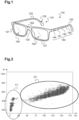
- the eyewear is a pair of eyeglasses 110 that includes a frame 120 (that forms to the "wearable device"), and two lenses 130 fixed to the frame.
- this eyewear could have a different shape (goggles, etc).
- the frame 120 is a structure receiving, retaining, holding, and/or supporting the lenses such that these lenses 130 can be placed in front of respective eyes of a wearer when the pair of eyeglasses 110 is being worn.
- the frame 120 includes two rims 121 for receiving the lenses 130.
- each of the two rims 121 is a full rim.
- the rims may also be half rims, or the frame 120 may be without rim (the lenses being screwed onto the frame). Accordingly, the frame 120 may be a full rimmed frame or a semi-rimless frame or a rimless frame.
- the frame 120 includes a bridge 123, situated above the nose of the wearer when the pair of eyeglasses 110 is being worn.
- the frame 120 also includes a pair of frame temples 122.
- the pair of frame temples 122 constitutes a pair of elongated side pieces of the frame 120, rested on the ears of the wearer when the pair of eyeglasses 110 is being worn.
- Each temple 122 is articulated to the corresponding rim by a hinge.
- the lenses 130 are designed to modify the natural evolution of an optical deficiency, here myopia.
- the invention also applies to corrective and non-corrective lenses, including single vision or multi-vision lenses, as well as other elements used to correct, protect, or enhance vision.
- the wearing detection module 140 is designed to determine if the pair of eyeglasses 110 is being worn by the wearer or not.
- This module is preferably embedded in the frame. It is for instance molded into a part of the frame 120 (for instance in one of its temples).
- this wearing detection module 140 may be attached to the frame. It could be permanently attached to the frame, for instance by means of glue. Or it could be removably attached to the frame, for example by means of snap-fastening means or by Velcro ® .
- This module is designed to frequently detect a wearing state (a state "worn” or “not worn”).
- it comprises preferably at least two wearing sensors 141, 142 each that could be able to determine a "wearing state approximation". As explained under, in a variant, it could comprise only one sensor.
- Each wearing sensor can be of any kind. They can be designed to measure the same kind of parameter (values of temperature, values of distance). But in a variant, the two sensors do not measure the same kind of parameter (they are not of the same nature). In any case, the sensors are designed to perform different measurements so as to be able to differently determine the wearing state approximations.
- one of the wearing sensors measures a parameter indicative of the distance between the spectacle frame (the temple) and the wearer.
- This sensor is for instance a light sensor, for example an infrared proximity sensor (a photodiode) configured to emit light and to detect the reflected light.
- An infrared proximity sensor placed on the temple 122 or on the nose pad 132 or on a rim 121 of the spectacle frame can indicate if the pair of eyeglasses 110 is probably worn or not. If not, no light is reflected.
- the senor is a capacitive sensor, configured to measure the contact area or the distance between the spectacle frame and the wearer.
- one of the wearing sensors measures a temperature or a temperature difference.
- the senor can comprise two cells suitable for measuring the temperature in two opposite directions (inside the temple and outside the temple).
- the detection of a difference of temperature between the two cells is a signature of the fact that the pair of eyeglasses 110 is probably worn.
- one of the wearing sensors is a resistive sensor configured to measure biological and/or physiological parameters of the wearer.
- the resistive sensor may be a heart rate sensor capable of detecting heart beats in a part of a spectacle frame element close to the skin of the wearer.
- Such a resistive sensor has the advantage to be specific by discriminating living things and objects.
- the heart rate sensor is preferably arranged on the temple, at the extremity of the tip of the temple facing a temporal bone of the wearer or on the bridge.
- one of the wearing sensors is a motion sensor, for example an accelerometer adapted to determine if the frame moves or not.
- the detection of a constant movement is a signature of the fact that the pair of eyeglasses 110 is probably worn.
- this is an IMU (for "Inertial Motion Unit) including an inclinometer (and/or a gyroscope) that is able to determine the tilt of the frame relative to the ground so as to determine if this tilt shows that the pair of eyeglasses 110 is probably placed on a furniture or if it is probably worn.
- IMU for "Inertial Motion Unit”
- inclinometer and/or a gyroscope
- one of the wearing sensors is a pressure sensor adapted to determine if the frame temples bear against the wearer's head or not.
- one of the wearing sensors is a pH sensor adapted to determine if the frame is in contact with the wearer's head or not.
- one of the wearing sensors is a capacitive sensor adapted to detect the wearer's head.
- Such a sensor is mainly composed of 2 parts, the electronic components and a copper layout laying down onto a semi-rigid tab.
- the electronic components are mostly used to manage the analog signal through the copper area and the digital communication with the processing unit.
- the copper layout acts as an antenna: it sends and receives an electrical field that is modulated by the proximity of the target (here, the wearer's head).
- the tab is integrated into the temple and the rigid part of the sensor is glued to the inside of the temple.
- one of the wearing sensors is adapted to detect whether the temples are in a closed state (against the rims of the frame) or in an opened state.
- a sensor will be called hereinafter as an "opening/closing sensor”. Two variants can be contemplated to design such a sensor.
- the senor is positioned on a face of an electronic board facing a magnet located into the hinge of the corresponding temple. Both parts are designed in such a way that an opening detection by the sensor occurs at temple opening mid race and the opposite way for closure detection.
- the electronic board can be located near the center of the temple and the magnet can either be located onto the opposite temple or into a rim or into the nose bridge 123.
- the pair of eyeglasses 110 comprises exactly two sensors.
- a first of the sensors 142 is a photodiode located in a frame temple 122 and configured to measure a distance between the frame temple 122 and the corresponding wearer head temple (when the frame 120 is being worn).
- the second sensor 143 is also a photodiode located in the nose pad 123 of the frame, configured to measure a distance between this nose pad and the wearer head face (when the frame 120 is being worn).
- the frame 120 is preferentially fitted with means for accumulating or generating an electrical energy to supply the processing unit 141 with an electrical current.
- These means comprise here a battery 144.
- these means can comprise an energy harvesting transducer that converts some form of ambient energy into electricity.
- This transducer can for instance generate an electrical current from movements of the frame or from sun light.
- the processing unit 141 is programmed to:
- the processing unit 141 comprises a central processing unit (CPU), a memory and input/output components.
- the processing unit stores information used in the process described below. It particularly stores a computer application, consisting of computer programs comprising instructions, the execution of which allowing the implementation by the processing unit 141 of the method described below.
- the processing unit 141 can receive data measured by the wearing sensors 142, 143.
- this processing unit 141 is a microcontroller embedded in the pair of eyeglasses 110.
- this processing unit could be remoted from the pair of eyeglasses 110 and formed by a controller of a computer or of a mobile device such as a smartphone.
- the frame 120 also comprises a communication unit 160 suitable to establish a radio contact with an informatics device (computer, smartphone, watch).
- the processing unit 141 can therefore send information (for instance the length of time), so that this information can be processed by the informatics device.
- This communication unit 160 is preferably a passive or active RFID chip. Such a chip does not require any battery to operate and can be scanned by a reader at a distance of 15 meters away from the scanner. In a variant, other technologies could be used (Bluetooth ® , WIFI).
- the frame also comprises a clock (a Real Time Clock) embedded in the frame 120 and that is able to date the measure and a memory to memorize the last measures.
- a clock a Real Time Clock
- the processing unit 141 can evaluate if the pair of eyeglasses 110 is worn or not and a simple log can register both the worn state and the corresponding time.
- This processing unit 141 determines whether the pair of eyeglasses 110 is worn is executed in loops, at determined time intervals (also called “sampling period").
- the time interval is preferably the same from a loop to another. It is advantageously greater than 5 seconds, to save electrical power.
- a loop is done every 30 seconds.
- the execution of the process may be limited to a predetermined period (for instance from 6am to 11pm).
- a wearer is indeed considered as sleeping between 11pm and 6am.
- the processing unit 150 is consequently on standby.
- the execution of the process may be put on standby when the battery 144 is charging.
- the process is carried out step by step, as shown in Figure 4 .
- the first step S1 consists in waking up the sensors.
- the second step S2 consists in determining a measured first value D1 by means of the first sensor 142.
- This first measured value is such that the processing unit could calculate a first wearing state approximation ("a priori worn” or "a priori not worn"), but here, this calculation is not necessary.
- step S2 the distance between the frame temple and the possible wearer head temple (if any) is measured.
- the processing unit 141 determines a second value D2 by means of the second sensor 143, this second measured value being such that the processing unit could calculate a second wearing state approximation ("a priori worn” or "a priori not worn"), but here again, this calculation is not necessary.
- step S3 the distance between the frame nose pad and the possible wearer head face (if any) is measured.
- the first and second values are simultaneously measured.
- the second sensor may be waked up only if the first value has a degree of precision or of uncertainty less than a predetermined threshold, to prevent unnecessary energy loss.
- the processing unit 141 has determined a pair of instant values (named herein after the last pair of values).
- the aim at the end of step S3 for the processing unit 141 is to determine a n-tuple of values.
- step S4 the process uses machine learning to determine the worn state.
- the processing unit 141 uses a database.
- This database comprises at least two fields (or columns), a first one associated to the values measured by the first sensor 142 and the second one associated to the values measured by the second sensor 143.
- This database can be filled with registers, each one corresponding to a couple of values.
- the process performed by the processing unit 141 is said non-supervised.
- the database is initially empty (when the pair of eyeglasses is sold or lent to the future wearer).
- Step S4 is implemented only when the database contains enough registers (for example more than 24 hours of recording).
- the processing unit 141 is programmed to determine whether the pair of eyeglasses 110 is currently worn or not as a function of the last pair of measured values, and only on the basis of the old pairs of values stored in the database.
- a first operation consisting in fitting the machine learning model is performed (here by cluster analysis).
- cluster analysis identifies commonalities in the stored pairs of values.
- step S4 when the last pair of values has been measured by the sensors, a second operation consisting in applying the model to this last pair of values is performed. This operation reacts based on the presence or absence of such commonalities in these new pair of values.
- the analysis of the registered data is made in two-dimensions because only two sensors are fitted in the pair of eyeglasses 110. It could be performed in a higher dimension when more than two sensors are used.
- each observation belongs to the cluster with the nearest mean. This minimizes within-cluster variances and maximize without-cluster variances.
- the number k is preferably equal to two. Consequently, one cluster is associated to the worn state when the other is associated to the non-worn state. But in a variant, as it will be explained after, k may be greater than two.
- the k-means clustering algorithm is performed on all the database registers.
- this algorithm enables to distinguish two sets of points (the clusters C1 & C2), one set corresponding to data measured when the pair of eyeglasses 110 was worn and another set corresponding to data measured when the pair of eyeglasses 110 was not worn.
- the selected solution consists in considering that the cluster that comprises the greatest number of points measured during night and/or during the battery charge corresponds to the non-worn state.
- a greater number of clusters can be used in order to distinguish other states than "worn” and "not worn". For instance, with k equal to three, a third cluster can be associated to a "sliding state", that is to say to a state where the pair of eyeglasses 110 is worn but has slipped along the nose of the wearer (in a bad position that has to be corrected).
- the clusters are distinguished from each other by the processing unit 141.
- the model is applied to the last pair of values.
- this embodiment it is determined whether the point corresponding to this last pair of measured values belongs to one cluster or to the other. Specifically, it is determined if this point is nearer from one or the other of the centers of the clusters.
- the frame is considered worn, else, it is considered not worn.
- the database may not be initially empty.
- the database may already be filled with registers issued from databases of other eyewear or resulting from various tests performed during the design of the monitoring equipment 100. Then, the first and second operations can be carried out in the same way as mentioned above, by considering these registers.
- the processing unit 141 can be programmed not to modify the database with new measured values, the list of recorded registers being unchanging (or being possibly editable only by an after-sales service).
- the first clustering operation is performed once. This variation is not preferred because it needs to label a great number of pairs of values to obtain accurate results.
- this step S4 is performed in a supervised manner.
- the processing unit 141 embedded in the eyewear does not store any database, but it is suitable to be wirelessly connected to a remote database.
- This remote database comprises, as in the first embodiment, first and second fields to store a pair of values, and it further comprises a third field to store the worn state.
- Each registered observation ie each pair of values stored in the database
- the remote database is already filled with registers.
- registers correspond to the results of various tests performed during the design of the monitoring equipment 100.
- These registers are for instance selected to comprise data as representative as possible of the values that could be measured by the two sensors in a great number of distinct environments, for various kinds of wearers behaviors.
- a remote model is initially determined and fine-tuned according to the data comprised in this remote database. Every kind of model can be used (decision tree, neural network, etc.). Thanks to this model, weights can be calculated. These weights, once applied to a measured pair of values, indicate whether the eyewear is worn or not. They are stored in the processing unit 141 so that the latter can determine, at each sampling period, it the eyewear is worn.
- the processing unit 141 is programmed, when a pair of values is measured, to apply to these values the weights in order to deduce whether the eyewear is worn or not.
- the processing unit 141 is programmed to send new registers to the remote database, and the remote model is adjusted according to these new registers to take into account the specific wearer behaviour.
- the remote database may be completed with all the measured pairs of values. But here, only some of the pairs are stored in the remote database, for instance the ones that are the most illustrating of the wearer behaviour or, in a preferred embodiment, the ones for which we are the surest of their labelling (a threshold is for instance used to determine if a pair has to be stored or not).
- the filling of the remote database is useful only during a limited period: after a given period, the filling of the remote database will not have any impact on the quality of the remote model.
- the database can comprise between 10 000 and 20 000 registers (preferably issued from values measured on at least five distinct wearers - here seven - and the more, the better). Then, the database is completed by a number of new registers lying between 10 000 and 20 000. In other words, the register initially stored in the database have less and less weights, but they are important to initiate the process and to label the new registers. Besides, a variant could consist of giving greater weight to the new registers than to the initial registers, or in removing little to little some of the initial registers.
- the processing unit 141 is programmed to carry out a learning operation during a learning period. More precisely, the future glasses wearer is asked by the optician to put on and then take off his pair of eyeglasses several times and under different conditions (by performing distinct movements, at different speeds). Concurrently, pairs of values are measured and labelled by the optician, for instance thanks to a button that he presses when the pair of eyeglasses is worn and that he releases else, and they are then sent to the remote database.
- curves F1, F2, F3, F4 illustrates the variations of four values (in this figure, it is considered that the frame is equipped with four distinct sensors), and the periods ⁇ represent the moments when the button is pressed.
- This learning period preferably lasts between 2 and 20 minutes, and more preferably between 4 and 7 minutes. Thanks to this learning operation, the remote database can be filled with values as representative as possible of the specific wearer behavior and the remote model can be adjusted as a function of these values.
- both second and third examples are combined.
- a learning operation is carried out and after, during at least a first part of the life of the eyeglasses, the database is completed with relevant data.
- This fourth example is, among all these examples, the one that gives the best results.
- step S4 the last pair of values is associated to a worn or not-worn state.
- step S5 is performed only if the pair of eyeglasses 110 is worn. This fifth step here consists in incrementing a wearing time counter when both sensors indicate that the pair of eyeglasses 110 is worn by the wearer.
- steps S6 and S7 are performed. During these final steps S6 and S7, both sensors 142, 143 are shut down.
- the length of time the pair of eyeglasses 110 has been worn during a predetermined period can be calculated and sent to the informatics device for next uses.
- k-means a Gaussian mixture model can be used, or a model based on a gradient-boosting decision tree.
- a neuronal network algorithm trained on the basis of a training database the used method is the one that gives the best results.
- a batch of tests can be performed to determine, based on the kind of sensors embedded in the frame, the model that gives the best results.
- the processing unit could also be possible to fit the processing unit with several models and to select one model as a function of the conditions (for instance, if one of the sensors is a temperature sensor, it is possible to select a first model when the ambient temperature is close to 37°C, and another model else).
- the inputs of the models could be the same or distinct (a first model being based on the measures made by a first and a second sensors, and a second model being based on the measures made by a third and a fourth sensors).
- the variation of the measured data during time can be taken into account to determine whether the pair of eyeglasses is worn or not.
- the processing unit is programmed to consider at least two last pair of measured values.
- the processing unit acquires the last pairs of values determined during the last j sampling periods by the two sensors (with j at least equal to two, and here equal to five). Then, it calculates the standards deviations or the rolling means (also called “moving averages") of these values. The statistically obtained pair of value is then considered to determine whether it is nearer from one or the other cluster, and by deducing therefrom the worn state.
- This second embodiment gives better results than the main one because it is less dependent from measure errors.
- This second embodiment can be carried out with any of the supervised and non-supervised method described above.
- This second embodiment can also be carried out if the eyeglass frame comprises only one sensor and if, at each sampling period, a single value is measured. This variant of the second embodiment can be detailed.
- each time a measure is performed this measure is registered in the database.
- a 5-uple of measures form an "observation" and the clustering is performed on the basis of all the recorded observations.
- the processing unit reads the last j measures, and it determines whether this last observation is nearer from one or the other cluster, and it deduces therefrom the worn state.
- the processing unit can modify the sampling period so as to reduce the energy consumption of the device or to obtain more detailed results.
- the processing unit can affect distinct weights to the values measured by each sensor.
- the application of the pair of eyeglasses 110 in the above embodiments is to detect the worn time for reducing myopia evolution.
- Other applications are possible, for instance for amblyopia risk prevention, for progressive addition lenses...
- the wearable device fitted with the wearing detection module could be of any other kind. It could be for instance a shoe for a person having legs of different lengths.
Landscapes
- Engineering & Computer Science (AREA)
- Physics & Mathematics (AREA)
- Health & Medical Sciences (AREA)
- Theoretical Computer Science (AREA)
- Software Systems (AREA)
- Life Sciences & Earth Sciences (AREA)
- General Physics & Mathematics (AREA)
- Data Mining & Analysis (AREA)
- Computing Systems (AREA)
- General Engineering & Computer Science (AREA)
- Evolutionary Computation (AREA)
- Mathematical Physics (AREA)
- Artificial Intelligence (AREA)
- General Health & Medical Sciences (AREA)
- Medical Informatics (AREA)
- Molecular Biology (AREA)
- Computer Vision & Pattern Recognition (AREA)
- Biophysics (AREA)
- Biomedical Technology (AREA)
- Heart & Thoracic Surgery (AREA)
- Surgery (AREA)
- Animal Behavior & Ethology (AREA)
- Pathology (AREA)
- Public Health (AREA)
- Veterinary Medicine (AREA)
- Computational Linguistics (AREA)
- Acoustics & Sound (AREA)
- Otolaryngology (AREA)
- Ophthalmology & Optometry (AREA)
- Optics & Photonics (AREA)
- Eyeglasses (AREA)
Priority Applications (1)
| Application Number | Priority Date | Filing Date | Title |
|---|---|---|---|
| EP23306603.4A EP4530706A1 (de) | 2023-09-26 | 2023-09-26 | Tragezustandserfassungsmodul zur befestigung an einem brillengestell und verfahren zur bestimmung, ob ein brillengestell getragen wird |
Applications Claiming Priority (1)
| Application Number | Priority Date | Filing Date | Title |
|---|---|---|---|
| EP23306603.4A EP4530706A1 (de) | 2023-09-26 | 2023-09-26 | Tragezustandserfassungsmodul zur befestigung an einem brillengestell und verfahren zur bestimmung, ob ein brillengestell getragen wird |
Publications (1)
| Publication Number | Publication Date |
|---|---|
| EP4530706A1 true EP4530706A1 (de) | 2025-04-02 |
Family
ID=88315638
Family Applications (1)
| Application Number | Title | Priority Date | Filing Date |
|---|---|---|---|
| EP23306603.4A Withdrawn EP4530706A1 (de) | 2023-09-26 | 2023-09-26 | Tragezustandserfassungsmodul zur befestigung an einem brillengestell und verfahren zur bestimmung, ob ein brillengestell getragen wird |
Country Status (1)
| Country | Link |
|---|---|
| EP (1) | EP4530706A1 (de) |
Citations (6)
| Publication number | Priority date | Publication date | Assignee | Title |
|---|---|---|---|---|
| US20170160394A1 (en) * | 2013-06-05 | 2017-06-08 | Google Inc. | Using Sounds For Determining A Worn State Of A Wearable Computing Device |
| US20180081201A1 (en) | 2016-09-22 | 2018-03-22 | Essilor International (Compagnie Generale D'optique) | Wearing detection module for spectacle frame |
| US20210386366A1 (en) * | 2018-11-08 | 2021-12-16 | Vivior Ag | System for detecting whether a visual behavior monitor is worn by the user |
| US11526212B1 (en) * | 2019-09-25 | 2022-12-13 | Amazon Technologies, Inc. | System to determine don/doff of wearable device |
| US20230162531A1 (en) * | 2021-11-22 | 2023-05-25 | Microsoft Technology Licensing, Llc | Interpretation of resonant sensor data using machine learning |
| US20230258963A1 (en) * | 2020-07-23 | 2023-08-17 | Essilor International | Optical deficiency monitoring equipment comprising a pair of eyeglasses |
-
2023
- 2023-09-26 EP EP23306603.4A patent/EP4530706A1/de not_active Withdrawn
Patent Citations (6)
| Publication number | Priority date | Publication date | Assignee | Title |
|---|---|---|---|---|
| US20170160394A1 (en) * | 2013-06-05 | 2017-06-08 | Google Inc. | Using Sounds For Determining A Worn State Of A Wearable Computing Device |
| US20180081201A1 (en) | 2016-09-22 | 2018-03-22 | Essilor International (Compagnie Generale D'optique) | Wearing detection module for spectacle frame |
| US20210386366A1 (en) * | 2018-11-08 | 2021-12-16 | Vivior Ag | System for detecting whether a visual behavior monitor is worn by the user |
| US11526212B1 (en) * | 2019-09-25 | 2022-12-13 | Amazon Technologies, Inc. | System to determine don/doff of wearable device |
| US20230258963A1 (en) * | 2020-07-23 | 2023-08-17 | Essilor International | Optical deficiency monitoring equipment comprising a pair of eyeglasses |
| US20230162531A1 (en) * | 2021-11-22 | 2023-05-25 | Microsoft Technology Licensing, Llc | Interpretation of resonant sensor data using machine learning |
Similar Documents
| Publication | Publication Date | Title |
|---|---|---|
| US11237409B2 (en) | Wearing detection module for spectacle frame | |
| US12601928B2 (en) | Determining a progressive lens optical design | |
| US20170059886A1 (en) | Method for optimizing an optical lens equipment for a wearer | |
| US20180252942A1 (en) | Automatic eyewear measurement and specification | |
| US12523891B2 (en) | Optical deficiency monitoring equipment comprising a pair of eyeglasses | |
| CA3060972C (en) | System and method for obtaining lens fabrication measurements that accurately account for natural head position | |
| CN106456363A (zh) | 从用户界面访问可安装至眼睛的装置的方法、装置和系统 | |
| EP3866100A1 (de) | System zur aktualisierung eines indexes einer person | |
| CN110892311B (zh) | 用于确定个人的姿势和视觉行为的方法 | |
| US12566342B2 (en) | Method and apparatus for detecting optical device mis-adaptation | |
| EP3113135A1 (de) | Modul und verfahren zur bestimmung der augenermüdung | |
| EP4530707A1 (de) | Verschleisserfassungsmodul zur befestigung an einem brillengestell und verfahren zur bestimmung, ob ein brillengestell getragen wird |
Legal Events
| Date | Code | Title | Description |
|---|---|---|---|
| PUAI | Public reference made under article 153(3) epc to a published international application that has entered the european phase |
Free format text: ORIGINAL CODE: 0009012 |
|
| STAA | Information on the status of an ep patent application or granted ep patent |
Free format text: STATUS: THE APPLICATION HAS BEEN PUBLISHED |
|
| AK | Designated contracting states |
Kind code of ref document: A1 Designated state(s): AL AT BE BG CH CY CZ DE DK EE ES FI FR GB GR HR HU IE IS IT LI LT LU LV MC ME MK MT NL NO PL PT RO RS SE SI SK SM TR |
|
| STAA | Information on the status of an ep patent application or granted ep patent |
Free format text: STATUS: THE APPLICATION HAS BEEN WITHDRAWN |
|
| 18W | Application withdrawn |
Effective date: 20250404 |