EP4530669A1 - Erfassungsverfahren, kommunikationsvorrichtung und kommunikationssystem - Google Patents
Erfassungsverfahren, kommunikationsvorrichtung und kommunikationssystem Download PDFInfo
- Publication number
- EP4530669A1 EP4530669A1 EP23822994.2A EP23822994A EP4530669A1 EP 4530669 A1 EP4530669 A1 EP 4530669A1 EP 23822994 A EP23822994 A EP 23822994A EP 4530669 A1 EP4530669 A1 EP 4530669A1
- Authority
- EP
- European Patent Office
- Prior art keywords
- sequence
- signal
- preset
- preset sequence
- communication apparatus
- Prior art date
- Legal status (The legal status is an assumption and is not a legal conclusion. Google has not performed a legal analysis and makes no representation as to the accuracy of the status listed.)
- Pending
Links
Images




Classifications
-
- G—PHYSICS
- G01—MEASURING; TESTING
- G01S—RADIO DIRECTION-FINDING; RADIO NAVIGATION; DETERMINING DISTANCE OR VELOCITY BY USE OF RADIO WAVES; LOCATING OR PRESENCE-DETECTING BY USE OF THE REFLECTION OR RERADIATION OF RADIO WAVES; ANALOGOUS ARRANGEMENTS USING OTHER WAVES
- G01S7/00—Details of systems according to groups G01S13/00, G01S15/00, G01S17/00
- G01S7/003—Transmission of data between radar, sonar or lidar systems and remote stations
- G01S7/006—Transmission of data between radar, sonar or lidar systems and remote stations using shared front-end circuitry, e.g. antennas
-
- G—PHYSICS
- G01—MEASURING; TESTING
- G01S—RADIO DIRECTION-FINDING; RADIO NAVIGATION; DETERMINING DISTANCE OR VELOCITY BY USE OF RADIO WAVES; LOCATING OR PRESENCE-DETECTING BY USE OF THE REFLECTION OR RERADIATION OF RADIO WAVES; ANALOGOUS ARRANGEMENTS USING OTHER WAVES
- G01S13/00—Systems using the reflection or reradiation of radio waves, e.g. radar systems; Analogous systems using reflection or reradiation of waves whose nature or wavelength is irrelevant or unspecified
- G01S13/02—Systems using reflection of radio waves, e.g. primary radar systems; Analogous systems
- G01S13/06—Systems determining position data of a target
- G01S13/08—Systems for measuring distance only
- G01S13/32—Systems for measuring distance only using transmission of continuous waves, whether amplitude-, frequency-, or phase-modulated, or unmodulated
-
- G—PHYSICS
- G01—MEASURING; TESTING
- G01S—RADIO DIRECTION-FINDING; RADIO NAVIGATION; DETERMINING DISTANCE OR VELOCITY BY USE OF RADIO WAVES; LOCATING OR PRESENCE-DETECTING BY USE OF THE REFLECTION OR RERADIATION OF RADIO WAVES; ANALOGOUS ARRANGEMENTS USING OTHER WAVES
- G01S13/00—Systems using the reflection or reradiation of radio waves, e.g. radar systems; Analogous systems using reflection or reradiation of waves whose nature or wavelength is irrelevant or unspecified
- G01S13/02—Systems using reflection of radio waves, e.g. primary radar systems; Analogous systems
- G01S13/06—Systems determining position data of a target
- G01S13/08—Systems for measuring distance only
- G01S13/32—Systems for measuring distance only using transmission of continuous waves, whether amplitude-, frequency-, or phase-modulated, or unmodulated
- G01S13/34—Systems for measuring distance only using transmission of continuous waves, whether amplitude-, frequency-, or phase-modulated, or unmodulated using transmission of continuous, frequency-modulated waves while heterodyning the received signal, or a signal derived therefrom, with a locally-generated signal related to the contemporaneously transmitted signal
- G01S13/343—Systems for measuring distance only using transmission of continuous waves, whether amplitude-, frequency-, or phase-modulated, or unmodulated using transmission of continuous, frequency-modulated waves while heterodyning the received signal, or a signal derived therefrom, with a locally-generated signal related to the contemporaneously transmitted signal using sawtooth modulation
-
- G—PHYSICS
- G01—MEASURING; TESTING
- G01S—RADIO DIRECTION-FINDING; RADIO NAVIGATION; DETERMINING DISTANCE OR VELOCITY BY USE OF RADIO WAVES; LOCATING OR PRESENCE-DETECTING BY USE OF THE REFLECTION OR RERADIATION OF RADIO WAVES; ANALOGOUS ARRANGEMENTS USING OTHER WAVES
- G01S7/00—Details of systems according to groups G01S13/00, G01S15/00, G01S17/00
- G01S7/02—Details of systems according to groups G01S13/00, G01S15/00, G01S17/00 of systems according to group G01S13/00
- G01S7/023—Interference mitigation, e.g. reducing or avoiding non-intentional interference with other HF-transmitters, base station transmitters for mobile communication or other radar systems, e.g. using electro-magnetic interference [EMI] reduction techniques
- G01S7/0233—Avoidance by phase multiplex
-
- H—ELECTRICITY
- H04—ELECTRIC COMMUNICATION TECHNIQUE
- H04L—TRANSMISSION OF DIGITAL INFORMATION, e.g. TELEGRAPHIC COMMUNICATION
- H04L27/00—Modulated-carrier systems
- H04L27/26—Systems using multi-frequency codes
- H04L27/2601—Multicarrier modulation systems
- H04L27/2602—Signal structure
- H04L27/26035—Maintenance of orthogonality, e.g. for signals exchanged between cells or users, or by using covering codes or sequences
-
- H—ELECTRICITY
- H04—ELECTRIC COMMUNICATION TECHNIQUE
- H04L—TRANSMISSION OF DIGITAL INFORMATION, e.g. TELEGRAPHIC COMMUNICATION
- H04L27/00—Modulated-carrier systems
- H04L27/26—Systems using multi-frequency codes
- H04L27/2601—Multicarrier modulation systems
- H04L27/2602—Signal structure
- H04L27/2605—Symbol extensions, e.g. Zero Tail, Unique Word [UW]
- H04L27/2607—Cyclic extensions
-
- H—ELECTRICITY
- H04—ELECTRIC COMMUNICATION TECHNIQUE
- H04L—TRANSMISSION OF DIGITAL INFORMATION, e.g. TELEGRAPHIC COMMUNICATION
- H04L27/00—Modulated-carrier systems
- H04L27/26—Systems using multi-frequency codes
- H04L27/2601—Multicarrier modulation systems
- H04L27/2602—Signal structure
- H04L27/261—Details of reference signals
- H04L27/2613—Structure of the reference signals
Definitions
- Embodiments of this application relate to the field of communication technologies, and more specifically, to a sensing method, a communication apparatus, and a communication system.
- a radio detection and ranging (radio detection and ranging, Radar) (briefly referred to as radar) technology is one of the current most frequently used radio sensing technologies. A principle thereof is described as follows.
- a radar transmits a sensing signal to specific space, and the sensing signal is reflected to form an echo signal after reaching a target.
- the radar receives the echo signal, and performs a correlation operation on the echo signal and the sensing signal to obtain spatial information of the target.
- Frequency modulated continuous wave (frequency modulated continuous wave, FMCW) is one of the current most commonly used radar sensing waveforms.
- FMCW-based radar technology is easily affected by an interference signal. For example, in a scenario in which a plurality of radars simultaneously perform sensing, a sensing signal and/or an echo signal generated by one radar may cause interference to an echo signal of another radar. In this way, the another radar may easily generate a false target in a sensing process.
- a sensing signal generated by the radar is usually processed in a time division, frequency division, or code division manner. For example, based on a pseudo-random sequence, a start time, a start frequency, or a phase of the sensing signal generated by the radar in a different period is adjusted.
- the time division manner increases a radar ranging time.
- the frequency division manner reduces a bandwidth actually occupied by the signal, thereby reducing a ranging resolution.
- Periodic cross-correlation properties of a pseudo-random sequence used in the code division manner are relatively poor. Therefore, an interference suppression capability of this manner for the echo signal of the radar is relatively limited, and reliability of radar sensing is reduced.
- Embodiments of this application provide a sensing method, a communication apparatus, and a communication system.
- the sensing method can suppress interference of a signal transmitted by another communication apparatus, so that the communication apparatus has a relatively strong interference suppression capability, thereby improving sensing reliability of the communication apparatus.
- a sensing method may be performed by a first communication apparatus, or may be performed by a component of the first communication apparatus, for example, a processor, a chip, or a chip system of the first communication apparatus, or may be implemented by a logical module or software that can implement all or some functions of the first communication apparatus.
- the first sensing signal is a sensing signal obtained based on a preset sequence
- the first sensing signal may suppress interference of a signal transmitted by another communication apparatus, so that the first communication apparatus has a relatively strong interference suppression capability, thereby improving sensing reliability of the first communication apparatus.
- a sensing time of the first communication apparatus is not increased, and a bandwidth actually occupied by a signal is not reduced, so that a sensing resolution is not reduced.
- Each of the first sequence and the second sequence is any sequence in the preset sequence, or each of the first sequence and the second sequence is a sequence obtained by performing cyclic shift on any sequence in the preset sequence, and the first sequence and the second sequence are different preset sequences.
- the first sequence and the second sequence not only have perfect periodic correlation, but also have relatively good aperiodic correlation.
- the first communication apparatus can eliminate a beat frequency signal generated by the second signal, so that the first communication apparatus can perfectly suppress interference caused by the second sensing signal transmitted by the second communication apparatus to a sensing process of the first communication apparatus.
- the first communication apparatus receives the second signal starting from a specific period of the N periods, although the first communication apparatus cannot completely eliminate, in a first group of N periods, the beat frequency signal generated by the second signal, because the first sequence and the second sequence have relatively good aperiodic correlation, a degree of interference caused by the second signal to the first communication apparatus is relatively small.
- the first communication apparatus after the first group of N periods, the first communication apparatus also receives the second signal in each period of the N periods. Therefore, because the first sequence and the second sequence have perfect periodic correlation, the first communication apparatus can eliminate the beat frequency signal generated by the second signal.
- the first communication apparatus can filter out, based on sensing results in a plurality of groups of N periods, incorrect sensing results generated in the first group of N periods. In this way, the first communication apparatus can also better suppress interference caused by the second sensing signal transmitted by the second communication apparatus to the sensing process of the first communication apparatus. Further, the interference suppression capability of the first communication apparatus is further enhanced, and the sensing reliability of the first communication apparatus is improved.
- the sensing method before the sending a first sensing signal, the sensing method further includes: determining the first sequence; and performing phase modulation on the second sub-signal based on the n th element in the first sequence, to obtain the first sensing signal.
- the first communication apparatus Before the first communication apparatus sends the first sensing signal, the first communication apparatus first detects a sensing signal of another communication apparatus, and determines, based on the detected sensing signal, a preset sequence for performing phase modulation on the sensing signal. Then, the first communication apparatus obtains the sensing signal of the first communication apparatus by using a preset sequence that is not used by another communication apparatus. In this way, the following case can be prevented: The first communication apparatus and the second communication apparatus use a same preset sequence, and the first communication apparatus cannot suppress interference caused by the second sensing signal transmitted by the second communication apparatus to the sensing process of the first communication apparatus.
- the first sequence is a preconfigured sequence.
- the first communication apparatus is a radar, or the first communication apparatus is a terminal device or a network device having a radar function.
- the second sub-signal includes a frequency modulated continuous wave FMCW signal, a cyclic prefix orthogonal frequency division multiplexing CP-OFDM signal, a discrete Fourier transform spread orthogonal frequency division multiplexing DFT-s-OFDM signal, or a single carrier SC signal.
- a signal generation method may be performed by a first communication apparatus, or may be performed by a component of the first communication apparatus, for example, a processor, a chip, or a chip system of the first communication apparatus, or may be implemented by a logical module or software that can implement all or some functions of the first communication apparatus.
- the method includes: determining a first sequence, where the first sequence includes N elements, N is a positive integer greater than 0, a maximum periodic cross-correlation value between the first sequence and a second sequence is 0, each of the first sequence and the second sequence is a binary sequence that includes N elements, and the second sequence is a sequence for performing phase modulation on a second sensing signal transmitted by a second communication apparatus; and performing phase modulation on a second sub-signal based on an n th element in the first sequence, to obtain a first sensing signal, where the first sensing signal is used to perform ranging on a target object.
- the maximum periodic cross-correlation value between the first sequence and the second sequence is 0, that is, the first sequence and the second sequence have perfect periodic correlation.
- the first communication apparatus can eliminate a beat frequency signal generated by the second signal. In this way, the first communication apparatus can perfectly suppress interference caused by a second sensing signal transmitted by a second communication apparatus to a sensing process of the first communication apparatus. Further, an interference suppression capability of the first communication apparatus is enhanced, and sensing reliability of the first communication apparatus is improved.
- an absolute value of a maximum aperiodic cross-correlation value between the second sequence and the first sequence is less than or equal to a threshold.
- the first communication apparatus receives the second signal starting from a specific period of the N periods, although the first communication apparatus cannot completely eliminate, in a first group of N periods, the beat frequency signal generated by the second signal, because the first sequence and the second sequence have relatively good aperiodic correlation, a degree of interference caused by the second signal to the first communication apparatus is relatively small.
- the first communication apparatus also receives the second signal in each period of the N periods.
- the first communication apparatus can eliminate the beat frequency signal generated by the second signal. Therefore, the first communication apparatus can filter out, based on sensing results in a plurality of groups of N periods, incorrect sensing results generated in the first group of N periods. In this way, the first communication apparatus can also better suppress interference caused by the second sensing signal transmitted by the second communication apparatus to the sensing process of the first communication apparatus. Further, the interference suppression capability of the first communication apparatus is further enhanced, and the sensing reliability of the first communication apparatus is improved.
- the determining the first sequence includes: detecting a second signal, where the second signal includes the second sensing signal and/or a signal obtained by reflecting the second sensing signal by the target object, the second sensing signal includes second sub-signals in N periods, and a second sub-signal in an n th period is a signal obtained by performing phase modulation on the second sub-signal based on an n th element in the second sequence; determining the second sequence based on the second signal and a preset orthogonal sequence set; and determining a sequence in the preset orthogonal sequence set other than the second sequence as the first sequence.
- the first sequence is a preconfigured sequence.
- N is equal to 8.
- the second sequence and the first sequence are two different sequences in a first preset sequence, a second preset sequence, a third preset sequence, and a fourth preset sequence, or the second sequence and the first sequence are sequences obtained by performing cyclic shift on at least one of two different sequences in the first preset sequence, the second preset sequence, the third preset sequence, and the fourth preset sequence, where the first preset sequence is ⁇ 1, 1, 1, 1, 1, 1, 1 ⁇ ; the second preset sequence is ⁇ 1, -1, 1, -1, 1, -1, 1, -1 ⁇ ; the third preset sequence is ⁇ 1, -1, -1, 1, 1, -1, -1, 1 ⁇ ; and the fourth preset sequence is ⁇ 1, -1, -1, -1, -1, 1, 1, 1 ⁇ or ⁇ 1, -1, 1, 1, -1, 1, - 1, -1 ⁇ .
- N is equal to 16.
- the second sequence and the first sequence are two different sequences in a fifth preset sequence, a sixth preset sequence, a seventh preset sequence, an eighth preset sequence, and a ninth preset sequence, or the first sequence and the first sequence are sequences obtained by performing cyclic shift on at least one of two different sequences in the fifth preset sequence, the sixth preset sequence, the seventh preset sequence, the eighth preset sequence, and the ninth preset sequence, where
- the first communication apparatus is a radar, or the first communication apparatus is a terminal device or a network device having a radar function.
- Each of the first sequence and the second sequence is any sequence in the preset sequence, or each of the first sequence and the second sequence is a sequence obtained by performing cyclic shift on any sequence in the preset sequence, and the first sequence and the second sequence are different preset sequences.
- the first sequence and the second sequence not only have perfect periodic correlation, but also have relatively good aperiodic correlation.
- the first communication apparatus can eliminate a beat frequency signal generated by the second signal, so that the first communication apparatus can perfectly suppress interference caused by the second sensing signal transmitted by the second communication apparatus to a sensing process of the first communication apparatus.
- the first communication apparatus receives the second signal starting from a specific period of the N periods, although the first communication apparatus cannot completely eliminate, in a first group of N periods, the beat frequency signal generated by the second signal, because the first sequence and the second sequence have relatively good aperiodic correlation, a degree of interference caused by the second signal to the first communication apparatus is relatively small.
- the first communication apparatus after the first group of N periods, the first communication apparatus also receives the second signal in each period of the N periods. Therefore, because the first sequence and the second sequence have perfect periodic correlation, the first communication apparatus can eliminate the beat frequency signal generated by the second signal.
- the first communication apparatus can filter out, based on sensing results in a plurality of groups of N periods, incorrect sensing results generated in the first group of N periods. In this way, the first communication apparatus can also better suppress interference caused by the second sensing signal transmitted by the second communication apparatus to the sensing process of the first communication apparatus. Further, the interference suppression capability of the first communication apparatus is further enhanced, and the sensing reliability of the first communication apparatus is improved.
- the first communication apparatus before the first communication apparatus is configured to send the first sensing signal, the first communication apparatus is further configured to: determine the first sequence; and perform phase modulation on the second sub-signal based on the n th element in the first sequence, to obtain the first sensing signal.
- the first sequence is a preconfigured sequence.
- the second communication apparatus before the second communication apparatus is configured to send the second sensing signal, the second communication apparatus is further configured to: determine the second sequence; and perform phase modulation on the second sub-signal based on the n th element in the second sequence, to obtain the second sensing signal.
- the second sequence is a preconfigured sequence.
- the first communication apparatus is a radar, or the first communication apparatus is a terminal device or a network device having a radar function; and/or the second communication apparatus is a radar, or the second communication apparatus is a terminal device or a network device having a radar function.
- the second sub-signal includes a frequency modulated continuous wave FMCW signal, a cyclic prefix orthogonal frequency division multiplexing CP-OFDM signal, a discrete Fourier transform spread orthogonal frequency division multiplexing DFT-s-OFDM signal, or a single carrier SC signal.
- a communication apparatus configured to implement the method according to the first aspect, the second aspect, and any possible implementation of the first aspect and the second aspect.
- the communication apparatus may be the foregoing first communication apparatus, or an apparatus included in the foregoing first communication apparatus, for example, a chip.
- the communication apparatus includes a corresponding module, unit, or means (means) for implementing the foregoing method.
- the module, unit, or means may be implemented by hardware, software, or hardware executing corresponding software.
- the hardware or the software includes one or more modules or units corresponding to the foregoing functions.
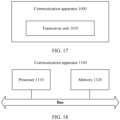
- the communication apparatus may include a processing module and a transceiver module.
- the transceiver module may also be referred to as a transceiver unit, and is configured to implement sending and/or receiving functions in the first aspect, the second aspect, and any possible implementation of the first aspect and the second aspect.
- the transceiver module may include a transceiver circuit, a transceiver machine, a transceiver, or a communication interface.
- the processing module may be configured to implement processing functions in the first aspect, the second aspect, and any possible implementation of the first aspect and the second aspect.
- the transceiver module includes a sending module and a receiving module, which are respectively configured to implement sending and receiving functions in the first aspect, the second aspect, and any possible implementation of the first aspect and the second aspect.
- a communication apparatus including one or more processors, one or more memories, and one or more computer programs.
- the one or more computer programs are stored in the one or more memories.
- the one or more computer programs include instructions, and when the instructions are executed by the communication apparatus, the communication apparatus is enabled to perform the method according to the first aspect, the second aspect, and any possible implementation of the first aspect and the second aspect.
- the communication apparatus may be the foregoing first communication apparatus, or an apparatus included in the foregoing first communication apparatus, for example, a chip.
- a communication apparatus including a processor and a communication interface, where the communication interface is configured to communicate with a module outside the communication apparatus, and the processor is configured to execute a computer program or instructions, so that the communication apparatus performs the method according to the first aspect, the second aspect, and any possible implementation of the first aspect and the second aspect.
- the communication apparatus may be the foregoing first communication apparatus, or an apparatus included in the foregoing first communication apparatus, for example, a chip.
- a communication apparatus including an interface circuit and a processor, where the interface circuit is a code/data read/write interface circuit, the interface circuit is configured to receive computer executable instructions (the computer executable instructions are stored in a memory, and may be read from the memory directly or through another component) and transmit the computer executable instructions to the processor, and the processor is configured to execute the computer execution instructions, so that the communication apparatus performs the method according to the first aspect, the second aspect, and any possible implementation of the first aspect and the second aspect.
- the communication apparatus may be the foregoing first communication apparatus, or an apparatus included in the foregoing first communication apparatus, for example, a chip.
- a communication apparatus including at least one processor, where the processor is configured to execute a computer program or instructions, so that the communication apparatus performs the method according to the first aspect, the second aspect, and any possible implementation of the first aspect and the second aspect.
- the communication apparatus may be the foregoing first communication apparatus, or an apparatus included in the foregoing first communication apparatus, for example, a chip.
- the communication apparatus includes a memory, and the memory is configured to store necessary program instructions and data.
- the memory may be coupled to the processor, or may be independent of the processor.
- the communication apparatus may be a chip or a chip system.
- the apparatus may include a chip, or may include a chip and another discrete component.
- the foregoing sending action/function may be understood as output information
- the foregoing receiving action/function may be understood as input information.
- a computer-readable storage medium stores instructions.
- the communication apparatus is enabled to perform the method according to the first aspect, the second aspect, and any possible implementation of the first aspect and the second aspect.
- a computer program product including instructions is provided.
- the communication apparatus is enabled to perform the method according to the first aspect, the second aspect, and any possible implementation of the first aspect and the second aspect.
- a chip including at least one processor and an interface circuit, where the interface circuit is configured to provide program instructions or data for the at least one processor, and the at least one processor is configured to execute the program instructions, to implement the method according to the first aspect, the second aspect, and any possible implementation of the first aspect and the second aspect.
- first, second, and various reference numerals in the following embodiments are merely used for differentiation for ease of description, but are not intended to limit the scope of embodiments of this application. For example, different sensing signals are distinguished.
- a plurality of in the embodiments of this application means two or more.
- GSM global system for mobile communications
- CDMA code division multiple access
- WCDMA wideband code division multiple access
- GSM global system for mobile communications
- CDMA code division multiple access
- WCDMA wideband code division multiple access
- general packet radio service general packet radio service
- GPRS general packet radio service
- LTE long term evolution
- LTE frequency division duplex frequency division duplex
- FDD frequency division duplex
- TDD time division duplex
- UMTS universal mobile telecommunications system
- WiMAX worldwide interoperability for microwave access
- WiMAX worldwide interoperability for microwave access
- 5G future 5 th generation
- 5G future 5 th generation
- 5G future 5 th generation
- NR new radio
- a periodic correlation result is: a 2 ⁇ b 1 + a 3 ⁇ b 2 + a 1 ⁇ b 3 .
- a periodic correlation result is: a 3 ⁇ b 1 + a 1 ⁇ b 2 + a 2 ⁇ b 3 .
- a periodic correlation result is: a 1 ⁇ b 1 + a 2 ⁇ b 2 + a 3 ⁇ b 3 .
- a periodic correlation result is: a 2 ⁇ b 1 + a 3 ⁇ b 2 + a 1 ⁇ b 3 .
- a periodic correlation result is: a 3 ⁇ b 1 + a 1 ⁇ b 2 + a 2 ⁇ b 3 .
- Aperiodic correlation operation When a correlation operation is performed on sequences, a correlation value between overlapping elements in two sequences is calculated based on a relative shift between the sequences. If lengths of the sequences are L, the relative shift between the sequences may include 2L-1 cases in total: -L+1, -L+2, ..., -1, 0, 1, ..., L-2, and L-1. Therefore, there are a total of 2L-1 values for an aperiodic correlation operation of the sequences.
- the sequence a and the sequence b are corresponding to the following cases: a 1 , a 2 ,a 3 b 1 , b 2 ,b 3
- an aperiodic correlation result is: a 1 ⁇ b 3 .
- the sequence a and the sequence b are corresponding to the following cases: a 1 , a 2 ,a 3 b 1 , b 2 , b 3
- an aperiodic correlation result is: a 1 ⁇ b 2 + a 2 ⁇ b 3 .
- the sequence a and the sequence b are corresponding to the following cases: a 1 , a 2 ,a 3 b 1 , b 2 , b 3
- an aperiodic correlation result is: a 1 ⁇ b 1 + a 2 ⁇ b 2 + a 3 ⁇ b 3 .
- the sequence a and the sequence b are corresponding to the following cases: a 1 , a 2 ,a 3 b 1 , b 2 , b 3
- an aperiodic correlation result is: a 2 ⁇ b 1 + a 3 ⁇ b 2 .
- the sequence a and the sequence b are corresponding to the following cases: a 1 , a 2 ,a 3 b 1 , b 2 ,b 3
- an aperiodic correlation result is: a 3 ⁇ b 1 .
- a correlation operation of the two sequences is a periodic correlation operation. If cyclic shift is not performed during relative shift, in other words, a quantity of overlapping elements of two sequences decreases as the relative shift increases, a correlation operation of the two sequences is an aperiodic correlation operation.
- Periodic cross-correlation If two sequences are different, a periodic correlation operation between the two sequences is referred to as periodic cross-correlation.
- Aperiodic cross-correlation If two sequences are different, an aperiodic correlation operation between the two sequences is referred to as aperiodic cross-correlation.
- Periodic cross-correlation peak For two sequences with a length of L, a maximum value of absolute values of 2 L -1 periodic cross-correlation results of the two sequences is referred to as a periodic cross-correlation peak.
- Aperiodic cross-correlation peak For two sequences with a length of L, a maximum value of absolute values of 2 L -1 aperiodic cross-correlation results of the two sequences is referred to as an aperiodic cross-correlation peak.
- Sensing A process in which a radar sends a sensing signal, receives an echo signal generated by reflecting the sensing signal by a target object, and completes ranging, speed measurement, or angle measurement by comparing the echo signal with the sensing signal may be referred to as sensing.
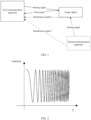
- FIG. 1 is a diagram of a communication system 100 applicable to a method provided in embodiments of this application.
- the communication system 100 includes a first communication apparatus.
- the first communication apparatus first sends a sensing signal, and then receives an echo signal generated by reflecting the sensing signal by a target object. In this way, the first communication apparatus can sense the target object.
- the communication system 100 may further include another communication apparatus, for example, a second communication apparatus shown in FIG. 1 .
- the second communication apparatus may also first send a sensing signal, and then receive an echo signal generated by reflecting the sensing signal by the target object. In this way, the second communication apparatus can sense the target object.
- the target object includes but is not limited to a surrounding apparatus (for example, a vehicle), a pedestrian (or a user), an obstacle, and the like.
- the foregoing description is provided by using an example in which the first communication apparatus and the second communication apparatus sense a same target object, and shall not constitute a limitation on this application.
- the first communication apparatus and the second communication apparatus may alternatively sense different target objects. This is not limited in this application.
- related functions of the first communication apparatus or the second communication apparatus may be implemented by one device, may be jointly implemented by a plurality of devices, may be implemented by one or more functional modules in one device, may be implemented by one or more chips, or may be implemented by a system on chip (system on chip, SoC) or a chip system.
- SoC system on chip
- the chip system may include a chip, or may include a chip and another discrete component. This is not specifically limited in this embodiment of this application.
- the foregoing function may be a network element in a hardware device, a software function running on dedicated hardware, a combination of hardware and software, or a virtualized function instantiated on a platform (for example, a cloud platform).
- the first communication apparatus and/or the second communication apparatus are/is a radar.
- the first communication apparatus and the second communication apparatus may be installed on a terminal device or a network device. This is not limited in this application.
- the first communication apparatus and/or the second communication apparatus are/is a terminal device or a network device having a radar function.
- the network device in this application may be any device having a wireless transceiver function.
- the network device includes but is not limited to an evolved NodeB (evolved NodeB, eNB or eNodeB), a radio network controller (radio network controller, RNC), a NodeB (NodeB, NB), a base station controller (base station controller, BSC), a base transceiver station (base transceiver station, BTS), a home base station (for example, a home evolved NodeB or a home NodeB, HNB), a baseband unit (baseband unit, BBU), an access point (access point, AP) in a wireless fidelity (wireless fidelity, Wi-Fi) system, a wireless relay node, a wireless backhaul node, a transmission point (transmission point, TP), a transmission and reception point (transmission and reception point, TRP), and the like.
- RNC radio network controller
- NodeB NodeB
- BSC base station controller
- the network device may be a gNB or a transmission point (TRP or TP) in a 5G system such as an NR system, may be one antenna panel or a group (including a plurality of antenna panels) of antenna panels of the gNB in the 5G system, or may be a network node, such as a baseband unit (BBU) or a distributed unit (distributed unit, DU), that constitutes a gNB or a transmission point.
- BBU baseband unit
- DU distributed unit
- a gNB may include a central unit (central unit, CU) and a DU.
- the gNB may further include a radio frequency unit (radio unit, RU).
- the CU implements some functions of the gNB
- the DU implements some functions of the gNB.
- the CU implements functions of a radio resource control (radio resource control, RRC) layer and a packet data convergence protocol (packet data convergence protocol, PDCP) layer
- the DU implements functions of a radio link control (radio link control, RLC) layer, a media access control (media access control, MAC) layer, and a physical (physical, PHY) layer.
- RRC radio resource control
- PDCP packet data convergence protocol
- the network device may be a CU node, a DU node, or a device including a CU node and a DU node.
- the CU may be classified into a network device in an access network (radio access network, RAN), or the CU may be classified into a network device in a core network (core network, CN). This is not limited in this application.
- the terminal device in this application may also be referred to as user equipment (user equipment, UE), an access terminal, a subscriber unit, a subscriber station, a mobile station, a remote station, a remote terminal, a mobile device, a user terminal, a terminal, a wireless communication device, a user agent, or a user apparatus.
- user equipment user equipment
- UE user equipment
- an access terminal a subscriber unit, a subscriber station, a mobile station, a remote station, a remote terminal, a mobile device, a user terminal, a terminal, a wireless communication device, a user agent, or a user apparatus.
- the terminal device in embodiments of this application may be a mobile phone (mobile phone), a tablet computer (pad), a computer with wireless receiving and sending functions, a virtual reality (virtual reality, VR) terminal device, an augmented reality (augmented reality, AR) terminal device, a wireless terminal in industrial control (industrial control), a wireless terminal in self driving (self driving), a wireless terminal in remote medical (remote medical), a wireless terminal in a smart grid (smart grid), a wireless terminal in transportation safety (transportation safety), a wireless terminal in a smart city (smart city), a wireless terminal in a smart home (smart home), or the like.
- An application scenario is not limited in embodiments of this application.
- the terminal device or the network device includes a hardware layer, an operating system layer running on the hardware layer, and an application layer running on the operating system layer.
- the hardware layer includes hardware such as a central processing unit (central processing unit, CPU), a memory management unit (memory management unit, MMU), and a memory (also referred to as a main memory).
- the operating system may be any one or more computer operating systems that implement service processing through a process (process), for example, a Linux ® operating system, a Unix ® operating system, an Android ® operating system, an iOS ® operating system, or a Windows ® operating system.
- the application layer includes applications such as a browser, an address book, word processing software, and instant messaging software.
- an execution body of a method provided in embodiments of this application is not particularly limited in embodiments of this application, provided that a program that records code of the method provided in embodiments of this application can be run to perform communication according to the method provided in embodiments of this application.
- the execution body of the method provided in embodiments of this application may be the terminal device or the network device, or a functional module that can invoke and execute the program in the terminal device or the network device.
- the technical solution in embodiments of this application may be applied to various communication systems.
- the communication system may be a 3 rd generation partnership project (3 rd generation partnership project, 3GPP) communication system, for example, a 5G or 6 th generation (sixth generation, 6G) mobile communication system or a sidelink (sidelink, SL) system, an ultra-wideband (ultra-wideband, UWB) system, a vehicle to everything (vehicle to everything, V2X) system, or a device-to-device (device-to-device, D2D) communication system, a machine-to-machine (machine-to-machine, M2M) communication system, an internet of things (internet of things, IoT), or another next generation communication system.
- the communication system may alternatively be a non-3GPP communication system, for example, a wireless local area network (wireless local area network, WLAN) system like Wi-Fi. This is not limited.
- the technical solution in embodiments of this application may be applied to various communication scenarios, for example, may be applied to one or more of the following communication scenarios: smart home, D2D, V2X, IoT communication scenarios, and the like.
- the first communication apparatus and/or the second communication apparatus may be various smart appliances at home, for example, a smart television and a smart speaker.
- each smart appliance at home may send a sensing signal to sense the person, to enhance track tracing accuracy.
- the first communication apparatus and/or the second communication apparatus may be an in-vehicle device.
- the in-vehicle device may send a sensing signal, and receive an echo signal generated by reflecting the sensing signal by a target object (for example, a surrounding vehicle, a pedestrian, or an obstacle), to sense a surrounding road condition.
- a target object for example, a surrounding vehicle, a pedestrian, or an obstacle
- the sensing signal sent by the first communication apparatus and/or the second communication apparatus shown in FIG. 1 may be an FMCW signal. In this way, a frequency of the sensing signal changes with time.
- FMCWs may be classified into a sawtooth wave, a triangular wave, and a trapezoidal wave in frequency domain.
- the sawtooth wave is a waveform most commonly used by the FMCW.
- a frequency of the FMCW of the sawtooth wave increases linearly with time.
- FIG. 2 is a diagram of a time domain waveform of an FMCW of a sawtooth wave
- FIG. 2 is a diagram of a time domain waveform of an FMCW of a sawtooth wave
- FIG. 3 is a diagram of a frequency domain waveform of an FMCW of a sawtooth wave. As shown in FIG. 3 , within time from 0 to T, a frequency of the FMCW linearly ramps from f c to ( f c +B) . In this way, a frequency ramp-up slope k of the FMCW of the sawtooth wave is B/T.
- the FMCW described below uses a sawtooth wave
- the FMCW in this embodiment of this application may alternatively be a triangular wave, a trapezoidal wave, or the like.
- the radar may obtain, by comparing a frequency difference between the sensing signal transmitted by the radar and an echo signal, time between a moment at which the sensing signal is sent and a moment at which the echo signal is received, and then calculate a distance between the radar and a target object based on the time.
- the radar repeatedly sends FMCW sensing signals of a plurality of periods, where a signal in each period is referred to as a chirp (chirp) signal.
- a signal in each period is referred to as a chirp (chirp) signal.
- frequency mixing and low-pass filtering are performed on each echo signal and the sensing signal, to obtain a beat frequency signal.
- a frequency f BF of the beat frequency signal can be obtained by using fast Fourier transform (fast fourier transform, FFT) to perform spectrum analysis on the beat frequency signal.
- FFT fast fourier transform
- (a) in FIG. 4 is a diagram of FMCW sensing signals and echo signals of the radar in a plurality of periods.
- (b) in FIG. 4 is a diagram of beat frequency signals in a plurality of periods that are obtained based on the FMCW sensing signals and the echo signals in the plurality of periods shown in (a) in FIG. 4 .
- the frequency f BF of the beat frequency signal is a difference between a frequency of the sensing signal and a frequency of the echo signal at a same moment.
- FIG. 4 shows a case in which there is only one target object.
- a plurality of echo signals and corresponding beat frequency signals are generated in one period.
- frequencies of the corresponding beat frequency signals are also different.
- a location of the target object does not change in an entire sensing period. Therefore, beat frequency signals generated by a same target object in a plurality of periods are the same.
- Spectrum analysis and ranging may be performed only on a beat frequency signal in one period, or spectrum analysis and ranging may be performed after beat frequency signals in a plurality of periods are accumulated. Accumulating beat frequency signals in a plurality of periods can effectively increase a signal to noise ratio (signal to noise ratio, SNR) gain after signal processing.
- SNR signal to noise ratio
- an interference signal of the second communication apparatus for the first communication apparatus mainly includes two sources: one source is the sensing signal generated by the second communication apparatus, that is, an interference signal 1 shown in FIG. 1 , and the other source is an interference signal 2 generated by reflecting, by the target object, the sensing signal generated by the second communication apparatus.
- FIG. 5 is a diagram of a sensing signal of an FMCW type sent by and signals received by the first communication apparatus in one period.
- the signals received by the first communication apparatus include an echo signal, an interference signal 1, and an interference signal 2.
- the first communication apparatus analyzes the received signals (the echo signal, the interference signal 1, and the interference signal 2) to obtain the distance between the first communication apparatus and the target object.
- the first communication apparatus and the second communication apparatus use the sensing signals of the same waveform, the first communication apparatus cannot distinguish between the echo signal and the interference signal.
- a false target object is easily generated.
- (b) in FIG. 5 is a diagram of beat frequency signals in one period obtained by the first communication apparatus based on the sensing signal of the FMCW type and the received signals in one period shown in (a) in FIG. 5 .
- the first communication apparatus may obtain three beat frequency signals, where a beat frequency signal 1 is a signal obtained through frequency mixing and low-pass filtering are performed on the sensing signal and the interference signal 1. Therefore, a frequency f BF1 of the beat frequency signal 1 is a difference between the frequency of the sensing signal and a frequency of the interference signal 1 at a same moment.
- a beat frequency signal 2 is a signal obtained through frequency mixing and low-pass filtering are performed on the sensing signal and the echo signal.
- a frequency f BF2 of the beat frequency signal 2 is a difference between the frequency of the sensing signal and the frequency of the echo signal at a same moment.
- a beat frequency signal 3 is a signal obtained through frequency mixing and low-pass filtering are performed on the sensing signal and the interference signal 2. Therefore, a frequency f BF3 of the beat frequency signal 3 is a difference between the frequency of the sensing signal and a frequency of the interference signal 2 at a same moment.
- the distance between the first communication apparatus and the target object is 50 m
- a distance between the first communication apparatus and the second communication apparatus is 60 m
- a path of the interference signal 2 generated by reflecting, by the target object, the sensing signal generated by the second communication apparatus is 120 m.
- the first communication apparatus uses FFT to perform spectrum analysis on the beat frequency signal shown in (b) in FIG. 5
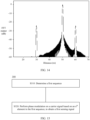
- a diagram of the obtained distance between the first communication apparatus and the target object is shown in FIG. 6 . It can be learned from FIG. 6 that the first communication apparatus may obtain three distances: 30 m, 50 m, and 60 m, respectively.
- the interference signal 1 and the interference signal 2 are not echo signals of the first communication apparatus, distances obtained based on the beat frequency signal 1 corresponding to the interference signal 1 and the beat frequency signal 3 corresponding to the interference signal 2 are distances to false target objects.
- the sensing signal generated by the first communication apparatus is generally processed in a time division, frequency division, or code division manner.
- the sensing signal generated by the first communication apparatus specifically includes:
- the first communication apparatus adjusts start time of chirp signals in different periods based on a randomly generated or preset pseudo-random sequence. In this way, the probability that the echo signal of the first communication apparatus is interfered is reduced in the time division manner. For example, as shown in FIG. 7 , when an element of a sequence is 0, the first communication apparatus does not adjust start time of a chirp signal in a corresponding period; or when an element of a sequence is 1, the first communication apparatus prolongs start time of a chirp signal in a corresponding period. However, the time division manner increases a ranging delay.
- the sensing signal generated by the first communication apparatus specifically includes:
- the first communication apparatus adjusts a start frequency of chirp signals in different periods based on a randomly generated or preset pseudo-random sequence. In this way, the probability that the echo signal of the first communication apparatus is interfered is reduced in the time division manner. For example, as shown in FIG. 8 , when an element of a sequence is 0, the first communication apparatus does not adjust a start frequency of a chirp signal in a corresponding period; or when an element of a sequence is 1, the first communication apparatus adjusts a start frequency of a chirp signal in a corresponding period from f L1 to f L2 .
- a highest frequency of the chirp signal in the period is adjusted from f H1 to f H2 .
- space needs to be reserved for frequency adjustment.
- a bandwidth actually occupied by a signal is reduced, thereby reducing a ranging resolution.
- the sensing signal generated by the first communication apparatus specifically includes: performing phase modulation on chirp signals of different periods by directly using a randomly generated or preset pseudo-random sequence.
- the probability that the echo signal of the first communication apparatus is interfered is reduced in the code division manner.
- the first communication apparatus when an element of a sequence is 1, the first communication apparatus directly sends a generated chirp signal in a corresponding period; or when an element of a sequence is -1, the first communication apparatus performs phase rotation on a chirp signal by 180° in a corresponding period and then sends the chirp signal. In this way, a receive end accumulates beat frequency signals of a plurality of periods and then performs spectrum analysis.
- interference is suppressed mainly by using periodic cross-correlation between different pseudo-random sequences used by different apparatuses.
- periodic cross-correlation between existing pseudo-random sequences is relatively poor. Therefore, a capability of suppressing interference to the echo signal of the first communication apparatus in the code division manner is relatively limited. For example, as shown in Table 1, periodic cross-correlation results between common pseudo-random sequences are shown.
- the periodic cross-correlation value shown in Table 1 is a periodic cross-correlation value between two sequences with a same length and a same type.
- a periodic cross-correlation value between two M sequences with a length 0f 15 is -4.44 dB.
- a periodic cross-correlation result between sequences shown in Table 1 is a relative value in a unit of decibel (decibel, dB).
- a periodic cross-correlation result between two sequences in a unit of decibel may be equal to 20 ⁇ log 10
- a Kasami sequence has no length of 31 or 127, "-" in Table 1 indicates that there is no periodic cross-correlation value.
- this application provides a sensing method.
- a sensing signal sent by a communication apparatus is generated based on a preset sequence. Therefore, in a sensing process of the communication apparatus, the sensing signal may suppress interference of a signal transmitted by another communication apparatus, so that the communication apparatus has a relatively strong interference suppression capability. In this way, a phenomenon that a false target object is generated by the communication apparatus can be avoided, thereby improving sensing reliability of the communication apparatus.
- the ranging delay is not increased, and the bandwidth actually occupied by the signal is not reduced to reduce the ranging resolution.
- the sensing signal in this embodiment of this application is not limited to an FMCW signal, and may alternatively be another type of signal.
- the sensing signal may be a cyclic prefix orthogonal frequency division multiplexing (cyclic prefix orthogonal frequency division multiplexing, CP-OFDM) signal, a discrete Fourier transform spread orthogonal frequency division multiplexing (discrete fourier transform spread orthogonal frequency division multiplexing, DFT-s-OFDM) signal, or a single carrier (single carrier, SC) signal. This is not limited in this application.
- the communication apparatus in this application may have only a sensing system, or may have a joint communication and sensing (joint communication and sensing, JCS) system. This is not limited in this application.
- the JCS system When the communication apparatus has a JCS system, the JCS system includes two parts: a communication system and a sensing system, and the two parts reuse a same system architecture, hardware facility, and spectrum resource.
- the communication system may also use a DFT-s-OFDM signal. Therefore, to reduce interference between the sensing system and the communication system, resource reuse is usually performed in a time division or frequency division manner. For example, resource reuse is performed in the time division manner, that is, only a sensing signal in the sensing system or a communication signal in the communication system is sent at a same time domain location, and the signal sent at the time domain location occupies all bandwidths configured in frequency domain. Based on this manner, the sensing signal may occupy all the configured bandwidths. In other words, compared with frequency division multiplexing, the bandwidth occupied by the sensing signal can be increased, thereby increasing a ranging resolution of the sensing system.
- a specific multiplexing manner or a resource allocation manner may be implemented by using a transport layer protocol or a network layer protocol.
- a transport layer protocol or a network layer protocol For example, a plurality of consecutive DFT-s-OFDM symbols may be used for the sensing system, and other symbols may be used for the communication system.
- a plurality of DFT-s-OFDM symbols allocated to the sensing system may be inconsecutive.
- a multiplexing manner is not specifically limited in this application.
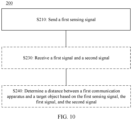
- FIG. 10 is a schematic flowchart of an example of a sensing method 200 according to an embodiment of this application.
- the sensing method 200 shown in FIG. 10 may be applied to the first communication apparatus and/or the second communication apparatus shown in FIG. 1 .
- the following uses an example in which the sensing method 200 is applied to the first communication apparatus for description, which shall not constitute a limitation on this application.
- the sensing method 200 includes S210.
- S210 describes S210 in detail.
- the first communication apparatus sends a first sensing signal.
- the second sub-signal may include but is not limited to an FMCW signal, a CP-OFDM signal, a DFT-s-OFDM signal, or an SC signal.
- the second sub-signal in this application may be understood as an original signal that is not phase modulated.
- phase modulation does not affect a type of a signal, that is, a type of the second sub-signal is the same as a type of the first sensing signal.
- the first sensing signal is also an FMCW signal; or if the second sub-signal is a CP-OFDM signal, the first sensing signal is also a CP-OFDM signal; or if the second sub-signal is a DFT-s-OFDM signal, the first sensing signal is also a DFT-s-OFDM signal; or if the second sub-signal is an SC signal, the first sensing signal is also an SC signal.
- a binary sequence in this application may be understood as that the sequence includes two elements.
- preset sequences in the following examples in Table 1 and Table 2 each include two elements: 1 and -1.
- the first sequence is any one of a first preset sequence, a second preset sequence, a third preset sequence, and a fourth preset sequence, or the first sequence is a sequence obtained by performing cyclic shift on any one of a first preset sequence, a second preset sequence, a third preset sequence, and a fourth preset sequence.
- the first preset sequence, the second preset sequence, the third preset sequence, and the fourth preset sequence may be shown in Table 2.
- Table 2 First preset sequence ⁇ 1, 1, 1, 1, 1, 1, 1, 1 ⁇ (denoted as S 0 ) Second preset sequence ⁇ 1, -1, 1, -1, 1, -1, 1, -1 ⁇ (denoted as S 1 ) Third preset sequence ⁇ 1, -1, -1, 1, 1, -1, -1, 1 ⁇ (denoted as S 2 )
- Fourth preset sequence ⁇ 1, -1, -1, -1, -1, 1, 1, 1 ⁇ (denoted as S 3 ), or ⁇ 1, -1, 1, 1, -1, 1, -1, -1 ⁇ (denoted as S 4 )
- the first sequence is any one of a fifth preset sequence, a sixth preset sequence, a seventh preset sequence, an eighth preset sequence, and a ninth preset sequence, or the first sequence is a sequence obtained by performing cyclic shift on any one of a fifth preset sequence, a sixth preset sequence, a seventh preset sequence, an eighth preset sequence, and a ninth preset sequence.
- the fifth preset sequence, the sixth preset sequence, the seventh preset sequence, the eighth preset sequence, and the ninth preset sequence may be shown in Table 3.
- Table 3 Fifth preset sequence ⁇ 1, 1, 1, 1, 1, 1, 1, 1, 1, 1, 1, 1, 1, 1 ⁇ (denoted as S 0 ')
- Sixth preset sequence ⁇ 1, -1, 1, -1, 1, -1, 1, -1, 1, -1, 1, -1, 1, -1 ⁇ (denoted as S 1 ')
- Seventh preset sequence ⁇ 1, 1, -1, -1, 1, 1, -1, -1, 1, 1, -1, -1, 1, 1, 1, -1, -1, 1, 1, -1, -1 ⁇ (denoted as S 2 ')
- Eighth preset sequence ⁇ 1, 1, 1, -1, -1, -1, -1, 1, 1, 1, 1, 1, -1, -1, -1, 1 ⁇ (denoted as S 3 ') or ⁇ 1, 1, -1, 1, -1, -1, 1, -1, 1, 1, -1, 1,
- Table 2 is an example of the first to the fourth preset sequences, and should not constitute a limitation on this application.
- the first to the fourth preset sequences may alternatively be W 1 times of each element in corresponding first to fourth preset sequences shown in Table 1.
- W 1 may be -1, 2, or the like.
- a value of W 1 is not limited in this application.
- Table 3 is an example of the fifth to the ninth preset sequences, and should not constitute a limitation on this application.
- the fifth to the ninth preset sequences may alternatively be W 2 times of each element in corresponding fifth to ninth preset sequences shown in Table 2.
- W 2 may be -1 or 2.
- a value of W 2 is not limited in this application.
- N may be 32, 64, ..., 2 m , where m is an integer greater than or equal to 3.
- the first communication apparatus before the first communication apparatus performs S210, the first communication apparatus further needs to generate the first sensing signal.
- the first communication apparatus generates the first sensing signal.
- a communication system may further include at least one second communication apparatus.
- the second communication apparatus may perform S220. The following describes S220 in detail.
- each second communication apparatus may perform S220.
- the second communication apparatus sends a second sensing signal.
- the second sensing signal includes third sub-signals in N periods, a third sub-signal in an n th period is a signal obtained by performing phase modulation on the second sub-signal based on an n th element in a second sequence, and the second sequence is a binary sequence that includes N elements. That is, the second sensing signal sent by the second communication apparatus and the first sensing signal sent by the first communication apparatus are sensing signals obtained by performing phase modulation on a same signal (the second sub-signal) based on different sequences. In addition, because both the second sensing signal and the first sensing signal are signals obtained by performing phase modulation on the second sub-signal, types of the second sensing signal, the first sensing signal, and the second sub-signal are the same. A maximum periodic cross-correlation value between the second sequence and the first sequence is 0. In other words, the second sequence and the first sequence are cyclically orthogonal. In this case, the second sequence and the first sequence have perfect periodic cross-correlation.
- the maximum periodic cross-correlation value between the second sequence and the first sequence is 0, and an absolute value of a maximum aperiodic cross-correlation value between the second sequence and the first sequence is also less than or equal to a threshold.
- the second sequence and the first sequence not only have perfect periodic cross-correlation properties, but also have relatively good aperiodic cross-correlation properties.
- a specific value of the threshold described above is not limited in this application.
- the absolute value of the maximum aperiodic cross-correlation value between the second sequence and the first sequence is less than or equal to 0.375 (as shown in Table 5).
- the absolute value of the maximum aperiodic cross-correlation value between the second sequence and the first sequence is less than or equal to 0.25 (as shown in Table 7).
- the second sequence is any one of the first preset sequence, the second preset sequence, the third preset sequence, and the fourth preset sequence, or the second sequence is a sequence obtained by performing cyclic shift on any one of the first preset sequence, the second preset sequence, the third preset sequence, and the fourth preset sequence.
- the second sequence and the first sequence are different preset sequences.
- the first to the fourth preset sequences are the first to the fourth preset sequences described in S210.
- Table 4 Serial number S 0 S 1 S 2 S 3 S 0 - 0 0 0 S 1 0 - 0 0 S 2 0 0 - 0 S 3 0 0 0 - Table 5 Serial number S 0 S 1 S 2 S 3 S 0 - 0.125 0.125 0.375 S 1 0.125 - 0.25 0.25 S 2 0.125 0.25 - 0.25 S 3 0.375 0.25 0.25 -
- the second sequence is any one of the fifth preset sequence, the sixth preset sequence, the seventh preset sequence, the eighth preset sequence, and the ninth preset sequence, or the second sequence is a sequence obtained by performing cyclic shift on any one of the fifth preset sequence, the sixth preset sequence, the seventh preset sequence, the eighth preset sequence, and the ninth preset sequence.
- the second sequence and the first sequence are different preset sequences.
- the fifth to the ninth preset sequences are the fifth to the ninth preset sequences described in S210.
- the eighth preset sequence is S 3 ' shown in Table 3
- the ninth preset sequence is S 5 ' shown in Table 3
- a maximum periodic cross-correlation result of different preset sequences in the fifth to the ninth preset sequences is shown in Table 6, and a maximum aperiodic cross-correlation result is shown in Table 7.
- the second communication apparatus before the second communication apparatus performs S220, the second communication apparatus further needs to generate the second sensing signal. For a specific step in which the second communication apparatus generates the second sensing signal, refer to the following description of the method 300. Details are not described herein again.
- S220 may be performed before S210, or S220 may be performed before S210, or S220 and S210 may be performed simultaneously.
- the first communication apparatus may further perform S230.
- S230 describes S230 in detail.
- the first communication apparatus receives a first signal and a second signal.
- the first signal is a signal obtained by reflecting the first sensing signal by a target object.
- the first signal is an echo signal obtained by reflecting the first sensing signal by the target object.
- the first signal may include the echo signal shown in FIG. 1 .
- the second signal includes the second sensing signal and/or a signal obtained by reflecting the second sensing signal by the target object.
- the first signal is the signal obtained by reflecting the first sensing signal by the target object, and the second sensing signal is transmitted by the second communication apparatus, the second signal may be considered as an interference signal of the first signal.
- the second signal includes the second sensing signal
- the second signal includes a direct-transmission interference signal generated by the second communication apparatus.
- the second sensing signal generated by the second communication apparatus is directly transmitted to the first communication apparatus.
- the second signal may include the interference signal 1 shown in FIG. 1 .
- the second signal includes the signal obtained by reflecting the second sensing signal by the target object
- the second signal includes a reflection interference signal generated by the second communication apparatus.
- the second sensing signal generated by the second communication apparatus is reflected to the first communication apparatus only after passing through the target object.
- the second signal may include the interference signal 2 shown in FIG. 1 .
- the first communication apparatus may first receive the second sensing signal, and then receive the signal obtained by reflecting the second sensing signal by the target object.
- the first communication apparatus may first receive the signal obtained by reflecting the second sensing signal by the target object, and then receive the second sensing signal.
- the first communication apparatus may simultaneously receive the second sensing signal and the signal obtained by reflecting the second sensing signal by the target object.
- a sequence in which the first communication apparatus receives the first signal and the second signal is not limited in this application.
- the first communication apparatus may first receive the first signal, and then receive the second signal.
- the first communication apparatus may first receive the second signal, and then receive the first signal.
- the first communication apparatus may simultaneously receive the first signal and the second signal.
- the foregoing sequence in which the first communication apparatus receives the first signal and the second signal may be a sequence in which the first communication apparatus receives the first signal and the second signal in each of the N periods, or may be a sequence in which the first communication apparatus receives the first signal and the second signal for the first time in the N periods. This is not limited in this embodiment of this application.
- the first communication apparatus may further perform S240.
- S240 Determine a distance between the first communication apparatus and the target object based on the first sensing signal, the first signal, and the second signal.
- both the first sensing signal and the second sensing signal are signals obtained by performing phase modulation on the second sub-signal.
- the first sensing signal and the second sensing signal use the same second sub-signal.
- sequences for performing phase modulation on the second sub-signal are different.
- the first sensing signal uses the first sequence
- the second sensing signal uses the second sequence. Therefore, the first communication apparatus cannot directly distinguish which of the first signal and the second signal is an echo signal and which of the first signal and the second signal is an interference signal. Therefore, in S240, the first communication apparatus determines the distance between the first communication apparatus and the target object not only based on the first sensing signal and the first signal, but also based on the first sensing signal and the second signal.
- the first communication apparatus performs frequency mixing separately and low-pass filtering on the first sensing signal and each of the first signal and the second signal, to obtain a first beat frequency signal and a second beat frequency signal.
- spectrum analysis is performed on the first beat frequency signal and the second beat frequency signal separately to obtain a frequency of the first beat frequency signal and a frequency of the second beat frequency signal.
- the distance between the first communication apparatus and the target object may be calculated based on the frequency of the first beat frequency signal and the frequency of the second beat frequency signal.
- Example 1 separately uses Example 1 and Example 2 as examples to describe how the first communication apparatus determines the distance between the first communication apparatus and the target object by using the sensing method 200.
- Example 1 Differences between Example 1 and Example 2 are as follows:
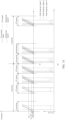
- FIG. 11 is a diagram of the first sensing signal sent by and signals received by the first communication apparatus in frequency domain in Example 1.
- the first communication apparatus transmits the first sensing signal, then the first communication apparatus receives the interference signal 1 (an example of the second sensing signal transmitted by the second communication apparatus), then the first communication apparatus receives the first signal generated by reflecting, by the target object, the first sensing signal transmitted by the first communication apparatus, and finally, the first communication apparatus receives the interference signal 2 (an example of the signal generated by reflecting, by the target object, the second sensing signal transmitted by the second communication apparatus).
- the interference signal 1 an example of the second sensing signal transmitted by the second communication apparatus
- the first communication apparatus receives the first signal generated by reflecting, by the target object, the first sensing signal transmitted by the first communication apparatus
- the interference signal 2 an example of the signal generated by reflecting, by the target object, the second sensing signal transmitted by the second communication apparatus.
- a process of performing ranging includes: Step 1: For each period in the 16 periods, separately perform frequency mixing and low-pass filtering on the first sensing signal that is not phase modulated and the first signal and the second signal that are phase modulated, to obtain corresponding beat frequency signals.
- frequency mixing and low-pass filtering are performed on the first sensing signal that is not phase modulated and the interference signal 1 that is phase modulated, to obtain signals of the beat frequency signal 1 in the 16 periods, which are sequentially as follows: S 1 ′ 2 x c 1 t , S 1 ′ 3 x c 1 t , ⁇ S 1 ′ 15 x c 1 t , S 1 ′ 0 x c 1 t , S 1 ′ 1 x c 1 t .
- Frequency mixing and low-pass filtering are performed on the first sensing signal that is not phase modulated and the first signal that is phase modulated, to obtain signals of the beat frequency signal 2 in the 16 periods, which are sequentially as follows: S 0 ′ 0 x BF t , S 0 ′ 1 x BF t , ⁇ S 0 ′ 15 x BF t .
- Frequency mixing and low-pass filtering are performed on the first sensing signal that is not phase modulated and the interference signal 2 that is not phase modulated, to obtain signals of the beat frequency signal 3 in the 16 periods, which are sequentially as follows: S 1 ′ 2 x c 2 t , S 1 ′ 3 x c 2 t , ⁇ , S 1 ′ 15 x c 2 t , S 1 ′ 0 x c 2 t , S 1 ′ 1 x c 2 t .
- Step 2 Based on the sequence used by the first sensing signal, perform phase demodulation on the beat frequency signals obtained through frequency mixing and low-pass filtering in step 1, to obtain corresponding beat frequency signals.
- phase demodulation is performed on the beat frequency signal 1 obtained in step 1, to obtain signals of the phase-demodulated beat frequency signal 1 in the 16 periods, which are sequentially as follows: S 0 ′ 0 S 1 ′ 2 x c 1 t , S 0 ′ 1 S 1 ′ 3 x c 1 t , ⁇ S 0 ′ 13 S 1 ′ 15 x c 1 t , S 0 ′ 14 S 1 ′ 0 x c 1 t , S 0 ′ 15 S 1 ′ 1 x c 1 t .
- phase demodulation is performed on the beat frequency signal 2 obtained in step 1, to obtain signals of the phase-demodulated beat frequency signal 2 in the 16 periods, which are sequentially as follows: S 0 ′ 0 S 0 ′ 0 x BF t , S 0 ′ 1 S 0 ′ 1 x BF t , ⁇ S 0 ′ 15 S 0 ′ 15 x BF t .
- phase demodulation is performed on the beat frequency signal 3 obtained in step 1, to obtain signals of the phase-demodulated beat frequency signal 3 in the 16 periods, which are sequentially as follows: S 0 ′ 0 S 1 ′ 2 x c 2 t , S 0 ′ 1 S 1 ′ 3 x c 2 t , ⁇ , S 0 ′ 13 S 1 ′ 15 x c 2 t , S 0 ′ 14 S 1 ′ 0 x c 2 t , S 0 ′ 15 S 1 ′ 1 x c 2 t .
- Step 3 Accumulate signals of each phase-demodulated beat frequency signal in the 16 periods obtained in step 2.
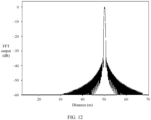
- FIG. 12 shows a result of measuring the distance between the target object and the first communication apparatus that is obtained based on the echo signals in the 16 periods described in Example 1. It can be learned from FIG. 12 that there is one distance between the target object and the first communication apparatus, and the distance is 50 m.
- Example 1 before the first communication apparatus senses the target object, the second communication apparatus has already been sensing the target object.
- the first communication apparatus receives the interference signal of the second communication apparatus in all the 16 periods.
- the first sequence and the second sequence have perfect periodic correlation, in the 16 periods, the first communication apparatus may eliminate the beat frequency signal generated by the interference signal.
- the first communication apparatus performs spectrum analysis only on the beat frequency signal generated by the echo signal, so as to obtain the distance between the target object and the first communication apparatus, and the quantity of the distances is only one. In this way, the first communication apparatus can perfectly suppress interference caused by the second sensing signal transmitted by the second communication apparatus to a sensing process of the first communication apparatus. Further, an interference suppression capability of the first communication apparatus is further enhanced, and sensing reliability of the first communication apparatus is improved.
- FIG. 13 is a diagram of the first sensing signal sent by and signals received by the first communication apparatus in frequency domain in Example 2.
- the first communication apparatus first transmits the first sensing signal, and then receives the first signal generated by reflecting, by the target object, the first sensing signal transmitted by the first communication apparatus.
- the first communication apparatus transmits the first sensing signal, then the first communication apparatus receives the interference signal 1 (an example of the second sensing signal transmitted by the second communication apparatus), then the first communication apparatus receives the first signal generated by reflecting, by the target object, the first sensing signal transmitted by the first communication apparatus, and finally, the first communication apparatus receives the interference signal 2 (an example of the signal generated by reflecting, by the target object, the second sensing signal transmitted by the second communication apparatus).
- the interference signal 1 an example of the second sensing signal transmitted by the second communication apparatus
- the first communication apparatus receives the first signal generated by reflecting, by the target object, the first sensing signal transmitted by the first communication apparatus
- the interference signal 2 an example of the signal generated by reflecting, by the target object, the second sensing signal transmitted by the second communication apparatus.
- a process of performing ranging includes: Step 1: For each period in the first 16 periods, separately perform frequency mixing and low-pass filtering on the first sensing signal that is not phase modulated and the first signal and the second signal that are phase modulated, to obtain corresponding beat frequency signals.
- frequency mixing and low-pass filtering are performed on the first sensing signal that is not phase modulated and the interference signal 1 that is phase modulated, to obtain signals of the beat frequency signal 1 in the last two periods of the first 16 periods, which are sequentially as follows: S 1 ′ 0 x c 1 t , S 1 ′ 1 x c 1 t .
- each period of the first 16 periods frequency mixing and low-pass filtering are performed on the first sensing signal that is not phase modulated and the first signal that is phase modulated, to obtain signals of the beat frequency signal 2 in the first 16 periods, which are sequentially as follows: S 0 ′ 0 x BF t , S 0 ′ 1 x BF t , ⁇ S 0 ′ 15 x BF t .
- each period of the last two periods (the 15 th period and the 16 th period) of the first 16 periods frequency mixing and low-pass filtering are performed on the first sensing signal that is not phase modulated and the interference signal 2 that is phase modulated, to obtain signals of the beat frequency signal 3 in the last two periods (the 15 th period and the 16 th period) of the first 16 periods, which are sequentially as follows: S 1 ′ 0 x c 2 t , S 1 ′ 1 x c 2 t .
- Step 2 Based on the sequence used by the first sensing signal, perform phase demodulation on the beat frequency signals obtained through frequency mixing and low-pass filtering in step 1, to obtain corresponding beat frequency signals.
- phase demodulation is performed on the beat frequency signal 1 obtained in step 1, to obtain signals of the phase-demodulated beat frequency signal 1 in the last two periods (the 15 th period and the 16 th period) of the first 16 periods, which are sequentially as follows: S 0 ′ 14 S 1 ′ 0 x c 1 t , S 0 ′ 15 S 1 1 x c 1 t .
- phase demodulation is performed on the beat frequency signal 2 obtained in step 1, to obtain signals of the phase-demodulated beat frequency signal 1 in the 16 periods, which are sequentially as follows: S 0 ′ 0 S 0 ′ 0 x BF t , S 0 ′ 1 S 0 ′ 1 x BF t , ⁇ , S 0 ′ 15 S 0 ′ 15 x BF t .
- phase demodulation is performed on the beat frequency signal 3 obtained in step 1, to obtain signals of the phase-demodulated beat frequency signal 3 in the last two periods (the 15 th period and the 16 th period) of the first 16 periods, which are sequentially as follows: S 0 ′ 14 S 1 ′ 0 x c 2 t , S 0 ′ 15 S 1 ′ 1 x c 2 t .
- Step 3 Accumulate signals of each phase-demodulated beat frequency signal in the 16 periods obtained in step 2.
- a process of obtaining the first distance includes: performing spectrum analysis on the beat frequency signal 1 generated by the interference signal 1 in the last two periods (the 15 th period and the 16 th period) of the first 16 periods, so as to obtain the distance between the target object and the first communication apparatus.
- a process of obtaining the second distance includes: performing spectrum analysis on the beat frequency signal 2 generated by the first signal in the first 16 periods, so as to obtain the distance between the target object and the first communication apparatus.
- a process of obtaining the third distance includes: performing spectrum analysis on the beat frequency signal 3 generated by the interference signal 2 in the last two periods (the 15 th period and the 16 th period) of the first 16 periods, so as to obtain the distance between the target object and the first communication apparatus.
- FIG. 14 shows a result of measuring the distance between the target object and the first communication apparatus that is obtained based on the echo signals in the first 16 periods described in Example 2. It can be learned from FIG. 14 that there are three distances between the target object and the first communication apparatus, and the distances are respectively 30 m, 50 m, and 60 m.
- Example 1 It can be learned from the foregoing descriptions of Example 1 that, in the second 16 periods, the beat frequency signal 1 generated by the interference signal 1 and the beat frequency signal 3 generated by the interference signal 2 are eliminated. Finally, the first communication apparatus only needs to perform spectrum analysis on the beat frequency signal 2 generated by the first signal, to obtain the distance between the target object and the first communication apparatus, and a quantity of the distances is only one. For example, it can be learned from FIG. 12 that the distance between the target object and the first communication apparatus is 50 m.
- the first communication apparatus may obtain three distances in the first 16 periods. After the first 16 periods, for example, in the second 16 periods, the first communication apparatus may obtain one distance. In this way, the first communication apparatus can filter out, based on first signals and second signals received in a plurality of 16 periods, false target objects caused by interference signals. For example, based on the distances obtained in the first 16 periods and distances obtained in a plurality of 16 periods after the first 16 periods, the distances 30 m and 60 m obtained in the first 16 periods can be filtered out. In this way, the first communication apparatus finally obtains only one distance between the target object and the first communication apparatus, that is, 50 m.
- the second communication apparatus does not start to sense the target object until in the 15 th period of the 16 periods in which the first communication apparatus senses the target object. That is, in the first 14 periods of the first 16 periods, the first communication apparatus does not receive the interference signal of the second communication apparatus, and only in the last two periods of the first 16 periods, that is, the 15 th period and the 16 th period, the first communication apparatus receives the interference signal of the second communication apparatus. In addition, starting from the second 16 periods, the first communication apparatus receives the interference signal of the second communication apparatus.
- the first communication apparatus cannot completely eliminate the beat frequency signal generated by the interference signal in the last two periods of the first 16 periods, because an aperiodic correlation value between the first sequence and the second sequence is less than or equal to 0.0625, the beat frequency signal generated by the interference signal causes relatively low interference to the first communication apparatus in the last two periods of the first 16 periods.
- the first communication apparatus receives the interference signal of the second communication apparatus in all the second 16 periods. In this way, as in Example 1, because the first sequence and the second sequence have perfect periodic correlation, in the 16 periods, the first communication apparatus may eliminate the beat frequency signal generated by the interference signal.
- the first communication apparatus performs spectrum analysis only on the beat frequency signal generated by the echo signal, so as to obtain the distance between the target object and the first communication apparatus, and the quantity of the distances is only one.
- the first communication apparatus can filter out a distance to a false target obtained in the first 16 periods with reference to the distances obtained in the first 16 periods and distances obtained in at least one 16 periods after the first 16 periods, so as to suppress interference caused by the second sensing signal transmitted by the second communication apparatus to the sensing process of the first communication apparatus. Further, the interference suppression capability of the first communication apparatus is further enhanced, and the sensing reliability of the first communication apparatus is improved.
- an embodiment of this application further provides an example of a signal generation method.
- an apparatus may first determine a sequence used by the apparatus to perform phase modulation on a signal, to ensure that the sequence is cyclically orthogonal to a sequence used by another apparatus to perform phase modulation on a same signal. Then, the apparatus performs phase modulation on the signal based on the determined sequence to obtain a sensing signal. In this way, the sensing signal generated by the apparatus causes relatively small interference to the another apparatus.
- an apparatus to which the signal generation method is applied may be the first communication apparatus or the second communication apparatus described in the foregoing method 200. It should be understood that the following uses an example in which the apparatus is the first communication apparatus described in the foregoing method 200 for description, which shall not constitute a limitation on this application.
- FIG. 15 is a schematic flowchart of an example of a signal generation method 300 according to an embodiment of this application.
- the method 300 includes S310 and S320.
- S310 Determine a first sequence.
- the first sequence may be a preconfigured sequence.
- different apparatuses may preconfigure different sequences, and different sequences configured by different apparatuses are cyclically orthogonal to each other.
- an apparatus is usually pre-installed in each room to sense an object in the room.
- different sequences may be preconfigured for different apparatuses installed in different rooms, and different sequences preconfigured for different apparatuses are cyclically orthogonal to each other.
- a location of a road-side unit (rode-side unit, RSU) (an example of a communication apparatus) is usually fixed.
- RSU road-side unit
- different sequences may be preconfigured for several adjacent road-side units, and different sequences preconfigured for different apparatuses are cyclically orthogonal to each other.
- a preconfiguration end is not limited in this application.
- the preconfiguration end may be a network device.
- the first communication apparatus is a network device, it may be understood that the first communication apparatus is a preconfiguration end, that is, the first communication apparatus itself configures the first sequence for the first communication apparatus. If the first communication apparatus is not a network device, the first communication apparatus needs to obtain the first sequence from a network device.
- the preconfiguration end may alternatively be the first communication apparatus. In this case, regardless of a type of the first communication apparatus, the first communication apparatus is a preconfiguration end, that is, the first communication apparatus itself configures the first sequence for the first communication apparatus.
- the first sequence may alternatively be specified in a protocol.
- the first communication apparatus may select any sequence from the plurality of first sequences as the first sequence, or the first communication apparatus may use a sequence selected by a user from the plurality of first sequences as the first sequence.
- the first sequence may be dynamically selected by the first communication apparatus.
- a quantity of vehicles around a vehicle is changeable.
- another apparatus for example, a smart screen
- a surrounding object for example, the screen is turned on when a person comes, or the screen is turned off when the person walks away.
- a quantity of apparatuses in the room is also changeable.
- the vehicle may listen to a nearby sensing signal in advance to determine a sequence occupation status, and then select an unoccupied sequence based on a listening result.
- S310 may specifically include the following steps: S311: Detect a second signal.
- the second signal includes a second sensing signal and/or a signal obtained by reflecting the second sensing signal by a target object.
- the second sensing signal includes third sub-signals in N periods. Therefore, detecting the second signal may be understood as detecting the third sub-signals in the N periods, and/or detecting signals obtained by reflecting the third sub-signals in the N periods by the target object.
- S312 Determine a second sequence based on the second signal and a preset orthogonal sequence set.
- the preset orthogonal sequence set may include a first preset sequence, a second preset sequence, a third preset sequence, and a fourth preset sequence.
- first to the fourth preset sequences refer to related descriptions in the foregoing method 200. Details are not described herein again.
- the preset orthogonal sequence set may include a fifth preset sequence, a sixth preset sequence, a seventh preset sequence, and an eighth preset sequence.
- the first communication apparatus may determine, based on the detected second signal, a sequence used by the second communication apparatus. In this way, the first communication apparatus removes, from the preset orthogonal sequence set, the sequence used by the second communication apparatus, and a remaining sequence can be used by the first communication apparatus. In this way, the following case can be prevented: The first communication apparatus and the second communication apparatus use a same preset sequence, and the first communication apparatus cannot suppress interference caused by the second sensing signal transmitted by the second communication apparatus to a sensing process of the first communication apparatus.
- the target sequence may be used as the first sequence.
- the first sequence may be determined from a sequence other than the target sequence in the preset orthogonal sequence set.
- S313 Determine the first sequence from a sequence in the preset orthogonal sequence set other than the second sequence.
- ⁇ 1 , ⁇ 2 respectively represent power of sensing signals transmitted by the two apparatuses and received by the first communication apparatus
- ⁇ 1 , ⁇ 2 respectively represents time at which the sensing signals transmitted by the two apparatuses arrive at the first communication apparatus.
- the first communication apparatus may use any sequence in S 2 ' to S 20 ' as the first sequence, or the first communication apparatus may use a sequence obtained by performing cyclic shift on any sequence in S 2 ' to S 20 ' as the first sequence.
- the first communication apparatus may select any sequence from the plurality of first sequences as the first sequence, or the first communication apparatus may use a sequence selected by a user from the plurality of first sequences as the first sequence.
- S320 Perform phase modulation on a second sub-signal based on an n th element in the first sequence, to obtain a first sensing signal.
- the signal generation method 300 may be used in combination with the method 200. That is, before S210 in the method 200, the first communication apparatus may generate the first sensing signal according to the signal generation method 300. Alternatively, before S220 in the method 200, the second communication apparatus may generate the second sensing signal according to the signal generation method 300. In this case, it is only necessary to replace the first communication apparatus in the method 300 with the first communication apparatus, the first sequence with the second sequence, the second sequence with the first sequence, and the second signal with the first signal.
- the signal generation method 300 and the method 200 may alternatively be used separately. This is not limited in this application.
- FIG. 16 is a diagram of a structure of an example of a communication apparatus according to an embodiment of this application.
- the communication apparatus shown in FIG. 16 may be the first communication apparatus or the second communication apparatus in the foregoing embodiment.
- the following uses an example in which the communication apparatus is the first communication apparatus for description.
- the communication apparatus includes a signal sending module, and the signal sending module is configured to send a first sensing signal.
- the signal sending module may include an up-converter, a power amplifier, and a transmit antenna.
- the up-converter is configured to modulate the first sensing signal from a baseband signal to a high-frequency carrier.
- the power amplifier is configured to amplify power of the first sensing signal modulated to the high-frequency carrier.
- the transmit antenna is configured to transmit the first sensing signal.
- the communication apparatus may further include a signal generation module, and the signal generation module is configured to send the first sensing signal.
- the signal generation module includes a signal generator and an analog-to-digital converter.
- the signal generator is configured to generate the first sensing signal
- the analog-to-digital converter is configured to convert the first sensing signal generated by the signal generator from an analog signal into a digital signal.
- the communication apparatus further includes a digital signal processor, configured to send, to the signal generator in the signal generation module, signaling used to trigger generation of the first sensing signal.
- a digital signal processor configured to send, to the signal generator in the signal generation module, signaling used to trigger generation of the first sensing signal.
- the signal generator after receiving the instruction sent by the digital signal processor, the signal generator generates the first sensing signal.
- the communication apparatus may further include a signal receiving module, configured to receive a first signal and a second signal.
- the signal receiving module may include a receive antenna, a power amplifier, and a down-converter.
- the receive antenna is configured to receive the first signal and the second signal.
- the power amplifier is configured to amplify power of the first signal and the second signal.
- the down-converter is configured to demodulate the first signal from a high-frequency carrier to obtain a first baseband signal and demodulate the second signal from the high-frequency carrier to obtain a second baseband signal.
- the communication apparatus 1000 may be configured to perform an action performed by the first communication apparatus in the foregoing method embodiment.
- the communication apparatus 1000 may be the first communication apparatus or a component that can be configured in the first communication apparatus.
- the transceiver unit 1010 is configured to perform a receiving and sending related operation on the first communication apparatus side in the foregoing method embodiment.
- the processing unit 1020 is configured to perform a processing related operation on the first communication apparatus side in the foregoing method embodiment.
- An embodiment of this application provides a communication system, including a first communication apparatus and at least one second communication apparatus.
- the system is configured to perform the technical solutions in the foregoing embodiments.
- An implementation principle and technical effect thereof are similar to those of the foregoing method-related embodiment. Details are not described herein again.
- An embodiment of this application provides a computer program product.
- the communication apparatus is enabled to perform the technical solutions in the foregoing embodiments.
- An implementation principle and technical effect thereof are similar to those of the foregoing method-related embodiment. Details are not described herein again.
- the communication apparatus may include the first communication apparatus or the second communication apparatus described in the foregoing embodiment.
- An embodiment of this application provides a readable storage medium.
- the readable storage medium includes instructions.
- the communication apparatus is enabled to perform the technical solutions of the foregoing embodiments. An implementation principle and technical effect thereof are similar. Details are not described herein again.
- the communication apparatus may include the first communication apparatus or the second communication apparatus described in the foregoing embodiment.
- the disclosed system, apparatus, and method may be implemented in other manners.
- the described apparatus embodiments are merely examples.
- the unit division is merely logical function division and may be other division in actual implementation.
- a plurality of units or components may be combined or integrated into another system, or some features may be ignored or not performed.
- the displayed or discussed mutual couplings or direct couplings or communication connections may be implemented by using some interfaces.
- the indirect couplings or communication connections between the apparatuses or units may be implemented in electronic, mechanical, or other forms.
- the units described as separate parts may or may not be physically separate, and parts displayed as units may or may not be physical units, may be located in one location, or may be distributed on a plurality of network units. Some or all of the units may be selected based on actual requirements to achieve the objectives of the solutions of embodiments.
- the functions When the functions are implemented in the form of a software functional unit and sold or used as an independent product, the functions may be stored in a computer-readable storage medium. Based on such an understanding, the technical solutions of embodiments of this application essentially, or the part contributing to the conventional technology, or a part of the technical solutions may be implemented in a form of a software product.
- the computer software product is stored in a storage medium, and includes several instructions for instructing a computer device (which may be a personal computer, a server, a network device, or the like) to perform all or some of the steps of the methods described in embodiments of this application.
- the foregoing storage medium includes any medium that can store program code, such as a USB flash drive, a removable hard disk, a read-only memory (read-only memory, ROM), a random access memory (random access memory, RAM), a magnetic disk, or an optical disc.
- program code such as a USB flash drive, a removable hard disk, a read-only memory (read-only memory, ROM), a random access memory (random access memory, RAM), a magnetic disk, or an optical disc.
Landscapes
- Engineering & Computer Science (AREA)
- Computer Networks & Wireless Communication (AREA)
- Radar, Positioning & Navigation (AREA)
- Remote Sensing (AREA)
- Signal Processing (AREA)
- Physics & Mathematics (AREA)
- General Physics & Mathematics (AREA)
- Radar Systems Or Details Thereof (AREA)
Applications Claiming Priority (3)
| Application Number | Priority Date | Filing Date | Title |
|---|---|---|---|
| CN202210667206 | 2022-06-13 | ||
| CN202210829804.7A CN117278368A (zh) | 2022-06-13 | 2022-07-15 | 感知方法、通信装置及通信系统 |
| PCT/CN2023/098783 WO2023241425A1 (zh) | 2022-06-13 | 2023-06-07 | 感知方法、通信装置及通信系统 |
Publications (2)
| Publication Number | Publication Date |
|---|---|
| EP4530669A1 true EP4530669A1 (de) | 2025-04-02 |
| EP4530669A4 EP4530669A4 (de) | 2025-09-24 |
Family
ID=89192134
Family Applications (1)
| Application Number | Title | Priority Date | Filing Date |
|---|---|---|---|
| EP23822994.2A Pending EP4530669A4 (de) | 2022-06-13 | 2023-06-07 | Erfassungsverfahren, kommunikationsvorrichtung und kommunikationssystem |
Country Status (3)
| Country | Link |
|---|---|
| US (1) | US20250112809A1 (de) |
| EP (1) | EP4530669A4 (de) |
| WO (1) | WO2023241425A1 (de) |
Families Citing this family (1)
| Publication number | Priority date | Publication date | Assignee | Title |
|---|---|---|---|---|
| US20240377503A1 (en) * | 2023-04-27 | 2024-11-14 | Mediatek Inc. | Applying port diversity of virtual array for improving sensing capability with joint communication links |
Family Cites Families (8)
| Publication number | Priority date | Publication date | Assignee | Title |
|---|---|---|---|---|
| DE102013210256A1 (de) * | 2013-06-03 | 2014-12-04 | Robert Bosch Gmbh | Interferenzunterdrückung bei einem fmcw-radar |
| JP6566396B2 (ja) * | 2015-08-06 | 2019-08-28 | パナソニック株式会社 | レーダ装置 |
| US11280876B2 (en) * | 2018-06-18 | 2022-03-22 | Qualcomm Incorporated | Multi-radar coexistence using phase-coded frequency modulated continuous wave waveforms |
| EP3939174B1 (de) * | 2019-03-11 | 2023-10-18 | Telefonaktiebolaget Lm Ericsson (Publ) | Übertragung eines symbols von einer vielzahl von antennen |
| CN112630767A (zh) * | 2019-09-20 | 2021-04-09 | 华为技术有限公司 | 一种信息上报、信息接收的方法及装置 |
| JP7437649B2 (ja) * | 2019-11-18 | 2024-02-26 | パナソニックIpマネジメント株式会社 | レーダ装置 |
| CN111538026B (zh) * | 2020-05-18 | 2022-06-03 | 福瑞泰克智能系统有限公司 | 一种激光测距方法及系统 |
| US11280879B2 (en) * | 2020-06-16 | 2022-03-22 | Oculii Corp. | System and method for radar interference mitigation |
-
2023
- 2023-06-07 WO PCT/CN2023/098783 patent/WO2023241425A1/zh not_active Ceased
- 2023-06-07 EP EP23822994.2A patent/EP4530669A4/de active Pending
-
2024
- 2024-12-11 US US18/977,006 patent/US20250112809A1/en active Pending
Also Published As
| Publication number | Publication date |
|---|---|
| WO2023241425A1 (zh) | 2023-12-21 |
| US20250112809A1 (en) | 2025-04-03 |
| EP4530669A4 (de) | 2025-09-24 |
Similar Documents
| Publication | Publication Date | Title |
|---|---|---|
| JP7285920B2 (ja) | チャネル状態情報csi処理ユニットの占有時間の決定方法及び端末機器 | |
| EP3527020B1 (de) | Koordinierte ressourcenpartitionierung | |
| KR101904443B1 (ko) | 전력 절감, 범위 개선 및 개선된 검출을 위한 향상된 prach 방식 | |
| US10440731B2 (en) | Mission critical and autonomous uplink transmission support | |
| EP3972174B1 (de) | Verfahren zur bestimmung einer direktzugriffsressource, endgerätevorrichtung und netzwerkvorrichtung | |
| KR102414373B1 (ko) | 신호 전송의 방법과 장치 | |
| EP3577988A1 (de) | Verbesserungen bei der abdeckung von physischen uplinks für gemeinsame kanäle | |
| US12200638B2 (en) | Methods, apparatus and device-readable mediums relating to wireless access in a network requiring a carrier-sense mechanism | |
| US11178703B2 (en) | Communication method and communications device | |
| US11246159B2 (en) | Transmission medium sharing in a wireless communications network | |
| CN114982300B (zh) | 传输随机接入前导的方法和装置 | |
| CN111800809B (zh) | 一种信道监听方法、通信设备 | |
| US20200329446A1 (en) | Signal transmission method, terminal device and network device | |
| WO2020061945A1 (zh) | 用于随机接入的方法、网络设备和终端设备 | |
| CN115336370A (zh) | 传输随机接入信号的方法和装置 | |
| US20250112809A1 (en) | Sensing method, communication apparatus, and communication system | |
| RU2759661C1 (ru) | Способ беспроводной связи и терминальное устройство | |
| US9894626B2 (en) | Secondary synchronization signals for a synchronization channel | |
| GB2562100A (en) | Methods and apparatuses for random-access | |
| CN106797280B (zh) | 一种数据传输方法、系统及终端 | |
| EP3965494A1 (de) | Verfahren zur übertragung eines uplink-kanals/-signals, endgerät und netzwerkvorrichtung | |
| US20250254734A1 (en) | Communication method, device, storage medium, and program product | |
| CN117278368A (zh) | 感知方法、通信装置及通信系统 | |
| WO2020034059A1 (en) | Random access preamble transmission | |
| US20260032735A1 (en) | Communication method and apparatus |
Legal Events
| Date | Code | Title | Description |
|---|---|---|---|
| STAA | Information on the status of an ep patent application or granted ep patent |
Free format text: STATUS: THE INTERNATIONAL PUBLICATION HAS BEEN MADE |
|
| PUAI | Public reference made under article 153(3) epc to a published international application that has entered the european phase |
Free format text: ORIGINAL CODE: 0009012 |
|
| STAA | Information on the status of an ep patent application or granted ep patent |
Free format text: STATUS: REQUEST FOR EXAMINATION WAS MADE |
|
| 17P | Request for examination filed |
Effective date: 20241223 |
|
| AK | Designated contracting states |
Kind code of ref document: A1 Designated state(s): AL AT BE BG CH CY CZ DE DK EE ES FI FR GB GR HR HU IE IS IT LI LT LU LV MC ME MK MT NL NO PL PT RO RS SE SI SK SM TR |
|
| DAV | Request for validation of the european patent (deleted) | ||
| DAX | Request for extension of the european patent (deleted) | ||
| A4 | Supplementary search report drawn up and despatched |
Effective date: 20250825 |
|
| RIC1 | Information provided on ipc code assigned before grant |
Ipc: G01S 13/32 20060101AFI20250819BHEP Ipc: G01S 7/02 20060101ALI20250819BHEP Ipc: H04L 27/26 20060101ALI20250819BHEP |