EP4530455A1 - Flugzeugantriebssystem mit hilfsturbinensystem - Google Patents
Flugzeugantriebssystem mit hilfsturbinensystem Download PDFInfo
- Publication number
- EP4530455A1 EP4530455A1 EP24203615.0A EP24203615A EP4530455A1 EP 4530455 A1 EP4530455 A1 EP 4530455A1 EP 24203615 A EP24203615 A EP 24203615A EP 4530455 A1 EP4530455 A1 EP 4530455A1
- Authority
- EP
- European Patent Office
- Prior art keywords
- rotor
- propulsor
- geartrain
- assembly
- axis
- Prior art date
- Legal status (The legal status is an assumption and is not a legal conclusion. Google has not performed a legal analysis and makes no representation as to the accuracy of the status listed.)
- Pending
Links
Images




Classifications
-
- F—MECHANICAL ENGINEERING; LIGHTING; HEATING; WEAPONS; BLASTING
- F02—COMBUSTION ENGINES; HOT-GAS OR COMBUSTION-PRODUCT ENGINE PLANTS
- F02C—GAS-TURBINE PLANTS; AIR INTAKES FOR JET-PROPULSION PLANTS; CONTROLLING FUEL SUPPLY IN AIR-BREATHING JET-PROPULSION PLANTS
- F02C3/00—Gas-turbine plants characterised by the use of combustion products as the working fluid
- F02C3/04—Gas-turbine plants characterised by the use of combustion products as the working fluid having a turbine driving a compressor
- F02C3/107—Gas-turbine plants characterised by the use of combustion products as the working fluid having a turbine driving a compressor with two or more rotors connected by power transmission
- F02C3/113—Gas-turbine plants characterised by the use of combustion products as the working fluid having a turbine driving a compressor with two or more rotors connected by power transmission with variable power transmission between rotors
-
- F—MECHANICAL ENGINEERING; LIGHTING; HEATING; WEAPONS; BLASTING
- F02—COMBUSTION ENGINES; HOT-GAS OR COMBUSTION-PRODUCT ENGINE PLANTS
- F02C—GAS-TURBINE PLANTS; AIR INTAKES FOR JET-PROPULSION PLANTS; CONTROLLING FUEL SUPPLY IN AIR-BREATHING JET-PROPULSION PLANTS
- F02C3/00—Gas-turbine plants characterised by the use of combustion products as the working fluid
- F02C3/04—Gas-turbine plants characterised by the use of combustion products as the working fluid having a turbine driving a compressor
- F02C3/107—Gas-turbine plants characterised by the use of combustion products as the working fluid having a turbine driving a compressor with two or more rotors connected by power transmission
-
- F—MECHANICAL ENGINEERING; LIGHTING; HEATING; WEAPONS; BLASTING
- F02—COMBUSTION ENGINES; HOT-GAS OR COMBUSTION-PRODUCT ENGINE PLANTS
- F02C—GAS-TURBINE PLANTS; AIR INTAKES FOR JET-PROPULSION PLANTS; CONTROLLING FUEL SUPPLY IN AIR-BREATHING JET-PROPULSION PLANTS
- F02C3/00—Gas-turbine plants characterised by the use of combustion products as the working fluid
- F02C3/04—Gas-turbine plants characterised by the use of combustion products as the working fluid having a turbine driving a compressor
- F02C3/10—Gas-turbine plants characterised by the use of combustion products as the working fluid having a turbine driving a compressor with another turbine driving an output shaft but not driving the compressor
-
- F—MECHANICAL ENGINEERING; LIGHTING; HEATING; WEAPONS; BLASTING
- F02—COMBUSTION ENGINES; HOT-GAS OR COMBUSTION-PRODUCT ENGINE PLANTS
- F02C—GAS-TURBINE PLANTS; AIR INTAKES FOR JET-PROPULSION PLANTS; CONTROLLING FUEL SUPPLY IN AIR-BREATHING JET-PROPULSION PLANTS
- F02C6/00—Plural gas-turbine plants; Combinations of gas-turbine plants with other apparatus; Adaptations of gas-turbine plants for special use
- F02C6/04—Gas-turbine plants providing heated or pressurised working fluid for other apparatus, e.g. without mechanical power output
- F02C6/06—Gas-turbine plants providing heated or pressurised working fluid for other apparatus, e.g. without mechanical power output providing compressed gas
- F02C6/08—Gas-turbine plants providing heated or pressurised working fluid for other apparatus, e.g. without mechanical power output providing compressed gas the gas being bled from the gas-turbine compressor
-
- F—MECHANICAL ENGINEERING; LIGHTING; HEATING; WEAPONS; BLASTING
- F02—COMBUSTION ENGINES; HOT-GAS OR COMBUSTION-PRODUCT ENGINE PLANTS
- F02C—GAS-TURBINE PLANTS; AIR INTAKES FOR JET-PROPULSION PLANTS; CONTROLLING FUEL SUPPLY IN AIR-BREATHING JET-PROPULSION PLANTS
- F02C7/00—Features, components parts, details or accessories, not provided for in, or of interest apart form groups F02C1/00 - F02C6/00; Air intakes for jet-propulsion plants
- F02C7/26—Starting; Ignition
- F02C7/268—Starting drives for the rotor, acting directly on the rotor of the gas turbine to be started
- F02C7/275—Mechanical drives
- F02C7/277—Mechanical drives the starter being a separate turbine
-
- F—MECHANICAL ENGINEERING; LIGHTING; HEATING; WEAPONS; BLASTING
- F02—COMBUSTION ENGINES; HOT-GAS OR COMBUSTION-PRODUCT ENGINE PLANTS
- F02C—GAS-TURBINE PLANTS; AIR INTAKES FOR JET-PROPULSION PLANTS; CONTROLLING FUEL SUPPLY IN AIR-BREATHING JET-PROPULSION PLANTS
- F02C7/00—Features, components parts, details or accessories, not provided for in, or of interest apart form groups F02C1/00 - F02C6/00; Air intakes for jet-propulsion plants
- F02C7/32—Arrangement, mounting, or driving, of auxiliaries
-
- F—MECHANICAL ENGINEERING; LIGHTING; HEATING; WEAPONS; BLASTING
- F02—COMBUSTION ENGINES; HOT-GAS OR COMBUSTION-PRODUCT ENGINE PLANTS
- F02C—GAS-TURBINE PLANTS; AIR INTAKES FOR JET-PROPULSION PLANTS; CONTROLLING FUEL SUPPLY IN AIR-BREATHING JET-PROPULSION PLANTS
- F02C7/00—Features, components parts, details or accessories, not provided for in, or of interest apart form groups F02C1/00 - F02C6/00; Air intakes for jet-propulsion plants
- F02C7/36—Power transmission arrangements between the different shafts of the gas turbine plant, or between the gas-turbine plant and the power user
-
- F—MECHANICAL ENGINEERING; LIGHTING; HEATING; WEAPONS; BLASTING
- F05—INDEXING SCHEMES RELATING TO ENGINES OR PUMPS IN VARIOUS SUBCLASSES OF CLASSES F01-F04
- F05D—INDEXING SCHEME FOR ASPECTS RELATING TO NON-POSITIVE-DISPLACEMENT MACHINES OR ENGINES, GAS-TURBINES OR JET-PROPULSION PLANTS
- F05D2220/00—Application
- F05D2220/30—Application in turbines
- F05D2220/32—Application in turbines in gas turbines
- F05D2220/323—Application in turbines in gas turbines for aircraft propulsion, e.g. jet engines
-
- F—MECHANICAL ENGINEERING; LIGHTING; HEATING; WEAPONS; BLASTING
- F05—INDEXING SCHEMES RELATING TO ENGINES OR PUMPS IN VARIOUS SUBCLASSES OF CLASSES F01-F04
- F05D—INDEXING SCHEME FOR ASPECTS RELATING TO NON-POSITIVE-DISPLACEMENT MACHINES OR ENGINES, GAS-TURBINES OR JET-PROPULSION PLANTS
- F05D2220/00—Application
- F05D2220/30—Application in turbines
- F05D2220/32—Application in turbines in gas turbines
- F05D2220/328—Application in turbines in gas turbines providing direct vertical lift
-
- F—MECHANICAL ENGINEERING; LIGHTING; HEATING; WEAPONS; BLASTING
- F05—INDEXING SCHEMES RELATING TO ENGINES OR PUMPS IN VARIOUS SUBCLASSES OF CLASSES F01-F04
- F05D—INDEXING SCHEME FOR ASPECTS RELATING TO NON-POSITIVE-DISPLACEMENT MACHINES OR ENGINES, GAS-TURBINES OR JET-PROPULSION PLANTS
- F05D2260/00—Function
- F05D2260/40—Transmission of power
- F05D2260/403—Transmission of power through the shape of the drive components
- F05D2260/4031—Transmission of power through the shape of the drive components as in toothed gearing
- F05D2260/40311—Transmission of power through the shape of the drive components as in toothed gearing of the epicyclical, planetary or differential type
-
- F—MECHANICAL ENGINEERING; LIGHTING; HEATING; WEAPONS; BLASTING
- F05—INDEXING SCHEMES RELATING TO ENGINES OR PUMPS IN VARIOUS SUBCLASSES OF CLASSES F01-F04
- F05D—INDEXING SCHEME FOR ASPECTS RELATING TO NON-POSITIVE-DISPLACEMENT MACHINES OR ENGINES, GAS-TURBINES OR JET-PROPULSION PLANTS
- F05D2260/00—Function
- F05D2260/90—Braking
- F05D2260/902—Braking using frictional mechanical forces
Definitions
- This invention relates generally to an aircraft propulsion system and, more particularly, to an auxiliary turbine arrangement for the aircraft propulsion system.
- propulsion systems are known in the art for an aircraft. Some of these aircraft propulsion systems may include an air turbine such as an air driven motor. While these known aircraft propulsion system geartrains have various benefits, there is still room in the art for improvement.
- an assembly for an aircraft.
- This aircraft assembly includes a first propulsor rotor, a geartrain, a rotating assembly and an auxiliary turbine.
- the rotating assembly is rotatable about an axis and includes a turbine rotor.
- the rotating assembly is coupled to and is configured to drive rotation of the first propulsor rotor through the geartrain.
- the auxiliary turbine is coupled to the first propulsor rotor independent of the geartrain.
- this aircraft assembly includes a first propulsor rotor, a geartrain, a rotating assembly and an auxiliary turbine.
- the rotating assembly is rotatable about an axis and includes a turbine rotor.
- the rotating assembly is coupled to and is configured to drive rotation of the first propulsor rotor through the geartrain.
- the auxiliary turbine is operatively coupled inline between the first propulsor rotor and one or more components of the geartrain.
- This aircraft assembly includes a propulsor rotor, a geartrain, an engine core, an auxiliary turbine and a clutch.
- the engine core includes a compressor section, a combustor section, a turbine section, a flowpath and a rotating assembly.
- the flowpath extends longitudinally through the compressor section, the combustor section and the turbine section from an inlet into the flowpath to an exhaust from the flowpath.
- the rotating assembly includes a turbine rotor arranged within the turbine section.
- the rotating assembly is configured to drive rotation of the propulsor rotor through the geartrain.
- the auxiliary turbine is configured to further drive the rotation of the propulsor rotor.
- the clutch is configured to couple the auxiliary turbine to the propulsor rotor when the auxiliary turbine is operational.
- the clutch is configured to decouple the auxiliary turbine from the propulsor rotor when the auxiliary turbine is non-operational.
- the auxiliary turbine may be arranged axially between the first propulsor rotor and the geartrain.
- the auxiliary turbine may be operatively coupled to the first propulsor rotor and/or the one or more components of the geartrain through a clutch.
- the assembly may also include a compressor section, a combustor section, a turbine section and a flowpath.
- the turbine section may include the turbine rotor.
- the flowpath may extend through the compressor section, the combustor section and the turbine section from an inlet into the flowpath to an exhaust from the flowpath.
- the auxiliary turbine may be configured to receive bleed gas from the flowpath.
- the bleed gas may be bleed air from a portion of the flowpath along the compressor section.
- the auxiliary turbine may be configured as or otherwise include an air turbine.
- the assembly may include a clutch configured to selectively couple an auxiliary turbine rotor of the auxiliary turbine to the first propulsor rotor.
- the clutch may be configured as or otherwise include a sprag clutch.
- the clutch may be configured as or otherwise include a passively actuated clutch.
- the clutch may be configured to: couple the auxiliary turbine rotor to the first propulsor rotor when the auxiliary turbine is powered up; and decouple the auxiliary turbine rotor from the first propulsor rotor when the auxiliary turbine is powered down.
- the assembly may also include a drive element extending axially along and rotatable about the axis.
- the first propulsor rotor may be coupled to the drive element at a first coupling.
- the geartrain may be coupled to the drive element at second coupling.
- An auxiliary turbine rotor of the auxiliary turbine may be coupled to the drive element at a position axially between the first coupling and the second coupling.
- the geartrain may be configured as or otherwise include an epicyclic gear system.
- the geartrain may include a plurality of interconnected gear systems.
- the assembly may include a lock device coupled to the geartrain through a first component.
- the geartrain may include a plurality of components rotatable about the axis.
- the components may include the first component, a second component and a third component.
- the first propulsor rotor may be coupled to the geartrain through the second component.
- the rotating assembly may be coupled to the geartrain through the third component.
- the lock device may be configured to lock rotation of the first component about the axis.
- the lock device may be configured as or otherwise include a splined coupling.
- the assembly may also include a brake coupled to the geartrain through a first component.
- the geartrain may include a plurality of components rotatable about the axis.
- the components may include the first component, a second component and a third component.
- the first propulsor rotor may be coupled to the geartrain through the second component.
- the rotating assembly may be coupled to the geartrain through the third component.
- the brake may be configured to brake rotation of the first component about the axis.
- the brake may be configured as or otherwise include a disk brake.
- the first component may be configured as or otherwise include a ring gear.
- the first component may be configured as or otherwise include a carrier.
- the second component may be configured as or otherwise include a ring gear.
- the third component may be configured as or otherwise include a sun gear.
- the assembly may also include a second propulsor rotor rotatable with the rotating assembly.
- the rotating assembly may be configured to drive rotation of the second propulsor rotor.
- the rotating assembly may be coupled to the second propulsor rotor independent of the geartrain.
- the axis may be a first axis
- the first propulsor rotor may be rotatable about the first axis
- the second propulsor rotor may be rotatable about a second axis that is angularly offset from the first axis.
- the present invention may include any one or more of the individual features disclosed above and/or below alone or in any combination thereof.
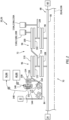
- FIG. 1 schematically illustrates a propulsion system 20 for an aircraft.
- the aircraft may be an airplane, a helicopter, a drone (e.g., an unmanned aerial vehicle (UAV)), a spacecraft or any other manned or unmanned aerial vehicle or system.
- This aircraft may be configured as a vertical take-off and landing (VTOL) aircraft or a short take-off and vertical landing (STOVL) aircraft.
- the first mode may be a horizontal flight mode (e.g., a forward flight mode) where the first direction propulsion is substantially horizontal propulsive thrust; e.g., within five degrees (5°), ten degrees (10°), etc. of a horizontal axis.
- the second mode may be a vertical flight and/or hover mode where the second direction propulsion is substantially vertical propulsive lift; e.g., within five degrees (5°), ten degrees (10°), etc. of a vertical axis.
- the aircraft propulsion system may also be configured to generate both the first direction propulsion (e.g., horizontal propulsion) and the second direction propulsion (e.g., vertical propulsion) during a third mode (e.g., a transition mode) of operation.
- the aircraft propulsion system 20 of FIG. 1 includes one or more bladed propulsor rotors such as, for example, at least one bladed first propulsor rotor 22 and at least one bladed second propulsor rotor 24.
- the aircraft propulsion system 20 of FIG. 1 also includes a gas turbine engine with a core 26 configured to rotatably drive the one or more propulsor rotors - the first propulsor rotor 22 and/or the second propulsor rotor 24.
- the first propulsor rotor 22 may be configured as a ducted rotor such as a fan rotor.
- the first propulsor rotor 22 may alternatively be configured as an open rotor (e.g., an un-ducted rotor) such as a propeller rotor, a pusher fan rotor or the like.
- the first propulsor rotor 22 of FIG. 1 is rotatable about a first rotor axis 28. This first rotor axis 28 is an axial centerline of the first propulsor rotor 22 and may be horizontal when the aircraft is on ground and/or during level aircraft flight.
- the first propulsor rotor 22 includes at least a first rotor disk 29 (or a hub) and a plurality of first rotor blades 30 (one visible in FIG. 1 ); e.g., fan blades.
- the first rotor blades 30 are distributed circumferentially around the first rotor disk 29 in an annular array.
- Each of the first rotor blades 30 is connected to and projects radially (relative to the first rotor axis 28) out from the first rotor disk 29.
- the second propulsor rotor 24 may be configured as an open rotor such as a propeller rotor or a helicopter (e.g., main) rotor.
- the second propulsor rotor 24 may alternatively be configured as a ducted rotor such as a fan rotor; e.g., see dashed line duct.
- the second propulsor rotor 24 of FIG. 1 is rotatable about a second rotor axis 32. This second rotor axis 32 is an axial centerline of the second propulsor rotor 24 and may be vertical when the aircraft is on the ground and/or during level aircraft flight.
- the second rotor axis 32 is angularly offset from the first rotor axis 28 by an included angle 34; e.g., an acute angle or a right angle.
- This included angle 34 may be between sixty degrees (60°) and ninety degrees (90°); however, the present disclosure is not limited to such an exemplary relationship.
- the second propulsor rotor 24 includes at least a second rotor disk 36 (or a hub) and a plurality of second rotor blades 38; e.g., open rotor blades.
- the second rotor blades 38 are distributed circumferentially around the second rotor disk 36 in an annular array. Each of the second rotor blades 38 is connected to and projects radially (relative to the second rotor axis 32) out from the second rotor disk 36.
- the engine core 26 extends axially along a core axis 40 from a forward, upstream airflow inlet 42 into the engine core 26 to an aft, downstream combustion products exhaust 44 from the engine core 26.
- the core axis 40 may be an axial centerline of the engine core 26 and may be horizontal when the aircraft is on the ground and/or during level aircraft flight. This core axis 40 may be parallel (e.g., coaxial) with the first rotor axis 28 and, thus, angularly offset from the second rotor axis 32.
- the engine core 26 of FIG. 1 includes a compressor section 46, a combustor section 47 and a turbine section 48.
- the turbine section 48 of FIG. 1 includes a high pressure turbine (HPT) section 48A and a low pressure turbine (LPT) section 48B (also sometimes referred to as a power turbine section).
- HPPT high pressure turbine
- LPT low pressure turbine
- the engine sections 46-48B may be arranged sequentially along the core axis 40 within an engine housing 50.
- This engine housing 50 includes an inner case 52 (e.g., a core case) and an outer case 54 (e.g., a fan case).
- the inner case 52 may house one or more of the engine sections 46-48B; e.g., the engine core 26.
- the outer case 54 may house the first propulsor rotor 22.
- the outer case 54 of FIG. 1 also axially overlaps and extends circumferentially about (e.g., completely around) the inner case 52 thereby at least partially forming a (e.g., annular) bypass flowpath 56 radially between the inner case 52 and the outer case 54.
- Each of the engine sections 46, 48A, 48B includes a bladed rotor 58-60 within that respective engine section 46, 48A, 48B.
- Each of these engine rotors 58-60 includes a plurality of rotor blades arranged circumferentially around and connected to one or more respective rotor disks (or hubs).
- the rotor blades may be formed integral with or mechanically fastened, welded, brazed and/or otherwise attached to the respective rotor disk(s) (or hub(s)).
- the compressor rotor 58 is connected to the HPT rotor 59 through a high speed shaft 62. At least (or only) these engine components 58, 59 and 62 collectively form a high speed rotating assembly 64; e.g., a high speed spool. This high speed rotating assembly 64 is rotatable about the core axis 40.
- the LPT rotor 60 is connected to a low speed shaft 66. At least (or only) these engine components 60 and 66 collectively form a low speed rotating assembly 68; e.g., a low speed spool. This low speed rotating assembly 68 is rotatable about the core axis 40.
- the low speed rotating assembly 68 and, more particularly, its low speed shaft 66 may project axially through a bore of the high speed rotating assembly 64 and its high speed shaft 62.
- the aircraft propulsion system 20 of FIG. 1 and its turbine engine include a drivetrain 70 that couples the low speed rotating assembly 68 to the first propulsor rotor 22 and that couples the low speed rotating assembly 68 to the second propulsor rotor 24.
- the drivetrain 70 of FIG. 1 includes a geartrain 72, a transmission 76 and a gearing 78; e.g., bevel gearing.
- the drivetrain 70 of FIG. 1 also includes one or more shafts 80 and 82 and/or other intermediate torque transmission devices for coupling the low speed rotating assembly 68 and its low speed shaft 66 to the second propulsor rotor 24.
- the drivetrain 70 may also include one or more intermediate torque transmission devices for coupling the geartrain 72 to the first propulsor rotor 22; e.g., a first propulsor shaft 84.
- An input into the geartrain 72 is coupled to the low speed rotating assembly 68 and its low speed shaft 66, where the low speed rotating assembly 68 forms a power input for the geartrain 72.
- An output from the geartrain 72 is coupled to the first propulsor rotor 22 through the first propulsor shaft 84, where the first propulsor rotor 22 forms a power output (e.g., load) for the geartrain 72.
- An input into the transmission 76 may be coupled to the low speed rotating assembly 68 independent of the geartrain 72.
- the low speed rotating assembly 68 for example, may be coupled to the input of the geartrain 72 and the input of the transmission 76 in parallel.
- the input of the transmission 76 of FIG. 1 is (e.g., directly or indirectly) connected to the LPT rotor 60 through the low speed shaft 66; e.g., without passing through the geartrain 72.
- An output from the transmission 76 is connected to an input into the gearing 78 through the transmission output shaft 80.
- the transmission 76 may be configured to selectively couple (e.g., transfer mechanical power between) the low speed rotating assembly 68 and the transmission output shaft 80.
- the transmission 76 may be configured to decouple the low speed rotating assembly 68 from the transmission output shaft 80, thereby decoupling the low speed rotating assembly 68 from the second propulsor rotor 24.
- the transmission 76 may be configured to couple the low speed rotating assembly 68 with the transmission output shaft 80, thereby coupling the low speed rotating assembly 68 with the second propulsor rotor 24.
- the transmission 76 may be configured as a clutched transmission or a clutchless transmission.
- An output from the gearing 78 is connected to the second propulsor rotor 24 through the second propulsor shaft 82.
- This gearing 78 provides a coupling between the transmission output shaft 80 rotating about the axis 28, 40 and the second propulsor shaft 82 rotating about the second rotor axis 32.
- the gearing 78 may also provide a speed change mechanism between the transmission output shaft 80 and the second propulsor shaft 82.
- the gearing 78 may alternatively provide a 1:1 rotational coupling between the transmission output shaft 80 and the second propulsor shaft 82 such that these shafts 80 and 82 rotate at a common (e.g., the same) rotational velocity.
- the gearing 78 and the transmission output shaft 80 may be omitted where the functionality of the gearing 78 is integrated into the transmission 76.
- the transmission 76 may be omitted where decoupling of the second propulsor rotor 24 is not required and/or where an optional additional speed change between the low speed rotating assembly 68 and the second propulsor rotor 24 is not required.
- core air During operation of the aircraft propulsion system 20, air enters the engine core 26 through the core inlet 42. This air is directed into a (e.g., annular) core flowpath 86, which core flowpath 86 extends sequentially through the compressor section 46, the combustor section 47, the HPT section 48A and the LPT section 48B from the core inlet 42 to the core exhaust 44.
- the air within this core flowpath 86 may be referred to as core air.
- the core air is compressed by the compressor rotor 58 and directed into a (e.g., annular) combustion chamber 88 of a (e.g., annular) combustor 90 in the combustor section 47.
- Fuel is injected into the combustion chamber 88 through one or more fuel injectors 92 (one visible in FIG. 1 ) and mixed with the compressed core air to provide a fuel-air mixture.
- This fuel-air mixture is ignited and combustion products thereof flow through and sequentially cause the HPT rotor 59 and the LPT rotor 60 to rotate.
- the rotation of the HPT rotor 59 drives rotation of the high speed rotating assembly 64 and its compressor rotor 58.
- the rotation of the LPT rotor 60 drives rotation of the low speed rotating assembly 68.
- the rotation of the low speed rotating assembly 68 drives rotation of the first propulsor rotor 22 through the geartrain 72 during one or more modes of operation; e.g., the first, the second and the third modes of operation.
- the rotation of the low speed rotating assembly 68 drives rotation of the second propulsor rotor 24 (e.g., independent of the geartrain 72) during one or more modes of operation; e.g., the second and the third modes of operation.
- the transmission 76 may decouple the low speed rotating assembly 68 from the second propulsor rotor 24 such that the low speed rotating assembly 68 does not drive rotation of the second propulsor rotor 24.
- the second propulsor rotor 24 may thereby be stationary (or windmill) during the first mode of operation.
- the rotation of the first propulsor rotor 22 propels bypass air (separate from the core air) through the aircraft propulsion system 20 and its bypass flowpath 56 to provide the first direction propulsion; e.g., the forward, horizontal thrust.
- the rotation of the second propulsor rotor 24 propels additional air (separate from the core air and the bypass air) to provide the second direction propulsion; e.g., vertical lift.
- the aircraft may thereby takeoff, land and/or otherwise hover during the second and the third modes of operation, and the aircraft may fly forward or otherwise move during the first and the third modes of operation.
- the bypass air may also flow through the bypass flowpath 56 during the second and the third modes of operation; however, a quantity of the bypass air flowing through the bypass flowpath 56 during the second mode of operation may be de minimis as described below in further detail.
- the geartrain 72 may include multiple (e.g., epicyclic) interconnected gear systems 94 and 96.
- the first gear system 94 has a plurality of first gear system components including a first sun gear 98, a first ring gear 100, a plurality of first intermediate gears 102 and a first carrier 104.
- the first sun gear 98 is rotatable about a rotational axis 106 of the geartrain 72, which rotational axis 106 may be parallel (e.g., coaxial) with the axis 28, 40.
- the first ring gear 100 circumscribes the first sun gear 98 and the first intermediate gears 102.
- the first ring gear 100 is rotatable about the axis 28, 40, 106.
- the first intermediate gears 102 are arranged circumferentially about the axis 28, 40, 106 and the first sun gear 98 in an array.
- Each of the first intermediate gears 102 is disposed radially between and meshed with the first sun gear 98 and the first ring gear 100.
- Each of the first intermediate gears 102 is rotatably mounted to the first carrier 104.
- the first carrier 104 is rotatable about the axis 28, 40, 106.
- the second gear system 96 has a plurality of second gear system components including a second sun gear 108, a second ring gear 110, a plurality of second intermediate gears 112 and a second carrier 114.
- the second sun gear 108 is rotatable about the axis 28, 40, 106.
- the second ring gear 110 circumscribes the second sun gear 108 and the second intermediate gears 112.
- the second ring gear 110 is rotatable about the axis 28, 40, 106.
- the second intermediate gears 112 are arranged circumferentially about the axis 28, 40, 106 and the second sun gear 108 in an array.
- Each of the second intermediate gears 112 is disposed radially between and meshed with the second sun gear 108 and the second ring gear 110.
- Each of the second intermediate gears 112 is rotatably mounted to the second carrier 114.
- the second carrier 114 is rotatable about the axis 28, 40, 106.
- This second carrier 114 is coupled to (e.g., via an inter-gear system shaft and/or another drive element) and rotatable with the first ring gear 100, where the second carrier 114 and the first ring gear 100 are configured to rotate at a common rotational velocity.
- the first propulsor rotor 22 is coupled to the geartrain 72 and its second gear system 96 through the second ring gear 110.
- the first propulsor shaft 84 (and/or another drive element), for example, may couple the first propulsor rotor 22 to the second ring gear 110.
- the first propulsor shaft 84 of FIG. 2 extends between and is connected to the first propulsor rotor 22 and the second ring gear 110.
- the low speed rotating assembly 68 and its low speed shaft 66 are coupled to the geartrain 72 and its first gear system 94 through the first sun gear 98.
- the low speed rotating assembly 68 and its low speed shaft 66 are also coupled to the geartrain 72 and its second gear system 96 through the second sun gear 108.
- the first sun gear 98 and the second sun gear 108 of FIG. 2 are each (e.g., independently) connected to the low speed rotating assembly 68 and its low speed shaft 66.
- the low speed rotating assembly 68 and its LPT rotor 60 are configured to (e.g., independently) drive rotation of the first sun gear 98 and the second sun gear 108, where the first sun gear 98, the second sun gear 108 and the LPT rotor 60 are rotate at a common rotational velocity.
- the aircraft propulsion system 20 and its drivetrain 70 may include one or more brakes 116A and 116B (generally referred to as " 116") and/or one or more lock devices 118A and 118B (generally referred to as "118").
- the first brake 116A and/or the first lock device 118A may be located at a first location 120A, or another suitable location.
- the second brake 116B and/or the second lock device 118B may be located at a second location 120B, or another suitable location.
- the first brake 116A of FIG. 2 is configured to brake (e.g., slow and/or stop) rotation of the first carrier 104 about the axis 28, 40, 106.
- the second lock device 118B is configured to lock (e.g., fix, prevent) rotation of the first ring gear 100 and the second carrier 114 about the axis 28, 40, 106, for example, following the braking of the second carrier 114 to a zero rotational speed about the axis 28, 40, 106 using the second brake 116B.
- the second carrier 114 is rotationally fixed (e.g., during the second mode of operation of FIG. 5 )
- a rotational speed of the first propulsor rotor 22 may decrease (compared to when the second carrier 114 is free to rotate).
- Reducing the rotational speed of the first propulsor rotor 22 during, for example, the second mode of operation reduces or substantially eliminates (e.g., de minimis ) the first direction propulsive thrust generated by the first propulsor rotor 22.
- Reducing first propulsor rotor thrust may, in turn, increase power available for driving rotation of the second propulsor rotor 24 and/or facilitate substantial second direction aircraft movement; e.g., without first direction aircraft movement.
- maintaining some rotation of the first propulsor rotor 22 may maintain lubrication of one or more bearings (e.g., bearings 122 in FIG. 2 ) supporting the first propulsor rotor 22 and/or prevent bearing related damage.
- shock loads may damage one of more internal components of the bearing.
- bearing damage may include, but are not limited to, brinelling and false brinelling.
- Maintaining some rotation of the first propulsor rotor 22 of FIG. 1 may also or alternatively prevent an exhaust backflow through the bypass flowpath 56 into the core inlet 42. Maintaining some rotation of the first propulsor rotor 22 may still also or alternatively prevent debris (e.g., sand, dirt, dust, etc.) from entering the core inlet 42 during the second mode of operation where the aircraft is more likely to be near the ground; e.g., for landing or takeoff.
- debris e.g., sand, dirt, dust, etc.
- the second brake 116B of FIG. 2 is configured to brake (e.g., slow and/or stop) rotation of the first ring gear 100 about the axis 28, 40, 106 and, thus, rotation of the second carrier 114 about the axis 28, 40, 106.
- the first lock device 118A is configured to lock (e.g., fix, prevent) rotation of the first carrier 104 about the axis 28, 40, 106.
- the geartrain 72 and its first gear system 94 and its second gear system 96 are configured to transfer additional power from the low speed rotating assembly 68 and its LPT rotor 60 to the first propulsor rotor 22 and any drivetrain element(s) therebetween (when included).
- This power transfer may be substantially all (e.g., minus losses in the drivetrain 70) of the power output from the low speed rotating assembly 68 and its LPT rotor 60 when the second propulsor rotor 24 is rotationally decoupled from the low speed rotating assembly 68; e.g., using the transmission 76 of FIG. 1 .
- the geartrain 72 may thereby provide a multi-speed transmission between the low speed rotating assembly 68 and the first propulsor rotor 22, where a speed ratio between the low speed rotating assembly 68 and the first propulsor rotor 22 during the second mode is less than a speed ratio between the low speed rotating assembly 68 and the first propulsor rotor 22 during the first mode.
- the transmission 76 selectively couples the low speed rotating assembly 68 and the transmission output shaft 80 to transfer power from the LPT rotor 60 to the second propulsor rotor 24. Similarly, to enter the first mode of operation from the third mode of operation, the transmission 76 selectively uncouples the low speed rotating assembly 68 and the transmission output shaft 80 to remove power transfer from the LPT rotor 60 to the second propulsor rotor 24.
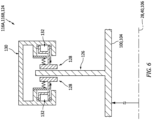
- the first brake 116A and/or the second brake 116B may each be configured as or otherwise include a disk brake 124.
- the disk brake 124 of FIG. 6 includes a brake rotor 126 and one or more brake pads 128.
- the brake rotor 126 is configured rotatable with the respective geartrain member 104, 100.
- the brake rotor 126 for example, may be connected to and rotatable with the respective geartrain member 104, 100, or another rotating element (directly or indirectly) rotatable with the respective geartrain member 104, 100.
- the brake pads 128 are anchored to a stationary structure 130, which may be part of the engine housing 50 and/or an airframe of the aircraft (see FIG. 1 ).
- the brake pads 128 may be actuated by one or more brake actuators 132 (e.g., hydraulic brake actuators) to move the brake pads 128 from an open position to a closed position.
- the brake pads 128 In the open position, the brake pads 128 are spaced from and do not engage (e.g., contact) the brake rotor 126 (see position of FIG. 6 ).
- the brake pads 128 In the closed position, the brake pads 128 engage (e.g., contact) and clamp onto (e.g., squeeze) the brake rotor 126. Frictional rubbing between the brake pads 128 and the brake rotor 126 is operable to brake rotation of the brake rotor 126 and, thus, the respective geartrain member 104, 100 (or another rotating element) connected thereto.
- first and the second brakes 116 of the present disclosure are not limited to such an exemplary disk brake configuration.
- first and/or the second brake 116B may alternatively be configured as another type of brake such as a drum brake or a set of clutch plates.
- the first lock device 118A and/or the second lock device 118B may each be configured as a splined lock device; e.g., a splined coupling.
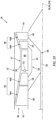
- the lock device 118 of FIG. 7 includes an inner lock element 134 (e.g., a splined shaft), an outer lock element 136 (e.g., a splined sleeve) and an actuator 138.
- the inner lock element 134 is rotatable about the axis 28, 40, 106.
- the outer lock element 136 is rotationally fixed about the axis 28, 40, 106.
- the actuator 138 is configured to move (e.g., axially translate) the outer lock element 136 along the axis 28, 40, 106 and the inner lock element 134 between an unlocked position (see dashed line in FIG. 7 ) and a locked position (see solid line in FIG. 7 ; see also FIG. 8 ).
- an unlocked position inner splines 140 of the outer lock element 136 are disengaged (e.g., spaced) from outer splines 142 of the inner lock element 134.
- the inner splines 140 of the outer lock element 136 are engaged (e.g., meshed) with the outer splines 142 of the inner lock element 134 (see also FIG. 8 ).
- the inner lock element 134 may rotate (e.g., freely, unencumbered by the outer lock element 136) about the axis 28, 40, 106.
- the outer lock element 136 is meshed with the inner lock element 134 and prevents rotation of the inner lock element 134 about the axis 28, 40, 106.
- the inner lock element 134 of the first lock device 118A may be configured as part of or may be attached (directly or indirectly) to the first carrier 104, or any other element rotatable therewith.
- the inner lock element 134 of the second lock device 118B may be configured as part of or may be attached (directly or indirectly) to the first ring gear 100, or any other element rotatable therewith. While the inner lock element 134 of FIGS. 7 and 8 is described as the rotating element and the outer lock element 136 is described as the rotationally fixed element, the operation of these elements may be switched in other embodiments.
- the inner lock element 134 may alternatively be configured as the rotationally fixed element and axially translatable by the actuator 138, and the outer lock element 136 may be configured as the rotating element.
- various other types of rotational lock devices are known in the art, and the present disclosure is not limited to any particular ones thereof.
- the aircraft propulsion system 20 also includes an auxiliary turbine 144.
- This auxiliary turbine 144 is configured to (e.g., help) drive rotation of the first propulsor rotor 22 during, for example, switching from the second to the first mode of operation.
- the auxiliary turbine 144 may be configured as an air turbine, a free turbine or any other type of turbine powered by (e.g., fluidly driven by) gas bled from the engine core 26.
- the aircraft propulsion system 20 of FIG. 2 for example, includes a bleed circuit 146 and an exhaust circuit 148 for the auxiliary turbine 144.
- the bleed circuit 146 is configured to bleed gas (e.g., compressed air) from the core flowpath 86, and provide the bleed gas (e.g., the bleed air) to an inlet into the auxiliary turbine 144.
- the bleed circuit 146 may bleed the gas from the compressor section 46 (or alternatively another section of the engine core 26 of FIG. 1 ). This bleed gas flows through the auxiliary turbine 144 from the inlet of the auxiliary turbine 144 to an outlet from the auxiliary turbine 144.
- the bleed gas is directed (e.g., expanded) across a bladed auxiliary turbine rotor 150 (e.g., an air turbine rotor) of the auxiliary turbine 144, which drives rotation of the auxiliary turbine rotor 150.
- the exhaust circuit 148 is configured to receive the (e.g., expanded) bleed gas exhausted from the outlet of the auxiliary turbine 144, and direct that exhausted bleed gas into a flowpath of the aircraft propulsion system 20 (e.g., the bypass flowpath 56 or the core flowpath 86). Alternatively, the exhaust circuit 148 may direct the exhausted bleed gas directly into an environment outside of the aircraft propulsion system 20.
- the present disclosure is not limited to the foregoing exemplary bleed circuit and/or exhaust circuit configurations.
- the auxiliary turbine rotor 150 is housed within a casing 152 of the auxiliary turbine 144, which casing 152 may be configured as part of or discrete from the engine housing 50 of FIG. 1 .
- the auxiliary turbine rotor 150 of FIG. 2 includes a plurality of turbine blades arranged circumferentially around and connected to one or more respective rotor disks (or hubs).
- the turbine rotor blades for example, may be formed integral with or mechanically fastened, welded, brazed and/or otherwise attached to the respective rotor disk(s) (or hub(s)).
- the auxiliary turbine 144 may be configured as an axial flow turbine or a radial flow turbine, and the auxiliary turbine 144 may include one or more stages; e.g., rows / arrays of its turbine blades.
- the auxiliary turbine rotor 150 of FIG. 2 is coupled to the first propulsor shaft 84, for example at an axially intermediate position between (a) a (e.g., forward) coupling between the first propulsor shaft 84 and the first propulsor rotor 22 and (b) a (e.g., aft) coupling between the first propulsor shaft 84 and the geartrain 72 and its second gear system 96 / its second ring gear 110.
- the auxiliary turbine 144 and its auxiliary turbine rotor 150 are also operably coupled inline between the first propulsor rotor 22 and one or more (e.g., all) components of the geartrain 72.
- the auxiliary turbine 144 and its auxiliary turbine rotor 150 may be coupled to the first propulsor rotor 22 independent of the geartrain 72 and its gear systems 94 and 96.
- the first propulsor shaft 84 may couple the first propulsor rotor 22 to the auxiliary turbine rotor 150 and the second ring gear 110 in parallel.
- the second lock device 118B may be disengaged and/or the second brake 116B may be released (if currently applied) to permit rotation of the second carrier 114; also the first brake 116A may be applied and/or the bleed circuit 146 may be opened to power the bladed auxiliary turbine rotor 150 to increase the rotational speed of the first propulsor rotor 22 and while also reducing the rotational speed of the first carrier 104 toward zero (see FIG. 5 ).
- the first lock device 118A may be engaged to prevent subsequent rotation.
- the drivetrain 70 may transfer (e.g., all, minus losses in the drivetrain 70) the power output from the low speed rotating assembly 68 and its LPT rotor 60 to (a) the first propulsor rotor 22 and the drivetrain element(s) therebetween and (b) the second propulsor rotor 24 and the drivetrain element(s) therebetween (e.g., independent of the geartrain 72 and its first gear system 94 and its second gear system 96).
- the first propulsor rotor 22 and the drivetrain element(s) therebetween e.g., independent of the geartrain 72 and its first gear system 94 and its second gear system 96.
- the first lock device 118A may be disengaged and/or the first brake 116A may be released (if currently applied) to permit rotation of the first carrier 104; also the second brake 116B may be applied to reduce the rotational speed of the second carrier 114 toward zero (see FIG. 5 ).
- the second lock device 118B may be engaged to prevent subsequent rotation.
- the combined steps of changing from the first mode to the third mode and from the third mode to the second mode may be done concurrently or in series.
- the combined steps of changing from the second mode to the third mode and from the third mode to the first mode may be done concurrently or in series.
- the auxiliary turbine 144 may be used to facilitate operation of one or more of the lock devices 118.
- the lock devices 118 are disengaged (e.g., unlocked) during the switching of modes of operation, both the first propulsor rotor 22 and the second propulsor rotor 24 may be rotating.
- the auxiliary turbine 144 of FIG. 2 is operated to drive rotation of the first propulsor rotor 22 and/or the second ring gear 110 about the axis 28, 40, 106.
- the auxiliary turbine 144 may thereby increase the rotational speed of the second ring gear 110 to drive the rotational speed of the first carrier 104 towards (e.g., down to) a zero rotational speed.
- the first lock device 118A may be engaged.
- the auxiliary turbine 144 may then be turned off (e.g., the bleed gas may be cutoff), and the first lock device 118A may maintain the first carrier 104 rotationally fixed.
- a clutch 154 may be provided.
- This clutch 154 is configured to selectively couple the auxiliary turbine 144 and its auxiliary turbine rotor 150 to the first propulsor shaft 84 and, thus, the first propulsor rotor 22 and/or the geartrain 72 and its second ring gear 110.
- the clutch 154 may be configured to couple the auxiliary turbine rotor 150 to the first propulsor shaft 84 when the auxiliary turbine 144 is operational and powered-up; e.g., receiving the bleed air which drives the rotation of the auxiliary turbine rotor 150.
- the clutch 154 may be configured to decouple the auxiliary turbine rotor 150 from the first propulsor shaft 84 when the auxiliary turbine 144 is non-operational and powered-down; e.g., cutoff from receiving the bleed air which drives the rotation of the auxiliary turbine rotor 150.
- the clutch 154 may be configured as a passively actuated clutch.
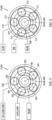
- the clutch 154 of FIG. 9A and 9B for example, is configured as a sprag clutch.
- This clutch 154 of FIGS. 9A and 9B includes an inner clutch member 156, an outer clutch member 158 and one or more sprags 160.
- the inner clutch member 156 may be coupled to and rotatably fixed with the auxiliary turbine rotor 150.
- the auxiliary turbine rotor 150 may thereby be coupled to the clutch 154 through the inner clutch member 156.
- the outer clutch member 158 may be coupled to and rotatably fixed with the first propulsor shaft 84 and, thus, the first propulsor rotor 22 and the geartrain 72 and its second ring gear 110.
- the propulsion system members 22, 84 and 110 may thereby be coupled to the clutch 154 through the outer clutch member 158.
- the outer clutch member 158 is disposed radially outboard of and radially spaced from the inner clutch member 156.
- the outer clutch member 158 extends circumferentially about (e.g., circumscribes) the inner clutch member 156.
- the sprags 160 are arranged circumferentially about the inner clutch member 156 in an array. This array of the sprags 160 is arranged within an annular gap formed by and radially between the inner clutch member 156 and the outer clutch member 158. Each of these sprags 160 is movable (e.g., pivotable) between an engaged position (e.g., see FIG. 9A ) and a disengaged position (e.g., see FIG. 9B ). Each sprag 160 may also be biased (e.g., spring biased) to move towards its engaged position.
- each sprag 160 engages (e.g., contacts) a (e.g., cylindrical) outer surface of the inner clutch member 156 and a (e.g., cylindrical) inner surface of the outer clutch member 158.
- the auxiliary turbine 144 When the auxiliary turbine 144 is operational / powered up, the auxiliary turbine rotor 150 may rotationally drive the inner clutch member 156 to a faster rotational velocity than the outer clutch member 158.
- the engagement between the outer surface of the inner clutch member 156 and each sprag 160 may cause that sprag 160 to move (e.g., pivot counterclockwise in FIG. 9A ) into and remain in the engaged position of FIG. 9A , where the sprags 160 are jammed between the inner clutch member 156 and the outer clutch member 158.
- jammed sprags 160 rotationally couple / lock the inner clutch member 156 to the outer clutch member 158.
- each sprag 160 may still engage (e.g., contact) the outer surface of the inner clutch member 156 and the inner surface of the outer clutch member 158; e.g., due to the spring bias.
- the rotational velocity of the inner clutch member 156 may be slower than the outer clutch member 158; e.g., where the first propulsor rotor 22 is rotating at its first operating mode rotational velocity.
- the engagement between the inner surface of the outer clutch member 158 and each sprag 160 may cause that sprag 160 to move (e.g., pivot clockwise in FIG. 9B ) into and remain in the disengaged position of FIG.
- the first sun gear 98 and the second sun gear 108 may each be independently connected (e.g., connected in parallel) to the low speed rotating assembly 68 and its low speed shaft 66. In other embodiments, however, the second sun gear 108 may be connected to the low speed rotating assembly 68 and its low speed shaft 66 through the first sun gear 98.
- the second sun gear 108 may be rotationally fixed to the first sun gear 98.
- the first sun gear 98 may be connected to the low speed rotating assembly 68 and its low speed shaft 66 through the second sun gear 108.
- the first sun gear 98 for example, may be rotationally fixed to the second sun gear 108.
- the low speed rotating assembly 68 and its low speed shaft 66 may be connected to the transmission 76 (see FIG. 1 ) and, thus, the second propulsor rotor 24 independent of (e.g., in parallel with) geartrain 72.
- the transmission 76 and, thus, the second propulsor rotor 24 may be coupled to the low speed rotating assembly 68 and its low speed shaft 66 through the first sun gear 98 or the second sun gear 108, but not though the rest of the first gear system 94 and the second gear system 96.
- the low speed rotating assembly 68 may be configured without a compressor rotor.
- the low speed rotating assembly 68 may include a low pressure compressor (LPC) rotor 58' arranged within a low pressure compressor (LPC) section 46A of the compressor section 46.
- the compressor rotor 58 may be a high pressure compressor (HPC) rotor 58 within a high pressure compressor (HPC) section 46B of the compressor section 46.
- HPC high pressure compressor
- the engine core 26 may have various configurations other than those described above.
- the engine core 26, for example, may be configured with a single spool, with two spools (e.g., see FIGS. 1 and 10 ), or with more than two spools.
- the engine core 26 may be configured with one or more axial flow compressor sections, one or more radial flow compressor sections, one or more axial flow turbine sections and/or one or more radial flow turbine sections.
- the engine core 26 may be configured with any type or configuration of annular, tubular (e.g., CAN), axial flow and/or reverser flow combustor. The present disclosure therefore is not limited to any particular types or configurations of gas turbine engine cores.
- the engine core 26 of the present disclosure may drive more than the two propulsor rotors 22 and 24, or a single one of the propulsor rotors 22, 24 and/or one or more other mechanical loads; e.g., electric machines, electric generators, electric motors, etc.
- the aircraft propulsion system 20, for example, may include two or more of the first propulsor rotors 22 and/or two or more of the second propulsor rotors 24.
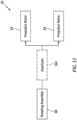
- the aircraft propulsion system 20 of FIG. 11 includes multiple second propulsor rotors 24 rotatably driven by the low speed rotating assembly 68. These second propulsor rotors 24 may rotate about a common axis.
- each second propulsor rotor 24 may rotate about a discrete axis where, for example, the second propulsor rotors 24 are laterally spaced from one another and coupled to the low speed rotating assembly 68 through a power splitting geartrain 162.
Landscapes
- Engineering & Computer Science (AREA)
- Chemical & Material Sciences (AREA)
- Combustion & Propulsion (AREA)
- Mechanical Engineering (AREA)
- General Engineering & Computer Science (AREA)
- Retarders (AREA)
Applications Claiming Priority (1)
| Application Number | Priority Date | Filing Date | Title |
|---|---|---|---|
| US18/375,011 US20250109707A1 (en) | 2023-09-29 | 2023-09-29 | Aircraft propulsion system with auxiliary turbine system |
Publications (1)
| Publication Number | Publication Date |
|---|---|
| EP4530455A1 true EP4530455A1 (de) | 2025-04-02 |
Family
ID=92932829
Family Applications (1)
| Application Number | Title | Priority Date | Filing Date |
|---|---|---|---|
| EP24203615.0A Pending EP4530455A1 (de) | 2023-09-29 | 2024-09-30 | Flugzeugantriebssystem mit hilfsturbinensystem |
Country Status (2)
| Country | Link |
|---|---|
| US (1) | US20250109707A1 (de) |
| EP (1) | EP4530455A1 (de) |
Citations (4)
| Publication number | Priority date | Publication date | Assignee | Title |
|---|---|---|---|---|
| US3381475A (en) * | 1965-06-28 | 1968-05-07 | Bristol Siddeley Engines Ltd | Jet propulsion engines |
| US3587766A (en) * | 1969-09-17 | 1971-06-28 | Caterpillar Tractor Co | Auxiliary turbine braking system for free-turbine gas-turbine engines |
| US4936748A (en) * | 1988-11-28 | 1990-06-26 | General Electric Company | Auxiliary power source in an unducted fan gas turbine engine |
| US20220194613A1 (en) * | 2020-12-21 | 2022-06-23 | Embraer S.A. | Kinetic energy taxi system and thermal energy recovery system |
Family Cites Families (7)
| Publication number | Priority date | Publication date | Assignee | Title |
|---|---|---|---|---|
| US5209428A (en) * | 1990-05-07 | 1993-05-11 | Lockheed Corporation | Propulsion system for a vertical and short takeoff and landing aircraft |
| GB0416344D0 (en) * | 2004-07-22 | 2004-08-25 | Rolls Royce Plc | Generator assembly |
| US20090247346A1 (en) * | 2008-03-25 | 2009-10-01 | Djh Engineering Center, Inc. | Two speed planetary electric shift gearbox |
| US9239004B2 (en) * | 2012-03-27 | 2016-01-19 | United Technologies Corporation | Reverse core gear turbofan |
| WO2015031143A1 (en) * | 2013-08-29 | 2015-03-05 | United Technologies Corporation | Three spool geared turbofan with low pressure compressor drive gear system and mechanical controller |
| GB201906526D0 (en) * | 2019-05-09 | 2019-06-26 | Rolls Royce Plc | Hybrid electric aircraft propulsion system |
| US12129802B2 (en) * | 2022-09-06 | 2024-10-29 | Rtx Corporation | Selective power distribution for an aircraft propulsion system |
-
2023
- 2023-09-29 US US18/375,011 patent/US20250109707A1/en active Pending
-
2024
- 2024-09-30 EP EP24203615.0A patent/EP4530455A1/de active Pending
Patent Citations (4)
| Publication number | Priority date | Publication date | Assignee | Title |
|---|---|---|---|---|
| US3381475A (en) * | 1965-06-28 | 1968-05-07 | Bristol Siddeley Engines Ltd | Jet propulsion engines |
| US3587766A (en) * | 1969-09-17 | 1971-06-28 | Caterpillar Tractor Co | Auxiliary turbine braking system for free-turbine gas-turbine engines |
| US4936748A (en) * | 1988-11-28 | 1990-06-26 | General Electric Company | Auxiliary power source in an unducted fan gas turbine engine |
| US20220194613A1 (en) * | 2020-12-21 | 2022-06-23 | Embraer S.A. | Kinetic energy taxi system and thermal energy recovery system |
Also Published As
| Publication number | Publication date |
|---|---|
| US20250109707A1 (en) | 2025-04-03 |
Similar Documents
| Publication | Publication Date | Title |
|---|---|---|
| EP4345007B1 (de) | Selektive leistungsverteilung für ein flugzeugantriebssystem | |
| US12092040B2 (en) | Selective power distribution for an aircraft propulsion system | |
| US12129802B2 (en) | Selective power distribution for an aircraft propulsion system | |
| US11958624B2 (en) | Selective power distribution for an aircraft propulsion system | |
| US12492663B2 (en) | Aircraft propulsion system geartrain | |
| US12043405B2 (en) | Selective power distribution for an aircraft propulsion system | |
| EP4325088B1 (de) | Getriebe für ein flugzeugantriebssystem | |
| US20250305451A1 (en) | Bearing arrangement for turbine engine geartrain | |
| EP4365429A1 (de) | Getriebe für ein flugzeugantriebssystem | |
| US12378000B2 (en) | Aircraft propulsion system geartrain | |
| US20250109707A1 (en) | Aircraft propulsion system with auxiliary turbine system | |
| EP4530458A1 (de) | Selektive leistungsverteilung für ein flugzeugantriebssystem | |
| US12135076B1 (en) | Fluid device(s) for supporting rotating structure(s) of a turbine engine | |
| EP4530442A2 (de) | Schnittstelle mit reduziertem abstand zwischen einer fluidvorrichtung und einer rotierenden struktur für ein zahnradgetriebe | |
| US12158112B1 (en) | Selective power distribution for an aircraft propulsion system | |
| US12292107B2 (en) | Fluid damper for turbine engine geartrain assembly | |
| US20230382522A1 (en) | Aircraft propulsion system with adjustable thrust propulsor |
Legal Events
| Date | Code | Title | Description |
|---|---|---|---|
| PUAI | Public reference made under article 153(3) epc to a published international application that has entered the european phase |
Free format text: ORIGINAL CODE: 0009012 |
|
| STAA | Information on the status of an ep patent application or granted ep patent |
Free format text: STATUS: THE APPLICATION HAS BEEN PUBLISHED |
|
| AK | Designated contracting states |
Kind code of ref document: A1 Designated state(s): AL AT BE BG CH CY CZ DE DK EE ES FI FR GB GR HR HU IE IS IT LI LT LU LV MC ME MK MT NL NO PL PT RO RS SE SI SK SM TR |
|
| STAA | Information on the status of an ep patent application or granted ep patent |
Free format text: STATUS: REQUEST FOR EXAMINATION WAS MADE |
|
| 17P | Request for examination filed |
Effective date: 20251002 |