EP4530257A1 - Positivelektrodenaktivmaterial, positivelektrode und wiederaufladbare lithiumbatterien - Google Patents
Positivelektrodenaktivmaterial, positivelektrode und wiederaufladbare lithiumbatterien Download PDFInfo
- Publication number
- EP4530257A1 EP4530257A1 EP24202274.7A EP24202274A EP4530257A1 EP 4530257 A1 EP4530257 A1 EP 4530257A1 EP 24202274 A EP24202274 A EP 24202274A EP 4530257 A1 EP4530257 A1 EP 4530257A1
- Authority
- EP
- European Patent Office
- Prior art keywords
- positive electrode
- electrode active
- active material
- equal
- cycle
- Prior art date
- Legal status (The legal status is an assumption and is not a legal conclusion. Google has not performed a legal analysis and makes no representation as to the accuracy of the status listed.)
- Pending
Links
Images





Classifications
-
- C—CHEMISTRY; METALLURGY
- C01—INORGANIC CHEMISTRY
- C01G—COMPOUNDS CONTAINING METALS NOT COVERED BY SUBCLASSES C01D OR C01F
- C01G53/00—Compounds of nickel
- C01G53/40—Complex oxides containing nickel and at least one other metal element
- C01G53/42—Complex oxides containing nickel and at least one other metal element containing alkali metals, e.g. LiNiO2
- C01G53/44—Complex oxides containing nickel and at least one other metal element containing alkali metals, e.g. LiNiO2 containing manganese
- C01G53/56—Complex oxides containing nickel and at least one other metal element containing alkali metals, e.g. LiNiO2 containing manganese of the type (MnO3)2-, e.g. Li2(NixMn1-x)O3 or Li2(MyNixMn1-x-y)O3
-
- H—ELECTRICITY
- H01—ELECTRIC ELEMENTS
- H01M—PROCESSES OR MEANS, e.g. BATTERIES, FOR THE DIRECT CONVERSION OF CHEMICAL ENERGY INTO ELECTRICAL ENERGY
- H01M4/00—Electrodes
- H01M4/02—Electrodes composed of, or comprising, active material
- H01M4/36—Selection of substances as active materials, active masses, active liquids
- H01M4/362—Composites
-
- C—CHEMISTRY; METALLURGY
- C01—INORGANIC CHEMISTRY
- C01G—COMPOUNDS CONTAINING METALS NOT COVERED BY SUBCLASSES C01D OR C01F
- C01G45/00—Compounds of manganese
- C01G45/12—Complex oxides containing manganese and at least one other metal element
- C01G45/1221—Manganates or manganites with trivalent manganese, tetravalent manganese or mixtures thereof
- C01G45/125—Manganates or manganites with trivalent manganese, tetravalent manganese or mixtures thereof of the type (MnO3)n-, e.g. CaMnO3
- C01G45/1257—Manganates or manganites with trivalent manganese, tetravalent manganese or mixtures thereof of the type (MnO3)n-, e.g. CaMnO3 containing lithium, e.g. Li2MnO3 or Li2(MxMn1-x)O3
-
- C—CHEMISTRY; METALLURGY
- C01—INORGANIC CHEMISTRY
- C01G—COMPOUNDS CONTAINING METALS NOT COVERED BY SUBCLASSES C01D OR C01F
- C01G53/00—Compounds of nickel
- C01G53/40—Complex oxides containing nickel and at least one other metal element
- C01G53/42—Complex oxides containing nickel and at least one other metal element containing alkali metals, e.g. LiNiO2
- C01G53/44—Complex oxides containing nickel and at least one other metal element containing alkali metals, e.g. LiNiO2 containing manganese
-
- C—CHEMISTRY; METALLURGY
- C01—INORGANIC CHEMISTRY
- C01G—COMPOUNDS CONTAINING METALS NOT COVERED BY SUBCLASSES C01D OR C01F
- C01G53/00—Compounds of nickel
- C01G53/40—Complex oxides containing nickel and at least one other metal element
- C01G53/42—Complex oxides containing nickel and at least one other metal element containing alkali metals, e.g. LiNiO2
- C01G53/44—Complex oxides containing nickel and at least one other metal element containing alkali metals, e.g. LiNiO2 containing manganese
- C01G53/50—Complex oxides containing nickel and at least one other metal element containing alkali metals, e.g. LiNiO2 containing manganese of the type (MnO2)n-, e.g. Li(NixMn1-x)O2 or Li(MyNixMn1-x-y)O2
-
- H—ELECTRICITY
- H01—ELECTRIC ELEMENTS
- H01M—PROCESSES OR MEANS, e.g. BATTERIES, FOR THE DIRECT CONVERSION OF CHEMICAL ENERGY INTO ELECTRICAL ENERGY
- H01M10/00—Secondary cells; Manufacture thereof
- H01M10/05—Accumulators with non-aqueous electrolyte
- H01M10/052—Li-accumulators
-
- H—ELECTRICITY
- H01—ELECTRIC ELEMENTS
- H01M—PROCESSES OR MEANS, e.g. BATTERIES, FOR THE DIRECT CONVERSION OF CHEMICAL ENERGY INTO ELECTRICAL ENERGY
- H01M4/00—Electrodes
- H01M4/02—Electrodes composed of, or comprising, active material
- H01M4/13—Electrodes for accumulators with non-aqueous electrolyte, e.g. for lithium-accumulators; Processes of manufacture thereof
- H01M4/131—Electrodes based on mixed oxides or hydroxides, or on mixtures of oxides or hydroxides, e.g. LiCoOx
-
- H—ELECTRICITY
- H01—ELECTRIC ELEMENTS
- H01M—PROCESSES OR MEANS, e.g. BATTERIES, FOR THE DIRECT CONVERSION OF CHEMICAL ENERGY INTO ELECTRICAL ENERGY
- H01M4/00—Electrodes
- H01M4/02—Electrodes composed of, or comprising, active material
- H01M4/36—Selection of substances as active materials, active masses, active liquids
- H01M4/48—Selection of substances as active materials, active masses, active liquids of inorganic oxides or hydroxides
- H01M4/50—Selection of substances as active materials, active masses, active liquids of inorganic oxides or hydroxides of manganese
- H01M4/505—Selection of substances as active materials, active masses, active liquids of inorganic oxides or hydroxides of manganese of mixed oxides or hydroxides containing manganese for inserting or intercalating light metals, e.g. LiMn2O4 or LiMn2OxFy
-
- H—ELECTRICITY
- H01—ELECTRIC ELEMENTS
- H01M—PROCESSES OR MEANS, e.g. BATTERIES, FOR THE DIRECT CONVERSION OF CHEMICAL ENERGY INTO ELECTRICAL ENERGY
- H01M4/00—Electrodes
- H01M4/02—Electrodes composed of, or comprising, active material
- H01M4/36—Selection of substances as active materials, active masses, active liquids
- H01M4/48—Selection of substances as active materials, active masses, active liquids of inorganic oxides or hydroxides
- H01M4/52—Selection of substances as active materials, active masses, active liquids of inorganic oxides or hydroxides of nickel, cobalt or iron
- H01M4/525—Selection of substances as active materials, active masses, active liquids of inorganic oxides or hydroxides of nickel, cobalt or iron of mixed oxides or hydroxides containing iron, cobalt or nickel for inserting or intercalating light metals, e.g. LiNiO2, LiCoO2 or LiCoOxFy
-
- C—CHEMISTRY; METALLURGY
- C01—INORGANIC CHEMISTRY
- C01P—INDEXING SCHEME RELATING TO STRUCTURAL AND PHYSICAL ASPECTS OF SOLID INORGANIC COMPOUNDS
- C01P2002/00—Crystal-structural characteristics
- C01P2002/70—Crystal-structural characteristics defined by measured X-ray, neutron or electron diffraction data
- C01P2002/74—Crystal-structural characteristics defined by measured X-ray, neutron or electron diffraction data by peak-intensities or a ratio thereof only
-
- C—CHEMISTRY; METALLURGY
- C01—INORGANIC CHEMISTRY
- C01P—INDEXING SCHEME RELATING TO STRUCTURAL AND PHYSICAL ASPECTS OF SOLID INORGANIC COMPOUNDS
- C01P2002/00—Crystal-structural characteristics
- C01P2002/70—Crystal-structural characteristics defined by measured X-ray, neutron or electron diffraction data
- C01P2002/76—Crystal-structural characteristics defined by measured X-ray, neutron or electron diffraction data by a space-group or by other symmetry indications
-
- C—CHEMISTRY; METALLURGY
- C01—INORGANIC CHEMISTRY
- C01P—INDEXING SCHEME RELATING TO STRUCTURAL AND PHYSICAL ASPECTS OF SOLID INORGANIC COMPOUNDS
- C01P2002/00—Crystal-structural characteristics
- C01P2002/70—Crystal-structural characteristics defined by measured X-ray, neutron or electron diffraction data
- C01P2002/78—Crystal-structural characteristics defined by measured X-ray, neutron or electron diffraction data by stacking-plane distances or stacking sequences
-
- C—CHEMISTRY; METALLURGY
- C01—INORGANIC CHEMISTRY
- C01P—INDEXING SCHEME RELATING TO STRUCTURAL AND PHYSICAL ASPECTS OF SOLID INORGANIC COMPOUNDS
- C01P2004/00—Particle morphology
- C01P2004/01—Particle morphology depicted by an image
- C01P2004/03—Particle morphology depicted by an image obtained by SEM
-
- C—CHEMISTRY; METALLURGY
- C01—INORGANIC CHEMISTRY
- C01P—INDEXING SCHEME RELATING TO STRUCTURAL AND PHYSICAL ASPECTS OF SOLID INORGANIC COMPOUNDS
- C01P2004/00—Particle morphology
- C01P2004/60—Particles characterised by their size
- C01P2004/61—Micrometer sized, i.e. from 1-100 micrometer
-
- C—CHEMISTRY; METALLURGY
- C01—INORGANIC CHEMISTRY
- C01P—INDEXING SCHEME RELATING TO STRUCTURAL AND PHYSICAL ASPECTS OF SOLID INORGANIC COMPOUNDS
- C01P2006/00—Physical properties of inorganic compounds
- C01P2006/40—Electric properties
-
- H—ELECTRICITY
- H01—ELECTRIC ELEMENTS
- H01M—PROCESSES OR MEANS, e.g. BATTERIES, FOR THE DIRECT CONVERSION OF CHEMICAL ENERGY INTO ELECTRICAL ENERGY
- H01M4/00—Electrodes
- H01M4/02—Electrodes composed of, or comprising, active material
- H01M2004/021—Physical characteristics, e.g. porosity, surface area
-
- H—ELECTRICITY
- H01—ELECTRIC ELEMENTS
- H01M—PROCESSES OR MEANS, e.g. BATTERIES, FOR THE DIRECT CONVERSION OF CHEMICAL ENERGY INTO ELECTRICAL ENERGY
- H01M4/00—Electrodes
- H01M4/02—Electrodes composed of, or comprising, active material
- H01M2004/026—Electrodes composed of, or comprising, active material characterised by the polarity
- H01M2004/028—Positive electrodes
-
- Y—GENERAL TAGGING OF NEW TECHNOLOGICAL DEVELOPMENTS; GENERAL TAGGING OF CROSS-SECTIONAL TECHNOLOGIES SPANNING OVER SEVERAL SECTIONS OF THE IPC; TECHNICAL SUBJECTS COVERED BY FORMER USPC CROSS-REFERENCE ART COLLECTIONS [XRACs] AND DIGESTS
- Y02—TECHNOLOGIES OR APPLICATIONS FOR MITIGATION OR ADAPTATION AGAINST CLIMATE CHANGE
- Y02E—REDUCTION OF GREENHOUSE GAS [GHG] EMISSIONS, RELATED TO ENERGY GENERATION, TRANSMISSION OR DISTRIBUTION
- Y02E60/00—Enabling technologies; Technologies with a potential or indirect contribution to GHG emissions mitigation
- Y02E60/10—Energy storage using batteries
Definitions
- Positive electrode active materials positive electrodes including the same, and rechargeable lithium batteries are disclosed herein.
- a portable information device such as a cell phone, a laptop, smart phone, and the like or an electric vehicle has used a rechargeable lithium battery having high energy density and easy portability as a driving power source. Recently, research has been actively conducted to use a rechargeable lithium battery having high energy density as a driving power source and/or a power storage power source for hybrid or electric vehicles.
- lithium nickel-based oxide, lithium nickel manganese cobalt composite oxide, lithium nickel cobalt aluminum composite oxide, and lithium cobalt oxide are mainly used as positive electrode active materials.
- transition metals such as nickel, cobalt, and the like may not only be severely insufficient, but also their prices are sharply increasing. Accordingly, there is a need for development of a low-cost high-energy positive electrode active material.
- a lithium-manganese-rich (LMR) material which is a layered positive electrode active material including lithium in an excessive amount and manganese in a relatively large amount and having a layered structure and thus expresses high capacity by applying a new principle referred to as oxygen oxidation-reduction (O-redox) as well as an existing transition metal oxidation-reduction and concurrently (e.g., simultaneously), includes low-cost manganese at a high ratio, is attracting attention as an ultra-low-cost-generation positive electrode active material.
- O-redox oxygen oxidation-reduction
- the LMR material has low reversibility of O-redox itself, which is a main source capable of producing the high capacity and may release oxygen gas during charging and discharging and thus deteriorate its crystal structure, there may be a voltage decay phenomenon in that a voltage drops during charging and discharging.
- O-redox capacity is higher out of the total capacity, an average discharge voltage of a positive electrode may be lower. Accordingly, although the O-redox is a main source of producing high capacity, when its proportion is excessively high, there is a problem of deteriorating cycle-life characteristics or energy density calculated as (capacity x voltage).
- a highly cost-competitive lithium-manganese-rich positive electrode active material that secures high capacity characteristics due to O-redox while minimizing or reducing the side effects caused by O-redox, thereby minimizing or reducing voltage drop and energy density decrease and improving cycle-life characteristics.
- Some embodiments provide a positive electrode active material for a rechargeable lithium battery including a compound represented by Chemical Formula 1.
- Chemical Formula 1 a[Li 1+x (Ni y Mn 1-y ) 1-x O 2 ] + (1-a)[b(LiNi z Mn 1-z O 2 )+c(Li 2 MnO 3 )]
- Some embodiments provide a positive electrode for a rechargeable lithium battery including the positive electrode active material.
- Some embodiments provide a rechargeable lithium battery including the positive electrode, the negative electrode, a separator between the positive electrode and the negative electrode, and an electrolyte.
- Some embodiments provide an all-solid-state rechargeable battery including the positive electrode, the negative electrode, and a solid electrolyte layer between the positive electrode and the negative electrode.
- the positive electrode active material is a lithium-manganese-rich positive electrode active material that is highly price competitive, can achieve high capacity by utilizing O-redox and at the same time, effectively improve problems of voltage drop and energy density by controlling a ratio of O-redox capacity to total capacity to exhibit high discharge capacity and average discharge voltage, and can realize excellent high-temperature cycle-life characteristics and high energy density.
- “combination thereof” means a mixture, a laminate, a composite, a copolymer, an alloy, a blend, a reaction product, and/or the like of the constituents.
- layer herein includes not only a shape formed on the whole surface when viewed from a plan view, but also a shape formed on a partial surface.
- the average particle diameter may be measured by any suitable method generally used in the art and, for example, may be measured by a particle size analyzer, and/or may be measured by a transmission electron microscopic image and/or a scanning electron microscopic image. In some embodiments, it is possible to obtain an average particle diameter value by using a dynamic light scattering method, performing data analysis, counting the number of particles for each particle size range, and calculating from this. Unless otherwise defined, the average particle diameter may mean the diameter (D 50 ) of particles having a cumulative volume of 50 volume% in the particle size distribution.
- the average particle diameter means a diameter (D 50 ) of particles having a cumulative volume of 50 volume% in the particle size distribution that is obtained by measuring the size (diameter or length of the major axis) of about 20 particles at random in a scanning electron microscopic image.
- Metal is interpreted as a concept including ordinary metals, transition metals and metalloids (semi-metals).
- Some embodiments provide a positive electrode active material for a rechargeable lithium battery including a compound represented by Chemical Formula 1.
- Chemical Formula 1 a[Li 1+x (Ni y Mn 1-y ) 1-x O 2 ] + (1-a)[b(LiNi z Mn 1-z O 2 )+ c(Li 2 MnO 3 )]
- [Li 1+x (Ni y Mn 1-y ) 1-x O 2 ] indicates a solid-solution phase
- [b(LiNi z Mn 1-z O 2 )+c(Li 2 MnO 3 )] indicates a composite phase.
- the compound represented by Chemical Formula 1 includes both a solid-solution phase and a composite phase.
- Existing lithium-manganese-rich materials may generally have either a solid-solution phase or a composite phase structure.
- the positive electrode active material may be a material in which not only a composite phase but also a solid-solution phase is added, for example, a material in which a composite phase and a solid-solution phase are mixed together, or a material in which a composite phase and a solid-solution phase coexist competitively (e.g., heterogeneously).
- the solid-solution phase is a solid mixture in which different elements are completely and uniformly mixed together.
- the solid-solution phase may mean that other elements are mixed into the solid crystal and distributed uniformly, exhibiting the appearance of a solution in which a solute is uniformly distributed in a solvent.
- the solid-solution phase may be the formation of a continuum quasi-isostructural compound having new properties due to the strong interrelationship of two or more individual components.
- the solid-solution is homogeneous, has almost the same composition, and may have a single phase or a single crystal structure.
- a composite phase is made up of two or more materials combined, and may be made up of materials having different physical properties, and the materials remain physically distinct.
- the composite phase may be heterogeneous and include two or more compositions and two or more phases or crystal structures.
- a is a ratio (or coefficient) of the solid-solution phase and (1-a) is a ratio (or coefficient) of the composite phase.
- the range of a is 0 ⁇ a ⁇ 1, for example, 0.1 ⁇ a ⁇ 0.9, 0.2 ⁇ a ⁇ 0.8, or 0.3 ⁇ a ⁇ 0.7 (e.g. 0.1 ⁇ a ⁇ 0.6, 0.15 ⁇ a ⁇ 0.5, 0.2 ⁇ a ⁇ 0.45, 0.3 ⁇ a ⁇ 0.45, 0.35 ⁇ a ⁇ 0.45, 0.4 ⁇ a ⁇ 0.45, or 0.42 ⁇ a ⁇ 0.45), but the range is not particularly limited.
- y is a nickel content of the solid-solution phase and z represents a nickel content of a layered material in the composite phase.
- the range of y may be 0.35 ⁇ y ⁇ 0.7, for example, 0.35 ⁇ y ⁇ 0.66, 0.4 ⁇ y ⁇ 0.60, 0.45 ⁇ y ⁇ 0.55, or 0.5 ⁇ y ⁇ 0.66 (e.g. 0.5 ⁇ y ⁇ 0.6 or 0.5 ⁇ y ⁇ 0.55).
- the range of z may be 0.5 ⁇ z ⁇ 1.0, for example, 0.5 ⁇ z ⁇ 0.99, 0.5 ⁇ z ⁇ 0.95, 0.50 ⁇ z ⁇ 0.85, or 0.6 ⁇ z ⁇ 0.75 (e.g. 0.55 ⁇ z ⁇ 0.75, 0.55 ⁇ z ⁇ 0.7, 0.55 ⁇ z ⁇ 0.65 or 0.55 ⁇ z ⁇ 0.6).
- the positive electrode active material may be a lithium-manganese-rich material having a nickel content of about 50 mol% to about 70 mol%, or for example, about 50 mol% to about 66 mol%, based on 100 mol% of all metals excluding lithium.
- the positive electrode active material of such a composition may secure price competitiveness by excluding or containing only a very small amount of expensive cobalt and also containing low-cost manganese, may realize high capacity by securing capacity according to the nickel content and at the same time, may secure capacity expressed by O-redox, and effectively improve problems of voltage drop and low energy density by limiting an O-redox proportion.
- x is related to a lithium content, and (1+x) corresponds to a molar ratio of lithium.
- the range of x is 0.03 ⁇ x ⁇ 0.2, for example, 0.03 ⁇ x ⁇ 0.15, 0.03 ⁇ x ⁇ 0.13, 0.03 ⁇ x ⁇ 0.11, or 0.03 ⁇ x ⁇ 0.09 (e.g. 0.03 ⁇ x ⁇ 0.07).
- a ratio of the lithium content (1+x) to the total content of metals (1-x) excluding lithium for example, (1+x)/(1-x) may be about 1.06 to about 1.5, about 1.06 to about 1.3, or about 1.1 to about 1.2 (e.g. about 1.1 to about 1.15).
- b and c may be related to a ratio of (LiNi z Mn 1-z O 2 ) and (Li 2 MnO 3 ) in the composite phase, respectively, and may be 0 ⁇ b ⁇ 1, 0 ⁇ c ⁇ 1, for example, 0.1 ⁇ b ⁇ 0.9, 0.2 ⁇ b ⁇ 0.8, or 0.3 ⁇ b ⁇ 0.7 (e.g. 0.5 ⁇ b ⁇ 0.9, 0.6 ⁇ b ⁇ 0.85, 0.7 ⁇ b ⁇ 0.85, 0.75 ⁇ b ⁇ 0.85, or 0.8 ⁇ b ⁇ 0.85), and 0.1 ⁇ c ⁇ 0.9, 0.2 ⁇ c ⁇ 0.8, or 0.3 ⁇ c ⁇ 0.7 (e.g. 0.1 ⁇ c ⁇ 0.5, 0.1 ⁇ c ⁇ 0.4, 0.1 ⁇ c ⁇ 0.3, 0.1 ⁇ c ⁇ 0.2, or 0.1 ⁇ c ⁇ 0.15), but the range is not particularly limited.
- the positive electrode active material according to some embodiments may have an "Energy above Hull" of less than about 25 meV/atom.
- Energy above Hull refers to a difference between the formation energy of the composite phase, which is in the most stable state, and the formation energy of the solid-solution phase, which is metastable.
- the 25 meV/atom is the energy that an atom can overcome at room temperature (300 K), indicating the thermodynamic stability of the material at room temperature.
- the greater the Energy above Hull the lower the possibility of existing as a solid-solution phase and the higher the possibility or ratio of existing as a stable composite phase.
- the positive electrode active material according to some embodiments may satisfy an Energy above Hull of less than about 25 meV/atom, and therefore, a composite phase and a solid-solution phase may exist concurrently (e.g., simultaneously) at room temperature.
- the positive electrode active material according to some embodiments including a solid-solution phase may include oxygen in the structure in a relatively more stable manner compared to the existing composite phase lithium-manganese-rich material.
- the capacity by O-redox is expressed by Li 1+x (Ni y Mn 1-y ) 1-x O 2 in the solid-solution phase and/or Li 2 MnO 3 in the composite phase. Either or both Li 1+x (Ni y Mn 1-y ) 1-x O 2 and Li 2 MnO 3 may contribute to O-redox.
- the positive electrode active material may have a composition that uses O-redox but minimizes or reduces side effects caused by O-redox.
- a ratio of a capacity expressed by O-redox to 100% of the total capacity of the positive electrode active material may be less than about 15%, for example about 1% to about 9.9%, or about 3% to about 9.5%.
- an O-redox proportion is controlled to less than about 15% in a lithium-manganese-rich material having a Ni content of about 50 to about 70 mol%, the problem of voltage drop due to charging and discharging may be effectively improved, and thus cycle-life characteristics and energy density may be improved.
- a method of measuring a ratio of a capacity expressed by O-redox to a total capacity of the positive electrode active material is as follows.
- a half-cell is manufactured by using a positive electrode using the corresponding positive electrode active material and a lithium counter electrode and applying a carbonate-based electrolyte, and charging and discharging is performed under the following conditions. After the first set, the second set proceeds.
- the X-Y value can be referred to as O-redox capacity. If O-redox is activated by charging to about 4.65 V in the first cycle, the capacity increases in the second cycle, and this increase can be seen as O-redox capacity.
- the ratio (%) of the capacity expressed by O-redox to the total capacity of the positive electrode active material may be calculated using Equation 1. X ⁇ Y / X ⁇ 100
- the O-redox reaction occurs at a high voltage range of greater than or equal to about 4.45 V, but a voltage at which the level of expression is maximum can be affected by various factors such as the positive electrode surface condition or composition, and electrolyte composition.
- a side reaction of the electrolyte solution occurs in addition to the O-redox reaction, wherein the higher the voltage the more severe the side reaction becomes, and when the voltage is excessively increased, the side reaction occurs more than the O-redox reaction, thereby making it difficult to precisely measure the O-redox capacity.
- the present inventors have performed various experiments to set an upper voltage limit of the first cycle of the first set at about 4.65 V, at which the O-redox capacity is most effectively measured but which may be changed by various factors such as a state or composition of the positive electrode surface, a composition of the electrolyte solution, and/or the like, for example, within a range of greater than or equal to about 4.55 V and less than or equal to about 4.8 V, for example, about 4.55 V, about 4.6 V, about 4.7 V, about 4.75 V, about 4.8 V, and/or the like.
- the average discharge voltage may be improved by controlling the O-redox proportion.
- the average discharge voltage vs. Li/Li +
- the average discharge voltage when the positive electrode active material is applied to a positive electrode to manufacture a half-cell, which is charged and discharged with the aforementioned first set, may mean an average discharge voltage at the second cycle of the first set by applying.
- the average discharge voltage may be, for example, calculated by dividing an Integral of an area under a voltage curve (a voltage-capacity graph) by discharge capacity.
- the positive electrode active material may have a ratio (I (020) /I (003) ) of about 2%, which is a ratio of peak intensity on a (020) plane on Li 2 MnO 3 corresponding to a C2/m space group to peak intensity on a (003) plane of LiNi z Mn 1-z O 2 corresponding to a R 3 m space group in an X-ray diffraction analysis.
- the (003) plane refers to a lattice plane corresponding to a Miller index (003)
- the (020) plane refers to a lattice plane corresponding to a Miller index (020).
- the peak of the (020) plane may be a peak due to Li 2 MnO 3 in Chemical Formula 1. Because the positive electrode active material according to some embodiments exhibits the (020) peak of Li 2 MnO 3 among composite phases, of which intensity is lowered, the ratio of peak intensity of the (020) plane to peak intensity of the (003) phase may be controlled to be less than or equal to about 2%.
- the ratio of I (020) /I (003) may be, for example, less than or equal to about 1.9%, less than or equal to about 1.8%, or less than or equal to about 1.0%, about 0.5% to about 2%, about 0.8% to about 1.9%, about 0.3% to about 1.8%, or about 0.3% to about 1.0% (e.g. about 0.8% to about 1.5%, or about 0.9% to about 1.4%).
- the ratio of I (020) /I (003) satisfies the ranges herein, the O-redox proportion may be reduced, which may improve the voltage drop problem that otherwise occurs during charging and discharging.
- the positive electrode active material may have an "a" lattice constant of greater than or equal to about 2.865 ⁇ , for example, greater than or equal to about 2.870 ⁇ , or about 2.875 ⁇ to about 2.885 ⁇ (e.g. 2.880 ⁇ to about 2.885 ⁇ , or 2.882 ⁇ to about 2.885 ⁇ ) in XRD.
- the "a" lattice constant of the positive electrode active material may be greater than or equal to about 2.875 ⁇ .
- a ratio of the "c" lattice constant to the "a" lattice constant may be less than or equal to about 4.968, for example, less than or equal to about 4.965, less than or equal to about 4.960, or about 4.955 to about 4.965 (e.g. about 4.950 to about 4.968, about 4.953 to about 4.960, or about 4.953 to about 4.955).
- the "a" lattice constant and the ratio of the "c” lattice constant to the "a” lattice constant of the positive electrode active material satisfy the ranges herein, the voltage drop problem of a rechargeable lithium battery including the same during the charge and discharge may be effectively improved, and cycle-life characteristics and energy density also may be improved.
- the positive electrode active material of some embodiments may realize a higher reversible discharge capacity ratio than an existing lithium-manganese-rich material.
- the reversible discharge capacity ratio may be a ratio (X/A) of discharge capacity (X) at the 2 nd cycle of the first set to charge capacity (A) at the first cycle in the method of measuring a ratio of capacity expressed by the O-redox.
- the reversible discharge capacity ratio may affect an N/P ratio, which is a loading level ratio between negative and positive electrodes in a full-cell design. For example, as the reversible discharge capacity ratio is lower, because a negative electrode having a higher loading level should be used in the cell to achieve the same positive electrode capacity, total energy density becomes lower.
- the higher reversible discharge capacity ratio may have more advantage or benefit to increase energy density of rechargeable lithium batteries.
- the positive electrode active material may have a reversible discharge capacity ratio of greater than or equal to about 63% or greater than or equal to about 72%, but, the reversible discharge capacity ratio may be further improved by lowering a molar ratio of lithium to total metal excluding the lithium, wherein the reversible discharge capacity ratio may be greater than or equal to about 77% or greater than or equal to about 79%, which may further improve the energy density of the rechargeable lithium batteries.
- the positive electrode active material may realize higher pellet density than an existing lithium-manganese-rich material.
- the positive electrode active material may have a pellet density of greater than about 2.70 g/cc, for example, greater than or equal to about 2.71 g/cc, greater than or equal to about 2.74 g/cc, or about 2.71 g/cc to about 2.85 g/cc (e.g. about 2.70 g/cc to about 2.85 g/cc, about 2.74 g/cc to about 2.85 g/cc, about 2.75 g/cc to about 2.81 g/cc, or about 2.80 g/cc to about 2.81 g/cc).
- the pellet density may be measured after pressing the positive electrode active material at a pressure of about 3.3 tons into a pellet.
- pellet density of the positive electrode active material becomes lower.
- the positive electrode active material may realize relatively high pellet density due to a somewhat lower content of lithium and/or manganese than an existing lithium-manganese-rich material and a low proportion of phases having lower theoretical density and thereby, is expected to realize high electrode density.
- the positive electrode active material may have a residual lithium content of less than or equal to about 0.4 wt% on the surface, for example, less than or equal to about 0.3 wt%, less than or equal to about 0.2 wt%, less than or equal to about 0.1 wt%, or about 0.001 wt% to about 0.1 wt% on the surface. This may be said to be a feature distinguished from high nickel-based materials having a nickel content of greater than about 70 mol%.
- the positive electrode active material may be in the form of secondary particles made by agglomerating a plurality of primary particles.
- An average particle diameter (D 50 ) of the positive electrode active material may be about 1 ⁇ m to about 20 ⁇ m, for example about 5 ⁇ m to about 15 ⁇ m, or about 8 ⁇ m to about 12 ⁇ m.
- the positive electrode active material may be a mixture of small particles having an average particle diameter (D 50 ) of about 0.5 ⁇ m to about 8 ⁇ m and large particles having an average particle diameter (D 50 ) of about 9 ⁇ m to about 20 ⁇ m.
- the average particle diameter may be obtained by measuring sizes of any 20 particles (e.g., a length of a particle diameter, a long diameter, or a major axis) from an SEM image of the positive electrode active material to obtain a particle size distribution, from which a particle size at 50 volume% of a cumulative volume is taken as the average particle diameter (D 50 ).
- any 20 particles e.g., a length of a particle diameter, a long diameter, or a major axis
- D 50 average particle diameter
- Some embodiments provide a method of preparing a positive electrode active material that includes (e.g. consists of) mixing together a precursor represented by Chemical Formula 2 and a lithium raw material and performing a heat treatment.
- a molar ratio of lithium of the lithium raw material to a total metal of the precursor is designed to be about 1.06 to about 1.5.
- a molar content of nickel to a total metal in the precursor may satisfy about 50 mol% to about 70 mol%, for example, about 50 mol% to about 66 mol%, about 50 mol% to about 60 mol%, or about 50 mol% to about 55 mol%.
- a positive electrode active material of Chemical Formula 1 may be synthesized in which a desired solid-solution phase and a composite phase concurrently (e.g., simultaneously) exist.
- the molar content of nickel to a total metal in the precursor is less than about 50 mol% or greater than about 70 mol%, which may result in Energy above Hull of greater than about 25 meV/atom, the solid-solution phase and the composite phase may not coexist at room temperature, for example, the composite phase alone may exist.
- LiNi z Mn 1-z O 2 corresponding to a R 3 m space group may not be formed or formed at a low rate, but Li 2 MnO 3 corresponding to a C2/m space group may be formed at an increased rate, and accordingly, the ratio of peak intensity (020) plane peak intensity (I a ) to (003) plane peak intensity (I b ), that is, I a /I b may be greater than about 2%.
- the O-redox capacity ratio is increased, and the voltage drop is increased during charging and discharging, thereby deteriorating cycle-life characteristics.
- a molar ratio (Li/(Ni+Mn)) of lithium of the lithium raw material to a total metal of the precursor may be about 1.06 to about 1.5 for example, about 1.06 to about 1.4, about 1.1 to about 1.3, or about 1.1 to about 1.2 (e.g. about 1.1 to about 1.15).
- a solid-solution phase and a composite phase exist concurrently (e.g., simultaneously).
- the heat treatment may be performed (e.g. at a heat treatment temperature) in a temperature range of, for example, about 700 °C to about 1100 °C, for example, about 700 °C to about 1000 °C, or about 750 °C to about 950 °C, and may be performed for about 10 hours to about 40 hours, about 12 hours to about 36 hours, or about 20 hours to about 30 hours.
- the heat treatment may include (e.g. consist of) a temperature increase step (e.g. from room temperature (e.g. 25 °C) to the heat treatment temperature), a temperature maintaining step (e.g. at the heat treatment temperature), and a temperature decrease step (e.g. from the heat treatment temperature to room temperature (e.g. 25 °C)).
- the temperature increase rate in the temperature increase step and the temperature decrease rate in the temperature decrease step may be, for example, about 1 °C/min to about 10 °C/min, or about 2 °C/min to about 5 °C/min, respectively, and if these ranges are satisfied, it is advantageous or beneficial to effectively synthesize a positive electrode active material according to the desired Chemical Formula 1.
- a positive electrode for a rechargeable lithium battery including the aforementioned positive electrode active material includes a positive electrode current collector and a positive electrode active material layer on the positive electrode current collector, and the positive electrode active material layer may include the aforementioned positive electrode active material.
- the positive electrode active material layer may further include other types (or kinds) of positive electrode active materials in addition to the aforementioned positive electrode active materials, and may optionally further include a binder, a conductive material (e.g., an electrically conductive material), or a combination thereof.
- the binder improves binding properties of positive electrode active material particles with one another and with a current collector.
- binders may include polyvinyl alcohol, carboxymethyl cellulose, hydroxypropyl cellulose, diacetyl cellulose, polyvinyl chloride, carboxylated polyvinyl chloride, polyvinyl fluoride, an ethylene oxide-containing polymer, polyvinylpyrrolidone, polyurethane, polytetrafluoroethylene, polyvinylidene fluoride, polyethylene, polypropylene, a styrene-butadiene rubber, a (meth)acrylated styrene-butadiene rubber, an epoxy resin, a (meth)acrylic resin, a polyester resin, and nylon, but are not limited thereto.
- the conductive material is included to provide electrode conductivity (e.g., electrical conductivity) and any suitable electrically conductive material may be used as a conductive material (e.g., an electrically conductive material) unless it causes a chemical change (e.g., an undesirable chemical change in the rechargeable lithium battery).
- electrode conductivity e.g., electrical conductivity
- any suitable electrically conductive material may be used as a conductive material (e.g., an electrically conductive material) unless it causes a chemical change (e.g., an undesirable chemical change in the rechargeable lithium battery).
- the conductive material may include a carbon-based material such as natural graphite, artificial graphite, carbon black, acetylene black, ketjen black, a carbon fiber, a carbon nanofiber, a carbon nanotube, and the like; a metal-based material of a metal powder and/or a metal fiber including copper, nickel, aluminum, silver, and the like; a conductive polymer (e.g., an electrically conductive polymer) such as a polyphenylene derivative; or a mixture thereof.
- a carbon-based material such as natural graphite, artificial graphite, carbon black, acetylene black, ketjen black, a carbon fiber, a carbon nanofiber, a carbon nanotube, and the like
- a metal-based material of a metal powder and/or a metal fiber including copper, nickel, aluminum, silver, and the like
- a conductive polymer e.g., an electrically conductive polymer
- a content of the binder and the conductive material may be about 0.5 wt% to about 5 wt%, respectively, based on 100 wt% of the positive electrode active material layer.
- the positive electrode current collector may include Al, but is not limited thereto.
- a rechargeable lithium battery including the aforementioned positive electrode, negative electrode, and electrolyte.
- the aforementioned positive electrode active material may be applied not only to lithium ion batteries but also to all-solid-state rechargeable batteries.
- a rechargeable lithium battery includes a positive electrode, a negative electrode, a separator between the positive electrode and the negative electrode, and an electrolyte
- an all-solid-state rechargeable battery includes the positive electrode, negative electrode, and a solid electrolyte layer between the positive electrode and the negative electrode.
- the rechargeable lithium battery may be classified into cylindrical, prismatic, pouch, coin, etc. depending on the shape.
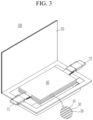
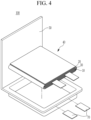
- FIGS. 1 to 4 are schematic views illustrating a rechargeable lithium battery according to an embodiment.
- FIG. 1 shows a cylindrical battery
- FIG. 2 shows a prismatic battery
- FIGS. 3 and 4 show pouch-type batteries.
- the rechargeable lithium battery 100 includes an electrode assembly 40 with a separator 30 interposed between a positive electrode 10 and a negative electrode 20, and a case 50 in which the electrode assembly 40 is housed.
- the positive electrode 10, the negative electrode 20, and the separator 30 may be impregnated with an electrolyte.
- the rechargeable lithium battery 100 may include a sealing member 60 sealing the case 50 as shown in FIG. 1 .
- the rechargeable lithium battery 100 may include a positive lead tab 11, a positive terminal 12, a negative lead tab 21, and a negative terminal 22.
- the rechargeable lithium battery 100 includes an electrode tab 70 ( FIG. 4 ), for example, a positive electrode tab 71 and a negative electrode tab 72 ( FIG. 3 ) serving as an electrical path for inducing the current formed in the electrode assembly 40 to the outside.
- the negative electrode may include a current collector and a negative electrode active material layer on the current collector, and may further include a negative electrode active material, a binder, a conductive material (e.g., an electrically conductive material), or a combination thereof.
- a negative electrode active material e.g., an electrically conductive material
- the negative electrode active material may include a material that reversibly intercalates/deintercalates lithium ions, a lithium metal, a lithium metal alloy, a material capable of doping/dedoping lithium, and/or a transition metal oxide.
- the material that reversibly intercalates/deintercalates lithium ions may include, for example crystalline carbon, amorphous carbon, or a combination thereof as a carbon-based negative electrode active material.
- the crystalline carbon may be irregular, and/or sheet, flake, spherical, and/or fiber shaped natural graphite and/or artificial graphite.
- the amorphous carbon may be a soft carbon, a hard carbon, a mesophase pitch carbonization product, calcined coke, and/or the like.
- the lithium metal alloy includes an alloy of lithium and a metal selected from Na, K, Rb, Cs, Fr, Be, Mg, Ca, Sr, Si, Sb, Pb, In, Zn, Ba, Ra, Ge, Al, and Sn (e.g. Na, K, Rb, Cs, Be, Mg, Ca, Sr, Si, Sb, Pb, In, Zn, Ba, Ge, Al, and Sn) .
- a metal selected from Na, K, Rb, Cs, Fr, Be, Mg, Ca, Sr, Si, Sb, Pb, In, Zn, Ba, Ge, Al, and Sn
- the material capable of doping/dedoping lithium may be a Si-based negative electrode active material and/or a Sn-based negative electrode active material.
- the Si-based negative electrode active material may include silicon, a silicon-carbon composite, SiO x (0 ⁇ x ⁇ 2), a Si-Q alloy (wherein Q is an element selected from an alkali metal, an alkaline-earth metal, a Group 13 element, a Group 14 element (excluding Si), a Group 15 element, a Group 16 element, a transition metal, a rare earth element, and a combination thereof, for example Mg, Ca, Sr, Ba, Ra, Sc, Y, Ti, Zr, Hf, Rf, V, Nb, Ta, Db, Cr, Mo, W, Sg, Tc, Re, Bh, Fe, Pb, Ru, Os, Hs, Rh, Ir, Pd, Pt, Cu, Ag, Au, Zn, Cd, B, Al, Ga, Sn, In, Tl, Ge, P
- the Sn-based negative electrode active material may be Sn, SnO 2 , a Sn alloy, or a combination thereof.
- the silicon-carbon composite may be a composite of silicon and amorphous carbon.
- An average particle diameter (D 50 ) of the silicon-carbon composite particles may be, for example, about 0.5 ⁇ m to about 20 ⁇ m.
- the silicon-carbon composite may be in the form of silicon particles and amorphous carbon coated on the surface of the silicon particles.
- it may include a secondary particle (core) in which silicon primary particles are assembled and an amorphous carbon coating layer (shell) on the surface of the secondary particle.
- the amorphous carbon may also be present between the silicon primary particles, for example, the silicon primary particles may be coated with amorphous carbon.
- the secondary particles may exist dispersed in an amorphous carbon matrix.
- the silicon-carbon composite may further include crystalline carbon.
- the silicon-carbon composite may include a core including crystalline carbon and silicon particles and an amorphous carbon coating layer on the surface of the core.
- the crystalline carbon may be artificial graphite, natural graphite, or a combination thereof.
- the amorphous carbon may include soft carbon and/or hard carbon, a mesophase pitch carbonized product, and/or calcined coke.
- a content of silicon may be about 10 wt% to about 50 wt% and a content of amorphous carbon may be about 50 wt% to about 90 wt% based on 100 wt% of the silicon-carbon composite.
- a content of silicon when the composite includes silicon, amorphous carbon, and crystalline carbon, a content of silicon may be about 10 wt% to about 50 wt%, a content of crystalline carbon may be about 10 wt% to about 70 wt%, and a content of amorphous carbon may be about 20 wt% to about 40 wt% based on 100 wt% of the silicon-carbon composite.
- a thickness of the amorphous carbon coating layer may be about 5 nm to about 100 nm.
- An average particle diameter (D 50 ) of the silicon particles (primary particles) may be about 10 nm to about 1 ⁇ m, or about 10 nm to about 200 nm.
- the silicon particles may exist as silicon alone, in the form of a silicon alloy, and/or in an oxidized form.
- the oxidized form of silicon may be represented by SiO x (0 ⁇ x ⁇ 2).
- the atomic content ratio of Si:O which indicates a degree of oxidation, may be about 99:1 to about 33:67.
- an average particle diameter (D 50 ) indicates a particle where an accumulated volume is about 50 volume% in a particle distribution.
- the Si-based negative electrode active material and/or Sn-based negative electrode active material may be mixed together with the carbon-based negative electrode active material.
- the mixing ratio may be a weight ratio of about 1:99 to about 90:10.
- the binder serves to well adhere the negative electrode active material particles to each other and also to adhere the negative electrode active material to the current collector.
- the binder may be a non-aqueous binder, an aqueous binder, a dry binder, or a combination thereof.
- the non-aqueous binder may include polyvinyl chloride, carboxylated polyvinyl chloride, polyvinyl fluoride, an ethylene propylene copolymer, polystyrene, polyurethane, polytetrafluoroethylene, polyvinylidene fluoride, polyethylene, polypropylene, polyamideimide, polyimide, or a combination thereof.
- the aqueous binder may include a styrene-butadiene rubber, a (meth)acrylated styrene-butadiene rubber, a (meth)acrylonitrile-butadiene rubber, a (meth)acrylic rubber, butyl rubber, a fluorine rubber, polyethylene oxide, polyvinylpyrrolidone, polyepichlorohydrin, polyphosphazene, poly(meth)acrylonitrile, an ethylene propylene diene copolymer, polyvinylpyridine, chlorosulfonated polyethylene, latex, a polyester resin, a (meth)acrylic resin, a phenol resin, an epoxy resin, polyvinyl alcohol, or a combination thereof.
- a cellulose-based compound capable of imparting viscosity may be further included.
- the cellulose-based compound one or more of carboxymethyl cellulose, hydroxypropylmethyl cellulose, methyl cellulose, or alkali metal salts thereof may be mixed together and used.
- the alkali metal may be Na, K, and/or Li.
- the dry binder may be a polymer material capable of becoming fiber (e.g., capable of being fibrillized or fiberized), and may be, for example, polytetrafluoroethylene, polyvinylidene fluoride, a polyvinylidene fluoride-hexafluoropropylene copolymer, polyethylene oxide, or a combination thereof.
- the conductive material is included to provide electrode conductivity (e.g., electrical conductivity) and any suitable electrically conductive material may be used as a conductive material (e.g., an electrically conductive material) unless it causes a chemical change (e.g., an undesirable chemical change in the rechargeable lithium battery).
- electrode conductivity e.g., electrical conductivity
- any suitable electrically conductive material may be used as a conductive material (e.g., an electrically conductive material) unless it causes a chemical change (e.g., an undesirable chemical change in the rechargeable lithium battery).
- the conductive material examples include a carbon-based material such as natural graphite, artificial graphite, carbon black, acetylene black, ketjen black, a carbon fiber, a carbon nanofiber, a carbon nanotube, and the like; a metal-based material of a metal powder and/or a metal fiber including copper, nickel, aluminum silver, and the like; a conductive polymer (e.g., an electrically conductive polymer) such as a polyphenylene derivative; or a mixture thereof.
- a carbon-based material such as natural graphite, artificial graphite, carbon black, acetylene black, ketjen black, a carbon fiber, a carbon nanofiber, a carbon nanotube, and the like
- a metal-based material of a metal powder and/or a metal fiber including copper, nickel, aluminum silver, and the like
- a conductive polymer e.g., an electrically conductive polymer
- a content of the negative electrode active material may be about 95 wt% to about 99.5 wt% based on 100 wt% of the negative electrode active material layer, and a content of the binder may be about 0.5 wt% to about 5 wt% based on 100 wt% of the negative electrode active material layer.
- the negative electrode active material layer may include about 90 wt% to about 99 wt% of the negative electrode active material, about 0.5 wt% to about 5 wt% of the binder, and about 0.5 wt% to about 5 wt% of the conductive material.
- the negative current collector may include, for example, indium (In), copper (Cu), magnesium (Mg), stainless steel, titanium (Ti), iron (Fe), cobalt (Co), nickel (Ni), zinc (Zn), aluminum (Al), germanium (Ge), lithium (Li), and/or an alloy thereof, and may be in the form of a foil, sheet, and/or foam.
- a thickness of the negative current collector may be, for example, about 1 ⁇ m to about 20 ⁇ m, about 5 ⁇ m to about 15 ⁇ m, or about 7 ⁇ m to about 10 ⁇ m.
- the electrolyte for a rechargeable lithium battery may be an electrolyte, which may include a non-aqueous organic solvent and a lithium salt.
- the non-aqueous organic solvent serves as a medium that transmits ions taking part in the electrochemical reaction of a battery.
- the non-aqueous organic solvent may be a carbonate-based, ester-based, ether-based, ketone-based, and/or alcohol-based solvent, an aprotic solvent, or a combination thereof.
- the carbonate-based solvent may include dimethyl carbonate (DMC), diethyl carbonate (DEC), dipropyl carbonate (DPC), methylpropyl carbonate (MPC), ethylpropyl carbonate (EPC), methylethyl carbonate (MEC), ethylene carbonate (EC), propylene carbonate (PC), butylene carbonate (BC), and/or the like.
- the ester-based solvent may include methyl acetate, ethyl acetate, n-propyl acetate, dimethyl acetate, methyl propionate, ethyl propionate, decanolide, mevalonolactone, valerolactone, caprolactone, and/or the like.
- the ether-based solvent may include dibutyl ether, tetraglyme, diglyme, dimethoxyethane, 2-methyltetrahydrofuran, 2,5-dimethyltetrahydrofuran, tetrahydrofuran, and/or the like.
- the ketone-based solvent may include cyclohexanone, and/or the like.
- the alcohol-based solvent may include ethanol, isopropyl alcohol, and/or the like and the aprotic solvent may include nitriles such as R-CN (wherein R is a C2 to C20 linear, branched, or cyclic hydrocarbon group, a double bond, an aromatic ring, and/or an ether bond, and/or the like; amides such as dimethylformamide; dioxolanes such as 1,3-dioxolane, 1,4-dioxolane, and/or the like; sulfolanes, and/or the like.
- R-CN wherein R is a C2 to C20 linear, branched, or cyclic hydrocarbon group, a double bond, an aromatic ring, and/or an ether bond, and/or the like
- amides such as dimethylformamide
- dioxolanes such as 1,3-dioxolane, 1,4-dioxolane, and/or the like
- the non-aqueous organic solvent can be used alone or in a mixture of two or more types (or kinds), and when two or more types (or kinds) are used in a mixture, a mixing ratio can be suitable or appropriately adjusted according to suitable or desired battery performance, which should be readily apparent to those working in the field upon reviewing this disclosure.
- a cyclic carbonate and a chain carbonate may be mixed together and used, and the cyclic carbonate and the chain carbonate may be mixed together in a volume ratio of about 1:1 to about 1:9.
- the electrolyte may further include vinyl ethylene carbonate, vinylene carbonate, and/or an ethylene carbonate-based compound to improve battery cycle-life.
- Examples of the ethylene carbonate-based compound may include fluoroethylene carbonate, difluoroethylene carbonate, chloroethylene carbonate, dichloroethylene carbonate, bromoethylene carbonate, dibromoethylene carbonate, nitroethylene carbonate, and cyanoethylene carbonate.
- the lithium salt dissolved in the organic solvent supplies lithium ions in a battery, enables a basic operation of a rechargeable lithium battery, and improves transportation of the lithium ions between positive and negative electrodes.
- the lithium salt may include at least one selected from LiPF 6 , LiBF 4 , LiSbF 6 , LiAsF 6 , LiClO 4 , LiAlO 2 , LiAlCl 4 , LiPO 2 F 2 , LiCl, Lil, LiN(SO 3 C 2 F 5 ) 2 , Li(FSO 2 ) 2 N (lithium bis(fluorosulfonyl)imide; LiFSI), LiC 4 F 9 SO 3 , LiN(C x F 2x+1 SO 2 )(C y F 2y+1 SO 2 ) (wherein x and y are integers of 1 to 20), lithium trifluoromethane sulfonate, lithium tetrafluoroethanesulfonate, lithium difluorobis(o
- a concentration of lithium salt may be within the range of about 0.1 M to about 2.0 M.
- the electrolyte has suitable or appropriate ion conductivity and viscosity, and thus excellent performance can be achieved and lithium ions can move effectively.
- a separator may be present between the positive electrode and the negative electrode.
- the separator may include polyethylene, polypropylene, polyvinylidene fluoride, or a multilayer film of two or more layers thereof, and a mixed multilayer film such as a polyethylene/polypropylene two-layer separator, polyethylene/polypropylene/polyethylene three-layer separator, polypropylene/polyethylene/polypropylene three-layer separator, and/or the like.
- the separator may include a porous substrate and a coating layer including an organic material, an inorganic material, or a combination thereof on one or both surfaces of the porous substrate.
- the porous substrate may be a polymer film formed of any one selected from a polymer polyolefin such as polyethylene and polypropylene, polyester such as polyethylene terephthalate and polybutylene terephthalate, polyacetal, polyamide, polyimide, polycarbonate, polyether ketone, polyarylether ketone, polyetherimide, polyamideimide, polybenzimidazole, polyethersulfone, polyphenylene oxide, a cyclic olefin copolymer, polyphenylene sulfide, polyethylene naphthalate, a glass fiber, TEFLON, and polytetrafluoroethylene, and/or a copolymer and/or a mixture of two or more thereof.
- a polymer polyolefin such as polyethylene and polypropylene
- polyester such as polyethylene terephthalate and polybutylene terephthalate
- polyacetal polyamide, polyimide, polycarbonate, polyether ketone,
- the porous substrate may have a thickness of about 1 ⁇ m to about 40 ⁇ m, for example, about 1 ⁇ m to about 30 ⁇ m, about 1 ⁇ m to about 20 ⁇ m, about 5 ⁇ m to about 15 ⁇ m, or about 10 ⁇ m to about 15 ⁇ m.
- the organic material may include a (meth)acryl-based copolymer including a first structural unit derived from (meth)acrylamide, and a second structural unit including at least one selected from a structural unit derived from (meth)acrylic acid or (meth)acrylate, and a structural unit derived from (meth)acrylamidosulfonic acid or a salt thereof.
- the inorganic material may include inorganic particles selected from Al 2 O 3 , SiO 2 , TiO 2 , SnO 2 , CeO 2 , MgO, NiO, CaO, GaO, ZnO, ZrO 2 , Y 2 O 3 , SrTiO 3 , BaTiO 3 , Mg(OH) 2 , boehmite, and a combination thereof, but is not limited thereto.
- An average particle diameter (D 50 ) of the inorganic particles may be about 1 nm to about 2000 nm, for example, about 100 nm to about 1000 nm, or about 100 nm to about 700 nm.
- the organic material and the inorganic material may be mixed together in one coating layer, or a coating layer including an organic material and a coating layer including an inorganic material may be stacked.
- the thickness of the coating layer may be about 0.5 ⁇ m to about 20 ⁇ m, for example, about 1 ⁇ m to about 10 ⁇ m, or about 1 ⁇ m to about 5 ⁇ m.
- NiSO 4 ⁇ 6H 2 O nickel sulfate
- MnSO 4 ⁇ H 2 O manganese sulfate
- aqueous ammonia aqueous ammonia
- NaOH sodium hydroxide
- the metal raw material mixed solution and the complex agent were injected thereinto at a rate of 142 ml/min and 34 ml/min, respectively, and a stirring power of 3.0 kW/m 3 at 50 °C to initiate a reaction. While NaOH was injected thereinto to maintain pH, the reaction was performed for 30 hours. The reaction was ended, when an average size of the obtained particles reached about 10.5 ⁇ m. The obtained resulting material was washed and dried with hot air at about 150 °C for 24 hours to obtain a nickel-manganese-based composite hydroxide (Ni 0.5 Mn 0.5 (OH) 2 ).
- Ni 0.5 Mn 0.5 (OH) 2 nickel-manganese-based composite hydroxide
- a loading level of the positive electrode active material layer was 10 mg/cm 2
- a density of the final rolled positive electrode was about 3.5 g/cc.
- a rechargeable lithium battery was manufactured by an existing method using a lithium counter electrode as the negative electrode, a polytetrafluoroethylene separator, and an electrolyte solution including 1 M LiPF 6 dissolved in a solvent in which ethylene carbonate, ethylmethyl carbonate, and dimethyl carbonate were mixed together in a volume ratio of 2:4:4, and 1.5 wt% of vinylene carbonate.
- a positive electrode active material and a rechargeable lithium battery cell were manufactured in substantially the same manner as in Example 1 except that a positive electrode active material precursor was prepared by changing the molar ratio of Ni and Mn to 66:34.
- the positive electrode active material of Example 2 may be expressed as 0.15[Li 1.13 Ni 0.57 Mn 0.30 O 2 ] + 0.85[0.61(LiNi 0.94 Mn 0.06 O 2 )+0.26 (Li 2 MnO 3 )].
- a positive electrode active material and a rechargeable lithium battery cell were manufactured in substantially the same manner as in Example 1 except that the positive electrode active material was prepared by changing the molar ratio of Li/(Ni+Mn) to 1.2.
- the positive electrode active material of Example 3 may be expressed as 0.41[Li 1.09 Ni 0.46 Mn 0.46 O 2 ] + 0.59[0.85(LiNi 0.56 Mn 0.44 O 2 ) + 0.10(Li 2 MnO 3 )].
- a positive electrode active material and a rechargeable lithium battery cell were manufactured in substantially the same manner as in Example 1 except that the positive electrode active material was prepared by changing the molar ratio of Li/(Ni+Mn) to 1.1.
- the positive electrode active material of Example 4 may be expressed as 0.43[Li 1.05 Ni 0.48 Mn 0.48 O 2 ] + 0.57[0.85(LiNi 0.56 Mn 0.44 O 2 ) + 0.10(Li 2 MnO 3 )].
- a positive electrode active material and a rechargeable lithium battery cell were manufactured in substantially the same manner as in Example 1 except that a positive electrode active material precursor was prepared by changing the molar ratio of Ni and Mn to 34:66.
- the positive electrode active material of Comparative Example 1 may be expressed as 0.66(LiNi 0.50 Mn 0.50 O 2 ) + 0.34(Li 2 MnO 3 ).
- a positive electrode active material and a rechargeable lithium battery cell were manufactured in substantially the same manner as in Example 1 except that a positive electrode active material precursor was prepared by changing the molar ratio of Ni and Mn to 40:60.
- the positive electrode active material of Comparative Example 2 may be expressed as 0.70(LiNi 0.57 Mn 0.43 O 2 ) + 0.30(Li 2 MnO 3 ).
- a positive electrode active material and a rechargeable lithium battery cell were manufactured in substantially the same manner as in Example 1 except that a positive electrode active material precursor was prepared by changing the molar ratio of Ni and Mn to 75:25.
- the positive electrode active material of Comparative Example 3 may be expressed as 0.75 ⁇ LiNiO 2 +0.25(Li 2 MnO 3 ).
- a positive electrode active material and a rechargeable lithium battery cell were manufactured in substantially the same manner as in Example 1 except that a positive electrode active material precursor was prepared by changing the molar ratio of Ni and Mn to 80:20.
- the positive electrode active material of Comparative Example 4 may be expressed as 0.80 ⁇ LiNiO 2 + 0.20(Li 2 MnO 3 )+0.05Li 2 O.
- a positive electrode active material and a rechargeable lithium battery cell were manufactured in substantially the same manner as in Example 2 except that the heat treatment temperature was changed to 700 °C.
- a positive electrode active material and a rechargeable lithium battery cell were manufactured in substantially the same manner as in Example 2 except that the heat treatment temperature was changed to 500 °C.
- each design content of the positive electrode active materials of Examples 1 and 2 and Comparative Examples 1 to 4 is simply shown in Table 1, wherein the contents of Examples 1, 3, and 4 are shown in Table 2, while the contents of Examples 2 and 5 and Comparative Example 5 are shown in Table 3.
- the positive electrode active materials of the examples satisfied a I a /I b ratio of less than or equal to 2%.
- Comparative Examples 1 and 2 having a nickel content of less than 50 mol% satisfied a I a /I b ratio of greater than 2%.
- the molar ratio of lithium to total metal excluding the lithium decreased from 1.3 to 1.1
- the I a /I b ratio decreased, and a ratio of capacity by O-redox to total capacity also decreased, and as an average discharge voltage increased, the voltage drop tendency was also reduced.
- FIG. 5 XRD analysis graphs of the positive electrode active materials of Examples 2 and 5 and Comparative Example 5 are shown in FIG. 5 .
- a horizontal axis means 2 ⁇ (°).
- a large graph represents a peak on the (003) plane
- a small graph represents a peak on the (020) plane.
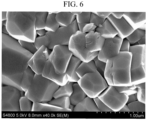
- FIGS. 6 to 8 show SEM images of the particle surfaces of the positive electrode active materials of Examples 2 and 5 and Comparative Example 5 in order. Referring to FIGS. 6 to 8 , the particles each had a different shape depending on a heat treatment temperature.
- the examples satisfied an a-axis lattice constant of greater than or equal to 2.865 ⁇ or greater than or equal to 2.875 ⁇ and concurrently (e.g., simultaneously), a ratio of a "c" lattice constant to the "a" lattice constant (c/a) of less than or equal to 4.968.
- a ratio of capacity by O-redox to total capacity decreased, an average discharge voltage increased, and the voltage drop tendency decreased.
- each of the positive electrode active materials of Examples 1 to 4 and Comparative Examples 1 to 4 was pressed at a pressure of 3.3 tons into a pellet, of which density was measured, and the results are shown as P/D (pellet density) in Tables 1 and 2.
- P/D pellet density
- the positive electrode active materials of the examples had a pellet density of greater than 2.70 g/cc, which turned out to be higher than those of Comparative Examples 1 and 2 having a high O-redox ratio due to a high manganese content.
- the pellet density turned out to increase.
- Comparative Examples 3 and 4 having a low manganese content exhibited higher pellet density than the examples but had difficulty in realizing high capacity due to an additional capacity ratio by O-redox of less than or equal to 0. Accordingly, the positive electrode active materials of the examples realized additional capacity by O-redox and concurrently (e.g., simultaneously), had a pellet density of greater than of 2.70 g/cc, resulting in realizing much higher electrode density.
- LiNiO 2 , LiMnO 2 , Li 2 MnO 3 which are basic materials of the positive electrode active material, each have theoretical density of 4.62 g/cc, 4.04 g/cc, and 3.73 g/cc
- a lithium-manganese-rich material such as the positive electrode active material of some embodiments tends to have lower theoretical density, as a Mn proportion is higher, but the theoretical density is higher, as a Ni proportion is higher.
- O-redox was expressed from Li 2 MnO 3 , the O-redox, which was used to achieve high capacity, conversely lowered the theoretical density, thereby canceling out the effect of increasing capacity.
- Examples 1 and 2 had a higher Mn and lower Ni proportion than Comparative Examples 1 and 2 having high O-redox proportion and thus exhibited high theoretical density but had a higher Mn proportion than Comparative Examples 3 and 4 and thus exhibited low theoretical density but realized high capacity due to expression of O-redox, wherein a strategy of finding a balance between suitable or appropriate O-redox expression and theoretical density was applied.
- the positive electrode active materials of Examples 1 to 4 and Comparative Examples 1 to 4 were measured with respect to a residual lithium content on the surface in an HCl titration method, and the results are shown in Tables 1 and 2.
- the residual lithium content which was measured by using a unit of ppm, was 10 -4 wt% based on 100 wt% of each positive electrode active material.
- 10 g of the positive electrode active material was added to 100 ml of distilled water and then, stirred for 30 minutes at 300 rpm and then, measured with respect to pH changes, while adding HCl thereto.
- the examples had an O-redox proportion of less than 15%.
- Comparative Examples 1 and 2 exhibited a high O-redox proportion of greater than or equal to 19.6%, and Comparative Examples 3 and 4 exhibited no O-redox expression capacity.
- the O-redox proportion decreased much further.
- the half-cells of Examples 1 to 4 and Comparative Examples 1 to 4 were charged and discharged as the first set and measured with respect to an average discharge voltage at the second cycle, and the results are shown as "average voltage" in Tables 1 and 2.
- the average discharge voltage was obtained by obtaining a discharge voltage curve (a voltage-capacity graph) after charging and discharging the half-cells, integrating an area under the curved line, and dividing the area by the discharge capacity.
- Comparative Examples 1 and 2 exhibited an average discharge voltage of less than or equal to 3.80 V, but the examples exhibited an improved average discharge voltage of greater than or equal to 3.83 V.
- the molar ratio of lithium to total metal excluding the lithium decreased from 1.3 to 1.1, the average discharge voltage increased.
- Examples 1 to 4 and Comparative Examples 1 to 4 were charged and discharged as the first set and then, 50 times or more repeatedly charged and discharged at 1.0 C within a voltage range of 3.0 V to 4.45 V at 45 °C to calculate a ratio of 50 th cycle discharge capacity to initial discharge capacity, which is shown as "high temperature cycle-life" in Tables 1 and 2.
- the result is shown as "voltage drop" in Tables 1 and 2.
- Comparative Examples 3 and 4 exhibited deteriorated cycle-life characteristics, that is, capacity retention of less than or equal to 71% at the 50 th cycle, but the examples realized cycle-life characteristics of greater than or equal to 77% or greater than or equal to 94%.
- Comparative Examples 1 and 2 exhibited a voltage drop of greater than or equal to 90 mV, but the examples exhibited a lowered voltage drop of less than or equal to 70 mV.
Landscapes
- Chemical & Material Sciences (AREA)
- Organic Chemistry (AREA)
- Inorganic Chemistry (AREA)
- Electrochemistry (AREA)
- General Chemical & Material Sciences (AREA)
- Chemical Kinetics & Catalysis (AREA)
- Engineering & Computer Science (AREA)
- Manufacturing & Machinery (AREA)
- Materials Engineering (AREA)
- Composite Materials (AREA)
- Battery Electrode And Active Subsutance (AREA)
- Secondary Cells (AREA)
- Inorganic Compounds Of Heavy Metals (AREA)
Applications Claiming Priority (1)
| Application Number | Priority Date | Filing Date | Title |
|---|---|---|---|
| KR1020230130990A KR20250046921A (ko) | 2023-09-27 | 2023-09-27 | 양극 활물질과 이를 포함하는 양극, 및 리튬 이차 전지 |
Publications (1)
| Publication Number | Publication Date |
|---|---|
| EP4530257A1 true EP4530257A1 (de) | 2025-04-02 |
Family
ID=92900072
Family Applications (1)
| Application Number | Title | Priority Date | Filing Date |
|---|---|---|---|
| EP24202274.7A Pending EP4530257A1 (de) | 2023-09-27 | 2024-09-24 | Positivelektrodenaktivmaterial, positivelektrode und wiederaufladbare lithiumbatterien |
Country Status (5)
| Country | Link |
|---|---|
| US (1) | US20250105272A1 (de) |
| EP (1) | EP4530257A1 (de) |
| JP (1) | JP2025059073A (de) |
| KR (1) | KR20250046921A (de) |
| CN (1) | CN119725517A (de) |
Citations (3)
| Publication number | Priority date | Publication date | Assignee | Title |
|---|---|---|---|---|
| CN102664255A (zh) * | 2012-05-28 | 2012-09-12 | 奇瑞汽车股份有限公司 | 锂镍锰氧材料及其制备方法、含该材料的锂离子电池 |
| CN103715410A (zh) * | 2012-09-29 | 2014-04-09 | 中信国安盟固利动力科技有限公司 | 一种高能复合锂离子电池正极材料 |
| CN104779385A (zh) * | 2015-04-21 | 2015-07-15 | 哈尔滨工业大学(威海) | 一种高比容量锂离子电池正极材料及其制备方法 |
Family Cites Families (5)
| Publication number | Priority date | Publication date | Assignee | Title |
|---|---|---|---|---|
| JP2015130272A (ja) * | 2014-01-07 | 2015-07-16 | 日立金属株式会社 | 非水系二次電池用正極、非水系二次電池用正極活物質、非水系二次電池及び車載用非水系二次電池モジュール |
| JP2016051504A (ja) * | 2014-08-28 | 2016-04-11 | 日立金属株式会社 | 非水系二次電池用正極活物質、非水系二次電池用正極、非水系二次電池及び車載用非水系二次電池モジュール |
| JP6511761B2 (ja) * | 2014-10-01 | 2019-05-15 | 住友金属鉱山株式会社 | 非水系電解質二次電池用正極活物質用の被覆複合酸化物粒子の製造方法及び当該製造方法によって製造される被覆複合酸化物粒子を用いた非水系電解質二次電池 |
| KR102595176B1 (ko) * | 2020-06-18 | 2023-10-27 | 삼성에스디아이 주식회사 | 리튬이차전지용 니켈계 복합양극활물질, 그 제조방법 및 이를 포함하는 양극을 함유한 리튬이차전지 |
| US20230282820A1 (en) * | 2020-07-24 | 2023-09-07 | Uchicago Argonne, Llc | Cathode materials for use in lithium cells and batteries |
-
2023
- 2023-09-27 KR KR1020230130990A patent/KR20250046921A/ko active Pending
-
2024
- 2024-09-23 US US18/893,638 patent/US20250105272A1/en active Pending
- 2024-09-24 EP EP24202274.7A patent/EP4530257A1/de active Pending
- 2024-09-27 JP JP2024167963A patent/JP2025059073A/ja active Pending
- 2024-09-27 CN CN202411358231.XA patent/CN119725517A/zh active Pending
Patent Citations (3)
| Publication number | Priority date | Publication date | Assignee | Title |
|---|---|---|---|---|
| CN102664255A (zh) * | 2012-05-28 | 2012-09-12 | 奇瑞汽车股份有限公司 | 锂镍锰氧材料及其制备方法、含该材料的锂离子电池 |
| CN103715410A (zh) * | 2012-09-29 | 2014-04-09 | 中信国安盟固利动力科技有限公司 | 一种高能复合锂离子电池正极材料 |
| CN104779385A (zh) * | 2015-04-21 | 2015-07-15 | 哈尔滨工业大学(威海) | 一种高比容量锂离子电池正极材料及其制备方法 |
Non-Patent Citations (1)
| Title |
|---|
| PARK ET AL: "Lithium-manganese-nickel-oxide electrodes with integrated layered-spinel structures for lithium batteries", ELECTROCHEMISTRY COMMUNICATIONS, ELSEVIER AMSTERDAM, NL, vol. 9, no. 2, 7 February 2007 (2007-02-07), pages 262 - 268, XP005878764, ISSN: 1388-2481, DOI: 10.1016/J.ELECOM.2006.09.014 * |
Also Published As
| Publication number | Publication date |
|---|---|
| US20250105272A1 (en) | 2025-03-27 |
| CN119725517A (zh) | 2025-03-28 |
| JP2025059073A (ja) | 2025-04-09 |
| KR20250046921A (ko) | 2025-04-03 |
Similar Documents
| Publication | Publication Date | Title |
|---|---|---|
| EP4501862B1 (de) | Positivelektrodenaktivmaterial, positivelektrode und wiederaufladbare lithiumbatterien | |
| EP4557316A1 (de) | Aktivierungsverfahren für wiederaufladbare lithiumbatterien und wiederaufladbare lithiumbatterien | |
| EP4545489A1 (de) | Positivelektroden-aktivmaterialien, positivelektroden und wiederaufladbare lithiumbatterien | |
| EP4512779A1 (de) | Aktives material für positive elektroden, verfahren zu dessen herstellung, positive elektrode und wiederaufladbare lithiumbatterien | |
| US20250105272A1 (en) | Positive electrode active material, positive electrode, and rechargeable lithium batteries | |
| US20250174650A1 (en) | Positive electrode active materials and rechargeable lithium batteries | |
| EP4693428A1 (de) | Vorbehandlungsverfahren für ein positivelektrodenaktivmaterial, positivelektrode und wiederaufladbare lithiumbatterien | |
| EP4507022A1 (de) | Positivelektrodenaktivmaterial, positivelektrode und wiederaufladbare lithiumbatterien | |
| EP4549398A1 (de) | Positivelektrodenaktivmaterial, herstellungsverfahren dafür, positivelektrode und wiederaufladbare lithiumbatterien | |
| EP4593110A1 (de) | Positivelektroden-aktivmaterialien, positivelektroden und wiederaufladbare lithiumbatterien | |
| EP4725910A1 (de) | Herstellungsverfahren dafür und herstellungsverfahren für ein positivelektrodenaktivmaterial damit | |
| KR102964602B1 (ko) | 양극 활물질과 그 제조 방법, 이를 포함하는 양극, 및 리튬 이차 전지 | |
| KR102964601B1 (ko) | 양극 활물질과 그 제조 방법, 이를 포함하는 양극, 및 리튬 이차 전지 | |
| EP4520725A1 (de) | Aktives material für positive elektroden, verfahren zu dessen herstellung, positive elektrode und wiederaufladbare lithiumbatterien | |
| EP4593105A1 (de) | Positivelektroden-aktivmaterialien, positivelektroden und wiederaufladbare lithiumbatterien | |
| KR102962662B1 (ko) | 양극 활물질과 그 제조 방법, 이를 포함하는 양극, 및 리튬 이차 전지 | |
| US20250246602A1 (en) | Positive electrode active materials, positive electrodes, and rechargeable lithium batteries | |
| EP4600219A1 (de) | Positivelektroden-aktivmaterialien, herstellungsverfahren dafür, positivelektroden und wiederaufladbare lithiumbatterien | |
| US20250246601A1 (en) | Positive electrode active materials, positive electrodes, and rechargeable lithium batteries | |
| EP4686703A1 (de) | Positivelektrodenaktivmaterial, herstellungsverfahren dafür, positivelektrode und wiederaufladbare lithiumbatterien | |
| EP4730419A1 (de) | Positivelektroden-aktivmaterialien, positivelektroden und wiederaufladbare lithiumbatterien | |
| EP4477624A1 (de) | Positivelektrodenaktivmaterial, herstellungsverfahren dafür, positivelektrode und wiederaufladbare lithiumbatterien | |
| EP4593115A1 (de) | Positivelektroden-aktivmaterialien, herstellungsverfahren dafür, positivelektroden und wiederaufladbare lithiumbatterien | |
| EP4501861A1 (de) | Positivelektrodenaktivmaterial, herstellungsverfahren dafür, positivelektrode und wiederaufladbare lithiumbatterien | |
| EP4654279A1 (de) | Positivelektroden-aktivmaterialien, herstellungsverfahren für positivelektroden-aktivmaterialien, positivelektroden und wiederaufladbare lithiumbatterien |
Legal Events
| Date | Code | Title | Description |
|---|---|---|---|
| PUAI | Public reference made under article 153(3) epc to a published international application that has entered the european phase |
Free format text: ORIGINAL CODE: 0009012 |
|
| STAA | Information on the status of an ep patent application or granted ep patent |
Free format text: STATUS: REQUEST FOR EXAMINATION WAS MADE |
|
| 17P | Request for examination filed |
Effective date: 20240924 |
|
| AK | Designated contracting states |
Kind code of ref document: A1 Designated state(s): AL AT BE BG CH CY CZ DE DK EE ES FI FR GB GR HR HU IE IS IT LI LT LU LV MC ME MK MT NL NO PL PT RO RS SE SI SK SM TR |