EP4529271A1 - Kommunikationsverfahren und endgerätevorrichtung - Google Patents
Kommunikationsverfahren und endgerätevorrichtung Download PDFInfo
- Publication number
- EP4529271A1 EP4529271A1 EP23909202.6A EP23909202A EP4529271A1 EP 4529271 A1 EP4529271 A1 EP 4529271A1 EP 23909202 A EP23909202 A EP 23909202A EP 4529271 A1 EP4529271 A1 EP 4529271A1
- Authority
- EP
- European Patent Office
- Prior art keywords
- cell
- strength
- rsrp
- neighboring
- terminal
- Prior art date
- Legal status (The legal status is an assumption and is not a legal conclusion. Google has not performed a legal analysis and makes no representation as to the accuracy of the status listed.)
- Pending
Links
Images






Classifications
-
- H—ELECTRICITY
- H04—ELECTRIC COMMUNICATION TECHNIQUE
- H04W—WIRELESS COMMUNICATION NETWORKS
- H04W36/00—Hand-off or reselection arrangements
-
- H—ELECTRICITY
- H04—ELECTRIC COMMUNICATION TECHNIQUE
- H04W—WIRELESS COMMUNICATION NETWORKS
- H04W36/00—Hand-off or reselection arrangements
- H04W36/0005—Control or signalling for completing the hand-off
- H04W36/0055—Transmission or use of information for re-establishing the radio link
- H04W36/0058—Transmission of hand-off measurement information, e.g. measurement reports
-
- H—ELECTRICITY
- H04—ELECTRIC COMMUNICATION TECHNIQUE
- H04W—WIRELESS COMMUNICATION NETWORKS
- H04W36/00—Hand-off or reselection arrangements
- H04W36/0005—Control or signalling for completing the hand-off
- H04W36/0083—Determination of parameters used for hand-off, e.g. generation or modification of neighbour cell lists
- H04W36/00835—Determination of neighbour cell lists
-
- H—ELECTRICITY
- H04—ELECTRIC COMMUNICATION TECHNIQUE
- H04W—WIRELESS COMMUNICATION NETWORKS
- H04W36/00—Hand-off or reselection arrangements
- H04W36/24—Reselection being triggered by specific parameters
- H04W36/30—Reselection being triggered by specific parameters by measured or perceived connection quality data
- H04W36/302—Reselection being triggered by specific parameters by measured or perceived connection quality data due to low signal strength
Definitions
- Embodiments of this application relate to the communication field, and in particular, to a communication method and a terminal device.
- a terminal may perform wireless communication by accessing a cell corresponding to a base station.
- the cell accessed by the terminal may be referred to as a camped cell.
- a cell whose coverage overlaps that of the camped cell may be referred to as a neighboring cell.
- Embodiments of this application provide a communication method and a terminal device, so that a measurement report reported to a base station does not include an interfering cell. Therefore, handover to the interfering cell is avoided.
- a communication method is provided. The method is applied to a terminal, the terminal is located at a first location, the first location falls within signal coverage of a first cell, a second cell, and a third cell, and the second cell, the third cell, and the first cell are intra-RAT cells.
- the first cell is a currently camped cell of the terminal, and the second cell and the third cell are two neighboring cells of the first cell. Modulo interference exists between the second cell and the first cell, and no modulo interference exists between the third cell and the first cell.
- the method includes: receiving a first measurement event from a base station, where the first measurement event triggers the terminal to perform intra-RAT neighboring cell measurement; sending a first measurement report to the base station, where the first measurement report includes cell information of the third cell, and the first measurement report does not include cell information of the second cell; receiving a first handover indication from the base station, where the terminal device hands over the currently camped cell from the first cell to the third cell; and moving, by the terminal, to a second location, where the second location falls within signal coverage of the first cell, the third cell, and a fourth cell, the fourth cell and the first cell are intra-RAT cells, the terminal recamps on the first cell, no modulo interference exists between the first cell and the third cell, and no modulo interference exists between the first cell and the fourth cell.
- the method further includes: receiving a second measurement event from the base station, where the second measurement event triggers the terminal to perform intra-RAT neighboring cell measurement; and sending a second measurement report to the base station, where the second measurement report includes the cell information of the third cell and cell information of the fourth cell.
- a cell identity may include information such as a physical cell identifier PCI of a cell.
- the cell identity may be used to uniquely determine a cell.
- a measurement report fed back to the base station may not carry cell information of an interfering cell.
- the base station may preferentially select, as a handover object of the terminal, a non-interfering cell carried in the measurement report.
- the preferential selection process may be selecting a non-interfering cell with largest RSRP as the handover object of the terminal.
- the terminal measures the second cell, the third cell, and the first cell includes: the terminal measures RSRP of the second cell, the terminal measures the RSRP of the third cell, and the terminal measures the RSRP of the first cell.
- the method further includes: receiving a third measurement event from the base station, where the third measurement event triggers the terminal to perform intra-RAT neighboring cell measurement; sending a third measurement report to the base station, where the third measurement report includes the cell information of the third cell and the cell information of the second cell; and receiving a second handover indication from the base station, and handing over to the second cell according to the second handover indication.
- the RSRP of the second cell is greater than the RSRP of the first cell or the third cell. Therefore, when the terminal hands over to and camps on the second cell, better communication quality can also be obtained.
- the terminal moves to a fourth location, the fourth location falls within signal coverage of the first cell, the second cell, and a fifth cell, the terminal recamps on the first cell, modulo interference exists between the second cell and the first cell, and modulo interference exists between the fifth cell and the first cell.
- the method further includes: receiving a fourth measurement event from the base station, where the fourth measurement event triggers the terminal to perform intra-RAT neighboring cell measurement; and sending a fourth measurement report to the base station, where the fourth measurement report does not include the cell information of the second cell, and the fourth measurement report does not include cell information of the fifth cell.
- the terminal is located at the fourth location, and the RSRP of the first cell is seventh strength.
- the RSRP of the second cell is eighth strength.
- RSRP of the fifth cell is ninth strength. A difference between the seventh strength and the eighth strength is less than the first strength threshold. A difference between the seventh strength and the ninth strength is less than the first strength threshold.
- the method further includes: receiving a fifth measurement report from the base station, where the fifth measurement report triggers the terminal to perform inter-RAT measurement; sending a fifth measurement report to the base station, where the fifth measurement report includes cell information of a sixth cell, RSRP of the sixth cell is tenth strength, the tenth RSRP is greater than the seventh strength of the first cell, and a difference between the tenth RSRP and the seventh strength exceeds the second strength threshold; and receiving a third handover indication from the base station, and handing over to the sixth cell according to the third handover indication.
- a priority of the sixth cell is less than that of the first cell.
- the sixth cell may be a 3G cell.
- the terminal may camp on a network with a lower priority through fallback, to ensure a basic communication function.
- a 5G cell, a 4G cell, a 3G cell, and a 2G cell are in descending order of priorities of the cells, and the first cell is any one of the 5G cell, the 4G cell, and the 3G cell.
- a communication method is provided.
- the method is applied to a terminal, and the method includes: the terminal receives a first measurement event from a base station; determines, through measurement based on the first measurement event, whether modulo interference exists between a currently camped cell and each of all neighboring cells; when no modulo interference exists between at least one first neighboring cell in all the neighboring cells and the currently camped cell, includes the at least one first neighboring cell in candidate neighboring cells; when modulo interference exists between at least one second neighboring cell in all the neighboring cells and the currently camped cell, and a difference between RSRP of the second neighboring cell and RSRP of the currently camped cell is greater than a second strength threshold, includes the at least one second neighboring cell in the candidate neighboring cells; when modulo interference exists between at least one third neighboring cell in all the neighboring cells and the currently camped cell, and a difference between RSRP of the third neighboring cell and the RSRP of the currently camped cell is less than a first strength threshold, includes the
- the method further includes: obtaining cell quality parameters of the third neighboring cell and the currently camped cell, and determining a network environment evaluation value of the third neighboring cell based on the cell quality parameters of the third neighboring cell and the currently camped cell, where the cell quality parameter includes at least one of the following: RSRP, reference signal received quality RSRQ, a channel quality indicator CQI, a signal-to-noise ratio SNR, a block error rate BLER, and a cyclic redundancy check state CRC State, the network environment evaluation value is used to identify a signal difference degree between a neighboring cell and the currently camped cell, and a larger network environment evaluation value identifies a smaller signal difference degree between the neighboring cell and the currently camped cell; and determining that the network environment evaluation value of the third neighboring cell is greater than an interference threshold, and determining that the third neighboring cell is an interfering cell.
- the cell quality parameter includes at least one of the following: RSRP, reference signal received quality RSRQ, a channel quality indicator C
- a terminal device configured to perform cell handover according to the method provided in any one of the first aspect and the possible designs of the first aspect or any one of the second aspect and the possible designs of the second aspect.
- a computer program product includes instructions.
- the computer program product runs on a computer, the computer is enabled to perform, according to the instructions, the method provided in any one of the first aspect and the possible designs of the first aspect or the method provided in any one of the second aspect and the possible designs of the second aspect.
- first and second are used merely for the purpose of description, and shall not be construed as indicating or implying relative importance or implicitly indicating a quantity of indicated technical features. Therefore, a feature defined with “first” or “second” may explicitly or implicitly include one or more such features. In the descriptions of the embodiments, unless otherwise stated, "a plurality of" means two or more.
- a terminal device (which may also be simply referred to as a terminal) may access a network through communication with a base station.
- the network may include a 2G network, a 3G (3rd Generation) network, a 4G (4th Generation) network, a 5G (5th Generation) network, and the like.
- the 4G network may further include an LTE network
- the 5G network may include an NR network and the like.
- the terminal When the terminal falls within a range of a cell A, the terminal may access the network through communication with a base station A corresponding to the cell A.
- the LTE network is used as an example.
- the terminal may fall within coverage of a plurality of cells.
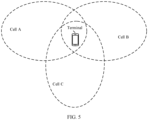
- a current location of the terminal may be covered by a cell A, a cell B, and a cell C.
- the terminal may select and camp on one of the cell A, the cell B, and the cell C, to implement access to the LTE network.
- the cell A may correspond to a base station A
- the cell B may correspond to a base station B
- the cell C may correspond to a base station C.
- a cell on which the terminal currently camps may be referred to as a camped cell.
- a cell that is adjacent to the camped cell and whose coverage includes the current location of the terminal is referred to as a neighboring cell.
- modulo interference exists between the camped cell and the neighboring cell, communication quality of the terminal is affected. The following describes the modulo interference.
- CRS Cell Reference Signal
- RB Resource Block
- the CRS may be determined based on information such as a physical cell identifier (Physical Cell Identifier, PCI) of a cell.
- PCI Physical Cell Identifier
- the LTE network is used as an example.
- a communication process between the terminal and a base station corresponding to the cell may be performed based on the RB.
- Composition of the RB may be separately described from a time domain perspective and a frequency domain perspective.
- one RB may include 12 contiguous subcarriers (subcarrier).
- each subframe may include two slots (slot). It may be understood that in the LTE network, a time domain length of one subframe may be 1 ms, and a time domain length of one slot may be 0.5 ms. In other words, one subframe includes two slots. Each slot may correspond to one RB. One subframe may include an RB pair (RB pair) including two RBs. Each slot may include seven symbols (symbol). Each symbol may correspond to one resource element (Resource Element, RE). Correspondingly, one RB may include, in time domain, one slot corresponding to seven symbols. It should be noted that an orthogonal frequency-division multiplexing (Orthogonal frequency-division multiplexing, OFDM) technology is used in the LTE network, and seven symbols in each slot may also be referred to as seven OFDM symbols.
- OFDM orthogonal frequency-division multiplexing
- information transmission is implemented by sending and/or receiving the RB.
- FIG. 3 is a schematic diagram of an RB. Each square corresponds to one RE.
- 12 rows of REs may be included in a longitudinal direction (frequency domain), and correspond to 12 subcarriers in frequency domain. Seven symbols may be included in a horizontal direction (time domain).
- the example in FIG. 3 shows a time domain distribution status of one RB pair.
- the RB pair may include an RB 1 and an RB 2.
- the RB 1 and the RB 2 each may include seven symbols in time domain.
- An RB pair of one subframe may include 14 symbols in time domain.
- the terminal receives a CRS-A sent by the base station A, and further obtains a PCI-A corresponding to the cell A.
- the PCI-A is 345, and a corresponding remainder of the PCI-A divided by 3 is 0.
- the terminal may determine, based on cell information of the camped cell and cell information of the target neighboring cell, whether modulo interference exists between the target neighboring cell and the camped cell.
- modulo interference may include MOD3 interference.
- a remainder of a PCI of the target neighboring cell divided by 3 is different from a remainder of a PCI of the camped cell divided by 3, no MOD3 interference exists between the target neighboring cell and the camped cell.
- the terminal may jump to S905 and perform S905 on a cell for which no modulo interference exists.
- the target neighboring cell is the cell C.
- the terminal may determine that no MOD3 interference exists between the cell C and the cell A. In this case, the terminal may continue to perform an operation in the following S905 on the cell C.
- S902 Determine a network environment evaluation value of the target neighboring cell based on cell communication parameters of the target neighboring cell and the camped cell.
- the terminal may measure the camped cell to obtain a cell communication parameter of the camped cell.
- the terminal may further measure the target neighboring cell to obtain a cell communication parameter of the target neighboring cell.
- the cell communication parameter may include at least one of the following: RSRP, reference signal received quality (Reference Signal Receiving Quality, RSRQ), a channel quality indicator (Channel Quality Indicator, CQI), a signal-to-noise ratio (Signal-to-noise ratio, SNR), a block error rate (block error rate, BLER), and a cyclic redundancy check state (CRC State).
- the network environment evaluation value may be used to identify a signal difference degree between the target cell and the camped cell.
- a smaller signal difference between the target cell and the camped cell indicates a larger corresponding network environment evaluation value.
- a larger signal difference between the target cell and the camped cell indicates a smaller corresponding network environment evaluation value.
- ⁇ RSRP is an absolute value of a difference between RSRP of the camped cell and RSRP of the target neighboring cell.
- ⁇ RSRQ is an absolute value of a difference between RSRQ of the camped cell and RSRQ of the target neighboring cell.
- ⁇ CQI is an absolute value of a difference between a CQI of the camped cell and a CQI of the target neighboring cell.
- ⁇ SNR is an absolute value of a difference between an SNR of the camped cell and an SNR of the target neighboring cell.
- ⁇ BLER is an absolute value of a difference between a BLER of the camped cell and a BLER of the target neighboring cell.
- ⁇ CRC State is an absolute value of a difference between a CRC State of the camped cell and a CRC State of the target neighboring cell.
- RSRP is used as an example.
- ⁇ RSRP is less than 1 dBm
- the corresponding weight K RSRP may be 1.5.
- ⁇ RSRP is greater than 2 dBm, the corresponding weight K RSRP may be 1.45.
- the target neighboring cell is the cell B.
- calculation is performed by using an example in which a cell communication parameter of the cell A is subtracted from a cell communication parameter of the cell B.
- a corresponding cell communication parameter difference may be calculated by using an absolute value of a difference between the cell communication parameter of the cell B and the cell communication parameter of the cell A.
- S903 Determine a magnitude relationship between the network environment evaluation value of the target neighboring cell and an interference threshold.
- the following S904 is performed. If the network environment evaluation value of the target neighboring cell is less than the interference threshold, the following S905 is performed.
- the interference threshold may be preset in the terminal.
- the interference threshold may alternatively be obtained by the terminal by using a cloud server.
- the target neighboring cell is the cell B.
- the terminal may determine a magnitude relationship between the network environment evaluation value B of the cell B and the interference threshold. When the network environment evaluation value B is greater than the interference threshold, relatively large interference exists for the cell B. The terminal may jump to the following S904 and perform the following S904 on the cell B.
- S904 Determine that the target neighboring cell is an interfering cell.
- the terminal determines that the target cell is an interfering cell, and removes the target cell from candidate neighboring cells.
- the cell B when modulo interference exists between the cell B and the cell A, and the network environment evaluation value B is greater than the interference threshold, the cell B is an interfering cell.
- the terminal may determine that the cell B does not belong to the candidate neighboring cells.
- the terminal when the target cell is an interfering cell, the terminal may generate an interference list.
- the interference list includes cell information of the interfering cell.
- the interference list may further include information such as a location of the current terminal and the network environment evaluation value of the target cell.
- the cell B is an interfering cell.
- the terminal may add information such as cell information of the cell B, the location of the current terminal, and the network environment evaluation value of the cell B to the interference list.
- the terminal may no longer access the cell in the interference list within preset duration. Therefore, cell handover efficiency is improved.
- the terminal may further report the interference list to the cloud server in real time/periodically.
- the cloud server may share the interference list with another terminal, so that the another terminal can quickly and accurately perform cell handover or cell reselection based on the interference list.
- S905 Determine that the target neighboring cell is a candidate neighboring cell.
- the terminal determines that the target cell is a non-interfering cell, and the target cell may be included in the candidate neighboring cells.
- the terminal may determine that the cell C belongs to the candidate neighboring cells.
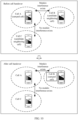
- a first A3 measurement report may include cell information of the cell C, and does not include the cell information of the cell B. Modulo interference does not exist for the cell C, modulo interference exists for the cell B, and signal strength of the cell B is equivalent to that signal strength of the cell A. Based on a similar determining mechanism, when the terminal moves from a location (for example, a first location) shown in FIG.
- the second location falls within coverage of the cell A (namely, a first cell), the cell C (namely, a third cell), and a fourth cell, and no modulo interference exists for the third cell and the fourth cell, the corresponding A3 measurement report may carry both cell information of the third cell and cell information of the fourth cell.
- the terminal when modulo interference exists between the target cell and the camped cell, and the network environment evaluation value of the target cell is less than the interference threshold, the terminal determines that the target cell is a non-interfering cell, and the target cell may be included in the candidate neighboring cells.
- the terminal may recamp on the cell A.
- the neighboring cells may include the cell B and the cell C.
- modulo interference exists between the cell B and the cell A, and no modulo interference exists between the cell A and the cell C.
- the signal strength of the cell A is equivalent to signal strength of the cell C.
- the signal strength of the cell B is greater than the signal strength of the cell A.
- the signal strength of the cell A may be fourth strength.
- the signal strength of the cell B is fifth strength.
- the signal strength of the cell C is sixth strength.
- the fourth strength is equivalent to the sixth strength.
- a difference between the fourth strength and the sixth strength is less than a first strength threshold.
- the fifth strength is greater than the fourth strength or the sixth strength.
- the fifth strength is greater than the fourth strength, and a difference between the fifth strength and the fourth strength exceeds a second strength threshold.
- the fifth strength is greater than the sixth strength, and a difference between the fifth strength and the sixth strength exceeds a second strength threshold.
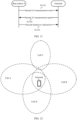
- the terminal can receive signals of the cell A, the cell B, and the cell C in the scenario shown in FIG. 10
- a location of the terminal may be different from a location in the scenario shown in FIG. 8 or FIG. 6 .
- the terminal may be located at a third location. At the third location, the terminal may hand over to and camp on the cell B with higher signal strength according to the following solution shown in FIG. 11 .
- the terminal may move from the first location to the third location. In some other embodiments, the terminal may move from another location to the third location. In some other embodiments, the terminal may always be located at the third location.
- FIG. 11 provides an interaction example of still another communication method according to this application.
- the terminal may hand over to and camp on a cell B under an indication of a base station A.
- the solution may include the following steps.
- the base station A delivers a second A3 measurement event to the terminal.
- the second A3 measurement event corresponds to an event A3, and may be used to trigger intra-frequency measurement to be performed on neighboring cells of a same network RAT as a camped cell.
- the terminal uploads a measurement report when an RSRP value of a neighboring cell is greater than RSRP of the camped cell and the RSRP value of the neighboring cell exceeds a first threshold.
- the second A3 measurement event may be referred to as a third measurement event.
- S1102 The terminal sends a second A3 measurement report to the base station A.
- the second A3 measurement report may be a measurement report corresponding to the second A3 measurement event.
- the second A3 measurement report may be referred to as a third measurement report.
- the signal strength of the cell A is seventh strength.
- the signal strength of the cell B is eighth strength.
- Signal strength of the cell D is ninth strength.
- the seventh strength, the eighth strength, and the ninth strength are equivalent.
- a difference between the seventh strength and the eighth strength is less than a first strength threshold.
- a difference between the seventh strength and the ninth strength is less than the first strength threshold.
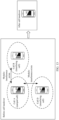
- FIG. 14 is a schematic diagram of interaction of a communication method according to an embodiment of this application.
- the solution can support a terminal in performing the cell handover shown in FIG. 13 .
- a base station A delivers a third A3 measurement event to the terminal.
- the third A3 measurement event may also be referred to as a fourth measurement event.
- S1402 The terminal feeds back a third A3 measurement report to the base station A.
- the third A3 measurement report may not include cell information of the candidate neighboring cell.
- both a cell B and a cell D in the neighboring cells are interfering cells.
- the terminal may perform intra-RAT measurement based on the third A3 measurement event. Reference is made to the solution descriptions in FIG. 9 .
- modulo interference exists between the cell B and a cell A, and an environment interference evaluation value of the cell B is greater than an interference threshold.
- the terminal determines that the cell B is an interfering cell.
- modulo interference exists between the cell D and the cell A, and an environment interference evaluation value of the cell D is greater than the interference threshold.
- the terminal determines that the cell D is an interfering cell.
- the terminal determines that all the current neighboring cells are interfering cells and there is no candidate neighboring cell.
- the third A3 report may not carry the cell information of the candidate neighboring cell.
- the base station A delivers a first B2 measurement event to the terminal.
- the first B2 measurement event corresponds to an event B2.
- the event B2 (Event B2) may be used to trigger measurement to be performed on an inter-RAT cell with a same priority or a lower priority.
- the terminal uploads a measurement report when RSRP of the camped cell is less than a third threshold and RSRP of the inter-RAT neighboring cell is greater than a fourth threshold.
- the first B2 measurement event may also be referred to as a fifth measurement event.
- the first B2 measurement event may be used to indicate the terminal to measure a cell in a 3G network.
- the base station A may deliver a first B1 measurement event to the terminal.
- the first B1 measurement event corresponds to an event B1.
- the event B1 (Event B1) may be used to trigger measurement to be performed on a high-priority inter-RAT cell.
- the terminal uploads a measurement report when RSRP of the neighboring cell is greater than a fifth threshold.
- the first B1 measurement event may be used to indicate the terminal to measure a cell in a 5G network.
- the base station may perform S1403, to deliver the first B2 measurement event to the terminal.
- the terminal may measure a network whose priority is less than a priority of the currently camped cell.
- the first B2 measurement report may also be referred to as a fifth measurement report.
- the currently camped cell is the cell A.
- the cell A is a 4G cell.
- the terminal may measure a cell in the 3G network.
- the first B2 measurement report may include cell information of a cell that can access the 3G network.
- the cell that can access the 3G network may be a sixth cell.
- signal strength of the cell that can access the 3G network may be greater than signal strength of the cell A or the cell B.
- the signal strength of the sixth cell is tenth strength.
- the tenth strength may be greater than seventh strength of the cell A.
- the tenth strength is greater than the seventh strength, and a difference between the tenth strength and the seventh strength exceeds a second strength threshold.
- S1405 The base station A sends a third cell handover indication to the terminal.
- the base station A indicates, by using the third cell handover indication, the terminal to access the 3G network through fallback. Therefore, a basic communication function of the terminal is ensured.
- the terminal when there is no candidate neighboring cell, the terminal may hand over to a lower priority (for example, hand over from the 4G network to the 3G network) under an indication of the base station A to perform communication.
- a lower priority for example, hand over from the 4G network to the 3G network
- level-2 self-healing is triggered, to ensure basic communication of the terminal in a scenario of a relatively poor current network.
- the terminal can also trigger level-1 self-healing or level-2 self-healing based on a current environment, to ensure communication quality.
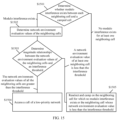
- the solution may include the following steps.
- S1501 Determine whether modulo interference exists between each neighboring cell and a camped cell.
- the following S1502 is performed.
- the following S1505 is performed.
- S1502 Determine network environment evaluation values of the neighboring cells.
- S1503 Determine magnitude relationships between the network environment evaluation values of the neighboring cells and an interference threshold.
- the terminal may camp on a cell of a 3G network through cell reselection.
- level-2 self-healing is triggered, and therefore, a basic communication function is ensured.
- S1505 The terminal reselects and camps on the neighboring cell for which no modulo interference exists or the neighboring cell whose network environment evaluation value is less than the interference threshold.
- FIG. 8 An example in which the neighboring cell for which no modulo interference exists is a cell C is used.
- the terminal may access, through cell reselection, the neighboring cell (namely, the cell C) for which no modulo interference exists, and camp on the neighboring cell.
- the neighboring cell namely, the cell C
- FIG. 10 An example in which a second cell is a cell B is used.
- the terminal may access, through cell reselection, the neighboring cell (namely, the cell B) whose network environment evaluation value is less than the interference threshold, and camp on the neighboring cell.
- the neighboring cell namely, the cell B
- the terminal may also store cell information of each interfering cell in an interference list.
- the terminal may no longer camp, within subsequent preset duration based on the interference list, on the cells recorded in the interference list. Therefore, communication quality is ensured.
- the terminal may further send the interference list to a cloud server through synchronization, so that the interference list is used as a reference when another terminal determines a camped cell.
- a first terminal may perform cell handover or cell reselection according to any one of the solutions shown in FIG. 6-FIG. 15 .
- the first terminal may generate an interference list.
- the first terminal currently camps on a cell A, and a network environment evaluation value of the cell B used as a neighboring cell is greater than the interference threshold.
- the interference list may include cell information of the cell B.
- the interference list may further include cell information of the currently camped cell (for example, the cell A).
- the first terminal may update the interference list to the cloud server in real time or periodically.
- a second terminal connected to the cloud server may obtain the interference list.
- the second terminal may obtain the interference list from the cloud server when the second terminal needs to perform cell reselection or cell handover.
- the second terminal may obtain the interference list from the cloud server in real time or periodically, so that the second terminal quickly invokes the interference list during cell handover or cell reselection.
- the interference list obtained by the second terminal may include the cell information of the cell A and the cell B.
- the second terminal may exclude the cell A and the cell B from candidate neighboring cells, and interact, according to the solution shown in FIG. 7 , with a base station corresponding to the camped cell, to access another cell under an indication of the base station to perform communication.
- the second terminal may determine, based on the interference list, that interference exists for the cell A and the cell B and the cell A and the cell B cannot provide a better communication service.
- the second terminal may hand over to another cell or RAT according to the solution shown in FIG. 15 to perform communication.
- the terminal may include any one of a desktop computer, a laptop computer, a handheld computer, a notebook computer, a vehicle-mounted device, an ultra-mobile personal computer (ultra-mobile personal computer, UMPC), a netbook, a cellular phone, a personal digital assistant (personal digital assistant, PDA), an augmented reality (augmented reality, AR) ⁇ virtual reality (virtual reality, VR) device, and the like.
- a specific form of the terminal is not specially limited in the embodiments of this application.
- the terminal device provided in the embodiments of this application includes corresponding hardware structures and/or software modules for performing the functions.
- a person skilled in the art may be easily aware that, in combination with example units and algorithm steps described in the embodiments disclosed in this specification, the embodiments of this application can be implemented by hardware or a combination of hardware and computer software. Whether a specific function is performed by hardware or hardware driven by computer software depends on a particular application and a design constraint of the technical solutions. A person skilled in the art may use different methods to implement the described functions for each particular application, but it should not be considered that the implementation goes beyond the scope of the embodiments of this application.
- the terminal device 1700 may include: an obtaining unit 1701, a calculation unit 1702, a storage unit 1704, and a transceiver unit 1703.
- the obtaining unit 1701 may be configured to obtain cell quality parameters of a currently camped cell and each neighboring cell.
- the calculation unit 1702 may be configured to calculate, based on the cell quality parameters of the currently camped cell and each neighboring cell, an environment interference evaluation value corresponding to each neighboring cell. After the calculation unit 1702 obtains the interference evaluation value corresponding to each neighboring cell, the interference evaluation value corresponding to each neighboring cell may be stored in the storage unit 1704.
- an interference list may be set in the storage unit 1704, and the interference list may be used to store cell information of the currently camped cell and a neighboring cell whose environment interference evaluation value is greater than an interference threshold.
- the transceiver unit 1703 may be configured to perform data communication with another device.
- the transceiver unit 1703 may be configured to receive a measurement event from a base station.
- the transceiver unit 1703 may be configured to send a measurement report to the base station.
- the measurement report may include cell information of a candidate neighboring cell.
- the transceiver unit 1703 may be further configured to receive a cell handover indication from the base station.
- the transceiver unit 1703 may be configured to: send the interference list to a cloud server and/or receive the interference list, and store the interference list in the storage unit 1704.
- the calculation unit 1702 may be a processor or a controller.
- the calculation unit 1702 may be a central processing unit (central processing unit, CPU), a digital signal processor (digital signal processor, DSP), an application-specific integrated circuit (application-specific integrated circuit, ASIC), a field programmable gate array (field programmable gate array, FPGA) or another programmable logic device, a transistor logic device, a hardware component, or any combination thereof.
- the processor may include an application processor and a baseband processor.
- the processor may implement or execute various example logical blocks, modules, and circuits described with reference to content disclosed in this application.
- the processor may alternatively be a combination that implements a computing function, for example, a combination of one or more microprocessors or a combination of a DSP and a microprocessor.
- the storage unit 1704 may be a memory.
- FIG. 17 provides an example of composition of the terminal device.
- the units shown in FIG. 17 may alternatively be disposed on a chip in the terminal device.
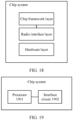
- FIG. 18 is a schematic diagram of composition of a chip system.
- the chip system may be divided into different layers, and the layers have different functions, and are configured to cooperate with each other, to enable the chip system to implement the foregoing communication method provided in any one of FIG. 7- FIG. 14 .
- the chip system may include a chip framework layer.
- all of the obtaining unit 1701, the calculation unit 1702, and the transceiver unit 1703 shown in FIG. 17 may be disposed in the chip framework layer.
- the chip system may include a radio interface layer.
- the radio interface layer Radio interface layer is simply referred to as an RIL layer.
- the radio interface layer may be configured to provide a plurality of interfaces, to implement transfer of a command in the chip framework layer from/to another component in the chip system.
- the chip system may include a hardware layer.
- the hardware layer may include a modem (modem).
- a storage medium (for example, corresponding to the storage unit 1704 in FIG. 17 ) may be further disposed in the hardware layer of the chip system.
- the storage medium may be configured to provide an on-chip storage function.
- the storage medium may be configured to store data such as a cell quality parameter of each cell, an interference list, and an interference threshold.
- the chip system includes at least one processor 1901 and at least one interface circuit 1902.
- the processor 1901 and the interface circuit 1902 may be connected by using a line.
- the interface circuit 1902 may be configured to receive a signal from another apparatus (for example, a memory of an electronic device).
- the interface circuit 1902 may be configured to send a signal to another apparatus (for example, the processor 1901).
- the interface circuit 1902 may read instructions stored in the memory, and send the instructions to the processor 1901.
- the electronic device may be enabled to perform steps in the foregoing embodiments.
- the chip system may further include another discrete device. This is not specifically limited in this embodiment of this application.
- An embodiment of this application further provides a computer storage medium.
- the computer storage medium includes computer instructions.
- the computer instructions When the computer instructions are run on the foregoing electronic device, the electronic device is enabled to perform the functions or steps performed by the mobile phone in the foregoing method embodiments.
- An embodiment of this application further provides a computer program product.
- the computer program product runs on a computer, the computer is enabled to perform the functions or steps performed by the mobile phone in the foregoing method embodiments.
- the disclosed apparatus and method may be implemented in another manner.
- the apparatus embodiments described above are merely examples.
- division into modules or units is merely logical function division.
- a plurality of units or components may be combined or integrated into another apparatus, or some features may be ignored or not performed.
- the displayed or discussed mutual couplings, direct couplings, or communication connections may be implemented by using some interfaces.
- the indirect couplings or communication connections between the apparatuses or units may be implemented in an electrical form, a mechanical form, or another form.
- the units described as separate parts may or may not be physically separate, and parts displayed as units may be one or more physical units, in other words, may be located in one place, or may be distributed in a plurality of different places. Some or all of the units may be selected based on actual requirements to achieve the objectives of the solutions in the embodiments.
- the functional units in the embodiments of this application may be integrated into one processing unit, or each of the units may exist alone physically, or two or more units may be integrated into one unit.
- the integrated unit may be implemented in a form of hardware, or may be implemented in a form of a software functional unit.
- the integrated unit When the integrated unit is implemented in the form of a software functional unit and sold or used as an independent product, the integrated unit may be stored in a readable storage medium. Based on such an understanding, the technical solutions of the embodiments of this application essentially, or the part contributing to the conventional technology, or all or some of the technical solutions may be implemented in a form of a software product.
- the software product is stored in a storage medium and includes several instructions for enabling a device (which may be a single-chip microcomputer, a chip, or the like) or a processor (processor) to perform all or some of the steps of the methods described in the embodiments of this application.
- the foregoing storage medium includes various media that can store program code, for example, a USB flash drive, a removable hard disk, a read-only memory (read only memory, ROM), a random access memory (random access memory, RAM), a magnetic disk, or an optical disc.
- program code for example, a USB flash drive, a removable hard disk, a read-only memory (read only memory, ROM), a random access memory (random access memory, RAM), a magnetic disk, or an optical disc.
Landscapes
- Engineering & Computer Science (AREA)
- Computer Networks & Wireless Communication (AREA)
- Signal Processing (AREA)
- Mobile Radio Communication Systems (AREA)
Applications Claiming Priority (2)
| Application Number | Priority Date | Filing Date | Title |
|---|---|---|---|
| CN202211698383.5A CN118265094A (zh) | 2022-12-28 | 2022-12-28 | 一种通信方法和终端设备 |
| PCT/CN2023/113760 WO2024139262A1 (zh) | 2022-12-28 | 2023-08-18 | 一种通信方法和终端设备 |
Publications (2)
| Publication Number | Publication Date |
|---|---|
| EP4529271A1 true EP4529271A1 (de) | 2025-03-26 |
| EP4529271A4 EP4529271A4 (de) | 2025-12-03 |
Family
ID=91611949
Family Applications (1)
| Application Number | Title | Priority Date | Filing Date |
|---|---|---|---|
| EP23909202.6A Pending EP4529271A4 (de) | 2022-12-28 | 2023-08-18 | Kommunikationsverfahren und endgerätevorrichtung |
Country Status (4)
| Country | Link |
|---|---|
| US (1) | US20260012856A1 (de) |
| EP (1) | EP4529271A4 (de) |
| CN (2) | CN118265094A (de) |
| WO (1) | WO2024139262A1 (de) |
Family Cites Families (6)
| Publication number | Priority date | Publication date | Assignee | Title |
|---|---|---|---|---|
| WO2013165202A1 (en) * | 2012-05-03 | 2013-11-07 | Lg Electronics Inc. | Method and apparatus for transmitting message in wireless communication system |
| CN107182062A (zh) * | 2016-03-11 | 2017-09-19 | 中国移动通信集团广东有限公司 | Lte网络中物理小区优化方法及装置 |
| CN109561436B (zh) * | 2017-09-26 | 2021-04-30 | 中国移动通信集团公司 | 一种物理层小区标识pci优化的方法、设备、计算机可读存储介质和装置 |
| CN112469089A (zh) * | 2019-09-06 | 2021-03-09 | 中国移动通信有限公司研究院 | 小区重选或者切换的方法、终端及网络设备 |
| CN114449593B (zh) * | 2020-10-30 | 2024-09-24 | 华为技术有限公司 | 一种小区切换方法及通信装置 |
| CN113645671B (zh) * | 2021-07-30 | 2022-09-02 | 北京紫光展锐通信技术有限公司 | 异频测量方法及相关设备 |
-
2022
- 2022-12-28 CN CN202211698383.5A patent/CN118265094A/zh active Pending
-
2023
- 2023-08-18 WO PCT/CN2023/113760 patent/WO2024139262A1/zh not_active Ceased
- 2023-08-18 CN CN202380059469.XA patent/CN119678556A/zh active Pending
- 2023-08-18 EP EP23909202.6A patent/EP4529271A4/de active Pending
- 2023-08-18 US US18/881,144 patent/US20260012856A1/en active Pending
Also Published As
| Publication number | Publication date |
|---|---|
| WO2024139262A1 (zh) | 2024-07-04 |
| CN118265094A (zh) | 2024-06-28 |
| US20260012856A1 (en) | 2026-01-08 |
| EP4529271A4 (de) | 2025-12-03 |
| CN119678556A (zh) | 2025-03-21 |
Similar Documents
| Publication | Publication Date | Title |
|---|---|---|
| US9055474B2 (en) | Apparatus for improved mobility in a wireless heterogeneous network | |
| US11856467B2 (en) | Cell ranking in multi beam system | |
| JP6069325B2 (ja) | セルを共有する複数のリモート無線ユニットのためのリソース割り当て方法及び装置 | |
| BR112016006747B1 (pt) | Métodos e arranjos de um nó de rede de uma rede de comunicação celular conectável a um ou mais dispositivos de comunicação sem fio e de um dispositivo de comunicação sem fio conectável a uma rede de comunicação celular, meio de armazenamento legível por computador, nó de rede para uma rede de comunicação celular, e, dispositivo de comunicação sem fio | |
| WO2018082904A1 (en) | Communications device and method | |
| US11265747B2 (en) | First network node, second network node, wireless device, and methods performed thereby | |
| CN103581991A (zh) | 测量参数的指示方法及装置 | |
| AU2016431367A1 (en) | Measurement method, terminal device, and network device | |
| RU2523030C2 (ru) | Базовая радиостанция, мобильная станция и способ управления связью | |
| US11012871B2 (en) | Apparatus and method | |
| US20190014514A1 (en) | Methods and Arrangements for Supporting Cell Selection and Cell Reselection in a Wireless Communication Network | |
| US11202303B2 (en) | Wireless device, network node, and methods performed thereby for handling a communication of blocks of physical channels or signals | |
| US20150153395A1 (en) | Performing and Reporting Relative Radio Measurements | |
| US20140119319A1 (en) | Apparatus and Method for Reactive Inter-Cell Interference Coordination | |
| WO2014107078A1 (en) | Resource allocation method in wireless communication system and apparatus using the same | |
| WO2022183395A1 (en) | Quality of experience indication and reporting in mobility management | |
| CN104782215A (zh) | 无线资源管理的方法、基站、用户设备及无线保真接入点 | |
| EP4529271A1 (de) | Kommunikationsverfahren und endgerätevorrichtung | |
| WO2022236703A1 (en) | Aperiodic and semi-persistent positioning reference signal and measurement gaps | |
| US11445436B2 (en) | Cell selection and resource allocation thresholds | |
| US10172075B1 (en) | Method and system for scanning for target coverage in order of signal strength threshold | |
| CN103209426A (zh) | 一种在用户终端异频切换前的测量方法及装置 | |
| US11284419B2 (en) | Communication method, terminal device and network device | |
| CN116668944B (zh) | 一种小区切换方法、装置及存储介质 |
Legal Events
| Date | Code | Title | Description |
|---|---|---|---|
| STAA | Information on the status of an ep patent application or granted ep patent |
Free format text: STATUS: THE INTERNATIONAL PUBLICATION HAS BEEN MADE |
|
| PUAI | Public reference made under article 153(3) epc to a published international application that has entered the european phase |
Free format text: ORIGINAL CODE: 0009012 |
|
| STAA | Information on the status of an ep patent application or granted ep patent |
Free format text: STATUS: REQUEST FOR EXAMINATION WAS MADE |
|
| 17P | Request for examination filed |
Effective date: 20241218 |
|
| AK | Designated contracting states |
Kind code of ref document: A1 Designated state(s): AL AT BE BG CH CY CZ DE DK EE ES FI FR GB GR HR HU IE IS IT LI LT LU LV MC ME MK MT NL NO PL PT RO RS SE SI SK SM TR |
|
| A4 | Supplementary search report drawn up and despatched |
Effective date: 20251103 |
|
| RIC1 | Information provided on ipc code assigned before grant |
Ipc: H04W 36/00 20090101AFI20251028BHEP Ipc: H04W 36/30 20090101ALN20251028BHEP |
|
| DAV | Request for validation of the european patent (deleted) | ||
| DAX | Request for extension of the european patent (deleted) |