EP4528858A1 - Multi-element positive electrode material and preparation method therefor, and lithium ion battery - Google Patents
Multi-element positive electrode material and preparation method therefor, and lithium ion battery Download PDFInfo
- Publication number
- EP4528858A1 EP4528858A1 EP23927833.6A EP23927833A EP4528858A1 EP 4528858 A1 EP4528858 A1 EP 4528858A1 EP 23927833 A EP23927833 A EP 23927833A EP 4528858 A1 EP4528858 A1 EP 4528858A1
- Authority
- EP
- European Patent Office
- Prior art keywords
- cathode material
- element cathode
- coating
- lithium
- sintering
- Prior art date
- Legal status (The legal status is an assumption and is not a legal conclusion. Google has not performed a legal analysis and makes no representation as to the accuracy of the status listed.)
- Pending
Links
Images


Classifications
-
- C—CHEMISTRY; METALLURGY
- C01—INORGANIC CHEMISTRY
- C01G—COMPOUNDS CONTAINING METALS NOT COVERED BY SUBCLASSES C01D OR C01F
- C01G53/00—Compounds of nickel
- C01G53/40—Complex oxides containing nickel and at least one other metal element
- C01G53/42—Complex oxides containing nickel and at least one other metal element containing alkali metals, e.g. LiNiO2
- C01G53/44—Complex oxides containing nickel and at least one other metal element containing alkali metals, e.g. LiNiO2 containing manganese
- C01G53/50—Complex oxides containing nickel and at least one other metal element containing alkali metals, e.g. LiNiO2 containing manganese of the type (MnO2)n-, e.g. Li(NixMn1-x)O2 or Li(MyNixMn1-x-y)O2
-
- H—ELECTRICITY
- H01—ELECTRIC ELEMENTS
- H01M—PROCESSES OR MEANS, e.g. BATTERIES, FOR THE DIRECT CONVERSION OF CHEMICAL ENERGY INTO ELECTRICAL ENERGY
- H01M10/00—Secondary cells; Manufacture thereof
- H01M10/05—Accumulators with non-aqueous electrolyte
- H01M10/052—Li-accumulators
- H01M10/0525—Rocking-chair batteries, i.e. batteries with lithium insertion or intercalation in both electrodes; Lithium-ion batteries
-
- H—ELECTRICITY
- H01—ELECTRIC ELEMENTS
- H01M—PROCESSES OR MEANS, e.g. BATTERIES, FOR THE DIRECT CONVERSION OF CHEMICAL ENERGY INTO ELECTRICAL ENERGY
- H01M4/00—Electrodes
- H01M4/02—Electrodes composed of, or comprising, active material
- H01M4/13—Electrodes for accumulators with non-aqueous electrolyte, e.g. for lithium-accumulators; Processes of manufacture thereof
- H01M4/131—Electrodes based on mixed oxides or hydroxides, or on mixtures of oxides or hydroxides, e.g. LiCoOx
-
- H—ELECTRICITY
- H01—ELECTRIC ELEMENTS
- H01M—PROCESSES OR MEANS, e.g. BATTERIES, FOR THE DIRECT CONVERSION OF CHEMICAL ENERGY INTO ELECTRICAL ENERGY
- H01M4/00—Electrodes
- H01M4/02—Electrodes composed of, or comprising, active material
- H01M4/13—Electrodes for accumulators with non-aqueous electrolyte, e.g. for lithium-accumulators; Processes of manufacture thereof
- H01M4/139—Processes of manufacture
- H01M4/1391—Processes of manufacture of electrodes based on mixed oxides or hydroxides, or on mixtures of oxides or hydroxides, e.g. LiCoOx
-
- H—ELECTRICITY
- H01—ELECTRIC ELEMENTS
- H01M—PROCESSES OR MEANS, e.g. BATTERIES, FOR THE DIRECT CONVERSION OF CHEMICAL ENERGY INTO ELECTRICAL ENERGY
- H01M4/00—Electrodes
- H01M4/02—Electrodes composed of, or comprising, active material
- H01M4/36—Selection of substances as active materials, active masses, active liquids
- H01M4/362—Composites
- H01M4/366—Composites as layered products
-
- H—ELECTRICITY
- H01—ELECTRIC ELEMENTS
- H01M—PROCESSES OR MEANS, e.g. BATTERIES, FOR THE DIRECT CONVERSION OF CHEMICAL ENERGY INTO ELECTRICAL ENERGY
- H01M4/00—Electrodes
- H01M4/02—Electrodes composed of, or comprising, active material
- H01M4/36—Selection of substances as active materials, active masses, active liquids
- H01M4/48—Selection of substances as active materials, active masses, active liquids of inorganic oxides or hydroxides
- H01M4/485—Selection of substances as active materials, active masses, active liquids of inorganic oxides or hydroxides of mixed oxides or hydroxides for inserting or intercalating light metals, e.g. LiTi2O4 or LiTi2OxFy
-
- H—ELECTRICITY
- H01—ELECTRIC ELEMENTS
- H01M—PROCESSES OR MEANS, e.g. BATTERIES, FOR THE DIRECT CONVERSION OF CHEMICAL ENERGY INTO ELECTRICAL ENERGY
- H01M4/00—Electrodes
- H01M4/02—Electrodes composed of, or comprising, active material
- H01M4/36—Selection of substances as active materials, active masses, active liquids
- H01M4/48—Selection of substances as active materials, active masses, active liquids of inorganic oxides or hydroxides
- H01M4/50—Selection of substances as active materials, active masses, active liquids of inorganic oxides or hydroxides of manganese
- H01M4/505—Selection of substances as active materials, active masses, active liquids of inorganic oxides or hydroxides of manganese of mixed oxides or hydroxides containing manganese for inserting or intercalating light metals, e.g. LiMn2O4 or LiMn2OxFy
-
- H—ELECTRICITY
- H01—ELECTRIC ELEMENTS
- H01M—PROCESSES OR MEANS, e.g. BATTERIES, FOR THE DIRECT CONVERSION OF CHEMICAL ENERGY INTO ELECTRICAL ENERGY
- H01M4/00—Electrodes
- H01M4/02—Electrodes composed of, or comprising, active material
- H01M4/36—Selection of substances as active materials, active masses, active liquids
- H01M4/48—Selection of substances as active materials, active masses, active liquids of inorganic oxides or hydroxides
- H01M4/52—Selection of substances as active materials, active masses, active liquids of inorganic oxides or hydroxides of nickel, cobalt or iron
- H01M4/525—Selection of substances as active materials, active masses, active liquids of inorganic oxides or hydroxides of nickel, cobalt or iron of mixed oxides or hydroxides containing iron, cobalt or nickel for inserting or intercalating light metals, e.g. LiNiO2, LiCoO2 or LiCoOxFy
-
- C—CHEMISTRY; METALLURGY
- C01—INORGANIC CHEMISTRY
- C01P—INDEXING SCHEME RELATING TO STRUCTURAL AND PHYSICAL ASPECTS OF SOLID INORGANIC COMPOUNDS
- C01P2002/00—Crystal-structural characteristics
- C01P2002/30—Three-dimensional structures
-
- C—CHEMISTRY; METALLURGY
- C01—INORGANIC CHEMISTRY
- C01P—INDEXING SCHEME RELATING TO STRUCTURAL AND PHYSICAL ASPECTS OF SOLID INORGANIC COMPOUNDS
- C01P2004/00—Particle morphology
- C01P2004/01—Particle morphology depicted by an image
- C01P2004/03—Particle morphology depicted by an image obtained by SEM
-
- C—CHEMISTRY; METALLURGY
- C01—INORGANIC CHEMISTRY
- C01P—INDEXING SCHEME RELATING TO STRUCTURAL AND PHYSICAL ASPECTS OF SOLID INORGANIC COMPOUNDS
- C01P2004/00—Particle morphology
- C01P2004/51—Particles with a specific particle size distribution
-
- C—CHEMISTRY; METALLURGY
- C01—INORGANIC CHEMISTRY
- C01P—INDEXING SCHEME RELATING TO STRUCTURAL AND PHYSICAL ASPECTS OF SOLID INORGANIC COMPOUNDS
- C01P2004/00—Particle morphology
- C01P2004/60—Particles characterised by their size
- C01P2004/61—Micrometer sized, i.e. from 1-100 micrometer
-
- C—CHEMISTRY; METALLURGY
- C01—INORGANIC CHEMISTRY
- C01P—INDEXING SCHEME RELATING TO STRUCTURAL AND PHYSICAL ASPECTS OF SOLID INORGANIC COMPOUNDS
- C01P2004/00—Particle morphology
- C01P2004/60—Particles characterised by their size
- C01P2004/62—Submicrometer sized, i.e. from 0.1-1 micrometer
-
- C—CHEMISTRY; METALLURGY
- C01—INORGANIC CHEMISTRY
- C01P—INDEXING SCHEME RELATING TO STRUCTURAL AND PHYSICAL ASPECTS OF SOLID INORGANIC COMPOUNDS
- C01P2006/00—Physical properties of inorganic compounds
- C01P2006/12—Surface area
-
- C—CHEMISTRY; METALLURGY
- C01—INORGANIC CHEMISTRY
- C01P—INDEXING SCHEME RELATING TO STRUCTURAL AND PHYSICAL ASPECTS OF SOLID INORGANIC COMPOUNDS
- C01P2006/00—Physical properties of inorganic compounds
- C01P2006/40—Electric properties
-
- H—ELECTRICITY
- H01—ELECTRIC ELEMENTS
- H01M—PROCESSES OR MEANS, e.g. BATTERIES, FOR THE DIRECT CONVERSION OF CHEMICAL ENERGY INTO ELECTRICAL ENERGY
- H01M4/00—Electrodes
- H01M4/02—Electrodes composed of, or comprising, active material
- H01M2004/021—Physical characteristics, e.g. porosity, surface area
-
- H—ELECTRICITY
- H01—ELECTRIC ELEMENTS
- H01M—PROCESSES OR MEANS, e.g. BATTERIES, FOR THE DIRECT CONVERSION OF CHEMICAL ENERGY INTO ELECTRICAL ENERGY
- H01M4/00—Electrodes
- H01M4/02—Electrodes composed of, or comprising, active material
- H01M2004/026—Electrodes composed of, or comprising, active material characterised by the polarity
- H01M2004/028—Positive electrodes
-
- H—ELECTRICITY
- H01—ELECTRIC ELEMENTS
- H01M—PROCESSES OR MEANS, e.g. BATTERIES, FOR THE DIRECT CONVERSION OF CHEMICAL ENERGY INTO ELECTRICAL ENERGY
- H01M2220/00—Batteries for particular applications
- H01M2220/20—Batteries in motive systems, e.g. vehicle, ship, plane
-
- Y—GENERAL TAGGING OF NEW TECHNOLOGICAL DEVELOPMENTS; GENERAL TAGGING OF CROSS-SECTIONAL TECHNOLOGIES SPANNING OVER SEVERAL SECTIONS OF THE IPC; TECHNICAL SUBJECTS COVERED BY FORMER USPC CROSS-REFERENCE ART COLLECTIONS [XRACs] AND DIGESTS
- Y02—TECHNOLOGIES OR APPLICATIONS FOR MITIGATION OR ADAPTATION AGAINST CLIMATE CHANGE
- Y02E—REDUCTION OF GREENHOUSE GAS [GHG] EMISSIONS, RELATED TO ENERGY GENERATION, TRANSMISSION OR DISTRIBUTION
- Y02E60/00—Enabling technologies; Technologies with a potential or indirect contribution to GHG emissions mitigation
- Y02E60/10—Energy storage using batteries
Definitions
- the present disclosure relates to the technical field of lithium-ion batteries, and particularly, to a multi-element cathode material, a preparation method thereof, and a lithium-ion battery.
- lithium-ion batteries have been widely applied in portable electronic devices, electric vehicles, and energy storage systems due to their high energy density.
- a cathode material is a primary aspect restricting performance of the lithium-ion batteries.
- An energy density of a graphite negative electrode can reach 360 mAh/g, while an energy density of a cathode material, for example, a ternary 622 material, is only 180 mAh/g.
- the cathode material is the most expensive and heaviest main component of the lithium-ion batteries. Therefore, an improvement in the energy density of the cathode material and cycle stability can effectively reduce a weight and a price of the electric vehicles.
- objects of the present disclosure are to provide a multi-element cathode material, a preparation method thereof, and a lithium-ion battery.
- a surface of the multi-element cathode material contains a dot-like coating and/or the island-like coating, and the coating has specific arithmetic average roughness and coverage.
- the multi-element cathode material has a relatively great particle size distribution D 1 , thereby reducing a content of micro-powders in the multi-element cathode material. In this way, the lithium-ion battery containing the cathode material has excellent capacity and cycle performance.
- a first aspect of the present disclosure provides a multi-element cathode material.
- a surface of the multi-element cathode material includes a dot-like coating and/or an island-like coating.
- a particle diameter D 1 with 1% cumulative particle size distribution of the multi-element cathode material is greater than or equal to 0.7 ⁇ m.
- An arithmetic average roughness Ra, measured with a three-dimensional scanning electron microscope, of the coating of the multi-element cathode material satisfies 20 nm ⁇ Ra ⁇ 200 nm.
- a coverage Q of the dot-like coating and/or the island-like coating of the multi-element cathode material satisfies 3% ⁇ Q ⁇ 30%.
- a second aspect of the present disclosure provides a method for preparing a multi-electrode positive material.
- the method includes:
- a third aspect of the present disclosure provides a multi-element cathode material prepared by the above method.
- a fourth aspect of the present disclosure provides a lithium-ion battery.
- the lithium-ion battery includes the above multi-element cathode material.
- the multi-element cathode material, the preparation method thereof, and the lithium-ion battery according to the present disclosure obtain beneficial effects as follows.
- the surface of the multi-element cathode material according to the present disclosure contains the dot-like coating and/or the island-like coating, and the coating has specific arithmetic average roughness and coverage. Moreover, the multi-element cathode material has a relatively great particle size distribution D 1 , thereby reducing a content of micro-powders in the multi-element cathode material. In this way, the lithium-ion battery containing the cathode material has excellent capacity and excellent cycle performance.
- the multi-element cathode material process product 1 obtained by the first high-temperature sintering can be dissociated by performing the acid solution rinsing with a good dissociation effect, without generating micro-powders. In this way, a generation of a large number of micro-powders caused by a conventional strong dissociation method can be avoided. Thus, poor slurry dispersibility and uneven coating as well as consumption of an electrolyte, which are caused by the excessive micro-powders, can be prevented, thereby preventing a reduction in the cycle performance and storage performance of the lithium-ion battery.
- Endpoint values and any values of ranges disclosed in the present disclosure are not limited to the precise ranges or values, and these ranges or values should be understood to include values close to these ranges or values.
- one or more new numerical ranges can be obtained by combining int values of the respective ranges, an endpoint value and an individual point value of the respective ranges, and the individual point values, and these numerical ranges should be regarded as specifically disclosed in the present disclosure.
- a first aspect of the present disclosure provides a multi-element cathode material.
- a surface of the multi-element cathode material includes a dot-like coating and/or an island-like coating.
- a particle diameter D 1 with 1% cumulative particle size distribution of the multi-element cathode material is greater than or equal to 0.7 ⁇ m.
- An arithmetic average roughness Ra measured with a three-dimensional scanning electron microscope, of the coating of the multi-element cathode material satisfies 20 nm ⁇ Ra ⁇ 200 nm.
- a coverage Q of the dot-like coating and/or the island-like coating of the multi-element cathode material satisfies 3% ⁇ Q ⁇ 30%.
- the multi-element cathode materials are hard blocks with serious inter-particle agglomeration. After strong dissociation, the multi-element cathode materials are prone to form micro-powders that remains on the surface of a multi-component positive electrode or is mixed in the multi-element cathode material. During battery manufacturing, the micro-powders may lead to poor slurry dispersibility and uneven coating. Moreover, the micro-powders consume more electrolyte, thereby affecting cycle performance and storage performance of a lithium-ion battery.
- the multi-element cathode material has a relatively great particle size distribution D 1 , indicating that the multi-element cathode material has fewer particles with small particle diameters and thus has a low content of micro-powders in the multi-element cathode material, such that a lithium-ion battery containing the cathode material has excellent capacity and cycle performance.
- the coating of the surface of the cathode material can significantly improve structural stability of the material.
- most research focuses on an impact of coating element types on the material.
- the Applicant found through research that a coating amount and a coating state of the coating of the surface of the multi-element cathode material also have a very important influence on the multi-element cathode material.
- the lithium-ion battery prepared by the multi-element cathode material has more excellent electrical performance.
- the coating can be prevented from being adsorbed by excessive micro-powders, avoiding a reduction in an effective coating effect, thereby avoiding a reduction in the capacity of the lithium-ion battery containing the multi-component cathode material.
- the lithium-ion battery prepared by the multi-element cathode material has the excellent cycle performance and capacity with a reduced usage amount of a coating agent.
- the arithmetic average roughness of the surface of the coating of the multi-element cathode material is measured with a three-dimensional scanning electron microscope (3D-SEM), and the arithmetic average roughness Ra of the surface of the particles is measured based on a method according to JIS B 0601(2001).
- the coverage of the coating is calculated by dividing a total area of the dot-like coating and/or the island-like coating within a 1 ⁇ m 2 region of a single particle surface under the electron microscope by an area of the 1 ⁇ m 2 region. As the region indicated by the box in FIG. 2 , regions of 300 different particles are selected to calculate an average value.
- the particle diameter D 1 with 1% cumulative particle size distribution of the multi-element cathode material satisfies 1 ⁇ m ⁇ D 1 ⁇ 2 ⁇ m; the arithmetic average roughness Ra, measured with the three-dimensional scanning electron microscope, of the coating of the multi-element cathode material satisfies 30 nm ⁇ Ra ⁇ 100 nm; and the coverage Q of the dot-like coating and/or the island-like coating of the multi-element cathode material satisfies 5% ⁇ Q ⁇ 15%.
- a particle diameter D 50 with 50% cumulative particle size distribution of the multi-element cathode material ranges from 2 ⁇ m to 8 ⁇ m, and preferably, from 2.5 ⁇ m to 7 ⁇ m.
- the particle diameter D 1 with 1% cumulative particle size distribution of the multi-element cathode material and the particle diameter D 50 with 50% cumulative particle size distribution of the multi-element cathode material are measured with a laser particle size analyzer.
- an average size P 50 of primary particles, measured with an SEM, of the multi-element cathode material ranges from 0.8 ⁇ m to 6 ⁇ m, and preferably, from 1 ⁇ m to 4 ⁇ m.
- a specific surface area S of the multi-element cathode material satisfies: 0.2 m 2 /g ⁇ S ⁇ 1.2 m 2 /g, and/or 1/P 50 -0.1 ⁇ S ⁇ 1/P 50 +0.2.
- P 50 is expressed in units of ⁇ m
- S is expressed in in units of m 2 /g, and the above relations are only a numerical relation.
- the multi-element cathode material has a relatively great particle size distribution D 1 and a relatively small specific surface area S, and the specific surface area decreases with an increase in the average size P 50 of the primary particles.
- the specific surface area S has an obvious correlation with the average size P 50 of the primary particles, which establishes a relation between a macroscopic indicator and a microscopic particle size.
- the specific surface area S of the multi-element cathode material satisfies both 0.2 m 2 /g ⁇ S ⁇ 1.2 m 2 /g and 1/P 50 -0.1 ⁇ S ⁇ 1/P 50 +0.2, it indicates that a suitable dissociation condition and a suitable coating and back-sintering condition are used in the process of preparing the cathode material.
- the multi-element cathode material provided by the present disclosure neither generates micro-powders through excessive dissociation, nor results in significant agglomeration caused by insufficient dissociation.
- the specific surface area S of the multi-element cathode material may be excessively great. If an insufficient dissociation leads to excessive agglomeration, the specific surface area S of the multi-element cathode material may be relatively small, such that a good arithmetic relation between the specific surface area S and the average size P 50 of the primary particles cannot be established.
- the surface coating also affects the specific surface area of the material. Too much residual surface coating leads to a relatively great specific surface area, whereas too little residual surface coating results in a relatively small specific surface area. Only when the residual surface coating falls within an appropriate range and the above-mentioned relations are satisfied, the multi-element cathode material can have better electrochemical performance.
- the specific surface area S of the multi-element cathode material satisfies: 0.3 m 2 /g ⁇ S ⁇ 1 m 2 /g, and/or 1/P 50 -0.05 ⁇ S ⁇ 1/P 50 +0.05.
- the specific surface area S of the multi-element cathode material satisfies: 0.2 m 2 /g ⁇ S ⁇ 1.2 m 2 /g and 1/P 50 -0.1 ⁇ S ⁇ 1/P 50 +0.2; and preferably, 0.3 m 2 /g ⁇ S ⁇ 1 m 2 /g and 1/P 50 -0.05 ⁇ S ⁇ 1/P 50 +0.05.
- the multi-element cathode material is particles of a spherical shape and/or an ellipsoidal shape.
- a matrix of the multi-element cathode material has a composition represented by a formula I: Li a Ni x Mn y Co z M b O 2 the formula I , where: 0.9 ⁇ a ⁇ 1.1, 0.5 ⁇ x ⁇ 1, 0 ⁇ y ⁇ 0.5, 0 ⁇ z ⁇ 0.5, and 0 ⁇ b ⁇ 0.02; and the coating includes a lithium oxide compound containing an element J and/or an oxide containing the element J, contents of the matrix and the coating enable the cathode material to satisfying 0 ⁇ [n(J)]/[n(Ni)+n(Co)+n(Mn)] ⁇ 0.03, and M and J being each independently selected from at least one element of Ba, Ra, Zr, Fe, Ca, Zn, B, W, Nb, Cd, Pb, Si, Mo, Cu, V, Ta, Cr, La, Al, Ce, Er, Ho, Y, Mg, Sr, and Ti.
- the lithium oxide compound containing the element J and/or the oxide containing the element J may further include at least one element of Ni, Co, Mn, and M from the matrix.
- M and J are each independently selected from at least one element of Ba, Zr, B, W, Nb, La, Al, Y, Mg, Sr and Ti.
- a second aspect of the present disclosure provides a method for preparing a multi-element cathode material.
- the method includes:
- the multi-element cathode material is prone to form a hard block with the serious inter-particle agglomeration after the sintering, which is required to be dissociated using a strong dissociation method.
- the strong dissociation method may likely generate the micro-powders.
- the multi-element cathode material process product 1 obtained by the first high-temperature sintering can be dissociated by performing the acid solution rinsing with a good dissociation effect, without generating micro-powders.
- the generation of a large number of micro-powders caused by the conventional strong dissociation method can be avoided.
- poor slurry dispersibility and uneven coating as well as consumption of an electrolyte, which are caused by the excessive micro-powders can be prevented, thereby preventing a reduction in the cycle performance and storage performance of the lithium-ion battery.
- a surface of the multi-element cathode material process product 1 may be corroded by the acid solution rinsing, thereby increasing roughness of a surface of the multi-element cathode material process product 2. Meanwhile, no particles are attached to the surface of the multi-element cathode material process product 2, enabling the coating to be more closely bonded to the surface of the prepared multi-element cathode material after the multi-element cathode material process product 2 and the coating agent are mixed and subjected to the second high-temperature sintering. In addition, during a cycling of the lithium-ion battery, the coating is not easy to fall off from the surface of the cathode material, thereby having better coating effect.
- the particles of the prepared multi-element cathode material can be separated from each other without generating micro-powders. More specifically, when the concentration of the acid solution is excessively low or the rinsing duration is excessively short, the separation effect cannot be achieved. When the concentration of the acid solution is excessively high or the rinsing duration is excessively long, the structure of the surface of the multi-element cathode material is destroyed, eventually degrading the performance of the lithium-ion battery containing the multi-element cathode material.
- the lithium-ion battery prepared by the multi-element cathode material according to the present disclosure can be ensured to have excellent cycle performance and the high capacity while reducing the amount of the added coating agent.
- the multi-element cathode material process product 2 is of independent particles of a spherical shape and/or an ellipsoidal shape.
- lithium carbonate and lithium hydroxide residual on the surface of the multi-element cathode material process product 1 can be washed away by performing the acid solution rinsing, resulting in a reduction in the residual lithium on the surface of the prepared multi-element cathode material, and thus lack of lithium is likely to occur on the surface layer.
- the second lithium source is added during the second high-temperature sintering to ensure that the lithium-ion battery containing the prepared multi-element cathode material has a high capacity.
- the second lithium source serves as a flux.
- the multi-element cathode material precursor is a ternary nickel-cobalt-manganese cathode material precursor.
- the multi-element cathode material precursor can be commercially available or self-made.
- the first lithium source and the second lithium source are each independently selected from one of lithium carbonate, lithium hydroxide, lithium oxide compound, and lithium acetate.
- the dopant and the coating agent are each independently selected from one of carbonates, hydroxides, oxides, and acetates capable of providing at least one element of Ba, Ra, Zr, Fe, Ca, Zn, B, W, Nb, Cd, Pb, Si, Mo, Cu, V, Ta, Cr, La, Al, Ce, Er, Ho, Y, Mg, Sr, and Ti.
- the acid solution is selected from at least one of sulfuric acid, carbonic acid, acetic acid, and oxalic acid.
- a total amount of the first lithium source and the second lithium source is added based on a stoichiometric ratio of 0.9 ⁇ [n(Li1)+n(Li2)]/[n(Ni)+n(Co)+n(Mn)] ⁇ 1.1.
- the total amount of the first lithium source and the second lithium source is added based on a stoichiometric ratio of 1 ⁇ [n(Li1)+n(Li2)]/[n(Ni)+n(Co)+n(Mn)] ⁇ 1.06.
- the respective amounts of the first lithium source and the second lithium source there is no particular limitation on the respective amounts of the first lithium source and the second lithium source, as long as the total amount of the first lithium source and the second lithium source satisfies the above-mentioned ranges.
- an amount of the first lithium source is added based on a stoichiometric ratio of 0.9 ⁇ [n(Li1)]/[n(Ni)+n(Co)+n(Mn)] ⁇ 1.05, and an amount of the second lithium source is added stoichiometric ratio of 0 ⁇ [n(Li2)]/[n(Ni)+n(Co)+n(Mn)] ⁇ 0.05.
- the amount of the first lithium source is added based on a stoichiometric ratio of 0.99 ⁇ [n(Li1)]/[n(Ni)+n(Co)+n(Mn)] ⁇ 1.05, and the amount of the second lithium source is added stoichiometric ratio of 0.01 ⁇ [n(Li2)]/[n(Ni)+n(Co)+n(Mn)] ⁇ 0.01.
- an amount of the dopant is added based on a stoichiometric ratio of 0 ⁇ [n(M)]/[n(Ni)+n(Co)+n(Mn)] ⁇ 0.02, and preferably, 0 ⁇ [n(M)]/[n(Ni)+n(Co)+n(Mn)] ⁇ 0.01.
- an amount of the coating agent is added based on a stoichiometric ratio of 0 ⁇ [n(J)]/[n(Ni)+n(Co)+n(Mn)] ⁇ 0.03.
- the amount of coating agent when the amount of coating agent is controlled to meet the above-mentioned ranges, it can ensure that the prepared multi-element cathode material has an appropriate content of the coating, thereby ensuring that the prepared multi-element cathode material has a stable structure without excessive residual coating on the surface.
- the amount of coating agent when the amount of coating agent is excessively high, excessive residual coating is remained on the surface of the material and affects lithium ion transmission, resulting in lower capacity and rate performance of the lithium-ion battery containing the multi-element cathode material.
- the amount of the coating agent When the amount of the coating agent is excessively low, the coating function cannot be exerted. In this case, during the cycle, the electrolyte can easily destroy the surface structure of the multi-element cathode material, resulting in a reduction in the performance of the lithium-ion battery containing the multi-element cathode material.
- an amount of the coating agent is added based on a stoichiometric ratio of 0.001 ⁇ [n(J)]/[n(Ni)+n(Co)+n(Mn)] ⁇ 0.01.
- conditions of first high-temperature sintering include: a sintering temperature T 1 ranging from 700°C to 1,200°C, a sintering duration ranging from 10 hours to 30 hours, and a sintering atmosphere of oxygen and/or air.
- first high-temperature sintering include: the sintering temperature T 1 ranging from 700°C to 1,050°C, the sintering duration ranging from 15 hours to 25 hours, and the sintering atmosphere of oxygen and/or the air.
- the conditions of the acid solution rinsing include: the concentration of the acid solution ranging from 0.02 g/mL to 0.04 g/mL, and the rinsing duration ranging from 5 seconds to 60 seconds.
- the coarse crushing can be performed by conventional methods well known to those skilled in the art, for example, dissociation by a pair of rollers with a wide gap, aiming to decompose the large block into small blocks with weak dissociation strength and generate fewer micro-powders.
- the operation of performing the water rinsing on the product after the acid solution rinsing is intended to remove residual acid solution.
- the sintering temperature of the second high-temperature sintering ranges from 300°C to 900°C.
- a sintering duration of the second high-temperature sintering ranges from 5 hours to 20 hours, and preferably, from 6 hours to 15 hours.
- the second high-temperature sintering is performed in air and/or oxygen.
- the sintering temperature T 2 of the second high-temperature sintering ranges from 200°C to 1,000°C, and the sintering temperature T 2 and a melting point T m of the coating agent satisfy a relation of 100 ⁇ lnT m -200 ⁇ T 2 ⁇ 100 ⁇ lnT n +100.
- the coating agent on the cathode material can have better coating effect by adjusting the sintering temperature of the second high-temperature sintering based on the type of the coating agent. Specifically, when the melting point of the coating agent and the sintering temperature of the second high-temperature sintering are controlled to satisfy the above-mentioned relation, the better coating effect can be obtained.
- the sintering temperature T 2 of the second high-temperature sintering ranges from 300°C to 900°C, and the sintering temperature T 2 and the melting point T m of the coating agent satisfy a relation of 100 ⁇ lnT m -100 ⁇ T 2 ⁇ 100 ⁇ lnT m +50.
- a third aspect of the present disclosure provides a multi-element cathode material prepared by the above preparation method.
- a fourth aspect of the present disclosure provides a lithium-ion battery.
- the lithium-ion battery includes the above-mentioned multi-element cathode material.
- room temperature mentioned in the present disclosure refers to 25 ⁇ 2°C.
- a process of preparing a button cell of model 2050 is as follows.
- a uniform slurry was formed by fully mixing a multi-element cathode material, acetylene black, and polyvinylidene fluoride (PVDF) in a mass ratio of 95:3:2 with an appropriate amount of N-methyl pyrrolidone (NMP); and after the slurry was coated on an aluminum foil and dried at 120°C for 12 hours, it was stamped with a pressure of 100 MPa into positive electrode plates having a diameter of 12 mm and a thickness of 120 ⁇ m.
- a loading quantity of the multi-element cathode material was 15 mg/cm 2 .
- Battery assembly in an argon-filled air glove box with a water content and oxygen content of less than 5 ppm, the positive electrode plate, a separator, a negative electrode plate, and an electrolyte were assembled into a button cell of model 2050, which was left standing for 6 hours.
- a lithium sheet having a diameter of 17 mm and a thickness of 1 mm served as the negative electrode.
- the electrolyte was a mixture of equal amounts of ethylene carbonate (EC) and diethyl ethyl carbonate (DEC) containing 1 mol/LLiPF 6 .
- Charge and discharge voltage was controlled to range from 3.0 V to 4.3 V.
- the button cell was tested for charging and discharging at 0.1C to evaluate first charge-discharge specific capacity and first charge-discharge efficiency of the multi-element cathode material.
- Cycle performance testing a charge and discharge voltage was controlled to range from 3.0 V to 4.3 V. At a constant temperature of 45°C, the button cell was charged and discharged for 2 cycles at 0.1C and charged and discharged for 80 cycles at 1C to evaluate high-temperature capacity retention rate of the multi-element cathode material.
- Rate performance testing the charge and discharge voltage was controlled to range from 3.0 V to 4.3 V.
- the button cell was charged and discharged for 2 cycles at 0.1C , and then charged and discharged for 1 cycle at 0.2C, 0.33C, 0.5C, and 1C respectively.
- Rate performance of the multi-element cathode material was evaluated by calculating a ratio of the first discharge specific capacity at 0.1C to the discharge specific capacity at 1C.
- the first discharge specific capacity at 0.1C was the discharge specific capacity of the button cell in the first cycle, and the discharge specific capacity at 1C is the discharge specific capacity of the button cell in the sixth cycle.
- This example is provided to explain the cathode material prepared by the method of the present disclosure.
- Example 2 to Example 7 adopted the method as described in Example 1.
- Example 2 to Example 7 differed Example 1 in the formula and the process parameters used, which are specifically listed in Table 1, and the other aspects were the same as Example 1, to prepare multi-element cathode materials.
- Example 1 Example 2
- Example 3 Example 4
- Precursor composition Ni 0.8 Co 0.1 Mn 0.1 (OH) 2 Ni 0.8 Co 0.1 Mn 0.1 (OH) 2 Ni 0.8 Co 0.1 Mn 0.1 (OH) 2 Ni 0.8 Co 0.1 Mn 0.1 (OH) 2
- Comparative Example 4 was based on the method of Example 1. Comparative Example 4 differed from Example 1 in step (3), in which the sintering was performed at 1,100°C in an oxygen atmosphere; and the other aspects were the same as Example 1, to obtain a multi-element cathode material. Data of characteristic parameter testing are shown in Table 2.
- Comparative Example 5 was based on the method of Example 1. Comparative Example 5 differed from Example 1 in step (2), in which the rinsing was performed with 0.1 g/mL sulfuric acid for 180s; and the other aspects were the same as Example 1, to obtain a multi-element cathode material. Data of characteristic parameter testing are shown in Table 2. Testing examples
- the multi-element cathode material process product 2 obtained in Comparative Example 1 had more micro-powders on the surface thereof, more fragments, and the corners thereof were worn, and in addition to the coating, more micro-powders were present on the surface of the multi-element cathode material.
- Example 2 L i1.05 Ni 0.8 Co 0.1 Mn 0.1 Al 0.001 O 2 Lithium oxide of Mg and/or oxide of Mg, and lithium oxide compound of W and/or oxide of W n(Mg)/[n(Ni)+n(Co)+n(Mn)
- Example 2 It can be seen from Table 2 that, compared with Example 1, in Example 2, the concentration of the sulfuric acid was lower, the rinsing duration was shorter, and the obtained S was smaller, indicating insufficient dissociation and particle agglomeration; and in Example 3, the concentration of the sulfuric acid was higher, the rinsing duration was longer, the obtained S was greater, and the obtained D 50 and P 50 were smaller, indicating that the surface of the cathode material was partially corroded by sulfuric acid.
- Example 4 Compared with Example 1, in Example 4, the coating amount was greater, the surface had more residual coating agents, and S, Ra, and Q were greater; and in Example 5, the temperature of the second-high temperature sintering was higher, more coating agents were incorporated into an outer layer of the cathode material, the surface had less residual coating, and S, Ra and Q were smaller.
- Example 1 Compared with Example 1, the coarsely crushed multi-element cathode material process product 1 was dissociated to have the target particle size using the pair of rollers in Comparative Example 1, leading to more micro-powders, smaller D 1 , greater S, and greater surface roughness Ra, which were consistent with the conclusions in FIG. 3 and FIG. 4 .
- Comparative Example 2 no coating was performed, and the particles were slightly aggregated after the second high-temperature sintering, resulting in smaller S; in Comparative Example 3, the coating amount was excessively greater, and the second high-temperature sintering temperature was lower, resulting in more residual coating agents on the surface, excessively greater S, greater surface roughness Ra and surface coverage Q; and in Comparative Example 4, the temperature of the second high-temperature sintering was high, the coating agent was incorporated into the outer layer of the cathode material, and the particles were aggregated, resulting in a smaller S.
- Example 3 It can be seen from Table 3 that compared with Example 1, in Example 2, the S was smaller, the particles were aggregated, the material capacity was slightly lower, and the rate and the cycle performance were slightly poor; and in Example 3, the S was greater, the surface was partially corroded, and the cycle performance of the material was poor.
- Example 4 Compared with Example 1, in Example 4, the coating amount was greater and the surface had more residual coating agents, which hindered lithium ion transmission, thereby reducing the material capacity and resulting in poor rate and slightly poor cycle performance; and in Example 5, the temperature of the second high-temperature sintering was high, the surface had less coating agent, and the cycle performance was poor; and in Example 8, no second lithium source was omitted, the surface was deficient in lithium, and the capacity was low.
- Example 1 Compared with Example 1, in Comparative Example 1, more micro-powders were present to consume more electrolyte, leading to insufficient electrolyte, which may be reflected in a reduction in the capacity of the material. In addition, the micro-powders can cause instability of the electrode plate of the battery, and thus the cycle performance deteriorates.
- Comparative Example 2 the coating was omitted. Thus, during a charge and a discharge of the battery, the surface was prone to structural transformation and the cycle performance was poor. In Comparative Example 3, more surface residues hindered lithium ion transmission, and the rate of the material was poor. In Comparative Example 4, the temperature of the second high-temperature sintering was high, the residual coating agent was less, the particles were aggregated, and therefore, cycle stability of the material was poor.
Landscapes
- Chemical & Material Sciences (AREA)
- Chemical Kinetics & Catalysis (AREA)
- Electrochemistry (AREA)
- General Chemical & Material Sciences (AREA)
- Inorganic Chemistry (AREA)
- Engineering & Computer Science (AREA)
- Organic Chemistry (AREA)
- Composite Materials (AREA)
- Materials Engineering (AREA)
- Manufacturing & Machinery (AREA)
- Battery Electrode And Active Subsutance (AREA)
- Inorganic Compounds Of Heavy Metals (AREA)
Abstract
Description
- The present disclosure relates to the technical field of lithium-ion batteries, and particularly, to a multi-element cathode material, a preparation method thereof, and a lithium-ion battery.
- In recent years, lithium-ion batteries have been widely applied in portable electronic devices, electric vehicles, and energy storage systems due to their high energy density.
- Despite the wide application of lithium-ion batteries, the electric vehicles currently still cannot meet needs of consumers as compared with fuel vehicles, primarily due to problems of the electric vehicles, for example, in terms of limited endurance mileage, poor low-temperature performance, and safety.
- A cathode material is a primary aspect restricting performance of the lithium-ion batteries. An energy density of a graphite negative electrode can reach 360 mAh/g, while an energy density of a cathode material, for example, a ternary 622 material, is only 180 mAh/g. In addition, the cathode material is the most expensive and heaviest main component of the lithium-ion batteries. Therefore, an improvement in the energy density of the cathode material and cycle stability can effectively reduce a weight and a price of the electric vehicles.
- In order to overcome problems that capacity and cycle performance of a cathode material of a lithium-ion battery in the related art cannot meet actual needs, objects of the present disclosure are to provide a multi-element cathode material, a preparation method thereof, and a lithium-ion battery. A surface of the multi-element cathode material contains a dot-like coating and/or the island-like coating, and the coating has specific arithmetic average roughness and coverage. Moreover, the multi-element cathode material has a relatively great particle size distribution D1, thereby reducing a content of micro-powders in the multi-element cathode material. In this way, the lithium-ion battery containing the cathode material has excellent capacity and cycle performance.
- In order to achieve the above objects, a first aspect of the present disclosure provides a multi-element cathode material. A surface of the multi-element cathode material includes a dot-like coating and/or an island-like coating. A particle diameter D1 with 1% cumulative particle size distribution of the multi-element cathode material is greater than or equal to 0.7 µm. An arithmetic average roughness Ra, measured with a three-dimensional scanning electron microscope, of the coating of the multi-element cathode material satisfies 20 nm≤Ra≤200 nm. A coverage Q of the dot-like coating and/or the island-like coating of the multi-element cathode material satisfies 3%≤Q≤30%.
- A second aspect of the present disclosure provides a method for preparing a multi-electrode positive material. The method includes:
- (1) mixing a multi-element cathode material precursor, a first lithium source, and an optional dopant, and performing first high-temperature sintering on the mixture, to obtain a multi-element cathode
material process product 1; - (2) coarsely crushing the multi-element cathode
material process product 1, and sequentially performing acid solution rinsing, water rinsing, and drying on the coarsely crushed multi-element cathodematerial process product 1, to obtain a multi-element cathode material process product 2; and - (3) mixing the multi-element cathode material process product 2, an optional second lithium source, and a coating agent, and performing second high-temperature sintering and sieving on the mixture, to obtain the multi-element cathode material, in which conditions of the acid solution rinsing include: a concentration of an acid solution ranges from 0.01 g/mL to 0.05 g/mL, and a rinsing duration ranges from 1 second to 120 seconds; a sintering temperature T2 of the second high-temperature sintering ranges from 200°C to 1,000°C; and an amount of the coating agent is added based on a stoichiometric ratio of 0<[n(J)]/[n(Ni)+n(Co)+n(Mn)]≤0.03.
- A third aspect of the present disclosure provides a multi-element cathode material prepared by the above method.
- A fourth aspect of the present disclosure provides a lithium-ion battery. The lithium-ion battery includes the above multi-element cathode material.
- Through the above technical solutions, the multi-element cathode material, the preparation method thereof, and the lithium-ion battery according to the present disclosure obtain beneficial effects as follows.
- The surface of the multi-element cathode material according to the present disclosure contains the dot-like coating and/or the island-like coating, and the coating has specific arithmetic average roughness and coverage. Moreover, the multi-element cathode material has a relatively great particle size distribution D1, thereby reducing a content of micro-powders in the multi-element cathode material. In this way, the lithium-ion battery containing the cathode material has excellent capacity and excellent cycle performance.
- In the method for preparing the multi-element cathode material according to the present disclosure, the multi-element cathode
material process product 1 obtained by the first high-temperature sintering can be dissociated by performing the acid solution rinsing with a good dissociation effect, without generating micro-powders. In this way, a generation of a large number of micro-powders caused by a conventional strong dissociation method can be avoided. Thus, poor slurry dispersibility and uneven coating as well as consumption of an electrolyte, which are caused by the excessive micro-powders, can be prevented, thereby preventing a reduction in the cycle performance and storage performance of the lithium-ion battery. -
-
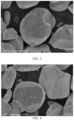
FIG. 1 is a Scanning Electron Microscope (SEM) image of a multi-element cathode material process product 2 prepared in Example 1; -
FIG. 2 is a SEM image of a multi-element cathode material prepared in Example 1, where a 1 µm2 region selected for calculating coverage is marked with a box; -
FIG. 3 is a SEM image of a multi-element cathode material process product 2 prepared in Comparative Example 1; -
FIG. 4 is a SEM image of a multi-element cathode material prepared in Comparative Example 1; and -
FIG. 5 is a cycle performance graph of cathode materials respectively prepared in Example 1 and Comparative Example 1 at a rate of 1 C, with a test temperature of 45°C and a voltage ranging from 3 V to 4.3 V. - Endpoint values and any values of ranges disclosed in the present disclosure are not limited to the precise ranges or values, and these ranges or values should be understood to include values close to these ranges or values. For numerical ranges, one or more new numerical ranges can be obtained by combining int values of the respective ranges, an endpoint value and an individual point value of the respective ranges, and the individual point values, and these numerical ranges should be regarded as specifically disclosed in the present disclosure.
- A first aspect of the present disclosure provides a multi-element cathode material. A surface of the multi-element cathode material includes a dot-like coating and/or an island-like coating.
- A particle diameter D1 with 1% cumulative particle size distribution of the multi-element cathode material is greater than or equal to 0.7 µm.
- An arithmetic average roughness Ra, measured with a three-dimensional scanning electron microscope, of the coating of the multi-element cathode material satisfies 20 nm≤Ra≤200 nm.
- A coverage Q of the dot-like coating and/or the island-like coating of the multi-element cathode material satisfies 3%≤Q≤30%.
- In the related art, most of the multi-element cathode materials are hard blocks with serious inter-particle agglomeration. After strong dissociation, the multi-element cathode materials are prone to form micro-powders that remains on the surface of a multi-component positive electrode or is mixed in the multi-element cathode material. During battery manufacturing, the micro-powders may lead to poor slurry dispersibility and uneven coating. Moreover, the micro-powders consume more electrolyte, thereby affecting cycle performance and storage performance of a lithium-ion battery.
- In the present disclosure, the multi-element cathode material has a relatively great particle size distribution D1, indicating that the multi-element cathode material has fewer particles with small particle diameters and thus has a low content of micro-powders in the multi-element cathode material, such that a lithium-ion battery containing the cathode material has excellent capacity and cycle performance.
- Further, the coating of the surface of the cathode material can significantly improve structural stability of the material. In the related art, in order to improve the cycle performance and the storage performance of the lithium-ion battery, most research focuses on an impact of coating element types on the material. However, the Applicant found through research that a coating amount and a coating state of the coating of the surface of the multi-element cathode material also have a very important influence on the multi-element cathode material. Specifically, when the dot-like coating and/or the island-like coating contained in the surface of the multi-element cathode material have the arithmetic average roughness and coverage as defined in the present disclosure, the lithium-ion battery prepared by the multi-element cathode material has more excellent electrical performance.
- Furthermore, in the present disclosure, as the multi-element cathode material has a low content of the micro-powders, the coating can be prevented from being adsorbed by excessive micro-powders, avoiding a reduction in an effective coating effect, thereby avoiding a reduction in the capacity of the lithium-ion battery containing the multi-component cathode material. Meanwhile, in the present disclosure, as the multi-element cathode material has the low content of the micro-powders, the lithium-ion battery prepared by the multi-element cathode material has the excellent cycle performance and capacity with a reduced usage amount of a coating agent.
- In the present disclosure, the arithmetic average roughness of the surface of the coating of the multi-element cathode material is measured with a three-dimensional scanning electron microscope (3D-SEM), and the arithmetic average roughness Ra of the surface of the particles is measured based on a method according to JIS B 0601(2001). The coverage of the coating is calculated by dividing a total area of the dot-like coating and/or the island-like coating within a 1 µm2 region of a single particle surface under the electron microscope by an area of the 1 µm2 region. As the region indicated by the box in
FIG. 2 , regions of 300 different particles are selected to calculate an average value. - In a preferred embodiment of the present disclosure, the particle diameter D1 with 1% cumulative particle size distribution of the multi-element cathode material satisfies 1 µm≤D1≤2 µm; the arithmetic average roughness Ra, measured with the three-dimensional scanning electron microscope, of the coating of the multi-element cathode material satisfies 30 nm≤Ra≤100 nm; and the coverage Q of the dot-like coating and/or the island-like coating of the multi-element cathode material satisfies 5%≤Q≤15%.
- According to the present disclosure, a particle diameter D50 with 50% cumulative particle size distribution of the multi-element cathode material ranges from 2 µm to 8 µm, and preferably, from 2.5 µm to 7 µm.
- In the present disclosure, the particle diameter D1 with 1% cumulative particle size distribution of the multi-element cathode material and the particle diameter D50 with 50% cumulative particle size distribution of the multi-element cathode material are measured with a laser particle size analyzer.
- According to the present disclosure, an average size P50 of primary particles, measured with an SEM, of the multi-element cathode material ranges from 0.8 µm to 6 µm, and preferably, from 1 µm to 4 µm.
- According to the present disclosure, a specific surface area S of the multi-element cathode material satisfies: 0.2 m2/g≤S≤1.2 m2/g, and/or 1/P50-0.1≤S≤1/P50+0.2.
- In the present disclosure, P50 is expressed in units of µm,S is expressed in in units of m2/g, and the above relations are only a numerical relation.
- In the present disclosure, the multi-element cathode material has a relatively great particle size distribution D1 and a relatively small specific surface area S, and the specific surface area decreases with an increase in the average size P50 of the primary particles. The specific surface area S has an obvious correlation with the average size P50 of the primary particles, which establishes a relation between a macroscopic indicator and a microscopic particle size. In particular, when the specific surface area S of the multi-element cathode material satisfies both 0.2 m2/g≤S≤1.2 m2/g and 1/P50-0.1≤S≤1/P50+0.2, it indicates that a suitable dissociation condition and a suitable coating and back-sintering condition are used in the process of preparing the cathode material. In this regard, the multi-element cathode material provided by the present disclosure neither generates micro-powders through excessive dissociation, nor results in significant agglomeration caused by insufficient dissociation. If the particle size distribution D1 is excessively small (i.e., a high content of micro-powders), the specific surface area S of the multi-element cathode material may be excessively great. If an insufficient dissociation leads to excessive agglomeration, the specific surface area S of the multi-element cathode material may be relatively small, such that a good arithmetic relation between the specific surface area S and the average size P50 of the primary particles cannot be established.
- In the present disclosure, further, the surface coating also affects the specific surface area of the material. Too much residual surface coating leads to a relatively great specific surface area, whereas too little residual surface coating results in a relatively small specific surface area. Only when the residual surface coating falls within an appropriate range and the above-mentioned relations are satisfied, the multi-element cathode material can have better electrochemical performance.
- Further, the specific surface area S of the multi-element cathode material satisfies: 0.3 m2/g≤S≤1 m2/g, and/or 1/P50-0.05≤S≤1/P50+0.05.
- In a preferred embodiment of the present disclosure, the specific surface area S of the multi-element cathode material satisfies: 0.2 m2/g≤S≤1.2 m2/g and 1/P50-0.1≤S≤1/P50+0.2; and preferably, 0.3 m2/g≤S≤1 m2/g and 1/P50-0.05≤S≤1/P50+0.05.
- According to the present disclosure, the multi-element cathode material is particles of a spherical shape and/or an ellipsoidal shape.
- According to the present disclosure, a matrix of the multi-element cathode material has a composition represented by a formula I:
Li a Ni x Mn y Co z M b O2 the formula I
, where:
0.9≤a≤1.1, 0.5≤x<1, 0<y<0.5, 0<z<0.5, and 0≤b≤0.02; and the coating includes a lithium oxide compound containing an element J and/or an oxide containing the element J, contents of the matrix and the coating enable the cathode material to satisfying 0<[n(J)]/[n(Ni)+n(Co)+n(Mn)]<0.03, and M and J being each independently selected from at least one element of Ba, Ra, Zr, Fe, Ca, Zn, B, W, Nb, Cd, Pb, Si, Mo, Cu, V, Ta, Cr, La, Al, Ce, Er, Ho, Y, Mg, Sr, and Ti. - In the present disclosure, the lithium oxide compound containing the element J and/or the oxide containing the element J may further include at least one element of Ni, Co, Mn, and M from the matrix.
- Further, 1≤a≤1.06, 0.6≤x<1, 0≤y≤0.4, 0≤z≤0.4, and 0.001≤b≤0.01; the contents of the matrix and the coating enable the cathode material to satisfy 0.001≤[n(J)]/[n(Ni)+n(Co)+n(Mn)]≤0.01; and M and J are each independently selected from at least one element of Ba, Zr, B, W, Nb, La, Al, Y, Mg, Sr and Ti.
- A second aspect of the present disclosure provides a method for preparing a multi-element cathode material. The method includes:
- (1) mixing a multi-element cathode material precursor, a first lithium source, and an optional dopant, and performing first high-temperature sintering on the mixture to obtain a multi-element cathode
material process product 1; - (2) coarsely crushing the multi-element cathode
material process product 1, and sequentially performing acid solution rinsing, water rinsing, and drying on the coarsely crushed multi-element cathodematerial process product 1, to obtain a multi-element cathode material process product 2; and - (3) mixing the multi-element cathode material process product 2, an optional second lithium source, and a coating agent, and performing second high-temperature sintering and sieving on the mixture, to obtain the multi-element cathode material, in which conditions of the acid solution rinsing include: a concentration of an acid solution ranging from 0.01 g/mL to 0.05 g/mL, and a rinsing duration ranging from 1 second to 120 seconds; a sintering temperature T2 of the second high-temperature sintering ranges from 200°C to 1,000°C; and an amount of the coating agent is added based on a stoichiometric ratio of 0<[n(J)]/[n(Ni)+n(Co)+n(Mn)]≤0.03.
- In the related art, due to the relatively high primary sintering temperature during the preparation of the multi-element cathode material, the multi-element cathode material is prone to form a hard block with the serious inter-particle agglomeration after the sintering, which is required to be dissociated using a strong dissociation method. The strong dissociation method may likely generate the micro-powders.
- In the method for preparing the multi-element cathode material according to the present disclosure, the multi-element cathode
material process product 1 obtained by the first high-temperature sintering can be dissociated by performing the acid solution rinsing with a good dissociation effect, without generating micro-powders. In this way, the generation of a large number of micro-powders caused by the conventional strong dissociation method can be avoided. Thus, poor slurry dispersibility and uneven coating as well as consumption of an electrolyte, which are caused by the excessive micro-powders, can be prevented, thereby preventing a reduction in the cycle performance and storage performance of the lithium-ion battery. - Further, a surface of the multi-element cathode
material process product 1 may be corroded by the acid solution rinsing, thereby increasing roughness of a surface of the multi-element cathode material process product 2. Meanwhile, no particles are attached to the surface of the multi-element cathode material process product 2, enabling the coating to be more closely bonded to the surface of the prepared multi-element cathode material after the multi-element cathode material process product 2 and the coating agent are mixed and subjected to the second high-temperature sintering. In addition, during a cycling of the lithium-ion battery, the coating is not easy to fall off from the surface of the cathode material, thereby having better coating effect. Specifically, by controlling the conditions of the acid solution rinsing to meet the above-mentioned ranges, the particles of the prepared multi-element cathode material can be separated from each other without generating micro-powders. More specifically, when the concentration of the acid solution is excessively low or the rinsing duration is excessively short, the separation effect cannot be achieved. When the concentration of the acid solution is excessively high or the rinsing duration is excessively long, the structure of the surface of the multi-element cathode material is destroyed, eventually degrading the performance of the lithium-ion battery containing the multi-element cathode material. - Furthermore, in the present disclosure, by performing the acid solution rinsing on the multi-element cathode
material process product 1 to reduce the content of the micro-powders of the multi-element cathode material, the lithium-ion battery prepared by the multi-element cathode material according to the present disclosure can be ensured to have excellent cycle performance and the high capacity while reducing the amount of the added coating agent. - In the present disclosure, the multi-element cathode material process product 2 is of independent particles of a spherical shape and/or an ellipsoidal shape.
- Furthermore, lithium carbonate and lithium hydroxide residual on the surface of the multi-element cathode
material process product 1 can be washed away by performing the acid solution rinsing, resulting in a reduction in the residual lithium on the surface of the prepared multi-element cathode material, and thus lack of lithium is likely to occur on the surface layer. Thus, the second lithium source is added during the second high-temperature sintering to ensure that the lithium-ion battery containing the prepared multi-element cathode material has a high capacity. Furthermore, the second lithium source serves as a flux. Thus, by adding the second lithium source during the second high-temperature sintering, the temperature of the second high-temperature sintering can be lowered, and energy consumption can be reduced. - According to the present disclosure, the multi-element cathode material precursor is a ternary nickel-cobalt-manganese cathode material precursor.
- In the present disclosure, the multi-element cathode material precursor can be commercially available or self-made.
- According to the present disclosure, the first lithium source and the second lithium source are each independently selected from one of lithium carbonate, lithium hydroxide, lithium oxide compound, and lithium acetate.
- According to the present disclosure, the dopant and the coating agent are each independently selected from one of carbonates, hydroxides, oxides, and acetates capable of providing at least one element of Ba, Ra, Zr, Fe, Ca, Zn, B, W, Nb, Cd, Pb, Si, Mo, Cu, V, Ta, Cr, La, Al, Ce, Er, Ho, Y, Mg, Sr, and Ti.
- According to the present disclosure, the acid solution is selected from at least one of sulfuric acid, carbonic acid, acetic acid, and oxalic acid.
- According to the present disclosure, a total amount of the first lithium source and the second lithium source is added based on a stoichiometric ratio of 0.9≤[n(Li1)+n(Li2)]/[n(Ni)+n(Co)+n(Mn)]≤1.1.
- Further, the total amount of the first lithium source and the second lithium source is added based on a stoichiometric ratio of 1≤[n(Li1)+n(Li2)]/[n(Ni)+n(Co)+n(Mn)]≤1.06.
- In the present disclosure, there is no particular limitation on the respective amounts of the first lithium source and the second lithium source, as long as the total amount of the first lithium source and the second lithium source satisfies the above-mentioned ranges.
- In a specific embodiment of the present disclosure, an amount of the first lithium source is added based on a stoichiometric ratio of 0.9≤[n(Li1)]/[n(Ni)+n(Co)+n(Mn)]≤1.05, and an amount of the second lithium source is added stoichiometric ratio of 0≤[n(Li2)]/[n(Ni)+n(Co)+n(Mn)]≤0.05.
- In a preferred embodiment of the present disclosure, the amount of the first lithium source is added based on a stoichiometric ratio of 0.99≤[n(Li1)]/[n(Ni)+n(Co)+n(Mn)]≤1.05, and the amount of the second lithium source is added stoichiometric ratio of 0.01≤[n(Li2)]/[n(Ni)+n(Co)+n(Mn)]≤0.01.
- According to the present disclosure, an amount of the dopant is added based on a stoichiometric ratio of 0≤[n(M)]/[n(Ni)+n(Co)+n(Mn)]≤0.02, and preferably, 0≤[n(M)]/[n(Ni)+n(Co)+n(Mn)]≤0.01.
- According to the present disclosure, an amount of the coating agent is added based on a stoichiometric ratio of 0<[n(J)]/[n(Ni)+n(Co)+n(Mn)]≤0.03.
- In the present disclosure, when the amount of coating agent is controlled to meet the above-mentioned ranges, it can ensure that the prepared multi-element cathode material has an appropriate content of the coating, thereby ensuring that the prepared multi-element cathode material has a stable structure without excessive residual coating on the surface. Specifically, when the amount of coating agent is excessively high, excessive residual coating is remained on the surface of the material and affects lithium ion transmission, resulting in lower capacity and rate performance of the lithium-ion battery containing the multi-element cathode material. When the amount of the coating agent is excessively low, the coating function cannot be exerted. In this case, during the cycle, the electrolyte can easily destroy the surface structure of the multi-element cathode material, resulting in a reduction in the performance of the lithium-ion battery containing the multi-element cathode material.
- According to the present disclosure, an amount of the coating agent is added based on a stoichiometric ratio of 0.001≤[n(J)]/[n(Ni)+n(Co)+n(Mn)]≤0.01.
- According to the present disclosure, conditions of first high-temperature sintering include: a sintering temperature T1 ranging from 700°C to 1,200°C, a sintering duration ranging from 10 hours to 30 hours, and a sintering atmosphere of oxygen and/or air.
- Further, the conditions of first high-temperature sintering include: the sintering temperature T1 ranging from 700°C to 1,050°C, the sintering duration ranging from 15 hours to 25 hours, and the sintering atmosphere of oxygen and/or the air.
- According to the present disclosure, the conditions of the acid solution rinsing include: the concentration of the acid solution ranging from 0.02 g/mL to 0.04 g/mL, and the rinsing duration ranging from 5 seconds to 60 seconds.
- In the present disclosure, the coarse crushing can be performed by conventional methods well known to those skilled in the art, for example, dissociation by a pair of rollers with a wide gap, aiming to decompose the large block into small blocks with weak dissociation strength and generate fewer micro-powders.
- In the present disclosure, the operation of performing the water rinsing on the product after the acid solution rinsing is intended to remove residual acid solution.
- According to the present disclosure, the sintering temperature of the second high-temperature sintering ranges from 300°C to 900°C.
- According to the present disclosure, a sintering duration of the second high-temperature sintering ranges from 5 hours to 20 hours, and preferably, from 6 hours to 15 hours.
- According to the present disclosure, the second high-temperature sintering is performed in air and/or oxygen.
- According to the present disclosure, the sintering temperature T2 of the second high-temperature sintering ranges from 200°C to 1,000°C, and the sintering temperature T2 and a melting point Tm of the coating agent satisfy a relation of 100×lnTm-200≤T2≤100×lnTn+100.
- In the present disclosure, it was found that the coating agent on the cathode material can have better coating effect by adjusting the sintering temperature of the second high-temperature sintering based on the type of the coating agent. Specifically, when the melting point of the coating agent and the sintering temperature of the second high-temperature sintering are controlled to satisfy the above-mentioned relation, the better coating effect can be obtained.
- Further, the sintering temperature T2 of the second high-temperature sintering ranges from 300°C to 900°C, and the sintering temperature T2 and the melting point Tm of the coating agent satisfy a relation of 100×lnTm-100≤T2≤100×lnTm+50.
- A third aspect of the present disclosure provides a multi-element cathode material prepared by the above preparation method.
- A fourth aspect of the present disclosure provides a lithium-ion battery. The lithium-ion battery includes the above-mentioned multi-element cathode material.
- The present disclosure is described in detail below by means of examples. In the following examples, all raw materials are commercially available unless otherwise specified.
- Unless otherwise specified, the room temperature mentioned in the present disclosure refers to 25±2°C.
- In the following examples and comparative examples, relevant parameters are tested by the following methods:
- (1) Particle size testing: laser particle analyzer;
- (2) Morphology and surface roughness testing: scanning electron microscope, model ERA-9200, manufactured by ELIONIX Co., Ltd., Japan;
- (3) Specific surface area testing: specific surface area analyzer, model Tristar 3020, manufactured by Micromeritics Instrument Corporation; and
- (4) Electrochemical performance testing: in the following examples and comparative examples, the electrochemical performance of the multi-element cathode material was tested using a button cell of model 2050.
- A process of preparing a button cell of model 2050 is as follows.
- Preparation of plate: a uniform slurry was formed by fully mixing a multi-element cathode material, acetylene black, and polyvinylidene fluoride (PVDF) in a mass ratio of 95:3:2 with an appropriate amount of N-methyl pyrrolidone (NMP); and after the slurry was coated on an aluminum foil and dried at 120°C for 12 hours, it was stamped with a pressure of 100 MPa into positive electrode plates having a diameter of 12 mm and a thickness of 120 µm. A loading quantity of the multi-element cathode material was 15 mg/cm2.
- Battery assembly: in an argon-filled air glove box with a water content and oxygen content of less than 5 ppm, the positive electrode plate, a separator, a negative electrode plate, and an electrolyte were assembled into a button cell of model 2050, which was left standing for 6 hours. A lithium sheet having a diameter of 17 mm and a thickness of 1 mm served as the negative electrode. A polyethylene porous film (Celgard2325) having a thickness of 25 µm served as the separator. The electrolyte was a mixture of equal amounts of ethylene carbonate (EC) and diethyl ethyl carbonate (DEC) containing 1 mol/LLiPF6.
- In the following examples and comparative examples, a battery testing system from Neware Technology Co., Ltd., was used to test electrochemical performance of the button cell of model 2050. Charge and discharge current density of 0.1C was 200 mA/g.
- Charge and discharge voltage was controlled to range from 3.0 V to 4.3 V. At the room temperature, the button cell was tested for charging and discharging at 0.1C to evaluate first charge-discharge specific capacity and first charge-discharge efficiency of the multi-element cathode material.
- Cycle performance testing: a charge and discharge voltage was controlled to range from 3.0 V to 4.3 V. At a constant temperature of 45°C, the button cell was charged and discharged for 2 cycles at 0.1C and charged and discharged for 80 cycles at 1C to evaluate high-temperature capacity retention rate of the multi-element cathode material.
- Rate performance testing: the charge and discharge voltage was controlled to range from 3.0 V to 4.3 V. At the room temperature, the button cell was charged and discharged for 2 cycles at 0.1C , and then charged and discharged for 1 cycle at 0.2C, 0.33C, 0.5C, and 1C respectively. Rate performance of the multi-element cathode material was evaluated by calculating a ratio of the first discharge specific capacity at 0.1C to the discharge specific capacity at 1C. The first discharge specific capacity at 0.1C was the discharge specific capacity of the button cell in the first cycle, and the discharge specific capacity at 1C is the discharge specific capacity of the button cell in the sixth cycle.
- This example is provided to explain the cathode material prepared by the method of the present disclosure.
- (1) A nickel-cobalt-manganese hydroxide precursor Ni0.8Co0.1Mn0.1(OH)2, lithium hydroxide, and aluminum oxide were uniformly mixed based on a ratio of n(Li):n(Al):[n(Ni)+n(Co)+n(Mn)]=1.04:0.001:1, and the mixture was sintered at 890°C for 20 hours in an oxygen atmosphere and naturally cooled to the room temperature, to obtain a multi-element cathode
material process product 1. - (2) The multi-element cathode
material process product 1 was coarsely crushed, and then the coarsely crushed multi-element cathodematerial process product 1 was rinsed with 0.03 g/mL sulfuric acid for 30 seconds, rinsed with deionized water to remove the residual sulfuric acid, and dried, to obtain a multi-element cathode material process product 2: Li1.04Ni0.8Co0.1Mn0.1Al0.001O2. - (3) The multi-element cathode material process product 2, lithium hydroxide, magnesium oxide, and tungsten oxide were uniformly mixed based on a ratio of n(Li):n(Mg):n(W):[n(Ni)+n(Co)+n(Mn)]=0.01:0.005:0.002:1, sintered at 700°C for 12 hours in an oxygen atmosphere, naturally cooled to the room temperature, and sieved, to obtain a multi-element cathode material.
- Example 2 to Example 7 adopted the method as described in Example 1. Example 2 to Example 7 differed Example 1 in the formula and the process parameters used, which are specifically listed in Table 1, and the other aspects were the same as Example 1, to prepare multi-element cathode materials.
[Table 1] Example 1 Example 2 Example 3 Example 4 Precursor composition Ni0.8Co0.1Mn0.1(OH)2 Ni0.8Co0.1Mn0.1(OH)2 Ni0.8Co0.1Mn0.1(OH)2 Ni0.8Co0.1Mn0.1(OH)2 First lithium source Lithium hydroxide Lithium hydroxide Lithium hydroxide Lithium hydroxide Li1/(Ni+Mn+Co) 1.04 1.04 1.04 1.04 Dopant Al2O3 Al2O3 Al2O3 Al2O3 Molar ratio of dopant Al/(Ni+Mn+Co)= 0.001:1 Al/(Ni+Mn+Co)= 0.001:1 Al/(Ni+Mn+Co)= 0.001:1 Al/(Ni+Mn+Co)= 0.001:1 First high-temperature sintering temperature/°C 890 890 890 890 First high-temperature sintering duration/h 20 20 20 20 Sulfuric acid concentration/g/mL 0.03 0.01 0.05 0.03 Rinsing duration/s 30 5 90 30 Second lithium source Lithium hydroxide Lithium hydroxide Lithium hydroxide Lithium hydroxide Li2/(Ni+Mn+Co) 0.01 0.01 0.01 0.01 Coating agent MgO, WO3 MgO, WO3 MgO, WO3 MgO, WO3 Molar ratio of coating agent Mg/(Ni+Mn+Co)= 0.005:1 Mg/(Ni+Mn+Co)= 0.005:1 Mg/(Ni+Mn+Co)= 0.005:1 Mg/(Ni+Mn+Co) =0.015:1 W/(Ni+Mn+Co)= 0.002:1 W/(Ni+Mn+Co)= 0.002:1 W/(Ni+Mn+Co)= 0.002:1 W/(Ni+Mn+Co) =0.01:1 Melting point of coating agent/°C 2,852, 1,473 2,852, 1,473 2,852, 1,473 2,852, 1,473 Second high-temperature sintering temperature/°C 700 700 700 580 Second high-temperature sintering duration/h 12 12 12 12 [Table 1 (continued)] Example 5 Example 6 Example 7 Example 8 Precursor composition Ni0.8Co0.1Mn0.1(OH)2 Ni0.6Co0.2Mn0.2(OH)2 Ni0.9CO0.05Mn0.05(OH)2 Ni0.8Co0.1Mn0.1(OH)2 First lithium source Lithium hydroxide Lithium hydroxide Lithium hydroxide Lithium hydroxide Li1/(Ni+Mn+Co) 1.04 1.04 1.04 1.04 Dopant Al2O3 / La2O3 Al2O3 Molar ratio of dopant Al/(Ni+Mn+Co) =0.001:1 / La/(Ni+Mn+Co) =0.003:1 Al/(Ni+Mn+Co)= 0.001:1 First high-temperature sintering temperature/°C 890 980 850 890 First high-temperature sintering duration/h 20 20 20 20 Sulfuric acid concentration/g/mL 0.03 0.03 0.03 0.03 Rinsing duration/s 30 30 30 30 Second lithium source Lithium hydroxide Lithium hydroxide Lithium hydroxide / Li2/(Ni+Mn+Co) 0.01 0.01 0.01 / Coating agent MgO, WO3 ZrO2 Al2O3, TiO2 MgO, WO3 Molar ratio of coating agent Mg/(Ni+Mn+Co) =0.005:1 Zr/(Ni+Mn+Co) =0.008:1 Al/(Ni+Mn+Co) =0.005:1 Mg/(Ni+Mn+Co)= 0.005:1 W/(Ni+Mn+Co) =0.002:1 Ti/(Ni+Mn+Co) =0.004:1 W/(Ni+Mn+Co)= 0.002:1 Melting point of coating agent/°C 2,852, 1,473 2,700 2,852, 1,840 2,852, 1,473 Second high-temperature sintering temperature/°C 870 730 690 700 Second high-temperature sintering duration/h 12 12 12 12 -
- (1) A nickel-cobalt-manganese hydroxide precursor Ni0.8Co0.1Mn0.1(OH)2, lithium hydroxide, and aluminum oxide were uniformly mixed based on a ratio of n(Li):n(Al):[n(Ni)+n(Co)+n(Mn)]=1.04:0.001:1, and the mixture was sintered at 890°C for 20 hours in an oxygen atmosphere and naturally cooled to the room temperature, to obtain a multi-element cathode
material process product 1. - (2) The multi-element cathode
material process product 1 was coarsely crushed, and then the coarsely crushed multi-element cathodematerial process product 1 was dissociated by a pair of rollers with a relatively narrow gap to a target particle size of 6.2 µm, to obtain a multi-element cathode material process product 2: Li1.04Ni0.8Co0.1Mn0.1Al0.001O2. - (3) The multi-element cathode material process product 2, lithium hydroxide, magnesium oxide, and tungsten oxide were uniformly mixed based on a ratio of n(Li):n(Mg):n(W):[n(Ni)+n(Co)+n(Mn)]=0.01:0.005:0.002:1, sintered at 700°C for 12 hours in an oxygen atmosphere, naturally cooled to the room temperature, and sieved, to obtain a multi-element cathode material.
- Comparative Example 2 was based on the method of Example 1. Comparative Example 2 differed from Example 1 in step (3), in which the multi-element cathode material process product 2 and lithium hydroxide were uniformly mixed based on a ratio of n(Li):[n(Ni)+n(Co)+n(Mn)]=0.01:1, and the other aspects were the same as Example 1, to obtain a multi-element cathode material: Li0.05Ni0.8Co0.1Mn0.1Al0.001O2. Data of characteristic parameter testing are shown in Table 2.
- Comparative Example 3 was based on the method of Example 1. Comparative Example 3 differed from Example 1 in step (3), in which the ternary material process product 2, lithium hydroxide, magnesium oxide, and tungsten oxide were uniformly mixed based on a ratio of n(Li):n(Mg):n(W):[n(Ni)+n(Co)+n(Mn)]=0.01:0.03:0.03:1, and sintered at 400°C for 12 hours in an oxygen atmosphere. The other aspects were the same as in Example 1. A multi-element cathode material was obtained. Data of characteristic parameter testing are shown in Table 2.
- Comparative Example 4 was based on the method of Example 1. Comparative Example 4 differed from Example 1 in step (3), in which the sintering was performed at 1,100°C in an oxygen atmosphere; and the other aspects were the same as Example 1, to obtain a multi-element cathode material. Data of characteristic parameter testing are shown in Table 2.
- Comparative Example 5 was based on the method of Example 1. Comparative Example 5 differed from Example 1 in step (2), in which the rinsing was performed with 0.1 g/mL sulfuric acid for 180s; and the other aspects were the same as Example 1, to obtain a multi-element cathode material. Data of characteristic parameter testing are shown in Table 2. Testing examples
- The present disclosure tested scanning electron microscope images of the cathode materials prepared in the above-mentioned examples and comparative examples and calculated an average size P50 of primary particles, an arithmetic average roughness Ra, and a coverage Q of the multi-element cathode material, as shown in
FIG. 1 to FIG. 4 and Table 2.FIG. 1 reveals that the surface of the multi-element cathode material process product 2 obtained in Example 1 had no agglomeration and had good particle independence.FIG. 2 reveals that the multi-element cathode material had the dot- and island-like coating on the surface thereof. The multi-element cathode material process product 2 obtained in Comparative Example 1 had more micro-powders on the surface thereof, more fragments, and the corners thereof were worn, and in addition to the coating, more micro-powders were present on the surface of the multi-element cathode material. - The present disclosure tested the D1, D50, P50, S, Ra, and Q of the multi-element cathode materials prepared in the above-mentioned examples and comparative examples. The specific testing results are shown in Table 2.
[Table 2] Matrix composition of cathode material Coating Content of coating Example 1 Li1.05Ni0.8Co0.1Mn0.1Al0.001O2 Lithium oxide of Mg and/or oxide of Mg, and lithium oxide compound of W and/or oxide of W n(Mg)/[n(Ni)+n(Co)+n(Mn)]=0.005; n(W)/(n(Ni)+n(Co)+n(Mn)]=0.002 Example 2 Li1.05Ni0.8Co0.1Mn0.1Al0.001O2 Lithium oxide of Mg and/or oxide of Mg, and lithium oxide compound of W and/or oxide of W n(Mg)/[n(Ni)+n(Co)+n(Mn)]=0.005; n(W)/(n(Ni)+n(Co)+n(Mn)]=0.002 Example 3 Li1.05Ni0.8Co0.1Mn0.1Al0.001O2 Lithium oxide of Mg and/or oxide of Mg, and lithium oxide compound of W and/or oxide of W n(Mg)/[n(Ni)+n(Co)+n(Mn)]=0.005; n(W)/(n(Ni)+n(Co)+n(Mn)]=0.002 Example 4 Li1.05Ni0.8Co0.1Mn0.1Al0.001O2 Lithium oxide of Mg and/or oxide of Mg, and lithium oxide compound of W and/or oxide of W n(Mg)/[n(Ni)+n(Co)+n(Mn)]=0.015; n(W)/[n(Ni)+n(Co)+n(Mn)]=0.01 Example 5 Li1.05Ni0.8Co0.1Mn0.1Al0.001O2 Lithium oxide of Mg and/or oxide of Mg, and lithium oxide compound of W and/or oxide of W n(Mg)/[n(Ni)+n(Co)+n(Mn)]=0.005; n(W)/(n(Ni)+n(Co)+n(Mn)]=0.002 Example 6 Li1.05Ni0.6CO0.2Mn0.2O2 Lithium oxide of Zr and/or oxide of Zr n(Zr)/[n(Ni)+n(Co)+n(Mn)]=0.008 Example 7 Li1.05Ni0.9CO0.05Mn0.05La0.003O2 Lithium oxide of Al and/or oxide of Al, and lithium oxide compound of Ti and/or oxide of Ti n(Al)/[n(Ni)+n(Co)+n(Mn)]=0.005; n(Ti)/[n(Ni)+n(Co)+n(Mn)]=0.004 Example 8 Li1.04Ni0.8Co0.1Mn0.1Al0.001O2 Lithium oxide of Mg and/or oxide of Mg, and lithium oxide compound of W and/or oxide of W n(Mg)/[n(Ni)+n(Co)+n(Mn)]=0.005; n(W)/(n(Ni)+n(Co)+n(Mn)]=0.002 Comparative Example 1 Li1.05Ni0.8Co0.1Mn0.1Al0.001O2 Lithium oxide of Mg and/or oxide of Mg, and lithium oxide compound of W and/or oxide of W n(Mg)/[n(Ni)+n(Co)+n(Mn)]=0.005; n(W)/[n(Ni)+n(Co)+n(Mn)]=0.002 Comparative Example 2 Li1.05Ni0.8Co0.1Mn0.1Al0.001O2 / / Comparative Example 3 Li1.05Ni0.8Co0.1Mn0.1Al0.001O2 Lithium oxide of Mg and/or oxide of Mg, and lithium oxide compound of W and/or oxide of W \n(Mg)/[n(Ni)+n(Co)+n(Mn)]=0.03; n(W)/[n(Ni)+n(Co)+n(Mn)]=0.03 Comparative Example 4 Li1.05Ni0.8Co0.1Mn0.1Al0.001O2 Lithium oxide of Mg and/or oxide of Mg, and lithium oxide compound of W and/or oxide of W n(Mg)/[n(Ni)+n(Co)+n(Mn)]=0.005; n(W)/(n(Ni)+n(Co)+n(Mn)]=0.002 Comparative Example 5 Li1.05Ni0.8Co0.1Mn0.1Al0.001O2 Lithium oxide of Mg and/or oxide of Mg, and lithium oxide compound of W and/or oxide of W n(Mg)/[n(Ni)+n(Co)+n(Mn)]=0.005; n(W)/[n(Ni)+n(Co)+n(Mn)]=0.002 [Table 2 (continued)] D1 D50 P50 1/P50 1/P50-0.1 to 1/P50+0.2 S Ra Q µm µm µm m2/g nm % Example 1 2.1 6.2 3.2 0.313 0.213-0.513 0.355 56 9 Example 2 3.2 7.9 3.2 0.313 0.213-0.513 0.324 58 12 Example 3 1.8 5.8 2.9 0.345 0.245-0.545 0.543 59 7 Example 4 2.1 6.2 3.2 0.313 0.213-0.513 0.582 142 21 Example 5 2.1 6.2 3.2 0.313 0.213-0.513 0.335 21 4 Example 6 1.1 3.8 1.9 0.526 0.426-0.726 0.584 38 6 Example 7 1.2 4.1 2.1 0.476 0.376-0.676 0.545 45 10 Example 8 2.1 6.2 3.2 0.313 0.213-0.513 0.355 60 12 Comparative Example 1 0.4 6.2 3.2 0.313 0.213-0.513 1.359 307 36 Comparative example 2 2.1 6.2 3.2 0.313 0.213-0.513 0.192 0 0 Comparative Example 3 2.1 6.2 3.2 0.313 0.213-0.513 0.782 242 39 Comparative Example 4 2.1 6.2 3.2 0.313 0.213-0.513 0.187 0 0 Comparative Example 5 1.2 2.6 1.8 0.556 0.456-0.756 0.782 42 2 - It can be seen from Table 2 that, compared with Example 1, in Example 2, the concentration of the sulfuric acid was lower, the rinsing duration was shorter, and the obtained S was smaller, indicating insufficient dissociation and particle agglomeration; and in Example 3, the concentration of the sulfuric acid was higher, the rinsing duration was longer, the obtained S was greater, and the obtained D50 and P50 were smaller, indicating that the surface of the cathode material was partially corroded by sulfuric acid.
- Compared with Example 1, in Example 4, the coating amount was greater, the surface had more residual coating agents, and S, Ra, and Q were greater; and in Example 5, the temperature of the second-high temperature sintering was higher, more coating agents were incorporated into an outer layer of the cathode material, the surface had less residual coating, and S, Ra and Q were smaller.
- Examples 6 and 7 indicate that different compositions and coating agents were also applicable.
- Compared with Example 1, the coarsely crushed multi-element cathode
material process product 1 was dissociated to have the target particle size using the pair of rollers in Comparative Example 1, leading to more micro-powders, smaller D1, greater S, and greater surface roughness Ra, which were consistent with the conclusions inFIG. 3 and FIG. 4 . - In Comparative Example 2, no coating was performed, and the particles were slightly aggregated after the second high-temperature sintering, resulting in smaller S; in Comparative Example 3, the coating amount was excessively greater, and the second high-temperature sintering temperature was lower, resulting in more residual coating agents on the surface, excessively greater S, greater surface roughness Ra and surface coverage Q; and in Comparative Example 4, the temperature of the second high-temperature sintering was high, the coating agent was incorporated into the outer layer of the cathode material, and the particles were aggregated, resulting in a smaller S.
- In Comparative Example 5, the concentration of the acid solution was relatively high, and the rinsing duration was long, leading to serious surface corrosion, smaller D50 and P50, and greater S.
[Table 3] First discharge specific capacity (0.1 C/mAh/g) Discharge specific capacity (1.0 C/mAh/g) Rate 1.0 C/0.1 C Capacity retention rate/% after 80 cycles at 45°C Example 1 202.5 186.2 0.920 96.2 Example 2 201.7 184.2 0.913 95.3 Example 3 201.6 184.5 0.915 94.8 Example 4 199.3 181.2 0.909 93.2 Example 5 199.6 181.1 0.907 92.9 Example 6 185.4 170.7 0.921 97.6 Example 7 211.5 193.8 0.916 91.5 Example 8 198.8 180.5 0.908 93.1 Comparative Example 1 198.2 174.1 0.878 88.9 Comparative Example 2 198.7 176.2 0.887 89.2 Comparative Example 3 198.3 176.2 0.889 90.8 Comparative Example 4 198.2 175.8 0.887 90.2 Comparative Example 5 200.1 180.2 0.901 89.0 - It can be seen from Table 3 that compared with Example 1, in Example 2, the S was smaller, the particles were aggregated, the material capacity was slightly lower, and the rate and the cycle performance were slightly poor; and in Example 3, the S was greater, the surface was partially corroded, and the cycle performance of the material was poor.
- Compared with Example 1, in Example 4, the coating amount was greater and the surface had more residual coating agents, which hindered lithium ion transmission, thereby reducing the material capacity and resulting in poor rate and slightly poor cycle performance; and in Example 5, the temperature of the second high-temperature sintering was high, the surface had less coating agent, and the cycle performance was poor; and in Example 8, no second lithium source was omitted, the surface was deficient in lithium, and the capacity was low.
- Compared with Example 1, in Comparative Example 1, more micro-powders were present to consume more electrolyte, leading to insufficient electrolyte, which may be reflected in a reduction in the capacity of the material. In addition, the micro-powders can cause instability of the electrode plate of the battery, and thus the cycle performance deteriorates.
- In Comparative Example 2, the coating was omitted. Thus, during a charge and a discharge of the battery, the surface was prone to structural transformation and the cycle performance was poor. In Comparative Example 3, more surface residues hindered lithium ion transmission, and the rate of the material was poor. In Comparative Example 4, the temperature of the second high-temperature sintering was high, the residual coating agent was less, the particles were aggregated, and therefore, cycle stability of the material was poor.
- In Comparative Example 5, the concentration of the acid solution was excessively high the rinsing duration was long, such that the material was severely corroded, leading to relatively poor cycle stability of the material.
- The preferred embodiments of the present disclosure are described in detail above. However, the present disclosure is not limited thereto. Within the scope of the technical concept of the present disclosure, various simple modifications can be made to the technical solutions of the present disclosure, including the combination of various technical features in any other suitable manner. These simple modifications and combinations should also be regarded as the disclosed content of the present disclosure and fall within the protection scope of the present disclosure.
Claims (11)
- A multi-element cathode material, wherein:a surface of the multi-element cathode material comprises a dot-like coating and/or an island-like coating;a particle diameter D1 with 1% cumulative particle size distribution of the multi-element cathode material is greater than or equal to 0.7 µm;an arithmetic average roughness Ra, measured with a three-dimensional scanning electron microscope, of the coating of the multi-element cathode material satisfies 20 nm≤Ra≤200 nm; anda coverage Q of the dot-like coating and/or the island-like coating of the multi-element cathode material satisfies 3%≤Q≤30%.
- The multi-element cathode material according to claim 1, wherein:the particle diameter D1 with 1% cumulative particle size distribution of the multi-element cathode material satisfies 1 µm≤D1≤2 µm;the arithmetic average roughness Ra, measured with the three-dimensional scanning electron microscope, of the coating of the multi-element cathode material satisfies 30 nm≤Ra≤100 nm; andthe coverage Q of the dot-like coating and/or the island-like coating of the multi-element cathode material satisfies 5%≤Q≤15%.
- The multi-element cathode material according to claim 1 or 2, wherein a particle diameter D50 with 50% cumulative particle size distribution of the multi-element cathode material ranges from 2 µm to 8 µm, and preferably, from 2.5 µm to 7 µm;preferably, an average size P50 of primary particles, measured with a Scanning Electron Microscope (SEM), of the multi-element cathode material ranges from 0.8 µm to 6 µm,and preferably, from 1 µm to 4 µm;preferably, a specific surface area S of the multi-element cathode material satisfies: 0.2 m2/g≤S≤1.2 m2/g, and/or 1/P50-0.1≤S≤1/P50+0.2; andpreferably, the multi-element cathode material is particles of a spherical shape and/or an ellipsoidal shape.
- The multi-element cathode material according to any one of claims 1 to 3, wherein a matrix of the cathode material has a composition represented by a formula I:
Li a Ni x Mn y Co z M b 02 the formula I,
where 0.9≤a≤1.1, 0.5≤x<1, 0<y<0.5, 0<z<0.5, and 0≤b≤0.02;wherein the coating comprises a lithium oxide compound containing an element J and/or an oxide containing the element J;wherein contents of the matrix and the coating enable the cathode material to satisfy 0<[n(J)]/[n(Ni)+n(Co)+n(Mn)]<0.03; andwherein M and J are each independently selected from at least one element of Ba, Ra, Zr, Fe, Ca, Zn, B, W, Nb, Cd, Pb, Si, Mo, Cu, V, Ta, Cr, La, Al, Ce, Er, Ho, Y, Mg, Sr, and Ti. - A method for preparing a multi-element cathode material, the method comprising:(1) mixing a multi-element cathode material precursor, a first lithium source, and an optional dopant, and performing first high-temperature sintering on the mixture, to obtain a multi-element cathode material process product 1;(2) coarsely crushing the multi-element cathode material process product 1, and sequentially performing acid solution rinsing, water rinsing, and drying on the coarsely crushed multi-element cathode material process product 1, to obtain a multi-element cathode material process product 2; and(3) mixing the multi-element cathode material process product 2, an optional second lithium source, and a coating agent, and performing second high-temperature sintering and sieving on the mixture, to obtain the multi-element cathode material; wherein:conditions of the acid solution rinsing comprise: a concentration of an acid solution ranging from 0.01 g/mL to 0.05 g/mL, and a rinsing duration ranging from 1 second to 120 seconds;a sintering temperature T2 of the second high-temperature sintering ranges from 200°C to 1,000°C; andan amount of the coating agent is added based on a stoichiometric ratio of 0<[n(J)]/[n(Ni)+n(Co)+n(Mn)]≤0.03.
- The method according to claim 5, wherein the multi-element cathode material precursor is a ternary nickel-cobalt-manganese cathode material precursor;preferably, the first lithium source and the second lithium source are each independently selected from one of lithium carbonate, lithium hydroxide, lithium oxide compound, and lithium acetate;preferably, the dopant and the coating agent are each independently selected from one of carbonates, hydroxides, oxides, and acetates capable of providing at least one element of Ba, Ra, Zr, Fe, Ca, Zn, B, W, Nb, Cd, Pb, Si, Mo, Cu, V, Ta, Cr, La, Al, Ce, Er, Ho, Y, Mg, Sr, and Ti; andpreferably, the acid solution is selected from at least one of sulfuric acid, carbonic acid, acetic acid, and oxalic acid.
- The method according to claim 6, wherein a total amount of the first lithium source and the second lithium source is added based on a stoichiometric ratio of 0.9≤[n(Li1)+n(Li2)]/[n(Ni)+n(Co)+n(Mn)]≤1.1, and preferably, 1<[n(Li1)+n(Li2)]/[n(Ni)+n(Co)+n(Mn)]≤1.06;preferably, an amount of the dopant is added based on a stoichiometric ratio of 0.0001≤[n(M)]/[n(Ni)+n(Co)+n(Mn)]≤0.02, and preferably, 0.001≤[n(M)]/[n(Ni)+n(Co)+n(Mn)]≤0.01; andpreferably, the amount of the coating agent is added based on a stoichiometric ratio of 0.001≤[n(J)]/[n(Ni)+n(Co)+n(Mn)]≤0.01.
- The method according to any one of claims 5 to 7, wherein conditions of first high-temperature sintering comprise: a sintering temperature T1 ranging from 700°C to 1,200°C, a sintering duration ranging from 10 hours to 30 hours, and a sintering atmosphere of oxygen and/or air;preferably, the conditions of the acid solution rinsing comprise: the concentration of the acid solution ranging from 0.02 g/mL to 0.04 g/mL, and the rinsing duration ranging from 5 seconds to 60 seconds;preferably, the sintering temperature T2 of the second high-temperature sintering ranges from 300°C to 900°C;preferably, a sintering duration of the second high-temperature sintering ranges from 5 hours to 20 hours, and preferably, from 6 hours to 15 hours; andpreferably, the second high-temperature sintering is performed in air and/or oxygen.
- The method according to any one of claims 5 to 8, wherein the sintering temperature T2 of the second high-temperature sintering ranges from 200°C to 1,000°C, and the sintering temperature T2 and a melting point Tm of the coating agent satisfy a relation of 100×lnTm-200≤T2≤100×lnTm+100; and
preferably, the sintering temperature T2 of the second high-temperature sintering ranges from 300°C to 900°C, and the sintering temperature T2 and the melting point Tm of the coating agent satisfy a relation of 100×lnTm-100≤T2≤100×lnTm+50. - A multi-element cathode material, prepared by the method according to any one of claims 5 to 9.
- A lithium ion battery, comprising the multi-element cathode material according to any one of claims 1 to 4 and 10.
Applications Claiming Priority (1)
| Application Number | Priority Date | Filing Date | Title |
|---|---|---|---|
| PCT/CN2023/088747 WO2024216447A1 (en) | 2023-04-17 | 2023-04-17 | Multi-element positive electrode material and preparation method therefor, and lithium ion battery |
Publications (2)
| Publication Number | Publication Date |
|---|---|
| EP4528858A1 true EP4528858A1 (en) | 2025-03-26 |
| EP4528858A4 EP4528858A4 (en) | 2025-11-26 |
Family
ID=93151887
Family Applications (1)
| Application Number | Title | Priority Date | Filing Date |
|---|---|---|---|
| EP23927833.6A Pending EP4528858A4 (en) | 2023-04-17 | 2023-04-17 | Multi-element positive electrode material and manufacturing process therefor, as well as lithium-ion battery |
Country Status (5)
| Country | Link |
|---|---|
| US (1) | US12612315B2 (en) |
| EP (1) | EP4528858A4 (en) |
| JP (1) | JP7719316B2 (en) |
| KR (1) | KR20240160140A (en) |
| WO (1) | WO2024216447A1 (en) |
Family Cites Families (16)
| Publication number | Priority date | Publication date | Assignee | Title |
|---|---|---|---|---|
| CN1188924C (en) * | 1999-06-21 | 2005-02-09 | 株式会社东芝 | Positive electrode active material for secondary battery and its preparation method, non-aqueous electrolyte secondary battery prepared therefrom, regenerated electronic functional material and its regenerating method |
| CN101478044B (en) * | 2009-01-07 | 2012-05-30 | 厦门钨业股份有限公司 | Multi-element composite positive pole material for lithium secondary battery and preparation thereof |
| JP6395064B2 (en) * | 2014-09-12 | 2018-09-26 | エルジー・ケム・リミテッド | Method for producing positive electrode material for lithium secondary battery |
| KR101632887B1 (en) * | 2014-12-24 | 2016-06-24 | 주식회사 포스코 | Cathode active material precursor for lithium rechargeable battery and preparation method thereof, cathode active material for lithium rechargeable battery and lithium rechargeable battery comprising the same |
| CN106450270B (en) * | 2015-08-13 | 2020-08-11 | 中国科学院物理研究所 | Positive active material of lithium ion secondary battery and preparation method and application thereof |
| WO2018097137A1 (en) * | 2016-11-25 | 2018-05-31 | 住友金属鉱山株式会社 | Transition metal-containing composite hydroxide and production method thereof, positive electrode active substance for non-aqueous electrolyte secondary battery and production method thereof, and non-aqueous electrolyte secondary battery |
| JP6288342B1 (en) * | 2017-03-30 | 2018-03-07 | 住友大阪セメント株式会社 | Positive electrode material for lithium ion secondary battery and lithium ion secondary battery |
| CN108878795B (en) * | 2017-05-15 | 2021-02-02 | 宁德时代新能源科技股份有限公司 | Modified positive electrode active material, preparation method thereof and electrochemical energy storage device |
| CN109742336A (en) * | 2018-12-07 | 2019-05-10 | 北京理工大学 | A kind of surface layer coats the tertiary cathode material and preparation method of tungstate lithium and doping W |
| CN110233259B (en) * | 2018-12-29 | 2021-02-09 | 宁德时代新能源科技股份有限公司 | Positive active material, positive pole piece and electrochemical energy storage device |
| CN112968150B (en) * | 2019-12-12 | 2023-02-10 | 比亚迪股份有限公司 | Positive electrode material and preparation method thereof |
| CN113839013A (en) * | 2020-06-08 | 2021-12-24 | 天津国安盟固利新材料科技股份有限公司 | Bimetallic element co-doped anode material and preparation method thereof |
| KR20220135551A (en) * | 2021-03-30 | 2022-10-07 | 포스코홀딩스 주식회사 | Positive active material for rechargeable lithium battery, and rechargeable lithium battery including the same |
| KR102743055B1 (en) * | 2021-06-18 | 2024-12-16 | 주식회사 엘 앤 에프 | Cathode Active Material for Lithium Secondary Battery |
| CN115863638A (en) * | 2021-09-23 | 2023-03-28 | 珠海冠宇电池股份有限公司 | A high-voltage positive electrode material and a lithium ion battery comprising the positive electrode material |
| CN115347168B (en) * | 2022-08-04 | 2025-09-30 | 广东邦普循环科技有限公司 | A positive electrode material and its preparation method and application |
-
2023
- 2023-04-17 JP JP2024559049A patent/JP7719316B2/en active Active
- 2023-04-17 KR KR1020247032491A patent/KR20240160140A/en active Pending
- 2023-04-17 WO PCT/CN2023/088747 patent/WO2024216447A1/en not_active Ceased
- 2023-04-17 EP EP23927833.6A patent/EP4528858A4/en active Pending
-
2024
- 2024-09-30 US US18/900,979 patent/US12612315B2/en active Active
Also Published As
| Publication number | Publication date |
|---|---|
| US12612315B2 (en) | 2026-04-28 |
| JP7719316B2 (en) | 2025-08-05 |
| WO2024216447A1 (en) | 2024-10-24 |
| JP2025516453A (en) | 2025-05-30 |
| KR20240160140A (en) | 2024-11-08 |
| EP4528858A4 (en) | 2025-11-26 |
| US20250019259A1 (en) | 2025-01-16 |
Similar Documents
| Publication | Publication Date | Title |
|---|---|---|
| EP3787071B1 (en) | Positive electrode sheet, manufacturing method therefor, lithium ion secondary battery, battery module, battery pack, and device | |
| EP3930051B1 (en) | Positive electrode material and application thereof | |
| EP3930052B1 (en) | Low gas-producing high capacity ternary positive electrode material | |
| WO2020134781A1 (en) | Positive electrode material with high compacted density and electrochemical energy storage device | |
| EP2169745A1 (en) | Cathode material for Li ion secondary battery and Li ion secondary battery using the same | |
| EP1662600B1 (en) | Non-aqueous electrolyte secondary battery | |
| EP2712009B1 (en) | Bimodal-type anode active material and lithium secondary battery including same | |
| EP4531135A1 (en) | Agglomeration-like multi-element positive electrode material, preparation method therefor, use thereof, and lithium-ion battery | |
| CN116504979A (en) | Multi-component positive electrode material and preparation method thereof, lithium-ion battery | |
| EP4488233A1 (en) | Modified monocrystal high-nickel ternary material, preparation method therefor and use thereof | |
| US20250091899A1 (en) | Lithium-manganese-nickel composite oxide and preparation method therefor, electrode plate, battery, and power consuming device | |
| CN118117075A (en) | High-nickel positive electrode active material, preparation method and application thereof | |
| EP3790083A1 (en) | Anti-compression positive electrode active material and electrochemical energy storage device | |
| EP4528851A1 (en) | Positive electrode material and preparation method therefor, and lithium-ion battery | |
| JP2025501057A (en) | Positive electrode active material and lithium ion battery | |
| EP4528858A1 (en) | Multi-element positive electrode material and preparation method therefor, and lithium ion battery | |
| CN119419382A (en) | An alkaline nickel-hydrogen battery | |
| CN115939337B (en) | Positive electrode active material, lithium ion secondary battery and electrical equipment | |
| JPH11260368A (en) | Positive electrode active material for lithium secondary battery | |
| JP2022165914A (en) | Composite positive electrode active material, method for preparing composite positive electrode active material, positive electrode sheet, and lithium ion secondary battery | |
| EP4664557A1 (en) | Positive electrode material, positive electrode slurry, and lithium-ion battery | |
| US20260125281A1 (en) | Cathode material and preparation method thereof, lithium-ion battery, and electrical device | |
| EP4636855A1 (en) | Cathode active material for lithium secondary battery, and method for manufacturing cathode active material | |
| CN118919711A (en) | Modified polycrystalline positive electrode material, preparation method thereof, positive electrode plate, sodium ion battery and electric equipment | |
| CN118281295A (en) | Lithium-rich manganese-based positive electrode material, preparation method thereof and lithium ion battery |
Legal Events
| Date | Code | Title | Description |
|---|---|---|---|
| STAA | Information on the status of an ep patent application or granted ep patent |
Free format text: STATUS: UNKNOWN |
|
| STAA | Information on the status of an ep patent application or granted ep patent |
Free format text: STATUS: THE INTERNATIONAL PUBLICATION HAS BEEN MADE |
|
| PUAI | Public reference made under article 153(3) epc to a published international application that has entered the european phase |
Free format text: ORIGINAL CODE: 0009012 |
|
| STAA | Information on the status of an ep patent application or granted ep patent |
Free format text: STATUS: REQUEST FOR EXAMINATION WAS MADE |
|
| 17P | Request for examination filed |
Effective date: 20241216 |
|
| AK | Designated contracting states |
Kind code of ref document: A1 Designated state(s): AL AT BE BG CH CY CZ DE DK EE ES FI FR GB GR HR HU IE IS IT LI LT LU LV MC ME MK MT NL NO PL PT RO RS SE SI SK SM TR |
|
| A4 | Supplementary search report drawn up and despatched |
Effective date: 20251024 |
|
| RIC1 | Information provided on ipc code assigned before grant |
Ipc: H01M 4/62 20060101AFI20251020BHEP Ipc: H01M 4/505 20100101ALI20251020BHEP Ipc: H01M 4/525 20100101ALI20251020BHEP Ipc: H01M 4/485 20100101ALI20251020BHEP Ipc: H01M 10/0525 20100101ALI20251020BHEP Ipc: C01G 53/00 20250101ALI20251020BHEP Ipc: C01G 41/02 20060101ALI20251020BHEP Ipc: C01F 5/02 20060101ALI20251020BHEP Ipc: C01F 7/021 20220101ALI20251020BHEP Ipc: C01G 23/047 20060101ALI20251020BHEP Ipc: C01G 25/02 20060101ALI20251020BHEP Ipc: C01G 23/08 20060101ALI20251020BHEP Ipc: H01M 4/1391 20100101ALI20251020BHEP Ipc: C01G 53/50 20250101ALI20251020BHEP Ipc: H01M 4/131 20100101ALI20251020BHEP Ipc: H01M 4/36 20060101ALI20251020BHEP Ipc: H01M 4/02 20060101ALI20251020BHEP |