EP4528596A1 - Netzwerkmodelltrainingsverfahren, datenverarbeitungsverfahren und vorrichtung - Google Patents
Netzwerkmodelltrainingsverfahren, datenverarbeitungsverfahren und vorrichtung Download PDFInfo
- Publication number
- EP4528596A1 EP4528596A1 EP23896645.1A EP23896645A EP4528596A1 EP 4528596 A1 EP4528596 A1 EP 4528596A1 EP 23896645 A EP23896645 A EP 23896645A EP 4528596 A1 EP4528596 A1 EP 4528596A1
- Authority
- EP
- European Patent Office
- Prior art keywords
- text
- image
- encoder
- recognition result
- data
- Prior art date
- Legal status (The legal status is an assumption and is not a legal conclusion. Google has not performed a legal analysis and makes no representation as to the accuracy of the status listed.)
- Pending
Links
Images



Classifications
-
- G—PHYSICS
- G06—COMPUTING OR CALCULATING; COUNTING
- G06N—COMPUTING ARRANGEMENTS BASED ON SPECIFIC COMPUTATIONAL MODELS
- G06N3/00—Computing arrangements based on biological models
- G06N3/02—Neural networks
- G06N3/08—Learning methods
-
- G—PHYSICS
- G06—COMPUTING OR CALCULATING; COUNTING
- G06N—COMPUTING ARRANGEMENTS BASED ON SPECIFIC COMPUTATIONAL MODELS
- G06N3/00—Computing arrangements based on biological models
- G06N3/02—Neural networks
- G06N3/08—Learning methods
- G06N3/09—Supervised learning
-
- G—PHYSICS
- G06—COMPUTING OR CALCULATING; COUNTING
- G06F—ELECTRIC DIGITAL DATA PROCESSING
- G06F16/00—Information retrieval; Database structures therefor; File system structures therefor
- G06F16/40—Information retrieval; Database structures therefor; File system structures therefor of multimedia data, e.g. slideshows comprising image and additional audio data
- G06F16/41—Indexing; Data structures therefor; Storage structures
-
- G—PHYSICS
- G06—COMPUTING OR CALCULATING; COUNTING
- G06F—ELECTRIC DIGITAL DATA PROCESSING
- G06F16/00—Information retrieval; Database structures therefor; File system structures therefor
- G06F16/40—Information retrieval; Database structures therefor; File system structures therefor of multimedia data, e.g. slideshows comprising image and additional audio data
- G06F16/43—Querying
-
- G—PHYSICS
- G06—COMPUTING OR CALCULATING; COUNTING
- G06F—ELECTRIC DIGITAL DATA PROCESSING
- G06F40/00—Handling natural language data
- G06F40/20—Natural language analysis
-
- G—PHYSICS
- G06—COMPUTING OR CALCULATING; COUNTING
- G06F—ELECTRIC DIGITAL DATA PROCESSING
- G06F40/00—Handling natural language data
- G06F40/30—Semantic analysis
-
- G—PHYSICS
- G06—COMPUTING OR CALCULATING; COUNTING
- G06N—COMPUTING ARRANGEMENTS BASED ON SPECIFIC COMPUTATIONAL MODELS
- G06N3/00—Computing arrangements based on biological models
- G06N3/02—Neural networks
- G06N3/04—Architecture, e.g. interconnection topology
- G06N3/045—Combinations of networks
-
- G—PHYSICS
- G06—COMPUTING OR CALCULATING; COUNTING
- G06V—IMAGE OR VIDEO RECOGNITION OR UNDERSTANDING
- G06V10/00—Arrangements for image or video recognition or understanding
- G06V10/70—Arrangements for image or video recognition or understanding using pattern recognition or machine learning
- G06V10/82—Arrangements for image or video recognition or understanding using pattern recognition or machine learning using neural networks
-
- Y—GENERAL TAGGING OF NEW TECHNOLOGICAL DEVELOPMENTS; GENERAL TAGGING OF CROSS-SECTIONAL TECHNOLOGIES SPANNING OVER SEVERAL SECTIONS OF THE IPC; TECHNICAL SUBJECTS COVERED BY FORMER USPC CROSS-REFERENCE ART COLLECTIONS [XRACs] AND DIGESTS
- Y02—TECHNOLOGIES OR APPLICATIONS FOR MITIGATION OR ADAPTATION AGAINST CLIMATE CHANGE
- Y02T—CLIMATE CHANGE MITIGATION TECHNOLOGIES RELATED TO TRANSPORTATION
- Y02T10/00—Road transport of goods or passengers
- Y02T10/10—Internal combustion engine [ICE] based vehicles
- Y02T10/40—Engine management systems
Definitions
- the present disclosure relates to the field of neural network technologies, and in particular, to a network model training method, a data processing method, and an apparatus.
- a corresponding pre-trained model may be selected according to an application scenario, and the pre-trained model is trained in a targeted manner, so as to obtain a network model that can adapt to a specific application scenario. Therefore, how to train the pre-trained model to improve the training efficiency of the neural network in an application process has become a technical problem that needs to be solved in this field.
- different pre-trained models may be set for data in different modalities such as images and texts, and the pre-trained models corresponding to the different modalities are trained separately, so as to obtain the pre-trained models corresponding to the modalities separately.
- this process is relatively complex, and different pre-trained models can be obtained only after multiple times of training, which is inefficient.
- the data type that can be processed is limited to data in a single modality, and there is no capability of processing multi-modal data.
- the embodiments of the present disclosure provide at least a network model training method, a data processing method, and an apparatus.
- an embodiment of the present disclosure provides a network model training method.
- the method includes:
- the text sample data includes first text sample data and second text sample data, the second text sample data is obtained by adding a mask to the first text sample data;
- the image sample data includes first image sample data and second image sample data, the second image sample data is obtained by adding a mask to the first image sample data; and the inputting the target sample data into the to-be-trained network model to obtain the sample recognition result includes:
- first supervision data corresponding to the second text sample data is text data corresponding to a mask in the second text sample data; and the adjusting the parameter of the text encoder based on the text recognition result and the first supervision data corresponding to the text recognition result includes:
- the first text sample data is used for describing content in the first image sample data; and the method further includes:
- adjusting the parameter of the image encoder includes a plurality of adjustment rounds, each adjustment round includes adjusting the parameter of the image encoder by using a plurality of pieces of second image sample data and second supervision data corresponding to the plurality of pieces of second image sample data, respectively; and for any adjustment round, the method further includes determining the second supervision data corresponding to the second image sample data in this adjustment round according to the following method: inputting the first image sample data corresponding to the second image sample data used in this adjustment round into the image encoder before this adjustment round starts, to obtain the second supervision data corresponding to the second image sample data used in this adjustment round.
- the first text sample data is used for describing content in the first image sample data; and the adjusting the parameter of the image encoder based on the image recognition result and the second supervision data corresponding to the image recognition result, the text-image hybrid recognition result, and the third supervision data corresponding to the text-image hybrid recognition result includes:
- the method further includes:
- an embodiment of the present disclosure further provides a data processing method.
- the method includes:
- the method further includes determining a target encoder configured to process the to-be-processed data in the target encoding network according to the following method:
- the apparatus includes:
- the text sample data includes first text sample data and second text sample data, the second text sample data is obtained by adding a mask to the first text sample data;
- the image sample data includes first image sample data and second image sample data, the second image sample data is obtained by adding a mask to the first image sample data;
- the first inputting module when inputting the target sample data into the to-be-trained network model to obtain the sample recognition result, is configured to:
- first supervision data corresponding to the second text sample data is text data corresponding to a mask in the second text sample data; and the adjusting module, when adjusting the parameter of the text encoder based on the text recognition result and the first supervision data corresponding to the text recognition result, is configured to:
- the first text sample data is used for describing content in the first image sample data; and the adjusting module is further configured to:
- adjusting the parameter of the image encoder includes a plurality of adjustment rounds, each adjustment round includes adjusting the parameter of the image encoder by using a plurality of pieces of second image sample data and second supervision data corresponding to the plurality of pieces of second image sample data, respectively; and for any adjustment round, the adjusting module is further configured to determine the second supervision data corresponding to the second image sample data in this adjustment round according to the following steps: inputting the first image sample data corresponding to the second image sample data used in this adjustment round into the image encoder before this adjustment round starts, to obtain the second supervision data corresponding to the second image sample data used in this adjustment round.
- the first text sample data is used for describing content in the first image sample data; and the adjusting module, when adjusting the parameter of the image encoder based on the image recognition result and the second supervision data corresponding to the image recognition result, the text-image hybrid recognition result, and the third supervision data corresponding to the text-image hybrid recognition result, is configured to:
- the adjusting module is further configured to:
- an embodiment of the present disclosure further provides a data processing apparatus.
- the apparatus includes:
- the second inputting module is further configured to determine a target encoder configured to process the to-be-processed data in the target encoding network according to the following steps:
- an embodiment of the present disclosure further provides a computer device.
- the computer device includes a processor, a memory, and a bus.
- the memory stores a machine-readable instruction executable by the processor.
- the processor communicates with the memory through the bus.
- the machine-readable instruction when executed by the processor, causes the processor to perform the steps in any possible implementation in the first aspect or the second aspect.
- an embodiment of the present disclosure further provides a computer-readable storage medium.
- the computer-readable storage medium stores a computer program.
- the computer program when executed by a processor, causes the processor to perform the steps in any possible implementation in the first aspect or the second aspect.
- the present disclosure provides a computer program product.
- the computer program product when executed by a processor, causes the processor to perform the method according to any one of the embodiments.
- a and/or B may indicate the following three cases: A exists alone, both A and B exist, and B exists alone.
- at least one used herein indicates any one of a plurality of types or any combination of at least two of a plurality of types. For example, including at least one of A, B, and C may indicate including any one or more elements selected from a set consisting of A, B, and C.
- prompt information is sent to the user to clearly inform the user that the requested operation will require acquisition and use of the user's personal information.
- the user may independently select, according to the prompt information, whether to provide the personal information to software or hardware such as an electronic device, an application, a server, or a storage medium that performs an operation of the technical solution of the present disclosure.
- the prompt information in response to receiving an active request from the user, may be sent to the user in a pop-up window, for example, and the prompt information may be presented in the pop-up window in the form of text.
- the pop-up window may further include a selection control for the user to select whether to "agree” or "disagree” to provide the personal information to the electronic device.
- encoders corresponding to a plurality of modalities may be integrated into one network model.
- the present disclosure provides a network model training method and apparatus, and a data processing method and apparatus.
- a parameter of the text encoder may be adjusted based on a text recognition result and first supervision data corresponding to the text recognition result, without using a loss value corresponding to a hybrid encoder to perform gradient update on the text encoder.
- a parameter of the image encoder may be adjusted based on an image recognition result and second supervision data corresponding to the image recognition result, a text-image hybrid recognition result and third supervision data corresponding to the text-image hybrid recognition result. In this manner, the impact of network precision between the encoders due to different optimization objectives during the training process can be reduced, and the convergence speed of the network model during the training process is increased, thereby improving the training efficiency of the network model.
- An execution subject of the network model training method provided in this embodiment is typically a computer device with a specific computing capability.
- the computer device includes a terminal device, a server, or another processing device.
- the terminal device may be a user equipment (UE), a mobile device, a user terminal, a terminal, a personal digital assistant (PDA), a handheld device, a computing device, a vehicle-mounted device, a wearable device, or the like.
- the network model training method may be implemented by a processor calling a computer-readable instruction stored in a memory.
- FIG. 1 is a flowchart of a network model training method according to an embodiment of the present disclosure. The method includes S101 to S103.
- target sample data is obtained, where the target sample data includes text sample data and image sample data.
- the target sample data is input into a to-be-trained network model to obtain a sample recognition result, where the network model includes a text encoder, an image encoder, and a hybrid encoder, and the sample recognition result includes a text recognition result determined based on the text encoder, an image recognition result determined based on the image encoder, and a text-image hybrid recognition result determined based on the hybrid encoder.
- the network model includes a text encoder, an image encoder, and a hybrid encoder
- the sample recognition result includes a text recognition result determined based on the text encoder, an image recognition result determined based on the image encoder, and a text-image hybrid recognition result determined based on the hybrid encoder.
- a parameter of the text encoder is adjusted based on the text recognition result and first supervision data corresponding to the text recognition result
- a parameter of the image encoder is adjusted based on the image recognition result and second supervision data corresponding to the image recognition result, the text-image hybrid recognition result and third supervision data corresponding to the text-image hybrid recognition result
- a parameter of the hybrid encoder is adjusted based on the text-image hybrid recognition result and the third supervision data corresponding to the text-image hybrid recognition result, to obtain a trained network model including the text encoder, the image encoder, and the hybrid encoder.
- the text sample data may include first text sample data and second text sample data, the second text sample data is obtained by adding a mask to the first text sample data;
- the image sample data may include first image sample data and second image sample data, the second image sample data is obtained by adding a mask to the first image sample data; and the first text sample data may be used for describing content in the first image sample data.
- the first text sample data may be text sample data in a text sample data set.
- the second text sample data obtained after the masking process may be obtained by performing random masking on the text in the first text sample data.
- a ground-truth corresponding to a mask in the masking process may be used as first supervision data corresponding to the second text sample data.
- the first image sample data may be image sample data in an image sample data set or an image-text paired data set, and the image-text paired data set includes the image sample data and text sample data corresponding to the image sample data.
- the second image sample data obtained after the masking process may be obtained by performing random masking on the first image sample data. Second supervision data corresponding to the second image sample data is described in detail below and is not described herein.
- the second text sample data obtained after the masking process may be "Two MASK and MASK dogs” after random masking is performed on the first text sample data.
- “brown” and “white” are masked by using a mask “MASK”, and a ground-truth "brown” corresponding to the first mask position and a ground-truth "white” corresponding to the second mask position may form the first supervision data corresponding to the second text sample data "Two MASK and MASK dogs".
- the first image sample data is an image with a size of 900 px ⁇ 1200 px
- the first image sample data may be divided into nine image blocks with a size of 300 px ⁇ 400 px, a plurality of image blocks of the nine image blocks may be randomly selected as target image blocks, and pixel values of the target image blocks are changed in manners such as replacing the image blocks and adjusting the pixel values of the target image blocks, to implement masking on the target image blocks.
- the second image sample data and the second text sample data for training the network model may be obtained by performing masking on the first image sample data and the first text sample data, respectively, and the supervision data corresponding to the sample data may be obtained without manual labeling of the sample data, to implement self-supervision training.
- the to-be-trained network model may be a unified basic model including a plurality of encoders.
- the unified basic model may be obtained by integrating encoders configured to implement tasks in different modalities into one network model, to implement an effect of processing the tasks in different modalities by using one model.
- the tasks that can be processed by the unified basic model include a visual understanding task in an image modality, an image-text retrieval task in an image-text hybrid modality, a text understanding task in a text modality, and the like.
- the trained unified basic model may be used as a pre-trained model, and adaptive adjustment is performed by performing fine-tuning training, model architecture adjustment, and other operations according to a specific application scenario.
- the text encoder may have a structure similar to a BERT model, and include 12 feature extraction layers transformers, which may be used to perform text feature extraction on input text data.
- the image encoder may have a structure similar to a BERT model, and include 12 feature extraction layers transformers, which may be used to perform image feature extraction on input image data.
- the hybrid encoder may have a structure similar to a BERT model, and include 12 feature extraction layers self-attention and 12 feature extraction layers cross-attention, which may be used to perform further data processing on the input text feature and image feature, to obtain an image-text hybrid feature.
- the following steps A1 to A3 may be performed.
- the first text sample data and the second text sample data are input into the text encoder, respectively, to obtain a first text vector and a second text vector output by the text encoder; and the first image sample data and the second image sample data are input into the image encoder, respectively, to obtain a first image vector and a second image vector output by the image encoder.
- the second text vector may be input into a text training model, to obtain a text recognition result output by the text training model.
- the text training model may be a Masking Language Model (MLM).
- MLM Masking Language Model
- the second image vector may be input into an image training model, to obtain an image recognition result output by the image training model.
- the image training model may be a Masking Image Model (MIM).
- MIM Masking Image Model
- the hybrid encoding vector may be input into a hybrid training model, to obtain the text-image hybrid recognition result.
- the hybrid training model may include an image-text matching model, a detection box prediction model, and the like.
- the text-image hybrid recognition result may include a determination result of whether an image and a text output by the image-text matching model match, and an image region corresponding to text content output by the detection box prediction model, for example, a detection box region corresponding to the text "dog" in the image.
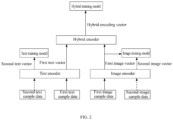
- a network architecture of the to-be-trained network model may be shown in FIG. 2 .
- the network model includes the text encoder and the corresponding text training model, the image encoder and the corresponding image training model, and the hybrid encoder and the corresponding hybrid training model.
- An arrow direction is a forward propagation direction of the network model in a data processing process.
- An arrow with a solid line indicates that transmitted data is data irrelevant to mask data, and an arrow with a dotted line indicates that transmitted data is data relevant to mask data.
- the first text sample data is input into the text encoder and then the first text vector is output by the text encoder; the second text sample data is input into the text encoder and then the second text vector is output by the text encoder.
- the first image sample data is input into the image encoder and then the first image vector is output by the image encoder; the second image sample data is input into the image encoder and then the second image vector is output by the image encoder.
- the first text vector and the first image vector are input into the hybrid encoder and then the hybrid encoding vector is output by the hybrid encoder.
- the process of adjusting the parameters of the text encoder, the image encoder, and the encoder may be performed simultaneously, and after the loss values corresponding to the encoders are determined, the parameters of the encoders may be adjusted according to a topology order of backpropagation.
- a first loss value for representing accuracy of a text recognition result is determined based on the text recognition result corresponding to the second text sample data and the first supervision data corresponding to the second text sample data.
- the first supervision data corresponding to the second text sample data may be the text data corresponding to the mask in the second text sample data, that is, the ground-truth corresponding to the mask.
- the text training model may determine the text recognition result based on the input second text vector, and determine the first loss value based on the text recognition result, the first supervision data, and a first loss function.
- the first loss function may be a cross entropy loss function.
- the parameter of the text encoder is adjusted based on the first loss value.
- gradient update may be performed on the network parameter in the text encoder based on the first loss value, and training is continued based on the updated network parameter, until the number of parameter adjustments reaches a preset number of times, and/or the network precision of the text encoder reaches a preset precision requirement.
- a second loss value for representing contrastive learning (ITC) between the image encoder and the text encoder may be determined based on the first text vector and the first image vector, and the parameter of the text encoder is adjusted based on the first loss value and the second loss value.
- the second loss value may be determined based on the similarity between the text recognition result output by the text encoder and the image recognition result output by the image encoder, and the parameter of the text encoder is adjusted based on the first loss value and the second loss value, until the number of parameter adjustments reaches a preset number of times, and/or the network precision of the text encoder reaches a preset precision requirement.
- weighted summation may be performed on the first loss value and the second loss value according to a preset weight value, and the network parameter of the text encoder is adjusted based on a loss value obtained by the weighted summation.
- the loss value corresponding to the hybrid encoder may be used to adjust not only the network parameter of the hybrid encoder, but also the network parameters of the text encoder and the image encoder before the hybrid encoder.
- the parameter adjustment of a plurality of encoders is involved in the training process, and optimization directions of different encoders are different, adjusting the network parameter of the text encoder based on the loss value corresponding to the hybrid encoder may not improve the network precision of the text encoder. Therefore, when the gradient update is performed based on the loss value corresponding to the hybrid encoder, the gradient update may not be performed on each network parameter in the text encoder.
- the network precision of the text encoder can be improved.
- the impact of network precision between the encoders in the training process can be reduced, and the convergence speed of the loss function of the network model in the training process is increased, thereby improving the training efficiency of the network model.
- adjusting the parameter of the image encoder includes a plurality of adjustment rounds, and each adjustment round includes adjusting the parameter of the image encoder by using a plurality of pieces of second image sample data and second supervision data corresponding to the plurality of pieces of second image sample data, respectively.
- the first image sample data corresponding to the second image sample data used in this adjustment round may be input into the image encoder before this adjustment round starts, to obtain the second supervision data corresponding to the second image sample data used in this adjustment round.
- the following steps C1 and C2 may be performed.
- a third loss value for representing accuracy of an image recognition result is determined based on the image recognition result corresponding to the second image sample data and the second supervision data; a fourth loss value for representing accuracy of text-image recognition is determined based on the text-image hybrid recognition result and third supervision data corresponding to the text-image hybrid recognition result; and a fifth loss value for representing contrastive learning between the image encoder and the text encoder is determined based on the first text vector and the first image vector.
- the third loss value may be, for example, an L2 loss or the like, which is used for representing a type of the image recognition result and a type of the second supervision data.
- the fourth loss value is described below and is not described herein.
- the fifth loss value may be the same as the second loss value.
- the parameter of the image encoder is adjusted based on the third loss value, the fourth loss value, and the fifth loss value.
- the parameter of the image encoder is adjusted based on the third loss value, the fourth loss value, and the fifth loss value
- weighted summation is performed on the third loss value, the fourth loss value, and the fifth loss value according to preset weight values
- the parameter of the image encoder is adjusted based on a loss value obtained after the weighted summation, until the number of parameter adjustments reaches a preset number of times, and/or the network precision of the text encoder reaches a preset precision requirement.
- the first image vector is used as the second supervision data corresponding to the second image sample data and the first image vector is obtained by inputting the first image sample data corresponding to the second image sample data into the image encoder.
- the first image vector is obtained by feature extraction performed on the image encoder after the contrastive learning and is used as the supervision data when the image training model determines the third loss value. Therefore the image encoder can further obtain a gain brought by image-text cross-modal data in the contrastive learning manner in the parameter adjustment process of the image encoder, thereby improving the multi-modal understanding capability of the network model.
- a solution such as contrastive learning is not used to bring an image-text cross-modal gain to the first image vector that is used as the supervision data, but only an image vector related to an image is used as the supervision data.
- the first image vector that is used as the supervision data includes the image-text cross-modal gain, and has richer semantics
- using the first image vector obtained by feature extraction performed on the image encoder after the contrastive learning as the supervision data when the image training model determines the third loss value can further improve the image understanding capability of the network model.
- the hybrid encoding vector may be input into the hybrid training model, to obtain the text-image hybrid recognition result output by the hybrid training model.
- a fourth loss value is determined based on the text-image hybrid recognition result and third supervision data corresponding to the text-image hybrid recognition result, and the network parameter of the hybrid encoder is adjusted based on the fourth loss value, until the number of parameter adjustments reaches a preset number of times, and/or the network precision of the hybrid encoder reaches a preset precision requirement.
- the type of the fourth loss value matches the type of the hybrid training model.
- the hybrid training model is a detection box prediction model
- the third supervision data may be a manually labeled detection box in an image
- the fourth loss value may be an Intersection over Union (IoU) loss, so that according to the fourth loss value, the cross-modal understanding capability of the network model to find a corresponding position region in the image according to the text content can be improved.
- IoU Intersection over Union
- the network precision of the hybrid encoder can be improved by adjusting the parameter of the hybrid encoder by using the hybrid training model, and the cross-modal understanding capability of the network model can be improved.
- the cross-modal understanding capability of the network model can be further improved by combining the process of contrastive learning with the parameter adjustment process of the image encoder.
- the hybrid training model may further include a Masking Language Model (MLM).
- MLM Masking Language Model
- the masking language model MLM may be used to determine text content corresponding to an image based on image content and text content in the image.
- the gradient update is performed based on the loss value corresponding to the hybrid encoder, the gradient update is not performed on each network parameter in the text encoder, so that the first text vector input into the hybrid encoder is not subjected to gradient update. Therefore, in the process of training the hybrid encoder by using the hybrid training model, more attention is paid to the image content, while the text content corresponding to the text vector that is not updated is ignored, so that the image understanding capability of the network model can be further improved.
- the method further includes obtaining a target network model according to the following steps D1 and D2.
- test sample data in a target scenario is obtained.
- fine-tuning processing is performed on the trained network model based on the test sample data, to obtain a target network model in the target scenario.
- the obtained network model may be used as a pre-trained model, and the network model, as the pre-trained model, is fine-tuned based on the test sample data corresponding to a target scenario for specific application, so that a target network model that can be applied in the target scenario can be obtained.
- the architecture of the trained network model may be adjusted according to a target requirement type corresponding to a target application scenario, and after the architecture of the network model is adjusted, the network model is fine-tuned based on the test sample data, to obtain the target network model.
- the target requirement type corresponding to the target scenario is text processing
- the text encoder in the trained network model may be selected and used as an encoder of the target network model, and the selected encoder and a decoder corresponding to the target scenario are combined to obtain a to-be-trained model.
- the test sample data is used to train the to-be-trained model, to obtain the target network model.
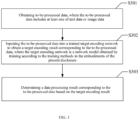
- FIG. 3 is a flowchart of a data processing method according to an embodiment of the present disclosure. The method includes S301 to S303.
- to-be-processed data is obtained, where the to-be-processed data includes at least one of text data or image data.
- the to-be-processed data may include one of the following: image data corresponding to a visual understanding task, text data corresponding to a text understanding task, text data and image data corresponding to a visual question answering task, text data and image data corresponding to a visual reasoning task, and text data and image data corresponding to an image-text retrieval task.
- Each type of task may correspond to a specific application scenario.
- the application scenarios are separately described below.
- the visual understanding task may be used to examine the capability of a network model to understand image content, and may be applied to various scenarios such as an image content understanding scenario and an object labeling scenario in an image.
- the visual understanding capability of the model is required in various application scenarios.
- the text understanding task may be used to examine the capability of a network model to understand text content, and may be applied to various scenarios such as text content recognition and determining key text content.
- the text understanding capability of the model is required in various application scenarios.
- the visual question answering task is used to examine the capability of a model to answer a question according to an image, and may be applied to various scenarios such as automatic answering and automatic paper grading.
- the visual reasoning task may be used to examine whether the network model can accurately determine whether text content can correctly describe an image, and the network model may be applied to various scenarios such as automatic answering and automatic paper grading.
- the image-text retrieval task may be used to examine the capability of the model to retrieve a related image through a text and retrieve a related text through an image, and the model may be applied to various search scenarios such as image search and image-text search.
- the network model for performing the corresponding tasks can be obtained through the subsequent steps, so that the network model used in each application scenario can be quickly trained, and the utilization efficiency and training speed of the network model in the above application scenarios are improved.
- the to-be-processed data is input into a trained target encoding network to obtain a target encoding result corresponding to the to-be-processed data, where the target encoding network is a network model trained according to the training method in the embodiment of the present disclosure.
- a data processing result corresponding to the to-be-processed data is determined based on the target encoding result.
- a target data type of the to-be-processed data may be determined, and an encoder matching the target data type may be used as a target encoder configured to process the to-be-processed data.
- the target data type of the to-be-processed data is text data
- the text encoder may be selected and used as the target encoder configured to process the to-be-processed data, and the to-be-processed data is processed based on the target encoder, to obtain the target encoding result.
- the target encoding result may be processed according to a target decoder matching the target data type, to obtain the data processing result.
- the parameter of the text encoder may be adjusted based on the text recognition result and the first supervision data corresponding to the text recognition result, without using the loss value corresponding to the hybrid encoder to perform the gradient update on the text encoder.
- the parameter of the image encoder may be adjusted based on the image recognition result and the second supervision data corresponding to the image recognition result, the text-image hybrid recognition result and the third supervision data corresponding to the text-image hybrid recognition result.
- the writing sequence of each step does not mean a strict execution sequence and does not constitute any limitation on the implementation process, and the specific execution sequence of each step should be determined based on its function and possible internal logic.
- the embodiments of the present disclosure further provide a network model training apparatus corresponding to the network model training method. Because the principle for solving problems in the apparatus in the embodiments of the present disclosure is similar to the network model training method described above in the embodiments of the present disclosure, for the implementation of the apparatus, refer to the implementation of the method, and details are not described herein again.
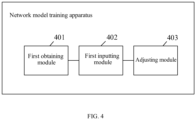
- FIG. 4 is a schematic architectural diagram of a network model training apparatus according to an embodiment of the present disclosure.
- the apparatus includes a first obtaining module 401, a first inputting module 402, and an adjusting module 403.
- the first obtaining module 401 is configured to obtain target sample data, where the target sample data includes text sample data and image sample data.
- the first inputting module 402 is configured to input the target sample data into a to-be-trained network model to obtain a sample recognition result, where the network model includes a text encoder, an image encoder, and a hybrid encoder, and the sample recognition result includes a text recognition result determined based on the text encoder, an image recognition result determined based on the image encoder, and a text-image hybrid recognition result determined based on the hybrid encoder.
- the network model includes a text encoder, an image encoder, and a hybrid encoder
- the sample recognition result includes a text recognition result determined based on the text encoder, an image recognition result determined based on the image encoder, and a text-image hybrid recognition result determined based on the hybrid encoder.
- the adjusting module 403 is configured to adjust a parameter of the text encoder based on the text recognition result and first supervision data corresponding to the text recognition result, adjust a parameter of the image encoder based on the image recognition result and second supervision data corresponding to the image recognition result, the text-image hybrid recognition result, and third supervision data corresponding to the text-image hybrid recognition result, and adjust a parameter of the hybrid encoder based on the text-image hybrid recognition result and the third supervision data corresponding to the text-image hybrid recognition result, to obtain a trained network model including the text encoder, the image encoder, and the hybrid encoder.
- the text sample data includes first text sample data and second text sample data, the second text sample data is obtained by adding a mask to the first text sample data;
- the image sample data includes first image sample data and second image sample data, the second image sample data is obtained by adding a mask to the first image sample data;
- the first inputting module 402, when inputting the target sample data into the to-be-trained network model to obtain the sample recognition result, is configured to:
- first supervision data corresponding to the second text sample data is text data corresponding to a mask in the second text sample data; and the adjusting module 403, when adjusting the parameter of the text encoder based on the text recognition result and the first supervision data corresponding to the text recognition result, is configured to:
- the first text sample data is used for describing content in the first image sample data; and the adjusting module 403 is further configured to:
- adjusting the parameter of the image encoder includes a plurality of adjustment rounds, each adjustment round includes adjusting the parameter of the image encoder by using a plurality of pieces of second image sample data and second supervision data corresponding to the plurality of pieces of second image sample data, respectively; and for any adjustment round, the adjusting module 403 is further configured to determine the second supervision data corresponding to the second image sample data in this adjustment round according to the following steps: inputting the first image sample data corresponding to the second image sample data used in this adjustment round into the image encoder before this adjustment round starts, to obtain the second supervision data corresponding to the second image sample data used in this adjustment round.
- the first text sample data is used for describing content in the first image sample data; and the adjusting module 403, when adjusting the parameter of the image encoder based on the image recognition result and the second supervision data corresponding to the image recognition result, the text-image hybrid recognition result and the third supervision data corresponding to the text-image hybrid recognition result, is configured to:
- the adjusting module 403 is further configured to:
- the parameter of the text encoder may be adjusted based on the text recognition result and the first supervision data corresponding to the text recognition result, without using the loss value corresponding to the hybrid encoder to perform the gradient update on the text encoder.
- the parameter of the image encoder may be adjusted based on the image recognition result and the second supervision data corresponding to the image recognition result, the text-image hybrid recognition result and the third supervision data corresponding to the text-image hybrid recognition result.
- FIG. 5 is a schematic architectural diagram of a data processing apparatus according to an embodiment of the present disclosure.
- the apparatus includes a second obtaining module 501, a second inputting module 502, and a determination module 503.
- the second obtaining module 501 is configured to obtain to-be-processed data, where the to-be-processed data includes at least one of text data or image data.
- the second inputting module 502 is configured to input the to-be-processed data into a trained target encoding network to obtain a target encoding result corresponding to the to-be-processed data, where the target encoding network is a network model trained according to any one of the training methods in the embodiments of the present disclosure.
- the determination module 503 is configured to determine a data processing result corresponding to the to-be-processed data based on the target encoding result.
- the second inputting module 502 is further configured to determine a target encoder configured to process the to-be-processed data in the target encoding network according to the following steps:
- FIG. 6 is a schematic structural diagram of a computer device 600 according to an embodiment of the present disclosure.
- the computer device 600 includes a processor 601, a memory 602, and a bus 603.
- the memory 602 is configured to store an execution instruction, and includes an internal memory 6021 and an external memory 6022.
- the internal memory 6021 also referred to as an internal memory, is configured to temporarily store operation data in the processor 601 and data exchanged with the external memory 6022 such as a hard disk.
- the processor 601 exchanges data with the external memory 6022 through the internal memory 6021.
- the processor 601 communicates with the memory 602 through the bus 603, so that the processor 601 executes the following instructions:
- the text sample data includes first text sample data and second text sample data, the second text sample data is obtained by adding a mask to the first text sample data;
- the image sample data includes first image sample data and second image sample data, the second image sample data is obtained by adding a mask to the first image sample data; and the inputting the target sample data into the to-be-trained network model to obtain the sample recognition result includes:
- first supervision data corresponding to the second text sample data is text data corresponding to a mask in the second text sample data; and the adjusting the parameter of the text encoder based on the text recognition result and the first supervision data corresponding to the text recognition result includes:
- the first text sample data is used for describing content in the first image sample data; and the method further includes:
- adjusting the parameter of the image encoder includes a plurality of adjustment rounds, each adjustment round includes adjusting the parameter of the image encoder by using a plurality of pieces of second image sample data and second supervision data corresponding to the plurality of pieces of second image sample data, respectively; and for any adjustment round, the method further includes determining the second supervision data corresponding to the second image sample data in this adjustment round according to the following method: inputting the first image sample data corresponding to the second image sample data used in this adjustment round into the image encoder before this adjustment round starts, to obtain the second supervision data corresponding to the second image sample data used in this adjustment round.
- the first text sample data is used for describing content in the first image sample data; and the adjusting the parameter of the image encoder based on the image recognition result and the second supervision data corresponding to the image recognition result, the text-image hybrid recognition result, and the third supervision data corresponding to the text-image hybrid recognition result includes:
- the instruction of the processor 601 further includes:
- the instruction of the processor 601 further includes determining a target encoder configured to process the to-be-processed data in the target encoding network according to the following method:
- the embodiments of the present disclosure further provide a computer-readable storage medium.
- the computer-readable storage medium stores a computer program thereon.
- the computer program when executed by a processor, causes the processor to perform the steps of the network model training method described in the foregoing method embodiments.
- the storage medium may be a volatile or non-volatile computer-readable storage medium.
- the embodiments of the present disclosure further provide a computer program product.
- the computer program product carries program code, and instructions included in the program code may be used to perform the steps of the network model training method described in the foregoing method embodiments. For details, refer to the foregoing method embodiments. Details are not described herein again.
- the computer program product may be specifically implemented by using hardware, software, or a combination thereof.
- the computer program product is specifically implemented as a computer storage medium.
- the computer program product is specifically implemented as a software product, for example, a software development kit (SDK) or the like.
- SDK software development kit
- the units described as separate parts may be or may not be physically separate, and the parts displayed as units may be or may not be physical units, that is, may be located in one place or distributed to a plurality of network units. Some or all of the units may be selected according to actual needs to implement the objectives of the solutions in the embodiments.
- the functional units in the embodiments of the present disclosure may be integrated in one processing unit, may exist separately physically, or may be integrated into one unit.
- the functions may be stored in a computer-readable storage medium that is non-volatile and executable by a processor.
- the substantial part or part making contributions relative to the related technology in the technical solutions of the present disclosure or part of the technical solution may be embodied in the form of a software product, and the computer software product is stored in a storage medium, including a plurality of instructions for causing a computer device (which may be a personal computer, a server, or a network device) to perform all or some of the steps of the methods in the embodiments of the present disclosure.
- the storage medium includes various media that can store program codes, such as a universal serial bus (USB) flash drive, a mobile hard disk, a read-only memory (ROM), a random access memory (RAM), a magnetic disk, or an optical disk.
- USB universal serial bus
- ROM read-only memory
- RAM random access memory
- magnetic disk or an optical disk.
Landscapes
- Engineering & Computer Science (AREA)
- Theoretical Computer Science (AREA)
- Physics & Mathematics (AREA)
- General Physics & Mathematics (AREA)
- Health & Medical Sciences (AREA)
- Artificial Intelligence (AREA)
- General Engineering & Computer Science (AREA)
- General Health & Medical Sciences (AREA)
- Evolutionary Computation (AREA)
- Software Systems (AREA)
- Computational Linguistics (AREA)
- Data Mining & Analysis (AREA)
- Computing Systems (AREA)
- Biophysics (AREA)
- Molecular Biology (AREA)
- Mathematical Physics (AREA)
- Biomedical Technology (AREA)
- Life Sciences & Earth Sciences (AREA)
- Databases & Information Systems (AREA)
- Multimedia (AREA)
- Audiology, Speech & Language Pathology (AREA)
- Computer Vision & Pattern Recognition (AREA)
- Medical Informatics (AREA)
- Image Analysis (AREA)
Applications Claiming Priority (2)
| Application Number | Priority Date | Filing Date | Title |
|---|---|---|---|
| CN202211518720.8A CN118153657A (zh) | 2022-11-30 | 2022-11-30 | 网络模型的训练方法、数据处理方法及装置 |
| PCT/CN2023/133545 WO2024114494A1 (zh) | 2022-11-30 | 2023-11-23 | 网络模型的训练方法、数据处理方法及装置 |
Publications (1)
| Publication Number | Publication Date |
|---|---|
| EP4528596A1 true EP4528596A1 (de) | 2025-03-26 |
Family
ID=91287363
Family Applications (1)
| Application Number | Title | Priority Date | Filing Date |
|---|---|---|---|
| EP23896645.1A Pending EP4528596A1 (de) | 2022-11-30 | 2023-11-23 | Netzwerkmodelltrainingsverfahren, datenverarbeitungsverfahren und vorrichtung |
Country Status (4)
| Country | Link |
|---|---|
| US (1) | US20250371362A1 (de) |
| EP (1) | EP4528596A1 (de) |
| CN (1) | CN118153657A (de) |
| WO (1) | WO2024114494A1 (de) |
Families Citing this family (5)
| Publication number | Priority date | Publication date | Assignee | Title |
|---|---|---|---|---|
| CN115982596A (zh) * | 2023-01-04 | 2023-04-18 | 脸萌有限公司 | 用于多模态数据处理的方法、装置、设备和介质 |
| CN118860900B (zh) * | 2024-09-19 | 2024-12-20 | 阿里巴巴(中国)有限公司 | 代码处理模型训练、代码任务处理以及代码开发方法 |
| CN118865029B (zh) * | 2024-09-26 | 2025-01-24 | 苏州元脑智能科技有限公司 | 一种模型训练及检索方法、计算机程序产品、设备、介质 |
| CN118886424B (zh) * | 2024-09-27 | 2025-02-18 | 科大讯飞股份有限公司 | 变体词识别方法、装置、设备和存储介质 |
| CN119538803A (zh) * | 2025-01-23 | 2025-02-28 | 中国科学院大学 | 电路表征方法、装置、计算机设备、存储介质和计算机程序产品 |
Family Cites Families (7)
| Publication number | Priority date | Publication date | Assignee | Title |
|---|---|---|---|---|
| CN112634867B (zh) * | 2020-12-11 | 2024-10-15 | 平安科技(深圳)有限公司 | 模型训练方法、方言识别方法、装置、服务器及存储介质 |
| CN114005012A (zh) * | 2021-11-05 | 2022-02-01 | 北京市商汤科技开发有限公司 | 多模态预训练模型的训练方法、装置、设备及存储介质 |
| CN114821223B (zh) * | 2022-03-30 | 2025-07-08 | 杭州阿里巴巴海外互联网产业有限公司 | 预训练图像文本模型处理方法和图文检索系统 |
| CN114972823A (zh) * | 2022-06-14 | 2022-08-30 | 北京有竹居网络技术有限公司 | 数据处理方法、装置、设备及计算机介质 |
| CN115221276B (zh) * | 2022-06-24 | 2025-05-06 | 平安科技(深圳)有限公司 | 基于clip的中文图文检索模型训练方法、装置、设备及介质 |
| CN115082966B (zh) * | 2022-07-22 | 2022-12-06 | 中国科学院自动化研究所 | 行人重识别模型训练方法、行人重识别方法、装置和设备 |
| CN115393902B (zh) * | 2022-09-26 | 2026-01-02 | 华东师范大学 | 一种基于对比语言图像预训练模型clip的行人重识别方法 |
-
2022
- 2022-11-30 CN CN202211518720.8A patent/CN118153657A/zh active Pending
-
2023
- 2023-11-23 WO PCT/CN2023/133545 patent/WO2024114494A1/zh not_active Ceased
- 2023-11-23 US US18/876,173 patent/US20250371362A1/en active Pending
- 2023-11-23 EP EP23896645.1A patent/EP4528596A1/de active Pending
Also Published As
| Publication number | Publication date |
|---|---|
| US20250371362A1 (en) | 2025-12-04 |
| WO2024114494A1 (zh) | 2024-06-06 |
| CN118153657A (zh) | 2024-06-07 |
Similar Documents
| Publication | Publication Date | Title |
|---|---|---|
| EP4528596A1 (de) | Netzwerkmodelltrainingsverfahren, datenverarbeitungsverfahren und vorrichtung | |
| CN108847241B (zh) | 将会议语音识别为文本的方法、电子设备及存储介质 | |
| WO2023201975A1 (zh) | 一种差异描述语句生成方法、装置、设备及介质 | |
| EP4390864A1 (de) | Bildverarbeitungsverfahren und zugehörige vorrichtung | |
| CN117453899B (zh) | 一种基于大模型的智能对话系统、方法与电子设备 | |
| WO2024098524A1 (zh) | 文本视频的互检索及模型训练方法、装置、设备及介质 | |
| CN112101042A (zh) | 文本情绪识别方法、装置、终端设备和存储介质 | |
| CN115658920B (zh) | 一种知识图谱的构建方法及装置 | |
| EP4191544A1 (de) | Verfahren und vorrichtung zur erkennung von token, elektronische vorrichtung und speichermedium | |
| Wang et al. | Simple o3: Towards interleaved vision-language reasoning | |
| CN118820415A (zh) | 提示词生成方法、装置、设备、存储介质及程序产品 | |
| CN117609437A (zh) | 基于大语言模型的信息获取方法、装置、设备及介质 | |
| CN117539984A (zh) | 一种回复文本的生成方法、装置及设备 | |
| CN115862031A (zh) | 文本处理方法、神经网络的训练方法、装置和设备 | |
| CN116013307A (zh) | 一种标点预测方法、装置、设备以及计算机存储介质 | |
| CN120318606A (zh) | 增强多模态大模型的细粒度感知能力的方法、基于多模态大模型的图像处理方法及装置 | |
| CN111222321B (zh) | 一种标点符号的处理方法及装置 | |
| CN115293165B (zh) | 信息提取方法、装置、电子设备及存储介质 | |
| CN119961584A (zh) | 样本的处理方法、系统和电子设备 | |
| CN119988617A (zh) | 文本处理方法、装置、计算机可读存储介质及电子设备 | |
| CN117312502A (zh) | 任务处理方法、问答任务处理方法及计算设备 | |
| CN120086600B (zh) | 一种多模态数据样本的生成方法及电子设备 | |
| KR20230099500A (ko) | 핵심 문장을 이용한 버그 리포트 적대적 데이터 생성 방법 | |
| US20250363103A1 (en) | Data processing method, computer device, and storage medium | |
| CN119149549B (zh) | 数据表筛选的方法、装置、电子设备和计算机程序产品 |
Legal Events
| Date | Code | Title | Description |
|---|---|---|---|
| STAA | Information on the status of an ep patent application or granted ep patent |
Free format text: STATUS: THE INTERNATIONAL PUBLICATION HAS BEEN MADE |
|
| PUAI | Public reference made under article 153(3) epc to a published international application that has entered the european phase |
Free format text: ORIGINAL CODE: 0009012 |
|
| STAA | Information on the status of an ep patent application or granted ep patent |
Free format text: STATUS: REQUEST FOR EXAMINATION WAS MADE |
|
| 17P | Request for examination filed |
Effective date: 20241219 |
|
| AK | Designated contracting states |
Kind code of ref document: A1 Designated state(s): AL AT BE BG CH CY CZ DE DK EE ES FI FR GB GR HR HU IE IS IT LI LT LU LV MC ME MK MT NL NO PL PT RO RS SE SI SK SM TR |
|
| DAV | Request for validation of the european patent (deleted) | ||
| DAX | Request for extension of the european patent (deleted) |