EP4527912A1 - Grease composition for constant-velocity joint and constant-velocity joint hermetically filled therewith - Google Patents
Grease composition for constant-velocity joint and constant-velocity joint hermetically filled therewith Download PDFInfo
- Publication number
- EP4527912A1 EP4527912A1 EP23807608.7A EP23807608A EP4527912A1 EP 4527912 A1 EP4527912 A1 EP 4527912A1 EP 23807608 A EP23807608 A EP 23807608A EP 4527912 A1 EP4527912 A1 EP 4527912A1
- Authority
- EP
- European Patent Office
- Prior art keywords
- mass
- constant
- grease composition
- oil
- velocity joint
- Prior art date
- Legal status (The legal status is an assumption and is not a legal conclusion. Google has not performed a legal analysis and makes no representation as to the accuracy of the status listed.)
- Pending
Links
Images
Classifications
-
- C—CHEMISTRY; METALLURGY
- C10—PETROLEUM, GAS OR COKE INDUSTRIES; TECHNICAL GASES CONTAINING CARBON MONOXIDE; FUELS; LUBRICANTS; PEAT
- C10M—LUBRICATING COMPOSITIONS; USE OF CHEMICAL SUBSTANCES EITHER ALONE OR AS LUBRICATING INGREDIENTS IN A LUBRICATING COMPOSITION
- C10M169/00—Lubricating compositions characterised by containing as components a mixture of at least two types of ingredient selected from base-materials, thickeners or additives, covered by the preceding groups, each of these compounds being essential
- C10M169/04—Mixtures of base-materials and additives
-
- C—CHEMISTRY; METALLURGY
- C10—PETROLEUM, GAS OR COKE INDUSTRIES; TECHNICAL GASES CONTAINING CARBON MONOXIDE; FUELS; LUBRICANTS; PEAT
- C10M—LUBRICATING COMPOSITIONS; USE OF CHEMICAL SUBSTANCES EITHER ALONE OR AS LUBRICATING INGREDIENTS IN A LUBRICATING COMPOSITION
- C10M111/00—Lubrication compositions characterised by the base-material being a mixture of two or more compounds covered by more than one of the main groups C10M101/00 - C10M109/00, each of these compounds being essential
- C10M111/06—Lubrication compositions characterised by the base-material being a mixture of two or more compounds covered by more than one of the main groups C10M101/00 - C10M109/00, each of these compounds being essential at least one of them being a compound of the type covered by group C10M109/00
-
- C—CHEMISTRY; METALLURGY
- C10—PETROLEUM, GAS OR COKE INDUSTRIES; TECHNICAL GASES CONTAINING CARBON MONOXIDE; FUELS; LUBRICANTS; PEAT
- C10M—LUBRICATING COMPOSITIONS; USE OF CHEMICAL SUBSTANCES EITHER ALONE OR AS LUBRICATING INGREDIENTS IN A LUBRICATING COMPOSITION
- C10M141/00—Lubricating compositions characterised by the additive being a mixture of two or more compounds covered by more than one of the main groups C10M125/00 - C10M139/00, each of these compounds being essential
- C10M141/12—Lubricating compositions characterised by the additive being a mixture of two or more compounds covered by more than one of the main groups C10M125/00 - C10M139/00, each of these compounds being essential at least one of them being an organic compound containing atoms of elements not provided for in groups C10M141/02 - C10M141/10
-
- C—CHEMISTRY; METALLURGY
- C10—PETROLEUM, GAS OR COKE INDUSTRIES; TECHNICAL GASES CONTAINING CARBON MONOXIDE; FUELS; LUBRICANTS; PEAT
- C10M—LUBRICATING COMPOSITIONS; USE OF CHEMICAL SUBSTANCES EITHER ALONE OR AS LUBRICATING INGREDIENTS IN A LUBRICATING COMPOSITION
- C10M2203/00—Organic non-macromolecular hydrocarbon compounds and hydrocarbon fractions as ingredients in lubricant compositions
- C10M2203/10—Petroleum or coal fractions, e.g. tars, solvents, bitumen
- C10M2203/1006—Petroleum or coal fractions, e.g. tars, solvents, bitumen used as base material
-
- C—CHEMISTRY; METALLURGY
- C10—PETROLEUM, GAS OR COKE INDUSTRIES; TECHNICAL GASES CONTAINING CARBON MONOXIDE; FUELS; LUBRICANTS; PEAT
- C10M—LUBRICATING COMPOSITIONS; USE OF CHEMICAL SUBSTANCES EITHER ALONE OR AS LUBRICATING INGREDIENTS IN A LUBRICATING COMPOSITION
- C10M2215/00—Organic non-macromolecular compounds containing nitrogen as ingredients in lubricant Compositions
- C10M2215/08—Amides [having hydrocarbon substituents containing less than thirty carbon atoms]
- C10M2215/0813—Amides [having hydrocarbon substituents containing less than thirty carbon atoms] used as thickening agents
-
- C—CHEMISTRY; METALLURGY
- C10—PETROLEUM, GAS OR COKE INDUSTRIES; TECHNICAL GASES CONTAINING CARBON MONOXIDE; FUELS; LUBRICANTS; PEAT
- C10M—LUBRICATING COMPOSITIONS; USE OF CHEMICAL SUBSTANCES EITHER ALONE OR AS LUBRICATING INGREDIENTS IN A LUBRICATING COMPOSITION
- C10M2217/00—Organic macromolecular compounds containing nitrogen as ingredients in lubricant compositions
- C10M2217/04—Macromolecular compounds from nitrogen-containing monomers obtained otherwise than by reactions only involving carbon-to-carbon unsaturated bonds
- C10M2217/045—Polyureas; Polyurethanes
- C10M2217/0456—Polyureas; Polyurethanes used as thickening agents
-
- C—CHEMISTRY; METALLURGY
- C10—PETROLEUM, GAS OR COKE INDUSTRIES; TECHNICAL GASES CONTAINING CARBON MONOXIDE; FUELS; LUBRICANTS; PEAT
- C10M—LUBRICATING COMPOSITIONS; USE OF CHEMICAL SUBSTANCES EITHER ALONE OR AS LUBRICATING INGREDIENTS IN A LUBRICATING COMPOSITION
- C10M2219/00—Organic non-macromolecular compounds containing sulfur, selenium or tellurium as ingredients in lubricant compositions
- C10M2219/06—Thio-acids; Thiocyanates; Derivatives thereof
- C10M2219/062—Thio-acids; Thiocyanates; Derivatives thereof having carbon-to-sulfur double bonds
- C10M2219/066—Thiocarbamic type compounds
- C10M2219/068—Thiocarbamate metal salts
-
- C—CHEMISTRY; METALLURGY
- C10—PETROLEUM, GAS OR COKE INDUSTRIES; TECHNICAL GASES CONTAINING CARBON MONOXIDE; FUELS; LUBRICANTS; PEAT
- C10M—LUBRICATING COMPOSITIONS; USE OF CHEMICAL SUBSTANCES EITHER ALONE OR AS LUBRICATING INGREDIENTS IN A LUBRICATING COMPOSITION
- C10M2219/00—Organic non-macromolecular compounds containing sulfur, selenium or tellurium as ingredients in lubricant compositions
- C10M2219/10—Heterocyclic compounds containing sulfur, selenium or tellurium compounds in the ring
- C10M2219/104—Heterocyclic compounds containing sulfur, selenium or tellurium compounds in the ring containing sulfur and carbon with nitrogen or oxygen in the ring
-
- C—CHEMISTRY; METALLURGY
- C10—PETROLEUM, GAS OR COKE INDUSTRIES; TECHNICAL GASES CONTAINING CARBON MONOXIDE; FUELS; LUBRICANTS; PEAT
- C10M—LUBRICATING COMPOSITIONS; USE OF CHEMICAL SUBSTANCES EITHER ALONE OR AS LUBRICATING INGREDIENTS IN A LUBRICATING COMPOSITION
- C10M2219/00—Organic non-macromolecular compounds containing sulfur, selenium or tellurium as ingredients in lubricant compositions
- C10M2219/10—Heterocyclic compounds containing sulfur, selenium or tellurium compounds in the ring
- C10M2219/104—Heterocyclic compounds containing sulfur, selenium or tellurium compounds in the ring containing sulfur and carbon with nitrogen or oxygen in the ring
- C10M2219/106—Thiadiazoles
-
- C—CHEMISTRY; METALLURGY
- C10—PETROLEUM, GAS OR COKE INDUSTRIES; TECHNICAL GASES CONTAINING CARBON MONOXIDE; FUELS; LUBRICANTS; PEAT
- C10M—LUBRICATING COMPOSITIONS; USE OF CHEMICAL SUBSTANCES EITHER ALONE OR AS LUBRICATING INGREDIENTS IN A LUBRICATING COMPOSITION
- C10M2223/00—Organic non-macromolecular compounds containing phosphorus as ingredients in lubricant compositions
- C10M2223/02—Organic non-macromolecular compounds containing phosphorus as ingredients in lubricant compositions having no phosphorus-to-carbon bonds
- C10M2223/04—Phosphate esters
- C10M2223/045—Metal containing thio derivatives
-
- C—CHEMISTRY; METALLURGY
- C10—PETROLEUM, GAS OR COKE INDUSTRIES; TECHNICAL GASES CONTAINING CARBON MONOXIDE; FUELS; LUBRICANTS; PEAT
- C10N—INDEXING SCHEME ASSOCIATED WITH SUBCLASS C10M RELATING TO LUBRICATING COMPOSITIONS
- C10N2010/00—Metal present as such or in compounds
- C10N2010/04—Groups 2 or 12
-
- C—CHEMISTRY; METALLURGY
- C10—PETROLEUM, GAS OR COKE INDUSTRIES; TECHNICAL GASES CONTAINING CARBON MONOXIDE; FUELS; LUBRICANTS; PEAT
- C10N—INDEXING SCHEME ASSOCIATED WITH SUBCLASS C10M RELATING TO LUBRICATING COMPOSITIONS
- C10N2010/00—Metal present as such or in compounds
- C10N2010/12—Groups 6 or 16
-
- C—CHEMISTRY; METALLURGY
- C10—PETROLEUM, GAS OR COKE INDUSTRIES; TECHNICAL GASES CONTAINING CARBON MONOXIDE; FUELS; LUBRICANTS; PEAT
- C10N—INDEXING SCHEME ASSOCIATED WITH SUBCLASS C10M RELATING TO LUBRICATING COMPOSITIONS
- C10N2020/00—Specified physical or chemical properties or characteristics, i.e. function, of component of lubricating compositions
- C10N2020/01—Physico-chemical properties
- C10N2020/02—Viscosity; Viscosity index
-
- C—CHEMISTRY; METALLURGY
- C10—PETROLEUM, GAS OR COKE INDUSTRIES; TECHNICAL GASES CONTAINING CARBON MONOXIDE; FUELS; LUBRICANTS; PEAT
- C10N—INDEXING SCHEME ASSOCIATED WITH SUBCLASS C10M RELATING TO LUBRICATING COMPOSITIONS
- C10N2020/00—Specified physical or chemical properties or characteristics, i.e. function, of component of lubricating compositions
- C10N2020/01—Physico-chemical properties
- C10N2020/065—Saturated Compounds
-
- C—CHEMISTRY; METALLURGY
- C10—PETROLEUM, GAS OR COKE INDUSTRIES; TECHNICAL GASES CONTAINING CARBON MONOXIDE; FUELS; LUBRICANTS; PEAT
- C10N—INDEXING SCHEME ASSOCIATED WITH SUBCLASS C10M RELATING TO LUBRICATING COMPOSITIONS
- C10N2030/00—Specified physical or chemical properties which is improved by the additive characterising the lubricating composition, e.g. multifunctional additives
- C10N2030/06—Oiliness; Film-strength; Anti-wear; Resistance to extreme pressure
-
- C—CHEMISTRY; METALLURGY
- C10—PETROLEUM, GAS OR COKE INDUSTRIES; TECHNICAL GASES CONTAINING CARBON MONOXIDE; FUELS; LUBRICANTS; PEAT
- C10N—INDEXING SCHEME ASSOCIATED WITH SUBCLASS C10M RELATING TO LUBRICATING COMPOSITIONS
- C10N2040/00—Specified use or application for which the lubricating composition is intended
- C10N2040/04—Oil-bath; Gear-boxes; Automatic transmissions; Traction drives
- C10N2040/045—Oil-bath; Gear-boxes; Automatic transmissions; Traction drives for continuous variable transmission [CVT]
-
- C—CHEMISTRY; METALLURGY
- C10—PETROLEUM, GAS OR COKE INDUSTRIES; TECHNICAL GASES CONTAINING CARBON MONOXIDE; FUELS; LUBRICANTS; PEAT
- C10N—INDEXING SCHEME ASSOCIATED WITH SUBCLASS C10M RELATING TO LUBRICATING COMPOSITIONS
- C10N2050/00—Form in which the lubricant is applied to the material being lubricated
- C10N2050/10—Form in which the lubricant is applied to the material being lubricated semi-solid; greasy
-
- F—MECHANICAL ENGINEERING; LIGHTING; HEATING; WEAPONS; BLASTING
- F16—ENGINEERING ELEMENTS AND UNITS; GENERAL MEASURES FOR PRODUCING AND MAINTAINING EFFECTIVE FUNCTIONING OF MACHINES OR INSTALLATIONS; THERMAL INSULATION IN GENERAL
- F16D—COUPLINGS FOR TRANSMITTING ROTATION; CLUTCHES; BRAKES
- F16D3/00—Yielding couplings, i.e. with means permitting movement between the connected parts during the drive
- F16D3/16—Universal joints in which flexibility is produced by means of pivots or sliding or rolling connecting parts
- F16D3/20—Universal joints in which flexibility is produced by means of pivots or sliding or rolling connecting parts one coupling part entering a sleeve of the other coupling part and connected thereto by sliding or rolling members
-
- F—MECHANICAL ENGINEERING; LIGHTING; HEATING; WEAPONS; BLASTING
- F16—ENGINEERING ELEMENTS AND UNITS; GENERAL MEASURES FOR PRODUCING AND MAINTAINING EFFECTIVE FUNCTIONING OF MACHINES OR INSTALLATIONS; THERMAL INSULATION IN GENERAL
- F16D—COUPLINGS FOR TRANSMITTING ROTATION; CLUTCHES; BRAKES
- F16D3/00—Yielding couplings, i.e. with means permitting movement between the connected parts during the drive
- F16D3/84—Shrouds, e.g. casings, covers; Sealing means specially adapted therefor
- F16D3/843—Shrouds, e.g. casings, covers; Sealing means specially adapted therefor enclosed covers
- F16D3/845—Shrouds, e.g. casings, covers; Sealing means specially adapted therefor enclosed covers allowing relative movement of joint parts due to the flexing of the cover
Definitions
- the present invention relates to a grease composition for a constant-velocity joint and a constant-velocity joint hermetically filled therewith.
- FF vehicles In automobiles, FF vehicles have been widely used from the viewpoint of reductions in weight for the purpose of environmental measures (CO 2 reduction) of vehicles and keeping occupational spaces, and constant-velocity joints (CVJs) that are essential for the power transmissions of FF vehicles have been used.
- CO 2 reduction environmental measures
- CVJs constant-velocity joints
- CVJs are devices that transmit rotation between two shafts that rotate with angles, and thus the components go through a complicated rolling sliding motion inside the joints.
- a plunging CVJ also has a sliding mechanism in an axial direction, and a sliding resistance in the axial direction is generated by friction between the members inside the joint. If this sliding resistance is large, it would cause vibrations and noise in some cases.
- the initial conformability means smoothing waviness or unevenness generated on a surface of the joint by processing of the joint promptly after the start of use of the joint.
- a grease obtained by blending a urea grease with a zinc dialkyldithiophosphate, a molybdenum dialkyl dithiocarbamate, a zinc dialkyldithiophosphate, and a sulfur-nitrogen-based extreme pressure additive (see Patent Literature 1) and a grease obtained by blending a urea grease with a molybdenum disulfide, a molybdenum dialkyl dithiocarbamate, a calcium salt of petroleum sulfonic acid, a sulfur-based extreme pressure agent, a specific vegetable oil or fat, and a zinc dialkyldithiocarbamate (see Patent Literature 2) have been proposed.
- an object of the present invention is to provide a grease composition that is excellent in durability and initial conformability even in a high-temperature environment.
- an object of the present invention is also to provide a constant-velocity joint hermetically filled with the above-described grease composition.
- the present inventors have found that a grease composition using a base oil having specific kinematic viscosity and viscosity index is excellent in durability and initial conformability even at a high temperature.
- the present invention provides a grease composition for a constant-velocity joint and a constant-velocity joint hermetically filled therewith as follows.
- the grease composition of the present invention is excellent in durability and initial conformability even in a high-temperature environment.
- the grease composition of the present invention is also excellent in shear stability.
- the grease composition of the present invention is also excellent in vibration resistance.
- a base oil of the present invention has a kinematic viscosity of 16.0 mm 2 /s or more at 100°C and a viscosity index of 90 or more.
- a sufficient oil film thickness can be secured even under a condition of a temperature of the surface of the CVJ of 90 to 100°C, and the lubricity at a high temperature can thus be maintained.
- vibration can be suppressed by a reduction in sliding resistance at ordinary temperature and a reduction in agitation resistance in a low-temperature environment.
- the type of base oil used in the present invention is not particularly limited.
- such base oils include mineral oils represented by a naphthene-based oil and a paraffin-based oil, synthetic hydrocarbon oils represented by polybutene, ether-based synthetic oils represented by alkyl diphenyl ether, and various synthetic oils such as silicone oil and fluorinated oil.
- the synthetic oil may be a so-called biomass oil produced by using a biological resource produced from an animal, a plants, or the like as a raw material.
- biomass ester oils synthesized from various fatty acids using vegetable oils as raw materials and alcohols and biomass hydrocarbon oils using vegetable oils such as palm oil, corn oil, and soybean oil can also be used.
- One base oil may be used alone, or two or more base oils may be mixed.
- a mineral oil is preferable from the viewpoint of cost, and a paraffin-based mineral oil is preferable to a naphthene-based oil from the viewpoint of viscosity index.
- the kinematic viscosity at 100°C is preferably 18.0 mm 2 /s or more from the viewpoint of securing an oil film thickness at a high temperature.
- the kinematic viscosity at 100°C is preferably 24.0 mm 2 /s or less, and more preferably 22.0 mm 2 /s or less, from the viewpoint of suppressing vibration at ordinary temperature and reducing an agitation resistance in a low-temperature environment.
- the viscosity index is preferably 93 or more from the viewpoint of suppressing vibration at ordinary temperature and reducing an agitation resistance in a low-temperature environment.
- the viscosity index is preferably 120 or less, and more preferably 110 or less, from the viewpoint of compatibility with a boot material.
- a mineral oil having a kinematic viscosity of 18.0 mm 2 /s or more at 100°C and a viscosity index of 95 or more is preferable from the viewpoint of securing an oil film thickness at a high temperature, reducing a sliding resistance at ordinary temperature, and reducing an agitation resistance in a low-temperature environment.
- a mineral oil having a kinematic viscosity of 19.0 to 20.0 mm 2 /s at 100°C and a viscosity index of 95 to 105 is more preferable.
- a thickener of the present invention is a diurea-based thickener represented by the following formula (1).
- R 1 NH-CO-NH-C 6 H 4 -p-CH 2 -C 6 H 4 -p-NH-CO-NHR 1 ' (1) wherein R 1 and R 1 ' are each independently an octyl group, a dodecyl group, a hexadecyl group, an octadecyl group, or a cyclohexyl group.
- the diurea-based thickener of the formula (1) includes an aliphatic diurea in which both R 1 and R 1 ' are each an octyl group, a dodecyl group, a hexadecyl group, or an octadecyl group, an alicyclic aliphatic diurea containing a diurea compound in which one of R 1 and R 1 ' is an octyl group, a dodecyl group, a hexadecyl group, or an octadecyl group and the other thereof is a cyclohexyl group, and an alicyclic diurea in which both R 1 and R 1 ' are each a cyclohexyl group.
- the thickener is preferably an aliphatic diurea thickener or an alicyclic aliphatic diurea thickener which is easily softened by shear, and more preferably an alicyclic aliphatic diurea thickener because when the grease easily flows in the CVJ, the grease can be easily supplied to a sliding portion, which leads to an improvement in durability.
- the aliphatic diurea thickener one of R 1 and R 1 ' in the formula (1) is preferably an octyl group.
- the alicyclic aliphatic diurea thickener is preferably a mixture of a diurea compound in which one of R 1 and R 1 ' in the formula (1) is an octadecyl group and the other thereof is a cyclohexyl group, a diurea compound in which both R 1 and R 1 ' in the formula (1) are each an octadecyl group, and a diurea compound in which both R 1 and R 1 ' in the formula (1) are each a cyclohexyl group is preferable.
- the molar ratio between a cyclohexyl group and an octadecyl group of the alicyclic aliphatic diurea thickener is preferably 1:9 to 3:7, and more preferably 1:9 to 2:8, from the viewpoint of securing the fluidity of the grease.
- the content of the thickener may be an amount with which the penetration of the grease can be adjusted to 300 to 350, and specifically, is preferably 3 to 10% by mass, more preferably 4 to 9% by mass, and further preferably 5 to 8% by mass, based on the total mass of the composition.
- the "penetration” means 60-stroke worked penetration measured in accordance with JIS K 2220.7.
- ZnDTP zinc dialkyldithiophosphate
- ZnDTP zinc dialkyldithiophosphate
- R 2 is a primary or secondary alkyl group having 1 to 24 carbon atoms or aryl group having 6 to 30 carbon atoms.
- R 2 is particularly preferably a primary or secondary alkyl group having 3 to 8 carbon atoms.
- the content of the component (c) is 0.2 to 2.0% by mass, preferably 0.5 to 1.8% by mass, and more preferably 0.8 to 1.5% by mass, based on the total mass of the composition. Adding the component (c) in such a range is preferable because sufficient initial conformability can be obtained.
- non-oil-soluble molybdenum dialkyl dithiocarbamate one represented by the following formula (3) is preferable.
- the content of the component (d) is 0.5 to 2.0% by mass, preferably 0.5 to 1.5% by mass, and more preferably 0.5 to 1.0% by mass, based on the total mass of the composition, from the viewpoint of low friction properties. Adding the component (d) in such a range is preferable because sufficient low friction properties can be obtained.
- oil-soluble MoDTC oil-soluble molybdenum dialkyl dithiocarbamate
- the content of the component (e) is 0.5 to 3.0% by mass, preferably 0.5 to 2.5% by mass, and more preferably 0.5 to 2.0% by mass, based on the total mass of the composition, from the viewpoint of low friction properties. Adding the component (e) in such a range is preferable because sufficient low friction properties can be obtained.
- ZnDTC zinc dialkyldithiocarbamate
- the content of the component (f) is 1.0 to 4.0% by mass, preferably 1.2 to 3.8% by mass, and more preferably 1.5 to 3.5% by mass, based on the total mass of the composition, from the viewpoint of initial conformability. Adding the component (f) in such a range is preferable because sufficient initial conformability can be obtained.
- a benzothiazole-thione or a derivative thereof is normally used as an extreme pressure agent for a grease.
- a "compound of amines, C16 to 22-tert-alkyl, and 2(3H)-benzothiazole-thione (1:1)" (a compound represented by Amines, C16-22-tert-alkyl, compds. with 2(3H)-benzothiazolethione (1:1)) (for example, Vanlube (registered trademark) 601 produced by Vanderbilt) can be used, and among these, one having a sulfur content of 5 to 20% by mass and a nitrogen content of 1 to 10% by mass is preferable.
- the content of the component (g) is 0.1 to 1.5% by mass, preferably 0.2 to 1.2% by mass, and more preferably 0.3 to 1.0% by mass, based on the total mass of the composition, from the viewpoint of initial conformability. Setting the content of the component (g) in such a range is preferable because sufficient initial conformability can be obtained.
- the grease composition of the present invention may contain an additive normally used for a grease composition, such as another extreme pressure additive, an antioxidant, or a rust inhibitor in addition to the above-described components.
- the other extreme pressure additive includes phosphoric acid ester and the like.
- the antioxidant includes amine-based and phenol-based antioxidants and the like.
- the rust inhibitor includes sulfonate-based, carboxylic acid-based, and amine-based rust inhibitors.
- the content of such an optional additive is, for example, 0.1 to 2.0% by mass, and preferably 0.3 to 1.0% by mass based on the total mass of the composition.
- the grease composition for a constant-velocity joint of the present invention can be used for any constant-velocity joints without limitation, but the expression of the advantageous effects is particularly significant in the case where the grease composition for a constant-velocity joint of the present invention is used for constant-velocity joints in which components conduct rolling sliding motions, for example, plunging constant-velocity joints such as tripod joints and double-offset joints.
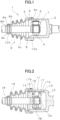
- Fig. 1 shows a partially-cut sectional view of a tripod joint (hereinafter, referred to as TJ) and Fig. 2 shows a partially-cut sectional view of a double-offset joint (hereinafter, referred to as DOJ).
- TJ tripod joint
- DOJ double-offset joint
- a TJ 1 includes three straight track grooves 3 formed in an axial direction in an inner surface of an outer joint member 2.
- a tripod member (inner joint member) 4 incorporated inside the outer joint member 2 is provided with three leg shafts 5.
- a spherical roller 6 is inserted on an outer side of each leg shaft 5, and a needle 7 is incorporated between the spherical roller 6 and the leg shaft 5 to support the spherical roller 6 such that the spherical roller 6 is rotatable and slidable in the axial direction.
- the spherical roller 6 is rollably inserted in the above-described track groove 3.
- a boot 9 is mounted from the outer joint member 2 over a shaft 8 joined to the tripod member 4.
- the boot 9 includes an outer tubular end portion (large-diameter attachment portion) 9a which is fitted and fixed onto the outer joint member 2, an inner tubular end portion (small-diameter attachment portion) 9b which is fitted and fixed onto the shaft 8 coupled to the inner joint member 4, and a bellows-shaped bent portion (hereinafter also referred to as "bellows portion") 9c which connects the outer tubular end portion 9a and the inner tubular end portion 9b and has a plurality of mountains and valleys, and covers the constant-velocity universal joint in a sealing manner.
- This sealed space is hermetically filled with the grease as a lubricant.
- the boot 9 is such that the outer tubular end portion 9a is fitted onto the outer joint member 2 and fixed with a fastening band 10a or the like, and the inner tubular end portion 9b is fixed onto the shaft 8 with a fastening band 10b or the like.
- a boot groove 8a is formed in an outer peripheral surface where the inner tubular end portion 9b of the shaft 8 is fixed, and the inner tubular end portion 9b is fitted into the boot groove 8a. Note that by providing annular protruding portions 8b on both sides of the boot groove 8a, the fixation of the inner tubular end portion 9b, which is fitted in the boot groove 8a, to the shaft 8 can be further strengthened.
- a DOJ 11 includes a plurality of straight track grooves 14, 15 formed in an axial direction in an inner surface of an outer joint member 12 and an outer surface of an inner race (inner joint member) 13.
- a ball 16 incorporated between the track grooves 14, 15 is supported with a cage 17, and an outer periphery of this cage 17 is formed into a spherical surface 17a and an inner periphery thereof is formed into a spherical surface 17b that matches an outer periphery of the inner race 13.
- the centers (A) and (B) of the respective spherical surfaces 17a, 17b are displaced in the axial direction on the axis of the outer joint member 12.
- a boot 19 is mounted from the outer joint member 12 over a shaft 18 joined to the inner race 13.
- the structure of the boot 19 and the attachment structure thereof are the same as those of the boot 9 in Fig. 1 .
- the space sealed by the boot 19 is hermetically filled with the grease as a lubricant.
- the constant-velocity universal joint used for a drive shaft for automobiles that is hermetically filled with the grease of the present embodiment, can maintain an excellent durability at a high temperature.
- Grease compositions of Examples and Comparative Examples were prepared by using components described below. Specifically, 1 mol of 4',4-diphenylmethane diisocyanate and 2 mol of a certain amine were reacted in a base oil, and the temperature was increased and cooled, then followed by kneading with a three roll mill to obtain a base grease. To the base grease, additives were blended in ratios shown in Table 1 (the numbers in Table are % by mass based on the total mass of the composition), and the base oil is further added to obtain the amounts of the thickener in ratios shown in Table 1, followed by dispersing with a three roll mill to obtain the grease compositions of Examples and Comparative Examples. Note that the penetrations were measured and all adjusted to 325 in accordance with JIS K2220 7.
- This test is a test for evaluating how easily the grease is softened by shear.
- This test is a test for evaluating the degree of smoothing of plate surface roughness after the test.
- the joint was dismantled and checked every 50 hours after the start of the test, and the time when the flaking area in the outer race, the inner race, or the trunnion or the needle reached 20 mm 2 was measured. Note that after the flaking area exceeds 20 mm 2 , the operation becomes difficult to continue.
Landscapes
- Chemical & Material Sciences (AREA)
- Chemical Kinetics & Catalysis (AREA)
- General Chemical & Material Sciences (AREA)
- Oil, Petroleum & Natural Gas (AREA)
- Organic Chemistry (AREA)
- Lubricants (AREA)
Abstract
(a) a base oil having a kinematic viscosity of 16.0 mm2/s or more @ 100°C and a viscosity index of 90 or more;
(b) a diurea-based thickener, for example, an aliphatic diurea;
(c) 0.2 to 2.0% by mass of zinc dialkyldithiophosphate;
(d) 0.5 to 2.0% by mass of non-oil-soluble molybdenum dialkyl dithiocarbamate;
(e) 0.5 to 3.0% by mass of oil-soluble molybdenum dialkyl dithiocarbamate;
(f) 1.0 to 4.0% by mass of zinc dialkyldithiocarbamate; and
(g) 0.1 to 1.5% by mass of a benzothiazole-thione or a derivative thereof, wherein (f):(g)=8:1 to 3:1 (mass ratio).
Description
- The present invention relates to a grease composition for a constant-velocity joint and a constant-velocity joint hermetically filled therewith.
- In automobiles, FF vehicles have been widely used from the viewpoint of reductions in weight for the purpose of environmental measures (CO2 reduction) of vehicles and keeping occupational spaces, and constant-velocity joints (CVJs) that are essential for the power transmissions of FF vehicles have been used.
- CVJs are devices that transmit rotation between two shafts that rotate with angles, and thus the components go through a complicated rolling sliding motion inside the joints. Among CVJs, a plunging CVJ also has a sliding mechanism in an axial direction, and a sliding resistance in the axial direction is generated by friction between the members inside the joint. If this sliding resistance is large, it would cause vibrations and noise in some cases.
- Due to changes in vehicle specifications associated with noise regulations and the demands for improvements of fuel economy of automobiles in recent years, there is a case where a plunging constant-velocity joint is exposed to a high-temperature environment. Hence, there is a demand for durability at a high temperature (anti-flaking properties) and an initial conformability for securing durability. The initial conformability means smoothing waviness or unevenness generated on a surface of the joint by processing of the joint promptly after the start of use of the joint.
- As greases for CVJ that are excellent in anti-flaking properties at ordinary temperature, a grease obtained by blending a urea grease with a zinc dialkyldithiophosphate, a molybdenum dialkyl dithiocarbamate, a zinc dialkyldithiophosphate, and a sulfur-nitrogen-based extreme pressure additive (see Patent Literature 1) and a grease obtained by blending a urea grease with a molybdenum disulfide, a molybdenum dialkyl dithiocarbamate, a calcium salt of petroleum sulfonic acid, a sulfur-based extreme pressure agent, a specific vegetable oil or fat, and a zinc dialkyldithiocarbamate (see Patent Literature 2) have been proposed.
- On the other hand, as greases that are excellent in wear resistance, a grease obtained by blending a urea grease with benzotriazole and/or a derivative thereof, and a phosphoric acid ester and/or an amine salt thereof has been proposed (see Patent Literature 3), and a grease obtained by blending a lithium soap grease with a stearic acid metallic salt of Ca, Mg, Zn, or the like, a molybdenum dialkyl dithiocarbamate, and a zinc dialkyldithiocarbamate has also been proposed (see Patent Literature 4).
- In this way, the durability and wear resistance at ordinary temperature have been studied for grease compositions for CVJs as well; however, it cannot necessarily be said that the durability and initial conformability at a high temperature have been sufficiently studied.
-
- Patent Literature 1:
Japanese Patent Application Publication No. 2008-297402 - Patent Literature 2:
Japanese Patent Application Publication No. 2010-90243 - Patent Literature 3:
Japanese Patent Application Publication No. 2015-108067 - Patent Literature 4:
Japanese Patent Application Publication No. 2011-79902 - Hence, an object of the present invention is to provide a grease composition that is excellent in durability and initial conformability even in a high-temperature environment.
- In addition, an object of the present invention is also to provide a constant-velocity joint hermetically filled with the above-described grease composition.
- As a result of conducting studies, the present inventors have found that a grease composition using a base oil having specific kinematic viscosity and viscosity index is excellent in durability and initial conformability even at a high temperature. Specifically, the present invention provides a grease composition for a constant-velocity joint and a constant-velocity joint hermetically filled therewith as follows.
- 1. A grease composition for a constant-velocity joint, comprising:
- (a) a base oil having a kinematic viscosity of 16.0 mm2/s or more at 100°C and a viscosity index of 90 or more;
- (b) a diurea-based thickener represented by the following formula (1)
R1NH-CO-NH-C6H4-p-CH2-C6H4-p-NH-CO-NHR1' (1)
wherein R1 and R1' are each independently an octyl group, a dodecyl group, a hexadecyl group, an octadecyl group, or a cyclohexyl group; - (c) 0.2 to 2.0% by mass of a zinc dialkyldithiophosphate;
- (d) 0.5 to 2.0% by mass of a non-oil-soluble molybdenum dialkyl dithiocarbamate;
- (e) 0.5 to 3.0% by mass of an oil-soluble molybdenum dialkyl dithiocarbamate;
- (f) 1.0 to 4.0% by mass of a zinc dialkyldithiocarbamate; and
- (g) 0.1 to 1.5% by mass of a benzothiazole-thione or a derivative thereof, wherein a mass ratio between the component (f) and the component (g) is (f):(g)=8:1 to 3:1.
- 2. The grease composition according to the above 1, wherein the component (c) is represented by the following formula (2):
[(R2O)2SP-S]2-Zn (2)
wherein R2 is a primary or secondary alkyl group having 1 to 24 carbon atoms. - 3. The grease composition according to the above 1 or 2, wherein the component (d) is represented by the following formula (3):
[R30 2N-CS-S]2-Mo2OmSn (3)
wherein R30 is a primary or secondary alkyl group having 1 to 4 carbon atoms, m is 0 to 3, n is 1 to 4, and m+n=4. - 4. The grease composition according to any one of the above 1 to 3, wherein the component (e) is represented by the following formula (4):
[R31 2N-CS-S]2-Mo2OmSn (4)
wherein R31 is a primary or secondary alkyl group having 5 to 24 carbon atoms, m is 0 to 3, n is 1 to 4, and m+n=4. - 5. The grease composition according to any one of the above 1 to 4, wherein the component (f) is represented by the following formula (5):
[R4 2N-CS-S]2-Zn(5)
wherein R4 is a primary or secondary alkyl group having 1 to 24 carbon atoms. - 6. A constant-velocity joint hermetically filled with the grease composition for a constant-velocity joint according to any one of the above 1 to 5.
- The grease composition of the present invention is excellent in durability and initial conformability even in a high-temperature environment. In addition, the grease composition of the present invention is also excellent in shear stability. In addition, the grease composition of the present invention is also excellent in vibration resistance.
-
-
Fig. 1 is a diagram of a tripod joint using a grease composition for a constant-velocity joint of the present invention in which a part thereof is cut out. -
Fig. 2 is a diagram of a double-offset joint using the grease composition for a constant-velocity joint of the present invention in which a part thereof is cut out. - A base oil of the present invention has a kinematic viscosity of 16.0 mm2/s or more at 100°C and a viscosity index of 90 or more.
- When the kinematic viscosity at 100°C is 16.0 mm2/s or more, a sufficient oil film thickness can be secured even under a condition of a temperature of the surface of the CVJ of 90 to 100°C, and the lubricity at a high temperature can thus be maintained.
- When the viscosity index is 90 or more, vibration can be suppressed by a reduction in sliding resistance at ordinary temperature and a reduction in agitation resistance in a low-temperature environment.
- As long as the kinematic viscosity and the viscosity index are within such ranges, the type of base oil used in the present invention is not particularly limited. For example, such base oils include mineral oils represented by a naphthene-based oil and a paraffin-based oil, synthetic hydrocarbon oils represented by polybutene, ether-based synthetic oils represented by alkyl diphenyl ether, and various synthetic oils such as silicone oil and fluorinated oil. The synthetic oil may be a so-called biomass oil produced by using a biological resource produced from an animal, a plants, or the like as a raw material. For example, biomass ester oils synthesized from various fatty acids using vegetable oils as raw materials and alcohols, and biomass hydrocarbon oils using vegetable oils such as palm oil, corn oil, and soybean oil can also be used. One base oil may be used alone, or two or more base oils may be mixed. A mineral oil is preferable from the viewpoint of cost, and a paraffin-based mineral oil is preferable to a naphthene-based oil from the viewpoint of viscosity index.
- The kinematic viscosity at 100°C is preferably 18.0 mm2/s or more from the viewpoint of securing an oil film thickness at a high temperature. In addition, the kinematic viscosity at 100°C is preferably 24.0 mm2/s or less, and more preferably 22.0 mm2/s or less, from the viewpoint of suppressing vibration at ordinary temperature and reducing an agitation resistance in a low-temperature environment.
- The viscosity index is preferably 93 or more from the viewpoint of suppressing vibration at ordinary temperature and reducing an agitation resistance in a low-temperature environment. In addition, the viscosity index is preferably 120 or less, and more preferably 110 or less, from the viewpoint of compatibility with a boot material.
- As the base oil of the present invention, a mineral oil having a kinematic viscosity of 18.0 mm2/s or more at 100°C and a viscosity index of 95 or more is preferable from the viewpoint of securing an oil film thickness at a high temperature, reducing a sliding resistance at ordinary temperature, and reducing an agitation resistance in a low-temperature environment. A mineral oil having a kinematic viscosity of 19.0 to 20.0 mm2/s at 100°C and a viscosity index of 95 to 105 is more preferable.
- Note that the kinematic viscosity of the base oil can be measured in accordance with JIS K 2283. The viscosity index of the base oil can be obtained from measured values of the kinematic viscosities at 40°C and 100°C of the base oil in accordance with a calculation formula specified in JIS.
- The content of the base oil is preferably 80 to 94% by mass, more preferably 83 to 92% by mass, and further preferably 85 to 90% by mass, based on the total mass of the composition, from the viewpoint of the fluidity of the grease.
- A thickener of the present invention is a diurea-based thickener represented by the following formula (1).
R1NH-CO-NH-C6H4-p-CH2-C6H4-p-NH-CO-NHR1' (1)
wherein R1 and R1' are each independently an octyl group, a dodecyl group, a hexadecyl group, an octadecyl group, or a cyclohexyl group. - The diurea-based thickener of the formula (1) includes an aliphatic diurea in which both R1 and R1' are each an octyl group, a dodecyl group, a hexadecyl group, or an octadecyl group, an alicyclic aliphatic diurea containing a diurea compound in which one of R1 and R1' is an octyl group, a dodecyl group, a hexadecyl group, or an octadecyl group and the other thereof is a cyclohexyl group, and an alicyclic diurea in which both R1 and R1' are each a cyclohexyl group.
- The thickener is preferably an aliphatic diurea thickener or an alicyclic aliphatic diurea thickener which is easily softened by shear, and more preferably an alicyclic aliphatic diurea thickener because when the grease easily flows in the CVJ, the grease can be easily supplied to a sliding portion, which leads to an improvement in durability. As the aliphatic diurea thickener, one of R1 and R1' in the formula (1) is preferably an octyl group. The alicyclic aliphatic diurea thickener is preferably a mixture of a diurea compound in which one of R1 and R1' in the formula (1) is an octadecyl group and the other thereof is a cyclohexyl group, a diurea compound in which both R1 and R1' in the formula (1) are each an octadecyl group, and a diurea compound in which both R1 and R1' in the formula (1) are each a cyclohexyl group is preferable. The molar ratio between a cyclohexyl group and an octadecyl group of the alicyclic aliphatic diurea thickener is preferably 1:9 to 3:7, and more preferably 1:9 to 2:8, from the viewpoint of securing the fluidity of the grease.
- The content of the thickener may be an amount with which the penetration of the grease can be adjusted to 300 to 350, and specifically, is preferably 3 to 10% by mass, more preferably 4 to 9% by mass, and further preferably 5 to 8% by mass, based on the total mass of the composition. Note that in the Specification, the "penetration" means 60-stroke worked penetration measured in accordance with JIS K 2220.7.
(c) As a zinc dialkyldithiophosphate (ZnDTP), one represented by the following formula (2) is preferable.
[(R2O)2SP-S]2-Zn (2)
wherein R2 is a primary or secondary alkyl group having 1 to 24 carbon atoms or aryl group having 6 to 30 carbon atoms. R2 is particularly preferably a primary or secondary alkyl group having 3 to 8 carbon atoms. - The content of the component (c) is 0.2 to 2.0% by mass, preferably 0.5 to 1.8% by mass, and more preferably 0.8 to 1.5% by mass, based on the total mass of the composition. Adding the component (c) in such a range is preferable because sufficient initial conformability can be obtained.
(d) As a non-oil-soluble molybdenum dialkyl dithiocarbamate (non-oil-soluble MoDTC), one represented by the following formula (3) is preferable.
[R30 2N-CS-S]2-Mo2OmSn (3)
wherein R30 is a primary or secondary alkyl group having 1 to 4 carbon atoms, and preferably a primary or secondary alkyl group having 2 to 4 carbon atoms, m is 0 to 3, n is 1 to 4, and m+n=4. - The content of the component (d) is 0.5 to 2.0% by mass, preferably 0.5 to 1.5% by mass, and more preferably 0.5 to 1.0% by mass, based on the total mass of the composition, from the viewpoint of low friction properties. Adding the component (d) in such a range is preferable because sufficient low friction properties can be obtained.
(e) As an oil-soluble molybdenum dialkyl dithiocarbamate (oil-soluble MoDTC), one represented by the following formula (4) is preferable.
[R31 2N-CS-S]2-Mo2OmSn (4)
wherein R31 is a primary or secondary alkyl group having 5 to 24 carbon atoms, and preferably a primary or secondary alkyl group having 5 to 18 carbon atoms, m is 0 to 3, n is 1 to 4, and m+n=4. - The content of the component (e) is 0.5 to 3.0% by mass, preferably 0.5 to 2.5% by mass, and more preferably 0.5 to 2.0% by mass, based on the total mass of the composition, from the viewpoint of low friction properties. Adding the component (e) in such a range is preferable because sufficient low friction properties can be obtained.
(f) As a zinc dialkyldithiocarbamate (ZnDTC), one represented by the following formula (5) is preferable.
[R4 2N-CS-S]2-Zn(5)
wherein R4 is a primary or secondary alkyl group having 1 to 24 carbon atoms or aryl group having 6 to 30 carbon atoms. R4 is preferably an alkyl group having 3 to 8 carbon atoms. - The content of the component (f) is 1.0 to 4.0% by mass, preferably 1.2 to 3.8% by mass, and more preferably 1.5 to 3.5% by mass, based on the total mass of the composition, from the viewpoint of initial conformability. Adding the component (f) in such a range is preferable because sufficient initial conformability can be obtained.
- (g) A benzothiazole-thione or a derivative thereof is normally used as an extreme pressure agent for a grease. For example, a "compound of amines, C16 to 22-tert-alkyl, and 2(3H)-benzothiazole-thione (1:1)" (a compound represented by Amines, C16-22-tert-alkyl, compds. with 2(3H)-benzothiazolethione (1:1)) (for example, Vanlube (registered trademark) 601 produced by Vanderbilt) can be used, and among these, one having a sulfur content of 5 to 20% by mass and a nitrogen content of 1 to 10% by mass is preferable.
- The content of the component (g) is 0.1 to 1.5% by mass, preferably 0.2 to 1.2% by mass, and more preferably 0.3 to 1.0% by mass, based on the total mass of the composition, from the viewpoint of initial conformability. Setting the content of the component (g) in such a range is preferable because sufficient initial conformability can be obtained.
- The mass ratio between the component (f) and the component (g) is (f):(g)=8:1 to 3:1, and preferably 6:1 to 3.5:1. Setting the mass ratio between the component (f) and the component (g) in such a range is preferable because sufficient initial conformability can be obtained.
- The grease composition of the present invention may contain an additive normally used for a grease composition, such as another extreme pressure additive, an antioxidant, or a rust inhibitor in addition to the above-described components. The other extreme pressure additive includes phosphoric acid ester and the like. The antioxidant includes amine-based and phenol-based antioxidants and the like. The rust inhibitor includes sulfonate-based, carboxylic acid-based, and amine-based rust inhibitors. The content of such an optional additive is, for example, 0.1 to 2.0% by mass, and preferably 0.3 to 1.0% by mass based on the total mass of the composition.
- The grease composition for a constant-velocity joint of the present invention can be used for any constant-velocity joints without limitation, but the expression of the advantageous effects is particularly significant in the case where the grease composition for a constant-velocity joint of the present invention is used for constant-velocity joints in which components conduct rolling sliding motions, for example, plunging constant-velocity joints such as tripod joints and double-offset joints.
- The structures of plunging constant-velocity universal joints preferable as the present embodiments are given below.
- (A) A structure including: an outer joint member in which three straight track grooves that extend in an axial direction are formed in an inner peripheral surface thereof; a tripod member as an inner joint member having three leg shafts protruding in a radial direction; and rollers as rolling elements rotatably supported on the leg shafts of the tripod member, wherein the rollers are arranged to be rollable along the track grooves of the outer joint member.
- (B) A structure including: an outer joint member in which a plurality of straight track grooves that extend in an axial direction are formed in a cylindrical inner peripheral surface thereof; an inner joint member in which a plurality of straight track grooves paired with the track grooves of the outer joint member are formed in a spherical outer peripheral surface thereof; (3 to 8) balls as rolling elements disposed between the track grooves of the outer joint member and the track grooves of the inner joint member; and a cage holding the balls between the outer joint member and the inner joint member.
- First and second specific embodiments of the constant-velocity universal joint of the present invention will be described based on
Fig. 1 and Fig. 2. Fig. 1 shows a partially-cut sectional view of a tripod joint (hereinafter, referred to as TJ) andFig. 2 shows a partially-cut sectional view of a double-offset joint (hereinafter, referred to as DOJ). These are sliding constant-velocity universal joints and are used for drive shaft for automobiles and the like. - As shown in
Fig. 1 , aTJ 1 includes threestraight track grooves 3 formed in an axial direction in an inner surface of an outerjoint member 2. A tripod member (inner joint member) 4 incorporated inside the outerjoint member 2 is provided with threeleg shafts 5. Aspherical roller 6 is inserted on an outer side of eachleg shaft 5, and aneedle 7 is incorporated between thespherical roller 6 and theleg shaft 5 to support thespherical roller 6 such that thespherical roller 6 is rotatable and slidable in the axial direction. Thespherical roller 6 is rollably inserted in the above-describedtrack groove 3. Aboot 9 is mounted from the outerjoint member 2 over ashaft 8 joined to thetripod member 4. - The
boot 9 includes an outer tubular end portion (large-diameter attachment portion) 9a which is fitted and fixed onto the outerjoint member 2, an inner tubular end portion (small-diameter attachment portion) 9b which is fitted and fixed onto theshaft 8 coupled to the innerjoint member 4, and a bellows-shaped bent portion (hereinafter also referred to as "bellows portion") 9c which connects the outer tubular end portion 9a and the inner tubular end portion 9b and has a plurality of mountains and valleys, and covers the constant-velocity universal joint in a sealing manner. This sealed space is hermetically filled with the grease as a lubricant. Theboot 9 is such that the outer tubular end portion 9a is fitted onto the outerjoint member 2 and fixed with a fastening band 10a or the like, and the inner tubular end portion 9b is fixed onto theshaft 8 with a fastening band 10b or the like. Aboot groove 8a is formed in an outer peripheral surface where the inner tubular end portion 9b of theshaft 8 is fixed, and the inner tubular end portion 9b is fitted into theboot groove 8a. Note that by providing annular protrudingportions 8b on both sides of theboot groove 8a, the fixation of the inner tubular end portion 9b, which is fitted in theboot groove 8a, to theshaft 8 can be further strengthened. - As shown in
Fig. 2 , a DOJ 11 includes a plurality ofstraight track grooves joint member 12 and an outer surface of an inner race (inner joint member) 13. Aball 16 incorporated between thetrack grooves cage 17, and an outer periphery of thiscage 17 is formed into a spherical surface 17a and an inner periphery thereof is formed into aspherical surface 17b that matches an outer periphery of theinner race 13. The centers (A) and (B) of the respectivespherical surfaces 17a, 17b are displaced in the axial direction on the axis of the outerjoint member 12. Aboot 19 is mounted from the outerjoint member 12 over ashaft 18 joined to theinner race 13. The structure of theboot 19 and the attachment structure thereof are the same as those of theboot 9 inFig. 1 . In addition, the space sealed by theboot 19 is hermetically filled with the grease as a lubricant. - The constant-velocity universal joint used for a drive shaft for automobiles, that is hermetically filled with the grease of the present embodiment, can maintain an excellent durability at a high temperature.
- Therefore, various constant-velocity joints hermetically filled with the above-described grease composition, particularly plunging constant-velocity joints, are also encompassed within the scope of the present invention.
- Grease compositions of Examples and Comparative Examples were prepared by using components described below. Specifically, 1 mol of 4',4-diphenylmethane diisocyanate and 2 mol of a certain amine were reacted in a base oil, and the temperature was increased and cooled, then followed by kneading with a three roll mill to obtain a base grease. To the base grease, additives were blended in ratios shown in Table 1 (the numbers in Table are % by mass based on the total mass of the composition), and the base oil is further added to obtain the amounts of the thickener in ratios shown in Table 1, followed by dispersing with a three roll mill to obtain the grease compositions of Examples and Comparative Examples. Note that the penetrations were measured and all adjusted to 325 in accordance with
JIS K2220 7. -
- For the aliphatic diurea, octylamine was used as an amine.
- For the alicyclic aliphatic diurea, cyclohexylamine and octadecylamine were used in a molar ratio of cyclohexylamine:octadecylamine=2:8 as amines.
- For the alicyclic aromatic diurea, cyclohexylamine and aniline were used in a molar ratio of cyclohexylamine:aniline =7:3 as amines.
-
- (c) ZnDTP: a zinc dialkyldithiophosphate
(LUBRIZOL 1395, produced by Lubrizol) - (d) MoDTC (non-oil-soluble): a molybdenum dialkyl dithiocarbamate
(ADEKA SAKURA-LUBE 600, produced by ADEKA) - (e) MoDTC (oil-soluble): a molybdenum dialkyl dithiocarbamate
(ADEKA SAKURA-LUBE 525, produced by ADEKA) - (f) ZnDTC: a zinc dialkyldithiocarbamate
(Vanlube AZ, produced by Vanderbilt) - (g) A benzothiazole-thione derivative
(Vanlube 601, produced by Vanderbilt) - Each grease composition of Examples and Comparative Examples was tested by methods described below. Results are shown in Table 1.
- This test is a test for evaluating how easily the grease is softened by shear.
- Test conditions
- Ambient temperature: 100°C
- Roll rotation speed: 165 rpm
- Rotation time: 24 h
- Evaluation criteria
- Worked penetration of the grease after the test
- ∘: 400 or more
- ×: less than 400
- This test is a test for evaluating the degree of smoothing of plate surface roughness after the test.
- Test conditions:
- Surface pressure: 2.8 GPa
- Sliding speed: 20 mm/s (3.0 mm×3.3 Hz)
- Plate temperature: 95°C
- Ball diameter: 17.5 mm
- Plate roughness Ra before the test: 0.7 µm
- Evaluation criteria
- Plate roughness Ra after the test
- ∘: less than 0.35 µm
- ×: 0.35 µm or more
- Each grease composition of Examples and Comparative Examples was put into an actual tripod CVJ, and a joint durability test was conducted by using this under conditions described below, and the durability at a high temperature was evaluated by measuring the time when flaking occurred.
- Test conditions
- Rotation speed: 200 rpm
- Torque: 800 Nm
- Angle: 6°
- Temperature of the surface of the joint: 90 to 100°C
- Evaluation method
- The joint was dismantled and checked every 50 hours after the start of the test, and the time when the flaking area in the outer race, the inner race, or the trunnion or the needle reached 20 mm2 was measured. Note that after the flaking area exceeds 20 mm2, the operation becomes difficult to continue.
- Evaluation criteria
- ∘: 250 h or more
- ×: less than 250 h
- Each grease composition of Examples and Comparative Examples was put into an actual tripod CVJ, and vibration resistance was evaluated by using this CVJ and measuring the force generated in the axial direction as an induced thrust when this CVJ was rotated at an operating angle and torque.
- Measurement conditions
- Rotation speed: 150 rpm
- Torque: 300 Nm
- Angle: 0 to 12 deg
- Evaluation criteria
- Third-order component
- ∘: 110 Nrms or less
- ×: more than 110 Nrms
-
- 1
- TJ
- 2
- outer joint member
- 3
- track groove
- 4
- tripod member (inner joint member)
- 5
- leg shaft
- 6
- spherical roller
- 7
- needle
- 8
- shaft
- 9
- boot
- 10a, 10b
- fastening band
- 11
- DOJ
- 12
- outer joint member
- 13
- inner race (inner joint member)
- 14, 15
- track groove
- 16
- ball
- 17
- cage
- 18
- shaft
- 19
- boot


Claims (6)
- A grease composition for a constant-velocity joint, comprising:(a) a base oil having a kinematic viscosity of 16.0 mm2/s or more at 100°C and a viscosity index of 90 or more;(b) a diurea-based thickener represented by the following formula (1)
R1NH-CO-NH-C6H4-p-CH2-C6H4-p-NH-CO-NHR1' (1)
wherein R1 and R1' are each independently an octyl group, a dodecyl group, a hexadecyl group, an octadecyl group, or a cyclohexyl group;(c) 0.2 to 2.0% by mass of a zinc dialkyldithiophosphate;(d) 0.5 to 2.0% by mass of a non-oil-soluble molybdenum dialkyl dithiocarbamate;(e) 0.5 to 3.0% by mass of an oil-soluble molybdenum dialkyl dithiocarbamate;(f) 1.0 to 4.0% by mass of a zinc dialkyldithiocarbamate; and(g) 0.1 to 1.5% by mass of a benzothiazole-thione or a derivative thereof, wherein a mass ratio between the component (f) and the component (g) is (f):(g)=8:1 to 3:1. - The grease composition according to claim 1, wherein the component (c) is represented by the following formula (2):
[(R2O)2SP-S]2-Zn (2)
wherein R2 is a primary or secondary alkyl group having 1 to 24 carbon atoms. - The grease composition according to claim 1, wherein the component (d) is represented by the following formula (3):
[R30 2N-CS-S]2-Mo2OmSn (3)
wherein R30 is a primary or secondary alkyl group having 1 to 4 carbon atoms, m is 0 to 3, n is 1 to 4, and m+n=4. - The grease composition according to claim 1, wherein the component (e) is represented by the following formula (4):
[R31 2N-CS-S]2-Mo2OmSn (4)
wherein R31 is a primary or secondary alkyl group having 5 to 24 carbon atoms, m is 0 to 3, n is 1 to 4, and m+n=4. - The grease composition according to claim 1, wherein the component (f) is represented by the following formula (5):
[R4 2N-CS-S]2-Zn (5)
wherein R4 is a primary or secondary alkyl group having 1 to 24 carbon atoms. - A constant-velocity joint hermetically filled with the grease composition for a constant-velocity joint according to claim 1.
Applications Claiming Priority (2)
| Application Number | Priority Date | Filing Date | Title |
|---|---|---|---|
| JP2022079995 | 2022-05-16 | ||
| PCT/JP2023/018130 WO2023224006A1 (en) | 2022-05-16 | 2023-05-15 | Grease composition for constant-velocity joint and constant-velocity joint hermetically filled therewith |
Publications (2)
| Publication Number | Publication Date |
|---|---|
| EP4527912A1 true EP4527912A1 (en) | 2025-03-26 |
| EP4527912A4 EP4527912A4 (en) | 2025-08-20 |
Family
ID=88835549
Family Applications (1)
| Application Number | Title | Priority Date | Filing Date |
|---|---|---|---|
| EP23807608.7A Pending EP4527912A4 (en) | 2022-05-16 | 2023-05-15 | LUBRICANT GREASE COMPOSITION FOR CONSTANT VELOCITY JOINT AND THEREFORE HERMETICALLY FILLED CONSTANT VELOCITY JOINT |
Country Status (5)
| Country | Link |
|---|---|
| US (1) | US20250354080A1 (en) |
| EP (1) | EP4527912A4 (en) |
| JP (1) | JPWO2023224006A1 (en) |
| CN (1) | CN119137249A (en) |
| WO (1) | WO2023224006A1 (en) |
Family Cites Families (12)
| Publication number | Priority date | Publication date | Assignee | Title |
|---|---|---|---|---|
| JP4397975B2 (en) * | 1997-03-31 | 2010-01-13 | 協同油脂株式会社 | Grease composition for constant velocity joints |
| US6022835A (en) * | 1997-10-22 | 2000-02-08 | Shell Oil Company | Lubricating composition |
| JP4181771B2 (en) * | 2001-11-30 | 2008-11-19 | Ntn株式会社 | Grease for constant velocity joint and constant velocity joint |
| JP2006283830A (en) * | 2005-03-31 | 2006-10-19 | Ntn Corp | Constant velocity universal joint |
| JP5379343B2 (en) * | 2006-05-10 | 2013-12-25 | 昭和シェル石油株式会社 | Grease composition for constant velocity joints |
| JP5258080B2 (en) | 2007-05-30 | 2013-08-07 | 協同油脂株式会社 | Grease composition for constant velocity joint and constant velocity joint enclosing it |
| JP5344424B2 (en) | 2008-10-07 | 2013-11-20 | 協同油脂株式会社 | Grease composition for constant velocity joint and constant velocity joint |
| JP5665298B2 (en) | 2009-10-05 | 2015-02-04 | 協同油脂株式会社 | Grease composition and constant velocity joint |
| JP2011236354A (en) * | 2010-05-12 | 2011-11-24 | Kyodo Yushi Co Ltd | Grease composition for ball-type constant velocity joint |
| JP6292569B2 (en) | 2013-12-04 | 2018-03-14 | 協同油脂株式会社 | Grease composition for constant velocity joint and constant velocity joint enclosing the grease composition |
| JP6223863B2 (en) * | 2014-02-27 | 2017-11-01 | 昭和シェル石油株式会社 | Grease composition |
| JP6348374B2 (en) * | 2014-08-25 | 2018-06-27 | シェルルブリカンツジャパン株式会社 | Grease composition |
-
2023
- 2023-05-15 EP EP23807608.7A patent/EP4527912A4/en active Pending
- 2023-05-15 WO PCT/JP2023/018130 patent/WO2023224006A1/en not_active Ceased
- 2023-05-15 US US18/866,269 patent/US20250354080A1/en active Pending
- 2023-05-15 JP JP2024521928A patent/JPWO2023224006A1/ja active Pending
- 2023-05-15 CN CN202380040455.3A patent/CN119137249A/en active Pending
Also Published As
| Publication number | Publication date |
|---|---|
| EP4527912A4 (en) | 2025-08-20 |
| JPWO2023224006A1 (en) | 2023-11-23 |
| WO2023224006A1 (en) | 2023-11-23 |
| US20250354080A1 (en) | 2025-11-20 |
| CN119137249A (en) | 2024-12-13 |
Similar Documents
| Publication | Publication Date | Title |
|---|---|---|
| US8518864B2 (en) | Grease composition for constant-velocity joints and constant-velocity joint enclosing the same | |
| US9139793B2 (en) | Grease composition, grease-packed bearing, universal joint and linear motion device | |
| US5952273A (en) | Grease composition for constant velocity joints | |
| JPH08157859A (en) | Lubricating grease composition | |
| CN102666820B (en) | Grease composition and constant velocity cardan joint | |
| JP4181771B2 (en) | Grease for constant velocity joint and constant velocity joint | |
| JP4809793B2 (en) | Grease composition and machine member | |
| WO2022113239A1 (en) | Grease composition for constant-velocity joint | |
| JP2017025189A (en) | Grease composition, grease sealed shaft bearing, universal joint and linear motion device | |
| EP2298856B1 (en) | Grease composition for constant velocity joint and constant velocity joint | |
| US10829714B2 (en) | Grease composition for constant velocity joints, and constant velocity joint in which same is sealed | |
| EP2891705B1 (en) | Grease composition for constant velocity joints, and constant velocity joint in which grease composition for constant velocity joints is sealed | |
| US20250354080A1 (en) | Grease composition for constant-velocity joint and constant-velocity joint filled therewith | |
| EP4524222B1 (en) | LUBRICANT COMPOSITION FOR OUTBOARD CONVERTER JOINTS | |
| JP5685141B2 (en) | Grease composition, grease-filled bearing, universal joint and linear motion device | |
| JP2006300260A (en) | Telescopic shaft | |
| JP2007078120A (en) | Tripod type constant velocity universal joint | |
| JP2026013589A (en) | Grease composition for constant velocity joints | |
| WO2024210158A1 (en) | Grease composition for constant-velocity joint, and constant-velocity joint having same sealed therein | |
| JP2003041280A (en) | Grease for constant velocity joints and constant velocity joints | |
| JP2006299036A (en) | Grease for constant velocity joint and constant velocity joint |
Legal Events
| Date | Code | Title | Description |
|---|---|---|---|
| STAA | Information on the status of an ep patent application or granted ep patent |
Free format text: STATUS: THE INTERNATIONAL PUBLICATION HAS BEEN MADE |
|
| PUAI | Public reference made under article 153(3) epc to a published international application that has entered the european phase |
Free format text: ORIGINAL CODE: 0009012 |
|
| STAA | Information on the status of an ep patent application or granted ep patent |
Free format text: STATUS: REQUEST FOR EXAMINATION WAS MADE |
|
| 17P | Request for examination filed |
Effective date: 20241125 |
|
| AK | Designated contracting states |
Kind code of ref document: A1 Designated state(s): AL AT BE BG CH CY CZ DE DK EE ES FI FR GB GR HR HU IE IS IT LI LT LU LV MC ME MK MT NL NO PL PT RO RS SE SI SK SM TR |
|
| REG | Reference to a national code |
Ref country code: DE Ref legal event code: R079 Free format text: PREVIOUS MAIN CLASS: C10M0169060000 Ipc: C10N0010040000 |
|
| A4 | Supplementary search report drawn up and despatched |
Effective date: 20250718 |
|
| DAV | Request for validation of the european patent (deleted) | ||
| DAX | Request for extension of the european patent (deleted) | ||
| RIC1 | Information provided on ipc code assigned before grant |
Ipc: C10N 10/04 20060101AFI20250714BHEP Ipc: C10N 10/12 20060101ALI20250714BHEP Ipc: C10N 30/00 20060101ALI20250714BHEP Ipc: C10N 40/04 20060101ALI20250714BHEP Ipc: C10N 50/10 20060101ALI20250714BHEP Ipc: C10M 115/08 20060101ALI20250714BHEP Ipc: C10M 135/18 20060101ALI20250714BHEP Ipc: C10M 135/36 20060101ALI20250714BHEP Ipc: C10M 137/10 20060101ALI20250714BHEP Ipc: F16D 3/20 20060101ALI20250714BHEP Ipc: F16D 3/84 20060101ALI20250714BHEP Ipc: C10M 169/04 20060101ALI20250714BHEP Ipc: C10N 20/02 20060101ALN20250714BHEP Ipc: C10N 30/06 20060101ALN20250714BHEP Ipc: C10N 20/00 20060101ALN20250714BHEP |
|
| STAA | Information on the status of an ep patent application or granted ep patent |
Free format text: STATUS: EXAMINATION IS IN PROGRESS |
|
| 17Q | First examination report despatched |
Effective date: 20260410 |