EP4527835A1 - Fluorene compound containing thioepoxy and (meth)allyl groups, and production method therefor - Google Patents
Fluorene compound containing thioepoxy and (meth)allyl groups, and production method therefor Download PDFInfo
- Publication number
- EP4527835A1 EP4527835A1 EP23807495.9A EP23807495A EP4527835A1 EP 4527835 A1 EP4527835 A1 EP 4527835A1 EP 23807495 A EP23807495 A EP 23807495A EP 4527835 A1 EP4527835 A1 EP 4527835A1
- Authority
- EP
- European Patent Office
- Prior art keywords
- meth
- thioepoxy
- acid
- allyl groups
- formula
- Prior art date
- Legal status (The legal status is an assumption and is not a legal conclusion. Google has not performed a legal analysis and makes no representation as to the accuracy of the status listed.)
- Pending
Links
Classifications
-
- C—CHEMISTRY; METALLURGY
- C07—ORGANIC CHEMISTRY
- C07D—HETEROCYCLIC COMPOUNDS
- C07D331/00—Heterocyclic compounds containing rings of less than five members, having one sulfur atom as the only ring hetero atom
- C07D331/02—Three-membered rings
Definitions
- This invention relates to a fluorene compound containing thioepoxy and (meth)allyl groups and a method of preparing the same.
- Patent Document 1 JP 4873223
- An object of the invention which has been made under the above-mentioned circumstances, is to provide a compound which can form a polymer having a high refractive index and is thus useful as a raw material for high refractive index optical materials.
- the invention provides a fluorene compound containing thioepoxy and (meth)allyl groups as defined below.
- the fluorene compound containing thioepoxy and (meth)allyl groups according to the invention allows for both polymerization via (meth)allyl groups and polymerization via thioepoxy groups. After polymers are formed, they can be crosslinked and cured by utilizing the groups. Since the fluorene compound containing thioepoxy and (meth)allyl groups according to the invention has two thioepoxy groups in the molecule and aromatic rings capable of achieving a high refractive index, the polymer obtained therefrom is expected to have a high refractive index and is useful as a raw material for high refractive index optical materials.
- One embodiment of the invention is a fluorene compound containing thioepoxy and (meth)allyl groups, represented by the formula (1).
- R 1 to R 4 are each independently hydrogen or methyl.
- R 1 and R 2 are preferably hydrogen or methyl, and R 3 and R 4 are preferably hydrogen.
- the compound having formula (1) can be prepared by reacting a fluorene compound containing glycidyl and (meth)allyl groups, represented by the formula (2), with thiourea or a thiocyanate.
- R 1 to R 4 are as defined above.
- the temperature of the reaction of the compound having formula (2) with a thiocyanate or thiourea is arbitrary, typically 0 to 100°C, preferably 20 to 70°C.
- the reaction time is not particularly limited as long as the reaction is completed, and is typically 20 hours or less.
- the thiocyanate or thiourea is used in a stoichiometric amount corresponding to the stoichiometric amount of epoxy groups of the epoxy compound, but may be used in either smaller amounts or larger amounts when the product purity, reaction rate, economy or the like is taken into account.
- the thiocyanate or thiourea is preferably used in an amount of more than 0 mole to about 5 moles, more preferably about 0.9 to about 5 moles, even more preferably about 1 to about 3 moles per mole of epoxy groups of the epoxy compound.
- the reaction may be performed in a solventless system or in a solvent.
- the solvent in which either of the thiocyanate or thiourea and the compound having formula (2) is soluble is preferably selected.
- the solvent include water, alcohols such as methanol and ethanol; ethers such as diethyl ether, tetrahydrofuran and dioxane; hydroxyethers such as methylcellosolve, ethylcellosolve, and butylcellosolve; aromatic hydrocarbons such as benzene, toluene and xylene; and halogenated hydrocarbons such as dichloroethane, chloroform and chlorobenzene.
- a mixture of these solvents is also acceptable.
- a mixture of an alcohol with water, or a mixture of an ether, hydroxyether, halogenated hydrocarbon or aromatic hydrocarbon with an alcohol is sometimes quite effective.
- the solvent when used, its amount is preferably 0.1 to 500 parts by weight, more preferably 1 to 400 parts by weight per 100 parts by weight of the compound having formula (2).
- Typical polymerization inhibitors are acids and acid anhydrides.
- the acids and acid anhydrides include nitric acid, hydrochloric acid, sulfuric acid, fuming sulfuric acid, boric acid, arsenic acid, phosphoric acid, hydrocyanic acid, acetic acid, peracetic acid, thioacetic acid, oxalic acid, tartaric acid, propionic acid, butyric acid, succinic acid, maleic acid, benzoic acid, nitric anhydride, sulfuric anhydride, boron oxide, diarsenic pentoxide, phosphorus pentoxide, chromic anhydride, acetic anhydride, propionic anhydride, butyric anhydride, succinic anhydride, maleic anhydride, benzoic anhydride, phthalic anhydride, silica gel, silica alumina, and aluminum chloride.
- the acids and acid anhydrides include nitric acid, hydrochloric acid, sulfuric acid
- the resulting compound By washing the reaction product with an acidic aqueous solution, the resulting compound can be improved in stability.
- the acid used in the acidic aqueous solution include nitric acid, hydrochloric acid, sulfuric acid, boric acid, arsenic acid, phosphoric acid, hydrocyanic acid, acetic acid, peracetic acid, thioacetic acid, oxalic acid, tartaric acid, succinic acid, and maleic acid.
- the acid may be used alone or in admixture.
- the acidic aqueous solution is often effective at pH 6 or lower, more effective at pH 0 to 3.
- the acid may be used alone or in admixture.
- the fluorene compound containing thioepoxy and (meth)allyl groups is a compound containing two thioepoxy groups and two (meth)allyl groups in the molecule.
- the fluorene compound can be polymerized through hydrosilation reaction with a siloxane compound having Si-H, obtaining a polymeric silicone material having a structure containing thioepoxy groups and capable of three-dimensional crosslinking.
- the fluorene compound can be used as a curable material having a structure capable of three-dimensional crosslinking.
- the fluorene compound After the fluorene compound is converted to a polymer by using thioepoxy or (meth)allyl groups, the polymer can be crosslinked and cured using the remaining functional groups.
- the fluorene compound containing thioepoxy and (meth)allyl groups is useful as a macromonomer for heat-resistant resin materials having a high refractive index.
Landscapes
- Chemical & Material Sciences (AREA)
- Organic Chemistry (AREA)
- Organic Low-Molecular-Weight Compounds And Preparation Thereof (AREA)
- Addition Polymer Or Copolymer, Post-Treatments, Or Chemical Modifications (AREA)
Abstract
Provided is a fluorene compound represented by formula (1) and containing thioepoxy and (meth)allyl groups.(In the formula, R<sup>1</sup> to R<sup>4</sup> are each independently a hydrogen atom or a methyl group.)
Description
- This invention relates to a fluorene compound containing thioepoxy and (meth)allyl groups and a method of preparing the same.
- One of the fluorene compounds containing (meth)allyl and glycidyl groups known in the art is the compound described in Patent Document 1. Since its refractive index is not high, the compound is insufficient as a raw material for high refractive index optical materials.
- Patent Document 1:
JP 4873223 - An object of the invention, which has been made under the above-mentioned circumstances, is to provide a compound which can form a polymer having a high refractive index and is thus useful as a raw material for high refractive index optical materials.
- Making extensive investigations to attain the above object, the inventor has found that by reacting a fluorene compound containing glycidyl and (meth)allyl groups, represented by the formula (2):

- wherein R1 to R4 are each independently hydrogen or methyl with thiourea or a thiocyanate, there is obtained a fluorene compound containing thioepoxy and (meth)allyl groups in the molecule, represented by the formula (1):

- wherein R1 to R4 are each independently hydrogen or methyl. The invention is predicated on this finding.
- The invention provides a fluorene compound containing thioepoxy and (meth)allyl groups as defined below.
- 1. A fluorene compound containing thioepoxy and (meth)allyl groups, represented by the formula (1):

- 2. A method of preparing a fluorene compound containing thioepoxy and (meth)allyl groups, represented by the formula (1), the method comprising the step of reacting a fluorene compound containing glycidyl and (meth)allyl groups, represented by the formula (2), with thiourea or a thiocyanate,

- wherein R1 to R4 are each independently hydrogen or methyl,

- wherein R1 to R4 are each independently hydrogen or methyl.
- wherein R1 to R4 are each independently hydrogen or methyl,
- The fluorene compound containing thioepoxy and (meth)allyl groups according to the invention allows for both polymerization via (meth)allyl groups and polymerization via thioepoxy groups. After polymers are formed, they can be crosslinked and cured by utilizing the groups. Since the fluorene compound containing thioepoxy and (meth)allyl groups according to the invention has two thioepoxy groups in the molecule and aromatic rings capable of achieving a high refractive index, the polymer obtained therefrom is expected to have a high refractive index and is useful as a raw material for high refractive index optical materials.
- One embodiment of the invention is a fluorene compound containing thioepoxy and (meth)allyl groups, represented by the formula (1).

- In formula (1), R1 to R4 are each independently hydrogen or methyl. R1 and R2 are preferably hydrogen or methyl, and R3 and R4 are preferably hydrogen.
- Examples of the compound having formula (1) are shown below, but not limited thereto.

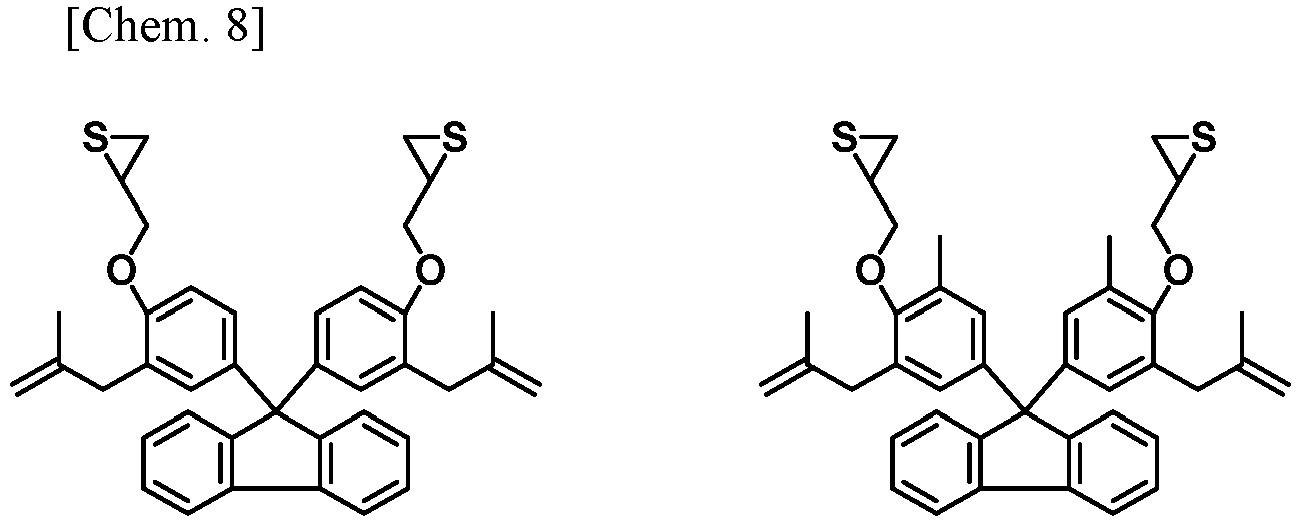
- The compound having formula (1) can be prepared by reacting a fluorene compound containing glycidyl and (meth)allyl groups, represented by the formula (2), with thiourea or a thiocyanate.

- Herein R1 to R4 are as defined above.
- Examples of the compound having formula (2) are shown below, but not limited thereto.


- The temperature of the reaction of the compound having formula (2) with a thiocyanate or thiourea is arbitrary, typically 0 to 100°C, preferably 20 to 70°C. The reaction time is not particularly limited as long as the reaction is completed, and is typically 20 hours or less.
- The thiocyanate or thiourea is used in a stoichiometric amount corresponding to the stoichiometric amount of epoxy groups of the epoxy compound, but may be used in either smaller amounts or larger amounts when the product purity, reaction rate, economy or the like is taken into account. In the practice of the invention, the thiocyanate or thiourea is preferably used in an amount of more than 0 mole to about 5 moles, more preferably about 0.9 to about 5 moles, even more preferably about 1 to about 3 moles per mole of epoxy groups of the epoxy compound.
- The reaction may be performed in a solventless system or in a solvent. When the solvent is used, the solvent in which either of the thiocyanate or thiourea and the compound having formula (2) is soluble is preferably selected. Examples of the solvent include water, alcohols such as methanol and ethanol; ethers such as diethyl ether, tetrahydrofuran and dioxane; hydroxyethers such as methylcellosolve, ethylcellosolve, and butylcellosolve; aromatic hydrocarbons such as benzene, toluene and xylene; and halogenated hydrocarbons such as dichloroethane, chloroform and chlorobenzene. A mixture of these solvents is also acceptable. For example, a mixture of an alcohol with water, or a mixture of an ether, hydroxyether, halogenated hydrocarbon or aromatic hydrocarbon with an alcohol is sometimes quite effective. When the solvent is used, its amount is preferably 0.1 to 500 parts by weight, more preferably 1 to 400 parts by weight per 100 parts by weight of the compound having formula (2).
- It is effective to add a polymerization inhibitor to the reaction solution because the reaction result is better. Typical polymerization inhibitors are acids and acid anhydrides. Examples of the acids and acid anhydrides include nitric acid, hydrochloric acid, sulfuric acid, fuming sulfuric acid, boric acid, arsenic acid, phosphoric acid, hydrocyanic acid, acetic acid, peracetic acid, thioacetic acid, oxalic acid, tartaric acid, propionic acid, butyric acid, succinic acid, maleic acid, benzoic acid, nitric anhydride, sulfuric anhydride, boron oxide, diarsenic pentoxide, phosphorus pentoxide, chromic anhydride, acetic anhydride, propionic anhydride, butyric anhydride, succinic anhydride, maleic anhydride, benzoic anhydride, phthalic anhydride, silica gel, silica alumina, and aluminum chloride. When used, the amount of the polymerization inhibitor added is preferably 0.001 to 10% by weight, more preferably 0.01 to 1% by weight of the overall amount of the reaction solution. The polymerization inhibitor may be used alone or in admixture.
- By washing the reaction product with an acidic aqueous solution, the resulting compound can be improved in stability. Examples of the acid used in the acidic aqueous solution include nitric acid, hydrochloric acid, sulfuric acid, boric acid, arsenic acid, phosphoric acid, hydrocyanic acid, acetic acid, peracetic acid, thioacetic acid, oxalic acid, tartaric acid, succinic acid, and maleic acid. The acid may be used alone or in admixture. The acidic aqueous solution is often effective at pH 6 or lower, more effective at pH 0 to 3. The acid may be used alone or in admixture.
- The fluorene compound containing thioepoxy and (meth)allyl groups is a compound containing two thioepoxy groups and two (meth)allyl groups in the molecule. Using the reactivity of (meth)allyl groups, the fluorene compound can be polymerized through hydrosilation reaction with a siloxane compound having Si-H, obtaining a polymeric silicone material having a structure containing thioepoxy groups and capable of three-dimensional crosslinking. Alternatively, using the reactivity of thioepoxy groups, the fluorene compound can be used as a curable material having a structure capable of three-dimensional crosslinking. After the fluorene compound is converted to a polymer by using thioepoxy or (meth)allyl groups, the polymer can be crosslinked and cured using the remaining functional groups. The fluorene compound containing thioepoxy and (meth)allyl groups is useful as a macromonomer for heat-resistant resin materials having a high refractive index.
- Examples of the invention are given below by way of illustration, but not by way of limitation.
- A 3-L separable flask equipped with a nitrogen gas inlet tube, thermometer, Dimroth condenser, vacuum controller, and aspirator was charged with 271 g (0.5 mol) of a compound having the formula (2-1):


- By following the same procedure as in Example 1 aside from using 285 g (0.5 mol) of a compound having the formula (2-2):


Claims (2)
- A fluorene compound containing thioepoxy and (meth)allyl groups, represented by the formula (1):

- A method of preparing a fluorene compound containing thioepoxy and (meth)allyl groups, represented by the formula (1), the method comprising the step of reacting a fluorene compound containing glycidyl and (meth)allyl groups, represented by the formula (2), with thiourea or a thiocyanate,
 wherein R1 to R4 are each independently hydrogen or methyl,
 wherein R1 to R4 are each independently hydrogen or methyl.
Applications Claiming Priority (2)
| Application Number | Priority Date | Filing Date | Title |
|---|---|---|---|
| JP2022081983A JP2023170317A (en) | 2022-05-19 | 2022-05-19 | Fluorene compound containing thioepoxy group and (meth)allyl group, and method for producing the same |
| PCT/JP2023/017430 WO2023223891A1 (en) | 2022-05-19 | 2023-05-09 | Fluorene compound containing thioepoxy and (meth)allyl groups, and production method therefor |
Publications (2)
| Publication Number | Publication Date |
|---|---|
| EP4527835A1 true EP4527835A1 (en) | 2025-03-26 |
| EP4527835A4 EP4527835A4 (en) | 2026-05-20 |
Family
ID=88835262
Family Applications (1)
| Application Number | Title | Priority Date | Filing Date |
|---|---|---|---|
| EP23807495.9A Pending EP4527835A4 (en) | 2022-05-19 | 2023-05-09 | FLUORINE COMPOUND WITH THIOEPOXIDE AND (METH)ALLYL GROUPS AND MANUFACTURING METHOD THERE FOR IT |
Country Status (7)
| Country | Link |
|---|---|
| US (1) | US20250270183A1 (en) |
| EP (1) | EP4527835A4 (en) |
| JP (1) | JP2023170317A (en) |
| KR (1) | KR20250012084A (en) |
| CN (1) | CN119183451A (en) |
| TW (1) | TW202402746A (en) |
| WO (1) | WO2023223891A1 (en) |
Family Cites Families (4)
| Publication number | Priority date | Publication date | Assignee | Title |
|---|---|---|---|---|
| JPS4873223U (en) | 1971-12-16 | 1973-09-12 | ||
| JP4873223B2 (en) * | 2006-02-02 | 2012-02-08 | ナガセケムテックス株式会社 | New epoxy resin |
| JP5890288B2 (en) * | 2012-09-20 | 2016-03-22 | 信越化学工業株式会社 | Method for producing novel organosilicon compound |
| JP6546023B2 (en) * | 2014-07-22 | 2019-07-17 | 学校法人 関西大学 | Curable composition containing episulfide compound, cured product and method for producing the same |
-
2022
- 2022-05-19 JP JP2022081983A patent/JP2023170317A/en active Pending
-
2023
- 2023-05-09 CN CN202380039877.9A patent/CN119183451A/en active Pending
- 2023-05-09 WO PCT/JP2023/017430 patent/WO2023223891A1/en not_active Ceased
- 2023-05-09 EP EP23807495.9A patent/EP4527835A4/en active Pending
- 2023-05-09 KR KR1020247040882A patent/KR20250012084A/en active Pending
- 2023-05-09 US US18/858,850 patent/US20250270183A1/en active Pending
- 2023-05-18 TW TW112118512A patent/TW202402746A/en unknown
Also Published As
| Publication number | Publication date |
|---|---|
| US20250270183A1 (en) | 2025-08-28 |
| WO2023223891A1 (en) | 2023-11-23 |
| TW202402746A (en) | 2024-01-16 |
| JP2023170317A (en) | 2023-12-01 |
| KR20250012084A (en) | 2025-01-23 |
| EP4527835A4 (en) | 2026-05-20 |
| CN119183451A (en) | 2024-12-24 |
Similar Documents
| Publication | Publication Date | Title |
|---|---|---|
| CA1141769A (en) | Diglycidyl ethers of di-secondary alcohols, their preparation, and curable compositions containing them | |
| EP2180001B1 (en) | Organosilicon compound having amino group and its production method | |
| US7863473B2 (en) | Method of producing organosilylamine containing radiation-polymerizable functional group and organosilylamine containing radiation-polymerizable functional group | |
| JP2014521807A (en) | Oxazolidone ring-containing vinyl ester resin and product thereof | |
| US20250270183A1 (en) | Fluorene compound containing thioepoxy and (meth)allyl groups, and production method therefor | |
| EP4527840A1 (en) | Organosilicon compound having thioepoxy groups and (meth)allyl group-containing fluorine groups, and method for producing same | |
| CN106946815A (en) | Aryl compound and manufacture method | |
| EP4342888A1 (en) | Thioepoxy group- and (meth)allyl group-containing compound, and method for producing same | |
| JP6826756B2 (en) | A novel episulfide compound having a hydroxyl group and a method for producing the same | |
| TWI810349B (en) | Composition containing 3-glycidyloxypropylalkoxysilane oligomers, process for the production thereof and use thereof | |
| JP2851498B2 (en) | Modification method of resin | |
| US10954206B2 (en) | Glycidyl ester compound preparation method | |
| US2786068A (en) | Allyl 3, 4-epoxy-2-hydroxyalkanoates and process for preparing the same | |
| CN107428667B (en) | Composition containing acrylic acid derivative and method for stabilizing acrylic acid derivative | |
| CN104583188A (en) | Alicyclic epoxy compound and method for producing same | |
| EP0217535A2 (en) | Preparation of side-chain polymers | |
| US11932598B2 (en) | Polyacyloxymethyl-4,4′-acyloxybiphenyl compound | |
| RU2019133652A (en) | METHOD FOR PRODUCING METHYL METHACRYLATE OR METHACRYLIC ACID | |
| JP5305580B2 (en) | Oxetane compounds | |
| EP4671309A1 (en) | Organopolysiloxane compound, derivative thereof, method for producing the organopolysiloxane compound and method for producing the derivative | |
| JP2018095591A (en) | Sulphonium compound and thermal polymerization initiator | |
| KR20080020777A (en) | Synthesis method of bisphenol type epoxy methacrylate | |
| JP2011132326A (en) | Method for producing reactive polysiloxane | |
| JP2004359556A (en) | Silanol group-containing compound, method for producing the same, aqueous solution of silanol group-containing compound, surface treatment agent, and glass fiber | |
| US20140213799A1 (en) | Synthesis of reversibly protected silanes |
Legal Events
| Date | Code | Title | Description |
|---|---|---|---|
| STAA | Information on the status of an ep patent application or granted ep patent |
Free format text: STATUS: THE INTERNATIONAL PUBLICATION HAS BEEN MADE |
|
| PUAI | Public reference made under article 153(3) epc to a published international application that has entered the european phase |
Free format text: ORIGINAL CODE: 0009012 |
|
| STAA | Information on the status of an ep patent application or granted ep patent |
Free format text: STATUS: REQUEST FOR EXAMINATION WAS MADE |
|
| 17P | Request for examination filed |
Effective date: 20241203 |
|
| AK | Designated contracting states |
Kind code of ref document: A1 Designated state(s): AL AT BE BG CH CY CZ DE DK EE ES FI FR GB GR HR HU IE IS IT LI LT LU LV MC ME MK MT NL NO PL PT RO RS SE SI SK SM TR |
|
| DAV | Request for validation of the european patent (deleted) | ||
| DAX | Request for extension of the european patent (deleted) |