EP4527661A1 - Method and apparatus for detecting an input of a user of a vehicle - Google Patents
Method and apparatus for detecting an input of a user of a vehicle Download PDFInfo
- Publication number
- EP4527661A1 EP4527661A1 EP23198591.2A EP23198591A EP4527661A1 EP 4527661 A1 EP4527661 A1 EP 4527661A1 EP 23198591 A EP23198591 A EP 23198591A EP 4527661 A1 EP4527661 A1 EP 4527661A1
- Authority
- EP
- European Patent Office
- Prior art keywords
- hand
- movement
- vehicle
- function
- image sensor
- Prior art date
- Legal status (The legal status is an assumption and is not a legal conclusion. Google has not performed a legal analysis and makes no representation as to the accuracy of the status listed.)
- Pending
Links
Images


Classifications
-
- B—PERFORMING OPERATIONS; TRANSPORTING
- B60—VEHICLES IN GENERAL
- B60K—ARRANGEMENT OR MOUNTING OF PROPULSION UNITS OR OF TRANSMISSIONS IN VEHICLES; ARRANGEMENT OR MOUNTING OF PLURAL DIVERSE PRIME-MOVERS IN VEHICLES; AUXILIARY DRIVES FOR VEHICLES; INSTRUMENTATION OR DASHBOARDS FOR VEHICLES; ARRANGEMENTS IN CONNECTION WITH COOLING, AIR INTAKE, GAS EXHAUST OR FUEL SUPPLY OF PROPULSION UNITS IN VEHICLES
- B60K35/00—Instruments specially adapted for vehicles; Arrangement of instruments in or on vehicles
- B60K35/10—Input arrangements, i.e. from user to vehicle, associated with vehicle functions or specially adapted therefor
-
- B—PERFORMING OPERATIONS; TRANSPORTING
- B60—VEHICLES IN GENERAL
- B60K—ARRANGEMENT OR MOUNTING OF PROPULSION UNITS OR OF TRANSMISSIONS IN VEHICLES; ARRANGEMENT OR MOUNTING OF PLURAL DIVERSE PRIME-MOVERS IN VEHICLES; AUXILIARY DRIVES FOR VEHICLES; INSTRUMENTATION OR DASHBOARDS FOR VEHICLES; ARRANGEMENTS IN CONNECTION WITH COOLING, AIR INTAKE, GAS EXHAUST OR FUEL SUPPLY OF PROPULSION UNITS IN VEHICLES
- B60K35/00—Instruments specially adapted for vehicles; Arrangement of instruments in or on vehicles
- B60K35/60—Instruments characterised by their location or relative disposition in or on vehicles
-
- B—PERFORMING OPERATIONS; TRANSPORTING
- B60—VEHICLES IN GENERAL
- B60K—ARRANGEMENT OR MOUNTING OF PROPULSION UNITS OR OF TRANSMISSIONS IN VEHICLES; ARRANGEMENT OR MOUNTING OF PLURAL DIVERSE PRIME-MOVERS IN VEHICLES; AUXILIARY DRIVES FOR VEHICLES; INSTRUMENTATION OR DASHBOARDS FOR VEHICLES; ARRANGEMENTS IN CONNECTION WITH COOLING, AIR INTAKE, GAS EXHAUST OR FUEL SUPPLY OF PROPULSION UNITS IN VEHICLES
- B60K35/00—Instruments specially adapted for vehicles; Arrangement of instruments in or on vehicles
- B60K35/65—Instruments specially adapted for specific vehicle types or users, e.g. for left- or right-hand drive
- B60K35/654—Instruments specially adapted for specific vehicle types or users, e.g. for left- or right-hand drive the user being the driver
-
- G—PHYSICS
- G06—COMPUTING OR CALCULATING; COUNTING
- G06F—ELECTRIC DIGITAL DATA PROCESSING
- G06F3/00—Input arrangements for transferring data to be processed into a form capable of being handled by the computer; Output arrangements for transferring data from processing unit to output unit, e.g. interface arrangements
- G06F3/01—Input arrangements or combined input and output arrangements for interaction between user and computer
- G06F3/017—Gesture based interaction, e.g. based on a set of recognized hand gestures
-
- B—PERFORMING OPERATIONS; TRANSPORTING
- B60—VEHICLES IN GENERAL
- B60K—ARRANGEMENT OR MOUNTING OF PROPULSION UNITS OR OF TRANSMISSIONS IN VEHICLES; ARRANGEMENT OR MOUNTING OF PLURAL DIVERSE PRIME-MOVERS IN VEHICLES; AUXILIARY DRIVES FOR VEHICLES; INSTRUMENTATION OR DASHBOARDS FOR VEHICLES; ARRANGEMENTS IN CONNECTION WITH COOLING, AIR INTAKE, GAS EXHAUST OR FUEL SUPPLY OF PROPULSION UNITS IN VEHICLES
- B60K2360/00—Indexing scheme associated with groups B60K35/00 or B60K37/00 relating to details of instruments or dashboards
- B60K2360/146—Instrument input by gesture
- B60K2360/1464—3D-gesture
-
- B—PERFORMING OPERATIONS; TRANSPORTING
- B60—VEHICLES IN GENERAL
- B60K—ARRANGEMENT OR MOUNTING OF PROPULSION UNITS OR OF TRANSMISSIONS IN VEHICLES; ARRANGEMENT OR MOUNTING OF PLURAL DIVERSE PRIME-MOVERS IN VEHICLES; AUXILIARY DRIVES FOR VEHICLES; INSTRUMENTATION OR DASHBOARDS FOR VEHICLES; ARRANGEMENTS IN CONNECTION WITH COOLING, AIR INTAKE, GAS EXHAUST OR FUEL SUPPLY OF PROPULSION UNITS IN VEHICLES
- B60K2360/00—Indexing scheme associated with groups B60K35/00 or B60K37/00 relating to details of instruments or dashboards
- B60K2360/20—Optical features of instruments
- B60K2360/21—Optical features of instruments using cameras
-
- B—PERFORMING OPERATIONS; TRANSPORTING
- B60—VEHICLES IN GENERAL
- B60K—ARRANGEMENT OR MOUNTING OF PROPULSION UNITS OR OF TRANSMISSIONS IN VEHICLES; ARRANGEMENT OR MOUNTING OF PLURAL DIVERSE PRIME-MOVERS IN VEHICLES; AUXILIARY DRIVES FOR VEHICLES; INSTRUMENTATION OR DASHBOARDS FOR VEHICLES; ARRANGEMENTS IN CONNECTION WITH COOLING, AIR INTAKE, GAS EXHAUST OR FUEL SUPPLY OF PROPULSION UNITS IN VEHICLES
- B60K2360/00—Indexing scheme associated with groups B60K35/00 or B60K37/00 relating to details of instruments or dashboards
- B60K2360/77—Instrument locations other than the dashboard
- B60K2360/782—Instrument locations other than the dashboard on the steering wheel
Definitions
- the present invention relates to a, in particular computer-implemented, method and an apparatus, for detecting an input of a user of a vehicle.
- At least one control unit is usually installed, via which the driver of the vehicle or other passengers can control various functions.
- These functions can be various vehicle or comfort functions, such as settings for the navigation system, air conditioning, seat settings, lighting settings and the like.
- Various functions of an infotainment system can also be controlled, such as playing music, making phone calls and the like.
- Modern vehicles comprise at least a display, which can be located centrally in the dashboard, for example.
- the individual functions, menus and the like can be displayed here.
- These displays are often touch-sensitive, so that the desired function can be controlled by touching the screen.
- the control elements are designed in such a way that they can be reached and operated by touching the surface of the display with one or more fingers.
- a function can be initiated when the corresponding area of the touch-sensitive screen is touched.
- Other means of control may also be provided, such as holding and dragging a control element, swiping gestures and the like. By using two fingers zooming in and zooming out of a content is possible.
- touch-sensitive displays need to be accessible by a user's hand in order to control a function by touch.
- It is an object of the present invention enable the detection of an input of a user of a vehicle which is improved regarding the described disadvantages.
- a first aspect of the solution is directed to a method, in particular a computer-implemented method, for detecting an input of a user, in particular a driver, of a vehicle, comprising: (i) Determining a position of a reference-surface regarding an image-sensor, which are located inside the vehicle; (ii) detecting a first hand of the user at a first position on the reference-surface by the image sensor; (iii) detecting a movement of the first hand from the first position to a second position on the reference-surface by the image sensor; (iv) determining a function of the vehicle based on the detected movement; (v) initiating the function by a control unit.
- the term "configured” or “set up” to perform a certain function (and respective variations thereof) as used herein shall be understood as meaning that the corresponding device is already present in a configuration or setting in which it can perform the function or that it is at least adjustable - i.e. configurable - in such a way that it can perform the function after corresponding adjustment.
- the configuration can be carried out, for example, by means of a corresponding setting of parameters of a process sequence or of switches or the like for activating or deactivating functionalities or settings.
- the device can have several predetermined configurations or operating modes, so that the configuration can be performed by means of a selection of one of these configurations or operating modes.
- vehicle as used herein specifically refers to a passenger car, including all types of motor vehicles, hybrid and battery electric vehicles, and vehicles such as sedans, vans, buses, trucks, vans and the like.
- image sensor refers to an image sensor, in particular an image sensor of a camera, that is capable of sensing a scene.
- the image sensor can have an electro-optical sensor that is designed to detect or measure electromagnetic signals, which are also referred to as image signals in the following and convert them into electrical signals.
- These sensors can be a charge-coupled device (CCD), a radar sensor, a lidar sensor, or any other sensor.
- CCD charge-coupled device
- radar sensor a radar sensor
- lidar sensor or any other sensor.
- such a sensor can also be designed to emit electromagnetic signals to an object and to detect the electromagnetic signals reflected back from this object, so that in a subsequent evaluation information about the object can be obtained from the emitted and the reflected-back electromagnetic signals.
- TOF Time-of-Flight
- the method of the first aspect can enable to initiate a function based on a movement of a first hand of the user regarding a reference-surface.
- the position of a reference-surface can be determined by reading it out from a database of the control unit in which positions of objects inside the vehicle are stored.
- the movement on the reference-surface occurs in two dimensions. Detecting such a movement and determining the function based on this movement requires less computational resources compared to an analysis of a gesture in three dimensions. This also means that the detection can be more accurate.
- the movement of the first hand is guided by the reference-surface. In case the user is the driver, this enables more safety, because the user has a reference to relate to.
- a movement of one of the fingers of the first hand from the first position to the second position is detected. This enables initiating a function based on little movement, because there is no need for the first hand to move completely when one of its fingers is moved. In case of a driver, being the user this enables that the driver can keep his hands on the steering wheel with only a minor movement of a finger. This enables a save driving.
- the method further comprises: (i) determining a distance between the first hand and the second hand while a movement of the first hand and the second hand occurs, (ii) wherein the function is determined by using the dependence on the determined distance. This enables a function depending on whether the first hand and second hand move towards each other or move away from each other. This can enable a function of graphical content of a display wherein graphical contents are moved towards each other or are moved away from each other.
- the method further comprises: (i) detecting a first arm relating to the first hand and/or detecting a second arm relating to the second hand and their corresponding movements by the image sensor; (ii) verifying the movement of the first arm in relation to the movement of the first hand and/or verifying the movement of the second arm in relation to the movement of the second hand; (iii) initiating the function if at least one of the verifications results such that the movement of the first arm in relation to the movement of the first hand and/or the movement of the second arm in relation to the movement of the second hand are consistent. This can ensure that function to be initiated can be verified. A case where the movements of the first hand and the first arm are consistent can be that both move in the same direction.
- the verification results such that the first hand moves in a different direction in relation to the first arm, this will result in an inconsistent result, and the function will not be initiated.
- the verification can enable that a function if correctly initiated, and otherwise is not initiated. Thereby accidental initiations of functions can be avoided.
- the function comprises an adaption of a graphical content of a display by the control unit. This enables an adaption of such a graphical content by a movement of a hand of the user regarding the reference-surface but without the need to contact or touch the display itself by a hand of the user.
- the reference-surface comprises a surface of a steering wheel of the vehicle. This enables the driver to keep his hands on the steering wheel while providing the input. This enables more safety during driving the vehicle.
- a map of reference objects and their positions relative to each other and relative to the reference-surface of the inside of the vehicle is stored in the control unit, and wherein the reference-surface and its position are determined by using the map of references.
- a second aspect of the solution is directed to an apparatus being configured to perform the method of the first aspect.
- the apparatus comprises: (i) A control unit which is configured to determine a position of a reference-surface regarding an image-sensor, which are located inside the vehicle; (ii) an image sensor which is configured to detect a first hand of a user of the vehicle at a first position on the reference-surface; (iii) wherein the image sensor is configured to detect a movement of the first hand from the first position to a second position on the reference-surface; (iv) wherein the control unit is configured to determine a function of the vehicle based on the detected movement; (v) and wherein the control unit is further configured to initiate the function.
- a third aspect of the present solution is directed to a computer-program with instructions for causing the apparatus of the second aspect to perform the steps of the method of the first aspect.
- the computer-program may be stored on a non-volatile medium.
- this is a data carrier in the form of an optical data carrier or a flash memory module.
- the computer program may be present as a file on a data processing unit, particularly a server, and downloadable via a data connection, such as the Internet or a dedicated data connection, such as a proprietary or local area network.
- the computer program may have a plurality of interacting individual program modules.
- Figure 1 schematically illustrates a flowchart 100 of an exemplary method for detecting an input of a driver 260 of a vehicle 200.
- a first step S110 of the method comprises determining a position of a surface 250 of a steering wheel 240 regarding an image sensor 230 of a camera, which are located inside the vehicle 200.
- a further step S120 of the method comprises detecting a first hand 300 of the driver 260 at a starting position 320 on the surface 250 by the image sensor 230.
- a further step S130 of the method comprises detecting a movement of the first hand 300 from the starting position 320 to an end position 330 on the surface 250 by the image sensor 230.
- a further step S140 of the method comprises determining a function of the vehicle 200 based on the detected movement.
- a function can be a zooming-function for enlarging or shrinking a graphical content of a display 210.
- a further step S150 of the method comprises initiating the function by a control unit 220 of the vehicle 200.
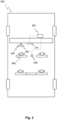
- FIG 2 schematically illustrates a vehicle 200 with an exemplary apparatus.
- the apparatus comprises a camera with an image sensor 230, which is arranged around the area of the vehicle headlining (not shown here).
- the image sensor 230 is configured to detect images of the arms but in particular the left hand 300 and the right hand 310 (see also Figures 3A to 3C ) of a driver 260 of the vehicle 200. Thereby the image sensor 230 detects the positions of the hands 300, 310 and their corresponding movements from one position 320 to another position on a surface 250 of a steering wheel 240.
- a control unit 220 is arranged at the vehicle 200.
- the control unit 220 is configured to evaluate the detected images of the camera 230. Thereby the control unit is configured to evaluate the movements of the left hand 300 and the right hand 310 from a corresponding starting position 320, 340, 370 to an end positions 330, 350, 380.
- a memory (not shown here) of the control unit 220 comprises a map of the interior of the vehicle 200, wherein the map comprises reference objects of the interior of the vehicle and their relative positions to each other. These include the steering wheel 250 and its surface 250 and their positions in particular regarding the position of the image sensor 230.
- This map can then be used by the control unit 220 for determining the current positions of the hands 300, 310 of the driver 260 and the steering wheel 240 and its surface 250.
- the control unit 220 is further connected to a display 210 of the vehicle 200.
- the display 200 is configured to display graphical contents, such as a map or a navigation route on the map.
- the control unit 220 is configured to adapt the graphical contents of the display 220 corresponding to the movement of one of the hands 300, 310 or of both hands 300, 310 regarding the surface 250 of the steering wheel 240.
- Exemplary movements of the left hand 300 and the right hand 310 of the driver are shown in Figures 3A to 3C .
- Figures 3A to 3C schematically illustrate exemplary movements of hands 300, 310 of a driver 260 at a steering wheel 240 of the vehicle 200.
- Figure 3A shows a left hand 300 at a starting position 320 and a right hand 310 at a starting position 340.
- the left hand 300 moves then to a final position 330 and the right hand 310 moves to a final position 350. This is indicated by the arrows.
- the left hand 300 and the right hand 310 move along the outer circumference of the steering wheel 240 towards each other.
- movements of the left hand 300 and the right hand 310 in the opposite direction are possible. This means the movement of the left hand 300 starts at the position 330 and the movement of the right hand starts at the position 350.
- a zoom-function at the display 210 can be initiated by the control unit 220.
- the left hand 300 and the right hand 310 move towards each other along the circumference of the steering wheel 240, as shown in Figure 3A , this can lead to a shrinking of a graphical content.
- this can lead to an enlargement of the displayed graphical content at the display 210.
- Figure 3B shows in contrast to Figure 3A only a movement of the right hand 310 of the driver 260 from a radially outward position 370 of the steering wheel 240 towards a position at the centre 380 of the steering wheel 240 in x-direction according to the schematically shown coordinate system. Such a movement can cause a shift of the graphical content along the x-direction. Likewise, the left hand 300 or the right hand 310 can move along the y-direction to cause a shift of the graphical content in the y-direction (not shown here).
- Figure 3C shows a movement of one finger, for example the middle finger, of the right hand 310 in z-direction, such as a tap or double-tap 360. This is illustrated with the dashed circles.
- the control unit 220 can initiate a selection or de-selection function at the display 220.
Landscapes
- Engineering & Computer Science (AREA)
- Chemical & Material Sciences (AREA)
- Combustion & Propulsion (AREA)
- Transportation (AREA)
- Mechanical Engineering (AREA)
- General Engineering & Computer Science (AREA)
- Theoretical Computer Science (AREA)
- Human Computer Interaction (AREA)
- Physics & Mathematics (AREA)
- General Physics & Mathematics (AREA)
- Position Input By Displaying (AREA)
Abstract
The invention relates to a method, in particular a computer-implemented method, for detecting an input of a user, in particular a driver, of a vehicle, comprising: (i) Determining a position of a reference-surface regarding an image sensor, which are located inside the vehicle; (ii) detecting a first hand of the user at a first position on the reference-surface by the image sensor; (iii) detecting a movement of the first hand from the first position to a second position on the reference-surface by the image sensor; (iv) determining a function of the vehicle based on the detected movement; (v) initiating the function by a control unit.
Description
- The present invention relates to a, in particular computer-implemented, method and an apparatus, for detecting an input of a user of a vehicle.
- In modern vehicles, at least one control unit is usually installed, via which the driver of the vehicle or other passengers can control various functions. These functions can be various vehicle or comfort functions, such as settings for the navigation system, air conditioning, seat settings, lighting settings and the like. Various functions of an infotainment system can also be controlled, such as playing music, making phone calls and the like.
- Conventional control units can be operated via corresponding control buttons. Modern vehicles comprise at least a display, which can be located centrally in the dashboard, for example. The individual functions, menus and the like can be displayed here. These displays are often touch-sensitive, so that the desired function can be controlled by touching the screen. For this purpose, the control elements are designed in such a way that they can be reached and operated by touching the surface of the display with one or more fingers. A function can be initiated when the corresponding area of the touch-sensitive screen is touched. Other means of control may also be provided, such as holding and dragging a control element, swiping gestures and the like. By using two fingers zooming in and zooming out of a content is possible. However, such touch-sensitive displays need to be accessible by a user's hand in order to control a function by touch.
- In vehicles, it is also known to control certain functions by free hand gestures. To do this, a user performs certain predefined gestures in free space, for example in a spatial area of the vehicle cabin above the centre console or in front of the dashboard. Gestures in free space requires a monitoring of the gesture in three dimensions which requires substantial computational resources.
- It is an object of the present invention enable the detection of an input of a user of a vehicle which is improved regarding the described disadvantages.
- A solution to this problem is provided by the teaching of the independent claims. Various preferred embodiments of the present invention are provided by the teachings of the dependent claims.
- A first aspect of the solution is directed to a method, in particular a computer-implemented method, for detecting an input of a user, in particular a driver, of a vehicle, comprising: (i) Determining a position of a reference-surface regarding an image-sensor, which are located inside the vehicle; (ii) detecting a first hand of the user at a first position on the reference-surface by the image sensor; (iii) detecting a movement of the first hand from the first position to a second position on the reference-surface by the image sensor; (iv) determining a function of the vehicle based on the detected movement; (v) initiating the function by a control unit.
- Where the term "comprising" or "including" is used in the present description and claims, it does not exclude other elements or steps. Where an indefinite or definite article is used when referring to a singular noun e.g. "a" or "an", "the", this includes a plural of that noun unless something else is specifically stated.
- Further, unless expressly stated to the contrary, "or" refers to an inclusive or and not to an exclusive or. For example, a condition A or B is satisfied by any one of the following: A is true (or present) and B is false (or not present), A is false (or not present) and B is true (or present), and both A and B are true (or present).
- The term "one" as used herein are defined in the sense of "one or more". The terms "another" and "a further" and any other variant thereof are to be understood in the sense of "at least one more".
- The term "plural" as used herein shall be understood in the sense of "two or more".
- The term "configured" or "set up" to perform a certain function (and respective variations thereof) as used herein shall be understood as meaning that the corresponding device is already present in a configuration or setting in which it can perform the function or that it is at least adjustable - i.e. configurable - in such a way that it can perform the function after corresponding adjustment. In this context, the configuration can be carried out, for example, by means of a corresponding setting of parameters of a process sequence or of switches or the like for activating or deactivating functionalities or settings. In particular, the device can have several predetermined configurations or operating modes, so that the configuration can be performed by means of a selection of one of these configurations or operating modes.
- The term "vehicle" as used herein specifically refers to a passenger car, including all types of motor vehicles, hybrid and battery electric vehicles, and vehicles such as sedans, vans, buses, trucks, vans and the like.
- The term "image sensor" as used here refers to an image sensor, in particular an image sensor of a camera, that is capable of sensing a scene. In particular, the image sensor can have an electro-optical sensor that is designed to detect or measure electromagnetic signals, which are also referred to as image signals in the following and convert them into electrical signals. These sensors can be a charge-coupled device (CCD), a radar sensor, a lidar sensor, or any other sensor. In addition, such a sensor can also be designed to emit electromagnetic signals to an object and to detect the electromagnetic signals reflected back from this object, so that in a subsequent evaluation information about the object can be obtained from the emitted and the reflected-back electromagnetic signals. Such sensors are used in so-called TOF (Time-of-Flight) cameras.
- Accordingly, the method of the first aspect can enable to initiate a function based on a movement of a first hand of the user regarding a reference-surface. The position of a reference-surface can be determined by reading it out from a database of the control unit in which positions of objects inside the vehicle are stored. The movement on the reference-surface occurs in two dimensions. Detecting such a movement and determining the function based on this movement requires less computational resources compared to an analysis of a gesture in three dimensions. This also means that the detection can be more accurate. Further the movement of the first hand is guided by the reference-surface. In case the user is the driver, this enables more safety, because the user has a reference to relate to.
- In the following, certain preferred embodiments of the method will be described, which can be arbitrarily combined with each other or with other aspects of the present solution, unless such combination is explicitly excluded or technically impossible.
- In some embodiments, a movement of one of the fingers of the first hand from the first position to the second position is detected. This enables initiating a function based on little movement, because there is no need for the first hand to move completely when one of its fingers is moved. In case of a driver, being the user this enables that the driver can keep his hands on the steering wheel with only a minor movement of a finger. This enables a save driving.
- In some embodiments the method further comprises: (i) Detecting a second hand of the user at a third position regarding the reference-surface by the image sensor; (ii) detecting a movement of the second hand from the third position to a fourth position regarding the reference-surface by the image sensor; (iii) determining a relative movement of the first hand to the second hand regarding the reference-surface; (iv) wherein the function is determined by using the determined relative movement. This enables a function by a relative movement of the first hand to the second hand. Such a movement might be possible when both hands are moving at a surface of a steering wheel of the vehicle, or when the vehicle is not moving. Thereby a more complex function can be initiated is possible, such as turning or moving of graphical contents of a display to each other. Another function could be a zooming-function for such graphical content.
- In some embodiments the method further comprises: (i) determining a distance between the first hand and the second hand while a movement of the first hand and the second hand occurs, (ii) wherein the function is determined by using the dependence on the determined distance. This enables a function depending on whether the first hand and second hand move towards each other or move away from each other. This can enable a function of graphical content of a display wherein graphical contents are moved towards each other or are moved away from each other.
- In some embodiments the method further comprises: (i) detecting a first arm relating to the first hand and/or detecting a second arm relating to the second hand and their corresponding movements by the image sensor; (ii) verifying the movement of the first arm in relation to the movement of the first hand and/or verifying the movement of the second arm in relation to the movement of the second hand; (iii) initiating the function if at least one of the verifications results such that the movement of the first arm in relation to the movement of the first hand and/or the movement of the second arm in relation to the movement of the second hand are consistent. This can ensure that function to be initiated can be verified. A case where the movements of the first hand and the first arm are consistent can be that both move in the same direction. In case the verification results such that the first hand moves in a different direction in relation to the first arm, this will result in an inconsistent result, and the function will not be initiated. Overall, the verification can enable that a function if correctly initiated, and otherwise is not initiated. Thereby accidental initiations of functions can be avoided.
- In some embodiments the function comprises an adaption of a graphical content of a display by the control unit. This enables an adaption of such a graphical content by a movement of a hand of the user regarding the reference-surface but without the need to contact or touch the display itself by a hand of the user.
- In some embodiments the reference-surface comprises a surface of a steering wheel of the vehicle. This enables the driver to keep his hands on the steering wheel while providing the input. This enables more safety during driving the vehicle.
- In some embodiments a map of reference objects and their positions relative to each other and relative to the reference-surface of the inside of the vehicle is stored in the control unit, and wherein the reference-surface and its position are determined by using the map of references. This can enable a more accurate detection of the positions and movements of the first hand and the second hand as well as a more accurate detection of the position of the reference-surface. As a result, the initiated function which is based on the movements can be operated more accurately.
- A second aspect of the solution is directed to an apparatus being configured to perform the method of the first aspect.
- In some embodiments the apparatus comprises: (i) A control unit which is configured to determine a position of a reference-surface regarding an image-sensor, which are located inside the vehicle; (ii) an image sensor which is configured to detect a first hand of a user of the vehicle at a first position on the reference-surface; (iii) wherein the image sensor is configured to detect a movement of the first hand from the first position to a second position on the reference-surface; (iv) wherein the control unit is configured to determine a function of the vehicle based on the detected movement; (v) and wherein the control unit is further configured to initiate the function.
- A third aspect of the present solution is directed to a computer-program with instructions for causing the apparatus of the second aspect to perform the steps of the method of the first aspect.
- In particular, the computer-program may be stored on a non-volatile medium. Preferably, this is a data carrier in the form of an optical data carrier or a flash memory module. This may be advantageous if the computer program as such is to be traded independently of a processor platform on which the one or more programs are to be executed. In another implementation, the computer program may be present as a file on a data processing unit, particularly a server, and downloadable via a data connection, such as the Internet or a dedicated data connection, such as a proprietary or local area network. In addition, the computer program may have a plurality of interacting individual program modules.
- The various embodiments and advantages described above in connection with the first aspect similarly apply to the other aspects.
- Further advantages, features and applications are provided in the following detailed description of preferred embodiments and the appended figures, wherein:
-
Fig. 1 schematically illustrates a flowchart of an exemplary method; -
Fig. 3 schematically illustrates a vehicle with an exemplary apparatus; and -
Figs. 3A to 3C schematically illustrates exemplary movements of hands of a driver at a steering wheel. - In the figures, identical reference signs are used for the same or mutually corresponding elements.
-
Figure 1 schematically illustrates aflowchart 100 of an exemplary method for detecting an input of adriver 260 of avehicle 200. - A first step S110 of the method comprises determining a position of a
surface 250 of asteering wheel 240 regarding animage sensor 230 of a camera, which are located inside thevehicle 200. - A further step S120 of the method comprises detecting a
first hand 300 of thedriver 260 at a startingposition 320 on thesurface 250 by theimage sensor 230. - A further step S130 of the method comprises detecting a movement of the
first hand 300 from the startingposition 320 to anend position 330 on thesurface 250 by theimage sensor 230. - A further step S140 of the method comprises determining a function of the
vehicle 200 based on the detected movement. Such a function can be a zooming-function for enlarging or shrinking a graphical content of adisplay 210. - A further step S150 of the method comprises initiating the function by a
control unit 220 of thevehicle 200. -
Figure 2 schematically illustrates avehicle 200 with an exemplary apparatus. The apparatus comprises a camera with animage sensor 230, which is arranged around the area of the vehicle headlining (not shown here). Theimage sensor 230 is configured to detect images of the arms but in particular theleft hand 300 and the right hand 310 (see alsoFigures 3A to 3C ) of adriver 260 of thevehicle 200. Thereby theimage sensor 230 detects the positions of thehands position 320 to another position on asurface 250 of asteering wheel 240. - A
control unit 220 is arranged at thevehicle 200. Thecontrol unit 220 is configured to evaluate the detected images of thecamera 230. Thereby the control unit is configured to evaluate the movements of theleft hand 300 and theright hand 310 from acorresponding starting position - A memory (not shown here) of the
control unit 220 comprises a map of the interior of thevehicle 200, wherein the map comprises reference objects of the interior of the vehicle and their relative positions to each other. These include thesteering wheel 250 and itssurface 250 and their positions in particular regarding the position of theimage sensor 230. - This map can then be used by the
control unit 220 for determining the current positions of thehands driver 260 and thesteering wheel 240 and itssurface 250. - The
control unit 220 is further connected to adisplay 210 of thevehicle 200. Thedisplay 200 is configured to display graphical contents, such as a map or a navigation route on the map. Thecontrol unit 220 is configured to adapt the graphical contents of thedisplay 220 corresponding to the movement of one of thehands hands surface 250 of thesteering wheel 240. - Exemplary movements of the
left hand 300 and theright hand 310 of the driver are shown inFigures 3A to 3C . -
Figures 3A to 3C schematically illustrate exemplary movements ofhands driver 260 at asteering wheel 240 of thevehicle 200. -
Figure 3A shows aleft hand 300 at a startingposition 320 and aright hand 310 at a startingposition 340. Theleft hand 300 moves then to afinal position 330 and theright hand 310 moves to afinal position 350. This is indicated by the arrows. During these movements theleft hand 300 and theright hand 310 move along the outer circumference of thesteering wheel 240 towards each other. Likewise, movements of theleft hand 300 and theright hand 310 in the opposite direction are possible. This means the movement of theleft hand 300 starts at theposition 330 and the movement of the right hand starts at theposition 350. - By such movements a zoom-function at the
display 210 can be initiated by thecontrol unit 220. For example, when theleft hand 300 and theright hand 310 move towards each other along the circumference of thesteering wheel 240, as shown inFigure 3A , this can lead to a shrinking of a graphical content. In the other case when theleft hand 300 and the right hand move away from each other, this can lead to an enlargement of the displayed graphical content at thedisplay 210. -
Figure 3B shows in contrast toFigure 3A only a movement of theright hand 310 of thedriver 260 from a radiallyoutward position 370 of thesteering wheel 240 towards a position at thecentre 380 of thesteering wheel 240 in x-direction according to the schematically shown coordinate system. Such a movement can cause a shift of the graphical content along the x-direction. Likewise, theleft hand 300 or theright hand 310 can move along the y-direction to cause a shift of the graphical content in the y-direction (not shown here). -
Figure 3C shows a movement of one finger, for example the middle finger, of theright hand 310 in z-direction, such as a tap or double-tap 360. This is illustrated with the dashed circles. By such a detected tap-movement thecontrol unit 220 can initiate a selection or de-selection function at thedisplay 220. - While above at least one exemplary embodiment has been described, it has to be noted that a great number of variations thereto exists. Furthermore, it is appreciated that the described exemplary embodiments only illustrate non-limiting examples of how the present solution can be implemented and that it is not intended to limit the scope, the application or the configuration of the herein-described apparatus' and methods. Rather, the preceding description will provide the person skilled in the art with constructions for implementing at least one exemplary embodiment of the solution, wherein it has to be understood that various changes of functionality and the arrangement of the elements of the exemplary embodiment can be made, without deviating from the subject-matter defined by the appended claims and their legal equivalents.
-
- 100
- Flowchart illustrating an exemplary method
- S110
- Determining a position of a reference-surface
- S120
- Detecting a first hand at a first position
- S130
- Detecting a movement
- S140
- Determining a function
- S150
- Initiating the function
- 200
- Vehicle
- 210
- Display
- 220
- Control unit
- 230
- Image sensor
- 240
- Steering wheel
- 250
- Surface of steering wheel
- 260
- Driver
- 300
- Left hand of the driver
- 310
- Right hand of the driver
- 320 to 380
- Positions of hands / fingers
Claims (11)
- A method for detecting an input of a user (260) of a vehicle (200) comprising the steps:Determining a position of a reference-surface (250) regarding an image sensor (230), which are located inside the vehicle (200);detecting a first hand (300) of the user (260) at a first position (320, 370) on the reference-surface (250) by the image sensor (230);detecting a movement of the first hand (300) from the first position (320, 370) to a second position (330, 380) on the reference-surface (250) by the image sensor (230);determining a function of the vehicle (200) based on the detected movement; initiating the function by a control unit (220) of the vehicle (200).
- The method of claim 1, wherein the detection comprises a movement of one of the fingers of the first hand (300) from the first position (320) to the second position (330).
- The method of claim 1 or 2, further comprising:Detecting a second hand (310) of the user (260) at a third position (340) regarding the reference-surface (250) by the image sensor (230);detecting a movement of the second hand (310) from the third position (340) to a fourth position (350) regarding the reference-surface (250) by the image sensor (230);determining a relative movement of the first hand (300) to the second hand (310) regarding the reference-surface (250);wherein the function is determined by using the determined relative movement.
- The method of claim 3, further comprising, determining a distance between the first hand (300) and the second hand (310) while a movement of the first hand (300) and the second hand (310) occurs; wherein the function is determined by using the dependence on the determined distance.
- The method of any of the preceding claims, further comprising:detecting a first arm relating to the first hand (300) and/or detecting a second arm relating to the second hand (310) and their corresponding movements by the image sensor (230);verifying the movement of the first arm in relation to the movement of the first hand (300) and/or verifying the movement of the second arm in relation to the movement of the second hand (310);initiating the function if at least one of the verifications results such that the movement of the first arm in relation to the movement of the first hand (300) and/or the movement of the second arm in relation to the movement of the second hand (300) are consistent.
- The method of any of the preceding claims, wherein the function comprises an adaption of a graphical content of a display (210) by the control unit (220).
- The method of any of the preceding claims, wherein the reference-surface comprises a surface (250) of a steering wheel (240) of the vehicle.
- The method of any of the preceding claims, wherein a map of reference objects and their positions relative to each other and relative to the reference-surface of the inside of the vehicle is stored in the control unit (220), and wherein the reference-surface (250) and its position are determined by using the map of references.
- An apparatus which is configured to execute the method of any of the preceding claims.
- The apparatus of claim 9, comprising:A control unit (220) which is configured to determine a position of a reference-surface (250) regarding an image sensor (230), which are located inside the vehicle (200);an image sensor (230) which is configured to detect a first hand (300) of a user (260) of the vehicle (200) at a first position (320, 370) on the reference-surface (250);wherein the image sensor (230) is configured to detect a movement of the first hand (300) from the first position (320) to a second position (330, 380) on the reference-surface (250);wherein the control unit (220) is configured to determine a function of the vehicle (200) based on the detected movement; and wherein the control unit (220) is further configured to initiate the function.
- A Computer-program with instructions for causing the apparatus of claims 9 to 10 to perform the steps of the method of any one of claims 1 to 8.
Priority Applications (1)
| Application Number | Priority Date | Filing Date | Title |
|---|---|---|---|
| EP23198591.2A EP4527661A1 (en) | 2023-09-20 | 2023-09-20 | Method and apparatus for detecting an input of a user of a vehicle |
Applications Claiming Priority (1)
| Application Number | Priority Date | Filing Date | Title |
|---|---|---|---|
| EP23198591.2A EP4527661A1 (en) | 2023-09-20 | 2023-09-20 | Method and apparatus for detecting an input of a user of a vehicle |
Publications (1)
| Publication Number | Publication Date |
|---|---|
| EP4527661A1 true EP4527661A1 (en) | 2025-03-26 |
Family
ID=88147261
Family Applications (1)
| Application Number | Title | Priority Date | Filing Date |
|---|---|---|---|
| EP23198591.2A Pending EP4527661A1 (en) | 2023-09-20 | 2023-09-20 | Method and apparatus for detecting an input of a user of a vehicle |
Country Status (1)
| Country | Link |
|---|---|
| EP (1) | EP4527661A1 (en) |
Citations (4)
| Publication number | Priority date | Publication date | Assignee | Title |
|---|---|---|---|---|
| US20090273563A1 (en) * | 1999-11-08 | 2009-11-05 | Pryor Timothy R | Programmable tactile touch screen displays and man-machine interfaces for improved vehicle instrumentation and telematics |
| US20180059798A1 (en) * | 2015-02-20 | 2018-03-01 | Clarion Co., Ltd. | Information processing device |
| US20200189595A1 (en) * | 2018-12-13 | 2020-06-18 | GM Global Technology Operations LLC | System and method for initiating and executing an automated lane change maneuver |
| US20230078074A1 (en) * | 2020-12-02 | 2023-03-16 | Wenshu LUO | Methods and devices for hand-on-wheel gesture interaction for controls |
-
2023
- 2023-09-20 EP EP23198591.2A patent/EP4527661A1/en active Pending
Patent Citations (4)
| Publication number | Priority date | Publication date | Assignee | Title |
|---|---|---|---|---|
| US20090273563A1 (en) * | 1999-11-08 | 2009-11-05 | Pryor Timothy R | Programmable tactile touch screen displays and man-machine interfaces for improved vehicle instrumentation and telematics |
| US20180059798A1 (en) * | 2015-02-20 | 2018-03-01 | Clarion Co., Ltd. | Information processing device |
| US20200189595A1 (en) * | 2018-12-13 | 2020-06-18 | GM Global Technology Operations LLC | System and method for initiating and executing an automated lane change maneuver |
| US20230078074A1 (en) * | 2020-12-02 | 2023-03-16 | Wenshu LUO | Methods and devices for hand-on-wheel gesture interaction for controls |
Similar Documents
| Publication | Publication Date | Title |
|---|---|---|
| US11181909B2 (en) | Remote vehicle control device, remote vehicle control system, and remote vehicle control method | |
| US10000212B2 (en) | Vehicle and method for controlling distance between traveling vehicles | |
| JP6805223B2 (en) | Vehicle display devices, vehicle display methods, and programs | |
| JP5286035B2 (en) | Vehicle speed control device | |
| US20150131857A1 (en) | Vehicle recognizing user gesture and method for controlling the same | |
| JP2018150043A (en) | System for information transmission in motor vehicle | |
| KR102084032B1 (en) | User interface, means of transport and method for distinguishing a user | |
| JP6515028B2 (en) | Vehicle control device | |
| US20190210462A1 (en) | Vehicle display device | |
| CN111483406B (en) | In-vehicle infotainment device and control method thereof, and vehicle including the same | |
| US9141185B2 (en) | Input device | |
| JPWO2019016936A1 (en) | Operation support apparatus and operation support method | |
| US20190286118A1 (en) | Remote vehicle control device and remote vehicle control method | |
| WO2018061413A1 (en) | Gesture detection device | |
| WO2018061603A1 (en) | Gestural manipulation system, gestural manipulation method, and program | |
| CN104756049B (en) | Method and apparatus for running input unit | |
| US20250256569A1 (en) | Method and system for controlling a human-machine interface in a vehicle | |
| US12325431B2 (en) | Vehicle component identification system | |
| US12057039B2 (en) | Vehicular display control device, vehicular display system, vehicle, display method, and non-transitory computer-readable medium | |
| US11941317B2 (en) | Display controlling method | |
| US12179669B2 (en) | In-vehicle display controlling device and display controlling method for improved display output of operations | |
| US20230004230A1 (en) | Electronic device and method for displaying data on a display screen, related display system, vehicle and computer program | |
| EP4596290A1 (en) | Method and apparatus for controlling a display of a vehicle | |
| US12361759B2 (en) | Control apparatus allowing a user to input operations | |
| CN118906743B (en) | Interface adjustment method and device for vehicle air conditioner panel, vehicle and storage medium |
Legal Events
| Date | Code | Title | Description |
|---|---|---|---|
| PUAI | Public reference made under article 153(3) epc to a published international application that has entered the european phase |
Free format text: ORIGINAL CODE: 0009012 |
|
| STAA | Information on the status of an ep patent application or granted ep patent |
Free format text: STATUS: THE APPLICATION HAS BEEN PUBLISHED |
|
| AK | Designated contracting states |
Kind code of ref document: A1 Designated state(s): AL AT BE BG CH CY CZ DE DK EE ES FI FR GB GR HR HU IE IS IT LI LT LU LV MC ME MK MT NL NO PL PT RO RS SE SI SK SM TR |
|
| STAA | Information on the status of an ep patent application or granted ep patent |
Free format text: STATUS: REQUEST FOR EXAMINATION WAS MADE |
|
| 17P | Request for examination filed |
Effective date: 20250605 |