EP4527369A1 - Infant-feeding teat - Google Patents
Infant-feeding teat Download PDFInfo
- Publication number
- EP4527369A1 EP4527369A1 EP24202724.1A EP24202724A EP4527369A1 EP 4527369 A1 EP4527369 A1 EP 4527369A1 EP 24202724 A EP24202724 A EP 24202724A EP 4527369 A1 EP4527369 A1 EP 4527369A1
- Authority
- EP
- European Patent Office
- Prior art keywords
- spherical
- dome
- teat
- spherical dome
- diameter
- Prior art date
- Legal status (The legal status is an assumption and is not a legal conclusion. Google has not performed a legal analysis and makes no representation as to the accuracy of the status listed.)
- Pending
Links
Images



Classifications
-
- A—HUMAN NECESSITIES
- A61—MEDICAL OR VETERINARY SCIENCE; HYGIENE
- A61J—CONTAINERS SPECIALLY ADAPTED FOR MEDICAL OR PHARMACEUTICAL PURPOSES; DEVICES OR METHODS SPECIALLY ADAPTED FOR BRINGING PHARMACEUTICAL PRODUCTS INTO PARTICULAR PHYSICAL OR ADMINISTERING FORMS; DEVICES FOR ADMINISTERING FOOD OR MEDICINES ORALLY; BABY COMFORTERS; DEVICES FOR RECEIVING SPITTLE
- A61J11/00—Teats
- A61J11/0035—Teats having particular shape or structure
- A61J11/0045—Aesthetic properties
- A61J11/005—Aesthetic properties for imitating a nipple
-
- A—HUMAN NECESSITIES
- A61—MEDICAL OR VETERINARY SCIENCE; HYGIENE
- A61J—CONTAINERS SPECIALLY ADAPTED FOR MEDICAL OR PHARMACEUTICAL PURPOSES; DEVICES OR METHODS SPECIALLY ADAPTED FOR BRINGING PHARMACEUTICAL PRODUCTS INTO PARTICULAR PHYSICAL OR ADMINISTERING FORMS; DEVICES FOR ADMINISTERING FOOD OR MEDICINES ORALLY; BABY COMFORTERS; DEVICES FOR RECEIVING SPITTLE
- A61J11/00—Teats
- A61J11/04—Teats with means for fastening to bottles
-
- A—HUMAN NECESSITIES
- A61—MEDICAL OR VETERINARY SCIENCE; HYGIENE
- A61J—CONTAINERS SPECIALLY ADAPTED FOR MEDICAL OR PHARMACEUTICAL PURPOSES; DEVICES OR METHODS SPECIALLY ADAPTED FOR BRINGING PHARMACEUTICAL PRODUCTS INTO PARTICULAR PHYSICAL OR ADMINISTERING FORMS; DEVICES FOR ADMINISTERING FOOD OR MEDICINES ORALLY; BABY COMFORTERS; DEVICES FOR RECEIVING SPITTLE
- A61J11/00—Teats
- A61J11/0035—Teats having particular shape or structure
- A61J11/006—Teats having particular shape or structure for improving flexibility
-
- A—HUMAN NECESSITIES
- A61—MEDICAL OR VETERINARY SCIENCE; HYGIENE
- A61J—CONTAINERS SPECIALLY ADAPTED FOR MEDICAL OR PHARMACEUTICAL PURPOSES; DEVICES OR METHODS SPECIALLY ADAPTED FOR BRINGING PHARMACEUTICAL PRODUCTS INTO PARTICULAR PHYSICAL OR ADMINISTERING FORMS; DEVICES FOR ADMINISTERING FOOD OR MEDICINES ORALLY; BABY COMFORTERS; DEVICES FOR RECEIVING SPITTLE
- A61J11/00—Teats
- A61J11/0035—Teats having particular shape or structure
- A61J11/0065—Teats having particular shape or structure for improving rigidity, e.g. anti-bite-through or anti-collapsing
Definitions
- the subject of the invention is an infant-feeding teat imitating the female breast and having the form of a flexible hollow piece attached to a food container.
- Infant-feeding teats are widely known and used, having the form of solid of revolution flexible and hollow piece made, for example, of silicone.
- This piece is made up of a part imitating the female breast and a part imitating the nipple, which delivers food into the infant's mouth.
- the part imitating the breast has the form of a dome equipped on its lower perimeter with means for connecting this part to the food container.
- the part imitating the nipple is located centrally at the top of the dome and is equipped on its closed top with at least one food outlet.
- the purpose of the invention was to create a teat that imitates a nursing woman's natural breast to a larger degree than before.
- Feeding a baby with the teat according to the invention almost perfectly imitates natural breastfeeding. This is due to proper positioning and opening of the fed baby's mouth as well as natural tightness and proper, coordinated suckling, swallowing and breathing, which results in air not being swallowed and eliminates the risk of food colic. Food is fed from such teat only when the newborn is actively suckling on it. This promotes the proper development of the craniofacial, oral and skeletal muscles, as well as accelerates the resolution of retrognathia in the newborn, which does not occur when feeding artificially with a teat from which the food comes out mainly by gravity or due to the baby biting or chewing on it.
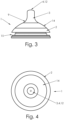
- Fig.1 and Fig.2 show axonometric views of the teat according to the invention from above and below, respectively, while Fig.3 and Fig.4 show the same teat in side and top views, respectively.
- Fig.5 shows a vertical-plane cross-section of the teat from Fig.3
- Fig.6 shows an enlarged part of the cross-section from Fig.5 .
- Fig.7 and Fig.8 show the same teat without an insert with reduced hardness.
- Fig.9 and Fig.10 show an enlarged first example of the layout of the holes constituting the food outlet of the teat according to the invention in axonometric view and top view, respectively, while Fig.11 and Fig.12 , show analogous views of the food outlet with a single hole, while Fig.13 and Fig.14 show analogous views of the food outlet with four holes.
- Fig.15, Fig.16 and Fig.17 show the insert with reduced hardness in axonometric view, side view and top view, respectively.
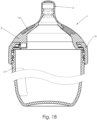
- Fig.18 shows the cross-section of the teat according to the invention analogous to the cross-section in Fig.5 , attached to a food container.
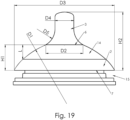
- Fig.19 shows the teat from Fig.3 with its geometric parameters marked.
- the invention is presented in more detail in the embodiment described below.
- the embodied teat 1 according to the invention has the form of a flexible rotary and hollow piece 2 made of silicone.
- the teat 1 contains a part imitating the breast, in the form of a spherical dome 2, and a cylindrical part 3, imitating the nipple, feeding food into the infant's mouth.
- the cylindrical part 3 is located centrally on top of the spherical dome 2 and equipped on its closed top 4 with a food outlet.
- the outer surface 5 of the spherical dome 2 constitutes a spherical segment with a diameter D1 of 86 mm, located between the top circle 6, which constitutes the upper edge of the spherical dome 2, and the bottom circle 7, which constitutes the lower edge of the spherical dome 2. Both circles 6 and 7 lie on said spherical surface and are parallel to each other.
- the diameter D2 of the top circle 6 is 25 mm, while the diameter D3 of the bottom circle 7 is 69 mm.
- the height H1 of the spherical segment, which constitutes the height of the spherical dome 2, is 18 mm.
- the initial thickness G1 of the wall 8 of the spherical dome 2 in the region of its lower edge 7 begins at 7 mm and decreases smoothly toward the upper edge 6 of this dome 2, reaching the final thickness G2 of 3 mm in its vicinity.
- the diameter D4 of the cylindrical part 3 is at least 13 mm.
- a part of the outer surface of the teat 1, connecting the upper edge 6 of the spherical dome 2 with the lower edge of the cylindrical part 3, is determined by a generatrix 9 in the form of a segment of a circle with a diameter D5 of 25 mm.
- the generatrix 9 lies in the vertical plane and is tangent to the outer surface 5 of the spherical dome 2 and tangent to the outer surface of the cylindrical part 3.
- the height H2 of the teat 1, measured from the lower edge 7 of the spherical dome 2 to the top 4 of the cylindrical part 3, equals 40 mm.
- the thickness G3 of the wall 10 of the teat 1 in the area above the upper edge 6 of the spherical dome 2 is substantially constant and is at least 1 mm.
- On the inner surface of the cylindrical part 3 there are two parallel rows of protrusions 11 with a height H3 that is substantially equal to the thickness G3 of the wall 10 of the teat 1 in this area.
- the food outlet is made of five vertical laser-made through-holes 12 with a diameter of 0.2 mm.
- the outer surface 5 of the spherical dome 2 has a cavity 13 filled with a flexible ring insert 14.
- the insert 14 extends downward from the upper edge 6 of the spherical dome 2 over a distance L of 8 mm.
- the outer surface of the insert 14 is flush with the outer surface 5 of the spherical dome 2.
- the average thickness G4 of the insert 14 is 2.5 mm.
- the insert 14 is made of silicone with a hardness of 20 Shore A, while the hardness of the material of the other parts (2 and 3) of the teat 1 is 40 Shore A.
- Below the lower edge 7 of the spherical dome 2 are the means connecting the teat 1 proper and the food container 17. They have the form of a circumferential groove 15, into which the flange of the nut 16, which is screwed onto the neck of the container 17, enters.
- the protrusions 11 simulate the tubercles present in a nursing woman's natural breast.
- the ratio of the height H3 of the protrusions 11 to the thickness G3 of the walls 10 actively stretching as the baby suckles the food, ensures that the outflow part 3 of the teat 1 fits into the baby's mouth, which brings the feeding conditions much closer to the natural suckling of the mother's breast.
- the step change in thickness between the wall 8 of the dome 2 and the wall 10 of the cylindrical part 3, i.e., the part subject to dynamic deformation during suckling, ensures the sealing of the suckling mouth and the optimal length of the said dynamic part for feeding.
Landscapes
- Health & Medical Sciences (AREA)
- Life Sciences & Earth Sciences (AREA)
- Animal Behavior & Ethology (AREA)
- General Health & Medical Sciences (AREA)
- Public Health (AREA)
- Veterinary Medicine (AREA)
- Medical Preparation Storing Or Oral Administration Devices (AREA)
Abstract
The teat (1) has a form of a solid of revolution flexible and hollow piece, containing a part in the form of a spherical dome (2) and a cylindrical part (3) that feeds food into the infant's mouth, located centrally at the top of the dome (2) and equipped on its top with a food outlet (12). The dome (2) has means for connecting it to a food container (17), located below the lower edge (7) of this dome (2). The outer surface (5) of the dome (2) constitutes a spherical segment, located between the top circle (6), which constitutes the upper edge of the spherical dome (2), and the bottom circle (7), which constitutes the lower edge of the spherical dome (2), with both circles (6, 7) lying on the spherical surface and being parallel to each other. The thickness (G1) of the wall (8) of the spherical dome (2) in the region of its lower edge (7) decreases smoothly toward the upper edge (6) of this dome (2). The outer surface of the teat (1), connecting the upper edge (6) of the spherical dome (2) with the lower edge of the cylindrical part (3), is determined by a generatrix (9) in the form of a segment of a circle. This generatrix (9) lies in the vertical plane and is tangent to the outer surface (5) of the spherical dome (2) and to the outer surface of the cylindrical part (3). The thickness (G3) of the wall (10) of the teat (1) in the area above the upper edge (6) of the spherical dome (2) is substantially constant. On the inner surface of the cylindrical part (3) there are protrusions (11) with a height (H3) that is essentially equal to the thickness (G3) of the wall (10) of the teat (1) in this area. The outer surface (5) of the spherical dome (2) has a cavity (13) filled with a flexible ring insert (14). The outer surface of this insert (14) is flush with the outer surface (5) of the spherical dome (2). The insert (14) is made of a flexible material with a hardness of from 10 Shore A to 30 Shore A, while the hardness of the material of the other parts (2, 3) of the teat (1) is twice the hardness of the material of the insert (14).
Description
- The subject of the invention is an infant-feeding teat imitating the female breast and having the form of a flexible hollow piece attached to a food container.
- Infant-feeding teats are widely known and used, having the form of solid of revolution flexible and hollow piece made, for example, of silicone. This piece is made up of a part imitating the female breast and a part imitating the nipple, which delivers food into the infant's mouth. The part imitating the breast has the form of a dome equipped on its lower perimeter with means for connecting this part to the food container. The part imitating the nipple is located centrally at the top of the dome and is equipped on its closed top with at least one food outlet. Solutions for such teats are disclosed, for example, in
publications EP2465484A1 ,EP25726597A1 EP3042644B1 ,EP3162351A2 ,WO2007/005427A2 ,WO2010/106346A1 andWO2012/138592A1 . - The purpose of the invention was to create a teat that imitates a nursing woman's natural breast to a larger degree than before.
- This purpose is achieved by the teat according to the invention as defined in
claims 1 to 5. - Feeding a baby with the teat according to the invention almost perfectly imitates natural breastfeeding. This is due to proper positioning and opening of the fed baby's mouth as well as natural tightness and proper, coordinated suckling, swallowing and breathing, which results in air not being swallowed and eliminates the risk of food colic. Food is fed from such teat only when the newborn is actively suckling on it. This promotes the proper development of the craniofacial, oral and skeletal muscles, as well as accelerates the resolution of retrognathia in the newborn, which does not occur when feeding artificially with a teat from which the food comes out mainly by gravity or due to the baby biting or chewing on it.
- The embodied invention is visualized in a figure and described in more detail below.
Fig.1 and Fig.2 show axonometric views of the teat according to the invention from above and below, respectively, whileFig.3 and Fig.4 show the same teat in side and top views, respectively.Fig.5 shows a vertical-plane cross-section of the teat fromFig.3 , whileFig.6 shows an enlarged part of the cross-section fromFig.5 .Fig.7 and Fig.8 show the same teat without an insert with reduced hardness.Fig.9 and Fig.10 show an enlarged first example of the layout of the holes constituting the food outlet of the teat according to the invention in axonometric view and top view, respectively, whileFig.11 and Fig.12 , show analogous views of the food outlet with a single hole, whileFig.13 and Fig.14 show analogous views of the food outlet with four holes.Fig.15, Fig.16 and Fig.17 show the insert with reduced hardness in axonometric view, side view and top view, respectively.Fig.18 shows the cross-section of the teat according to the invention analogous to the cross-section inFig.5 , attached to a food container.Fig.19 shows the teat fromFig.3 with its geometric parameters marked. - The invention is presented in more detail in the embodiment described below. The
embodied teat 1 according to the invention has the form of a flexible rotary andhollow piece 2 made of silicone. Theteat 1 contains a part imitating the breast, in the form of aspherical dome 2, and acylindrical part 3, imitating the nipple, feeding food into the infant's mouth. Thecylindrical part 3 is located centrally on top of thespherical dome 2 and equipped on its closedtop 4 with a food outlet. Theouter surface 5 of thespherical dome 2 constitutes a spherical segment with a diameter D1 of 86 mm, located between thetop circle 6, which constitutes the upper edge of thespherical dome 2, and thebottom circle 7, which constitutes the lower edge of thespherical dome 2. Bothcircles top circle 6 is 25 mm, while the diameter D3 of thebottom circle 7 is 69 mm. The height H1 of the spherical segment, which constitutes the height of thespherical dome 2, is 18 mm. The initial thickness G1 of thewall 8 of thespherical dome 2 in the region of itslower edge 7 begins at 7 mm and decreases smoothly toward theupper edge 6 of thisdome 2, reaching the final thickness G2 of 3 mm in its vicinity. The diameter D4 of thecylindrical part 3 is at least 13 mm. A part of the outer surface of theteat 1, connecting theupper edge 6 of thespherical dome 2 with the lower edge of thecylindrical part 3, is determined by ageneratrix 9 in the form of a segment of a circle with a diameter D5 of 25 mm. Thegeneratrix 9 lies in the vertical plane and is tangent to theouter surface 5 of thespherical dome 2 and tangent to the outer surface of thecylindrical part 3. The height H2 of theteat 1, measured from thelower edge 7 of thespherical dome 2 to thetop 4 of thecylindrical part 3, equals 40 mm. The thickness G3 of thewall 10 of theteat 1 in the area above theupper edge 6 of thespherical dome 2 is substantially constant and is at least 1 mm. On the inner surface of thecylindrical part 3 there are two parallel rows ofprotrusions 11 with a height H3 that is substantially equal to the thickness G3 of thewall 10 of theteat 1 in this area. There are eightprotrusions 11 in each of these rows, spaced at regular intervals from each other. The food outlet is made of five vertical laser-made through-holes 12 with a diameter of 0.2 mm. Theouter surface 5 of thespherical dome 2 has acavity 13 filled with aflexible ring insert 14. Theinsert 14 extends downward from theupper edge 6 of thespherical dome 2 over a distance L of 8 mm. The outer surface of theinsert 14 is flush with theouter surface 5 of thespherical dome 2. The average thickness G4 of theinsert 14 is 2.5 mm. Theinsert 14 is made of silicone with a hardness of 20 Shore A, while the hardness of the material of the other parts (2 and 3) of theteat 1 is 40 Shore A. Below thelower edge 7 of thespherical dome 2 are the means connecting theteat 1 proper and thefood container 17. They have the form of acircumferential groove 15, into which the flange of thenut 16, which is screwed onto the neck of thecontainer 17, enters. - The
protrusions 11 simulate the tubercles present in a nursing woman's natural breast. The ratio of the height H3 of theprotrusions 11 to the thickness G3 of thewalls 10 actively stretching as the baby suckles the food, ensures that theoutflow part 3 of theteat 1 fits into the baby's mouth, which brings the feeding conditions much closer to the natural suckling of the mother's breast. In addition, the step change in thickness between thewall 8 of thedome 2 and thewall 10 of thecylindrical part 3, i.e., the part subject to dynamic deformation during suckling, ensures the sealing of the suckling mouth and the optimal length of the said dynamic part for feeding. -
- 1 - teat,
- 2 -
spherical dome 2, - 3 - cylindrical part,
- 4 - closed top of the cylindrical part,
- 5 - outer surface of the
spherical dome 2, - 6 - top circle of the spherical segment/upper edge of the
spherical dome 2, - 7 - bottom circle of the spherical segment/lower edge of the
spherical dome 2, - 8 - wall of the
spherical dome 2, - 9 - generatrix of the outer surface of the transition from the
spherical dome 2 to thecylindrical part 3, - 10 - wall of the
cylindrical part 3, - 11 - protrusion,
- 12 - feeding hole,
- 13 - recess for
insert 14, - 14 - soft insert,
- 15 - groove,
- 16 - nut,
- 17 - container,
- D1 - diameter of the sphere,
- D2 - diameter of the
top circle 6, - D3 - diameter of the
bottom circle 7, - D4 - diameter of the
cylindrical part 3, - D5 - diameter of the
generatrix 9, - G1 - initial thickness of the
wall 8, - G2 - final thickness of the
wall 8, - G3 - thickness of the
wall 10, - G4 - thickness of the
insert 14, - H1 - height of the spherical segment/
spherical dome 2, - H2 - height of the
teat 1, - H3 - height of the
protrusion 11, - L - vertical height of the
insert 14, - S - width of the base of the
protrusion 11.
Claims (4)
- An infant-feeding teat, having the form of a solid of revolution flexible and hollow piece, advantageously made of silicone, containing a part imitating the breast, in the form of a spherical dome and equipped on its lower perimeter with means for connecting it to the food container, and a cylindrical part imitating the nipple, feeding food into the infant's mouth, located centrally at the top of the spherical dome and equipped on its closed top with at least one food outlet,
characterized in that:a) outer surface (5) of the spherical dome (2) constitutes a spherical segment located between the top circle (6), which constitutes an upper edge of the spherical dome (2), and a bottom circle (7), which constitutes the lower edge of the spherical dome (2), with both circles (6, 7) lying on the spherical surface and being parallel to each other, while diameter (D2) of the top circle (6) is from 27% to 33% of the diameter (D1) of the sphere, the diameter (D3)of the bottom circle (7) is from 58% to 64% of the diameter (D1) of the sphere, and the height (H1) of the spherical segment, which constitutes the height (H1) of the spherical dome (2) is from 6% to 12% of the diameter (D1) of the sphere;b) the means for connecting (15, 16) the teat (1) to the food container (17) are located below the lower edge (7) of the spherical dome (2);c) initial thickness (G1) of the wall (8) of the spherical dome (2) in the region of its lower edge (7) is from 9% to 13% of the diameter (D3) of the bottom circle (7) of the spherical segment and decreases smoothly toward the upper edge (6) of this dome (2), reaching the final thickness (G2) from 35% to 45% of the initial thickness (G1) of the said wall (8), in the vicinity of the upper edge;d) the diameter (D4) of the cylindrical part (3) is from 15% and 21% of the diameter (D3) of the bottom circle (7) of the spherical segment;e) outer surface of the teat (1), connecting the upper edge (6) of the spherical dome (2) with the lower edge of the cylindrical part (3), is determined by a generatrix (9) in the form of a segment of a circle with a diameter of between 30% and 36% of the diameter (D1) of the sphere determining the outer surface of the spherical dome (2), and this generatrix (9) lies in the vertical plane and is tangent to the outer surface (5) of the spherical dome (2) and tangent to the outer surface of the cylindrical part (3);f) height (H2) of the teat (1), measured from the lower edge (7) of the spherical dome (2) to the top (4) of the cylindrical part (3) is from 54% to 61% of the diameter (D3) of the bottom circle (7) of the spherical segment;g) thickness (G3) of a wall (10) of the teat (1) in the area above the upper edge (6) of the spherical dome (2) is substantially constant and is from 30% to 36% of the final thickness (G2) of the wall (8) of the spherical dome (2);h) on inner surface of the cylindrical part (3) there are protrusions (11) with a height (H3) that is substantially equal to the thickness (G3) of the wall (10) of the teat (1) in this area;i) the food outlet is made of one to twelve vertical through-holes (12) with a diameter of from 0.08 mm to 0.3 mm;j) outer surface (5) of the spherical dome (2) has a cavity (13) filled with a flexible ring insert (14), extending downward from the upper edge (6) of the spherical dome (2) over a distance (L) amounting from 45% to 55% of the height (H1) of this dome (2), outer surface of the insert (14) is flush with the outer surface (5) of the spherical dome (2), and thickness (G4) of this insert (14) amounts from 47% to 53% of the thickness of the wall (8) of the spherical dome (2) at the place where this insert (14) is located;k) the insert (14) is made of a flexible material with a hardness of between 10 Shore A and 30 Shore A, while the hardness of the material of the other parts (2, 3) of the teat (1) is twice the hardness of the material of the insert (14). - The teat according to claim 1, characterized in that it is made of silicone of two different hardnesses, wherein the hardness of the silicone of which the insert (14) is made amounts 20 Shore A.
- The teat according to claim 1 or 2, characterized in that its cylindrical part (3) contains two horizontal rows of inner protrusions (11), spaced in each row at regular intervals from each other.
- The teat according to claim 3, characterized in that there are eight protrusions (11) in each row.
Applications Claiming Priority (1)
| Application Number | Priority Date | Filing Date | Title |
|---|---|---|---|
| PL446218A PL446218A1 (en) | 2023-09-25 | 2023-09-25 | Pacifier for feeding infants |
Publications (1)
| Publication Number | Publication Date |
|---|---|
| EP4527369A1 true EP4527369A1 (en) | 2025-03-26 |
Family
ID=93590775
Family Applications (1)
| Application Number | Title | Priority Date | Filing Date |
|---|---|---|---|
| EP24202724.1A Pending EP4527369A1 (en) | 2023-09-25 | 2024-09-25 | Infant-feeding teat |
Country Status (2)
| Country | Link |
|---|---|
| EP (1) | EP4527369A1 (en) |
| PL (1) | PL446218A1 (en) |
Citations (8)
| Publication number | Priority date | Publication date | Assignee | Title |
|---|---|---|---|---|
| JP2006006809A (en) * | 2004-06-29 | 2006-01-12 | Pigeon Corp | Artificial nipples and baby bottles |
| WO2007005427A2 (en) | 2005-06-30 | 2007-01-11 | Medela Holding Ag | Artificial nipple with reinforcement |
| WO2010106346A1 (en) | 2009-03-20 | 2010-09-23 | Jackel International Limited | A teat for a baby product |
| EP2465484A1 (en) | 2010-12-20 | 2012-06-20 | Koninklijke Philips Electronics N.V. | A teat for a feeding bottle |
| WO2012138592A1 (en) | 2011-04-07 | 2012-10-11 | Tesini David A | Teat for feeding bottle |
| EP3162351A2 (en) | 2015-10-26 | 2017-05-03 | MAPA GmbH | Teat and cap for a drinking bottle |
| US20170296437A1 (en) * | 2003-04-29 | 2017-10-19 | Bamed Ag | Teat |
| EP3042644B1 (en) | 2015-01-09 | 2021-04-14 | MAPA GmbH | Teat with laser cut capillary slit |
Family Cites Families (3)
| Publication number | Priority date | Publication date | Assignee | Title |
|---|---|---|---|---|
| US6736830B2 (en) * | 2000-08-22 | 2004-05-18 | Deborah M. Roust | Baby pacifier |
| US8545537B2 (en) * | 2007-06-21 | 2013-10-01 | Erin Murphy Matro | Developmental pacifier |
| JP5629081B2 (en) * | 2009-10-30 | 2014-11-19 | ピジョン株式会社 | Artificial nipple, baby bottle and pacifier toy using the same |
-
2023
- 2023-09-25 PL PL446218A patent/PL446218A1/en unknown
-
2024
- 2024-09-25 EP EP24202724.1A patent/EP4527369A1/en active Pending
Patent Citations (8)
| Publication number | Priority date | Publication date | Assignee | Title |
|---|---|---|---|---|
| US20170296437A1 (en) * | 2003-04-29 | 2017-10-19 | Bamed Ag | Teat |
| JP2006006809A (en) * | 2004-06-29 | 2006-01-12 | Pigeon Corp | Artificial nipples and baby bottles |
| WO2007005427A2 (en) | 2005-06-30 | 2007-01-11 | Medela Holding Ag | Artificial nipple with reinforcement |
| WO2010106346A1 (en) | 2009-03-20 | 2010-09-23 | Jackel International Limited | A teat for a baby product |
| EP2465484A1 (en) | 2010-12-20 | 2012-06-20 | Koninklijke Philips Electronics N.V. | A teat for a feeding bottle |
| WO2012138592A1 (en) | 2011-04-07 | 2012-10-11 | Tesini David A | Teat for feeding bottle |
| EP3042644B1 (en) | 2015-01-09 | 2021-04-14 | MAPA GmbH | Teat with laser cut capillary slit |
| EP3162351A2 (en) | 2015-10-26 | 2017-05-03 | MAPA GmbH | Teat and cap for a drinking bottle |
Also Published As
| Publication number | Publication date |
|---|---|
| PL446218A1 (en) | 2025-03-31 |
Similar Documents
| Publication | Publication Date | Title |
|---|---|---|
| EP2253299B1 (en) | Artificial nipple | |
| US4993568A (en) | Nipple for nursing bottles | |
| US8579131B2 (en) | Teat for milk bottles | |
| AU2006266099B2 (en) | Artificial nipple with reinforcement | |
| US20110155684A1 (en) | Baby bottle and feeding system | |
| US20240293287A1 (en) | Method and product for a customized 3d printed nipple for breastfeeding mothers | |
| US5190174A (en) | Swivel teat for baby bottle | |
| AU2005244136B2 (en) | Artificial feeding nipple tip with variable flow | |
| JP4035574B2 (en) | Mouthpiece for baby bottle | |
| EP4527369A1 (en) | Infant-feeding teat | |
| US12364649B2 (en) | Flow control valve for infant feeding device | |
| CN104013535A (en) | Artificial nipple and feeding bottle with same | |
| JP2000189496A (en) | Artificial nipple | |
| CN211751149U (en) | Nipple containing milk deeply | |
| US20060011572A1 (en) | Infant nursing nipple | |
| US20250000746A1 (en) | Nipple and nipple assembly | |
| JP2622598B2 (en) | Baby nipples | |
| US20250041161A1 (en) | Nipple and nipple assembly | |
| CN111110569B (en) | Nipple containing milk deeply | |
| JP2022155510A (en) | artificial nipple |
Legal Events
| Date | Code | Title | Description |
|---|---|---|---|
| STAA | Information on the status of an ep patent application or granted ep patent |
Free format text: STATUS: UNKNOWN |
|
| PUAI | Public reference made under article 153(3) epc to a published international application that has entered the european phase |
Free format text: ORIGINAL CODE: 0009012 |
|
| STAA | Information on the status of an ep patent application or granted ep patent |
Free format text: STATUS: THE APPLICATION HAS BEEN PUBLISHED |
|
| AK | Designated contracting states |
Kind code of ref document: A1 Designated state(s): AL AT BE BG CH CY CZ DE DK EE ES FI FR GB GR HR HU IE IS IT LI LT LU LV MC ME MK MT NL NO PL PT RO RS SE SI SK SM TR |
|
| STAA | Information on the status of an ep patent application or granted ep patent |
Free format text: STATUS: REQUEST FOR EXAMINATION WAS MADE |
|
| 17P | Request for examination filed |
Effective date: 20250924 |