EP4527221A2 - Rauchersatzvorrichtung - Google Patents
Rauchersatzvorrichtung Download PDFInfo
- Publication number
- EP4527221A2 EP4527221A2 EP25157235.0A EP25157235A EP4527221A2 EP 4527221 A2 EP4527221 A2 EP 4527221A2 EP 25157235 A EP25157235 A EP 25157235A EP 4527221 A2 EP4527221 A2 EP 4527221A2
- Authority
- EP
- European Patent Office
- Prior art keywords
- air
- vaporiser element
- aerosol
- velocity
- outlet
- Prior art date
- Legal status (The legal status is an assumption and is not a legal conclusion. Google has not performed a legal analysis and makes no representation as to the accuracy of the status listed.)
- Pending
Links
Images









Classifications
-
- A—HUMAN NECESSITIES
- A24—TOBACCO; CIGARS; CIGARETTES; SIMULATED SMOKING DEVICES; SMOKERS' REQUISITES
- A24F—SMOKERS' REQUISITES; MATCH BOXES; SIMULATED SMOKING DEVICES
- A24F40/00—Electrically operated smoking devices; Component parts thereof; Manufacture thereof; Maintenance or testing thereof; Charging means specially adapted therefor
- A24F40/40—Constructional details, e.g. connection of cartridges and battery parts
- A24F40/48—Fluid transfer means, e.g. pumps
- A24F40/485—Valves; Apertures
-
- A—HUMAN NECESSITIES
- A24—TOBACCO; CIGARS; CIGARETTES; SIMULATED SMOKING DEVICES; SMOKERS' REQUISITES
- A24F—SMOKERS' REQUISITES; MATCH BOXES; SIMULATED SMOKING DEVICES
- A24F40/00—Electrically operated smoking devices; Component parts thereof; Manufacture thereof; Maintenance or testing thereof; Charging means specially adapted therefor
- A24F40/40—Constructional details, e.g. connection of cartridges and battery parts
- A24F40/48—Fluid transfer means, e.g. pumps
-
- A—HUMAN NECESSITIES
- A24—TOBACCO; CIGARS; CIGARETTES; SIMULATED SMOKING DEVICES; SMOKERS' REQUISITES
- A24B—MANUFACTURE OR PREPARATION OF TOBACCO FOR SMOKING OR CHEWING; TOBACCO; SNUFF
- A24B15/00—Chemical features or treatment of tobacco; Tobacco substitutes, e.g. in liquid form
- A24B15/10—Chemical features of tobacco products or tobacco substitutes
- A24B15/16—Chemical features of tobacco products or tobacco substitutes of tobacco substitutes
- A24B15/167—Chemical features of tobacco products or tobacco substitutes of tobacco substitutes in liquid or vaporisable form, e.g. liquid compositions for electronic cigarettes
-
- A—HUMAN NECESSITIES
- A24—TOBACCO; CIGARS; CIGARETTES; SIMULATED SMOKING DEVICES; SMOKERS' REQUISITES
- A24F—SMOKERS' REQUISITES; MATCH BOXES; SIMULATED SMOKING DEVICES
- A24F40/00—Electrically operated smoking devices; Component parts thereof; Manufacture thereof; Maintenance or testing thereof; Charging means specially adapted therefor
- A24F40/10—Devices using liquid inhalable precursors
-
- A—HUMAN NECESSITIES
- A24—TOBACCO; CIGARS; CIGARETTES; SIMULATED SMOKING DEVICES; SMOKERS' REQUISITES
- A24F—SMOKERS' REQUISITES; MATCH BOXES; SIMULATED SMOKING DEVICES
- A24F40/00—Electrically operated smoking devices; Component parts thereof; Manufacture thereof; Maintenance or testing thereof; Charging means specially adapted therefor
- A24F40/40—Constructional details, e.g. connection of cartridges and battery parts
- A24F40/44—Wicks
-
- A—HUMAN NECESSITIES
- A24—TOBACCO; CIGARS; CIGARETTES; SIMULATED SMOKING DEVICES; SMOKERS' REQUISITES
- A24F—SMOKERS' REQUISITES; MATCH BOXES; SIMULATED SMOKING DEVICES
- A24F40/00—Electrically operated smoking devices; Component parts thereof; Manufacture thereof; Maintenance or testing thereof; Charging means specially adapted therefor
- A24F40/40—Constructional details, e.g. connection of cartridges and battery parts
- A24F40/46—Shape or structure of electric heating means
Definitions
- the present invention relates to a smoking substitute apparatus and, in particular, a smoking substitute apparatus that is able to deliver nicotine to a user in an effective manner.
- Known smoking substitute systems include electronic systems that permit a user to simulate the act of smoking by producing an aerosol (also referred to as a "vapour") that is drawn into the lungs through the mouth (inhaled) and then exhaled.
- the inhaled aerosol typically bears nicotine and/or a flavourant without, or with fewer of, the health risks associated with conventional smoking.
- smoking substitute systems have grown rapidly in the past few years. Although originally marketed as an aid to assist habitual smokers wishing to quit tobacco smoking, consumers are increasingly viewing smoking substitute systems as desirable lifestyle accessories. There are a number of different categories of smoking substitute systems, each utilising a different smoking substitute approach. Some smoking substitute systems are designed to resemble a conventional cigarette and are cylindrical in form with a mouthpiece at one end. Other smoking substitute devices do not generally resemble a cigarette (for example, the smoking substitute device may have a generally box-like form, in whole or in part).
- a vaporisable liquid, or an aerosol former sometimes typically referred to herein as “e-liquid”
- e-liquid is heated by a heating device (sometimes referred to herein as an electronic cigarette or “e-cigarette” device) to produce an aerosol vapour which is inhaled by a user.
- the e-liquid typically includes a base liquid, nicotine and may include a flavourant.
- the resulting vapour therefore also typically contains nicotine and/or a flavourant.
- the base liquid may include propylene glycol and/or vegetable glycerine.
- a typical e-cigarette device includes a mouthpiece, a power source (typically a battery), a tank for containing e-liquid and a heating device.
- a power source typically a battery
- a tank for containing e-liquid In use, electrical energy is supplied from the power source to the heating device, which heats the e-liquid to produce an aerosol (or "vapour") which is inhaled by a user through the mouthpiece.
- E-cigarettes can be configured in a variety of ways.
- there are "closed system" vaping smoking substitute systems which typically have a sealed tank and heating element. The tank is prefilled with e-liquid and is not intended to be refilled by an end user.
- One subset of closed system vaping smoking substitute systems include a main body which includes the power source, wherein the main body is configured to be physically and electrically couplable to a consumable including the tank and the heating element. In this way, when the tank of a consumable has been emptied of e-liquid, that consumable is removed from the main body and disposed of. The main body can then be reused by connecting it to a new, replacement, consumable.
- Another subset of closed system vaping smoking substitute systems are completely disposable, and intended for one-use only.
- vaping smoking substitute systems which typically have a tank that is configured to be refilled by a user. In this way the entire device can be used multiple times.
- An example vaping smoking substitute system is the myblu TM e-cigarette.
- the myblu TM e-cigarette is a closed system which includes a main body and a consumable.
- the main body and consumable are physically and electrically coupled together by pushing the consumable into the main body.
- the main body includes a rechargeable battery.
- the consumable includes a mouthpiece and a sealed tank which contains e-liquid.
- the consumable further includes a heater, which for this device is a heating filament coiled around a portion of a wick. The wick is partially immersed in the e-liquid, and conveys e-liquid from the tank to the heating filament.
- the system is controlled by a microprocessor on board the main body.
- the system includes a sensor for detecting when a user is inhaling through the mouthpiece, the microprocessor then activating the device in response.
- the system When the system is activated, electrical energy is supplied from the power source to the heating device, which heats e-liquid from the tank to produce a vapour which is inhaled by a user through the mouthpiece.
- the aerosol droplets have a size distribution that is not suitable for delivering nicotine to the lungs. Aerosol droplets of a large particle size tend to be deposited in the mouth and/or upper respiratory tract. Aerosol particles of a small (e.g. sub-micron) particle size can be inhaled into the lungs but may be exhaled without delivering nicotine to the lungs. As a result the user would require drawing a longer puff, more puffs, or vaporising e-liquid with a higher nicotine concentration in order to achieve the desired experience.
- the maximum magnitude of velocity of air in the vaporiser element region may be calculated using computational fluid dynamics.
- the resultant aerosol particle size is advantageously controlled to be in a desirable range. It is further considered that the velocity of air in the vaporiser element region is more relevant to the resultant particle size characteristics than consideration of the velocity in the vaporisation chamber as a whole. This is in view of the significant effect of the velocity of air in the vaporiser element region on the cooling of the vapour emitted from the vaporiser element surface.
- the present inventors consider that a flow rate of 1.3 L min -1 is towards the lower end of a typical user expectation of flow rate through a conventional cigarette and therefore through a user-acceptable smoking substitute apparatus.
- the present inventors further consider that a flow rate of 2.0 L min -1 is towards the higher end of a typical user expectation of flow rate through a conventional cigarette and therefore through a user-acceptable smoking substitute apparatus.
- Embodiments of the present invention therefore provide an aerosol with advantageous particle size characteristics across a range of flow rates of air through the apparatus.
- the apparatus may be operable such that the aerosol has a Dv50 of more than 1 ⁇ m.
- the aerosol may have a Dv50 of at least 1.1 ⁇ m, at least 1.2 ⁇ m, at least 1.3 ⁇ m, at least 1.4 ⁇ m, at least 1.5 ⁇ m, at least 1.6 ⁇ m, at least 1.7 ⁇ m, at least 1.8 ⁇ m, at least 1.9 ⁇ m or at least 2.0 ⁇ m.
- the aerosol may have a Dv50 of not more than 4.9 ⁇ m, not more than 4.8 ⁇ m, not more than 4.7 ⁇ m, not more than 4.6 ⁇ m, not more than 4.5 ⁇ m, not more than 4.4 ⁇ m, not more than 4.3 ⁇ m, not more than 4.2 ⁇ m, not more than 4.1 ⁇ m, not more than 4.0 ⁇ m, not more than 3.9 ⁇ m, not more than 3.8 ⁇ m, not more than 3.7 ⁇ m, not more than 3.6 ⁇ m, not more than 3.5 ⁇ m, not more than 3.4 ⁇ m, not more than 3.3 ⁇ m, not more than 3.2 ⁇ m, not more than 3.1 ⁇ m or not more than 3.0 ⁇ m.
- a particularly preferred range for Dv50 of the aerosol is in the range 2-3 ⁇ m.
- the air inlet, flow passage, outlet and the vaporisation chamber may be configured so that, when the air flow rate inhaled by the user through the apparatus is 1.3 L min -1 , the average magnitude of velocity of air in the vaporisation chamber is in the range 0-1.3 ms -1 .
- the average magnitude velocity of air may be calculated based on knowledge of the geometry of the vaporisation chamber and the flow rate.
- the average magnitude of velocity of air in the vaporisation chamber may be at least 0.001 ms -1 , or at least 0.005 ms -1 , or at least 0.01 ms -1 , or at least 0.05 ms -1 .
- the average magnitude of velocity of air in the vaporisation chamber may be at most 1.2 ms -1 , at most 1.1 ms -1 , at most 1.0 ms -1 , at most 0.9 ms -1 , at most 0.8 ms -1 , at most 0.7 ms -1 or at most 0.6 ms -1 .
- the maximum magnitude of velocity of air in the vaporiser element region may be at least 0.001 ms -1 , or at least 0.005 ms -1 , or at least 0.01 ms -1 , or at least 0.05 ms -1 .
- the maximum magnitude of velocity of air in the vaporiser element region may be at most 1.9 ms -1 , at most 1.8 ms -1 , at most 1.7 ms -1 , at most 1.6 ms -1 , at most 1.5 ms -1 , at most 1.4 ms -1 , at most 1.3 ms -1 or at most 1.2 ms -1 .
- the air inlet, flow passage, outlet and the vaporisation chamber may be configured so that, when the air flow rate inhaled by the user through the apparatus is 2.0 L min -1 , the maximum magnitude of velocity of air in the vaporiser element region is in the range 0-2.0 ms -1 .
- the maximum magnitude of velocity of air in the vaporiser element region may be at least 0.001 ms -1 , or at least 0.005 ms -1 , or at least 0.01 ms -1 , or at least 0.05 ms -1 .
- the air inlet, flow passage, outlet and the vaporisation chamber may be configured so that, when the air flow rate inhaled by the user through the apparatus is 2.0 L min -1 , the average magnitude of velocity of air in the vaporisation chamber is in the range 0-1.3 ms -1 .
- the average magnitude velocity of air may be calculated based on knowledge of the geometry of the vaporisation chamber and the flow rate.
- the average magnitude of velocity of air in the vaporisation chamber may be at least 0.001 ms -1 , or at least 0.005 ms -1 , or at least 0.01 ms -1 , or at least 0.05 ms -1 .
- the average magnitude of velocity of air in the vaporisation chamber may be at most 1.2 ms -1 , at most 1.1 ms -1 , at most 1.0 ms -1 , at most 0.9 ms -1 , at most 0.8 ms -1 , at most 0.7 ms -1 or at most 0.6 ms -1 .
- the resultant aerosol particle size is advantageously controlled to be in a desirable range. It is further considered that the configuration of the apparatus can be selected so that the average magnitude of velocity of air in the vaporisation chamber can be brought within the ranges specified, at the exemplary flow rate of 1.3 L min -1 and/or the exemplary flow rate of 2.0 L min -1 .
- the average magnitude of velocity of air in the vaporiser element region may be in the range 0-1.2 ms -1 .
- the air inlet, flow passage, outlet and the vaporisation chamber may be configured so that, when the air flow rate inhaled by the user through the apparatus is 2.0 L min -1 , the average magnitude of velocity of air in the vaporiser element region is in the range 0-1.2 ms -1 .
- the average magnitude of velocity of air in the vaporiser element region may be calculated using computational fluid dynamics.
- the average magnitude of velocity of air in the vaporiser element region may be at least 0.001 ms -1 , or at least 0.005 ms -1 , or at least 0.01 ms -1 , or at least 0.05 ms -1 .
- the average magnitude of velocity of air in the vaporiser element region may be at most 1.1 ms -1 , at most 1.0 ms -1 , at most 0.9 ms -1 , at most 0.8 ms -1 , at most 0.7 ms -1 or at most 0.6 ms -1 .
- the resultant aerosol particle size is advantageously controlled to be in a desirable range.
- configuring the apparatus in a manner to permit such control of velocity of the airflow at the vaporiser permits the generation of aerosols with particularly advantageous particle size characteristics, including Dv50 values.
- the air inlet, flow passage, outlet and the vaporisation chamber may be configured so that, when the air flow rate inhaled by the user through the apparatus is 1.3 L min -1 , the turbulence intensity in the vaporiser element region is not more than 1%.
- the turbulence intensity in the vaporiser element region may be not more than 0.95%, not more than 0.9%, not more than 0.85%, not more than 0.8%, not more than 0.75%, not more than 0.7%, not more than 0.65% or not more than 0.6%.
- the particle size characteristics of the generated aerosol may be determined by the cooling rate experienced by the vapour after emission from the vaporiser element (e.g. wick).
- the vaporiser element e.g. wick
- imposing a relatively slow cooling rate on the vapour has the effect of generating aerosols with a relatively large particle size.
- the parameters discussed above are considered to be mechanisms for implementing a particular cooling dynamic to the vapour.
- the air inlet, flow passage, outlet and the vaporisation chamber may be configured so that a desired cooling rate is imposed on the vapour.
- the particular cooling rate to be used depends of course on the nature of the aerosol precursor and other conditions. However, for a particular aerosol precursor it is possible to define a set of testing conditions in order to define the cooling rate, and by extension this imposes limitations on the configuration of the apparatus to permit such cooling rates as are shown to result in advantageous aerosols.
- the air inlet, flow passage, outlet and the vaporisation chamber may be configured so that the cooling rate of the vapour is such that the time taken to cool to 50 °C is not less than 16 ms, when tested according to the following protocol.
- the aerosol precursor is an e-liquid consisting of 1.6% freebase nicotine and the remainder a 65:35 propylene glycol and vegetable glycerine mixture, the e-liquid having a boiling point of 209 °C.
- Air is drawn into the air inlet at a temperature of 25 °C.
- the vaporiser is operated to release a vapour of total particulate mass 5 mg over a 3 second duration from the vaporiser element surface in an air flow rate between the air inlet and outlet of 1.3 L min -1 .
- the air inlet, flow passage, outlet and the vaporisation chamber may be configured so that the cooling rate of the vapour is such that the time taken to cool to 50 °C is not less than 16 ms, when tested according to the following protocol.
- the aerosol precursor is an e-liquid consisting of 1.6% freebase nicotine and the remainder a 65:35 propylene glycol and vegetable glycerine mixture, the e-liquid having a boiling point of 209 °C.
- Air is drawn into the air inlet at a temperature of 25 °C.
- the vaporiser is operated to release a vapour of total particulate mass 5 mg over a 3 second duration from the vaporiser element surface in an air flow rate between the air inlet and outlet of 2.0 L min -1 .
- Cooling of the vapour such that the time taken to cool to 50 °C is not less than 16 ms corresponds to an equivalent linear cooling rate of not more than 10 °C/ms.
- the equivalent linear cooling rate of the vapour to 50 °C may be not more than 9 °C/ms, not more than 8 °C/ms, not more than 7 °C/ms, not more than 6 °C/ms or not more than 5 °C/ms.
- Cooling of the vapour such that the time taken to cool to 50 °C is not less than 32 ms corresponds to an equivalent linear cooling rate of not more than 5 °C/ms.
- the testing protocol set out above considers the cooling of the vapour (and subsequent aerosol) to a temperature of 50 °C. This is a temperature which can be considered to be suitable for an aerosol to exit the apparatus for inhalation by a user without causing significant discomfort. It is also possible to consider cooling of the vapour (and subsequent aerosol) to a temperature of 75 °C. Although this temperature is possibly too high for comfortable inhalation, it is considered that the particle size characteristics of the aerosol are substantially settled by the time the aerosol cools to this temperature (and they may be settled at still higher temperature).
- the rectangular tubes with different dimensions were used to generate aerosols that were tested for particle size in a Malvern PANalytical Spraytec laser diffraction system.
- An external digital power supply was dialled to 2.6A constant current to supply 10W power to the heater coil in all experiments. Between two runs, the wick was saturated manually by applying one drop of e-liquid on each side of the wick.
- Table 1 shows a list of experiments in this study.
- the values in "calculated air velocity” column were obtained by simply dividing the flow rate by the intersection area at the centre plane of wick.
- Turbulence intensity was introduced as a quantitative parameter to assess the level of turbulence. The definition and simulation of turbulence intensity is discussed below (see section 3.2).
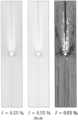
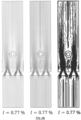
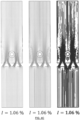
- Figures 4A-4D show air flow streamlines in the four devices used in this turbulence study.
- Figure 4A is a standard 12mm rectangular tube with wick and coil installed as explained in the previous section, with no jetting panel.
- Figure 4B has a jetting panel located 10mm below (upstream from) the wick.
- Figure 4C has the same jetting panel 5mm below the wick.
- Figure 4D has the same jetting panel 2.5mm below the wick.
- the jetting panel has an arrangement of apertures shaped and directed in order to promote jetting from the downstream face of the panel and therefore to promote turbulent flow.
- the jetting panel can introduce turbulence downstream, and the panel causes higher level of turbulence near the wick when it is positioned closer to the wick.
- the four geometries gave turbulence intensities of 0.55%, 0.77%, 1.06% and 1.34%, respectively, with Figure 4A being the least turbulent, and Figure 4D being the most turbulent.
- the experimental set up is shown in Figure 5 .
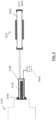
- the testing used a Carbolite Gero EHA 12300B tube furnace 3210 with a quartz tube 3220 to heat up the air. Hot air in the tube furnace was then led into a transparent housing 3158 that contains the EVP device 3150 to be tested.
- a thermocouple meter 3410 was used to assess the temperature of the air pulled into the EVP device. Once the EVP device was activated, the aerosol was pulled into the Spraytec laser diffraction system 3310 via a silicone connector 3320 for particle size measurement.
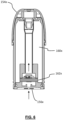
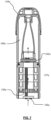
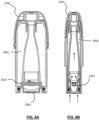
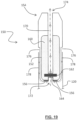
- pod 1 is the commercially available "myblu optimised" pod ( Figure 6 ); pod 2 is a pod featuring an extended inflow path upstream of the wick ( Figure 7 ); and pod 3 is pod with the wick located in a stagnant vaporisation chamber and the inlet air bypassing the vaporisation chamber but entraining the vapour from an outlet of the vaporisation chamber ( Figures 8A and 8B ).
- Pod 1 shown in longitudinal cross sectional view (in the width plane) in Figure 6 , has a main housing that defines a tank 160x holding an e-liquid aerosol precursor. Mouthpiece 154x is formed at the upper part of the pod. Electrical contacts 156x are formed at the lower end of the pod. Wick 162x is held in a vaporisation chamber. The air flow direction is shown using arrows.
- Air velocity in the vicinity of the wick is believed to play an important role in affecting particle size.
- the air velocity was calculated by dividing the flow rate by the intersection area, which is referred to as "calculated velocity" in this work. This involves a very crude simplification that assumes velocity distribution to be homogeneous across the intersection area.
- the CFD model uses a laminar single-phase flow setup.
- the outlet was configured to a corresponding flowrate
- the inlet was configured to be pressure-controlled
- the wall conditions were set as "no slip”.
- a 1 mm wide ring-shaped domain (wick vicinity) was created around the wick surface, and domain probes were implemented to assess the average and maximum magnitudes of velocity in this ring-shaped wick vicinity domain.
- the CFD model outputs the average velocity and maximum velocity in the vicinity of the wick for each set of experiments carried out in section 2.1. The outcomes are reported in Table 2.
- turbulence intensity values represent higher levels of turbulence.
- turbulence intensity below 1% represents a low-turbulence case
- turbulence intensity between 1% and 5% represents a medium-turbulence case
- turbulence intensity above 5% represents a high-turbulence case.
- Turbulence intensity was assessed within the volume up to 1 mm away from the wick surface (defined as the wick vicinity domain). For the four experiments explained in section 2.2, the turbulence intensities are 0.55%, 0.77%, 1.06% and 1.34%, respectively, as also shown in Figures 4A-4D .
- the cooling rate modelling involves three coupling models in COMSOL Multiphysics: 1) laminar two-phase flow; 2) heat transfer in fluids, and 3) particle tracing.
- the model is setup in three steps:
- Laminar mixture flow physics was selected in this study.
- the outlet was configured in the same way as in section 3.1.
- this model includes two fluid phases released from two separate inlets: the first one is the vapour released from wick surface, at an initial velocity of 2.84 cm/s (calculated based on 5 mg total particulate mass over 3 seconds puff duration) with initial velocity direction normal to the wick surface; the second inlet is air influx from the base of tube, the rate of which is pressure-controlled.
- the inflow and outflow settings in heat transfer physics was configured in the same way as in the two-phase flow model.
- the air inflow was set to 25 °C
- the vapour inflow was set to 209 °C (boiling temperature of the e-liquid formulation).
- the heat transfer physics is configured to be two-way coupled with the laminar mixture flow physics.
- the above model reaches steady state after approximately 0.2 second with a step size of 0.001 second.
- the particle tracing physics has one-way coupling with the previous model, which means the fluid flow exerts dragging force on the particles, whereas the particles do not exert counterforce on the fluid flow. Therefore, the particles function as moving probes to output vapour temperature at each timestep.
- the model outputs average vapour temperature at each time steps.
- a MATLAB script was then created to find the time step when the vapour cools to a target temperature (50°C or 75°C), based on which the vapour cooling rates were obtained (Table 3).
- Table 3 Average vapour cooling rate obtained from Multiphysics modelling Tube size [mm] Flow rate [lpm] Cooling rate to 50° C [°C/ms] Cooling rate to 75° C [°C/ms] 1.3 lpm 4.5 1.3 11.4 44.7 6 1.3 5.48 14.9 constant flow rate 7 1.3 3.46 7.88 8 1.3 2.24 5.15 10 1.3 1.31 2.85 12 1.3 0.841 1.81 20 1.3 0* 0.536 50 1.3 0 0 2.0 Ipm 4.5 2.0 19.9 670 5 2.0 13.3 67 6 2.0 8.83 26.8 constant flow rate 8 2.0 3.61 8.93 12 2.0 1.45 3.19 20 2.0 0.395 0.761 50 2.0 0 0 * Zero cooling rate when the average vapour temperature is still above target temperature after
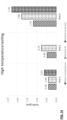
- Particle size measurement results for the rectangular tube testing are shown in Table 4.
- Table 4 For every tube size and flow rate combination, five repetition runs were carried out in the Spraytec laser diffraction system. The Dv50 values from five repetition runs were averaged, and the standard deviations were calculated to indicate errors, as shown in Table 4.
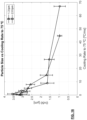
- the particle size (Dv50) experimental results are plotted against calculated air velocity in Figure 9 .
- the graph shows a strong correlation between particle size and air velocity.
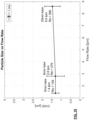
- Figure 10 shows the results of three experiments with highly different setup arrangements: 1) 5mm tube measured at 1.4 Ipm flow rate with Reynolds number of 155; 2) 8mm tube measured at 2.8 Ipm flow rate with Reynolds number of 279; and 3) 20mm tube measured at 8.6 Ipm flow rate with Reynolds number of 566. It is relevant that these setup arrangements have one similarity: the air velocities are all calculated to be 1 m/s.
- Figure 10 shows that, although these three sets of experiments have different tube sizes, flow rates and Reynolds numbers, they all delivered similar particle sizes, as the air velocity was kept constant. These three data points were also plotted out in Figure 9 (1 m/s data with star marks) and they tie in nicely into particle size-air velocity trendline.
- the particle size measurement data were plotted against the average velocity ( Figure 11 ) and maximum velocity ( Figure 12 ) in the vicinity of the wick, as obtained from CFD modelling.
Landscapes
- Chemical & Material Sciences (AREA)
- Chemical Kinetics & Catalysis (AREA)
- General Chemical & Material Sciences (AREA)
- Catching Or Destruction (AREA)
- Medicinal Preparation (AREA)
Applications Claiming Priority (4)
| Application Number | Priority Date | Filing Date | Title |
|---|---|---|---|
| EP19198722.1A EP3795012A1 (de) | 2019-09-20 | 2019-09-20 | Rauchersatzvorrichtung |
| EP19198560.5A EP3795002A1 (de) | 2019-09-20 | 2019-09-20 | Rauchersatzvorrichtung |
| EP20789856.0A EP3930518B1 (de) | 2019-09-20 | 2020-09-21 | Rauchersatzvorrichtung |
| PCT/EP2020/076311 WO2021053233A1 (en) | 2019-09-20 | 2020-09-21 | Smoking substitute apparatus |
Related Parent Applications (2)
| Application Number | Title | Priority Date | Filing Date |
|---|---|---|---|
| EP20789856.0A Division-Into EP3930518B1 (de) | 2019-09-20 | 2020-09-21 | Rauchersatzvorrichtung |
| EP20789856.0A Division EP3930518B1 (de) | 2019-09-20 | 2020-09-21 | Rauchersatzvorrichtung |
Publications (2)
| Publication Number | Publication Date |
|---|---|
| EP4527221A2 true EP4527221A2 (de) | 2025-03-26 |
| EP4527221A3 EP4527221A3 (de) | 2025-05-21 |
Family
ID=72840473
Family Applications (2)
| Application Number | Title | Priority Date | Filing Date |
|---|---|---|---|
| EP25157235.0A Pending EP4527221A3 (de) | 2019-09-20 | 2020-09-21 | Rauchersatzvorrichtung |
| EP20789856.0A Active EP3930518B1 (de) | 2019-09-20 | 2020-09-21 | Rauchersatzvorrichtung |
Family Applications After (1)
| Application Number | Title | Priority Date | Filing Date |
|---|---|---|---|
| EP20789856.0A Active EP3930518B1 (de) | 2019-09-20 | 2020-09-21 | Rauchersatzvorrichtung |
Country Status (3)
| Country | Link |
|---|---|
| US (1) | US20220202092A1 (de) |
| EP (2) | EP4527221A3 (de) |
| WO (1) | WO2021053233A1 (de) |
Families Citing this family (3)
| Publication number | Priority date | Publication date | Assignee | Title |
|---|---|---|---|---|
| CN109007984B (zh) * | 2018-09-17 | 2025-01-07 | 深圳市合元科技有限公司 | 加热体及加热器 |
| EP4197364A1 (de) | 2021-12-16 | 2023-06-21 | Imperial Tobacco Limited | Dampferzeugungssystem |
| EP4197368A1 (de) | 2021-12-16 | 2023-06-21 | Imperial Tobacco Limited | Rauchersatzvorrichtung |
Family Cites Families (5)
| Publication number | Priority date | Publication date | Assignee | Title |
|---|---|---|---|---|
| EP2319334A1 (de) * | 2009-10-27 | 2011-05-11 | Philip Morris Products S.A. | Rauchsystem mit einem Flüssigkeitsspeicherteil |
| JP6189321B2 (ja) * | 2011-12-08 | 2017-08-30 | フィリップ・モーリス・プロダクツ・ソシエテ・アノニム | 空気流ノズルを有するエーロゾル発生デバイス |
| WO2015042412A1 (en) * | 2013-09-20 | 2015-03-26 | E-Nicotine Technology. Inc. | Devices and methods for modifying delivery devices |
| EP3760059B1 (de) * | 2014-09-17 | 2022-10-26 | Fontem Holdings 4 B.V. | Vorrichtung zum speichern und verdampfen flüssiger medien |
| GB2604314A (en) * | 2017-09-22 | 2022-09-07 | Nerudia Ltd | Device, system and method |
-
2020
- 2020-09-21 EP EP25157235.0A patent/EP4527221A3/de active Pending
- 2020-09-21 WO PCT/EP2020/076311 patent/WO2021053233A1/en not_active Ceased
- 2020-09-21 EP EP20789856.0A patent/EP3930518B1/de active Active
-
2022
- 2022-03-17 US US17/697,072 patent/US20220202092A1/en active Pending
Also Published As
| Publication number | Publication date |
|---|---|
| EP3930518B1 (de) | 2025-04-02 |
| US20220202092A1 (en) | 2022-06-30 |
| EP3930518A1 (de) | 2022-01-05 |
| EP4527221A3 (de) | 2025-05-21 |
| WO2021053233A1 (en) | 2021-03-25 |
Similar Documents
| Publication | Publication Date | Title |
|---|---|---|
| EP3795009A1 (de) | Rauchersatzvorrichtung | |
| US20220202092A1 (en) | Smoking substitute apparatus | |
| WO2021053220A1 (en) | Smoking substitute apparatus | |
| EP3794971A1 (de) | Rauchersatzvorrichtung | |
| EP3930510B1 (de) | Rauchersatzvorrichtung | |
| EP3930498B1 (de) | Rauchersatzvorrichtung | |
| EP3930513B1 (de) | Rauchersatzvorrichtung | |
| EP3930516B1 (de) | Rauchersatzvorrichtung | |
| EP3794988A1 (de) | Rauchersatzvorrichtung | |
| EP3794969A1 (de) | Rauchersatzvorrichtung | |
| EP3795013A1 (de) | Rauchersatzvorrichtung | |
| EP3930514B1 (de) | Rauchersatzvorrichtung | |
| EP3930515B1 (de) | Rauchersatzvorrichtung | |
| EP3795003A1 (de) | Rauchersatzvorrichtung | |
| EP3795002A1 (de) | Rauchersatzvorrichtung | |
| EP3795012A1 (de) | Rauchersatzvorrichtung | |
| EP3795001A1 (de) | Rauchersatzvorrichtung | |
| EP3794982A1 (de) | Rauchersatzvorrichtung | |
| EP3794967A1 (de) | Rauchersatzvorrichtung | |
| EP3794996A1 (de) | Rauchersatzvorrichtung | |
| EP3795008A1 (de) | Rauchersatzvorrichtung | |
| EP3794980A1 (de) | Rauchersatzvorrichtung | |
| EP3794974A1 (de) | Rauchersatzvorrichtung | |
| EP3794972A1 (de) | Rauchersatzvorrichtung | |
| EP3794992A1 (de) | Rauchersatzvorrichtung |
Legal Events
| Date | Code | Title | Description |
|---|---|---|---|
| PUAI | Public reference made under article 153(3) epc to a published international application that has entered the european phase |
Free format text: ORIGINAL CODE: 0009012 |
|
| STAA | Information on the status of an ep patent application or granted ep patent |
Free format text: STATUS: THE APPLICATION HAS BEEN PUBLISHED |
|
| AC | Divisional application: reference to earlier application |
Ref document number: 3930518 Country of ref document: EP Kind code of ref document: P |
|
| AK | Designated contracting states |
Kind code of ref document: A2 Designated state(s): AL AT BE BG CH CY CZ DE DK EE ES FI FR GB GR HR HU IE IS IT LI LT LU LV MC MK MT NL NO PL PT RO RS SE SI SK SM TR |
|
| REG | Reference to a national code |
Ref country code: DE Ref legal event code: R079 Free format text: PREVIOUS MAIN CLASS: A24F0040460000 Ipc: A24F0040485000 |
|
| PUAL | Search report despatched |
Free format text: ORIGINAL CODE: 0009013 |
|
| AK | Designated contracting states |
Kind code of ref document: A3 Designated state(s): AL AT BE BG CH CY CZ DE DK EE ES FI FR GB GR HR HU IE IS IT LI LT LU LV MC MK MT NL NO PL PT RO RS SE SI SK SM TR |
|
| RIC1 | Information provided on ipc code assigned before grant |
Ipc: A24F 40/46 20200101ALN20250415BHEP Ipc: A24F 40/10 20200101ALN20250415BHEP Ipc: A24F 40/485 20200101AFI20250415BHEP |
|
| STAA | Information on the status of an ep patent application or granted ep patent |
Free format text: STATUS: REQUEST FOR EXAMINATION WAS MADE |
|
| 17P | Request for examination filed |
Effective date: 20251030 |
|
| STAA | Information on the status of an ep patent application or granted ep patent |
Free format text: STATUS: EXAMINATION IS IN PROGRESS |