EP4527200A1 - Fungicidal compositions and uses thereof in prevention and treatment of fusarium diseases of crops - Google Patents
Fungicidal compositions and uses thereof in prevention and treatment of fusarium diseases of crops Download PDFInfo
- Publication number
- EP4527200A1 EP4527200A1 EP22949956.1A EP22949956A EP4527200A1 EP 4527200 A1 EP4527200 A1 EP 4527200A1 EP 22949956 A EP22949956 A EP 22949956A EP 4527200 A1 EP4527200 A1 EP 4527200A1
- Authority
- EP
- European Patent Office
- Prior art keywords
- composition
- fungicide
- zjs178
- fusarium
- compound
- Prior art date
- Legal status (The legal status is an assumption and is not a legal conclusion. Google has not performed a legal analysis and makes no representation as to the accuracy of the status listed.)
- Pending
Links
Classifications
-
- A—HUMAN NECESSITIES
- A01—AGRICULTURE; FORESTRY; ANIMAL HUSBANDRY; HUNTING; TRAPPING; FISHING
- A01N—PRESERVATION OF BODIES OF HUMANS OR ANIMALS OR PLANTS OR PARTS THEREOF; BIOCIDES, e.g. AS DISINFECTANTS, AS PESTICIDES OR AS HERBICIDES; PEST REPELLANTS OR ATTRACTANTS; PLANT GROWTH REGULATORS
- A01N37/00—Biocides, pest repellants or attractants, or plant growth regulators containing organic compounds containing a carbon atom having three bonds to hetero atoms with at the most two bonds to halogen, e.g. carboxylic acids
- A01N37/34—Nitriles
-
- A—HUMAN NECESSITIES
- A01—AGRICULTURE; FORESTRY; ANIMAL HUSBANDRY; HUNTING; TRAPPING; FISHING
- A01N—PRESERVATION OF BODIES OF HUMANS OR ANIMALS OR PLANTS OR PARTS THEREOF; BIOCIDES, e.g. AS DISINFECTANTS, AS PESTICIDES OR AS HERBICIDES; PEST REPELLANTS OR ATTRACTANTS; PLANT GROWTH REGULATORS
- A01N37/00—Biocides, pest repellants or attractants, or plant growth regulators containing organic compounds containing a carbon atom having three bonds to hetero atoms with at the most two bonds to halogen, e.g. carboxylic acids
- A01N37/44—Biocides, pest repellants or attractants, or plant growth regulators containing organic compounds containing a carbon atom having three bonds to hetero atoms with at the most two bonds to halogen, e.g. carboxylic acids containing at least one carboxylic group or a thio analogue, or a derivative thereof, and a nitrogen atom attached to the same carbon skeleton by a single or double bond, this nitrogen atom not being a member of a derivative or of a thio analogue of a carboxylic group, e.g. amino-carboxylic acids
-
- A—HUMAN NECESSITIES
- A01—AGRICULTURE; FORESTRY; ANIMAL HUSBANDRY; HUNTING; TRAPPING; FISHING
- A01N—PRESERVATION OF BODIES OF HUMANS OR ANIMALS OR PLANTS OR PARTS THEREOF; BIOCIDES, e.g. AS DISINFECTANTS, AS PESTICIDES OR AS HERBICIDES; PEST REPELLANTS OR ATTRACTANTS; PLANT GROWTH REGULATORS
- A01N43/00—Biocides, pest repellants or attractants, or plant growth regulators containing heterocyclic compounds
- A01N43/34—Biocides, pest repellants or attractants, or plant growth regulators containing heterocyclic compounds having rings with one nitrogen atom as the only ring hetero atom
- A01N43/36—Biocides, pest repellants or attractants, or plant growth regulators containing heterocyclic compounds having rings with one nitrogen atom as the only ring hetero atom five-membered rings
-
- A—HUMAN NECESSITIES
- A01—AGRICULTURE; FORESTRY; ANIMAL HUSBANDRY; HUNTING; TRAPPING; FISHING
- A01N—PRESERVATION OF BODIES OF HUMANS OR ANIMALS OR PLANTS OR PARTS THEREOF; BIOCIDES, e.g. AS DISINFECTANTS, AS PESTICIDES OR AS HERBICIDES; PEST REPELLANTS OR ATTRACTANTS; PLANT GROWTH REGULATORS
- A01N43/00—Biocides, pest repellants or attractants, or plant growth regulators containing heterocyclic compounds
- A01N43/48—Biocides, pest repellants or attractants, or plant growth regulators containing heterocyclic compounds having rings with two nitrogen atoms as the only ring hetero atoms
- A01N43/50—1,3-Diazoles; Hydrogenated 1,3-diazoles
-
- A—HUMAN NECESSITIES
- A01—AGRICULTURE; FORESTRY; ANIMAL HUSBANDRY; HUNTING; TRAPPING; FISHING
- A01N—PRESERVATION OF BODIES OF HUMANS OR ANIMALS OR PLANTS OR PARTS THEREOF; BIOCIDES, e.g. AS DISINFECTANTS, AS PESTICIDES OR AS HERBICIDES; PEST REPELLANTS OR ATTRACTANTS; PLANT GROWTH REGULATORS
- A01N43/00—Biocides, pest repellants or attractants, or plant growth regulators containing heterocyclic compounds
- A01N43/48—Biocides, pest repellants or attractants, or plant growth regulators containing heterocyclic compounds having rings with two nitrogen atoms as the only ring hetero atoms
- A01N43/54—1,3-Diazines; Hydrogenated 1,3-diazines
-
- A—HUMAN NECESSITIES
- A01—AGRICULTURE; FORESTRY; ANIMAL HUSBANDRY; HUNTING; TRAPPING; FISHING
- A01N—PRESERVATION OF BODIES OF HUMANS OR ANIMALS OR PLANTS OR PARTS THEREOF; BIOCIDES, e.g. AS DISINFECTANTS, AS PESTICIDES OR AS HERBICIDES; PEST REPELLANTS OR ATTRACTANTS; PLANT GROWTH REGULATORS
- A01N43/00—Biocides, pest repellants or attractants, or plant growth regulators containing heterocyclic compounds
- A01N43/48—Biocides, pest repellants or attractants, or plant growth regulators containing heterocyclic compounds having rings with two nitrogen atoms as the only ring hetero atoms
- A01N43/56—1,2-Diazoles; Hydrogenated 1,2-diazoles
-
- A—HUMAN NECESSITIES
- A01—AGRICULTURE; FORESTRY; ANIMAL HUSBANDRY; HUNTING; TRAPPING; FISHING
- A01N—PRESERVATION OF BODIES OF HUMANS OR ANIMALS OR PLANTS OR PARTS THEREOF; BIOCIDES, e.g. AS DISINFECTANTS, AS PESTICIDES OR AS HERBICIDES; PEST REPELLANTS OR ATTRACTANTS; PLANT GROWTH REGULATORS
- A01N43/00—Biocides, pest repellants or attractants, or plant growth regulators containing heterocyclic compounds
- A01N43/64—Biocides, pest repellants or attractants, or plant growth regulators containing heterocyclic compounds having rings with three nitrogen atoms as the only ring hetero atoms
- A01N43/647—Triazoles; Hydrogenated triazoles
- A01N43/653—1,2,4-Triazoles; Hydrogenated 1,2,4-triazoles
-
- A—HUMAN NECESSITIES
- A01—AGRICULTURE; FORESTRY; ANIMAL HUSBANDRY; HUNTING; TRAPPING; FISHING
- A01N—PRESERVATION OF BODIES OF HUMANS OR ANIMALS OR PLANTS OR PARTS THEREOF; BIOCIDES, e.g. AS DISINFECTANTS, AS PESTICIDES OR AS HERBICIDES; PEST REPELLANTS OR ATTRACTANTS; PLANT GROWTH REGULATORS
- A01N47/00—Biocides, pest repellants or attractants, or plant growth regulators containing organic compounds containing a carbon atom not being member of a ring and having no bond to a carbon or hydrogen atom, e.g. derivatives of carbonic acid
- A01N47/08—Biocides, pest repellants or attractants, or plant growth regulators containing organic compounds containing a carbon atom not being member of a ring and having no bond to a carbon or hydrogen atom, e.g. derivatives of carbonic acid the carbon atom having one or more single bonds to nitrogen atoms
- A01N47/28—Ureas or thioureas containing the groups >N—CO—N< or >N—CS—N<
- A01N47/38—Ureas or thioureas containing the groups >N—CO—N< or >N—CS—N< containing the group >N—CO—N< where at least one nitrogen atom is part of a heterocyclic ring; Thio analogues thereof
-
- A—HUMAN NECESSITIES
- A01—AGRICULTURE; FORESTRY; ANIMAL HUSBANDRY; HUNTING; TRAPPING; FISHING
- A01P—BIOCIDAL, PEST REPELLANT, PEST ATTRACTANT OR PLANT GROWTH REGULATORY ACTIVITY OF CHEMICAL COMPOUNDS OR PREPARATIONS
- A01P13/00—Herbicides; Algicides
-
- A—HUMAN NECESSITIES
- A01—AGRICULTURE; FORESTRY; ANIMAL HUSBANDRY; HUNTING; TRAPPING; FISHING
- A01P—BIOCIDAL, PEST REPELLANT, PEST ATTRACTANT OR PLANT GROWTH REGULATORY ACTIVITY OF CHEMICAL COMPOUNDS OR PREPARATIONS
- A01P3/00—Fungicides
Definitions
- the present invention relates to the technical field of plant disease prevention and treatment, in particular to five fungicidal compositions and uses thereof in prevention and treatment of Fusarium diseases of crops.
- Fusarium spp. is a worldwide distribution of fungi, causing a variety of plant diseases such as root rot, stem rot, crown rot, flower rot, and ear rot, resulting in wilting and death of crops, and affecting yield and quality.
- Common Fusarium diseases include bakanal disease of rice, wheat head blight, ear rot of corn, fusarium wilt of cucurbits, root rot of various crops, etc.
- bakanal disease of rice caused by Fusarium fujikuroi species complex is a worldwide fungal disease.
- bakanal disease has become more and more common, with an incidence rate of 100 % in some areas, causing serious yield losses.
- Fusarium spp. can also cause a variety of fruit and vegetable wilt diseases, for example, banana fusarium wilt caused by Fusarium oxysporum species complex has resulted in yellowing and death of banana leaves, causing severe losses to banana farmers and becoming a "cancer" of the banana industry. Moreover, fusarium wilts of cucurbits, tomatoes, and the like caused by Fusarium oxysporum species complex seriously restrict the healthy development of the industry.
- Triazole fungicides have been widely used in the prevention and treatment of Fusarium diseases of crops.
- Triazole fungicides are sterol biosynthesis inhibitors, which inhibit the synthesis of pathogen ergosterol, resulting in changes in membrane-associated cell functions, and thus playing a role in inhibiting and killing fungi.
- tebuconazole chemical name: (RS)-1-p-chlorophenyl-4,4-dimethyl-3-(1H-1,2,4-triazol-1-yl methyl)pentan-3-ol
- metconazole chemical name: 5-(4-chlorophenyl)-2,2-dimethyl-1-(1H-1,2,4-triazol-1-yl methyl)cyclopentanol
- metconazole chemical name: 5-(4-chlorophenyl)-2,2-dimethyl-1-(1H-1,2,4-triazol-1-yl methyl)cyclopentanol
- the long-term use of the reagent would result in resistance of Fusarium spp. thereto, which affects the efficacy of the reagent.
- Succinate dehydrogenase inhibitor (SDHI) fungicides such as pydiflumetofen can be used to prevent and treat diseases such as fusarium head blight caused by Fusarium on cereals.
- Pydiflumetofen chemical name: 3-(difluoromethyl)-N-methoxy-1-methyl-N-[(RS)-1-methyl-2-(2,4,6-trichlorophenyl)ethyl]pyrazol e-4-carboxamide, is a new generation succinate dehydrogenase inhibitor (SDHI) developed by Syngenta.
- Penflufen chemical name: 5-fluoro-1, 3-dimethyl-N-[2-(4-methylpentan-2-yl)phenyl]-1H-pyrazole-4-carboxamide
- Penflufen chemical name: 5-fluoro-1, 3-dimethyl-N-[2-(4-methylpentan-2-yl)phenyl]-1H-pyrazole-4-carboxamide
- Bayer Through the action on the respiratory chain complex II, it inhibits ATP synthesis and has systemic, preventive and treating efficacies. At present, it is mainly used for seed treatment.
- the reagent permeates into the germinated seed and transmits to the whole plant through the xylem of the young plant, thereby playing a protective role.
- succinate dehydrogenase inhibitor fungicides have a single site of action, and as they are widely used, the risk of resistance continues to increase.
- the pyrrole fungicide fludioxonil (chemical name: 4-(2,2-difluoro-1,3-benzodioxol-4-yl) pyrrole-3-carbonitrile) is commonly used to prevent and treat wheat crown rot, bakanal disease of rice, tomato fusarium wilt and other diseases. It mainly inhibits the growth of fungal mycelia by activating the histidine kinase signaling pathway. It can be used as a seed treatment to prevent and treat many kinds of seed-borne and soil-borne pathogens, such as Alternaria genus , Fusarium genus , Helminthosporium genus.
- Prochloraz chemical name: N-propyl-N-[2-(2,4,6-trichlorophenoxy) ethyl]-imidazole-1-carboxamide, is a broad-spectrum fungicide and has an obvious preventive effect on diseases caused by Ascomycete and Deuteromycete in many crops.
- Carbendazim chemical name: methyl benzimidazol-2-yl carbamate, a broad-spectrum systemic fungicide, mainly interferes with the mitotic process of cells and is effective against some pathogens of Ascomycete and most pathogenic fungi of Deuteromycete.
- Thiophanate-methyl chemical name: 1,2-bis (3-carbomethoxy-2-thioureido)benzene, belonging to a broad-spectrum systemic low-toxic fungicide, has systemic conduction characteristics; this reagent acts on ⁇ -tubulin of pathogenic fungi, thereby inhibiting cell division of the pathogen and achieving the effect of inhibiting pathogen growth.
- Azoxystrobin chemical name: (E)-methyl 2- ⁇ 2-[6-(2-cyanophenoxy)pyrimidin-4-yloxy]phenyl ⁇ -3-strobilurin, belonging to the strobilurin fungicides, inhibits the electron transfer between fungal cytochrome bc1, thereby inhibiting mitochondrial respiration and causing fungal cell death.
- This reagent has good efficacy on various crop diseases caused by Ascomycotina , Basidiomycotina , Mastigomycotina , and Deuteromycotina.
- Trifloxystrobin chemical name: (E)-methyl methoxyimino- ⁇ (E)- ⁇ -[1-( ⁇ , ⁇ , ⁇ -trifluoro-m-methyl)ethyliminooxy]o-tolyl ⁇ acetate, broad-spectrum, long duration, has protective, treatment, and eradicative activity against most diseases caused by pathogenic fungi such as Ascomycete , Basidiomycete , Oomycete and Deuteromycete. There is no cross-resistance with existing fungicides.
- Fluoxastrobin chemical name: ⁇ 2-]6-(2-chlorophenoxy)-3-fluoropyrimidin-4-yloxyphenyl ⁇ (5,6-dihydro-1,4,2-dioxazin-3-yl)met hanone o-methyloxime, with a broad spectrum of fungicidal activity, has good activity against almost all fungi ( Ascomycete , Basidiomycete , Oomycete and Deuteromycete ) diseases, such as rust, glume, net blotch, powdery mildew, downy mildew, etc.
- Picoxystrobin chemical name: (E)-methyl 3-methoxy-2- ⁇ 2-[6-(trifluoromethyl)-2-pyridinoxymethyl]phenyl ⁇ acrylate, belongs to broad-spectrum systemic fungicides.
- Pyraclostrobin chemical name: methyl N-[2-[[1-(4-chlorophenyl) pyrazol-3-yl]oxymethyl] phenyl]-N-methoxycarbamate has a wide range of applications due to its protective effect, treating effect, systemic conductivity and rain erosion resistance.
- Fenaminstrobin chemical name: (E,E,E)-N-methyl-2-[(((((1-methyl-3-(2,6-dichlorophenyl)-2-propenyl)imino)oxy)methyl)phenyl]-2-methoxyiminoacetamide, with a broad spectrum of fungicidal activity and high activity, has preventive and treating effects on a variety of plant diseases caused by Flagellum , Zygomycota , Ascomycete , Basidiomycete and Deuteromycete, with excellent efficacies on powdery mildew and rust.
- the pathogens easily develop resistance to the above-mentioned reagents, affecting the efficacy of the reagents. Therefore, it is very important to develop a suitable reagent combination for the prevention and treatment of Fusarium diseases.
- the present invention adopts the following technical solutions:
- fungicidal composition comprising as active ingredients a compound ZJS178 of formula (I) and a triazole fungicide,
- the above-mentioned compound ZJS178 is a new compound previously prepared by the research group of the present invention and has a chemical name of ethyl 2-cyano-3-amino-3-[4-(N-ethyl-N-methylamino)phenyl]acrylate, and the synthetic route thereof is as follows:
- This compound is a cyanoacrylate fungicidal compound that acts on Type I myosin (motor protein) of Fusarium spp., depriving the pathogens of their growth and causing their death.
- Type I myosin motor protein
- ZJS178 has a novel structure and a unique mode of action, with no cross-resistance to triazole reagents. It is effective against diseases caused by Fusarium spp. and has protective and treating effects.
- the compound ZJS178 and triazole fungicides are compounded in the present invention, resulting in significantly higher efficacy in preventing Fusarium diseases of crops than single reagents.
- the composition can reduce the dosage of single reagents, help delay the development of fungicidal resistance, prolong the service life of fungicides, and reduce costs.
- a mass ratio of the compound ZJS178 to the triazole fungicide is from 50:1 to 1:50.
- triazole fungicides include, but are not limited to: tebuconazole, metconazole, myclobutanil, difenoconazole, triadimefon, epoxiconazole, diniconazole, prothioconazole, propiconazole, etc.
- the triazole fungicide is tebuconazole or metconazole.
- the mass ratio of the compound ZJS178 to the triazole fungicide in the composition is from 15:1 to 1:15.
- Fusarium fujikuroi there is a synergistic effect when the compound ZJS178 is compounded with the triazole fungicide in a mass ratio of 4:1 to 1:5 on the inhibition of metconazole-sensitive Fusarium fujikuroi , and there is a synergistic effect when the two are compounded in a mass ratio of 5:1 to 1:3 on the inhibition of metconazole-resistant Fusarium fujikuroi.
- the mass ratio of the compound ZJS178 to the triazole fungicide in the composition is from 8: 1 to 1: 8.
- the fungicidal composition further comprises auxiliary ingredients required for pesticide formulations, and the mass proportion of active ingredients in the composition is 1-90 %.
- the auxiliary ingredients are commonly-used carriers and adjuvants in pesticides.
- the fungicidal composition of the present invention can be formulated into various agriculturally-acceptable formulations in practical use, including a water dispersible granule, a suspension, an emulsion in water, a microemulsion, and a seed treatment suspension.
- the emulsifier can be selected from calcium dodecylbenzene sulfonate (agricultural emulsifier 500#), agricultural emulsifier 700#, agricultural emulsifier 2201#, span-60#, tween-80-60#, TX-10, agricultural emulsifier 1601, agricultural emulsifier 600#, agricultural emulsifier 400#;
- the co-emulsifier can be selected from methanol, isopropanol, n-butanol and ethanol;
- the solvent can be selected from cyclohexanone, N-methylpyrrolidone, xylene, toluene and mineral spirits (S-150, S-180, and S-200); and the stabilizer can be selected from triphenyl phosphite and epichlorohydrin.
- the film-forming agent may be polyethylene glycol, polyvinyl alcohol resin, polyvinyl pyrrolidone, hydroxyethyl cellulose, poly(vinyl acetate), sodium carboxymethyl cellulose, gum arabic, gelatin, polyvinyl alcohol, polyacrylamide, or mixtures thereof.
- the skilled person can adjust the proportion of poly(vinyl acetate) according to the desired viscosity of the product.
- the present invention also provides a use of the fungicidal composition in the prevention and treatment of crop diseases caused by Fusarium spp.
- Fusarium spp. refers to phytopathogenic fusarium, mainly including Fusarium graminearum species complex, Fusarium fujikuroi species complex, Fusarium oxysporum species complex and Fusarium moniliforme, etc.
- the crop diseases comprise wheat head blight, bakanal disease of rice, and strawberry fusarium wilt.
- the fungicidal composition is applied at the early stage of heading and flowering of wheat at intervals of 6-7 days.
- a highly efficient fungicidal composition comprising as active ingredients a compound ZJS178 of formula (I) and a succinate dehydrogenase inhibitor fungicide,
- the compound ZJS178 has a novel structure and a unique mode of action. Studies have shown that the compound ZJS178 has no cross-resistance to succinate dehydrogenase inhibitors (SDHI). It is effective against diseases caused by Fusarium spp. and has protective and treating effects.
- SDHI succinate dehydrogenase inhibitors
- the present invention compounds the two to significantly enhancing the fungicidal effect, delay fungicidal resistance, and reduce prevention and treatment costs.
- the SDHI fungicides can effectively inhibit the synthesis of ATP of pathogens, and rationally compounding the compound ZJS178 with the SDHI reagent can simultaneously block the synthesis of ATP and the activity of the motor protein, which is equivalent to simultaneously blocking the "gasoline” and "engine” of pathogens, so as to achieve efficient inhibition of pathogen growth and delay the development of resistance of pathogens to any of these reagents.
- a mass ratio of the compound ZJS178 to the succinate dehydrogenase inhibitor fungicide in the composition is from 50: 1 to 1: 50.
- Such succinate dehydrogenase inhibitor fungicides include but are not limited to pydiflumetofen, penflufen, fluxapyroxad, fluopyram, carboxin and the like.
- the mass ratio of the compound ZJS178 to the succinate dehydrogenase inhibitor fungicide in the composition is from 9: 1 to 1: 9.
- the highly efficient fungicidal composition further comprises a pesticide-acceptable carrier and adjuvant.
- the mass percentage of the active ingredients in the composition is 1-90 %.
- the mass percentage of the active ingredients in the composition is 10-40 %.
- the fungicidal composition of the present invention can be formulated into various agriculturally-acceptable formulations in practical use, and the usual formulations include a water dispersible granule, a suspension, a microemulsion, an emulsion in water, a suspoemulsion, and a seed treatment suspension.
- the dispersant can be selected from polycarboxylates, lignosulfonates and alkyl naphthalene sulfonates; the wetting agent can be selected from alkyl sulfates, alkyl sulfonates and naphthalene sulfonates; the disintegrant can be selected from ammonium sulfate, urea, sucrose and glucose; the binder can be selected from diatomite, corn starch, polyvinyl alcohol and carboxymethyl (ethyl) cellulose; and the filler can be selected from diatomite, kaolin, white carbon black, light calcium, talc, attapulgite and china clay.
- the adjuvants that can be used in the suspension formulation can be selected from polycarboxylates, lignosulfonates, and alkyl naphthalene sulfonates;
- the wetting agent can be selected from alkylphenol polyoxyethylene polyether formaldehyde condensate sulfates, alkylphenol polyoxyethylene ether phosphates, phenethylphenol polyoxyethylene ether phosphates, alkyl sulfates, alkyl sulfonates, and naphthalene sulfonates;
- the thickener can be selected from xanthan gum, polyvinyl alcohol and bentonite;
- the preservative can be selected from formaldehyde, benzoic acid, and sodium benzoate;
- the defoamer is a silicone defoamer; and the antifreeze can be selected from ethylene glycol, propylene glycol, glycerol, urea and inorganic salts
- the emulsifier can be selected from nonylphenol polyoxyethylene ether phosphates, triethylphenol polyoxyethylene ether phosphates (agricultural emulsifier 600# phosphate), agricultural emulsifier 700#, agricultural emulsifier 2201#, span-60#, emulsifier T-60, surfactant TX-10, agricultural emulsifier 1601#, agricultural emulsifier 600#, and agricultural emulsifier 400#;
- the solvent is selected from xylene, toluene, cyclohexanone, and mineral spirits (S-150, S-180 and S-200);
- the stabilizer can be selected from triphenyl phosphite, epichlorohydrin, and acetic anhydride;
- the thickener can be selected from xanthan gum, polyvinyl alcohol, bentonite, and magnesium aluminum silicate; and the preservatives can be selected from
- the emulsifier can be selected from calcium dodecylbenzene sulfonate (agricultural emulsifier 500#), agricultural emulsifier 700#, agricultural emulsifier 2201#, span-60#, tween-80-60#, TX-10, agricultural emulsifier 1601, agricultural emulsifier 600#, agricultural emulsifier 400#;
- the co-emulsifier can be selected from methanol, isopropanol, n-butanol and ethanol;
- the solvent can be selected from cyclohexanone, N-methylpyrrolidone, xylene, toluene and mineral spirits (S-150, S-180, and S-200); and the stabilizer can be selected from triphenyl phosphite and epichlorohydrin.
- the film-forming agent may be polyethylene glycol, polyvinyl alcohol resin, polyvinyl pyrrolidone, hydroxyethyl cellulose, poly(vinyl acetate), sodium carboxymethyl cellulose, gum arabic, gelatin, polyvinyl alcohol, polyacrylamide, or mixtures thereof.
- the skilled person can adjust the proportion of poly(vinyl acetate) according to the desired viscosity of the product.
- the present invention also provides a use of the highly efficient fungicidal composition in the prevention and treatment of crop diseases caused by Fusarium spp.
- Fusarium spp. refers to phytopathogenic fusarium, mainly including Fusarium graminearum species complex, Fusarium fujikuroi species complex, Fusarium oxysporum species complex and Fusarium moniliforme, etc.
- the crop diseases caused by Fusarium spp. include but are not limited to wheat head blight and bakanal disease of rice.
- the compounding of the compound ZJS178 with pydiflumetofen is applied once during the early stage of heading and flowering of wheat, and then applied again after a 6-day interval.
- the reagent obtained by compounding the compound ZJS178 and penflufen is used as a seed treatment for prevention and treatment of crop diseases.
- a fungicide composition comprising as active ingredients a compound ZJS178 of formula (I) and a pyrrole fungicide,
- the above-mentioned compound ZJS178 is a new compound previously prepared by the research group of the present invention and has a chemical name of ethyl 2-cyano-3-amino-3-[4-(N-ethyl-N-methylamino)phenyl]acrylate, and the synthetic route thereof is as follows:
- This compound is a cyanoacrylate fungicidal compound that acts on Type I myosin (motor protein) of Fusarium spp., depriving the pathogens of their growth and causing their death.
- the compound ZJS178 has a novel structure and a unique mode of action, and has no cross-resistance to pyrrole reagents such as fludioxonil. Due to the different mechanism of action between the compound ZJS178 and pyrrole fungicides, the present invention can not only expand the fungicidal scope and enhance the fungicidal efficacy, but also delay the development of drug resistance.
- the composition comprises the compound ZJS178 and the pyrrole fungicide in a mass ratio of from 50: 1 to 1: 50.
- Such pyrrole fungicides include, but are not limited to, fludioxonil, fenpiclonil, and the like. Further preferably, the mass ratio of the compound ZJS178 to the pyrrole fungicide is from 11:1 to 1:11.
- the mass ratio of the compound ZJS178 to the pyrrole fungicide in the fungicide composition is from 1:1-3.
- composition provided herein is suitable for preventing and treating diseases caused by Fusarium spp.
- Example 2 Laboratory toxicity test of compound ZJS178 compounded with tebuconazole against Fusarium graminearum
- Test object tebuconazole-sensitive (TS) and tebuconazole-resistant (TR) Fusarium graminearum strains were isolated from the field, and the tested strains were identified by morphology, pathogenicity and resistance, and then preserved by the laboratory for future use.
- TS tebuconazole-sensitive
- TR tebuconazole-resistant Fusarium graminearum strains were isolated from the field, and the tested strains were identified by morphology, pathogenicity and resistance, and then preserved by the laboratory for future use.
- Test reagents compound ZJS178 synthesized by Example 1; tebuconazole provided by Zhejiang Research Institute of Chemical Industry.
- Test method refer to "Agricultural Industry Standard of the People's Republic of China NY/T 1156.2-2006" mycelial growth rate method.
- Five dosages of each reagent were set according to the active ingredient content, and the growth inhibition rate of the pathogens was between 10 % and 90 %.
- the above-mentioned pathogens of wheat head blight were inoculated on a PDA medium.
- a fungicidal block at the edge of the colony was made by a punch with a diameter of 5 mm.
- the fungicidal block was transferred to the center of the pre-prepared drug-containing medium plate using an inoculating needle, and then placed in a 25 °C incubator for 3 days.
- the diameter of each treated colony was measured with a caliper using a cross method, and the corrected inhibition percentage was calculated.
- EC 50 values for each reagent were then calculated using linear regression analysis between the probability of inhibition values and the log of the series of concentrations, repeated 4 times per treatment.
- the compound ZJS178 was set as the standard reagent, and the co-toxicity coefficient (CTC) was calculated according to the following formulas.
- Toxicity Index ATI EC 50 of standard reagent / EC 50 of test reagent ⁇ 100 ;
- Theoretical Toxicity Index (TTI) Standard reagent toxicity index x Percentage of the standard reagent in the mixed combination + Test reagent toxicity index x Percentage of the test reagent in the mixed combination;
- Co - Toxicity Coefficient CTC ATI / TTI ⁇ 100 % ;
- a CTC value of less than 80 indicates an antagonistic effect;
- a CTC value of 80-120 indicates an additive effect;
- a CTC value of greater than 120 indicates a synergistic effect.
- Table 1 Laboratory toxicity test results of compound ZJS178 compounded with tebuconazole against tebuconazole-sensitive Fusarium graminearum (TS) Reagent EC 50 ( ⁇ g/ mL) Actual Toxicity Index (ATI) Theoretical Toxicity Index (TTI) Co-toxicity coefficient (CTC) ZJS178 (A) 0.0385 100.00 / / Tebuconazole (B) 0.1746 22.05 / / A+B (10: 1) 0.0365 105.48 92.91 113.52 A+B (8: 1) 0.0378 101.85 91.34 111.51 A+B (5: 1) 0.0402 95.77 87.01 110.07 A+B (4: 1) 0.0412 93.45 84.41 110.71 A+B (3: 1) 0.0391 98.47 80.51 122.30 A+B (2: 1) 0.0381 101.05 74.02 136.52 A+
- Example 3 Laboratory toxicity test of compound ZJS178 compounded with metconazole against Fusarium fujikuroi
- Test reagents compound ZJS178 synthesized by Example 1; metconazole (provided by Zhejiang Research Institute of Chemical Industry).
- the bioassay method was referred to the description in Example 2.
- Table 3 Laboratory toxicity test results of compound ZJS178 compounded with metconazole against metconazole-sensitive Fusarium fujikuroi (MS) Reagent EC 50 ( ⁇ g/ mL) ATI TTI CTC ZJS178 (A) 0.0690 100.00 / / Metconazole (B) 0.2274 30.34 / / A+B (15: 1) 0.0658 104.86 95.65 109.64 A+B (10: 1) 0.0637 108.32 93.67 115.64 A+B (5: 1) 0.0656 105.18 88.39 119.00 A+B (4: 1) 0.0668 103.29 86.07 120.01 A+B (3: 1) 0.0611 112.93 82.59 136.74 A+B (2: 1) 0.0701 98.43 76.78 128.20 A+B (1: 1) 0.0838 82.34 65.17 126.34 A+B (1: 2) 0.0961
- Example 4 Laboratory toxicity test of compound ZJS178 compounded with tebuconazole against Fusarium oxysporum
- Test object Fusarium oxysporum were isolated from diseased strawberries in the field. The tested strains were identified by morphology and pathogenicity, and preserved by the laboratory.
- Test reagents compound ZJS178 synthesized by Example 1; tebuconazole (provided by Zhejiang Research Institute of Chemical Industry).
- the bioassay method was referred to the description in Example 2.
- Table 5 Laboratory toxicity test results of compound ZJS178 compounded with tebuconazole against Fusarium oxysporum Reagent EC 50 ( ⁇ g/ mL) ATI TTI CTC ZJS178 (A) 0.03987 100.00 / / Tebuconazole (B) 0.2758 14.46 / / A+B (1: 8) 0.1334 29.89 23.96 124.72 A+B (1: 6) 0.1135 35.13 26.68 131.66 A+B (1: 4) 0.0856 46.58 31.57 147.55 A+B (1: 3) 0.0721 55.30 35.85 154.27 A+B (1: 2) 0.0538 74.11 42.97 172.45 A+B (1: 1) 0.0411 97.01 57.23 169.50 A+B (2: 1) 0.0322 123.82 71.49 173.21 A+B (3: 1) 0.0303 131.58 78.62 167.
- the above-mentioned raw materials were mixed and subjected to high-speed shearing and emulsifying.
- the prevention and treatment of wheat head blight was carried out according to NY/T1464.15-2007 Guidelines on efficacy evaluation of pesticides Part 15: Fungicides against fusarium head blight of wheat.
- the reagent was applied once at the initial stage of heading and flowering of wheat, and once again at 6-day intervals.
- the survey was performed at the milky stage.
- Each experimental plot was sampled at 5 points along the diagonal line, 100-200 ears were investigated at each point, and the number of diseased ears at each level and the total number of ears were recorded according to the percentage of dry ear area in the whole ear area.
- the disease rating scale is as follows:
- Disease index ⁇ (number of diseased ears at each scale x relative disease scale number)/(total number of investigated ears x 5)
- Reagent Efficacy (%) (Disease index after treatment in blank control area - Disease index after treatment in reagent treatment area) / Disease index after treatment in blank control area x100 %
- Table 6 Field efficacy test results of compound ZJS178 compounded with triazole against wheat head blight Reagent treatment Active ingredient content (grams / Chinese acre) Efficacy % (after 2 doses) * Water dispersible granule comprising 40 % ZJS178 • tebuconazole 10 89.92 a Suspension comprising 30 % ZJS178 • tebuconazole 10 92.37 a Suspension comprising 25 % ZJS178 • Metconazole 10 96.58 a Microemulsion comprising 40 % ZJS178 • tebuconazole 10 92.97 a Emulsion in water comprising 15 % ZJS178 • tebuconazole 10 88.99 a Suspension comprising 25 % ZJS178 10 85.54 b 430 g/L tebuconazole suspension (commercially available) 10 76.12 c * Different lowercase letters after the same column of data
- composition of the present invention has a synergistic effect and has excellent inhibition and efficacy against Fusarium diseases in a variety of crops.
- the composition consists of active ingredients with different mechanisms of action, which is beneficial to overcome and delay the emergence of pathogen resistance and is safe for experimental crops.
- Example 6 Laboratory toxicity test of compound ZJS178 compounded with pydiflumetofen against Fusarium graminearum
- Test object Fusarium graminearum, isolated from the field, identified as Fusarium graminearum by morphological, pathogenic and other biological methods, was preserved by the laboratory for future use.
- Test reagents compound ZJS178 synthesized by Example 1, pydiflumetofen (Syngenta Nantong Crop Protection Co. Ltd., commercially available).
- Test method refer to "Agricultural Industry Standard of the People's Republic of China NY/T 1156.2-2006" mycelial growth rate method.
- Five dosages of each reagent were set according to the active ingredient content, and the growth inhibition rate of the pathogen was between 10 % and 90 %.
- the above-mentioned pathogens of wheat head blight were inoculated on a PDA medium.
- a fungicidal block at the edge of the colony was made by a punch with a diameter of 5 mm.
- the fungicidal block was transferred to the center of the pre-prepared drug-containing medium using an inoculating needle, and then placed in a 25 °C incubator for 3 days.
- Toxicity Index ATI EC 50 of standard reagent / EC 50 of test reagent ⁇ 100 ;
- Theoretical Toxicity Index (TTI) Standard reagent toxicity index x Percentage of the standard reagent in the mixed combination + Test reagent toxicity index x Percentage of the test reagent in the mixed combination;
- Co - Toxicity Coefficient CTC ATI / TTI ⁇ 100 % ;
- a CTC value of less than 80 indicates an antagonistic effect;
- a CTC value of 80-120 indicates an additive effect;
- a CTC value of greater than 120 indicates a synergistic effect.
- Table 7 Laboratory toxicity test results of compound ZJS178 compounded with pydiflumetofen against Fusarium graminearum Reagent EC 50 ( ⁇ g/ mL) ATI TTI CTC ZJS178 (A) 0.0379 100.00 / / Pydiflumetofen 0.3191 11.88 / / A+B (9: 1) 0.0357 106.16 91.19 116.42 A+B (7: 1) 0.0322 117.70 88.98 132.27 A+B (5: 1) 0.0306 123.86 85.31 145.18 A+B (4: 1) 0.0315 120.32 82.38 146.06 A+B (3: 1) 0.0314 120.70 77.97 154.81 A+B (2: 1) 0.0332 114.16 70.63 161.64 A+B (1: 1) 0.0429 88.34 55.94 157.93 A+B (1: 2) 0.0596 63.59 41.25 154.
- Example 7 Laboratory toxicity test of compound ZJS178 compounded with penflufen against Fusarium fujikuroi
- Test object Fusarium fujikuroi, isolated from the field, identified as Fusarium fujikuroi by morphological, pathogenic and other biological methods, was preserved by the laboratory.
- Test reagents compound ZJS178 synthesized by Example 1, penflufen (Bayer AG, commercially available).
- the bioassay method was referred to the description in Example 6.
- Table 8 Laboratory toxicity test results of compound ZJS178 compounded with penflufen against Fusarium fujikuroi Reagent EC 50 ( ⁇ g/ mL) ATI TTI CTC ZJS178 (A) 0.0671 100.00 / / Penflufen (B) 0.2937 22.85 / / A+B (9: 1) 0.0639 105.01 92.28 113.79 A+B (7: 1) 0.0582 115.29 90.36 127.60 A+B (5: 1) 0.0516 130.04 87.14 149.23 A+B (4: 1) 0.0589 113.92 84.57 134.71 A+B (3:1) 0.0575 116.70 80.71 144.58 A+B (2:1) 0.0557 120.47 74.28 162.17 A+B (1: 1) 0.0669 100.30 61.42 163.29 A+B (1: 2) 0.0836 80.26 48.56 165.27 A+B (1
- the active ingredients, dispersant, suspending agent and antifreeze were added to a batching kettle to be mixed well.
- the mixture was dispersed by ball mill or high-speed shear for 30 min, and then sanded with a sand mill to prepare a suspension.
- the prevention and treatment of wheat head blight was carried out according to NY/T1464.15-2007 Guidelines on efficacy evaluation of pesticides Part 15: Fungicides against fusarium head blight of wheat.
- the reagent was applied once at the initial stage of heading and flowering of wheat, and once again at 6-day intervals.
- the survey was performed at two weeks after the application.
- Each experimental plot was sampled at 5 points along the diagonal line, 100-200 ears were investigated at each point, and the number of diseased ears at each level and the total number of ears were recorded according to the percentage of dry ear area in the whole ear area.
- the disease rating scale is as follows:
- Table 9 Field efficacy test results of compound ZJS178 •compounded with pydiflumetofen against wheat head blight Reagent treatment Active ingredient content (grams / Chinese acre) Efficacy % (after 2 doses) Water dispersible granule comprising 40 % ZJS178 5 91.31 ab • pydiflumetofen 10 94.53 a 15 97.88 a Suspension comprising 25 % ZJS178 5 78.41 c Suspension comprising 200 g/L pydiflumetofen 10 86.22 b * Different lowercase letters after the same column of data indicate significant differences at the P ⁇ 0.05 level.
- bakanal disease of rice was carried out according to the provisions of "GB-T 17980.104-2004 Pesticide -- Guidelines for the field efficacy trials (II) -- Part 104: Fungicides against bakanal disease of rice".
- the test site was in Dongpu Town, Shaoxing City, and the rice variety was Zhongzao 39 (susceptible variety).
- the seeds were soaked in a solution diluted to a certain ratio for 72 h, and then germinated, and planted. Nutritive soil was used for seedling raising.
- the seedling raising process was carried out in strict accordance with the seedling raising process of mechanical transplanting. The seed quantity and soil fertility of all treatments were consistent. Each treatment used 20 trays, and the seed amount per tray was 150 g.
- Rate of diseased plants % Diseased plants / Investigated plants ⁇ 100
- Reagent efficacy (%) (Rate of diseased plants in a blank control area - Rate of diseased plants in a reagent treatment area) / Rate of diseased plants in a blank control area x 100
- Table 10 Field efficacy test results of compound ZJS178 compounded with penflufen against bakanal disease of rice Reagent Name Dosage (dilution factor) Reagent Efficacy (%) Before transplanting Before heading Suspension comprising 10 % ZJS178 • penflufen 3000 96.2 b 96.8 b 2500 100 a 100 a 2000 100 a 100 a Suspension comprising 25 % ZJS178 5000 (equivalent to the dosage of the suspension comprising 10 % ZJS178 • penflufen in 2000-fold dilution) 89.6 c 89.1 c Suspension comprising 22.4 % penflufen 4480 (equivalent to the dosage of the suspension comprising 10 % ZJS178 • penflufen in 2000-fold dilution) 89.6 c 89.4 c * Different lowercase letters after the same column of data indicate significant differences at the P ⁇ 0.05 level.
- Example 9 Laboratory toxicity test of compound ZJS178 compounded with fludioxonil against Fusarium pseudograminearum
- Test object fludioxonil-resistant (FR) and fludioxonil-sensitive (FS) Fusarium pseudograminearum , isolated from the field and identified by the laboratory and preserved.
- Test reagents compound ZJS178 synthesized by Example 1; fludioxonil (provided by Zhejiang Research Institute of Chemical Industry).
- Test method refer to "Agricultural Industry Standard of the People's Republic of China NY/T 1156.2-2006" mycelial growth rate method. Five doses of each reagent were set according to the active ingredient content. The above-mentioned Fusarium pseudograminearum was inoculated on a PDA medium. When the colony grew to 2/3 of the culture dish, a fungicidal block at the edge of the colony was made by a punch with a diameter of 5 mm. The fungicidal block was transferred to the center of the pre-prepared drug-containing PDA medium using an inoculating needle, and then placed in a 25 °C incubator for 3 days.
- Toxicity Index ATI EC 50 of standard reagent / EC 50 of test reagent ⁇ 100 ;
- Theoretical Toxicity Index (TTI) Standard reagent toxicity index x Percentage of the standard reagent in the mixed combination + Test reagent toxicity index x Percentage of the test reagent in the mixed combination;
- Co - Toxicity Coefficient CTC ATI / TTI ⁇ 100 % ;
- a CTC value of less than 80 indicates an antagonistic effect;
- a CTC value of 80-120 indicates an additive effect;
- a CTC value of greater than 120 indicates a synergistic effect.
- Table 11 Laboratory toxicity test results of compound ZJS178 compounded with fludioxonil against fludioxonil-resistant Fusarium pseudograminearum (FR) Reagent EC 50 ( ⁇ g/ mL) ATI TTI CTC ZJS178 (A) 0.0383 100.00 / / Fludioxonil (B) 18.049 0.21 / / A+B (11: 1) 0.0413 92.74 91.68 101.15 A+B (9: 1) 0.0422 90.76 90.02 100.82 A+B (7: 1) 0.0416 92.07 87.53 105.19 A+B (5: 1) 0.0409 93.64 83.37 112.32 A+B (4: 1) 0.0411 93.19 80.04 116.42 A+B (3: 1) 0.0425 90.12 75.05 120.07 A+B (2: 1) 0.0477 80.29 66.74 120.31 A+B (1: 1) 0.06
- Example 10 Laboratory toxicity test of compound ZJS178 compounded with fludioxonil against Fusarium fujikuroi
- Test object Fusarium fujikuroi preserved in a culture room of the laboratory.
- the bioassay method was referred to the description in Example 9.
- Table 13 Laboratory toxicity test results of compound ZJS178 compounded with fludioxonil against Fusarium fujikuroi Reagent EC 50 ( ⁇ g/ mL) ATI TTI CTC ZJS178 (A) 0.0481 100.00 / / Fludioxonil (B) 0.0529 90.93 / / A+B (11: 1) 0.0473 101.69 99.24 102.47 A+B (9: 1) 0.0481 100.00 99.09 100.92 A+B (7: 1) 0.0447 107.61 98.87 108.84 A+B (5: 1) 0.0425 113.18 98.49 114.91 A+B (4: 1) 0.0423 113.71 98.19 115.81 A+B (3: 1) 0.0451 106.65 97.73 109.13 A+B (2: 1) 0.0427 112.65 96.98 116.16 A+B (1: 1) 0.0408 117.89 95.46
- Example 11 Laboratory toxicity test of compound ZJS178 compounded with fludioxonil against Fusarium oxysporum
- Test object Fusarium oxysporum preserved in the laboratory.
- Test reagents compound ZJS178 synthesized by Example 1; fludioxonil (provided by Zhejiang Research Institute of Chemical Industry).
- the bioassay method was referred to the description in Example 9.
- Table 14 Laboratory toxicity test results of compound ZJS178 compounded with fludioxonil against Fusarium oxysporum Reagent EC 50 ( ⁇ g/ mL) ATI TTI CTC ZJS178 (A) 0.0878 100.00 / / Fludioxonil (B) 0.0683 128.55 / / A+B (11: 1) 0.0872 100.69 102.38 98.35 A+B (9: 1) 0.0791 111.00 102.86 107.92 A+B (7: 1) 0.0743 118.17 103.57 114.10 A+B (5: 1) 0.074 118.65 104.76 113.26 A+B (4: 1) 0.0721 121.78 105.71 115.20 A+B (3: 1) 0.0716 122.63 107.14 114.46 A+B (2: 1) 0.0707 124.19 109.52 113.40 A+B (1: 1) 0.0623 140.93 114.
- the percentages of the seed treatment suspension are all mass percentages. According to the formulation ratio, with water as the medium, the active ingredients, dispersant, suspending agent and antifreeze were added to a batching kettle to be mixed well. The mixture was dispersed by ball mill or high-speed shear for 30 min, and then sanded with a sand mill.
- bakanal disease of rice was carried out according to the provisions of "GB-T 17980.104-2004 Pesticide -- Guidelines for the field efficacy trials (II) -- Part 104: Fungicides against bakanal disease of rice".
- the test site was in Dongpu Town, Shaoxing City, and the rice variety was Zhongzao 39 (susceptible variety).
- the solution was diluted to a certain ratio and soaked for 72 h, and then the seeds were germinated and planted.
- Nutritive soil was used for seedling raising.
- the seedling raising process was carried out in strict accordance with the seedling raising process of mechanical transplanting. The seed quantity and soil fertility of all treatments were consistent. Each treatment used 20 trays, and the seed amount per tray was 150 g.
- Rate of diseased plants % Diseased plants / Investigated plants ⁇ 100
- Reagent efficacy (%) (Rate of diseased plants in a blank control area - Rate of diseased plants in a reagent treatment area) / Rate of diseased plants in a blank control area x 100
- Table 15 Field efficacy test results of compound ZJS178 compounded with fludioxonil against bakanal disease of rice Reagent Name Dosage (dilution factor) Reagent Efficacy (%) Before transplanting Before heading Suspension comprising 25 % ZJS178 • fludioxonil 5000 98.2 a 97.6 a Suspension comprising 25 % ZJS178 5000 91.6 b 90.1 b Suspension comprising 25 % fludioxonil 5000 86.4 c 85.2 c * Different lowercase letters after the same column of data indicate significant differences at the P ⁇ 0.05 level.
- the test site was in Dongpu town, Shaoxing city; the soil type was loam; the fertility was medium; and the pH value was neutral.
- the wheat variety was Jimai 22.
- the seed quantity and soil fertility of all treatments were consistent.
- the medicinal solution was diluted to a certain ratio to mix the seeds. When mixing, the water usage was 2 % of the seed quantity. After mixing, the seeds were placed in a well-ventilated and dark place to dry. Three plots were set for each treatment. Samples were taken at 5 points in each plot before heading. 100 plants were investigated at each point, and the total number of plants and diseased plants were recorded. According to the investigation results, the rate of diseased plants and efficacy were calculated according to the following formulas.
- composition of the present invention has a significant synergistic effect, and the composition consists of active ingredients with different mechanisms of action, is beneficial to overcome and delay the occurrence of drug resistance of pathogens. There is no obvious adverse effect on the test crops, and the leaf color and growth vigor are normal, with good safety.
- Example 13 Laboratory toxicity test of compound ZJS178 compounded with thiophanate-methyl against F. oxysporum f.sp. niveum
- Test object F. oxysporum f.sp. niveum isolated from the field. The tested strains were identified by morphology and pathogenicity, and then stored in the laboratory for future use.
- Test reagents compound ZJS178 synthesized by Example 1 and thiophanate-methyl provided by Zhejiang Research Institute of Chemical Industry.
- Test method refer to "Agricultural Industry Standard of the People's Republic of China NY/T 1156.2-2006" mycelial growth rate method. Five doses of each reagent were set according to the active ingredient content, and the growth inhibition rate of the pathogen was between 10 % and 90 %. The above-mentioned F. oxysporum f.sp. niveum was inoculated on a PDA medium. When the colony grew to 2/3 of the culture dish, a fungicidal block at the edge of the colony was made by a punch with a diameter of 5 mm.
- the fungicidal block was transferred to the center of the pre-prepared drug-containing medium plate using an inoculating needle, and then placed in a 25 °C incubator for 3 days.
- the diameter of each treated colony was measured with a caliper using a cross method, and the corrected inhibition percentage was calculated.
- EC 50 values for each reagent were then calculated using linear regression analysis between the probability of inhibition values and the log of the series of concentrations, repeated 4 times per treatment.
- the compound ZJS178 was set as the standard reagent, and the co-toxicity coefficient (CTC) was calculated according to the following formulas.
- Actual Toxicity Index ATI EC 50 of standard reagent / EC 50 of test reagent ⁇ 100 ;
- TTI Standard reagent toxicity index x Percentage of the standard reagent in the mixed combination + Test reagent toxicity index x Percentage of the test reagent in the mixed combination;
- Co - Toxicity Coefficient CTC ATI / TTI ⁇ 100 % ;
- a CTC value of less than 80 indicates an antagonistic effect;
- a CTC value of 80-120 indicates an additive effect;
- a CTC value of greater than 120 indicates a synergistic effect.
- Table 17 Laboratory toxicity test results of compound ZJS178 compounded with thiophanate-methyl against F. oxysporum f.sp. Niveum Reagent EC 50 ( ⁇ g/ mL) Actual Toxicity Index (ATI) Theoretical Toxicity Index (TTI) Co-toxicity coefficient (CTC) ZJS178 (A) 0.0569 100.00 / / Thiophanate-methyl 0.2224 25.58 / / A+B (12: 1) 0.0602 94.53 94.28 100.27 A+B (9: 1) 0.0533 106.77 92.56 115.36 A+B (7: 1) 0.0541 105.19 90.70 115.98 A+B (6: 1) 0.0511 111.37 89.37 124.62 A+B (4: 1) 0.0521 109.23 85.12 128.33 A+B (3: 1) 0.0539 105.58 81.40 129.71 A+B (2: 1) 0.0588 96
- Example 14 Laboratory toxicity test of compound ZJS178 compounded with prochloraz against Fusarium graminearum
- Test object Fusarium graminearum preserved in the laboratory.
- Test method refer to "Agricultural Industry Standard of the People's Republic of China NY/T 1156.2-2006" mycelial growth rate method. Five doses of each reagent were set according to the active ingredient content. The above-mentioned Fusarium graminearum was inoculated on a PDA medium. When the colony grew to 2/3 of the culture dish, a fungicidal block at the edge of the colony was made by a punch with a diameter of 5 mm. The fungicidal block was transferred to the center of the pre-prepared toxicity-containing PDA medium using an inoculating needle, and then placed in a 25 °C incubator. Each treatment was performed for 4 times.
- Table 18 Laboratory toxicity test results of compound ZJS178 compounded with prochloraz against Fusarium graminearum Reagent EC 50 ( ⁇ g/ mL) ATI TTI CTC ZJS178 (A) 0.0379 100.00 / / Prochloraz (B) 0.3191 11.88 / / A+B (1: 20) 0.2214 17.12 16.08 106.48 A+B (1: 15) 0.1788 21.20 17.39 121.91 A+B (1: 12) 0.1587 23.88 18.66 127.99 A+B (1: 8) 0.1224 30.96 21.67 142.88 A+B (1: 6) 0.1067 35.52 24.47 145.17 A+B (1: 4) 0.0789 48.04 29.50 162.81 A+B (1: 3) 0.0725 52.28 33.91 154.16 A+B (1: 2) 0.0599 63.27 41.25 153.37 A+B (1: 1) 0.0422 89.81 55.94 160
- Example 15 Laboratory toxicity test of compound ZS178 compounded with prochloraz-manganese chloride complex against Fusarium oxysporum
- Test object Fusarium oxysporum preserved in the laboratory.
- the bioassay method was referred to the bioassay Example 14.
- Table 19 Laboratory toxicity test results of compound ZJS178 compounded with prochloraz -manganese chloride complex against Fusarium oxysporum Reagent EC 50 ( ⁇ g/ mL) ATI TTI CTC ZJS178 (A) 0.03987 100.00 / / Prochloraz-manganese chloride complex (B) 0.2758 14.46 / / A+B (1: 20) 0.1887 21.13 18.53 114.00 A+B (1: 15) 0.1701 23.44 19.81 118.34 A+B (1: 12) 0.1524 26.16 21.04 124.34 A+B (1: 8) 0.1334 29.89 23.96 124.72 A+B (1: 6) 0.1135 35.13 26.68 131.66 A+B (1: 4) 0.0856 46.58 31.57 147.55 A+B (1: 3) 0.0721 55.30 35.85 154.27 A+B (1: 2) 0.0538 74.11 42.
- the active ingredients, dispersant, suspending agent and antifreeze were added to a batching kettle to be mixed well.
- the mixture was dispersed by ball mill or high-speed shear for 30 min, and then sanded with a sand mill to prepare a suspension.
- the prevention and treatment of wheat head blight was carried out according to NY/T1464.15-2007 Guidelines on efficacy evaluation of pesticides Part 15: Fungicides against fusarium head blight of wheat.
- the reagent was applied once at the initial stage of heading and flowering of wheat.
- the survey was performed at the milky stage.
- Each experimental plot was sampled at 5 points along the diagonal line, 100-200 ears were investigated at each point, and the number of diseased ears at each level and the total number of ears were recorded according to the percentage of dry ear area in the whole ear area.
- the disease rating scale is as follows:
- CK 1 is the disease index after treatment in a blank control area
- PT 1 is the disease index after treatment in a reagent-treated area.
- Table 20 Field Efficacy Test against wheat head blight Reagent treatment Active ingredient content (grams / Chinese acre) Efficiency % (milky stage) Suspension comprising 46 % ZJS178 • prochloraz 5 91.31 a 10 94.53 a 15 97.88 a Suspension comprising 25 % ZJS178 5 82.41 b suspension comprising 200 g/L prochloraz 12 89.22 b * Different lowercase letters after the same column of data indicate significant differences at the P ⁇ 0.05 level.
- Table 20 show that: a suspension comprising 46 % ZJS178 • prochloraz has a good efficacy against wheat head blight, up to 91.31 %-97.88 % at the dosage of 5 g active ingredients / Chinese acre to 15 g active ingredients / Chinese acre, better than that of single reagents.
- the test reagent is safe for the test crop.
- the test site was in Dongpu town, Shaoxing city; the soil type was loam; the fertility was medium; and the pH value was neutral.
- the variety was Zhefen 202.
- the root was irrigated with liquid reagent. See Table 5 for the types and dosages of chemicals.
- Table 21 Field efficacy test results of compound ZJS178 compounded with thiophanate-methyl against tomato fusarium wilt Reagent treatment Active ingredient content (grams / Chinese acre) Efficacy % (after 2 doses)* Suspension comprising 20 % ZJS178 • thiophanate-methyl 40 82.36 a Suspension comprising 20 % ZJS178 40 71.13 b Wettable powder comprising 50 % thiophanate-methyl 40 52.81c * Different lowercase letters after the same column of data indicate significant differences at the P ⁇ 0.05 level.
- Table 21 show that the compounding of ZJS178 • thiophanate-methyl can effectively prevent and treat tomato fusarium wilt at the same effective dosage, and the efficacy is significantly better than that of single reagents.
- the test reagent is safe for the test crop.
- Example 17 Laboratory toxicity test of compound ZJS178 compounded with azoxystrobin against F. oxysporum f. sp. lycopersici
- Test object F. oxysporum f. sp. lycopersici isolated from diseased tomatoes from the field. The tested strains were identified by morphology and pathogenicity, and then stored in the laboratory for future use.
- Test reagents compound ZJS178 synthesized by Example 1; azoxystrobin provided by Zhejiang Research Institute of Chemical Industry.
- the fungicidal block was transferred to the center of the pre-prepared drug-containing medium plate using an inoculating needle, and then placed in a 25 °C incubator for 3 days.
- the diameter of each treated colony was measured with a caliper using a cross method, and the corrected inhibition percentage was calculated.
- EC 50 values for each reagent were then calculated using linear regression analysis between the probability of inhibition values and the log of the series of concentrations, repeated 4 times per treatment.
- the compound ZJS178 was set as the standard reagent, and the co-toxicity coefficient (CTC) was calculated according to the following formulas.
- Toxicity Index ATI EC 50 of standard reagent / EC 50 of test reagent ⁇ 100 ;
- TTI Standard reagent toxicity index x Percentage of the standard reagent in the mixed combination + Test reagent toxicity index x Percentage of the test reagent in the mixed combination;
- Co ⁇ Toxicity Coefficient CTC ATI / TTI ⁇ 100 % ;
- a CTC value of less than 80 indicates an antagonistic effect;
- a CTC value of 80-120 indicates an additive effect;
- a CTC value of greater than 120 indicates a synergistic effect.
- Table 22 Laboratory toxicity test results of compound ZJS178 compounded with azoxystrobin against F . oxysporum f. sp. lycopersici Reagent EC 50 ( ⁇ g/ mL) ATI TTI CTC ZJS178 (A) 0.0461 100.00 / / Azoxystrobin (B) 0.8247 5.59 / / A+B (12: 1) 0.0522 88.31 92.74 95.23 A+B (9: 1) 0.05101 90.37 90.56 99.80 A+B (7: 1) 0.05118 90.07 88.20 102.13 A+B (6: 1) 0.04687 98.36 86.51 113.69 A+B (4: 1) 0.0413 111.62 81.12 137.60 A+B (3: 1) 0.0433 106.47 76.40 139.36 A+B (2: 1) 0.0455 101.32 68.53 147.85 A+B (1: 1) 0.0638 72
- Example 18 Laboratory toxicity test of compound ZJS178 compounded with pyraclostrobin against Fusarium moniliforme
- Test object Fusarium moniliforme preserved in a culture room of the laboratory.
- the bioassay method was referred to the description in Example 17.
- Table 23 Laboratory toxicity test results of compound ZJS178 compounded with pyraclostrobin against Fusarium moniliforme Reagent EC 50 ( ⁇ g/ mL) ATI TTI CTC ZJS178 (A) 0.6781 100.00 / / Pyraclostrobin (B) 4.9852 13.61 / / A+B (1: 20) 3.4121 19.89 17.72 112.19 A+B (1: 15) 3.0678 22.12 19.01 116.35 A+B (1: 12) 2.6822 25.30 20.26 124.89 A+B (1: 8) 2.2455 30.22 23.21 130.19 A+B (1: 6) 1.9855 34.17 25.95 131.68 A+B (1: 4) 1.5321 44.29 30.89 143.37 A+B (1: 3) 1.3025 52.09 35
- the active ingredients, dispersant, suspending agent and antifreeze were added to a batching kettle to be mixed well.
- the mixture was dispersed by ball mill or high-speed shear for 30 min, and then sanded with a sand mill to prepare a suspension.
- Table 24 Field efficacy test results of compound ZJS178 compound with azoxystrobin against watermelon fusarium wilt Reagent treatment Active ingredient content (grams / Chinese acre) Efficacy % (15 days after 2 doses)* Suspension comprising 40 % ZJS178 • azoxystrobin 20 85.02 a Suspension comprising 40 % ZJS178 20 73.32 b Granule comprising 1 % azoxystrobin 20 60.18 c * Different lowercase letters after the same column of data indicate significant differences at the P ⁇ 0.05 level.
- Nutritive soil was used for seedling raising.
- the seedling raising process was carried out in strict accordance with the seedling raising process of mechanical transplanting.
- the seed quantity and soil fertility of all treatments were consistent.
- Each treatment used 20 trays, and the seed amount per tray was 150 g.
- One day before transplanting and before heading, the incidence of rice seedling disease was investigated.
- Efficacy calculation method According to the investigation results, the diseased index and efficacy were calculated according to the following formulas (1) and (2).
- the test data were statistically analyzed using Duncan's new multiple range test (DMRT).
- Table 25 show that the suspension comprising 24 % ZJS178 • pyraclostrobin can achieve good efficacy against bakanal disease of rice by soaking seeds at a dilution factor of 3000-2000, and the efficacy is 89.8 %-96.2 %, which is significantly better than that of single reagents.
- the test reagent is safe for the test crop.
- the composition of the present invention has reasonable components, prevention and treatment effects and good fungicidal effect, reduced times of administration, and is low in cost of administration. Its activity and fungicidal effect are not a simple superposition of the activities of each ingredient, but a significant synergistic effect.
- the composition is composed of active ingredients with different mechanisms of action, and the site of action is increased, beneficial to overcome and delay the occurrence of drug resistance of pathogens. There is no obvious adverse effect on the test crops, and the leaf color and growth vigor are normal, with good safety, and meeting the safety requirements of pesticide formulations.
- the present invention has excellent efficacy against diseases caused by Fusarium spp.
- the present invention has excellent efficacy against seed-borne and soil-borne crop diseases caused by Fusarium spp.
Landscapes
- Life Sciences & Earth Sciences (AREA)
- Wood Science & Technology (AREA)
- Environmental Sciences (AREA)
- Pest Control & Pesticides (AREA)
- Plant Pathology (AREA)
- Engineering & Computer Science (AREA)
- Zoology (AREA)
- Health & Medical Sciences (AREA)
- General Health & Medical Sciences (AREA)
- Dentistry (AREA)
- Agronomy & Crop Science (AREA)
- Chemical & Material Sciences (AREA)
- Chemical Kinetics & Catalysis (AREA)
- General Chemical & Material Sciences (AREA)
- Microbiology (AREA)
- Mycology (AREA)
- Agricultural Chemicals And Associated Chemicals (AREA)
Abstract
Description
- The present invention relates to the technical field of plant disease prevention and treatment, in particular to five fungicidal compositions and uses thereof in prevention and treatment of Fusarium diseases of crops.
- Fusarium spp. is a worldwide distribution of fungi, causing a variety of plant diseases such as root rot, stem rot, crown rot, flower rot, and ear rot, resulting in wilting and death of crops, and affecting yield and quality. Common Fusarium diseases include bakanal disease of rice, wheat head blight, ear rot of corn, fusarium wilt of cucurbits, root rot of various crops, etc.
- In recent years, with the changes of climate and tillage methods, wheat head blight caused by Fusarium graminearum species complex seriously threatens the safety of wheat production. Unlike other crop diseases, Fusarium graminearum produces deoxynivalenol (DON), zearalenone (ZEA) and other mycotoxins on infected wheat, which seriously threatens human and animal safety. Therefore, the disease has been classified as "Class I Crop Disease and Pest" by the Ministry of Agriculture and Rural Affairs of the People' republic of China. In addition, due to the large-scale crop rotation of wheat and corn in China, ear rot of corn caused by Fusarium graminearum species complex has showed an aggravating trend, which has received high attention from the agricultural and grain procurement departments of major producing provinces.
- In addition to Fusarium graminearum, bakanal disease of rice caused by Fusarium fujikuroi species complex is a worldwide fungal disease. In China, with the large-scale promotion of machine transplanting, seedling throwing, and other centralized seedling raising technologies, bakanal disease has become more and more common, with an incidence rate of 100 % in some areas, causing serious yield losses.
- Fusarium spp. can also cause a variety of fruit and vegetable wilt diseases, for example, banana fusarium wilt caused by Fusarium oxysporum species complex has resulted in yellowing and death of banana leaves, causing severe losses to banana farmers and becoming a "cancer" of the banana industry. Moreover, fusarium wilts of cucurbits, tomatoes, and the like caused by Fusarium oxysporum species complex seriously restrict the healthy development of the industry.
- Therefore, continuous and efficient prevention and treatment of Fusarium diseases is of great significance to ensure effective supply and quality safety of agricultural products in China.
- Due to the lack of high-resistant varieties, chemical prevention and treatment is still the main method for the prevention and treatment of Fusarium diseases of crops.
- At present, triazole fungicides have been widely used in the prevention and treatment of Fusarium diseases of crops. Triazole fungicides are sterol biosynthesis inhibitors, which inhibit the synthesis of pathogen ergosterol, resulting in changes in membrane-associated cell functions, and thus playing a role in inhibiting and killing fungi. For example, tebuconazole, chemical name: (RS)-1-p-chlorophenyl-4,4-dimethyl-3-(1H-1,2,4-triazol-1-yl methyl)pentan-3-ol, can be used to prevent and treat rust, head blight, powdery mildew, net blotch, root rot, and other crop diseases; metconazole, chemical name: 5-(4-chlorophenyl)-2,2-dimethyl-1-(1H-1,2,4-triazol-1-yl methyl)cyclopentanol, can be used to prevent and treat various diseases on cereal, wheat and legume crops, with good protective and treating properties, and a long service life. However, the long-term use of the reagent would result in resistance of Fusarium spp. thereto, which affects the efficacy of the reagent.
- Succinate dehydrogenase inhibitor (SDHI) fungicides such as pydiflumetofen can be used to prevent and treat diseases such as fusarium head blight caused by Fusarium on cereals. Pydiflumetofen, chemical name: 3-(difluoromethyl)-N-methoxy-1-methyl-N-[(RS)-1-methyl-2-(2,4,6-trichlorophenyl)ethyl]pyrazol e-4-carboxamide, is a new generation succinate dehydrogenase inhibitor (SDHI) developed by Syngenta. Through the action on the respiratory chain complex II, it can prevent the synthesis of ATP, inhibit the growth of pathogens, and lead to their death, finally achieving the purpose of prevention and treatment of plant diseases. Penflufen, chemical name: 5-fluoro-1, 3-dimethyl-N-[2-(4-methylpentan-2-yl)phenyl]-1H-pyrazole-4-carboxamide, is an SDHI fungicide developed by Bayer. Through the action on the respiratory chain complex II, it inhibits ATP synthesis and has systemic, preventive and treating efficacies. At present, it is mainly used for seed treatment. After the seed treatment, the reagent permeates into the germinated seed and transmits to the whole plant through the xylem of the young plant, thereby playing a protective role. However, succinate dehydrogenase inhibitor fungicides have a single site of action, and as they are widely used, the risk of resistance continues to increase.
- The pyrrole fungicide fludioxonil (chemical name: 4-(2,2-difluoro-1,3-benzodioxol-4-yl) pyrrole-3-carbonitrile) is commonly used to prevent and treat wheat crown rot, bakanal disease of rice, tomato fusarium wilt and other diseases. It mainly inhibits the growth of fungal mycelia by activating the histidine kinase signaling pathway. It can be used as a seed treatment to prevent and treat many kinds of seed-borne and soil-borne pathogens, such as Alternaria genus, Fusarium genus, Helminthosporium genus., Rhizoctonia genus, and Penicillium genus. However, existing studies have shown that pathogenic fungi can easily develop resistance to this reagent, significantly affecting the efficacy of the reagent (Oiki et al., 2022. Wide distribution of resistance to the fungicides fludioxonil and iprodione in Penicillium species. PLOS ONE 17 (1); Dowling et al., 2021. Characterization of high fludioxonil resistance in Botrytis cinerea isolates from calibrachoa flowers. Phytopathology, 111(3): pp.478-484; and Wen et al., 2022. Biological and molecular characterizations of field fludioxonil-resistant isolates of Fusarium graminearum. Pesticide biochemistry and physiology, 184: DOI10.1016/j.pestbp.2022.105101.).
- Prochloraz, chemical name: N-propyl-N-[2-(2,4,6-trichlorophenoxy) ethyl]-imidazole-1-carboxamide, is a broad-spectrum fungicide and has an obvious preventive effect on diseases caused by Ascomycete and Deuteromycete in many crops. Carbendazim, chemical name: methyl benzimidazol-2-yl carbamate, a broad-spectrum systemic fungicide, mainly interferes with the mitotic process of cells and is effective against some pathogens of Ascomycete and most pathogenic fungi of Deuteromycete. Thiophanate-methyl, chemical name: 1,2-bis (3-carbomethoxy-2-thioureido)benzene, belonging to a broad-spectrum systemic low-toxic fungicide, has systemic conduction characteristics; this reagent acts on β-tubulin of pathogenic fungi, thereby inhibiting cell division of the pathogen and achieving the effect of inhibiting pathogen growth.
- Azoxystrobin, chemical name: (E)-methyl 2-{2-[6-(2-cyanophenoxy)pyrimidin-4-yloxy]phenyl}-3-strobilurin, belonging to the strobilurin fungicides, inhibits the electron transfer between fungal cytochrome bc1, thereby inhibiting mitochondrial respiration and causing fungal cell death. This reagent has good efficacy on various crop diseases caused by Ascomycotina, Basidiomycotina, Mastigomycotina, and Deuteromycotina. It is high-efficiency, broad-spectrum, and has good activity against powdery mildew, rust, glume blotch, net blotch, downy mildew and rice blast of grains, rice, peanuts, grapes, potatoes, fruit trees, vegetables, coffee and lawns. It can be used for stem and leaf spraying, seed treatment and soil treatment. Trifloxystrobin, chemical name: (E)-methyl methoxyimino-{(E)-α-[1-(α,α,α-trifluoro-m-methyl)ethyliminooxy]o-tolyl}acetate,
broad-spectrum, long duration, has protective, treatment, and eradicative activity against most diseases caused by pathogenic fungi such as Ascomycete, Basidiomycete, Oomycete and Deuteromycete. There is no cross-resistance with existing fungicides. Fluoxastrobin, chemical name:
{2-]6-(2-chlorophenoxy)-3-fluoropyrimidin-4-yloxyphenyl}(5,6-dihydro-1,4,2-dioxazin-3-yl)met hanone o-methyloxime, with a broad spectrum of fungicidal activity, has good activity against almost all fungi (Ascomycete, Basidiomycete, Oomycete and Deuteromycete) diseases, such as rust, glume, net blotch, powdery mildew, downy mildew, etc. Picoxystrobin, chemical name: (E)-methyl 3-methoxy-2-{2-[6-(trifluoromethyl)-2-pyridinoxymethyl]phenyl}acrylate, belongs to broad-spectrum systemic fungicides. Pyraclostrobin, chemical name: methyl N-[2-[[1-(4-chlorophenyl) pyrazol-3-yl]oxymethyl] phenyl]-N-methoxycarbamate has a wide range of applications due to its protective effect, treating effect, systemic conductivity and rain erosion resistance. Fenaminstrobin, chemical name: (E,E,E)-N-methyl-2-[((((1-methyl-3-(2,6-dichlorophenyl)-2-propenyl)imino)oxy)methyl)phenyl]-2-methoxyiminoacetamide, with a broad spectrum of fungicidal activity and high activity, has preventive and treating effects on a variety of plant diseases caused by Flagellum, Zygomycota, Ascomycete, Basidiomycete and Deuteromycete, with excellent efficacies on powdery mildew and rust. - As a result of the long-term use of the reagents, the pathogens easily develop resistance to the above-mentioned reagents, affecting the efficacy of the reagents. Therefore, it is very important to develop a suitable reagent combination for the prevention and treatment of Fusarium diseases.
- It is an object of the present invention to provide a highly efficient, less toxic, and environmentally friendly fungicidal composition having specific efficacy against crop diseases caused by Fusarium spp., while delaying the resistance to the reagent and extending the service life of the reagent.
- To achieve the above objectives, the present invention adopts the following technical solutions:
- In a first aspect of the present invention, provided is a fungicidal composition, comprising as active ingredients a compound ZJS178 of formula (I) and a triazole fungicide,
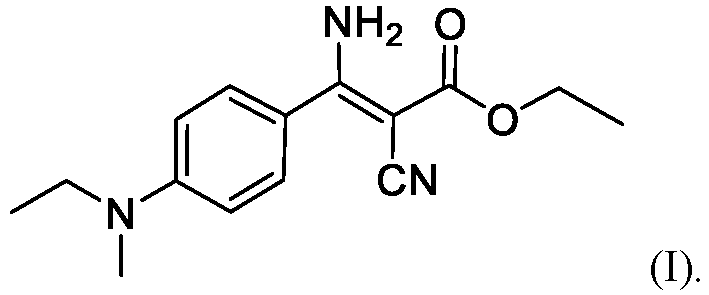
- The above-mentioned compound ZJS178 is a new compound previously prepared by the research group of the present invention and has a chemical name of ethyl 2-cyano-3-amino-3-[4-(N-ethyl-N-methylamino)phenyl]acrylate, and the synthetic route thereof is as follows:

- This compound is a cyanoacrylate fungicidal compound that acts on Type I myosin (motor protein) of Fusarium spp., depriving the pathogens of their growth and causing their death. Research has shown that the compound ZJS178 has a novel structure and a unique mode of action, with no cross-resistance to triazole reagents. It is effective against diseases caused by Fusarium spp. and has protective and treating effects.
- Due to their different mechanisms of action, the compound ZJS178 and triazole fungicides are compounded in the present invention, resulting in significantly higher efficacy in preventing Fusarium diseases of crops than single reagents. The composition can reduce the dosage of single reagents, help delay the development of fungicidal resistance, prolong the service life of fungicides, and reduce costs.
- Preferably, in the composition, a mass ratio of the compound ZJS178 to the triazole fungicide is from 50:1 to 1:50.
- Such triazole fungicides include, but are not limited to: tebuconazole, metconazole, myclobutanil, difenoconazole, triadimefon, epoxiconazole, diniconazole, prothioconazole, propiconazole, etc. Preferably, the triazole fungicide is tebuconazole or metconazole.
- Further preferably, the mass ratio of the compound ZJS178 to the triazole fungicide in the composition is from 15:1 to 1:15.
- The results show that the compounding of the compound ZJS178 and the triazole fungicide in a certain ratio has a synergistic effect against Fusarium diseases. For example, in the case of Fusarium oxysporum species complex, there is a synergistic effect when the compound ZJS178 is compounded with the triazole fungicide in a mass ratio of 8:1 to 1:8. In the case of Fusarium fujikuroi, there is a synergistic effect when the compound ZJS178 is compounded with the triazole fungicide in a mass ratio of 4:1 to 1:5 on the inhibition of metconazole-sensitive Fusarium fujikuroi, and there is a synergistic effect when the two are compounded in a mass ratio of 5:1 to 1:3 on the inhibition of metconazole-resistant Fusarium fujikuroi. In the case of Fusarium graminearum, there is a synergistic effect when the compound ZJS178 is compounded with the triazole fungicide in a mass ratio of 3:1 to 1:3 on the inhibition of tebuconazole-sensitive Fusarium graminearum, and there is a synergistic effect when the two are compounded in a mass ratio of 2:1 to 1:3 on the inhibition of tebuconazole-resistant Fusarium graminearum.
- Preferably, the mass ratio of the compound ZJS178 to the triazole fungicide in the composition is from 8: 1 to 1: 8.
- More preferably, the compound ZJS178 is compounded with the triazole fungicide in a mass ratio of 2:1 to 1:3.
- Further, the fungicidal composition further comprises auxiliary ingredients required for pesticide formulations, and the mass proportion of active ingredients in the composition is 1-90 %. The auxiliary ingredients are commonly-used carriers and adjuvants in pesticides.
- Preferably, the mass percentage of active ingredients is 15-40 %.
- According to the methods well known to those skilled in the art, the fungicidal composition of the present invention can be formulated into various agriculturally-acceptable formulations in practical use, including a water dispersible granule, a suspension, an emulsion in water, a microemulsion, and a seed treatment suspension.
- For the water dispersible granule formulation, a person skilled in the art can use a corresponding adjuvant to complete the present invention. The dispersant can be selected from polycarboxylates, lignosulfonates and alkyl naphthalene sulfonates; the wetting agent can be selected from alkyl sulfates, alkyl sulfonates and naphthalene sulfonates; the disintegrant can be selected from ammonium sulfate, urea, sucrose and glucose; the binder can be selected from diatomite, corn starch, polyvinyl alcohol and carboxymethyl (ethyl) cellulose; and the filler can be selected from diatomite, kaolin, white carbon black, light calcium, talc, attapulgite and china clay.
- The adjuvants that can be used in the suspension formulation: the dispersant can be selected from polycarboxylates, lignosulfonates, and alkyl naphthalene sulfonates; the wetting agent can be selected from alkylphenol polyoxyethylene polyether formaldehyde condensate sulfates, alkylphenol polyoxyethylene ether phosphates, phenethylphenol polyoxyethylene ether phosphates, alkyl sulfates, alkyl sulfonates, and naphthalene sulfonates; the thickener can be selected from xanthan gum, polyvinyl alcohol and bentonite; the preservative can be selected from formaldehyde, benzoic acid, and sodium benzoate; the defoamer is a silicone defoamer; and the antifreeze can be selected from ethylene glycol, propylene glycol, glycerol, urea and inorganic salts such as sodium chloride.
- The adjuvants that can be used in the emulsion in water formulation: the emulsifier can be selected from nonylphenol polyoxyethylene ether phosphates, triethylphenol polyoxyethylene ether phosphates (agricultural emulsifier 600# phosphate), agricultural emulsifier 700#, agricultural emulsifier 2201#, span-60#, emulsifier T-60, surfactant TX-10, agricultural emulsifier 1601#, agricultural emulsifier 600#, and agricultural emulsifier 400#; the solvent is selected from xylene, toluene, cyclohexanone, and mineral spirits (S-150, S-180 and S-200); the stabilizer can be selected from triphenyl phosphite, epichlorohydrin, and acetic anhydride; the thickener can be selected from xanthan gum, polyvinyl alcohol, bentonite, and magnesium aluminum silicate; and the preservatives can be selected from methanol, benzoic acid, and sodium benzoate.
- The adjuvants that can be used in the microemulsion formulation: the emulsifier can be selected from calcium dodecylbenzene sulfonate (agricultural emulsifier 500#), agricultural emulsifier 700#, agricultural emulsifier 2201#, span-60#, tween-80-60#, TX-10, agricultural emulsifier 1601, agricultural emulsifier 600#, agricultural emulsifier 400#; the co-emulsifier can be selected from methanol, isopropanol, n-butanol and ethanol; the solvent can be selected from cyclohexanone, N-methylpyrrolidone, xylene, toluene and mineral spirits (S-150, S-180, and S-200); and the stabilizer can be selected from triphenyl phosphite and epichlorohydrin.
- The adjuvants that can be used in the seed treatment suspension: the film-forming agent may be polyethylene glycol, polyvinyl alcohol resin, polyvinyl pyrrolidone, hydroxyethyl cellulose, poly(vinyl acetate), sodium carboxymethyl cellulose, gum arabic, gelatin, polyvinyl alcohol, polyacrylamide, or mixtures thereof. The skilled person can adjust the proportion of poly(vinyl acetate) according to the desired viscosity of the product.
- The present invention also provides a use of the fungicidal composition in the prevention and treatment of crop diseases caused by Fusarium spp.
- Further, the Fusarium spp. refers to phytopathogenic fusarium, mainly including Fusarium graminearum species complex, Fusarium fujikuroi species complex, Fusarium oxysporum species complex and Fusarium moniliforme, etc.
- Further, the crop diseases comprise wheat head blight, bakanal disease of rice, and strawberry fusarium wilt.
- Specifically, in the use of preventing and treating wheat head blight, the fungicidal composition is applied at the early stage of heading and flowering of wheat at intervals of 6-7 days.
- In a second aspect of the present invention, provided is a highly efficient fungicidal composition, comprising as active ingredients a compound ZJS178 of formula (I) and a succinate dehydrogenase inhibitor fungicide,

- The above-mentioned compound ZJS178 is a new compound previously prepared by the research group of the present invention and has a chemical name of ethyl 2-cyano-3-amino-3-[4-(N-ethyl-N-methylamino)phenyl]acrylate, and the synthetic route thereof is as follows:

- This compound is a cyanoacrylate fungicidal compound, which acts on Type I myosin (motor protein) of Fusarium spp. Type I myosin, as the motor protein of pathogens, can hydrolyze ATP, convert biological energy into mechanical energy, and provide power for biological activities such as growth, infection and toxin synthesis of pathogens. The compound ZJS178 specifically acts on Type I myosin (motor protein) of Fusarium spp., depriving the pathogens of their growth and causing their death.
- The compound ZJS178 has a novel structure and a unique mode of action. Studies have shown that the compound ZJS178 has no cross-resistance to succinate dehydrogenase inhibitors (SDHI). It is effective against diseases caused by Fusarium spp. and has protective and treating effects.
- Due to the different mechanisms of action between the compound ZJS178 and SDHI fungicides, but their binding sites are related, the present invention compounds the two to significantly enhancing the fungicidal effect, delay fungicidal resistance, and reduce prevention and treatment costs. Specifically, the SDHI fungicides can effectively inhibit the synthesis of ATP of pathogens, and rationally compounding the compound ZJS178 with the SDHI reagent can simultaneously block the synthesis of ATP and the activity of the motor protein, which is equivalent to simultaneously blocking the "gasoline" and "engine" of pathogens, so as to achieve efficient inhibition of pathogen growth and delay the development of resistance of pathogens to any of these reagents.
- Preferably, a mass ratio of the compound ZJS178 to the succinate dehydrogenase inhibitor fungicide in the composition is from 50: 1 to 1: 50.
- Such succinate dehydrogenase inhibitor fungicides include but are not limited to pydiflumetofen, penflufen, fluxapyroxad, fluopyram, carboxin and the like.
- Preferably, the mass ratio of the compound ZJS178 to the succinate dehydrogenase inhibitor fungicide in the composition is from 9: 1 to 1: 9.
- The results show that the compounding of the compound ZJS178 and the succinate dehydrogenase inhibitor in a certain ratio has a synergistic effect against Fusarium diseases. When the mass ratio of the compound ZJS178 to the succinate dehydrogenase inhibitor fungicides is from 7:1 to 1:5, it has a synergistic effect on the inhibition of Fusarium graminearum and Fusarium fujikuroi.
- Further, the highly efficient fungicidal composition further comprises a pesticide-acceptable carrier and adjuvant. The mass percentage of the active ingredients in the composition is 1-90 %.
- Preferably, the mass percentage of the active ingredients in the composition is 10-40 %.
- According to the methods well known to those skilled in the art, the fungicidal composition of the present invention can be formulated into various agriculturally-acceptable formulations in practical use, and the usual formulations include a water dispersible granule, a suspension, a microemulsion, an emulsion in water, a suspoemulsion, and a seed treatment suspension.
- For the water dispersible granule formulation, a person skilled in the art can use a corresponding adjuvant to complete the present invention. The dispersant can be selected from polycarboxylates, lignosulfonates and alkyl naphthalene sulfonates; the wetting agent can be selected from alkyl sulfates, alkyl sulfonates and naphthalene sulfonates; the disintegrant can be selected from ammonium sulfate, urea, sucrose and glucose; the binder can be selected from diatomite, corn starch, polyvinyl alcohol and carboxymethyl (ethyl) cellulose; and the filler can be selected from diatomite, kaolin, white carbon black, light calcium, talc, attapulgite and china clay.
- The adjuvants that can be used in the suspension formulation: the dispersant can be selected from polycarboxylates, lignosulfonates, and alkyl naphthalene sulfonates; the wetting agent can be selected from alkylphenol polyoxyethylene polyether formaldehyde condensate sulfates, alkylphenol polyoxyethylene ether phosphates, phenethylphenol polyoxyethylene ether phosphates, alkyl sulfates, alkyl sulfonates, and naphthalene sulfonates; the thickener can be selected from xanthan gum, polyvinyl alcohol and bentonite; the preservative can be selected from formaldehyde, benzoic acid, and sodium benzoate; the defoamer is a silicone defoamer; and the antifreeze can be selected from ethylene glycol, propylene glycol, glycerol, urea and inorganic salts such as sodium chloride.
- The adjuvants that can be used in the emulsion in water formulation: the emulsifier can be selected from nonylphenol polyoxyethylene ether phosphates, triethylphenol polyoxyethylene ether phosphates (agricultural emulsifier 600# phosphate), agricultural emulsifier 700#, agricultural emulsifier 2201#, span-60#, emulsifier T-60, surfactant TX-10, agricultural emulsifier 1601#, agricultural emulsifier 600#, and agricultural emulsifier 400#; the solvent is selected from xylene, toluene, cyclohexanone, and mineral spirits (S-150, S-180 and S-200); the stabilizer can be selected from triphenyl phosphite, epichlorohydrin, and acetic anhydride; the thickener can be selected from xanthan gum, polyvinyl alcohol, bentonite, and magnesium aluminum silicate; and the preservatives can be selected from methanol, benzoic acid, and sodium benzoate.
- The adjuvants that can be used in the microemulsion formulation: the emulsifier can be selected from calcium dodecylbenzene sulfonate (agricultural emulsifier 500#), agricultural emulsifier 700#, agricultural emulsifier 2201#, span-60#, tween-80-60#, TX-10, agricultural emulsifier 1601, agricultural emulsifier 600#, agricultural emulsifier 400#; the co-emulsifier can be selected from methanol, isopropanol, n-butanol and ethanol; the solvent can be selected from cyclohexanone, N-methylpyrrolidone, xylene, toluene and mineral spirits (S-150, S-180, and S-200); and the stabilizer can be selected from triphenyl phosphite and epichlorohydrin.
- The adjuvants that can be used in the seed treatment suspension: the film-forming agent may be polyethylene glycol, polyvinyl alcohol resin, polyvinyl pyrrolidone, hydroxyethyl cellulose, poly(vinyl acetate), sodium carboxymethyl cellulose, gum arabic, gelatin, polyvinyl alcohol, polyacrylamide, or mixtures thereof. The skilled person can adjust the proportion of poly(vinyl acetate) according to the desired viscosity of the product.
- The present invention also provides a use of the highly efficient fungicidal composition in the prevention and treatment of crop diseases caused by Fusarium spp.
- Further, the Fusarium spp. refers to phytopathogenic fusarium, mainly including Fusarium graminearum species complex, Fusarium fujikuroi species complex, Fusarium oxysporum species complex and Fusarium moniliforme, etc.
- Further, the crop diseases caused by Fusarium spp. include but are not limited to wheat head blight and bakanal disease of rice.
- Specifically, to prevent and treat wheat head blight, the compounding of the compound ZJS178 with pydiflumetofen is applied once during the early stage of heading and flowering of wheat, and then applied again after a 6-day interval. The reagent obtained by compounding the compound ZJS178 and penflufen is used as a seed treatment for prevention and treatment of crop diseases.
- In a third aspect of the present invention, provided is a fungicide composition, comprising as active ingredients a compound ZJS178 of formula (I) and a pyrrole fungicide,

- The above-mentioned compound ZJS178 is a new compound previously prepared by the research group of the present invention and has a chemical name of ethyl 2-cyano-3-amino-3-[4-(N-ethyl-N-methylamino)phenyl]acrylate, and the synthetic route thereof is as follows:
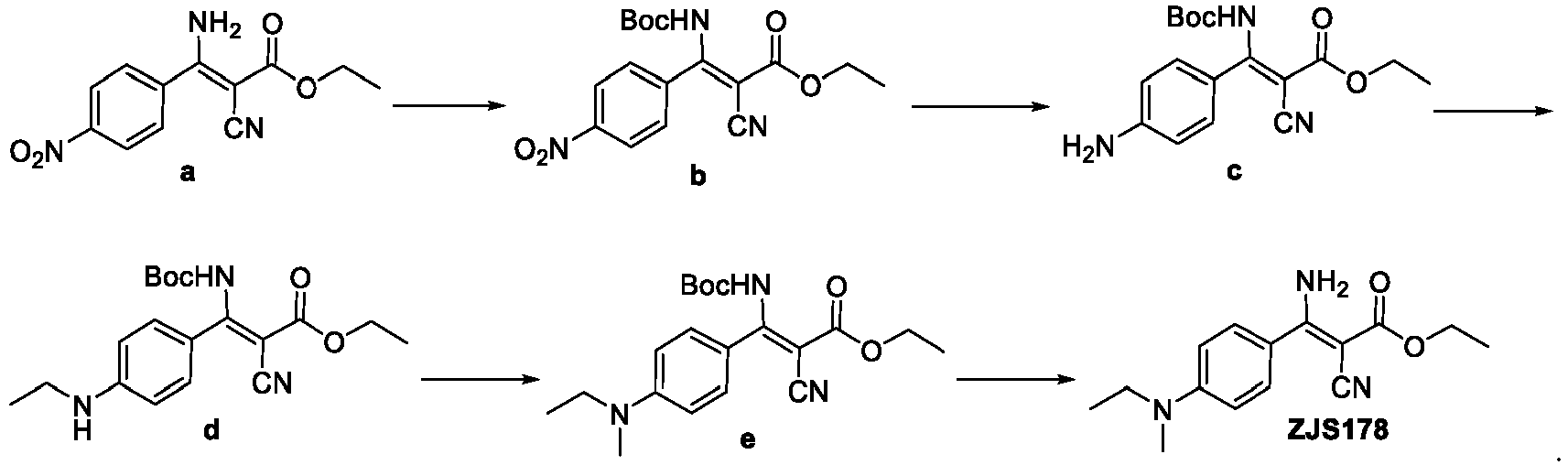
- This compound is a cyanoacrylate fungicidal compound that acts on Type I myosin (motor protein) of Fusarium spp., depriving the pathogens of their growth and causing their death.
- The compound ZJS178 has a novel structure and a unique mode of action, and has no cross-resistance to pyrrole reagents such as fludioxonil. Due to the different mechanism of action between the compound ZJS178 and pyrrole fungicides, the present invention can not only expand the fungicidal scope and enhance the fungicidal efficacy, but also delay the development of drug resistance.
- Preferably, the composition comprises the compound ZJS178 and the pyrrole fungicide in a mass ratio of from 50: 1 to 1: 50.
- Such pyrrole fungicides include, but are not limited to, fludioxonil, fenpiclonil, and the like. Further preferably, the mass ratio of the compound ZJS178 to the pyrrole fungicide is from 11:1 to 1:11.
- The results show that the compounding of the compound ZJS178 and the pyrrole fungicide in a certain ratio has a synergistic effect on the inhibition of Fusarium diseases. Specifically, in the case of Fusarium pseudograminearum, the compounding of the compound ZJS178 and the pyrrole fungicide in a mass ratio of 3: 1 to 1: 2 has a synergistic effect on the inhibition of fludioxonil-resistant Fusarium pseudograminearum, and has a synergistic effect on the inhibition of fludioxonil-senstive Fusarium pseudograminearum in a mass ratio of 1: 2 to 3; in the case of Fusarium fujikuroi, the compounding of the compound ZJS178 and the pyrrole fungicide in the mass ratio of 1: 1 to 2 has a synergistic effect; in the case of Fusarium oxysporum species complex, the compounding of the compound ZJS178 and the pyrrole fungicide in a mass ratio of 1: 1 to 3 has a synergistic effect.
- Preferably, the mass ratio of the compound ZJS178 to the pyrrole fungicide in the fungicide composition is from 1:1-3.
- Further, the composition also includes, in addition to the active ingredients described above, a pesticide-acceptable carrier and adjuvant. Wherein, the mass percentage of the active ingredients is 1-90 %.
- Preferably, the mass percentage of the active ingredients in the composition is 25-40 %.
- According to the methods well known to those skilled in the art, the fungicide composition of the present invention can be formulated into various formulations which are agriculturally acceptable in practical use, and the preferable formulation formulations can be a seed treatment suspension, a water dispersible granule, a microemulsion, and an emulsion in water.
- For the seed treatment suspension, the person skilled in the art is familiar with the use of a corresponding adjuvant to complete the present invention. The adjuvants that can be used for the seed treatment suspension: the film-forming agent may be polyethylene glycol, polyvinyl alcohol resin, polyvinyl pyrrolidone, hydroxyethyl cellulose, poly(vinyl acetate), sodium carboxymethyl cellulose, gum arabic, gelatin, polyvinyl alcohol, polyacrylamide, or mixtures thereof. The skilled person can adjust the proportion of poly(vinyl acetate) according to the desired viscosity of the product.
- For the water dispersible granule formulation, the dispersant is selected from polycarboxylate, lignosulfonate and alkyl naphthalene sulfonate; the wetting agent is selected from alkyl sulfates, alkyl sulfonates and naphthalene sulfonates; the disintegrant is selected from ammonium sulfate, urea, sucrose and glucose; the binder is selected from diatomite, corn starch, polyvinyl alcohol and carboxymethyl (ethyl) cellulose; and the filler is selected from diatomite, kaolin, white carbon black, light calcium, talc, attapulgite and china clay.
- The adjuvants that can be used in the emulsion in water formulation: the emulsifier can be selected from nonylphenol polyoxyethylene ether phosphates, triethylphenol polyoxyethylene ether phosphates (agricultural emulsifier 600# phosphate), agricultural emulsifier 700#, agricultural emulsifier 2201#, span-60#, emulsifier T-60, surfactant TX-10, agricultural emulsifier 1601#, agricultural emulsifier 600#, and agricultural emulsifier 400#; the solvent is selected from xylene, toluene, cyclohexanone, and mineral spirits (S-150, S-180 and S-200); the stabilizer can be selected from triphenyl phosphite, epichlorohydrin, and acetic anhydride; the thickener can be selected from xanthan gum, polyvinyl alcohol, bentonite, and magnesium aluminum silicate; and the preservatives can be selected from methanol, benzoic acid, and sodium benzoate.
- The adjuvants that can be used in the microemulsion formulation: the emulsifier can be selected from calcium dodecylbenzene sulfonate (agricultural emulsifier 500#), agricultural emulsifier 700#, agricultural emulsifier 2201#, span-60#, tween-80-60#, TX-10, agricultural emulsifier 1601, agricultural emulsifier 600#, agricultural emulsifier 400#; the co-emulsifier can be selected from methanol, isopropanol, n-butanol and ethanol; the solvent can be selected from cyclohexanone, N-methylpyrrolidone, xylene, toluene and mineral spirits (Item No.: S-150, S-180, and S-200); and the stabilizer can be selected from triphenyl phosphite and epichlorohydrin.
- The present invention also provides a use of the fungicide composition in the prevention and treatment of crop diseases caused by Fusarium spp.
- Further, the Fusarium spp. refers to phytopathogenic fusarium, mainly including Fusarium pseudograminearum, Fusarium fujikuroi, Fusarium oxysporum and the like.
- Such crop diseases include, but are not limited to: wheat stem rot, bakanal disease of rice, and tomato fusarium wilt.
- Further, the use comprises treating crop seeds with a seed treatment prepared from the fungicide composition.
- In a fourth aspect of the present invention, provided is a fungicidal composition, comprising a compound ZJS178 of formula (I) and an imidazole fungicide,

- The above-mentioned compound ZJS178 is a new compound previously prepared by the research group of the present invention and has a chemical name of ethyl 2-cyano-3-amino-3-[4-(N-ethyl-N-methylamino)phenyl]acrylate, and the synthetic route thereof is as follows:

- This compound is a cyanoacrylate fungicidal compound that acts on Type I myosin (motor protein) of Fusarium spp., depriving the pathogens of their growth and causing their death. The compound ZJS178 has a novel structure and a unique mode of action, and has no cross-resistance to imidazole fungicides.
- Preferably, a mass ratio of the compound ZJS178 to the imidazole fungicide in the composition is from 60: 1 to 1: 60.
- The imidazole fungicide includes, but are not limited to: prochloraz, carbendazim, prochloraz-manganese chloride complex, thiophanate-methyl and the like.
- It is further preferred that the mass ratio of the compound ZJS178 to the imidazole fungicide in the composition is from 20: 1 to 1: 20.
- Further preferably, the composition has a mass ratio of the compound ZJS178 to the imidazole fungicide in the composition is from 12: 1 to 1:12.
- Still further preferably, the composition has a mass ratio of the compound ZJS178 to the imidazole fungicide in the composition is from 6: 1 to 1: 6.
- Most preferably, the composition has a mass ratio of the compound ZJS178 to the imidazole fungicide in the composition is from 3: 1 to 1: 3.
- The composition provided herein is suitable for sterilization, particularly for agricultural sterilization.
- Preferably, the composition provided herein is suitable for preventing and treating diseases caused by Fusarium spp.
- Further preferably, the Fusarium spp. refers to phytopathogenic fusarium, mainly including Fusarium graminearum species complex, Fusarium fujikuroi species complex, Fusarium oxysporum species complex and Fusarium moniliforme, etc.
- Still more preferably, crop diseases caused by Fusarium spp. include, but are not limited to fusarium wilt of cucurbits, tomato fusarium wilt, banana fusarium wilt, cotton fusarium wilt, strawberry fusarium wilt, bakanal disease of rice, and wheat head blight, and the like.
- The present invention provides a fungicidal composition containing 0.5-90 % by weight of the active ingredients.
- It is further preferred that the fungicidal composition comprises 5-80 % by weight of the active ingredients.
- The fungicide provided by the present invention may further include an agriculture-acceptable carrier and adjuvant, in addition to the aforementioned composition.
- Due to the different mechanism of action, the compound ZJS178 and the imidazole fungicide are compounded in the present invention, resulting in significantly higher efficacy in preventing crop diseases caused by Fusarium spp. than single reagents. This reduces the dosage of single reagents, helps delay the development of fungicidal resistance, and prolongs the service life of fungicides.
- The results show that the compounding of the compound ZJS178 and the imidazole fungicide in a certain ratio has a synergistic effect on the inhibition of the growth of Fusarium spp. For example, the compounding of the compound ZJS178 and thiophanate-methyl in a mass ratio of 3: 1 to 1: 3 has a significant synergistic effect on the inhibition of the growth of Fusarium oxysporum.
- Further, the fungicide further comprises auxiliary ingredients required for pesticide formulations, and the mass percentage of the active ingredients in the composition is 0.5-90 %. The auxiliary ingredients are commonly used carriers and adjuvants in pesticides.
- According to the methods well known to those skilled in the art, the fungicidal composition of the present invention can be formulated into various agriculturally-acceptable formulations in practical use, including a water dispersible granule, a suspension, and a seed treatment suspension. For the water dispersible granule formulation, polycarboxylate, lignosulfonate and alkyl naphthalene sulfonate can be selected as a dispersant; the wetting agent is selected from alkyl sulfates, alkyl sulfonates and naphthalene sulfonates; the disintegrant is selected from ammonium sulfate, urea, sucrose and glucose; diatomite, corn starch, polyvinyl alcohol and carboxymethyl cellulose are selected as a binder; and the filler is selected from diatomite, kaolin, white carbon black, light calcium, talc, attapulgite and china clay, etc.
- For adjuvants that can be used in the suspension formulation, the dispersant can be selected from polycarboxylates, lignosulfonates, and alkyl naphthalene sulfonates; the wetting agent can be selected from alkylphenol polyoxyethylene polyether formaldehyde condensate sulfates, alkylphenol polyoxyethylene ether phosphates, phenethylphenol polyoxyethylene ether phosphates, alkyl sulfates, alkyl sulfonates, and naphthalene sulfonates; the thickener can be selected from xanthan gum, polyvinyl alcohol and bentonite; the preservative can be selected from formaldehyde, benzoic acid, and sodium benzoate; the defoamer is a silicone defoamer; and the antifreeze can be selected from ethylene glycol, propylene glycol, glycerol, urea and inorganic salts such as sodium chloride.
- For adjuvants that can be used for the seed treatment suspension, the film-forming agent may be polyethylene glycol, polyvinyl alcohol resin, polyvinyl pyrrolidone, hydroxyethyl cellulose, poly(vinyl acetate), sodium carboxymethyl cellulose, gum arabic, gelatin, polyvinyl alcohol, polyacrylamide, or mixtures thereof. The skilled person can adjust the proportion of poly(vinyl acetate) according to the desired viscosity of the product.
- In a fifth aspect of the present invention, provided is a fungicidal composition, comprising a compound ZJS178 of formula (I) and a strobilurin fungicide,

- The above-mentioned compound ZJS178 is a new compound previously prepared by the research group of the present invention and has a chemical name of ethyl 2-cyano-3-amino-3-[4-(N-ethyl-N-methylamino)phenyl]acrylate, and the synthetic route thereof is as follows:
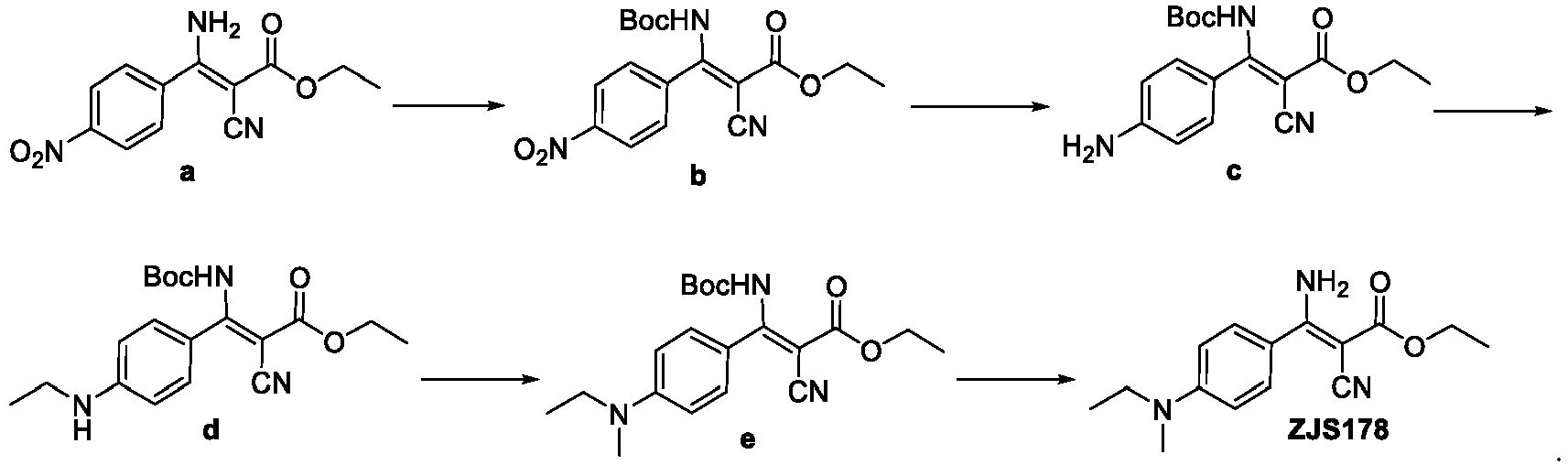
- This compound is a cyanoacrylate fungicidal compound that acts on Type I myosin (motor protein) of Fusarium spp., depriving the pathogens of their growth and causing their death. The compound ZJS178 has a novel structure and a unique mode of action with no cross-resistance to strobilurin fungicides.
- Preferably, a mass ratio of the compound ZJS178 to the strobilurin fungicide is from 60:1 to 1:60. The strobilurin fungicide includes but is not limited to azoxystrobin, trifloxystrobin, fluoxastrobin, picoxystrobin, pyraclostrobin, bemystrobin, fenaminstrobin, and the like.
- Further preferably, the mass ratio of the compound ZJS178 to the strobilurin fungicide is from 20:1 to 1:20.
- Still further preferably, the mass ratio of the compound ZJS178 to the strobilurin fungicide is from 12:1 to 1:12.
- Yet still further preferably, the mass ratio of the compound ZJS178 to the strobilurin fungicide is from 6:1 to 1:6.
- Most preferably, the mass ratio of the compound ZJS178 to the strobilurin fungicide is from 3:1 to 1:3.
- The composition provided herein is suitable for sterilization, particularly for agricultural sterilization.
- Preferably, the composition provided herein is suitable for preventing and treating diseases caused by Fusarium spp.
- Further preferably, the Fusarium spp. refers to phytopathogenic fusarium, mainly including Fusarium graminearum species complex, Fusarium fujikuroi species complex, Fusarium oxysporum species complex and Fusarium moniliforme, etc.
- Even more preferably, the composition provided by the present invention is used for preventing and treating diseases such as fusarium wilt of cucurbits, tomato fusarium wilt, banana fusarium wilt, cotton fusarium wilt, strawberry fusarium wilt, bakanal disease of rice, and wheat head blight, and the like.
- The present invention provides a fungicidal composition containing 0.5-90 % by weight of the active ingredients.
- It is further preferred that the fungicidal composition comprises 5-80 % by weight of the active ingredients.
- The composition provided by the present invention may further include an agriculture-acceptable carrier and adjuvant, in addition to the aforementioned composition.
- Due to the different mechanism of action, the compound ZJS178 and the strobilurin fungicide are compounded in the present invention, resulting in significantly higher efficacy in preventing crop diseases caused by Fusarium spp. than single reagents. This reduces the dosage of single reagents, helps delay the development of fungicidal resistance, and prolongs the service life of fungicides.
- The results show that the compounding of the compound ZJS178 and the strobilurin fungicide in a certain ratio has a synergistic effect on the inhibition of the growth of Fusarium spp. For example, the compounding of the compound ZJS178 and azoxystrobin in a mass ratio of 3: 1 to 1: 1 has an obvious synergistic effect on the inhibition of the growth of Fusarium oxysporum.
- Further, the fungicidal composition further comprises auxiliary ingredients required for pesticide formulations, and the mass proportion of active ingredients in the composition is 0.5-90 %. The auxiliary ingredients are commonly used carriers and adjuvants in pesticides.
- According to the methods well known to those skilled in the art, the fungicidal composition of the present invention can be formulated into various agriculturally acceptable formulations in practical use, including a water dispersible granule, a suspension, and a seed treatment suspension.
- For the water dispersible granule formulation, polycarboxylate, lignosulfonate and alkyl naphthalene sulfonate can be selected as a dispersant; the wetting agent is selected from alkyl sulfates, alkyl sulfonates and naphthalene sulfonates; the disintegrant is selected from ammonium sulfate, urea, sucrose and glucose; diatomite, corn starch, polyvinyl alcohol and carboxymethyl cellulose are selected as a binder; and the filler is selected from diatomite, kaolin, white carbon black, light calcium, talc, attapulgite and china clay, etc.
- For adjuvants that can be used in the suspension formulation, the dispersant can be selected from polycarboxylates, lignosulfonates, and alkyl naphthalene sulfonates; the wetting agent can be selected from alkylphenol polyoxyethylene polyether formaldehyde condensate sulfates, alkylphenol polyoxyethylene ether phosphates, phenethylphenol polyoxyethylene ether phosphates, alkyl sulfates, alkyl sulfonates, and naphthalene sulfonates; the thickener can be selected from xanthan gum, polyvinyl alcohol and bentonite; the preservative can be selected from formaldehyde, benzoic acid, and sodium benzoate; the defoamer is a silicone defoamer; and the antifreeze can be selected from ethylene glycol, propylene glycol, glycerol, urea and inorganic salts such as sodium chloride.
- For adjuvants that can be used for the seed treatment suspension, the film-forming agent may be polyethylene glycol, polyvinyl alcohol resin, polyvinyl pyrrolidone, hydroxyethyl cellulose, poly(vinyl acetate), sodium carboxymethyl cellulose, gum arabic, gelatin, polyvinyl alcohol, polyacrylamide, or mixtures thereof. The skilled person can adjust the proportion of poly(vinyl acetate) according to the desired viscosity of the product.
- Compared with the prior art, the present invention has the beneficial effects as follows:
- (1) The fungicidal compositions provided by the present invention have an excellent efficacy on crop diseases caused by Fusarium spp. The compounding of the compound ZJS178 and the triazole fungicide has a synergistic effect, which can significantly improve the fungicidal activity and efficacy. The compounding of the compound ZJS178 and the succinate dehydrogenase inhibitor fungicide has a synergistic effect, significantly enhancing the fungicidal effect, since the two components respectively inhibit the mechanical energy (motor protein) and biological energy (ATP synthesis) of pathogens, and the two mechanisms of action are different but interrelated. The compounding of the compound ZJS178 and the pyrrole fungicide has a synergistic effect, which significantly improve the fungicidal activity against Fusarium spp., with significant efficacy on seed-borne and soil-borne crop diseases caused by Fusarium spp.. The compounding of the compound ZJS178 and thiophanate-methyl or prochloraz has a synergistic effect, which could significantly improve the fungicidal activity and efficacy. The compounding of the compound ZJS178 and the strobilurin fungicide has a significant synergistic effect, and could significantly improve the fungicidal activity and efficacy.
- (2) The compositions provided by the present invention are composed of active ingredients with different mechanisms of action, have no cross-resistance, are beneficial for overcoming and delaying the resistance of pathogens, have good crop safety, and meet the requirements of pesticide ingredients reduction and efficacy increase.
- The present invention will be further described in conjunction with specific examples. The following examples are only used to illustrate the present invention and are not intended to limit the scope of application of the present invention. Any modifications or substitutions made to the methods, steps, or conditions of the present invention without departing from the spirit and essence of the present invention fall within the scope of the present invention.
- The experimental methods used in the following examples are conventional methods unless otherwise specified. The materials, reagents, etc. used, unless otherwise specified, are commercially available.
-

- To a reaction flask were added 7.0 g of raw material a (CAS No. 67710-36-5) and 150 mL of dichloromethane. 11.7 g of Boc anhydride was added under an ice bath, then 6.0 g of triethylamine and 3.3 g of DMAP were added slowly. Stirring was continued under an ice bath for 0.5 h and then the reaction mixture was brought to room temperature, followed by another 5 h of stirring. After completion of the reaction, 1 M hydrochloric acid was added to the reaction solution. The organic phase was separated, and the organic phase was washed once with purified water and once with saturated aqueous sodium chloride. The organic phase was dried with anhydrous Na2SO4 and concentrated to give 9.6 g of an intermediate b. The crude product was used directly in the next step without further purification.
-

- To a reaction flask were added 9.6 g of the intermediate b, 120 mL of ethanol, and 24 mL of water. The temperature was raised to 90 °C. 3.7 g of iron powder and 12 mL of saturated ammonium chloride solution were added, and the reaction was continued for 4 h. After completion of the reaction, the mixture was filtered through diatomite. The filtrate was concentrated, added with water, and extracted three times with ethyl acetate. The organic phases were combined, concentrated and separated by column chromatography (eluent: ethyl acetate: petroleum ether, volume ratio 1: 2) to give 4.5 g of an intermediate c, with a yield of 51.1 %.
-

- To 20 mL of tetrahydrofuran were added 0.19 g of sodium hydride, and 1.0 g of the intermediate c. After warming to room temperature, the reaction mixture was stirred for 30 minutes. Then, 0.74 g of ethyl iodide was added and the reaction mixture was stirred at room temperature overnight. After completion of the reaction, the reaction was quenched by adding water and extracted with ethyl acetate three times. The organic phases were combined, concentrated and separated by column chromatography (eluent: ethyl acetate: petroleum ether, volume ratio 1:5) to give 0.52 g of an intermediate d, with a yield of 48.0 %.
-

- To 10 mL of tetrahydrofuran were added 0.11 g of sodium hydride, and 0.5 g of the intermediate d. After warming to room temperature, the reaction mixture was stirred for 30 minutes. Then, 0.40 g of methyl iodide was added and the reaction mixture was stirred at room temperature overnight. After completion of the reaction, the reaction was quenched by adding water and extracted with ethyl acetate three times. The organic phases were combined, concentrated and separated by column chromatography (eluent: ethyl acetate: petroleum ether, volume ratio 1: 5) to give 0.34 g of an intermediate e, with a yield of 65.5 %.
-

- To a reaction flask were added 0.34 g of the intermediate e and 10 mL of tetrahydrofuran. Hydrogen chloride gas was prepared by dropwise adding concentrated sulfuric acid to sodium chloride. The reaction solution was slowly bubbled, after 1 h, the aeration was stopped. The mixture was stirred at room temperature overnight. After completion of the reaction, the reactant was added with a saturated aqueous solution of sodium bicarbonate and extracted with ethyl acetate twice. The organic phases were combined, concentrated and separated by column chromatography (eluent: ethyl acetate: petroleum ether, volume ratio 1:2) to give 0.22 g of a compound ZJS178, with a yield of 93.2 %.
- Test object: tebuconazole-sensitive (TS) and tebuconazole-resistant (TR) Fusarium graminearum strains were isolated from the field, and the tested strains were identified by morphology, pathogenicity and resistance, and then preserved by the laboratory for future use.
- Test reagents: compound ZJS178 synthesized by Example 1; tebuconazole provided by Zhejiang Research Institute of Chemical Industry.
- Test method: refer to "Agricultural Industry Standard of the People's Republic of China NY/T 1156.2-2006" mycelial growth rate method. Five dosages of each reagent were set according to the active ingredient content, and the growth inhibition rate of the pathogens was between 10 % and 90 %. The above-mentioned pathogens of wheat head blight were inoculated on a PDA medium. When the colony grew to 2/3 of the culture dish, a fungicidal block at the edge of the colony was made by a punch with a diameter of 5 mm. The fungicidal block was transferred to the center of the pre-prepared drug-containing medium plate using an inoculating needle, and then placed in a 25 °C incubator for 3 days. The diameter of each treated colony was measured with a caliper using a cross method, and the corrected inhibition percentage was calculated. EC50 values for each reagent were then calculated using linear regression analysis between the probability of inhibition values and the log of the series of concentrations, repeated 4 times per treatment. The compound ZJS178 was set as the standard reagent, and the co-toxicity coefficient (CTC) was calculated according to the following formulas.

Theoretical Toxicity Index (TTI) = Standard reagent toxicity index x Percentage of the standard reagent in the mixed combination + Test reagent toxicity index x Percentage of the test reagent in the mixed combination; 
- A CTC value of less than 80 indicates an antagonistic effect; A CTC value of 80-120 indicates an additive effect; A CTC value of greater than 120 indicates a synergistic effect.
- The test results are shown in Tables 1 and 2.
Table 1: Laboratory toxicity test results of compound ZJS178 compounded with tebuconazole against tebuconazole-sensitive Fusarium graminearum (TS) Reagent EC50 (µg/ mL) Actual Toxicity Index (ATI) Theoretical Toxicity Index (TTI) Co-toxicity coefficient (CTC) ZJS178 (A) 0.0385 100.00 / / Tebuconazole (B) 0.1746 22.05 / / A+B (10: 1) 0.0365 105.48 92.91 113.52 A+B (8: 1) 0.0378 101.85 91.34 111.51 A+B (5: 1) 0.0402 95.77 87.01 110.07 A+B (4: 1) 0.0412 93.45 84.41 110.71 A+B (3: 1) 0.0391 98.47 80.51 122.30 A+B (2: 1) 0.0381 101.05 74.02 136.52 A+B (1: 1) 0.0438 87.90 61.03 144.04 A+B (1: 2) 0.0617 62.40 48.03 129.91 A+B (1: 3) 0.0751 51.26 41.54 123.42 A+B (1: 4) 0.0868 44.35 37.64 117.84 A+B (1: 5) 0.09062 42.49 35.04 121.24 A+B (1: 8) 0.1082 35.58 30.71 115.86 A+B (1: 10) 0.1103 34.90 29.14 119.80 Table 2: Laboratory toxicity test results of compound ZJS178 compounded with tebuconazole against tebuconazole-resistant Fusarium graminearum (TR) Reagent EC50 (µg/ mL) ATI TTI CTC ZJS178 (A) 0.0356 100.00 / / Tebuconazole (B) 1.5236 2.34 / / A+B (10: 1) 0.0378 94.18 91.12 103.36 A+B (8: 1) 0.0381 93.44 89.15 104.81 A+B (5: 1) 0.0393 90.59 83.72 108.20 A+B (4: 1) 0.0401 88.78 80.47 110.33 A+B (3: 1) 0.0412 86.41 75.58 114.32 A+B (2: 1) 0.0421 84.56 67.45 125.38 A+B (1: 1) 0.0576 61.81 51.17 120.79 A+B (1:2) 0.0817 43.57 34.89 124.89 A+B (1: 3) 0.1051 33.87 26.75 126.61 A+B (1:4) 0.1482 24.02 21.87 109.84 A+B (1: 5) 0.1702 20.92 18.61 112.37 A+B (1: 8) 0.2602 13.68 13.19 103.74 A+B (1: 10) 0.3106 11.46 11.22 102.20 - It can be seen from Tables 1 and 2 that the compound ZJS178 has a strong inhibition effect against tebuconazole-resistant (TR) and tebuconazole-sensitive (TS) Fusarium graminearum. The compounding of the compound ZJS178 and tebuconazole in a ratio of 2: 1, 1: 1 and 1: 2 shows a synergistic effect on both resistant and sensitive strains.
- Test object: the metconazole-sensitive (MS) and metconazole-resistant (MR) strains of Fusarium fujikuroi were isolated from the field, and the tested strains were identified by morphology, pathogenicity and resistance, and then preserved by the laboratory.
- Test reagents: compound ZJS178 synthesized by Example 1; metconazole (provided by Zhejiang Research Institute of Chemical Industry).
- The bioassay method was referred to the description in Example 2.
- The test results are shown in Tables 3 and 4.
Table 3: Laboratory toxicity test results of compound ZJS178 compounded with metconazole against metconazole-sensitive Fusarium fujikuroi(MS) Reagent EC50 (µg/ mL) ATI TTI CTC ZJS178 (A) 0.0690 100.00 / / Metconazole (B) 0.2274 30.34 / / A+B (15: 1) 0.0658 104.86 95.65 109.64 A+B (10: 1) 0.0637 108.32 93.67 115.64 A+B (5: 1) 0.0656 105.18 88.39 119.00 A+B (4: 1) 0.0668 103.29 86.07 120.01 A+B (3: 1) 0.0611 112.93 82.59 136.74 A+B (2: 1) 0.0701 98.43 76.78 128.20 A+B (1: 1) 0.0838 82.34 65.17 126.34 A+B (1: 2) 0.0961 71.80 53.56 134.05 A+B (1: 3) 0.1102 62.61 47.76 131.11 A+B (1: 4) 0.1214 56.84 44.27 128.37 A+B (1: 5) 0.1306 52.83 41.95 125.94 A+B (1: 10) 0.1782 38.72 36.68 105.58 A+B (1: 15) 0.1933 35.70 34.70 102.88 Table 4: Laboratory toxicity test results of compound ZJS178 compounded with metconazole against metconazole-resistance Fusarium fujikuroi(MR) Reagent EC50 (µg/ mL) ATI TTI CTC ZJS178 (A) 0.0621 100.00 / / Metconazole (B) 1.8731 3.32 / / A+B (15: 1) 0.0628 98.89 93.96 105.25 A+B (10: 1) 0.0617 100.65 91.21 110.35 A+B (5: 1) 0.0606 102.48 83.89 122.16 A+B (4: 1) 0.0618 100.49 80.66 124.57 A+B (3: 1) 0.0611 101.64 75.83 134.03 A+B (2: 1) 0.0711 87.34 67.77 128.88 A+B (1: 1) 0.0863 71.96 51.66 139.30 A+B (1: 2) 0.1326 46.83 35.54 131.76 A+B (1: 3) 0.1702 36.49 27.49 132.74 A+B (1: 4) 0.2616 23.74 22.65 104.80 A+B (1: 5) 0.3101 20.03 19.43 103.07 A+B (1: 10) 0.4752 13.07 12.10 107.96 A+B (1: 15) 0.6233 9.96 9.36 106.46 - It can be seen from Tables 3 and 4 that the compound ZJS178 has a strong inhibition effect on the mycelial growth of both metconazole-sensitive and metconazole-resistance Fusarium fujikuroi. The compounding of the compound ZJS178 and metconazole in a ratio of 3: 1, 2: 1, 1: 1, 1: 2 and 1: 3 shows a synergistic effect on both resistant and sensitive strains.
- Test object: Fusarium oxysporum were isolated from diseased strawberries in the field. The tested strains were identified by morphology and pathogenicity, and preserved by the laboratory.
- Test reagents: compound ZJS178 synthesized by Example 1; tebuconazole (provided by Zhejiang Research Institute of Chemical Industry).
- The bioassay method was referred to the description in Example 2.
- The test results are shown in Table 5.
Table 5: Laboratory toxicity test results of compound ZJS178 compounded with tebuconazole against Fusarium oxysporum Reagent EC50 (µg/ mL) ATI TTI CTC ZJS178 (A) 0.03987 100.00 / / Tebuconazole (B) 0.2758 14.46 / / A+B (1: 8) 0.1334 29.89 23.96 124.72 A+B (1: 6) 0.1135 35.13 26.68 131.66 A+B (1: 4) 0.0856 46.58 31.57 147.55 A+B (1: 3) 0.0721 55.30 35.85 154.27 A+B (1: 2) 0.0538 74.11 42.97 172.45 A+B (1: 1) 0.0411 97.01 57.23 169.50 A+B (2: 1) 0.0322 123.82 71.49 173.21 A+B (3: 1) 0.0303 131.58 78.62 167.38 A+B (4: 1) 0.0311 128.20 82.89 154.66 A+B (6: 1) 0.0319 124.98 87.78 142.38 A+B (8: 1) 0.0321 124.21 90.50 137.25 - It can be seen from the results in Table 5 that the compounding of the compound ZJS178 and tebuconazole has a synergistic effect and can significantly improve the inhibition effect of the reagent against Fusarium oxysporum.
- The percentage contents in all formulation ratios were expressed as a mass percentage.
- (1) A water dispersible granule comprising 40 % ZJS178 • tebuconazole
10 % of ZJS178, 30 % of tebuconazole, 3 % of TERSPERSE 2700, 2% of a dispersant NNO (alkyl naphthalene sulfonate formaldehyde condensate), 3 % of Nekal powder BX (sodium dibutyl naphthalene sulfonate), 4 % of K-12 (sodium dodecyl sulfate), 3 % of diatomite, 5 % of glucose and a balance of kaolin to 100% were weighed.
According to the formulation ratio, granulation was performed by a conventional method for preparing a water dispersible granule, i.e. mixing the active ingredients and the dispersant, the moisturizer, the binder, etc., and then pulverizing by an ultramicro airflow, and adding into a granulator equipped with a sieve of certain specification. A granule product was obtained by drying and sieving. - (2) A suspension comprising 30 % ZJS178 • tebuconazole
15 % of ZJS178, 15 % of tebuconazole, 2 % of TERSPERSE 2500, 3 % of TERSPERSE 2425, 0.2 % of xanthan gum, 3 % of white carbon black, 5 % of ethylene glycol, 0.3 % of benzoic acid, 0.5 % of a silicone defoamer and a balance of deionized water to 100 % were weighed.
According to the formulation ratio, with water as the medium, the active ingredients, dispersant, suspending agent and antifreeze were added to a batching kettle to be mixed well. The mixture was dispersed by ball mill or high-speed shear for 30 min, and then sanded with a sand mill to prepare a suspension. - (3) A suspension comprising 25 % ZJS178 • metconazole
15 % of ZJS178, 10 % of metconazole, 2 % of NNO, 2 % of TERSPERSE 2500, 1 % of an emulsifier T-60, 3 % of an agricultural emulsifier 700#, 0.1 % of xanthan gum, 3 % of white carbon black, 5 % of propylene glycol, 0.5 % of formaldehyde, 0.5 % of a silicone defoamer, and a balance of deionized water to 100 % were weighed.
According to the formulation ratio, with water as the medium, the active ingredients, dispersant, suspending agent and antifreeze were added to a batching kettle to be mixed well. The mixture was dispersed by ball mill or high-speed shear for 30 min, and then sanded with a sand mill to prepare a suspension. - (4) A microemulsion comprising 40 % ZJS178 • tebuconazole
25 % of ZJS178, 15 % of tebuconazole, 4 % of TX-10, 6 % of an agricultural emulsifier 500#, 4 % of an agricultural emulsifier 1601#, 15 % of cyclohexanone, 5 % of N-methylpyrrolidone, 5 % of n-butanol, and 1 % of epichlorohydrin were weighed, dissolved completely and mixed well. A balance of deionized water was added to 100 % and stirred to prepare a microemulsion.
The active ingredient, solvent and emulsifier were added together to dissolve into a homogeneous oil phase. A water-soluble component was mixed with water to obtain an aqueous phase. The oil phase was mixed with the aqueous phase under high agitation to produce a microemulsion. - (5) An emulsion in water comprising 15 % ZJS178 • tebuconazole
10 % of ZJS178, 5 % of tebuconazole, 1.5 % of nonylphenol polyoxyethylene (EO=10) ether phosphate, 2.5 % of triphenylethylphenol polyoxyethylene ether phosphate (agricultural emulsifier 600# phosphate), 1 % of epichlorohydrin, 5 % of ethylene glycol, 20 % of xylene, 10 % of cyclohexanone, 0.3 % of xanthan gum, 0.5 % of benzoic acid and a balance of deionized water to 100 % were weighed. - The above-mentioned raw materials were mixed and subjected to high-speed shearing and emulsifying.
- The prevention and treatment of wheat head blight was carried out according to NY/T1464.15-2007 Guidelines on efficacy evaluation of pesticides Part 15: Fungicides against fusarium head blight of wheat. The reagent was applied once at the initial stage of heading and flowering of wheat, and once again at 6-day intervals. The survey was performed at the milky stage. Each experimental plot was sampled at 5 points along the diagonal line, 100-200 ears were investigated at each point, and the number of diseased ears at each level and the total number of ears were recorded according to the percentage of dry ear area in the whole ear area. The disease rating scale is as follows:
- Scale 0: no disease on all wheat ears;
- Scale 1: no more than 1/4 by area of the wheat ears are blight;
- Scale 2: from 1/4 to 1/2 by area of the wheat ears are blight;
- Scale 3: from 1/2 to 3/4 by area of the wheat ears are blight; and
- Scale 5: greater than 3/4 by area of the wheat ears are blight.
- Calculation method of efficacy: according to the investigation results, the disease index and the efficacy are calculated according to the following formulas.
Disease index = ∑ (number of diseased ears at each scale x relative disease scale number)/(total number of investigated ears x 5) Reagent Efficacy (%) = (Disease index after treatment in blank control area - Disease index after treatment in reagent treatment area) / Disease index after treatment in blank control area x100 % - The test results are shown in Table 6.
Table 6: Field efficacy test results of compound ZJS178 compounded with triazole against wheat head blight Reagent treatment Active ingredient content (grams / Chinese acre) Efficacy % (after 2 doses) * Water dispersible granule comprising 40 % ZJS178 • tebuconazole 10 89.92a Suspension comprising 30 % ZJS178 • tebuconazole 10 92.37a Suspension comprising 25 % ZJS178 • Metconazole 10 96.58a Microemulsion comprising 40 % ZJS178 • tebuconazole 10 92.97a Emulsion in water comprising 15 % ZJS178 • tebuconazole 10 88.99a Suspension comprising 25 % ZJS178 10 85.54b 430 g/L tebuconazole suspension (commercially available) 10 76.12c * Different lowercase letters after the same column of data indicate significant differences at the P<0.05 level. - It can be seen from the results of the above field efficacy test (Table 6) that the compouding of ZJS178 • triazole fungicide can effectively prevent and treat wheat head blight, and the combination is significantly better than a single control at the same dosage. The reagent is safe for the experimental crops within the scope of experimental use.
- The results of laboratory bioassay and field efficacy test show that: the composition of the present invention has a synergistic effect and has excellent inhibition and efficacy against Fusarium diseases in a variety of crops. The composition consists of active ingredients with different mechanisms of action, which is beneficial to overcome and delay the emergence of pathogen resistance and is safe for experimental crops.
- Test object: Fusarium graminearum, isolated from the field, identified as Fusarium graminearum by morphological, pathogenic and other biological methods, was preserved by the laboratory for future use.
- Test reagents: compound ZJS178 synthesized by Example 1, pydiflumetofen (Syngenta Nantong Crop Protection Co. Ltd., commercially available).
- Test method: refer to "Agricultural Industry Standard of the People's Republic of China NY/T 1156.2-2006" mycelial growth rate method. Five dosages of each reagent were set according to the active ingredient content, and the growth inhibition rate of the pathogen was between 10 % and 90 %. The above-mentioned pathogens of wheat head blight were inoculated on a PDA medium. When the colony grew to 2/3 of the culture dish, a fungicidal block at the edge of the colony was made by a punch with a diameter of 5 mm. The fungicidal block was transferred to the center of the pre-prepared drug-containing medium using an inoculating needle, and then placed in a 25 °C incubator for 3 days. The diameter in cm of each treated colony was measured with a caliper using a cross method, and the corrected inhibition percentage was calculated. EC50 values for each reagent were then calculated using linear regression analysis between the probability of inhibition values and the log of the series of concentrations, repeated 4 times per treatment. The compound ZJS178 was set as the standard reagent, and the co-toxicity coefficient (CTC) was calculated according to the following formulas.

Theoretical Toxicity Index (TTI) = Standard reagent toxicity index x Percentage of the standard reagent in the mixed combination + Test reagent toxicity index x Percentage of the test reagent in the mixed combination; 
- A CTC value of less than 80 indicates an antagonistic effect; A CTC value of 80-120 indicates an additive effect; A CTC value of greater than 120 indicates a synergistic effect.
- The test results are shown in Table 7.
Table 7: Laboratory toxicity test results of compound ZJS178 compounded with pydiflumetofen against Fusarium graminearum Reagent EC50 (µg/ mL) ATI TTI CTC ZJS178 (A) 0.0379 100.00 / / Pydiflumetofen 0.3191 11.88 / / A+B (9: 1) 0.0357 106.16 91.19 116.42 A+B (7: 1) 0.0322 117.70 88.98 132.27 A+B (5: 1) 0.0306 123.86 85.31 145.18 A+B (4: 1) 0.0315 120.32 82.38 146.06 A+B (3: 1) 0.0314 120.70 77.97 154.81 A+B (2: 1) 0.0332 114.16 70.63 161.64 A+B (1: 1) 0.0429 88.34 55.94 157.93 A+B (1: 2) 0.0596 63.59 41.25 154.15 A+B (1: 3) 0.0702 53.99 33.91 159.22 A+B (1: 4) 0.0916 41.38 29.50 140.25 A+B (1: 5) 0.1181 32.09 26.56 120.81 A+B (1: 7) 0.1532 24.74 22.89 108.07 A+B (1: 9) 0.1583 23.94 20.69 115.72 - As can be seen from the results in Table 7, the compound ZJS178 and pydiflumetofen both have excellent inhibition effect against Fusarium graminearum, and the compounding of the two in a range of 5: 1 to 1: 5 has a significant synergistic effect.
- Test object: Fusarium fujikuroi, isolated from the field, identified as Fusarium fujikuroi by morphological, pathogenic and other biological methods, was preserved by the laboratory.
- Test reagents: compound ZJS178 synthesized by Example 1, penflufen (Bayer AG, commercially available).
- The bioassay method was referred to the description in Example 6.
- The test results are shown in Table 8.
Table 8: Laboratory toxicity test results of compound ZJS178 compounded with penflufen against Fusarium fujikuroi Reagent EC50 (µg/ mL) ATI TTI CTC ZJS178 (A) 0.0671 100.00 / / Penflufen (B) 0.2937 22.85 / / A+B (9: 1) 0.0639 105.01 92.28 113.79 A+B (7: 1) 0.0582 115.29 90.36 127.60 A+B (5: 1) 0.0516 130.04 87.14 149.23 A+B (4: 1) 0.0589 113.92 84.57 134.71 A+B (3:1) 0.0575 116.70 80.71 144.58 A+B (2:1) 0.0557 120.47 74.28 162.17 A+B (1: 1) 0.0669 100.30 61.42 163.29 A+B (1: 2) 0.0836 80.26 48.56 165.27 A+B (1: 3) 0.1072 62.59 42.13 148.55 A+B (1: 4) 0.1086 61.79 38.28 161.42 A+B (1: 5) 0.1181 56.82 35.71 159.13 A+B (1: 7) 0.1772 37.87 32.49 116.55 A+B (1: 9) 0.1993 33.67 30.56 110.16 - It can be seen from the results in Table 8 that the compound ZJS178 and penflufen both have a very good inhibition effect against Fusarium fujikuroi, and the compounding of the compound ZJS178 and penflufen in a range of 5: 1 to 1: 5 has a significant synergistic effect.
- The percentage contents in all formulation ratios were expressed as a mass percentage.
- (1) a water dispersible granule comprising 40 % ZJS178 • pydiflumetofen 20 % of ZJS178, 20 % of pydiflumetofen, 3 % of TERSPERSE 2700, 2 % of a dispersant NNO (alkyl naphthalene sulfonate formaldehyde condensate), 3 % of Nekal powder BX (sodium dibutyl naphthalene sulfonate), 4 % of K-12 (sodium dodecyl sulfate), 3 % of diatomite, 5 % of glucose and a balance of kaolin to 100 % were weighed.
According to the formulation ratio, granulation was performed by a conventional method for preparing a water dispersible granule, i.e. mixing the active ingredients and the dispersant, the moisturizer, the binder, etc., and then pulverizing by an ultramicro airflow, and adding into a granulator equipped with a sieve of certain specification. A granule product was obtained by drying and sieving. - (2) A suspension comprising 10 % ZJS178 • penflufen
5 % of ZJS178, 5 % of penflufen, 2 % of TERSPERSE 2500, 3 % of TERSPERSE 2425, 0.2 % of xanthan gum, 3 % of white carbon black, 5 % of ethylene glycol, 0.5 % of formaldehyde, 0.3 % of benzoic acid, and 0.5 % a silicon defoamer (product name: s-29 Nanjing Sixin Scientific-Technological Application Research Institute Co., Ltd.), and a balance of deionized water to 100 % were weighed. - According to the formulation ratio, with water as the medium, the active ingredients, dispersant, suspending agent and antifreeze were added to a batching kettle to be mixed well. The mixture was dispersed by ball mill or high-speed shear for 30 min, and then sanded with a sand mill to prepare a suspension.
- The prevention and treatment of wheat head blight was carried out according to NY/T1464.15-2007 Guidelines on efficacy evaluation of pesticides Part 15: Fungicides against fusarium head blight of wheat. The reagent was applied once at the initial stage of heading and flowering of wheat, and once again at 6-day intervals. The survey was performed at two weeks after the application. Each experimental plot was sampled at 5 points along the diagonal line, 100-200 ears were investigated at each point, and the number of diseased ears at each level and the total number of ears were recorded according to the percentage of dry ear area in the whole ear area. The disease rating scale is as follows:
- Scale 0: no disease on all wheat ears;
- Scale 1: no more than 1/4 by area of the wheat ears are blight;
- Scale 2: from 1/4 to 1/2 by area of the wheat ears are blight;
- Scale 3: from 1/2 to 3/4 by area of the wheat ears are blight; and
- Scale 4: greater than 3/4 by area of the wheat ears are blight.
Disease index = ∑ (number of diseased ears at each scale x relative disease scale number) / (total number of investigated ears x 5) Reagent Efficacy (%) = (Disease index after treatment in blank control area - Disease index after treatment in reagent treatment area) / Disease index after treatment in blank control area x100 % - The test results are shown in Table 9.
Table 9. Field efficacy test results of compound ZJS178 •compounded with pydiflumetofen against wheat head blight Reagent treatment Active ingredient content (grams / Chinese acre) Efficacy % (after 2 doses) Water dispersible granule comprising 40 % ZJS178 5 91.31ab • pydiflumetofen 10 94.53a 15 97.88a Suspension comprising 25 % ZJS178 5 78.41c Suspension comprising 200 g/L pydiflumetofen 10 86.22b * Different lowercase letters after the same column of data indicate significant differences at the P<0.05 level. - The results in Table 9 show that ZJS178 • pydiflumetofen fungicidal composition has excellent efficacy against wheat head blight; compared with single reagents, the compounding of the two has a significant synergistic effect at the same dosage.
- The prevention and treatment of bakanal disease of rice was carried out according to the provisions of "GB-T 17980.104-2004 Pesticide -- Guidelines for the field efficacy trials (II) -- Part 104: Fungicides against bakanal disease of rice". The test site was in Dongpu Town, Shaoxing City, and the rice variety was Zhongzao 39 (susceptible variety). The seeds were soaked in a solution diluted to a certain ratio for 72 h, and then germinated, and planted. Nutritive soil was used for seedling raising. The seedling raising process was carried out in strict accordance with the seedling raising process of mechanical transplanting. The seed quantity and soil fertility of all treatments were consistent. Each treatment used 20 trays, and the seed amount per tray was 150 g. One day before transplanting and before heading, the incidence of rice seedling disease was investigated. The rate of diseased plants and efficacy were calculated according to the following formulas.

Reagent efficacy (%) = (Rate of diseased plants in a blank control area - Rate of diseased plants in a reagent treatment area) / Rate of diseased plants in a blank control area x 100 - The test results were shown in Table 10.
Table 10: Field efficacy test results of compound ZJS178 compounded with penflufen against bakanal disease of rice Reagent Name Dosage (dilution factor) Reagent Efficacy (%) Before transplanting Before heading Suspension comprising 10 % ZJS178 • penflufen 3000 96.2b 96.8b 2500 100a 100a 2000 100a 100a Suspension comprising 25 % ZJS178 5000 (equivalent to the dosage of the suspension comprising 10 % ZJS178 • penflufen in 2000-fold dilution) 89.6c 89.1c Suspension comprising 22.4 % penflufen 4480 (equivalent to the dosage of the suspension comprising 10 % ZJS178 • penflufen in 2000-fold dilution) 89.6c 89.4c * Different lowercase letters after the same column of data indicate significant differences at the P<0.05 level. - The results of field efficacy test of Table 10 show that the compounding of the compound ZJS178 and penflufen has an excellent efficacy on bakanal disease of rice; at the same effective dosage, the efficacy of the composition was significantly better than that of single reagents. The composition is safe for the experimental crops within the scope of experimental use.
- The results of laboratory bioassay and field efficacy test show that: the synergistic effect of the fungicide composition of the present invention is significant, and the composition is composed of active ingredients with different mechanisms of action, which can delay the resistance of pathogens to single reagents. There is no obvious adverse effect on the experimental crops, and the leaf color and growth vigor are normal.
- Test object: fludioxonil-resistant (FR) and fludioxonil-sensitive (FS) Fusarium pseudograminearum, isolated from the field and identified by the laboratory and preserved.
- Test reagents: compound ZJS178 synthesized by Example 1; fludioxonil (provided by Zhejiang Research Institute of Chemical Industry).
- Test method: refer to "Agricultural Industry Standard of the People's Republic of China NY/T 1156.2-2006" mycelial growth rate method. Five doses of each reagent were set according to the active ingredient content. The above-mentioned Fusarium pseudograminearum was inoculated on a PDA medium. When the colony grew to 2/3 of the culture dish, a fungicidal block at the edge of the colony was made by a punch with a diameter of 5 mm. The fungicidal block was transferred to the center of the pre-prepared drug-containing PDA medium using an inoculating needle, and then placed in a 25 °C incubator for 3 days. The diameter in cm of each treated colony was measured with a caliper using a cross method, and the corrected inhibition percentage was calculated. EC50 values for each reagent were then calculated using linear regression analysis between the probability of inhibition values and the log of the series of concentrations, repeated 4 times per treatment. The compound ZJS178 was set as the standard reagent, and the co-toxicity coefficient (CTC) was calculated according to the following formulas.

Theoretical Toxicity Index (TTI) = Standard reagent toxicity index x Percentage of the standard reagent in the mixed combination + Test reagent toxicity index x Percentage of the test reagent in the mixed combination; 
- A CTC value of less than 80 indicates an antagonistic effect; A CTC value of 80-120 indicates an additive effect; A CTC value of greater than 120 indicates a synergistic effect.
- The test results are shown in Tables 11 and 12.
Table 11: Laboratory toxicity test results of compound ZJS178 compounded with fludioxonil against fludioxonil-resistant Fusarium pseudograminearum (FR) Reagent EC50 (µg/ mL) ATI TTI CTC ZJS178 (A) 0.0383 100.00 / / Fludioxonil (B) 18.049 0.21 / / A+B (11: 1) 0.0413 92.74 91.68 101.15 A+B (9: 1) 0.0422 90.76 90.02 100.82 A+B (7: 1) 0.0416 92.07 87.53 105.19 A+B (5: 1) 0.0409 93.64 83.37 112.32 A+B (4: 1) 0.0411 93.19 80.04 116.42 A+B (3: 1) 0.0425 90.12 75.05 120.07 A+B (2: 1) 0.0477 80.29 66.74 120.31 A+B (1: 1) 0.0617 62.07 50.11 123.89 A+B (1: 2) 0.0936 40.92 33.47 122.24 A+B (1: 3) 0.1272 30.11 25.16 119.68 A+B (1: 4) 0.2056 18.63 20.17 92.36 A+B (1: 5) 0.2318 16.52 16.84 98.10 A+B (1: 7) 0.3173 12.07 12.69 95.15 A+B (1: 9) 0.4123 9.29 10.19 91.15 A+B (1: 11) 0.4467 8.57 8.53 100.54 Table 12: Laboratory toxicity test results of compound ZJS178 compounded with fludioxonil against fludioxonil-sensitive Fusarium pseudograminearum (FS) Reagent EC50 (µg/ mL) ATI TTI CTC ZJS178 (A) 0.0323 100.00 / / Fludioxonil (B) 0.0426 75.82 / / A+B (11: 1) 0.0331 97.58 97.99 99.59 A+B (9: 1) 0.0309 104.53 97.58 107.12 A+B (7: 1) 0.0327 98.78 96.98 101.86 A+B (5: 1) 0.0334 96.71 95.97 100.77 A+B (4: 1) 0.0325 99.38 95.16 104.43 A+B (3: 1) 0.0326 99.08 93.96 105.45 A+B (2: 1) 0.0337 95.85 91.94 104.25 A+B (1: 1) 0.0357 90.48 87.91 102.92 A+B (1: 2) 0.0317 101.89 83.88 121.47 A+B (1: 3) 0.0322 100.31 81.87 122.53 A+B (1: 4) 0.0356 90.73 80.66 112.49 A+B (1: 5) 0.0397 81.36 79.85 101.89 A+B (1: 7) 0.0391 82.61 78.84 104.78 A+B (1: 9) 0.0411 78.59 78.24 100.45 A+B (1: 11) 0.0434 74.42 77.84 95.62 - The results in Tables 11 and 12 show that the compound ZJS178 has a good inhibition effect against fludioxonil-resistant (FR) and fludioxonil-sensitive (FS) Fusarium pseudograminearum. The rational compounding of the compound ZJS178 and fludioxonil has an additive or synergistic effect with sensitive strains, but has no antagonistic effect.
- Test object: Fusarium fujikuroi preserved in a culture room of the laboratory.
- Test reagents: compound ZJS178 synthesized by Example 1; fludioxonil (provided by Zhejiang Research Institute of Chemical Industry).
- The bioassay method was referred to the description in Example 9.
- The test results are shown in Table 13.
Table 13: Laboratory toxicity test results of compound ZJS178 compounded with fludioxonil against Fusarium fujikuroi Reagent EC50 (µg/ mL) ATI TTI CTC ZJS178 (A) 0.0481 100.00 / / Fludioxonil (B) 0.0529 90.93 / / A+B (11: 1) 0.0473 101.69 99.24 102.47 A+B (9: 1) 0.0481 100.00 99.09 100.92 A+B (7: 1) 0.0447 107.61 98.87 108.84 A+B (5: 1) 0.0425 113.18 98.49 114.91 A+B (4: 1) 0.0423 113.71 98.19 115.81 A+B (3: 1) 0.0451 106.65 97.73 109.13 A+B (2: 1) 0.0427 112.65 96.98 116.16 A+B (1: 1) 0.0408 117.89 95.46 123.49 A+B (1: 2) 0.0415 115.90 93.95 123.37 A+B (1: 3) 0.0435 110.57 93.19 118.65 A+B (1: 4) 0.0462 104.11 92.74 112.26 A+B (1: 5) 0.0501 96.01 92.44 103.86 A+B (1: 7) 0.0503 95.63 92.06 103.87 A+B (1: 9) 0.0515 93.40 91.83 101.70 A+B (1: 11) 0.0527 91.27 91.68 99.55 - The results in Table 13 show that both ZJS178 and fludioxonil have excellent inhibition effect against Fusarium fujikuroi, and the compounding of the two shows an additive or synergistic effect.
- Test object: Fusarium oxysporum preserved in the laboratory.
- Test reagents: compound ZJS178 synthesized by Example 1; fludioxonil (provided by Zhejiang Research Institute of Chemical Industry).
- The bioassay method was referred to the description in Example 9.
- The test results are shown in Table 14.
Table 14. Laboratory toxicity test results of compound ZJS178 compounded with fludioxonil against Fusarium oxysporum Reagent EC50 (µg/ mL) ATI TTI CTC ZJS178 (A) 0.0878 100.00 / / Fludioxonil (B) 0.0683 128.55 / / A+B (11: 1) 0.0872 100.69 102.38 98.35 A+B (9: 1) 0.0791 111.00 102.86 107.92 A+B (7: 1) 0.0743 118.17 103.57 114.10 A+B (5: 1) 0.074 118.65 104.76 113.26 A+B (4: 1) 0.0721 121.78 105.71 115.20 A+B (3: 1) 0.0716 122.63 107.14 114.46 A+B (2: 1) 0.0707 124.19 109.52 113.40 A+B (1: 1) 0.0623 140.93 114.28 123.33 A+B (1: 2) 0.0611 143.70 119.03 120.72 A+B (1: 3) 0.0601 146.09 121.41 120.32 A+B (1: 4) 0.0622 141.16 122.84 114.91 A+B (1: 5) 0.0601 146.09 123.79 118.01 A+B (1: 7) 0.0625 140.48 124.98 112.40 A+B (1: 9) 0.061 143.93 125.70 114.51 A+B (1: 11) 0.0709 123.84 126.17 98.15 - The results in Table 14 show that both the compound ZJS178 and fludioxonil have a significant inhibition effect against Fusarium oxysporum, and a reasonable compounding of the two has an additive or synergistic effect.
- The percentages of the seed treatment suspension are all mass percentages. According to the formulation ratio, with water as the medium, the active ingredients, dispersant, suspending agent and antifreeze were added to a batching kettle to be mixed well. The mixture was dispersed by ball mill or high-speed shear for 30 min, and then sanded with a sand mill.
- 15 % of ZJS178, 10 % of fludioxonil, 2 % of TERSPERSE 2500, 3 % of TERSPERSE 2425, 0.2 % of xanthan gum, 3 % of white carbon black, 5 % of ethylene glycol, 0.3 % of benzoic acid, 0.5 % of a silicone defoamer (product name: s-29 Nanjing Sixin Scientific-Technological Application Research Institute Co., Ltd.), and a balance of deionized water to 100 % were weighed.
- The prevention and treatment of bakanal disease of rice was carried out according to the provisions of "GB-T 17980.104-2004 Pesticide -- Guidelines for the field efficacy trials (II) -- Part 104: Fungicides against bakanal disease of rice". The test site was in Dongpu Town, Shaoxing City, and the rice variety was Zhongzao 39 (susceptible variety). The solution was diluted to a certain ratio and soaked for 72 h, and then the seeds were germinated and planted. Nutritive soil was used for seedling raising. The seedling raising process was carried out in strict accordance with the seedling raising process of mechanical transplanting. The seed quantity and soil fertility of all treatments were consistent. Each treatment used 20 trays, and the seed amount per tray was 150 g. One day before transplanting and before heading, the incidence of rice seedling disease was investigated. The rate of diseased plants and efficacy were calculated according to the following formulas.

Reagent efficacy (%) = (Rate of diseased plants in a blank control area - Rate of diseased plants in a reagent treatment area) / Rate of diseased plants in a blank control area x 100 - The test results are shown in Table 15.
Table 15: Field efficacy test results of compound ZJS178 compounded with fludioxonil against bakanal disease of rice Reagent Name Dosage (dilution factor) Reagent Efficacy (%) Before transplanting Before heading Suspension comprising 25 % ZJS178 • fludioxonil 5000 98.2a 97.6a Suspension comprising 25 % ZJS178 5000 91.6b 90.1b Suspension comprising 25 % fludioxonil 5000 86.4c 85.2c * Different lowercase letters after the same column of data indicate significant differences at the P<0.05 level. - The results in Table 15 show that the efficacy of ZJS178 • fludioxonil fungicidal composition against bakanal disease of rice is significantly better than that of single reagents under the same effective dosage soaking condition.
- The test site was in Dongpu town, Shaoxing city; the soil type was loam; the fertility was medium; and the pH value was neutral. The wheat variety was Jimai 22. The seed quantity and soil fertility of all treatments were consistent. The medicinal solution was diluted to a certain ratio to mix the seeds. When mixing, the water usage was 2 % of the seed quantity. After mixing, the seeds were placed in a well-ventilated and dark place to dry. Three plots were set for each treatment. Samples were taken at 5 points in each plot before heading. 100 plants were investigated at each point, and the total number of plants and diseased plants were recorded. According to the investigation results, the rate of diseased plants and efficacy were calculated according to the following formulas. The test data were statistically analyzed using Duncan's new multiple range test (DMRT).

Reagent efficacy (%) = (Rate of diseased plants in a blank control area - Rate of diseased plants in a reagent treatment area) / Rate of diseased plants in a blank control area x 100 - The test results are shown in Table 16.
Table 16. Field efficacy test results of compound ZJS178 compounded with fludioxonil against wheat crown rot Reagent Name Dosage (a. i. g/100 kg seeds) Rate of diseased plants (%) Efficacy (%) Suspension comprising 25 % ZJS178 • fludioxonil 10 3.4 87.36a Suspension comprising 25 % ZJS178 (prepared) 10 9.6 64.31b Suspension comprising 25 % fludioxonil (prepared) 10 8.3 69.14b Blank control 26.9 * Different lowercase letters after the same column of data indicate significant differences at the P<0.05 level. - The results in Table 16 show that the efficacy of ZJS178 • fludioxonil fungicidal composition against wheat crown rot is significantly better than that of single reagents under the same effective dosage mixing condition.
- The results of laboratory bioassay and field efficacy test show that: the composition of the present invention has a significant synergistic effect, and the composition consists of active ingredients with different mechanisms of action, is beneficial to overcome and delay the occurrence of drug resistance of pathogens. There is no obvious adverse effect on the test crops, and the leaf color and growth vigor are normal, with good safety.
- Test object: F. oxysporum f.sp. niveum isolated from the field. The tested strains were identified by morphology and pathogenicity, and then stored in the laboratory for future use.
- Test reagents: compound ZJS178 synthesized by Example 1 and thiophanate-methyl provided by Zhejiang Research Institute of Chemical Industry.
- Test method: refer to "Agricultural Industry Standard of the People's Republic of China NY/T 1156.2-2006" mycelial growth rate method. Five doses of each reagent were set according to the active ingredient content, and the growth inhibition rate of the pathogen was between 10 % and 90 %. The above-mentioned F. oxysporum f.sp. niveum was inoculated on a PDA medium. When the colony grew to 2/3 of the culture dish, a fungicidal block at the edge of the colony was made by a punch with a diameter of 5 mm. The fungicidal block was transferred to the center of the pre-prepared drug-containing medium plate using an inoculating needle, and then placed in a 25 °C incubator for 3 days. The diameter of each treated colony was measured with a caliper using a cross method, and the corrected inhibition percentage was calculated. EC50 values for each reagent were then calculated using linear regression analysis between the probability of inhibition values and the log of the series of concentrations, repeated 4 times per treatment. The compound ZJS178 was set as the standard reagent, and the co-toxicity coefficient (CTC) was calculated according to the following formulas.

- Theoretical Toxicity Index (TTI) = Standard reagent toxicity index x Percentage of the standard reagent in the mixed combination + Test reagent toxicity index x Percentage of the test reagent in the mixed combination;

- A CTC value of less than 80 indicates an antagonistic effect; A CTC value of 80-120 indicates an additive effect; A CTC value of greater than 120 indicates a synergistic effect.
- The test results are shown in Table 17.
Table 17: Laboratory toxicity test results of compound ZJS178 compounded with thiophanate-methyl against F. oxysporum f.sp. Niveum Reagent EC50 (µg/ mL) Actual Toxicity Index (ATI) Theoretical Toxicity Index (TTI) Co-toxicity coefficient (CTC) ZJS178 (A) 0.0569 100.00 / / Thiophanate-methyl 0.2224 25.58 / / A+B (12: 1) 0.0602 94.53 94.28 100.27 A+B (9: 1) 0.0533 106.77 92.56 115.36 A+B (7: 1) 0.0541 105.19 90.70 115.98 A+B (6: 1) 0.0511 111.37 89.37 124.62 A+B (4: 1) 0.0521 109.23 85.12 128.33 A+B (3: 1) 0.0539 105.58 81.40 129.71 A+B (2: 1) 0.0588 96.79 75.20 128.71 A+B (1: 1) 0.0702 81.07 62.80 129.10 A+B (1: 2) 0.0822 69.23 50.39 137.39 A+B (1: 3) 0.0901 63.16 44.19 142.93 A+B (1: 4) 0.1234 46.12 40.47 113.95 A+B (1: 6) 0.1406 40.48 36.22 111.75 A+B (1: 7) 0.1622 35.09 34.89 100.56 A+B (1: 9) 0.1612 35.30 33.03 106.88 A+B (1: 12) 0.1703 33.42 31.31 106.72 - As shown in Table 17, when the mass ratio of the compound ZJS178 and thiophanate-methyl is 6: 1 to 1: 3, the inhibition effect on the growth of F. oxysporum fsp. Niveum is significantly synergistic. Other ratios achieve additive effects.
- Test object: Fusarium graminearum preserved in the laboratory.
- Test method: refer to "Agricultural Industry Standard of the People's Republic of China NY/T 1156.2-2006" mycelial growth rate method. Five doses of each reagent were set according to the active ingredient content. The above-mentioned Fusarium graminearum was inoculated on a PDA medium. When the colony grew to 2/3 of the culture dish, a fungicidal block at the edge of the colony was made by a punch with a diameter of 5 mm. The fungicidal block was transferred to the center of the pre-prepared toxicity-containing PDA medium using an inoculating needle, and then placed in a 25 °C incubator. Each treatment was performed for 4 times. Dependent on the CK colony growth status, the diameter in cm of each treated colony was taken with a caliper using a cross method, and the corrected inhibition percentage was calculated. EC50 values for each reagent were then calculated using linear regression analysis between the probability of inhibition values and the log of the series of concentrations, and the co-toxicity coefficient (CTC) was calculated using Sun Yunpei's method.
- Efficacy calculation: each colony was crossed by two diameters and the average represented the colony size. The colony growth inhibition rate was calculated according to the following formula: Inhibition rate of colony growth % = (colony growth diameter of blank control - colony growth diameter of reagent treatment) x 100 / colony growth diameter of blank control.
Table 18: Laboratory toxicity test results of compound ZJS178 compounded with prochloraz against Fusarium graminearum Reagent EC50 (µg/ mL) ATI TTI CTC ZJS178 (A) 0.0379 100.00 / / Prochloraz (B) 0.3191 11.88 / / A+B (1: 20) 0.2214 17.12 16.08 106.48 A+B (1: 15) 0.1788 21.20 17.39 121.91 A+B (1: 12) 0.1587 23.88 18.66 127.99 A+B (1: 8) 0.1224 30.96 21.67 142.88 A+B (1: 6) 0.1067 35.52 24.47 145.17 A+B (1: 4) 0.0789 48.04 29.50 162.81 A+B (1: 3) 0.0725 52.28 33.91 154.16 A+B (1: 2) 0.0599 63.27 41.25 153.37 A+B (1: 1) 0.0422 89.81 55.94 160.55 A+B (2: 1) 0.0322 117.70 70.63 166.65 A+B (3: 1) 0.0311 121.86 77.97 156.30 A+B (4: 1) 0.0301 125.91 82.38 152.85 A+B (6: 1) 0.0293 129.35 87.41 147.98 A+B (8: 1) 0.0301 125.91 90.21 139.58 A+B (12: 1) 0.0314 120.70 93.22 129.48 A+B (15: 1) 0.0342 110.82 94.49 117.28 A+B (20: 1) 0.0365 103.84 95.80 108.38 - As shown in Table 18, when the mass ratio of the compound ZJS178 and prochloraz is 1: 15 to 12: 1, the inhibition effect on the growth of Fusarium graminearum is significantly synergistic. Other ratios achieve additive effects.
- Example 15: Laboratory toxicity test of compound ZS178 compounded with prochloraz-manganese chloride complex against Fusarium oxysporum Test object: Fusarium oxysporum preserved in the laboratory. The bioassay method was referred to the bioassay Example 14.
Table 19: Laboratory toxicity test results of compound ZJS178 compounded with prochloraz -manganese chloride complex against Fusarium oxysporum Reagent EC50 (µg/ mL) ATI TTI CTC ZJS178 (A) 0.03987 100.00 / / Prochloraz-manganese chloride complex (B) 0.2758 14.46 / / A+B (1: 20) 0.1887 21.13 18.53 114.00 A+B (1: 15) 0.1701 23.44 19.81 118.34 A+B (1: 12) 0.1524 26.16 21.04 124.34 A+B (1: 8) 0.1334 29.89 23.96 124.72 A+B (1: 6) 0.1135 35.13 26.68 131.66 A+B (1: 4) 0.0856 46.58 31.57 147.55 A+B (1: 3) 0.0721 55.30 35.85 154.27 A+B (1: 2) 0.0538 74.11 42.97 172.45 A+B (1: 1) 0.0411 97.01 57.23 169.50 A+B (2: 1) 0.0322 123.82 71.49 173.21 A+B (3: 1) 0.0303 131.58 78.62 167.38 A+B (4: 1) 0.0311 128.20 82.89 154.66 A+B (6: 1) 0.0319 124.98 87.78 142.38 A+B (8: 1) 0.0321 124.21 90.50 137.25 A+B (12: 1) 0.0355 112.31 93.42 120.22 A+B (15: 1) 0.0348 114.57 94.65 121.04 A+B (20: 1) 0.0351 113.59 95.93 118.41 - As shown in Table 19, when the mass ratio of ZJS178 and prochloraz-manganese chloride complex is 1: 12 to 15: 1, the inhibition effect on the growth of Fusarium oxysporum is significantly synergistic. Other ratios achieve additive effects.
- The percentage contents in all formulation ratios were expressed as a mass percentage.
- (1) A suspension comprising 20 % ZJS178• thiophanate-methyl
10 % of ZJS178, 10 % of thiophanate-methyl, 2 % of TERSPERSE 2500, 3 % of TERSPERSE 2425, 0.2 % of xanthan gum, 3 % of white carbon black, 5 % of ethylene glycol, 0.3 % of benzoic acid, 0.5 % of a silicone defoamer and a balance of deionized water to 100 % were weighed. According to the formulation ratio, with water as the medium, the active ingredients, dispersant, suspending agent and antifreeze were added to a batching kettle to be mixed well. The mixture was dispersed by ball mill or high-speed shear for 30 min, and then sanded with a sand mill to prepare a suspension. - (2) A suspension comprising 46 % ZJS178• prochloraz
23 % of ZJS178, 23 % of prochloraz, 2 % of NNO, 2 % of TERSPERSE 2500, 1 % of an emulsifier T-60, 3 % of an agricultural emulsifier 700#, 0.1 % of xanthan gum, 3 % of white carbon black, 5 % of propylene glycol, 0.5 % of formaldehyde, 0.5 % of a silicone defoamer, and a balance of deionized water to 100 % were weighed. - According to the formulation ratio, with water as the medium, the active ingredients, dispersant, suspending agent and antifreeze were added to a batching kettle to be mixed well. The mixture was dispersed by ball mill or high-speed shear for 30 min, and then sanded with a sand mill to prepare a suspension.
- The prevention and treatment of wheat head blight was carried out according to NY/T1464.15-2007 Guidelines on efficacy evaluation of pesticides Part 15: Fungicides against fusarium head blight of wheat. The reagent was applied once at the initial stage of heading and flowering of wheat. The survey was performed at the milky stage. Each experimental plot was sampled at 5 points along the diagonal line, 100-200 ears were investigated at each point, and the number of diseased ears at each level and the total number of ears were recorded according to the percentage of dry ear area in the whole ear area. The disease rating scale is as follows:
- Scale 0: no disease on all wheat ears;
- Scale 1: no more than 1/4 by area of the wheat ears are blight;
- Scale 3: from 1/4 to 1/2 by area of the wheat ears are blight;
- Scale 5: from 1/2 to 3/4 by area of the wheat ears are blight; and
- Scale 7: greater than 3/4 by area of the wheat ears are blight.
- Calculation method of efficacy: according to the investigation results, the disease index and the efficacy were calculated according to the following formulas (1) and (2). The test data were statistically analyzed using Duncan's new multiple range test (DMRT).
Disease index = ∑ (number of diseased ears at each scale x relative disease scale number)/(total number of investigated ears x 7) (1) 
- Wherein: CK1 is the disease index after treatment in a blank control area; and PT1 is the disease index after treatment in a reagent-treated area.
Table 20: Field Efficacy Test against wheat head blight Reagent treatment Active ingredient content (grams / Chinese acre) Efficiency % (milky stage) Suspension comprising 46 % ZJS178 • prochloraz 5 91.31a 10 94.53a 15 97.88a Suspension comprising 25 % ZJS178 5 82.41b suspension comprising 200 g/L prochloraz 12 89.22b * Different lowercase letters after the same column of data indicate significant differences at the P<0.05 level. - The results in Table 20 show that: a suspension comprising 46 % ZJS178 • prochloraz has a good efficacy against wheat head blight, up to 91.31 %-97.88 % at the dosage of 5 g active ingredients / Chinese acre to 15 g active ingredients / Chinese acre, better than that of single reagents. The test reagent is safe for the test crop.
- The test site was in Dongpu town, Shaoxing city; the soil type was loam; the fertility was medium; and the pH value was neutral. The variety was Zhefen 202. After the tomato seedlings were transplanted and fixed, the root was irrigated with liquid reagent. See Table 5 for the types and dosages of chemicals. One week after the first administration, the root was re-perfused. The occurrence of tomato fusarium wilt was investigated 21 days after the treatment. Samples at 5 points were randomly taken for each treatment, 5 square meters were investigated at each point, and the total number of tomato plants and the number of diseased plants at each point were respectively investigated. The rate of diseased plants and efficacy were calculated.
Efficacy (%) = ((Rate of diseased plants of the control - Rate of diseased plants of the treatment) / Rate of diseased plants of the control) x 100 - The test results are shown in table 21:
Table 21: Field efficacy test results of compound ZJS178 compounded with thiophanate-methyl against tomato fusarium wilt Reagent treatment Active ingredient content (grams / Chinese acre) Efficacy % (after 2 doses)* Suspension comprising 20 % ZJS178 • thiophanate-methyl 40 82.36a Suspension comprising 20 % ZJS178 40 71.13b Wettable powder comprising 50 % thiophanate-methyl 40 52.81c * Different lowercase letters after the same column of data indicate significant differences at the P<0.05 level. - The results in Table 21 show that the compounding of ZJS178 • thiophanate-methyl can effectively prevent and treat tomato fusarium wilt at the same effective dosage, and the efficacy is significantly better than that of single reagents. The test reagent is safe for the test crop.
- In summary, the results of laboratory bioassay and field efficacy test show that: the composition of the present invention has reasonable components, prevention and treatment effects and good fungicidal effect, reduced times of administration, and is low in cost of administration. Its activity and fungicidal effect are not a simple superposition of the activities of each ingredient, but a significant synergistic effect. The composition is composed of active ingredients with different mechanisms of action, and the site of action is increased, beneficial to overcome and delay the occurrence of drug resistance of pathogens. There is no obvious adverse effect on the test crops, and the leaf color and growth vigor are normal, with good safety, and meeting the safety requirements of pesticide formulations. The present invention has excellent efficacy against diseases caused by Fusarium spp.
- Test object: F. oxysporum f. sp. lycopersici isolated from diseased tomatoes from the field. The tested strains were identified by morphology and pathogenicity, and then stored in the laboratory for future use.
- Test reagents: compound ZJS178 synthesized by Example 1; azoxystrobin provided by Zhejiang Research Institute of Chemical Industry.
- Test method: refer to "Agricultural Industry Standard of the People's Republic of China NY/T 1156.2-2006" mycelial growth rate method. Five dosages of each reagent were set according to the active ingredient content, and the growth inhibition rate of the pathogens was between 10 % and 90 %. The above-mentioned F. oxysporum f. sp. lycopersici was inoculated on a PDA medium, and 50 ug/mL salicylhydroxamic acid (SHAM) was added to the culture medium to inhibit the bacteria's bypass respiration. When the colony grew to 2/3 of the culture dish, a fungicidal block at the edge of the colony was made by a punch with a diameter of 5 mm. The fungicidal block was transferred to the center of the pre-prepared drug-containing medium plate using an inoculating needle, and then placed in a 25 °C incubator for 3 days. The diameter of each treated colony was measured with a caliper using a cross method, and the corrected inhibition percentage was calculated. EC50 values for each reagent were then calculated using linear regression analysis between the probability of inhibition values and the log of the series of concentrations, repeated 4 times per treatment. The compound ZJS178 was set as the standard reagent, and the co-toxicity coefficient (CTC) was calculated according to the following formulas.

Theoretical Toxicity Index (TTI) = Standard reagent toxicity index x Percentage of the standard reagent in the mixed combination + Test reagent toxicity index x Percentage of the test reagent in the mixed combination; 
- A CTC value of less than 80 indicates an antagonistic effect; A CTC value of 80-120 indicates an additive effect; A CTC value of greater than 120 indicates a synergistic effect.
- The test results are shown in Table 22.
Table 22: Laboratory toxicity test results of compound ZJS178 compounded with azoxystrobin against F. oxysporum f. sp. lycopersici Reagent EC50 (µg/ mL) ATI TTI CTC ZJS178 (A) 0.0461 100.00 / / Azoxystrobin (B) 0.8247 5.59 / / A+B (12: 1) 0.0522 88.31 92.74 95.23 A+B (9: 1) 0.05101 90.37 90.56 99.80 A+B (7: 1) 0.05118 90.07 88.20 102.13 A+B (6: 1) 0.04687 98.36 86.51 113.69 A+B (4: 1) 0.0413 111.62 81.12 137.60 A+B (3: 1) 0.0433 106.47 76.40 139.36 A+B (2: 1) 0.0455 101.32 68.53 147.85 A+B (1: 1) 0.0638 72.26 52.80 136.86 A+B (1: 2) 0.0922 50.00 37.06 134.92 A+B (1: 3) 0.1133 40.69 29.19 139.38 A+B (1: 4) 0.1502 30.69 24.47 125.42 A+B (1: 6) 0.1903 24.22 19.08 126.98 A+B (1: 7) 0.2553 18.06 17.39 103.83 A+B (1: 9) 0.3106 14.84 15.03 98.74 A+B (1: 12) 0.3711 12.42 12.85 96.66 - As shown in Table 22, when the mass ratio of the compound ZJS178 and azoxystrobin is 4: 1 to 1: 6, the inhibition effect on the growth of F. oxysporum f. sp. lycopersici is significantly synergistic. Other ratios achieve additive effects.
- Test object: Fusarium moniliforme preserved in a culture room of the laboratory. The bioassay method was referred to the description in Example 17.
Table 23: Laboratory toxicity test results of compound ZJS178 compounded with pyraclostrobin against Fusarium moniliforme Reagent EC50 (µg/ mL) ATI TTI CTC ZJS178 (A) 0.6781 100.00 / / Pyraclostrobin (B) 4.9852 13.61 / / A+B (1: 20) 3.4121 19.89 17.72 112.19 A+B (1: 15) 3.0678 22.12 19.01 116.35 A+B (1: 12) 2.6822 25.30 20.26 124.89 A+B (1: 8) 2.2455 30.22 23.21 130.19 A+B (1: 6) 1.9855 34.17 25.95 131.68 A+B (1: 4) 1.5321 44.29 30.89 143.37 A+B (1: 3) 1.3025 52.09 35.21 147.96 A+B (1: 2) 1.1034 61.49 42.41 145.00 A+B (1:1) 0.8322 81.53 56.81 143.53 A+B (2: 1) 0.6215 109.17 71.20 153.32 A+B (3: 1) 0.578 117.39 78.40 149.72 A+B (4: 1) 0.5899 115.02 82.72 139.04 A+B (6: 1) 0.6021 112.69 87.66 128.55 A+B (8: 1) 0.6107 111.10 90.40 122.90 A+B (12:1) 0.6124 110.79 93.35 118.68 A+B (15:1) 0.6278 108.08 94.60 114.24 A+B (20: 1) 0.6488 104.58 95.89 109.06 - As shown in Table 23, when the mass ratio of the compound ZJS178 and pyraclostrobin is 1: 12 to 8: 1, the inhibition effect on the growth of Fusarium moniliforme is significantly synergistic. Other ratios achieve additive effects.
- The percentage contents in all formulation ratios were expressed as a mass percentage.
- (1) A suspension comprising 40 % ZJS178 • azoxystrobin 30 % of ZJS178, 10 % of azoxystrobin, 2 % of NNO, 2 % of TERSPERSE 2500, 1 % of an emulsifier T-60, 3 % of an agricultural emulsifier 700#, 0.1 % of xanthan gum, 3 % of white carbon black, 5 % of propylene glycol, 0.5 % of formaldehyde, 0.5 % of a silicone defoamer and a balance of deionized water to 100 % were weighed.
According to the formulation ratio, with water as the medium, the active ingredients, dispersant, suspending agent and antifreeze were added to a batching kettle to be mixed well. The mixture was dispersed by ball mill or high-speed shear for 30 min, and then sanded with a sand mill to prepare a suspension. - (2) A suspension comprising 24 % ZJS178 • pyraclostrobin
16 % of ZJS178, 8 % of pyraclostrobin, 2 % of TERSPERSE 2500, 3 % of TERSPERSE 2425, 0.2 % of xanthan gum, 3 % of white carbon black, 5 % of ethylene glycol, 0.3 % of benzoic acid, 0.5 % of a silicone defoamer (product name: s-29 Nanjing Sixin Scientific-Technological Application Research Institute Co., Ltd.), and a balance of deionized water to 100 % were weighed. - According to the formulation ratio, with water as the medium, the active ingredients, dispersant, suspending agent and antifreeze were added to a batching kettle to be mixed well. The mixture was dispersed by ball mill or high-speed shear for 30 min, and then sanded with a sand mill to prepare a suspension.
- The prevention and treatment of watermelon fusarium wilt was carried out according to "GB-T 17980.113-2004 Pesticide -- Guidelines for the field efficacy trials (II) -- Part 113: Fungicides against fusarium wilt of cucurbits". The test site was in Dongpu town, Shaoxing city; the soil type was loam; the fertility was medium; and the pH value was neutral. The variety was Zhemi 8. After the watermelon seedlings were transplanted and fixed, the root was irrigated with liquid reagent. See Table 3 for the types and dosages of the reagents. One week after the first application, the root was re-perfused. Fourteen days after treatment, all plants in the plot were investigated for the presence of typical symptoms of fusarium wilt, and the number of diseased plants and the total number of investigated plants were recorded. According to the investigation results, the rate of diseased plants and efficacy were calculated according to the following formulas (1) and (2). The test data were statistically analyzed using Duncan's new multiple range test (DMRT).

Reagent efficacy (%) = (Rate of diseased plants in a blank control area - Rate of diseased plants in a reagent treatment area) / Rate of diseased plants in a blank control area x 100 (2) - The test results are shown in table 24:
Table 24: Field efficacy test results of compound ZJS178 compound with azoxystrobin against watermelon fusarium wilt Reagent treatment Active ingredient content (grams / Chinese acre) Efficacy % (15 days after 2 doses)* Suspension comprising 40 % ZJS178 • azoxystrobin 20 85.02a Suspension comprising 40 % ZJS178 20 73.32b Granule comprising 1 % azoxystrobin 20 60.18c * Different lowercase letters after the same column of data indicate significant differences at the P<0.05 level. - The results in Table 24 show that, at the same effective dosage, the compounding of ZJS178 • azoxystrobin can achieve excellent efficacy on watermelon fusarium wilt, and the efficacy is significantly higher than that of single reagents. The test reagent is safe for the test crop.
- The prevention and treatment of bakanal disease of rice disease was carried out according to the provisions of "GB-T 17980.104-2004 Pesticide -- Guidelines for the field efficacy trials (II)Part 104: Fungicides against bakanal disease of rice". Samples were taken at 5 points in each plot. 100 plants were investigated at each point, and the total number of plants and diseased plants were recorded. Samples were randomly taken at 5 points in each plot before field heading, and 20 clusters were taken at each point. The test site was in Dongpu town, Shaoxing city. The seeds were soaked in a liquid diluted to a certain ratio for 72 h. The soil type was loam; the fertility was medium; and the pH value was neutral. The rice variety was Zhongzao 39 (susceptible variety). Nutritive soil was used for seedling raising. The seedling raising process was carried out in strict accordance with the seedling raising process of mechanical transplanting. The seed quantity and soil fertility of all treatments were consistent. Each treatment used 20 trays, and the seed amount per tray was 150 g. One day before transplanting and before heading, the incidence of rice seedling disease was investigated. Efficacy calculation method:
According to the investigation results, the diseased index and efficacy were calculated according to the following formulas (1) and (2). The test data were statistically analyzed using Duncan's new multiple range test (DMRT).
Reagent efficacy (%) = (Rate of diseased plants in a blank control area - Rate of diseased plants in a reagent treatment area) / Rate of diseased plants in a blank control area x 100 (2) Table 25: Field efficacy test against bakanal disease of rice Reagent Name Dosage (dilution factor) Before transplanting Before heading Rate of diseased plants (%) Efficacy(%) Rate of diseased plants (%) Efficacy(%) Suspension comprising 24 % ZJS178 • pyraclostrobin 3000 0.72 89.2 0.89 89.8a 2500 0.57 91.5 0.64 92.7a 2000 0.33 95.0 0.33 96.2a Suspension comprising 25 % ZJS178 2000 3.13 85.6 3.94 86.1b Suspension comprising 25 % pyraclostrobin 2000 0.82 87.6 1.27 85.4b * Different lowercase letters after the same column of data indicate significant differences at the P<0.05 level. - The results in Table 25 show that the suspension comprising 24 % ZJS178 • pyraclostrobin can achieve good efficacy against bakanal disease of rice by soaking seeds at a dilution factor of 3000-2000, and the efficacy is 89.8 %-96.2 %, which is significantly better than that of single reagents. The test reagent is safe for the test crop.
- In summary, the results of laboratory bioassay and field efficacy test show that: the composition of the present invention has reasonable components, prevention and treatment effects and good fungicidal effect, reduced times of administration, and is low in cost of administration. Its activity and fungicidal effect are not a simple superposition of the activities of each ingredient, but a significant synergistic effect. The composition is composed of active ingredients with different mechanisms of action, and the site of action is increased, beneficial to overcome and delay the occurrence of drug resistance of pathogens. There is no obvious adverse effect on the test crops, and the leaf color and growth vigor are normal, with good safety, and meeting the safety requirements of pesticide formulations. The present invention has excellent efficacy against diseases caused by Fusarium spp.
- The present invention has excellent efficacy against seed-borne and soil-borne crop diseases caused by Fusarium spp.
Claims (52)
- A fungicidal composition, characterized by comprising as active ingredients a compound ZJS 178 of formula (I) and a triazole fungicide,

- The fungicidal composition of claim 1, characterized in that the triazole fungicide is tebuconazole or metconazole.
- The fungicidal composition of claim 1, characterized in that a mass ratio of the compound ZJS178 to the triazole fungicide in the composition is 50:1 to 1:50.
- The fungicidal composition of claim 3, characterized in that the mass ratio of the compound ZJS178 to the triazole fungicide in the composition is 8:1 to 1:8.
- The fungicidal composition of claim 4, characterized in that the mass ratio of the compound ZJS178 to the triazole fungicide in the composition is 2:1 to 1:3.
- The fungicidal composition of any one of claims 1-5, characterized in that the fungicide composition further comprises an auxiliary ingredient required for pesticide formulations, and the mass percentage of active ingredients in the composition is 1-90 %.
- The fungicidal composition of claim 6, characterized in that the mass percentage of active ingredients is 15-40 %.
- A use of the fungicidal composition of any one of claims 1-7 in the prevention and treatment of crop diseases caused by Fusarium spp.
- The use of claim 8, characterized in that the Fusarium spp. comprises Fusarium graminearum species complex, Fusarium fujikuroi species complex, Fusarium oxysporum species complex, and Fusarium moniliforme.
- The use of claim 9, characterized in that the crop diseases comprise wheat head blight, bakanal disease of rice, and strawberry fusarium wilt.
- A highly efficient fungicidal composition, characterized by comprising as active ingredients a compound ZJS178 of formula (I) and a succinate dehydrogenase inhibitor fungicide,

- The highly efficient fungicidal composition of claim 11, characterized in that a mass ratio of the compound ZJS178 to the succinate dehydrogenase inhibitor fungicide in the composition is 50: 1 to 1: 50.
- The highly efficient fungicidal composition of claim 11, characterized in that the succinate dehydrogenase inhibitor fungicide is pydiflumetofen or penflufen.
- The highly efficient fungicidal composition of claim 12 or 13, characterized in that the mass ratio of the compound ZJS178 to the succinate dehydrogenase inhibitor fungicide in the composition is 9: 1 to 1: 9.
- The highly efficient fungicidal composition of claim 14, characterized in that a preferable mass ratio of the compound ZJS178 to the succinate dehydrogenase inhibitor fungicide in the composition is 7: 1 to 1: 5.
- The highly efficient fungicidal composition of claim 11, characterized in that the mass percentage of the active ingredients in the composition is 10-40 %.
- The highly efficient fungicidal composition of claim 11, characterized in that the composition further comprises a pesticide-acceptable carrier and adjuvant.
- A use of the highly efficient fungicidal composition of any one of claims 11-17 in the prevention and treatment of crop diseases caused by Fusarium spp.
- The use of claim 18, characterized in that the Fusarium spp. comprises Fusarium graminearum species complex, Fusarium fujikuroi species complex, Fusarium oxysporum species complex, and Fusarium moniliforme.
- The use of claim 19, characterized in that the disease comprises wheat head blight and bakanal disease of rice.
- A fungicide composition, characterized by comprising as active ingredients a compound ZJS178 of formula (I) and a pyrrole fungicide,

- The fungicide composition of claim 21, characterized in that the pyrrole fungicide is fludioxonil.
- The fungicide composition of claim 21 or 22, characterized in that a mass ratio of the compound ZJS178 to the pyrrole fungicide is 50: 1 to 1: 50.
- The fungicide composition of claim 23, characterized in that the mass ratio of the compound ZJS178 to the pyrrole fungicide is 11: 1 to 1: 11.
- The fungicide composition of claim 24, characterized in that the mass ratio of the compound ZJS178 to the pyrrole fungicide is 1: 1-3.
- The fungicide composition of claim 21, characterized in that the mass percentage of the active ingredients in the composition is 25-40 %.
- The fungicide composition of claim 21, characterized in that the composition further comprises a pesticide-acceptable carrier and adjuvant.
- A use of the fungicide composition of any one of claims 21-27 in the prevention and treatment of crop diseases caused by Fusarium spp.
- The use of claim 28, characterized in that the Fusarium spp. comprises Fusarium pseudograminearum, Fusarium fujikuroi, and Fusarium oxysporum.
- The use of claim 29, characterized in that the use comprises treating crop seeds by a seed treatment prepared from the fungicide composition.
- A fungicide composition, characterized by comprising as active ingredients a compound ZJS178 of formula (I) and an imidazole fungicide,
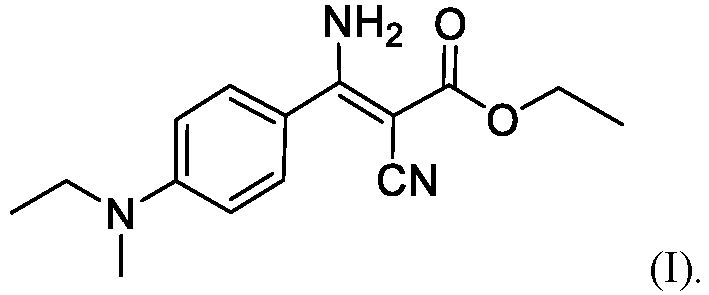
- The fungicide composition of claim 31, characterized in that the imidazole fungicide is at least one selected from the group consisting of prochloraz, carbendazim, prochloraz-manganese chloride complex, or thiophanate-methyl.
- The fungicide composition of claim 31, characterized in that a mass ratio of the compound ZJS178 to the imidazole fungicide in the composition is 60:1 to 1:60.
- The fungicide composition of claim 33, characterized in that the mass ratio of the compound ZJS178 to the imidazole fungicides in the composition is 20:1 to 1:20.
- The fungicide composition of claim 34, characterized in that the mass ratio of the compound ZJS178 to the imidazole fungicides in the composition is 12:1 to 1:12.
- The fungicide composition of claim 35, characterized in that the mass ratio of the compound ZJS178 to the imidazole fungicide in the composition is 6:1 to 1:6.
- The fungicide composition of claim 36, characterized in that the mass ratio of the compound ZJS178 to the imidazole fungicide in the composition is 3:1 to 1:3.
- The fungicide composition of any one of claims 31-37, characterized in that the fungicide composition further comprises an auxiliary ingredient required for pesticide formulations, and the mass percentage of active ingredients in the composition is 0.5-90 %.
- A use of the fungicide composition of any one of claims 31-37 in the prevention and treatment of crop diseases caused by Fusarium spp.
- The use of claim 39, characterized in that the Fusarium spp. comprises Fusarium graminearum species complex, Fusarium fujikuroi species complex, Fusarium oxysporum species complex, and Fusarium moniliforme.
- The use of claim 40, characterized in that the crop diseases comprise fusarium wilt of cucurbits, tomato fusarium wilt, banana fusarium wilt, cotton fusarium wilt, strawberry fusarium wilt, bakanal disease of rice, and wheat head blight.
- A fungicidal composition, characterized by comprising as active ingredients a compound ZJS 178 of formula (I) and a strobilurin fungicide,
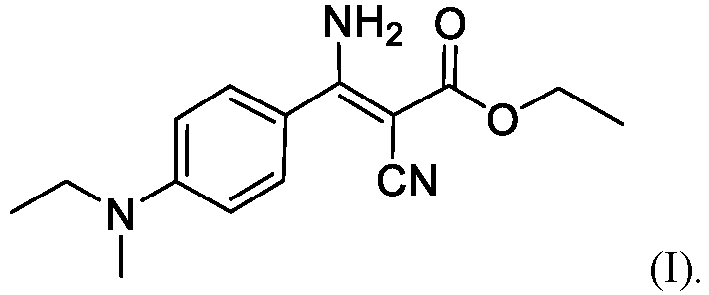
- The fungicidal composition of claim 42, characterized in that the strobilurin fungicide is at least one selected from the group consisting of azoxystrobin, trifloxystrobin, fluoxastrobin, picoxystrobin, pyraclostrobin, and fenaminstrobin.
- The fungicidal composition of claim 42, characterized in that a mass ratio of the compound ZJS178 to the strobilurin fungicide in the composition is 60:1 to 1:60.
- The fungicidal composition of claim 44, characterized in that the mass ratio of the compound ZJS178 to the strobilurin fungicide in the composition is 20:1-1:20.
- The fungicidal composition of claim 45, characterized in that the mass ratio of the compound ZJS178 to the strobilurin fungicide in the composition is 12:1-1:12.
- The fungicidal composition of claim 46, characterized in that the mass ratio of the compound ZJS178 to the strobilurin fungicide in the composition is 6:1 to 1:6.
- The fungicidal composition of claim 47, characterized in that the mass ratio of the compound ZJS178 to the strobilurin fungicide in the composition is 3:1 to 1:3.
- The fungicidal composition of any one of claims 42-48, characterized in that the fungicide composition further comprises an auxiliary ingredient required for pesticide formulations, and the mass percentage of active ingredients in the composition is 0.5-90 %.
- A use of the fungicidal composition of any one of claims 42-48 in the prevention and treatment of crop diseases caused by Fusarium spp.
- The use of claim 50, characterized in that the Fusarium spp. comprises Fusarium graminearum species complex, Fusarium fujikuroi species complex, Fusarium oxysporum species complex, and Fusarium moniliforme.
- The use of claim 51, characterized in that the crop diseases comprise fusarium wilt of cucurbits, tomato fusarium wilt, banana fusarium wilt, cotton fusarium wilt, strawberry fusarium wilt, bakanal disease of rice, and wheat head blight.
Applications Claiming Priority (4)
| Application Number | Priority Date | Filing Date | Title |
|---|---|---|---|
| CN202210792944.1A CN115005213B (en) | 2022-07-05 | 2022-07-05 | Bactericide composition and application thereof in prevention and treatment of fusarium disease of crops |
| CN202210805610.3A CN115005214B (en) | 2022-07-08 | 2022-07-08 | Efficient bactericidal composition for preventing and treating fusarium disease of crops |
| CN202210813382.4A CN115039778B (en) | 2022-07-11 | 2022-07-11 | Bactericide composition for preventing and treating crop diseases caused by fusarium |
| PCT/CN2022/107593 WO2024007376A1 (en) | 2022-07-05 | 2022-07-25 | Fungicidal compositions and uses thereof in prevention and treatment of fusarium diseases of crops |
Publications (2)
| Publication Number | Publication Date |
|---|---|
| EP4527200A1 true EP4527200A1 (en) | 2025-03-26 |
| EP4527200A4 EP4527200A4 (en) | 2025-07-30 |
Family
ID=89454031
Family Applications (1)
| Application Number | Title | Priority Date | Filing Date |
|---|---|---|---|
| EP22949956.1A Pending EP4527200A4 (en) | 2022-07-05 | 2022-07-25 | FUNGICIDAL COMPOSITIONS AND THEIR USES IN THE PREVENTION AND TREATMENT OF FUSARIUM DISEASES OF CROPS |
Country Status (8)
| Country | Link |
|---|---|
| US (1) | US20260026499A1 (en) |
| EP (1) | EP4527200A4 (en) |
| JP (1) | JP2025525444A (en) |
| KR (1) | KR102997226B1 (en) |
| AU (1) | AU2022468419B2 (en) |
| MX (1) | MX2024015358A (en) |
| WO (1) | WO2024007376A1 (en) |
| ZA (1) | ZA202410023B (en) |
Families Citing this family (2)
| Publication number | Priority date | Publication date | Assignee | Title |
|---|---|---|---|---|
| CN117481120A (en) * | 2022-07-25 | 2024-02-02 | 浙江省化工研究院有限公司 | A kind of fungicide composition for preventing and treating crop diseases caused by Fusarium |
| CN120827111B (en) * | 2025-09-17 | 2026-02-17 | 中国农业大学三亚研究院 | Sterilization composition containing WML-01 and triazole compound, preparation and application thereof |
Family Cites Families (11)
| Publication number | Priority date | Publication date | Assignee | Title |
|---|---|---|---|---|
| CN1160318C (en) * | 2001-05-08 | 2004-08-04 | 江苏省农药研究所 | 2-cyano-3-substituted phenylacrylate compounds, compositions and their preparing prcess and application as disinfectant of agricultural crops |
| CN1279817C (en) * | 2004-02-18 | 2006-10-18 | 江苏省农药研究所有限公司 | Bactericidal composition containing compound 2-cyano-3-amino-3-phenylacrylate ethyl ester |
| CN101417962B (en) | 2008-12-04 | 2013-05-01 | 江苏省农药研究所股份有限公司 | Method for preparing 2-cyano-3-amino acrylic ester derivates |
| CN101595890A (en) * | 2009-05-07 | 2009-12-09 | 深圳诺普信农化股份有限公司 | A kind of cyanoxystrobin and triazole composition and its application |
| CN103749454B (en) * | 2012-07-30 | 2015-09-09 | 陕西上格之路生物科学有限公司 | The bactericidal composition of a kind of 2-cyano-3-amino-3-phenylancryic acetate-containing and acid amide fungicides |
| CN104186480A (en) * | 2014-08-29 | 2014-12-10 | 安徽省农业科学院植物保护与农产品质量安全研究所 | Bactericidal composition containing JS399-19 and penflufen |
| CA3061572A1 (en) * | 2017-04-27 | 2018-11-01 | Upl Ltd | Fungicidal combinations comprising benzovindiflupyr andphenamacril, benzamacril, or a combination thereof |
| CN106962363B (en) * | 2017-05-27 | 2019-11-12 | 南京农业大学 | A synergistic weight reduction bactericidal composition containing metconazole |
| CN109867623B (en) * | 2019-02-27 | 2021-02-09 | 江苏省农药研究所股份有限公司 | 3-pyridyl-3-amino-2-cyanoacrylate compounds and preparation method and application thereof |
| CN109879834A (en) * | 2019-03-15 | 2019-06-14 | 江苏省农药研究所股份有限公司 | A kind of 3- amino -2- cyanoacrylate compound and its application |
| CN118058288B (en) * | 2019-11-25 | 2026-04-21 | 沈阳中化农药化工研发有限公司 | bactericidal compositions and their applications |
-
2022
- 2022-07-25 KR KR1020257001905A patent/KR102997226B1/en active Active
- 2022-07-25 JP JP2024577007A patent/JP2025525444A/en active Pending
- 2022-07-25 EP EP22949956.1A patent/EP4527200A4/en active Pending
- 2022-07-25 WO PCT/CN2022/107593 patent/WO2024007376A1/en not_active Ceased
- 2022-07-25 AU AU2022468419A patent/AU2022468419B2/en active Active
-
2024
- 2024-12-11 MX MX2024015358A patent/MX2024015358A/en unknown
- 2024-12-23 ZA ZA2024/10023A patent/ZA202410023B/en unknown
- 2024-12-29 US US19/004,425 patent/US20260026499A1/en active Pending
Also Published As
| Publication number | Publication date |
|---|---|
| KR102997226B1 (en) | 2026-07-29 |
| US20260026499A1 (en) | 2026-01-29 |
| MX2024015358A (en) | 2025-03-07 |
| ZA202410023B (en) | 2025-07-30 |
| AU2022468419B2 (en) | 2026-04-30 |
| KR20250025721A (en) | 2025-02-24 |
| WO2024007376A1 (en) | 2024-01-11 |
| EP4527200A4 (en) | 2025-07-30 |
| AU2022468419A1 (en) | 2025-01-09 |
| JP2025525444A (en) | 2025-08-05 |
Similar Documents
| Publication | Publication Date | Title |
|---|---|---|
| US20260026499A1 (en) | Fungicidal compositions and uses thereof in prevention and treatment of fusarium diseases of crops | |
| CN104886073B (en) | A kind of microbicide compositions and preparation and its application | |
| CN100500004C (en) | A kind of bactericidal composition containing difenoconazole and copper element bactericide | |
| CN105284821B (en) | Metconazole-containing pesticide composition for preventing and treating wheat head blight and use thereof | |
| CN106172421A (en) | A kind of containing metconazole and the bactericidal composition of Tebuconazole and application | |
| CN105961402B (en) | A kind of bactericidal composition and its application of jinggangmeisu and triticonazole | |
| CN102217599B (en) | Pesticide composition containing oxine-copper and kresoxim-methyl | |
| CN103563942A (en) | Bactericidal composition containing pyraclostrobin and epoxiconazole and application thereof | |
| CN115005213B (en) | Bactericide composition and application thereof in prevention and treatment of fusarium disease of crops | |
| CN102239850B (en) | Fluopicolpkd-containing agricultural bactericidal composition | |
| CN115005214B (en) | Efficient bactericidal composition for preventing and treating fusarium disease of crops | |
| CN106962363A (en) | A kind of collaboration decrement bactericidal composition containing metconazole | |
| CN102696624A (en) | Bactericidal composition containing difenoconazole and kresoxim-methyl | |
| CN102224820A (en) | Microbicidal composition containing benzene kresoxim-methyl and boscalid | |
| CN106259366B (en) | A bactericide composition | |
| CN105766937B (en) | The bactericidal composition and its application of a kind of jinggangmeisu and kind bacterium azoles | |
| CN102119697B (en) | A synergistic bactericidal composition containing fluazinam and carbendazim and its application | |
| CN106070236A (en) | A kind of containing kind of bacterium azoles and the bactericidal composition of Tebuconazole and application | |
| CN118435956A (en) | Sterilization composition and application thereof | |
| CN106857511A (en) | A kind of microbicide compositions comprising emodin derivates Yu pyrazol acid amide compounds | |
| CN104488869B (en) | A kind of bactericidal composition of the ethyl phenylacrylate of 2 cyano group, 3 amino 3 and Osthole | |
| CN107646859A (en) | A kind of purposes of effects enhancing and dose reducing biology-chemical pesticide composition in gibberella zeaze petch of wheat and barley is prevented and treated | |
| CN102224824B (en) | Sterilization composition containing kresoxim-methyl and iprodione | |
| CN115968893B (en) | Sterilization composition for preventing and treating fruit and vegetable fungal diseases and application thereof | |
| CN106561664B (en) | Bactericidal composition containing pyraclostrobin and mefenone |
Legal Events
| Date | Code | Title | Description |
|---|---|---|---|
| STAA | Information on the status of an ep patent application or granted ep patent |
Free format text: STATUS: THE INTERNATIONAL PUBLICATION HAS BEEN MADE |
|
| PUAI | Public reference made under article 153(3) epc to a published international application that has entered the european phase |
Free format text: ORIGINAL CODE: 0009012 |
|
| STAA | Information on the status of an ep patent application or granted ep patent |
Free format text: STATUS: REQUEST FOR EXAMINATION WAS MADE |
|
| 17P | Request for examination filed |
Effective date: 20241218 |
|
| AK | Designated contracting states |
Kind code of ref document: A1 Designated state(s): AL AT BE BG CH CY CZ DE DK EE ES FI FR GB GR HR HU IE IS IT LI LT LU LV MC MK MT NL NO PL PT RO RS SE SI SK SM TR |
|
| A4 | Supplementary search report drawn up and despatched |
Effective date: 20250701 |
|
| RIC1 | Information provided on ipc code assigned before grant |
Ipc: A01N 37/44 20060101AFI20250625BHEP Ipc: A01N 43/653 20060101ALI20250625BHEP Ipc: A01N 43/56 20060101ALI20250625BHEP Ipc: A01N 43/36 20060101ALI20250625BHEP Ipc: A01N 43/50 20060101ALI20250625BHEP Ipc: A01N 43/54 20060101ALI20250625BHEP Ipc: A01N 43/40 20060101ALI20250625BHEP Ipc: A01N 47/34 20060101ALI20250625BHEP Ipc: A01N 47/38 20060101ALI20250625BHEP Ipc: A01N 47/24 20060101ALI20250625BHEP Ipc: A01P 3/00 20060101ALI20250625BHEP |
|
| DAV | Request for validation of the european patent (deleted) | ||
| DAX | Request for extension of the european patent (deleted) | ||
| STAA | Information on the status of an ep patent application or granted ep patent |
Free format text: STATUS: EXAMINATION IS IN PROGRESS |