EP4525004A1 - Compound, molded body and cured product - Google Patents
Compound, molded body and cured product Download PDFInfo
- Publication number
- EP4525004A1 EP4525004A1 EP23819732.1A EP23819732A EP4525004A1 EP 4525004 A1 EP4525004 A1 EP 4525004A1 EP 23819732 A EP23819732 A EP 23819732A EP 4525004 A1 EP4525004 A1 EP 4525004A1
- Authority
- EP
- European Patent Office
- Prior art keywords
- soft magnetic
- compound
- coating film
- insulating coating
- magnetic powder
- Prior art date
- Legal status (The legal status is an assumption and is not a legal conclusion. Google has not performed a legal analysis and makes no representation as to the accuracy of the status listed.)
- Pending
Links
Images




Classifications
-
- B—PERFORMING OPERATIONS; TRANSPORTING
- B22—CASTING; POWDER METALLURGY
- B22F—WORKING METALLIC POWDER; MANUFACTURE OF ARTICLES FROM METALLIC POWDER; MAKING METALLIC POWDER; APPARATUS OR DEVICES SPECIALLY ADAPTED FOR METALLIC POWDER
- B22F1/00—Metallic powder; Treatment of metallic powder, e.g. to facilitate working or to improve properties
- B22F1/16—Metallic particles coated with a non-metal
-
- H—ELECTRICITY
- H01—ELECTRIC ELEMENTS
- H01F—MAGNETS; INDUCTANCES; TRANSFORMERS; SELECTION OF MATERIALS FOR THEIR MAGNETIC PROPERTIES
- H01F1/00—Magnets or magnetic bodies characterised by the magnetic materials therefor; Selection of materials for their magnetic properties
- H01F1/01—Magnets or magnetic bodies characterised by the magnetic materials therefor; Selection of materials for their magnetic properties of inorganic materials
- H01F1/03—Magnets or magnetic bodies characterised by the magnetic materials therefor; Selection of materials for their magnetic properties of inorganic materials characterised by their coercivity
- H01F1/12—Magnets or magnetic bodies characterised by the magnetic materials therefor; Selection of materials for their magnetic properties of inorganic materials characterised by their coercivity of soft-magnetic materials
- H01F1/14—Magnets or magnetic bodies characterised by the magnetic materials therefor; Selection of materials for their magnetic properties of inorganic materials characterised by their coercivity of soft-magnetic materials metals or alloys
- H01F1/20—Magnets or magnetic bodies characterised by the magnetic materials therefor; Selection of materials for their magnetic properties of inorganic materials characterised by their coercivity of soft-magnetic materials metals or alloys in the form of particles, e.g. powder
- H01F1/22—Magnets or magnetic bodies characterised by the magnetic materials therefor; Selection of materials for their magnetic properties of inorganic materials characterised by their coercivity of soft-magnetic materials metals or alloys in the form of particles, e.g. powder pressed, sintered, or bound together
- H01F1/24—Magnets or magnetic bodies characterised by the magnetic materials therefor; Selection of materials for their magnetic properties of inorganic materials characterised by their coercivity of soft-magnetic materials metals or alloys in the form of particles, e.g. powder pressed, sintered, or bound together the particles being insulated
- H01F1/26—Magnets or magnetic bodies characterised by the magnetic materials therefor; Selection of materials for their magnetic properties of inorganic materials characterised by their coercivity of soft-magnetic materials metals or alloys in the form of particles, e.g. powder pressed, sintered, or bound together the particles being insulated by macromolecular organic substances
-
- B—PERFORMING OPERATIONS; TRANSPORTING
- B22—CASTING; POWDER METALLURGY
- B22F—WORKING METALLIC POWDER; MANUFACTURE OF ARTICLES FROM METALLIC POWDER; MAKING METALLIC POWDER; APPARATUS OR DEVICES SPECIALLY ADAPTED FOR METALLIC POWDER
- B22F1/00—Metallic powder; Treatment of metallic powder, e.g. to facilitate working or to improve properties
- B22F1/05—Metallic powder characterised by the size or surface area of the particles
- B22F1/052—Metallic powder characterised by the size or surface area of the particles characterised by a mixture of particles of different sizes or by the particle size distribution
-
- B—PERFORMING OPERATIONS; TRANSPORTING
- B22—CASTING; POWDER METALLURGY
- B22F—WORKING METALLIC POWDER; MANUFACTURE OF ARTICLES FROM METALLIC POWDER; MAKING METALLIC POWDER; APPARATUS OR DEVICES SPECIALLY ADAPTED FOR METALLIC POWDER
- B22F1/00—Metallic powder; Treatment of metallic powder, e.g. to facilitate working or to improve properties
- B22F1/10—Metallic powder containing lubricating or binding agents; Metallic powder containing organic material
-
- B—PERFORMING OPERATIONS; TRANSPORTING
- B22—CASTING; POWDER METALLURGY
- B22F—WORKING METALLIC POWDER; MANUFACTURE OF ARTICLES FROM METALLIC POWDER; MAKING METALLIC POWDER; APPARATUS OR DEVICES SPECIALLY ADAPTED FOR METALLIC POWDER
- B22F1/00—Metallic powder; Treatment of metallic powder, e.g. to facilitate working or to improve properties
- B22F1/10—Metallic powder containing lubricating or binding agents; Metallic powder containing organic material
- B22F1/103—Metallic powder containing lubricating or binding agents; Metallic powder containing organic material containing an organic binding agent comprising a mixture of, or obtained by reaction of, two or more components other than a solvent or a lubricating agent
-
- C—CHEMISTRY; METALLURGY
- C08—ORGANIC MACROMOLECULAR COMPOUNDS; THEIR PREPARATION OR CHEMICAL WORKING-UP; COMPOSITIONS BASED THEREON
- C08G—MACROMOLECULAR COMPOUNDS OBTAINED OTHERWISE THAN BY REACTIONS ONLY INVOLVING UNSATURATED CARBON-TO-CARBON BONDS
- C08G59/00—Polycondensates containing more than one epoxy group per molecule; Macromolecules obtained by polymerising compounds containing more than one epoxy group per molecule using curing agents or catalysts which react with the epoxy groups
- C08G59/18—Macromolecules obtained by polymerising compounds containing more than one epoxy group per molecule using curing agents or catalysts which react with the epoxy groups ; e.g. general methods of curing
- C08G59/40—Macromolecules obtained by polymerising compounds containing more than one epoxy group per molecule using curing agents or catalysts which react with the epoxy groups ; e.g. general methods of curing characterised by the curing agents used
- C08G59/62—Alcohols or phenols
- C08G59/621—Phenols
-
- C—CHEMISTRY; METALLURGY
- C08—ORGANIC MACROMOLECULAR COMPOUNDS; THEIR PREPARATION OR CHEMICAL WORKING-UP; COMPOSITIONS BASED THEREON
- C08G—MACROMOLECULAR COMPOUNDS OBTAINED OTHERWISE THAN BY REACTIONS ONLY INVOLVING UNSATURATED CARBON-TO-CARBON BONDS
- C08G59/00—Polycondensates containing more than one epoxy group per molecule; Macromolecules obtained by polymerising compounds containing more than one epoxy group per molecule using curing agents or catalysts which react with the epoxy groups
- C08G59/18—Macromolecules obtained by polymerising compounds containing more than one epoxy group per molecule using curing agents or catalysts which react with the epoxy groups ; e.g. general methods of curing
- C08G59/68—Macromolecules obtained by polymerising compounds containing more than one epoxy group per molecule using curing agents or catalysts which react with the epoxy groups ; e.g. general methods of curing characterised by the catalysts used
- C08G59/686—Macromolecules obtained by polymerising compounds containing more than one epoxy group per molecule using curing agents or catalysts which react with the epoxy groups ; e.g. general methods of curing characterised by the catalysts used containing nitrogen
-
- C—CHEMISTRY; METALLURGY
- C22—METALLURGY; FERROUS OR NON-FERROUS ALLOYS; TREATMENT OF ALLOYS OR NON-FERROUS METALS
- C22C—ALLOYS
- C22C33/00—Making ferrous alloys
- C22C33/02—Making ferrous alloys by powder metallurgy
- C22C33/0257—Making ferrous alloys by powder metallurgy characterised by the range of the alloying elements
-
- H—ELECTRICITY
- H01—ELECTRIC ELEMENTS
- H01F—MAGNETS; INDUCTANCES; TRANSFORMERS; SELECTION OF MATERIALS FOR THEIR MAGNETIC PROPERTIES
- H01F1/00—Magnets or magnetic bodies characterised by the magnetic materials therefor; Selection of materials for their magnetic properties
- H01F1/01—Magnets or magnetic bodies characterised by the magnetic materials therefor; Selection of materials for their magnetic properties of inorganic materials
- H01F1/03—Magnets or magnetic bodies characterised by the magnetic materials therefor; Selection of materials for their magnetic properties of inorganic materials characterised by their coercivity
- H01F1/12—Magnets or magnetic bodies characterised by the magnetic materials therefor; Selection of materials for their magnetic properties of inorganic materials characterised by their coercivity of soft-magnetic materials
- H01F1/14—Magnets or magnetic bodies characterised by the magnetic materials therefor; Selection of materials for their magnetic properties of inorganic materials characterised by their coercivity of soft-magnetic materials metals or alloys
- H01F1/147—Alloys characterised by their composition
- H01F1/14766—Fe-Si based alloys
-
- H—ELECTRICITY
- H01—ELECTRIC ELEMENTS
- H01F—MAGNETS; INDUCTANCES; TRANSFORMERS; SELECTION OF MATERIALS FOR THEIR MAGNETIC PROPERTIES
- H01F1/00—Magnets or magnetic bodies characterised by the magnetic materials therefor; Selection of materials for their magnetic properties
- H01F1/01—Magnets or magnetic bodies characterised by the magnetic materials therefor; Selection of materials for their magnetic properties of inorganic materials
- H01F1/03—Magnets or magnetic bodies characterised by the magnetic materials therefor; Selection of materials for their magnetic properties of inorganic materials characterised by their coercivity
- H01F1/12—Magnets or magnetic bodies characterised by the magnetic materials therefor; Selection of materials for their magnetic properties of inorganic materials characterised by their coercivity of soft-magnetic materials
- H01F1/14—Magnets or magnetic bodies characterised by the magnetic materials therefor; Selection of materials for their magnetic properties of inorganic materials characterised by their coercivity of soft-magnetic materials metals or alloys
- H01F1/147—Alloys characterised by their composition
- H01F1/153—Amorphous metallic alloys, e.g. glassy metals
- H01F1/15358—Making agglomerates therefrom, e.g. by pressing
- H01F1/15366—Making agglomerates therefrom, e.g. by pressing using a binder
-
- H—ELECTRICITY
- H01—ELECTRIC ELEMENTS
- H01F—MAGNETS; INDUCTANCES; TRANSFORMERS; SELECTION OF MATERIALS FOR THEIR MAGNETIC PROPERTIES
- H01F1/00—Magnets or magnetic bodies characterised by the magnetic materials therefor; Selection of materials for their magnetic properties
- H01F1/01—Magnets or magnetic bodies characterised by the magnetic materials therefor; Selection of materials for their magnetic properties of inorganic materials
- H01F1/03—Magnets or magnetic bodies characterised by the magnetic materials therefor; Selection of materials for their magnetic properties of inorganic materials characterised by their coercivity
- H01F1/12—Magnets or magnetic bodies characterised by the magnetic materials therefor; Selection of materials for their magnetic properties of inorganic materials characterised by their coercivity of soft-magnetic materials
- H01F1/14—Magnets or magnetic bodies characterised by the magnetic materials therefor; Selection of materials for their magnetic properties of inorganic materials characterised by their coercivity of soft-magnetic materials metals or alloys
- H01F1/20—Magnets or magnetic bodies characterised by the magnetic materials therefor; Selection of materials for their magnetic properties of inorganic materials characterised by their coercivity of soft-magnetic materials metals or alloys in the form of particles, e.g. powder
- H01F1/22—Magnets or magnetic bodies characterised by the magnetic materials therefor; Selection of materials for their magnetic properties of inorganic materials characterised by their coercivity of soft-magnetic materials metals or alloys in the form of particles, e.g. powder pressed, sintered, or bound together
- H01F1/24—Magnets or magnetic bodies characterised by the magnetic materials therefor; Selection of materials for their magnetic properties of inorganic materials characterised by their coercivity of soft-magnetic materials metals or alloys in the form of particles, e.g. powder pressed, sintered, or bound together the particles being insulated
-
- H—ELECTRICITY
- H01—ELECTRIC ELEMENTS
- H01F—MAGNETS; INDUCTANCES; TRANSFORMERS; SELECTION OF MATERIALS FOR THEIR MAGNETIC PROPERTIES
- H01F1/00—Magnets or magnetic bodies characterised by the magnetic materials therefor; Selection of materials for their magnetic properties
- H01F1/01—Magnets or magnetic bodies characterised by the magnetic materials therefor; Selection of materials for their magnetic properties of inorganic materials
- H01F1/03—Magnets or magnetic bodies characterised by the magnetic materials therefor; Selection of materials for their magnetic properties of inorganic materials characterised by their coercivity
- H01F1/12—Magnets or magnetic bodies characterised by the magnetic materials therefor; Selection of materials for their magnetic properties of inorganic materials characterised by their coercivity of soft-magnetic materials
- H01F1/33—Magnets or magnetic bodies characterised by the magnetic materials therefor; Selection of materials for their magnetic properties of inorganic materials characterised by their coercivity of soft-magnetic materials mixtures of metallic and non-metallic particles; metallic particles having oxide skin
-
- H—ELECTRICITY
- H01—ELECTRIC ELEMENTS
- H01F—MAGNETS; INDUCTANCES; TRANSFORMERS; SELECTION OF MATERIALS FOR THEIR MAGNETIC PROPERTIES
- H01F3/00—Cores, Yokes, or armatures
- H01F3/08—Cores, Yokes, or armatures made from powder
-
- H—ELECTRICITY
- H05—ELECTRIC TECHNIQUES NOT OTHERWISE PROVIDED FOR
- H05K—PRINTED CIRCUITS; CASINGS OR CONSTRUCTIONAL DETAILS OF ELECTRIC APPARATUS; MANUFACTURE OF ASSEMBLAGES OF ELECTRICAL COMPONENTS
- H05K9/00—Screening of apparatus or components against electric or magnetic fields
- H05K9/0073—Shielding materials
- H05K9/0081—Electromagnetic shielding materials, e.g. EMI, RFI shielding
-
- B—PERFORMING OPERATIONS; TRANSPORTING
- B22—CASTING; POWDER METALLURGY
- B22F—WORKING METALLIC POWDER; MANUFACTURE OF ARTICLES FROM METALLIC POWDER; MAKING METALLIC POWDER; APPARATUS OR DEVICES SPECIALLY ADAPTED FOR METALLIC POWDER
- B22F1/00—Metallic powder; Treatment of metallic powder, e.g. to facilitate working or to improve properties
- B22F1/06—Metallic powder characterised by the shape of the particles
- B22F1/065—Spherical particles
-
- B—PERFORMING OPERATIONS; TRANSPORTING
- B22—CASTING; POWDER METALLURGY
- B22F—WORKING METALLIC POWDER; MANUFACTURE OF ARTICLES FROM METALLIC POWDER; MAKING METALLIC POWDER; APPARATUS OR DEVICES SPECIALLY ADAPTED FOR METALLIC POWDER
- B22F1/00—Metallic powder; Treatment of metallic powder, e.g. to facilitate working or to improve properties
- B22F1/06—Metallic powder characterised by the shape of the particles
- B22F1/068—Flake-like particles
-
- B—PERFORMING OPERATIONS; TRANSPORTING
- B22—CASTING; POWDER METALLURGY
- B22F—WORKING METALLIC POWDER; MANUFACTURE OF ARTICLES FROM METALLIC POWDER; MAKING METALLIC POWDER; APPARATUS OR DEVICES SPECIALLY ADAPTED FOR METALLIC POWDER
- B22F1/00—Metallic powder; Treatment of metallic powder, e.g. to facilitate working or to improve properties
- B22F1/08—Metallic powder characterised by particles having an amorphous microstructure
-
- B—PERFORMING OPERATIONS; TRANSPORTING
- B22—CASTING; POWDER METALLURGY
- B22F—WORKING METALLIC POWDER; MANUFACTURE OF ARTICLES FROM METALLIC POWDER; MAKING METALLIC POWDER; APPARATUS OR DEVICES SPECIALLY ADAPTED FOR METALLIC POWDER
- B22F1/00—Metallic powder; Treatment of metallic powder, e.g. to facilitate working or to improve properties
- B22F1/09—Mixtures of metallic powders
-
- B—PERFORMING OPERATIONS; TRANSPORTING
- B22—CASTING; POWDER METALLURGY
- B22F—WORKING METALLIC POWDER; MANUFACTURE OF ARTICLES FROM METALLIC POWDER; MAKING METALLIC POWDER; APPARATUS OR DEVICES SPECIALLY ADAPTED FOR METALLIC POWDER
- B22F2301/00—Metallic composition of the powder or its coating
- B22F2301/20—Refractory metals
-
- B—PERFORMING OPERATIONS; TRANSPORTING
- B22—CASTING; POWDER METALLURGY
- B22F—WORKING METALLIC POWDER; MANUFACTURE OF ARTICLES FROM METALLIC POWDER; MAKING METALLIC POWDER; APPARATUS OR DEVICES SPECIALLY ADAPTED FOR METALLIC POWDER
- B22F2301/00—Metallic composition of the powder or its coating
- B22F2301/35—Iron
-
- B—PERFORMING OPERATIONS; TRANSPORTING
- B22—CASTING; POWDER METALLURGY
- B22F—WORKING METALLIC POWDER; MANUFACTURE OF ARTICLES FROM METALLIC POWDER; MAKING METALLIC POWDER; APPARATUS OR DEVICES SPECIALLY ADAPTED FOR METALLIC POWDER
- B22F2302/00—Metal Compound, non-Metallic compound or non-metal composition of the powder or its coating
- B22F2302/25—Oxide
- B22F2302/256—Silicium oxide (SiO2)
-
- B—PERFORMING OPERATIONS; TRANSPORTING
- B22—CASTING; POWDER METALLURGY
- B22F—WORKING METALLIC POWDER; MANUFACTURE OF ARTICLES FROM METALLIC POWDER; MAKING METALLIC POWDER; APPARATUS OR DEVICES SPECIALLY ADAPTED FOR METALLIC POWDER
- B22F5/00—Manufacture of workpieces or articles from metallic powder characterised by the special shape of the product
- B22F5/10—Manufacture of workpieces or articles from metallic powder characterised by the special shape of the product of articles with cavities or holes, not otherwise provided for in the preceding subgroups
- B22F5/106—Tube or ring forms
-
- C—CHEMISTRY; METALLURGY
- C08—ORGANIC MACROMOLECULAR COMPOUNDS; THEIR PREPARATION OR CHEMICAL WORKING-UP; COMPOSITIONS BASED THEREON
- C08K—Use of inorganic or non-macromolecular organic substances as compounding ingredients
- C08K2201/00—Specific properties of additives
- C08K2201/01—Magnetic additives
-
- C—CHEMISTRY; METALLURGY
- C08—ORGANIC MACROMOLECULAR COMPOUNDS; THEIR PREPARATION OR CHEMICAL WORKING-UP; COMPOSITIONS BASED THEREON
- C08K—Use of inorganic or non-macromolecular organic substances as compounding ingredients
- C08K2201/00—Specific properties of additives
- C08K2201/014—Additives containing two or more different additives of the same subgroup in C08K
-
- C—CHEMISTRY; METALLURGY
- C08—ORGANIC MACROMOLECULAR COMPOUNDS; THEIR PREPARATION OR CHEMICAL WORKING-UP; COMPOSITIONS BASED THEREON
- C08K—Use of inorganic or non-macromolecular organic substances as compounding ingredients
- C08K3/00—Use of inorganic substances as compounding ingredients
- C08K3/02—Elements
- C08K3/08—Metals
-
- C—CHEMISTRY; METALLURGY
- C08—ORGANIC MACROMOLECULAR COMPOUNDS; THEIR PREPARATION OR CHEMICAL WORKING-UP; COMPOSITIONS BASED THEREON
- C08K—Use of inorganic or non-macromolecular organic substances as compounding ingredients
- C08K3/00—Use of inorganic substances as compounding ingredients
- C08K3/34—Silicon-containing compounds
- C08K3/36—Silica
-
- C—CHEMISTRY; METALLURGY
- C22—METALLURGY; FERROUS OR NON-FERROUS ALLOYS; TREATMENT OF ALLOYS OR NON-FERROUS METALS
- C22C—ALLOYS
- C22C38/00—Ferrous alloys, e.g. steel alloys
- C22C38/02—Ferrous alloys, e.g. steel alloys containing silicon
-
- C—CHEMISTRY; METALLURGY
- C22—METALLURGY; FERROUS OR NON-FERROUS ALLOYS; TREATMENT OF ALLOYS OR NON-FERROUS METALS
- C22C—ALLOYS
- C22C38/00—Ferrous alloys, e.g. steel alloys
- C22C38/18—Ferrous alloys, e.g. steel alloys containing chromium
Definitions
- the present disclosure relates to a compound, a molded body, and a cured product.
- a compound containing a soft magnetic powder and a thermosetting resin is used as a raw material for various industrial products required to have soft magnetic characteristics (refer to Patent Literatures 1 to 3 described below).
- the compound is used as a raw material for an inductor, a transformer, a reactor, a thyristor valve, a noise filter (an EMI filter), a choke coil, an iron core for a motor, a rotor and a yoke of a motor used for general household electrical appliances and industrial appliances, an electromagnetic shield, a solenoid core (a fixed iron core) for an electromagnetic valve, and the like.
- Pure iron or an iron-based alloy used as the soft magnetic powder of the related art has not only the soft magnetic characteristics (a comparatively high relative magnetic permeability or the like) but also electrical conduction properties. Therefore, the compound of the related art containing the soft magnetic powder does not have sufficient electrical insulating properties (a dielectric withstanding voltage or the like). As the content of the soft magnetic powder in the compound increases, the soft magnetic characteristics increase, but the electrical insulating properties are degraded. The electrical insulating properties of the compound are improved by physically attaching glass to the surface of the soft magnetic powder (soft magnetic particles) in accordance with a mechano-fusion method or the like.
- the electrical insulating properties of the compound are improved by forming a coating film consisting of a phosphate or a phosphosilicate on the surface of the soft magnetic powder (the soft magnetic particles).
- the soft magnetic characteristics are degraded as the electrical insulating properties are improved, it is difficult to make the soft magnetic characteristics and the electrical insulating properties compatible.
- the mechanical strength for example, a bending strength
- a cured product of the compound of the related art is likely to decrease under a high-temperature and humidity environment.
- An object of one aspect of the present invention is to provide a compound excellent in soft magnetic characteristics and electrical insulating properties, a molded body containing the compound, and a cured product of the compound.
- one aspect of the present invention relates to [1] to [14] described below.
- the compound excellent in the soft magnetic characteristics and the electrical insulating properties, the molded body containing the compound, and the cured product of the compound are provided.
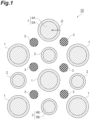
- a compound 10 contains a first soft magnetic powder (first soft magnetic particles 1), a second soft magnetic powder (second soft magnetic particles 2), and a resin composition 3.
- the resin composition 3 contains a thermosetting resin.
- the first soft magnetic powder is composed of a plurality of first soft magnetic particles 1 (a large number of first soft magnetic particles 1).
- the second soft magnetic powder is composed of a plurality of second soft magnetic particles 2 (a large number of second soft magnetic particles 2).
- Each of the first soft magnetic powder and the second soft magnetic powder may also be referred to as a metal filler.
- the resin composition 3 binds the metal fillers to each other.
- the compound may consist of only the first soft magnetic powder (the first soft magnetic particles 1), the second soft magnetic powder (the second soft magnetic particles 2), and the resin composition 3.
- the compound 10 may be a powder at an ordinary temperature (a room temperature).
- a molded body according to this embodiment contains the compound 10 described above.
- the molded body according to this embodiment may consist of only the compound 10.
- the molded body may contain other members such as a coil, in addition to the compound 10.
- the molded body according to this embodiment may contain one or both of an uncured product of the resin composition 3 and a semi-cured product of the resin composition 3 (the resin composition 3 in a stage B).
- a cured product according to this embodiment is the cured product of the compound 10 described above, and contains a cured product of the resin composition 3 (the resin composition 3 in a stage C).
- Soft magnetic characteristics for example, a high relative magnetic permeability
- Soft magnetic characteristics described below are characteristics common to the compound 10, the molded body, and the cured product.
- Electrical insulating properties for example, a high volume resistivity and a high dielectric withstanding voltage
- a mechanical strength for example, a high bending strength
- the particle diameter of the first soft magnetic powder is greater than the particle diameter of the second soft magnetic powder.
- the average particle diameter of the first soft magnetic powder may be greater than the average particle diameter of the second soft magnetic powder.
- D50 (the median diameter) of the first soft magnetic powder may be greater than D50 of the second soft magnetic powder.
- D90 of the first soft magnetic powder may be greater than D90 of the second soft magnetic powder.
- the compound 10 contains the first soft magnetic powder and the second soft magnetic powder as the metal filler
- the second soft magnetic particles 2 smaller than the first soft magnetic particles 1 are filled in the gaps between the plurality of first soft magnetic particles 1, and the filling rate of the metal filler in the compound 10 increases.
- the specific weight of the compound 10 increases.
- the soft magnetic characteristics are improved.
- the filling rate of the metal filler in the compound 10 increases, the cured product of the compound 10 becomes dense, and the mechanical strength of the cured product is improved.
- the average particle diameter of the first soft magnetic powder may be 11 ⁇ m or more and 45 ⁇ m or less.
- the average particle diameter of the second soft magnetic powder may be 0.1 ⁇ m or more and 9.0 ⁇ m or less.
- the filling rate of the metal filler in the compound 10 is likely to increase, and the soft magnetic characteristics and the mechanical strength are likely to be improved.
- the average particle diameter, D50, and D90 of the first soft magnetic powder may be calculated from a particle size distribution based on the number, the volume, or the mass of the first soft magnetic particles 1.
- the average particle diameter, D50, and D90 of the second soft magnetic powder may be calculated from a particle size distribution based on the number, the volume, or the mass of the second soft magnetic particles 2.
- Each of the particle size distributions may be measured by a laser diffraction particle size distribution analyzer.
- Each of the particle size distributions may be calculated on the basis of the measurement of the mass or the volume of each of the soft magnetic particles by sieving.
- the shape of each of the first soft magnetic particles 1 and the second soft magnetic particles 2 is not particularly limited.
- the shape of each of the first soft magnetic particles 1 and the second soft magnetic particles 2 may be a spherical shape, an approximately spherical shape, a flat shape, or an acicular shape.
- the compound 10 according to this embodiment may be a compound (an all-in-one type compound) containing one type of soft magnetic powder as a raw material, the particle diameter of one part of the one type of soft magnetic powder may be in the range of the average particle diameter of the first soft magnetic powder, and the particle diameter of the other part of the one type of soft magnetic powder may be in the range of the average particle diameter of the second soft magnetic powder.
- the number of peaks in the particle size distribution of the soft magnetic powder contained in the compound 10 may be one insofar as the compound 10 contains both of the first soft magnetic powder and the second soft magnetic powder.
- the particle size distribution curve of the first soft magnetic powder and the particle size distribution curve of the second soft magnetic powder may overlap each other to form a particle size distribution curve in which the number of apparent peaks is one.
- one peak in the particle size distribution of the soft magnetic powder contained in the compound 10 may be separated into a peak corresponding to the particle diameter of the first soft magnetic powder and another peak corresponding to the particle diameter of the second soft magnetic powder.
- the particle size distribution of the soft magnetic powder contained in the compound 10 may have at least two peaks. That is, the particle size distribution of the soft magnetic powder contained in the compound 10 may have a peak corresponding to the first soft magnetic powder and another peak corresponding to the second soft magnetic powder.
- the compound 10 according to this embodiment may be a mixture of a compound containing only the first soft magnetic powder as the soft magnetic powder and a compound containing only the second soft magnetic powder as the soft magnetic powder.
- a part or all of the plurality of first soft magnetic particles 1 composing the first soft magnetic powder may include a metal portion 4A (core particle), and an insulating coating film 5A directly covering the metal portion 4A.
- Each of the first soft magnetic particles 1 may consist of only the metal portion 4A and the insulating coating film 5A.
- the insulating coating film 5A may directly cover a part or all of the metal portion 4A.
- a part or all of the insulating coating film 5A may be covered with the resin composition 3.
- At least a part or all of the metal portion 4A may be a soft magnetic alloy.
- the soft magnetic alloy contains at least iron (Fe), chromium (Cr), and silicon (Si).
- the insulating coating film 5A contains at least silica (SiO 2 ). SiO 2 may be the main component of the insulating coating film 5A.
- a region of the first soft magnetic particle 1 where a depth D (a distance) from the outermost surface of the first soft magnetic particle 1 (the insulating coating film 5A) is 0 nm or more and 100 nm or less will be referred to as a surface region.
- a content (a concentration) of Fe 2 O 3 in the surface region is 0% by atom or more and 10% by atom or less.
- the content (the concentration) of Fe 2 O 3 in the surface region may be identical to a sum of contents (concentrations) of Fe and O composing Fe 2 O 3 in the surface region.
- the content of Fe 2 O 3 in the insulating coating film 5A may be approximately or completely identical to the content of Fe 2 O 3 in the surface region, and the content of Fe 2 O 3 in the insulating coating film 5A may be 0% by atom or more and 10% by atom or less.
- the content of Fe 2 O 3 in the surface region may be measured by at least one analysis method of photoemission spectroscopy (XPS) and energy dispersive X-ray spectroscopy (EDX).
- the surface region may be a part or all of the insulating coating film 5A.
- the thickness of the insulating coating film 5A may be greater than or equal to the thickness of the surface region.
- the insulating coating film 5A may be a part or all of the surface region. That is, the thickness of the insulating coating film 5A may be less than or equal to the thickness of the surface region.
- the content (the concentration) of Fe 2 O 3 in the surface region may be 0.000% by atom or more and 0.045% by atom or less, or 0.045% by atom or more and 10.000% by atom or less.
- the insulating coating film 5A of the first soft magnetic particles 1 may be formed by a wet method.
- a raw material powder and a treatment liquid are used.
- Each of a plurality of raw material particles composing the raw material powder is a soft magnetic alloy containing Fe, Cr, and Si.
- Each of the raw material particles may consist of only Fe, Cr, and Si.
- Each of the raw material particles may further contain other elements, in addition to Fe, Cr, and Si.
- the treatment liquid contains metal alkoxide as a solute (a reactive substrate), and contains an aqueous solution of alcohol as a solvent.
- the metal alkoxide may be at least one alkoxysilane of tetraethoxysilane and tetramethoxysilane.
- the surface of the raw material particles reacts with the treatment liquid.
- the surface of the raw material particles is changed to the insulating coating film 5A (or the surface region described above), and the inside of the raw material particles remains as the metal portion 4A.
- SiO 2 (and Fe 2 O 3 ) composing the insulating coating film 5A (or the surface region) may be generated by a reaction between Si (and Fe) composing the surface of the raw material particles and the solute in the treatment liquid.
- At least a part of Si composing SiO 2 in the insulating coating film 5A (or the surface region) may be derived from Si composing the raw material particles, or Fe composing Fe 2 O 3 in the insulating coating film 5A (or the surface region) may be derived from Fe composing the raw material particles.
- At least a part of Si composing SiO 2 in the insulating coating film 5A (or the surface region) may be derived from the alkoxysilane in the treatment liquid. Since Cr contained in the raw material particles suppresses the generation of Fe 2 O 3 in the surface region, SiO 2 is more likely to be generated than Fe 2 O 3 in the insulating coating film 5A and the surface region.
- a portion of the metal portion 4A in contact with the insulating coating film 5A may contain Cr, or Cr contained in the portion of the metal portion 4A in contact with the insulating coating film 5A may suppress the generation of Fe 2 O 3 in the insulating coating film 5A.
- the surface region, where the content of Fe 2 O 3 is 0% by atom or more and 10% by atom or less, is formed.
- the thickness of the insulating coating film 5A is likely to increase, and the content of SiO 2 in the insulating coating film 5A and the surface region is likely to increase.
- the thickness of the insulating coating film 5A is likely to increase, and the content of SiO 2 in the insulating coating film 5A and the surface region is likely to increase.
- the raw material powder and the treatment liquid may be stirred.
- the raw material powder and the treatment liquid may be heated at an appropriate reaction temperature.
- the volume resistivity of the first soft magnetic powder is likely to affect the electrical insulating properties (for example, the dielectric withstanding voltage) of the entire compound 10. Since each of the first soft magnetic particles 1 composing the first soft magnetic powder includes the insulating coating film 5A covering the metal portion 4A, the first soft magnetic powder may have a high volume resistivity. Further, since both of the insulating coating film 5A and the resin composition 3 are interposed between the adjacent metal portions 4A in the compound 10, an insulation breakdown in the compound 10 is suppressed. Therefore, the compound 10, the molded body, and the cured product may have a high dielectric withstanding voltage.
- the surface of each of the first soft magnetic particles 1 may have a large number of hydroxyl groups (silanol groups).
- the equipotential of the surface of each of the first soft magnetic particles 1 is shifted to an acid side.
- the wettability and the reactivity of the first soft magnetic particles 1 and the resin composition 3 are improved, and the first soft magnetic particles 1 in the cured product of the compound 10 are strongly bonded to each other via the cured product of the resin composition 3.
- the cured product of the compound 10 may have a high mechanical strength even under a high-temperature and humidity environment.
- the insulating coating film 5A contains SiO 2 , and the content of Fe 2 O 3 in the surface region is 0% by atom or more and 10% by atom or less, not only the soft magnetic characteristics but also the electrical insulating properties are improved. Therefore, according to this embodiment, even in a case where the content of the metal filler in the compound is high, it is easy to make the soft magnetic characteristics and the electrical insulating properties compatible.
- the total content of the first soft magnetic powder and the second soft magnetic powder in the whole of the compound 10 may be 94% by mass or more and 98% by mass or less, or 95.5% by mass or more and 96.0% by mass or less.
- the content of the resin composition 3 in the whole of the compound 10 may be 2.0% by mass or more and 6.0% by mass or less, or 4.0% by mass or more and 4.5% by mass or less.
- the soft magnetic characteristics of the compound are improved as the content of the metal filler in the compound increases.
- the content of the resin composition 3 contributing to the electrical insulating properties and the mechanical strength decreases, and the electrical insulating properties and the mechanical strength are degraded.
- the compound has a high relative magnetic permeability, but it is difficult for the compound to have excellent electrical insulating properties, and it is difficult for the cured product of the compound to have a high mechanical strength.
- the compound is likely to have not only excellent soft magnetic characteristics but also excellent electrical insulating properties, and the cured product of the compound is likely to have a high mechanical strength.
- An insulating coating film consisting of only at least one of SiO 2 and glass physically attached to the surface of the metal portion 4A (the metal particles) may be excluded from the insulating coating film 5A in the present invention.
- An insulating coating film formed by a method (for example, a dry method) other than the wet method may be excluded from the insulating coating film 5A in the present invention.
- the dry method may be a method (mechano-fusion) for physically attaching an insulating substance containing at least one of SiO 2 and glass to the surface of the metal particles.
- the dry method may include physically mixing (physically blending) the insulating substance containing at least one of SiO 2 and glass and the metal particles.
- the insulating coating film 5A consists of only at least one of SiO 2 and glass physically attached to the surface of the metal portion 4A (the metal particles), at least one of the soft magnetic characteristics, the electrical insulating properties, and the mechanical strength is inferior to that of this embodiment.
- the insulating coating film 5A does not have to contain phosphorus (P).
- the insulating coating film 5A does not have to contain a phosphate (phosphate glass) containing at least one of Fe, Si, and Cr.
- the phosphate is at least one of an inorganic phosphate and an organic phosphate.
- the insulating coating film 5A does not have to contain a phosphosilicate (phosphosilicate glass) containing at least one of Fe and Cr.
- the insulating coating film 5A may contain a slight amount of phosphorus.
- the insulating coating film 5A may contain a slight amount of phosphate.
- the insulating coating film 5A may contain a slight amount of phosphosilicate.
- the insulating coating film 5A may further contain Fe 2 O 3 , in addition to SiO 2 .
- SiO 2 and Fe 2 O 3 may be mixed in the insulating coating film 5A.
- the maximum value of the content (the concentration) of Fe 2 O 3 in the surface region may be greater than 0% by atom and 10% by atom or less, 0.84% by atom or more and 10% by atom or less, 1.29% by atom or more and 10% by atom or less, or 0.84% by atom or more and 1.30% by atom or less.
- the content of Fe 2 O 3 in the insulating coating film 5A may be greater than 0% by atom and 10% by atom or less, 0.84% by atom or more and 10% by atom or less, 1.29% by atom or more and 10% by atom or less, or 0.84% by atom or more and 1.30% by atom or less.
- the content of SiO 2 in the surface region may be greater than the content of Fe 2 O 3 in the surface region.
- the content (the concentration) of SiO 2 in the surface region may be 7.99% by atom or more and 50.00% by atom or less, 11.03% by atom or more and 50.00% by atom or less, 23% by atom or more and 50% by atom or less, 7.99% by atom or more and 32.00% by atom or less, 11.03% by atom or more and 32.00% by atom or less, 27% by atom or more and 32% by atom or less, or 7.99% by atom or more and 11.03% by atom or less.
- the content (the concentration) of SiO 2 in the surface region may be identical to the total content (concentration) of Si and O composing SiO 2 in the surface region.
- the content of SiO 2 in the surface region may be measured by at least one analysis method of XPS and EDX.
- the content of SiO 2 in the insulating coating film 5A may be approximately or completely identical to the content of SiO 2 in the surface region.
- the insulating coating film 5A does not have to contain chromium.
- the insulating coating film 5A may contain chromium.
- the insulating coating film 5A may contain an oxide of chromium (for example, Cr 2 O 3 ), in addition to SiO 2 .
- SiO 2 and an oxide of chromium (for example, Cr 2 O 3 ) may be mixed in the insulating coating film 5A.
- the insulating coating film 5A may contain an oxide of chromium (for example, Cr 2 O 3 ), in addition to SiO 2 and Fe 2 O 3 .
- SiO 2 , Fe 2 O 3 , and an oxide of chromium (for example, Cr 2 O 3 ) may be mixed in the insulating coating film 5A.
- the insulating coating film 5A may consist of only an oxide of silicon (for example, SiO 2 ).
- the insulating coating film 5A may consist of only SiO 2 and Fe 2 O 3 .
- the insulating coating film 5A may consist of SiO 2 , Fe 2 O 3 , and an oxide of chromium (for example, Cr 2 O 3 ).
- the insulating coating film 5A may contain a composite oxide (for example, a composite oxide containing silicon).
- the insulating coating film 5A may further contain other elements or compounds (for example, carbon or a carbon compound), in addition to Si, Fe, Cr, and O.
- the composition of the surface region may be approximately or completely identical to the composition of the insulating coating film 5A. Unless the insulating properties of the insulating coating film 5A are impaired, the insulating coating film 5A or the surface region may contain a slight amount of one or more types of metals (containing Si) common to the metal portion 4A.
- the thickness of the insulating coating film 5A may be 10 nm or more and 200 nm or less, or 20 nm or more and 40 nm or less. In a case where the thickness of the insulating coating film 5A is 10 nm or more, the volume resistivity of the first soft magnetic powder sufficiently increases, and the electrical insulating properties are likely to be improved. Since not only the insulating coating film 5A but also the resin composition 3 have the electrical insulating properties, both of the insulating coating film 5A and the resin composition 3 contribute to the suppression of the insulation breakdown between the metal fillers.
- the insulating coating film 5A may have sufficient electrical insulating properties.
- the thickness of the insulating coating film 5A is 200 nm or less, the soft magnetic characteristics are likely to be improved.
- the compound 10 is likely to be kneaded, the heated compound 10 is likely to be fluid, the formation of voids (air gaps) in the cured product of the compound 10 is suppressed, and the mechanical strength is likely to be improved.
- the thickness of the insulating coating film 5A may be approximately or completely even.
- the thickness of the insulating coating film 5A may be measured on the cross-sectional surface of the first soft magnetic particles using a transmission electron microscope (TEM) and EDX.
- TEM transmission electron microscope
- the relative magnetic permeability of the cured product of the compound 10 may be 23 or more and 27 or less.
- the relative magnetic permeability of the cured product of the compound 10 may be 23 or more and 26 or less, or 23.9 or more and 25.7 or less.
- the content of Fe in the metal portion 4A composing the first soft magnetic particles 1, for example, may be 70.0% by mass or more and 99.8% by mass or less.
- the content of Cr in the metal portion 4A for example, may be 0.1% by mass or more and 15.0% by mass or less.
- the content of Si in the metal portion 4A for example, may be 0.1% by mass or more and 15.0% by mass or less.
- the metal portion 4A may consist of only Fe, Cr, and Si.
- the metal portion 4A, as with the second soft magnetic particles 2 described below, may further contain other elements, in addition to Fe, Cr, and Si.
- the metal portion 4A may be crystalline or amorphous.
- the content of each element in the metal portion 4A may be measured by at least one analysis method of XPS and EDX.
- the second soft magnetic particles 2 contain a soft magnetic material.
- the second soft magnetic particles 2 may contain iron.
- the second soft magnetic particles 2 may contain at least one element selected from the group consisting of a base metal element, a noble metal element, a transition metal element, and a rare earth element, in addition to iron.
- the metal element other than iron contained in the second soft magnetic particles 2 may be at least one element selected from the group consisting of copper (Cu), titanium (Ti), manganese (Mn), cobalt (Co), nickel (Ni), zinc (Zn), aluminum (Al), tin (Sn), chromium (Cr), barium (Ba), strontium (Sr), lead (Pb), and silver (Ag).
- the second soft magnetic particles 2 may contain a non-metal element, in addition to the metal element.
- the non-metal element contained in the second soft magnetic particles 2 may be at least one element selected from the group consisting of oxygen (O), beryllium (Be), phosphorus (P), boron (B), and silicon (Si).
- the second soft magnetic particles 2 may contain pure iron, or an alloy containing iron (an iron-based alloy).
- the second soft magnetic particles 2 may consist of only pure iron, or an alloy containing iron (an iron-based alloy).
- the iron-based alloy contained in the second soft magnetic particles 2 may be a Fe-Cr-Si-based alloy, a Fe-Cr-based alloy, a Fe-Si-based alloy, a Fe-Si-Al-based alloy, a Fe-Ni-based alloy, a Fe-Cu-Ni-based alloy, a Fe-Co-based alloy, or a Fe-Ni-Cr-based alloy.
- the iron or the iron-based alloy contained in the second soft magnetic particles 2 may be crystalline or amorphous.
- a part or all of the plurality of second soft magnetic particles 2 composing the second soft magnetic powder may include a metal portion 4B (core particles), and an insulating coating film 5B directly covering the metal portion 4B.
- Each of the second soft magnetic particles 2 may consist of only the metal portion 4B and the insulating coating film 5B.
- the insulating coating film 5B may directly cover a part or all of the surface of the metal portion 4B.
- a part or all of the insulating coating film 5B may be covered with the resin composition 3.
- the insulating coating film 5B composing the second soft magnetic particles 2 improves the electrical insulating properties.
- the metal portion 4B of the second soft magnetic particles 2 may contain pure iron or an iron-based alloy.
- the metal portion 4B of the second soft magnetic particles 2 may consist of only pure iron or an iron-based alloy.
- the metal portion 4B of the second soft magnetic particles 2 may contain iron, chromium, and silicon.
- the metal portion 4B of the second soft magnetic particles 2 may consist of only iron, chromium, and silicon.
- the composition of the metal portion 4B of the second soft magnetic particles 2 may be approximately or completely the same as the composition of the metal portion 4A of the first soft magnetic particles 1.
- the metal portion 4B of the second soft magnetic particles 2 may be crystalline or amorphous.
- the insulating coating film 5B of the second soft magnetic particles 2 may contain SiO 2 .
- the insulating coating film 5B of the second soft magnetic particles 2 may consist of only SiO 2 .
- the insulating coating film 5B of the second soft magnetic particles 2 may contain glass.
- the insulating coating film 5B of the second soft magnetic particles 2 may consist of only glass.
- the glass contained in the insulating coating film 5B of the second soft magnetic particles 2 may contain at least one element selected from the group consisting of oxygen (O), boron (B), sodium (Na), and aluminum (Al), in addition to silicon (Si).
- the glass contained in the insulating coating film 5B of the second soft magnetic particles 2 may be at least one of silicate glass (a silicate), phosphosilicate glass (a phosphosilicate), and borosilicate glass (a borosilicate).
- the insulating coating film 5B of the second soft magnetic particles 2 may contain at least SiO 2 , and the content (the concentration) of Fe 2 O 3 in a surface region of the second soft magnetic particles 2 where a depth (a distance) from the outermost surface of the second soft magnetic particles 2 (the insulating coating film 5B) is 0 nm or more and 100 nm or less may be 0% by atom or more and 10% by atom or less.
- composition of the insulating coating film 5B of the second soft magnetic particles 2 may be approximately or completely the same as the composition of the insulating coating film 5A of the first soft magnetic particles 1, and the insulating coating film 5B of the second soft magnetic particles 2 may have the same function as that of the insulating coating film 5A of the first soft magnetic particles 1 described above.
- the insulating coating film 5B of the second soft magnetic particles 2 may be formed by the wet method described above.
- a treatment liquid containing an inorganic phosphoric acid or an organic phosphoric acid may be used.
- the insulating coating film 5B of the second soft magnetic particles 2 may be formed by the dry method described above.
- the thickness of the insulating coating film 5B of the second soft magnetic particles 2 may be 5 nm or more and 40 nm or less. In a case where the insulating coating film 5B is 5 nm or more, the volume resistivity of the second soft magnetic powder sufficiently increases, and the electrical insulating properties are likely to be improved. Since not only the insulating coating film 5B but also the resin composition 3 have the electrical insulating properties, both of the insulating coating film 5B and the resin composition 3 contribute to the suppression of the insulation breakdown between the metal fillers. Therefore, even in a case where the insulating coating film 5B is thin, due to the contribution of the resin composition 3, the compound 10, the molded body, and the cured product may have sufficient electrical insulating properties. In a case where the insulating coating film 5B is 40 nm or less, the soft magnetic characteristics are likely to be improved. The thickness of the insulating coating film 5B of the second soft magnetic particles 2 may be approximately or completely even.
- composition of the second soft magnetic particles 2 (the metal portion 4B, and the insulating coating film 5B and the surface region), and the thickness of the insulating coating film 5B of the second soft magnetic particles 2 may be measured by the same method as that of the first soft magnetic particles 1.
- the mass of the first soft magnetic powder may be represented by M1, and the mass of the second soft magnetic powder may be represented by M2.
- M1/(M1 + M2) may be 0.70 or more and 0.95 or less
- M2/(M1 + M2) may be 0.05 or more and 0.30 or less.
- the second soft magnetic particles 2 smaller than the first soft magnetic particles 1 are likely to be filled in the gaps between the plurality of first soft magnetic particles 1, and the filling rate of the metal filler in the compound 10 (the specific weight of the compound 10) is likely to increase.
- the soft magnetic characteristics and the mechanical strength are likely to be improved.
- the compound 10 may further contain a non-metal filler, in addition to the first soft magnetic powder and the second soft magnetic powder.
- the compound 10 may contain a filler consisting of silica (SiO 2 ) (a particulate filling material), as the non-metal filler.
- the particle diameter of the non-metal filler may be approximately or completely identical to the particle diameter of the first soft magnetic powder or the second soft magnetic powder.
- the compound 10 may be fluidized by heating at a temperature lower than the thermal curing temperature of the resin composition 3, and the fluidized compound 10 may be molded.
- the compound 10 is likely to be used for transfer molding.
- the transfer molding is a type of injection molding method.
- the transfer molding may also be referred to as pressure molding.
- the transfer molding may include a step of heating and fluidizing the powdered compound 10 in a heating chamber, and a step of feeding (injecting) the fluidized compound 10 into a metallic mold from the heating chamber through a casting runner.
- the lowest melt viscosity of the compound 10 at 175°C may be 10 Pa ⁇ s or more and 250 Pa ⁇ s or less, or 52 Pa ⁇ s or more and 185 Pa ⁇ s or less.
- the spiral flow of the compound 10 at 175°C may be 30 cm or more and 200 cm or less, or 65 cm or more and 71 cm or less. Since the heated compound 10 has excellent fluidity in a case where each of the lowest melt viscosity and the spiral flow is in the range described above, the compound 10 is likely to flow through the narrow casting runner without a pause (without entrapping air bubbles), and is likely to be evenly filled in a space (a cavity) in the metallic mold. As a result thereof, it is possible to produce the molded body and the cured product thereof with few defects such as an air gap or burr by the transfer molding of the compound 10.
- the molding method of the compound 10 is not limited to the transfer molding.
- the molding method of the compound 10 may be extrusion molding or compression molding (powder compacting molding).
- the compound 10 may have both of the electrical insulating properties required for a sealing material for an electronic device and the soft magnetic characteristics (electromagnetic shielding capability) required for an electromagnetic shielding material. Therefore, the compound 10, and the molded body and the cured product thereof may be a sealing material also serving as an electromagnetic shielding material.
- the sealing material also serving as the electromagnetic shielding material may be a sealing material (such as underfill) for a semiconductor package such as an IC package and an LSI package.
- the compound 10 and the molded body thereof may be used as a raw material for a magnetic core of a coil. That is, the cured product of the compound 10 may be the magnetic core of the coil.
- a specific industrial product (a product containing a coil) produced by using the compound 10 may be an inductor, a transformer, a reactor, a thyristor valve, a noise filter (an EMI filter), a choke coil, a rotor and a yoke of a motor, a solenoid core (a fixed iron core) for an electromagnetic valve built in an electronically controlled fuel injector of an internal-combustion engine, and the like.
- the resin composition is the remaining portion (a non-volatile component) excluding the filler (the first soft magnetic powder, the second soft magnetic powder, and the like) and an organic solvent in the compound.
- the resin composition contains at least a thermosetting resin.
- the resin composition may further contain at least one component selected from the group consisting of a curing agent, a curing accelerator (a curing catalyst), a coupling agent, a wax (a mold release agent), and a flame retardant, in addition to the thermosetting resin. Specific examples of each component are as follows.
- the thermosetting resin contained in the resin composition may be at least one resin selected from the group consisting of an epoxy resin, a phenolic resin, a bismaleimide resin, a polyimide resin, and a polyamide imide resin.
- the resin composition may further contain other resins (for example, a thermosplastic resin), in addition to the thermosetting resin.
- the resin composition may further contain at least one other resin selected from the group consisting of a polyphenylene sulfide resin, an acrylic resin, polyethylene, polypropylene, polystyrene, polyvinyl chloride, polyethylene terephthalate, and a silicone resin.
- the epoxy resin may be at least one selected from the group consisting of a biphenyl-type epoxy resin, a stilbene-type epoxy resin, a diphenyl methane-type epoxy resin, a sulfur atom-containing epoxy resin, a novolac-type epoxy resin, a dicyclopentadiene-type epoxy resin, a salicylic aldehyde-type epoxy resin, a copolymerized epoxy resin of naphthols and phenols, an epoxidized aralkyl-type phenolic resin, a bisphenol-type epoxy resin, a glycidyl ether-type epoxy resin of alcohols, a glycidyl ether-type epoxy resin of a para-xylene-modified phenolic resin and/or a meta-xylene-modified phenolic resin, a glycidyl ether-type epoxy resin of terpene-modified phenolic resin, a cyclopentadiene-type epoxy resin, a
- At least a part of the epoxy resin may be naphthalene-type epoxy resin having a naphthalene structure.
- the naphthalene-type epoxy resin is a solid at an ordinary temperature.
- a product (the cured product of the compound) produced from the compound is likely to have a high mechanical strength at a room temperature and a high temperature.
- the naphthalene-type epoxy resin may be at least one epoxy resin selected from the group consisting of a naphthalene diepoxy compound, a naphthylene ether-type epoxy resin, a naphthalene novolac-type epoxy resin, a methylene-bonded dimer of a naphthalene diepoxy compound, a methylene-bonded body of a naphthalene monoepoxy compound and a naphthalene diepoxy compound, and the like.
- the epoxy resin may include a difunctional epoxy resin.
- the difunctional epoxy resin may be at least one of an ⁇ -naphthol-type epoxy resin and a ⁇ -naphthol-type epoxy resin.
- the epoxy resin may include at least one of a trifunctional epoxy resin and a tetrafunctional epoxy resin.
- the naphthalene-type epoxy resin described above may be at least one of a trifunctional epoxy resin and a tetrafunctional epoxy resin.
- the trifunctional epoxy resin is an epoxy resin composed of a structural unit having three epoxy groups.
- the tetrafunctional epoxy resin is an epoxy resin composed of a structural unit having four epoxy groups. In a case where the epoxy resin includes at least one of the trifunctional epoxy resin and the tetrafunctional epoxy resin, in the process of the thermal curing of the compound, the epoxy resins are three-dimensionally cross-linked to each other to form a strong cross-linked network.
- the movement of the epoxy resin in the cured product of the compound is likely to be suppressed under a high temperature. That is, the glass transition temperature of each of the trifunctional epoxy resin and the tetrafunctional epoxy resin is higher than the glass transition temperature of the difunctional epoxy resin. Therefore, in a case where the epoxy resin includes at least one of the trifunctional epoxy resin and the tetrafunctional epoxy resin, the cured product of the compound (the product produced from the compound) is likely to have a high mechanical strength at a high temperature.
- the compound may contain one type of epoxy resin among the epoxy resins described above.
- the compound may contain a plurality of types of epoxy resins among the epoxy resins described above.
- the curing agent is classified into a curing agent for curing the epoxy resin in a range from a low temperature to a room temperature and a thermal curable curing agent for curing the epoxy resin in association with heating.
- the curing agent for curing the epoxy resin in the range from the low temperature to the room temperature is aliphatic polyamine, polyaminoamide, polymercaptan, and the like.
- the thermal curable curing agent is aromatic polyamine, an acid anhydride, a phenol novolac resin, dicyan diamide (DICY), and the like.
- the curing agent may be preferably the thermal curable curing agent, more preferably the phenolic resin, and even more preferably the phenol novolac resin.
- the phenol novolac resin as the curing agent, the cured product of the epoxy resin with a high glass transition point is likely to be obtained. As a result thereof, the heat resistance of the cured product of the compound is likely to be improved.
- a part or all of the curing agent may be a phenolic resin.
- the phenolic resin may be at least one selected from the group consisting of an aralkyl-type phenolic resin, a dicyclopentadiene-type phenolic resin, a salicylic aldehyde-type phenolic resin, a novolac-type phenolic resin, a copolymerized phenolic resin of benzaldehyde-type phenol and aralkyl-type phenol, a para-xylene and/or meta-xylene-modified phenolic resin, a melamine-modified phenolic resin, a terpene-modified phenolic resin, a dicyclopentadiene-type naphthol resin, a cyclopentadiene-modified phenolic resin, a polycyclic aromatic ring-modified phenolic resin, a biphenyl-type phenolic resin, and a triphenyl methane-type
- the phenol novolac resin may be a resin obtained by condensing or co-condensing phenols and/or naphthols and aldehydes under an acid catalyst.
- the phenols composing the phenol novolac resin may be at least one selected from the group consisting of phenol, cresol, xylenol, resorcin, catechol, bisphenol A, bisphenol F, phenyl phenol, and aminophenol.
- the naphthols composing the phenol novolac resin may be at least one selected from the group consisting of ⁇ -naphthol, ⁇ -naphthol, and dihydroxynaphthalene.
- the aldehydes composing the phenol novolac resin may be at least one selected from the group consisting of formaldehyde, acetaldehyde, propionaldehyde, benzaldehyde, and salicylic aldehyde.
- the curing agent may be a compound having two phenolic hydroxyl groups in one molecule.
- the compound having two phenolic hydroxyl groups in one molecule may be at least one selected from the group consisting of resorcin, catechol, bisphenol A, bisphenol F, and substituted or non-substituted biphenol.
- the compound may contain, as the curing agent, one type of phenolic resin among the phenolic resins described above.
- the compound may contain, as the curing agent, a plurality of types of phenolic resins among the phenolic resins described above.
- a ratio of a hydroxyl equivalent of the phenolic resin to an epoxy equivalent of the epoxy resin may be 0.5 or more and 1.5 or less. That is, a ratio of an active group (a phenolic OH group) in the phenolic resin that reacts with the epoxy group in the epoxy resin may be 0.5 equivalents or more and 1.5 equivalents or less with respect to 1 equivalent of the epoxy group in the epoxy resin. In a case where the ratio of the active group in the phenolic resin is less than 0.5 equivalents, the amount of OH groups per unit mass of the epoxy resin after curing decreases, and the curing rate of the resin composition (the epoxy resin) decreases.
- the glass transition temperature of the obtained cured product is likely to decrease, and a sufficient elastic modulus of the cured product is less likely to be obtained.
- the ratio of the active group in the phenolic resin is 1.5 equivalents or less, the cured product of the compound is likely to have a high mechanical strength.
- the curing accelerator (the curing catalyst) is not limited insofar as the curing accelerator is a composition reacting with the epoxy resin to accelerate the curing of the epoxy resin.
- the curing accelerator may be a urea compound.
- the curing accelerator may be imidazoles such as alkyl group-substituted imidazole or benzoimidazole.
- the curing accelerator may be a phosphorus-based curing accelerator.
- the phosphorus-based curing accelerator may be at least one curing accelerator selected from the group consisting of triphenyl phosphine-benzoquinone, tris-4-hydroxyphenyl phosphine-benzoquinone, tetraphenyl phosphonium/tetrakis(4-methyl phenyl) borate, tetra(n-butyl) phosphonium tetraphenyl borate, and the like.
- the cured product of the compound containing the curing accelerator described above is likely to have a high mechanical strength at a high temperature.
- the compound containing the curing accelerator described above is likely to be stably stored for a long period of time even under a high temperature and humidity environment.
- the compound may contain one type of curing accelerator.
- the compound may contain a plurality of types of curing accelerators.
- the blending amount of the curing accelerator is not particularly limited. From the viewpoint of improving the curing properties and the fluidity of the epoxy resin during moisture-absorption, the blending amount of the curing accelerator may be 0.1 parts by mass or more and 30 parts by mass or less with respect to 100 parts by mass of the epoxy resin. In a case where the blending amount of the curing accelerator is 0.1 parts by mass or more, a sufficient curing accelerating effect is likely to be obtained. In a case where the blending amount of the curing accelerator is 30 parts by mass or less, the compound is likely to be stably stored. From the same reason, the content of the curing accelerator may be 0.001 parts by mass or more and 5 parts by mass or less with respect to the total mass of the epoxy resin and the curing agent (for example, a phenolic resin).
- the curing agent for example, a phenolic resin
- the coupling agent may be a coupling agent that reacts with a glycidyl group of the resin composition such as an epoxy resin.
- the coupling agent improves adhesiveness between the first soft magnetic particles and the second soft magnetic particles and the resin composition, and improves the mechanical strength of the cured product of the compound.
- the coupling agent that reacts with the glycidyl group may be a silane-based compound (a silane coupling agent).
- the silane coupling agent for example, may be at least one selected from the group consisting of epoxy silane, mercaptosilane, aminosilane, alkyl silane, ureidosilane, acid anhydride-based silane, and vinyl silane.
- a more specific silane coupling agent may be at least one selected from the group consisting of vinyl trimethoxysilane, vinyl triethoxysilane, 2-(3,4-epoxy cyclohexyl) ethyl trimethoxysilane, 3-glycidoxypropyl methyl dimethoxysilane, 3-glycidoxypropyl trimethoxysilane, 3-glycidoxypropyl methyl diethoxysilane, 3-glycidoxypropyl methyl diethoxysilane, 3-glycidoxypropyl triethoxysilane, p-styryl trimethoxysilane, 3-methacryloxypropyl methyl dimethoxysilane, 3-methacryloxypropyl trimethoxysilane, 3-methacryloxypropyl methyl diethoxysilane, 3-methacryloxypropyl triethoxysilane, 3-acryloxypropyl trimethoxysilane, N-2-(amino
- a part or all of the coupling agent may have a succinic anhydride group.
- the adhesiveness between the first soft magnetic particles and the second soft magnetic particles and the resin composition such as an epoxy resin is likely to be improved, the coupling agent is likely to be cross-linked with the resin composition such as an epoxy resin under a high humidity environment, and the heat resistance and the weather resistance of the product produced from the compound (the cured product of the compound) are likely to be improved.
- the compound may contain one type of coupling agent among the coupling agents described above.
- the compound may contain a plurality of types of coupling agents among the coupling agents described above.
- the compound may contain a wax.
- the wax may also be referred to as a lubricant or a mold release agent.
- the wax may be at least one of a saturated fatty acid, a saturated fatty acid salt, and saturated fatty acid ester.
- the wax may be a synthetic wax.
- the wax may be at least one selected from the group consisting of a caproic acid, an enanthic acid, a caprylic acid, a pelargonic acid, a capric acid, a lauric acid, a myristic acid, a pentadecanoic acid, a palmitic acid, a margaric acid, a stearic acid, an arachidic acid, a heneicosylic acid, a behenic acid, a lignoceric acid, a cerotic acid, a montanic acid, a melissic acid, calcium caproate, barium caproate, calcium enanthate, barium enanthate, calcium caprylate, barium caprylate, calcium pelargonate, barium pelargonate, calcium caprate, barium caprate, calcium laurate, barium laurate, calcium myristate, calcium pentadecanoate, calcium palmitate, calcium margarate, calcium stea
- the compound may contain a wax other than the waxes described above.
- the wax may be at least one selected from the group consisting of a magnesium salt of the saturated fatty acid, an aluminum salt of the saturated fatty acid, a 12-oxystearic acid, calcium ricinoleate, stearic acid amide, oleic acid amide, erucic acid amide, behenic acid amide, palmitic acid amide, lauric acid amide, hydroxystearic acid amide, methylene bisstearic acid amide, ethylene bisstearic acid amide, ethylene bislauric acid amide, distearyl adipic acid amide, ethylene bisoleic acid amide, dioleyl adipic acid amide, N-stearyl stearic acid amide, N-oleyl stearic acid amide, N-stearyl erucic acid amide, methylol stearic acid amide, methylol behenic acid amide, ethylene glycol
- the compound may contain a flame retardant.
- the flame retardant may be at least one selected from the group consisting of a bromine-based flame retardant, a phosphorus-based flame retardant, a hydrated metal compound-based flame retardant, a silicone-based flame retardant, a nitrogen-containing compound, a hindered amine compound, an organic metal compound, and an aromatic engineering plastic.
- the compound may contain one type of flame retardant among the flame retardants described above, or may contain a plurality of types of flame retardants among the flame retardants described above.
- the compound is obtained by kneading the metal filler (the first soft magnetic powder and the second soft magnetic powder), each component composing the resin composition while heating.
- a kneading means may be a kneader, a roll, or a stirrer.
- the resin composition may cover a part or all of the surface of each of the soft magnetic particles composing the metal filler by heating and mixing the metal filler and the resin composition.
- a part or all of the resin composition may be a semi-cured product by heating and mixing the metal filler and the resin composition.
- the metal filler (the first soft magnetic powder and the second soft magnetic powder), and all the components composing the resin composition may be collectively kneaded.
- a mixture of the metal filler and the coupling agent may be prepared in advance, and the mixture may be kneaded with the other components of the resin composition.
- a mixture of each component of the resin composition excluding the curing accelerator and the metal filler may be prepared in advance, and the mixture may be kneaded with the curing accelerator.
- a mixture of each component of the resin composition excluding the wax and the metal filler may be prepared in advance, and the mixture may be kneaded with the wax.
- a kneading time depends on the kneading means, the volume of the kneading means, and the production amount of the compound.
- the kneading time is not limited.
- the kneading time may be 1 minute or longer, 2 minutes or longer, or 3 minutes or longer.
- the kneading time may be 20 minutes or shorter, 15 minutes or shorter, or 10 minutes or shorter. In a case where the kneading time is shorter than 1 minute, the kneading is insufficient, the moldability of the compound is impaired, and the curing degree of the compound varies.
- the temperature (the heating temperature) of the metal filler and the resin composition during kneading may be a temperature at which the semi-cured product of the thermosetting resin (the resin composition in the stage B) is generated, and the generation of the cured product of the thermosetting resin (the resin composition in the stage C) is suppressed.
- the heating temperature may be a temperature lower than the activation temperature of the curing accelerator.
- the heating temperature may be 50°C or higher, 60°C or higher, or 70°C or higher.
- the heating temperature may be 150°C or lower, 120°C or lower, or 110°C or lower.
- the resin composition during kneading is softened and likely to cover the surface of each of the soft magnetic particles, the semi-cured product of the thermosetting resin is likely to be generated, and the complete curing of the thermosetting resin is likely to be suppressed.
- the molded body is obtained by molding the compound described above.
- the thermal treatment of the molded body (the thermal curing of the resin composition in the molded body), the metal fillers are strongly bound to each other by the cured product of the resin composition, and the cured product of the compound is obtained.
- the molding method of the compound may be transfer molding, extrusion molding, or compression molding (powder compacting molding).
- the dimension and the shape of the metallic mold used to mold the compound may be selected in accordance with the industrial product produced by using the compound.
- the thermal treatment temperature of the molded body may be a temperature at which the resin composition in the molded body is sufficiently cured, or may be higher than or equal to the activation temperature of the curing accelerator.
- the thermal treatment temperature may be 100°C or higher and 300°C or lower, or 150°C or higher and 250°C or lower.
- the thermal treatment temperature is higher than 300°C, the metal filler is oxidized by a slight amount of oxygen inevitably contained in the atmosphere of the thermal treatment, or the resin cured product is degraded.
- the thermal treatment of the molded body may be performed under an inert atmosphere.
- the thermal treatment time may be several minutes or longer and 10 hours or shorter, or 5 minutes or longer and 8 hours or shorter.
- a first soft magnetic powder was prepared by the wet method described above.
- "6B2" manufactured by EPSON ATMIX Corporation
- "6B2” is a powder of a soft magnetic alloy consisting of Fe, Cr, and Si.
- the average particle diameter of "6B2” was 24 ⁇ m.
- the average particle diameter of a second soft magnetic powder was approximately identical to the average particle diameter of the raw material powder (6B2).
- the particle diameter of the first soft magnetic powder was even.
- a plurality of first soft magnetic particles composing the first soft magnetic powder were analyzed by the following XPS method.
- the plurality of first soft magnetic particles were arranged on the surface of a flat base material without a gap and adhered to the surface of the base material.
- the particle diameter of the plurality of first soft magnetic particles adhering to the surface of the base material was even. From the same reason, the plurality of first soft magnetic particles were disposed on the surface of the base material such that the plurality of first soft magnetic particles do not overlap each other in a direction perpendicular to the surface of the base material.
- the ion etching of the surface of each of the plurality of first soft magnetic particles adhering to the surface of the base material, and the detection of photoelectrons discharged from the cross-sectional surface of each of the first soft magnetic particles exposed by the ion etching were repeated.
- the average composition of the surface region of the first soft magnetic particles where a depth D from the outermost surface of the first soft magnetic particles was 0 nm or more and 100 nm or less was analyzed.
- An X-ray simultaneously applied to the plurality of first soft magnetic particles during the measurement described above was a K ⁇ -ray of Al.
- the diameter of the spot of the X-ray was 200 ⁇ m.
- an X-ray photoemission spectroscope K-Alpha
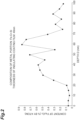
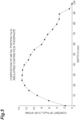
- FIG. 2 illustrates the distribution of the content of Fe 2 O 3 in the surface region of the first soft magnetic particles of Example 1.
- the distribution illustrated in FIG. 2 is a distribution measured by the XPS method described above.
- the minimum value of the content of Fe 2 O 3 in the surface region of Example 1 was approximately 0.045% by atom.
- the maximum value of the content of Fe 2 O 3 in the surface region of Example 1 was approximately 0.848% by atom.
- the content (the minimum value) of SiO 2 in the surface region of Example 1 was 11.03% by atom.
- the cross-sectional surface of the first soft magnetic particles was analyzed.
- the result of the analysis by TEM and EDX was approximately coincident with the result of the analysis by XPS.
- the first soft magnetic particles consisted of a metal portion, and an insulating coating film directly covering the entire metal portion.
- the metal portion contained a soft magnetic alloy consisting of iron, chromium, and silicon.
- the main component (a component other than the detected Fe 2 O 3 ) of the insulating coating film was SiO 2 .
- SiO 2 that is the main component, and a slight amount of Fe 2 O 3 were mixed in the insulating coating film.
- the average value of the thickness of the insulating coating film was 40 nm.
- a second soft magnetic powder was prepared by the wet method described above.
- "SAP-2C” is a powder of a soft magnetic alloy consisting of Fe, Cr, and Si.
- the average particle diameter of "SAP-2C” was 2 ⁇ m.
- the average particle diameter of the second soft magnetic powder was approximately identical to the average particle diameter of the raw material powder (SAP-2C).
- the particle diameter of the second soft magnetic powder was even.
- the average particle diameter of the second soft magnetic powder was less than the average particle diameter of the first soft magnetic powder.
- a plurality of second soft magnetic particles composing the second soft magnetic powder were analyzed by the method described above, as with the first soft magnetic particles. The result of the analysis indicated that the second soft magnetic particles have the following characteristics.
- the second soft magnetic particles consisted of a metal portion, and an insulating coating film directly covering the entire metal portion.
- the metal portion contained a soft magnetic alloy consisting of iron, chromium, and silicon.
- the main component of the insulating coating film was SiO 2 .
- the average value of the thickness of the insulating coating film was 5 nm.
- an epoxy resin As a component composing a resin composition, an epoxy resin, a curing agent, a curing accelerator (a catalyst), a coupling agent, and a wax (a mold release agent) were used.
- NC-3000 is a biphenyl aralkyl-type epoxy resin.
- the mass of "NC-3000” was 60 g.
- “TECHMORE VG3101L” is a trifunctional epoxy resin, and is a derivative of 1-[ ⁇ -methyl- ⁇ -(4-hydroxyphenyl) ethyl]-4-[ ⁇ , ⁇ -bis(4-hydroxyphenyl) ethyl] benzene.
- the mass of "TECHMORE VG3101L” was 40 g.
- HF-3M As the curing agent, "HF-3M”, manufactured by UBE Corporation (formerly Meiwa Plastic Industries, Ltd), was used. "HF-3M” is a phenolic resin. The mass of “HF-3M” was 43.2 g.
- U-CAT3512T As the curing accelerator (the catalyst), "U-CAT3512T”, manufactured by San-Apro Ltd., was used. "U-CAT3512T” is aromatic dimethyl urea.
- KBM-803 is 3-mercaptopropyl trimethoxysilane.
- the mass of "KBM-803” was 1.9 g.
- KBM-5803 is 8-methacryloxyoctyl trimethoxysilane.
- the mass of "KBM-5803” was 1.9 g.
- “Licowax OP” As the wax (the mold release agent), "Licowax OP", manufactured by Clariant Chemicals Co., Ltd., was used. “Licowax OP” is montanic acid ester partially gelled by calcium hydroxide. The mass of “Licowax OP” was 2.0 g.
- a compound (a powder) of Example 1 was obtained by kneading, as the raw material of the compound, all the components of the first soft magnetic powder, the second soft magnetic powder, and the resin composition while heating.
- the temperature of the raw material during kneading was 130°C at maximum.
- the total content of a metal filler (the first soft magnetic powder and the second soft magnetic powder) in the compound was adjusted to 95.5% by mass. In other words, the total content of the resin composition in the compound was adjusted to 4.5% by mass.
- a ratio (M1/(M1 + M2) described above) of the mass of the first soft magnetic powder to the metal filler was adjusted to 0.82. In other words, a ratio (M2/(M1 + M2) described above) of the mass of the second soft magnetic powder to the metal filler was adjusted to 0.18.
- a sample was obtained by transfer molding of the compound of Example 1 at 175°C, and post curing (heating at 175°C for 5.5 hours) subsequent to the transfer molding.
- a pressure applied to the compound during the transfer molding was 13.5 MPa.
- the sample was in the shape of a rectangular parallelepiped.
- the dimension of the sample was Vertical Width of 80 mm ⁇ Horizontal Width of 10 mm ⁇ Thickness of 3.0 mm.
- AGS-500A manufactured by SHIMADZU CORPORATION, a three-point support-type bending test was implemented. In the bending test, one surface of the sample was supported by two support points F disposed at an interval of 64 mm.
- a load W was applied to the center position between two support points F on the other surface of the sample.
- a load when the sample was damaged was measured as a bending strength (Unit: MPa).
- the bending strength of Example 1 measured at a room temperature in the atmosphere is shown in Table 1 described below.
- the bending strength of Example 1 measured at a high temperature (250°C) in the atmosphere is shown in Table 1 described below.
- PCT pressure cooker test
- the bending strength measured at a room temperature before PCT is 100 MPa or more.
- “A” described in the section “Room temperature” indicates that the bending strength measured at a room temperature before PCT is 100 MPa or more.
- “B” described in the section “Room temperature” indicates that the bending strength measured at a room temperature before PCT is less than 100 MPa.
- the bending strength measured at a high temperature (250°C) before PCT is 8 MPa or more.
- “A” described in the section “High temperature” indicates that the bending strength measured at a high temperature before PCT is 8 MPa or more.
- “B” described in the section “High temperature” indicates that the bending strength measured at a high temperature before PCT is less than 8 MPa.
- the bending strength measured at a room temperature in the atmosphere after PCT is 80 MPa or more.
- A described in the section “After PCT” indicates that the bending strength measured after PCT is 80 MPa or more.
- B described in the section “after PCT” indicates that the bending strength measured after PCT is less than 80 MPa.
- a test piece was obtained by the transfer molding of the compound of Example 1 at 175°C, and the post curing (heating at 175°C for 5.5 hours) subsequent to the transfer molding.
- a pressure applied to the compound during the transfer molding was 13.5 MPa.
- the test piece was in the shape of a column.
- the dimension of the test piece was a diameter of 50 mm ⁇ Thickness of 2 mm.
- a voltage was applied between a pair of stainless steel electrodes provided on the test piece by using a sourcemeter. The current in the test piece was continuously measured while continuously increasing the voltage. Then, a voltage (an insulation breakdown voltage) when the current passing through the test piece exceeded 10 mA was read out.
- the test described above was repeated a total of 14 times by the same method except that the position of the electrode was different.
- the central value of the insulation breakdown voltage read out in the fourteenth test is defined as the dielectric withstanding voltage (Unit: V/mm) of the test piece.
- V/mm dielectric withstanding voltage
- As the sourcemeter a high-voltage dielectric characteristic evaluation apparatus, manufactured by Yamayo Tester Co., Ltd., was used.
- the dielectric withstanding voltage of Example 1 is shown in Table 1 described below.
- the dielectric withstanding voltage is 200 V/mm or more.
- “A” described in the section “Dielectric withstanding voltage” indicates that the dielectric withstanding voltage is 200 V/mm or more.
- “B” described in the section “Dielectric withstanding voltage” indicates that the dielectric withstanding voltage is less than 200 V/mm.
- a toroidal molded body was obtained by the transfer molding of the compound of Example 1 at 175°C, and the post curing (heating at 175°C for 5.5 hours) subsequent to the transfer molding.
- a pressure applied to the compound during the transfer molding was 6.9 MPa.
- the dimension of the molded body was Outer Diameter of 20 mm ⁇ Inner Diameter of 12 mm ⁇ Thickness of 2 mm.
- Primary winding was wound around the molded body by 5 turns, and secondary winding was wound around the molded body by 5 turns.
- the relative magnetic permeability of the sample prepared by the method described above was measured. In the measurement of the relative magnetic permeability, a B-H analyzer (SY-8258), manufactured by IWATSU ELECTRIC CO., LTD., was used. A frequency when measuring the relative magnetic permeability was 1 MHz.
- the relative magnetic permeability of Example 1 is shown in Table 1 described below.
- the relative magnetic permeability is 23 or more.
- “A” described in the section “Relative magnetic permeability” indicates that the relative magnetic permeability is 23 or more.
- “B” described in the section “Relative magnetic permeability” indicates that the relative magnetic permeability is less than 23.
- the compound was accommodated in a transfer molding machine provided with a metallic mold.
- the spiral flow (Unit: cm) of the compound was measured at a metallic mold temperature of 175°C and an injection pressure of 6.9 MPa for a molding time of 120 seconds.
- the spiral flow is a length that the compound flows into a groove formed in the metallic mold. That is, the spiral flow is the fluid distance of the softened or liquefied compound.
- the groove into which the compound flows is in the shape of a spiral curve (a spiral of Archimedes). As the compound is likely to be fluid, the spiral flow increases.
- As the transfer molding machine a 100 KN transfer molding machine (PZ-10 type), manufactured by Kodaira Seisakusho Co., Ltd., was used.
- As the metallic mold a metallic mold based on ASTM D3123 was used.
- the spiral flow of Example 1 is shown in Table 1 described below.
- Example 1 The lowest melt viscosity of the compound of Example 1 at 175°C was measured using a viscometer. As the viscometer, CFT-100 (a flow tester), manufactured by SHIMADZU CORPORATION, was used. The lowest melt viscosity of Example 1 is shown in Table 1 described below.
- Example 2 a first soft magnetic powder of Example 2 was prepared by the wet method using "6B2" as the raw material powder.
- the thickness of the insulating coating film was adjusted to 20 nm.
- the first soft magnetic powder of Example 2 was analyzed by the same method as that in Example 1. Even in Example 2, the result of the analysis by TEM and EDX was approximately coincident with the result of the analysis by XPS. The results of the analysis of Example 2 were as follows.
- FIG. 3 illustrates the distribution of the content of Fe 2 O 3 in the surface region of first soft magnetic particles of Example 2.
- the minimum value of the content Fe 2 O 3 in the surface region of Example 2 was approximately 0.000% by atom.
- the maximum value of the content of Fe 2 O 3 in the surface region of Example 2 was approximately 1.295% by atom.
- the content (the minimum value) of SiO 2 in the surface region of Example 2 was 7.99% by atom.
- the first soft magnetic particles of Example 2 consisted of a metal portion, and an insulating coating film directly covering the entire metal portion.
- Example 2 contained a soft magnetic alloy consisting of iron, chromium, and silicon.
- the main component (a component other than the detected Fe 2 O 3 ) of the insulating coating film of Example 2 was SiO 2 .
- SiO 2 that is the main component, and a slight amount of Fe 2 O 3 were mixed in the insulating coating film of Example 2.
- a compound of Example 2 was prepared by the same method as that in Example 1 except for the composition and the thickness of the insulating coating film of the first soft magnetic particles. Measurement using the compound of Example 2 was implemented by the same method as that in Example 1. The measurement results of Example 2 are shown in Table 1 described below.
- the total content of a metal filler (a first soft magnetic powder and a second soft magnetic powder) in a compound of Example 3 was adjusted to 96.0% by mass. In other words, the total content of a resin composition in the compound of Example 3 was adjusted to 4.0% by mass.
- Example 3 The compound of Example 3 was prepared by the same method as that in Example 1 except for the above respects. Measurement using the compound of Example 3 was implemented by the same method as that in Example 1. The measurement results of Example 3 are shown in Table 1 described below.
- “9A4" As a first soft magnetic powder of Comparative Example 1, "9A4", manufactured by EPSON ATMIX Corporation, was used. "9A4" is a powder of a soft magnetic alloy consisting of Fe and Si, and does not contain Cr. The average particle diameter of "9A4" was 24 ⁇ m. In Comparative Example 1, an insulating coating film of first soft magnetic particles was not formed. The particle diameter of the first soft magnetic powder consisting of "9A4" was even.
- the first soft magnetic powder of Comparative Example 1 was analyzed by the same method as that in Example 1.
- FIG. 4 illustrates the distribution of the content of Fe 2 O 3 in the surface region of the first soft magnetic particles of Comparative Example 1.
- the maximum value of the content of Fe 2 O 3 in the surface region of Comparative Example 1 was considerably greater than 10% by atom.
- the detected Fe 2 O 3 in Comparative Example 1 is derived from a native oxide formed on the surface of the first soft magnetic particles.
- a compound of Comparative Example 1 was prepared by the same method as that in Example 1 except for the composition of the first soft magnetic powder. Measurement using the compound of Comparative Example 1 was implemented by the same method as that in Example 1. The measurement results of Comparative Example 1 are shown in Table 1 described below.
- first soft magnetic particles of Comparative Example 2 were composed of a metal portion of an alloy consisting of Fe and Si, and an insulating coating film consisting of iron oxide and a phosphate.
- the particle diameter of the first soft magnetic powder of Comparative Example 2 was even.
- the first soft magnetic powder of Comparative Example 2 was analyzed by the same method as that in Example 1.
- FIG. 5 illustrates the distribution of the content of Fe 2 O 3 in the surface region of the first soft magnetic particles of Comparative Example 2.
- the maximum value of the content of Fe 2 O 3 in the surface region of Comparative Example 2 was greater than 10% by atom.
- a compound of Comparative Example 2 was prepared by the same method as that in Example 1 except for the composition of the first soft magnetic powder. Measurement using the compound of Comparative Example 2 was implemented by the same method as that in Example 1. The measurement results of Comparative Example 2 are shown in Table 1 described below.
- a compound of Comparative Example 3 was prepared by the same method as that in Example 1 except for the composition of the first soft magnetic powder. Measurement using the compound of Comparative Example 3 was implemented by the same method as that in Example 1. The measurement results of Comparative Example 3 are shown in Table 1 described below.
- a compound of Comparative Example 4 was prepared by the same method as that in Example 1 except for the composition of the first soft magnetic powder. Measurement using the compound of Comparative Example 4 was implemented by the same method as that in Example 1. The measurement results of Comparative Example 4 are shown in Table 1 described below.
- first soft magnetic particles of Comparative Example 5 were composed of a metal portion of an alloy consisting of Fe, Cr, and Si, and an insulating coating film consisting of iron oxide and a phosphate.
- the particle diameter of the first soft magnetic powder of Comparative Example 5 was even.
- the first soft magnetic powder of Comparative Example 5 was analyzed by the same method as that in Example 1.
- FIG. 7 illustrates the distribution of the content in Fe 2 O 3 in the surface region of the first soft magnetic particles of Comparative Example 5.
- a compound of Comparative Example 5 was prepared by the same method as that in Example 1 except for the composition of the first soft magnetic powder. Measurement using the compound of Comparative Example 5 was implemented by the same method as that in Example 1. The measurement results of Comparative Example 5 are shown in Table 1 described below.
- Example 1 Example 2
- Example 3 Total content of metal filler (Unit: % by mass) 95.5 95.5 95.5 95.5 95.5 95.5 95.5 95.5 96.0
- First soft magnetic powder Metal portion Fe-Si (9A4) Fe-Si (9A4) Fe-Si (9A4) Fe-Cr-Si (6B2) Fe-Cr-Si (6B2) Fe-Cr-Si (6B2) Fe-Cr-Si (6B2) Fe-Cr-Si (6B2) Fe-Cr-Si (6B2) Fe-Cr-Si (6B2) Insulating coating film None Phosphate None None Phosphate Silica Silica Thickness of insulating coating film (Unit: mm) 0 10 0 0 10 40 20 40 Bending strength (Unit: MPa) Room temperature 77 88 98 98 94 116 109 141 B B B B B A A A High temperature 5 5 5 5 6 11 13 13 B B B B B A A A After PCT 52 36 63 82 30 101
- a green compact 1 was formed by compressing the raw material powder (6B2) used in Example 1 at a pressure shown in Table 2 described below without implementing the wet method for forming the insulating coating film.
- the volume resistivity (Unit: ⁇ cm) of the green compact 1 formed at each pressure was measured.
- the volume resistivity of the green compact 1 formed at each pressure is shown in Table 2 described below.
- a green compact 2 was formed by compressing the first soft magnetic powder of Example 1 at a pressure shown in Table 2 described below. The volume resistivity of the green compact 2 formed at each pressure was measured. The volume resistivity of the green compact 2 formed at each pressure is shown in Table 2 described below.
- the compound according to one aspect of the present invention may be used for a coil component, an electromagnetic shield, or a semiconductor package.
- first soft magnetic particles first soft magnetic powder
- second soft magnetic particles second soft magnetic powder
- resin composition resin composition
- 4A, 4B metal portion
- 5A, 5B insulating coating film
- 10 compound.
Landscapes
- Chemical & Material Sciences (AREA)
- Engineering & Computer Science (AREA)
- Power Engineering (AREA)
- Dispersion Chemistry (AREA)
- Physics & Mathematics (AREA)
- Chemical Kinetics & Catalysis (AREA)
- Electromagnetism (AREA)
- Organic Chemistry (AREA)
- Health & Medical Sciences (AREA)
- Medicinal Chemistry (AREA)
- Polymers & Plastics (AREA)
- Microelectronics & Electronic Packaging (AREA)
- Materials Engineering (AREA)
- Mechanical Engineering (AREA)
- Metallurgy (AREA)
- Spectroscopy & Molecular Physics (AREA)
- Soft Magnetic Materials (AREA)
Abstract
Description
- The present disclosure relates to a compound, a molded body, and a cured product.
- A compound containing a soft magnetic powder and a thermosetting resin is used as a raw material for various industrial products required to have soft magnetic characteristics (refer to
Patent Literatures 1 to 3 described below). For example, the compound is used as a raw material for an inductor, a transformer, a reactor, a thyristor valve, a noise filter (an EMI filter), a choke coil, an iron core for a motor, a rotor and a yoke of a motor used for general household electrical appliances and industrial appliances, an electromagnetic shield, a solenoid core (a fixed iron core) for an electromagnetic valve, and the like. -
- Patent Literature 1:
Japanese Unexamined Patent Publication No. 2009-94428 - Patent Literature 2:
Japanese Unexamined Patent Publication No. 2019-104954 - Patent Literature 3: International Publication
WO 2020/217476 - Pure iron or an iron-based alloy used as the soft magnetic powder of the related art has not only the soft magnetic characteristics (a comparatively high relative magnetic permeability or the like) but also electrical conduction properties. Therefore, the compound of the related art containing the soft magnetic powder does not have sufficient electrical insulating properties (a dielectric withstanding voltage or the like). As the content of the soft magnetic powder in the compound increases, the soft magnetic characteristics increase, but the electrical insulating properties are degraded. The electrical insulating properties of the compound are improved by physically attaching glass to the surface of the soft magnetic powder (soft magnetic particles) in accordance with a mechano-fusion method or the like. Alternatively, the electrical insulating properties of the compound are improved by forming a coating film consisting of a phosphate or a phosphosilicate on the surface of the soft magnetic powder (the soft magnetic particles). However, since there is a tendency that the soft magnetic characteristics are degraded as the electrical insulating properties are improved, it is difficult to make the soft magnetic characteristics and the electrical insulating properties compatible. Further, the mechanical strength (for example, a bending strength) of a cured product of the compound of the related art is likely to decrease under a high-temperature and humidity environment.
- In order to apply the compound containing the soft magnetic powder to various industrial products, it is desirable to improve the soft magnetic characteristics and the electrical insulating properties of the compound.
- An object of one aspect of the present invention is to provide a compound excellent in soft magnetic characteristics and electrical insulating properties, a molded body containing the compound, and a cured product of the compound.
- For example, one aspect of the present invention relates to [1] to [14] described below.
- [1] A compound containing:
- a first soft magnetic powder;
- a second soft magnetic powder; and
- a resin composition,
- wherein the resin composition contains a thermosetting resin,
- a particle diameter of the first soft magnetic powder is greater than a particle diameter of the second soft magnetic powder,
- first soft magnetic particles composing the first soft magnetic powder include a metal portion, and an insulating coating film directly covering the metal portion,
- at least a part of the metal portion is a soft magnetic alloy containing iron, chromium, and silicon,
- the insulating coating film contains SiO2, and
- a content of Fe2O3 in a surface region of the first soft magnetic particles where a depth from an outermost surface of the first soft magnetic particles is 100 nm or less is 0% by atom or more and 10% by atom or less.
- [2] The compound according to 1],
- wherein a lowest melt viscosity of the compound at 175°C is 10 Pa·s or more and 250 Pa·s or less, and
- a spiral flow of the compound at 175°C is 30 cm or more and 200 cm or less.
- [3] The compound according to [1] or [2],
wherein the compound fluidized by heating is molded (pressed). - [4] The compound according to any one of [1] to [3],
wherein a thickness of the insulating coating film is 10 nm or more and 200 nm or less. - [5] The compound according to any one of [1] to [4],
- wherein the insulating coating film further contains Fe2O3, and
- a maximum value of the content of Fe2O3 in the surface region is greater than 0% by atom and 10% by atom or less.
- [6] The compound according to [5],
wherein SiO2 and Fe2O3 are mixed in the insulating coating film. - [7] The compound according to any one of [1] to [6],
wherein the insulating coating film does not contain phosphorus. - [8] The compound according to any one of [1] to [7],
wherein a total content of the first soft magnetic powder and the second soft magnetic powder in the whole of the compound is 94% by mass or more and 98% by mass or less. - [9] The compound according to any one of [1] to [8],
wherein the resin composition contains an epoxy resin, a curing agent, and a coupling agent. - [10] The compound according to any one of [1] to [9],
wherein a content of SiO2 in the surface region is greater than the content of Fe2O3 in the surface region. - [11] The compound according to any one of [1] to [10],
wherein the compound is used for a magnetic core of a coil. - [12] The compound according to any one of [1] to [10],
wherein the compound is a sealing material also serving as an electromagnetic shielding material. - [13] A molded body (a compact) containing
the compound according to any one of [1] to [12]. - [14] A cured product of the compound according to any one of [1] to [12].
- According to one aspect of the present invention, the compound excellent in the soft magnetic characteristics and the electrical insulating properties, the molded body containing the compound, and the cured product of the compound are provided.
-
- [
FIG. 1] FIG. 1 is a schematic cross-sectional view of a compound according to one embodiment of the present invention. - [
FIG. 2] FIG. 2 illustrates a distribution of a content of Fe2O3 in a surface region of first soft magnetic particles used in Example 1 of the present invention. - [
FIG. 3] FIG. 3 illustrates a distribution of a content of Fe2O3 in a surface region of first soft magnetic particles used in Example 2 of the present invention. - [
FIG. 4] FIG. 4 illustrates a distribution of a content of Fe2O3 in a surface region of first soft magnetic particles used in Comparative Example 1. - [
FIG. 5] FIG. 5 illustrates a distribution of a content of Fe2O3 in a surface region of first soft magnetic particles used in Comparative Example 2. - [
FIG. 6] FIG. 6 illustrates a distribution of a content of Fe2O3 in a surface region of first soft magnetic particles used in Comparative Example 4. - [
FIG. 7] FIG. 7 illustrates a distribution of a content of Fe2O3 in a surface region of first soft magnetic particles used in Comparative Example 5. - Hereinafter, a preferred embodiment of the present invention will be described with reference to the drawings. In the drawings, equivalent reference numerals are applied to equivalent constituents. The present invention is not limited to the following embodiment.
- As illustrated in
FIG. 1 , acompound 10 according to this embodiment contains a first soft magnetic powder (first soft magnetic particles 1), a second soft magnetic powder (second soft magnetic particles 2), and aresin composition 3. Theresin composition 3 contains a thermosetting resin. The first soft magnetic powder is composed of a plurality of first soft magnetic particles 1 (a large number of first soft magnetic particles 1). The second soft magnetic powder is composed of a plurality of second soft magnetic particles 2 (a large number of second soft magnetic particles 2). Each of the first soft magnetic powder and the second soft magnetic powder may also be referred to as a metal filler. In a molded body containing thecompound 10 or a cured product of thecompound 10, theresin composition 3 binds the metal fillers to each other. Further, theresin composition 3 interposed between the adjacent metal fillers electrically insulates the adjacent metal fillers. The compound may consist of only the first soft magnetic powder (the first soft magnetic particles 1), the second soft magnetic powder (the second soft magnetic particles 2), and theresin composition 3. Thecompound 10 may be a powder at an ordinary temperature (a room temperature). - A molded body according to this embodiment contains the
compound 10 described above. The molded body according to this embodiment may consist of only thecompound 10. The molded body may contain other members such as a coil, in addition to thecompound 10. The molded body according to this embodiment may contain one or both of an uncured product of theresin composition 3 and a semi-cured product of the resin composition 3 (theresin composition 3 in a stage B). A cured product according to this embodiment is the cured product of thecompound 10 described above, and contains a cured product of the resin composition 3 (theresin composition 3 in a stage C). Soft magnetic characteristics (for example, a high relative magnetic permeability) described below are characteristics common to thecompound 10, the molded body, and the cured product. Electrical insulating properties (for example, a high volume resistivity and a high dielectric withstanding voltage) described below are also characteristics common to thecompound 10, the molded body, and the cured product. A mechanical strength (for example, a high bending strength) described below is the characteristics of the cured product of thecompound 10. - The particle diameter of the first soft magnetic powder is greater than the particle diameter of the second soft magnetic powder. For example, the average particle diameter of the first soft magnetic powder may be greater than the average particle diameter of the second soft magnetic powder. For example, D50 (the median diameter) of the first soft magnetic powder may be greater than D50 of the second soft magnetic powder. For example, D90 of the first soft magnetic powder may be greater than D90 of the second soft magnetic powder. In a case where the
compound 10 contains only the first soft magnetic powder with a large particle diameter as the metal filler, gaps are likely to be formed between the plurality of adjacent first softmagnetic particles 1, and the filling rate of the metal filler in thecompound 10 is less likely to increase. On the other hand, in a case where thecompound 10 contains the first soft magnetic powder and the second soft magnetic powder as the metal filler, the second softmagnetic particles 2 smaller than the first softmagnetic particles 1 are filled in the gaps between the plurality of first softmagnetic particles 1, and the filling rate of the metal filler in thecompound 10 increases. In other words, since thecompound 10 contains the first soft magnetic powder and the second soft magnetic powder with different particle diameters, the specific weight of thecompound 10 increases. As a result thereof, the soft magnetic characteristics are improved. Further, as the filling rate of the metal filler in thecompound 10 increases, the cured product of thecompound 10 becomes dense, and the mechanical strength of the cured product is improved. - For example, the average particle diameter of the first soft magnetic powder may be 11 µm or more and 45 µm or less. For example, the average particle diameter of the second soft magnetic powder may be 0.1 µm or more and 9.0 µm or less. In a case where the average particle diameter of the first soft magnetic powder is in the range described above, and the average particle diameter of the second soft magnetic powder is in the range described above, the filling rate of the metal filler in the
compound 10 is likely to increase, and the soft magnetic characteristics and the mechanical strength are likely to be improved. - The average particle diameter, D50, and D90 of the first soft magnetic powder may be calculated from a particle size distribution based on the number, the volume, or the mass of the first soft
magnetic particles 1. The average particle diameter, D50, and D90 of the second soft magnetic powder may be calculated from a particle size distribution based on the number, the volume, or the mass of the second softmagnetic particles 2. Each of the particle size distributions may be measured by a laser diffraction particle size distribution analyzer. Each of the particle size distributions may be calculated on the basis of the measurement of the mass or the volume of each of the soft magnetic particles by sieving. The shape of each of the first softmagnetic particles 1 and the second softmagnetic particles 2 is not particularly limited. For example, the shape of each of the first softmagnetic particles 1 and the second softmagnetic particles 2 may be a spherical shape, an approximately spherical shape, a flat shape, or an acicular shape. - The
compound 10 according to this embodiment may be a compound (an all-in-one type compound) containing one type of soft magnetic powder as a raw material, the particle diameter of one part of the one type of soft magnetic powder may be in the range of the average particle diameter of the first soft magnetic powder, and the particle diameter of the other part of the one type of soft magnetic powder may be in the range of the average particle diameter of the second soft magnetic powder. - The number of peaks in the particle size distribution of the soft magnetic powder contained in the
compound 10 may be one insofar as thecompound 10 contains both of the first soft magnetic powder and the second soft magnetic powder. For example, the particle size distribution curve of the first soft magnetic powder and the particle size distribution curve of the second soft magnetic powder may overlap each other to form a particle size distribution curve in which the number of apparent peaks is one. In other words, one peak in the particle size distribution of the soft magnetic powder contained in thecompound 10 may be separated into a peak corresponding to the particle diameter of the first soft magnetic powder and another peak corresponding to the particle diameter of the second soft magnetic powder. - The particle size distribution of the soft magnetic powder contained in the
compound 10 may have at least two peaks. That is, the particle size distribution of the soft magnetic powder contained in thecompound 10 may have a peak corresponding to the first soft magnetic powder and another peak corresponding to the second soft magnetic powder. - The
compound 10 according to this embodiment may be a mixture of a compound containing only the first soft magnetic powder as the soft magnetic powder and a compound containing only the second soft magnetic powder as the soft magnetic powder. - As illustrated in
FIG. 1 , a part or all of the plurality of first softmagnetic particles 1 composing the first soft magnetic powder may include ametal portion 4A (core particle), and an insulatingcoating film 5A directly covering themetal portion 4A. Each of the first softmagnetic particles 1 may consist of only themetal portion 4A and the insulatingcoating film 5A. The insulatingcoating film 5A may directly cover a part or all of themetal portion 4A. A part or all of the insulatingcoating film 5A may be covered with theresin composition 3. - At least a part or all of the
metal portion 4A may be a soft magnetic alloy. The soft magnetic alloy contains at least iron (Fe), chromium (Cr), and silicon (Si). The insulatingcoating film 5A contains at least silica (SiO2). SiO2 may be the main component of the insulatingcoating film 5A. A region of the first softmagnetic particle 1 where a depth D (a distance) from the outermost surface of the first soft magnetic particle 1 (the insulatingcoating film 5A) is 0 nm or more and 100 nm or less will be referred to as a surface region. A content (a concentration) of Fe2O3 in the surface region is 0% by atom or more and 10% by atom or less. The content (the concentration) of Fe2O3 in the surface region may be identical to a sum of contents (concentrations) of Fe and O composing Fe2O3 in the surface region. The content of Fe2O3 in the insulatingcoating film 5A may be approximately or completely identical to the content of Fe2O3 in the surface region, and the content of Fe2O3 in the insulatingcoating film 5A may be 0% by atom or more and 10% by atom or less. The content of Fe2O3 in the surface region may be measured by at least one analysis method of photoemission spectroscopy (XPS) and energy dispersive X-ray spectroscopy (EDX). The surface region may be a part or all of the insulatingcoating film 5A. That is, the thickness of the insulatingcoating film 5A may be greater than or equal to the thickness of the surface region. The insulatingcoating film 5A may be a part or all of the surface region. That is, the thickness of the insulatingcoating film 5A may be less than or equal to the thickness of the surface region. The content (the concentration) of Fe2O3 in the surface region may be 0.000% by atom or more and 0.045% by atom or less, or 0.045% by atom or more and 10.000% by atom or less. - The insulating
coating film 5A of the first softmagnetic particles 1 may be formed by a wet method. In the wet method, a raw material powder and a treatment liquid are used. Each of a plurality of raw material particles composing the raw material powder is a soft magnetic alloy containing Fe, Cr, and Si. Each of the raw material particles may consist of only Fe, Cr, and Si. Each of the raw material particles may further contain other elements, in addition to Fe, Cr, and Si. The treatment liquid contains metal alkoxide as a solute (a reactive substrate), and contains an aqueous solution of alcohol as a solvent. For example, the metal alkoxide may be at least one alkoxysilane of tetraethoxysilane and tetramethoxysilane. In the wet method, the surface of the raw material particles reacts with the treatment liquid. As a result thereof, the surface of the raw material particles is changed to the insulatingcoating film 5A (or the surface region described above), and the inside of the raw material particles remains as themetal portion 4A. For example, SiO2 (and Fe2O3) composing the insulatingcoating film 5A (or the surface region) may be generated by a reaction between Si (and Fe) composing the surface of the raw material particles and the solute in the treatment liquid. That is, at least a part of Si composing SiO2 in the insulatingcoating film 5A (or the surface region) may be derived from Si composing the raw material particles, or Fe composing Fe2O3 in the insulatingcoating film 5A (or the surface region) may be derived from Fe composing the raw material particles. At least a part of Si composing SiO2 in the insulatingcoating film 5A (or the surface region) may be derived from the alkoxysilane in the treatment liquid. Since Cr contained in the raw material particles suppresses the generation of Fe2O3 in the surface region, SiO2 is more likely to be generated than Fe2O3 in the insulatingcoating film 5A and the surface region. For example, a portion of themetal portion 4A in contact with the insulatingcoating film 5A may contain Cr, or Cr contained in the portion of themetal portion 4A in contact with the insulatingcoating film 5A may suppress the generation of Fe2O3 in the insulatingcoating film 5A. As a result thereof, the surface region, where the content of Fe2O3 is 0% by atom or more and 10% by atom or less, is formed. - As shown in Comparative Example 3 described below, in a case where each of the raw material particles composing the raw material powder does not contain Cr, it is difficult to form the insulating
coating film 5A by the wet method. That is, in a case where each of the raw material particles composing the raw material powder does not contain Cr, it is difficult to form the surface region where the content of Fe2O3 is 0% by atom or more and 10% by atom or less by the wet method. - As the content (Unit: % by mass) of the solute in the treatment liquid increases, the thickness of the insulating
coating film 5A is likely to increase, and the content of SiO2 in the insulatingcoating film 5A and the surface region is likely to increase. As a ratio of the mass of the treatment liquid to the mass of the raw material powder increases, the thickness of the insulatingcoating film 5A is likely to increase, and the content of SiO2 in the insulatingcoating film 5A and the surface region is likely to increase. In the wet method, the raw material powder and the treatment liquid may be stirred. In the wet method, the raw material powder and the treatment liquid may be heated at an appropriate reaction temperature. - Since the particle diameter of the first soft magnetic powder is greater than the particle diameter of the second soft magnetic powder, the volume resistivity of the first soft magnetic powder is likely to affect the electrical insulating properties (for example, the dielectric withstanding voltage) of the
entire compound 10. Since each of the first softmagnetic particles 1 composing the first soft magnetic powder includes the insulatingcoating film 5A covering themetal portion 4A, the first soft magnetic powder may have a high volume resistivity. Further, since both of the insulatingcoating film 5A and theresin composition 3 are interposed between theadjacent metal portions 4A in thecompound 10, an insulation breakdown in thecompound 10 is suppressed. Therefore, thecompound 10, the molded body, and the cured product may have a high dielectric withstanding voltage. - In a case where the
metal portion 4A contains Cr, the insulatingcoating film 5A contains SiO2, and the content of Fe2O3 in the surface region is 0% by atom or more and 10% by atom or less, due to a large amount of SiO2 in the insulatingcoating film 5A, the surface of each of the first softmagnetic particles 1 may have a large number of hydroxyl groups (silanol groups). In addition, due to the large amount of SiO2 in the insulatingcoating film 5A, the equipotential of the surface of each of the first softmagnetic particles 1 is shifted to an acid side. According to such factors, the wettability and the reactivity of the first softmagnetic particles 1 and theresin composition 3 are improved, and the first softmagnetic particles 1 in the cured product of thecompound 10 are strongly bonded to each other via the cured product of theresin composition 3. As a result thereof, the cured product of thecompound 10 may have a high mechanical strength even under a high-temperature and humidity environment. - In a case where the
metal portion 4A contains Cr, the insulatingcoating film 5A contains SiO2, and the content of Fe2O3 in the surface region is 0% by atom or more and 10% by atom or less, not only the soft magnetic characteristics but also the electrical insulating properties are improved. Therefore, according to this embodiment, even in a case where the content of the metal filler in the compound is high, it is easy to make the soft magnetic characteristics and the electrical insulating properties compatible. - For example, the total content of the first soft magnetic powder and the second soft magnetic powder in the whole of the
compound 10 may be 94% by mass or more and 98% by mass or less, or 95.5% by mass or more and 96.0% by mass or less. The content of theresin composition 3 in the whole of thecompound 10 may be 2.0% by mass or more and 6.0% by mass or less, or 4.0% by mass or more and 4.5% by mass or less. - In the case of a compound of the related art that does not contain the first soft magnetic powder, the soft magnetic characteristics of the compound are improved as the content of the metal filler in the compound increases. However, as the content of the metal filler in the compound increases, the content of the
resin composition 3 contributing to the electrical insulating properties and the mechanical strength decreases, and the electrical insulating properties and the mechanical strength are degraded. For example, in a case where the content of the metal filler in the compound of the related art that does not contain the first soft magnetic powder is 94% by mass or more, the compound has a high relative magnetic permeability, but it is difficult for the compound to have excellent electrical insulating properties, and it is difficult for the cured product of the compound to have a high mechanical strength. On the other hand, according to this embodiment, even in a case where the total content of the first soft magnetic powder and the second soft magnetic powder in the whole of thecompound 10 is 94% by mass or more, due to the effect according to the insulatingcoating film 5A and the surface region described above, the compound is likely to have not only excellent soft magnetic characteristics but also excellent electrical insulating properties, and the cured product of the compound is likely to have a high mechanical strength. - As shown in Comparative Examples 1 and 3 described below, in a case where the
metal portion 4A does not contain Cr, and the insulatingcoating film 5A is not provided, there is a tendency that the relative magnetic permeability, the dielectric withstanding voltage, and the mechanical strength are lower than those of this embodiment. - As shown in Comparative Examples 1 and 2 described below, in a case where the
metal portion 4A does not contain Cr, and the maximum value of the content of Fe2O3 in the surface region is greater than 10% by atom, there is a tendency that the relative magnetic permeability and the mechanical strength are lower than those of this embodiment. - As shown in Comparative Example 4 described below, in a case where the
metal portion 4A contains Cr, and the insulatingcoating film 5A is not provided, there is a tendency that the dielectric withstanding voltage and the mechanical strength are lower than those of this embodiment. - As shown in Comparative Example 5 described below, in a case where the
metal portion 4A contains Cr, and the insulatingcoating film 5A substantially consists of a phosphate, there is a tendency that the dielectric withstanding voltage and the mechanical strength are lower than those of this embodiment. - An insulating coating film consisting of only at least one of SiO2 and glass physically attached to the surface of the
metal portion 4A (the metal particles) may be excluded from the insulatingcoating film 5A in the present invention. An insulating coating film formed by a method (for example, a dry method) other than the wet method may be excluded from the insulatingcoating film 5A in the present invention. For example, the dry method may be a method (mechano-fusion) for physically attaching an insulating substance containing at least one of SiO2 and glass to the surface of the metal particles. Alternatively, the dry method may include physically mixing (physically blending) the insulating substance containing at least one of SiO2 and glass and the metal particles. In a case where the insulatingcoating film 5A consists of only at least one of SiO2 and glass physically attached to the surface of themetal portion 4A (the metal particles), at least one of the soft magnetic characteristics, the electrical insulating properties, and the mechanical strength is inferior to that of this embodiment. - The insulating
coating film 5A does not have to contain phosphorus (P). The insulatingcoating film 5A does not have to contain a phosphate (phosphate glass) containing at least one of Fe, Si, and Cr. The phosphate is at least one of an inorganic phosphate and an organic phosphate. The insulatingcoating film 5A does not have to contain a phosphosilicate (phosphosilicate glass) containing at least one of Fe and Cr. Here, the insulatingcoating film 5A may contain a slight amount of phosphorus. The insulatingcoating film 5A may contain a slight amount of phosphate. The insulatingcoating film 5A may contain a slight amount of phosphosilicate. - As shown in Comparative Example 2 described below, in a case where the
metal portion 4A does not contain Cr, and the insulatingcoating film 5A contains a phosphate, there is a tendency that the maximum value of the content of Fe2O3 in the surface region is greater than 10% by atom, and the relative magnetic permeability and the mechanical strength are lower than those of this embodiment. - As shown in Comparative Example 5 described below, in a case where the
metal portion 4A contains Cr, and the insulatingcoating film 5A contains a phosphate, there is a tendency that the dielectric withstanding voltage and the mechanical strength are lower than those of this embodiment. - The insulating
coating film 5A may further contain Fe2O3, in addition to SiO2. SiO2 and Fe2O3 may be mixed in the insulatingcoating film 5A. In a case where the insulatingcoating film 5A further contains Fe2O3, in addition to SiO2, the maximum value of the content (the concentration) of Fe2O3 in the surface region may be greater than 0% by atom and 10% by atom or less, 0.84% by atom or more and 10% by atom or less, 1.29% by atom or more and 10% by atom or less, or 0.84% by atom or more and 1.30% by atom or less. The content of Fe2O3 in the insulatingcoating film 5A may be greater than 0% by atom and 10% by atom or less, 0.84% by atom or more and 10% by atom or less, 1.29% by atom or more and 10% by atom or less, or 0.84% by atom or more and 1.30% by atom or less. - The content of SiO2 in the surface region may be greater than the content of Fe2O3 in the surface region. For example, the content (the concentration) of SiO2 in the surface region may be 7.99% by atom or more and 50.00% by atom or less, 11.03% by atom or more and 50.00% by atom or less, 23% by atom or more and 50% by atom or less, 7.99% by atom or more and 32.00% by atom or less, 11.03% by atom or more and 32.00% by atom or less, 27% by atom or more and 32% by atom or less, or 7.99% by atom or more and 11.03% by atom or less. The content (the concentration) of SiO2 in the surface region may be identical to the total content (concentration) of Si and O composing SiO2 in the surface region. The content of SiO2 in the surface region may be measured by at least one analysis method of XPS and EDX. The content of SiO2 in the insulating
coating film 5A may be approximately or completely identical to the content of SiO2 in the surface region. - The insulating
coating film 5A does not have to contain chromium. The insulatingcoating film 5A may contain chromium. For example, the insulatingcoating film 5A may contain an oxide of chromium (for example, Cr2O3), in addition to SiO2. SiO2 and an oxide of chromium (for example, Cr2O3) may be mixed in the insulatingcoating film 5A. The insulatingcoating film 5A may contain an oxide of chromium (for example, Cr2O3), in addition to SiO2 and Fe2O3. SiO2, Fe2O3, and an oxide of chromium (for example, Cr2O3) may be mixed in the insulatingcoating film 5A. The insulatingcoating film 5A may consist of only an oxide of silicon (for example, SiO2). The insulatingcoating film 5A may consist of only SiO2 and Fe2O3. The insulatingcoating film 5A may consist of SiO2, Fe2O3, and an oxide of chromium (for example, Cr2O3). The insulatingcoating film 5A may contain a composite oxide (for example, a composite oxide containing silicon). The insulatingcoating film 5A may further contain other elements or compounds (for example, carbon or a carbon compound), in addition to Si, Fe, Cr, and O. The composition of the surface region may be approximately or completely identical to the composition of the insulatingcoating film 5A. Unless the insulating properties of the insulatingcoating film 5A are impaired, the insulatingcoating film 5A or the surface region may contain a slight amount of one or more types of metals (containing Si) common to themetal portion 4A. - The thickness of the insulating
coating film 5A may be 10 nm or more and 200 nm or less, or 20 nm or more and 40 nm or less. In a case where the thickness of the insulatingcoating film 5A is 10 nm or more, the volume resistivity of the first soft magnetic powder sufficiently increases, and the electrical insulating properties are likely to be improved. Since not only the insulatingcoating film 5A but also theresin composition 3 have the electrical insulating properties, both of the insulatingcoating film 5A and theresin composition 3 contribute to the suppression of the insulation breakdown between the metal fillers. Therefore, even in a case where the insulatingcoating film 5A is thin, due to the contribution of theresin composition 3, thecompound 10, the molded body, and the cured product may have sufficient electrical insulating properties. In a case where the thickness of the insulatingcoating film 5A is 200 nm or less, the soft magnetic characteristics are likely to be improved. Further, in a case where the thickness of the insulatingcoating film 5A is 200 nm or less, thecompound 10 is likely to be kneaded, theheated compound 10 is likely to be fluid, the formation of voids (air gaps) in the cured product of thecompound 10 is suppressed, and the mechanical strength is likely to be improved. The thickness of the insulatingcoating film 5A may be approximately or completely even. The thickness of the insulatingcoating film 5A may be measured on the cross-sectional surface of the first soft magnetic particles using a transmission electron microscope (TEM) and EDX. - The relative magnetic permeability of the cured product of the
compound 10 may be 23 or more and 27 or less. The relative magnetic permeability of the cured product of thecompound 10 may be 23 or more and 26 or less, or 23.9 or more and 25.7 or less. - The content of Fe in the
metal portion 4A composing the first softmagnetic particles 1, for example, may be 70.0% by mass or more and 99.8% by mass or less. The content of Cr in themetal portion 4A, for example, may be 0.1% by mass or more and 15.0% by mass or less. The content of Si in themetal portion 4A, for example, may be 0.1% by mass or more and 15.0% by mass or less. Themetal portion 4A may consist of only Fe, Cr, and Si. Themetal portion 4A, as with the second softmagnetic particles 2 described below, may further contain other elements, in addition to Fe, Cr, and Si. Themetal portion 4A may be crystalline or amorphous. The content of each element in themetal portion 4A may be measured by at least one analysis method of XPS and EDX. - The second soft
magnetic particles 2 contain a soft magnetic material. For example, the second softmagnetic particles 2 may contain iron. The second softmagnetic particles 2 may contain at least one element selected from the group consisting of a base metal element, a noble metal element, a transition metal element, and a rare earth element, in addition to iron. For example, the metal element other than iron contained in the second softmagnetic particles 2 may be at least one element selected from the group consisting of copper (Cu), titanium (Ti), manganese (Mn), cobalt (Co), nickel (Ni), zinc (Zn), aluminum (Al), tin (Sn), chromium (Cr), barium (Ba), strontium (Sr), lead (Pb), and silver (Ag). The second softmagnetic particles 2 may contain a non-metal element, in addition to the metal element. For example, the non-metal element contained in the second softmagnetic particles 2 may be at least one element selected from the group consisting of oxygen (O), beryllium (Be), phosphorus (P), boron (B), and silicon (Si). - The second soft
magnetic particles 2 may contain pure iron, or an alloy containing iron (an iron-based alloy). The second softmagnetic particles 2 may consist of only pure iron, or an alloy containing iron (an iron-based alloy). For example, the iron-based alloy contained in the second softmagnetic particles 2 may be a Fe-Cr-Si-based alloy, a Fe-Cr-based alloy, a Fe-Si-based alloy, a Fe-Si-Al-based alloy, a Fe-Ni-based alloy, a Fe-Cu-Ni-based alloy, a Fe-Co-based alloy, or a Fe-Ni-Cr-based alloy. The iron or the iron-based alloy contained in the second softmagnetic particles 2 may be crystalline or amorphous. - As illustrated in
FIG. 1 , a part or all of the plurality of second softmagnetic particles 2 composing the second soft magnetic powder may include ametal portion 4B (core particles), and an insulatingcoating film 5B directly covering themetal portion 4B. Each of the second softmagnetic particles 2 may consist of only themetal portion 4B and the insulatingcoating film 5B. The insulatingcoating film 5B may directly cover a part or all of the surface of themetal portion 4B. A part or all of the insulatingcoating film 5B may be covered with theresin composition 3. The insulatingcoating film 5B composing the second softmagnetic particles 2 improves the electrical insulating properties. - The
metal portion 4B of the second softmagnetic particles 2 may contain pure iron or an iron-based alloy. Themetal portion 4B of the second softmagnetic particles 2 may consist of only pure iron or an iron-based alloy. For example, themetal portion 4B of the second softmagnetic particles 2 may contain iron, chromium, and silicon. Themetal portion 4B of the second softmagnetic particles 2 may consist of only iron, chromium, and silicon. The composition of themetal portion 4B of the second softmagnetic particles 2 may be approximately or completely the same as the composition of themetal portion 4A of the first softmagnetic particles 1. Themetal portion 4B of the second softmagnetic particles 2 may be crystalline or amorphous. - The insulating
coating film 5B of the second softmagnetic particles 2 may contain SiO2. The insulatingcoating film 5B of the second softmagnetic particles 2 may consist of only SiO2. The insulatingcoating film 5B of the second softmagnetic particles 2 may contain glass. The insulatingcoating film 5B of the second softmagnetic particles 2 may consist of only glass. For example, the glass contained in the insulatingcoating film 5B of the second softmagnetic particles 2 may contain at least one element selected from the group consisting of oxygen (O), boron (B), sodium (Na), and aluminum (Al), in addition to silicon (Si). The glass contained in the insulatingcoating film 5B of the second softmagnetic particles 2, for example, the glass contained in the insulatingcoating film 5B of the second softmagnetic particles 2 may be at least one of silicate glass (a silicate), phosphosilicate glass (a phosphosilicate), and borosilicate glass (a borosilicate). - The insulating
coating film 5B of the second softmagnetic particles 2 may contain at least SiO2, and the content (the concentration) of Fe2O3 in a surface region of the second softmagnetic particles 2 where a depth (a distance) from the outermost surface of the second soft magnetic particles 2 (the insulatingcoating film 5B) is 0 nm or more and 100 nm or less may be 0% by atom or more and 10% by atom or less. The composition of the insulatingcoating film 5B of the second softmagnetic particles 2 may be approximately or completely the same as the composition of the insulatingcoating film 5A of the first softmagnetic particles 1, and the insulatingcoating film 5B of the second softmagnetic particles 2 may have the same function as that of the insulatingcoating film 5A of the first softmagnetic particles 1 described above. - As with the insulating
coating film 5A of the first softmagnetic particles 1, the insulatingcoating film 5B of the second softmagnetic particles 2 may be formed by the wet method described above. In the wet method, instead of the treatment liquid described above, a treatment liquid containing an inorganic phosphoric acid or an organic phosphoric acid may be used. The insulatingcoating film 5B of the second softmagnetic particles 2 may be formed by the dry method described above. - The thickness of the insulating
coating film 5B of the second softmagnetic particles 2 may be 5 nm or more and 40 nm or less. In a case where the insulatingcoating film 5B is 5 nm or more, the volume resistivity of the second soft magnetic powder sufficiently increases, and the electrical insulating properties are likely to be improved. Since not only the insulatingcoating film 5B but also theresin composition 3 have the electrical insulating properties, both of the insulatingcoating film 5B and theresin composition 3 contribute to the suppression of the insulation breakdown between the metal fillers. Therefore, even in a case where the insulatingcoating film 5B is thin, due to the contribution of theresin composition 3, thecompound 10, the molded body, and the cured product may have sufficient electrical insulating properties. In a case where the insulatingcoating film 5B is 40 nm or less, the soft magnetic characteristics are likely to be improved. The thickness of the insulatingcoating film 5B of the second softmagnetic particles 2 may be approximately or completely even. - The composition of the second soft magnetic particles 2 (the
metal portion 4B, and the insulatingcoating film 5B and the surface region), and the thickness of the insulatingcoating film 5B of the second softmagnetic particles 2 may be measured by the same method as that of the first softmagnetic particles 1. - The mass of the first soft magnetic powder may be represented by M1, and the mass of the second soft magnetic powder may be represented by M2. M1/(M1 + M2) may be 0.70 or more and 0.95 or less, and M2/(M1 + M2) may be 0.05 or more and 0.30 or less. In a case where each of M1/(M1 + M2) and M2/(M1 + M2) is in the range described above, the second soft
magnetic particles 2 smaller than the first softmagnetic particles 1 are likely to be filled in the gaps between the plurality of first softmagnetic particles 1, and the filling rate of the metal filler in the compound 10 (the specific weight of the compound 10) is likely to increase. As a result thereof, the soft magnetic characteristics and the mechanical strength are likely to be improved. - The
compound 10 may further contain a non-metal filler, in addition to the first soft magnetic powder and the second soft magnetic powder. For example, thecompound 10 may contain a filler consisting of silica (SiO2) (a particulate filling material), as the non-metal filler. The particle diameter of the non-metal filler may be approximately or completely identical to the particle diameter of the first soft magnetic powder or the second soft magnetic powder. - The
compound 10 may be fluidized by heating at a temperature lower than the thermal curing temperature of theresin composition 3, and thefluidized compound 10 may be molded. For example, thecompound 10 is likely to be used for transfer molding. The transfer molding is a type of injection molding method. The transfer molding may also be referred to as pressure molding. The transfer molding may include a step of heating and fluidizing thepowdered compound 10 in a heating chamber, and a step of feeding (injecting) thefluidized compound 10 into a metallic mold from the heating chamber through a casting runner. - The lowest melt viscosity of the
compound 10 at 175°C may be 10 Pa·s or more and 250 Pa·s or less, or 52 Pa·s or more and 185 Pa·s or less. The spiral flow of thecompound 10 at 175°C may be 30 cm or more and 200 cm or less, or 65 cm or more and 71 cm or less. Since theheated compound 10 has excellent fluidity in a case where each of the lowest melt viscosity and the spiral flow is in the range described above, thecompound 10 is likely to flow through the narrow casting runner without a pause (without entrapping air bubbles), and is likely to be evenly filled in a space (a cavity) in the metallic mold. As a result thereof, it is possible to produce the molded body and the cured product thereof with few defects such as an air gap or burr by the transfer molding of thecompound 10. - The molding method of the
compound 10 is not limited to the transfer molding. For example, the molding method of thecompound 10 may be extrusion molding or compression molding (powder compacting molding). - The
compound 10 may have both of the electrical insulating properties required for a sealing material for an electronic device and the soft magnetic characteristics (electromagnetic shielding capability) required for an electromagnetic shielding material. Therefore, thecompound 10, and the molded body and the cured product thereof may be a sealing material also serving as an electromagnetic shielding material. For example, the sealing material also serving as the electromagnetic shielding material may be a sealing material (such as underfill) for a semiconductor package such as an IC package and an LSI package. - The
compound 10 and the molded body thereof may be used as a raw material for a magnetic core of a coil. That is, the cured product of thecompound 10 may be the magnetic core of the coil. For example, a specific industrial product (a product containing a coil) produced by using thecompound 10 may be an inductor, a transformer, a reactor, a thyristor valve, a noise filter (an EMI filter), a choke coil, a rotor and a yoke of a motor, a solenoid core (a fixed iron core) for an electromagnetic valve built in an electronically controlled fuel injector of an internal-combustion engine, and the like. - The resin composition is the remaining portion (a non-volatile component) excluding the filler (the first soft magnetic powder, the second soft magnetic powder, and the like) and an organic solvent in the compound. The resin composition contains at least a thermosetting resin. The resin composition may further contain at least one component selected from the group consisting of a curing agent, a curing accelerator (a curing catalyst), a coupling agent, a wax (a mold release agent), and a flame retardant, in addition to the thermosetting resin. Specific examples of each component are as follows.
- The thermosetting resin contained in the resin composition may be at least one resin selected from the group consisting of an epoxy resin, a phenolic resin, a bismaleimide resin, a polyimide resin, and a polyamide imide resin. The resin composition may further contain other resins (for example, a thermosplastic resin), in addition to the thermosetting resin. For example, the resin composition may further contain at least one other resin selected from the group consisting of a polyphenylene sulfide resin, an acrylic resin, polyethylene, polypropylene, polystyrene, polyvinyl chloride, polyethylene terephthalate, and a silicone resin.
- The epoxy resin may be at least one selected from the group consisting of a biphenyl-type epoxy resin, a stilbene-type epoxy resin, a diphenyl methane-type epoxy resin, a sulfur atom-containing epoxy resin, a novolac-type epoxy resin, a dicyclopentadiene-type epoxy resin, a salicylic aldehyde-type epoxy resin, a copolymerized epoxy resin of naphthols and phenols, an epoxidized aralkyl-type phenolic resin, a bisphenol-type epoxy resin, a glycidyl ether-type epoxy resin of alcohols, a glycidyl ether-type epoxy resin of a para-xylene-modified phenolic resin and/or a meta-xylene-modified phenolic resin, a glycidyl ether-type epoxy resin of terpene-modified phenolic resin, a cyclopentadiene-type epoxy resin, a glycidyl ether-type epoxy resin of a polycyclic aromatic ring-modified phenolic resin, a glycidyl ether-type epoxy resin of a naphthalene ring-containing phenolic resin, a glycidyl ester-type epoxy resin, a glycidyl-type or methyl glycidyl-type epoxy resin, an alicyclic epoxy resin, a halogenated phenol novolac-type epoxy resin, an ortho-cresol novolac-type epoxy resin, a hydroquinone-type epoxy resin, a trimethylol propane-type epoxy resin, and a linear aliphatic epoxy resin obtained by oxidizing an olefin bond with an peroxy acid such as a peracetic acid.
- At least a part of the epoxy resin may be naphthalene-type epoxy resin having a naphthalene structure. The naphthalene-type epoxy resin is a solid at an ordinary temperature. In a case where the compound contains the naphthalene-type epoxy resin, a product (the cured product of the compound) produced from the compound is likely to have a high mechanical strength at a room temperature and a high temperature. The naphthalene-type epoxy resin may be at least one epoxy resin selected from the group consisting of a naphthalene diepoxy compound, a naphthylene ether-type epoxy resin, a naphthalene novolac-type epoxy resin, a methylene-bonded dimer of a naphthalene diepoxy compound, a methylene-bonded body of a naphthalene monoepoxy compound and a naphthalene diepoxy compound, and the like. The epoxy resin may include a difunctional epoxy resin. For example, the difunctional epoxy resin may be at least one of an α-naphthol-type epoxy resin and a β-naphthol-type epoxy resin.
- The epoxy resin may include at least one of a trifunctional epoxy resin and a tetrafunctional epoxy resin. The naphthalene-type epoxy resin described above may be at least one of a trifunctional epoxy resin and a tetrafunctional epoxy resin. The trifunctional epoxy resin is an epoxy resin composed of a structural unit having three epoxy groups. The tetrafunctional epoxy resin is an epoxy resin composed of a structural unit having four epoxy groups. In a case where the epoxy resin includes at least one of the trifunctional epoxy resin and the tetrafunctional epoxy resin, in the process of the thermal curing of the compound, the epoxy resins are three-dimensionally cross-linked to each other to form a strong cross-linked network. As a result thereof, the movement of the epoxy resin in the cured product of the compound is likely to be suppressed under a high temperature. That is, the glass transition temperature of each of the trifunctional epoxy resin and the tetrafunctional epoxy resin is higher than the glass transition temperature of the difunctional epoxy resin. Therefore, in a case where the epoxy resin includes at least one of the trifunctional epoxy resin and the tetrafunctional epoxy resin, the cured product of the compound (the product produced from the compound) is likely to have a high mechanical strength at a high temperature.
- The compound may contain one type of epoxy resin among the epoxy resins described above. The compound may contain a plurality of types of epoxy resins among the epoxy resins described above.
- The curing agent is classified into a curing agent for curing the epoxy resin in a range from a low temperature to a room temperature and a thermal curable curing agent for curing the epoxy resin in association with heating. For example, the curing agent for curing the epoxy resin in the range from the low temperature to the room temperature is aliphatic polyamine, polyaminoamide, polymercaptan, and the like. For example, the thermal curable curing agent is aromatic polyamine, an acid anhydride, a phenol novolac resin, dicyan diamide (DICY), and the like.
- In the case of using the curing agent for curing the epoxy resin in the range from the low temperature to the room temperature, there is a tendency that the glass transition point of the cured product of the epoxy resin is low, and the cured product of the epoxy resin is soft. As a result thereof, the cured product of the compound is also likely to be soft. Therefore, from the viewpoint of improving the heat resistance (the mechanical strength at a high temperature) of the cured product of the compound, the curing agent may be preferably the thermal curable curing agent, more preferably the phenolic resin, and even more preferably the phenol novolac resin. In particular, by using the phenol novolac resin as the curing agent, the cured product of the epoxy resin with a high glass transition point is likely to be obtained. As a result thereof, the heat resistance of the cured product of the compound is likely to be improved.
- A part or all of the curing agent may be a phenolic resin. For example, the phenolic resin may be at least one selected from the group consisting of an aralkyl-type phenolic resin, a dicyclopentadiene-type phenolic resin, a salicylic aldehyde-type phenolic resin, a novolac-type phenolic resin, a copolymerized phenolic resin of benzaldehyde-type phenol and aralkyl-type phenol, a para-xylene and/or meta-xylene-modified phenolic resin, a melamine-modified phenolic resin, a terpene-modified phenolic resin, a dicyclopentadiene-type naphthol resin, a cyclopentadiene-modified phenolic resin, a polycyclic aromatic ring-modified phenolic resin, a biphenyl-type phenolic resin, and a triphenyl methane-type phenolic resin. The phenolic resin may be a copolymer composed of two or more types of phenolic resins among the phenolic resins described above.
- The phenol novolac resin may be a resin obtained by condensing or co-condensing phenols and/or naphthols and aldehydes under an acid catalyst. The phenols composing the phenol novolac resin may be at least one selected from the group consisting of phenol, cresol, xylenol, resorcin, catechol, bisphenol A, bisphenol F, phenyl phenol, and aminophenol. The naphthols composing the phenol novolac resin may be at least one selected from the group consisting of α-naphthol, β-naphthol, and dihydroxynaphthalene. The aldehydes composing the phenol novolac resin may be at least one selected from the group consisting of formaldehyde, acetaldehyde, propionaldehyde, benzaldehyde, and salicylic aldehyde.
- The curing agent may be a compound having two phenolic hydroxyl groups in one molecule. For example, the compound having two phenolic hydroxyl groups in one molecule may be at least one selected from the group consisting of resorcin, catechol, bisphenol A, bisphenol F, and substituted or non-substituted biphenol.
- The compound may contain, as the curing agent, one type of phenolic resin among the phenolic resins described above. The compound may contain, as the curing agent, a plurality of types of phenolic resins among the phenolic resins described above.
- A ratio of a hydroxyl equivalent of the phenolic resin to an epoxy equivalent of the epoxy resin may be 0.5 or more and 1.5 or less. That is, a ratio of an active group (a phenolic OH group) in the phenolic resin that reacts with the epoxy group in the epoxy resin may be 0.5 equivalents or more and 1.5 equivalents or less with respect to 1 equivalent of the epoxy group in the epoxy resin. In a case where the ratio of the active group in the phenolic resin is less than 0.5 equivalents, the amount of OH groups per unit mass of the epoxy resin after curing decreases, and the curing rate of the resin composition (the epoxy resin) decreases. In addition, in a case where the ratio of the active group in the phenolic resin is less than 0.5 equivalents, the glass transition temperature of the obtained cured product is likely to decrease, and a sufficient elastic modulus of the cured product is less likely to be obtained. On the other hand, in a case where the ratio of the active group in the phenolic resin is 1.5 equivalents or less, the cured product of the compound is likely to have a high mechanical strength.
- The curing accelerator (the curing catalyst) is not limited insofar as the curing accelerator is a composition reacting with the epoxy resin to accelerate the curing of the epoxy resin. For example, the curing accelerator may be a urea compound. The curing accelerator may be imidazoles such as alkyl group-substituted imidazole or benzoimidazole. The curing accelerator may be a phosphorus-based curing accelerator. The phosphorus-based curing accelerator may be at least one curing accelerator selected from the group consisting of triphenyl phosphine-benzoquinone, tris-4-hydroxyphenyl phosphine-benzoquinone, tetraphenyl phosphonium/tetrakis(4-methyl phenyl) borate, tetra(n-butyl) phosphonium tetraphenyl borate, and the like. The cured product of the compound containing the curing accelerator described above is likely to have a high mechanical strength at a high temperature. In addition, the compound containing the curing accelerator described above is likely to be stably stored for a long period of time even under a high temperature and humidity environment. The compound may contain one type of curing accelerator. The compound may contain a plurality of types of curing accelerators.
- The blending amount of the curing accelerator is not particularly limited. From the viewpoint of improving the curing properties and the fluidity of the epoxy resin during moisture-absorption, the blending amount of the curing accelerator may be 0.1 parts by mass or more and 30 parts by mass or less with respect to 100 parts by mass of the epoxy resin. In a case where the blending amount of the curing accelerator is 0.1 parts by mass or more, a sufficient curing accelerating effect is likely to be obtained. In a case where the blending amount of the curing accelerator is 30 parts by mass or less, the compound is likely to be stably stored. From the same reason, the content of the curing accelerator may be 0.001 parts by mass or more and 5 parts by mass or less with respect to the total mass of the epoxy resin and the curing agent (for example, a phenolic resin).
- The coupling agent may be a coupling agent that reacts with a glycidyl group of the resin composition such as an epoxy resin. The coupling agent improves adhesiveness between the first soft magnetic particles and the second soft magnetic particles and the resin composition, and improves the mechanical strength of the cured product of the compound. The coupling agent that reacts with the glycidyl group may be a silane-based compound (a silane coupling agent). The silane coupling agent, for example, may be at least one selected from the group consisting of epoxy silane, mercaptosilane, aminosilane, alkyl silane, ureidosilane, acid anhydride-based silane, and vinyl silane. A more specific silane coupling agent may be at least one selected from the group consisting of vinyl trimethoxysilane, vinyl triethoxysilane, 2-(3,4-epoxy cyclohexyl) ethyl trimethoxysilane, 3-glycidoxypropyl methyl dimethoxysilane, 3-glycidoxypropyl trimethoxysilane, 3-glycidoxypropyl methyl diethoxysilane, 3-glycidoxypropyl methyl diethoxysilane, 3-glycidoxypropyl triethoxysilane, p-styryl trimethoxysilane, 3-methacryloxypropyl methyl dimethoxysilane, 3-methacryloxypropyl trimethoxysilane, 3-methacryloxypropyl methyl diethoxysilane, 3-methacryloxypropyl triethoxysilane, 3-acryloxypropyl trimethoxysilane, N-2-(aminoethyl)-3-aminopropyl methyl dimethoxysilane, N-2-(aminoethyl)-3-aminopropyl trimethoxysilane, N-2-(aminoethyl)-3-aminopropyl triethoxysilane, 3-aminopropyl trimethoxysilane, 3-aminopropyl triethoxysilane, 3-triethoxysilyl-N-(1,3-dimethyl-butylidene) propyl amine, N-phenyl-3-aminopropyl trimethoxysilane, a hydrochloride of N-(vinyl benzyl)-2-aminoethyl-3-aminopropyl trimethoxysilane, 3-ureidopropyl triethoxysilane, 3-mercaptopropyl methyl dimethoxysilane, 3-mercaptopropyl trimethoxysilane, bis(triethoxysilyl propyl) tetrasulfide, 3-isocyanate propyl triethoxysilane, a polycondensate of dimethyl silane, a polycondensate of diphenyl silane, and a copolycondensate of dimethyl silane and diphenyl silane.
- A part or all of the coupling agent may have a succinic anhydride group. By the coupling agent having a succinic anhydride group, the adhesiveness between the first soft magnetic particles and the second soft magnetic particles and the resin composition such as an epoxy resin is likely to be improved, the coupling agent is likely to be cross-linked with the resin composition such as an epoxy resin under a high humidity environment, and the heat resistance and the weather resistance of the product produced from the compound (the cured product of the compound) are likely to be improved. The compound may contain one type of coupling agent among the coupling agents described above. The compound may contain a plurality of types of coupling agents among the coupling agents described above.
- The compound may contain a wax. The wax may also be referred to as a lubricant or a mold release agent. By the compound containing the wax, the fluidity and the moldability of the compound are improved, and the mold releasability of the compound is improved. As a result thereof, the accuracy of the shape and the dimension of the product produced from the compound (the cured product of the compound) is improved, and a structural defect of the product is likely to be suppressed. For example, the wax may be at least one of a saturated fatty acid, a saturated fatty acid salt, and saturated fatty acid ester. The wax may be a synthetic wax. For example, the wax may be at least one selected from the group consisting of a caproic acid, an enanthic acid, a caprylic acid, a pelargonic acid, a capric acid, a lauric acid, a myristic acid, a pentadecanoic acid, a palmitic acid, a margaric acid, a stearic acid, an arachidic acid, a heneicosylic acid, a behenic acid, a lignoceric acid, a cerotic acid, a montanic acid, a melissic acid, calcium caproate, barium caproate, calcium enanthate, barium enanthate, calcium caprylate, barium caprylate, calcium pelargonate, barium pelargonate, calcium caprate, barium caprate, calcium laurate, barium laurate, calcium myristate, calcium pentadecanoate, calcium palmitate, calcium margarate, calcium stearate, calcium arachidate, calcium heneicosylate, calcium behenate, calcium lignocerate, calcium cerotate, calcium montanate, calcium melissate, barium laurate, barium myristate, barium pentadecanoate, barium palmitate, barium margarate, barium stearate, barium arachidate, barium heneicosylate, barium behenate, barium lignocerate, barium cerotate, barium montanate, barium melissate, lauric acid ester, myristic acid ester, pentadecanoic acid ester, palmitic acid ester, margaric acid ester, stearic acid ester, arachidic acid ester, heneicosylic acid ester, behenic acid ester, lignoceric acid ester, cerotic acid ester, montanic acid ester, and melissic acid ester. The compound may contain a wax other than the waxes described above. For example, the wax may be at least one selected from the group consisting of a magnesium salt of the saturated fatty acid, an aluminum salt of the saturated fatty acid, a 12-oxystearic acid, calcium ricinoleate, stearic acid amide, oleic acid amide, erucic acid amide, behenic acid amide, palmitic acid amide, lauric acid amide, hydroxystearic acid amide, methylene bisstearic acid amide, ethylene bisstearic acid amide, ethylene bislauric acid amide, distearyl adipic acid amide, ethylene bisoleic acid amide, dioleyl adipic acid amide, N-stearyl stearic acid amide, N-oleyl stearic acid amide, N-stearyl erucic acid amide, methylol stearic acid amide, methylol behenic acid amide, ethylene glycol, stearyl alcohol, polyethylene glycol, polypropylene glycol, polytetramethylene glycol, silicone oil, silicone grease, fluorine-based oil, fluorine-based grease, a fluorine-containing resin powder, a paraffin wax, a polyethylene wax, an oxidized polyethylene wax, an amide wax, a polypropylene wax, an ester wax, a carnauba wax, a microwax, and the like. The compound may contain one type of wax among the waxes described above. The compound may contain a plurality of types of waxes among the waxes described above.
- For the environmental safety, the recyclability, the mold workability, and the low cost of the compound, the compound may contain a flame retardant. The flame retardant, for example, may be at least one selected from the group consisting of a bromine-based flame retardant, a phosphorus-based flame retardant, a hydrated metal compound-based flame retardant, a silicone-based flame retardant, a nitrogen-containing compound, a hindered amine compound, an organic metal compound, and an aromatic engineering plastic. The compound may contain one type of flame retardant among the flame retardants described above, or may contain a plurality of types of flame retardants among the flame retardants described above.
- The compound is obtained by kneading the metal filler (the first soft magnetic powder and the second soft magnetic powder), each component composing the resin composition while heating. For example, a kneading means may be a kneader, a roll, or a stirrer. The resin composition may cover a part or all of the surface of each of the soft magnetic particles composing the metal filler by heating and mixing the metal filler and the resin composition. A part or all of the resin composition may be a semi-cured product by heating and mixing the metal filler and the resin composition.
- The metal filler (the first soft magnetic powder and the second soft magnetic powder), and all the components composing the resin composition may be collectively kneaded. A mixture of the metal filler and the coupling agent may be prepared in advance, and the mixture may be kneaded with the other components of the resin composition. A mixture of each component of the resin composition excluding the curing accelerator and the metal filler may be prepared in advance, and the mixture may be kneaded with the curing accelerator. A mixture of each component of the resin composition excluding the wax and the metal filler may be prepared in advance, and the mixture may be kneaded with the wax.
- A kneading time depends on the kneading means, the volume of the kneading means, and the production amount of the compound. The kneading time is not limited. For example, the kneading time may be 1 minute or longer, 2 minutes or longer, or 3 minutes or longer. The kneading time may be 20 minutes or shorter, 15 minutes or shorter, or 10 minutes or shorter. In a case where the kneading time is shorter than 1 minute, the kneading is insufficient, the moldability of the compound is impaired, and the curing degree of the compound varies. For example, in a case where the kneading time is longer than 20 minutes, the thermal curing of the resin composition excessively progresses, and the fluidity and the moldability of the resin composition are likely to be impaired. The temperature (the heating temperature) of the metal filler and the resin composition during kneading may be a temperature at which the semi-cured product of the thermosetting resin (the resin composition in the stage B) is generated, and the generation of the cured product of the thermosetting resin (the resin composition in the stage C) is suppressed. The heating temperature may be a temperature lower than the activation temperature of the curing accelerator. For example, the heating temperature may be 50°C or higher, 60°C or higher, or 70°C or higher. The heating temperature may be 150°C or lower, 120°C or lower, or 110°C or lower. In a case where the heating temperature is in the range described above, the resin composition during kneading is softened and likely to cover the surface of each of the soft magnetic particles, the semi-cured product of the thermosetting resin is likely to be generated, and the complete curing of the thermosetting resin is likely to be suppressed.
- The molded body is obtained by molding the compound described above. According to the thermal treatment of the molded body (the thermal curing of the resin composition in the molded body), the metal fillers are strongly bound to each other by the cured product of the resin composition, and the cured product of the compound is obtained. For example, the molding method of the compound may be transfer molding, extrusion molding, or compression molding (powder compacting molding). The dimension and the shape of the metallic mold used to mold the compound may be selected in accordance with the industrial product produced by using the compound. The thermal treatment temperature of the molded body may be a temperature at which the resin composition in the molded body is sufficiently cured, or may be higher than or equal to the activation temperature of the curing accelerator. For example, the thermal treatment temperature may be 100°C or higher and 300°C or lower, or 150°C or higher and 250°C or lower. In a case where the thermal treatment temperature is higher than 300°C, the metal filler is oxidized by a slight amount of oxygen inevitably contained in the atmosphere of the thermal treatment, or the resin cured product is degraded. In order to suppress the oxidization of the metal filler in the molded body, the thermal treatment of the molded body may be performed under an inert atmosphere. In order to sufficiently cure the resin composition while suppressing the oxidization of the metal filler and the degradation of the resin cured product, the thermal treatment time may be several minutes or longer and 10 hours or shorter, or 5 minutes or longer and 8 hours or shorter.
- The present invention is not necessarily limited to the embodiment described above. Various modifications of the present invention are available within a range not departing from the spirit of the present invention, and modification examples thereof are also included in the present invention.
- The present invention will be described in detail by Examples and Comparative Examples described below. The present invention is not limited by Examples described below.
- A first soft magnetic powder was prepared by the wet method described above. As the raw material powder of the first soft magnetic powder, "6B2", manufactured by EPSON ATMIX Corporation, was used. "6B2" is a powder of a soft magnetic alloy consisting of Fe, Cr, and Si. The average particle diameter of "6B2" was 24 µm. The average particle diameter of a second soft magnetic powder was approximately identical to the average particle diameter of the raw material powder (6B2). The particle diameter of the first soft magnetic powder was even. A plurality of first soft magnetic particles composing the first soft magnetic powder were analyzed by the following XPS method.
- The plurality of first soft magnetic particles were arranged on the surface of a flat base material without a gap and adhered to the surface of the base material. In order to measure the average thickness of an insulating coating film, and the average composition of each of the insulating coating film and a surface region, the particle diameter of the plurality of first soft magnetic particles adhering to the surface of the base material was even. From the same reason, the plurality of first soft magnetic particles were disposed on the surface of the base material such that the plurality of first soft magnetic particles do not overlap each other in a direction perpendicular to the surface of the base material. The ion etching of the surface of each of the plurality of first soft magnetic particles adhering to the surface of the base material, and the detection of photoelectrons discharged from the cross-sectional surface of each of the first soft magnetic particles exposed by the ion etching were repeated. By repeating the ion etching and the detection of the photoelectrons, the average composition of the surface region of the first soft magnetic particles where a depth D from the outermost surface of the first soft magnetic particles was 0 nm or more and 100 nm or less was analyzed. An X-ray simultaneously applied to the plurality of first soft magnetic particles during the measurement described above was a Kα-ray of Al. The diameter of the spot of the X-ray was 200 µm. In the measurement described above, an X-ray photoemission spectroscope (K-Alpha), manufactured by Thermo Fisher Scientific Inc., was used.
-
FIG. 2 illustrates the distribution of the content of Fe2O3 in the surface region of the first soft magnetic particles of Example 1. The distribution illustrated inFIG. 2 is a distribution measured by the XPS method described above. The minimum value of the content of Fe2O3 in the surface region of Example 1 was approximately 0.045% by atom. The maximum value of the content of Fe2O3 in the surface region of Example 1 was approximately 0.848% by atom. The content (the minimum value) of SiO2 in the surface region of Example 1 was 11.03% by atom. - By TEM and EDX, the cross-sectional surface of the first soft magnetic particles was analyzed. The result of the analysis by TEM and EDX was approximately coincident with the result of the analysis by XPS. The results of the analysis indicated that the first soft magnetic particles have the following characteristics.
- The first soft magnetic particles consisted of a metal portion, and an insulating coating film directly covering the entire metal portion.
- The metal portion contained a soft magnetic alloy consisting of iron, chromium, and silicon.
- The main component (a component other than the detected Fe2O3) of the insulating coating film was SiO2. SiO2 that is the main component, and a slight amount of Fe2O3 were mixed in the insulating coating film.
- The average value of the thickness of the insulating coating film was 40 nm.
- A second soft magnetic powder was prepared by the wet method described above. As the raw material powder of the second soft magnetic powder, "SAP-2C", manufactured by SINTOKOGIO, LTD., was used. "SAP-2C" is a powder of a soft magnetic alloy consisting of Fe, Cr, and Si. The average particle diameter of "SAP-2C" was 2 µm. The average particle diameter of the second soft magnetic powder was approximately identical to the average particle diameter of the raw material powder (SAP-2C). The particle diameter of the second soft magnetic powder was even. The average particle diameter of the second soft magnetic powder was less than the average particle diameter of the first soft magnetic powder. A plurality of second soft magnetic particles composing the second soft magnetic powder were analyzed by the method described above, as with the first soft magnetic particles. The result of the analysis indicated that the second soft magnetic particles have the following characteristics.
- The second soft magnetic particles consisted of a metal portion, and an insulating coating film directly covering the entire metal portion.
- The metal portion contained a soft magnetic alloy consisting of iron, chromium, and silicon.
- The main component of the insulating coating film was SiO2.
- The average value of the thickness of the insulating coating film was 5 nm.
- As a component composing a resin composition, an epoxy resin, a curing agent, a curing accelerator (a catalyst), a coupling agent, and a wax (a mold release agent) were used.
- As the epoxy resin, "NC-3000", manufactured by Nippon Kayaku Co., Ltd., and "TECHMORE VG-3101L", manufactured by Printec Corporation, were used.
- "NC-3000" is a biphenyl aralkyl-type epoxy resin. The mass of "NC-3000" was 60 g.
- "TECHMORE VG3101L" is a trifunctional epoxy resin, and is a derivative of 1-[α-methyl-α-(4-hydroxyphenyl) ethyl]-4-[α,α-bis(4-hydroxyphenyl) ethyl] benzene. The mass of "TECHMORE VG3101L" was 40 g.
- As the curing agent, "HF-3M", manufactured by UBE Corporation (formerly Meiwa Plastic Industries, Ltd), was used. "HF-3M" is a phenolic resin. The mass of "HF-3M" was 43.2 g.
- As the curing accelerator (the catalyst), "U-CAT3512T", manufactured by San-Apro Ltd., was used. "U-CAT3512T" is aromatic dimethyl urea.
- As the coupling agent, "KBM-803" and "KBM-5803", manufactured by Shin-Etsu Chemical Co., Ltd., were used.
- "KBM-803" is 3-mercaptopropyl trimethoxysilane. The mass of "KBM-803" was 1.9 g.
- "KBM-5803" is 8-methacryloxyoctyl trimethoxysilane. The mass of "KBM-5803" was 1.9 g.
- As the wax (the mold release agent), "Licowax OP", manufactured by Clariant Chemicals Co., Ltd., was used. "Licowax OP" is montanic acid ester partially gelled by calcium hydroxide. The mass of "Licowax OP" was 2.0 g.
- A compound (a powder) of Example 1 was obtained by kneading, as the raw material of the compound, all the components of the first soft magnetic powder, the second soft magnetic powder, and the resin composition while heating. The temperature of the raw material during kneading was 130°C at maximum. The total content of a metal filler (the first soft magnetic powder and the second soft magnetic powder) in the compound was adjusted to 95.5% by mass. In other words, the total content of the resin composition in the compound was adjusted to 4.5% by mass. A ratio (M1/(M1 + M2) described above) of the mass of the first soft magnetic powder to the metal filler was adjusted to 0.82. In other words, a ratio (M2/(M1 + M2) described above) of the mass of the second soft magnetic powder to the metal filler was adjusted to 0.18.
- A sample was obtained by transfer molding of the compound of Example 1 at 175°C, and post curing (heating at 175°C for 5.5 hours) subsequent to the transfer molding. A pressure applied to the compound during the transfer molding was 13.5 MPa. The sample was in the shape of a rectangular parallelepiped. The dimension of the sample was Vertical Width of 80 mm × Horizontal Width of 10 mm × Thickness of 3.0 mm. By using an autograph AGS-500A, manufactured by SHIMADZU CORPORATION, a three-point support-type bending test was implemented. In the bending test, one surface of the sample was supported by two support points F disposed at an interval of 64 mm. A load W was applied to the center position between two support points F on the other surface of the sample. A load when the sample was damaged was measured as a bending strength (Unit: MPa). The bending strength of Example 1 measured at a room temperature in the atmosphere is shown in Table 1 described below. The bending strength of Example 1 measured at a high temperature (250°C) in the atmosphere is shown in Table 1 described below.
- The following pressure cooker test (PCT) was implemented. In PCT, the sample was left to stand in an airtight container containing moisture vapor for 20 hours. The temperature in the airtight container was 121°C, and the humidity in the airtight container was 100%RH. After PCT, the bending strength of the sample at a room temperature in the atmosphere was measured. The bending strength of Example 1 measured after PCT is shown in Table 1 described below.
- It is preferable that the bending strength measured at a room temperature before PCT is 100 MPa or more. In Table 1, "A" described in the section "Room temperature" indicates that the bending strength measured at a room temperature before PCT is 100 MPa or more. In Table 1, "B" described in the section "Room temperature" indicates that the bending strength measured at a room temperature before PCT is less than 100 MPa.
- It is preferable that the bending strength measured at a high temperature (250°C) before PCT is 8 MPa or more. In Table 1, "A" described in the section "High temperature" indicates that the bending strength measured at a high temperature before PCT is 8 MPa or more. In Table 1, "B" described in the section "High temperature" indicates that the bending strength measured at a high temperature before PCT is less than 8 MPa.
- It is preferable that the bending strength measured at a room temperature in the atmosphere after PCT is 80 MPa or more. In Table 1, "A" described in the section "After PCT" indicates that the bending strength measured after PCT is 80 MPa or more. In Table 1, "B" described in the section "after PCT" indicates that the bending strength measured after PCT is less than 80 MPa.
- A test piece was obtained by the transfer molding of the compound of Example 1 at 175°C, and the post curing (heating at 175°C for 5.5 hours) subsequent to the transfer molding. A pressure applied to the compound during the transfer molding was 13.5 MPa. The test piece was in the shape of a column. The dimension of the test piece was a diameter of 50 mm × Thickness of 2 mm. In the following test, a voltage was applied between a pair of stainless steel electrodes provided on the test piece by using a sourcemeter. The current in the test piece was continuously measured while continuously increasing the voltage. Then, a voltage (an insulation breakdown voltage) when the current passing through the test piece exceeded 10 mA was read out. The test described above was repeated a total of 14 times by the same method except that the position of the electrode was different. The central value of the insulation breakdown voltage read out in the fourteenth test is defined as the dielectric withstanding voltage (Unit: V/mm) of the test piece. As the sourcemeter, a high-voltage dielectric characteristic evaluation apparatus, manufactured by Yamayo Tester Co., Ltd., was used. The dielectric withstanding voltage of Example 1 is shown in Table 1 described below.
- It is preferable that the dielectric withstanding voltage is 200 V/mm or more. In Table 1, "A" described in the section "Dielectric withstanding voltage" indicates that the dielectric withstanding voltage is 200 V/mm or more. In Table 1, "B" described in the section "Dielectric withstanding voltage" indicates that the dielectric withstanding voltage is less than 200 V/mm.
- A toroidal molded body was obtained by the transfer molding of the compound of Example 1 at 175°C, and the post curing (heating at 175°C for 5.5 hours) subsequent to the transfer molding. A pressure applied to the compound during the transfer molding was 6.9 MPa. The dimension of the molded body was Outer Diameter of 20 mm × Inner Diameter of 12 mm × Thickness of 2 mm. Primary winding was wound around the molded body by 5 turns, and secondary winding was wound around the molded body by 5 turns. The relative magnetic permeability of the sample prepared by the method described above was measured. In the measurement of the relative magnetic permeability, a B-H analyzer (SY-8258), manufactured by IWATSU ELECTRIC CO., LTD., was used. A frequency when measuring the relative magnetic permeability was 1 MHz. The relative magnetic permeability of Example 1 is shown in Table 1 described below.
- It is preferable that the relative magnetic permeability is 23 or more. In Table 1, "A" described in the section "Relative magnetic permeability" indicates that the relative magnetic permeability is 23 or more. In Table 1, "B" described in the section "Relative magnetic permeability" indicates that the relative magnetic permeability is less than 23.
- The compound was accommodated in a transfer molding machine provided with a metallic mold. The spiral flow (Unit: cm) of the compound was measured at a metallic mold temperature of 175°C and an injection pressure of 6.9 MPa for a molding time of 120 seconds. The spiral flow is a length that the compound flows into a groove formed in the metallic mold. That is, the spiral flow is the fluid distance of the softened or liquefied compound. The groove into which the compound flows is in the shape of a spiral curve (a spiral of Archimedes). As the compound is likely to be fluid, the spiral flow increases. As the transfer molding machine, a 100 KN transfer molding machine (PZ-10 type), manufactured by Kodaira Seisakusho Co., Ltd., was used. As the metallic mold, a metallic mold based on ASTM D3123 was used. The spiral flow of Example 1 is shown in Table 1 described below.
- The lowest melt viscosity of the compound of Example 1 at 175°C was measured using a viscometer. As the viscometer, CFT-100 (a flow tester), manufactured by SHIMADZU CORPORATION, was used. The lowest melt viscosity of Example 1 is shown in Table 1 described below.
- As with Example 1, a first soft magnetic powder of Example 2 was prepared by the wet method using "6B2" as the raw material powder. Here, in the wet method of Example 2, the thickness of the insulating coating film was adjusted to 20 nm. The first soft magnetic powder of Example 2 was analyzed by the same method as that in Example 1. Even in Example 2, the result of the analysis by TEM and EDX was approximately coincident with the result of the analysis by XPS. The results of the analysis of Example 2 were as follows.
-
FIG. 3 illustrates the distribution of the content of Fe2O3 in the surface region of first soft magnetic particles of Example 2. The minimum value of the content Fe2O3 in the surface region of Example 2 was approximately 0.000% by atom. The maximum value of the content of Fe2O3 in the surface region of Example 2 was approximately 1.295% by atom. The content (the minimum value) of SiO2 in the surface region of Example 2 was 7.99% by atom. - The first soft magnetic particles of Example 2 consisted of a metal portion, and an insulating coating film directly covering the entire metal portion.
- The metal portion of Example 2 contained a soft magnetic alloy consisting of iron, chromium, and silicon.
- The main component (a component other than the detected Fe2O3) of the insulating coating film of Example 2 was SiO2. SiO2 that is the main component, and a slight amount of Fe2O3 were mixed in the insulating coating film of Example 2.
- A compound of Example 2 was prepared by the same method as that in Example 1 except for the composition and the thickness of the insulating coating film of the first soft magnetic particles. Measurement using the compound of Example 2 was implemented by the same method as that in Example 1. The measurement results of Example 2 are shown in Table 1 described below.
- The total content of a metal filler (a first soft magnetic powder and a second soft magnetic powder) in a compound of Example 3 was adjusted to 96.0% by mass. In other words, the total content of a resin composition in the compound of Example 3 was adjusted to 4.0% by mass.
- The compound of Example 3 was prepared by the same method as that in Example 1 except for the above respects. Measurement using the compound of Example 3 was implemented by the same method as that in Example 1. The measurement results of Example 3 are shown in Table 1 described below.
- As a first soft magnetic powder of Comparative Example 1, "9A4", manufactured by EPSON ATMIX Corporation, was used. "9A4" is a powder of a soft magnetic alloy consisting of Fe and Si, and does not contain Cr. The average particle diameter of "9A4" was 24 µm. In Comparative Example 1, an insulating coating film of first soft magnetic particles was not formed. The particle diameter of the first soft magnetic powder consisting of "9A4" was even.
- The first soft magnetic powder of Comparative Example 1 was analyzed by the same method as that in Example 1.
FIG. 4 illustrates the distribution of the content of Fe2O3 in the surface region of the first soft magnetic particles of Comparative Example 1. The maximum value of the content of Fe2O3 in the surface region of Comparative Example 1 was considerably greater than 10% by atom. The detected Fe2O3 in Comparative Example 1 is derived from a native oxide formed on the surface of the first soft magnetic particles. - A compound of Comparative Example 1 was prepared by the same method as that in Example 1 except for the composition of the first soft magnetic powder. Measurement using the compound of Comparative Example 1 was implemented by the same method as that in Example 1. The measurement results of Comparative Example 1 are shown in Table 1 described below.
- As the raw material powder of a first soft magnetic powder of Comparative Example 2, "9A4" described above was used. By treating the surface of each of soft magnetic alloy particles composing the raw material powder with an aqueous solution of a phosphoric acid, an insulating coating film consisting of iron oxide and a phosphate was formed on the surface of each of the soft magnetic alloy particles. That is, first soft magnetic particles of Comparative Example 2 were composed of a metal portion of an alloy consisting of Fe and Si, and an insulating coating film consisting of iron oxide and a phosphate. The particle diameter of the first soft magnetic powder of Comparative Example 2 was even.
- The first soft magnetic powder of Comparative Example 2 was analyzed by the same method as that in Example 1.
FIG. 5 illustrates the distribution of the content of Fe2O3 in the surface region of the first soft magnetic particles of Comparative Example 2. The maximum value of the content of Fe2O3 in the surface region of Comparative Example 2 was greater than 10% by atom. - A compound of Comparative Example 2 was prepared by the same method as that in Example 1 except for the composition of the first soft magnetic powder. Measurement using the compound of Comparative Example 2 was implemented by the same method as that in Example 1. The measurement results of Comparative Example 2 are shown in Table 1 described below.
- As the raw material powder of a first soft magnetic powder of Comparative Example 3, "9A4" described above was used. As with Example 1 except for the composition of the raw material powder, the formation of an insulating coating film was attempted by the wet method. However, since the raw material powder of Comparative Example 3 did not contain Cr, the insulating coating film was not formed on the surface of each of soft magnetic alloy particles composing the raw material powder.
- A compound of Comparative Example 3 was prepared by the same method as that in Example 1 except for the composition of the first soft magnetic powder. Measurement using the compound of Comparative Example 3 was implemented by the same method as that in Example 1. The measurement results of Comparative Example 3 are shown in Table 1 described below.
- As a first soft magnetic powder of Comparative Example 4, "6B2" described above was used without being worked. That is, in Comparative Example 4, an insulating coating film of first soft magnetic particles was not formed. The particle diameter of the first soft magnetic powder consisting of "6B2" was even.
- The first soft magnetic powder of Comparative Example 4 was analyzed by the same method as that in Example 1.
FIG. 6 illustrates the distribution of the content of Fe2O3 in the surface region of the first soft magnetic particles of Comparative Example 4. - A compound of Comparative Example 4 was prepared by the same method as that in Example 1 except for the composition of the first soft magnetic powder. Measurement using the compound of Comparative Example 4 was implemented by the same method as that in Example 1. The measurement results of Comparative Example 4 are shown in Table 1 described below.
- As the raw material powder of a first soft magnetic powder of Comparative Example 5, "6B2" described above was used. By treating the surface of each of soft magnetic alloy particles composing the raw material powder with an aqueous solution of a phosphoric acid, an insulating coating film consisting of iron oxide and a phosphate was formed on the surface of each of the soft magnetic alloy particles. That is, first soft magnetic particles of Comparative Example 5 were composed of a metal portion of an alloy consisting of Fe, Cr, and Si, and an insulating coating film consisting of iron oxide and a phosphate. The particle diameter of the first soft magnetic powder of Comparative Example 5 was even.
- The first soft magnetic powder of Comparative Example 5 was analyzed by the same method as that in Example 1.
FIG. 7 illustrates the distribution of the content in Fe2O3 in the surface region of the first soft magnetic particles of Comparative Example 5. - A compound of Comparative Example 5 was prepared by the same method as that in Example 1 except for the composition of the first soft magnetic powder. Measurement using the compound of Comparative Example 5 was implemented by the same method as that in Example 1. The measurement results of Comparative Example 5 are shown in Table 1 described below.
[Table 1] Table 1 Comparative Example 1 Comparative Example 2 Comparative Example 3 Comparative Example 4 Comparative Example 5 Example 1 Example 2 Example 3 Total content of metal filler (Unit: % by mass) 95.5 95.5 95.5 95.5 95.5 95.5 95.5 96.0 First soft magnetic powder Metal portion Fe-Si (9A4) Fe-Si (9A4) Fe-Si (9A4) Fe-Cr-Si (6B2) Fe-Cr-Si (6B2) Fe-Cr-Si (6B2) Fe-Cr-Si (6B2) Fe-Cr-Si (6B2) Insulating coating film None Phosphate None None Phosphate Silica Silica Silica Thickness of insulating coating film (Unit: mm) 0 10 0 0 10 40 20 40 Bending strength (Unit: MPa) Room temperature 77 88 98 98 94 116 109 141 B B B B B A A A High temperature 5 5 5 5 6 11 13 13 B B B B B A A A After PCT 52 36 63 82 30 101 101 105 B B B A B A A A Dielectric withstanding voltage (Unit: V/mm) 196 343 154 83 109 394 236 358 B A B B B A A A Relative magnetic permeability (Unit: none) 22.1 21.0 21.0 27.9 26.8 23.9 24.8 25.7 B B B A A A A A Spiral flow (Unit: cm) 57 71 66 66 81 67 71 65 Lowest melt viscosity (Unit: Pa·s) 114 39 48 48 73 57 52 185 - A
green compact 1 was formed by compressing the raw material powder (6B2) used in Example 1 at a pressure shown in Table 2 described below without implementing the wet method for forming the insulating coating film. The volume resistivity (Unit: Ω·cm) of thegreen compact 1 formed at each pressure was measured. The volume resistivity of thegreen compact 1 formed at each pressure is shown in Table 2 described below. - A
green compact 2 was formed by compressing the first soft magnetic powder of Example 1 at a pressure shown in Table 2 described below. The volume resistivity of thegreen compact 2 formed at each pressure was measured. The volume resistivity of thegreen compact 2 formed at each pressure is shown in Table 2 described below. - In the measurement of the volume resistivity, a measuring device (Product Number: 5451), manufactured by ADC CORPORATION, was used.
[Table 2] Table 2 Pressure (MPa) Volume resistivity (Ω·cm) Green compact 1 Green compact 2 13 5.60E+04 4.40E+10 26 4.40E+04 3.30E+10 38 3.90E+04 2.90E+10 50 1.20+04 2.40E+10 64 1.20+04 1.50E+10 - For example, the compound according to one aspect of the present invention may be used for a coil component, an electromagnetic shield, or a semiconductor package.
- 1: first soft magnetic particles (first soft magnetic powder), 2: second soft magnetic particles (second soft magnetic powder), 3: resin composition, 4A, 4B: metal portion, 5A, 5B: insulating coating film, 10: compound.
Claims (14)
- A compound comprising:a first soft magnetic powder;a second soft magnetic powder; anda resin composition,wherein the resin composition contains a thermosetting resin,a particle diameter of the first soft magnetic powder is greater than a particle diameter of the second soft magnetic powder,first soft magnetic particles composing the first soft magnetic powder include a metal portion, and an insulating coating film directly covering the metal portion,at least a part of the metal portion is a soft magnetic alloy containing iron, chromium, and silicon,the insulating coating film contains SiO2, anda content of Fe2O3 in a surface region of the first soft magnetic particles where a depth from an outermost surface of the first soft magnetic particles is 100 nm or less is 0% by atom or more and 10% by atom or less.
- The compound according to claim 1,wherein a lowest melt viscosity of the compound at 175°C is 10 Pa·s or more and 250 Pa·s or less, anda spiral flow of the compound at 175°C is 30 cm or more and 200 cm or less.
- The compound according to claim 1 or 2,
wherein the compound fluidized by heating is molded. - The compound according to claim 1 or 2,
wherein a thickness of the insulating coating film is 10 nm or more and 200 nm or less. - The compound according to claim 1 or 2,wherein the insulating coating film further contains Fe2O3, anda maximum value of the content of Fe2O3 in the surface region is greater than 0% by atom and 10% by atom or less.
- The compound according to claim 5,
wherein SiO2 and Fe2O3 are mixed in the insulating coating film. - The compound according to claim 1 or 2,
wherein the insulating coating film does not contain phosphorus. - The compound according to claim 1 or 2,
wherein a total content of the first soft magnetic powder and the second soft magnetic powder in the whole of the compound is 94% by mass or more and 98% by mass or less. - The compound according to claim 1 or 2,
wherein the resin composition contains an epoxy resin, a curing agent, and a coupling agent. - The compound according to claim 1 or 2,
wherein a content of SiO2 in the surface region is greater than the content of Fe2O3 in the surface region. - The compound according to claim 1 or 2,
wherein the compound is used for a magnetic core of a coil. - The compound according to claim 1 or 2,
wherein the compound is a sealing material also serving as an electromagnetic shielding material. - A molded body comprising
the compound according to claim 1 or 2. - A cured product of the compound according to claim 1 or 2.
Applications Claiming Priority (2)
| Application Number | Priority Date | Filing Date | Title |
|---|---|---|---|
| PCT/JP2022/023340 WO2023238338A1 (en) | 2022-06-09 | 2022-06-09 | Compound, moulded article, and cured product |
| PCT/JP2023/020295 WO2023238752A1 (en) | 2022-06-09 | 2023-05-31 | Compound, molded body and cured product |
Publications (2)
| Publication Number | Publication Date |
|---|---|
| EP4525004A1 true EP4525004A1 (en) | 2025-03-19 |
| EP4525004A4 EP4525004A4 (en) | 2025-10-01 |
Family
ID=89117787
Family Applications (1)
| Application Number | Title | Priority Date | Filing Date |
|---|---|---|---|
| EP23819732.1A Pending EP4525004A4 (en) | 2022-06-09 | 2023-05-31 | JOINT, MOLDED BODY AND CURED PRODUCT |
Country Status (6)
| Country | Link |
|---|---|
| US (1) | US20250353078A1 (en) |
| EP (1) | EP4525004A4 (en) |
| JP (1) | JPWO2023238752A1 (en) |
| CN (1) | CN118830035A (en) |
| TW (1) | TW202400680A (en) |
| WO (2) | WO2023238338A1 (en) |
Family Cites Families (8)
| Publication number | Priority date | Publication date | Assignee | Title |
|---|---|---|---|---|
| JP2009094428A (en) | 2007-10-12 | 2009-04-30 | Toko Inc | High permeability magnetic molding material |
| KR101881246B1 (en) * | 2014-10-10 | 2018-07-23 | 가부시키가이샤 무라타 세이사쿠쇼 | Soft magnetic material powder and method for producing same, and magnetic core and method for producing same |
| US10573442B2 (en) * | 2017-01-12 | 2020-02-25 | Tdk Corporation | Soft magnetic material, core, and inductor |
| US20190013129A1 (en) * | 2017-07-06 | 2019-01-10 | Panasonic Intellectual Property Management Co., Ltd. | Dust core |
| JP7511319B2 (en) * | 2017-11-28 | 2024-07-05 | 住友ベークライト株式会社 | Thermosetting resin composition, coil having magnetic core and/or exterior member, and method for manufacturing molded article |
| JP2019104954A (en) | 2017-12-11 | 2019-06-27 | 日立化成株式会社 | Metal element-containing powder, and molded body |
| KR102805892B1 (en) | 2019-04-26 | 2025-05-12 | 가부시끼가이샤 레조낙 | Compound, molded article, hardened product of compound, and method for manufacturing compound |
| WO2021039828A1 (en) * | 2019-08-30 | 2021-03-04 | Dowaエレクトロニクス株式会社 | Silicon oxide-coated fe-based soft magnetic powder, and method for manufacturing same |
-
2022
- 2022-06-09 WO PCT/JP2022/023340 patent/WO2023238338A1/en not_active Ceased
-
2023
- 2023-05-31 JP JP2024526400A patent/JPWO2023238752A1/ja active Pending
- 2023-05-31 CN CN202380025337.5A patent/CN118830035A/en active Pending
- 2023-05-31 US US18/871,703 patent/US20250353078A1/en active Pending
- 2023-05-31 EP EP23819732.1A patent/EP4525004A4/en active Pending
- 2023-05-31 WO PCT/JP2023/020295 patent/WO2023238752A1/en not_active Ceased
- 2023-06-01 TW TW112120468A patent/TW202400680A/en unknown
Also Published As
| Publication number | Publication date |
|---|---|
| WO2023238338A1 (en) | 2023-12-14 |
| US20250353078A1 (en) | 2025-11-20 |
| JPWO2023238752A1 (en) | 2023-12-14 |
| TW202400680A (en) | 2024-01-01 |
| EP4525004A4 (en) | 2025-10-01 |
| WO2023238752A1 (en) | 2023-12-14 |
| CN118830035A (en) | 2024-10-22 |
Similar Documents
| Publication | Publication Date | Title |
|---|---|---|
| JP7388502B2 (en) | Metal element-containing powders and molded bodies | |
| US12365783B2 (en) | Compound, molded article, and cured product | |
| JP2022125219A (en) | Compounds and moldings | |
| JP2024040258A (en) | Compounds, molded bodies, and cured products of compounds | |
| JP7318422B2 (en) | Resin composition and molded product | |
| JP7120304B2 (en) | Compounds, compacts, and electronic parts | |
| US20250353078A1 (en) | Compound, molded body and cured product | |
| JP7070672B2 (en) | Manufacturing methods for encapsulants, electronic components, electronic circuit boards, and encapsulants | |
| JP7020603B1 (en) | Bond magnet compounds, moldings, and bond magnets | |
| JP7782441B2 (en) | Compounds, molded products and cured products | |
| JP7782442B2 (en) | Compounds, molded products and cured products | |
| JP7540618B1 (en) | Compound powder and manufacturing method thereof | |
| CN118632753A (en) | Composite powder, molded body, bonded magnet and pressed powder core | |
| KR102668756B1 (en) | Sealing composition and method for manufacturing the same and semiconductor device | |
| WO2021241513A1 (en) | Compound, molded object, and cured object | |
| KR20260069633A (en) | Compound powder, molded body, cured product, and method for manufacturing compound powder | |
| JP2026067796A (en) | Compounds, molded products, cured products, compacted magnetic cores, and electronic components | |
| WO2023157138A1 (en) | Compound powder,compact, bonded magnet, and dust core |
Legal Events
| Date | Code | Title | Description |
|---|---|---|---|
| STAA | Information on the status of an ep patent application or granted ep patent |
Free format text: STATUS: THE INTERNATIONAL PUBLICATION HAS BEEN MADE |
|
| PUAI | Public reference made under article 153(3) epc to a published international application that has entered the european phase |
Free format text: ORIGINAL CODE: 0009012 |
|
| STAA | Information on the status of an ep patent application or granted ep patent |
Free format text: STATUS: REQUEST FOR EXAMINATION WAS MADE |
|
| 17P | Request for examination filed |
Effective date: 20241213 |
|
| AK | Designated contracting states |
Kind code of ref document: A1 Designated state(s): AL AT BE BG CH CY CZ DE DK EE ES FI FR GB GR HR HU IE IS IT LI LT LU LV MC ME MK MT NL NO PL PT RO RS SE SI SK SM TR |
|
| STAA | Information on the status of an ep patent application or granted ep patent |
Free format text: STATUS: EXAMINATION IS IN PROGRESS |
|
| DAV | Request for validation of the european patent (deleted) | ||
| DAX | Request for extension of the european patent (deleted) | ||
| A4 | Supplementary search report drawn up and despatched |
Effective date: 20250828 |
|
| RIC1 | Information provided on ipc code assigned before grant |
Ipc: H01F 1/28 20060101AFI20250822BHEP Ipc: B22F 1/052 20220101ALI20250822BHEP Ipc: B22F 1/10 20220101ALI20250822BHEP Ipc: B22F 1/103 20220101ALI20250822BHEP Ipc: B22F 1/16 20220101ALI20250822BHEP Ipc: C22C 33/02 20060101ALI20250822BHEP Ipc: H01F 1/153 20060101ALI20250822BHEP Ipc: H01F 1/24 20060101ALI20250822BHEP Ipc: H01F 1/26 20060101ALI20250822BHEP Ipc: H01F 3/08 20060101ALI20250822BHEP Ipc: B22F 5/10 20060101ALI20250822BHEP Ipc: C08L 63/00 20060101ALI20250822BHEP Ipc: C22C 38/02 20060101ALN20250822BHEP Ipc: C22C 38/18 20060101ALN20250822BHEP |
|
| 17Q | First examination report despatched |
Effective date: 20250909 |