EP4524969A1 - Pfaderzeugungsvorrichtung, pfaderzeugungsverfahren und pfaderzeugungsprogramm - Google Patents
Pfaderzeugungsvorrichtung, pfaderzeugungsverfahren und pfaderzeugungsprogramm Download PDFInfo
- Publication number
- EP4524969A1 EP4524969A1 EP23940002.1A EP23940002A EP4524969A1 EP 4524969 A1 EP4524969 A1 EP 4524969A1 EP 23940002 A EP23940002 A EP 23940002A EP 4524969 A1 EP4524969 A1 EP 4524969A1
- Authority
- EP
- European Patent Office
- Prior art keywords
- molecule
- pathway
- molecules
- similarity
- generated
- Prior art date
- Legal status (The legal status is an assumption and is not a legal conclusion. Google has not performed a legal analysis and makes no representation as to the accuracy of the status listed.)
- Pending
Links
Images

Classifications
-
- G—PHYSICS
- G16—INFORMATION AND COMMUNICATION TECHNOLOGY [ICT] SPECIALLY ADAPTED FOR SPECIFIC APPLICATION FIELDS
- G16H—HEALTHCARE INFORMATICS, i.e. INFORMATION AND COMMUNICATION TECHNOLOGY [ICT] SPECIALLY ADAPTED FOR THE HANDLING OR PROCESSING OF MEDICAL OR HEALTHCARE DATA
- G16H50/00—ICT specially adapted for medical diagnosis, medical simulation or medical data mining; ICT specially adapted for detecting, monitoring or modelling epidemics or pandemics
- G16H50/70—ICT specially adapted for medical diagnosis, medical simulation or medical data mining; ICT specially adapted for detecting, monitoring or modelling epidemics or pandemics for mining of medical data, e.g. analysing previous cases of other patients
-
- G—PHYSICS
- G16—INFORMATION AND COMMUNICATION TECHNOLOGY [ICT] SPECIALLY ADAPTED FOR SPECIFIC APPLICATION FIELDS
- G16B—BIOINFORMATICS, i.e. INFORMATION AND COMMUNICATION TECHNOLOGY [ICT] SPECIALLY ADAPTED FOR GENETIC OR PROTEIN-RELATED DATA PROCESSING IN COMPUTATIONAL MOLECULAR BIOLOGY
- G16B5/00—ICT specially adapted for modelling or simulations in systems biology, e.g. gene-regulatory networks, protein interaction networks or metabolic networks
- G16B5/20—Probabilistic models
-
- G—PHYSICS
- G16—INFORMATION AND COMMUNICATION TECHNOLOGY [ICT] SPECIALLY ADAPTED FOR SPECIFIC APPLICATION FIELDS
- G16B—BIOINFORMATICS, i.e. INFORMATION AND COMMUNICATION TECHNOLOGY [ICT] SPECIALLY ADAPTED FOR GENETIC OR PROTEIN-RELATED DATA PROCESSING IN COMPUTATIONAL MOLECULAR BIOLOGY
- G16B20/00—ICT specially adapted for functional genomics or proteomics, e.g. genotype-phenotype associations
-
- G—PHYSICS
- G16—INFORMATION AND COMMUNICATION TECHNOLOGY [ICT] SPECIALLY ADAPTED FOR SPECIFIC APPLICATION FIELDS
- G16B—BIOINFORMATICS, i.e. INFORMATION AND COMMUNICATION TECHNOLOGY [ICT] SPECIALLY ADAPTED FOR GENETIC OR PROTEIN-RELATED DATA PROCESSING IN COMPUTATIONAL MOLECULAR BIOLOGY
- G16B30/00—ICT specially adapted for sequence analysis involving nucleotides or amino acids
-
- G—PHYSICS
- G16—INFORMATION AND COMMUNICATION TECHNOLOGY [ICT] SPECIALLY ADAPTED FOR SPECIFIC APPLICATION FIELDS
- G16B—BIOINFORMATICS, i.e. INFORMATION AND COMMUNICATION TECHNOLOGY [ICT] SPECIALLY ADAPTED FOR GENETIC OR PROTEIN-RELATED DATA PROCESSING IN COMPUTATIONAL MOLECULAR BIOLOGY
- G16B40/00—ICT specially adapted for biostatistics; ICT specially adapted for bioinformatics-related machine learning or data mining, e.g. knowledge discovery or pattern finding
Definitions
- the present invention relates to a pathway generation apparatus, a pathway generation method, and a pathway generation program, and is particularly suitable for use in a technology for generating a pathway representing an intermolecular interaction as a route map.
- the pathway represents a molecule of a gene, protein, etc. using a symbol such as a circle or a square, and is expressed by connecting symbols with arrows that represent intermolecular interactions.
- a pathway is widely used in a field of disease treatment or drug discovery.
- a pathway generation apparatus described in PTL 1 a pathway is generated by disposing a causality molecule on an upstream side and a responsiveness molecule on a downstream side, reflecting a connection relationship between molecules shown in a known knowledge database, and causing molecules having close similarity values between the disease feature vector and the molecule feature vector to be easily connected to each other.
- a minimum flow algorithm is used to specify a sequential connection relationship among three or more molecules not shown in the known knowledge database.
- PTL 2 discloses a method in which one or more molecules are designated in an intermolecular network generated once to perform connection search again, and the intermolecular network generated there (which becomes a partial network of an original intermolecular network) is marked and displayed.
- This method is considered to be useful for predicting the extent of the intermolecular network to be affected, for example, when expression of a certain protein is suppressed by a method such as knockout or RNA interference, or when a function of a certain protein is modified by a transgenic (also referred to as knock-in) method.
- the technology described in PTL 2 merely obtains and marks a partial network that connects a molecule (indicated by one * in FIG. 12) designated by the user as a start point and a molecule (indicated by two #s in FIG. 12) designated by the user as an end point in an intermolecular network once generated through connection search (inverts and displays molecules belonging to the partial network). Therefore, for example, it has not been possible to analyze which effect occurs other than the partial network connecting the start point and the end point designated by the user when one certain molecule is knocked out or knocked in.
- the invention generates a pathway representing an intermolecular interaction as a route map based on property information representing a property of a molecule acting on a disease or a symptom, connection information representing a connection relationship between molecules, and similarity information representing a similarity between molecules by disposing a causality molecule on an upstream side and a responsiveness molecule on a downstream side, reflecting a connection relationship indicated by the connection information, and causing molecules having high similarities indicated by the similarity information to be easily connected to each other.
- a pathway is generated using a minimum flow algorithm in order to satisfy at least two conditions that (1) a path is generated by connecting only molecules whose flow values are greater than a minimum threshold and less than a maximum threshold, and (2) a path is generated by connecting only molecules whose flow values are equal to or less than a threshold related to a similarity.
- the entire pathway is generated by selecting an intermolecular connection based on a flow value or the magnitude of a similarity from among intermolecular connections defined by connection information representing a connection relationship between molecules.
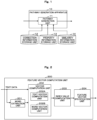
- FIG. 1 is a block diagram illustrating a functional configuration example of a pathway generation apparatus 10 according to this embodiment.
- the pathway generation apparatus 10 of this embodiment includes, as a functional configuration, a pathway generation unit 11.
- a connection information storage unit 12 As storage media, a connection information storage unit 12, a property information storage unit 13, and a similarity information storage unit 14 are connected to the pathway generation apparatus 10 of this embodiment.
- the pathway generation unit 11 can include any of hardware, a DSP (Digital Signal Processor), and software.
- the pathway generation unit 11 is realized by an operation of a pathway generation program stored in a storage medium such as a RAM, a ROM, a hard disk, or a semiconductor memory under control of a microcomputer including a CPU, a RAM, a ROM, etc.
- the connection information storage unit 12 stores connection information that indicates a connection relationship between molecules.
- the connection information includes known information such as interactome information.
- the interactome information is known information related to an intermolecular interaction, such as when an expression level of a certain molecule (gene or protein) increases (or decreases), an expression level of another molecule increases (or decreases) in conjunction with the increase (or decrease) of the expression level of the certain molecule.
- this interactome information merely indicates which molecules are related to each other, and does not include information indicating magnitude of a connection relationship.
- the interactome information is a collection of information indicating a connection relationship between two molecules, and is not information indicating a sequential connection relationship among three or more molecules.
- the property information storage unit 13 stores property information representing a property of a molecule acting on a disease or a symptom.
- a property of a molecular indicates whether the molecule acts causally or responsively on a disease or a symptom.
- Causality is a property considered to have a possibility of causing a disease or a symptom due to presence or mutation of the molecule.
- Responsiveness is a property considered to have a possibility that the molecule may mutate due to onset of a disease or symptom.
- a pathway related to a specific disease (hereinafter referred to as a disease pathway)
- known information recorded in various literature, databases, etc. as information on a plurality of molecules related to the disease and information on properties (causality or responsiveness) of the molecules acting on the disease.
- Any algorithm can be used as an algorithm for estimating a molecule related to a disease or for estimating a property of a molecule.
- a new molecule related to a disease can be estimated by an estimation model trained by machine learning using known information on relevance between a disease and a molecule.
- a property of a new molecule can be estimated by an estimation model trained by machine learning using known information on a property of a molecule that acts on a disease.
- a pathway related to a specific symptom (hereinafter referred to as a symptom pathway) is generated. That is, known information recorded in various literature, databases, etc. can be used as information on a plurality of molecules related to a symptom and information on properties of these molecules acting on the symptom. In addition, it is possible to use information obtained by estimating a molecule related to a specific symptom using a specified algorithm, and estimating a property of a specific molecule acting on the symptom using a specified algorithm.
- the similarity information storage unit 14 stores similarity information representing a similarity between molecules.
- the similarity information storage unit 14 stores information representing a similarity between respective molecules for a plurality of molecules stored as interactome information in the connection information storage unit 12.
- the similarity between molecules can be evaluated using various methods. For example, it is possible to apply a method of extracting a predetermined feature quantity for each piece of information related to a plurality of molecules (for example, a description of the molecules, structures or functions of the molecules, etc.) and evaluating a similarity of the feature quantity. As an example, it is possible to use a similarity between pairs of molecules expressed by a fingerprint method.
- a molecule name as a word tends to be used in a text having a description related to a molecule, and not used in a text unrelated to the molecule.
- a text in which a certain molecule name is included as a word is a text describing the molecule, and there is a high possibility that the molecule name is not included in a text describing another type of molecule.
- a text in which a molecule name is included as a word tends to vary depending on the type of molecule treated as a theme by the text. Therefore, a vector that represents a text to which a molecule name contributes and a degree to which the molecule name contributes to the text can be used as a feature vector that can identify a molecule.
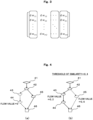
- FIG. 2 is a block diagram illustrating a functional configuration example of a feature vector computation apparatus 200.
- a word extraction unit 201 analyzes m texts (m is any integer equal to or greater than 2) and extracts n words (n is any integer equal to or greater than 2) from the m texts. For example, known morphological analysis can be used as text analysis. Note that a plurality of same words may be included in the m texts. In this case, the word extraction unit 201 extracts only one word without extracting the plurality of same words. In other words, the n words extracted by the word extraction unit 201 mean n types of words.
- a vector computation unit 202 computes m text vectors and n word vectors from m texts and n words.
- n word vectors w j ⁇ 1, 2, ..., n
- a specific method of computing the text vectors d i ⁇ and the word vectors w j ⁇ will not be described here.
- An index value computation unit 203 computes each of the inner products of the m text vectors d i ⁇ and the n word vectors w j ⁇ computed by the vector computation unit 202, thereby computing index values reflecting a relationship between the m texts d i and the n words w j .
- the index value computation unit 203 obtains the product of a text matrix D having the respective q axis components (d 11 to d mq ) of the m text vectors d i ⁇ as respective elements and a word matrix W having the respective q axis components (w 11 to w nq ) of the n word vectors w j ⁇ as respective elements, thereby computing an index value matrix DW having m ⁇ n index values as elements.
- W t is the transposed matrix of the word matrix.
- Each element of the index value matrix DW computed in this manner may indicate which word contributes to which text and to what extent and which text contributes to which word and to what extent.
- an element dw 12 in the first row and the second column may be a value indicating a degree at which the word w 2 contributes to a text d 1 and may be a value indicating a degree at which the text d 1 contributes to a word w 2 .
- each row of the index value matrix DW can be used to evaluate a similarity of a text, and each column can be used to evaluate a similarity of a word.
- a feature vector specification unit 204 specifies, as a molecule feature vector, a word index value group including m index values for one molecule name for each of a plurality of molecule names among n words. That is, as illustrated in FIG. 3 , the feature vector specification unit 204 specifies, as a molecule feature vector corresponding to each molecule name, a word index value group related to a word corresponding to a molecule name among n sets of word index value groups (m index values per column) constituting respective columns of the index value matrix DW.
- a similarity of molecule feature vectors can be evaluated in various ways. For example, it is possible to apply a method of extracting a feature quantity for each molecule feature vector using a predetermined function, and evaluating a similarity of the feature quantity. Alternatively, a Euclidean distance or cosine similarity between molecule feature vectors may be used, or an edit distance may be used.
- the pathway generation unit 11 generates a pathway representing an intermolecular interaction as a route map through optimization processing using a minimum flow algorithm based on property information representing a property of a molecule acting on a specific disease or symptom designated by a user, connection information (interactome information) representing a connection relationship between molecules for the designated disease or symptom, and similarity information representing a similarity between molecules.
- the interactome information, the property information, and the similarity information are used by being read from the connection information storage unit 12, the property information storage unit 13, and the similarity information storage unit 14, respectively.
- the pathway generation unit 11 generates a pathway with a molecule of causality (hereafter, causality molecule) indicated by the property information on an upstream side and a molecule of responsiveness (hereafter, responsiveness molecule) on a downstream side, and by reflecting a connection relationship indicated by the interactome information to place other molecules (hereafter referred to as connectivity molecules) between the causality molecule and the responsiveness molecule, and causing molecules having high similarities as indicated by similarity information to be more likely to be connected to each other.
- the pathway generation unit 11 sets one start point on the further upstream side of all causality molecules, sets one end point on the further downstream side of all responsiveness molecules, and applies a minimum flow algorithm to a section from the start point to the end point.
- the pathway generation unit 11 when a specific disease is designated by the user, the pathway generation unit 11 generates, as a disease pathway, an intermolecular network in which an intermolecular interaction of a molecule related to the designated disease is represented as a route map. In addition, when a specific symptom is designated by the user, the pathway generation unit 11 generates, as a symptom pathway, an intermolecular network in which an intermolecular interaction of a molecule related to the designated symptom is represented as a route map.
- a flow value is an evaluation value computed for each molecule when connecting molecules using the minimum flow algorithm. This evaluation value is computed to satisfy the following conditions.
- a minimum threshold of the flow value can be set to "0". This means that a path including a molecule having a flow value of "0” is not adopted, and any of flow values of respective molecules included in a generated pathway does not become “0".
- the maximum threshold of the flow value in condition (1) may be different from or the same as a threshold related to a similarity in condition (2). When the values are the same, it means that the maximum threshold of the flow value in condition (1) is defined by the threshold related to the similarity (condition (2) is incorporated into condition (1)).
- FIG. 4 is a schematic diagram for describing the above-mentioned conditions (1) and (2).
- a diamond-shaped node represents a causality molecule
- a rectangle-shaped node represents a responsiveness molecule
- an oval-shaped node represents a connectivity molecule (similarly applied to the other figures described below).
- the interactome information As illustrated in FIG. 4(a) , it is assumed that two paths can be adopted by the interactome information as a path from a causality molecule 41 to a responsiveness molecule 46. That is, it is possible to adopt a first path of the causality molecule 41 ⁇ connectivity molecules 42, 43, and 44 ⁇ the responsiveness molecule 46, and a second path of the causality molecule 41 ⁇ connectivity molecules 42 and 45 ⁇ the responsiveness molecule 46.
- a flow value of the connectivity molecule 44 is computed to be zero, the first path is eliminated and the second path is adopted.
- FIG. 5 is a diagram illustrating an example of a pathway generation method by the pathway generation unit 11.
- the pathway generation unit 11 disposes the causality molecule on the upstream side, and disposes the responsiveness molecule on the downstream side.
- a start point is set on the further upstream side of all causality molecules, and an end point is set on the further downstream side of all responsiveness molecules.
- the pathway generation unit 11 applies a minimum flow algorithm to a section from the start point to the end point, and disposes connectivity molecules between causality molecules and responsiveness molecules based on a connection relationship indicated by interactome information, thereby generating a pathway.
- the pathway generation unit 11 computes a flow value of each molecule to satisfy conditions (A) to (C), and performs optimization processing to satisfy conditions (1) and (2) based on the computed flow value.
- the pathway generation unit 11 regenerates the pathway using a minimum flow algorithm so that conditions (1) and (2) are satisfied in a state in which the molecule designated to be knocked out is deleted.
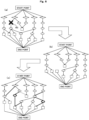
- FIG. 6 is a diagram illustrating an example of regenerating a pathway by knocking out one connectivity molecule 60 included in a pathway generated once.
- FIG. 6(a) is a pathway generated as in FIG. 5(b) , and illustrates that the one connectivity molecule 60 in this pathway is knocked out.
- a molecule to be knocked out can be arbitrarily designated. For example, it is possible to knock out a molecule that is a target gene for drug discovery.
- Knocking out the molecule 60 is equivalent to forcibly setting the flow value of that molecule 60 to zero. Therefore, as illustrated in FIG. 6(b) , a path passing through the knocked-out molecule 60 is eliminated. When a path including the knocked-out molecule 60 disappears, the flow value that has been assigned to the path is assigned to another path. In this instance, the pathway generation unit 11 recalculates a flow value of each molecule to satisfy conditions (A) to (C), and re-executes optimization processing based on the recalculated flow value to satisfy conditions (1) and (2).
- a path that has been adopted before knockout since the path satisfied conditions (1) and (2) may disappear after knockout since the path no longer satisfies conditions (1) and (2).
- a path that has not been adopted before knockout since the path does not satisfy conditions (1) and (2) may be adopted after knockout since the path satisfies conditions (1) and (2).
- the pathway before the knockout illustrated in FIG. 6(a) changes to a pathway illustrated in FIG. 6(c) .
- a dotted line indicates a disappearing path
- a bold line indicates a newly created path.
- a pathway when a pathway is generated based on property information representing a property of a molecule acting on a disease or a symptom, interactome information representing a connection relationship between molecules, and similarity information representing a similarity between molecules, the pathway is generated using a minimum flow algorithm in order to satisfy at least two conditions that (1) a path is generated by connecting only molecules whose flow values are greater than a minimum threshold and less than a maximum threshold, and (2) a path is generated by connecting only molecules whose flow values are equal to or less than a threshold related to a similarity.
- an intermolecular connection based on the similarity of the molecule feature vector related to the designated disease or symptom is preferentially selected from among molecular connections defined by interactome information, and a pathway reflecting an intermolecular interaction related to the designated disease or symptom is generated.
- a similarity between molecules used in this embodiment indicates closeness between two molecule feature vectors obtained by analyzing a plurality of texts (literature information, etc.).
- a threshold related to this similarity for example, a threshold determined from the similarity
- a path between two molecules having low relevance is excluded by the flow rate limiting, and a path having high relevance is adopted.
- processing is performed such that a molecule is replaced with a molecule having a higher similarity, or a flow value of another path is changed so that the upper limit is not exceeded. For this reason, molecules in which relevance between two molecules is high are selected in an important path, a connection between two molecules based on literature information on a certain disease is selected with priority, and a pathway close to a disease state is generated.
- an analysis unit is further provided to analyze a difference between a pathway newly constructed by knocking out a specific molecule (gene) and a pathway before knockout, and it is possible to predict resistance to an anticancer drug using as an indicator that a gene changed in the pathway before and after knockout is a cancer-related gene (Cancer Hallmark).
- a pathway obtained by knocking out a specific gene is considered to be a pathway that exhibits resistance to an anticancer drug (treatment resistance) when anticancer drug treatment targeting the specific gene is performed.
- analysis is performed as follows. First, a disease pathway related to cancer to be analyzed is constructed, and a drug discovery target candidate gene X is selected. Next, the selected gene X is knocked out to construct a new disease pathway. Then, a constituent gene changed between two disease pathways is extracted, and a function of the constituent gene is analyzed. Here, it is analyzed whether the function of the changed gene corresponds to Cancer Hallmarks (an indicator that characterizes cancer). When the changed gene corresponds to Cancer Hallmarks, this indicates a possibility that new cancer may develop even if the target gene is inhibited, and resistance to the anticancer drug can be predicted.
- Cancer Hallmarks an indicator that characterizes cancer
- a network size of the pathway falls within a preset range.
- the network size may be, for example, the number of molecules included on a path from a causality molecule to a responsiveness molecule, or the total number of molecules included in the entire pathway.
- a shortest path (the number of included molecules is minimum) is selected therefrom.
- a path in which the sum of flow values of respective molecules from a causality molecule to a responsiveness molecule is maximum is adopted.
- the flow value of each molecule is a value determined by taking into account the similarity between molecules.
- the invention is not limited thereto.
- the flow value of each molecule may be a value computed independently of the similarity between molecules, and the flow value of each molecule may be unequal to the similarity between molecules.
- the disease pathway or symptom pathway may be generated using, for example, the algorithm described in JP6915818B .
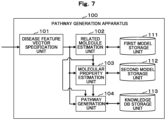
- FIG. 7 is a block diagram illustrating a functional configuration example of a pathway generation apparatus 100 when the algorithm is used. Note that, here, the case where a disease pathway is generated will be described as an example.
- a disease feature vector specification unit 101 specifies a feature vector (hereinafter referred to as a disease feature vector) corresponding to a disease name.
- the disease feature vector is data representing features of the disease (features that can identify the disease) as a combination of values of a plurality of elements.
- a vector representing a text to which a disease name included as a word in a plurality of texts contributes and a degree at which the disease name contributes to the text is used as a disease feature vector.
- Such a disease feature vector can be computed, for example, by the feature vector computation apparatus 200 illustrated in FIG. 2 .
- the feature vector computation apparatus 200 receives input of text data related to a text and computes a disease feature vector that reflects a relationship between the text and a word included therein. That is, in the index value matrix DW computed as illustrated in FIG. 3 , among n word index value groups included in each column, a word index value group related to a word corresponding to a disease name is specified as a disease feature vector for each disease name.
- a related molecule estimation unit 102 inputs a disease feature vector specified by the disease feature vector specification unit 101 to a first trained model stored in advance in a first model storage unit 111, thereby estimating a plurality of molecules associated with a disease.
- the first trained model is subjected to machine learning so as to output information about a molecule corresponding to a molecule feature vector similar to a disease feature vector when the disease feature vector is input based on a similarity between the disease feature vector and the molecule feature vector.
- the feature vector computation apparatus 200 computes a disease feature vector related to a plurality of disease names and computes a molecule feature vector related to a plurality of molecule names. Then, the first trained model is machine-trained in advance using these data sets, and the first trained model trained based on a similarity between the disease feature vector and the molecule feature vector is stored in the first model storage unit 111.
- the similarity between the disease feature vector and the molecule feature vector can be evaluated using various methods. For example, it is possible to apply a method of extracting a feature quantity using a predetermined function for each of the disease feature vector and the molecule feature vector and evaluating a similarity of the feature quantity. Alternatively, it is possible to use a Euclidean distance or cosine similarity between the word index value group of the disease feature vector and the word index value group of the molecule feature vector, or it is possible to use an edit distance.
- a molecular property estimation unit 103 inputs a disease feature vector specified by the disease feature vector specification unit 101 and a molecule feature vector specified for a plurality of molecules estimated by the related molecule estimation unit 102 to a second trained model stored in a second model storage unit 112, thereby estimating a probability that a molecule acting on the disease is causative or responsive as a property for each of a plurality of molecules presumed to be associated with the disease.
- the second trained model is subjected to machine learning to output a probability that a property of a molecule is causative or responsive when a disease feature vector and a molecule feature vector are input using the disease feature vector, the molecule feature vector, and a data set of property information representing the property of the molecule acting on a disease as teacher data.
- a pathway generation unit 104 places a causality molecule on an upstream side and a responsiveness molecule on a downstream side for a plurality of molecules, relevance of which with respect to a disease is estimated by the related molecule estimation unit 102, and reflects a connection relationship indicated by interactome information in other connectivity molecules to dispose the connectivity molecules between the causality molecule and the responsiveness molecule, thereby generating a pathway (intermolecular network) representing an intermolecular interaction as a route map.
- a pathway intermolecular network
- the pathway generation unit 104 computes a flow value of each molecule to satisfy conditions (A) to (C), and generates a pathway using a minimum flow algorithm to satisfy conditions (1) and (2) based on the computed flow value by disposing a causality molecule whose probability value estimated by the molecular property estimation unit 103 as causative is greater than a first threshold Th1 on an upstream side of the pathway, disposing a responsiveness molecule whose probability value is less than a second threshold Th2 (Th1 > Th2) on a downstream side of the pathway, and disposing a connectivity molecule whose probability value is greater than or equal to the second threshold Th2 and less than or equal to the first threshold Th1 between the causality molecule and the responsiveness molecule.
- condition (B) when computing the flow value, for example, a value of a similarity between a disease feature vector specified by the related molecule estimation unit 102 and a molecule feature vector may be used.
- a threshold related to the similarity used in condition (2) a threshold related to a similarity between a disease feature vector and a molecule feature vector may be used.
Landscapes
- Engineering & Computer Science (AREA)
- Health & Medical Sciences (AREA)
- Physics & Mathematics (AREA)
- Life Sciences & Earth Sciences (AREA)
- Medical Informatics (AREA)
- Bioinformatics & Cheminformatics (AREA)
- General Health & Medical Sciences (AREA)
- Theoretical Computer Science (AREA)
- Bioinformatics & Computational Biology (AREA)
- Biotechnology (AREA)
- Evolutionary Biology (AREA)
- Biophysics (AREA)
- Spectroscopy & Molecular Physics (AREA)
- Data Mining & Analysis (AREA)
- Public Health (AREA)
- Chemical & Material Sciences (AREA)
- Analytical Chemistry (AREA)
- Proteomics, Peptides & Aminoacids (AREA)
- Molecular Biology (AREA)
- Databases & Information Systems (AREA)
- Epidemiology (AREA)
- Genetics & Genomics (AREA)
- Evolutionary Computation (AREA)
- Computer Vision & Pattern Recognition (AREA)
- Bioethics (AREA)
- Artificial Intelligence (AREA)
- Software Systems (AREA)
- Biomedical Technology (AREA)
- Pathology (AREA)
- Primary Health Care (AREA)
- Physiology (AREA)
- Probability & Statistics with Applications (AREA)
- Management, Administration, Business Operations System, And Electronic Commerce (AREA)
- Information Retrieval, Db Structures And Fs Structures Therefor (AREA)
Applications Claiming Priority (1)
| Application Number | Priority Date | Filing Date | Title |
|---|---|---|---|
| PCT/JP2023/024250 WO2025004283A1 (ja) | 2023-06-29 | 2023-06-29 | パスウェイ生成装置、パスウェイ生成方法およびパスウェイ生成プログラム |
Publications (2)
| Publication Number | Publication Date |
|---|---|
| EP4524969A1 true EP4524969A1 (de) | 2025-03-19 |
| EP4524969A4 EP4524969A4 (de) | 2026-02-25 |
Family
ID=93938265
Family Applications (1)
| Application Number | Title | Priority Date | Filing Date |
|---|---|---|---|
| EP23940002.1A Pending EP4524969A4 (de) | 2023-06-29 | 2023-06-29 | Pfaderzeugungsvorrichtung, pfaderzeugungsverfahren und pfaderzeugungsprogramm |
Country Status (4)
| Country | Link |
|---|---|
| EP (1) | EP4524969A4 (de) |
| JP (1) | JP7755275B2 (de) |
| KR (1) | KR20250004244A (de) |
| WO (1) | WO2025004283A1 (de) |
Family Cites Families (5)
| Publication number | Priority date | Publication date | Assignee | Title |
|---|---|---|---|---|
| WO2003082214A2 (en) * | 2002-03-29 | 2003-10-09 | Genomatica, Inc. | Human metabolic models and methods |
| EP1810202A4 (de) | 2004-09-29 | 2008-08-13 | Inst Med Molecular Design Inc | Verfahren zur anzeige eines molekülfunktionsnetzwerks |
| JP2010165230A (ja) | 2009-01-16 | 2010-07-29 | Pharma Design Inc | 薬剤標的となるタンパク質−タンパク質相互作用を予測する方法及び予測システム |
| JP6915818B1 (ja) * | 2020-07-02 | 2021-08-04 | 株式会社Fronteo | パスウェイ生成装置、パスウェイ生成方法およびパスウェイ生成用プログラム |
| JP7034453B1 (ja) | 2021-03-03 | 2022-03-14 | 株式会社Fronteo | 情報解析装置、情報解析方法および情報解析用プログラム |
-
2023
- 2023-06-29 WO PCT/JP2023/024250 patent/WO2025004283A1/ja active Pending
- 2023-06-29 KR KR1020247035415A patent/KR20250004244A/ko active Pending
- 2023-06-29 EP EP23940002.1A patent/EP4524969A4/de active Pending
- 2023-06-29 JP JP2024543977A patent/JP7755275B2/ja active Active
Also Published As
| Publication number | Publication date |
|---|---|
| WO2025004283A1 (ja) | 2025-01-02 |
| KR20250004244A (ko) | 2025-01-07 |
| JP7755275B2 (ja) | 2025-10-16 |
| EP4524969A4 (de) | 2026-02-25 |
| JPWO2025004283A1 (de) | 2025-01-02 |
Similar Documents
| Publication | Publication Date | Title |
|---|---|---|
| CN110532388B (zh) | 文本聚类的方法、设备和存储介质 | |
| JP7339923B2 (ja) | 材料の特性値を推定するシステム | |
| JP2020046891A (ja) | 予測プログラム、予測方法および学習装置 | |
| JP6281491B2 (ja) | テキストマイニング装置、テキストマイニング方法及びプログラム | |
| US20230273771A1 (en) | Secret decision tree test apparatus, secret decision tree test system, secret decision tree test method, and program | |
| JP6915818B1 (ja) | パスウェイ生成装置、パスウェイ生成方法およびパスウェイ生成用プログラム | |
| EP4524969A1 (de) | Pfaderzeugungsvorrichtung, pfaderzeugungsverfahren und pfaderzeugungsprogramm | |
| CN105335375A (zh) | 主题挖掘方法和装置 | |
| Baten et al. | Fast splice site detection using information content and feature reduction | |
| JP7450402B2 (ja) | プラント運転支援装置、プラント制御装置、並びにその方法 | |
| EP4700777A1 (de) | Pfadanalysevorrichtung, pfadanalyseverfahren und pfadanalyseprogramm | |
| JP7567930B2 (ja) | 秘密決定木学習装置、秘密決定木学習システム、秘密決定木学習方法、及びプログラム | |
| CN112784556A (zh) | 一种生成数据透视表值的方法及装置 | |
| US20210350260A1 (en) | Decision list learning device, decision list learning method, and decision list learning program | |
| US20230325304A1 (en) | Secret decision tree test apparatus, secret decision tree test system, secret decision tree test method, and program | |
| US20190294637A1 (en) | Similar data search device, similar data search method, and recording medium | |
| JP7292235B2 (ja) | 分析支援装置及び分析支援方法 | |
| EP4509795A1 (de) | Pfadanalysevorrichtung, pfadanalyseverfahren und pfadanalyseprogramm | |
| US20220092260A1 (en) | Information output apparatus, question generation apparatus, and non-transitory computer readable medium | |
| Kim et al. | An approach to extract informative rules for web page recommendation by genetic programming | |
| JP7468681B2 (ja) | 学習方法、学習装置、及びプログラム | |
| JP7099543B2 (ja) | 教師付き無限バイナリ行列生成装置、方法およびプログラム | |
| JP2019105883A (ja) | 判別プログラム、判別方法および判別装置 | |
| JP2026018946A (ja) | イベント解析システム、イベント解析方法、及びイベント解析プログラム | |
| EP4231275A1 (de) | Geheimgruppierungsvorrichtung, geheimgruppierungssystem, geheimgruppierungsverfahren und programm |
Legal Events
| Date | Code | Title | Description |
|---|---|---|---|
| STAA | Information on the status of an ep patent application or granted ep patent |
Free format text: STATUS: UNKNOWN |
|
| STAA | Information on the status of an ep patent application or granted ep patent |
Free format text: STATUS: THE INTERNATIONAL PUBLICATION HAS BEEN MADE |
|
| PUAI | Public reference made under article 153(3) epc to a published international application that has entered the european phase |
Free format text: ORIGINAL CODE: 0009012 |
|
| STAA | Information on the status of an ep patent application or granted ep patent |
Free format text: STATUS: REQUEST FOR EXAMINATION WAS MADE |
|
| 17P | Request for examination filed |
Effective date: 20241212 |
|
| AK | Designated contracting states |
Kind code of ref document: A1 Designated state(s): AL AT BE BG CH CY CZ DE DK EE ES FI FR GB GR HR HU IE IS IT LI LT LU LV MC ME MK MT NL NO PL PT RO RS SE SI SK SM TR |
|
| REG | Reference to a national code |
Ref country code: DE Ref legal event code: R079 Free format text: PREVIOUS MAIN CLASS: G16B0005000000 Ipc: G16B0005200000 |
|
| A4 | Supplementary search report drawn up and despatched |
Effective date: 20260127 |
|
| RIC1 | Information provided on ipc code assigned before grant |
Ipc: G16B 5/20 20190101AFI20260121BHEP Ipc: G16B 20/00 20190101ALI20260121BHEP |