EP4524741A1 - Elektronische vorrichtung und steuerungsverfahren für elektronische vorrichtung - Google Patents
Elektronische vorrichtung und steuerungsverfahren für elektronische vorrichtung Download PDFInfo
- Publication number
- EP4524741A1 EP4524741A1 EP23846894.6A EP23846894A EP4524741A1 EP 4524741 A1 EP4524741 A1 EP 4524741A1 EP 23846894 A EP23846894 A EP 23846894A EP 4524741 A1 EP4524741 A1 EP 4524741A1
- Authority
- EP
- European Patent Office
- Prior art keywords
- operation speed
- processor
- external device
- electronic device
- preprocessing
- Prior art date
- Legal status (The legal status is an assumption and is not a legal conclusion. Google has not performed a legal analysis and makes no representation as to the accuracy of the status listed.)
- Pending
Links
Images



Classifications
-
- G—PHYSICS
- G06—COMPUTING OR CALCULATING; COUNTING
- G06N—COMPUTING ARRANGEMENTS BASED ON SPECIFIC COMPUTATIONAL MODELS
- G06N3/00—Computing arrangements based on biological models
- G06N3/02—Neural networks
- G06N3/08—Learning methods
- G06N3/084—Backpropagation, e.g. using gradient descent
-
- G—PHYSICS
- G06—COMPUTING OR CALCULATING; COUNTING
- G06N—COMPUTING ARRANGEMENTS BASED ON SPECIFIC COMPUTATIONAL MODELS
- G06N3/00—Computing arrangements based on biological models
- G06N3/02—Neural networks
- G06N3/08—Learning methods
- G06N3/091—Active learning
-
- G—PHYSICS
- G06—COMPUTING OR CALCULATING; COUNTING
- G06F—ELECTRIC DIGITAL DATA PROCESSING
- G06F9/00—Arrangements for program control, e.g. control units
- G06F9/06—Arrangements for program control, e.g. control units using stored programs, i.e. using an internal store of processing equipment to receive or retain programs
- G06F9/46—Multiprogramming arrangements
- G06F9/50—Allocation of resources, e.g. of the central processing unit [CPU]
Definitions
- the disclosure relates to an electronic device and a method for controlling the electronic device, and more specifically, to an electronic device capable of efficiently performing an operation process for training a neural network model and a method for controlling the electronic device.
- an electronic device includes: a communicator; at least one memory configured to store data for a neural network model; at least one first processor configured to perform a training process of the neural network model; and at least one second processor configured to: perform a plurality of preprocessing processes for the training process, determine a first operation speed of at least one preprocessing process of the plurality of preprocessing processes performed by the at least one second processor and a second operation speed of the training process performed by the at least one first processor, based on the first operation speed being slower than the second operation speed, control the communicator to transmit at least one input value for the at least one preprocessing process to an external device connected to the electronic device, and obtain an output value corresponding to the at least one input value by receiving, through the communicator, a processing result of the external device for the at least one input value from the external device.
- the at least one second processor may be further configured to, based on the first operation speed being faster than the second operation speed, obtain an output value corresponding to the at least one input value by performing the at least one preprocessing process on the at least one input value.
- the method may further include, based on the first operation speed being faster than the second operation speed, obtaining an output value corresponding to the at least one input value by performing the at least one preprocessing process on the at least one input value.
- the at least one first processor may include a graphics processing unit (GPU) or a neural processing unit (NPU), and the at least one second processor may include a central processing unit (CPU) or a microprocessor unit (MPU).
- GPU graphics processing unit
- NPU neural processing unit
- MPU microprocessor unit
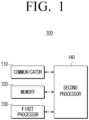
- FIG. 1 is a block diagram schematically showing a configuration of an electronic device according to an embodiment of the disclosure
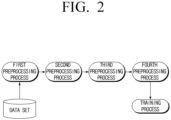
- FIG. 2 is a diagram showing a plurality of preprocessing processes and training processes sequentially performed according to an embodiment of the disclosure
- an electronic device 100 may include a communicator (or communication interface) 110, a memory 120, a first processor 130, and a second processor 140.
- the neural network model according to the disclosure refers to an artificial intelligence (AI) model including a plurality of neural network layers, and the term "neural network model” may be used interchangeably with the term of artificial intelligence (AI) model in this disclosure.
- the neural network model according to the disclosure may sequentially perform the processes shown in FIG. 2 . Specifically, the neural network model may perform a training process based on a data set (i.e., training data). In addition, the neural network model may perform a plurality of preprocessing processes prior to performing the training process.
- training process is used as a term for referring to the entire training process including a feedforward process and a backpropagation process of the neural network model, and there are no special limitations on the training method.
- the communicator 110 may include at least one of a Wi-Fi module, a Bluetooth module, a wireless communication module, a near-field communication (NFC) module, and an ultra-wide band (UWB) module.
- the Wi-Fi module and the Bluetooth module may perform communication using a Wi-Fi method or a Bluetooth method, respectively.
- various connection information such as an SSID, may be first transmitted and received to connect for communication using the SSID, and then, transmit and receive various information.
- the wireless communication module may perform communication according to various communication standards, such as IEEE, Zigbee, 3rd Generation (3G), 3rd Generation Partnership Project (3GPP), Long Term Evolution (LTE), and 5th Generation (5G).
- the NFC module may perform communication using an NFC method using a 13.56 MHz band among various RF-ID frequency bands, such as 135 kHz, 13.56 MHz, 433 MHz, 860 to 960 MHz, and 2.45 GHz.
- the UWB module may accurately calculate time of arrival (ToA), which is a time at which a pulse arrives at a target, and angle of arrival (AoA), which is an angle of arrival of a pulse in a transmitting device, through communication between UWB antennas, and accordingly, it is possible to recognize a precise distance and location within an error range of several tens of cm in an indoor area.
- ToA time of arrival
- AoA angle of arrival
- various software modules for operating the electronic device 100 may be stored in the memory 120 according to various embodiments of the disclosure, and the processor may control the operation of the electronic device 100 by executing various software modules stored in the memory 120. That is, the memory 120 may be accessed by the processor, and data may be read/written/corrected/deleted/updated by the processor.
- memory e.g., memory 120
- memory 120 may include ROM in a processor, RAM, or a memory card (e.g., micro SD card, memory stick) mounted in the electronic device 100.
- data for a neural network model may be stored in the memory 120.
- the data for the neural network model may include a training data set for training the neural network model, and data for layers, parameters, weights, and the like constituting the neural network model.
- the memory 120 may store input values for a plurality of preprocessing processes and training processes according to the disclosure and output values corresponding to the input values.
- information on the first operation speed, the second operation speed, and the third operation speed may be stored in the memory 120.
- various information required within the scope of achieving the object of the disclosure may be stored in the memory 120, and the information stored in the memory 120 may be updated as received from the external device 200 or input by a user.
- a processor according to the disclosure may include the first processor 130 and the second processor 140.
- the first processor 130 and the second processor 140 according to the present disclosure are implemented as separate components, but it is also possible to implement the first processor 130 and the second processor 140 as a single hardware component.
- the first processor 130 may perform a training process of a neural network model. Also, the first processor 130 may perform an inference process of the neural network model using the trained neural network model. In particular, since an operation speed when the first processor 130 performs the training process of the neural network model is important in the disclosure, the following description will focus on the training process of the neural network model performed by the first processor 130.
- the first processor 130 may be a graphics processing unit (GPU) or a neural processing unit (NPU), but is not limited thereto.
- the second processor 140 may control the overall operation of the electronic device 100. That is, the second processor 140 may be connected to the configuration of the electronic device 100 including the communicator 110, the memory 120, and the first processor 130, and control an operation for implementing various embodiments according to the present disclosure by executing at least one instruction stored in the memory 120.
- the second processor 140 may be a central processing unit (CPU) or a microprocessor unit (MPU), but is not limited thereto.
- the second processor 140 may perform a plurality of preprocessing processes for training of the neural network model.
- the second processor 140 may perform a process of determining whether an operation is delayed and a process of processing the operation delay according to various embodiments of the disclosure.
- the second processor 140 may identify whether each of the plurality of preprocessing processes and the training process is performed by the first processor 130 or the second processor 140 based on each operation structure (e.g., directed acyclic graph (DAG)) for the plurality of preprocessing processes and the training process.
- DAG directed acyclic graph
- a determination of whether each of the plurality of preprocessing processes and training process is performed by the first processor 130 or the second processor 140 may be set by a developer or a user.
- the second processor 140 may calculate a first operation speed of at least one of the plurality of preprocessing processes performed by the second processor 140 and a second operation speed of the training process performed by the first processor 130.
- the second processor 140 may divide the neural network model or data processed by the first processor 130 into smaller units and control the neural network model so that the first processor 130 may process fewer operations.
- the second processor 140 may resolve the delay by performing the data offloading operation as described above, and when a delay in operation occurs in the training process by the first processor 130, the second processor 140 may resolve the delay by dividing and processing the operation process of the first processor 130 in parallel.
- the data offloading for the second processor 140 and the dividing of the operation process for the second processor 140 may be performed together.
- the fact that the operation structure is the same may mean that, for example, a DAG representing the operation structure of the first preprocessing process is the same as a DAG representing the operation structure of the previously performed processing process and resource of the electronic device 100 for performing the operation process, that is, a component used in the corresponding operation process, among the memory 120, the first processor 130, and the second processor 140, is the same.
- the electronic device 100 may identify a portion that causes an operation delay in the preprocessing processes performed prior to the training process of the neural network model and transmit the input value for the portion to the external device 200, thereby solving a bottleneck phenomenon caused due to preprocessing.
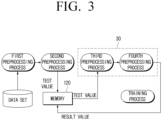
- FIG. 3 is a diagram illustrating a method of determining whether a third preprocessing process and a fourth preprocessing process are delayed in an operation among a plurality of preprocessing processes according to an embodiment of the disclosure.
- the second processor 140 may classify the plurality of preprocessing processes based on each operation structure (e.g., a DAG structure) for a plurality of preprocessing processes and the training process and identify whether the plurality of preprocessing processes and the training process are performed by the first processor 130 or the second processor 140.
- each operation structure e.g., a DAG structure
- FIG. 4 is a diagram illustrating a method of performing at least a portion of a third preprocessing process and a fourth preprocessing process through the external device 200 according to an embodiment of the disclosure
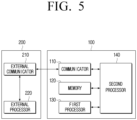
- FIG. 5 is a block diagram showing a configuration of the external device 200 together with a configuration of the electronic device 100 for performing at least a portion of a preprocessing process according to the disclosure.
- the external device 200 may include an external communicator 210 and an external processor 220 as shown in FIG. 5 .
- the external communicator 210 refers to a component capable of performing communication with the electronic device 100.
- the external processor 220 refers to a component capable of performing a plurality of preprocessing processes for the training process of the neural network model and capable of performing a process of determining whether an operation is delayed according to various embodiments of the disclosure.
- the external device 200 may not include a separate processor for a training process of the neural network model, such as the first processor 130 of the electronic device 100.
- the second processor 140 may control the communicator 110 to transmit one test value for at least one preprocessing process to the external device 200.
- the external processor 220 of the external device 200 may receive the test value from the electronic device 100 through the external communicator 210.
- the external processor 220 of the external device 200 may calculate a third operation speed of a case of performing at least one preprocessing process for the test value by the external processor 220 using the same method as the calculation method of the first operation speed described above. Thereafter, the external processor 220 of the external device 200 may control the external communicator 210 to transmit information indicating the third operation speed to the electronic device 100, and accordingly, the second processor 140 may receive information indicating the third operation speed from the external device 200 through the communicator 110.
- the second processor 140 may determine, as the number of at least one input value to be transmitted to the external device 200 per second, the minimum number 20, among 50 which is the number of input values that may be processed at the operation speed corresponding to the difference between the first operation speed and the second operation speed per second, 30 which is the number of input values that may be processed at the third operation speed per second, and 20 which is the number of input values that may be transmitted through the bandwidth of the network during the predetermined time period.
- RCthp refers to the number of at least one input value to be transmitted to the external device 200, that is, maximum throughput of data that may be offloaded to the external processor 220 of the external device 200 to be processed.
- Cthp1 refers to the number of input values according to the first operation speed by the first processor 130
- Gthp1 refers to the number of input values according to the second operation speed by the second processor 140
- Cthp2 refers to the number of input values according to the third operation speed by the external processor 220
- NB/d_size refers to the number of input values that may be transmitted through the bandwidth of the network.
- the second processor 140 may calculate at least one of NB/d_size1, Gthp1-Cthp1, and Cthp2, and calculate the minimum value RCthp among the calculated values. Also, the second processor 140 transmits input values equal to RCthp to the external processor 220 to perform preprocessing, and the second processor 140 itself may perform preprocessing on the remaining input values. While throughput of the first processor 130 before performing offloading according to the disclosure is min(Ghp1, Cthp1), throughput of the first processor 130 after performing offloading is min(Ghp1, Cthp1 + RCthp). Therefore, since min(Ghp1, Cthp1 + RCthp) is always greater than or equal to min(Ghp1, Cthp1), the efficiency of the first processor 130 may be improved.
- the second processor 140 may control the communicator 110 to transmit one test value for at least one preprocessing process to the external device 200, and when a processing result of the external device 200 for the test value is received from the external device 200 through the communicator 110, the second processor 140 may calculate a third operation speed based on a time point at which the test value is transmitted to the external device 200 and a time point at which the processing result is received from the external device 200.
- At least a portion of the third preprocessing process and the fourth preprocessing process is performed by the external device 200 based on the assumption that operation delay occurs in the process of including the third preprocessing process and the fourth preprocessing process, but the embodiment described above may also be applied to each of the third preprocessing process and the fourth preprocessing process in order for the second processor 140 to clearly identify the process of causing a delay of operation among the third preprocessing process and the fourth preprocessing process.
- the electronic device 100 may transmit input values sufficient to resolve the operation delay to the external device 200, thereby effectively solving a bottleneck phenomenon due to the preprocessing.
- the electronic device 100 may calculate a second operation speed of the training process of the neural network model (S720). Specifically, the electronic device 100 may calculate the second operation speed by storing one test value for a training process in a memory and repeatedly performing the training process based on the stored test value.
- the operation of calculating the first operation speed and the operation of calculating the second operation are separately specified, but there is no order restriction between the operation of calculating the first operation speed and the operation of calculating the second operation speed, and at least portions of the operation of calculating the first operation speed and the operation of calculating the second operation speed may be performed simultaneously.
- the electronic device 100 may identify whether the first operation speed is slower than the second operation speed (S730). Specifically, if the first operation speed is identified as being slower than the second operation speed (S730-Y) as a result of comparing the first operation speed with the second operation speed, the electronic device 100 may transmit at least one of input values for at least one preprocessing process to the external device 200 connected to the electronic device 100 (S740). Also, the electronic device 100 may receive a processing result of the external device 200 for at least one input value from the external device 200 to obtain an output value corresponding to at least one input value (S750).
- the second processor may obtain an output value corresponding to at least one input value by performing at least one preprocessing process on the at least one input value by itself.
- the processor may calculate the first operation speed of one or more other preprocessing processes that are different from the at least one preprocessing process as a target of calculation of the operation speed and compare the first operation speed with the second operation speed to identify whether a delay occurs in one or more preprocessing processes.
- the method of controlling the electronic device 100 may be implemented as a program and provided to the electronic device 100.
- the program including the method of controlling the electronic device 100 may be stored and provided in a non-transitory computer-readable medium.
- the method of controlling the electronic device 100 may include calculating a first operation speed of at least one of the plurality of preprocessing processes performed by the second processor and a second operation speed of the training process performed by the first processor, transmitting at least one of input values for the at least one preprocessing process to the external device 200 connected to the electronic device 100 when the first operation speed is slower than the second operation speed, and obtaining an output value corresponding to the at least one input value by receiving a processing result of the external device 200 for the at least one input value from the external device 200.
- the electronic device 100 identifies a portion that causes operation delay during a preprocessing process performed prior to a training process of a neural network model and transmits an input value for the portion to the external device 200, thereby solving a bottleneck phenomenon due to preprocessing.
- the electronic device 100 transmits as many input values as possible to resolve the delay in operation to the external device 200, thereby reducing the bottleneck phenomenon caused by the preprocessing.
- the functions related to the above may be performed through a memory and a processor.
- the one or a plurality of processors control to process input data according to a predefined operation rule or AI model stored in a non-volatile memory or a volatile memory.
- the predefined operation rule or AI model is made through training
- being made through training may refer, for example, to a predefined operation rule or AI model having desired characteristics being made by applying a training algorithm to a plurality of training data.
- Such training may be performed in a device itself in which the AI according to the disclosure is performed, or may be performed through a separate server/system.
- the AI model may be configured with a plurality of neural network layers. Each layer has a plurality of weight values, and a layer operation is performed through operation of the previous layer and an operation between the plurality of weights.
- Examples of neural networks include Convolutional Neural Network (CNN), Deep Neural Network (DNN), Recurrent Neural Network (RNN), Restricted Boltzmann Machine (RBM), Deep Belief Network (DBN), Bidirectional Recurrent Deep Neural Network (BRDNN), and GAN (GAN).
- CNN Convolutional Neural Network
- DNN Deep Neural Network
- RNN Restricted Boltzmann Machine
- DBN Deep Belief Network
- BBN Bidirectional Recurrent Deep Neural Network
- GAN GAN
- the training algorithm may refer, for example, to a method of training a predetermined target device (e.g., a robot) using a plurality of training data so that the predetermined target device may make a decision or make a prediction by itself.
- a predetermined target device e.g., a robot
- Examples of the training algorithm include supervised training, unsupervised training, semi-supervised training, or reinforcement training, and the training algorithm in the disclosure is not limited to the examples mentioned above, except for a specified case.
- the device-readable storage medium may be provided in the form of a non-transitory storage medium.
- 'non-temporary storage medium' only means that it is a tangible device and does not contain signals (e.g., electromagnetic waves). This term does not distinguish between a case in which data is stored semi-permanently in a storage medium and a case in which data is stored temporarily.
- a 'non-temporary storage medium' may include a buffer in which data is temporarily stored.
- a method according to various embodiments of the disclosure may be included and provided in a computer program product.
- the computer program product may be traded as a product between a seller and a buyer.
- the computer program product may be distributed in the form of a machine-readable storage medium (e.g., compact disc read only memory (CD-ROM)), or be distributed (e.g., downloaded or uploaded) online via an application store (e.g., Play Store TM ), or between two user devices (e.g., smartphones) directly.
- CD-ROM compact disc read only memory
- an application store e.g., Play Store TM
- two user devices e.g., smartphones
Landscapes
- Engineering & Computer Science (AREA)
- Theoretical Computer Science (AREA)
- Physics & Mathematics (AREA)
- Software Systems (AREA)
- General Engineering & Computer Science (AREA)
- General Physics & Mathematics (AREA)
- Artificial Intelligence (AREA)
- Life Sciences & Earth Sciences (AREA)
- Health & Medical Sciences (AREA)
- Biomedical Technology (AREA)
- Biophysics (AREA)
- Computational Linguistics (AREA)
- Data Mining & Analysis (AREA)
- Evolutionary Computation (AREA)
- General Health & Medical Sciences (AREA)
- Molecular Biology (AREA)
- Computing Systems (AREA)
- Mathematical Physics (AREA)
- Image Analysis (AREA)
Applications Claiming Priority (3)
| Application Number | Priority Date | Filing Date | Title |
|---|---|---|---|
| KR20220094786 | 2022-07-29 | ||
| KR1020220118866A KR20240016852A (ko) | 2022-07-29 | 2022-09-20 | 전자 장치 및 전자 장치의 제어 방법 |
| PCT/KR2023/010309 WO2024025235A1 (ko) | 2022-07-29 | 2023-07-18 | 전자 장치 및 전자 장치의 제어 방법 |
Publications (2)
| Publication Number | Publication Date |
|---|---|
| EP4524741A1 true EP4524741A1 (de) | 2025-03-19 |
| EP4524741A4 EP4524741A4 (de) | 2025-08-20 |
Family
ID=89706823
Family Applications (1)
| Application Number | Title | Priority Date | Filing Date |
|---|---|---|---|
| EP23846894.6A Pending EP4524741A4 (de) | 2022-07-29 | 2023-07-18 | Elektronische vorrichtung und steuerungsverfahren für elektronische vorrichtung |
Country Status (4)
| Country | Link |
|---|---|
| US (1) | US20240232640A9 (de) |
| EP (1) | EP4524741A4 (de) |
| CN (1) | CN119816815A (de) |
| WO (1) | WO2024025235A1 (de) |
Family Cites Families (9)
| Publication number | Priority date | Publication date | Assignee | Title |
|---|---|---|---|---|
| KR20050068000A (ko) * | 2003-12-29 | 2005-07-05 | 삼성전자주식회사 | 디지털 신호 프로세서에서의 연산을 보조하기 위한 외부장치 |
| US20150261721A1 (en) * | 2014-03-13 | 2015-09-17 | Lantiq Deutschland Gmbh | Flow control between processing devices |
| JP6872117B2 (ja) * | 2017-01-26 | 2021-05-19 | 富士フイルムビジネスイノベーション株式会社 | 情報処理装置及びプログラム |
| CN107832843B (zh) * | 2017-10-30 | 2021-09-21 | 上海寒武纪信息科技有限公司 | 一种信息处理方法及相关产品 |
| JP7024415B2 (ja) * | 2018-01-10 | 2022-02-24 | トヨタ自動車株式会社 | 自動運転装置 |
| KR102805668B1 (ko) * | 2018-10-17 | 2025-05-13 | 삼성전자주식회사 | 모듈화된 신경망의 데이터 처리를 제어하는 전자 장치 및 그 제어 방법 |
| US11593156B2 (en) * | 2019-08-16 | 2023-02-28 | Red Hat, Inc. | Instruction offload to processor cores in attached memory |
| KR102504537B1 (ko) * | 2020-11-25 | 2023-02-28 | (주)디지탈쉽 | 데이터 분할 기반 데이터 전처리 장치 및 방법 |
| CN112508188B (zh) * | 2020-12-01 | 2024-06-14 | 北京奇艺世纪科技有限公司 | 一种分布式模型训练系统、方法、装置、设备和存储介质 |
-
2023
- 2023-07-18 WO PCT/KR2023/010309 patent/WO2024025235A1/ko not_active Ceased
- 2023-07-18 EP EP23846894.6A patent/EP4524741A4/de active Pending
- 2023-07-18 CN CN202380056666.6A patent/CN119816815A/zh active Pending
- 2023-12-28 US US18/399,061 patent/US20240232640A9/en active Pending
Also Published As
| Publication number | Publication date |
|---|---|
| US20240232640A9 (en) | 2024-07-11 |
| WO2024025235A1 (ko) | 2024-02-01 |
| CN119816815A (zh) | 2025-04-11 |
| US20240135189A1 (en) | 2024-04-25 |
| EP4524741A4 (de) | 2025-08-20 |
Similar Documents
| Publication | Publication Date | Title |
|---|---|---|
| US12223411B2 (en) | Electronic apparatus and method of controlling thereof | |
| US12437191B2 (en) | Training neural network model based on data point selection | |
| CN114556366A (zh) | 用于实现可变精度神经网络的方法和系统 | |
| US20240160860A1 (en) | Electronic device and controlling method of electronic device | |
| US20230359836A1 (en) | Electronic device and controlling method of electronic device | |
| US12482236B2 (en) | Electronic apparatus and method for controlling thereof | |
| EP4524741A1 (de) | Elektronische vorrichtung und steuerungsverfahren für elektronische vorrichtung | |
| KR20210007829A (ko) | 가변 정확도 신경망을 구현하기 위한 방법 및 시스템 | |
| KR20240008746A (ko) | 전자 장치 및 전자 장치의 제어 방법 | |
| US20230064500A1 (en) | Optimizing machine learning as-a-service performance for cellular communication systems | |
| KR20230113118A (ko) | 시선 정보에 기초하여 치매를 식별하는 기법 | |
| US12067754B2 (en) | Electronic device and method of inferring object in image | |
| KR20240016852A (ko) | 전자 장치 및 전자 장치의 제어 방법 | |
| EP4524862A1 (de) | Elektronische vorrichtung und verfahren zur steuerung einer elektronischen vorrichtung | |
| KR102613227B1 (ko) | 빅데이터 및 머신 러닝에 기반한 농업용 저수지 이수 안전도 평가를 위한 전자 장치 및 전자 장치의 제어 방법 | |
| US20250081083A1 (en) | Electronic device and controlling method of electronic device | |
| CN114239792A (zh) | 模型量化方法、装置及存储介质 | |
| US20250078861A1 (en) | Electronic device and controlling method of electronic device | |
| KR102911907B1 (ko) | 전자 장치 및 그의 이상 탐지 방법 | |
| EP4357974A1 (de) | Elektronische vorrichtung und steuerungsverfahren für elektronische vorrichtung | |
| US20260100030A1 (en) | Electronic apparatus and control method thereof | |
| KR20230045525A (ko) | 전자 장치 및 전자 장치의 제어 방법 | |
| US20250370802A1 (en) | Electronic device and controlling method thereof | |
| WO2021162692A1 (en) | Multiple-task neural networks | |
| KR20230032843A (ko) | 전자 장치 및 전자 장치의 제어 방법 |
Legal Events
| Date | Code | Title | Description |
|---|---|---|---|
| STAA | Information on the status of an ep patent application or granted ep patent |
Free format text: STATUS: THE INTERNATIONAL PUBLICATION HAS BEEN MADE |
|
| PUAI | Public reference made under article 153(3) epc to a published international application that has entered the european phase |
Free format text: ORIGINAL CODE: 0009012 |
|
| STAA | Information on the status of an ep patent application or granted ep patent |
Free format text: STATUS: REQUEST FOR EXAMINATION WAS MADE |
|
| 17P | Request for examination filed |
Effective date: 20241210 |
|
| AK | Designated contracting states |
Kind code of ref document: A1 Designated state(s): AL AT BE BG CH CY CZ DE DK EE ES FI FR GB GR HR HU IE IS IT LI LT LU LV MC ME MK MT NL NO PL PT RO RS SE SI SK SM TR |
|
| A4 | Supplementary search report drawn up and despatched |
Effective date: 20250717 |
|
| RIC1 | Information provided on ipc code assigned before grant |
Ipc: G06F 9/50 20060101AFI20250711BHEP Ipc: G06F 9/38 20180101ALI20250711BHEP Ipc: G06N 3/08 20230101ALI20250711BHEP Ipc: G06N 3/084 20230101ALI20250711BHEP |
|
| DAV | Request for validation of the european patent (deleted) | ||
| DAX | Request for extension of the european patent (deleted) |