EP4524264A2 - Verfahren und zusammensetzungen zur detektion somatischer varianten - Google Patents
Verfahren und zusammensetzungen zur detektion somatischer varianten Download PDFInfo
- Publication number
- EP4524264A2 EP4524264A2 EP25152979.8A EP25152979A EP4524264A2 EP 4524264 A2 EP4524264 A2 EP 4524264A2 EP 25152979 A EP25152979 A EP 25152979A EP 4524264 A2 EP4524264 A2 EP 4524264A2
- Authority
- EP
- European Patent Office
- Prior art keywords
- variants
- germline
- variant
- database
- allele frequency
- Prior art date
- Legal status (The legal status is an assumption and is not a legal conclusion. Google has not performed a legal analysis and makes no representation as to the accuracy of the status listed.)
- Pending
Links
Images





Classifications
-
- G—PHYSICS
- G16—INFORMATION AND COMMUNICATION TECHNOLOGY [ICT] SPECIALLY ADAPTED FOR SPECIFIC APPLICATION FIELDS
- G16B—BIOINFORMATICS, i.e. INFORMATION AND COMMUNICATION TECHNOLOGY [ICT] SPECIALLY ADAPTED FOR GENETIC OR PROTEIN-RELATED DATA PROCESSING IN COMPUTATIONAL MOLECULAR BIOLOGY
- G16B20/00—ICT specially adapted for functional genomics or proteomics, e.g. genotype-phenotype associations
- G16B20/20—Allele or variant detection, e.g. single nucleotide polymorphism [SNP] detection
-
- C—CHEMISTRY; METALLURGY
- C12—BIOCHEMISTRY; BEER; SPIRITS; WINE; VINEGAR; MICROBIOLOGY; ENZYMOLOGY; MUTATION OR GENETIC ENGINEERING
- C12Q—MEASURING OR TESTING PROCESSES INVOLVING ENZYMES, NUCLEIC ACIDS OR MICROORGANISMS; COMPOSITIONS OR TEST PAPERS THEREFOR; PROCESSES OF PREPARING SUCH COMPOSITIONS; CONDITION-RESPONSIVE CONTROL IN MICROBIOLOGICAL OR ENZYMOLOGICAL PROCESSES
- C12Q1/00—Measuring or testing processes involving enzymes, nucleic acids or microorganisms; Compositions therefor; Processes of preparing such compositions
- C12Q1/68—Measuring or testing processes involving enzymes, nucleic acids or microorganisms; Compositions therefor; Processes of preparing such compositions involving nucleic acids
- C12Q1/6869—Methods for sequencing
-
- C—CHEMISTRY; METALLURGY
- C12—BIOCHEMISTRY; BEER; SPIRITS; WINE; VINEGAR; MICROBIOLOGY; ENZYMOLOGY; MUTATION OR GENETIC ENGINEERING
- C12Q—MEASURING OR TESTING PROCESSES INVOLVING ENZYMES, NUCLEIC ACIDS OR MICROORGANISMS; COMPOSITIONS OR TEST PAPERS THEREFOR; PROCESSES OF PREPARING SUCH COMPOSITIONS; CONDITION-RESPONSIVE CONTROL IN MICROBIOLOGICAL OR ENZYMOLOGICAL PROCESSES
- C12Q1/00—Measuring or testing processes involving enzymes, nucleic acids or microorganisms; Compositions therefor; Processes of preparing such compositions
- C12Q1/68—Measuring or testing processes involving enzymes, nucleic acids or microorganisms; Compositions therefor; Processes of preparing such compositions involving nucleic acids
- C12Q1/6876—Nucleic acid products used in the analysis of nucleic acids, e.g. primers or probes
- C12Q1/6883—Nucleic acid products used in the analysis of nucleic acids, e.g. primers or probes for diseases caused by alterations of genetic material
- C12Q1/6886—Nucleic acid products used in the analysis of nucleic acids, e.g. primers or probes for diseases caused by alterations of genetic material for cancer
-
- G—PHYSICS
- G16—INFORMATION AND COMMUNICATION TECHNOLOGY [ICT] SPECIALLY ADAPTED FOR SPECIFIC APPLICATION FIELDS
- G16B—BIOINFORMATICS, i.e. INFORMATION AND COMMUNICATION TECHNOLOGY [ICT] SPECIALLY ADAPTED FOR GENETIC OR PROTEIN-RELATED DATA PROCESSING IN COMPUTATIONAL MOLECULAR BIOLOGY
- G16B30/00—ICT specially adapted for sequence analysis involving nucleotides or amino acids
- G16B30/10—Sequence alignment; Homology search
-
- G—PHYSICS
- G16—INFORMATION AND COMMUNICATION TECHNOLOGY [ICT] SPECIALLY ADAPTED FOR SPECIFIC APPLICATION FIELDS
- G16B—BIOINFORMATICS, i.e. INFORMATION AND COMMUNICATION TECHNOLOGY [ICT] SPECIALLY ADAPTED FOR GENETIC OR PROTEIN-RELATED DATA PROCESSING IN COMPUTATIONAL MOLECULAR BIOLOGY
- G16B40/00—ICT specially adapted for biostatistics; ICT specially adapted for bioinformatics-related machine learning or data mining, e.g. knowledge discovery or pattern finding
-
- C—CHEMISTRY; METALLURGY
- C12—BIOCHEMISTRY; BEER; SPIRITS; WINE; VINEGAR; MICROBIOLOGY; ENZYMOLOGY; MUTATION OR GENETIC ENGINEERING
- C12Q—MEASURING OR TESTING PROCESSES INVOLVING ENZYMES, NUCLEIC ACIDS OR MICROORGANISMS; COMPOSITIONS OR TEST PAPERS THEREFOR; PROCESSES OF PREPARING SUCH COMPOSITIONS; CONDITION-RESPONSIVE CONTROL IN MICROBIOLOGICAL OR ENZYMOLOGICAL PROCESSES
- C12Q2535/00—Reactions characterised by the assay type for determining the identity of a nucleotide base or a sequence of oligonucleotides
- C12Q2535/122—Massive parallel sequencing
-
- C—CHEMISTRY; METALLURGY
- C12—BIOCHEMISTRY; BEER; SPIRITS; WINE; VINEGAR; MICROBIOLOGY; ENZYMOLOGY; MUTATION OR GENETIC ENGINEERING
- C12Q—MEASURING OR TESTING PROCESSES INVOLVING ENZYMES, NUCLEIC ACIDS OR MICROORGANISMS; COMPOSITIONS OR TEST PAPERS THEREFOR; PROCESSES OF PREPARING SUCH COMPOSITIONS; CONDITION-RESPONSIVE CONTROL IN MICROBIOLOGICAL OR ENZYMOLOGICAL PROCESSES
- C12Q2537/00—Reactions characterised by the reaction format or use of a specific feature
- C12Q2537/10—Reactions characterised by the reaction format or use of a specific feature the purpose or use of
- C12Q2537/165—Mathematical modelling, e.g. logarithm, ratio
-
- C—CHEMISTRY; METALLURGY
- C12—BIOCHEMISTRY; BEER; SPIRITS; WINE; VINEGAR; MICROBIOLOGY; ENZYMOLOGY; MUTATION OR GENETIC ENGINEERING
- C12Q—MEASURING OR TESTING PROCESSES INVOLVING ENZYMES, NUCLEIC ACIDS OR MICROORGANISMS; COMPOSITIONS OR TEST PAPERS THEREFOR; PROCESSES OF PREPARING SUCH COMPOSITIONS; CONDITION-RESPONSIVE CONTROL IN MICROBIOLOGICAL OR ENZYMOLOGICAL PROCESSES
- C12Q2600/00—Oligonucleotides characterized by their use
- C12Q2600/156—Polymorphic or mutational markers
Definitions
- a somatic variant can be distinguished from a germline variant based on variant allele frequency of a variant in a sample and its location in a genome.
- NGS Next-generation sequencing
- VAF variant allele frequency
- the low quality bases usually near the 3' end of reads, and exogenous sequences such as sequencing adapters are trimmed from the DNA sample read processing tools.
- the cleaned reads are mapped using mapping and alignment tools to determine where the variants may come from in a reference genome, and then aligned base-by-base.
- the process of variant calling is used to separate real variants from artifacts stemming from library preparation, sample enrichment, sequencing, and mapping/alignment. There is a continued need for improved methods of variant calling from sequence data.
- Some embodiments include a method for identifying somatic variants in a plurality of variants, comprising: (a) obtaining a plurality of variants comprising somatic variants and germline variants; (b) applying a database filter to the plurality of variants, comprising: determining first germline variants in the plurality of variants, wherein the first germline variants each have an allele count in a first reference set of variants greater than or equal to a threshold allele count; (c) applying a proximity filter to the plurality of variants, comprising: (i) binning variants of the plurality of variants into a plurality of bins, wherein variants located in the same region of a genome are binned into the same bin, (ii) determining database variants in the plurality of variants, wherein a database variant is present in a second reference set of variants, and (iii) determining second germline variants in the plurality of variants, wherein the second germline variants each have an allele
- (b) and (c) are performed consecutively.
- (c) is performed before (b).
- the threshold allele count is 5. In some embodiments, the threshold allele count is 10.
- the first or second reference set of variants comprises a database of variants for a plurality of individuals. In some embodiments, the first or second reference set of variants comprises at least one database selected from a genome aggregation database (gnomAD), and a 1000 genome database.
- gnomAD genome aggregation database
- the same region of a genome is within the same chromosome. In some embodiments, the same region of a genome is within the same chromosomal arm. In some embodiments, the same region of a genome is within the same chromosomal cytoband. In some embodiments, the same region of a genome is within a 10 Mb region.
- the applying a proximity filter further comprises identifying a second germline variant having an allele frequency greater than or equal to 0.9.
- the applying a proximity filter further comprises identifying a second germline variant in the plurality of variants, wherein the second germline variant is a database variant present in the second reference set of variants.
- the proximate range is a range having a maximum and a minimum of 0.05 from the allele frequency of a second germline variant.
- the proximate range is a range having a maximum and a minimum of two standard deviations from a binomial distribution of an allele frequency of a second germline variant, and centered from the allele frequency of a second germline variant.
- the second germline variants have an allele frequency within a threshold proximity to an allele frequency of at least five database variants in the same bin as the second germline variant. In some embodiments, the second germline variants have an allele frequency within a threshold proximity to an allele frequency of at least ten database variants in the same bin as the second germline variant.
- (a) comprises: obtaining sequence data from a biological sample comprising a tumor cell. Some embodiments also include aligning the sequence data with a reference sequence, and identifying variants in the sequence data.
- Some embodiments include a method of determining a tumor mutation burden of a tumor, comprising: obtaining sequence data from a biological sample comprising a tumor cell; determining a plurality of variants from the sequence data; and determining the number of somatic variants in a plurality of variants according to the method of any one of the foregoing embodiments, wherein the number of somatic variants is the tumor mutation burden of the tumor.
- Some embodiments include a method of treating a tumor, comprising: determining a tumor having a tumor mutation burden greater than or equal to 10 somatic variants according to a method of determining a tumor mutation burden of a tumor; and treating the tumor by administering an effective amount of a checkpoint inhibitor.
- the checkpoint inhibitor is selected from the group consisting of a CTLA-4 inhibitor, a PD-1 inhibitor, and a PD-L1 inhibitor. In some embodiments, the checkpoint inhibitor is selected from the group consisting of Ipilimumab, Nivolumab, Pembrolizumab, Spartalizumab, Atezolizumab, Avelumab, and Durvalumab.
- Some embodiments include an electronic system for analyzing genetic variation data, comprising: an informatics module running on a processor and adapted to identify a plurality of variants from sequence data from a biological sample comprising a tumor cell, wherein the plurality of variants comprises somatic variants and germline variants; a database filter module adapted to remove first germline variants from the plurality of variants, wherein the first germline variants each have an allele count in a first reference set of variants greater than or equal to a threshold allele count; a proximity filter module adapted to remove second germline variants from the plurality of variants, the proximity filter module comprising: a binning sub-module adapted to return a plurality of bins, each bin containing variants of the plurality of variants located in the same region of a genome, an identification sub-module adapted to return database variants in the plurality of variants, wherein a database variant is present in a second reference set of variants, and a removal sub-module adapted to remove
- informatics module comprises a variant annotation tool.
- the first and second reference set of variants are the same reference set.
- the same region of a genome is within the same chromosome. In some embodiments, the same region of a genome is within the same chromosomal arm. In some embodiments, the same region of a genome is within the same chromosomal cytoband. In some embodiments, the same region of a genome is within a 10 Mb region.
- the removal sub-module is adapted to remove a variant having an allele frequency greater than or equal to 0.9 from the plurality of variants.
- the removal sub-module is adapted to remove a database variant present in the second reference set of variants from the plurality of variants.
- the proximate range is a range having a maximum and a minimum of two standard deviations from a binomial distribution of an allele frequency of a second germline variant, and centered from the allele frequency of a second germline variant.
- the second germline variants have an allele frequency within a threshold proximity to an allele frequency of at least five database variants in the same bin as the second germline variant. In some embodiments, the second germline variants have an allele frequency within a threshold proximity to an allele frequency of at least ten database variants in the same bin as the second germline variant.
- the biological sample comprising a tumor cell is selected from a serum sample, a stool sample, a blood sample, a tumor sample. In some embodiments, the tumor sample is fixed.
- Some embodiments include a computer-implemented method for identifying somatic variants in a plurality of variants, comprising: performing the method of any one of the foregoing methods.
- the first and second reference set of variants are the same reference set.
- the first or second reference set of variants comprises a database of variants for a plurality of individuals. In some embodiments, the first or second reference set of variants comprises at least one database selected from a genome aggregation database (gnomAD), and a 1000 genome database.
- gnomAD genome aggregation database
- the same region of a genome is within the same chromosome. In some embodiments, the same region of a genome is within the same chromosomal arm. In some embodiments, the same region of a genome is within the same chromosomal cytoband. In some embodiments, the same region of a genome is within a 10 Mb region.
- the generating an index of second filtered variants further comprises identifying a second germline variant having an allele frequency greater than or equal to 0.9.
- the generating an index of second filtered variants further comprises identifying a second germline variant in the plurality of variants, wherein the second germline variant is a database variant present in the second reference set of variants.
- the proximate range is a range having a maximum and a minimum of 0.05 from the allele frequency of a second germline variant.
- the proximate range is a range having a maximum and a minimum of two standard deviations from a binomial distribution of an allele frequency of a second germline variant, and centered from the allele frequency of a second germline variant.
- the second germline variants have an allele frequency within a threshold proximity to an allele frequency of at least five database variants in the same bin as the second germline variant. In some embodiments, the second germline variants have an allele frequency within a threshold proximity to an allele frequency of at least ten database variants in the same bin as the second germline variant.
- the biological sample comprising a tumor cell is selected from a serum sample, a stool sample, a blood sample, a tumor sample. In some embodiments, the tumor sample is fixed.
- variant calling between somatic variants and germline variants has relied on a comparison between data obtained from a tumor sample, and data obtained from a matched normal sample.
- traditional variant calling requires a matched sample to be available, and for two sets of data to be obtained.
- Embodiments provided herein relate to variant calling from sequence data taken from a single sample from an individual. Using a single sample may reduce the need for a matched sample, and the costs that would have been required for obtaining sequence data for both a tumor sample, and a matched normal sample.
- An uncharacterized binned variant can be determined to be a germline variant if the uncharacterized binned variant has an allele frequency similar to the allele frequency of one or more identified germline variants in the same bin as the uncharacterized variant.
- Some embodiments also include applying a database filter to identify germline variants.
- the database filter can identify germline variants according to an allele count of corresponding variants in one or more reference sets of variants.
- a database filter and a proximity filter can be applied to the plurality of variants to identify germline variants.
- somatic variants are variants that are identified as germline variants. The number of somatic variants can indicate the tumor mutation burden of a tumor.
- the germline variants may include variants that an individual is born with (or shared between the tumor and the normal cell) but which are detected as variants in comparison to the reference genome. These variants do not contribute to distinguishing tumor cells from normal cells, and thus can lead to over estimation of the tumor mutation burden if not correctly filtered out.
- Embodiments include determining a tumor mutation burden for a tumor, selecting a treatment for the tumor according to the tumor mutation burden, and administering the treatment to a subject in need thereof.
- Some embodiments of the methods and systems provided herein relate to a method for identifying a somatic variant in a plurality of variants comprising somatic variants and germline variants.
- germline variants can be filtered from the plurality of variants using one or more filters. Examples of such filters include a database filter, and a proximity filter.
- a database filter can be applied to a plurality of variants.
- the database filter can be used to identify a variant as a germline variant, and remove the variant from the plurality of variants.
- the database filter can be related to an allele count of a corresponding variant in a database, for a particular variant of the plurality of variants.
- a reference database can be searched for the corresponding variant in the database.
- a reference database can include a database of variants for a plurality of individuals. Examples of databases useful with embodiments provided herein include a genome aggregation database (gnomAD), including gnomAD exome and gnomAD genome databases, and a 1000 genome database (International Genome Sample Resource). See e.g., Lek, M., et al., (2016) Nature 536:285-292 which is incorporated by reference in its entirety.
- a total allele count can be determined for the corresponding variant in one or more reference databases. An allele count can represent the total number of observations within a database that a variant is observed.
- an allele count of 10 in a database for a corresponding variant denotes that the corresponding variant has been observed in at least 5 samples for homozygous variants, or a maximum of 10 samples for heterozygous variants.
- an allele count can be the highest allele count observed in more than one databases.
- a variant having a corresponding variant with an allele count greater than or equal to a certain threshold allele count can be identified as a germline variant
- the threshold allele count can be greater than or equal to 2, 3, 4, 5, 6, 7, 8, 9, 10, 11, 12, 13, 14, 15, 16, 17, 18, 19 and 20.
- a proximity filter can be applied to a plurality of variants.
- the database filter can be used to identify a variant as a germline variant, and remove the variant from the plurality of variants.
- the proximity filter can be related to the allele frequency of a certain variant of the plurality of variants, the location of the variant in region of a genome, and the proximity of the allele frequency of the variant to the allele frequency of identified germline variants in the same region of a genome.
- variants of the plurality of variants can be sorted or binned into a plurality of bins, such that variants located in the same region of a genome are sorted or binned into the same bin.
- the same region of a genome can be within the same chromosome, within the same arm of a chromosome, within the same chromosomal cytoband. In some embodiments, the same region of a genome can be within the same contiguous 100 Mb, 50 Mb, 40 Mb, 30 Mb, 20 Mb, 10 Mb, 5 Mb, 1Mb, or within any range between any two of the foregoing numbers.
- the proximity filter also includes determining which binned variants are readily identifiable as germline variants.
- a binned variant can have a corresponding variant present in one or more reference databases and be identified as a germline variant.
- the proximity filter includes determining that variants having an allele frequency greater than or equal to a threshold frequency in the sample are germline variants. In some such embodiments, variants having an allele frequency greater than or equal to 0.7, 0.8, 0.9, or 1.0 can be identified as germline variants.
- the proximity filter includes determining a proximate range of an allele frequency for a variant that has not been identified as a germline variant.
- a proximate range of an allele frequency for a variant can include a range of allele frequencies above and below the allele frequency of the variant.
- the proximate range is a range having a maximum and a minimum from the allele frequency of variant of 0.01, 0.02, 0.03, 0.04, 0.05, 0.06, 0.07, 0.08, 0.09, or any number within a range between any two of the foregoing numbers. For example, for a variant having an allele frequency of 0.2 and a proximate range of 0.05, the minimum and maximum of the proximate range would be allele frequencies of 0.15 and 0.25, respectively.
- the proximate range is determined by the value of two (n) standard deviations of a binomial distribution assuming the supporting evidence for the given variant is generated by a binomial process.
- the proximate range is the higher of either 0.05, or two (n) standard deviations from a binomial distribution of the allele frequency of the variant, above and below the allele frequency of the variant.
- a variant can be identified as a germline variant if the variant has an allele frequency within proximate range of one or more identified germline variants in the same bin as the variant. In some embodiments, a variant can be identified as a germline variant if the variant has an allele frequency within proximate range of more than 1, 2, 3, 4, 5, 6, 7, 8, 9, or 10 identified germline variants in the same bin as the variant. In some embodiments, a variant can be identified as a germline variant if the variant has an allele frequency within proximate range of more than 5 identified germline variants in the same bin as the variant.
- a variant having an allele frequency of 0.2 with a proximate range of 0.05, thus having a minimum range of 0.15 and a maximum range of 0.25 and binned in a bin representing chromosome 7 would be identified as a germline variant where more than 5 identified germline variants having allele frequencies in proximate range of the variant and binned in the bin representing chromosome 7.
- the database filter or the proximity filter can be applied to the plurality of variants to identify and remove germline variants from the plurality of variants.
- the database filter and the proximity filter can be applied consecutively. For example, the output of the database filter such can be used for the input of the proximity filter. Conversely, the output of the proximity filter can be used as the input of the database filter.
- Some embodiments of the methods and systems provided herein include electronic system for analyzing genetic variation data.
- a database filter described herein and/or a proximity filter described herein can be applied to the genetic variation data to identify germline variants.
- Some embodiments can include an informatics module running on a processor and adapted to identify a plurality of variants from sequence data from a biological sample comprising a tumor cell, in which the plurality of variants comprises somatic variants and germline variants.
- Some embodiments include a proximity filter module adapted to remove germline variants from the plurality of variants.
- the proximity filter module can include a binning sub-module adapted to return a plurality of bins, each bin containing variants of the plurality of variants located in the same region of a genome.
- variants of the plurality of variants can be sorted or binned into a plurality of bins, such that variants located in the same region of a genome are sorted or binned into the same bin.
- the same region of a genome can be within the same chromosome, within the same arm of a chromosome, within the same chromosomal cytoband.
- the same region of a genome can be within the same contiguous 100 Mb, 50 Mb, 40 Mb, 30 Mb, 20 Mb, 10 Mb, 5 Mb, 1Mb, or within any range between any two of the foregoing numbers.
- the proximity filter module can include an identification sub-module adapted to return database variants in the plurality of variants, wherein a database variant is present in a reference set of variants.
- the proximate range is a range having a maximum and a minimum of two standard deviations from a binomial distribution of the allele frequency of the variant. In some embodiments, the proximate range is the higher of 0.05, or two (n) standard deviations from a binomial distribution of the allele frequency of the variant, above and below the allele frequency of the variant.
- a variant can be identified as a germline variant if the variant has an allele frequency within proximate range of one or more identified germline variants in the same bin as the variant. In some embodiments, a variant can be identified as a germline variant if the variant has an allele frequency within proximate range of more than 1, 2, 3, 4, 5, 6, 7, 8, 9, or 10 identified germline variants in the same bin as the variant. In some embodiments, the removal sub-module is adapted to remove a variant having an allele frequency greater than or equal to a threshold frequency. In some such embodiments, variants having an allele frequency greater than or equal to 0.7, 0.8, 0.9, or 1.0 can be identified as germline variants. In some embodiments, the removal sub-module is adapted to remove a database variant present in the reference set of variants from the plurality of variants.
- Some embodiments provided herein include computer-implemented methods for identifying somatic variants in a plurality of variants. Some such embodiments can include receiving a plurality of variants from sequence data from a biological sample comprising a tumor cell, the plurality of variants can include somatic variants and germline variants.
- Some embodiments include applying a database filter to the plurality of variants. Some such embodiments include creating an index of documents for the plurality of variants, searching a reference set of variants with the index to identify germline variants in the index. In some embodiments, the germline variants each have an allele count in the reference set of variants greater than or equal to a threshold allele count. In some embodiments, the threshold allele count can be greater than or equal to 2, 3, 4, 5, 6, 7, 8, 9, 10, 11, 12, 13, 14, 15, 16, 17, 18, 19 and 20. Some embodiments also include removing the identified germline variants from the index to create an index of first filtered variants.
- Some embodiments include applying a proximity filter to the index of first filtered variants. Some such embodiments include creating a plurality of bins for different regions of a genome. Some embodiments include binning variants of the index of first filtered variants, wherein variants located in the same region of a genome are binned into the same bin. In some embodiments, the same region of a genome can be within the same chromosome, within the same arm of a chromosome, within the same chromosomal cytoband.
- the same region of a genome can be within the same contiguous 100 Mb, 50 Mb, 40 Mb, 30 Mb, 20 Mb, 10 Mb, 5 Mb, 1Mb, or within any range between any two of the foregoing numbers.
- Some embodiments include searching a reference set of variants with the index of first filtered variants to identify database variants in the index of first filtered variants.
- Some embodiments include generating an index of germline variants from the index of first filtered variants by identifying germline variants.
- the germline variants each have an allele frequency within a proximate range of an allele frequency of at least one database variant in the same bin as the second germline variant.
- the proximate range is a range having a maximum and a minimum from the allele frequency of variant of 0.01, 0.02, 0.03, 0.04, 0.05, 0.06, 0.07, 0.08, 0.09, or any number within a range between any two of the foregoing numbers.
- the proximate range is a range having a maximum and a minimum of two standard deviations from a binomial distribution of the allele frequency of the variant. In some embodiments, the proximate range is the higher of 0.05, or two (n) standard deviations from a binomial distribution of the allele frequency of the variant, above and below the allele frequency of the variant.
- a variant can be identified as a germline variant if the variant has an allele frequency within a proximate range of one or more identified germline variants in the same bin as the variant. In some embodiments, a variant can be identified as a germline variant if the variant has an allele frequency within proximate range of more than 1, 2, 3, 4, 5, 6, 7, 8, 9, or 10 identified germline variants in the same bin as the variant. In some embodiments, the germline variant can be identified as a variant having an allele frequency greater than or equal to a threshold frequency. In some such embodiments, variants having an allele frequency greater than or equal to 0.7, 0.8, 0.9, or 1.0 can be identified as germline variants.
- Some embodiments include removing the identified germline variants from the index of first filtered variants to create an index of somatic variants, thereby identifying somatic variants in the plurality of variants.
- the number of somatic variants obtained from sequencing data from a tumor is the tumor mutation burden of the tumor.
- Some embodiments of the methods and systems include methods of treating a tumor.
- the number of somatic variants present in a tumor can be determined by the methods and systems provided herein.
- sequence data can be obtained from a tumor
- a plurality of variants can be identified from the sequence data
- germline variants can be identified and removed from a plurality of variants, thereby identifying somatic variants in the plurality of variants.
- germline variants can be identified and removed from the plurality of variants by applying one or more of a database filter, and/or a proximity filter, thereby identifying somatic variants that are not removed by applying the one or more of the filters.
- the number of somatic variants obtained from sequencing data from a tumor is the tumor mutation burden of the tumor.
- tumor mutation burden is calculated as an average number of somatic variants per genomic region, such as, for example, mutations per 50kb, 100 kb, 1 Mb, 10 Mb, 100 Mb, and the like.
- Tumor mutation burden can be sampled by sequencing an entire genome or a portion thereof. For example, a portion of a genome may be sequenced by enriching for one or more genomic regions of interest, such as a tumor gene panel, a full exome, a partial exome, and the like.
- the network in some cases is a telecommunication and/or data network.
- the network can include one or more computer servers, which can enable distributed computing, such as cloud computing.
- the network in some cases with the aid of the computer system, can implement a peer-to-peer network, which may enable devices coupled to the computer system to behave as a client or a server.
- FIG. 2A is a graph showing the variant allele frequency (VAF) for different variants according to chromosomal location of each variant with somatic variants (black-filled circles), and germline variants (gray-filled circles). This method required two samples from the individual.
- VAF variant allele frequency
- Sequence data was obtained for a tumor sample only from Example 1. Variants were identified in the sequence data.
- variants called from a variant calling pipeline were annotated using an annotation tool, Nirvana (Illumina, San Diego).
- Nirvana provided clinical-grade annotation of genomic variants, such as single nucleotide variants, multi-nucleotide variants, insertions, deletions, copy number variants.
- the input to Nirvana was in a variant call format (VCF) and the output was a structured JSON representation of all annotation and sample information.
- VCF variant call format
- the total allele counts were parsed for a given variant in the genome aggregation database (gnomAD) exome, gnomAD genome, and the 1000 genome database along with the variant allele frequencies and coverage. These total allele counts represented the total number of observations within the database across different subpopulations. For each variant, the maximum allele count observed in all three databases was taken to take into account regions that were not covered in the exome database, while taking advantage of its larger sample size compared to the genome database. The filtering strategy marked variants with a maximum allele count of greater or equal than 10 as potential germline variants.
- gnomAD genome aggregation database
- FIG. 2B is a graph showing the variant allele frequency (VAF) for various variants according to chromosomal location of each variant with filter-determined somatic variants (black-filled circles), and filter-determined germline variants (gray-filled circles). This demonstrated that database filtering only, mis-called variants.
- VAF variant allele frequency
- Sequence data was obtained for a tumor sample only from an individual. Variants were identified in the sequence data.
- the database filter of Example 2 was applied to the variants. A proximity filter was used to further filter out variants that were not found in the database.
- the proximity filter used information of database filtered variants in close positional proximity. For a given variant that was not found in the database and had an allele frequency lower than 0.9, variants on the same chromosome were retrieved within a given range of variant allele frequencies of the unfiltered variant. Variants with an allele frequency greater than 90% were marked as germline without any further processing.
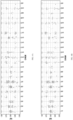
- FIG. 3 (left panel) is a graph showing the variant allele frequency (VAF) for various variants according to chromosomal location for chromosomes 1-7 for each variant with filter-determined somatic variants (black-filled circles), and filter-determined germline variants (gray-filled circles), filtered with a database filter only.
- FIG. 3 (right panel) is an enlargement for variants located on chromosome 7 in which a particular filter-determined somatic variant (black circle) has been selected, and a range drawn from the variant that encompasses several filter-determined germline variants (gray circle).
- a determination that the selected filter-determined somatic variant (black circle) should be called as a germline variant can be made based on the proximity of the selected variant's allele frequency to the allele frequencies of a certain number of already identified germline variants.
- FIG. 4A is a graph showing the variant allele frequency (VAF) for various variants according to chromosomal location of each variant with filter-determined somatic variants (black-filled circles), and filter-determined germline variants (gray-filled circles), filtered with a database filter only.
- FIG. 4B is a graph showing the variant allele frequency (VAF) for various variants according to chromosomal location of each variant with filter-determined somatic variants (black-filled circles), and filter-determined germline variants (gray-filled circles), filtered with a database filter only, and a proximity filter.
- FIG. 4B shows that certain putative false positives shown as somatic variants in FIG. 4A , were identified as germline variants in FIG. 4B .
- identified somatic variants located on chromosome 7 having allele frequencies about 0.4 and 0.3 were identified as germline variants when the proximity filter was applied ( FIG. 4B ).
- This example relates to a targeted next-generation sequencing assay for measuring tumor mutation burden (TMB) in formalin-fixed, paraffin-embedded (FFPE) tumor samples.
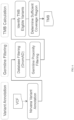
- FIG. 5 shows an example workflow for the assay. Sequence data was obtained from tumor samples for 523 genes in a panel size of 1.94 Mb with exon size of 1.33 Mb. Sequencing and was performed with unique molecular identifiers (UMIs), and using Illumina NextSeq TM 500/550 platforms. Data analysis was performed using a pipeline for detecting variants at 5% variant allele frequencies (VAF). For technical noise removal, a variant calling algorithm was used that utilized information from UMIs, and sample specific error profiles to ensure a uniform variant calling performance across samples of different FFPE qualities. To accurately remove germline variants from TMB calculations, a hybrid strategy was used that integrated information from large-scale public databases with the measured coverage and variant allele frequency of each variant, and that was substantially similar to the database filter and the proximity filter of the foregoing Examples.
- sequence data was obtained, aligned with a reference, and variants were identified.
- Germline variants were filtered from the identified variants using a database filter and a proximity filter, and a TMB was calculated in a workflow substantially similar to the pipeline shown in FIG. 6 .
- a total of 170 pairs of tumor-normal samples were analyzed to assess the germline filtering and TMB performance (TABLE 1).
- a subset of 108 sample pairs were also analyzed with whole exome sequencing (WES).
- FIG. 7 shows distribution of remaining germline variant count after filtering with database only (graph peaks at about 3 germline residuals / Mb) and the hybrid strategy (graph peaks at about 0 germline residuals / Mb).
- TMB reproducibility was assessed in 8 different samples including 4 cell lines and 4 FFPE samples across 3 operators. Mean and standard deviation (SD) of each sample were calculated. TABLE 2 lists TMB reproducibility assessed in 4 cell lines and 4 FFPE samples across 12 replicates each. TABLE 2 Sample DNA type Replicates TMB mean TMB SD T47D Cell line 12 0.9 0.7 H2228 Cell line 12 7.5 0.8 HD799 Cell line 12 405.0 6.8 OncoSpan Cell line 12 389.1 8.4 1251 FFPE 12 0.3 0.4 4116 FFPE 11 24.9 0.7 3643 FFPE 12 7.6 1.4 4118 FFPE 12 50.5 1.5
- FIG. 8A shows TMB comparison between tumor-only and tumor/normal assays.
- FIG. 8B shows TMB comparison between tumor-only and WES tumor-normal assays.
- TMB classification performance TABLE 3 WES T/N TMB high WES T/N TMB low TMB high 54 3 TMB low 2 49
Landscapes
- Life Sciences & Earth Sciences (AREA)
- Chemical & Material Sciences (AREA)
- Health & Medical Sciences (AREA)
- Engineering & Computer Science (AREA)
- Proteomics, Peptides & Aminoacids (AREA)
- Physics & Mathematics (AREA)
- Organic Chemistry (AREA)
- Bioinformatics & Cheminformatics (AREA)
- Analytical Chemistry (AREA)
- Biophysics (AREA)
- Biotechnology (AREA)
- General Health & Medical Sciences (AREA)
- Genetics & Genomics (AREA)
- Wood Science & Technology (AREA)
- Zoology (AREA)
- Medical Informatics (AREA)
- Molecular Biology (AREA)
- Immunology (AREA)
- Evolutionary Biology (AREA)
- Spectroscopy & Molecular Physics (AREA)
- Theoretical Computer Science (AREA)
- Bioinformatics & Computational Biology (AREA)
- Microbiology (AREA)
- General Engineering & Computer Science (AREA)
- Pathology (AREA)
- Biochemistry (AREA)
- Hospice & Palliative Care (AREA)
- Oncology (AREA)
- Evolutionary Computation (AREA)
- Databases & Information Systems (AREA)
- Epidemiology (AREA)
- Data Mining & Analysis (AREA)
- Computer Vision & Pattern Recognition (AREA)
- Bioethics (AREA)
- Artificial Intelligence (AREA)
- Public Health (AREA)
- Software Systems (AREA)
- Measuring Or Testing Involving Enzymes Or Micro-Organisms (AREA)
Applications Claiming Priority (3)
| Application Number | Priority Date | Filing Date | Title |
|---|---|---|---|
| US201862754094P | 2018-11-01 | 2018-11-01 | |
| EP19805856.2A EP3874066B1 (de) | 2018-11-01 | 2019-10-30 | Verfahren und zusammensetzungen zur detektion von somatischen varianten |
| PCT/US2019/058895 WO2020092591A1 (en) | 2018-11-01 | 2019-10-30 | Methods and compositions for somatic variant detection |
Related Parent Applications (1)
| Application Number | Title | Priority Date | Filing Date |
|---|---|---|---|
| EP19805856.2A Division EP3874066B1 (de) | 2018-11-01 | 2019-10-30 | Verfahren und zusammensetzungen zur detektion von somatischen varianten |
Publications (2)
| Publication Number | Publication Date |
|---|---|
| EP4524264A2 true EP4524264A2 (de) | 2025-03-19 |
| EP4524264A3 EP4524264A3 (de) | 2025-06-11 |
Family
ID=68610356
Family Applications (2)
| Application Number | Title | Priority Date | Filing Date |
|---|---|---|---|
| EP25152979.8A Pending EP4524264A3 (de) | 2018-11-01 | 2019-10-30 | Verfahren und zusammensetzungen zur detektion somatischer varianten |
| EP19805856.2A Active EP3874066B1 (de) | 2018-11-01 | 2019-10-30 | Verfahren und zusammensetzungen zur detektion von somatischen varianten |
Family Applications After (1)
| Application Number | Title | Priority Date | Filing Date |
|---|---|---|---|
| EP19805856.2A Active EP3874066B1 (de) | 2018-11-01 | 2019-10-30 | Verfahren und zusammensetzungen zur detektion von somatischen varianten |
Country Status (12)
| Country | Link |
|---|---|
| US (2) | US12417819B2 (de) |
| EP (2) | EP4524264A3 (de) |
| JP (2) | JP7554121B2 (de) |
| KR (1) | KR102890173B1 (de) |
| CN (1) | CN112424380B (de) |
| AU (1) | AU2019369517A1 (de) |
| BR (1) | BR112020026259A2 (de) |
| CA (1) | CA3104004A1 (de) |
| IL (1) | IL279435B2 (de) |
| MX (1) | MX2020014090A (de) |
| SG (1) | SG11202012487WA (de) |
| WO (1) | WO2020092591A1 (de) |
Families Citing this family (2)
| Publication number | Priority date | Publication date | Assignee | Title |
|---|---|---|---|---|
| KR102427600B1 (ko) * | 2021-12-14 | 2022-08-01 | 주식회사 테라젠바이오 | 줄기세포의 배양적응성을 판단하기 위한 체세포 변이를 선별하는 방법 |
| US20230215513A1 (en) | 2021-12-31 | 2023-07-06 | Sophia Genetics S.A. | Methods and systems for detecting tumor mutational burden |
Citations (1)
| Publication number | Priority date | Publication date | Assignee | Title |
|---|---|---|---|---|
| US20180218789A1 (en) | 2015-07-07 | 2018-08-02 | Farsight Genome Systems, Inc. | Methods and systems for sequencing-based variant detection |
Family Cites Families (9)
| Publication number | Priority date | Publication date | Assignee | Title |
|---|---|---|---|---|
| TWI518325B (zh) | 2010-02-04 | 2016-01-21 | 自治醫科大學 | 對alk抑制劑具有先抗性或後抗性癌症的識別、判斷和治療 |
| RU2442999C1 (ru) | 2010-10-21 | 2012-02-20 | Общество с ограниченной ответственностью "Сибирская геофизическая научно-производственная компания" | Программно-измерительный комплекс (пик) |
| US11261494B2 (en) | 2012-06-21 | 2022-03-01 | The Chinese University Of Hong Kong | Method of measuring a fractional concentration of tumor DNA |
| CA3060708A1 (en) | 2014-04-29 | 2015-11-05 | Illumina, Inc | Multiplexed single cell gene expression analysis using template switch and tagmentation |
| WO2016055971A2 (en) * | 2014-10-10 | 2016-04-14 | Invitae Corporation | Methods, systems and processes of de novo assembly of sequencing reads |
| US10395760B2 (en) * | 2015-04-13 | 2019-08-27 | Invitae Corporation | Methods, systems and processes of identifying genetic variation in highly similar genes |
| EP4086357A1 (de) * | 2015-08-28 | 2022-11-09 | Illumina, Inc. | Nukleinsäuresequenzanalyse aus einzelnen zellen |
| WO2018067886A2 (en) * | 2016-10-05 | 2018-04-12 | Nantomics, Llc | Stress induced mutations as a hallmark of cancer |
| CN107491666B (zh) * | 2017-09-01 | 2020-11-10 | 深圳裕策生物科技有限公司 | 异常组织中单样本体细胞突变位点检测方法、装置和存储介质 |
-
2019
- 2019-10-30 BR BR112020026259-5A patent/BR112020026259A2/pt unknown
- 2019-10-30 EP EP25152979.8A patent/EP4524264A3/de active Pending
- 2019-10-30 KR KR1020207037041A patent/KR102890173B1/ko active Active
- 2019-10-30 EP EP19805856.2A patent/EP3874066B1/de active Active
- 2019-10-30 IL IL279435A patent/IL279435B2/en unknown
- 2019-10-30 WO PCT/US2019/058895 patent/WO2020092591A1/en not_active Ceased
- 2019-10-30 MX MX2020014090A patent/MX2020014090A/es unknown
- 2019-10-30 JP JP2020572675A patent/JP7554121B2/ja active Active
- 2019-10-30 CN CN201980042604.3A patent/CN112424380B/zh active Active
- 2019-10-30 US US16/669,270 patent/US12417819B2/en active Active
- 2019-10-30 SG SG11202012487WA patent/SG11202012487WA/en unknown
- 2019-10-30 CA CA3104004A patent/CA3104004A1/en active Pending
- 2019-10-30 AU AU2019369517A patent/AU2019369517A1/en active Pending
-
2024
- 2024-08-08 JP JP2024131915A patent/JP2024153922A/ja not_active Withdrawn
-
2025
- 2025-08-29 US US19/314,988 patent/US20260051365A1/en active Pending
Patent Citations (1)
| Publication number | Priority date | Publication date | Assignee | Title |
|---|---|---|---|---|
| US20180218789A1 (en) | 2015-07-07 | 2018-08-02 | Farsight Genome Systems, Inc. | Methods and systems for sequencing-based variant detection |
Non-Patent Citations (1)
| Title |
|---|
| LEK, M. ET AL., NATURE, vol. 536, 2016, pages 285 - 292 |
Also Published As
| Publication number | Publication date |
|---|---|
| US20260051365A1 (en) | 2026-02-19 |
| WO2020092591A1 (en) | 2020-05-07 |
| EP3874066A1 (de) | 2021-09-08 |
| JP2022511208A (ja) | 2022-01-31 |
| KR102890173B1 (ko) | 2025-11-21 |
| EP3874066B1 (de) | 2025-01-22 |
| CA3104004A1 (en) | 2020-05-07 |
| CN112424380B (zh) | 2025-03-04 |
| CN112424380A (zh) | 2021-02-26 |
| EP4524264A3 (de) | 2025-06-11 |
| AU2019369517A1 (en) | 2021-01-21 |
| JP7554121B2 (ja) | 2024-09-19 |
| IL279435B1 (en) | 2025-10-01 |
| IL279435B2 (en) | 2026-02-01 |
| KR20210083208A (ko) | 2021-07-06 |
| MX2020014090A (es) | 2021-03-09 |
| BR112020026259A2 (pt) | 2021-07-27 |
| US12417819B2 (en) | 2025-09-16 |
| JP2024153922A (ja) | 2024-10-29 |
| US20200143905A1 (en) | 2020-05-07 |
| SG11202012487WA (en) | 2021-01-28 |
| IL279435A (en) | 2021-01-31 |
Similar Documents
| Publication | Publication Date | Title |
|---|---|---|
| JP7685436B2 (ja) | 転移性組織サンプルのトランスクリプトームデコンボリューション | |
| US20260051365A1 (en) | Methods and compositions for germline variant detection | |
| CN109689891B (zh) | 用于无细胞核酸的片段组谱分析的方法 | |
| EP4597451A2 (de) | Auf tiefenlernen basierende techniken zum trainieren von tiefen neuronalen faltungsnetzwerken | |
| WO2017065959A2 (en) | Methods and compositions that utilize transcriptome sequencing data in machine learning-based classification | |
| US20240401035A1 (en) | Fragment size characterization of cell-free dna mutations from clonal hematopoiesis | |
| US20220223227A1 (en) | Machine learning techniques for identifying malignant b- and t-cell populations | |
| HK40119646A (en) | Methods and compositions for somatic variant detection | |
| CA3219608A1 (en) | Detection of human leukocyte antigen loss of heterozygosity | |
| RU2813655C2 (ru) | Способы и композиции для обнаружения соматического варианта | |
| HK40061573B (en) | Methods and compositions for somatic variant detection | |
| HK40061573A (en) | Methods and compositions for somatic variant detection | |
| HK40046981A (en) | Methods and compositions for somatic variant detection | |
| HK40046981B (zh) | 用於体细胞变体检测的方法和组合物 | |
| Gupta et al. | Genetics for dermatologists. Part 2: Clinical evaluation, sequencing technologies and interpretation | |
| US20250149117A1 (en) | Techniques for detecting de novo and rare variants using a family graph reference | |
| Leppiniemi et al. | SegmentQTL: Identifying genetic variants influencing molecular phenotypes in copy number–driven cancers | |
| WO2024258639A1 (en) | Methods and systems of classifying tumor tissue samples | |
| WO2025217057A1 (en) | Variant detection using improved sequence data alignments | |
| CN121393536A (zh) | 基于群体样本eQTL和单细胞eQTL的数据分析方法及系统 | |
| Friedenberg | Understanding the Genetic Basis of Addison's Disease in Standard Poodle Dogs |
Legal Events
| Date | Code | Title | Description |
|---|---|---|---|
| PUAI | Public reference made under article 153(3) epc to a published international application that has entered the european phase |
Free format text: ORIGINAL CODE: 0009012 |
|
| STAA | Information on the status of an ep patent application or granted ep patent |
Free format text: STATUS: THE APPLICATION HAS BEEN PUBLISHED |
|
| AC | Divisional application: reference to earlier application |
Ref document number: 3874066 Country of ref document: EP Kind code of ref document: P |
|
| AK | Designated contracting states |
Kind code of ref document: A2 Designated state(s): AL AT BE BG CH CY CZ DE DK EE ES FI FR GB GR HR HU IE IS IT LI LT LU LV MC MK MT NL NO PL PT RO RS SE SI SK SM TR |
|
| REG | Reference to a national code |
Ref country code: DE Ref legal event code: R079 Free format text: PREVIOUS MAIN CLASS: C12Q0001688600 Ipc: C12Q0001686900 |
|
| PUAL | Search report despatched |
Free format text: ORIGINAL CODE: 0009013 |
|
| AK | Designated contracting states |
Kind code of ref document: A3 Designated state(s): AL AT BE BG CH CY CZ DE DK EE ES FI FR GB GR HR HU IE IS IT LI LT LU LV MC MK MT NL NO PL PT RO RS SE SI SK SM TR |
|
| RIC1 | Information provided on ipc code assigned before grant |
Ipc: C12Q 1/6886 20180101ALI20250508BHEP Ipc: C12Q 1/6869 20180101AFI20250508BHEP |
|
| REG | Reference to a national code |
Ref country code: HK Ref legal event code: DE Ref document number: 40119646 Country of ref document: HK |
|
| STAA | Information on the status of an ep patent application or granted ep patent |
Free format text: STATUS: THE APPLICATION IS DEEMED TO BE WITHDRAWN |