EP4521848A2 - Steuerung der übertragung von gruppenadressierten daten - Google Patents
Steuerung der übertragung von gruppenadressierten daten Download PDFInfo
- Publication number
- EP4521848A2 EP4521848A2 EP24215569.5A EP24215569A EP4521848A2 EP 4521848 A2 EP4521848 A2 EP 4521848A2 EP 24215569 A EP24215569 A EP 24215569A EP 4521848 A2 EP4521848 A2 EP 4521848A2
- Authority
- EP
- European Patent Office
- Prior art keywords
- group
- wireless device
- addressed
- data
- addressed data
- Prior art date
- Legal status (The legal status is an assumption and is not a legal conclusion. Google has not performed a legal analysis and makes no representation as to the accuracy of the status listed.)
- Pending
Links
Images
Classifications
-
- H—ELECTRICITY
- H04—ELECTRIC COMMUNICATION TECHNIQUE
- H04L—TRANSMISSION OF DIGITAL INFORMATION, e.g. TELEGRAPHIC COMMUNICATION
- H04L12/00—Data switching networks
- H04L12/02—Details
- H04L12/16—Arrangements for providing special services to substations
- H04L12/18—Arrangements for providing special services to substations for broadcast or conference, e.g. multicast
- H04L12/189—Arrangements for providing special services to substations for broadcast or conference, e.g. multicast in combination with wireless systems
-
- H—ELECTRICITY
- H04—ELECTRIC COMMUNICATION TECHNIQUE
- H04W—WIRELESS COMMUNICATION NETWORKS
- H04W4/00—Services specially adapted for wireless communication networks; Facilities therefor
- H04W4/06—Selective distribution of broadcast services, e.g. multimedia broadcast multicast service [MBMS]; Services to user groups; One-way selective calling services
-
- H—ELECTRICITY
- H04—ELECTRIC COMMUNICATION TECHNIQUE
- H04W—WIRELESS COMMUNICATION NETWORKS
- H04W72/00—Local resource management
- H04W72/30—Resource management for broadcast services
-
- H—ELECTRICITY
- H04—ELECTRIC COMMUNICATION TECHNIQUE
- H04W—WIRELESS COMMUNICATION NETWORKS
- H04W76/00—Connection management
- H04W76/40—Connection management for selective distribution or broadcast
-
- H—ELECTRICITY
- H04—ELECTRIC COMMUNICATION TECHNIQUE
- H04W—WIRELESS COMMUNICATION NETWORKS
- H04W84/00—Network topologies
- H04W84/02—Hierarchically pre-organised networks, e.g. paging networks, cellular networks, WLAN [Wireless Local Area Network] or WLL [Wireless Local Loop]
- H04W84/10—Small scale networks; Flat hierarchical networks
- H04W84/12—WLAN [Wireless Local Area Networks]
Definitions
- Wireless networks can include a wireless local area network (WLAN), which includes one or more wireless access points (APs) to which devices are able to wirelessly connect.
- WLAN wireless local area network
- APs wireless access points
- an AP can send a message targeted to multiple recipient wireless devices.
- This form of communication can include a broadcast of the message (which is targeted at all wireless devices within range of the AP or that satisfies some other condition) or a multicast of the message (which is targeted at wireless devices within a specified group regardless of whether they are in range of the AP).
- Broadcast and multicast transmissions can more generally be referred to as "group-addressed transmissions", where the "group" of wireless devices targeted can be all wireless devices within range of the transmitting device or that satisfies some other condition, or a group that is associated with a specified address (e.g., a multicast address). Controlling group-addressed transmissions in a WLAN can be associated with various challenges.
- wireless devices may communicate with one another.
- a wireless device can include an endpoint device or a wireless access point (AP).
- a wireless AP (or more simply, an AP) can refer to a communication device to which a wireless device can establish a wireless connection to communicate with other endpoint devices.
- WLANs can include wireless networks that operate according to the Institute of Electrical and Electronic Engineers (IEEE) 802.11 or Wi-Fi Alliance Specifications.
- endpoint devices include stations (STAs), access points (APs), computers (e.g., tablet computers, notebook computers, desktop computers, server computers, etc.), handheld devices (e.g. smart phones, personal digital assistants, etc.), wearable devices (smart watches, electronic eyeglasses, head-mounted devices, etc.), game appliances, health monitors, vehicles (or equipment in vehicles), cargo transportation units (e.g., trailers, containers, etc.), Internet of Things (IoT) devices, roadside units (RSUs) (such as devices in traffic lights, traffic signs, etc., that are able to transmit information to vehicles or other devices), storage devices, communication nodes, or other types of endpoint or user devices that are able to communicate wirelessly.
- Endpoint devices can include mobile devices and/or fixed position devices. More generally, an endpoint device can refer to an electronic device that is able to communicate wirelessly.
- broadcasting or multicasting of information according to “broadcast services” refers to broadcasting or multicasting information that may be different from control information used for associating a device with a network or establishing a connection with a network.
- broadcasting or multicasting of information according to “broadcast services” can refer to broadcasting or multicasting data, such as user data, application program data, vehicle-related data (e.g., data relating to vehicles, vehicular traffic, road conditions, etc.), and/or other types of data.
- the AP may cache (or store) group-addressed data that are targeted to the wireless devices in the power-save mode, and can later deliver the data in a unicast transmission to each of the wireless devices as the wireless device transition out of the power-save mode.
- a BSS typically refers to a group of wireless devices associated with one another, where one wireless device is an AP. If there are a large number of wireless devices, sending data in unicast transmissions can lead to replication of a large number of data frames to be transmitted in unicast transmissions to the corresponding wireless devices. Such unicast transmissions can be inefficient.
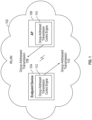
- Fig. 1 is a block diagram of an example network arrangement that includes a WLAN 102.
- the WLAN 102 includes one or more APs 106 with which one or more endpoint devices 104 are able to wirelessly communicate.
- the WLAN 102 can include multiple APs, and there may be multiple endpoint devices to communicate with the one or more APs of the WLAN 102.
- the AP 106 can be a source wireless device that is able to broadcast or multicast information (in a group-addressed transmission 108) according to a broadcast service
- the endpoint device 104 can be a recipient wireless device to receive broadcast or multicast information according to the broadcast service.
- the endpoint device 104 can be a source wireless device that can send broadcast or multicast information (in a group-addressed transmission 110) according to a broadcast service to one or more recipient wireless devices.
- a “wireless device” can refer to either an endpoint device or an AP.
- a wireless device can perform group-addressed transmission of group-addressed data to other wireless devices.
- the endpoint device 104 includes a group-addressed transmission control engine 112 that is able to control the communication of group-addressed data.
- the AP 106 includes a group-addressed transmission control engine 114 that is able to control the transmission of group-addressed data.
- an “engine” can refer to a hardware processing circuit, which can include any or some combination of a microprocessor, a core of a multi-core microprocessor, a microcontroller, a programmable integrated circuit, a programmable gate array, a digital signal processor, or another hardware processing circuit.
- an “engine” can refer to a combination of a hardware processing circuit and machine-readable instructions (software and/or firmware) executable on the hardware processing circuit.
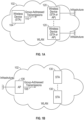
- a wireless endpoint device 104 such as a non-AP station (STA) can perform group-addressed transmissions 110 to one or more other wireless devices 120 that are part of a network infrastructure (e.g., the WLAN 102).
- the "network infrastructure" can include an AP or another wireless device that is part of a network.
- the wireless device that performs group-addressed transmissions can include a sensor device, an RSU, a vehicle, or any other type of wireless device.
- a source wireless device can send a group-addressed transmission to one or more other recipient wireless devices that are within range of the source wireless device.
- the sensor data can be encoded and transmitted to devices (e.g., monitoring devices) that subscribe to a stream of the sensor data.
- devices e.g., monitoring devices
- a "stream" refers to a flow of data that is separately identifiable.
- the stream can be sent in an Outside the Context of a BSS (OCB) mode or an Independent BSS (IBSS) mode.
- OCB BSS
- IBSS Independent BSS
- An enhanced OCB mode is also being defined by IEEE 802.11 bd. This may allow operation of enhanced OCB devices outside of the 5.9 GHz band (e.g., in the rest of the 5 GHz band) and also provide the ability to use other channel bandwidths, apart from 10 and 20 MHz.
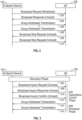
- the Broadcast Request message is sent with a group-addressed destination address and a group-addressed BSS identity (BSSID), for indicating that a group-addressed transmission is requested by the endpoint device 104.
- BSSID group-addressed BSS identity
- the message contains information about the stream or streams the device is advertising to send in a group-addressed transmission.
- a "stream” refers to a flow of data that is separately identifiable.
- the sending of the Broadcast Request message is an example of how a wireless device can subscribe to one or more streams that are sent in group-addressed transmission(s).
- the group-addressed transmission control engine 114 in the AP 106 sends (at 204) a Broadcast Response message.
- the Broadcast Response message is a unicast message sent by the AP 106 (or another wireless device) that received the Broadcast Request message from the endpoint device 104.
- the Broadcast Response message 204 is directed at the endpoint device 104.
- the Broadcast Response message includes an accept or reject indication.
- the Broadcast Response message can contain one or more stream indications (e.g., information elements, etc.) to indicate which one or more of the streams the recipient wireless device (the AP 106 in the example of Fig. 2 ) has chosen to receive.
- the Broadcast Response message may contain a time limit indication (a time duration or end time) during which the recipient wireless device has chosen to receive the stream(s) of group-addressed data.
- the group-addressed data is not acknowledged by the AP 106 (or other recipient wireless device).
- the group-addressed transmissions (206) can be periodic transmissions (transmitted every regular time period) or intermittent transmissions (transmitted when triggered by an event, such as a temperature going outside a specified range, etc.).
- Each group-addressed transmission (206) can include one or more group-addressed frames (e.g., a data frame and/or a management frame).
- a destination address is set to a multicast address or broadcast address.
- a source address which can be a source MAC address, of the sender wireless device
- a destination address which can be a group address (broadcast or multicast address representing a group-addressed stream);
- a group-addressed BSSID set to a specified value, such as FF-FF-FF-FF-FE (or another address with an I/G bit set to G).
- a recipient wireless device can choose to process a received frame as a broadcast or multicast stream based on all three of the addresses above, or just a subset.
- the endpoint device 104 can include a temperature sensor, a pressure sensor, and a humidity sensor. Temperature data from the temperature sensor is to be sent in a temperature data stream, pressure data from the pressure sensor is to be sent in a pressure data stream, and humidity data from the humidity sensor is to be sent in a humidity data stream (three streams in this example).
- the Broadcast Request message includes information about the three streams.
- the Broadcast Response message indicates which of the three streams the AP 106 has chosen to receive.
- the group-addressed transmission control engine 112 of the endpoint device 104 can consider the selection of which streams were selected by the AP 106 for receipt when the group-addressed transmission control engine 112 decides which streams to start sending.
- BSA broadcast service area
- the group-addressed transmission control engine 112 can take into account Broadcast Response messages from more than one recipient wireless device when deciding which streams to transmit.
- recipient wireless device 1 may choose stream 1 but not streams 2 and 3, but recipient 2 may choose streams 1 and 2 but not stream 3.
- the group-addressed transmission control engine 112 can decide to transmit streams 1 and 2, but not stream 3.
- the device e.g., the AP 106 in Fig. 2
- the AP 106 may forward the stream of data to another entity in the network.
- the IEEE 802.11 three address format may include a destination address that exists elsewhere behind the AP 106 in the LAN/WLAN.
- the AP 106 can rebroadcast or re-multicast the data frames of a stream on the entire LAN, or the AP 106 may unicast the data frames of the stream to Internet Group Management Protocol (IGMP)-snooped recipient(s) wireless devices.
- IGMP Internet Group Management Protocol
- the AP 106 (the recipient wireless device) (or another wireless coupled to the AP 106) may decide that the AP 106 wishes to stop receiving group-addressed data.
- the AP 106 sends (at 208) a Broadcast Stop Request message to the endpoint device 104.
- the Broadcast Stop Request message can be a unicast message individually addressed to the endpoint device 104.
- the Broadcast Stop Request message may indicate the specific one or more streams to cease transmitting. This may be identified by a stream identifier, such as a group-addressed MAC address, a group-addressed IP address, or another identity.
- the endpoint device 104 considers the information in the Broadcast Stop Request message when deciding whether or not to stop the group-addressed transmission of a given stream. If for example there are multiple recipient wireless devices of a stream, the group-addressed transmission control engine 112 of the endpoint device 104 may continue to transmit the stream even though one of the recipient wireless devices sent a Broadcast Stop Request message to stop the stream.
- the group-addressed transmission control engine 112 of the endpoint device 104 sends (at 210) a Broadcast Stop Response message to acknowledge the receipt of the Broadcast Stop Request message.
- the Broadcast Stop Response message is unicast to the AP 106.
- the endpoint device 104 may send the Broadcast Stop Request message to the AP 106, requesting the AP 106 to stop the group-addressed transmission of a given stream. The AP 106 would then transmit a Broadcast Stop Response message to the endpoint device 104 to acknowledge the receipt of the Broadcast Stop Request message.
- Fig. 2 shows an example where in-band control signaling (i.e., control signaling exchanged over a channel of the WLAN 102) is exchanged between the endpoint device 104 and the AP 106 (in the form of the messages 202, 204, 208, and 210) for controlling the group-addressed transmission of data.
- the exchange of messages for controlling the group-addressed transmission of data can be negotiated out-of-band, i.e., over a communication link that is separate from the WLAN 102.
- the control messages that are exchanged can establish channel information, a data rate, and a scheduling of the group-addressed transmission of data.
- security can be implemented by provisioning a security association.
- a mechanism can be provided for a recipient wireless device to subscribe to a sender wireless device to receive group-addressed transmissions.
- key distribution an encryption key for encrypting group-addressed data can be performed using an out-of-band mechanism (e.g., through a higher layer protocol).
- the higher layer protocol negotiates the key and once a key is agreed by the sender and recipient wireless devices, encryption at layer 2 (L2) can be used.
- network infrastructure equipment such as the AP 106, can transmit group-addressed data (in 108) in a downlink to one or more recipient wireless devices (e.g., STAs 130, one of which can be the endpoint device 104), such as one or more associated wireless devices (e.g., wireless devices in State 4 as discussed above) or unassociated wireless devices (e.g., wireless devices in State 1 that is in the same BSA as the AP).
- recipient wireless devices e.g., STAs 130, one of which can be the endpoint device 104
- associated wireless devices e.g., wireless devices in State 4 as discussed above
- unassociated wireless devices e.g., wireless devices in State 1 that is in the same BSA as the AP.
- Fig. 3 is a message flow diagram of a process between the endpoint device 104 and the AP 106.
- the message flow diagram of Fig. 3 includes a discovery phase 302, a subscription/control phase 304, and a broadcast phase 306.
- the AP 106 can advertise that the AP 106 has data to send in group-addressed transmission(s) according to broadcast services.
- the discovery phase 302 can use techniques as described in U.S. Application No. 16/124,847, entitled "Indicating Support for a Broadcast Service," filed September 7, 2018 .
- ANQP is a type of an advertisement protocol.
- ANQP operates as a simple request and response protocol that is used by a device to discover a range of information from an "Access Network" (AN) server.
- AN Access Network
- This AN server is either co-located with an AP or is located within a LAN, which is the layer 2 network to which the AP is connected.
- ANQP allows a device to determine the properties of the LAN before starting an association procedure.
- the recipient wireless device (which in this case is the endpoint device 104) can send a request to the AP 106 requesting information of further details (e.g., characteristics and/or state) of a broadcast service(s), and in response, the AP 106 responds with a response containing the requested information.
- information included in the response can include any or some combination of the following: a number of stream(s) the source wireless device has available to send in group-addressed transmissions, channels (or sub-channels) on which the stream(s) is (are) broadcast, time and availability of the stream(s), whether security is provided on the stream(s), and so forth.
- the subscription/control phase 304 can include control messages exchanged between the endpoint device 104 and the AP 106 to control the group-addressed transmission of data.
- the group-addressed transmission control engine 112 in the endpoint device 104 can send (at 308) a Broadcast Inquiry Request message to the AP 106.
- the Broadcast Inquiry Request message can be sent as a unicast message, and includes information indicating that the endpoint device 104 is interested in group-addressed data transmitted by the AP 106 (or another device coupled to the AP 106).
- the Broadcast Inquiry Request message can include identifier(s) of stream(s) of the group-addressed data that the endpoint device 104 is interested in.
- the Broadcast Inquiry Request message is an example of how a wireless device can subscribe to a stream.
- the Broadcast Inquiry Response message can include information useable by the endpoint device 104 in receiving a group-addressed transmission from the AP 106.
- Broadcast Inquiry Response message can include an Orthogonal Frequency-Division Multiple Access (OFDMA) resource unit (RU), a channel, a secondary channel, or other transmission resource to use for the group-addressed transmission.
- OFDMA Orthogonal Frequency-Division Multiple Access
- the AP 106 may provide OFDMA resource allocation such that some RUs are used for group-addressed transmissions, and other RUs are used for unicast transmissions.
- a wireless device may receive group-addressed data frames and unicast data frames, from different source addresses in the WLAN 102, on different subchannels (or RUs) simultaneously. This type of multiple access is enabled by the OFDMA capabilities in IEEE 802.11ax, for example.
- the Broadcast Inquiry Response message can include a Multicast Group Temporal Key (MGTK) specific to a stream that the endpoint device 104 is interested in. If the endpoint device 104 has expressed interest in multiple streams using information in the Broadcast Inquiry Request message, the Broadcast Inquiry Response message can include multiple MGTKs for the respective streams.
- MGTK Multicast Group Temporal Key
- the control messages exchanged in the subscription/control phase 304 can include Generic Advertisement Service (GAS) or ANQP request and response messages (according to IEEE 802.11aq) or other types of messages (in state 1 or 4).
- GAS Generic Advertisement Service
- ANQP request and response messages according to IEEE 802.11aq
- other types of messages in state 1 or 4.
- the control messages can include Current Traffic Specification (TSPEC) information, which allows one wireless device to signal its traffic requirement to another wireless device.
- TSPEC Current Traffic Specification
- Internet Group Management Protocol IGMP
- IGMP Internet Group Management Protocol
- a network infrastructure e.g., an AP or another network device
- a wireless device e.g., the endpoint device 104
- IGMP snooping can be used at the AP 106 to manage the list of streams (as group addresses in use) and the wireless devices subscribed to those streams
- Each group-addressed transmission from the AP 106 includes one or more frames (data frame and/or management frame), which can be sent to a wireless device in State 4 or State 1.
- a value of one or more of the addresses in the three address MAC header of each frame may correspond to the multicast or broadcast destination address of the stream.
- the frames may be transmitted in a particular resource unit (RU) of an IEEE 802.11ax OFDMA transmission, for example.
- a stream may be transmitted in a channel adjacent to another channel used for unicast data.
- a dedicated subchannel e.g., an OFDMA RU
- the determination of whether a received frame is part of a stream starts by checking the 3 addresses, and whether the BSSID matches the multicast address of a particular stream.
- the AP 106 may allocate RU sizes based on requirements of the stream
- the transmission of frames of a stream may be synchronized with a power save state such as Traffic indication map/Delivery traffic indicaiton map (TIM/DTIM) periods or target wake time (TWT) periods. This may be communicated from to the receiving device such that it can optimize the power saving of its receiver hardware.
- a power save state such as Traffic indication map/Delivery traffic indicaiton map (TIM/DTIM) periods or target wake time (TWT) periods.
- TIM/DTIM periods are periods that define a general time for a wireless device to be in a power-save mode or be awake. Therefore if the transmission of group-addressed data from an AP is synchronised based on the TIM/DTIM transmissions from the same AP, then the recipient wireless device may be be awake to receive the group-addressed data.
- TWT periods define when a wireless device is to wake up to receive data.
- Security in a BSS can use an encryption key for encrypting a data frame.
- the key can include a group key.
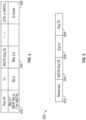
- a Group Temporal Key (GTK) that is distributed by an AP has a key identifier (Key ID) of 0 or 1 and is applied to all group-addressed data.
- multiple group keys can be used for different streams of group-addressed data or different groups of wireless devices.
- a group key can be referred to as a Multicast GTK (MGTK).
- MGTK Multicast GTK
- One or more MGTKs can be defined.
- the IEEE 802.11-2016 GTK can be referred to as a Broadcast GTK (BGTK).
- a new Authentication and Key Management (or set of AKMs) is defined that support BGTK and MGTK.
- Support for the new AKM or set of AKMs can be negotiated between the AP 106 and the wireless devices during the association process.
- this new AKM instead of previously defined AKM a larger number of Key IDs are enabled as described later.
- the AP 106 assigns the wireless device to an MGTK group and transmits the MGTK to the wireless device in a GTK handshake exchange.
- the endpoint device 104 and/or the AP 106 can each advertise support for MGTK.
- support for MGTK can be advertised as a service or an element in an ANQP message or another type of message.
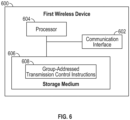
- Fig. 6 is a block diagram of a first wireless device 600 that is able to transmit or receive group-addressed data according to some examples.
- the first wireless device 600 can be the endpoint device 104 of Fig. 1 , for example.
- the first wireless device 600 further includes a non-transitory machine-readable or computer-readable storage medium 606 storing machine-readable instructions that are executable on the one or more processors to perform respective tasks.
- the machine-readable instructions can include group-addressed transmission control instructions 608 to manage communications of group-addressed data.
- the group-addressed transmission control instructions 608 are executable to send, from the first wireless device 600 to a second wireless device (e.g., the AP 106), a control indication that controls transmission of group-addressed data between the first wireless device and the second wireless device over the WLAN.
- the control indication can include a start indication (e.g., the Broadcast Request message of Fig. 2 ) to start a procedure for the first wireless device 600 to send group-addressed data (e.g., 206 in Fig. 2 ).
- control indication can include another start indication (e.g., the Broadcast Inquiry Request message of Fig. 3 ) to cause the second wireless device to transmit the group-addressed data to the first wireless device 600.
- another start indication e.g., the Broadcast Inquiry Request message of Fig. 3
- the first wireless device 600 receives a response indication (e.g., the Broadcast Response message of Fig. 2 or the Broadcast Inquiry Response message of Fig. 3 ) from the second wireless device regarding the transmission of the group-addressed data.
- a response indication e.g., the Broadcast Response message of Fig. 2 or the Broadcast Inquiry Response message of Fig. 3
- the control indication identifies a plurality of streams of group-addressed data
- the response indication from the second wireless device identifies a subset of the plurality of streams of group-addressed data that the second wireless device has selected to receive.
- the response indication can include timing information (e.g., the time limit indication discussed in the section "Group-addressed transmission start procedure" above) relating to a timing relating to when the second wireless device has chosen to receive the group-addressed data.
- the first wireless device 600 receives, from the second wireless device, a key for encrypting the group-addressed data, where the key is associated with a group of wireless devices, and where different groups of wireless devices are associated with different keys for data encryption. Further, the key is associated with a particular stream that includes the group-addressed data, and different streams of group-addressed data are associated with different keys for data encryption.
- the storage medium 606 can include any or some combination of the following: a semiconductor memory device such as a dynamic or static random access memory (a DRAM or SRAM), an erasable and programmable read-only memory (EPROM), an electrically erasable and programmable read-only memory (EEPROM) and flash memory; a magnetic disk such as a fixed, floppy and removable disk; another magnetic medium including tape; an optical medium such as a compact disc (CD) or a digital video disc (DVD); or another type of storage device.
- a semiconductor memory device such as a dynamic or static random access memory (a DRAM or SRAM), an erasable and programmable read-only memory (EPROM), an electrically erasable and programmable read-only memory (EEPROM) and flash memory
- a magnetic disk such as a fixed, floppy and removable disk
- another magnetic medium including tape an optical medium such as a compact disc (CD) or a digital video disc (DVD); or another type of storage device.
- CD compact disc
- Such computer-readable or machine-readable storage medium or media is (are) considered to be part of an article (or article of manufacture).
- An article or article of manufacture can refer to any manufactured single component or multiple components.
- the storage medium or media can be located either in the machine running the machine-readable instructions, or located at a remote site from which machine-readable instructions can be downloaded over a network for execution.
- the application further comprises the following aspects:
Landscapes
- Engineering & Computer Science (AREA)
- Computer Networks & Wireless Communication (AREA)
- Signal Processing (AREA)
- Multimedia (AREA)
- Mobile Radio Communication Systems (AREA)
Applications Claiming Priority (3)
| Application Number | Priority Date | Filing Date | Title |
|---|---|---|---|
| US16/242,798 US12082076B2 (en) | 2019-01-08 | 2019-01-08 | Controlling transmission of group-addressed data |
| PCT/CA2019/051831 WO2020142831A1 (en) | 2019-01-08 | 2019-12-17 | Controlling transmission of group-addressed data |
| EP19908765.1A EP3909393B1 (de) | 2019-01-08 | 2019-12-17 | Steuerung der übertragung von gruppenadressierten daten |
Related Parent Applications (1)
| Application Number | Title | Priority Date | Filing Date |
|---|---|---|---|
| EP19908765.1A Division EP3909393B1 (de) | 2019-01-08 | 2019-12-17 | Steuerung der übertragung von gruppenadressierten daten |
Publications (2)
| Publication Number | Publication Date |
|---|---|
| EP4521848A2 true EP4521848A2 (de) | 2025-03-12 |
| EP4521848A3 EP4521848A3 (de) | 2025-03-19 |
Family
ID=71404686
Family Applications (2)
| Application Number | Title | Priority Date | Filing Date |
|---|---|---|---|
| EP19908765.1A Active EP3909393B1 (de) | 2019-01-08 | 2019-12-17 | Steuerung der übertragung von gruppenadressierten daten |
| EP24215569.5A Pending EP4521848A3 (de) | 2019-01-08 | 2019-12-17 | Steuerung der übertragung von gruppenadressierten daten |
Family Applications Before (1)
| Application Number | Title | Priority Date | Filing Date |
|---|---|---|---|
| EP19908765.1A Active EP3909393B1 (de) | 2019-01-08 | 2019-12-17 | Steuerung der übertragung von gruppenadressierten daten |
Country Status (6)
| Country | Link |
|---|---|
| US (2) | US12082076B2 (de) |
| EP (2) | EP3909393B1 (de) |
| CN (1) | CN113273226B (de) |
| CA (1) | CA3120483A1 (de) |
| ES (1) | ES2999629T3 (de) |
| WO (1) | WO2020142831A1 (de) |
Families Citing this family (6)
| Publication number | Priority date | Publication date | Assignee | Title |
|---|---|---|---|---|
| US11523306B1 (en) | 2019-05-30 | 2022-12-06 | Marvell Asia Pte Ltd | Traffic characteristics for target wake time (TWT) negotiation |
| US11463988B2 (en) * | 2019-06-04 | 2022-10-04 | Qualcomm Incorporated | Uplink broadcast service in a wireless local area network (WLAN) |
| US11109394B2 (en) * | 2019-07-30 | 2021-08-31 | Cypress Semiconductor Corporation | Methods, systems and devices for providing differentiated quality of service for wireless communication devices |
| US12041444B2 (en) * | 2020-09-10 | 2024-07-16 | Blackberry Limited | Authentication using wireless sensing |
| US12013684B2 (en) * | 2021-03-24 | 2024-06-18 | Yokogawa Electric Corporation | Commissioning devices to process automation systems using portable setup devices |
| US12184497B2 (en) * | 2021-04-23 | 2024-12-31 | Arista Networks, Inc | Ordering possible device locations on the network by port-of-entry likelihood |
Family Cites Families (29)
| Publication number | Priority date | Publication date | Assignee | Title |
|---|---|---|---|---|
| US7062272B2 (en) | 2003-02-18 | 2006-06-13 | Qualcomm Incorporated | Method and apparatus to track count of broadcast content recipients in a wireless telephone network |
| US7424007B2 (en) | 2004-05-12 | 2008-09-09 | Cisco Technology, Inc. | Power-save method for 802.11 multicast paging applications |
| US7634223B2 (en) | 2004-07-12 | 2009-12-15 | Motorola Inc. | Method and apparatus for controlling a delivery of a broadcast-multicast flow in a packet data communication system |
| KR100966517B1 (ko) | 2005-11-04 | 2010-06-29 | 노키아 코포레이션 | 가변 멀티캐스트 및/또는 브로드캐스트 청취 인터벌 |
| US7711004B2 (en) | 2006-04-18 | 2010-05-04 | Cisco Technology, Inc. | Multiple broadcast channels for wireless networks |
| US20080049703A1 (en) | 2006-08-28 | 2008-02-28 | Nokia Corporation | Multicast-only data transmission mode for access points and virtual access points in a wireless network |
| KR100969318B1 (ko) | 2007-01-25 | 2010-07-09 | 엘지전자 주식회사 | 멀티캐스트 데이터 송수신 방법 |
| US8929328B2 (en) | 2007-02-02 | 2015-01-06 | Microsoft Corporation | Decoupling scanning from handoff for reduced delay over wireless LAN |
| ES2381175T3 (es) * | 2007-06-26 | 2012-05-23 | Media Patents, S. L. | Dispositivo para gestionar grupos multidifusión |
| WO2009047734A1 (en) | 2007-10-10 | 2009-04-16 | Nokia Corporation | Apparatus, method, and computer program product providing improved power management in wireless networks |
| US9814085B2 (en) | 2011-10-28 | 2017-11-07 | Qualcomm, Incorporated | Systems and methods for fast initial network link setup |
| US9907014B2 (en) | 2012-07-03 | 2018-02-27 | Futurewei Technologies, Inc. | System and method for subscription and policy provisioning |
| EP2940887B1 (de) * | 2012-12-27 | 2020-04-22 | LG Electronics Inc. | Verfahren und vorrichtung für multicast/broadcast in einem relaisnetz eines wlan-systems |
| CN104468139B (zh) | 2013-09-24 | 2018-08-24 | 新华三技术有限公司 | 一种组播数据报文转发方法及设备 |
| US20150112767A1 (en) * | 2013-10-17 | 2015-04-23 | Cisco Technology, Inc. | System and method for using network mobility events to build advertising demographics |
| US9455902B2 (en) | 2014-10-31 | 2016-09-27 | Aruba Networks, Inc. | IGMP/MLD leave upon client disassociation or user idle timer expiry |
| US10827425B2 (en) * | 2015-01-28 | 2020-11-03 | Qualcomm Incorporated | Triggered target wake time operation |
| US10028142B2 (en) | 2015-04-21 | 2018-07-17 | Newracom, Inc. | Apparatus and methods for channel access in WLAN |
| WO2016178474A1 (ko) * | 2015-05-06 | 2016-11-10 | 엘지전자 주식회사 | 다중 시그널링 필드를 포함하는 무선 프레임 전송 방법 및 이를 위한 장치 |
| US10313226B2 (en) | 2015-09-03 | 2019-06-04 | Apple Inc. | Multicast in multi-user transmissions |
| US10123226B2 (en) | 2015-12-02 | 2018-11-06 | At&T Intellectual Property I, L.P. | Detection of active listeners and dynamic provisioning of cell sites for broadcast |
| US10575242B2 (en) * | 2016-07-22 | 2020-02-25 | Apple Inc. | Extended range networking |
| US10750432B2 (en) | 2016-10-25 | 2020-08-18 | Blackberry Limited | Group-addressed transmission of information relating to an access network |
| GB2561615B (en) | 2017-04-21 | 2020-12-02 | Canon Kk | Multi-user resource units in a multi-user downlink transmission of a 802.11AX network |
| US11375453B2 (en) * | 2017-12-21 | 2022-06-28 | Apple Inc. | Power-efficient communication of group-addressed frames |
| WO2019136128A1 (en) * | 2018-01-03 | 2019-07-11 | Convida Wireless, Llc | Multicast and broadcast services in 5g networks for iot applications |
| CN117615431A (zh) * | 2018-01-12 | 2024-02-27 | 交互数字专利控股公司 | 用于唤醒无线电的有效重新发现和介质访问的方法 |
| US10972876B2 (en) * | 2018-01-30 | 2021-04-06 | Qualcomm Incorporated | Local broadcast for group calls |
| US11039374B2 (en) | 2018-09-07 | 2021-06-15 | Blackberry Limited | Indicating support for a broadcast service |
-
2019
- 2019-01-08 US US16/242,798 patent/US12082076B2/en active Active
- 2019-12-17 ES ES19908765T patent/ES2999629T3/es active Active
- 2019-12-17 WO PCT/CA2019/051831 patent/WO2020142831A1/en not_active Ceased
- 2019-12-17 CN CN201980088286.4A patent/CN113273226B/zh active Active
- 2019-12-17 EP EP19908765.1A patent/EP3909393B1/de active Active
- 2019-12-17 CA CA3120483A patent/CA3120483A1/en active Pending
- 2019-12-17 EP EP24215569.5A patent/EP4521848A3/de active Pending
-
2024
- 2024-01-19 US US18/417,062 patent/US12477309B2/en active Active
Also Published As
| Publication number | Publication date |
|---|---|
| CN113273226A (zh) | 2021-08-17 |
| EP3909393A4 (de) | 2022-09-21 |
| US12082076B2 (en) | 2024-09-03 |
| EP3909393C0 (de) | 2024-11-27 |
| EP3909393A1 (de) | 2021-11-17 |
| EP3909393B1 (de) | 2024-11-27 |
| US12477309B2 (en) | 2025-11-18 |
| US20200221262A1 (en) | 2020-07-09 |
| ES2999629T3 (en) | 2025-02-26 |
| EP4521848A3 (de) | 2025-03-19 |
| WO2020142831A1 (en) | 2020-07-16 |
| CA3120483A1 (en) | 2020-07-16 |
| US20240214777A1 (en) | 2024-06-27 |
| CN113273226B (zh) | 2022-12-30 |
Similar Documents
| Publication | Publication Date | Title |
|---|---|---|
| US12477309B2 (en) | Controlling transmission of group-addressed data | |
| KR101661408B1 (ko) | 오퍼레이터 지원 디바이스 대 디바이스(d2d) 탐색 | |
| EP3275225B1 (de) | Multicast-zuteilung zwischen in einer nan datenverbindung teilnehmenden geräten | |
| US20230403649A1 (en) | Wireless communication method and wireless communication terminal using wake-up radio | |
| US10251048B2 (en) | Method for performing scanning in wireless communication system, and apparatus therefor | |
| US20240031918A1 (en) | Indicating support for a broadcast service | |
| CN106464487A (zh) | 用于选择性关联的系统和方法 | |
| US12127123B2 (en) | Wireless communication method using wake-up radio and wireless communication terminal therefor | |
| HK40057757A (en) | Method, device and storage medium for controlling transmission of group-addressed data | |
| HK40057757B (en) | Method, device and storage medium for controlling transmission of group-addressed data | |
| US12520156B2 (en) | Neighbor awareness networking pairing termination |
Legal Events
| Date | Code | Title | Description |
|---|---|---|---|
| PUAI | Public reference made under article 153(3) epc to a published international application that has entered the european phase |
Free format text: ORIGINAL CODE: 0009012 |
|
| STAA | Information on the status of an ep patent application or granted ep patent |
Free format text: STATUS: THE APPLICATION HAS BEEN PUBLISHED |
|
| REG | Reference to a national code |
Ref country code: DE Ref legal event code: R079 Free format text: PREVIOUS MAIN CLASS: H04W0076400000 Ipc: H04L0012180000 |
|
| PUAL | Search report despatched |
Free format text: ORIGINAL CODE: 0009013 |
|
| AC | Divisional application: reference to earlier application |
Ref document number: 3909393 Country of ref document: EP Kind code of ref document: P |
|
| AK | Designated contracting states |
Kind code of ref document: A2 Designated state(s): AL AT BE BG CH CY CZ DE DK EE ES FI FR GB GR HR HU IE IS IT LI LT LU LV MC MK MT NL NO PL PT RO RS SE SI SK SM TR |
|
| AK | Designated contracting states |
Kind code of ref document: A3 Designated state(s): AL AT BE BG CH CY CZ DE DK EE ES FI FR GB GR HR HU IE IS IT LI LT LU LV MC MK MT NL NO PL PT RO RS SE SI SK SM TR |
|
| RIC1 | Information provided on ipc code assigned before grant |
Ipc: H04W 76/40 20180101ALI20250211BHEP Ipc: H04W 4/06 20090101ALI20250211BHEP Ipc: H04L 12/18 20060101AFI20250211BHEP |
|
| STAA | Information on the status of an ep patent application or granted ep patent |
Free format text: STATUS: REQUEST FOR EXAMINATION WAS MADE |
|
| 17P | Request for examination filed |
Effective date: 20250821 |
|
| GRAP | Despatch of communication of intention to grant a patent |
Free format text: ORIGINAL CODE: EPIDOSNIGR1 |
|
| STAA | Information on the status of an ep patent application or granted ep patent |
Free format text: STATUS: GRANT OF PATENT IS INTENDED |
|
| INTG | Intention to grant announced |
Effective date: 20251124 |
|
| GRAS | Grant fee paid |
Free format text: ORIGINAL CODE: EPIDOSNIGR3 |
|
| GRAA | (expected) grant |
Free format text: ORIGINAL CODE: 0009210 |
|
| STAA | Information on the status of an ep patent application or granted ep patent |
Free format text: STATUS: THE PATENT HAS BEEN GRANTED |