EP4521802A1 - Modellerfassungsverfahren und kommunikationsvorrichtung - Google Patents
Modellerfassungsverfahren und kommunikationsvorrichtung Download PDFInfo
- Publication number
- EP4521802A1 EP4521802A1 EP23799274.8A EP23799274A EP4521802A1 EP 4521802 A1 EP4521802 A1 EP 4521802A1 EP 23799274 A EP23799274 A EP 23799274A EP 4521802 A1 EP4521802 A1 EP 4521802A1
- Authority
- EP
- European Patent Office
- Prior art keywords
- communication device
- model
- information
- request
- models
- Prior art date
- Legal status (The legal status is an assumption and is not a legal conclusion. Google has not performed a legal analysis and makes no representation as to the accuracy of the status listed.)
- Pending
Links
Images




Classifications
-
- H—ELECTRICITY
- H04—ELECTRIC COMMUNICATION TECHNIQUE
- H04W—WIRELESS COMMUNICATION NETWORKS
- H04W24/00—Supervisory, monitoring or testing arrangements
- H04W24/08—Testing, supervising or monitoring using real traffic
-
- H—ELECTRICITY
- H04—ELECTRIC COMMUNICATION TECHNIQUE
- H04W—WIRELESS COMMUNICATION NETWORKS
- H04W24/00—Supervisory, monitoring or testing arrangements
- H04W24/02—Arrangements for optimising operational condition
-
- G—PHYSICS
- G06—COMPUTING OR CALCULATING; COUNTING
- G06N—COMPUTING ARRANGEMENTS BASED ON SPECIFIC COMPUTATIONAL MODELS
- G06N20/00—Machine learning
-
- G—PHYSICS
- G06—COMPUTING OR CALCULATING; COUNTING
- G06N—COMPUTING ARRANGEMENTS BASED ON SPECIFIC COMPUTATIONAL MODELS
- G06N3/00—Computing arrangements based on biological models
- G06N3/02—Neural networks
- G06N3/08—Learning methods
- G06N3/098—Distributed learning, e.g. federated learning
-
- H—ELECTRICITY
- H04—ELECTRIC COMMUNICATION TECHNIQUE
- H04L—TRANSMISSION OF DIGITAL INFORMATION, e.g. TELEGRAPHIC COMMUNICATION
- H04L41/00—Arrangements for maintenance, administration or management of data switching networks, e.g. of packet switching networks
- H04L41/14—Network analysis or design
- H04L41/142—Network analysis or design using statistical or mathematical methods
-
- H—ELECTRICITY
- H04—ELECTRIC COMMUNICATION TECHNIQUE
- H04L—TRANSMISSION OF DIGITAL INFORMATION, e.g. TELEGRAPHIC COMMUNICATION
- H04L41/00—Arrangements for maintenance, administration or management of data switching networks, e.g. of packet switching networks
- H04L41/14—Network analysis or design
- H04L41/145—Network analysis or design involving simulating, designing, planning or modelling of a network
-
- H—ELECTRICITY
- H04—ELECTRIC COMMUNICATION TECHNIQUE
- H04L—TRANSMISSION OF DIGITAL INFORMATION, e.g. TELEGRAPHIC COMMUNICATION
- H04L41/00—Arrangements for maintenance, administration or management of data switching networks, e.g. of packet switching networks
- H04L41/34—Signalling channels for network management communication
-
- H—ELECTRICITY
- H04—ELECTRIC COMMUNICATION TECHNIQUE
- H04W—WIRELESS COMMUNICATION NETWORKS
- H04W24/00—Supervisory, monitoring or testing arrangements
- H04W24/04—Arrangements for maintaining operational condition
-
- H—ELECTRICITY
- H04—ELECTRIC COMMUNICATION TECHNIQUE
- H04W—WIRELESS COMMUNICATION NETWORKS
- H04W88/00—Devices specially adapted for wireless communication networks, e.g. terminals, base stations or access point devices
- H04W88/14—Backbone network devices
Definitions
- a network data analytics function (Network Data Analytics Function, NWDAF) automatically perceives and analyzes a network based on network data, and participates in a full life cycle of network planning, construction, operation and maintenance, network optimization, and operations. This makes the network easy to maintain and control, improves utilization of network resources, and improves service experience of a user.
- NWDAF may include two parts: an analytics logical function (Analytics Logical Function, AnLF) and a model training logical function (Model Training Logical Function, MTLF).
- AnLF is responsible for an inference function.
- the MTLF is responsible for a training function.
- the AnLF When receiving a task initiated by a consumer (consumer), the AnLF needs to obtain a model, to use the model to perform inference and derive an analytics result. Therefore, a model obtaining method urgently needs to be implemented for persons skilled in the field.
- Embodiments of this application provide a model obtaining method and a communication device, to resolve a problem about how to implement a model obtaining method.
- a model obtaining method including:
- a model obtaining apparatus including:
- a model obtaining apparatus including:
- a model obtaining apparatus including:
- a model obtaining apparatus including:
- a second communication device including a processor and a communication interface.
- the communication interface is configured to: receive a first request sent by a first communication device, where the first request is used to request to obtain information of at least one third communication device, and each third communication device is able to provide model information of at least one model required by the first communication device; and send information of the at least one third communication device to the first communication device, where the information of the at least one third communication device is used for the first communication device to obtain model information of a plurality of models.
- the processor is configured to determine at least one third communication device according to the first request.
- a third communication device includes a processor and a memory
- the memory stores a program or instructions capable of running on the processor, and when the program or instructions are executed by the processor, the steps of the method according to the first aspect are implemented.
- a fourth communication device including a processor and a communication interface.
- the communication interface is configured to: send a task request to a first communication device; and receive data analytics result information sent by the first communication device, where the data analytics result information is obtained by the first communication device by performing analytics based on a plurality of models, the plurality of models are obtained by the first communication device based on information of at least one third communication device, and each third communication device is able to provide model information of at least one model required by the first communication device.
- a chip is provided, where the chip includes a processor and a communication interface, the communication interface is coupled to the processor, and the processor is configured to run a program or instructions to implement the method according to the first aspect, or implement the method according to the second aspect, or implement the method according to the third aspect, or implement the method according to the fourth aspect.
- first, second, and the like in this specification and the claims of this application are used to distinguish between similar objects rather than to describe a specific order or sequence. It should be understood that terms used in this way are interchangeable in appropriate circumstances so that the embodiments of this application can be implemented in other orders than the order illustrated or described herein.
- first and second are usually used to distinguish objects of a same type, and do not limit the number of objects. For example, there may be one or more first objects.
- "and/or" represents at least one of connected objects, and the character “/" typically represents an "or” relationship between the associated objects.
- technologies described in the embodiments of this application are not limited to a long term evolution (Long Term Evolution, LTE)/LTE-advanced (LTE-Advanced, LTE-A) system, and may also be applied to other wireless communication systems, such as code division multiple access (Code Division Multiple Access, CDMA), time division multiple access (Time Division Multiple Access, TDMA), frequency division multiple access (Frequency Division Multiple Access, FDMA), orthogonal frequency division multiple access (Orthogonal Frequency Division Multiple Access, OFDMA), single-carrier frequency division multiple access (Single-carrier Frequency Division Multiple Access, SC-FDMA), and other systems.
- code division multiple access Code Division Multiple Access
- TDMA time division multiple access
- FDMA frequency division multiple access
- OFDMA Orthogonal frequency division multiple access
- SC-FDMA single-carrier Frequency Division Multiple Access
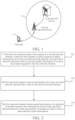
- FIG. 1 is a block diagram of a wireless communication system to which embodiments of this application are applicable.
- the wireless communication system includes a terminal 11 and a network-side device 12.
- the terminal 11 may be a terminal-side device such as a mobile phone, a tablet personal computer (Tablet Personal Computer), a laptop computer (Laptop Computer) or referred to as a notebook computer, a personal digital assistant (Personal Digital Assistant, PDA), a palmtop computer, a netbook, an ultra-mobile personal computer (ultra-mobile personal computer, UMPC), a mobile Internet device (Mobile Internet Device, MID), an augmented reality (augmented reality, AR)/virtual reality (virtual reality, VR) device, a robot, a wearable device (Wearable Device), vehicle user equipment (VUE), pedestrian user equipment (PUE), smart household (a home appliance with a wireless communication function, for example, a refrigerator, a television, a washing machine, or furniture), a game console, a personal computer (personal computer, PC), a
- the wearable device includes a smart watch, a smart band, a smart headset, smart glasses, smart jewelry (a smart bangle, a smart bracelet, a smart ring, a smart necklace, a smart anklet, a smart ankle chain, or the like), a smart wristband, smart clothing, or the like.
- the terminal 11 may alternatively be a chip in a terminal, for example, a modem (Modem) chip or a system on chip (System on Chip, SoC). It should be noted that a specific type of the terminal 11 is not limited in the embodiments of this application.
- the network-side device 12 may include an access network device or a core network device.
- the access network device 12 may also be referred to as a radio access network device, a radio access network (Radio Access Network, RAN), a radio access network function, or a radio access network unit.
- the access network device 12 may include a base station, a WLAN access point, a Wi-Fi node, or the like.
- the base station may be referred to as a NodeB, an evolved NodeB (eNB), an access point, a base transceiver station (Base Transceiver Station, BTS), a radio base station, a radio transceiver, a basic service set (Basic Service Set, BSS), an extended service set (Extended Service Set, ESS), a home NodeB, a home evolved NodeB, a transmitting receiving point (Transmitting Receiving Point, TRP), or another appropriate term in the art.
- the base station is not limited to a specific technical term.
- the core network device may include but is not limited to at least one of the following: a core network node, a core network function, a mobility management entity (Mobility Management Entity, MME), an access and mobility management function (Access and Mobility Management Function, AMF), a session management function (Session Management Function, SMF), a user plane function (User Plane Function, UPF), a policy control function (Policy Control Function, PCF), a policy and charging rules function (Policy and Charging Rules Function, PCRF), an edge application server discovery function (Edge Application Server Discovery Function, EASDF), unified data management (Unified Data Management, UDM), a unified data repository (Unified Data Repository, UDR), a home subscriber server (Home Subscriber Server, HSS), centralized network configuration (Centralized network configuration, CNC), a network repository function (Network Re
- NWDAF Network Data Analytics Function
- 3GPP 3rd Generation Partnership Project
- NWDAF has a specific function of artificial intelligence analytics.
- the NWDAF performs some operation optimization or statistical analytics by collecting some data, obtaining a result through analytics by using a built-in algorithm and an analytics capability, and providing the result for a core network device.
- the network data analytics function automatically perceives and analyzes a network based on network data, and participates in a full life cycle of network planning, construction, operation and maintenance, network optimization, and operations. This makes the network easy to maintain and control, improves utilization of network resources, and improves service experience of a user.
- the NWDAF can provide an observed service experience related network data analytics (Observed Service Experience related network data analytics) function.
- This function network element may initiate a request to another network element to request to collect quality of service (Quality of Service, QoS) information, such as uplink and downlink rates and a packet loss rate, of a terminal accessing an IP address of a server, and output statistical information, where the information includes user experience of the terminal accessing the server.
- QoS Quality of Service
- the NWDAF may also perform prediction based on historical experience of the terminal accessing the server, for example, predict possible user experience of the terminal in a case that the terminal accesses the server in a specific area within a specific time period in the future.
- analytics or prediction content that the NWDAF can provide is distinguished by using an analytic identifier (Analytic ID).
- Analytic ID an analytic identifier
- Different analytic IDs and some parameters may be indicated to the NWDAF, so that the NWDAF can provide analytics and prediction results corresponding to the analytic identifiers.
- an analytic ID is Service Experience. Therefore, the NWDAF can provide corresponding analytics provided that a network element served by the NWDAF is obtained and an analytic ID is entered in a request for analytics.
- the NWDAF may include two parts: an analytics logical function AnLF and a model training logical function MTLF.
- the AnLF is responsible for an inference function.
- the MTLF is responsible for a training function.
- the AnLF performs inference and derives an analytics result by using a model.
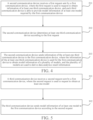
- FIG. 2 is a first schematic flowchart of a model obtaining method according to an embodiment of this application.
- the method provided in this embodiment includes the following steps: Step 101: A first communication device sends a first request to a second communication device, where the first request is used to request to obtain information of at least one third communication device, and each third communication device is able to provide model information of at least one model required by the first communication device.
- the first communication device and the second communication device may be network-side devices (for example, core network devices).
- the first communication device may be, for example, an AnLF of an NWDAF.
- the second communication device may be a network repository function (NF Repository Function, NRF).
- the third communication device may be an MTLF of the NWDAF or an analytics data repository function (Analytics Data Repository Function, ADRF).
- the first communication device sends the first request to the second communication device when a task request sent by another communication device is received or another trigger condition is met.
- the first request is used to request to obtain information of at least one third communication device.
- Each third communication device is able to provide model information of at least one model required by the first communication device.
- the model information may be the model itself (for example, a file including the model), a download address of the model, or the like.
- Step 102 The first communication device receives information of at least one third communication device that is sent by the second communication device.
- the second communication device determines the at least one third communication device and sends the information of the at least one third communication device to the first communication device according to the first request, and the first communication device receives the information of the at least one third communication device that is sent by the second communication device.
- information of a third communication device includes an analytics task identifier supported by the third communication device, an identifier or an address of the third communication device, the number of models available for an analytics task corresponding to the supported analytics task identifier, model attribute information of a supported model, or the like.
- Step 103 The first communication device obtains model information of a plurality of models based on the information of the at least one third communication device, where the plurality of models are used to derive data analytics result information.
- each third communication device may provide model information of at least one model, and the model information of the plurality of models may be obtained from the at least one third communication device. Further, the first communication device may obtain the plurality of models, and perform analytics and other operations based on the plurality of models, so that a data analytics result can be more accurate.
- a first communication device sends a first request to a second communication device, where the first request is used to request to obtain information of at least one third communication device, and each third communication device is able to provide model information of at least one model required by the first communication device. Further, the first communication device may obtain model information of a plurality of models based on information of at least one third communication device that is sent by the second communication device. In this way, a model obtaining method is implemented, with low implementation complexity and high efficiency. In addition, the plurality of models are used to derive data analytics result information, so that a data analytics result can be more accurate.
- the first request includes: an analytics task identifier, where the analytics task identifier is used to identify a data analytics task to which a required model is applicable.
- the first request further includes at least one of the following:
- the analytics task identifier may indicate a data analytics task to which a model required by the first communication device is applicable.
- information of a plurality of third communication devices is sorted in descending order of model quantities.
- three MTLFs are included: an MTLF 1, an MTLF 2, and an MTLF 3, where the MTLF 3 meets a requirement of the AnLF, and the MTLF 1, the MTLF 2, and the MTLF 3 have two models, one model, and three models respectively.
- MTLF information finally returned by the NRF to the AnLF is sorted in an order of the MTLF 3, the MTLF 1, and the MTLF 2.
- the number of required models may be a numerical value or a number range. For example, the minimum number and the maximum number are defined.
- the number of required third communication devices is similar to the number of required models.
- information of each third communication device includes at least one of the following: an analytics task identifier supported by the third communication device, an identifier of the third communication device, an address of the third communication device, the number of models corresponding to the analytics task identifier supported by the third communication device, or model attribute information of at least one model supported by the third communication device.
- the number of models corresponding to the analytics task identifier supported by the third communication device is the number of models able to process an analytics task corresponding to the analytics task identifier.
- the model attribute information includes at least one of the following: scope information of model use, a model identifier, result evaluation information of model training, result evaluation information of model use, a model size, model inference duration, or training data information.
- the scope information of model use includes at least one of the following: a target object of a model, a target time range, a target location range, single network slice selection assistance information S-NSSAI, or a data network name DNN.
- the target time range is used to indicate a time range within which the model is to be used.
- the target location range is used to indicate a location range within which the model is to be used.
- the result evaluation information of model training includes at least one of the following: accuracy, error information, model training duration, or a data amount of model training; and the result evaluation information of model use includes at least one of the following: accuracy, error information, or model running duration.
- the target object of the model indicates, for example, to perform mobility analytics for a specific terminal;
- the target time range indicates that the model can be used within the target time range;
- the target location range indicates that the model can be used within the target location range, for example, the target object is within the target location range.
- the result evaluation information of model training is used to describe result evaluation information of a trained model, for example, accuracy of recognition or decision-making, error information, duration, or a data amount.
- the error information may be a mean absolute error (Mean Absolute Error, MAE) or a root mean square error (Root Mean Square Error, RMSE).
- MAE mean Absolute Error
- RMSE Root Mean Square Error
- the result evaluation information of model use is similar to the result evaluation information of model training.
- the model size is a size of storage space required for storing the model or running the model.
- the model inference duration is used to represent duration within which a model obtains a convergent data inference result during running.
- the training data information may include, for example, at least one of the following: source information of training data, for example, source location information of data, or information about a source communication device; or time information of training data, for example, the training data is data within a period from three months ago to two months ago.
- the model attribute information that a model needs to meet is, for example, as follows: A target object of the model is a terminal in a specific area, a model size is within 500 MB, accuracy of model use is greater than a specific threshold, a source communication device of training data used by the model is a communication device a, and training data is data within the last week or month.
- the method further includes:
- the model information of the plurality of models is addresses of the models.
- the plurality of models may be obtained based on the addresses of the models, and analytics may be performed based on the obtained plurality of models to obtain the data analytics result information.
- the first communication device performs a model inference operation based on each of the plurality of models to obtain a plurality of data inference results; and the first communication device processes the plurality of data inference results to obtain the data analytics result information.
- Final data analytics result information is derived through the foregoing processing, such as aggregation (aggregation) and voting (voting).
- the first communication device may process the plurality of data inference results to obtain the data analytics result information in at least one of the following manners:
- the weighted averaging, the averaging, and the like are aggregation operations, and the accumulation and the accumulation with performance taken into account are specific implementations of cumulative voting. Performance of a model may be taken into account during accumulation. For example, if accuracy of the model is 0.6, a weight in an inference result may be 0.6.
- model inference, analytics, and other processing are performed based on the plurality of models, and an obtained result has good performance and high accuracy, and is not likely to be affected by a change in a network condition or network data.
- the method further includes:
- the method further includes: the first communication device sends the data analytics result information to the fourth communication device.
- the fourth communication device may be a consumer device, for example, an application function (Application Function, AF).
- the fourth communication device may send a task request to the first communication device to request to obtain data analytics result information corresponding to some data analytics tasks.
- Application Function Application Function
- content included in the task request may be the same as content included in the first request.
- step 103 may be implemented in the following manner: the first communication device determines at least one target communication device based on the information of the at least one third communication device and model attribute information that a model needs to meet, and obtains the model information of the plurality of models from the at least one target communication device, where each target communication device is able to provide model information of a model matching the model attribute information.
- analytics task identifiers supported by a third communication device are an identifier 1 and an identifier 2, the number of models corresponding to the identifier 1 is 5, the number of models corresponding to the identifier 2 is 10, and for three of the five models corresponding to the identifier 1, use scopes are consistent with a use scope in the model attribute information that needs to be met, result evaluation information of model training and use matches result evaluation information in the required model attribute information, and model sizes also match a model size in the model attribute information. Therefore, the third communication device may serve as a target communication device.
- model information of the plurality of models may be obtained from the at least one target communication device specifically in the following manner:
- the first communication device receives the model information of the plurality of models that is sent by the at least one target communication device, and each target communication device may send model information of one or more models.
- the number of the at least one target communication device may be 1, and that the first communication device sends a second request to the at least one target communication device includes:
- the method further includes: the first communication device determines that the one target communication device is able to provide the model information of the plurality of models.
- the number of the at least one target communication device may be greater than 1, and that the first communication device sends a second request to the at least one target communication device includes:
- the method further includes: the first communication device determines that none of the at least one target communication device is able to provide model information of all of the plurality of models.
- each target communication device may send model information of one or more models. None of the target communication devices is able to provide the model information of all of the plurality of models required by the first communication device. Therefore, the model information needs to be obtained from the plurality of target communication devices.
- the first communication device sends the second request to one or more of the at least one target communication device to obtain the model information of the plurality of models, with low implementation complexity and high efficiency.
- An MTLF may send a capability registration message to an NRF, namely, a second communication device.
- the capability registration message includes at least one of the following: an identifier, a supported analytics task identifier, a network function type, a network function instance identifier, the number of models corresponding to the supported analytics task identifier, or model attribute information of at least one supported model.
- the capability registration message may be carried in Nnrf_NFManagement_NFRegister Register signaling.
- NF type NWDAF type or MTLF type.
- the network function instance identifier is identification information of a communication device in current registration, for example, fully qualified domain name (Fully Qualified Domain Name, FQDN) information of the communication device for indicating a location of the communication device and connecting to the communication device, or IP address information (another type of identification information).
- FQDN Fully Qualified Domain Name
- the supported analytics task identifier indicates a type of a task that the NWDAF can perform.
- Steps 2 and 3 The NRF stores information of the MTLF and sends a response message.
- the response message may be carried in Nnrf_NFManagement_NFRegister response signaling.
- the response message is used to notify a third communication device that registration is successful.
- Step 4 A consumer device sends a task request to an AnLF (or an NWDAF, or an AnLF including an MTLF).
- the task request is carried in Nnwdaf_AnalyticsInfo_Request signaling.
- Step 5 Send a first request to the NRF.
- the first request may be carried in Nnrf_NFDiscovery_Request signaling.
- the first request includes a task analytics identifier, and may further include at least one of the following:
- Step 6 The NRF determines, according to the first request from the AnLF, MTLF information to be fed back.
- the NRF searches for all registered MTLFs, selects a final MTLF by matching information, generates an MTLF list, and feeds back MTLF information based on the MTLF list.
- the first request from the AnLF includes the number of required models and information indicating that information of a plurality of MTLFs is required.
- the NRF searches for all MTLFs that support the analytics task identifier included in the first request, and feeds back information about an MTLF that has a plurality of models corresponding to the analytics task identifier. If there are not a plurality of MTLFs meeting the condition, information about other MTLFs that do not meet the model quantity requirement is fed back. In this case, the number of models of a plurality of MTLFs needs to meet the requirement of the number of required models in the first request.
- the NRF selects information about a plurality of MTLFs that have a model corresponding to the analytics task identifier for feedback.
- the NRF searches, through matching, MTLF information for information about an MTLF that has a plurality of models corresponding to the analytics task identifier for feedback. If no information is found, failure information is returned.
- Step 7 The NRF returns information about an MTLF meeting the condition to the AnLF.
- Step 8 The AnLF determines a target MTLF from which a model is to be obtained.
- Steps 9a and step 9b The AnLF requests a model that meets a task requirement from the target MTLF.
- the request includes a task analytics identifier and model attribute information that the model needs to meet.
- Step 10 The AnLF performs analytics by using a plurality of models.
- Step 11 The AnLF returns data analytics result information to the consumer device.
- the data analytics result information is carried in Nnwdaf_AnalyticsInfo_Request response signaling.
- the consumer device may further send the data analytics result information to user equipment, such as a terminal.
- user equipment such as a terminal.
- the model obtaining method provided in the embodiments of this application may be performed by a model obtaining apparatus.
- a model obtaining apparatus provided in the embodiments of this application is described by using an example in which the model obtaining apparatus performs the model obtaining method.
- FIG. 4 is a second schematic flowchart of a model obtaining method according to this application. As shown in FIG. 4 , the model obtaining method provided in this embodiment includes the following steps:
- the first request includes: an analytics task identifier, where the analytics task identifier is used to identify a data analytics task to which a required model is applicable; and the first request further includes at least one of the following:
- the method further includes: the second communication device determines, according to the first request sent by the first communication device, the number of the at least one third communication device to be returned.
- the second communication device determines the number of the at least one third communication device according to the first request sent by the first communication device includes at least one of the following:
- the model attribute information includes at least one of the following: scope information of model use, a model identifier, result evaluation information of model training, result evaluation information of model use, a model size, model execution duration, source information of training data, or time information of the training data, where the model size is used to represent a size of storage space required for storing or running a model, and the model inference duration is used to represent duration within which a model obtains a data inference result during running.
- the result evaluation information of model training includes at least one of the following: accuracy, error information, model training duration, or a data amount of model training; and the result evaluation information of model use includes at least one of the following: accuracy, error information, or model running duration.
- information of each third communication device includes at least one of the following: an analytics task identifier supported by the third communication device, an identifier of the third communication device, an address of the third communication device, the number of models corresponding to the analytics task identifier supported by the third communication device, or model attribute information of at least one model supported by the third communication device.
- the method further includes: the second communication device receives a capability registration message sent by the third communication device, where the capability registration message includes at least one of the following: an analytics task identifier supported by the third communication device, a network function type of the third communication device, a network function instance identifier of the third communication device, the number of models corresponding to the analytics task identifier supported by the third communication device, or model attribute information of at least one model supported by the third communication device.
- FIG. 5 is a third schematic flowchart of a model obtaining method according to this application. As shown in FIG. 5 , the model obtaining method provided in this embodiment includes the following steps:
- the second request includes at least one of the following:
- the method further includes: the third communication device sends a capability registration message to a second communication device, where the capability registration message includes at least one the following: an analytics task identifier supported by the third communication device, a network function type of the third communication device, a network function instance identifier of the third communication device, the number of models corresponding to the analytics task identifier supported by the third communication device, or model attribute information of at least one model supported by the third communication device.
- the model attribute information includes at least one of the following: scope information of model use, a model identifier, result evaluation information of model training, result evaluation information of model use, a model size, model execution duration, source information of training data, or time information of the training data, where the model size is used to represent a size of storage space required for storing or running a model, and the model inference duration is used to represent duration within which a model obtains a data inference result during running.
- the result evaluation information of model training includes at least one of the following: accuracy, error information, model training duration, or a data amount of model training; and the result evaluation information of model use includes at least one of the following: accuracy, error information, or model running duration.
- information of each third communication device includes at least one of the following: an analytics task identifier supported by the third communication device, an identifier of the third communication device, an address of the third communication device, the number of models corresponding to the analytics task identifier supported by the third communication device, or model attribute information of at least one model supported by the third communication device.
- FIG. 6 is a fourth schematic flowchart of a model obtaining method according to this application. As shown in FIG. 6 , the model obtaining method provided in this embodiment includes the following steps:
- the model attribute information includes at least one of the following: scope information of model use, a model identifier, result evaluation information of model training, result evaluation information of model use, a model size, model execution duration, source information of training data, or time information of the training data, where the model size is used to represent a size of storage space required for storing or running a model, and the model inference duration is used to represent duration within which a model obtains a data inference result during running.
- the result evaluation information of model training includes at least one of the following: accuracy, error information, model training duration, or a data amount of model training; and the result evaluation information of model use includes at least one of the following: accuracy, error information, or model running duration.
- information of each third communication device includes at least one of the following: an analytics task identifier supported by the third communication device, an identifier of the third communication device, an address of the third communication device, the number of models corresponding to the analytics task identifier supported by the third communication device, or model attribute information of at least one model supported by the third communication device.
- FIG. 7 is a first schematic structural diagram of a model obtaining apparatus according to this application.
- the model obtaining apparatus provided in this embodiment may be applied to a first communication device.
- the model obtaining apparatus provided in this embodiment includes:
- the obtaining module 130 is further configured to: obtain the plurality of models based on the model information of the plurality of models.
- the apparatus further includes: a processing module, configured to perform analytics based on the plurality of models to obtain the data analytics result information.
- a processing module configured to perform analytics based on the plurality of models to obtain the data analytics result information.
- processing module is specifically configured to:
- the obtaining module 130 is specifically configured to perform at least one of the following operations:
- the receiving module 120 is further configured to:
- the obtaining module 130 is specifically configured to: determine at least one target communication device based on the information of the at least one third communication device and model attribute information that a model needs to meet, and obtaining the model information of the plurality of models from the at least one target communication device, where each target communication device is able to provide model information of a model matching the model attribute information.
- the first request includes:
- information of each third communication device includes at least one of the following: an analytics task identifier supported by the third communication device, an identifier of the third communication device, an address of the third communication device, the number of models corresponding to the analytics task identifier supported by the third communication device, or model attribute information of at least one model supported by the third communication device.
- the sending module 110 is further configured to:
- the sending module 110 is specifically configured to:
- the sending module 110 is specifically configured to:
- the model attribute information includes at least one of the following: scope information of model use, a model identifier, result evaluation information of model training, result evaluation information of model use, a model size, model inference duration, source information of training data, or time information of the training data, where the model size is used to represent a size of storage space required for storing or running a model, and the model inference duration is used to represent duration within which a model obtains a data inference result during running.
- the result evaluation information of model training includes at least one of the following: accuracy, error information, model training duration, or a data amount of model training; and the result evaluation information of model use includes at least one of the following: accuracy, error information, or model running duration.
- the apparatus in this embodiment may be configured to perform the method in any one of the method embodiments on the first communication device side.
- Specific implementation processes and technical effect of the apparatus are the same as those in the method embodiment on the first communication device side.
- FIG. 8 is a second schematic structural diagram of a model obtaining apparatus according to this application.
- the model obtaining apparatus provided in this embodiment may be applied to a second communication device.
- the model obtaining apparatus provided in this embodiment includes:
- the first request includes: an analytics task identifier, where the analytics task identifier is used to identify a data analytics task to which a required model is applicable; and the first request further includes at least one of the following:
- the processing module 220 is further configured to: determine the number of the at least one third communication device according to the first request sent by the first communication device.
- the second communication device determines the number of the at least one third communication device according to the first request sent by the first communication device includes at least one of the following:
- the model attribute information includes at least one of the following: scope information of model use, a model identifier, result evaluation information of model training, result evaluation information of model use, a model size, model execution duration, source information of training data, or time information of the training data, where the model size is used to represent a size of storage space required for storing or running a model, and the model inference duration is used to represent duration within which a model obtains a data inference result during running.
- the result evaluation information of model training includes at least one of the following: accuracy, error information, model training duration, or a data amount of model training; and the result evaluation information of model use includes at least one of the following: accuracy, error information, or model running duration.
- information of each third communication device includes at least one of the following: an analytics task identifier supported by the third communication device, an identifier of the third communication device, an address of the third communication device, the number of models corresponding to the analytics task identifier supported by the third communication device, or model attribute information of at least one model supported by the third communication device.
- the receiving module 210 is further configured to: receive a capability registration message sent by the third communication device, where the capability registration message includes at least one of the following: an analytics task identifier supported by the third communication device, a network function type of the third communication device, a network function instance identifier of the third communication device, the number of models corresponding to the analytics task identifier supported by the third communication device, or model attribute information of at least one model supported by the third communication device.
- the apparatus in this embodiment may be configured to perform the method in any one of the method embodiments on the second communication device side.
- Specific implementation processes and technical effect of the apparatus are the same as those in the method embodiment on the second communication device side.
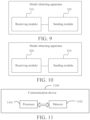
- FIG. 9 is a third schematic structural diagram of a model obtaining apparatus according to this application.
- the model obtaining apparatus provided in this embodiment may be applied to a third communication device.
- the model obtaining apparatus provided in this embodiment includes:
- the model attribute information includes at least one of the following: scope information of model use, a model identifier, result evaluation information of model training, result evaluation information of model use, a model size, model execution duration, source information of training data, or time information of the training data, where the model size is used to represent a size of storage space required for storing or running a model, and the model inference duration is used to represent duration within which a model obtains a data inference result during running.
- the result evaluation information of model training includes at least one of the following: accuracy, error information, model training duration, or a data amount of model training; and the result evaluation information of model use includes at least one of the following: accuracy, error information, or model running duration.
- information of each third communication device includes at least one of the following: an analytics task identifier supported by the third communication device, an identifier of the third communication device, an address of the third communication device, the number of models corresponding to the analytics task identifier supported by the third communication device, or model attribute information of at least one model supported by the third communication device.
- the sending module 320 is further configured to: send a capability registration message to a second communication device, where the capability registration message includes at least one the following: an analytics task identifier supported by the third communication device, a network function type of the third communication device, a network function instance identifier of the third communication device, the number of models corresponding to the analytics task identifier supported by the third communication device, or model attribute information of at least one model supported by the third communication device.
- the apparatus in this embodiment may be configured to perform the method in any one of the method embodiments on the third communication device side.
- Specific implementation processes and technical effect of the apparatus are the same as those in the method embodiment on the third communication device side.
- FIG. 10 is a third schematic structural diagram of a model obtaining apparatus according to this application.
- the model obtaining apparatus provided in this embodiment may be applied to a fourth communication device.
- the model obtaining apparatus provided in this embodiment includes:
- the task request includes: an analytics task identifier, where the analytics task identifier is used to identify a data analytics task to which a required model is applicable; and the task request further includes at least one of the following:
- the model attribute information includes at least one of the following: scope information of model use, a model identifier, result evaluation information of model training, result evaluation information of model use, a model size, model execution duration, source information of training data, or time information of the training data, where the model size is used to represent a size of storage space required for storing or running a model, and the model inference duration is used to represent duration within which a model obtains a data inference result during running.
- the result evaluation information of model training includes at least one of the following: accuracy, error information, model training duration, or a data amount of model training; and the result evaluation information of model use includes at least one of the following: accuracy, error information, or model running duration.
- information of each third communication device includes at least one of the following: an analytics task identifier supported by the third communication device, an identifier of the third communication device, an address of the third communication device, the number of models corresponding to the analytics task identifier supported by the third communication device, or model attribute information of at least one model supported by the third communication device.
- the apparatus in this embodiment may be configured to perform the method in any one of the method embodiments on the fourth communication device side.
- Specific implementation processes and technical effect of the apparatus are the same as those in the method embodiment on the fourth communication device side.
- the model obtaining apparatus in the embodiments of this application may be an electronic device, for example, an electronic device with an operating system; or may be a component in an electronic device, for example, an integrated circuit or a chip.
- the electronic device may be a terminal or another device other than the terminal.
- the terminal may include but is not limited to the aforementioned types of the terminal 11, and the another device may be a server, a network attached storage (Network Attached Storage, NAS), or the like. This is not specifically limited in the embodiments of this application.
- the model obtaining apparatus provided in the embodiments of this application is capable of implementing the processes implemented in the method embodiments of FIG. 2 to FIG. 6 , with the same technical effect achieved. To avoid repetition, details are not described herein again.
- an embodiment of this application further provides a communication device 1100, including a processor 1101 and a memory 1102.
- the memory 1102 stores a program or instructions capable of running on the processor 1101.
- the communication device 1100 is a terminal, when the program or instructions are executed by the processor 1101, the steps in the model obtaining method embodiments are implemented, with the same technical effect achieved.
- the communication device 1100 is a network-side device, when the program or instructions are executed by the processor 1101, the steps in the model obtaining method embodiments are implemented, with the same technical effect achieved. To avoid repetition, details are not described herein again.
- An embodiment of this application further provides a first communication device, including a processor and a communication interface.
- the communication interface is configured to: send, for the first communication device, a first request to a second communication device, where the first request is used to request to obtain information of at least one third communication device, and each third communication device is able to provide model information of at least one model required by the first communication device; receive information of at least one third communication device that is sent by the second communication device; and obtain model information of a plurality of models based on the information of the at least one third communication device, where the plurality of models are used to derive data analytics result information.
- the embodiment of the first communication device corresponds to the method embodiment on the first communication device side, and all implementation processes and implementations of the method embodiment are applicable to the embodiment of the first communication device, with the same technical effect achieved.
- An embodiment of this application further provides a second communication device, including a processor and a communication interface.
- the communication interface is configured to: receive a first request sent by a first communication device, where the first request is used to request to obtain information of at least one third communication device, and each third communication device is able to provide model information of at least one model required by the first communication device; and send information of the at least one third communication device to the first communication device, where the information of the at least one third communication device is used for the first communication device to obtain model information of a plurality of models, and the plurality of models are used to derive data analytics result information.
- the processor is configured to determine at least one third communication device according to the first request.
- the embodiment of the second communication device corresponds to the method embodiment on the second communication device side, and all implementation processes and implementations of the method embodiment are applicable to the embodiment of the second communication device, with the same technical effect achieved.
- An embodiment of this application further provides a third communication device, including a processor and a communication interface.
- the communication interface is configured to: receive a second request sent by a first communication device, where the second request is used to request to obtain at least one model; and send model information of at least one model to the first communication device according to the second request, where the second request includes at least one of the following: an analytics task identifier, where the analytics task identifier is used to identify a data analytics task to which a required model is applicable; an identifier of a required model; the number of required models; or model attribute information that a model needs to meet.
- the embodiment of the third communication device corresponds to the method embodiment on the third communication device side, and all implementation processes and implementations of the method embodiment are applicable to the embodiment of the third communication device, with the same technical effect achieved.
- An embodiment of this application further provides a fourth communication device, including a processor and a communication interface.
- the communication interface is configured to: send a task request to a first communication device; and receive data analytics result information sent by the first communication device, where the data analytics result information is obtained by the first communication device by performing analytics based on a plurality of models, the plurality of models are obtained by the first communication device based on information of at least one third communication device, and each third communication device is able to provide model information of at least one model required by the first communication device.
- the embodiment of the fourth communication device corresponds to the method embodiment on the fourth communication device side, and all implementation processes and implementations of the method embodiment are applicable to the embodiment of the fourth communication device, with the same technical effect achieved.
- an embodiment of this application further provides a network-side device.
- the network-side device 1200 includes a processor 1201, a network interface 1202, and a memory 1203.
- the network interface 1202 is, for example, a common public radio interface (common public radio interface, CPRI).
- the network-side device 1200 in this embodiment of the present invention further includes instructions or a program stored in the memory 1203 and capable of running on the processor 1201, and the processor 1201 invokes the instructions or program in the memory 1203 to perform the method performed by the modules shown in FIG. 7 to FIG. 10 , with the same technical effect achieved. To avoid repetition, details are not described herein again.
- the structure of the network-side device may be applied to the first communication device, the second communication device, the third communication device, and the fourth communication device.
- An embodiment of this application further provides a readable storage medium.
- the readable storage medium stores a program or instructions.
- the processes in the model obtaining method embodiments are implemented, with the same technical effect achieved. To avoid repetition, details are not described herein again.
- the processor is a processor in the terminal in the foregoing embodiments.
- the readable storage medium includes a computer-readable storage medium, for example, a computer read-only memory ROM, a random access memory RAM, a magnetic disk, or an optical disc.
- An embodiment of this application further provides a chip.
- the chip includes a processor and a communication interface.
- the communication interface is coupled to the processor.
- the processor is configured to run a program or instructions to implement the processes in the model obtaining method embodiments, with the same technical effect achieved. To avoid repetition, details are not described herein again.
- the chip provided in this embodiment of this application may also be referred to as a system-level chip, a system on chip, a chip system, a system-on-a-chip, or the like.
- An embodiment of this application further provides a computer program or program product.
- the computer program or program product is stored in a storage medium.
- the computer program or program product is executed by at least one processor to implement the processes in the model obtaining method embodiments, with the same technical effect achieved. To avoid repetition, details are not described herein again.
- An embodiment of this application further provides a communication system, including a first communication device, a second communication device, a third communication device, and a fourth communication device, where the first communication device, the second communication device, the third communication device, and the fourth communication device may be configured to perform the steps of the model obtaining method.
- An embodiment of this application further provides a model processing method.
- the model processing method includes the following steps:
- the model quantity information is used to indicate the number of models that correspond to an analytics task identifier and that are supported by the first network element.
- the model information includes at least one of the following information of a model that corresponds to the analytics task identifier and that is supported by the first network element:
- the first network element may be understood as a model training network element, for example, in some embodiments, may be a model training logical function (Model Training logical function, MTLF), also referred to as an MTLF included in a network data analytics function (Network Data Analytics Function, NWDAF).
- MTLF Model Training logical function
- NWDAF Network Data Analytics Function
- the second network element may be understood as an NRF.
- the registration request message may further include other information in addition to the capability information, for example, may include:
- the model performance information may be used to represent accuracy, an error value, and the like of an output result of a model.
- the model performance information may include at least one of the following: first performance information, where the first performance information is used to indicate performance that a model is able to achieve in a training stage; or second performance information, where the second performance information is used to indicate performance that a model is able to achieve in an inference stage.
- the second network element may store information carried in the registration request message, and send the registration request response message to the first network element after determining that registration is successful.
- the model size may be represented by a parameter (parameter) of a model.
- the source information of training data and the time information of training data may be understood as data information for training a model.
- the registration request message may alternatively include other data information for training a model. This is not further limited herein.
- the third network element may first send a second request message to the second network element to request to find a first network element able to perform the target analytics task. Because capability information is stored in the second network element, N first network elements that have models able to be used to perform the target analytics task may be determined based on the capability information. Then the third network element selects a target network element from the N first network elements, and invokes a model in the target network element to perform the target analytics task, to be specific, performs model inference for the target task by using the model in the target network element.
- a new first network element needs to be found to perform model inference for the target analytics task again due to low accuracy and/or a large error value of model inference for the target analytics task. Therefore, in this embodiment of this application, efficiency of finding a first network element can be further improved.
- the second network element may obtain, through matching, a first network element meeting a model quantity requirement of the target analytics task. This can improve reliability of model inference for the target analytics task.
- the first network element may obtain, through matching, a first network element meeting a model requirement (for example, a model performance requirement) of the target analytics task. This can improve reliability of model inference for the target analytics task.
- the third network element may be understood as a data analytics logical function (Analytics logical function, AnLF), also referred to as an AnLF included in an NWDAF.
- AnLF data analytics logical function
- a first network element sends a registration request message to a second network element, where the registration request message includes capability information of the first network element, and the capability information includes at least one of model quantity information and model information; and the first network element receives a registration request response message from the second network element.
- the second network element may determine, based on the capability information, a first network element matching a target analytics task, and then may invoke a model in the matching first network element to perform model inference for the target analytics task. Therefore, in this embodiment of this application, reliability of model inference can be improved.
- the method further includes:
- the third network element may send the first request message to the first network elements to request to obtain a target model able to perform the target analytics task.
- the target analytics task request may be information received by the third network element from a fourth network element.
- the fourth network element may send a task request message to the third network element, where the task request message may include an analytics task identifier of the target analytics task, and may further include task filter information.
- the task filter information may include filter information and an analytic target (analytic target) of a data analytics task model.
- the filter information of the data analytics task model may be referred to as machine learning model filter information (Machine Learning model filter info).
- the task filter information may be used to define a task scope, such as an analytics object (for example, mobility analytics for specific UE) of a model, target time of a task, an area of interest (Area of Interest, AOI), single network slice selection assistance information (Single Network Slice Selection Assistance Information, S-NSSAI), and a data network name (Data Network Name, DNN)
- an analytics object for example, mobility analytics for specific UE
- target time of a task a model
- An area of interest Area of Interest, AOI
- single network slice selection assistance information Single Network Slice Selection Assistance Information
- S-NSSAI Single Network Slice Selection Assistance Information
- DNN Data Network Name
- the first network element may determine, based on the first request message, a target model able to be used to perform the target analytics task, and then indicate the target model by using the first request response message.
- the third network element may perform a model inference operation for the target task by using the target model, derive a target analytics report, and finally send the target analytics report to the fourth network element.
- the first request message includes an analytics task identifier of the target analytics task and model filter information
- the model filter information includes at least one of the following:
- the model filter information may be determined based on the task filter information, or may be agreed upon in a protocol (for example, model filter information corresponding to different tasks is agreed upon in the protocol) or determined by the third network element itself.
- the target model fed back by the first network element should meet the model filter information. Details are as follows:
- the filter information of the number of models may be understood as filter information of the number of models corresponding to the analytics task identifier of the target analytics task.
- the filter information of the number of models may include a quantity threshold.
- the model filter information includes the filter information of the number of models, the number of target models that the first network element needs to feed back to the third network element should be greater than or equal to the quantity threshold, or the number of target models to be fed back should be less than or equal to the quantity threshold.
- the filter information of a model identifier may include one or more preset model identifiers.
- the model filter information includes the filter information of a model identifier
- the first network element needs to feed back, to the third network element, a target model among models corresponding to the preset model identifiers; or the third network element needs to feed back, to the third network element, a target model among models other than the models corresponding to the preset model identifiers.
- the filter information of model performance information may include a performance indicator.
- the model filter information includes the filter information of performance information
- the first network element needs to feed back a target model meeting the performance indicator to the third network element.
- the filter information of model performance information may include at least one of filter information of the first performance information and filter information of the second performance information.
- the filter information of a model size may include a model size threshold.
- the model filter information includes the filter information of a model size
- the first network element needs to feed back, to the third network element, a target model whose model size is greater than or equal to the model size threshold, or feed back a target model whose model size is less than or equal to the model size threshold.
- the filter information of inference duration may include an inference time threshold.
- the model filter information includes the filter information of inference duration
- the first network element needs to feed back, to the third network element, a target model whose inference duration is greater than or equal to the inference time threshold, or feed back a target model whose inference duration is less than or equal to the inference time threshold.
- the filter information of a source of training data may include source information of training data.
- the model filter information includes the filter information of a source of training data
- the first network element needs to feed back, to the third network element, a target model among models trained by using the source infonnation of training data; or the third network element needs to feed back, to the third network element, a target model among models other than the models trained by using the source information of training data.
- the filter information of time information of training data may include a time threshold of training data.
- a time range may be determined based on the time threshold.
- the first network element needs to feed back, to the third network element, a target model that uses, in a training stage, training data generated within time that belongs to the time range.
- the first performance information includes at least one of the following information of the model in training: a first performance indicator, a calculation method for the first performance indicator, first time information, a first value, and a first result, where the first performance indicator includes at least one of accuracy in training and an error value in training, the first time information includes time information corresponding to calculation of the first performance indicator, the first value is used to represent an amount of data used for calculating the first performance indicator, and the first result is a result value obtained through calculation based on a plurality of first performance indicators.
- the first performance indicator may also be understood as performance of the model in training (performance in Training), and is a value obtained based on specific statistical calculation, for example, may be at least one of the accuracy in training (accuracy in Training, AiT) and the error value in training (Mean Absolute Error in Training, MAEIT).
- the accuracy in training may be referred to as accuracy of the model in training, and the accuracy may be obtained by dividing the number of times that the model obtains a correct decision-making result by the total number of times of decision-making.
- the first network element may set a verification data set for evaluating accuracy of a model.
- the verification set includes data to be input to a model and actual label data.
- the first network element inputs verification input data to a trained model to obtain output data.
- the first network element compares the output data with the actual label data to verify consistency, and then obtains a value of accuracy of the model by using the foregoing calculation method.
- the calculation method for the first performance indicator may include at least one of the following: a ratio of the number of accurate predictions by a model to the total number of predictions by the model, an MAE, a root mean square error (Root Mean Square Error), a recall (Recall), an F1 score (F1 score), and the like.
- the first time information is expressed as a time node or a period of time (for example, including start time of calculation of the first performance indicator and end time of calculation of the first performance indicator).
- the first result may represent a distribution status of the plurality of first performance indicators, and may be specifically calculated by using a preset calculation method.
- the first result may be a mean, a median, or a variance.
- the second performance information includes at least one of the following information of the model in use: a second performance indicator, a calculation method for the second performance indicator, second time information, a second value, and a second result, where the second performance indicator includes at least one of accuracy in use and an error value in use, and the second time information includes time information corresponding to calculation of the second performance indicator.
- the use may be understood as using the model for model inference
- the second performance information corresponds to the first performance information
- the second performance indicator may also be understood as performance of the model in use (performance in use).
- the calculation method for the second performance indicator may include at least one of the following: a ratio of the number of accurate predictions by a model to the total number of predictions by the model, an MAE, a root mean square error (Root Mean Square Error), a recall (Recall), an F1 score (F1 score), and the like.
- the second time information is expressed as a time node or a period of time (for example, including start time of calculation of the second performance indicator and end time of calculation of the second performance indicator).
- the second result may represent a distribution status of the plurality of second performance indicators, and may be specifically calculated by using a preset calculation method.
- the second result may be a mean, a median, or a variance.
- Step 1401 An MTLF sends an a registration request message to an NRF, where the registration request message may be referred to as a capability registration message for capability registration.
- the registration request message may include information such as identification information of the MTLF and a supported analytic ID, and may further include the foregoing capability information, to be specific, include at least one of model quantity information and model information.
- Accuracy and an error value in the model information may be used for determining which one of two models is more suitable for the target analytics task. Distribution of accuracy may be used for determining whether performance of the model is stable. Whether a model matches the target analytics task may be determined based on source information and time information of training data of the model (for example, a model trained by using early data is more likely to be affected by a change in network data).
- Step 1402 The NRF stores information carried in the registration request message.
- Step 1403 The NRF sends a registration request response message.
- Step 1404 A task consumer sends a task request message to an AnLF, where the task request message includes an analytics task identifier of the target analytics task, and filter information and an analytic target of a data analytics task model.
- step 1403 is performed before step 1404.
- Step 1405 The AnLF sends a second request message to the NRF, where the second request message is used for finding a suitable MTLF, and may further include target requirement information in addition to the analytics task identifier of the target analytics task and the filter information of the data analytics task model.
- the target requirement information includes at least one of the following:
- the target requirement information may be understood as a requirement for a model or a filter requirement for a model.
- the filter information of the number of models may be a quantity threshold. In this case, the number of models that a suitable MTLF can provide for performing the target analytics task needs to be greater than or equal to the quantity threshold, or less than or equal to the quantity threshold.
- the requirement information of a model identifier may include at least one model identifier. In this case, a model that a suitable MTLF can provide for performing the target analytics task includes or does not include a model corresponding to the at least one model identifier.
- the requirement information of model performance information may include a performance indicator (for example, may include at least one of a first performance indicator and a second performance indicator).
- a model that a suitable MTLF can provide for performing the target analytics task needs to meet a required performance indicator.
- the filter information of a model size may include a model size threshold.
- a model that a suitable MTLF can provide for performing the target analytics task needs to include a model whose model size is greater than or equal to the model size threshold, or needs to include a model whose model size is less than or equal to the model size threshold.
- the filter information of a source of training data may include source information of training data.
- a model that a suitable MTLF can provide for performing the target analytics task needs to include or not include a model trained by using the source information of training data.
- the time information of training data may include a time threshold of training data, and a time range may be determined based on the time threshold.
- a suitable MTLF needs to include a model that uses, in a training stage, training data generated within time that belongs to the time range.
- Step 1406 The NRF feeds back a second request response message to the AnLF, where the second request response message needs to include determined N MTLFs, and may further include at least one of a task analytics identifier supported by each MTLF, model quantity information, and model information.
- each MTLF includes a model that supports the analytics task identifier of the target analytics task, and the model (or the MTLF) needs to meet the target requirement information and the filter information of the data analytics task model.
- the second request response message may further include validity time corresponding to each of the N first network elements.
- the validity time may be understood as validity time of registered capability information of an MTLF. After the time elapses, the capability information of the MTLF may change. If a model in the MTLF is requested beyond the validity time, reliability of final model inference may be unable to be guaranteed. Therefore, the AnLF may preferentially request a model in an MTLF within the validity time.
- Step 1407 The AnLF determines a target MTLF from the N MTLFs.
- the MTLF is determined as a target MTLF; or if the NRF feeds back a plurality of MTLFs, one of the plurality of MTLFs further needs to be selected as a target MTLF.
- the AnLF may alternatively select at least two MTLFs as target MTLFs.
- Step 1408 The AnLF sends a first request message (namely, a model obtaining request), for example, Nnwdaf_MLModelInfo_Request or Nnwdaf_MLModelProvision_Request, to the target MTLF.
- a first request message namely, a model obtaining request
- Nnwdaf_MLModelInfo_Request for example, Nnwdaf_MLModelProvision_Request
- the first request message may include the analytics task identifier of the target analytics task and model filter information.
- Step 1409 The target MTLF sends a first request response message to the AnLF, where the first request response message includes the target model and address information for obtaining the target model.
- That the first request information includes the target model may be understood as including a configuration file of the model, a description of the model, and the like.
- the address information of the target model may include a uniform resource locator (Uniform Resource Locator, URL), FQDN information, an IP address, and the like.
- URL Uniform Resource Locator
- FQDN information FQDN information
- IP address IP address
- the AnLF may directly download the target model.
- Step 1410 The AnLF performs model inference for the target analytics task based on the target model to obtain a target task report.
- Step 1411 The AnLF feeds back a task request response message to the task consumer, where the task request response message includes the target analytics report.
- the methods in the foregoing embodiments may be implemented by using software in combination with a necessary common hardware platform, or certainly may be implemented by using hardware. However, in most cases, the former is a preferred implementation.
- the technical solutions of this application essentially or the part contributing to the conventional technology may be implemented in a form of a computer software product.
- the computer software product is stored in a storage medium (for example, a ROM/RAM, a magnetic disk, or a compact disc), and includes several instructions for instructing a terminal (which may be a mobile phone, a computer, a server, an air conditioner, a network device, or the like) to perform the methods in the embodiments of this application.
Landscapes
- Engineering & Computer Science (AREA)
- Computer Networks & Wireless Communication (AREA)
- Signal Processing (AREA)
- Physics & Mathematics (AREA)
- Theoretical Computer Science (AREA)
- Software Systems (AREA)
- General Physics & Mathematics (AREA)
- Mathematical Physics (AREA)
- Artificial Intelligence (AREA)
- General Engineering & Computer Science (AREA)
- Computing Systems (AREA)
- Evolutionary Computation (AREA)
- Data Mining & Analysis (AREA)
- Mathematical Optimization (AREA)
- Molecular Biology (AREA)
- Biophysics (AREA)
- Computational Linguistics (AREA)
- Life Sciences & Earth Sciences (AREA)
- Health & Medical Sciences (AREA)
- General Health & Medical Sciences (AREA)
- Biomedical Technology (AREA)
- Pure & Applied Mathematics (AREA)
- Probability & Statistics with Applications (AREA)
- Mathematical Analysis (AREA)
- Algebra (AREA)
- Computer Vision & Pattern Recognition (AREA)
- Medical Informatics (AREA)
- Mobile Radio Communication Systems (AREA)
- Data Exchanges In Wide-Area Networks (AREA)
Applications Claiming Priority (3)
| Application Number | Priority Date | Filing Date | Title |
|---|---|---|---|
| CN202210482186.3A CN117062047A (zh) | 2022-05-05 | 2022-05-05 | 模型处理方法、装置、网络侧设备及可读存储介质 |
| CN202210483893.4A CN117062098A (zh) | 2022-05-05 | 2022-05-05 | 模型获取方法及通信设备 |
| PCT/CN2023/092194 WO2023213288A1 (zh) | 2022-05-05 | 2023-05-05 | 模型获取方法及通信设备 |
Publications (2)
| Publication Number | Publication Date |
|---|---|
| EP4521802A1 true EP4521802A1 (de) | 2025-03-12 |
| EP4521802A4 EP4521802A4 (de) | 2025-08-20 |
Family
ID=88646285
Family Applications (1)
| Application Number | Title | Priority Date | Filing Date |
|---|---|---|---|
| EP23799274.8A Pending EP4521802A4 (de) | 2022-05-05 | 2023-05-05 | Modellerfassungsverfahren und kommunikationsvorrichtung |
Country Status (3)
| Country | Link |
|---|---|
| US (1) | US20250063406A1 (de) |
| EP (1) | EP4521802A4 (de) |
| WO (1) | WO2023213288A1 (de) |
Families Citing this family (3)
| Publication number | Priority date | Publication date | Assignee | Title |
|---|---|---|---|---|
| CN120075783A (zh) * | 2023-11-30 | 2025-05-30 | 华为技术有限公司 | 通信方法及装置 |
| CN120263678A (zh) * | 2024-01-02 | 2025-07-04 | 华为技术有限公司 | 通信方法及通信装置 |
| CN120730301A (zh) * | 2024-03-27 | 2025-09-30 | 中兴通讯股份有限公司 | 一种模型共享授权、模型推理方法、电子设备和存储介质 |
Family Cites Families (3)
| Publication number | Priority date | Publication date | Assignee | Title |
|---|---|---|---|---|
| EP4027584B1 (de) * | 2019-09-30 | 2025-12-10 | Huawei Technologies Co., Ltd. | Verfahren und vorrichtung und system zur bestimmung von vorrichtungsinformationen |
| KR102820764B1 (ko) * | 2020-08-13 | 2025-06-12 | 한국전자통신연구원 | 네트워크 데이터 분석 기능 장치를 위한 기계학습 모델 관리 방법 |
| WO2022061784A1 (zh) * | 2020-09-25 | 2022-03-31 | 华为技术有限公司 | 通信方法、装置及系统 |
-
2023
- 2023-05-05 WO PCT/CN2023/092194 patent/WO2023213288A1/zh not_active Ceased
- 2023-05-05 EP EP23799274.8A patent/EP4521802A4/de active Pending
-
2024
- 2024-11-05 US US18/937,061 patent/US20250063406A1/en active Pending
Also Published As
| Publication number | Publication date |
|---|---|
| WO2023213288A1 (zh) | 2023-11-09 |
| US20250063406A1 (en) | 2025-02-20 |
| EP4521802A4 (de) | 2025-08-20 |
Similar Documents
| Publication | Publication Date | Title |
|---|---|---|
| EP4503685A1 (de) | Verfahren zur registrierung von netzwerkelementen, modellbestimmungsverfahren, vorrichtungen, netzwerkelemente, kommunikationssystem und speichermedium | |
| EP4521802A1 (de) | Modellerfassungsverfahren und kommunikationsvorrichtung | |
| EP4517608A1 (de) | Verfahren und vorrichtung zur erfassung von modellinformationen, verfahren und vorrichtung zum senden von modellinformationen sowie knoten und speichermedium | |
| EP4502880A1 (de) | Modellauswahlverfahren und -vorrichtung sowie netzwerkseitige vorrichtung | |
| US20250023800A1 (en) | Device Determining Method and Communication Device | |
| US20240428097A1 (en) | Method and Apparatus for Determining Model Accuracy, and Network-Side Device | |
| CN117062047A (zh) | 模型处理方法、装置、网络侧设备及可读存储介质 | |
| US20240428098A1 (en) | Data Processing Method in Communication Network, and Network-Side Device | |
| US20250061232A1 (en) | Data processing method and apparatus, core network node, electronic device, and storage medium | |
| CN116846772A (zh) | 信息处理方法、装置、通信设备及可读存储介质 | |
| EP4593358A1 (de) | Datenerfassungsverfahren, -vorrichtung und -system sowie vorrichtung | |
| US20250016544A1 (en) | Method and apparatus for determining user plane function network element | |
| CN117062098A (zh) | 模型获取方法及通信设备 | |
| WO2024099187A1 (zh) | Ai模型策略确定方法、装置、第一设备及第二设备 | |
| CN116776988A (zh) | 通信网络中的数据处理方法及网络侧设备 | |
| CN117910589A (zh) | 模型请求方法、装置、通信设备及可读存储介质 | |
| US20240428094A1 (en) | Model accuracy determining method and apparatus, and network-side device | |
| US20250240217A1 (en) | Model supervision processing method and apparatus, network-side device, and readable storage medium | |
| US20260025317A1 (en) | Information processing method and apparatus, and network function | |
| US20240428141A1 (en) | Model Accuracy Determination Method and Network Side Device | |
| WO2024153013A1 (zh) | 信息传输方法、装置及通信设备 | |
| CN120050703A (zh) | 能耗信息的获取方法、装置及网络侧设备 | |
| CN117792909A (zh) | 信息获取方法、装置、网络侧设备及存储介质 |
Legal Events
| Date | Code | Title | Description |
|---|---|---|---|
| STAA | Information on the status of an ep patent application or granted ep patent |
Free format text: STATUS: THE INTERNATIONAL PUBLICATION HAS BEEN MADE |
|
| PUAI | Public reference made under article 153(3) epc to a published international application that has entered the european phase |
Free format text: ORIGINAL CODE: 0009012 |
|
| STAA | Information on the status of an ep patent application or granted ep patent |
Free format text: STATUS: REQUEST FOR EXAMINATION WAS MADE |
|
| 17P | Request for examination filed |
Effective date: 20241203 |
|
| AK | Designated contracting states |
Kind code of ref document: A1 Designated state(s): AL AT BE BG CH CY CZ DE DK EE ES FI FR GB GR HR HU IE IS IT LI LT LU LV MC ME MK MT NL NO PL PT RO RS SE SI SK SM TR |
|
| REG | Reference to a national code |
Ref country code: DE Ref legal event code: R079 Free format text: PREVIOUS MAIN CLASS: H04W0024020000 Ipc: H04L0041142000 |
|
| DAV | Request for validation of the european patent (deleted) | ||
| DAX | Request for extension of the european patent (deleted) | ||
| A4 | Supplementary search report drawn up and despatched |
Effective date: 20250718 |
|
| RIC1 | Information provided on ipc code assigned before grant |
Ipc: H04L 41/142 20220101AFI20250714BHEP Ipc: H04W 24/02 20090101ALI20250714BHEP Ipc: H04L 41/14 20220101ALI20250714BHEP Ipc: G06N 3/098 20230101ALI20250714BHEP Ipc: G06N 20/00 20190101ALI20250714BHEP Ipc: H04L 41/34 20220101ALN20250714BHEP Ipc: H04W 88/14 20090101ALN20250714BHEP Ipc: H04W 24/04 20090101ALN20250714BHEP |