EP4521694A2 - Verfahren und vorrichtung zum zugriff auf eine netzwerkfunktionsvirtualisierungssteuerung durch ein netzwerkelement - Google Patents
Verfahren und vorrichtung zum zugriff auf eine netzwerkfunktionsvirtualisierungssteuerung durch ein netzwerkelement Download PDFInfo
- Publication number
- EP4521694A2 EP4521694A2 EP24221780.0A EP24221780A EP4521694A2 EP 4521694 A2 EP4521694 A2 EP 4521694A2 EP 24221780 A EP24221780 A EP 24221780A EP 4521694 A2 EP4521694 A2 EP 4521694A2
- Authority
- EP
- European Patent Office
- Prior art keywords
- network element
- service unit
- service
- task
- function virtualization
- Prior art date
- Legal status (The legal status is an assumption and is not a legal conclusion. Google has not performed a legal analysis and makes no representation as to the accuracy of the status listed.)
- Pending
Links
Images




Classifications
-
- H—ELECTRICITY
- H04—ELECTRIC COMMUNICATION TECHNIQUE
- H04L—TRANSMISSION OF DIGITAL INFORMATION, e.g. TELEGRAPHIC COMMUNICATION
- H04L41/00—Arrangements for maintenance, administration or management of data switching networks, e.g. of packet switching networks
- H04L41/34—Signalling channels for network management communication
- H04L41/342—Signalling channels for network management communication between virtual entities, e.g. orchestrators, SDN or NFV entities
-
- H—ELECTRICITY
- H04—ELECTRIC COMMUNICATION TECHNIQUE
- H04L—TRANSMISSION OF DIGITAL INFORMATION, e.g. TELEGRAPHIC COMMUNICATION
- H04L41/00—Arrangements for maintenance, administration or management of data switching networks, e.g. of packet switching networks
- H04L41/40—Arrangements for maintenance, administration or management of data switching networks, e.g. of packet switching networks using virtualisation of network functions or resources, e.g. SDN or NFV entities
-
- H—ELECTRICITY
- H04—ELECTRIC COMMUNICATION TECHNIQUE
- H04L—TRANSMISSION OF DIGITAL INFORMATION, e.g. TELEGRAPHIC COMMUNICATION
- H04L41/00—Arrangements for maintenance, administration or management of data switching networks, e.g. of packet switching networks
- H04L41/02—Standardisation; Integration
- H04L41/022—Multivendor or multi-standard integration
-
- H—ELECTRICITY
- H04—ELECTRIC COMMUNICATION TECHNIQUE
- H04L—TRANSMISSION OF DIGITAL INFORMATION, e.g. TELEGRAPHIC COMMUNICATION
- H04L41/00—Arrangements for maintenance, administration or management of data switching networks, e.g. of packet switching networks
- H04L41/08—Configuration management of networks or network elements
- H04L41/0803—Configuration setting
- H04L41/0806—Configuration setting for initial configuration or provisioning, e.g. plug-and-play
-
- H—ELECTRICITY
- H04—ELECTRIC COMMUNICATION TECHNIQUE
- H04L—TRANSMISSION OF DIGITAL INFORMATION, e.g. TELEGRAPHIC COMMUNICATION
- H04L41/00—Arrangements for maintenance, administration or management of data switching networks, e.g. of packet switching networks
- H04L41/08—Configuration management of networks or network elements
- H04L41/0893—Assignment of logical groups to network elements
-
- H—ELECTRICITY
- H04—ELECTRIC COMMUNICATION TECHNIQUE
- H04L—TRANSMISSION OF DIGITAL INFORMATION, e.g. TELEGRAPHIC COMMUNICATION
- H04L41/00—Arrangements for maintenance, administration or management of data switching networks, e.g. of packet switching networks
- H04L41/08—Configuration management of networks or network elements
- H04L41/0895—Configuration of virtualised networks or elements, e.g. virtualised network function or OpenFlow elements
-
- H—ELECTRICITY
- H04—ELECTRIC COMMUNICATION TECHNIQUE
- H04L—TRANSMISSION OF DIGITAL INFORMATION, e.g. TELEGRAPHIC COMMUNICATION
- H04L67/00—Network arrangements or protocols for supporting network services or applications
- H04L67/50—Network services
- H04L67/60—Scheduling or organising the servicing of application requests, e.g. requests for application data transmissions using the analysis and optimisation of the required network resources
Definitions
- the present disclosure relates to the field of cloud computing technology, and specifically to the field of cloud service technology.
- NFV Network Function Virtualization
- NFV controllers due to significant differences in virtual device construction, configuration provisioning, data flow forwarding, statistics and alarm data collection and reporting among different types of network elements, it is challenging to support multiple types of network elements within a single NFV controller.
- a method and apparatus for accessing a network function virtualization controller by a network element, a storage medium and a program product are provided according to embodiments of the disclosure.
- a method for accessing a network function virtualization controller by a network element includes: creating at least one service unit in a region to which a network element belongs; associating the at least one service unit with a system virtual private cloud (VPC) corresponding to the network element; associating at least one availability zone comprised in the service unit with at least one device pool and at least one subnet respectively, wherein the device pool is formed by aggregating at least one virtual network element device; associating the at least one device pool with the at least one subnet based on an IP corresponding relationship; and accessing, by the at least one service unit, a network function virtualization controller deployed in the region to which the network element belongs.
- VPC system virtual private cloud
- an apparatus for accessing a network function virtualization controller by a network element including: a creating module configured to create at least one service unit in a region to which a network element belongs; a first associating module configured to associate the at least one service unit with a system virtual private cloud (VPC) corresponding to the network element; a second associating module configured to associate at least one availability zone comprised in the service unit with at least one device pool and at least one subnet respectively, wherein the device pool is formed by aggregating at least one virtual network element device; a third associating module configured to associate the at least one device pool with the at least one subnet based on an IP corresponding relationship; and an accessing module configured to access, by the at least one service unit, a network function virtualization controller deployed in the region to which the network element belongs.
- VPC system virtual private cloud
- non-transitory computer readable storage medium storing instructions is provided according to embodiments of the disclosure, where the instructions are used to cause a computer to execute the method according to the first aspect.
- a computer program product including a computer program according to embodiments of the disclosure is provided, which, when executed by a processor performs the method according to the first aspect
- Fig. 1 is a diagram of an NFV architecture. As shown in Fig. 1 , the NFV architecture mainly includes the following modules and components:
- Fig. 2 illustrates a flow 200 of an embodiment of a method for accessing a network function virtualization controller by a network element according to the present disclosure.
- the method for accessing a network function virtualization controller by a network element includes the following steps:
- Step 201 creating at least one service unit in a region to which a network element belongs.
- the NFV controller is deployed at a granularity of regions, and the network element accesses the NFV controller at a granularity of service units in each region.
- the network element accesses the NFV controller at a granularity of service units in each region.
- at least one service unit may be created in a given region, and the resources in the at least one service unit are isolated from each other.
- Region is a concept in cloud computing, regions referring to geographical areas divided by a cloud service provider on a global scale. Each region typically consists of a plurality of data centers. The plurality of data centers are distributed at different geographical locations, and may provide cloud computing services.
- An NFV service unit refers to that the NFV controller providing services for a virtual network element at the granularity of service units.
- the service unit stores the definition of the service type of the network element. Resources, environments and devices in different service units are completely isolated from each other. For one network element account, at least one service unit may be created in the NFV controller. An operation is performed on an internal NFV service through a specified service unit.
- One service unit can only belong to one user, and can only be associated with one system VPC (virtual private cloud).
- Step 202 associating the at least one service unit with a system VPC corresponding to the network element.
- the at least one service unit is associated with the system VPC corresponding to the network element.
- one service unit can only be associated with one system VPC.
- One system VPC may be associated with at least one service unit, such that different service units may run in a given system VPC.
- VPC is a customizable virtual network that enables users to build their own network environments by specifying configurations such as IP address ranges and subnets. Networks between different VPCs are isolated, allowing users to create and manage cloud resource instances such as virtual machines within their VPCs.
- An NFV system VPC refers to a VPC environment where an NFV network element is.
- the NFV system VPC is managed and created by the NFV system.
- An NFV system VPC may be associated with at least one NFV service unit.
- the system VPC is created by an NFV system cloud account and is a subordinate resource of the cloud account.
- the NFV system cloud account is an account used by the NFV system to access resources on the cloud.
- the account is generally granted permissions for cloud resource invocation by the network element service provider and configured for use in the NFV management system.
- An NFV management system is associated with multiple system cloud accounts.
- Step 203 associating at least one availability zone included in the service unit with at least one device pool and at least one subnet respectively.
- At least one availability zone included in the service unit is associated with at least one device pool and at least one subnet, respectively.
- an service unit may include at least one availability zone. Each availability zone may be associated with at least one device pool and at least one subnet. A given device pool may be associated with at least one subnet, and a given subnet may be associated with at least one device pool.
- the device pool is formed by aggregating at least one virtual network element device, and is responsible for the management of the entire lifecycle of an internal virtual network element device.
- the virtual network element device consists of service entities hosted on at least one of virtual machines, container objects, and elastic bare metal servers, providing consistent data forwarding capabilities externally. Also, there may be one or more virtual machines, container objects and elastic bare metal servers.
- the availability zone refers to a physical data center having independent power and a network system within a given region.
- the subnet is a user-definable range of IP addresses within the VPC. According to service requirements, different address spaces and IP segments can be specified by CIDR (Classless Inter Domain Routing). Subnets have an availability zone attribute, and there is a one-to-one relationship between subnets and availability zones.
- An NFV device pool is a virtual network element container having an availability zone attribute in the service unit. The capacity expansion and reduction of the NFV device is completed in the device pool.
- a plurality of device pools with the same availability zone attribute may be created under a single service unit.
- a device pool may be associated with at least one subnet, including a primary subnet and a secondary subnet.
- the virtual network element device is a basic unit through which the NFV network element provides a service externally.
- a virtual network element device is composed of at least one of the virtual machine, the container object and the elastic bare metal server, and there may be one or more virtual machines, container objects and elastic bare metal servers.
- a plurality of virtual network element devices work together to complete functions such as transmission, forwarding and routing of network data.
- Step 204 associating the at least one device pool with the at least one subnet based on an IP corresponding relationship .
- the at least one device pool is associated with the at least one subnet based on the IP corresponding relationship.
- a given device pool may be associated with at least one subnet, and a given subnet may be associated with at least one device pool.
- Step 205 accessing, by the at least one service unit, a network function virtualization controller deployed in the region to which the network element belongs.
- the at least one service unit accesses the network function virtualization controller deployed in the region to which the network element belongs.
- the embodiment of the present disclosure provides an implementation of an NFV controller supporting the access of a plurality of network elements, and provides a differentiated network function virtualization capability for various types of network elements.
- a construction model supporting the access of the plurality of network elements to the NFV platform is proposed through a set of abstractions for cloud resources. Compared to the implementation of providing a separate NFV controller for each different network element, the method only requires the maintenance of a single NFV controller, thereby reducing equipment costs and operational and maintenance expenses.
- Fig. 3 illustrates a flow 300 of another embodiment of the method for accessing a network function virtualization controller by a network element according to the present disclosure.
- the method for accessing a network function virtualization controller by a network element includes the following steps:
- the device pool is formed by aggregating at least one virtual network element device, and a virtual network element device is composed of at least one virtual machine and/or a container object.
- Step 304 associating the at least one device pool with the at least one subnet based on an IP corresponding relationship.
- Step 305 accessing, by the at least one service unit, a network function virtualization controller deployed in the region to which the network element belongs.
- steps 301-305 are already described in detail in steps 201-205 in the embodiment shown in Fig. 2 , and thus, the details will not be repeatedly described here.
- Step 306 determining a task flow of the network element, when a management operation of the virtual network element device is performed on the service unit.
- each operation flow in the lifecycle of the NFV network element may be defined by a task flow.
- the task flow can run sequentially according to the execution order of the tasks in a task list.
- Each task corresponds to one function method in the NFV controller, and all tasks have a given method definition, and share a set of context data as input-parameter information for their respective tasks.
- a task in the task list is a referenceable method entity existing independently of the task flow. In two different task flows, the entity may be referenced by the task flows in different ways. The service logic redundancy problem when the NFV is accessed by different task flows and network elements is solved through the reference association between the task and the task flow.
- Step 307 running tasks based on an order of tasks in a task list in the task flow.
- the tasks are run based on the order of the tasks in the task list in the task flow.
- the embodiment of the present disclosure provides an implementation of an NFV controller supporting the access of a plurality of network elements, and provides a differentiated network function virtualization capability for various types of network elements.
- a construction model supporting the access of the plurality of network elements to the NFV platform is proposed through a set of abstractions on cloud resources.
- the service logic redundancy problem of the NFV system due to the access of different network elements is solved through a reusable task module.
- the logic redundancy problem due to the access of the network elements having similar lifecycle logic is solved through a service type.
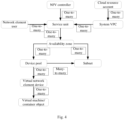
- Fig. 4 is a logical relationship diagram between service objects.
- an NFV controller is deployed at a granularity of regions, and a network element accesses the NFV controller at a granularity of service units in each region.
- a plurality of service units may be created in a given region, and resources are isolated between the plurality of service units.
- One service unit can only be associated with one system VPC.
- One system VPC may be associated with a plurality of service units, such that different service units may operate in a given system VPC.
- One service unit may include a plurality of availability zones, each of which may be associated with a plurality of device pools and subnets.
- Fig. 5 is a schematic diagram of a task flow.
- the task list in the task flow 1 includes tasks such as data verification, creating a VM and a container, configuring a router, creating an elastic network interface, allocating an IP address, and constructing response data.
- the task list in the task flow 2 includes tasks such as data verification, creating a VM and a container, creating an elastic network interface, allocating an IP address, configuring alerts, and constructing response data.
- a task is a referenceable method entity existing independently of a task flow. In two different task flows, the entity may be referenced by the task flows in different ways.
- A1 in the task flow 1 and A2 in the task flow 2 are both references from an entity method (A method entity), and A1 and A2 are identical.
- a method entity an entity method
- A1 and A2 are identical.
- the service logic redundancy problem when the NFV is accessed by different task flows and network elements is solved through the reference association between the task and the task flow.
- Fig. 6 is a schematic diagram of an access of a network element user to a service unit instance.
- the service type "Gateway” is inherited from the service type "Defalut”
- the network element user accesses a service unit instance with the ID "su-123456”
- the service type of this instance is "Gateway”.
- the [Create Device] API When the [Create Device] API is invoked, the system will find the task flow [Create Device (Init)] defined in the "Gateway” type according to the service type in the service unit, and execute the task flow.
- the [Release Device] operation is invoked, the system calls the task flow in the lower-layer service type "Defalut" for execution, since the related task flow is not defined in the service type Gateway.
- the present disclosure provides an embodiment of an apparatus for accessing a network function virtualization controller by a network element.
- the embodiment of the apparatus corresponds to the embodiment of the method shown in Fig. 2 , and the apparatus may be applied in various electronic devices.
- an apparatus 700 for accessing a network function virtualization controller by a network element in this embodiment may include: a creating module 701, a first associating module 702, a second associating module 703, a third associating module 704 and an accessing module 705.
- the creating module 701 is configured to create at least one service unit in a region to which a network element belongs.
- the first associating module 702 is configured to associate the at least one service unit with a system VPC corresponding to the network element.
- the second associating module 703 is configured to associate at least one availability zone included in the service unit with at least one device pool and at least one subnet respectively.
- the device pool is formed by aggregating at least one virtual network element device.
- the third associating module 704 is configured to associate the at least one device pool with the at least one subnet based on an IP corresponding relationship.
- the accessing module 705 is configured to access, by the at least one service unit, a network function virtualization controller deployed in the region to which the network element belongs.
- the apparatus 700 for accessing a network function virtualization controller by a network element further includes: a determining module, configured to determine a task flow of the network element, when a management operation of the virtual network element device is performed on the service unit; and a running module, configured to run tasks based on an order of the tasks in a task list in the task flow.
- the determining module is further configured to: call, in response to finding a service type associated with the service unit from the network function virtualization controller, a task flow under the service type associated with the service unit.
- the determining module is further configured to: call, in response to not finding the service type associated with the service unit from the network function virtualization controller, a task flow under a service type inherited by the service unit.
- a task is a referenceable method entity existing independently of the task flow, and a given referenceable method entity is capable of being referenced by different task flows in different ways.
- the acquisition, storage, use, etc. of the personal information of a user all comply with the provisions of the relevant laws and regulations, and do not violate public order and good customs.
- the present disclosure further provides an electronic device, a readable storage medium and a computer program product.
- FIG. 8 illustrates a schematic block diagram of an example electronic device 800 that may be used to implement embodiments of the present disclosure.
- the electronic device is intended to represent various forms of digital computers, such as laptop computers, desktop computers, workbenches, personal digital assistants, servers, blade servers, mainframe computers, and other suitable computers.
- the electronic device may also represent various forms of mobile apparatuses, such as personal digital processors, cellular phones, smart phones, wearable devices, and other similar computing apparatuses.
- the components shown herein, their connections and relationships, and their functions are merely examples, and are not intended to limit the implementation of the present disclosure described and/or claimed herein.
- the device 800 includes a computation unit 801, which may perform various appropriate actions and processing, based on a computer program stored in a read-only memory (ROM) 802 or a computer program loaded from a storage unit 808 into a random access memory (RAM) 803.
- ROM read-only memory
- RAM random access memory
- various programs and data required for the operation of the device 800 may also be stored.
- the computation unit 801, the ROM 802, and the RAM 803 are connected to each other through a bus 804.
- An input/output (I/O) interface 805 is also connected to the bus 804.
- the I/O interface 805 includes: an input unit 806, for example, a keyboard and a mouse; an output unit 807, for example, various types of displays and speakers; the storage unit 808, for example, a disk and an optical disk; and a communication unit 809, for example, a network card, a modem, or a wireless communication transceiver.
- the communication unit 809 allows the device 800 to exchange information/data with other devices over a computer network such as the Internet and/or various telecommunication networks.
- the computation unit 801 may be various general-purpose and/or dedicated processing components having processing and computing capabilities. Some examples of the computation unit 801 include, but are not limited to, central processing unit (CPU), graphics processing unit (GPU), various dedicated artificial intelligence (AI) computing chips, various computing units running machine learning model algorithms, digital signal processors (DSP), and any appropriate processors, controllers, microcontrollers, etc.
- the computation unit 801 performs the various methods and processes described above, such as a method for accessing a network function virtualization controller by a network element.
- the method for accessing a network function virtualization controller by a network element may be implemented as a computer software program, which is tangibly included in a machine readable medium, such as the storage unit 808.
- part or all of the computer program may be loaded and/or installed on the device 800 via the ROM 802 and/or the communication unit 809.
- the computer program When the computer program is loaded into the RAM 803 and executed by the computation unit 801, one or more steps of the method for accessing a network function virtualization controller by a network element described above may be performed.
- the computation unit 801 may be configured to perform the method for accessing a network function virtualization controller by a network element by any other appropriate means (for example, by means of firmware).
- Various embodiments of the systems and technologies described above can be implemented in digital electronic circuit system, integrated circuit system, field programmable gate array (FPGA), application specific integrated circuit (ASIC), application special standard product (ASSP), system on chip (SOC), complex programmable logic device (CPLD), computer hardware, firmware, software, and/or combinations thereof.
- FPGA field programmable gate array
- ASIC application specific integrated circuit
- ASSP application special standard product
- SOC system on chip
- CPLD complex programmable logic device
- computer hardware firmware, software, and/or combinations thereof.
- Program codes for implementing the method of the present disclosure may be written in any combination of one or more programming languages. These program codes may be provided to a processor or controller of a general purpose computer, special purpose computer or other programmable apparatus for data processing such that the program codes, when executed by the processor or controller, enables the functions/operations specified in the flowcharts and/or block diagrams being implemented.
- the program codes may execute entirely on the machine, partly on the machine, as a stand-alone software package partly on the machine and partly on the remote machine, or entirely on the remote machine or server.
- the machine readable medium may be a tangible medium that may contain or store programs for use by or in connection with an instruction execution system, apparatus, or device.
- the machine readable medium may be a machine readable signal medium or a machine readable storage medium.
- the machine readable medium may include, but is not limited to, an electronic, magnetic, optical, electromagnetic, infrared, or semiconductor system, apparatus, or device, or any suitable combination of the foregoing.
- machine readable storage medium may include an electrical connection based on one or more wires, portable computer disk, hard disk, random access memory (RAM), read only memory (ROM), erasable programmable read only memory (EPROM or flash memory), optical fiber, portable compact disk read only memory (CD-ROM), optical storage device, magnetic storage device, or any suitable combination of the foregoing.
- RAM random access memory
- ROM read only memory
- EPROM or flash memory erasable programmable read only memory
- CD-ROM portable compact disk read only memory
- magnetic storage device magnetic storage device, or any suitable combination of the foregoing.
- the systems and techniques described herein may be implemented on a computer having: a display device for displaying information to the user (e.g., a CRT (cathode ray tube) or LCD (liquid crystal display) monitor); a keyboard and a pointing device (e.g., mouse or trackball), through which the user can provide input to the computer.
- a display device for displaying information to the user
- LCD liquid crystal display
- a keyboard and a pointing device e.g., mouse or trackball
- Other kinds of devices can also be used to provide interaction with users.
- the feedback provided to the user may be any form of sensory feedback (e.g., visual feedback, auditory feedback, or tactile feedback); and the input from the user can be received in any form (including acoustic input, voice input or tactile input).
- the systems and technologies described herein may be implemented in a computing system that includes a back-end component (e.g., as a data server), or a computing system that includes a middleware component (e.g., an application server), or a computing system that includes a front-end component (e.g., a user computer with a graphical user interface or a web browser through which the user can interact with an implementation of the systems and technologies described herein), or a computing system that includes any combination of such a back-end component, such a middleware component, or such a front-end component.
- the components of the system may be interconnected by digital data communication (e.g., a communication network) in any form or medium. Examples of the communication network include: a local area network (LAN), a wide area network (WAN), and the Internet.
- the computer system may include a client and a server.
- the client and the server are generally remote from each other, and generally interact with each other through a communication network.
- the relationship between the client and the server is generated by virtue of computer programs that run on corresponding computers and have a client-server relationship with each other.
- the server may be a cloud server, a server in a distributed system, or a server that incorporates blockchain.
Landscapes
- Engineering & Computer Science (AREA)
- Computer Networks & Wireless Communication (AREA)
- Signal Processing (AREA)
- Data Exchanges In Wide-Area Networks (AREA)
Applications Claiming Priority (1)
| Application Number | Priority Date | Filing Date | Title |
|---|---|---|---|
| CN202410155328.4A CN117938692A (zh) | 2024-02-02 | 2024-02-02 | 网元接入网络功能虚拟化控制器的方法和装置 |
Publications (2)
| Publication Number | Publication Date |
|---|---|
| EP4521694A2 true EP4521694A2 (de) | 2025-03-12 |
| EP4521694A3 EP4521694A3 (de) | 2025-10-08 |
Family
ID=90757348
Family Applications (1)
| Application Number | Title | Priority Date | Filing Date |
|---|---|---|---|
| EP24221780.0A Pending EP4521694A3 (de) | 2024-02-02 | 2024-12-19 | Verfahren und vorrichtung zum zugriff auf eine netzwerkfunktionsvirtualisierungssteuerung durch ein netzwerkelement |
Country Status (3)
| Country | Link |
|---|---|
| US (1) | US20250097122A1 (de) |
| EP (1) | EP4521694A3 (de) |
| CN (1) | CN117938692A (de) |
Family Cites Families (4)
| Publication number | Priority date | Publication date | Assignee | Title |
|---|---|---|---|---|
| CN105830394B (zh) * | 2014-11-27 | 2019-05-21 | 华为技术有限公司 | 虚拟网络策略的配置方法、系统及其虚拟网元和网管系统 |
| US11012299B2 (en) * | 2019-01-18 | 2021-05-18 | Cisco Technology, Inc. | Seamless multi-cloud routing and policy interconnectivity |
| KR102815797B1 (ko) * | 2020-11-05 | 2025-06-02 | 삼성에스디에스 주식회사 | 클라우드 환경에서의 네트워크 분석 장치 및 방법 |
| CN115297004B (zh) * | 2022-07-25 | 2024-05-24 | 紫光云技术有限公司 | 一种单可用区内vpc对等连接实现方法 |
-
2024
- 2024-02-02 CN CN202410155328.4A patent/CN117938692A/zh active Pending
- 2024-09-25 US US18/896,656 patent/US20250097122A1/en active Pending
- 2024-12-19 EP EP24221780.0A patent/EP4521694A3/de active Pending
Also Published As
| Publication number | Publication date |
|---|---|
| US20250097122A1 (en) | 2025-03-20 |
| EP4521694A3 (de) | 2025-10-08 |
| CN117938692A (zh) | 2024-04-26 |
Similar Documents
| Publication | Publication Date | Title |
|---|---|---|
| US20220342693A1 (en) | Custom placement policies for virtual machines | |
| EP3876100A2 (de) | Verfahren und vorrichtung zur gemeinsamen gpu-nutzung, elektronische vorrichtung und lesbares speichermedium | |
| US8825863B2 (en) | Virtual machine placement within a server farm | |
| US10394477B2 (en) | Method and system for memory allocation in a disaggregated memory architecture | |
| US11023267B2 (en) | Composite virtual machine template for virtualized computing environment | |
| JP5352890B2 (ja) | 計算機システムの運用管理方法、計算機システム及びプログラムを記憶する計算機読み取り可能な媒体 | |
| CN102594919B (zh) | It资源支撑系统 | |
| US11354150B1 (en) | Utilizing maintenance event windows to determine placement of instances | |
| US20150012657A1 (en) | Allocation of resources in a networked computing environment based on physical location mapping | |
| US10395195B2 (en) | Provisioning virtual machines to optimize application licensing costs | |
| CN117616395A (zh) | 迁移期间应用的连续活跃度和完整性 | |
| CN105897805A (zh) | 对多层架构的数据中心的资源进行跨层调度的方法和装置 | |
| US10880172B2 (en) | Optimization of cloud compliance services based on compliance actions | |
| US12468981B2 (en) | Database resource management using predictive models | |
| US20160203014A1 (en) | Managing virtual machines using globally unique persistent virtual machine identifiers | |
| US20240152404A1 (en) | Container cross-cluster capacity scaling | |
| CN117642719A (zh) | 访问核的拓扑映射 | |
| CN115469887A (zh) | 云原生应用的发布方法及装置、电子设备和存储介质 | |
| CN115878257A (zh) | 用于优化网络设备队列管理的方法和计算装置 | |
| CN105100180A (zh) | 集群节点动态加载的方法、装置及系统 | |
| EP4521694A2 (de) | Verfahren und vorrichtung zum zugriff auf eine netzwerkfunktionsvirtualisierungssteuerung durch ein netzwerkelement | |
| US11122053B2 (en) | Flexible rights management for cloud-based access to computing resources | |
| CN114625717B (zh) | 数据库生成方法、针对分布式对象的管理方法和装置 | |
| US12619479B2 (en) | Artificial intelligence model management | |
| US20240333658A1 (en) | Automated provisioning techniques for distributed applications with independent resource management at constituent services |
Legal Events
| Date | Code | Title | Description |
|---|---|---|---|
| PUAI | Public reference made under article 153(3) epc to a published international application that has entered the european phase |
Free format text: ORIGINAL CODE: 0009012 |
|
| STAA | Information on the status of an ep patent application or granted ep patent |
Free format text: STATUS: REQUEST FOR EXAMINATION WAS MADE |
|
| 17P | Request for examination filed |
Effective date: 20241219 |
|
| AK | Designated contracting states |
Kind code of ref document: A2 Designated state(s): AL AT BE BG CH CY CZ DE DK EE ES FI FR GB GR HR HU IE IS IT LI LT LU LV MC ME MK MT NL NO PL PT RO RS SE SI SK SM TR |
|
| REG | Reference to a national code |
Ref country code: DE Ref legal event code: R079 Free format text: PREVIOUS MAIN CLASS: H04L0041000000 Ipc: H04L0041022000 |
|
| PUAL | Search report despatched |
Free format text: ORIGINAL CODE: 0009013 |
|
| AK | Designated contracting states |
Kind code of ref document: A3 Designated state(s): AL AT BE BG CH CY CZ DE DK EE ES FI FR GB GR HR HU IE IS IT LI LT LU LV MC ME MK MT NL NO PL PT RO RS SE SI SK SM TR |
|
| RIC1 | Information provided on ipc code assigned before grant |
Ipc: H04L 41/022 20220101AFI20250902BHEP Ipc: H04L 41/0806 20220101ALI20250902BHEP Ipc: H04L 41/40 20220101ALI20250902BHEP Ipc: H04L 41/0895 20220101ALI20250902BHEP |