EP4520950A2 - Raketenmotor und komponenten davon - Google Patents
Raketenmotor und komponenten davon Download PDFInfo
- Publication number
- EP4520950A2 EP4520950A2 EP25153066.3A EP25153066A EP4520950A2 EP 4520950 A2 EP4520950 A2 EP 4520950A2 EP 25153066 A EP25153066 A EP 25153066A EP 4520950 A2 EP4520950 A2 EP 4520950A2
- Authority
- EP
- European Patent Office
- Prior art keywords
- rocket motor
- feed system
- gas
- sonic
- motor feed
- Prior art date
- Legal status (The legal status is an assumption and is not a legal conclusion. Google has not performed a legal analysis and makes no representation as to the accuracy of the status listed.)
- Pending
Links
Images



Classifications
-
- F—MECHANICAL ENGINEERING; LIGHTING; HEATING; WEAPONS; BLASTING
- F02—COMBUSTION ENGINES; HOT-GAS OR COMBUSTION-PRODUCT ENGINE PLANTS
- F02K—JET-PROPULSION PLANTS
- F02K9/00—Rocket-engine plants, i.e. plants carrying both fuel and oxidant therefor; Control thereof
- F02K9/42—Rocket-engine plants, i.e. plants carrying both fuel and oxidant therefor; Control thereof using liquid or gaseous propellants
- F02K9/44—Feeding propellants
- F02K9/52—Injectors
-
- F—MECHANICAL ENGINEERING; LIGHTING; HEATING; WEAPONS; BLASTING
- F02—COMBUSTION ENGINES; HOT-GAS OR COMBUSTION-PRODUCT ENGINE PLANTS
- F02K—JET-PROPULSION PLANTS
- F02K9/00—Rocket-engine plants, i.e. plants carrying both fuel and oxidant therefor; Control thereof
- F02K9/42—Rocket-engine plants, i.e. plants carrying both fuel and oxidant therefor; Control thereof using liquid or gaseous propellants
-
- F—MECHANICAL ENGINEERING; LIGHTING; HEATING; WEAPONS; BLASTING
- F02—COMBUSTION ENGINES; HOT-GAS OR COMBUSTION-PRODUCT ENGINE PLANTS
- F02K—JET-PROPULSION PLANTS
- F02K9/00—Rocket-engine plants, i.e. plants carrying both fuel and oxidant therefor; Control thereof
- F02K9/42—Rocket-engine plants, i.e. plants carrying both fuel and oxidant therefor; Control thereof using liquid or gaseous propellants
- F02K9/44—Feeding propellants
-
- F—MECHANICAL ENGINEERING; LIGHTING; HEATING; WEAPONS; BLASTING
- F02—COMBUSTION ENGINES; HOT-GAS OR COMBUSTION-PRODUCT ENGINE PLANTS
- F02K—JET-PROPULSION PLANTS
- F02K9/00—Rocket-engine plants, i.e. plants carrying both fuel and oxidant therefor; Control thereof
- F02K9/42—Rocket-engine plants, i.e. plants carrying both fuel and oxidant therefor; Control thereof using liquid or gaseous propellants
- F02K9/44—Feeding propellants
- F02K9/50—Feeding propellants using pressurised fluid to pressurise the propellants
-
- F—MECHANICAL ENGINEERING; LIGHTING; HEATING; WEAPONS; BLASTING
- F02—COMBUSTION ENGINES; HOT-GAS OR COMBUSTION-PRODUCT ENGINE PLANTS
- F02K—JET-PROPULSION PLANTS
- F02K9/00—Rocket-engine plants, i.e. plants carrying both fuel and oxidant therefor; Control thereof
- F02K9/42—Rocket-engine plants, i.e. plants carrying both fuel and oxidant therefor; Control thereof using liquid or gaseous propellants
- F02K9/44—Feeding propellants
- F02K9/56—Control
-
- F—MECHANICAL ENGINEERING; LIGHTING; HEATING; WEAPONS; BLASTING
- F02—COMBUSTION ENGINES; HOT-GAS OR COMBUSTION-PRODUCT ENGINE PLANTS
- F02K—JET-PROPULSION PLANTS
- F02K9/00—Rocket-engine plants, i.e. plants carrying both fuel and oxidant therefor; Control thereof
- F02K9/42—Rocket-engine plants, i.e. plants carrying both fuel and oxidant therefor; Control thereof using liquid or gaseous propellants
- F02K9/44—Feeding propellants
- F02K9/56—Control
- F02K9/58—Propellant feed valves
-
- F—MECHANICAL ENGINEERING; LIGHTING; HEATING; WEAPONS; BLASTING
- F02—COMBUSTION ENGINES; HOT-GAS OR COMBUSTION-PRODUCT ENGINE PLANTS
- F02K—JET-PROPULSION PLANTS
- F02K9/00—Rocket-engine plants, i.e. plants carrying both fuel and oxidant therefor; Control thereof
- F02K9/42—Rocket-engine plants, i.e. plants carrying both fuel and oxidant therefor; Control thereof using liquid or gaseous propellants
- F02K9/60—Constructional parts; Details not otherwise provided for
- F02K9/62—Combustion or thrust chambers
- F02K9/64—Combustion or thrust chambers having cooling arrangements
-
- F—MECHANICAL ENGINEERING; LIGHTING; HEATING; WEAPONS; BLASTING
- F02—COMBUSTION ENGINES; HOT-GAS OR COMBUSTION-PRODUCT ENGINE PLANTS
- F02K—JET-PROPULSION PLANTS
- F02K9/00—Rocket-engine plants, i.e. plants carrying both fuel and oxidant therefor; Control thereof
- F02K9/96—Rocket-engine plants, i.e. plants carrying both fuel and oxidant therefor; Control thereof characterised by specially adapted arrangements for testing or measuring
-
- F—MECHANICAL ENGINEERING; LIGHTING; HEATING; WEAPONS; BLASTING
- F05—INDEXING SCHEMES RELATING TO ENGINES OR PUMPS IN VARIOUS SUBCLASSES OF CLASSES F01-F04
- F05D—INDEXING SCHEME FOR ASPECTS RELATING TO NON-POSITIVE-DISPLACEMENT MACHINES OR ENGINES, GAS-TURBINES OR JET-PROPULSION PLANTS
- F05D2270/00—Control
- F05D2270/30—Control parameters, e.g. input parameters
- F05D2270/306—Mass flow
Definitions
- Rocket motors can require a motor feed system which delivers a mass flow rate of propellant.
- Rocket motor feed systems may use active feed systems with pumps or blowdown systems to provide a specified mass flow rate of propellant. Active feed systems can be complex and expensive.
- a rocket motor feed system can comprise a feed line supplying a gas from a gas supply; an injector provided in the feedline, wherein the injector is configured to at least substantially isolate the upstream feed line from a downstream combustor; characterised in that a sonic choke can be provided in the feed line, the sonic choke being configured to passively regulate the mass flow rate of gas passing therethrough; wherein the injector is downstream of the sonic choke.
- the gas supplied from the gas supply can be propene, propane, methane, ethane, ethene or hydrazine.
- the gas supplied from the gas supply can be nitrous oxide, nitrogen tetroxide, or liquid oxygen.
- the gas supplied from the gas supply can be self-pressurised.
- the gas supplied from the gas supply can be the vapour phase of a liquified gas.
- the gas supplied from the gas supply can have a pressure of at least 5 bar from -10°C to 35°C.
- the sonic choke can define a cylindrical orifice.
- the cylindrical orifice can have a diameter of 50 to 10000 microns.
- the cylindrical orifice can have a length:diameter ratio of 1 to 10.
- the sonic choke can provide a mass flow rate of 0.1 - 1 kilogram/second.
- the rocket motor feed system can include a combustor downstream of the injector.
- the rocket motor feed system can include a regenerative cooling circuit.
- the rocket motor feed system can include a second feed line supplying a gas from a second supply; a second sonic choke provided in the second feed line, the second sonic choke being configured to passively regulate the mass flow rate of gas passing therethrough; wherein the injector is configured to at least substantially isolate the upstream second feed line from a downstream combustor.
- the first feed line can be a fuel branch and the second feed line can be an oxidiser branch.
- the rocket motor feed system can provide an oxidiser:fuel ratio between 0.5 to 20.
- FIG. 1 depicts a block diagram of an example of a spacecraft, such as a satellite.
- the spacecraft 10 includes a power supply 11.
- the power supply 11 stores potential energy and is used to power various components of the spacecraft 10.
- the power supply 11 may be recharged via an energy supply, such as a solar collector 12.
- the spacecraft 10 includes a transceiver 13 and a central controller 14.
- the spacecraft 10 can communicate with other entities or objects on Earth or in space via transceiver 13. Instructions can be received by transceiver 13 and interpreted by central controller 14, which can then actuate or instruct other components of the spacecraft 10 to perform various operations.
- the spacecraft 10 may also include a payload 15, which will vary depending on the application of the spacecraft 10.
- the spacecraft 10 also includes a rocket motor module 16.
- the rocket motor module 16 is used to propel the spacecraft 10 and can be used to adjust the orbit or attitude of the spacecraft 10.
- the rocket motor module 16 includes at least a rocket motor feed system 17.
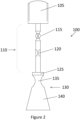
- FIG. 2 depicts an example of a rocket motor feed system 100 of a spacecraft.
- the rocket motor feed system 100 is used to feed propellant to a rocket motor.
- the feed system 100 includes at least one gas supply 105 which contains a gas.
- the gas can be a gaseous propellant.
- the gas supply 105 is in fluid communication with a feed line 110 which supplies gas from the gas supply 105.
- a valve 115 may be provided within the feed line 110 to control the flow of gas from the gas supply 105.
- a sonic choke 120 is provided within the feed line 110.
- the sonic choke 120 defines a sonic flow orifice and is configured (e.g. dimensioned, sized, and/or shaped) to passively regulate the mass flow rate of gas passing through the sonic choke 120.
- An injector 125 is also provided within the feed line 110, downstream of the sonic choke 120.
- the injector 125 is upstream of a combustor 130 and defines one or more orifices (not visible in Figure 2 ) which are configured to at least substantially isolate the upstream section of feed line 110 from the downstream combustor 130. Examples of the injector 125 are provided in greater detail below.
- the combustor can include a combustion chamber 135 and a nozzle 140. Substantially isolating the upstream section of feed line 110 from the combustor 130 prevents pressure oscillations or shockwaves from propagating up the feed line 110, which would otherwise affect performance of the rocket motor feed system 100.
- the gas supply 105 contains a propellant.
- the propellant within the gas supply 105 may be a fuel or may be an oxidiser.
- the rocket motor feed system 100 can also include a second branch with a second gas supply and second feed line. Examples of these are described in more detail below.
- the rocket motor fed by the rocket motor feed system 100 may consume a single propellant, in which case the gas supply 105 contains a monopropellant.
- the propellant stored within the gas supply 105 can be a liquefied gas and can have a liquid phase portion and a vapour phase portion within the gas supply 105.
- the vapour phase portion of the propellant contained within the gas supply 105 can be supplied to the feed line 110 when the valve 115 is open, while the liquid phase portion of the propellant remains in the gas supply 105.
- the gas supplied by the gas supply 105 to the feed line 110 can be self-pressurised.
- the gas can be supplied from the gas supply 105 to the feed line 110 without the use of blowdown systems or pumps, and can be supplied to the feed line mainly through the vapour pressure of the vapour phase portion of the propellant within the gas supply 105.
- the vapour pressure of the vapour phase portion of the propellant within the gas supply 105 may temporarily drop as the vapour phase portion is supplied to the feed line 110. This drop in vapour pressure can cause the liquid phase portion of the propellant within the gas supply 105 to boil and to replenish the vapour phase portion of the propellant within the gas supply 105. In this way, the vapour phase portion of the propellant within the gas supply 105 can be replaced or replenished over time as gas is supplied to the feed line 110.
- the gas supplied by the gas supply 105 to the feed line 110 passes through the sonic choke 120.
- the sonic choke 120 defines a sonic flow orifice and is configured (e.g. dimensioned, sized, and/or shaped) to passively regulate the mass flow rate of gas passing through the sonic choke 120.
- the sonic choke 120 is configured to at least substantially establish choked flow or sonic flow conditions across the sonic flow orifice defined by the sonic choke 120.
- the sonic choke 120 can also be integrated with a valve 115.
- Sonic flow is a phenomenon which can occur when a compressible fluid, such as a gas, passes through an orifice.
- the velocity of a gas passing through an orifice generally increases as the gas passes through the higher-pressure upstream side of the orifice to the lower-pressure downstream side of the orifice.
- the velocity of the gas exiting the orifice is at least partially determined by the upstream and downstream gas temperatures, upstream and downstream gas pressures, and characteristics inherent to the gas (such as the specific heat ratio of the gas.)
- sonic flow conditions can be substantially (but possibly not completely) established across an orifice.
- the velocity of the gas exiting the orifice is sufficiently close to Mach 1 for the mass flow rate passing through the orifice to be substantially determined by upstream conditions, but can be very weakly dependent on downstream conditions (e.g. decreasing the downstream pressure may very weakly increase the mass flow rate passing through the orifice.)
- the sonic choke 120 provided in the feed line 110 defines a sonic flow orifice and is configured (e.g. dimensioned, sized, and/or shaped) to substantially or completely establish sonic flow or choked flow conditions as the gas in the feed line 110 passes through the sonic choke 120.
- sonic flow or choked flow is at least substantially established across the sonic choke 120, the mass flow rate of gas passing through the sonic choke 120 is substantially determined by the conditions upstream of the sonic choke 120 and is substantially decoupled from the conditions downstream of the sonic choke 120.
- Whether partial or complete sonic flow or choked flow is established across the sonic choke 120 depends at least partially on the difference in pressure between the gas upstream of the sonic choke 120 and the gas downstream of the sonic choke 120.
- the pressure downstream of the sonic choke 120 can vary during operation of the rocket engine, while the pressure upstream of the sonic choke 120 is primarily determined by the pressure of the gas supplied by the gas supply 105 within the feed line 110.
- the gas supplied by the gas supply 105 is a self-pressurised vapour phase portion of propellant, the vapour pressure of the vapour phase portion must be high enough to at least partially establish sonic flow or choked flow conditions across the sonic choke 120.
- the vapour pressure depends on the temperature of the propellant within the gas supply 105 according to the vapour pressure curve of the propellant.
- the temperature of the propellant or gas within the gas supply 105 can vary during operation of the rocket motor feed system 100. For example, the temperature can increase due to the conduction of heat from the downstream combustor 130 to the gas supply 105.
- the process of the liquid phase portion of the propellant partially boiling and replenishing the vapour phase portion of the propellant can extract heat from the gas supply 105, thereby lowering its temperature.
- the different operating temperatures of the gas supplied by the gas supply 105 therefore need to be taken into account when selecting a suitable propellant to use with the rocket motor feed system 100.
- propellants with vapour pressures of at least 5 bar across the range of operating temperatures are most suitable for use as self-pressurising propellants for at least partially establishing sonic flow or choked flow conditions across the sonic choke 120.
- the range of operating temperatures of the self-pressurised propellant typically varies from -10°C to 35°C.
- propene can be used as a self-pressurised gaseous fuel within gas supply 105.
- Propene has a vapour pressure of approximately 12 bar at room temperature and has a high enough pressure over a large range of operating temperatures to at least partially establish sonic flow or choked flow conditions across sonic choke 120.
- nitrous oxide can be used as a self-pressurised gaseous oxidiser within gas supply 105. Nitrous oxide has a vapour pressure of approximately 52 bar at room temperature, which is high enough over a large range of operating temperatures to at least partially establish sonic flow or choked flow conditions across sonic choke 120.
- suitable self-pressurised gaseous fuels can also include methane, ethane, ethene, propane and hydrazine.
- any gaseous fuel which has a vapour pressure of at least 5 bar across the range of operating temperatures can be most suitable for use as a self-pressurised propellant in the rocket motor feed system 100.
- suitable oxidisers include nitrogen tetroxide and liquefied oxygen, but any gaseous oxidiser which has a vapour pressure of at least 5 bar across the range of operating temperatures can be most suitable for use as a self-pressurised propellant in the rocket motor feed system 100.
- Self-pressured propellants with vapour pressures of less than 5 bar across the range of operating temperatures can also be compatible with the present invention, but the use of these propellants may result in low downstream pressures in the rocket motor and may adversely affect the rocket motor's performance. As a result, it is usually advantageous and preferable to use propellants with vapour pressures of at least 5 bar, but this is not a strict limitation.
- the gas supply 105 can include a temperature regulator to ensure that the temperature of the propellant stays within an acceptable range.
- the gas supply 105 can include an active heater or cooler which ensures that the temperature of the gas within the gas supply 105 stays within a specified range.
- the temperature regulator of gas supply 105 can allow the temperature of the gas within the gas supply 105 to fall below a certain point when the rocket motor fed by the rocket motor feed system 100 is not operational, but may warm up the gas within the gas supply 105 to an acceptable temperature/pressure prior to firing the rocket motor.
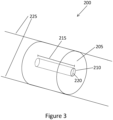
- FIG 3 depicts an example of a sonic choke 200 provided in a feed line.
- This sonic choke 200 includes a body 205 which defines a sonic flow orifice 210.
- the sonic choke 200 is disposed in a portion of a feed line indicated by the feed line walls 225.
- the body 205 of the sonic choke 200 is a plate or disc situated within the feed line and the sonic flow orifice 210 is defined approximately in the centre of the body 205.
- the invention is not limited in this respect, and the body 205 which defines the sonic flow orifice 210 can vary depending on the application of the rocket motor feed system.
- the body 205 of the sonic choke 200 which defines the sonic orifice 210 can be one or more protuberances originating from the walls of the feed line 225. These protuberances can be integrally formed with the walls 225 or can be attached or coupled to the walls 225 in some other way. In other examples, a portion of a wall 225 of the feed line can define the sonic flow orifice 210 - i.e. the sonic flow orifice 210 can pass through one of the walls 225 and can be tangential or orthogonal to the longitudinal axis of the feed line.
- the diameter of the feed line (or distance between the walls 225 of the feed line) can narrow at a certain point, and this narrow passage can define the sonic flow orifice 210.
- the body 205 of the sonic choke 200 which defines the flow sonic orifice 210 can vary depending on the application of the rocket motor feed system, as long as the body 205 of the sonic choke 200 defines the sonic flow orifice 210 such that the sonic flow orifice 210 is provided in the feed line 200 of the rocket motor feed system.
- FIG. 3 shows a single sonic flow orifice 210 defined by the body 205 of the sonic choke 200
- the invention is not limited in this respect.
- One or more bodies 205 can define a plurality of sonic flow orifices 210 depending on the application of the rocket motor feed system.
- the body 205 defining the sonic flow orifice 210 is at least substantially formed from a material which is compatible (e.g. substantially non-reactive) with the gas used in conjunction with the sonic flow orifice 210.
- a material which is compatible e.g. substantially non-reactive
- the sonic flow orifice 210 has a shape and dimensions that can substantially determine the mass flow rate of a gas (for a given gas type and upstream conditions) and therefore can depend on (or be configured for) the application of the sonic flow orifice 210 and the overall rocket motor feed system.
- the shape of the sonic flow orifice 210 is substantially cylindrical and has an associated diameter 220.
- the sonic flow orifice 210 may have substantially elliptical shapes (having major and minor axes instead of diameters) or entirely non-circular shapes, depending on the application of the sonic choke 200 and the overall rocket motor feed system.
- the diameter 220 of the sonic flow orifice 210 may be between 50 microns to 10,000 microns.
- the sonic flow orifice 210 also has a length 215 extending through the body 205 of the sonic choke 200.
- the diameter 220 (or equivalent dimension for non-circular orifices) may be substantially constant along the length 215 of the sonic flow orifice 210. In other examples, the diameter 220 (or equivalent dimension for non-circular orifices) can vary along the length 215 of the sonic flow orifice 210.
- the length 215 may also be expressed in terms of a ratio of the length 215 to the diameter 220 of the sonic flow orifice 210.
- the sonic flow orifice 210 may have a length 215 to diameter 220 ratio within the range of 1 to 10. In particular examples having a constant cylindrical diameter 220, the length:diameter ratio may be about 5.
- the shape and dimensions of the sonic flow orifice 210 can also depend on the application of the sonic choke 200 within the rocket motor feed system.
- the dimensions and/or shape of the sonic flow orifice 210 can at least partially, if not significantly, determine the sonic flow or choked flow conditions for a given propellant.
- the magnitude of the pressure drop across the sonic flow orifice 210 in order to establish substantial sonic flow or choked flow can be determined by the dimensions and/or shape of the sonic flow orifice 210.
- the configuration (e.g. dimensions, size, and/or shape) of the sonic flow orifice 210 therefore can depend on the type of gas used within the rocket motor feed system.
- the mass flow rate dictated by the sonic choke 200 can be at least partially, if not substantially, determined by the dimensions and/or shape of the sonic flow orifice 210, for a given upstream gas having a given temperature and pressure. Selecting the appropriate dimensions and/or shape of the sonic flow orifice 210 will depend on the application of the sonic choke 200.
- the sonic choke 200 can be provided in the feed system of a rocket motor of a satellite.
- the choke 200 can be configured (e.g. dimensioned, sized, and/or shaped) to provide a substantially constant mass flow rate within the ranges of about 0.1 kg/second to 1 kg/second for a given gas, which can be a self-pressurised gaseous propellant such as propene or nitrous oxide.
- the sonic choke 200 can be used to provide a substantially constant mass flow of a fuel such as propene or an oxidiser such as nitrous oxide, but in the feed system of a rocket motor of a full-sized rocket.
- a fuel such as propene or an oxidiser such as nitrous oxide
- the mass flow rate of gas will be correspondingly larger given the larger rocket motor.
- the mass flow rate passing through the sonic choke 200 is at least substantially determined by the upstream gas conditions (e.g. the gas temperature and gas pressure) and is substantially independent of the gas conditions downstream of the sonic choke 200.
- the sonic choke 200 therefore passively regulates the flow rate of mass leaving the gas supply to provide a predictable and substantially constant mass flow rate for a given set of upstream gas conditions, effectively decoupling the mass flow rate from changes or fluctuations in the gas conditions downstream of the sonic choke 200.
- the rocket motor feed system is used to feed a bi-propellant rocket motor
- this allows the rocket motor feed system to provide a predictable and substantially constant ratio of oxidiser to fuel within the combustor, which can be important for maintaining a high motor efficiency and beneficial for combustor longevity.
- This also means that the rocket motor can behave more predictably in general.
- FIG. 4 depicts an example of a rocket motor feed system with a regenerative cooling circuit.
- the rocket motor feed system 300 includes a gas supply 305 connected to a feed line 310.
- a valve 315 may be situated within the feed line 310 and is used to control the flow of gas from the gas supply 305.
- a sonic choke 320 is situated downstream of the gas valve 315 in the feed line 310 and is configured (e.g. dimensioned, sized, and/or shaped) to passively regulate the mass flow rate of gas passing therethrough by establishing sonic flow across the sonic choke 320.
- a regenerative cooling circuit 322 is provided downstream of the sonic choke 320.
- the regenerative cooling circuit 322 is in thermal contact with a combustor 330 including one or more of a combustion chamber 335, nozzle 340, and/or injector 325.
- Gas supplied by the gas supply 305 passes through the feed line 310 and sonic choke 320 before entering the regenerative cooling circuit 322. Heat generated from the combustion of propellant in the combustor 330 is transferred to the regenerative cooling circuit 322 due to the thermal contact between the components, and consequently to the gas passing through the regenerative cooling circuit 322.
- the gas consequently passes through the regenerative cooling circuit 322 and through the one or more orifices defined by the injector 325 before being combusted in the combustion chamber 335 and expelled out the nozzle 340.
- the one or more orifices defined by the injector 325 are configured to at least substantially isolate the upstream feed line 310 from the combustor 330.
- Including the regenerative cooling circuit 322 in the rocket motor feed system 300 can allow the combustor 330 to provide a larger amount of thrust than would otherwise be possible without the use of a cooling system, as it is able to burn more propellant per unit time while still remaining at a safe operating temperature. Additionally or alternatively, the use of a regenerative cooling circuit 322 can increase the longevity of the combustor 330, particularly when compared with alternative, non-regenerative cooling methods.
- the mass flow rate of gas supplied by the gas supply 305 and passing through the upstream sonic choke 320 is substantially constant for the given upstream gas conditions, provided that sonic flow remains at least substantially established across the sonic choke 320.
- the mass flow rate of gas entering the one or more orifices defined by the injector 325 is therefore also substantially constant, meaning that the combustor continues to behave in a predictable manner.
- the ratio of oxidiser to fuel reaching the combustor 330 can also be substantially constant, which can be important for the efficiency and performance of the combustor 330.
- the regenerative cooling circuit 322 consists of a plurality of helical tubes 3D-printed into the combustor 330.
- the internal diameter of one or more of the helical tubes can vary along the length of the tube such that the velocity of gas flowing within the tube is varied as required by the local cooling requirements.
- the regenerative cooling circuit 322 can consist of more traditional designs or may be manufactured using more traditional techniques. The overall design of the regenerative cooling circuit 322 can depend on the application of the rocket motor feed system 300 and its associated rocket motor.
- More than one rocket motor feed system of the present invention can also be used within a single rocket motor.
- a single bi-propellant rocket motor can have a fuel branch (e.g. a first rocket motor feed system which feeds fuel to the rocket motor) and an oxidiser branch (e.g. a second rocket motor feed system which feeds oxidiser to the rocket motor.)
- These branches or rocket motor feed systems can be completely independent of one another or can have components which are shared or common to both branches/rocket motor feed systems.
- the fuel branch and the oxidiser branch of a bi-propellant rocket motor feed system will typically share a common injector upstream of the combustor, although each propellant will typically flow through different orifices defined by the injector.
- multiple fuel branches and/or multiple oxidiser branches may be used to feed a single rocket motor.
- some examples of the rocket motor feed system can include multiple fuel/oxidiser gas supplies with dedicated feed lines or single gas supplies with multiple feed lines.
- the number and configuration of fuel branches and oxidiser branches can vary depending on the rocket motor feed system and the requirements or configuration of the spacecraft.
- the rocket motor feed system 400 includes a first gas supply 405 and a second gas supply 406.
- Each gas supply can respectively contain a fuel and an oxidiser. These may be self-pressurised liquified gases with mixtures of liquid phase portions and vapour phase portions within each gas supply.
- the two gas supplies 405 and 406 are respectively connected to a first feed line 410 and a second feed line 411.
- a first valve 415 may be provided within the first feed line 410, while a second valve 416 may be provided within the second feed line 411.
- a first sonic choke 420 is provided in the first feed line 410, while a second sonic choke 421 is provided within the second feed line 411.
- Each sonic choke 420 and 421 is configured (e.g. dimensioned, sized, and/or shaped) to passively regulate the mass flow rate of gas passing therethrough.
- the first feed line 410 and/or second feed line 411 can also include a regenerative cooling circuit.
- a regenerative cooling circuit 422 is provided in the first feed line 410, downstream of the first sonic choke 420.
- both feed lines 410 and 411 can include one or more regenerative cooling circuits.
- neither feed line 410 or 411 may include a regenerative cooling circuit, and regenerative cooling circuits can be absent entirely from the rocket motor feed system 400. Whether and where a regenerative cooling circuit is included in the rocket motor feed system 400 can depend on the application of the rocket motor feed system.
- an injector 425 is provided downstream of the regenerative cooling circuit 422 of the first feed line 410 and downstream of the second sonic choke 421 of the second feed line 411.
- a combustor 430 is also provided downstream of the injector 425 and includes a combustion chamber 335 and a nozzle 440.
- the injector 425 defines one or more orifices (explained in greater detail below) used to introduce propellants into the combustor 430.
- the one or more orifices are configured to substantially isolate the upstream section of the first feed line 410 from the downstream combustor 430 and to substantially isolate the upstream section of the second feed line 411 from the downstream combustor 430 (from e.g.
- the orifices defined by the injector 425 are configured to at least substantially decouple the pressure within the combustion chamber 435 from the propellant feed pressure.
- Fuel and oxidiser supplied by the first and second gas supplies 405 and 406 respectively pass through the orifice(s) defined by the injector 425 before mixing and igniting in the combustion chamber 435.
- the combusted mixture is then expelled out of the nozzle 440, producing thrust and propelling the spacecraft.
- the efficiency and performance of the motor can depend at least partially on how the fuel and oxidiser mixes and burns within the combustion chamber 435.
- the orifice(s) defined by the injector 425 can also be configured to ensure adequate mixing of the gaseous fuel and gaseous oxidiser supplied respectively by the first gas supply 405 via the first feed line 410 and by the second gas supply 406 via the second feed line 411.
- the orifices defined by the injector 425 can also at least partially determine the injection velocity of gaseous fuel and gaseous oxidiser into the combustion chamber 435.
- the injector 425 can include an injection plate which is fed by the first upstream feed line 410 and the second upstream feed line 411.
- the injection plate can define a first orifice (or plurality of orifices) used to inject a first type of propellant (e.g. fuel) supplied by first gas supply 405 into the combustion chamber 435, and can define a second orifice (or plurality of orifices) used to inject a second type of propellant (e.g. oxidiser) supplied by second gas supply 406 into the combustion chamber 435.
- the first and second orifice (or orifices) can at least substantially isolate their respective upstream feed lines from the downstream combustor 430 by achieving a sufficient pressure drop across each orifice.
- FIG. 6(a) depicts a non-limiting example of an injector.
- the injector 500 includes an injection plate 510 which defines a first plurality of orifices (a portion of which are indicated by 520) and a second plurality of orifices (a portion of which are indicated by 530.) Fuel supplied by a first feed line is injected into the combustor through the first plurality of orifices 520, while oxidiser supplied by a second feed line is injected into the combustor through the second plurality of orifices 530.
- Figure 6(b) depicts a cross-section view of example injector through section A-A.
- the injection plate 510 defines a first plurality of manifolds 525 and a second plurality of manifolds 535.
- Fuel supplied by a first upstream feed line (not pictured) to the injector passes through the first plurality of manifolds 525, while oxidiser fed through a second upstream feed line (not pictured) to the injector passes through the second plurality of manifolds 535.
- Each fuel manifold 525 is in fluid communication with a plurality of orifices 520 used to inject fuel into the combustion chamber (denoted generally by 550), while each oxidiser manifold 535 is in fluid communication with orifices 530 used inject oxidiser into the combustion chamber 550.
- the fuel orifices 520 are configured to isolate the first upstream feed line from the combustor, while the oxidiser orifices 530 are configured to isolate the second upstream feed line from the combustor. This can be achieved by ensuring a sufficient pressure drop across each respective orifice.
- the fuel orifices 520 and/or the oxidiser orifices 530 may be sonic orifices themselves, although this may require high gas pressures within the fuel and oxidiser manifolds 525 and 535. In most cases, sonic flow across the fuel orifices 520 and/or oxidiser orifices 530 will not be necessary to substantially isolate each respective feed line from the downstream combustor.
- the particular non-limiting example of the injector depicted in Figure 6(b) is an unlike triplet impinging injector.
- fuel which is injected through the fuel orifices 520 defined by the injection plate 510 impinges upon oxidiser injected through the oxidiser orifices 530 defined by the injection plate 510 at various impingement points - one impingement point 560 is illustrated.
- the injector of the rocket motor feed system is not limited to this particular design, and many other variations could be used with the rocket motor feed system depending on its application.
- other injectors may be coaxial and may be, for example, a pintle injector, a shear coaxial injector, a central body coaxial injector, or a shear tri-coaxial injector.
- the injector may be an impinging injector of a different design (including like and unlike impinging injectors, doublet impinging injectors, etc), a showerhead injector, or anything with a defined orifice.
- the injector could be a porous injector, and the orifices used to inject oxidiser and/or fuel can be defined by the porous media of the injector.
- the design of the injector can depend on its application and other factors including (for example) the size of the motor, the types of propellants used in the rocket motor feed system, the required injection velocity of the propellants, and the required rates of propellant masses flowing into the combustor.
- the efficiency and performance of the rocket motor can also depend on the ratio of oxidiser to fuel being burned within the combustion chamber.
- the oxidiser:fuel ratio reaching the combustion chamber 435 is at least partially determined by the first and second sonic chokes 420 and 421, as the first and second sonic chokes 420 and 421 passively regulate the mass flow rate of fuel and oxidiser within the first and second feed lines 410 and 411.
- the first and second sonic chokes 420 and 421 can therefore be configured to provide a target ratio of oxidiser:fuel to the combustion chamber 435 and/or a ratio within a preferred range.
- the shape and/or dimensions and/or size of the first and second sonic chokes 420 and 421 can be chosen to deliver a target ratio of oxidiser:fuel flowing into the combustion chamber 435.
- the ideal oxidiser:fuel ratio will typically depend on the specific propellants used with the motor.
- the first and second sonic chokes 420 and 421 will typically be configured (e.g. dimensioned, sized, and/or shaped) to provide an oxidiser:fuel ratio on the order of 0.5:1 to 20:1, depending on the applications of the motor and the propellants used with the rocket motor feed system.
- the ideal ratio is approximately 8:1 oxidiser:fuel.
- each sonic choke 420 and 421 depends not only on how each sonic choke (or sonic orifice defined thereby) is configured (e.g. dimensioned, sized, and/or shaped), but also on the type of gas and the upstream gas conditions, such as temperature and pressure.
- the gaseous propellants supplied by gas supplies 405 and 406 are vapour phase portions of self-pressurised liquefied gases
- the pressure and temperature of each gaseous propellant are related by the propellant's vapour pressure curve.
- the mass flow rate of a gaseous propellant at 35°C may be 100% of a relative mass flow rate, while the mass flow rate of the same gaseous propellant at -10°C may be 35% of the relative mass flow rate.
- the propellants can be selected based on their vapour pressure curves such that the ratio of the mass flow rate through the sonic choke 420 of the oxidiser branch to the mass flow rate through the sonic choke 421 of the fuel branch does not substantially change over the range of operating temperatures of the rocket motor feed system 400. This concept will be explained in more depth below.
- the rate of mass flowing through a sonic choke (or sonic flow orifice defined by a sonic choke) has an approximately linear dependence on the upstream propellant temperature. Furthermore, the upstream propellant temperature is related to the temperature of the propellant vapour by the propellant's vapour pressure curve.
- the rocket motor feed system is configured to provide oxidiser and fuel to the combustor at a known ratio at a specific propellant temperature
- the ratio of oxidiser:fuel supplied by the rocket motor feed system at a given propellant temperature can be approximated by considering the ratio of each propellant's pressure at that given temperature, due to the approximately linear relationship between mass flow rate and upstream propellant pressure.
- ⁇ O (T) be the mass flow rate of oxidiser at temperature T (measured in degrees Celsius) passing through a sonic choke provided in an oxidiser branch
- ⁇ F (T) be the mass flow rate of fuel at temperature T passing through a sonic choke provided in a fuel branch.
- P O (T) the mass flow rate of oxidiser at temperature T
- P F (T) the fuel pressure at temperature T
- the ratio of the oxidiser:fuel mass flow rates can be determined for a different temperature T 2 by considering the pressures of the oxidiser/fuel at T 2 .
- a rocket motor feed system can use self-pressurised propene vapour as a fuel and self-pressurised nitrous oxide vapour as an oxidiser.
- the sonic choke of the oxidiser branch and sonic choke of the fuel branch can each be configured (e.g. dimensioned, sized, and/or shaped) such that when both propellants are 0°C, the mass flow rate of oxidiser and mass flow rate of fuel is supplied to the combustor at an 8:1 ratio oxidiser:fuel ratio (or in other words, ⁇ O (0°): ⁇ F (0°) is 8:1).
- the new ratio of oxidiser:fuel mass flow rates at 20°C is approximately 7.44:1, a decrease of approximately 7% from the 8:1 ratio at 0°C.
- the above example approximates a linear relationship between the mass flow rate and propellant temperature/pressure. It should be noted that this is an approximation to a first order and the pressure/temperature values provided above are not exact.
- This example merely illustrates the principle of how a target ratio of oxidiser:fuel may be provided (with some acceptable variation) by the rocket motor feed system. It is fully expected that there may be some non-linear component to the relationship between the mass flow rate and pressure, and the present invention is not tied to the assumption that the aforementioned relationship is entirely linear.
- Some applications of the rocket motor feed system can require the ratio of the oxidiser:fuel mass flow rates to stay within a comparatively narrow range of values, and the configuration or operating parameters of the rocket motor feed system may vary accordingly.
- the rocket motor feed system may only be allowed to operate within a correspondingly narrow range of propellant temperatures in order to substantially preserve the ideal ratio of oxidiser:fuel mass flow rates.
- the exact ratio of oxidiser:fuel mass flow rates may be of less importance and the range of acceptable operating temperatures of each propellant, or the choice of propellants themselves, may also vary accordingly.
- the example given above also presumes that the temperature of both propellants changes more or less concomitantly. This may a sensible approximation in some examples as the temperatures of the gas supplies of the rocket motor feed system may vary in more or less the same way.
- the mass flow rate of oxidiser leaving the oxidiser gas supply 405 is often greater than the mass flow rate of fuel leaving the fuel gas supply 406 (for oxidiser:fuel ratios > 1), the total mass of propellant contained within the oxidiser gas supply 405 can be comparatively larger.
- the ratio of mass leaving each gas supply to the total mass contained within that gas supply can be substantially the same for each gas supply of the rocket motor feed system. This can mean that the temperature effects of e.g. evaporative cooling of each gas due to the boiling of liquid phase propellant to vapour phase propellant will affect the temperature of the gas supplies of the rocket motor feed system in more or less the same way.
- the first and second gas supplies 405 and 406 can be in thermal contact with one another.
- the first and second gas supplies 405 and 406 can share a bulkhead and can have one or more metal components (e.g. sidewalls) in common. If a discrepancy in the gas supply temperatures does arise, the thermal contact between the first and second gas supply 405 and 406 will mean the two gas supplies naturally tend towards thermal equilibrium.
- the first and second gas supplies 405 and 406 can also be in thermal contact with the body of the spacecraft (e.g. satellite), which may equalise any thermal discrepancies more quickly due to the larger thermal mass.
- each gas supply may have a thermometer or temperature sensor and a heating element.
- the temperature sensor associated with each gas supply can interface with a controller which controls the respective heating element to maintain the gas supplies at the same temperature.
- the rocket motor feed system can be configured to provide a particular ratio of oxidiser:fuel by actively controlling the temperature of one or more of the gas supplies.
- a central controller on the spacecraft can include a lookup table stored in a form of memory.
- the lookup table can contain the vapour pressure curve of one or more of the on-board gas supplies.
- Each gas supply can include a thermometer or temperature sensor and a heating and/or cooling element in communication with the controller.
- the controller can actively monitor and control the temperature of the one or more gas supplies with reference to the vapour pressure curve of the one or more gas supplies stored within the controller's memory.
- the temperature of each gas supply can be controlled independently and may differ in order for the rocket motor feed system to deliver the specified oxidiser:fuel ratio to the combustor.
- the temperatures of the one or more gas supplies can be allowed to vary. In some applications, it may not be practical to maintain a similar temperature between the one or more gas supplies of the rocket motor feed system without some form of active control.
- the rocket motor feed system could be used on board an orbiting satellite. One side of the satellite may be more or less constantly illuminated by the sun, while the other side of the satellite may be more or less constantly in the shade. If one of the gas supplies is contained within the illuminated side while another gas supply is contained within the shaded side, a temperature gradient may exist between the two gas supplies even if they are in thermal contact with one another. If the oxidiser:fuel ratio supplied by the rocket motor feed system to the combustor is important, an active control system (as described above) may be employed. Otherwise, the temperatures of the gas supplies may be allowed to vary.
- the motor of the rocket motor feed system can be restricted to performing small burns with small propellant flow rates.
- the mass flow rate of propellant leaving each gas supply can be small enough to cause quasi-static gas supply conditions, meaning the pressure and temperature of propellant within each gas supply does not appreciably change during the operation of the combustor.
- the combustor of the motor may not combust a large enough amount of propellant at any one time to appreciably increase the temperature of either gas supply through conduction.
- the small temperature decrease through the expansion of gaseous propellant out of each gas supply may be offset by a small temperature increase through heat conduction via the combustor, thereby achieving substantially quasi-static upstream gas conditions (e.g. gas temperature and pressure.)
Landscapes
- Engineering & Computer Science (AREA)
- Chemical & Material Sciences (AREA)
- Combustion & Propulsion (AREA)
- Mechanical Engineering (AREA)
- General Engineering & Computer Science (AREA)
- Testing Of Engines (AREA)
- Engine Equipment That Uses Special Cycles (AREA)
- Toys (AREA)
Applications Claiming Priority (2)
| Application Number | Priority Date | Filing Date | Title |
|---|---|---|---|
| US202063061959P | 2020-08-06 | 2020-08-06 | |
| EP21189573.5A EP3951157B1 (de) | 2020-08-06 | 2021-08-04 | Raketenmotor und seine bestandteile |
Related Parent Applications (2)
| Application Number | Title | Priority Date | Filing Date |
|---|---|---|---|
| EP21189573.5A Division-Into EP3951157B1 (de) | 2020-08-06 | 2021-08-04 | Raketenmotor und seine bestandteile |
| EP21189573.5A Division EP3951157B1 (de) | 2020-08-06 | 2021-08-04 | Raketenmotor und seine bestandteile |
Publications (2)
| Publication Number | Publication Date |
|---|---|
| EP4520950A2 true EP4520950A2 (de) | 2025-03-12 |
| EP4520950A3 EP4520950A3 (de) | 2025-05-07 |
Family
ID=77207082
Family Applications (2)
| Application Number | Title | Priority Date | Filing Date |
|---|---|---|---|
| EP21189573.5A Active EP3951157B1 (de) | 2020-08-06 | 2021-08-04 | Raketenmotor und seine bestandteile |
| EP25153066.3A Pending EP4520950A3 (de) | 2020-08-06 | 2021-08-04 | Raketenmotor und komponenten davon |
Family Applications Before (1)
| Application Number | Title | Priority Date | Filing Date |
|---|---|---|---|
| EP21189573.5A Active EP3951157B1 (de) | 2020-08-06 | 2021-08-04 | Raketenmotor und seine bestandteile |
Country Status (6)
| Country | Link |
|---|---|
| US (2) | US12116958B2 (de) |
| EP (2) | EP3951157B1 (de) |
| AU (1) | AU2021211979A1 (de) |
| ES (1) | ES3017607T3 (de) |
| FI (1) | FI3951157T3 (de) |
| PL (1) | PL3951157T3 (de) |
Families Citing this family (2)
| Publication number | Priority date | Publication date | Assignee | Title |
|---|---|---|---|---|
| IT202200020457A1 (it) * | 2022-10-05 | 2024-04-05 | D Orbit S P A | Propulsore per manovre orbitali, sistema propulsivo per manovre orbitali e veicolo di trasporto orbitale |
| CN115680943B (zh) * | 2022-10-31 | 2024-07-30 | 北京航天试验技术研究所 | 火箭发动机热辐射测量装置 |
Family Cites Families (44)
| Publication number | Priority date | Publication date | Assignee | Title |
|---|---|---|---|---|
| US2719584A (en) * | 1953-03-05 | 1955-10-04 | Elizabeth L Winslow | Nozzle for rocket motor |
| US3001365A (en) * | 1957-05-27 | 1961-09-26 | Aerojet General Co | Shut-off valve |
| US3094838A (en) * | 1959-06-17 | 1963-06-25 | United Aircraft Corp | Thrust control system |
| US3088406A (en) * | 1959-06-22 | 1963-05-07 | Thompson Ramo Wooldridge Inc | Quantized impulse rocket |
| US3172254A (en) * | 1961-04-17 | 1965-03-09 | Chandler Evans Corp | Propellant control system for a rocket engine |
| US3453827A (en) * | 1962-11-26 | 1969-07-08 | North American Rockwell | Injection throttling |
| US3166900A (en) * | 1963-02-01 | 1965-01-26 | United Aircraft Corp | Method and apparatus for fluid flow control in two phase aeration systems |
| BE644309A (de) | 1963-02-25 | 1900-01-01 | ||
| US3368353A (en) * | 1965-09-30 | 1968-02-13 | United Aircraft Corp | Automatic o/f control |
| US3581495A (en) * | 1968-05-01 | 1971-06-01 | United Aircraft Corp | Slot tube swirler injector |
| US3848806A (en) | 1973-04-30 | 1974-11-19 | Rockwell International Corp | Throttling venturi valve |
| US4424679A (en) * | 1981-09-10 | 1984-01-10 | The United States Of America As Represented By The Secretary Of The Air Force | Constant thrust hybrid rocket motor |
| US4782660A (en) * | 1987-01-20 | 1988-11-08 | Rockwell International Corporation | Sequenced and pressure controlled injector |
| US5063734A (en) * | 1990-01-26 | 1991-11-12 | The United States Of America As Represented By The Administrator Of The National Aeronautics And Space Administration | Method for providing real-time control of a gaseous propellant rocket propulsion system |
| US5148674A (en) * | 1990-01-26 | 1992-09-22 | Morris Brian G | Method and apparatus for providing real-time control of a gaseous propellant rocket propulsion system |
| US5819526A (en) * | 1996-02-23 | 1998-10-13 | Trw Inc. | Low power arcjet propellant feed system |
| US6193187B1 (en) * | 1998-12-31 | 2001-02-27 | Harry Scott | Payload carry and launch system |
| US6250602B1 (en) | 1999-01-18 | 2001-06-26 | Jansen's Aircraft Systems Controls, Inc. | Positive shut-off metering valve with axial thread drive |
| US6205770B1 (en) * | 1999-03-10 | 2001-03-27 | Gregg G. Williams | Rocket engine |
| US6783108B2 (en) | 2001-08-17 | 2004-08-31 | Jansen's Aircraft Systems Controls, Inc. | Fueldraulic pintle valve |
| JP3783040B2 (ja) * | 2002-07-11 | 2006-06-07 | 独立行政法人 宇宙航空研究開発機構 | 2液式エンジンおよび2液式エンジンを搭載したロケット |
| US6799417B2 (en) * | 2003-02-05 | 2004-10-05 | Aerojet-General Corporation | Diversion of combustion gas within a rocket engine to preheat fuel |
| US6832471B2 (en) * | 2003-03-12 | 2004-12-21 | Aerojet-General Corporation | Expander cycle rocket engine with staged combustion and heat exchange |
| US7757476B2 (en) * | 2003-07-22 | 2010-07-20 | The Aerospace Corporation | Catalytically activated transient decomposition propulsion system |
| US20080016846A1 (en) * | 2006-07-18 | 2008-01-24 | United Technologies Corporation | System and method for cooling hydrocarbon-fueled rocket engines |
| US20100257839A1 (en) * | 2006-08-15 | 2010-10-14 | United Technologies Corporation | Hydrocarbon-fueled rocket engine with endothermic fuel cooling |
| US7784269B1 (en) * | 2006-08-25 | 2010-08-31 | Xcor Aerospace | System and method for cooling rocket engines |
| US20080264035A1 (en) * | 2007-04-25 | 2008-10-30 | Ricciardo Mark J | Coolant flow swirler for a rocket engine |
| US20090288390A1 (en) * | 2008-05-23 | 2009-11-26 | Thomas Clayton Pavia | Simplified thrust chamber recirculating cooling system |
| US8438930B2 (en) * | 2009-01-08 | 2013-05-14 | United Launch Alliance, Llc | Mechanical signal processing accumulator attenuation device and method |
| US8381508B2 (en) * | 2009-05-28 | 2013-02-26 | Alliant Techsystems Inc. | Closed-cycle rocket engine assemblies and methods of operating such rocket engine assemblies |
| CN101644627B (zh) | 2009-09-11 | 2011-05-04 | 北京航空航天大学 | 音速喷嘴自动标定系统及自动标定方法 |
| US8572948B1 (en) * | 2010-10-15 | 2013-11-05 | Florida Turbine Technologies, Inc. | Rocket engine propulsion system |
| WO2013105988A2 (en) * | 2011-02-15 | 2013-07-18 | Firestar Engineering, Llc | Clustered, fixed cant, throttleable rocket assembly |
| US8250853B1 (en) * | 2011-02-16 | 2012-08-28 | Florida Turbine Technologies, Inc. | Hybrid expander cycle rocket engine |
| KR101180430B1 (ko) * | 2011-08-24 | 2012-09-07 | 한국항공우주연구원 | Dc 모터를 이용한 유량제어 밸브의 다단제어 방법 |
| FR2994587B1 (fr) * | 2012-08-20 | 2017-07-07 | Snecma | Allumeur bimodal et procede d'injection bimodale pour allumeur de moteur-fusee |
| CN103089488A (zh) | 2013-01-21 | 2013-05-08 | 北京航空航天大学 | 一种适用于高浓度过氧化氢的可调汽蚀文氏管 |
| US10940961B2 (en) | 2015-01-14 | 2021-03-09 | Ventions, Llc | Small satellite propulsion system |
| US10072612B2 (en) * | 2015-10-05 | 2018-09-11 | Vector Launch Inc. | Enhanced liquid oxygen-propylene rocket engine |
| US20180171933A1 (en) * | 2016-12-19 | 2018-06-21 | Flight Works, Inc. | Micropump-fed autogenous pressurization system |
| DE102018114868B4 (de) | 2018-06-20 | 2026-01-15 | Deutsches Zentrum für Luft- und Raumfahrt e.V. | Antriebssystem für ein Raumfahrzeug und Verfahren zum Antrieb eines Raumfahrzeugs |
| US12060853B2 (en) * | 2019-01-30 | 2024-08-13 | Laboratoire Reaction Dynamics Inc. | Rocket engine with integrated oxidizer catalyst in manifold and injector assembly |
| EP4350138B1 (de) * | 2020-09-30 | 2026-04-22 | Rolls-Royce plc | Gasturbinenmotor mit komplexem zyklus |
-
2021
- 2021-08-02 AU AU2021211979A patent/AU2021211979A1/en active Pending
- 2021-08-04 ES ES21189573T patent/ES3017607T3/es active Active
- 2021-08-04 EP EP21189573.5A patent/EP3951157B1/de active Active
- 2021-08-04 PL PL21189573.5T patent/PL3951157T3/pl unknown
- 2021-08-04 EP EP25153066.3A patent/EP4520950A3/de active Pending
- 2021-08-04 FI FIEP21189573.5T patent/FI3951157T3/fi active
- 2021-08-05 US US17/394,768 patent/US12116958B2/en active Active
-
2024
- 2024-09-12 US US18/883,691 patent/US20260078719A1/en active Pending
Non-Patent Citations (2)
| Title |
|---|
| CELANO M P ET AL: "Injector Characterization for a GOX-GCH4 Single Element Combustion Chamber", 5 TH EUROPEAN CONFERENCE FOR AERONAUTICS AND SPACE SCIENCES (EUCASS) ; MUNICH, GERMANY; JULY 1ST TILL JULY 5TH 2013, 1 July 2013 (2013-07-01), pages 1 - 14, XP093341028, Retrieved from the Internet <URL:https://www.eucass.eu/component/docindexer/?task=download&id=4017> * |
| LINNE DIANE ET AL: "Mars Surface Mobility Leading to Sustainable Exploration", 50TH AIAA AEROSPACE SCIENCES MEETING INCLUDING THE NEW HORIZONS FORUM AND AEROSPACE EXPOSITION, 9 January 2012 (2012-01-09), Reston, Virigina, pages 1 - 22, XP093341070, ISBN: 978-1-60086-936-5, Retrieved from the Internet <URL:https://ntrs.nasa.gov/api/citations/20120004103/downloads/20120004103.pdf> DOI: 10.2514/6.2012-806 * |
Also Published As
| Publication number | Publication date |
|---|---|
| US12116958B2 (en) | 2024-10-15 |
| EP3951157A1 (de) | 2022-02-09 |
| EP3951157B1 (de) | 2025-02-26 |
| ES3017607T3 (en) | 2025-05-13 |
| EP4520950A3 (de) | 2025-05-07 |
| US20260078719A1 (en) | 2026-03-19 |
| FI3951157T3 (fi) | 2025-05-22 |
| US20220112867A1 (en) | 2022-04-14 |
| PL3951157T3 (pl) | 2025-06-16 |
| AU2021211979A1 (en) | 2022-02-24 |
Similar Documents
| Publication | Publication Date | Title |
|---|---|---|
| US20260078719A1 (en) | Rocket Motor and Components Thereof | |
| Dressler | Summary of deep throttling rocket engines with emphasis on Apollo LMDE | |
| US11181076B2 (en) | Rocket engine bipropellant supply system including an electrolyzer | |
| US10844808B2 (en) | Rocket engine systems with an independently regulated cooling system | |
| US4073138A (en) | Mixed mode rocket engine | |
| EP0620895B1 (de) | Antriebs- und energieversorgungssystem für einen satelliten | |
| Dressler et al. | TRW pintle engine heritage and performance characteristics | |
| US8341933B2 (en) | Method for cooling rocket engines | |
| US20210148307A1 (en) | Rocket engine with integrated oxidizer catalyst in manifold and injector assembly | |
| US11480136B1 (en) | Monopropellant continuous detonation engines | |
| JP2014505835A (ja) | 傾斜角が固定された可変推力ロケットアセンブリー{clustered、fixedcant、throttleablerocketassembly} | |
| US7958719B2 (en) | Noncircular transient fluid fuel injector control channels in propellant injector combustion systems | |
| Haag et al. | Low cost propulsion development for small satellites at the surrey space centre | |
| US7404288B2 (en) | High propulsion mass fraction hybrid propellant system | |
| Bzdyk et al. | Investigation of the operating parameters and performance of an autophage, hybrid rocket propulsion system | |
| US8099945B2 (en) | Hybrid propulsion system | |
| US7069717B2 (en) | Hybrid propulsion system | |
| Asakura et al. | Influence of Injector for Performance of N2O/DME Bipropellant Thruster | |
| Miotti et al. | Bi-propellant micro-rocket engine | |
| Kuranaga et al. | N2O/DME bipropellant thruster with premixer | |
| FREI et al. | Recent test results of a warm gas pumped monopropellant propulsion system | |
| Ito | Propellant injection systems and processes | |
| Eilers et al. | Development and Testing of the Regeneratively Cooled Multiple Use Plug Hybrid (for) Nanosats (MUPHyN) Motor | |
| Deif et al. | Preliminary design of a hydrogen peroxide thruster for remote sensing satellite | |
| Suresh et al. | Propulsion Systems |
Legal Events
| Date | Code | Title | Description |
|---|---|---|---|
| PUAI | Public reference made under article 153(3) epc to a published international application that has entered the european phase |
Free format text: ORIGINAL CODE: 0009012 |
|
| STAA | Information on the status of an ep patent application or granted ep patent |
Free format text: STATUS: REQUEST FOR EXAMINATION WAS MADE |
|
| 17P | Request for examination filed |
Effective date: 20250121 |
|
| AC | Divisional application: reference to earlier application |
Ref document number: 3951157 Country of ref document: EP Kind code of ref document: P |
|
| AK | Designated contracting states |
Kind code of ref document: A2 Designated state(s): AL AT BE BG CH CY CZ DE DK EE ES FI FR GB GR HR HU IE IS IT LI LT LU LV MC MK MT NL NO PL PT RO RS SE SI SK SM TR |
|
| REG | Reference to a national code |
Ref country code: DE Ref legal event code: R079 Free format text: PREVIOUS MAIN CLASS: F02K0009960000 Ipc: F02K0009440000 |
|
| PUAL | Search report despatched |
Free format text: ORIGINAL CODE: 0009013 |
|
| AK | Designated contracting states |
Kind code of ref document: A3 Designated state(s): AL AT BE BG CH CY CZ DE DK EE ES FI FR GB GR HR HU IE IS IT LI LT LU LV MC MK MT NL NO PL PT RO RS SE SI SK SM TR |
|
| RIC1 | Information provided on ipc code assigned before grant |
Ipc: F02K 9/96 20060101ALI20250331BHEP Ipc: F02K 9/56 20060101ALI20250331BHEP Ipc: F02K 9/52 20060101ALI20250331BHEP Ipc: F02K 9/44 20060101AFI20250331BHEP |
|
| STAA | Information on the status of an ep patent application or granted ep patent |
Free format text: STATUS: EXAMINATION IS IN PROGRESS |
|
| 17Q | First examination report despatched |
Effective date: 20260225 |