EP4520439A1 - Globales verfahren zur herstellung von lithiumsulfatmonohydraterz mit niedrigem gehalt an mit chlor und magnesium assoziierten verunreinigungen - Google Patents
Globales verfahren zur herstellung von lithiumsulfatmonohydraterz mit niedrigem gehalt an mit chlor und magnesium assoziierten verunreinigungen Download PDFInfo
- Publication number
- EP4520439A1 EP4520439A1 EP22940528.7A EP22940528A EP4520439A1 EP 4520439 A1 EP4520439 A1 EP 4520439A1 EP 22940528 A EP22940528 A EP 22940528A EP 4520439 A1 EP4520439 A1 EP 4520439A1
- Authority
- EP
- European Patent Office
- Prior art keywords
- flotation
- lithium sulfate
- stage
- ore
- impurities
- Prior art date
- Legal status (The legal status is an assumption and is not a legal conclusion. Google has not performed a legal analysis and makes no representation as to the accuracy of the status listed.)
- Pending
Links
Images

Classifications
-
- B—PERFORMING OPERATIONS; TRANSPORTING
- B03—SEPARATION OF SOLID MATERIALS USING LIQUIDS OR USING PNEUMATIC TABLES OR JIGS; MAGNETIC OR ELECTROSTATIC SEPARATION OF SOLID MATERIALS FROM SOLID MATERIALS OR FLUIDS; SEPARATION BY HIGH-VOLTAGE ELECTRIC FIELDS
- B03B—SEPARATING SOLID MATERIALS USING LIQUIDS OR USING PNEUMATIC TABLES OR JIGS
- B03B7/00—Combinations of wet processes or apparatus with other processes or apparatus, e.g. for dressing ores or garbage
-
- C—CHEMISTRY; METALLURGY
- C22—METALLURGY; FERROUS OR NON-FERROUS ALLOYS; TREATMENT OF ALLOYS OR NON-FERROUS METALS
- C22B—PRODUCTION AND REFINING OF METALS; PRETREATMENT OF RAW MATERIALS
- C22B26/00—Obtaining alkali, alkaline earth metals or magnesium
- C22B26/10—Obtaining alkali metals
- C22B26/12—Obtaining lithium
-
- B—PERFORMING OPERATIONS; TRANSPORTING
- B03—SEPARATION OF SOLID MATERIALS USING LIQUIDS OR USING PNEUMATIC TABLES OR JIGS; MAGNETIC OR ELECTROSTATIC SEPARATION OF SOLID MATERIALS FROM SOLID MATERIALS OR FLUIDS; SEPARATION BY HIGH-VOLTAGE ELECTRIC FIELDS
- B03D—FLOTATION; DIFFERENTIAL SEDIMENTATION
- B03D1/00—Flotation
- B03D1/001—Flotation agents
- B03D1/004—Organic compounds
- B03D1/01—Organic compounds containing nitrogen
-
- B—PERFORMING OPERATIONS; TRANSPORTING
- B03—SEPARATION OF SOLID MATERIALS USING LIQUIDS OR USING PNEUMATIC TABLES OR JIGS; MAGNETIC OR ELECTROSTATIC SEPARATION OF SOLID MATERIALS FROM SOLID MATERIALS OR FLUIDS; SEPARATION BY HIGH-VOLTAGE ELECTRIC FIELDS
- B03D—FLOTATION; DIFFERENTIAL SEDIMENTATION
- B03D1/00—Flotation
- B03D1/08—Subsequent treatment of concentrated product
- B03D1/082—Subsequent treatment of concentrated product of the froth product, e.g. washing
-
- B—PERFORMING OPERATIONS; TRANSPORTING
- B03—SEPARATION OF SOLID MATERIALS USING LIQUIDS OR USING PNEUMATIC TABLES OR JIGS; MAGNETIC OR ELECTROSTATIC SEPARATION OF SOLID MATERIALS FROM SOLID MATERIALS OR FLUIDS; SEPARATION BY HIGH-VOLTAGE ELECTRIC FIELDS
- B03D—FLOTATION; DIFFERENTIAL SEDIMENTATION
- B03D1/00—Flotation
- B03D1/08—Subsequent treatment of concentrated product
- B03D1/085—Subsequent treatment of concentrated product of the feed, e.g. conditioning, de-sliming
-
- B—PERFORMING OPERATIONS; TRANSPORTING
- B03—SEPARATION OF SOLID MATERIALS USING LIQUIDS OR USING PNEUMATIC TABLES OR JIGS; MAGNETIC OR ELECTROSTATIC SEPARATION OF SOLID MATERIALS FROM SOLID MATERIALS OR FLUIDS; SEPARATION BY HIGH-VOLTAGE ELECTRIC FIELDS
- B03D—FLOTATION; DIFFERENTIAL SEDIMENTATION
- B03D1/00—Flotation
- B03D1/08—Subsequent treatment of concentrated product
- B03D1/087—Subsequent treatment of concentrated product of the sediment, e.g. regrinding
-
- C—CHEMISTRY; METALLURGY
- C22—METALLURGY; FERROUS OR NON-FERROUS ALLOYS; TREATMENT OF ALLOYS OR NON-FERROUS METALS
- C22B—PRODUCTION AND REFINING OF METALS; PRETREATMENT OF RAW MATERIALS
- C22B1/00—Preliminary treatment of ores or scrap
- C22B1/14—Agglomerating; Briquetting; Binding; Granulating
- C22B1/24—Binding; Briquetting ; Granulating
-
- C—CHEMISTRY; METALLURGY
- C22—METALLURGY; FERROUS OR NON-FERROUS ALLOYS; TREATMENT OF ALLOYS OR NON-FERROUS METALS
- C22B—PRODUCTION AND REFINING OF METALS; PRETREATMENT OF RAW MATERIALS
- C22B3/00—Extraction of metal compounds from ores or concentrates by wet processes
- C22B3/04—Extraction of metal compounds from ores or concentrates by wet processes by leaching
-
- C—CHEMISTRY; METALLURGY
- C22—METALLURGY; FERROUS OR NON-FERROUS ALLOYS; TREATMENT OF ALLOYS OR NON-FERROUS METALS
- C22B—PRODUCTION AND REFINING OF METALS; PRETREATMENT OF RAW MATERIALS
- C22B3/00—Extraction of metal compounds from ores or concentrates by wet processes
- C22B3/20—Treatment or purification of solutions, e.g. obtained by leaching
- C22B3/22—Treatment or purification of solutions, e.g. obtained by leaching by physical processes, e.g. by filtration, by magnetic means, or by thermal decomposition
-
- B—PERFORMING OPERATIONS; TRANSPORTING
- B01—PHYSICAL OR CHEMICAL PROCESSES OR APPARATUS IN GENERAL
- B01D—SEPARATION
- B01D11/00—Solvent extraction
- B01D11/02—Solvent extraction of solids
- B01D11/0261—Solvent extraction of solids comprising vibrating mechanisms, e.g. mechanical, acoustical
-
- B—PERFORMING OPERATIONS; TRANSPORTING
- B01—PHYSICAL OR CHEMICAL PROCESSES OR APPARATUS IN GENERAL
- B01D—SEPARATION
- B01D11/00—Solvent extraction
- B01D11/02—Solvent extraction of solids
- B01D11/0288—Applications, solvents
-
- B—PERFORMING OPERATIONS; TRANSPORTING
- B03—SEPARATION OF SOLID MATERIALS USING LIQUIDS OR USING PNEUMATIC TABLES OR JIGS; MAGNETIC OR ELECTROSTATIC SEPARATION OF SOLID MATERIALS FROM SOLID MATERIALS OR FLUIDS; SEPARATION BY HIGH-VOLTAGE ELECTRIC FIELDS
- B03D—FLOTATION; DIFFERENTIAL SEDIMENTATION
- B03D2201/00—Specified effects produced by the flotation agents
- B03D2201/02—Collectors
-
- B—PERFORMING OPERATIONS; TRANSPORTING
- B03—SEPARATION OF SOLID MATERIALS USING LIQUIDS OR USING PNEUMATIC TABLES OR JIGS; MAGNETIC OR ELECTROSTATIC SEPARATION OF SOLID MATERIALS FROM SOLID MATERIALS OR FLUIDS; SEPARATION BY HIGH-VOLTAGE ELECTRIC FIELDS
- B03D—FLOTATION; DIFFERENTIAL SEDIMENTATION
- B03D2203/00—Specified materials treated by the flotation agents; Specified applications
- B03D2203/02—Ores
- B03D2203/04—Non-sulfide ores
Definitions
- Lithium production in the salt flat contemplates 2 deposits, one where the predominant anion is Chlorine and another one that has a large amount of Sulfate. This difference is important because the production and/or refining process changes depending on the raw material.
- Cisokia Chinese patent publication CN102921553 (A ) describes a method for the flotation of Lithium Potassium Sulfate in a mixture with Sodium Chloride.
- the product floated in this application is Lithium Sulfate, which is a mineral species different from Lithium Potassium Sulfate.
- Lithium Sulfate is originally mixed with a number of minerals besides Sodium Chloride, such as Carnallite (hydrated Potassium Magnesium Chloride), Bischofite (hydrated Magnesium Chloride) and other contaminants which are also present, making the process more complex.
- Cide Patent publication CN101318670 (A ) describes a production process for extracting Lithium Chloride salt from a salt mixture containing Lithium Chloride salt and Bischofite (hydrated Magnesium Chloride) produced from brine that is evaporated in evaporation ponds.
- the salts obtained are different both in terms of the salt to be floated, since in the case of this application the salt is Lithium Sulfate and that of patent CN101318670 is Lithium Chloride, and in terms of the salts present in the mixture, since in addition to Bischofite, in this application, Sodium Chloride, Carnallite (Potassium Chloride and hydrated Magnesium Chloride) and other contaminants are also present.
- Cispheral patent publication CN109174438 (A ) describes a classification process of spodumene ore beneficiation and belongs to the technical field of multi-metal beneficiation.
- spodumene flotation can be part of a process that generates Lithium Sulfate as an intermediate product
- spodumene is a lithium aluminosilicate derived from a mixture of rocks and not from brines, which makes the raw material to be floated completely different from the one used in this application.
- this invention solves a problem for which no solution previously existed, since it manages to concentrate lithium sulfate monohydrate with low contents of impurities associated to chlorine and magnesium from brines which used to be financially unattractive for purposes of exploiting the same for the production of lithium.
- the process of the invention has the great advantage of using salts and brines that are not currently being processed today and that were already extracted for potassium production.
- the process to obtain lithium sulfate monohydrate ore with low impurity contents associated with chlorine and (Li 2 SO 4 *H 2 0) magnesium involves 3 main stages: grinding, flotation and leaching.
- the process begins with the feeding of potassium carnallite salts with high SO 4 concentration to a comminution stage, specifically grinding.
- the purpose of this is to reduce its size and release the lithium sulfate present in the mineral.
- This material enters a rougher flotation stage, which aims to recover as much material of interest as possible, prioritizing recovery over ore grade.
- the generated concentrate enters a cleaner flotation stage, which aims to increase the grade of the concentrate to the required purity, to be fed to a leaching stage with hot water at 80°C, thus increasing the grade of the product.
- the leached solid enters a washing stage, in order to displace the impregnation, reaching a Li 2 SO 4 *H 2 O grade of over 90%.
- the selective concentration stage favors the grade of the mineral of interest over the recovery.
- the tailings generated in the cleaner flotation or cleaning stage are recirculated to the rougher flotation in order to recover the material that was not floated in the circuit.
- the Rougher tailings that are generated enter a second recuperative stage, which consists of a Scavenger flotation, the purpose of which is to increase the overall recovery of the flotation circuit, recovering the mineral that could not be floated in the previous stage, and obtaining tailings exhausted in lithium sulfate with a grade of 0.2% Li.
- the concentrate obtained is characterized by being of low grade, so it can be recirculated to the Rougher Flotation.
- Lithium Sulfate feed that has been validated is in the order of 4-30% Lithium Sulfate monohydrate, with 50-70% of potassium Carnallite, 8-17% of sodium chloride; in some cases bischofite (MgCl 2 *6H 2 O) can be found in ranges of 4-20%, the remaining being mainly impurities associated with boron (1-2%) and calcium (0.1-0.2%).
- the grinding of the material is carried out in a collapse crusher and cage mill, with the objective of releasing the lithium sulfate crystals present in the potassium carnallite matrix and preparing them for flotation.
- previously saturated and balanced brine is added to the mill shells, thus removing possible solids embedded therein.
- the salt comes into contact with the brine previously saturated and balanced with the same salt, thereby generating a pulp with a high percentage of solids (40-50%), where 50% of flotation reagent (amine collector) is added to prepare the material for the flotation stage and thus pump the pulp to the Rougher flotation cells.
- 50% of flotation reagent amine collector
- the recirculation flow of the tailings from the cleaner flotation stage and Scavenger concentrate are added to the rougher flotation cell; these flows have a low percentage of solids. As a result, a pulp of approximately 30-35% solids is generated as feed to the Rougher flotation, and the remaining 30% of the collector and frothier is added to the cell.
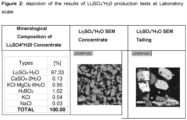
- the Rougher flotation operates in a recuperative way, obtaining lithium sulfate monohydrate concentrates above 50%.
- the reground and small size material from the classification is pooled together to become the feed to the Scavenger flotation stage, together with the remaining percentage of collector and frother, the objective of which is to generate plant tailings with the lowest levels of lithium sulfate, with the cell working in a recuperative way.
- the rougher concentrate obtained is taken to the cleaning stage (Cleaner), where it must be concentrated to levels of 85% lithium Sulfate, working the cells selectively to increase the height of the cushion. Given that this is a selective flotation, the tailings of this phase are recirculated to the rougher flotation mentioned above in order to avoid losses.
- the Cleaner concentrate is sent to a filtration stage, where a pile with a high content of lithium sulfate ⁇ 85% is obtained, and it is there where the pile is washed with sprinklers using hot water, the objective of which is to solubilize the impurities associated with chlorine and increase the grade of the product, thus obtaining grades higher than 90%.
- the Lithium Sulfate feeder range that has been validated at a laboratory scale is of the order of 4-30% monohydrated Lithium Sulfate, with 50-70% of potassium Carnallite, 8-17% sodium chloride, in some cases bischofite (MgCl 2 *6H 2 O) is present in ranges of 5-2%, with the remainder being mainly impurities associated to boron (1-2%) and calcium (0.1-0.2%).
- the homogeneous loads of the milled material are generated, in accordance with the cell's capacity.
- a pulp is formed with 50% of solids, which is conditioned during 10 minutes by shaking it in the flotation cell with the flotation reagents (amine collector and frothier). Once this conditioning time has expired, the remaining brine is added in order to achieve the percentage of solids sought for the stage; in this case, the process works at 31% of solids, the air is released, and the parameters are adjusted as indicated above.
- the flotation time begins. For the Rougher flotation, this time was set at 7 minutes.
- the concentrate is padded every 15 seconds and the brine is repositioned in order to maintain the cell's level via a peristaltic pump.
- the air valve is closed and the shaking is halted, the obtained flows are kneaded and filtered, in order to obtain the solid product and tailings, which must also be kneaded in order to generate a new pulp to feed the Cleaner flotation.
- the same 5-liter cell is used and the procedure is repeated, conditioning during 10 minutes at 50% of solids, adding collector and the frothier and, once the conditioning has concluded, it is refilled until completing 20% of feeding solids and the air is released.
- the flotation time begins once the first drop of concentrate falls through the cell's wall. The time set for this flotation is 10 minutes. The obtained concentrate material is then filtrated and disposed of for the leaching stage.
- a container is used, where the already filtered salt is added along with the water, at a ratio of 0.3 water/salid, then shaken with a mechanical shaker during 15 minutes and subsequently filtered. After the filtering, it is possible to wash the concentrate formed in the funnel, adding water at a ratio of 0.14 water/solid in order to displace the remaining impurities and impregnation, thus increasing the product's grade at over 95% purity.
Landscapes
- Chemical & Material Sciences (AREA)
- Engineering & Computer Science (AREA)
- Materials Engineering (AREA)
- Mechanical Engineering (AREA)
- Geology (AREA)
- Manufacturing & Machinery (AREA)
- General Life Sciences & Earth Sciences (AREA)
- Environmental & Geological Engineering (AREA)
- Life Sciences & Earth Sciences (AREA)
- Metallurgy (AREA)
- Organic Chemistry (AREA)
- Geochemistry & Mineralogy (AREA)
- Dispersion Chemistry (AREA)
- Manufacture And Refinement Of Metals (AREA)
- Compounds Of Alkaline-Earth Elements, Aluminum Or Rare-Earth Metals (AREA)
Applications Claiming Priority (1)
| Application Number | Priority Date | Filing Date | Title |
|---|---|---|---|
| PCT/CL2022/050047 WO2023212832A1 (es) | 2022-05-02 | 2022-05-02 | Proceso global de obtención del mineral de sulfato de litio monohidratado con bajos contenidos de impurezas asociadas a cloro y magnesio |
Publications (1)
| Publication Number | Publication Date |
|---|---|
| EP4520439A1 true EP4520439A1 (de) | 2025-03-12 |
Family
ID=88646059
Family Applications (1)
| Application Number | Title | Priority Date | Filing Date |
|---|---|---|---|
| EP22940528.7A Pending EP4520439A1 (de) | 2022-05-02 | 2022-05-02 | Globales verfahren zur herstellung von lithiumsulfatmonohydraterz mit niedrigem gehalt an mit chlor und magnesium assoziierten verunreinigungen |
Country Status (7)
| Country | Link |
|---|---|
| US (1) | US20260028696A1 (de) |
| EP (1) | EP4520439A1 (de) |
| CN (1) | CN119136915A (de) |
| AR (1) | AR129096A1 (de) |
| AU (1) | AU2022457220A1 (de) |
| CA (1) | CA3249725A1 (de) |
| WO (1) | WO2023212832A1 (de) |
Family Cites Families (8)
| Publication number | Priority date | Publication date | Assignee | Title |
|---|---|---|---|---|
| US3342548A (en) * | 1963-09-16 | 1967-09-19 | Signal Oil & Gas Co | Process for the recovery of lithium and potassium from great salt lake brine |
| US4287163A (en) * | 1979-05-29 | 1981-09-01 | Saline Processors, Inc. | Process for recovering lithium from brine by salting out lithium sulfate monohydrate |
| US6207126B1 (en) * | 1998-07-16 | 2001-03-27 | Chemetall Foote Corporation | Recovery of lithium compounds from brines |
| US6547836B1 (en) * | 1998-11-10 | 2003-04-15 | Sqm Salar S.A. | Process for obtaining monohydrated lithium sulfate from natural brines |
| CN101318670A (zh) | 2008-07-16 | 2008-12-10 | 化工部长沙设计研究院 | 一种从含锂盐湖卤水中提取锂盐的生产工艺 |
| CN102921553B (zh) | 2012-11-23 | 2014-03-19 | 化工部长沙设计研究院 | 一种从硫酸锂钾与氯化钠混盐中浮选硫酸锂钾的方法 |
| RS61569B1 (sr) * | 2014-02-24 | 2021-04-29 | Nemaska Lithium Inc | Postupci za obradu materijalima koji sadrže litijum |
| CN109174438B (zh) | 2018-09-17 | 2020-05-26 | 长沙有色冶金设计研究院有限公司 | 锂辉石矿选矿分选工艺 |
-
2022
- 2022-05-02 EP EP22940528.7A patent/EP4520439A1/de active Pending
- 2022-05-02 CA CA3249725A patent/CA3249725A1/en active Pending
- 2022-05-02 AU AU2022457220A patent/AU2022457220A1/en active Pending
- 2022-05-02 CN CN202280095695.9A patent/CN119136915A/zh active Pending
- 2022-05-02 US US18/862,400 patent/US20260028696A1/en active Pending
- 2022-05-02 WO PCT/CL2022/050047 patent/WO2023212832A1/es not_active Ceased
-
2023
- 2023-04-20 AR ARP230100949A patent/AR129096A1/es unknown
Also Published As
| Publication number | Publication date |
|---|---|
| AR129096A1 (es) | 2024-07-17 |
| CN119136915A (zh) | 2024-12-13 |
| CA3249725A1 (en) | 2025-02-03 |
| WO2023212832A1 (es) | 2023-11-09 |
| US20260028696A1 (en) | 2026-01-29 |
| AU2022457220A1 (en) | 2024-06-20 |
Similar Documents
| Publication | Publication Date | Title |
|---|---|---|
| US10894997B2 (en) | Lithium recovery from phosphate minerals | |
| MX2014013532A (es) | Metodo y aparato para separacion de molibdenita a partir de menas de cobre-molibdeno que contienen pirita. | |
| US20200353477A1 (en) | Ore-dressing process | |
| CN102205976A (zh) | 浮选尾液和尾渣中钾离子的回收方法 | |
| WO2024036697A1 (zh) | 一种从锂黏土矿中富集锂的方法 | |
| CN1094466C (zh) | 从钾石盐与光卤石的混合矿中提取氯化钾的方法 | |
| AU2016376980B2 (en) | Method for the control of sulphate forming compounds in the preparation of potassium sulphate from potassium-containing ores at high ambient temperatures | |
| EP4520439A1 (de) | Globales verfahren zur herstellung von lithiumsulfatmonohydraterz mit niedrigem gehalt an mit chlor und magnesium assoziierten verunreinigungen | |
| CN101327941A (zh) | 一种低品位含钾混合盐提钾生产工艺 | |
| US12098442B2 (en) | Method for enriching lithium from lithium clay | |
| EP4520438A1 (de) | Verfahren zur herstellung von lithiumsulfatmonohydraterz mit niedrigem gehalt an mit chlor und magnesium assoziierten verunreinigungen | |
| AU2007236559A1 (en) | Process for recovery of antimony and metal values from antimony- and metal value-bearing materials | |
| Mehri et al. | Flotation of potash for Carnallite resources in Khur playa of Iran using Jameson flotation cell | |
| CN110627092B (zh) | 一种含硫、镁的钾石盐矿资源综合利用加工方法 | |
| CN108714481B (zh) | 从含脉石矿物的杂卤石矿中提取杂卤石的方法 | |
| WO2017220709A1 (en) | Method for the reduction of halite in the preparation of potassium sulphate from potassium-containing ores at high ambient temperatures | |
| CN115228622B (zh) | 一种用于钙镁碳酸盐矿物浮选分离的捕收剂及其应用 | |
| RU2271252C1 (ru) | Способ получения мелкозернистого хлористого калия с низким содержанием пылевых фракций | |
| US10954133B2 (en) | Systems and methods of producing potassium sulfate | |
| CN119173478A (zh) | 通过从硫酸锂精矿浸出获得高纯度硫酸锂一水合物的方法 | |
| RU2738883C1 (ru) | Способ флотационного обогащения калийных руд | |
| CN118080173A (zh) | 一种萤石伴生锂云母矿反浮选分离方法 | |
| Foot et al. | Direct Flotation of Potash from Carnallite | |
| Katsiolis et al. | Nutrient recovery from seawater brine-a circular economy approach for Bio-Based Fertilizers production | |
| KR20180111174A (ko) | 칼륨화합물의 제조 방법 및 이로부터 수득된 칼륨화합물 |
Legal Events
| Date | Code | Title | Description |
|---|---|---|---|
| STAA | Information on the status of an ep patent application or granted ep patent |
Free format text: STATUS: THE INTERNATIONAL PUBLICATION HAS BEEN MADE |
|
| PUAI | Public reference made under article 153(3) epc to a published international application that has entered the european phase |
Free format text: ORIGINAL CODE: 0009012 |
|
| STAA | Information on the status of an ep patent application or granted ep patent |
Free format text: STATUS: REQUEST FOR EXAMINATION WAS MADE |
|
| 17P | Request for examination filed |
Effective date: 20241202 |
|
| AK | Designated contracting states |
Kind code of ref document: A1 Designated state(s): AL AT BE BG CH CY CZ DE DK EE ES FI FR GB GR HR HU IE IS IT LI LT LU LV MC MK MT NL NO PL PT RO RS SE SI SK SM TR |
|
| DAV | Request for validation of the european patent (deleted) | ||
| DAX | Request for extension of the european patent (deleted) | ||
| STAA | Information on the status of an ep patent application or granted ep patent |
Free format text: STATUS: THE APPLICATION IS DEEMED TO BE WITHDRAWN |