EP4518521A2 - Planungsverfahren für versorgungszelle, endgerätevorrichtung und netzwerkvorrichtung - Google Patents
Planungsverfahren für versorgungszelle, endgerätevorrichtung und netzwerkvorrichtung Download PDFInfo
- Publication number
- EP4518521A2 EP4518521A2 EP25152414.6A EP25152414A EP4518521A2 EP 4518521 A2 EP4518521 A2 EP 4518521A2 EP 25152414 A EP25152414 A EP 25152414A EP 4518521 A2 EP4518521 A2 EP 4518521A2
- Authority
- EP
- European Patent Office
- Prior art keywords
- serving cell
- scheduling
- configuration information
- search space
- component carrier
- Prior art date
- Legal status (The legal status is an assumption and is not a legal conclusion. Google has not performed a legal analysis and makes no representation as to the accuracy of the status listed.)
- Pending
Links
Images


Classifications
-
- H—ELECTRICITY
- H04—ELECTRIC COMMUNICATION TECHNIQUE
- H04W—WIRELESS COMMUNICATION NETWORKS
- H04W72/00—Local resource management
- H04W72/04—Wireless resource allocation
- H04W72/044—Wireless resource allocation based on the type of the allocated resource
- H04W72/0453—Resources in frequency domain, e.g. a carrier in FDMA
-
- H—ELECTRICITY
- H04—ELECTRIC COMMUNICATION TECHNIQUE
- H04W—WIRELESS COMMUNICATION NETWORKS
- H04W72/00—Local resource management
- H04W72/20—Control channels or signalling for resource management
- H04W72/23—Control channels or signalling for resource management in the downlink direction of a wireless link, i.e. towards a terminal
Definitions
- the present invention relates to the communications field, and in particular, to a serving cell scheduling method, a terminal device, and a network device.
- a new radio (New Radio, NR) system supports carrier aggregation (Carrier Aggregation, CA).
- Carrier Aggregation CA
- multiple component carriers (Component Carrier, CC) or cells can be configured and activated for user equipment (User Equipment, UE, which can also be called terminal device).
- UE User Equipment
- the NR system also supports cross carrier scheduling in the CA scenario.
- a serving cell in the NR system supports scheduling by only one scheduling cell at the same time. Specifically, at a same moment, the serving cell can only be self-scheduled or scheduled by another serving cell.
- a primary cell Primary cell, Pcell
- PDCCH Physical Downlink Control Channel
- One of the technical problems solved by the embodiments of the present invention is that a serving cell in an NR system supports scheduling by only one scheduling cell at the same time, thereby affecting system performance.
- an embodiment of the present invention provides a serving cell scheduling method, applied to a terminal device.
- the method includes: receiving first configuration information sent by a network device, where the first configuration information is used to indicate that a first serving cell simultaneously supports execution of self-scheduling and cross component carrier scheduling; and determining, according to the first configuration information, a first scheduling resource for performing self-scheduling on the first serving cell and a second scheduling resource for performing cross component carrier scheduling on the first serving cell, where the first scheduling resource and the second scheduling resource include corresponding search spaces or candidate physical downlink control channels (PDCCH).
- PDCH physical downlink control channels
- an embodiment of the present invention provides a terminal device.
- the terminal device includes: a receiving module, configured to receive first configuration information sent by a network device, where the first configuration information is used to indicate that a first serving cell simultaneously supports execution of self-scheduling and cross component carrier scheduling; and a scheduling module, configured to schedule, according to the first configuration information, a first scheduling resource for performing self-scheduling on the first serving cell and a second scheduling resource for performing cross component carrier scheduling on the first serving cell, where the first scheduling resource and the second scheduling resource include corresponding search spaces or candidate physical downlink control channels (PDCCH).
- a receiving module configured to receive first configuration information sent by a network device, where the first configuration information is used to indicate that a first serving cell simultaneously supports execution of self-scheduling and cross component carrier scheduling
- a scheduling module configured to schedule, according to the first configuration information, a first scheduling resource for performing self-scheduling on the first serving cell and a second scheduling resource for performing cross component carrier scheduling on the first serving cell, where the first scheduling
- an embodiment of the present invention provides a computer-readable storage medium, where the computer-readable storage medium stores a computer program, and when the computer program is executed by a processor, steps of the method in the first aspect are implemented.
- an embodiment of the present invention provides a network device.
- the network device includes: a configuration module, configured to configure first configuration information, where the first configuration information is used to indicate that a first serving cell simultaneously supports execution of self-scheduling and cross component carrier scheduling; and a sending module, configured to send the first configuration information to a terminal device, where the first configuration information is used by the terminal device to determine a first scheduling resource for performing self-scheduling on the first serving cell and a second scheduling resource for performing cross component carrier scheduling on the first serving cell, and the first scheduling resource and the second scheduling resource include corresponding search spaces or candidate physical downlink control channels (PDCCH).
- a configuration module configured to configure first configuration information, where the first configuration information is used to indicate that a first serving cell simultaneously supports execution of self-scheduling and cross component carrier scheduling
- a sending module configured to send the first configuration information to a terminal device, where the first configuration information is used by the terminal device to determine a first scheduling resource for performing self-scheduling on the first serving cell and a second
- the first scheduling resource required for performing self-scheduling on the first serving cell and the second scheduling resource required for performing cross component carrier scheduling on the first serving cell may be determined based on the first configuration information from the network device, and it can be learned based on the first configuration information that the first serving cell simultaneously supports execution of self-scheduling and cross component carrier scheduling (Cross Component Carrier Scheduling).
- Cross component carrier scheduling may be performed on the serving cell based on the second scheduling resource including the search space or the candidate PDCCH, thereby improving system performance, especially in a dynamic spectrum sharing scenario.
- GSM Global System of Mobile communication
- CDMA Code Division Multiple Access
- WCDMA wideband code division multiple access
- GPRS General Packet Radio Service
- LTE-A Long Term Evolution advanced
- NR NR
- User equipment UE also referred to as a terminal device (Mobile Terminal), mobile user equipment, or the like, may communicate with one or more core networks through a radio access network (Radio Access Network, RAN).
- the user equipment may be a terminal device, such as a mobile phone (or referred to as a "cellular" phone) and a computer with the terminal device.
- the user equipment may be a portable, pocket-sized, handheld, computer built-in, or in-vehicle mobile apparatus, which exchanges voice and/or data with the radio access network.
- a physical resource for PDCCH transmission is in unit of control channel element (Control Channel Element, CCE), the size of one CCE is 9 resource element groups (Resource Element Group, REG), that is, 36 resource elements ( Resource Element, RE), and a PDCCH may occupy 1, 2, 4 or 8 CCEs.
- resource element groups Resource Element Group, REG
- REG resource element groups
- a PDCCH may occupy 1, 2, 4 or 8 CCEs.
- tree-like aggregation may be used for the four PDCCH sizes occupying 1, 2, 4, and 8 CCEs.
- Each aggregation level defines a search space (Search Space), including a common (Common) search space (CSS) and a UE-specific (UE-Specific) search space (USS).
- UE performs blind detection on all possible PDCCH code rates in a search space according to a downlink control information (Downlink Control Information, DCI) format (format) of a transmission mode of the UE.
- DCIformat0 is used to indicate the scheduling of a physical uplink shared channel (Physical Uplink Shared Channel, PUSCH), and DCIformat1 is used for a different mode of codeword scheduling of a physical downlink Shared Channel (Physical Downlink Shared Channel, PDSCH).
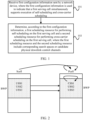
- an embodiment of the present invention provides a serving cell scheduling method, executed by a terminal device, and the method includes the following process steps.
- Step 101 Receive first configuration information sent by a network device, where the first configuration information is used to indicate that a first serving cell simultaneously supports execution of self-scheduling and cross component carrier scheduling.
- Step 103 Determine, according to the first configuration information, a first scheduling resource for performing self-scheduling on the first serving cell and a second scheduling resource for performing cross component carrier scheduling on the first serving cell, where the first scheduling resource and the second scheduling resource include corresponding search spaces or candidate physical downlink control channels PDCCHs.
- the first scheduling resource required for performing self-scheduling on the first serving cell and the second scheduling resource required for performing cross component carrier scheduling on the first serving cell may be determined based on the first configuration information from the network device, and it can be learned based on the first configuration information that the first serving cell simultaneously supports execution of self-scheduling and cross component carrier scheduling.
- the serving cell performs self-scheduling based on the first scheduling resource including the search space or the candidate PDCCH
- cross component carrier scheduling may be performed on the serving cell based on the second scheduling resource including the search space or the candidate PDCCH, thereby improving system performance, especially in a dynamic spectrum sharing scenario.
- the second serving cell while the first serving cell performs self-scheduling based on the first scheduling resource, the second serving cell (that is, the scheduling cell) may be allowed to perform cross component carrier scheduling on the first serving cell (that is, the scheduled cell) based on the second scheduling resource.
- the first scheduling resource may include at least one of the following (1) to (4).
- the first DCI format may include DCI format 0_1 or DCI format 1_1, and the first RNTI may include system information RNTI (System Information RNTI, SI-RNTI) or configured scheduling RNTI (Configured Scheduling RNTI, CS-RNTI) or the like.
- system information RNTI System Information RNTI, SI-RNTI
- configured scheduling RNTI Configured Scheduling RNTI, CS-RNTI
- the first configuration information may further include other relevant information about the self-scheduling performed by the first serving cell.
- the other relevant information of the self-scheduling performed by the first serving cell may include: a carrier indicator field (Carrier Indicator Field, CIF) value in a downlink control information format (for example, DCI Format 0_1 or DCI Format 1_1).
- CIF Carrier Indicator Field
- the first configuration information may further include other relevant information for performing cross component carrier scheduling on the first serving cell, where the other relevant information for performing cross component carrier scheduling on the first serving cell may at least include: a cell identifier (Identifier, ID) of the second serving cell and a CIF value of the first serving cell for scheduling in the second serving cell.
- ID cell identifier
- CIF CIF value
- the CIF is used to determine a component carrier of a detected PDCCH.
- a secondary serving cell when the first serving cell is a primary serving cell (Pcell), a secondary serving cell (Scell) may be used as a scheduling cell (that is, the second serving cell described above); and when the first serving cell is a secondary serving cell, the primary serving cell or another secondary serving cell can be used as a scheduling cell (that is, the second serving cell).
- Pcell primary serving cell
- Scell secondary serving cell
- the first serving cell is a primary serving cell and the primary serving cell simultaneously supports execution of self-scheduling and cross component carrier scheduling
- PDCCH load in the Pcell can be effectively reduced, and system performance can be greatly improved especially in a dynamic spectrum sharing scenario.
- the indication herein may be an explicit indication or an implicit indication. That is, the network device can explicitly indicate to the terminal device through the first configuration information that the first serving cell simultaneously supports execution of self-scheduling and cross component carrier scheduling, or the network device can implicitly indicate to the terminal device through the first configuration information that the first serving cell simultaneously supports execution of self-scheduling and cross component carrier scheduling.
- the first configuration information includes a first configuration item, and that the first serving cell simultaneously supports execution of self-scheduling and cross component carrier scheduling is implicitly indicated by the network device to the terminal device through the first configuration item.
- the network device may implicitly indicate this to the terminal device through the first configuration information.
- the implicit indication is performed through the first configuration item in the first configuration information, where the first configuration item includes but is not limited to the other item.
- the first configuration item may be used to indicate other relevant information for performing self-scheduling by the first serving cell.
- the first serving cell is a Pcell
- corresponding configuration information (equivalent to the first configuration information) may indicate that the Pcell can perform self-scheduling and cross component carrier scheduling at the same time, that is, while the Pcell performs self-scheduling, a Scell (that is, the second serving cell) performs cross component carrier scheduling on the Pcell.
- the configuration information may further indicate a ScellID for scheduling the Pcell and a CIF value for scheduling the Pcell in the Scell.
- a configuration item (such as the other configuration item, that is, the first configuration item) in the configuration information can be used to implicitly indicate joint self-scheduling and cross component carrier scheduling; or an added new field (that is, the second configuration item) in the configuration information can be used to (explicitly) indicate joint self-scheduling and cross component carrier scheduling (that is, indicate that the Pcell supports self-scheduling and cross component carrier scheduling at the same time).
- Common search spaces configured on the activated BWP in the Pcell are all search spaces for self-scheduling, and the terminal device performs, in these search spaces configured in the Pcell, PDCCH blind detection on DCI 0_0 and DCI 1_0 scrambled by a C-RNTI, a CS-RNTI (if configured), or a modulation and coding scheme cell RNTI (Modulation and Coding Scheme Cell RNTI, MCS-C-RNTI) (if configured), to receive data.
- a search space including a search space index and the number of candidate PDCCHs for blind detection at each aggregation level can be configured.
- a search space is configured on the activated BWP in the Scell, and the activated BWP in the Pcell includes a UE-specific search space that has the same search space index and that can be used for cross component carrier scheduling.
- the shaded part represents a complete search space configuration
- the unshaded part represents a search space configuration that only includes the search space index and the number of candidate PDCCHs for blind detection.
- the complete search space configuration is a search space configuration that includes all specific fields (also called RRC optional fields). Otherwise, a search space configuration is an incomplete search space configuration, for example, a search space configuration that only includes the search space index and the number of candidate PDCCHs for blind detection.
- some specific fields are used to configure time-frequency monitoring locations of the search space, including but not limited to a time domain monitoring period, a time domain monitoring location, and an associated frequency-domain control resource set (Control resource set, CORESET).
- the UE-specific search space including a complete configuration is a search space for self-scheduling by default, and only a search space that only includes the search space index and the number of candidate PDCCHs for blind detection at each aggregation level can correspond to a search space for cross component carrier scheduling.
- a search space is configured on the activated BWP in the Scell, and the activated BWP in the Pcell includes a UE-specific search space of an incomplete configuration that has the same search space index and that can be used for cross component carrier scheduling.
- the shaded part represents a complete search space configuration
- the unshaded part represents a search space configuration that only includes the search space index and the number of candidate PDCCHs for blind detection.
- the shaded part represents a search space used for self-scheduling
- the unshaded part represents a search space used for cross component carrier scheduling.
- the first configuration information includes a second configuration item, and that the first serving cell simultaneously supports execution of self-scheduling and cross component carrier scheduling is explicitly indicated by the network device to the terminal device through the second configuration item.
- the network device may explicitly indicate this to the terminal device through the first configuration information.
- the explicit indication is performed through a second configuration item in the first configuration information, where the second configuration item includes but is not limited to an added new indicator field in the first configuration information.
- the second configuration item may be used to indicate other relevant information for performing cross component carrier scheduling on the first serving cell.
- the first serving cell is a Pcell or a Scell 1
- corresponding configuration information (equivalent to the first configuration information) may indicate that the Pcell or Scell 1 can perform self-scheduling and cross component carrier scheduling at the same time, that is, while the Pcell or Scell 1 performs self-scheduling, a Scell 2 (that is, the second serving cell) performs cross component carrier scheduling on the Pcell.
- the search space configuration configured on the activated BWP in the Pcell or Scell 1 can be used as mapping configuration of a search space for self-scheduling or a search space for cross component carrier scheduling, which can be distinguished by using a DCI format or an RNTI.
- Two numbers of candidate PDCCHs for blind detection can be configured in this search space, or the same configuration of the number of candidate PDCCHs for blind detection can be shared.
- the USS3 configuration can be used to monitor DCI 0_0, DCI 1_0, DCI 0_1, and DCI 1_1. Specifically, monitoring of DCI 0_0 and DCI 1_0 is performed in USS3 configured in Pcell, and monitoring of DCI 0_1 and DCI 1_1 is performed in USS3 configured in Scell 2.
- some monitoring time domain locations may be used in the USS3 of Scell 2 to perform cross component carrier scheduling on Pcell, and some monitoring time domain locations may be used in the USS3 in Pcell for self-scheduling of Pcell.
- the following step is further included: determining a second serving cell for scheduling the first serving cell.
- the method may further include: receiving second configuration information that corresponds to the second serving cell and that is sent by the network device.
- the second configuration information includes relevant configuration information of the search space corresponding to the second serving cell, including but not limited to a search space index, a search space type, candidate PDCCH configuration, and other information.
- the second scheduling resource may include at least one of the following (1) to (4).
- the scheduling resource of the scheduling cell for performing cross component carrier scheduling on the scheduled cell is specified, to help perform cross component carrier scheduling on the first serving cell while performing self-scheduling on the first serving cell.
- the first preset rule and the second preset rule are rules set based on time domain monitoring locations, such as, interval rules for time domain monitoring locations corresponding to self-scheduling and cross component carrier scheduling respectively.
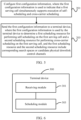
- Step 201 Configure first configuration information, where the first configuration information is used to indicate that a first serving cell simultaneously supports execution of self-scheduling and cross component carrier scheduling.
- Step 203 Send the first configuration information to a terminal device, where the first configuration information is used by the terminal device to determine a first scheduling resource for performing self-scheduling on the first serving cell and a second scheduling resource for performing cross component carrier scheduling on the first serving cell, and the first scheduling resource and the second scheduling resource include corresponding search spaces or candidate physical downlink control channels (PDCCH).
- the first configuration information is used by the terminal device to determine a first scheduling resource for performing self-scheduling on the first serving cell and a second scheduling resource for performing cross component carrier scheduling on the first serving cell, and the first scheduling resource and the second scheduling resource include corresponding search spaces or candidate physical downlink control channels (PDCCH).
- PDCH physical downlink control channels
- the first scheduling resource may include at least one of the following (1) to (4).
- At least one of the first DCI format, the first RNTI, and the first time domain location is related to the candidate PDCCH.
- the first DCI format may include DCI format 0_1 or DCI format 1_1, and the first RNTI may include an SI-RNTI or a CS-RNTI or the like.
- the first configuration information may further include other relevant information about the self-scheduling performed by the first serving cell.
- the other relevant information of the self-scheduling performed by the first serving cell may include: a CIF value in a downlink control information format (for example, DCI Format 0_1 or DCI Format 1_1).
- the first configuration information may further include other relevant information for performing cross component carrier scheduling on the first serving cell, where the other relevant information for performing cross component carrier scheduling on the first serving cell may at least include: a cell ID of the second serving cell and a CIF value of the first serving cell for scheduling in the second serving cell.
- the cell ID of the second serving cell can be used by the terminal device to determine the second serving cell used for scheduling the first serving cell.
- the CIF is used to determine a component carrier of a detected PDCCH.
- a secondary serving cell when the first serving cell is a primary serving cell (Pcell), a secondary serving cell (Scell) may be used as a scheduling cell (that is, the second serving cell described above); and when the first serving cell is a secondary serving cell, the primary serving cell or another secondary serving cell can be used as a scheduling cell (that is, the second serving cell).
- Pcell primary serving cell
- Scell secondary serving cell
- the first serving cell is a primary serving cell and the primary serving cell simultaneously supports execution of self-scheduling and cross component carrier scheduling
- PDCCH load in the Pcell can be effectively reduced, and system performance can be greatly improved especially in a dynamic spectrum sharing scenario.
- the indication herein may be an explicit indication or an implicit indication. That is, the first configuration information can explicitly indicate to the terminal device that the first serving cell simultaneously supports execution of self-scheduling and cross component carrier scheduling, or the first configuration information can implicitly indicate to the terminal device that the first serving cell simultaneously supports execution of self-scheduling and cross component carrier scheduling.
- the first serving cell in a case that the first serving cell is a primary serving cell, that the first serving cell simultaneously supports execution of self-scheduling and cross component carrier scheduling is implicitly indicated through a first configuration item in the first configuration information.
- the first configuration information may implicitly indicate this to the terminal device.
- the implicit indication is performed through the first configuration item in the first configuration information, where the first configuration item includes but is not limited to the other item.
- the first configuration item may be used to indicate other relevant information for performing self-scheduling by the first serving cell.
- the first serving cell in a case that the first serving cell is a primary serving cell or a secondary serving cell, that the first serving cell simultaneously supports execution of self-scheduling and cross component carrier scheduling is explicitly indicated through a second configuration item in the first configuration information.
- the first configuration information may explicitly indicate this to the terminal device.
- the explicit indication is performed through a second configuration item in the first configuration information, where the second configuration item includes but is not limited to an added new indicator field in the first configuration information.
- the second configuration item may be used to indicate other relevant information for performing cross component carrier scheduling on the first serving cell.
- the following content may be further included: configuring second configuration information corresponding to a second serving cell, where the second serving cell is used to schedule the first serving cell; and sending the second configuration information to the terminal device, where the second configuration information is used for the terminal device to determine the second scheduling resource.
- the second configuration information includes relevant configuration information of the search space corresponding to the second serving cell, including but not limited to a search space index, a search space type, candidate PDCCH configuration, and other information.
- the second configuration information corresponding to the second serving cell can be provided to the terminal device, so that when determining the second scheduling resource for performing cross component carrier scheduling on the first serving cell, the terminal device may consider both the first configuration information and the second configuration information.
- the second scheduling resource may include at least one of the following (1) to (4).
- At least one of the second DCI format, the second RNTI, and the second time domain location is related to the candidate PDCCH.
- the second DCI format may include DCI format 0_1 or DCI format 1_1, and the second RNTI may include a C-RNTI or the like.
- the method further includes: configuring that the first sub-scheduling resource includes some time domain monitoring locations or some candidate PDCCHs determined (or preconfigured) based on a first preset rule, and configuring that the second sub-scheduling resource includes some time domain monitoring locations or some candidate PDCCHs determined (or preconfigured) based on a second preset rule.
- the scheduling resource of the scheduling cell for performing cross component carrier scheduling on the scheduled cell is effectively configured, to help perform cross component carrier scheduling on the first serving cell while performing self-scheduling on the first serving cell.
- the first preset rule and the second preset rule are rules set based on time domain monitoring locations, such as, interval rules for time domain monitoring locations corresponding to self-scheduling and cross component carrier scheduling respectively. Further, there may be a correlation between the first preset rule and the second preset rule, for example, time domain monitoring locations are numbered, odd-numbered time domain monitoring locations are used for self-scheduling of the first serving cell, and even-numbered time domain monitoring locations are used for cross component carrier scheduling of the first serving cell.
- the time domain monitoring location may include a slot slot, and a monitoring occasion, a period, and the like configured in a slot.
- an embodiment of the present invention provides a terminal device 300.
- the terminal device 300 includes: a receiving module 301 and a scheduling module 303.
- the receiving module 301 is configured to receive first configuration information sent by a network device, where the first configuration information is used to indicate that a first serving cell simultaneously supports execution of self-scheduling and cross component carrier scheduling; and the scheduling module 303 is configured to schedule, according to the first configuration information, a first scheduling resource for performing self-scheduling on the first serving cell and a second scheduling resource for performing cross component carrier scheduling on the first serving cell, where the first scheduling resource and the second scheduling resource include corresponding search spaces or candidate physical downlink control channels (PDCCH).
- PDCH physical downlink control channels
- the first configuration information includes a first configuration item, and that the first serving cell simultaneously supports execution of self-scheduling and cross component carrier scheduling is implicitly indicated by the network device to the terminal device through the first configuration item.
- the first configuration information includes a second configuration item, and that the first serving cell simultaneously supports execution of self-scheduling and cross component carrier scheduling is explicitly indicated by the network device to the terminal device through the second configuration item.
- the first scheduling resource includes at least one of the following: a first type of search space configured by an activated bandwidth part BWP in the first serving cell; a search space that is of search spaces corresponding to an activated BWP in the first serving cell and that is explicitly identified as self-scheduling; a search space that is of search spaces corresponding to an activated BWP in the first serving cell and that is implicitly identified as self-scheduling; and a search space that is configured by an activated BWP in the first serving cell to monitor a first object, where the first object includes at least one of a first downlink control information (DCI) format, a first radio network temporary identifier, and a first time domain location.
- DCI downlink control information
- the terminal device 300 in the embodiments of the present invention may further include: a determining module, configured to determine a second serving cell for scheduling the first serving cell.
- the receiving module 301 may be further configured to receive second configuration information that corresponds to the second serving cell and that is sent by the network device; and the scheduling module 303 may be specifically configured to determine the second scheduling resource according to the first configuration information and the second configuration information.
- the second scheduling resource includes at least one of the following: a first search space configured by an activated BWP in the second serving cell, where the activated BWP in the first serving cell has a second type of search space that has a same index as that of the first search space; a second search space configured by an activated BWP in the second serving cell, where the activated BWP in the first serving cell has a search space that has a same index as that of the second search space and that is explicitly identified as cross component carrier scheduling; a third search space configured by an activated BWP in the second serving cell, where the activated BWP in the first serving cell has a search space that has a same index as that of the third search space and that is implicitly identified as cross component carrier scheduling; and a fourth search space configured by an activated BWP in the second serving cell to monitor a second object, where the activated BWP in the first serving cell has a search space that has a same index as that of
- the terminal device 300 in the embodiments of the present invention, in a case that a search space of the second serving cell includes a first sub-scheduling resource for self-scheduling of the second serving cell and a second sub-scheduling resource for scheduling of the first serving cell, the first sub-scheduling resource includes some time domain monitoring locations or some candidate PDCCHs determined based on a first preset rule, and the second sub-scheduling resource includes some time domain monitoring locations or some candidate PDCCHs determined based on a second preset rule.
- the first configuration information further includes other relevant information for performing cross component carrier scheduling on the first serving cell, and the other relevant information includes: a cell identifier of the second serving cell and a carrier indicator field CIF value of the first serving cell for scheduling in the second serving cell.
- the terminal device 300 provided in this embodiment of the present invention can implement the serving cell scheduling method performed by the terminal device 300, and relevant descriptions of the serving cell scheduling method is applicable to the terminal device 300. Details are not described herein again.
- the first scheduling resource required for performing self-scheduling on the first serving cell and the second scheduling resource required for performing cross component carrier scheduling on the first serving cell may be determined based on the first configuration information from the network device, and it can be learned based on the first configuration information that the first serving cell simultaneously supports execution of self-scheduling and cross component carrier scheduling.
- the serving cell performs self-scheduling based on the first scheduling resource including the search space or the candidate PDCCH
- cross component carrier scheduling may be performed on the serving cell based on the second scheduling resource including the search space or the candidate PDCCH, thereby improving system performance, especially in a dynamic spectrum sharing scenario.
- an embodiment of the present invention provides a network device 400.
- the network device 400 includes: a configuration module 401 and a sending module 403.
- the configuration module 401 is configured to configure first configuration information, where the first configuration information is used to indicate that a first serving cell simultaneously supports execution of self-scheduling and cross component carrier scheduling; and the sending module 403 is configured to send the first configuration information to a terminal device, where the first configuration information is used by the terminal device to determine a first scheduling resource for performing self-scheduling on the first serving cell and a second scheduling resource for performing cross component carrier scheduling on the first serving cell, and the first scheduling resource and the second scheduling resource include corresponding search spaces or candidate physical downlink control channels (PDCCH).
- PDCH physical downlink control channels
- the configuration module 401 may be specifically configured to: in a case that the first serving cell is a primary serving cell, implicitly indicate, through a first configuration item in the first configuration information, that the first serving cell simultaneously supports execution of self-scheduling and cross component carrier scheduling.
- the configuration module 401 may be specifically configured to: in a case that the first serving cell is a primary serving cell or a secondary serving cell, explicitly indicate, through a second configuration item in the first configuration information, that the first serving cell simultaneously supports execution of self-scheduling and cross component carrier scheduling.
- the configuration module 401 may be further configured to: configure second configuration information corresponding to a second serving cell, where the second serving cell is used to schedule the first serving cell; and the sending module 403 may be further configured to send the second configuration information to the terminal device, where the second configuration information is used for the terminal device to determine the second scheduling resource.
- the configuration module 401 may be further configured to: in a case that a search space of the second serving cell includes a first sub-scheduling resource for self-scheduling of the second serving cell and a second sub-scheduling resource for scheduling of the first serving cell, configure that the first sub-scheduling resource includes some time domain monitoring locations or some candidate PDCCHs determined based on a first preset rule, and configure that the second sub-scheduling resource includes some time domain monitoring locations or some candidate PDCCHs determined based on a second preset rule.
- the first configuration information further includes other relevant information for performing cross component carrier scheduling on the first serving cell, and the other relevant information includes: a cell identifier of the second serving cell and a carrier indicator field CIF value of the first serving cell for scheduling in the second serving cell.
- the network device 400 provided in this embodiment of the present invention can implement the serving cell scheduling method performed by the network device 400, and relevant descriptions of the serving cell scheduling method is applicable to the network device. Details are not described herein again.
- the first configuration information may be provided to the terminal device, so that the first scheduling resource required for performing self-scheduling on the first serving cell and the second scheduling resource required for performing cross component carrier scheduling on the first serving cell may be determined by the terminal device, and the first configuration information may indicate that the first serving cell simultaneously supports execution of self-scheduling and cross component carrier scheduling.
- the serving cell performs self-scheduling based on the first scheduling resource including the search space or the candidate PDCCH
- cross component carrier scheduling may be performed on the serving cell based on the second scheduling resource including the search space or the candidate PDCCH, thereby improving system performance, especially in a dynamic spectrum sharing scenario.
- FIG. 8 is a block diagram of a terminal device according to another embodiment of the present invention.
- the terminal device 500 shown in FIG. 8 includes at least one processor 501, a memory 502, at least one network interface 504, and a user interface 503. All components in the terminal device 500 are coupled together through a bus system 505. It may be understood that the bus system 505 is configured to implement connection and communication between these components. In addition to a data bus, the bus system 505 further includes a power bus, a control bus, and a status signal bus. However, for clear description, various buses are marked as the bus system 505 in FIG. 8 .
- the user interface 503 may include a display, a keyboard, or a clicking device (for example, a mouse, a trackball (trackball)), a touch panel, or a touchscreen.
- a clicking device for example, a mouse, a trackball (trackball)
- a touch panel for example, a touch panel, or a touchscreen.
- the memory 502 in this embodiment of the present invention may be a volatile memory or a non-volatile memory, or may include both a volatile memory and a non-volatile memory.
- the nonvolatile memory may be a read-only memory (Read-Only Memory, ROM), a programmable read-only memory (Programmable ROM, PROM), an erasable programmable read-only memory (Erasable PROM, EPROM), an electrically erasable programmable read-only memory (Electrically EPROM, EEPROM), or a flash memory.
- the volatile memory may be a random access memory (Random Access Memory, RAM), used as an external cache.
- RAMs may be used, for example, a static random access memory (Static RAM, SRAM), a dynamic random access memory (Dynamic RAM, DRAM), a synchronous dynamic random access memory (Synchronous DRAM, SDRAM), a double data rate synchronous dynamic random access memory (Double Data Rate SDRAM, DDR SD RAM), an enhanced synchronous dynamic random access memory (Enhanced SD RAM, ESDRAM), a synchlink dynamic random access memory (Synchlink DRAM, SLDRAM), and a direct rambus random access memory (Direct Rambus RAM, DRRAM).
- Static RAM, SRAM static random access memory
- DRAM dynamic random access memory
- DRAM synchronous dynamic random access memory
- SDRAM double data rate synchronous dynamic random access memory
- Enhanced SD RAM, ESDRAM enhanced synchronous dynamic random access memory
- Synchlink dynamic random access memory Synchlink dynamic random access memory
- SLDRAM direct rambus random access memory
- Direct Rambus RAM Direct Rambus RAM
- the memory 502 stores the following elements: an executable module or a data structure, or a subset thereof, or an extension set thereof: an operating system 5021 and an application program 5022.
- the operating system 5021 includes various system programs, for example, a framework layer, a kernel library layer, and a driver layer, and is configured to implement various basic services and process a hardware-based task.
- the application program 5022 includes various application programs, for example, a media player (Media Player) and a browser (Browser), and is used to implement various application services.
- a program for implementing the method in the embodiments of the present invention may be included in the application program 5022.
- the terminal device 500 further includes: a computer program stored in the memory 502 and executable on the processor 501.
- the computer program is executed by the processor 501, the following steps are implemented: receiving first configuration information sent by a network device, where the first configuration information is used to indicate that a first serving cell simultaneously supports execution of self-scheduling and cross component carrier scheduling; and determining, according to the first configuration information, a first scheduling resource for performing self-scheduling on the first serving cell and a second scheduling resource for performing cross component carrier scheduling on the first serving cell, where the first scheduling resource and the second scheduling resource include corresponding search spaces or candidate physical downlink control channels (PDCCH).
- PDCH physical downlink control channels
- the foregoing method disclosed in the embodiments of the present invention may be applied to the processor 501, or implemented by the processor 501.
- the processor 501 may be an integrated circuit chip, and has a signal processing capability. In an implementation process, the steps in the foregoing methods may be completed by using an integrated logic circuit of hardware in the processor 501 or an instruction in a form of software.
- the foregoing processor 501 may be a general-purpose processor, a digital signal processor (Digital Signal Processor, DSP), an application-specific integrated circuit (Application Specific Integrated Circuit, ASIC), a field programmable gate array (Field Programmable Gate Array, FPGA) or another programmable logic component, a discrete gate or a transistor logic component, or a discrete hardware component.
- DSP Digital Signal Processor
- ASIC Application Specific Integrated Circuit
- FPGA Field Programmable Gate Array
- the methods, steps, and logical block diagrams disclosed in the embodiments of the present invention may be implemented or executed.
- the general purpose processor may be a microprocessor, or the processor may be any conventional processor or the like.
- the steps of the method disclosed with reference to the embodiments of the present invention may be directly performed by a hardware decoding processor, or may be performed by using a combination of hardware and software modules in a decoding processor.
- the software module may be located in a computer-readable storage medium that is mature in the art, such as a random access memory, a flash memory, a read-only memory, a programmable read-only memory, an electrically erasable programmable memory, or a register.
- the computer-readable storage medium is located in the memory 502, and the processor 501 reads information in the memory 502 and completes the steps in the foregoing method in combination with hardware of the processor. Specifically, the computer-readable storage medium stores a computer program, and when the computer program is executed by the processor 501, the steps of the foregoing the serving cell scheduling method in the foregoing embodiment are performed.
- the embodiments described in the embodiments of the present invention may be implemented by hardware, software, firmware, middleware, microcode, or a combination thereof.
- the processing unit may be implemented in one or more application specific integrated circuits (Application Specific Integrated Circuit, ASIC), a digital signal processor (Digital Signal Processing, DSP), a digital signal processing device (DSP Device, DSPD), a programmable logic device (Programmable Logic Device, PLD), a field-programmable gate array (Field-Programmable Gate Array, FPGA), a general-purpose processor, a controller, a microcontroller, a microprocessor, another electronic unit for implementing the functions of the present invention, or a combination thereof.
- ASIC Application Specific Integrated Circuit
- DSP Digital Signal Processing
- DSP Device digital signal processing device
- PLD programmable logic device
- FPGA field-programmable gate array
- a general-purpose processor a controller, a microcontroller, a microprocessor, another electronic unit for implementing the functions of the present invention,
- the techniques described in embodiments of the present invention may be implemented by modules (for example, processes or functions) that perform the functions described in the embodiments of the present invention.
- the software code may be stored in a memory and executed by a processor.
- the memory may be implemented in or outside the processor.
- the first scheduling resource required for performing self-scheduling on the first serving cell and the second scheduling resource required for performing cross component carrier scheduling on the first serving cell may be determined based on the first configuration information from the network device, and it can be learned based on the first configuration information that the first serving cell simultaneously supports execution of self-scheduling and cross component carrier scheduling.
- the serving cell performs self-scheduling based on the first scheduling resource including the search space or the candidate PDCCH
- cross component carrier scheduling may be performed on the serving cell based on the second scheduling resource including the search space or the candidate PDCCH, thereby improving system performance, especially in a dynamic spectrum sharing scenario.
- the terminal device 500 can implement processes implemented by the terminal device in the foregoing method embodiments. To avoid repetition, details are not described herein again.
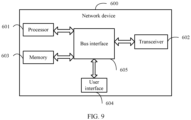
- FIG. 9 is a structural diagram of a network device applied to the embodiments of the present invention, and the network device can implement details of the foregoing serving cell scheduling method and achieve the same effect.
- a network device 600 includes: a processor 601, a transceiver 602, a memory 603, a user interface 604, and a bus interface 605.
- the network device 600 further includes: a computer program stored in the memory 603 and executable on the processor 601.
- the following steps are implemented: configuring first configuration information, where the first configuration information is used to indicate that a first serving cell simultaneously supports execution of self-scheduling and cross component carrier scheduling; and sending the first configuration information to a terminal device, where the first configuration information is used by the terminal device to determine a first scheduling resource for performing self-scheduling on the first serving cell and a second scheduling resource for performing cross component carrier scheduling on the first serving cell, and the first scheduling resource and the second scheduling resource include corresponding search spaces or candidate physical downlink control channels (PDCCH).
- PDCH physical downlink control channels
- a bus architecture may include any quantity of interconnected buses and bridges, and is specifically linked by various circuits of one or more processors represented by the processor 601 and a memory represented by the memory 603.
- the bus architecture may further link various other circuits such as a peripheral device, a voltage regulator, and a power management circuit together. These are all well-known in the art, and therefore are not further described in this specification.
- the bus interface 605 provides an interface.
- the transceiver 602 may be a plurality of elements, in other words, includes a transmitter and a receiver, and provides a unit configured to communicate with various other apparatuses on a transmission medium.
- the user interface 604 may be further an interface capable of connecting externally and internally a required device.
- the connected device includes but is not limited to a keypad, a display, a speaker, a microphone, a joystick, and the like.
- the processor 601 is responsible for managing the bus architecture and common processing, and the memory 603 may store data used when the processor 601 performs an operation.
- the first configuration information may be provided to the terminal device, so that the first scheduling resource required for performing self-scheduling on the first serving cell and the second scheduling resource required for performing cross component carrier scheduling on the first serving cell may be determined by the terminal device, and the first configuration information may indicate that the first serving cell simultaneously supports execution of self-scheduling and cross component carrier scheduling.
- the serving cell performs self-scheduling based on the first scheduling resource including the search space or the candidate PDCCH
- cross component carrier scheduling may be performed on the serving cell based on the second scheduling resource including the search space or the candidate PDCCH, thereby improving system performance, especially in a dynamic spectrum sharing scenario.
- an embodiment of the present invention further provides a terminal device, including a processor, a memory, and a computer program stored in the memory and executable on the processor.
- a terminal device including a processor, a memory, and a computer program stored in the memory and executable on the processor.
- the computer program is executed by the processor, the processes of the serving cell scheduling method shown in the foregoing embodiments are implemented, and a same technical effect can be achieved. To avoid repetition, details are not described herein.
- Embodiments of the present invention further provide a computer readable storage medium.
- the computer readable storage medium stores a computer program.
- the processes of the serving cell scheduling method applied to a terminal device in the foregoing embodiments are implemented, and a same technical effect can be achieved. To avoid repetition, details are not described herein.
- the computer readable storage medium may be a read-only memory (Read-Only Memory, ROM), a random access memory (Random Access Memory, RAM), a magnetic disk, an optical disc, or the like.
- an embodiment of the present invention further provides a network device, including a processor, a memory, and a computer program stored in the memory and executable on the processor.
- a network device including a processor, a memory, and a computer program stored in the memory and executable on the processor.
- the computer program is executed by the processor, the processes of the serving cell scheduling method shown in the foregoing embodiments are implemented, and a same technical effect can be achieved. To avoid repetition, details are not described herein.
- Embodiments of the present invention further provide a computer readable storage medium.
- the computer readable storage medium stores a computer program.
- the processes of the serving cell scheduling method applied to a network device in the foregoing embodiments are implemented, and a same technical effect can be achieved. To avoid repetition, details are not described herein.
- the computer readable storage medium may be a read-only memory (Read-Only Memory, ROM), a random access memory (Random Access Memory, RAM), a magnetic disk, an optical disc, or the like.
- the computer software product is stored in a storage medium (such as a ROM/RAM, a magnetic disk, or an optical disc) and includes several instructions for instructing a terminal (which may be a mobile phone, a computer, a server, an air conditioner, or a network device) to execute the methods described in the embodiments of the present invention.
- a storage medium such as a ROM/RAM, a magnetic disk, or an optical disc
- a terminal which may be a mobile phone, a computer, a server, an air conditioner, or a network device
Landscapes
- Engineering & Computer Science (AREA)
- Computer Networks & Wireless Communication (AREA)
- Signal Processing (AREA)
- Mobile Radio Communication Systems (AREA)
Applications Claiming Priority (3)
| Application Number | Priority Date | Filing Date | Title |
|---|---|---|---|
| CN202010117361.XA CN113382479B (zh) | 2020-02-25 | 2020-02-25 | 服务小区调度方法、终端设备和网络设备 |
| EP21761315.7A EP4099790B1 (de) | 2020-02-25 | 2021-02-24 | Verfahren zur planung einer bedienenden zelle, endgerätevorrichtung und netzwerkvorrichtung |
| PCT/CN2021/077598 WO2021169979A1 (zh) | 2020-02-25 | 2021-02-24 | 服务小区调度方法、终端设备和网络设备 |
Related Parent Applications (2)
| Application Number | Title | Priority Date | Filing Date |
|---|---|---|---|
| EP21761315.7A Division-Into EP4099790B1 (de) | 2020-02-25 | 2021-02-24 | Verfahren zur planung einer bedienenden zelle, endgerätevorrichtung und netzwerkvorrichtung |
| EP21761315.7A Division EP4099790B1 (de) | 2020-02-25 | 2021-02-24 | Verfahren zur planung einer bedienenden zelle, endgerätevorrichtung und netzwerkvorrichtung |
Publications (2)
| Publication Number | Publication Date |
|---|---|
| EP4518521A2 true EP4518521A2 (de) | 2025-03-05 |
| EP4518521A3 EP4518521A3 (de) | 2025-06-04 |
Family
ID=77490721
Family Applications (2)
| Application Number | Title | Priority Date | Filing Date |
|---|---|---|---|
| EP25152414.6A Pending EP4518521A3 (de) | 2020-02-25 | 2021-02-24 | Planungsverfahren für versorgungszelle, endgerätevorrichtung und netzwerkvorrichtung |
| EP21761315.7A Active EP4099790B1 (de) | 2020-02-25 | 2021-02-24 | Verfahren zur planung einer bedienenden zelle, endgerätevorrichtung und netzwerkvorrichtung |
Family Applications After (1)
| Application Number | Title | Priority Date | Filing Date |
|---|---|---|---|
| EP21761315.7A Active EP4099790B1 (de) | 2020-02-25 | 2021-02-24 | Verfahren zur planung einer bedienenden zelle, endgerätevorrichtung und netzwerkvorrichtung |
Country Status (5)
| Country | Link |
|---|---|
| US (1) | US12402140B2 (de) |
| EP (2) | EP4518521A3 (de) |
| CN (1) | CN113382479B (de) |
| ES (1) | ES3027138T3 (de) |
| WO (1) | WO2021169979A1 (de) |
Families Citing this family (9)
| Publication number | Priority date | Publication date | Assignee | Title |
|---|---|---|---|---|
| CN113316166A (zh) * | 2020-02-26 | 2021-08-27 | 北京三星通信技术研究有限公司 | Pdcch候选的盲检方法、用户设备、电子设备及存储介质 |
| EP4412373A4 (de) * | 2021-09-30 | 2024-12-25 | Vivo Mobile Communication Co., Ltd. | Ue-fähigkeitsmeldeverfahren, gemeinsames planungsverfahren, planungsverfahren und vorrichtung |
| CN115942478A (zh) * | 2021-09-30 | 2023-04-07 | 维沃移动通信有限公司 | 联合调度方法和设备 |
| CN116033570A (zh) * | 2021-10-22 | 2023-04-28 | 华为技术有限公司 | 通信方法及装置 |
| CN118140516A (zh) * | 2021-12-31 | 2024-06-04 | Oppo广东移动通信有限公司 | 一种资源分配指示域的确定方法及终端设备、网络设备 |
| CN116419412A (zh) * | 2021-12-31 | 2023-07-11 | 维沃移动通信有限公司 | Pdcch的监测方法、装置、终端及可读存储介质 |
| CN117527174A (zh) * | 2022-04-24 | 2024-02-06 | 上海朗帛通信技术有限公司 | 一种用于无线通信的节点中的方法和装置 |
| CN114938544A (zh) * | 2022-04-28 | 2022-08-23 | 华为技术有限公司 | 资源调度方法和通信装置以及通信设备 |
| CN115315918B (zh) * | 2022-06-13 | 2024-11-01 | 北京小米移动软件有限公司 | 一种多小区调度的调度信息的检测方法及其装置 |
Family Cites Families (15)
| Publication number | Priority date | Publication date | Assignee | Title |
|---|---|---|---|---|
| CN101714892B (zh) * | 2009-11-02 | 2014-12-31 | 中兴通讯股份有限公司 | 一种下行控制信息的传输方法及系统 |
| WO2013002583A2 (ko) * | 2011-06-28 | 2013-01-03 | 엘지전자 주식회사 | 무선통신 시스템에서 수신확인 전송 방법 및 장치 |
| WO2014175634A1 (ko) * | 2013-04-22 | 2014-10-30 | 엘지전자 주식회사 | 무선 자원의 용도 변경을 지원하는 무선 통신 시스템에서 파워 헤드룸 보고 방법 및 이를 위한 장치 |
| CN104936189A (zh) * | 2014-05-01 | 2015-09-23 | 上海朗帛通信技术有限公司 | 一种ue、基站中在非授权频带上的通信方法和设备 |
| CN105337710B (zh) * | 2014-08-06 | 2019-09-06 | 上海朗帛通信技术有限公司 | 一种ue、基站中利用非授权频谱通信的方法和设备 |
| CN106304371B (zh) * | 2015-05-15 | 2021-07-23 | 中兴通讯股份有限公司 | 一种数据传输方法、装置、终端、基站及系统 |
| EP3128801B1 (de) * | 2015-08-07 | 2019-10-02 | Panasonic Intellectual Property Corporation of America | Selbst- und trägerübergreifende planung |
| US20170135127A1 (en) * | 2015-11-05 | 2017-05-11 | Sharp Laboratories Of America, Inc. | User equipments, base stations and methods |
| WO2017166162A1 (zh) * | 2016-03-31 | 2017-10-05 | 华为技术有限公司 | 一种上行信道接入方法及相关设备 |
| CN110475356B (zh) * | 2018-05-11 | 2021-12-28 | 维沃移动通信有限公司 | 确定下行控制信息的方法和设备 |
| EP3570613A1 (de) * | 2018-05-18 | 2019-11-20 | Comcast Cable Communications LLC | Trägerübergreifende planung mit mehreren aktiven bandbreitenteilen |
| EP4645742A3 (de) * | 2018-05-21 | 2025-12-24 | Comcast Cable Communications, LLC | Direktzugriffsverfahren unter verwendung mehrerer aktiver bandbreitenteile |
| CN110662228B (zh) * | 2018-06-29 | 2021-02-12 | 维沃移动通信有限公司 | 跨载波调度的pdcch候选分配方法、设备和存储介质 |
| WO2021130941A1 (ja) * | 2019-12-25 | 2021-07-01 | 株式会社Nttドコモ | 端末及び無線通信方法 |
| CN111901869B (zh) * | 2020-02-12 | 2025-02-07 | 中兴通讯股份有限公司 | 一种调度主小区的配置方法、装置、设备及储存介质 |
-
2020
- 2020-02-25 CN CN202010117361.XA patent/CN113382479B/zh active Active
-
2021
- 2021-02-24 EP EP25152414.6A patent/EP4518521A3/de active Pending
- 2021-02-24 WO PCT/CN2021/077598 patent/WO2021169979A1/zh not_active Ceased
- 2021-02-24 ES ES21761315T patent/ES3027138T3/es active Active
- 2021-02-24 EP EP21761315.7A patent/EP4099790B1/de active Active
-
2022
- 2022-08-23 US US17/894,140 patent/US12402140B2/en active Active
Also Published As
| Publication number | Publication date |
|---|---|
| CN113382479B (zh) | 2023-04-18 |
| EP4099790A4 (de) | 2023-05-24 |
| EP4099790C0 (de) | 2025-04-09 |
| US20220408473A1 (en) | 2022-12-22 |
| WO2021169979A1 (zh) | 2021-09-02 |
| CN113382479A (zh) | 2021-09-10 |
| US12402140B2 (en) | 2025-08-26 |
| EP4099790B1 (de) | 2025-04-09 |
| ES3027138T3 (en) | 2025-06-12 |
| EP4099790A1 (de) | 2022-12-07 |
| EP4518521A3 (de) | 2025-06-04 |
Similar Documents
| Publication | Publication Date | Title |
|---|---|---|
| US12402140B2 (en) | Serving cell scheduling method, terminal device, and network device | |
| US11395287B2 (en) | Method for blind detection of physical downlink control channel and terminal device | |
| CN110324127B (zh) | Pdcch监听候选的分配方法和网络侧设备 | |
| US11246142B2 (en) | Control channel transmission method, network device, network controller, and terminal device | |
| US11985686B2 (en) | Channel resource indication method, terminal device and network device | |
| CN113225751B (zh) | 搜索空间的监听方法和设备 | |
| CN113677014B (zh) | 一种确定反馈信息传输位置的方法及设备 | |
| EP4161198A1 (de) | Informationsübertragungsverfahren und -vorrichtung | |
| EP3780818B1 (de) | Verfahren und vorrichtung zur bestimmung von ressourcen | |
| WO2017193827A1 (zh) | Srs的发送处理方法及装置和发送方法、装置及系统 | |
| US12432733B2 (en) | Maximum PDCCH processing capability allocation method, terminal device, and network device | |
| EP3614756B1 (de) | Drahtloskommunikationsverfahren, endgerät und sende- und empfangsknoten | |
| WO2021164727A1 (zh) | 一种传输下行控制信息的方法和通信设备 | |
| EP3972163B1 (de) | Verfahren und vorrichtung zur bestimmung eines dynamischen harq-ack-codebuchs und eines pdcch-überwachungssatzes | |
| US12185227B2 (en) | Method for determining effective time of minimum cross-slot scheduling interval and electronic device | |
| US20210068113A1 (en) | Wireless communication method and device | |
| US20190260529A1 (en) | Carrier scheduling method and apparatus |
Legal Events
| Date | Code | Title | Description |
|---|---|---|---|
| PUAI | Public reference made under article 153(3) epc to a published international application that has entered the european phase |
Free format text: ORIGINAL CODE: 0009012 |
|
| STAA | Information on the status of an ep patent application or granted ep patent |
Free format text: STATUS: REQUEST FOR EXAMINATION WAS MADE |
|
| 17P | Request for examination filed |
Effective date: 20250117 |
|
| AC | Divisional application: reference to earlier application |
Ref document number: 4099790 Country of ref document: EP Kind code of ref document: P |
|
| AK | Designated contracting states |
Kind code of ref document: A2 Designated state(s): AL AT BE BG CH CY CZ DE DK EE ES FI FR GB GR HR HU IE IS IT LI LT LU LV MC MK MT NL NO PL PT RO RS SE SI SK SM TR |
|
| REG | Reference to a national code |
Ref country code: DE Ref legal event code: R079 Free format text: PREVIOUS MAIN CLASS: H04W0072230000 Ipc: H04W0072045300 |
|
| PUAL | Search report despatched |
Free format text: ORIGINAL CODE: 0009013 |
|
| AK | Designated contracting states |
Kind code of ref document: A3 Designated state(s): AL AT BE BG CH CY CZ DE DK EE ES FI FR GB GR HR HU IE IS IT LI LT LU LV MC MK MT NL NO PL PT RO RS SE SI SK SM TR |
|
| RIC1 | Information provided on ipc code assigned before grant |
Ipc: H04W 72/23 20230101ALI20250429BHEP Ipc: H04W 72/0453 20230101AFI20250429BHEP |