EP4518218A1 - Verfahren und vorrichtung zum senden und empfangen von daten - Google Patents
Verfahren und vorrichtung zum senden und empfangen von daten Download PDFInfo
- Publication number
- EP4518218A1 EP4518218A1 EP22939155.2A EP22939155A EP4518218A1 EP 4518218 A1 EP4518218 A1 EP 4518218A1 EP 22939155 A EP22939155 A EP 22939155A EP 4518218 A1 EP4518218 A1 EP 4518218A1
- Authority
- EP
- European Patent Office
- Prior art keywords
- cell
- cells
- information field
- information
- dci
- Prior art date
- Legal status (The legal status is an assumption and is not a legal conclusion. Google has not performed a legal analysis and makes no representation as to the accuracy of the status listed.)
- Pending
Links
Images

Classifications
-
- H—ELECTRICITY
- H04—ELECTRIC COMMUNICATION TECHNIQUE
- H04W—WIRELESS COMMUNICATION NETWORKS
- H04W72/00—Local resource management
- H04W72/12—Wireless traffic scheduling
-
- H—ELECTRICITY
- H04—ELECTRIC COMMUNICATION TECHNIQUE
- H04L—TRANSMISSION OF DIGITAL INFORMATION, e.g. TELEGRAPHIC COMMUNICATION
- H04L5/00—Arrangements affording multiple use of the transmission path
-
- H—ELECTRICITY
- H04—ELECTRIC COMMUNICATION TECHNIQUE
- H04L—TRANSMISSION OF DIGITAL INFORMATION, e.g. TELEGRAPHIC COMMUNICATION
- H04L5/00—Arrangements affording multiple use of the transmission path
- H04L5/0001—Arrangements for dividing the transmission path
- H04L5/0003—Two-dimensional division
- H04L5/0005—Time-frequency
- H04L5/0007—Time-frequency the frequencies being orthogonal, e.g. OFDM(A) or DMT
- H04L5/001—Time-frequency the frequencies being orthogonal, e.g. OFDM(A) or DMT the frequencies being arranged in component carriers
-
- H—ELECTRICITY
- H04—ELECTRIC COMMUNICATION TECHNIQUE
- H04L—TRANSMISSION OF DIGITAL INFORMATION, e.g. TELEGRAPHIC COMMUNICATION
- H04L5/00—Arrangements affording multiple use of the transmission path
- H04L5/003—Arrangements for allocating sub-channels of the transmission path
- H04L5/0044—Allocation of payload; Allocation of data channels, e.g. PDSCH or PUSCH
-
- H—ELECTRICITY
- H04—ELECTRIC COMMUNICATION TECHNIQUE
- H04L—TRANSMISSION OF DIGITAL INFORMATION, e.g. TELEGRAPHIC COMMUNICATION
- H04L5/00—Arrangements affording multiple use of the transmission path
- H04L5/003—Arrangements for allocating sub-channels of the transmission path
- H04L5/0053—Allocation of signalling, i.e. of overhead other than pilot signals
-
- H—ELECTRICITY
- H04—ELECTRIC COMMUNICATION TECHNIQUE
- H04W—WIRELESS COMMUNICATION NETWORKS
- H04W72/00—Local resource management
- H04W72/04—Wireless resource allocation
-
- H—ELECTRICITY
- H04—ELECTRIC COMMUNICATION TECHNIQUE
- H04W—WIRELESS COMMUNICATION NETWORKS
- H04W72/00—Local resource management
- H04W72/04—Wireless resource allocation
- H04W72/044—Wireless resource allocation based on the type of the allocated resource
- H04W72/0453—Resources in frequency domain, e.g. a carrier in FDMA
-
- H—ELECTRICITY
- H04—ELECTRIC COMMUNICATION TECHNIQUE
- H04W—WIRELESS COMMUNICATION NETWORKS
- H04W72/00—Local resource management
- H04W72/12—Wireless traffic scheduling
- H04W72/1263—Mapping of traffic onto schedule, e.g. scheduled allocation or multiplexing of flows
-
- H—ELECTRICITY
- H04—ELECTRIC COMMUNICATION TECHNIQUE
- H04W—WIRELESS COMMUNICATION NETWORKS
- H04W72/00—Local resource management
- H04W72/12—Wireless traffic scheduling
- H04W72/1263—Mapping of traffic onto schedule, e.g. scheduled allocation or multiplexing of flows
- H04W72/1268—Mapping of traffic onto schedule, e.g. scheduled allocation or multiplexing of flows of uplink data flows
-
- H—ELECTRICITY
- H04—ELECTRIC COMMUNICATION TECHNIQUE
- H04W—WIRELESS COMMUNICATION NETWORKS
- H04W72/00—Local resource management
- H04W72/12—Wireless traffic scheduling
- H04W72/1263—Mapping of traffic onto schedule, e.g. scheduled allocation or multiplexing of flows
- H04W72/1273—Mapping of traffic onto schedule, e.g. scheduled allocation or multiplexing of flows of downlink data flows
-
- H—ELECTRICITY
- H04—ELECTRIC COMMUNICATION TECHNIQUE
- H04W—WIRELESS COMMUNICATION NETWORKS
- H04W72/00—Local resource management
- H04W72/20—Control channels or signalling for resource management
- H04W72/23—Control channels or signalling for resource management in the downlink direction of a wireless link, i.e. towards a terminal
-
- H—ELECTRICITY
- H04—ELECTRIC COMMUNICATION TECHNIQUE
- H04W—WIRELESS COMMUNICATION NETWORKS
- H04W72/00—Local resource management
- H04W72/20—Control channels or signalling for resource management
- H04W72/23—Control channels or signalling for resource management in the downlink direction of a wireless link, i.e. towards a terminal
- H04W72/232—Control channels or signalling for resource management in the downlink direction of a wireless link, i.e. towards a terminal the control data signalling from the physical layer, e.g. DCI signalling
Definitions
- This disclosure relates to the field of communication technologies.
- radio resource control configures a carrier (cell) to perform self-scheduling or cross-carrier scheduling.
- Self-scheduling is that PDSCHs and/or PUSCHs on a carrier are scheduled by DCI transmitted on the carrier; and cross-carrier is that PDSCHs and/or PUSCHs on a carrier are scheduled by DCI transmitted on another carrier (cell).
- DCI only supports scheduling one serving cell (once), including cases of self-scheduling and cross-carrier scheduling.
- the NR system supports scheduling PDSCHs and/or PUSCHs of multiple serving cells by one DCI.
- the NR system supports scheduling PDSCHs and/or PUSCHs of multiple serving cells by one DCI.
- there is currently no specific solution on how to support scheduling PDSCHs and/or PUSCHs of multiple serving cells by one DCI (such as how to indicate/determine one or more serving cells scheduled by one DCI, etc.).
- embodiments of this disclosure provide a data transceiving method and apparatus.
- a data transceiving apparatus applicable to a terminal equipment, the apparatus including:
- a data transceiving apparatus applicable to a network device, the apparatus including:
- a communication system including a terminal equipment and a network device, the terminal equipment including the data transceiving apparatus as described in the one aspect, and the network device including the data transceiving apparatus as described in the other aspect.
- An advantage of the embodiments of this disclosure exists in that scheduling PDSCHs and/or PUSCHs of multiple serving cells by one DCI may be supported, thereby alleviating DCI monitoring burden on a terminal equipment, and reducing power consumption and complexity.
- terms “first”, and “second”, etc. are used to differentiate different elements with respect to names, and do not indicate spatial arrangement or temporal orders of these elements, and these elements should not be limited by these terms.
- Terms “and/or” include any one and all combinations of one or more relevantly listed terms.
- Terms “contain”, “include” and “have” refer to existence of stated features, elements, components, or assemblies, but do not exclude existence or addition of one or more other features, elements, components, or assemblies.
- single forms “a”, and “the”, etc. include plural forms, and should be understood as “a kind of' or “a type of” in a broad sense, but should not defined as a meaning of "one”; and the term “the” should be understood as including both a single form and a plural form, except specified otherwise.
- the term “according to” should be understood as “at least partially according to”, the term “based on” should be understood as “at least partially based on”, except specified otherwise.
- the term “communication network” or “wireless communication network” may refer to a network satisfying any one of the following communication standards: long term evolution (LTE), long term evolution-advanced (LTE-A), wideband code division multiple access (WCDMA), and high-speed packet access (HSPA), etc.
- LTE long term evolution
- LTE-A long term evolution-advanced
- WCDMA wideband code division multiple access
- HSPA high-speed packet access
- communication between devices in a communication system may be performed according to communication protocols at any stage, which may, for example, include but not limited to the following communication protocols: 1G (generation), 2G, 2.5G, 2.75G, 3G, 4G, 4.5G, and 5G and new radio (NR) in the future, etc., and/or other communication protocols that are currently known or will be developed in the future.
- 1G generation
- 2G 2.5G, 2.75G
- NR new radio
- the term "network device”, for example, refers to a device in a communication system that accesses a user equipment to the communication network and provides services for the user equipment.
- the network device may include but not limited to the following devices: a base station (BS), an access point (AP), a transmission reception point (TRP), a broadcast transmitter, a mobile management entity (MME), a gateway, a server, a radio network controller (RNC), a base station controller (BSC), etc.
- the base station may include but not limited to a node B (NodeB or NB), an evolved node B (eNodeB or eNB), and a 5G base station (gNB), etc. Furthermore, it may include a remote radio head (RRH), a remote radio unit (RRU), a relay, or a low-power node (such as a femto, and a pico, etc.).
- NodeB or NB node B
- eNodeB or eNB evolved node B
- gNB 5G base station
- RRH remote radio head
- RRU remote radio unit
- relay or a low-power node (such as a femto, and a pico, etc.).
- base station may include some or all of its functions, and each base station may provide communication coverage for a specific geographical area.
- a term “cell” may refer to a base station and/or its coverage area, depending on a context of the term.
- the term "user equipment (UE)” or “terminal equipment (TE) or terminal device” refers to, for example, an equipment accessing to a communication network and receiving network services via a network device.
- the user equipment may be fixed or mobile, and may also be referred to as a mobile station (MS), a terminal, a subscriber station (SS), an access terminal (AT), or a station, etc.
- the terminal equipment may include but not limited to the following devices: a cellular phone, a personal digital assistant (PDA), a wireless modem, a wireless communication device, a hand-held device, a machine-type communication device, a lap-top, a cordless telephone, a smart cell phone, a smart watch, and a digital camera, etc.
- PDA personal digital assistant
- wireless modem a wireless communication device
- hand-held device a machine-type communication device
- a machine-type communication device a lap-top
- a cordless telephone a smart cell phone, a smart watch, and a digital camera, etc.
- the terminal equipment may also be a machine or a device performing monitoring or measurement.
- the terminal equipment may include but not limited to a machine-type communication (MTC) terminal, a vehicle mounted communication terminal, a device to device (D2D) terminal, and a machine to machine (M2M) terminal, etc.
- MTC machine-type communication
- D2D device to device
- M2M machine to machine
- network side or “network device side” refers to a side of a network, which may be a base station or one or more network devices including those described above.
- user side or “terminal side” or “terminal equipment side” refers to a side of a user or a terminal, which may be a UE, and may include one or more terminal equipment described above.
- a device may refer to a network device, and may also refer to a terminal equipment, except otherwise specified.
- uplink control signal and “uplink control information (UCI)” or “physical uplink control channel (PUCCH)” are interchangeable, and terms “uplink data signal” and “uplink data information” or “physical uplink shared channel (PUSCH)” are interchangeable.
- cell means interchangeable, and the terms “cell”, “carrier”, “serving cell”, “carrier component” and “serving carrier” are interchangeable.
- downlink control signal and “downlink control information (DCI)” or “physical downlink control channel (PDCCH)” are interchangeable, and the terms “downlink data signal” and “downlink data information” or “physical downlink shared channel (PDSCH)” are interchangeable.
- DCI and “DCI format” are interchangeable.
- transmitting or receiving a PUSCH may be understood as transmitting or receiving uplink data carried by the PUSCH
- transmitting or receiving a PUCCH may be understood as transmitting or receiving uplink information (e.g. UCI) carried by the PUCCH
- transmitting or receiving a PRACH may be understood as transmitting or receiving a preamble carried by the PRACH.
- Transmitting or receiving a PDSCH may be understood as transmitting or receiving downlink data carried by the PDSCH
- transmitting or receiving a PDCCH may be understood as transmitting or receiving downlink information carried by the PDCCH.
- higher-layer signaling may be, for example, radio resource control (RRC) signaling; for example, it is referred to an RRC message, which includes an MIB, system information, and a dedicated RRC message; or, it is referred to an as an RRC information element (RRC IE).
- RRC radio resource control
- RRC IE RRC information element
- Higher-layer signaling may also be, for example, medium access control (MAC) signaling, or an MAC control element (MAC CE); however, this disclosure is not limited thereto.
- MAC medium access control
- MAC CE MAC control element
- multiple refers to at least two, or two or more than two.
- predefined refers to specified in a protocol or determined according to a rule specified in a protocol, without needing additional configuration.
- the configuration refers to directly or indirectly indicating by a network device via higher-layer signaling and/or physical layer signaling.
- the physical layer signaling refers to, for example, control information (DCI) carried by a physical control channel or control information carried by a sequence; however, it is not limited thereto.
- DCI control information
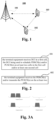
- FIG. 1 is a schematic diagram of a communication system of embodiments of this disclosure, in which a case where terminal equipments and a network device are taken as examples is schematically shown.
- a communication system 100 may include a network device 101 and terminal equipment 102, 103.
- a network device 101 may include a network device 101 and terminal equipment 102, 103.
- terminal equipment 102, 103 may include a network device 101 and terminal equipment 102, 103.
- FIG. 1 an example having only two terminal equipment and one network device is schematically given in FIG. 1 ; however, the embodiments of this disclosure is not limited thereto.
- eMBB enhanced mobile broadband
- MTC massive machine type communication
- URLLC ultra-reliable and low-latency communication
- eMBB enhanced mobile broadband
- URLLC ultra-reliable and low-latency communication
- FIG. 1 shows that two terminal equipment 102, 103 are both in coverage of the network device 101.
- this disclosure is not limited thereto, and the two terminal equipment 102, 103 may not be in coverage of the network device 101, or one terminal equipment 102 is in coverage of the network device 101 and the other terminal equipment 103 is out of coverage of the network device 101.
- cross-carrier scheduling is configured by an RRC cross-carrier scheduling configuration information element (CrossCarrierSchedulingConfig), which is carried by serving cell configuration (ServingCellConff) of a serving cell, wherein whether the serving cell is cross-carrier scheduled by another serving cell or may be cross-carrier scheduled another serving cell is configured by CrossCarrierSchedulingConfig.
- CrossCarrierSchedulingConfig RRC cross-carrier scheduling configuration information element
- the serving cell may cross-carrier schedule another serving cell, it is referred to as, for example, a scheduling cell, and if the serving cell is cross-carrier scheduled by another serving cell, the serving cell is referred to as, for example, a scheduled cell.
- a scheduling cell may carry downlink control information (DCI) used for scheduling a scheduled cell.
- DCI downlink control information
- an NR system supports scheduling PDSCHs and/or PUSCHs of multiple serving cells by one DCI.
- scheduling PDSCHs and/or PUSCHs of multiple serving cells by one DCI such as how to indicate/determine one or more serving cells scheduled by one DCI, etc.
- the embodiments of this disclosure provide a data transceiving method, which shall be described from a terminal equipment side.
- FIG. 2 is a schematic diagram of a data transceiving method of the embodiments of this disclosure. As shown in FIG. 2 , a method includes:
- the terminal equipment receives the DCI in the first cell, and the first cell may schedule PDSCHs and/or PUSCHs on the first cell and/or the second cells.
- the first cell may also be referred to as a scheduling cell, and the second cell may also be referred to as a scheduled cell; however, it is not limited thereto.
- the first cell may also schedule PDSCHs and/or PUSCHs of its own (self-scheduling).
- the first cell may be a primary cell or a secondary cell, and the second cell may be a primary cell or a secondary cell, and the embodiment of this disclosure is not limited thereto.
- a second cell corresponds to one or more first cells, that is, all of multiple first cells may schedule PDSCHs and/or PUSCHs on the second cell, and at least one second cell to which the multiple first cells respectively correspond includes the second cell.
- a cell is both a first cell and a second cell, that is, the cell may be used to schedule PDSCHs and/or PUSCHs on at least one second cell, and PDSCHs and/or PUSCHs on the cell may also be scheduled by at least one first cell.
- scheduling a first or second cell by the first cell may also be referred to as scheduling PDSCHs and/or PUSCHs on the first or second cell by the first cell
- scheduling a cell by DCI may also be referred to as scheduling PDSCHs and/or PUSCHs on the first or second cell by the DCI
- scheduling PDSCHs and/or PUSCHs on the first or second cell by DCI received on the first cell may also be referred to as scheduling PDSCHs and/or PUSCHs on the first or second cell by DCI received on the first cell.
- the DCI used for scheduling the PDSCHs may also be referred to as downlink (DL) assignment
- the DCI used for scheduling the PUSCHs may also be referred to as an uplink (UL) grant.
- the DCI is used to schedule PDSCHs and/or PUSCHs on at least two cells, thereby reducing a DCI listening burden on the terminal equipment and lowering power consumption and complexity.
- the at least two cells (hereinafter referred to as M cells; where, M is an integer greater than or equal to 2) are M cells in the first cell and/or at least one (N; where, N is an integer greater than or equal to 1) second cell. That is, the M cells may all be M cells in N second cells, or the M cells may be one first cell and M-1 cells in N second cells.
- Ranges of the first cell and N second cells shall be described below.
- the first cell and N second cells may include all or part of cells in a primary cell group or a secondary cell group or the same PUCCH group (set 1), or the first cell and at least one second cell may include cells that can (may) be scheduled by the first cell (set 2), or cells that can (may) be scheduled simultaneously by the first cell (set 3), or cells that can (may) be scheduled by the DCI (set 4).
- the first cell and N second cells may also be referred to as bundled cells, or the at least two cells scheduled by the DCI are referred to as bundled cells; however, it is not limited thereto.
- the first cell and/or at least one second cell may include at least one (P) sub set of cells, and cells in different sub sets of cells are unable to be scheduled by a same DCI (on the first cell). That is, when the same DCI schedules M cells, the M cells belong to the same sub set of cells, or in other words, the M cells do not exist at least two cells distributed in different sub sets of cells.
- the sub set of cells is a subset of set 1 or set 2 or set 3 or set 4; however, the embodiment of this disclosure is not limited thereto.
- the sub set of cells may be set 2 or set 3 or set 4, or a subset of set 2 or set 3 or set 4, which shall not be enumerated herein any further.
- division modes (cell ranges) of sub sets of cells concerned in different scenarios may be identical or different, which shall be described in detail later.
- a sub combination of cells refers to a subset of set 1 or set 2 or set 3 or set 4.
- cells in set 1 or set 2 or set 3 or set 4 that may be scheduled by the same DCI may be taken as a sub combination of cells.
- a sub set of cells or sub combination of cells may include one or more cells, different sub sets of cells have intersections or not, different sub combinations of cells have intersections or not, and the sub sets of cells and sub combinations of cells are identical or different.
- FIGs. 3A and 3B are schematic diagrams of distribution of the first cell and N second cells. As shown in FIGs. 3A and 3B , different cells (carriers) may be in identical frequency ranges (frequency bands), or may be in different frequency ranges (frequency bands).
- the DCI is only used for scheduling two or more cells simultaneously (i.e. once), or the DCI may be used for scheduling two or more cells simultaneously (i.e. once), and may be used for scheduling only one cell once.
- a format of the DCI may be a first DCI format, which may be, for example, a DCI format used to support multi-cell scheduling.
- the first DCI format is DCI format 1_1 and/or 0_1, or DCI format 1_2 and/or 0_2, or DCI formats newly introduced to support multi-cell scheduling (e.g. DCI format 1_3 and/or 0_3), etc.
- the embodiment of this disclosure is not limited thereto.
- the DCI format that only supports multi-cell scheduling is not distinguished from other DCI formats, and these DCI formats are any DCI formats used for scheduling PDSCHs and/or PUSCHs, which shall not be enumerated herein any further.
- the DCI schedules PDSCHs and/or PUSCHs on M cells, but the DCI may only support multi-cell scheduling, or the DCI may support single-cell scheduling and multi-cell scheduling.
- the M cells scheduled by the DCI may be predefined or configured, or may be dynamically (explicitly or implicitly) indicated by the DCI, such as being dynamically (explicitly or implicitly) indicated by at least one of a first information field, second information field, third information field and fourth information field in the DCI, and the method may further include (not shown): the terminal equipment receives first configuration information and/or first activation/deactivation information, the first configuration information and/or the first activation/deactivation information including information indicating the first cell and/or the at least one second cell, and/or, information of the at least one sub set of cells, and/or, information of a sub combination of cells that are able to be scheduled by the same DCI in the first cell and/or the at least one second cell.
- the first configuration information is carried by RRC signaling, and may include cell configuration information of the first cell or cross-carrier scheduling configuration information (CrossCarrierSchedulingConfig) in cell configuration information of the first cell, and/or cell configuration information of the second cell or cross-carrier scheduling configuration information (CrossCarrierSchedulingConfig) in cell configuration information of the second cell, and/or configuration information of a primary cell group or a secondary cell group, which shall be illustrated later.
- the first activation/deactivation information may be carried by an MAC CE.
- the first activation/deactivation information is used to activate and/or deactivate sub sets of cells that are pre-defined and/or configured by the first configuration information and/or sub combinations of cells that may be scheduled by the same DCI.
- the scheduled M cells may be determined according to the first configuration information and/or the first activation/deactivation information, without the need to combine information fields in the DCI.
- the scheduled M cells may be indicated/determined according to the first configuration information and/or the first activation/deactivation information, in combination with the information fields in the DCI. For example, cells or sub combination of cells corresponding to values of the information fields in the DCI or values of a part of blocks in the information fields may be determined according to the first configuration information and/or the first activation/deactivation information.
- the M cells are the first cell and N second cells, that is, the M cells scheduled by the DCI are equivalent to the first cell and N second cells scheduled by the DCI.
- the first cell and N second cells are predefined or configured (such as RRC signaling and/or MAC signaling).
- the M cells scheduled by the DCI are predefined or configured (such as the first configuration information) first cell and N second cells.
- the first configuration information indicates information of the first cell and N second cells (second indication information), and the first configuration information is for the first DCI format.
- the first configuration information configures information of the first cell and N second cells respectively for different first DCI formats (such as different for uplink and downlink).
- the first configuration information includes values of CIFs corresponding to the first cell and N second cells, and optionally, it may also include first DCI format indication information corresponding to the information configuring the first cell and N second cells.
- the M cells are dynamically (explicitly or implicitly) indicated by the DCI.
- the information fields in the DCI shall be described below with reference to FIGs. 4A-4C .
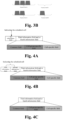
- FIG. 4A is a schematic diagram of a DCI format.
- an information field (such as a first information field or second information field described later) in the DCI is used to explicitly indicate a cell scheduled by the DCI.
- the DCI also includes a third information field and/or a fourth information field, which may be common or cell-specific or cell-group-specific information field(s).
- the third information field and/or fourth information field may be frequency resource allocation field(s) or time-domain resource allocation field(s), etc., which shall not be enumerated herein any further.
- the third information field and/or fourth information field may implicitly indicate cell(s) scheduled by the DCI, or are not used to indicate cell(s) scheduled by the DCI.
- FIG. 4B is a schematic diagram of a DCI format. As shown in FIG. 4B , two or more than two information fields (such as the first information field and second information field described later) in the DCI are used to explicitly indicate the cells scheduled by the DCI.
- the DCI also includes a third information field and/or a fourth information field, which may be common or cell-specific or cell-group-specific information field(s).
- the third information field and/or fourth information field may be frequency resource allocation field(s) or time-domain resource allocation field(s), etc., which shall not be enumerated herein any further.
- the third information field and/or fourth information field may implicitly indicate cell(s) scheduled by the DCI, or are not used to indicate cell(s) scheduled by the DCI.
- FIG. 4C is a schematic diagram of a DCI format. As shown in FIG. 4C , the DCI does not include an information field used to explicitly indicate the cells scheduled by the DCI.
- the DCI also includes a third information field and/or a fourth information field, which may be common or cell-specific or cell-group-specific information field(s).
- the third information field and/or fourth information field may be frequency resource allocation field(s) or time-domain resource allocation field(s), etc., which shall not be enumerated herein any further.
- the third information field and/or fourth information field may implicitly indicate cell(s) scheduled by the DCI.
- the first information field may be an existing carrier indication field (CIF) of the DCI (a mode for indication may be modified), and the second information field may be a newly-added information field.
- CIF existing carrier indication field
- the embodiment of this disclosure is not limited thereto.
- a method for indicating/determining the cells scheduled by the DCI shall be described below with reference to FIGs. 4A-4C .
- the DCI does not include an information field explicitly indicating the scheduled cells.
- the DCI may or may not include a third information field.
- a value of the third information field is a first value, or the DCI does not include a third information field, or the terminal equipment ignores the third information field.
- the number of the third information field is at least two, and bit positions of the at least two information fields in the DCI are consecutive or discrete.
- Each third information field includes one or more consecutive bits, and the terminal equipment may determine the M cells scheduled by the DCI according to the value of the third information field.
- the third information field is a cell-specific or cell-group-specific information field, that is, different third information fields correspond to different sub sets of cells or cells, and the third information field indicates via a first value that a corresponding sub set of cells or cell is not scheduled. Or, if a sub set of cells or cell is not scheduled, a corresponding third information field is set to be the first value or no third information field is included. When the value of the third information field is not the first value, it implicitly indicates that a corresponding sub set of cells or cell is scheduled.
- the third information field is a frequency resource allocation field and is used to explicitly indicate PDSCH and/or PUSCH frequency resources scheduled on a corresponding cell or sub set of cells.
- third information fields there are three third information fields in total, which correspond to sub set 1 of cells, sub set 2 of cells and sub set 3 of cells, respectively.
- a value of a first one of the third information fields is the first value or the first one of the third information fields is not included, sub set 1 of cells is not scheduled;
- a value of a second one of the third information fields is not the first value (which is a fourth value)
- sub set 2 of cells is scheduled, the fourth value being used to indicate PDSCH and/or PUSCH frequency resources scheduled on sub set 2 of cells;
- a value of a third one of the information fields is not the first value (which is a fifth value)
- sub set 3 of cells is scheduled, the fifth value being used to indicate PDSCH and/or PUSCH frequency resources scheduled on sub set 3 of cells.
- the DCI includes a fourth information field, which includes a first block and/or a second block.
- a value of the first block or second block is a second value or the fourth information field does not include the first block or second block, or the terminal equipment ignores the first block or second block, and the terminal equipment may determine the M cells scheduled by the DCI according to a value of the fourth information field.
- the fourth information field includes a first block and/or a second block, bits included in the second block and the first block may or may not intersect.
- Different blocks correspond to different sub sets of cells or cells, and the first block and/or the second block indicate(s) via a second value that a corresponding sub set of cells or cell is not scheduled or that a corresponding sub set of cells or cell is not scheduled is indicated by not including the first block and/or the second block.
- a corresponding first block and/or second block is/are set to be the second value or the first block and/or the second blocks is/are not included.
- the fourth information field includes a first block and a second block, which correspond to sub set 1 of cells and sub set 2 of cells, respectively.
- a value of the first block is the second value or the first block is not included, and sub set 1 of cells is not scheduled.
- a value of the second block is not the second value or the second block is included, and sub set 2 of cells is scheduled, which shall not be enumerated herein any further.
- the cells or sub sets of cells to which the value of the third information field or fourth information field or the values of part of blocks of the fourth information field correspond may be determined above via the first configuration information, and implementations thereof are as described above, which shall not be repeated herein any further.
- the DCI includes a first information field, the first information field being used to explicitly indicate the cells scheduled by DCI.
- a value of a CIF may correspond to multiple cells.
- the first information field of the DCI is the value of the CIF, it indicates scheduling multiple cells to which the value of the CIF corresponds.
- the downlink allocation or uplink grant of the DCI is for the multiple cells, for example, the first information field may be an existing CIF.
- one or more corresponding values of CIFs may be predefined and/or configured for each cell, or one or more cells may be predefined or configured for each value of CIF.
- configuring via the first configuration information
- one or more corresponding values of CIFs for each cell as an example, and a mode for predefining one or more corresponding values of CIFs is similar thereto, which shall not be enumerated herein any further.
- the first configuration information includes cell configuration information (cross-carrier scheduling configuration information therein) of the first cell and/or the second cell, the cell configuration information of the first cell and/or the second cell including first indication information, the first indication information being used to indicate one or more values of a first information field to which the first cell or the second cell corresponds.
- the first configuration information is carried by RRC signaling, and the terminal equipment may determine a correspondence between the first cell and/or the second cell and the value of the first information field (a cell or a sub combination of cells to which the value of the first information field corresponds) according to the first configuration information.
- which cells in the first cell and/or the second cell to which a value of each first information field corresponds may be known, hence, the M scheduled cells is determined according to the correspondence when the DCI indicates one value of first information field.
- the first indication information may indicate one or more values of a first information field in a manner of sequence or bitmap, and the cross-carrier scheduling configuration information of the first cell may be expressed as follows by using an ASN.1 data format (a sequence value):
- the first indication information cif-InSchedulingCellList-r18 is used to indicate one or more values of a first information field to which the first cell or the second cell corresponds.
- the cross-carrier scheduling configuration information of each second cell also includes the first indication information cif-InSchedulingCellList-r18, which is used to indicate one or more values of a first information field to which the first cell or the second cell corresponds.
- the first cell is cell 1
- the second cells include cell 2, cell 3 and cell 4
- first indication information indicating CIF values of the cross-carrier scheduling configuration information of cell 1 are 0, 4, 5, 6, 10, 11, 12 and 14
- first indication information indicating CIF values of cross-carrier scheduling configuration information of cell 2 are 1, 4, 7, 8, 10, 12, 13 and 14
- first indication information indicating CIF values of cross-carrier scheduling configuration information of cell 3 are 2, 5, 7, 9, 10, 11, 13 and 14,
- first indication information indicating CIF values of cross-carrier scheduling configuration information of cell 4 are 3, 6, 8, 9, 11, 12, 13 and 14.
- the value of the first information field of the DCI is 9 (e.g. 1001), it indicates scheduling cell 3 and cell 4, and when the first information field value is 14, it indicates scheduling cells 1, 2, 3 and 4.
- Table 1 is illustrative only; however, this disclosure is not limited thereto. For example, it may also be as shown in Table 2 or Table 3 below: Table 2 CIF value Cell 1 Cell 2 Cell 3 Cell 4 0 1 ⁇ 2 ⁇ 3 ⁇ 4 ⁇ ⁇ 5 ⁇ ⁇ 6 ⁇ ⁇ 7 ⁇ ⁇ 8 ⁇ ⁇ 9 ⁇ ⁇ 10 ⁇ ⁇ ⁇ 11 ⁇ ⁇ ⁇ 12 ⁇ ⁇ ⁇ 13 ⁇ ⁇ ⁇ 14 ⁇ ⁇ ⁇ Table 3 CIF value Cell 1 Cell 2 Cell 3 Cell 4 0 ⁇ ⁇ 1 ⁇ ⁇ 2 ⁇ ⁇ 3 ⁇ 4 ⁇ ⁇ 5 ⁇ 6 ⁇ ⁇ ⁇ 7 ⁇ ⁇ ⁇ 8 ⁇ ⁇ 9 ⁇ ⁇ ⁇ 10 ⁇ ⁇ ⁇ ⁇
- the cross-carrier scheduling configuration information of the first cell may be expressed as follows by using an ASN.1 data format (a bitmap):
- the first indication information cif-InSchedulingCellList-r18 is used to indicate one or more values of a first information field to which the first cell or the second cell corresponds.
- the cross-carrier scheduling configuration information of the second cells also include the first indication information cif-InSchedulingCellList-r18, which is used to indicate one or more values of a first information field to which the first cell or the second cells correspond(s).
- the first indication information is a bitmap, each bit corresponding to a CIF value. For example, if the first indication information of the cross-carrier scheduling configuration information of cell 1 is 10001110, it indicates that the CIF values are 0, 4, 5, 6.
- the first indication information of the cross-carrier scheduling configuration information of cell 2 is 01001001, it indicates the CIF values are 1, 4, 7. If the first indication information of the cross-carrier scheduling configuration information of cell 3 is 00100101, it indicates the CIF values are 2, 5, 7. If the first indication information of the cross-carrier scheduling configuration information of cell 4 is 00010010, it indicates the CIF values are 3, 6. Therefore, when the value of the first information field of the DCI is 0110 (the CIF value is 6), it indicates scheduling cell 1 and cell 4, and when the first information field value is 0111, it indicates scheduling cell 2 and cell 3.
- that the value for the first information field is equal to 0 corresponds only to the first cell, and a range of values of the first information field to which the first cell corresponds includes 0. That is, a range of values of the first information field to which the second cell corresponds does not include 0, that the value of the first information field is 0 is only used for scheduling the first cell separately. When it is needed to schedule the first cell and the second cell simultaneously, the value of the first information field is not 0. However, this is illustrative only, for example, the range of values of the first information field to which the second cells correspond may also include 0.
- the first information field is 0 is unable to be configured in the cross-carrier scheduling configuration information, but is predefined as corresponding to the first cell.
- the range of values of the first information field that may be indicated by the first indication information includes 0 or not.
- ranges of values of the first information field that may be indicated by the first indication information for the first cell and second cell are identical or different, and/or numbers of values of the first information field that may be configured are identical or different.
- the range of values of the first information field that may be indicated by the first indication information for the first cell does not include 0 (optionally, is default, and the value of the first information field to which it corresponds includes 0)
- the range of values of the first information field that may be indicated by the first indication information for the second cell includes 0.
- all the ranges of values of the first information field that may be indicated by the first indication information for the first cell and second cell include 0 or do not include 0.
- the range of values of the first information field that may be indicated by the first indication information for the second cell does not include 0, and for Table 3, the range of values of the first information field that may be indicated by the first indication information for the second cell includes 0.
- the range of values of the first information field that may be indicated by the first indication information for the first cell includes 0, if the first indication information is not included, a configured value of the first information field is 0 by default.
- the first information field is taken as a whole to indicate the M cells scheduled by the DCI.
- that the first information field includes a third block and/or a fourth block, and when one or more cells to which the third block or fourth block corresponds are not scheduled, a value of the third block or fourth block is a third value, and the terminal equipment may determine the M cells scheduled by the DCI according to value of each block in the first information field.
- the first information field includes the third block and/or the fourth block, bits included in the third block and the fourth block may or may not intersect. Different blocks correspond to different sub sets of cells or cells, and the third block and/or the fourth block indicate(s) via a third value that a corresponding sub set of cells or cell is not scheduled. Or, in other words, if a sub set of cells or cell is not scheduled, a corresponding third block and fourth block is/are set to be a third value.
- the first information field includes a third block and a fourth block, which correspond to sub set 1 of cells and sub set 2 of cells, respectively. A value of the third block is the third value, and sub set 1 of cells is not scheduled. A value of the fourth block is not the third value, and sub set 2 of cells is scheduled, which shall not be enumerated herein any further.
- the DCI includes one first information field, indicating the M scheduled cells.
- the DCI may include at least two first information fields, different first information fields corresponding to different sub sets of cells or cells. For example, when a cell or sub set of cells to which a first information field corresponds is not scheduled, a value of the first information field is the third value.
- the first information field indicates via the third value that a corresponding sub set of cells or cell is not scheduled. Or, if a sub set of cells or cell is not scheduled, a corresponding first information field is set to be the third value. When the value of the first information field is not the third value, it indicates that the corresponding sub set of cells or cell is scheduled.
- the terminal equipment may determine cells or sub sets of cells to which values of the first information fields or values of a part of blocks of the first information fields correspond according to the first configuration information.
- the above first information field indicates the scheduled cells by indicating the value of the CIF; however, the embodiment of this disclosure is not limited thereto.
- the scheduled cells may be indicated not based on indicating the value of the CIF, which shall be illustrated below.
- the DCI includes a first information field or a second information field.
- the first information field or the second information field indicates the scheduled cells in a form of bitmap or RIV, or is used to indicate an index of sub set of cells.
- the terminal equipment determines the cells scheduled by the DCI according to a value of the first information field or the second information field. Following description shall be given by taking the bitmap as an example, and different bits correspond to different cells or sub sets of cells.
- a cell range that may be indicated by the bitmap is the first cell and/or N second cells, that is, cells that may be indicated by the bitmap are cells that may be scheduled by the first cell or cells that may be scheduled by the DCI.
- the cell range that may be indicated by the bitmap are cells in a sub set of cells, optionally, except for the first cell or second cells configured with a CIF value. That is, the bitmap indicates cells associated with the cells corresponding to the CIF value in the DCI; however, the embodiment of this disclosure is not limited thereto.
- the cell range that may be indicated by the bitmap are cells associated with cells corresponding to the configured or predefined CIF value, optionally, except for the first cell or second cells configured with the CIF value. That is, the bitmap indicates cells associated with cells corresponding to the CIF value in the DCI. What is different from above is that the associated cells are not limited to being within the same cell, and may be across sub sets of cells.
- the cell range that may be indicated by the bitmap are cells within one sub set of cells, the sub set of cells also including the first cell, or the cell range that may be indicated by the bitmap are cells that may be scheduled by the first DCI format. What is different from above is that the scheduled cells are not limited to being within the same cell, and the associated cells may be across sub sets of cells.
- the method for configuring the correspondence between the first information field or second information field and the cells or sub sets of cells is similar to that of the first configuration information described above.
- the terminal equipment may determine the cells or sub sets of cells to which the value of the first information field or second information field corresponds according to the first configuration information, which shall not be enumerated herein any further.
- the DCI includes a first information field, the first information field being used to indicate a cell in the cells scheduled by the DCI, which is similar to the related art.
- the values of the first information field correspond to the cells one by one, and the above-described first configuration information indicates information of at least one sub set of cells, such as indicating in cell configuration information of a cell that the at least one sub set of cells is at least one sub set of cells associated with the cells.
- At least one sub set of cells associated with the cell to which the value of the first information field corresponds may be determined according to the first configuration information, and a cell to which the value of the first information field corresponds and cells in at least one sub set of cells associated with the cell are the M cells scheduled by the DCI.
- the scheduled sub combination of cells may be indicated from one or more sub combinations of cells where the cell is located via activation/deactivation information or the second information field, or the activation/deactivation information or the second information field is/are used to indicate the scheduled sub combination of cells from one or more sub combinations of cells associated with the cell, or used to indicate one or more cells in the cells scheduled by the DCI other than the cell (or to indicate/activate a sub set of cells from multiple sets).
- the activation/deactivation information is a set index of the activated sub set of cells
- a value of the second information field is a set index of a sub set of cells.
- the first cell and N second cells are equivalent to cells in the activated sub set of cells. Details are as shown in Table 4 below (the gray grids represent the cells to which the CIF values correspond, and the striped grids represent the associated cells).
- the DCI includes a first information field and a second information field, the first information field and the second information field jointly indicating the cells scheduled by the DCI.
- the terminal equipment determines the M cells scheduled by the DCI according to values of the first information field and second information field.
- the second information field is used to indicate the index of the sub set of cells
- the first information field is used to indicate the cells scheduled by the DCI in the sub set of cells indicated by the second information field.
- the range of scheduled cells indicated by the first information field is cells in sub sets of cells in the first cell and second cell, and reference may be made to the above-described embodiments for a specific mode for indication, which shall not be repeated herein any further.
- the DCI includes a second information field, the second information field indicating the number M of the scheduled cells, and the terminal equipment determines the M cells scheduled by the DCI according to a value of the second information field.
- multiple scheduling cell patterns may be configured via the first configuration information, wherein numbers of scheduled cells to which the patterns correspond are different, and each pattern indicates which cells are scheduled. Therefore, according to the number of scheduling cells indicated by the second information field, the terminal equipment may determine patterns to which the number corresponds, and determine the M scheduled cells according to the patterns.
- a value of the third information field corresponding to the cell or sub set of cells is the second value, or a corresponding third information field is not included, or the terminal equipment ignores a corresponding third information field, or a value of a first block or second block of a fourth information field corresponding to the cell or sub set of cells is the second value, or a corresponding third information field is not included, or the terminal equipment ignores a corresponding third information field, and reference may be made to the above-described embodiments for specific implementations, which shall not be repeated herein any further.
- scheduling PDSCHs and/or PUSCHs of multiple serving cells by one DCI may be supported, thereby alleviating DCI monitoring burden on the terminal equipment, and reducing power consumption and complexity.
- the embodiments of this disclosure provide a data transceiving method, which shall be described from a network device side, with parts repeated with those in the embodiments of the first aspect being not going to be described herein any further.
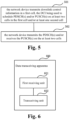
- FIG. 5 is a schematic diagram of a data transceiving method of the embodiments of this disclosure. As shown in FIG. 5 , a method includes:
- the method may further include (not shown): the network device transmits first configuration information and/or first activation/deactivation information to a terminal equipment, the first configuration information and/or the first activation/deactivation information including information indicating the first cell and/or the at least one second cell, and/or, information of at least one sub set of cells, and/or, information of a sub combination of cells in the first cell and/or the at least one second cell that are able to be scheduled by the same DCI, and reference may be made to the embodiment of the first aspect for details.
- scheduling PDSCHs and/or PUSCHs of multiple serving cells by one DCI may be supported, thereby alleviating DCI monitoring burden on the terminal equipment, and reducing power consumption and complexity.
- the embodiments of this disclosure provide a data transceiving apparatus.
- the apparatus may be, for example, a terminal equipment, or one or some components or assemblies configured in the terminal equipment. Contents in this embodiment identical to those in the embodiments of the first aspect shall not be described herein any further.
- FIG. 6 is a schematic diagram of a data transceiving apparatus of the embodiments of this disclosure. As shown in FIG. 6 , the data transceiving apparatus 600 includes:
- the first cell and the at least one second cell include all or a part of cells in a primary cell group or a secondary cell group or the same PUCCH group.
- the first cell and the at least one second cell include cells that are able to be scheduled by the first cell, or cells that are able to be scheduled by the DCI.
- the first cell and/or the at least one second cell include(s) at least one sub set of cells, and cells in different sub sets of cells are unable to be scheduled by the same DCI.
- the DCI is a first DCI format.
- the first DCI format only supports multi-cell scheduling.
- the DCI includes a first information field and/or a second information field, the first information field and/or the second information field being used to indicate the cells scheduled by the DCI.
- the DCI is used to simultaneously schedule the first cell and/or the at least one second cell.
- the first cell and/or the at least one second cell is/are predefined or configured.
- the DCI includes or does not include a third information field, when one or more cells to which the third information field corresponds are not scheduled, a value of the third information field is a first value, or the DCI does not include a third information field, or the terminal equipment ignores the third information field.
- the DCI includes at least two third information fields.
- the DCI includes a fourth information field, the fourth information field including a first block and/or a second block.
- the fourth information field including a first block and/or a second block.
- bits included in the second block and the first block may or may not intersect.
- the apparatus further includes: a second receiving unit (not shown) configured to receive first configuration information and/or first activation/deactivation information, the first configuration information and/or the first activation/deactivation information including information indicating the first cell and/or the at least one second cell, and/or, information of at least one sub set of cells, and/or, information of a sub combination of cells in the first cell and/or the at least one second cell that are able to be scheduled by the same DCI.
- a second receiving unit (not shown) configured to receive first configuration information and/or first activation/deactivation information, the first configuration information and/or the first activation/deactivation information including information indicating the first cell and/or the at least one second cell, and/or, information of at least one sub set of cells, and/or, information of a sub combination of cells in the first cell and/or the at least one second cell that are able to be scheduled by the same DCI.
- the first configuration information includes cell configuration information of the first cell, and/or cell configuration information of the second cell, and/or configuration information of a primary cell group or a secondary cell group.
- the apparatus further includes (not shown): a first determining unit configured to determine, according to the first configuration information and/or the first activation/deactivation information, a cell or a sub set of cells to which a value of an information field in the DCI corresponds or values of a part of blocks of an information field correspond.
- a first determining unit configured to determine, according to the first configuration information and/or the first activation/deactivation information, a cell or a sub set of cells to which a value of an information field in the DCI corresponds or values of a part of blocks of an information field correspond.
- the first configuration information includes cell configuration information of the first cell and/or the second cell, the cell configuration information of the first cell and/or the second cell including first indication information, the first indication information being used to indicate one or more values of a first information field and/or one or more values of a second information field to which the first cell or the second cell corresponds.
- the first configuration information includes cell configuration information of the first cell and/or configuration information of a primary cell group or a secondary cell group, the cell configuration information of the first cell and/or the configuration information of the primary cell group or the secondary cell group including second indication information, the second indication information being used to indicate value(s) of the first information fields and/or one or more values of a second information field to which the first cell and/or the at least one cell correspond(s).
- the DCI includes a first information field, the first information field being used to indicate the at least two cells.
- the DCI includes a first information field, the first information field being used to indicate a cell in the at least two cells.
- the DCI further includes a second information field, the second information field being used to indicate a scheduled sub set of cells from one or more sub sets of cells in which the one cell is located, or being used to indicate a scheduled sub set of cells from one or more sub sets of cells associated with the one cell, or being used to indicate one or more cells other than the one cell in the cells scheduled by the DCI.
- the first information field includes a third block and/or a fourth block, and when one or more cells to which the third block or fourth block corresponds are not scheduled, a value of the third block or fourth block is a third value, or the fourth information field does not include a third block and/or a fourth block, or the terminal equipment ignores the third block or the fourth block.
- the DCI includes multiple first information fields, and when one or more cells to which one first information field correspond are not scheduled, a value of the first information field is a third value or the DCI does not include the first information field or the terminal equipment ignores the first information field.
- the DCI includes a first information field or a second information field, the first information field or the second information field being a bitmap, a first bit and a second bit in the bitmap corresponding to different cells or sub sets of cells.
- the DCI includes a first information field or a second information field, the first information field or the second information field being a resource indication value (RIV).
- RIV resource indication value
- the DCI includes a first information field or a second information field, the first information field or the second information field being used to indicate an index sub set of cells.
- the DCI includes a first information field and a second information field, the second information field being used to indicate an index of sub set of cells, and the first information field being used to indicate a cell scheduled by the DCI in the sub set of cells indicated by the second information field.
- the apparatus further includes: a second determining unit (not shown) configured to determine one or more cells scheduled by the DCI according to a value of the second information field and/or the first information field.
- a second determining unit (not shown) configured to determine one or more cells scheduled by the DCI according to a value of the second information field and/or the first information field.
- the apparatus further includes: a third determining unit (not shown) configured to determine one or more cells scheduled by the DCI according to a DCI format.
- the apparatus further includes: a fourth determining unit (not shown) configured to determine one or more cells scheduled by the DCI according to values of a part of blocks of the third information field and/or the fourth information field.
- a fourth determining unit (not shown) configured to determine one or more cells scheduled by the DCI according to values of a part of blocks of the third information field and/or the fourth information field.
- connection relationships between the components or modules or signal profiles thereof are only illustrated in FIG. 6 .
- connection relationships between the components or modules or signal profiles thereof are only illustrated in FIG. 6 .
- such related techniques as bus connection, etc. may be adopted.
- the above components or modules may be implemented by hardware, such as a processor, a memory, a transmitter, and a receiver, etc., which are not limited in the embodiment of this disclosure.
- scheduling PDSCHs and/or PUSCHs of multiple serving cells by one DCI may be supported, thereby alleviating DCI monitoring burden on the terminal equipment, and reducing power consumption and complexity.
- the embodiments of this disclosure provide a data transceiving apparatus.
- the apparatus may be, for example, a network device, or one or some components or assemblies configured in the network device. Contents in this embodiment identical to those in the embodiment of the fourth aspect shall not be described herein any further.
- FIG. 7 is a schematic diagram of a data transceiving apparatus of the embodiments of this disclosure. As shown in FIG. 7 , the data transceiving apparatus 700 includes:
- the apparatus further includes (not shown): a second receiving unit configured to receive first configuration information and/or first activation/deactivation information, the first configuration information and/or the first activation/deactivation information including information indicating the first cell and/or the at least one second cell, and/or, information of at least one sub set of cells, and/or, information of a sub combination of cells in the first cell and/or the at least one second cell that are able to be scheduled by the same DCI.
- a second receiving unit configured to receive first configuration information and/or first activation/deactivation information, the first configuration information and/or the first activation/deactivation information including information indicating the first cell and/or the at least one second cell, and/or, information of at least one sub set of cells, and/or, information of a sub combination of cells in the first cell and/or the at least one second cell that are able to be scheduled by the same DCI.
- connection relationships between the components or modules or signal profiles thereof are only illustrated in FIG. 7 .
- connection relationships between the components or modules or signal profiles thereof are only illustrated in FIG. 7 .
- such related techniques as bus connection, etc. may be adopted.
- the above components or modules may be implemented by hardware, such as a processor, a memory, a transmitter, and a receiver, etc., which are not limited in the embodiment of this disclosure.
- scheduling PDSCHs and/or PUSCHs of multiple serving cells by one DCI may be supported, thereby alleviating DCI monitoring burden on the terminal equipment, and reducing power consumption and complexity.
- the embodiments of this disclosure provide a communication system, and reference may be made to FIG. 1 , with contents identical to those in the embodiments of the first to the fourth aspects being not going to be described herein any further.
- the communication system 100 may at least include: a terminal equipment 102 and a network device 101.
- the embodiments of this disclosure further provide a network device, which may be, for example, a base station. However, this disclosure is not limited thereto, and it may also be another network device.
- FIG. 8 is a schematic diagram of a structure of the network device of the embodiment of this disclosure.
- a network device 800 may include a processor 810 (such as a central processing unit (CPU)) and a memory 820, the memory 820 being coupled to the processor 810.
- the memory 820 may store various data, and furthermore, it may store a program 830 for information processing, and execute the program 830 under control of the processor 810.
- the processor 810 may be configured to execute a program to carry out the data transceiving method described in the embodiments of the second aspect.
- the network device 800 may include a transceiver 840, and an antenna 850, etc. Functions of the above components are similar to those in the related art, and shall not be described herein any further. It should be noted that the network device 800 does not necessarily include all the parts shown in FIG. 8 , and furthermore, the network device 800 may include parts not shown in FIG. 8 , and the related art may be referred to.
- the embodiments of this disclosure further provide a terminal equipment; however, this disclosure is not limited thereto, and it may also be another equipment.
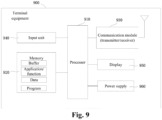
- FIG. 9 is a schematic diagram of a terminal equipment of the embodiment of this disclosure.
- a terminal equipment 900 may include a processor 910 and a memory 920, the memory 920 storing data and a program and being coupled to the processor 910. It should be noted that this figure is illustrative only, and other types of structures may also be used, so as to supplement or replace this structure and achieve a telecommunications function or other functions.
- the processor 910 may be configured to execute a program to carry out the data transceiving method as described in the embodiments of the first aspect.
- the terminal equipment 900 may further include a communication module 930, an input unit 940, a display 950, and a power supply 960; wherein functions of the above components are similar to those in the related art, which shall not be described herein any further. It should be noted that the terminal equipment 900 does not necessarily include all the parts shown in FIG. 9 , and the above components are not necessary. Furthermore, the terminal equipment 900 may include parts not shown in FIG. 9 , and the related art may be referred to.
- Embodiments of this disclosure provide a computer readable program, which, when executed in a terminal equipment, causes the terminal equipment to carry out the data transceiving method as described in the embodiments of the first aspect.
- Embodiments of this disclosure provide a computer storage medium, including a computer readable program, which causes a terminal equipment to carry out the data transceiving method as described in the embodiments of the first aspect.
- Embodiments of this disclosure provide a computer readable program, which, when executed in a network device, causes the network device to carry out the data transceiving method as described in the embodiments of the second aspect.
- Embodiments of this disclosure provide a computer storage medium, including a computer readable program, which causes a network device to carry out the data transceiving method as described in the embodiments of the second aspect.
- the above apparatuses and methods of this disclosure may be implemented by hardware, or by hardware in combination with software.
- This disclosure relates to such a computer-readable program that when the program is executed by a logic device, the logic device is enabled to carry out the apparatus or components as described above, or to carry out the methods or steps as described above.
- This disclosure also relates to a storage medium for storing the above program, such as a hard disk, a floppy disk, a CD, a DVD, and a flash memory, etc.
- the methods/apparatuses described with reference to the embodiments of this disclosure may be directly embodied as hardware, software modules executed by a processor, or a combination thereof.
- one or more functional block diagrams and/or one or more combinations of the functional block diagrams shown in the drawings may either correspond to software modules of procedures of a computer program, or correspond to hardware modules.
- Such software modules may respectively correspond to the steps shown in the drawings.
- the hardware module for example, may be carried out by firming the soft modules by using a field programmable gate array (FPGA).
- FPGA field programmable gate array
- the soft modules may be located in an RAM, a flash memory, an ROM, an EPROM, an EEPROM, a register, a hard disc, a floppy disc, a CD-ROM, or any memory medium in other forms known in the art.
- a memory medium may be coupled to a processor, so that the processor may be able to read information from the memory medium, and write information into the memory medium; or the memory medium may be a component of the processor.
- the processor and the memory medium may be located in an ASIC.
- the soft modules may be stored in a memory of a mobile terminal, and may also be stored in a memory card of a pluggable mobile terminal.
- the soft modules may be stored in the MEGA-SIM card or the flash memory device of a large capacity.
- One or more functional blocks and/or one or more combinations of the functional blocks in the drawings may be realized as a universal processor, a digital signal processor (DSP), an application-specific integrated circuit (ASIC), a field programmable gate array (FPGA) or other programmable logic devices, discrete gate or transistor logic devices, discrete hardware component or any appropriate combinations thereof carrying out the functions described in this application.
- DSP digital signal processor
- ASIC application-specific integrated circuit
- FPGA field programmable gate array
- the one or more functional block diagrams and/or one or more combinations of the functional block diagrams in the drawings may also be realized as a combination of computing equipment, such as a combination of a DSP and a microprocessor, multiple processors, one or more microprocessors in communication combination with a DSP, or any other such configuration.
Landscapes
- Engineering & Computer Science (AREA)
- Signal Processing (AREA)
- Computer Networks & Wireless Communication (AREA)
- Mobile Radio Communication Systems (AREA)
Applications Claiming Priority (1)
| Application Number | Priority Date | Filing Date | Title |
|---|---|---|---|
| PCT/CN2022/090098 WO2023206305A1 (zh) | 2022-04-28 | 2022-04-28 | 数据收发方法以及装置 |
Publications (2)
| Publication Number | Publication Date |
|---|---|
| EP4518218A1 true EP4518218A1 (de) | 2025-03-05 |
| EP4518218A4 EP4518218A4 (de) | 2025-06-18 |
Family
ID=88516895
Family Applications (1)
| Application Number | Title | Priority Date | Filing Date |
|---|---|---|---|
| EP22939155.2A Pending EP4518218A4 (de) | 2022-04-28 | 2022-04-28 | Verfahren und vorrichtung zum senden und empfangen von daten |
Country Status (6)
| Country | Link |
|---|---|
| US (1) | US20250056529A1 (de) |
| EP (1) | EP4518218A4 (de) |
| JP (1) | JP7841623B2 (de) |
| KR (1) | KR20240166552A (de) |
| CN (1) | CN119072886A (de) |
| WO (1) | WO2023206305A1 (de) |
Family Cites Families (7)
| Publication number | Priority date | Publication date | Assignee | Title |
|---|---|---|---|---|
| JP7420835B2 (ja) * | 2020-01-10 | 2024-01-23 | 株式会社Nttドコモ | 端末及び通信方法 |
| CN115211204B (zh) * | 2020-01-31 | 2025-05-13 | 高通股份有限公司 | 用于单dci到多小区调度的pdcch监测 |
| US12471103B2 (en) * | 2020-03-18 | 2025-11-11 | Lg Electronics Inc. | Method and device for uplink or downlink transmission/reception supporting multi-cell scheduling in wireless communication system |
| CN113473635B (zh) * | 2020-03-31 | 2026-04-21 | 英特尔公司 | 用于nr操作的两小区调度 |
| CN113630873B (zh) | 2020-05-08 | 2024-10-29 | 维沃移动通信有限公司 | 频域资源分配方法及设备 |
| KR102945900B1 (ko) * | 2020-06-05 | 2026-04-01 | 삼성전자주식회사 | 무선 통신 시스템에서 데이터 채널들을 스케줄하는 하향링크 제어 정보의 송수신 방법 및 장치 |
| US20230262699A1 (en) | 2020-08-06 | 2023-08-17 | Sony Group Corporation | Communication method |
-
2022
- 2022-04-28 KR KR1020247035545A patent/KR20240166552A/ko active Pending
- 2022-04-28 EP EP22939155.2A patent/EP4518218A4/de active Pending
- 2022-04-28 WO PCT/CN2022/090098 patent/WO2023206305A1/zh not_active Ceased
- 2022-04-28 CN CN202280095286.9A patent/CN119072886A/zh active Pending
- 2022-04-28 JP JP2024562809A patent/JP7841623B2/ja active Active
-
2024
- 2024-10-17 US US18/918,180 patent/US20250056529A1/en active Pending
Also Published As
| Publication number | Publication date |
|---|---|
| JP2025514111A (ja) | 2025-05-02 |
| WO2023206305A1 (zh) | 2023-11-02 |
| CN119072886A (zh) | 2024-12-03 |
| JP7841623B2 (ja) | 2026-04-07 |
| EP4518218A4 (de) | 2025-06-18 |
| US20250056529A1 (en) | 2025-02-13 |
| KR20240166552A (ko) | 2024-11-26 |
Similar Documents
| Publication | Publication Date | Title |
|---|---|---|
| US12047961B2 (en) | Methods and apparatuses for transmitting and configuring sidelink data | |
| US11723114B2 (en) | Command indication method and apparatus and information interaction method and apparatus | |
| US11888627B2 (en) | Configuration and/or activation method for duplication transmission, method for duplication transmission and apparatuses thereof | |
| US20200304263A1 (en) | Method and Apparatus for Indicating and Receiving Signaling, and Communication System | |
| US11729784B2 (en) | Apparatus and system for obtaining resources using a coefficient | |
| US11832236B2 (en) | Resource configuration method, resource determination method, apparatuses thereof and communication system | |
| US11284402B2 (en) | Resource indication method and apparatus and communication system | |
| US20190273600A1 (en) | Transmission Apparatus and Method of Suppressing Interference Information and Communication System | |
| US20190313418A1 (en) | Transmission Apparatus and Method Based on Dynamic Time Division Duplex and Communication System | |
| US11013018B2 (en) | Data multiplexing apparatus and method and communication system | |
| US20190274053A1 (en) | Apparatus and Method for Configuring Dynamic Time Division Duplex and Communication System | |
| US20230156779A1 (en) | Uplink signal sending and receiving method and apparatus | |
| US11582813B2 (en) | System information indication method and apparatus and communication system | |
| US20220256470A1 (en) | Power allocation method and apparatus | |
| EP3965491A1 (de) | Referenzsignalsendeverfahren und vorrichtung und kommunikationssystem | |
| US20200084794A1 (en) | Resource Indication and Reception Methods and Apparatuses and Communication System | |
| US20230246788A1 (en) | Information feedback method and apparatus | |
| EP4016900A1 (de) | Verfahren und vorrichtung zum senden eines uplink-signals sowie verfahren und vorrichtungen zum empfangen eines uplink-signals | |
| EP4572258A1 (de) | Verfahren und vorrichtung zur meldung von kanalstatusinformationen | |
| EP4518218A1 (de) | Verfahren und vorrichtung zum senden und empfangen von daten | |
| US20250193871A1 (en) | Resource determination method, resource scheduling method and apparatuses thereof | |
| US20250330980A1 (en) | Information indication method, repeater and network device | |
| EP4668929A1 (de) | Datenempfangsvorrichtung und -verfahren sowie datensendevorrichtung und -verfahren | |
| US20260025800A1 (en) | Information transmitting method, information receiving method, repeater and network device |
Legal Events
| Date | Code | Title | Description |
|---|---|---|---|
| STAA | Information on the status of an ep patent application or granted ep patent |
Free format text: STATUS: THE INTERNATIONAL PUBLICATION HAS BEEN MADE |
|
| PUAI | Public reference made under article 153(3) epc to a published international application that has entered the european phase |
Free format text: ORIGINAL CODE: 0009012 |
|
| STAA | Information on the status of an ep patent application or granted ep patent |
Free format text: STATUS: REQUEST FOR EXAMINATION WAS MADE |
|
| 17P | Request for examination filed |
Effective date: 20241024 |
|
| AK | Designated contracting states |
Kind code of ref document: A1 Designated state(s): AL AT BE BG CH CY CZ DE DK EE ES FI FR GB GR HR HU IE IS IT LI LT LU LV MC MK MT NL NO PL PT RO RS SE SI SK SM TR |
|
| A4 | Supplementary search report drawn up and despatched |
Effective date: 20250519 |
|
| RIC1 | Information provided on ipc code assigned before grant |
Ipc: H04W 72/232 20230101ALN20250513BHEP Ipc: H04W 72/23 20230101ALN20250513BHEP Ipc: H04W 72/1273 20230101ALN20250513BHEP Ipc: H04W 72/1268 20230101ALN20250513BHEP Ipc: H04W 72/1263 20230101ALN20250513BHEP Ipc: H04W 72/0453 20230101ALN20250513BHEP Ipc: H04W 72/04 20230101ALN20250513BHEP Ipc: H04W 72/12 20230101ALI20250513BHEP Ipc: H04L 5/00 20060101AFI20250513BHEP |
|
| DAV | Request for validation of the european patent (deleted) | ||
| DAX | Request for extension of the european patent (deleted) | ||
| RAP1 | Party data changed (applicant data changed or rights of an application transferred) |
Owner name: 1FINITY INC. |