EP4517596A1 - Auf uplink-interferenz basierendes lernen für dynamische handhabung von sondierungsressourcen - Google Patents
Auf uplink-interferenz basierendes lernen für dynamische handhabung von sondierungsressourcen Download PDFInfo
- Publication number
- EP4517596A1 EP4517596A1 EP23194867.0A EP23194867A EP4517596A1 EP 4517596 A1 EP4517596 A1 EP 4517596A1 EP 23194867 A EP23194867 A EP 23194867A EP 4517596 A1 EP4517596 A1 EP 4517596A1
- Authority
- EP
- European Patent Office
- Prior art keywords
- interference
- vector
- user equipment
- sounding channel
- uplink
- Prior art date
- Legal status (The legal status is an assumption and is not a legal conclusion. Google has not performed a legal analysis and makes no representation as to the accuracy of the status listed.)
- Pending
Links
Images

Classifications
-
- H—ELECTRICITY
- H04—ELECTRIC COMMUNICATION TECHNIQUE
- H04W—WIRELESS COMMUNICATION NETWORKS
- H04W72/00—Local resource management
- H04W72/50—Allocation or scheduling criteria for wireless resources
- H04W72/54—Allocation or scheduling criteria for wireless resources based on quality criteria
- H04W72/541—Allocation or scheduling criteria for wireless resources based on quality criteria using the level of interference
-
- H—ELECTRICITY
- H04—ELECTRIC COMMUNICATION TECHNIQUE
- H04W—WIRELESS COMMUNICATION NETWORKS
- H04W16/00—Network planning, e.g. coverage or traffic planning tools; Network deployment, e.g. resource partitioning or cells structures
- H04W16/02—Resource partitioning among network components, e.g. reuse partitioning
- H04W16/10—Dynamic resource partitioning
-
- G—PHYSICS
- G06—COMPUTING OR CALCULATING; COUNTING
- G06N—COMPUTING ARRANGEMENTS BASED ON SPECIFIC COMPUTATIONAL MODELS
- G06N3/00—Computing arrangements based on biological models
- G06N3/02—Neural networks
- G06N3/04—Architecture, e.g. interconnection topology
- G06N3/048—Activation functions
-
- G—PHYSICS
- G06—COMPUTING OR CALCULATING; COUNTING
- G06N—COMPUTING ARRANGEMENTS BASED ON SPECIFIC COMPUTATIONAL MODELS
- G06N3/00—Computing arrangements based on biological models
- G06N3/02—Neural networks
- G06N3/08—Learning methods
- G06N3/084—Backpropagation, e.g. using gradient descent
-
- H—ELECTRICITY
- H04—ELECTRIC COMMUNICATION TECHNIQUE
- H04L—TRANSMISSION OF DIGITAL INFORMATION, e.g. TELEGRAPHIC COMMUNICATION
- H04L5/00—Arrangements affording multiple use of the transmission path
- H04L5/003—Arrangements for allocating sub-channels of the transmission path
- H04L5/0048—Allocation of pilot signals, i.e. of signals known to the receiver
Definitions
- the teachings in accordance with the exemplary embodiments of this invention relate generally to a new machine learning-dedicated bearer for machine learning or artificial intelligence related to techniques and apparatuses for data exchange over wireless communication systems, and more particularly to techniques and apparatuses in wireless communication access networks based on neural network-based UL interference learning.
- sensing approaches use statistics based on channel estimates (e.g., changes in the propagation environment).
- channel estimates e.g., changes in the propagation environment.
- machine learning techniques, or artificial intelligence are applied to the channel estimates in order to make inferences and/or take decisions based on the changes in the propagation environment (e.g., regarding device positioning, radio environments, etc.).
- beamforming protocols may enable channel sounding, feedback of channel state information (CSI), precoding at the transmitter, etc.
- Example embodiments of this invention proposes improved operations for at least the above including learning and predicting neural network to place objects using one or more neural networks.
- an apparatus such as a user equipment side apparatus, comprising: at least one processor; and at least one non-transitory memory storing instructions, that when executed by the at least one processor, cause the apparatus at least to: determine a vector of uplink sounding channel resources in a cell at a user equipment position, wherein the vector of uplink sounding channel resources is associated with a sounding channel parameters configuration allocated to the user equipment for uplink transmissions; based on the determined vector of uplink sounding channel resources in the cell at the user equipment and a vector of uplink sounding channel resources of a neighboring cell, predict a set of interference probabilities which forms an interference-based distribution due to uplink sounding channel resources in at least one neighbor cell, based on the predicted set of interference probability, select a radio access network resources configuration vector associated with a sounding channel resource for the user equipment to counteract uplink interference in the radio access network.
- a method comprising: determining a vector of uplink sounding channel resources in a cell at a user equipment position, wherein the vector of uplink sounding channel resources is associated with a sounding channel parameters configuration allocated to the user equipment for uplink transmissions; based on the determined vector of uplink sounding channel resources in the cell at the user equipment and a vector of uplink sounding channel resources of a neighboring cell, predicting a set of interference probabilities which forms an interference-based distribution due to uplink sounding channel resources in at least one neighbor cell, based on the predicted set of interference probability, selecting a radio access network resources configuration vector associated with a sounding channel resource for the user equipment to counteract uplink interference in the radio access network.
- a further example embodiment is an apparatus and a method comprising the apparatus and the method of the previous paragraphs, wherein there is, based on an interference probability being above a probability target threshold, providing a best sounding channel resource allocation vector as classified with minimum interference impact among all predicted sounding channel resource allocation vectors for the user equipment position, wherein the probability target threshold is defined based on a load of the radio access network, wherein there is, determining an access network performance of the user equipment, wherein based on determining an access network performance of the user equipment is above a key performance indicator targeting, locking, and committing the selected radio access network resources configuration vector in a configuration of the radio access network, wherein there is, based on determining an access network performance of the user equipment is below a key performance indicator target, selecting a new sounding channel resources signal configuration as a new uplink sounding channel resources vector and fallback or use new uplink sounding channel resources vector to predict a new set of interference probabilities and select a new radio access network resources configuration vector, wherein the set of interference probabilities is predicted using a
- a non-transitory computer-readable medium storing program code, the program code executed by at least one processor to perform at least the method as described in the paragraphs above.
- an apparatus comprising: means for determining a vector of uplink sounding channel resources in a cell at a user equipment position, wherein the vector of uplink sounding channel resources is associated with a sounding channel parameters configuration allocated to the user equipment for uplink transmissions; means, based on the determined vector of uplink sounding channel resources in the cell at the user equipment and a vector of uplink sounding channel resources of a neighboring cell, for predicting a set of interference probabilities which forms an interference-based distribution due to uplink sounding channel resources in at least one neighbor cell; and means, based on the predicted set of interference probability, for selecting a radio access network resources configuration vector associated with a sounding channel resource for the user equipment to counteract uplink interference in the radio access network.
- At least the means for determining, predicting, and selecting comprises a network interface, and computer program code stored on a computer-readable medium and executed by at least one processor.
- a communication system comprising the network side apparatus and the user equipment side apparatus performing operations as described above.
- example embodiments of this invention there is proposed at least a method and apparatus for a new machine learning-dedicated bearer for machine learning or artificial intelligence related to techniques and apparatuses for data exchange over wireless communication systems based on neural network-based UL interference learning.
- Wireless communications systems design and deployment aim to provide multiple telecommunications services and may include a number of base stations (BSs) providing cell coverage to support communications for a number of user equipment (UEs).
- a user equipment (UE) or mobile terminal may communicate with a base station (BS) or network element via the downlink and uplink.
- the downlink refers to the communications link from the BS to the UE
- the uplink refers to the communications link from the UE to the BS.
- Wireless Access Network design and dimensioning are based on simultaneous multi resources approach in multiple access and rely on the univocity of the resource allocated to each among all served users.
- the optimized handling of allocated resources is a fundamental factor to guarantee the target service quality offered to users on the network.
- Multiple-access technologies could include different multiplexed resources variants, such as code division multiple access (CDMA) systems, time division multiple access (TDMA) systems, frequency-division multiple access (FDMA) systems, orthogonal frequency-division multiple access (OFDMA) systems, single-carrier frequency-division multiple access (SC-FDMA) systems, time division synchronous code division multiple access (TD- SCDMA) systems, and long term evolution (LTE).
- LTE/ LTE-Advanced is a set of enhancements to the universal mobile telecommunications system (UMTS) mobile standard promulgated by the Third Generation Partnership Project (3GPP).
- UMTS universal mobile telecommunications system
- a resource could be represented by a vector of resources to handle the communication, to transmit and receive on the available channel, e.g. a certain time (as in TDMA), a specific frequency band (as in FDMA), a dedicated electromagnetic wave in a specific beam space direction, a particular mathematical resource, e.g. orthogonal Walsh-Hadamard code (as in CDMA), or specific reference signal resources, e.g. CAZAC (Constant Amplitude Zero AutoCorrelation) sequence cyclic shift.
- This resources usage applies to the signal emitted on transmitter side and is used as reference in the receiver side to discriminate it from other coming signals (same applies to User equipment or Base Station transmitter and receiver).
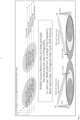
- FIG. 1 shows a wireless access network design in accordance with example embodiments of the invention using intelligent resources allocation by integrating fast learning and efficient Artificial neural networks resource optimized prediction to minimize uplink interference.
- FIG. 1 there is a UL energy or access receiver metric input, at a timeslot 1 over a time domain, subBand 1 over a frequency domain, beam 1 over a beam space domain, and cyclic shift with an orthogonal code over a cyclic shift domain for a UE1 and at a timeslot 2 over the time domain, subBand 2 over the frequency domain, beam 2 over the beam space domain, and cyclic shift with an orthogonal code over the cyclic shift domain.
- FIG. 1 shows a wireless access network design in accordance with example embodiments of the invention using intelligent resources allocation by integrating fast learning and efficient Artificial neural networks resource optimized prediction to minimize uplink interference.
- FIG. 1 there is a UL energy or access receiver metric input, at a timeslot 1 over a time domain, subBand 1 over a frequency domain, beam 1
- the wireless access network relies on basic principle: the resources per user orthogonality, i.e., each user ideally shall own its unique Time Frequency Beam space index, Orthogonal code, Cyclic Shift resource. Further, as shown in FIG. 1 in accordance with example embodiments of the invention the at cell1 the BS1/UE1 resources are communicated with No interference, and the at cell2 the BS2/UE2 resources are communicated with No interference.
- Wireless Access Network design could benefit from intelligent resources allocation by integrating fast learning and efficient Artificial neural networks resource optimized prediction to minimize UL interference.
- a neural network is an artificial neural network comprising a given number of hidden layers between the input layer and the output layer.
- Artificial neural networks may include interconnected groups of artificial neurons. Training of the neural network allows it to find the correct mathematical manipulation to transform the input into the proper output even when the relationship is highly nonlinear and/or complicated.
- the artificial neural network may be a computational device or represented as a method to be performed by a computational device.
- a set of rules or functions that are designed to execute tasks such as regression, classification, clustering, and pattern recognition are comprised in the artificial neural network.
- Such objectives are achieved by the artificial neural network through a training (learning) procedure by processing examples, each of which contains a known input and result, forming probability-weighted associations between the two, which are stored within the data structure of the net itself.
- the training of a neural network from a given example is conducted by determining the error between the processed output of the network (prediction) and a target output.
- the network then adjusts its weighted associations according to a learning rule and using this error value. Successive adjustments allow the neural network to produce output that is increasingly similar to the target output. After a sufficient number of these adjustments, the training can be terminated based on certain criteria. Learning by using labels is called supervised learning and learning without labels is called unsupervised learning. Deep learning typically requires a large amount of input data.
- Applying neural network-based UL interference learning to wireless communications in radio access networks allow to identify dynamically the optimized resources configuration, for each physical channel in radio access interface.
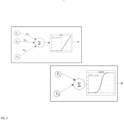
- FIG. 2 shows inputs which are outputs from a previous layer multiplied by weights, a bias added to this sum, and a nonlinear function known as activation function applied to a result.
- each network neuron (except those in the input layer) is actually a sum of all its inputs; which are in fact the outputs from the previous layer multiplied by some weights.
- An additional term called bias is added to this sum.
- a nonlinear function known as activation function is applied to the result.
- Initial weights can be set based on different approaches. During the training phase they are adapted to improve the accuracy of the process based on analysing errors in decision making. In principle, each node of the neural network makes a decision from the input multiplied by a weight, and then compares this decision to collected data to find out the difference to the collected data. That means it determines the error, based on which the weights are adjusted.
- the training phase is performed by using a stochastic gradient descent optimization algorithm for which the gradients are calculated using the backpropagation algorithm.
- the gradient descent algorithm looks for changing the weights so that the next evaluation decreases the error.
- the optimization algorithm is navigating down the gradient, the slope, of error.
- Any other suitable optimization algorithm e.g. momentum, could be used for more efficient and accurate weights.
- the function used to define the set of weights is referred to as the objective function.
- the objective function is referred as a cost function or a loss function.
- the process of minimizing loss is called optimization.
- any suitable method may be used as a loss function, some examples are mean squared error (MSE), maximum likelihood (MLE), and cross entropy.
- the activation function of the node defines the output of that node given an input or set of inputs.
- the node calculates a weighted sum of inputs, perhaps adds a bias and then makes a decision as "activate” or “not activate” based on a decision threshold as a binary activation or using an activation function that gives a nonlinear decision function.
- Any suitable activation function may be used, for example sigmoid, rectified linear unit (ReLU), normalized exponential function (soft- max), sotfplus, tanh, etc.
- the activation function is usually set at the layer level and applies to all neurons in that layer. The output is then used as input for the next node and so on until a desired solution to the original problem is found.
- Wireless transmission of the mobile terminals and network elements typically cause interference to other transmissions of the network due to multiple factors subjects of constant optimization study: mismanaged UL power transmission, increased amount of UEs in near-far condition, different types of Base station receivers on different network layouts, different layers in planned network, overlapping cells coverage footprints as due to noise rise shrinkage effect in loaded access network.
- a continuous UL interference learning could become a dominant factor and plays a key input in access network handling.
- An efficient approach by optimizing UL channels related parameters is based on dynamic adaptation from changed mobility and access network conditions. This could be based on Artificial Neural Networks.
- the interference shall be fast learnt, handled and successfully reduced to achieve the predefined target quality and avoid user perception degradation in the right extent.
- 3GPP standard specification describes the signaling mechanism to send sounding channel configuration parameters from a base station to the user equipment.
- This generates the UL sounding reference signal defined by the set of parameters: mainly the allocated time (e.g. OFDM symbol in LTE/NR), the sub-band or subcarrier in frequency, the beam space (in technology based on beamforming approach), or specific reference signal resource, e.g. CAZAC (Constant Amplitude Zero Auto Correlation) sequence Cyclic Shift (CS).
- the allocated time e.g. OFDM symbol in LTE/NR
- the sub-band or subcarrier in frequency e.g.
- the beam space in technology based on beamforming approach
- specific reference signal resource e.g. CAZAC (Constant Amplitude Zero Auto Correlation) sequence Cyclic Shift (CS).
- UEs which are assigned to different sets of frequencies, transmit reference signals on subcarriers and achieve separability of the reference signal via frequency division multiplexing.
- UEs could be assigned to transmit on the same set of subcarriers.
- the reference signals can interfere with each other, and the separation the reference signals from the different transmitters is needed.
- the orthogonality between reference signals occupying the same set of subcarriers id provided by exploiting the fact that the correlation of a mathematic sequence (CAZAC) with any Cyclic Shift (CS) of the same sequence is zero. From mathematical perspective the Cyclic shift is equivalent to a phase rotation in the frequency domain of same reference signal base sequence.
- CAZAC mathematic sequence
- CS Cyclic Shift
- the base sequence is cyclic shifted to increase the total number of available sequences which orthogonality properties depend on different factors: UL signal timing misalignment or as effect of the channel delay spread, i.e. secondary echoes due signal energy dispersion in time leaking into neighboring cyclic shift.
- the Sounding Reference (SRS) Signal plays a key role.
- SRS Sounding Reference
- TDD is dominant mode of deployment.
- gNB can utilize the channel estimation result from SRS not only for UL scheduling but also for DL scheduling.
- Loss of orthogonality and Sounding Channel reference signal resources collision compromises the capabilities of Base Station receiver to discriminate UE signal or correct beam direction.
- UL interference in the cell due to orthogonality loss for CS power leakage, or for collision due to Cyclic shift re-usage in neighboring cell, can be minimized by several cyclic shifts spacing and frequency SRS sub band position configuring accordingly.
- the receiver which computes from signal received strength the beam space direction, could mislead high level of power coming from wrong direction carried by colliding resource resulting in handled UE beam instability observations.
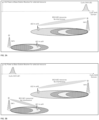
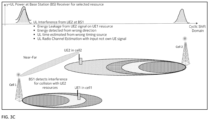
- FIG. 3A, FIG. 3B , and FIG. 3C each show communications in different cells between cell towers and UE where FIG. 3C shows uplink interference and/or power leakage in an uplink from a UE.
- UE1 served by gNB1 is allocated UL SRS CS1
- UE2 served by gNB2 is also allocated UL SRS CS1.
- the two UEs sounding channels are totally indistinguishable at each of the neighbour gNBs and mislead the gNBs to believe that the estimated conditions are better than they actually are.
- the gNBs do suboptimal resource allocation and this results in degraded performance at each of the 2 UEs.
- highly directional interference at the cell edge may reduce the data rate and negatively impact a user experience, e.g. inducing high variant beam choice or any other not correct scheduler algorithm choice.
- High variance in the interference makes it more difficult to perform link adaptation, such as predicting a supportable modulation and coding scheme (MCS).
- MCS modulation and coding scheme
- a solution of wireless communication that includes using a learning and predicting neural network with input the radio access network parameters for selection of dynamically optimized UL sounding resources allocation to counteract UL interference in a radio access network.
- the solution determines from actual radio access network resources configuration vector, a selection of radio access network configuration variables.
- FIG. 6 Before describing the example embodiments as disclosed herein in detail, reference is made to FIG. 6 for illustrating a simplified block diagram of various electronic devices that are suitable for use in practicing the example embodiments of this invention.
- FIG. 6 is a block diagram of one possible and non-limiting system in which the example embodiments may be practiced.
- FIG. 6 shows a block diagram of one possible and non-limiting example in which the examples may be practiced.
- a user equipment (UE) 110 and a radio access LTE, 5G, or 6G network base station i.e., gNB 170, and NCE/MME/GW 190 are illustrated.
- the user equipment (UE) 110 is in wireless communication with a wireless network 100.
- a UE is a wireless device that can access the wireless network 100.
- the UE 110 includes one or more processors 120, one or more memories 125, and one or more transceivers 130 interconnected through one or more buses 127.
- Each of the one or more transceivers 130 includes a receiver, Rx, 132 and a transmitter, Tx, 133.
- the one or more buses 127 may be address, data, or control buses, and may include any interconnection mechanism, such as a series of lines on a motherboard or integrated circuit, fiber optics or other optical communication equipment, and the like.
- the one or more transceivers 130 are connected to one or more antennas 128.
- the one or more memories 125 include computer program code 123.
- the UE 110 includes a output module 140, comprising one of or both parts 140-1 and/or 140-2, which may be implemented in a number of ways.
- the output module 140 may be implemented in hardware as output module 140-1, such as being implemented as part of the one or more processors 120.
- the output module 140-1 may be implemented also as an integrated circuit or through other hardware such as a programmable gate array.
- the output module 140 may be implemented as output module 140-2, which is implemented as computer program code 123 and is executed by the one or more processors 120.
- the one or more memories 125 and the computer program code 123 may be configured to, with the one or more processors 120, cause the user equipment 110 to perform one or more of the operations as described herein.
- the UE 110 communicates with gNB 170 via a wireless link 111.
- the gNB 170 in this example is a base station that provides access by wireless devices such as the UE 110 to the wireless network 100.
- the gNB 170 may be, for example, a base station for 5G, also called New Radio (NR).
- the gNB 170 may be a NG-RAN node, which is defined as either a gNB or an ng-eNB or an en-gNB.
- a gNB is a node providing NR user plane and control plane protocol terminations towards the UE, and connected via the NG interface to a 5GC (such as, for example, the NCE/MME/GW 190).
- the ng-eNB is a node providing E-UTRA user plane and control plane protocol terminations towards the UE, and connected via the NG interface to the 5GC.
- the NG-RAN node may include multiple gNBs, which may also include a central unit (CU) (gNB-CU) 196 and distributed unit(s) (DUs) (gNB-DUs), of which DU 195 is shown.
- the DU may include or be coupled to and control a radio unit (RU).
- the gNB-CU is a logical node hosting radio resource control (RRC), SDAP and PDCP protocols of the gNB or RRC and PDCP protocols of the en-gNB that controls the operation of one or more gNB-DUs.
- RRC radio resource control
- the gNB-CU terminates the F1 interface connected with the gNB-DU.
- the F1 interface is illustrated as reference 198, although reference 198 also illustrates a link between remote elements of the gNB 170 and centralized elements of the gNB 170, such as between the gNB-CU 196 and the gNB-DU 195.
- the gNB-DU is a logical node hosting RLC, MAC and PHY layers of the gNB or en-gNB, and its operation is partly controlled by gNB-CU.
- One gNB-CU supports one or multiple cells. One cell is supported by only one gNB-DU.
- the gNB-DU terminates the F1 interface 198 connected with the gNB-CU.
- the DU 195 is considered to include the transceiver 160, e.g., as part of a RU, but some examples of this may have the transceiver 160 as part of a separate RU, e.g., under control of and connected to the DU 195.
- the gNB 170 may also be an eNB (evolved NodeB) base station, for LTE (long term evolution), or any other suitable base station or node.
- eNB evolved NodeB
- the gNB 170 includes one or more processors 152, one or more memories 155, one or more network interfaces (N/W I/F(s)) 161, and one or more transceivers 160 interconnected through one or more buses 157.
- Each of the one or more transceivers 160 includes a receiver, Rx, 162 and a transmitter, Tx, 163.
- the one or more transceivers 160 are connected to one or more antennas 158.
- the one or more memories 155 include computer program code 153.
- the CU 196 may include the processor(s) 152, memories 155, and network interfaces 161. Note that the DU 195 may also contain its own memory/memories and processor(s), and/or other hardware, but these are not shown.
- the gNB 170 includes a output module 150, comprising one of or both parts 150-1 and/or 150-2, which may be implemented in a number of ways.
- the output module 150 may be implemented in hardware as output module 150-1, such as being implemented as part of the one or more processors 152.
- the output module 150-1 may be implemented also as an integrated circuit or through other hardware such as a programmable gate array.
- the output module 150 may be implemented as output module 150-2, which is implemented as computer program code 153 and is executed by the one or more processors 152.
- the one or more memories 155 and the computer program code 153 are configured to, with the one or more processors 152, cause the gNB 170 to perform one or more of the operations as described herein.
- the functionality of the output module 150 may be distributed, such as being distributed between the DU 195 and the CU 196, or be implemented solely in the DU 195.
- the one or more network interfaces 161 communicate over a network such as via the links 176 and 131.
- Two or more gNBs 170 may communicate using, e.g., link 176.
- the link 176 may be wired or wireless or both and may implement, for example, an Xn interface for 5G, an X2 interface for LTE, or other suitable interface for other standards.
- the one or more buses 157 may be address, data, or control buses, and may include any interconnection mechanism, such as a series of lines on a motherboard or integrated circuit, fiber optics or other optical communication equipment, wireless channels, and the like.
- the one or more transceivers 160 may be implemented as a remote radio head (RRH) 195 for LTE or a distributed unit (DU) 195 receiver for gNB implementation for 5G, with the other elements of the gNB 170 possibly being physically in a different location from the RRH/DU, and the one or more buses 157 could be implemented in part as, for example, fiber optic cable or other suitable network connection to connect the other elements (e.g., a central unit (CU), gNB-CU) of the gNB 170 to the RRH/DU 195.
- Reference 198 also indicates those suitable network link(s).
- the cell makes up part of a base station. That is, there can be multiple cells per base station. For example, there could be three cells for a single carrier frequency and associated bandwidth, each cell covering one-third of a 360 degree area so that the single base station's coverage area covers an approximate oval or circle. Furthermore, each cell can correspond to a single carrier and a base station may use multiple carriers. So if there are three 120 degree cells per carrier and two carriers, then the base station has a total of 6 cells.
- the wireless network 100 may include a network element or elements 190 that may include core network functionality. Further, this NCE/MME/GW 190 can for example perform Access & Mobility Management Function (AMF), Location Management Function (LMF), Mobility Management Entity (MME), Network Control Element (NCE), Policy Control Function (PCF), Serving Gateway (SGW), Session Management Function (SMF), and Unified Data Management (UDM).
- AMF Access & Mobility Management Function
- LMF Location Management Function
- MME Mobility Management Entity
- NCE Network Control Element
- PCF Policy Control Function
- SGW Serving Gateway
- SGW Session Management Function
- UDM Unified Data Management
- the NCE/MME/GW 190 provides connectivity via a link or links 181 with a further network, such as a telephone network and/or a data communications network (e.g., the Internet).
- Such core network functionality for 5G may include access and mobility management function(s) (AMF(S)) and/or user plane functions (UPF(s)) and/or session management function(s) (SMF(s)).
- AMF(S) access and mobility management function(s)
- UPF(s) user plane functions
- SMF(s) session management function(s)
- LTE Long Term Evolution
- MME Mobility Management Entity
- SGW Serving Gateway
- the wireless network 100 may implement network virtualization, which is the process of combining hardware and software network resources and network functionality into a single, software-based administrative entity, a virtual network.
- Network virtualization involves platform virtualization, often combined with resource virtualization.
- Network virtualization is categorized as either external, combining many networks, or parts of networks, into a virtual unit, or internal, providing network-like functionality to software containers on a single system. Note that the virtualized entities that result from the network virtualization are still implemented, at some level, using hardware such as processors 152 or 175 and memories 155 and 171, and also such virtualized entities create technical effects.
- the computer readable memories 125, 155, and 171 may be of any type suitable to the local technical environment and may be implemented using any suitable data storage technology, such as semiconductor based memory devices, flash memory, magnetic memory devices and systems, optical memory devices and systems, fixed memory and removable memory.
- the computer readable memories 125, 155, and 171 may be means for performing storage functions.
- the processors 120, 152, and 175 may be of any type suitable to the local technical environment, and may include one or more of general purpose computers, special purpose computers, microprocessors, digital signal processors (DSPs) and processors based on a multi-core processor architecture, as non-limiting examples.
- the processors 120, 152, and 175 may be means for performing functions, such as controlling the UE 110, gNB 170, NCE/MME/GW 190, and other functions as described herein.
- the various embodiments of the user equipment 110 can include, but are not limited to, cellular telephones such as smart phones, tablets, personal digital assistants (PDAs) having wireless communication capabilities, portable computers having wireless communication capabilities, image capture devices such as digital cameras having wireless communication capabilities, gaming devices having wireless communication capabilities, music storage and playback appliances having wireless communication capabilities, Internet appliances permitting wireless Internet access and browsing, tablets with wireless communication capabilities, as well as portable units or terminals that incorporate combinations of such functions.
- cellular telephones such as smart phones, tablets, personal digital assistants (PDAs) having wireless communication capabilities, portable computers having wireless communication capabilities, image capture devices such as digital cameras having wireless communication capabilities, gaming devices having wireless communication capabilities, music storage and playback appliances having wireless communication capabilities, Internet appliances permitting wireless Internet access and browsing, tablets with wireless communication capabilities, as well as portable units or terminals that incorporate combinations of such functions.
- PDAs personal digital assistants
- portable computers having wireless communication capabilities
- image capture devices such as digital cameras having wireless communication capabilities
- gaming devices having wireless communication capabilities
- music storage and playback appliances having wireless communication capabilities
- One or more of output modules 140-1, 140-2, 150-1, and 150-2 may be configured to implement high level syntax for a compressed representation of neural networks based on the examples described herein.
- Computer program code 173 may also be configured to implement high level syntax for a compressed representation of neural networks based on the examples described herein.
- any of these devices can be used with a UE vehicle, a High Altitude Platform Station, or any other such type node associated with a terrestrial network or any drone type radio or a radio in aircraft or other airborne vehicle or a vessel that travels on water such as a boat.
- the present disclosure generally relates to wireless communication systems, and more particularly to techniques and apparatuses in wireless communication access networks based on neural network-based UL interference learning.
- a solution of wireless communication for selection of dynamically optimized UL sounding resources allocation to counteract UL interference in a radio access network determines from actual radio access network resources configuration vector, a selection of radio access network configuration variables . It includes a learning and predicting neural network with input the radio access network parameters. The predicted output and the target output delta represents the error to minimize for the selected set of resource allocation (i.e. sounding channel parameters configuration).
- Embodiments of the present disclosure aims reducing the UL interference from adapted resources configuration improving the cell throughput performance in the access network.
- a network device e.g., gNB or centralized node predicts interference and then may coordinate with the neighbor base station to reduce the interference.
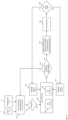
- FIG. 4 shows an example of a possible solution implemented at an apparatus in accordance with example embodiments of the invention for the optimal sounding channel resources configuration vector choice to maximize performance in terms of lowest BLER or max cell throughput rate.
- FIG. 4 shows a NN with a feedback loop in which the SRS codes CS are tuned until the UE performance is improved.
- the method starts with some random SRS configuration (freqDomainPosition, cyclicShift) and outputs a probability of collision. Then, using this probability, the resources are allocated and the UE performance is evaluated. If the performance is above target, the config is locked (i.e. Vector commit). If the performance is below target, a new SRS config is selected (Vector fallback), using also the current interference state information.
- FIG. 4 is a configuration using an own cell 1 and a neighboring cell 2.
- at a specific UE position at least one vector of uplink sounding channel resources is determined.
- the UE position is defined by a UE position metric.
- the UE position metric comprises a path loss or signal to noise ratio as a path loss function.
- the determined at least one vector of uplink sounding channel resources forms the input to a neural network 400 (i.e., NN inference 428), which has been trained (in Fig. 4 , at block 426) to predict a set of interference probabilities.
- a neural network 400 i.e., NN inference 428
- KPI access network key performance indicator
- block 460 of FIG. 4 it is determined whether KPI is above a target. If no, then as shown in block 424 of FIG. 4 , a new sounding channel resources signal configuration is selected as a new uplink sounding channel resources vector which is used as input to the neural network to predict a new set of interference probabilities and repeat the above-described process. If the access network performance of the user equipment as determined at 450 is above a key performance indicator target -- yes at block 460 --, then as shown in block 470 of FIG. 4 the selected radio access network resources configuration vector is locked and committed in a configuration of the radio access network.
- target -- yes at block 460 -- If the access network performance of the user equipment as determined at 450 is above a key performance indicator target -- yes at block 460 --, then as shown in block 470 of FIG. 4 the selected radio access network resources configuration vector is locked and committed in a configuration of the radio access network.
- an optional anomaly detection step is performed as a preliminary condition to be verified before triggering the neural network in a varying interference radio access network context.
- the neural network-based interference prediction is only then started if a network anomaly was detected.
- the anomaly detection step may be implemented by determining or monitoring performance disruption of an established call configured with a given sounding channel resource allocation vector while an uplink received signal power or beam energy is measured with no user equipment radio conditions variations.
- the anomaly detection method may be adopted to trigger the neural network only when an unexpected peak of Block Error Rate or sudden degraded cell throughput occurs while good radio conditions are measured by base station for corresponding UE position metrics.
- it may correspond, on an established call configured with a given sounding channel resources (e.g. SRS freqDomainPosition, combOffset, cyclicShift) vector, to an abrupt performance disruption while high UL received signal Power (or beam energy) is measured with no UE radio conditions variations, e.g. long term frequency doppler estimation measurement at base station proving UE in stable static condition or in low speed.
- a given sounding channel resources e.g. SRS freqDomainPosition, combOffset, cyclicShift
- the optional anomaly detection method is facilitating a more efficient usage of the neural network, as it increases the efficiency of the neural network learning/inference feedback loop, otherwise always performed.
- the neural network in base station could predict an interference distribution of problematic position in the cell for a given resources configuration vector related to the sounding channel (e.g. SRS), used by the base station receiver as input of any algorithm type, e.g. UL timing correction, or UL Synchronization, or rank UL prediction, or Channel Estimate, or UL Beam space direction input.
- SRS sounding channel
- the UE position in the cell could be defined by one or all variables from the UE position metric vector:
- UE transmitted power e.g. UE PHR, Power Head Room, signaled on air radio interface via MAC protocol layer as per 3GPP definition
- the neural network in base station could predict an interference distribution of problematic Path Loss (or problematic UE position metrics vector) in the cell for a given sounding configuration resources vector (e.g. SRS freqDomainPosition, combOffset, cyclic Shift) for the own cell and for the cells in neighboring cluster.
- sounding configuration resources vector e.g. SRS freqDomainPosition, combOffset, cyclic Shift
- the neural network stores from the base performance simulations for a specific sounding channel resources vector and UE position (e.g. PL or SNR as PL function) with and without interference, that means with IoT (Interference over Thermal) or INR (Interference to Noise Ratio) equal to 0 (no interference, e.g. no collision or no power leakage from cyclic shift) or not equal to 0 (interference, e.g. collision or power leakage from adjacent cyclic shift).
- IoT Interference over Thermal
- INR Interference to Noise Ratio
- the training may be carried out by collecting the receiver performance simulation data into a data storage or by collecting the inputs from the access network that have been injected in receiver simulation to provide the training performance data, that maximize the optimum receiver performance in terms of the throughput data rate at specific of UE metric position e.g. PL or SNR as PL function.
- UE metric position e.g. PL or SNR as PL function.
- the neural network is so either trained at base station or the neural network weights are shared among neighboring base stations.
- the base stations in a cluster of cells share their configurations, so when a measurement is performed, the base stations may determine interference associated to the sounding channel configuration resources vector to which the measurement corresponds.
- the neural processing engine predicts an interference-based distribution for the current position of the UEs. For example, the neural network at the base station is used to predict the interference-based distribution at a given UE position due to an aggressor sounding resources.
- the classification score can be seen as a set of probabilities, where each probability is the probability of the input data, including the feature from a set of features, in our case the (UE position, sounding channel resources vectors) combination: the one with the lowest probability of interference (BLER below target) is chosen as the classification result.
- the neural network learns to recognize correlations between the features and optimal results.
- the interference could be used to identify the problematic resources (BLER above target) due to sounding resource allocated to UE as interfered from neighboring cells (e.g. cyclic shift collision or power leakage from adjacent cyclic shift).
- the neural network makes prediction for a given UE position for classified problematic working zones/resources (UE metric position vs. Sounding channel configuration resources vectors).
- the neural network predicts for the given UE position (e.g. Path Loss) interference probabilities for all Sounding channel resources vectors, providing as response the best to be proposed as classified with minimum interference (smallest probability of collision of power leakage from adjacent cyclic shift) impact.
- the model can be seen as a feedback loop in which the Sounding Channel Resources Vector (e.g. SRS freqDomainPosition, comb Offset, cyclicShift) are tuned until the UE (KPI access network) performance is improved. If the performance is above target, the config is locked (i.e. Vector commit). If the performance is below target, a new SRS config is selected (Vector fallback), using also the current interference state information.
- the Sounding Channel Resources Vector e.g. SRS freqDomainPosition, comb Offset, cyclicShift
- the usage of neural network resource vectors output is than propagated and configured to be changed on the radio access network.
- An observation time window period is started to monitor Key Performance Indicators compared to the target performance.
- the key performance metrics are calculated and compared to metrics obtained earlier using the configuration that led to UL interference detection (cell throughput degradation). If performance is higher, the new resources configuration are committed as confirmed.
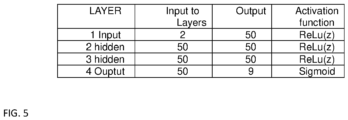
- FIG. 5 shows operation layers of a neural network structure in accordance with example embodiments of the invention.
- the neural network includes 4 layers in total: 1st layer input, 2 hidden layers, 1 output layer and 2 inputs: UE position Metric (e.g. Path Loss and/or Signal to Noise Ratio for a specific Path Loss, and/or Received Signal power for a specific Path Loss, and/or Sounding Channel Covariance matrix in case of beamforming for a specific Path Loss and/or Channel Estimation Response for a specific Path Loss and or for a specific beam) Vector, Sounding Channel Configuration Resources (i.e. freqDomainPosition, comb Offset, cyclic Shift) Vector.
- UE position Metric e.g. Path Loss and/or Signal to Noise Ratio for a specific Path Loss, and/or Received Signal power for a specific Path Loss, and/or Sounding Channel Covariance matrix in case of beamforming for a specific Path Loss and/or Channel Estimation Response for a specific Path Loss and or for a specific beam
- Sounding Channel Configuration Resources
- the rectified linear unit (ReLU) as activation function is applied.
- a sigmoid function to map the output to class probabilities, there are two input features, which are mapped into a prediction among a given number of classes, each class representing a certain combination of 2 inputs.
- the optimal Sounding Channel Resources Vector represents a label, i.e., the output of the neural network. It may be noted that each vector may be encoded into a numerical class indicator, and therefore the neural network essentially outputs probabilities for the optimality of the different Sounding Channel Resources Vector parameter. The one with the highest probability is typically chosen as the classification result.
- This implementation is just an example of possible neural network structure.
- the feedback from real networks observation could allow to finetune the output of the neural network improving the prediction precision or any new change on the real network.
- Applying neural network-based UL interference learning to wireless communications in radio access networks allow to identify dynamically the optimized resources configuration, for each physical channel in radio access interface.
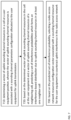
- FIG. 7 shows a method in accordance with example embodiments of the invention which may be performed by an apparatus.
- FIG. 7 illustrates operations which may be performed by a device such as, but not limited to, a device such as a network device (e.g., the UE 110 as in FIG. 6 ).
- a device such as a network device (e.g., the UE 110 as in FIG. 6 ).
- a device such as a network device (e.g., the UE 110 as in FIG. 6 ).
- block 710 of FIG. 7 there is determining a vector of uplink sounding channel resources in a cell at a user equipment position, wherein the vector of uplink sounding channel resources is associated with a sounding channel parameters configuration allocated to the user equipment for uplink transmissions.
- the probability target threshold is defined based on a load of the radio access network.
- the set of interference probabilities is predicted using a trained neural network comprising one input layer, one output layer and a plurality of hidden layers.
- training data that maximizes at least a throughput data rate of a radio access network receiver performance at a specific user equipment metric position by collecting receiver performance simulation data into a data storage or collecting the inputs from access network that have been injected in receiver simulation to provide the training performance data.
- the neural network stores performance simulations for a specific sounding resource allocation vector and a user equipment position.
- the user equipment metric position comprises at least one of a path loss or signal to noise ratio as a path loss function.
- the determining is based on anomaly detection based on performance disruption of an established call configured with a given sounding channel resource allocation vector while an uplink received signal power or beam energy is measured with no user equipment radio conditions variations.
- the user equipment radio conditions variations comprise long term frequency doppler estimation measurement proving user equipment in stable static condition or in a low speed.
- the interference-based distribution is based on aggressor sounding resources vector.
- the sounding channel is used as input of an algorithm type comprising at least one of uplink timing correction, uplink synchronization, rank uplink prediction, channel estimate, or uplink beam space direction input.
- the probability of interference is based on whether there is a cyclic shift collision or whether there is power leakage from adjacent cyclic shift.
- the minimum interference is based on a smallest probability of collision of power leakage from an adjacent cyclic shift.
- the sounding resource allocation vectors comprise at least one of a sounding reference signal, a freqDomainPosition, a combOffset, or a cyclicShift vector.
- the predicting a set of interference probabilities of the feature set comprises a classification score based on a set of probabilities, wherein each probability of the set is a probability of the input data, including the feature from the set of features.
- a non-transitory computer-readable medium (Memory(ies) 125 AND/OR Memory(ies) 155 as in FIG. 6 ) storing program code (computer program code 123 and/or output module 140-2 AND/OR computer program code 153 and/or output module 150-2 as in FIG. 6 ), the program code executed by at least one processor (processor(s) 120 and/or output module 140-1 AND/OR at least one processor (Processor(s) 152 and/or output module 150-1 as in FIG. 6 ) to perform the operations as at least described in the paragraphs above.
- an apparatus comprising: means for determining (one or more transceivers 130, Memory(ies) 125, computer program code 123 and/or output module 140-2, and processor(s) 120 and/or output module 140-1; AND/OR one or more transceivers 160, Memory(ies) 155, computer program code 153 and/or output module 150-2, and at least one processor (Processor(s) 152 and/or output module 150-1 as in FIG. 6 ) as in FIG.
- a vector of uplink sounding channel resources in a cell at a user equipment position wherein the vector of uplink sounding channel resources is associated with a sounding channel parameters configuration allocated to the user equipment for uplink transmissions; means, based on the determined vector of uplink sounding channel resources in the cell at the user equipment and a vector of uplink sounding channel resources of a neighboring cell, for predicting (one or more transceivers 130, Memory(ies) 125, computer program code 123 and/or output module 140-2, and processor(s) 120 and/or output module 140-1; AND/OR one or more transceivers 160, Memory(ies) 155, computer program code 153 and/or output module 150-2, and at least one processor (Processor(s) 152 and/or output module 150-1 as in FIG.
- a set of interference probabilities which forms an interference-based distribution due to uplink sounding channel resources in at least one neighbor cell; and means, based on the predicted set of interference probability, for selecting (one or more transceivers 130, Memory(ies) 125, computer program code 123 and/or output module 140-2, and processor(s) 120 and/or output module 140-1; AND/OR one or more transceivers 160, Memory(ies) 155, computer program code 153 and/or output module 150-2, and at least one processor (Processor(s) 152; and/or output module 150-1 as in FIG. 6 ) as in FIG. 6 ) ) a radio access network resources configuration vector associated with a sounding channel resource for the user equipment to counteract uplink interference in the radio access network.
- circuitry for performing operations in accordance with example embodiments of the invention as disclosed herein.
- This circuitry can include any type of circuitry including content coding circuitry, content decoding circuitry, processing circuitry, image generation circuitry, data analysis circuitry, etc.).
- this circuitry can include discrete circuitry, application-specific integrated circuitry (ASIC), and/or field-programmable gate array circuitry (FPGA), etc. as well as a processor specifically configured by software to perform the respective function, or dual-core processors with software and corresponding digital signal processors, etc.).
- ASIC application-specific integrated circuitry
- FPGA field-programmable gate array circuitry
- circuitry can include at least one or more or all of the following:
- circuitry as may be used herein refers to at least the following:
- circuitry applies to all uses of this term in this application, including in any claims.
- circuitry would also cover an implementation of merely a processor (or multiple processors) or portion of a processor and its (or their) accompanying software and/or firmware.
- circuitry would also cover, for example and if applicable to the particular claim element, a baseband integrated circuit or applications processor integrated circuit for a mobile phone or a similar integrated circuit in a server, a cellular network device, or other network device.
- the various embodiments may be implemented in hardware or special purpose circuits, software, logic or any combination thereof.
- some aspects may be implemented in hardware, while other aspects may be implemented in firmware or software which may be executed by a controller, microprocessor or other computing device, although the invention is not limited thereto.
- firmware or software which may be executed by a controller, microprocessor or other computing device, although the invention is not limited thereto.
- While various aspects of the invention may be illustrated and described as block diagrams, flow charts, or using some other pictorial representation, it is well understood that these blocks, apparatus, systems, techniques or methods described herein may be implemented in, as non-limiting examples, hardware, software, firmware, special purpose circuits or logic, general purpose hardware or controller or other computing devices, or some combination thereof.
- Embodiments of the inventions may be practiced in various components such as integrated circuit modules.
- the design of integrated circuits is by and large a highly automated process.
- Complex and powerful software tools are available for converting a logic level design into a semiconductor circuit design ready to be etched and formed on a semiconductor substrate.
- connection means any connection or coupling, either direct or indirect, between two or more elements, and may encompass the presence of one or more intermediate elements between two elements that are “connected” or “coupled” together.
- the coupling or connection between the elements can be physical, logical, or a combination thereof.
- two elements may be considered to be “connected” or “coupled” together by the use of one or more wires, cables and/or printed electrical connections, as well as by the use of electromagnetic energy, such as electromagnetic energy having wavelengths in the radio frequency region, the microwave region and the optical (both visible and invisible) region, as several non-limiting and non-exhaustive examples.
Landscapes
- Engineering & Computer Science (AREA)
- Computer Networks & Wireless Communication (AREA)
- Signal Processing (AREA)
- Quality & Reliability (AREA)
- Mobile Radio Communication Systems (AREA)
Priority Applications (1)
| Application Number | Priority Date | Filing Date | Title |
|---|---|---|---|
| EP23194867.0A EP4517596A1 (de) | 2023-09-01 | 2023-09-01 | Auf uplink-interferenz basierendes lernen für dynamische handhabung von sondierungsressourcen |
Applications Claiming Priority (1)
| Application Number | Priority Date | Filing Date | Title |
|---|---|---|---|
| EP23194867.0A EP4517596A1 (de) | 2023-09-01 | 2023-09-01 | Auf uplink-interferenz basierendes lernen für dynamische handhabung von sondierungsressourcen |
Publications (1)
| Publication Number | Publication Date |
|---|---|
| EP4517596A1 true EP4517596A1 (de) | 2025-03-05 |
Family
ID=87929284
Family Applications (1)
| Application Number | Title | Priority Date | Filing Date |
|---|---|---|---|
| EP23194867.0A Pending EP4517596A1 (de) | 2023-09-01 | 2023-09-01 | Auf uplink-interferenz basierendes lernen für dynamische handhabung von sondierungsressourcen |
Country Status (1)
| Country | Link |
|---|---|
| EP (1) | EP4517596A1 (de) |
Cited By (2)
| Publication number | Priority date | Publication date | Assignee | Title |
|---|---|---|---|---|
| CN120811443A (zh) * | 2025-07-10 | 2025-10-17 | 江西创新科技有限公司 | 双极化天线调节方法、系统及天线 |
| CN120980374A (zh) * | 2025-10-21 | 2025-11-18 | 中科国源(辽宁)电子科技有限公司 | 基于双模通信的智能电网信息采集方法及系统 |
Citations (3)
| Publication number | Priority date | Publication date | Assignee | Title |
|---|---|---|---|---|
| US20140112168A1 (en) * | 2012-10-24 | 2014-04-24 | Qualcomm Incorporated | Enhanced srs transmission for mimo operation in lte-a |
| US20170104567A1 (en) * | 2009-12-03 | 2017-04-13 | Qualcomm Incorporated | Sounding reference signal enhancements for wireless communication |
| EP4207658A1 (de) * | 2020-08-27 | 2023-07-05 | ZTE Corporation | Verfahren und vorrichtung zur dynamischen auswahl von srs-zeitbereichsressourcen, speichermedium und elektronische vorrichtung |
-
2023
- 2023-09-01 EP EP23194867.0A patent/EP4517596A1/de active Pending
Patent Citations (3)
| Publication number | Priority date | Publication date | Assignee | Title |
|---|---|---|---|---|
| US20170104567A1 (en) * | 2009-12-03 | 2017-04-13 | Qualcomm Incorporated | Sounding reference signal enhancements for wireless communication |
| US20140112168A1 (en) * | 2012-10-24 | 2014-04-24 | Qualcomm Incorporated | Enhanced srs transmission for mimo operation in lte-a |
| EP4207658A1 (de) * | 2020-08-27 | 2023-07-05 | ZTE Corporation | Verfahren und vorrichtung zur dynamischen auswahl von srs-zeitbereichsressourcen, speichermedium und elektronische vorrichtung |
Non-Patent Citations (1)
| Title |
|---|
| YOUNGBUM KIM ET AL: "Representative sub use cases for CSI feedback enhancement", vol. 3GPP RAN 1, no. Toulouse, FR; 20221114 - 20221118, 7 November 2022 (2022-11-07), XP052222602, Retrieved from the Internet <URL:https://www.3gpp.org/ftp/TSG_RAN/WG1_RL1/TSGR1_111/Docs/R1-2212037.zip R1-2212037.DOCX> [retrieved on 20221107] * |
Cited By (2)
| Publication number | Priority date | Publication date | Assignee | Title |
|---|---|---|---|---|
| CN120811443A (zh) * | 2025-07-10 | 2025-10-17 | 江西创新科技有限公司 | 双极化天线调节方法、系统及天线 |
| CN120980374A (zh) * | 2025-10-21 | 2025-11-18 | 中科国源(辽宁)电子科技有限公司 | 基于双模通信的智能电网信息采集方法及系统 |
Similar Documents
| Publication | Publication Date | Title |
|---|---|---|
| CN114390580B (zh) | 波束上报方法、波束信息确定方法及相关设备 | |
| EP4387316A1 (de) | Kommunikationsverfahren und -vorrichtung | |
| CN115913486B (zh) | 信息上报方法、装置、终端及可读存储介质 | |
| US11997722B2 (en) | Random access procedure reporting and improvement for wireless networks | |
| EP2115893B1 (de) | Milderung von co-kanalstörungen in einem drahtlosen kommunikationssystem | |
| US12010571B2 (en) | Spectral efficiency prediction with artificial intelligence for enhancing carrier aggregation and proactive radio resource management | |
| EP4517596A1 (de) | Auf uplink-interferenz basierendes lernen für dynamische handhabung von sondierungsressourcen | |
| US11968151B2 (en) | Spatial inter-cell interference aware downlink coordination | |
| US11412521B1 (en) | Machine learning aided location-based downlink interference assistance information | |
| US11722921B2 (en) | Secondary cell group selection based on primary frequency band measurements | |
| Kim et al. | Autonomous power allocation based on distributed deep learning for device-to-device communication underlaying cellular network | |
| Zhang et al. | QoS-based interference alignment with similarity clustering for efficient subchannel allocation in dense small cell networks | |
| WO2023200485A1 (en) | Interference avoidance for cellular networks | |
| KR20230124634A (ko) | 지능적 신호 송수신 방법 및 이를 위한 장치 | |
| US11616582B2 (en) | Neural network-based spatial inter-cell interference learning | |
| da Silva et al. | Fast-Lipschitz power control and user-frequency assignment in full-duplex cellular networks | |
| EP4250798A1 (de) | Verfahren zur verarbeitung von fehlenden teileingaben in einem ki-netzwerk und vorrichtung | |
| Li et al. | Successive Resource Allocation in Multi-User ISAC System through Deep Reinforcement Learning | |
| US20250240663A1 (en) | Transmission method and apparatus, communication device, and readable storage medium | |
| US20190020456A1 (en) | Uplink Reference Signals Allocation Based on UE Priority | |
| CN117998443A (zh) | 报告传输方法及通信装置 | |
| WO2024094273A1 (en) | Channel prediction | |
| US12389302B1 (en) | Mobile terminal handover decision optimizations | |
| WO2025251211A1 (en) | Beam failure prediction occasions and time window for bfd prediction | |
| WO2025078006A1 (en) | Graph-learning sub-band allocation |
Legal Events
| Date | Code | Title | Description |
|---|---|---|---|
| PUAI | Public reference made under article 153(3) epc to a published international application that has entered the european phase |
Free format text: ORIGINAL CODE: 0009012 |
|
| STAA | Information on the status of an ep patent application or granted ep patent |
Free format text: STATUS: THE APPLICATION HAS BEEN PUBLISHED |
|
| AK | Designated contracting states |
Kind code of ref document: A1 Designated state(s): AL AT BE BG CH CY CZ DE DK EE ES FI FR GB GR HR HU IE IS IT LI LT LU LV MC ME MK MT NL NO PL PT RO RS SE SI SK SM TR |
|
| STAA | Information on the status of an ep patent application or granted ep patent |
Free format text: STATUS: REQUEST FOR EXAMINATION WAS MADE |
|
| 17P | Request for examination filed |
Effective date: 20250905 |