EP4516884A2 - Synthetic lubricity additives for hydrocarbon fuels - Google Patents
Synthetic lubricity additives for hydrocarbon fuels Download PDFInfo
- Publication number
- EP4516884A2 EP4516884A2 EP25151670.4A EP25151670A EP4516884A2 EP 4516884 A2 EP4516884 A2 EP 4516884A2 EP 25151670 A EP25151670 A EP 25151670A EP 4516884 A2 EP4516884 A2 EP 4516884A2
- Authority
- EP
- European Patent Office
- Prior art keywords
- independently selected
- substituted
- unsubstituted
- groups
- fuel
- Prior art date
- Legal status (The legal status is an assumption and is not a legal conclusion. Google has not performed a legal analysis and makes no representation as to the accuracy of the status listed.)
- Pending
Links
Classifications
-
- C—CHEMISTRY; METALLURGY
- C10—PETROLEUM, GAS OR COKE INDUSTRIES; TECHNICAL GASES CONTAINING CARBON MONOXIDE; FUELS; LUBRICANTS; PEAT
- C10L—FUELS NOT OTHERWISE PROVIDED FOR; NATURAL GAS; SYNTHETIC NATURAL GAS OBTAINED BY PROCESSES NOT COVERED BY SUBCLASSES C10G OR C10K; LIQUIFIED PETROLEUM GAS; USE OF ADDITIVES TO FUELS OR FIRES; FIRE-LIGHTERS
- C10L10/00—Use of additives to fuels or fires for particular purposes
- C10L10/08—Use of additives to fuels or fires for particular purposes for improving lubricity; for reducing wear
-
- C—CHEMISTRY; METALLURGY
- C07—ORGANIC CHEMISTRY
- C07D—HETEROCYCLIC COMPOUNDS
- C07D207/00—Heterocyclic compounds containing five-membered rings not condensed with other rings, with one nitrogen atom as the only ring hetero atom
- C07D207/02—Heterocyclic compounds containing five-membered rings not condensed with other rings, with one nitrogen atom as the only ring hetero atom with only hydrogen or carbon atoms directly attached to the ring nitrogen atom
- C07D207/04—Heterocyclic compounds containing five-membered rings not condensed with other rings, with one nitrogen atom as the only ring hetero atom with only hydrogen or carbon atoms directly attached to the ring nitrogen atom having no double bonds between ring members or between ring members and non-ring members
- C07D207/10—Heterocyclic compounds containing five-membered rings not condensed with other rings, with one nitrogen atom as the only ring hetero atom with only hydrogen or carbon atoms directly attached to the ring nitrogen atom having no double bonds between ring members or between ring members and non-ring members with hetero atoms or with carbon atoms having three bonds to hetero atoms with at the most one bond to halogen, e.g. ester or nitrile radicals, directly attached to ring carbon atoms
- C07D207/12—Oxygen or sulfur atoms
-
- C—CHEMISTRY; METALLURGY
- C10—PETROLEUM, GAS OR COKE INDUSTRIES; TECHNICAL GASES CONTAINING CARBON MONOXIDE; FUELS; LUBRICANTS; PEAT
- C10L—FUELS NOT OTHERWISE PROVIDED FOR; NATURAL GAS; SYNTHETIC NATURAL GAS OBTAINED BY PROCESSES NOT COVERED BY SUBCLASSES C10G OR C10K; LIQUIFIED PETROLEUM GAS; USE OF ADDITIVES TO FUELS OR FIRES; FIRE-LIGHTERS
- C10L1/00—Liquid carbonaceous fuels
- C10L1/10—Liquid carbonaceous fuels containing additives
- C10L1/14—Organic compounds
- C10L1/22—Organic compounds containing nitrogen
- C10L1/222—Organic compounds containing nitrogen containing at least one carbon-to-nitrogen single bond
- C10L1/224—Amides; Imides carboxylic acid amides, imides
-
- C—CHEMISTRY; METALLURGY
- C10—PETROLEUM, GAS OR COKE INDUSTRIES; TECHNICAL GASES CONTAINING CARBON MONOXIDE; FUELS; LUBRICANTS; PEAT
- C10L—FUELS NOT OTHERWISE PROVIDED FOR; NATURAL GAS; SYNTHETIC NATURAL GAS OBTAINED BY PROCESSES NOT COVERED BY SUBCLASSES C10G OR C10K; LIQUIFIED PETROLEUM GAS; USE OF ADDITIVES TO FUELS OR FIRES; FIRE-LIGHTERS
- C10L1/00—Liquid carbonaceous fuels
- C10L1/10—Liquid carbonaceous fuels containing additives
- C10L1/14—Organic compounds
- C10L1/22—Organic compounds containing nitrogen
- C10L1/234—Macromolecular compounds
- C10L1/238—Macromolecular compounds obtained otherwise than by reactions involving only carbon-to-carbon unsaturated bonds
- C10L1/2383—Polyamines or polyimines, or derivatives thereof (poly)amines and imines; derivatives thereof (substituted by a macromolecular group containing 30C)
- C10L1/2387—Polyoxyalkyleneamines (poly)oxyalkylene amines and derivatives thereof (substituted by a macromolecular group containing 30C)
-
- C—CHEMISTRY; METALLURGY
- C10—PETROLEUM, GAS OR COKE INDUSTRIES; TECHNICAL GASES CONTAINING CARBON MONOXIDE; FUELS; LUBRICANTS; PEAT
- C10L—FUELS NOT OTHERWISE PROVIDED FOR; NATURAL GAS; SYNTHETIC NATURAL GAS OBTAINED BY PROCESSES NOT COVERED BY SUBCLASSES C10G OR C10K; LIQUIFIED PETROLEUM GAS; USE OF ADDITIVES TO FUELS OR FIRES; FIRE-LIGHTERS
- C10L2200/00—Components of fuel compositions
- C10L2200/04—Organic compounds
- C10L2200/0407—Specifically defined hydrocarbon fractions as obtained from, e.g. a distillation column
- C10L2200/0438—Middle or heavy distillates, heating oil, gasoil, marine fuels, residua
-
- C—CHEMISTRY; METALLURGY
- C10—PETROLEUM, GAS OR COKE INDUSTRIES; TECHNICAL GASES CONTAINING CARBON MONOXIDE; FUELS; LUBRICANTS; PEAT
- C10L—FUELS NOT OTHERWISE PROVIDED FOR; NATURAL GAS; SYNTHETIC NATURAL GAS OBTAINED BY PROCESSES NOT COVERED BY SUBCLASSES C10G OR C10K; LIQUIFIED PETROLEUM GAS; USE OF ADDITIVES TO FUELS OR FIRES; FIRE-LIGHTERS
- C10L2200/00—Components of fuel compositions
- C10L2200/04—Organic compounds
- C10L2200/0407—Specifically defined hydrocarbon fractions as obtained from, e.g. a distillation column
- C10L2200/0438—Middle or heavy distillates, heating oil, gasoil, marine fuels, residua
- C10L2200/0446—Diesel
-
- C—CHEMISTRY; METALLURGY
- C10—PETROLEUM, GAS OR COKE INDUSTRIES; TECHNICAL GASES CONTAINING CARBON MONOXIDE; FUELS; LUBRICANTS; PEAT
- C10L—FUELS NOT OTHERWISE PROVIDED FOR; NATURAL GAS; SYNTHETIC NATURAL GAS OBTAINED BY PROCESSES NOT COVERED BY SUBCLASSES C10G OR C10K; LIQUIFIED PETROLEUM GAS; USE OF ADDITIVES TO FUELS OR FIRES; FIRE-LIGHTERS
- C10L2200/00—Components of fuel compositions
- C10L2200/04—Organic compounds
- C10L2200/0461—Fractions defined by their origin
- C10L2200/0469—Renewables or materials of biological origin
- C10L2200/0476—Biodiesel, i.e. defined lower alkyl esters of fatty acids first generation biodiesel
-
- C—CHEMISTRY; METALLURGY
- C10—PETROLEUM, GAS OR COKE INDUSTRIES; TECHNICAL GASES CONTAINING CARBON MONOXIDE; FUELS; LUBRICANTS; PEAT
- C10L—FUELS NOT OTHERWISE PROVIDED FOR; NATURAL GAS; SYNTHETIC NATURAL GAS OBTAINED BY PROCESSES NOT COVERED BY SUBCLASSES C10G OR C10K; LIQUIFIED PETROLEUM GAS; USE OF ADDITIVES TO FUELS OR FIRES; FIRE-LIGHTERS
- C10L2270/00—Specifically adapted fuels
- C10L2270/02—Specifically adapted fuels for internal combustion engines
- C10L2270/026—Specifically adapted fuels for internal combustion engines for diesel engines, e.g. automobiles, stationary, marine
Definitions
- US 5,551,957 concerns a fuel additive concentrate for use as a detergent/dispersant.
- the fuel additive concentrate includes a fuel-solub1e product formed by reaction between (a) at least one polyamine and (b) at least one acyclic hydrocarbyl-substituted succinic acylating agent.
- each n is independently selected from integers from 2-40 inclusive, from 2-20 inclusive, or from 2-8 inclusive.
- each R 2 is independently selected from C2-C6, C2-C4, or C2-C3 divalent aliphatic hydrocarbon groups or from the group consisting of -CH 2 CH 2 -, -CH(CH 3 )CH 2 -, -CH 2 CH(CH 3 )-, and -CH(Ph)-CH 2 -.
- R 1 is selected from C3-C12 aliphatic hydrocarbon groups or C3-C6 aliphatic hydrocarbon groups. Additional embodiments of the lubricity additives of the present disclosure are described below.
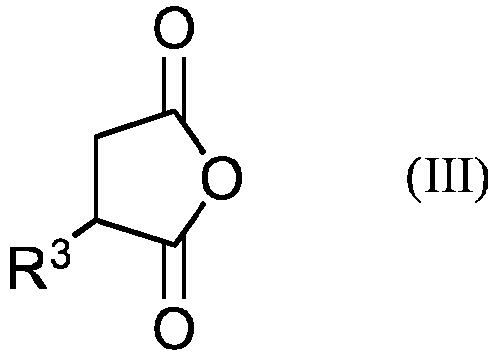
- the present disclosure provides methods of making lubricity additives comprising reacting an alkenyl succinic anhydride according to formula III: with a species according to formula IV: R 1 [(-O-R 2 ) n -NH 2 ] p (IV) wherein p is 3 or greater; each n is independently selected from integers equal to 2 or greater; R 1 is a C3-C20 aliphatic hydrocarbon group of valence p which is branched or linear and which is substituted or unsubstituted; each R 2 is independently selected from C2-C20 divalent aliphatic or aromatic hydrocarbon groups which are branched or linear and which are substituted or unsubstituted; and each R 3 is independently selected from C8-C60 alkenyl groups which are substituted or unsubstituted. Additional embodiments of the methods of the present disclosure are described below.
- Lubricity additives may be species according to formula I: R 1 [(-O-R 2 ) n -Q] p (I) wherein p is 3 or greater; wherein each n is independently selected from integers equal to 2 or greater; wherein R 1 is a C3-C20 aliphatic hydrocarbon group of valence p which is branched or linear and which is substituted or unsubstituted; wherein each R 2 is independently selected from C2-C20 divalent aliphatic or aromatic hydrocarbon groups which are branched or linear and which are substituted or unsubstituted; and wherein each Q is independently selected from -NH 2 or a moiety according to formula II: wherein each R 3 is independently selected from C8-C60 alkenyl groups which are substituted or unsubstituted, providing that at least one Q is the moiety according to formula II.
- p is 3 or p is 4.
- each n may be independently selected from integers equal to or greater than 2, 3, 4, 5, 6, 8, or 10. In any such embodiments, n optionally may be limited to not greater than 40, 30, 20, 15, 10, or 8.
- each R 2 may be independently selected from C2-C20 divalent aliphatic or aromatic hydrocarbon groups which are branched or linear and which are substituted or unsubstituted.
- each R 2 group may be independently selected from C2-C16 groups, C2-C12 groups, C2-C8 groups, C2-C6 groups, C2-C5 groups, C2-C4 groups, or C2-C3 groups.
- each R 2 group may be independently selected from -CH 2 CH 2 -, -CH(CH 3 )CH 2 -, -CH 2 CH(CH 3 )-, -CH 2 CH 2 CH 2 -, -CH(CH 3 )CH 2 CH 2 -, -CH 2 CH(CH 3 )CH 2 -, -CH 2 CH 2 CH(CH 3 ) -, or - CH(Ph)-CH 2 -.
- each R 3 may be independently selected from straight-chain, branched, or cyclic groups. Each R 3 may attach to the succinyl group of Formula II at a terminal carbon of the R 3 group, or may attach to the succinyl group at a non-terminal carbon of the R 3 group such that the R 3 group branches at that carbon.
- each R 3 group may be independently selected from C8-C60 alkenyl groups, C10-C60 alkenyl groups, C12-C60 alkenyl groups, C14-C60 alkenyl groups, C16-C60 alkenyl groups, C18-C60 alkenyl groups, C20-C60 alkenyl groups, C21-C60 alkenyl groups, C8-C50 alkenyl groups, C10-C50 alkenyl groups, C12-C50 alkenyl groups, C14-C50 alkenyl groups, C16-C50 alkenyl groups, C18-C50 alkenyl groups, C20-C50 alkenyl groups, C21-C50 alkenyl groups, C8-C40 alkenyl groups, C10-C40 alkenyl groups, C12-C40 alkenyl groups, C14-C40 alkenyl groups, C16-C40 alkenyl groups, C18-C40 alkenyl groups
- the present lubricity additives may be made by any suitable method.
- an alkenyl succinic anhydride (ASA) according to formula III: is reacted with a species according to formula IV: R 1 [(-O-R 2 ) n -NH 2 ] p (IV) wherein R 1 , R 2 , R 3 , n, and p are as described above.
- the species according to formula IV is a polyamine having p terminal amine groups and including polyether moieties represented by (-O-R 2 ) n .
- the alkenyl succinic anhydride (ASA) according to formula III may be made according to any suitable method.
- a selected olefin is reacted with maleic anhydride under inert atmosphere at elevated temperature, as described below in the Examples.
- the selected olefin may be present in a slight molar excess to minimize the formation of polymaleic anhydride.
- the olefin may be an alpha olefin or an internal olefin having a carbon-carbon double bond available for reaction.
- the selected olefin may be a single species of olefin or a mixture of species.
- the ASA may be reacted with the species according to formula IV by any suitable method.
- the two reactants are reacted under inert atmosphere at elevated temperature, as described below in the Examples.
- the ASA and the species according to formula IV may be present in the reaction mixture in a molar ratio of at least about 1: 1, at least about 1.5:1, at least about 2: 1, at least about 2.5:1, or at least about 3: 1.
- the reaction temperature is increased stepwise to provide amidation of ASA at lower temperatures, followed by ring closure to provide the corresponding imide groups at higher temperatures. Stepwise amidation and imidation was found to eliminate the formation of precipitates resulting from side-reactions.
- the present fuel additives may be provided neat or in solution.
- Certain fuel additives may be gels or solids at room temperature in the absence of solvent, leading to difficulty in handling and in blending with fuel.
- neat ASA/polyamine adducts are gels or solids at room temperature, depending on the length and the structure (e.g., branched or straight) of the alkenyl R groups.
- Formulations of these lubricity additives with as little as 10% solvent may remain liquid and stable (i.e., no gelation, precipitation, phase separation, or dramatic increase in viscosity) during prolonged storage at 10°C.
- Any suitable common solvent may be used.
- the solvent is an aromatic solvent such as heavy aromatic naphtha.
- Formulations of these lubricity additives with 20% solvent, 30% solvent, or 50% solvent may demonstrate low viscosity at sub-zero (centigrade) temperatures and excellent performance as lubricity additives.
- the present disclosure additionally provides fuel mixtures comprising a hydrocarbon fuel and a lubricity additive according to the present disclosure.
- a hydrocarbon fuel may be a middle distillate fuel, a bio-sourced fuel, or a diesel fuel.
- the fuel mixture may additionally comprise other additives such as one or more of dispersants, antioxidants, viscosity index modifiers, corrosion inhibitors, and the like.
- Ethylenediamine CAS 107-15-3 , obtained from Aldrich under the designation 1,2-Ethylenediamine (EDA).
- diaminopropane Diaminopropane, CAS 109-76-2 , obtained from Aldrich under the designation 1,3-Diaminopropane.
- diaminohexane Diaminohexane, CAS 124-09-4 , obtained from Aldrich under the designation 1,6-diaminohexane.
- i-octadecenylsuccinicanhydride iODSA
- Polyamine T-403 or comparative polyamines ethylenediamine, 1,3-diaminopropane, or 1,6-diaminohexane was then charged to the well-stirred reaction mixture in a 2:1 ASA/polyamine molar ratio.
- the resulting mixture was heated gradually to 120 °C with nitrogen blanketing, then heated up to 150 °C with nitrogen purging, and stirred at 150 °C with nitrogen purging for 3 to 5 hours or until completion of the reaction to result in the desired product.
- a portion of the product was formulated to 70% or 80% actives by weight with heavy aromatic naphtha solvent in a glass jar, and the formulated product was put in a 6 to 8 °C fridge for at least 7 days for a product storage stability test. After finishing and passing the product stability test, the formulated product was used for lubricity performance evaluation (HFRR test).
- HFRR testing was performed in accordance with ASTM D6079 Standard Test Method for Evaluating Lubricity of Diesel Fuels by the High-Frequency Reciprocating Rig (HFRR).
- Table I reports HFRR results demonstrating lubricity improvement (smaller wear scar) with the use of the iODSA/ T-403 adduct (Example 1) than with the use of comparative iODSA/diamine adducts (Comparative Examples C3-C5) or no additive (Comparative Example C2). All additive formulations were 80% by weight additive in heavy aromatic naphtha. The indicated additive formulation was used to treat ULSD fuels at a concentration of 200 ppm (inclusive of additive and solvent in the additive formulation) and tested in accordance with the HFRR Test Method.
Landscapes
- Chemical & Material Sciences (AREA)
- Organic Chemistry (AREA)
- Oil, Petroleum & Natural Gas (AREA)
- Engineering & Computer Science (AREA)
- Combustion & Propulsion (AREA)
- Chemical Kinetics & Catalysis (AREA)
- General Chemical & Material Sciences (AREA)
- Lubricants (AREA)
- Liquid Carbonaceous Fuels (AREA)
- Organic Low-Molecular-Weight Compounds And Preparation Thereof (AREA)
Abstract
R1[(-0-R2)n-Q]p (I)
wherein p is 3 or greater; each n is independently selected from integers equal to 2 or greater; R1 is a C3-C20 aliphatic hydrocarbon group of valence p which is branched or linear and which is substituted or unsubstituted; each R2 is independently selected from C2-C20 divalent aliphatic or aromatic hydrocarbon groups which are branched or linear and which are substituted or unsubstituted; and each Q is independently selected from -NH2 or a moiety according to formula II herein, wherein each R3 of formula II is independently selected from C8-C60 alkenyl groups which are substituted or unsubstituted, providing that at least one Q is the moiety according to formula II.
Description
- This application claims the benefit of
U.S. Provisional Patent Application Serial Number 63/188,095, filed May 13, 2021 - This disclosure relates to lubricity additives for hydrocarbon fuels, including adducts of alkenyl succinic anhydrides (ASA's) and certain polyamines which include polyether moieties.
- Refiners utilize intensive fuel processing in order to meet the stringent government mandates limiting permissible levels of sulfur in finished fuels. At present in the United States, the maximum specification for ultra-low sulfur diesel (ULSD) is 15 ppm. USLD is the on-road diesel fuel in the US. Unfortunately, this intensive processing also eliminates trace oxygen and nitrogen compounds that contribute to the fuel's inherent lubricity. Hence ULSD is known to be less lubricating if not treated with lubricity improving additives. Lubrication is vital in preventing wear in fuel delivery systems, particularly in pumps, high pressure pumps, and injectors.
- The majority of commercial lubricity additives are based on fatty acids of natural origin such as vegetable oils or plant oils, such as tall oil fatty acids (TOFA). As such, these lubricity additives are subjected to supply and cost constraints due to the inherent price volatility of these raw materials. Moreover, variabilities in qualities and properties of vegetable and plant-based oils in various regions create product quality inconsistencies. Hence, the development of 100% synthetic-based lubricity additives holds the potential to ease supply chain challenges, avoid significant raw material cost fluctuations, and ensure consistent product quality.
- In addition to lubricity additives, hydrocarbon fuels such as diesel fuel may be formulated with additives to modify other characteristics of the fuel and its performance in an engine. Such additives may include dispersants, antioxidants, viscosity index modifiers, corrosion inhibitors, and the like.
-
US 7,361,629 concerns a composition for use as an additive for fuels and lubricants that includes an amination product of a hydrocarbyl substituted succinic acylating agent and polyamines.US 7,361,629 teaches the use of this additive as a dispersant to maintain impurities and deposits in a suspended state so that they can be removed from the system by filtration or other means rather than being deposited on internal engine components. -
US 5,551,957 concerns a fuel additive concentrate for use as a detergent/dispersant. The fuel additive concentrate includes a fuel-solub1e product formed by reaction between (a) at least one polyamine and (b) at least one acyclic hydrocarbyl-substituted succinic acylating agent. - Briefly, the present disclosure provides lubricity additives according to formula I:
R1[(-O-R2)n-Q]p (I)
wherein p is 3 or greater; each n is independently selected from integers equal to 2 or greater; R1 is a C3-C20 aliphatic hydrocarbon group of valence p which is branched or linear and which is substituted or unsubstituted; each R2 is independently selected from C2-C20 divalent aliphatic or aromatic hydrocarbon groups which are branched or linear and which are substituted or unsubstituted; and each Q is independently selected from -NH2 or a moiety according to formula II:
- In another aspect, the present disclosure provides fuel mixtures comprising a hydrocarbon fuel; and a lubricity additive according to the present disclosure. In various embodiments the hydrocarbon fuel may be a middle distillate fuel, derived from petroleum or biobased feedstock. Additional embodiments of the fuel mixtures of the present disclosure are described below.
- In another aspect, the present disclosure provides methods of making lubricity additives comprising reacting an alkenyl succinic anhydride according to formula III:
R1[(-O-R2)n-NH2]p (IV)
wherein p is 3 or greater; each n is independently selected from integers equal to 2 or greater; R1 is a C3-C20 aliphatic hydrocarbon group of valence p which is branched or linear and which is substituted or unsubstituted; each R2 is independently selected from C2-C20 divalent aliphatic or aromatic hydrocarbon groups which are branched or linear and which are substituted or unsubstituted; and each R3 is independently selected from C8-C60 alkenyl groups which are substituted or unsubstituted. Additional embodiments of the methods of the present disclosure are described below. - The preceding summary of the present disclosure is not intended to describe each embodiment of the present invention. The details of one or more embodiments of the invention are also set forth in the description below. Other features, objects, and advantages of the invention will be apparent from the description and from the claims.
- In this application:
- "common solvents" refers to low molecular weight organic liquids commonly used as solvents by practitioners in the art, which may include aliphatic and alicyclic hydrocarbons (e.g., hexane, heptane, and cyclohexane), aromatic solvents (e.g., benzene, toluene, xylene, and mixtures of heavy aromatic naphtha), ethers (e.g., diethyl ether, glyme, diglyme, diisopropyl ether, and tetrahydrofuran), esters (e.g., ethyl acetate and butyl acetate), alcohols (e.g., ethanol and isopropyl alcohol), ketones (e.g., acetone, methyl ethyl ketone, and methyl isobutyl ketone), sulfoxides (e.g., dimethyl sulfoxide), amides (e.g., N,N-dimethylformamide, N,N-dimethylacetamide, and N-methyl-2-pyrrolidone), halogenated solvents (e.g., methylchloroform, 1,1,2-trichloro-1,2,2-trifluoroethane, trichloroethylene, and trifluorotoluene), and mixtures thereof; and
- "substituted" means, for a chemical species, group or moiety, substituted by conventional substituents which do not interfere with the desired product or process, e.g., substituents can be alkyl, alkoxy, aryl, phenyl, halo (F, Cl, Br, I), cyano, nitro, etc.
- All scientific and technical terms used herein have meanings commonly used in the art unless otherwise specified. All chemical formulas used herein are intended to include all enantiomers or stereoisomers unless otherwise specified.
- As used in this specification and the appended claims, the singular forms "a", "an", and "the" encompass embodiments having plural referents, unless the content clearly dictates otherwise.
- As used in this specification and the appended claims, the term "or" is generally employed in its sense including "and/or" unless the content clearly dictates otherwise.
- As used herein, "have", "having", "include", "including", "comprise", "comprising" or the like are used in their open ended sense, and generally mean "including, but not limited to." It will be understood that the terms "consisting of" and "consisting essentially of" are subsumed in the term "comprising," and the like.
- The present disclosure provides synthetic lubricity additives for hydrocarbon fuels such as diesel fuel. Lubricity additives may be species according to formula I:
R1[(-O-R2)n-Q]p (I)
wherein p is 3 or greater; wherein each n is independently selected from integers equal to 2 or greater; wherein R1 is a C3-C20 aliphatic hydrocarbon group of valence p which is branched or linear and which is substituted or unsubstituted; wherein each R2 is independently selected from C2-C20 divalent aliphatic or aromatic hydrocarbon groups which are branched or linear and which are substituted or unsubstituted; and wherein each Q is independently selected from -NH2 or a moiety according to formula II:
- In some embodiments, p is 3 or p is 4.
- In various embodiments, each n may be independently selected from integers equal to or greater than 2, 3, 4, 5, 6, 8, or 10. In any such embodiments, n optionally may be limited to not greater than 40, 30, 20, 15, 10, or 8.
- In some embodiments, R1 may be selected from straight-chain, branched, or cyclic aliphatic hydrocarbon groups of valence p. In various embodiments, R1 may be selected from C3-C20 groups, C3-C16 groups, C3-C12 groups, C3-C8 groups, C4-C20 groups, C4-C16 groups, C4-C12 groups, C4-C8 groups, C5-C20 groups, C5-C16 groups, C5-C12 groups, C5-C8 groups, C6-C20 groups, C6-C16 groups, C6-C12 groups, or C6-C8 groups.
- In various embodiments, each R2 may be independently selected from C2-C20 divalent aliphatic or aromatic hydrocarbon groups which are branched or linear and which are substituted or unsubstituted. In various embodiments, each R2 group may be independently selected from C2-C16 groups, C2-C12 groups, C2-C8 groups, C2-C6 groups, C2-C5 groups, C2-C4 groups, or C2-C3 groups. In some embodiments, each R2 group may be independently selected from -CH2CH2-, -CH(CH3)CH2-, -CH2CH(CH3)-, -CH2CH2CH2-, -CH(CH3)CH2CH2-, -CH2CH(CH3)CH2-, -CH2CH2CH(CH3) -, or - CH(Ph)-CH2-.
- In various embodiments, each R3 may be independently selected from straight-chain, branched, or cyclic groups. Each R3 may attach to the succinyl group of Formula II at a terminal carbon of the R3 group, or may attach to the succinyl group at a non-terminal carbon of the R3 group such that the R3 group branches at that carbon. In various embodiments, each R3 group may be independently selected from C8-C60 alkenyl groups, C10-C60 alkenyl groups, C12-C60 alkenyl groups, C14-C60 alkenyl groups, C16-C60 alkenyl groups, C18-C60 alkenyl groups, C20-C60 alkenyl groups, C21-C60 alkenyl groups, C8-C50 alkenyl groups, C10-C50 alkenyl groups, C12-C50 alkenyl groups, C14-C50 alkenyl groups, C16-C50 alkenyl groups, C18-C50 alkenyl groups, C20-C50 alkenyl groups, C21-C50 alkenyl groups, C8-C40 alkenyl groups, C10-C40 alkenyl groups, C12-C40 alkenyl groups, C14-C40 alkenyl groups, C16-C40 alkenyl groups, C18-C40 alkenyl groups, C20-C40 alkenyl groups, C21-C40 alkenyl groups, C8-C32 alkenyl groups, C10-C32 alkenyl groups, C12-C32 alkenyl groups, C14-C32 alkenyl groups, C16-C32 alkenyl groups, C18-C32 alkenyl groups, C20-C32 alkenyl groups, C21-C32 alkenyl groups, C8-C28 alkenyl groups, C10-C28 alkenyl groups, C12-C28 alkenyl groups, C14-C28 alkenyl groups, C16-C28 alkenyl groups, C18-C28 alkenyl groups, C20-C28 alkenyl groups, C21-C28 alkenyl groups, C8-C24 alkenyl groups, C10-C24 alkenyl groups, C12-C24 alkenyl groups, C14-C24 alkenyl groups, C16-C24 alkenyl groups, C18-C24 alkenyl groups, C20-C24 alkenyl groups, or C21-C24 alkenyl groups. Among lubricity additives according to the present disclosure having R3 groups in the range of C12-C24, it is believed that the longer-chain R3 groups may provide more effective lubricity additives.
- The present lubricity additives may be made by any suitable method. In one method, an alkenyl succinic anhydride (ASA) according to formula III:

R1[(-O-R2)n-NH2]p (IV)
wherein R1, R2, R3, n, and p are as described above. The species according to formula IV is a polyamine having p terminal amine groups and including polyether moieties represented by (-O-R2)n. - The alkenyl succinic anhydride (ASA) according to formula III may be made according to any suitable method. In one embodiment, a selected olefin is reacted with maleic anhydride under inert atmosphere at elevated temperature, as described below in the Examples. The selected olefin may be present in a slight molar excess to minimize the formation of polymaleic anhydride. The olefin may be an alpha olefin or an internal olefin having a carbon-carbon double bond available for reaction. The selected olefin may be a single species of olefin or a mixture of species.
- The ASA may be reacted with the species according to formula IV by any suitable method. In one embodiment, the two reactants are reacted under inert atmosphere at elevated temperature, as described below in the Examples. The ASA and the species according to formula IV may be present in the reaction mixture in a molar ratio of at least about 1: 1, at least about 1.5:1, at least about 2: 1, at least about 2.5:1, or at least about 3: 1. Typically the ASA and the species according to formula IV are present in the reaction mixture in a molar ratio of about 2:1. In one embodiment, the reaction temperature is increased stepwise to provide amidation of ASA at lower temperatures, followed by ring closure to provide the corresponding imide groups at higher temperatures. Stepwise amidation and imidation was found to eliminate the formation of precipitates resulting from side-reactions.
- The present fuel additives may be provided neat or in solution. Certain fuel additives may be gels or solids at room temperature in the absence of solvent, leading to difficulty in handling and in blending with fuel. For example, neat ASA/polyamine adducts are gels or solids at room temperature, depending on the length and the structure (e.g., branched or straight) of the alkenyl R groups. Formulations of these lubricity additives with as little as 10% solvent may remain liquid and stable (i.e., no gelation, precipitation, phase separation, or dramatic increase in viscosity) during prolonged storage at 10°C. Any suitable common solvent may be used. In some embodiments, the solvent is an aromatic solvent such as heavy aromatic naphtha. Greater dilution may result in reduced viscosity and therefore improved pumpability at lower temperatures. Formulations of these lubricity additives with 20% solvent, 30% solvent, or 50% solvent may demonstrate low viscosity at sub-zero (centigrade) temperatures and excellent performance as lubricity additives.
- The present disclosure additionally provides fuel mixtures comprising a hydrocarbon fuel and a lubricity additive according to the present disclosure. Any suitable fuel may be used. In various embodiments, the hydrocarbon fuel may be a middle distillate fuel, a bio-sourced fuel, or a diesel fuel. The fuel mixture may additionally comprise other additives such as one or more of dispersants, antioxidants, viscosity index modifiers, corrosion inhibitors, and the like.
- Additional embodiments are recited in the Selected Embodiments and Examples below.
- The following embodiments, designated by letter and number, are intended to further illustrate the present disclosure but should not be construed to unduly limit this disclosure.
- A1. A lubricity additive according to formula I:
R1[(-O-R2)n-Q]p (I)
- wherein p is 3 or greater;
- wherein each n is independently selected from integers equal to 2 or greater;
- wherein R1 is a C3-C20 aliphatic hydrocarbon group of valence p which is branched or linear and which is substituted or unsubstituted;
- wherein each R2 is independently selected from C2-C20 divalent aliphatic or aromatic hydrocarbon groups which are branched or linear and which are substituted or unsubstituted; and
- wherein each Q is independently selected from -NH2 or a moiety according to formula II:

- wherein each R3 is independently selected from C8-C60 alkenyl groups which are substituted or unsubstituted,
- providing that at least one Q is the moiety according to formula II.
- A2. A lubricity additive according to embodiment A1 wherein at least two Q's are moieties according to formula II.
- A3. A lubricity additive according to embodiment A1 wherein two Q's are moieties according to formula II and one Q is -NH2.
- A4. A lubricity additive according to any of embodiments A1-A3 or wherein p is 3 or 4.
- A5. A lubricity additive according to any of embodiments A1-A3 wherein p is 3.
- A6. A lubricity additive according to any of embodiments A1-A5 wherein each n is independently selected from integers from 2-40 inclusive.
- A7. A lubricity additive according to any of embodiments A1-A5 wherein each n is independently selected from integers from 2-20 inclusive.
- A8. A lubricity additive according to any of embodiments A1-A5 wherein each n is independently selected from integers from 2-8 inclusive.
- A9. A lubricity additive according to any of embodiments A1-A5 wherein each n is independently selected from integers from 4-40 inclusive.
- A10. A lubricity additive according to any of embodiments A1-A5 wherein each n is independently selected from integers from 4-20 inclusive.
- A11. A lubricity additive according to any of embodiments A1-A5 wherein each n is independently selected from integers from 4-8 inclusive.
- A12. A lubricity additive according to any of embodiments A1-A11 wherein each R2 is independently selected from C2-C6 divalent aliphatic hydrocarbon groups which are branched or linear and which are substituted or unsubstituted.
- A13. A lubricity additive according to any of embodiments A1-A11 wherein each R2 is independently selected from C2-C4 divalent aliphatic hydrocarbon groups which are branched or linear and which are substituted or unsubstituted.
- A14. A lubricity additive according to any of embodiments A1-A11 wherein each R2 is independently selected from C2-C3 divalent aliphatic hydrocarbon groups which are branched or linear and which are substituted or unsubstituted.
- A15. A lubricity additive according to any of embodiments A1-A11 wherein each R2 is independently selected from the group consisting of -CH2CH2-, -CH(CH3)CH2-, -CH2CH(CH3)-, and -CH(Ph)-CH2-.
- A16. A lubricity additive according to any of embodiments A1-A11 wherein each R2 is independently selected from the group consisting of -CH2CH2-, -CH(CH3)CH2-, and -CH2CH(CH3)-.
- A17. A lubricity additive according to any of embodiments A1-A11 wherein each R2 is - CH(Ph)-CH2-.
- A18. A lubricity additive according to any of embodiments A1-A11 wherein each R2 is independently selected from the group consisting of -CH(CH3)CH2- and -CH2CH(CH3)-.
- A19. A lubricity additive according to any of embodiments A1-A18 wherein R1 is selected from C3-C12 aliphatic hydrocarbon groups of valence p which are branched or linear and which are substituted or unsubstituted.
- A20. A lubricity additive according to any of embodiments A1-A18 wherein R1 is selected from C3-C6 aliphatic hydrocarbon groups of valence p which are branched or linear and which are substituted or unsubstituted.
- F1. A fuel mixture comprising:
- a) a hydrocarbon fuel; and
- b) a lubricity additive according to any of embodiments 1-14.
- F2. A fuel mixture according to embodiment F1 wherein the hydrocarbon fuel is a middle distillate fuel.
- F3. A fuel mixture according to embodiment F1 wherein the hydrocarbon fuel is a diesel fuel.
- F4. A fuel mixture according to embodiment F1 wherein the hydrocarbon fuel is a diesel fuel derived from petroleum or biobased feedstock.
- F5. A fuel mixture according to embodiment F1 wherein the hydrocarbon fuel is a bio-based fuel.
- M1. A method of making a lubricity additive comprising reacting an alkenyl succinic anhydride according to formula III:

R1[(-O-R2)n-NH2]p (IV)
- wherein p is 3 or greater;
- wherein each n is independently selected from integers equal to 2 or greater;
- wherein R1 is a C3-C20 aliphatic hydrocarbon group of valence p which is branched or linear and which is substituted or unsubstituted;
- wherein each R2 is independently selected from C2-C20 divalent aliphatic or aromatic hydrocarbon groups which are branched or linear and which are substituted or unsubstituted; and
- wherein each R3 is independently selected from C8-C60 alkenyl groups which are substituted or unsubstituted.
- M2. A method according to embodiment M1 wherein the alkenyl succinic anhydride according to formula III is reacted with the species according to formula IV at a molar ratio of at least about 1:1.
- M3. A method according to embodiment M1 wherein the alkenyl succinic anhydride according to formula III is reacted with the species according to formula IV at a molar ratio of at least about 2:1.
- M4. A method according to any of embodiments M1-M3 or wherein p is 3 or 4.
- M5. A method according to any of embodiments M1-M3 wherein p is 3.
- M6. A method according to any of embodiments M1-M5 wherein each n is independently selected from integers from 2-40 inclusive.
- M7. A method according to any of embodiments M1-M5 wherein each n is independently selected from integers from 2-20 inclusive.
- M8. A method according to any of embodiments M1-M5 wherein each n is independently selected from integers from 2-8 inclusive.
- M9. A method according to any of embodiments M1-M5 wherein each n is independently selected from integers from 4-40 inclusive.
- M10. A method according to any of embodiments M1-M5 wherein each n is independently selected from integers from 4-20 inclusive.
- M11. A method according to any of embodiments M1-M5 wherein each n is independently selected from integers from 4-8 inclusive.
- M12. A method according to any of embodiments M1-M11 wherein each R2 is independently selected from C2-C6 divalent aliphatic hydrocarbon groups which are branched or linear and which are substituted or unsubstituted.
- M13. A method according to any of embodiments M1-M11 wherein each R2 is independently selected from C2-C4 divalent aliphatic hydrocarbon groups which are branched or linear and which are substituted or unsubstituted.
- M14. A method according to any of embodiments M1-M11 wherein each R2 is independently selected from C2-C3 divalent aliphatic hydrocarbon groups which are branched or linear and which are substituted or unsubstituted.
- M15. A method according to any of embodiments M1-M11 wherein each R2 is independently selected from the group consisting of -CH2CH2-, -CH(CH3)CH2-, -CH2CH(CH3)-, and -CH(Ph)-CH2-.
- M16. A method according to any of embodiments M1-M11 wherein each R2 is independently selected from the group consisting of -CH2CH2-, -CH(CH3)CH2-, and -CH2CH(CH3)-.
- M17. A method according to any of embodiments M1-M11 wherein each R2 is -CH(Ph)-CH2-.
- M18. A method according to any of embodiments M1-M11 wherein each R2 is independently selected from the group consisting of -CH(CH3)CH2- and -CH2CH(CH3)-.
- M19. A method according to any of embodiments M1-M18 wherein R1 is selected from C3-C12 aliphatic hydrocarbon groups of valence p which are branched or linear and which are substituted or unsubstituted.
- M20. A method according to any of embodiments M1-M18 wherein R1 is selected from C3-C6 aliphatic hydrocarbon groups of valence p which are branched or linear and which are substituted or unsubstituted.
- M21. A method according to any of embodiments M1-M20 wherein the lubricity additive is a lubricity additive according to any of embodiments A1-A14.
- Objects and advantages of this disclosure are further illustrated by the following examples, but the particular materials and amounts thereof recited in these examples, as well as other conditions and details, should not be construed to unduly limit this disclosure.
- Unless otherwise noted, all reagents were obtained or are available from Aldrich Chemical Co., Milwaukee, WI, (Aldrich) or may be synthesized by known methods.
- All parts, percentages, ratios, etc. in the examples and the rest of the specification are by weight, unless noted otherwise. The following abbreviations may be used: m = meters; cm = centimeters; mm = millimeters; um = micrometers; ft = feet; in = inch; RPM = revolutions per minute; kg = kilograms; oz = ounces; lb = pounds; Pa = Pascals; sec = seconds; min = minutes; hr = hours; and RH = relative humidity. The terms "weight %", "% by weight", and "wt%" are used interchangeably.
-
Designation Description heavy aromatic naphtha heavy aromatic naphtha obtained from ExxonMobil Chemical, USA, under the brand name SOLVESSO™ 150. i-octadecenyl-succinicanhydride (iODSA) i-Octadecenyl-succinicanhydride obtained from Dixie Chemical Company, USA, under designation ODSA. T-403 Trimethylolpropane tris[poly(propylene glycol), amine terminated] ether, CAS 39423-51-3, obtained from Aldrich under the chemical trade name Jeffamine® T-403 Polyetheramine. ethylenediamine Ethylenediamine, CAS 107-15-3, obtained from Aldrich under the designation 1,2-Ethylenediamine (EDA). diaminopropane Diaminopropane, CAS 109-76-2, obtained from Aldrich under the designation 1,3-Diaminopropane. diaminohexane Diaminohexane, CAS 124-09-4, obtained from Aldrich under the designation 1,6-diaminohexane. ULSD Ultra-Low Sulfur Diesel fuel, Winter Export formulation. - To a 250 mL three-necked round-bottom flask equipped with a temperature probe, nitrogen inlet, Dean-Stark apparatus, condenser and magnetic stir bar was added i-octadecenylsuccinicanhydride (iODSA) via one of the necks. Polyamine (T-403 or comparative polyamines ethylenediamine, 1,3-diaminopropane, or 1,6-diaminohexane) was then charged to the well-stirred reaction mixture in a 2:1 ASA/polyamine molar ratio. The resulting mixture was heated gradually to 120 °C with nitrogen blanketing, then heated up to 150 °C with nitrogen purging, and stirred at 150 °C with nitrogen purging for 3 to 5 hours or until completion of the reaction to result in the desired product. A portion of the product was formulated to 70% or 80% actives by weight with heavy aromatic naphtha solvent in a glass jar, and the formulated product was put in a 6 to 8 °C fridge for at least 7 days for a product storage stability test. After finishing and passing the product stability test, the formulated product was used for lubricity performance evaluation (HFRR test).
- HFRR testing was performed in accordance with ASTM D6079 Standard Test Method for Evaluating Lubricity of Diesel Fuels by the High-Frequency Reciprocating Rig (HFRR).
- Table I reports HFRR results demonstrating lubricity improvement (smaller wear scar) with the use of the iODSA/ T-403 adduct (Example 1) than with the use of comparative iODSA/diamine adducts (Comparative Examples C3-C5) or no additive (Comparative Example C2). All additive formulations were 80% by weight additive in heavy aromatic naphtha. The indicated additive formulation was used to treat ULSD fuels at a concentration of 200 ppm (inclusive of additive and solvent in the additive formulation) and tested in accordance with the HFRR Test Method.
Table I Example Adduct (200 ppm) Wear Scar (µm) 1 iODSA/ T-403 429 2C -none- 558 3C iODSA/ethylenediamine 597 4C iODSA/diaminopropane 537 5C iODSA/diaminohexane 554 - Various modifications and alterations of this disclosure will become apparent to those skilled in the art without departing from the scope and principles of this disclosure, and it should be understood that this disclosure is not to be unduly limited to the illustrative embodiments set forth hereinabove.
-
- 1. A lubricity additive according to formula I:
R1[(-O-R2)n-Q]p (I)
- wherein p is 3 or greater;
- wherein each n is independently selected from integers equal to 2 or greater;
- wherein R1 is a C3-C20 aliphatic hydrocarbon group of valence p which is branched or linear and which is substituted or unsubstituted;
- wherein each R2 is independently selected from C2-C20 divalent aliphatic or aromatic hydrocarbon groups which are branched or linear and which are substituted or unsubstituted; and
- wherein each Q is independently selected from -NH2 or a moiety according to formula II:

- wherein each R3 is independently selected from C8-C60 alkenyl groups which are substituted or unsubstituted,
- providing that at least one Q is the moiety according to formula II.
- 2. A lubricity additive according to aspect 1 wherein at least two Q's are moieties according to formula II.
- 3. A lubricity additive according to any of aspects 1-2 or wherein p is 3 or 4.
- 4. A lubricity additive according to any of aspects 1-2 wherein p is 3.
- 5. A lubricity additive according to any of aspects 1-4 wherein each n is independently selected from integers from 2-40 inclusive.
- 6. A lubricity additive according to any of aspects 1-4 wherein each n is independently selected from integers from 2-20 inclusive.
- 7. A lubricity additive according to any of aspects 1-4 wherein each n is independently selected from integers from 2-8 inclusive.
- 8. A lubricity additive according to any of aspects 1-7 wherein each R2 is independently selected from C2-C6 divalent aliphatic hydrocarbon groups which are branched or linear and which are substituted or unsubstituted.
- 9. A lubricity additive according to any of aspects 1-7 wherein each R2 is independently selected from C2-C4 divalent aliphatic hydrocarbon groups which are branched or linear and which are substituted or unsubstituted.
- 10. A lubricity additive according to any of aspects 1-7 wherein each R2 is independently selected from C2-C3 divalent aliphatic hydrocarbon groups which are branched or linear and which are substituted or unsubstituted.
- 11. A lubricity additive according to any of aspects 1-7 wherein each R2 is independently selected from the group consisting of -CH2CH2-, -CH(CH3)CH2-, -CH2CH(CH3)-, and -CH(Ph)-CH2-.
- 12. A lubricity additive according to any of aspects 1-7 wherein each R2 is independently selected from the group consisting of -CH(CH3)CH2- and -CH2CH(CH3)-.
- 13. A lubricity additive according to any of aspects 1-12 wherein R1 is selected from C3-C12 aliphatic hydrocarbon groups of valence p which are branched or linear and which are substituted or unsubstituted.
- 14. A lubricity additive according to any of aspects 1-12 wherein R1 is selected from C3-C6 aliphatic hydrocarbon groups of valence p which are branched or linear and which are substituted or unsubstituted.
- 15. A fuel mixture comprising:
- a) a hydrocarbon fuel; and
- b) a lubricity additive according to any of aspects 1-14.
- 16. A fuel mixture according to aspect 15 wherein the hydrocarbon fuel is a middle distillate fuel.
- 17. A fuel mixture according to aspect 15 wherein the hydrocarbon fuel is a diesel fuel derived from petroleum or biobased feedstock.
- 18. A method of making a lubricity additive comprising reacting an alkenyl succinic anhydride according to formula III:

R1[(-O-R2)n-NH2]p (IV)
- wherein p is 3 or greater;
- wherein each n is independently selected from integers equal to 2 or greater;
- wherein R1 is a C3-C20 aliphatic hydrocarbon group of valence p which is branched or linear and which is substituted or unsubstituted;
- wherein each R2 is independently selected from C2-C20 divalent aliphatic or aromatic hydrocarbon groups which are branched or linear and which are substituted or unsubstituted; and
- wherein each R3 is independently selected from C8-C60 alkenyl groups which are substituted or unsubstituted.
- 19. A method according to claim 18 wherein the lubricity additive is a lubricity additive according to any of aspects 1-17.
Claims (11)
- A method of improving fuel lubricity performance comprising adding to a hydrocarbon fuel a lubricity additive according to formula (I):
R1[(-O-R2)n-Q]p (I)
wherein p is 3 or greater;wherein each n is independently selected from integers equal to 2 or greater;wherein R1 is a C3-C20 aliphatic hydrocarbon group of valence p which is branched or linear and which is substituted or unsubstituted;wherein each R2 is independently selected from C2-C20 divalent aliphatic or aromatic hydrocarbon groups which are branched or linear and which are substituted or unsubstituted; andwherein each Q is independently selected from -NH2 or a moiety according to formula II: wherein each R3 is independently selected from C14-C60 alkenyl groups which are substituted or unsubstituted,providing that at least one Q is the moiety according to formula (II).
 - The method according to claim 1 wherein at least two Q's are moieties according to formula II.
- The method according to any one of claims 1 to 2 or wherein p is 3 or 4 preferably wherein p is 3.
- The method according to any one of claims 1 to 3 wherein each n is independently selected from integers from 2-40 inclusive preferably wherein each n is independently selected from integers from 2-20 inclusive, more preferably wherein each n is independently selected from integers from 2-8 inclusive.
- The method according to any one of claims 1 to 4 wherein each R2 is independently selected from C2-C6 divalent aliphatic hydrocarbon groups which are branched or linear and which are substituted or unsubstituted, preferably wherein each R2 is independently selected from C2-C4 divalent aliphatic hydrocarbon groups which are branched or linear and which are substituted or unsubstituted more preferably wherein each R2 is independently selected from C2-C3 divalent aliphatic hydrocarbon groups which are branched or linear and which are substituted or unsubstituted.
- The method according to any one of claims 1 to 4 wherein each R2 is independently selected from the group consisting of -CH2CH2-, -CH(CH3)CH2-, -CH2CH(CH3)-, and -CH(Ph)-CH2-, preferably wherein each R2 is independently selected from the group consisting of -CH(CH3)CH2- and -CH2CH(CH3)-.
- The method according to any one of claims 1 to 6 wherein R1 is selected from C3-C12 aliphatic hydrocarbon groups of valence p which are branched or linear and which are substituted or unsubstituted, preferably wherein R1 is selected from C3-C6 aliphatic hydrocarbon groups of valence p which are branched or linear and which are substituted or unsubstituted.
- The method according to any one of claims 1 to 7 wherein the hydrocarbon fuel is a middle distillate fuel.
- The method according to any one of claims 1 to 7 wherein the hydrocarbon fuel is a diesel fuel, preferably wherein the hydrocarbon fuel is an ultra-low sulfur diesel fuel.
- The method according to any one of claims 1 to 7 wherein the hydrocarbon fuel is a diesel fuel derived from petroleum or biobased feedstock.
- The method according to any one of claims 1 to 7 wherein the hydrocarbon fuel is a bio-based fuel.
Applications Claiming Priority (3)
| Application Number | Priority Date | Filing Date | Title |
|---|---|---|---|
| US202163188095P | 2021-05-13 | 2021-05-13 | |
| EP22734391.0A EP4337748B1 (en) | 2021-05-13 | 2022-05-13 | Synthetic lubricity additives for hydrocarbon fuels |
| PCT/US2022/029166 WO2022241203A1 (en) | 2021-05-13 | 2022-05-13 | Synthetic lubricity additives for hydrocarbon fuels |
Related Parent Applications (1)
| Application Number | Title | Priority Date | Filing Date |
|---|---|---|---|
| EP22734391.0A Division EP4337748B1 (en) | 2021-05-13 | 2022-05-13 | Synthetic lubricity additives for hydrocarbon fuels |
Publications (2)
| Publication Number | Publication Date |
|---|---|
| EP4516884A2 true EP4516884A2 (en) | 2025-03-05 |
| EP4516884A3 EP4516884A3 (en) | 2025-03-26 |
Family
ID=82258217
Family Applications (2)
| Application Number | Title | Priority Date | Filing Date |
|---|---|---|---|
| EP25151670.4A Pending EP4516884A3 (en) | 2021-05-13 | 2022-05-13 | Synthetic lubricity additives for hydrocarbon fuels |
| EP22734391.0A Active EP4337748B1 (en) | 2021-05-13 | 2022-05-13 | Synthetic lubricity additives for hydrocarbon fuels |
Family Applications After (1)
| Application Number | Title | Priority Date | Filing Date |
|---|---|---|---|
| EP22734391.0A Active EP4337748B1 (en) | 2021-05-13 | 2022-05-13 | Synthetic lubricity additives for hydrocarbon fuels |
Country Status (5)
| Country | Link |
|---|---|
| US (2) | US11746302B2 (en) |
| EP (2) | EP4516884A3 (en) |
| CA (1) | CA3217915A1 (en) |
| SA (1) | SA523451512B1 (en) |
| WO (1) | WO2022241203A1 (en) |
Citations (2)
| Publication number | Priority date | Publication date | Assignee | Title |
|---|---|---|---|---|
| US5551957A (en) | 1992-05-06 | 1996-09-03 | Ethyl Corporation | Compostions for control of induction system deposits |
| US7361629B2 (en) | 2004-03-10 | 2008-04-22 | Afton Chemical Corporation | Additives for lubricants and fuels |
Family Cites Families (22)
| Publication number | Priority date | Publication date | Assignee | Title |
|---|---|---|---|---|
| CA1048507A (en) | 1974-03-27 | 1979-02-13 | Jack Ryer | Additive useful in oleaginous compositions |
| US4240970A (en) | 1976-07-28 | 1980-12-23 | Mobil Oil Corporation | Reaction products of hydroxy aromatic or alkylphenylether compounds and alkenylsuccinic acid, anhydride, or ester |
| US5162526A (en) | 1976-09-24 | 1992-11-10 | Exxon Chemical Patents Inc. | Macrocyclic polyamine and polycyclic polyamine multifunctional lubricating oil |
| US4292186A (en) | 1979-12-04 | 1981-09-29 | Mobil Oil Corporation | Metal complexes of alkylsuccinic compounds as lubricant and fuel additives |
| FR2510598A1 (en) | 1981-07-30 | 1983-02-04 | Inst Francais Du Petrole | USE OF NITROGEN ADDITIVES AS DISORDERS OF HYDROCARBON MEDIUM DISTILLATE DISORDER POINT AND HYDROCARBON MEDIUM DISTILLATE COMPOSITIONS COMPRISING SUCH ADDITIVES |
| US4675374A (en) * | 1984-03-26 | 1987-06-23 | Gus Nichols | Solventless polymeric composition reaction product of (1) adduct of amine and acrylate with (2) polyacrylate |
| CA1262721A (en) * | 1985-07-11 | 1989-11-07 | Jacob Emert | Oil soluble dispersant additives useful in oleaginous compositions |
| FR2586255B1 (en) | 1985-08-14 | 1988-04-08 | Inst Francais Du Petrole | IMPROVED COMPOSITIONS OF DISPERSING ADDITIVES FOR LUBRICATING OILS AND THEIR PREPARATION |
| US5032145A (en) | 1987-04-20 | 1991-07-16 | Mobil Oil Corporation | Low temperature fluidity improver and compositions thereof |
| US5047160A (en) | 1988-02-29 | 1991-09-10 | Exxon Chemical Patents Inc. | Polyanhydride modified adducts or reactants and oleaginous compositions containing same |
| US4997456A (en) | 1989-09-11 | 1991-03-05 | Ethyl Petroleum Additives, Inc. | Fuel compositions |
| US5241003A (en) | 1990-05-17 | 1993-08-31 | Ethyl Petroleum Additives, Inc. | Ashless dispersants formed from substituted acylating agents and their production and use |
| US6419714B2 (en) | 1999-07-07 | 2002-07-16 | The Lubrizol Corporation | Emulsifier for an acqueous hydrocarbon fuel |
| EP1151994A1 (en) | 2000-05-01 | 2001-11-07 | Ethyl Corporation | Succinimide-acid compounds and derivatives thereof |
| US7182795B2 (en) * | 2002-03-13 | 2007-02-27 | Atton Chemical Intangibles Llc | Fuel lubricity additives derived from hydrocarbyl succinic anhydrides and hydroxy amines, and middle distillate fuels containing same |
| WO2003078552A2 (en) | 2002-03-14 | 2003-09-25 | The Lubrizol Corporation | Ethanol-diesel fuel composition and methods thereof |
| CA2535107A1 (en) | 2003-08-01 | 2005-02-10 | The Lubrizol Corporation | Mixed dispersants for lubricants |
| CN102307977A (en) | 2008-12-09 | 2012-01-04 | 卢布里佐尔公司 | Method of operating an engine using an ashless consumable lubricant |
| ES2690473T5 (en) | 2009-05-15 | 2021-07-12 | Lubrizol Corp | Quaternary ammonium amide salts |
| CA2816776A1 (en) | 2012-05-29 | 2013-11-29 | Tpc Group Llc | Adducts of low molecular weight pib with low polydispersity and high vinylidene content |
| US10260019B2 (en) | 2016-06-30 | 2019-04-16 | The Lubrizol Corporation | Hydroxyaromatic succinimide detergents for lubricating compositions |
| EP3504304A1 (en) * | 2016-08-25 | 2019-07-03 | Evonik Degussa GmbH | Amine alkenyl substituted succinimide reaction product fuel additives, compositions, and methods |
-
2022
- 2022-05-13 CA CA3217915A patent/CA3217915A1/en active Pending
- 2022-05-13 EP EP25151670.4A patent/EP4516884A3/en active Pending
- 2022-05-13 WO PCT/US2022/029166 patent/WO2022241203A1/en not_active Ceased
- 2022-05-13 US US17/744,229 patent/US11746302B2/en active Active
- 2022-05-13 EP EP22734391.0A patent/EP4337748B1/en active Active
-
2023
- 2023-07-19 US US18/223,694 patent/US12018222B2/en active Active
- 2023-11-13 SA SA523451512A patent/SA523451512B1/en unknown
Patent Citations (2)
| Publication number | Priority date | Publication date | Assignee | Title |
|---|---|---|---|---|
| US5551957A (en) | 1992-05-06 | 1996-09-03 | Ethyl Corporation | Compostions for control of induction system deposits |
| US7361629B2 (en) | 2004-03-10 | 2008-04-22 | Afton Chemical Corporation | Additives for lubricants and fuels |
Also Published As
| Publication number | Publication date |
|---|---|
| US20230365882A1 (en) | 2023-11-16 |
| EP4337748A1 (en) | 2024-03-20 |
| US12018222B2 (en) | 2024-06-25 |
| US20220364006A1 (en) | 2022-11-17 |
| EP4337748C0 (en) | 2025-02-12 |
| CA3217915A1 (en) | 2022-11-17 |
| EP4337748B1 (en) | 2025-02-12 |
| WO2022241203A1 (en) | 2022-11-17 |
| EP4516884A3 (en) | 2025-03-26 |
| US11746302B2 (en) | 2023-09-05 |
| SA523451512B1 (en) | 2025-05-15 |
Similar Documents
| Publication | Publication Date | Title |
|---|---|---|
| EP1991643B1 (en) | Use of polynuclear phenolic compounds as stabilisers | |
| US7704931B2 (en) | Lubricant compositions stabilized with multiple antioxidants | |
| EP3149126B1 (en) | Low molecular weight amide/ester containing quaternary ammonium salts | |
| US20090011961A1 (en) | Lubricant compositions stabilized with styrenated phenolic antioxidant | |
| CA3119081A1 (en) | Amino alkanediols and carboxylate salts as additives for improving fuel efficiency | |
| US3843536A (en) | Metal-deactivated organic compositions and process therefor | |
| JP2014533760A (en) | Amine mixture | |
| JP2003514979A (en) | Use of fatty acid salts of alkoxylated oligoamines as lubricity improvers for petroleum products | |
| EP3149130B1 (en) | Use of epoxide quaternized quaternary ammonium salts | |
| US12018222B2 (en) | Synthetic lubricity additives for hydrocarbon fuels | |
| DE102007047229A1 (en) | Branched succinimide dispersant compounds and methods of preparing the compounds | |
| US7789918B2 (en) | Lubricity improving additive composition for low sulfur diesel fuel | |
| CN119242365B (en) | Ashless antirust agent and preparation method thereof | |
| EP4244316B1 (en) | Synthetic lubricity additives for hydrocarbon fuels | |
| CN116789582A (en) | Imide compound and preparation method and application thereof | |
| US9447342B2 (en) | Low temperature stable fatty acid composition | |
| US20070074449A1 (en) | Additive concentrate | |
| US12241034B2 (en) | Synthetic lubricity additives for hydrocarbon fuels | |
| PL230015B1 (en) | Multifunctional detergent-dispersing agent for the energy-saving diesel oils | |
| EP2401346A1 (en) | Biodiesel containing non-phenolic additives and thereby possessing enhanced oxidative stability and low acid number |
Legal Events
| Date | Code | Title | Description |
|---|---|---|---|
| PUAI | Public reference made under article 153(3) epc to a published international application that has entered the european phase |
Free format text: ORIGINAL CODE: 0009012 |
|
| STAA | Information on the status of an ep patent application or granted ep patent |
Free format text: STATUS: THE APPLICATION HAS BEEN PUBLISHED |
|
| REG | Reference to a national code |
Ref country code: DE Ref legal event code: R079 Free format text: PREVIOUS MAIN CLASS: C10L0010080000 Ipc: C10L0001224000 |
|
| PUAL | Search report despatched |
Free format text: ORIGINAL CODE: 0009013 |
|
| AC | Divisional application: reference to earlier application |
Ref document number: 4337748 Country of ref document: EP Kind code of ref document: P |
|
| AK | Designated contracting states |
Kind code of ref document: A2 Designated state(s): AL AT BE BG CH CY CZ DE DK EE ES FI FR GB GR HR HU IE IS IT LI LT LU LV MC MK MT NL NO PL PT RO RS SE SI SK SM TR |
|
| AK | Designated contracting states |
Kind code of ref document: A3 Designated state(s): AL AT BE BG CH CY CZ DE DK EE ES FI FR GB GR HR HU IE IS IT LI LT LU LV MC MK MT NL NO PL PT RO RS SE SI SK SM TR |
|
| RIC1 | Information provided on ipc code assigned before grant |
Ipc: C10L 10/08 20060101ALI20250214BHEP Ipc: C10L 1/2387 20060101ALI20250214BHEP Ipc: C10L 1/224 20060101AFI20250214BHEP |
|
| STAA | Information on the status of an ep patent application or granted ep patent |
Free format text: STATUS: REQUEST FOR EXAMINATION WAS MADE |
|
| 17P | Request for examination filed |
Effective date: 20250919 |
|
| GRAP | Despatch of communication of intention to grant a patent |
Free format text: ORIGINAL CODE: EPIDOSNIGR1 |
|
| STAA | Information on the status of an ep patent application or granted ep patent |
Free format text: STATUS: GRANT OF PATENT IS INTENDED |
|
| INTG | Intention to grant announced |
Effective date: 20260115 |
|
| RIN1 | Information on inventor provided before grant (corrected) |
Inventor name: DHAWAN, ASHISH Inventor name: LI, XIAOJIN H. Inventor name: SORIANO, JR., NESTOR U. Inventor name: EURESTE, KARINA |
|
| GRAS | Grant fee paid |
Free format text: ORIGINAL CODE: EPIDOSNIGR3 |
|
| GRAA | (expected) grant |
Free format text: ORIGINAL CODE: 0009210 |
|
| STAA | Information on the status of an ep patent application or granted ep patent |
Free format text: STATUS: THE PATENT HAS BEEN GRANTED |