EP4516694A2 - Artikelträger und zuschnitt dafür - Google Patents
Artikelträger und zuschnitt dafür Download PDFInfo
- Publication number
- EP4516694A2 EP4516694A2 EP24222525.8A EP24222525A EP4516694A2 EP 4516694 A2 EP4516694 A2 EP 4516694A2 EP 24222525 A EP24222525 A EP 24222525A EP 4516694 A2 EP4516694 A2 EP 4516694A2
- Authority
- EP
- European Patent Office
- Prior art keywords
- panel
- fold line
- edge
- medial
- blank
- Prior art date
- Legal status (The legal status is an assumption and is not a legal conclusion. Google has not performed a legal analysis and makes no representation as to the accuracy of the status listed.)
- Pending
Links
Images








Classifications
-
- B—PERFORMING OPERATIONS; TRANSPORTING
- B65—CONVEYING; PACKING; STORING; HANDLING THIN OR FILAMENTARY MATERIAL
- B65D—CONTAINERS FOR STORAGE OR TRANSPORT OF ARTICLES OR MATERIALS, e.g. BAGS, BARRELS, BOTTLES, BOXES, CANS, CARTONS, CRATES, DRUMS, JARS, TANKS, HOPPERS, FORWARDING CONTAINERS; ACCESSORIES, CLOSURES, OR FITTINGS THEREFOR; PACKAGING ELEMENTS; PACKAGES
- B65D71/00—Bundles of articles held together by packaging elements for convenience of storage or transport, e.g. portable segregating carrier for plural receptacles such as beer cans or pop bottles; Bales of material
- B65D71/0003—Tray-like elements provided with handles, for storage or transport of several articles, e.g. bottles, tins, jars
- B65D71/0022—Tray-like elements provided with handles, for storage or transport of several articles, e.g. bottles, tins, jars formed by folding or erecting one blank, and provided with vertical partitions
-
- B—PERFORMING OPERATIONS; TRANSPORTING
- B65—CONVEYING; PACKING; STORING; HANDLING THIN OR FILAMENTARY MATERIAL
- B65D—CONTAINERS FOR STORAGE OR TRANSPORT OF ARTICLES OR MATERIALS, e.g. BAGS, BARRELS, BOTTLES, BOXES, CANS, CARTONS, CRATES, DRUMS, JARS, TANKS, HOPPERS, FORWARDING CONTAINERS; ACCESSORIES, CLOSURES, OR FITTINGS THEREFOR; PACKAGING ELEMENTS; PACKAGES
- B65D71/00—Bundles of articles held together by packaging elements for convenience of storage or transport, e.g. portable segregating carrier for plural receptacles such as beer cans or pop bottles; Bales of material
- B65D71/0003—Tray-like elements provided with handles, for storage or transport of several articles, e.g. bottles, tins, jars
-
- B—PERFORMING OPERATIONS; TRANSPORTING
- B65—CONVEYING; PACKING; STORING; HANDLING THIN OR FILAMENTARY MATERIAL
- B65D—CONTAINERS FOR STORAGE OR TRANSPORT OF ARTICLES OR MATERIALS, e.g. BAGS, BARRELS, BOTTLES, BOXES, CANS, CARTONS, CRATES, DRUMS, JARS, TANKS, HOPPERS, FORWARDING CONTAINERS; ACCESSORIES, CLOSURES, OR FITTINGS THEREFOR; PACKAGING ELEMENTS; PACKAGES
- B65D2571/00—Bundles of articles held together by packaging elements for convenience of storage or transport, e.g. portable segregating carrier for plural receptacles such as beer cans, pop bottles; Bales of material
- B65D2571/00123—Bundling wrappers or trays
- B65D2571/00129—Wrapper locking means
- B65D2571/00216—Wrapper locking means non integral with the wrapper
- B65D2571/00222—Adhesive members, e.g. tape
-
- B—PERFORMING OPERATIONS; TRANSPORTING
- B65—CONVEYING; PACKING; STORING; HANDLING THIN OR FILAMENTARY MATERIAL
- B65D—CONTAINERS FOR STORAGE OR TRANSPORT OF ARTICLES OR MATERIALS, e.g. BAGS, BARRELS, BOTTLES, BOXES, CANS, CARTONS, CRATES, DRUMS, JARS, TANKS, HOPPERS, FORWARDING CONTAINERS; ACCESSORIES, CLOSURES, OR FITTINGS THEREFOR; PACKAGING ELEMENTS; PACKAGES
- B65D2571/00—Bundles of articles held together by packaging elements for convenience of storage or transport, e.g. portable segregating carrier for plural receptacles such as beer cans, pop bottles; Bales of material
- B65D2571/00123—Bundling wrappers or trays
- B65D2571/00333—Partitions, i.e. elements contacting a major part of each aarticle or extending across the whole length of the wrapper
- B65D2571/0037—Partitions, i.e. elements contacting a major part of each aarticle or extending across the whole length of the wrapper extending from at least a side wall
- B65D2571/00376—Squarings or the like
-
- B—PERFORMING OPERATIONS; TRANSPORTING
- B65—CONVEYING; PACKING; STORING; HANDLING THIN OR FILAMENTARY MATERIAL
- B65D—CONTAINERS FOR STORAGE OR TRANSPORT OF ARTICLES OR MATERIALS, e.g. BAGS, BARRELS, BOTTLES, BOXES, CANS, CARTONS, CRATES, DRUMS, JARS, TANKS, HOPPERS, FORWARDING CONTAINERS; ACCESSORIES, CLOSURES, OR FITTINGS THEREFOR; PACKAGING ELEMENTS; PACKAGES
- B65D2571/00—Bundles of articles held together by packaging elements for convenience of storage or transport, e.g. portable segregating carrier for plural receptacles such as beer cans, pop bottles; Bales of material
- B65D2571/00123—Bundling wrappers or trays
- B65D2571/00432—Handles or suspending means
- B65D2571/00438—Holes
-
- B—PERFORMING OPERATIONS; TRANSPORTING
- B65—CONVEYING; PACKING; STORING; HANDLING THIN OR FILAMENTARY MATERIAL
- B65D—CONTAINERS FOR STORAGE OR TRANSPORT OF ARTICLES OR MATERIALS, e.g. BAGS, BARRELS, BOTTLES, BOXES, CANS, CARTONS, CRATES, DRUMS, JARS, TANKS, HOPPERS, FORWARDING CONTAINERS; ACCESSORIES, CLOSURES, OR FITTINGS THEREFOR; PACKAGING ELEMENTS; PACKAGES
- B65D2571/00—Bundles of articles held together by packaging elements for convenience of storage or transport, e.g. portable segregating carrier for plural receptacles such as beer cans, pop bottles; Bales of material
- B65D2571/00123—Bundling wrappers or trays
- B65D2571/00432—Handles or suspending means
- B65D2571/00438—Holes
- B65D2571/0045—Holes for hands
-
- B—PERFORMING OPERATIONS; TRANSPORTING
- B65—CONVEYING; PACKING; STORING; HANDLING THIN OR FILAMENTARY MATERIAL
- B65D—CONTAINERS FOR STORAGE OR TRANSPORT OF ARTICLES OR MATERIALS, e.g. BAGS, BARRELS, BOTTLES, BOXES, CANS, CARTONS, CRATES, DRUMS, JARS, TANKS, HOPPERS, FORWARDING CONTAINERS; ACCESSORIES, CLOSURES, OR FITTINGS THEREFOR; PACKAGING ELEMENTS; PACKAGES
- B65D2571/00—Bundles of articles held together by packaging elements for convenience of storage or transport, e.g. portable segregating carrier for plural receptacles such as beer cans, pop bottles; Bales of material
- B65D2571/00123—Bundling wrappers or trays
- B65D2571/00432—Handles or suspending means
- B65D2571/00456—Handles or suspending means integral with the wrapper
- B65D2571/00475—Handles or suspending means integral with the wrapper and extending ion a substantially vertical plane
- B65D2571/00487—Handles or suspending means integral with the wrapper and extending ion a substantially vertical plane and formed integrally with a partition
-
- B—PERFORMING OPERATIONS; TRANSPORTING
- B65—CONVEYING; PACKING; STORING; HANDLING THIN OR FILAMENTARY MATERIAL
- B65D—CONTAINERS FOR STORAGE OR TRANSPORT OF ARTICLES OR MATERIALS, e.g. BAGS, BARRELS, BOTTLES, BOXES, CANS, CARTONS, CRATES, DRUMS, JARS, TANKS, HOPPERS, FORWARDING CONTAINERS; ACCESSORIES, CLOSURES, OR FITTINGS THEREFOR; PACKAGING ELEMENTS; PACKAGES
- B65D2571/00—Bundles of articles held together by packaging elements for convenience of storage or transport, e.g. portable segregating carrier for plural receptacles such as beer cans, pop bottles; Bales of material
- B65D2571/00123—Bundling wrappers or trays
- B65D2571/00648—Elements used to form the wrapper
- B65D2571/00654—Blanks
- B65D2571/0066—Blanks formed from one single sheet
-
- B—PERFORMING OPERATIONS; TRANSPORTING
- B65—CONVEYING; PACKING; STORING; HANDLING THIN OR FILAMENTARY MATERIAL
- B65D—CONTAINERS FOR STORAGE OR TRANSPORT OF ARTICLES OR MATERIALS, e.g. BAGS, BARRELS, BOTTLES, BOXES, CANS, CARTONS, CRATES, DRUMS, JARS, TANKS, HOPPERS, FORWARDING CONTAINERS; ACCESSORIES, CLOSURES, OR FITTINGS THEREFOR; PACKAGING ELEMENTS; PACKAGES
- B65D2571/00—Bundles of articles held together by packaging elements for convenience of storage or transport, e.g. portable segregating carrier for plural receptacles such as beer cans, pop bottles; Bales of material
- B65D2571/00123—Bundling wrappers or trays
- B65D2571/00833—Other details of wrappers
- B65D2571/00839—Integral reinforcements
-
- B—PERFORMING OPERATIONS; TRANSPORTING
- B65—CONVEYING; PACKING; STORING; HANDLING THIN OR FILAMENTARY MATERIAL
- B65D—CONTAINERS FOR STORAGE OR TRANSPORT OF ARTICLES OR MATERIALS, e.g. BAGS, BARRELS, BOTTLES, BOXES, CANS, CARTONS, CRATES, DRUMS, JARS, TANKS, HOPPERS, FORWARDING CONTAINERS; ACCESSORIES, CLOSURES, OR FITTINGS THEREFOR; PACKAGING ELEMENTS; PACKAGES
- B65D2571/00—Bundles of articles held together by packaging elements for convenience of storage or transport, e.g. portable segregating carrier for plural receptacles such as beer cans, pop bottles; Bales of material
- B65D2571/00123—Bundling wrappers or trays
- B65D2571/00833—Other details of wrappers
- B65D2571/00932—Flattenable or foldable packages
Definitions
- the present invention relates to carriers and to blanks for forming the same. More specifically, but not exclusively, the invention relates to a carrier having a partition structure feature defining cells or compartments within an interior of a carrier of the basket-style.
- the blank from which the carrier is formed can be readily assembled into a carrier in a simple and efficient manner.
- the present invention seeks to provide an improvement in the field of cartons, typically formed from paperboard or the like.
- a first aspect of the invention provides a collapsible article carrier for packaging a plurality of articles.
- the article carrier comprises a collapsible tubular structure and an end closure.
- the end closure comprises a first panel and a second panel.
- the first panel comprises a proximal portion hinged to the tubular structure along a first fold line and a distal portion adjacent to the proximal portion.
- the second panel is hinged to the tubular structure along third fold line and is secured to the distal portion in face-contacting arrangement.
- the first and third fold lines are parallel to one another.
- the distal portion has a first free edge non-parallel to the first fold line.
- the second panel has a second free edge at least part of which is configured complementary to at least part of the first free edge and is disposed offset from the first free edge such that the first and second free edges extend alongside one another.
- the first and second panels are bottom panels of the carrier.
- a plurality of primary panels provide walls of the tubular structure and define an interior of the carrier, the walls including first and second opposed side walls and first and second opposed end walls.
- first and second panels are hinged to a respective one of the first and second opposed side walls.
- the second free edge is offset from the first free edge in a direction extending along the first fold line.
- first and second opposed end walls each comprise a hinge to facilitate folding of the collapsible tubular structure between a stowed condition and an erected condition.
- each of the first and second edges comprises at least one straight segment extending obliquely with respect to the first fold line.
- the at least one straight segment comprises two or more straight edge segments each angled with respect to an adjacent one of the straight segments.
- each of the first and second edges further comprises at least one curved segment.
- each of the first and second edges comprises a shaped edge.
- the shaped edge comprises at least one curved segment.
- the shaped edge has a serpentine shape.
- the first panel may comprise at least one post receiving opening or recess.
- the first panel may comprise at least one post receiving opening or recess.
- first, second, and third fold lines are parallel to one another.
- each of the first and second edges comprises at least one straight segment extending obliquely with respect to the first fold line.
- the at least one straight segment comprises two or more straight edge segments each angled with respect to an adjacent one of the straight segments.
- each of the first and second edges comprises a shaped edge.
- a third aspect of the invention provides a blank for forming an article carrier.
- the blank comprises a plurality of primary panels for forming walls of a tubular structure defining an interior chamber.
- the blank comprises a first panel and a second panel for forming a foldable end closure.
- the first panel comprises a proximal portion hinged, along a first fold line, to one of the panels forming a wall of the tubular structure and a distal portion hinged to the proximal portion along a second fold line.
- the second panel is hinged, along third fold line, to a second one of the panels forming an opposing wall of the tubular structure.
- the second panel is configured to be securable to the distal portion in face-contacting arrangement in at least partial overlapping relationship therewith.
- the second free edge is arranged to extend alongside the first free edge in set up carrier when in an erected condition and when in a stowed condition.
- a fourth aspect of the invention provides a blank for forming an article carrier.
- the blank comprises a plurality of primary panels for forming walls of a tubular structure defining an interior chamber.
- the blank comprises a first panel and a second panel for forming a foldable end closure.
- the first panel comprises a proximal portion hinged, along a first fold line, to one of the panels forming a wall of the tubular structure and a distal portion hinged to the proximal portion along a second fold line.
- the second panel is hinged, along third fold line, to a second one of the panels forming an opposing wall of the tubular structure.
- the second panel is configured to be securable to the distal portion in face-contacting arrangement in at least partial overlapping relationship therewith.
- the first, second, and third fold lines are parallel to one another.
- the distal portion has a first free edge non-parallel to the first fold line.
- the second panel has a second free edge at least part of which is shaped identical to at least part of the first free edge and wherein the second free edge is disposed offset from the first free edge when the blank is erected to form the article carrier.
- a fifth aspect of the invention provides a carton which comprises a plurality of walls. At least some of the plurality of walls define an interior of the carton.
- One of the plurality of walls comprises a planar wall structure which includes a first panel and a second panel. The first and second panels are secured together in an overlapping arrangement such that at least the first panel comprises a first area in flat face contacting arrangement with the second panel and a second area which is free of contact with the second panel.
- the first panel further comprises a plurality of score lines formed along the second area.
- each of the score lines may be linear and the score lines may be arranged substantially parallel to each other and in a series such that each score line is adjacent another score line.
- the second panel may have a free edge disposed along a boundary of the first and second areas of the first panel.
- the free edge may extend substantially parallel to the plurality of score lines.
- the first panel may have an embossed region within the second area.
- the embossed region may be positioned adjacent to the respective end points of the plurality of score lines.
- a sixth aspect of the invention provides an article carrier for packaging one or more articles and a blank for forming the article carrier.
- the article carrier comprises a collapsible tubular structure and an end closure.
- the end closure comprises a first panel and a second panel.
- the first panel is hinged to the tubular structure along a first fold line.
- the first panel comprises an opposing first free edge, at least one first panel-interlocking element, and a row of first handling openings.
- the row of first handling or machine openings is located closer to the first fold line than the at least one first panel-interlocking element.
- the second panel is hinged to the tubular structure along second fold line.
- the second panel comprises an opposing second free edge and at least one second panel-interlocking element.
- the first and second panel-interlocking elements are aligned and engaged together such that the first and second panels are in face-contacting overlapping arrangement.
- the first panel has a first side edge extending between the first fold line and the first free edge.
- the second panel has a second side edge extending between the second fold line and the second free edge. At least a part of the first side edge is configured complementary to at least a part of the second free edge. At least a part of the second side edge is disposed between the at least one first panel-interlocking element and one of the first handling openings such that no part of the second side edge overlaps any one of the at least one first panel-interlocking element and the first handling openings.
- At least part of the second free edge is disposed between the first fold line and a first notional line.
- At least part of the first free edge is disposed between second fold line and a second notional line.
- the second panel comprises a row of second handling or machine openings.
- the row of second handling openings is located closer to the second fold line than the at least one second panel-interlocking element.
- At least a part of the first side edge is disposed between the at least one second panel-interlocking element and one of second handling openings such that no part of the first side edge overlaps any one of the at least one second panel-interlocking element and the second handling openings.
- a seventh aspect of the invention provides an article carrier for packaging one or more articles and a blank for forming the article carrier.
- the article carrier comprises a plurality of primary panels forming a tubular structure defining an interior of the article carrier.
- the article carrier comprises an intermediate wall dividing the interior into two chambers.
- the intermediate wall comprises an article guard comprising at least one flap configured to be disposed between an article and a post of a tertiary package or crate receivable in the interior of the article carrier.
- the at least one flap defines, at least in part, an opening in the intermediate wall for receiving said post.
- the article guard protects or defends the articles from the crate post.
- An eighth aspect of the invention provides an article carrier for packaging one or more articles and a blank for forming the article carrier.
- the article carrier comprises a plurality of primary panels forming a tubular structure defining an interior of the article carrier and an end wall closing an end of the tubular structure, and an intermediate wall dividing the interior into a pair of chambers.
- the intermediate wall comprises a post receiving opening and a securing device for retaining the carrier in an erected condition.
- the post receiving opening is arranged to accommodate at least one post of a tertiary package receivable in the article carrier through the end wall.
- the securing device comprises a hook or catch defined at least in part by a portion of post receiving opening.
- the securing device and the post receiving opening are defined in entirety within the intermediate wall.
- the securing device and the post receiving opening defined in entirety within a panel forming the intermediate wall.
- a ninth aspect of the invention provides an article carrier for packaging one or more articles and a blank for forming the article carrier.
- the article carrier comprises a plurality of primary panels forming a tubular structure defining an interior of the article carrier, an intermediate wall dividing the interior into a pair of chambers.
- the intermediate wall comprises a post receiving opening and at least one partition structure.
- the at least one partition structure separates one of the pair of chambers into two or more article-receiving cells.
- the post receiving opening is arranged to accommodate at least one post of a tertiary package receivable in the interior of the article carrier.
- the post receiving opening is disposed between the at least one partition structure and an end wall closing an end of the tubular structure and is spaced apart from the at least one partition structure by a portion of the intermediate wall.
- a tenth aspect of the invention provides a packaging system comprising the article carrier as described in the previous paragraph, a plurality of articles disposed in the interior of the carrier and a tertiary package in which the carrier is disposed.
- the post is received in the interior of the carrier and is disposed in a void defined at least in part by two or more articles.
- the portion of the intermediate wall between the at least one partition structure and the post receiving opening is disposed over said at least one post.
- An eleventh aspect of the invention provides an article carrier for packaging one or more articles and a blank for forming the article carrier.
- the article carrier comprises a plurality of primary panels forming a tubular structure defining an interior of the article carrier, an end wall closing an end of the tubular structure, and an intermediate wall dividing the interior into a pair of chambers.
- the intermediate wall comprises a first medial panel and a second medial panel.
- the second medial panel is hingedly connected to a first edge of the first medial panel by a hinged connection.
- the first edge of the first medial panel faces the end wall.
- the first medial panel and the second medial panel comprise at least one cutaway interrupting the hinged connection and defining a recess in each of first and second medial panels.
- the recess in each of first and second medial panels forms a post receiving opening between the intermediate wall and the end wall for receiving at least one post of a tertiary package.
- the second handle opening may be defined at least in part by a second handle aperture A3 struck from, or defined within, an upper portion of the second medial panel 28.
- the handle structure comprises a first bridging panel 30, the first bridging panel 30 is disposed adjacent to the first side panel 18 and is separated therefrom by the second cutline 51.
- a first side edge of the first bridging panel 30 is coupled to a side edge of the first handle reinforcing panel 32 by a hinged connection in the form of a fold line 31.
- a second side edge of the first bridging panel 30 is coupled to a side edge of the first end panel 16 by a connecting portion in the form of a hinged connection collinearly arranged with fold line 17.
- the connecting portion is sufficient to maintain the connection between the first bridging panel 30 and the first end panel 16 during handling of the blank 10 prior to assembly and optionally during at least a portion of the assembly process.
- the first handle reinforcing panel 32 comprises a third handle opening.
- the third handle opening may be defined by an optional first cushioning flap 40 struck from the first handle reinforcing panel 32 and hinged thereto by a hinged connection in the form of a fold line 41.
- the first cushioning flap 40 defines at least a part of the third handle opening.
- the second handle reinforcing panel 34 comprises a fourth handle opening.
- the fourth handle opening may be defined by an optional second cushioning flap 42 struck from the second handle reinforcing panel 34 and hinged thereto by a hinged connection in the form of a fold line 43.
- the second cushioning flap 42 defines at least a part of the fourth handle opening.
- the blank 10 may comprise a partition structure P1, P2 which defines or creates a plurality of cells disposed on one or both sides of the divider formed by first and second medial panels 14, 28.
- the blank 10 comprises a first partition structure P1, best illustrated in Figure 1B .
- the first partition structure P1 defines or creates a plurality of cells disposed between the first side panel 18 and the first medial panel 14.
- the first partition structure P1 is defined in a first partition panel portion 14B provided by a lower portion of the first medial panel 14.
- the blank 10 comprises a second partition structure P2.
- the second partition structure P2 defines or creates a plurality of cells disposed between the second side panel 24 and the second medial panel 28.
- the second partition structure P2 is defined in a second partition panel portion 28B provided by a lower portion of the second medial panel 28.
- the first and second partition structures P1, P2 are substantially similar in construction, albeit the second partition structure P2 is a mirror image (in blank form) of the first partition structure P1. In this way the first and second partition structures P1, P2 are disposed substantially in registry with each other when the blank 10 is folded into a flat collapsed form (see Figure 4C ).
- the first and second partition structures P1, P2 will be described in further detail by reference to the first partition structure P1, as illustrated in Figure 1B .
- the first partition structure P1 comprises a first partition panel 64 struck from, or defined in, the first medial panel 14 and hingedly connected, at a first or proximal end, thereto by a hinged connection in the form of a fold line 63.
- the first partition structure P1 comprises a second partition panel 68 struck from, or defined in, the first medial panel 14 and hingedly connected, at first or a proximal end, thereto by a hinged connection in the form of a fold line 69.
- the first and second partition panels 64, 68 are dimensioned to extend, laterally, between the first medial panel 14 and the first side panel 18 in a set up condition.
- the first partition structure P1 comprises a first glue panel 72 to which the first partition panel 64 is each coupled by a distal end joint.
- the first partition structure P1 comprises a second glue panel 66 to which the second partition panel 68 is each coupled by a distal end joint.
- the first partition panel 64 is defined by a cutline 73.
- the first partition panel 64 is hingedly connected, at a distal end, to the first glue panel 72 by a hinged connection in the form of fold line 67.
- Fold line 67 defines an outer end of the first partition panel 64
- fold line 63 defines an inner end of the first partition panel 64 a linear dimension is defined therebetween.
- the second partition panel 68 is defined by a cutline 71.
- the second partition panel 68 is hingedly connected to the second glue panel 66 by a hinged connection in the form of fold line 77.
- the second partition panel 68 comprises an outer end, defined by a portion of cutline 71, said portion may be collinear, coincident or coextensive with the fold line 15 between the first medial panel 14 and the first end panel 16.
- Fold line 77 is offset, inset from, the outer end of the second partition panel 68.
- Fold line 69 defines an inner end of the second partition panel 68.
- the outer end of the second partition panel 68 and the fold line 69 define a linear dimension therebetween.
- the second partition panel 68 is separated from the second glue panel 66 by a cut line or severance line 79; the severance line 65 may be substantially "U" or "C” shaped.
- the second glue panel 66 can be considered to be struck from or defined in, at least in part, the second partition panel 68.
- the second glue panel 66 is coupled to the second partition panel 68 by a connecting portion 70 (also referred to herein as joint panel 70).
- the connecting portion 70 is hinged to the second glue panel 66 by a hinged connection in the form of fold line 77.
- the connecting portion 70 is hinged to the second partition panel 68 by at least one hinged connection.
- the connecting portion 70 is hinged to the second partition panel 68 by a pair of fold lines 75A, 75B.
- a first one 75A of the pair of fold lines 75A, 75B may be divergently arranged with respect to a second one 75B of the pair of fold lines 75A, 75B.
- Each end of the cutline 79 may extend beyond a respective one of the pair of fold lines 75A, 75B into the connecting portion 70 and may terminate with a "J' shaped cut.
- the first partition structure P1 comprises a second substantially 'U' shaped cutline 61 defining a tab or projection 62 of the first medial panel 14 which is struck from or defined in the first partition panel 64.
- the cutline 61 interrupts the fold line 63 hinging the first partition panel 64 to the first medial panel 14.
- Each end of the cutline 71 may extend beyond fold line 69 into the first medial panel 14, to define cut line extensions 71A, 71B, and may terminate with a "J' shaped cut.
- Each end of the cutline 73 may extend beyond fold line 63 into the first medial panel 14, to define cut line extensions 73A, 73B, and may terminate with a "J' shaped cut.
- the fold lines 75A, 75B define, at least in part an end portion or region of the second partition panel 68, more specifically an end portion or region of the connecting portion 70.
- the end portion may be defined between the fold lines 75A, 75B and the portion of the cut line 71 which is coextensive with the fold line 15.
- the connecting portion 70 may rotate out of the plane of the second partition panel 68. In this way a hinge is created between the second glue panel 66 and the second partition panel 68.
- the hinge may be resiliently biased, due to the inherent resilience of the substrate.
- the hinge may provide resistance to tearing or severance of the connecting portion 70 from the second partition panel 68. For example, when load forces cause movement of the side walls 18, 24 in an outward direction or to allow movement of the joint panel 70 towards a coplanar arrangement with the remainder of the glue panel 66.
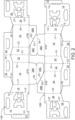
- the blank 10 is configured to be nestable with another similarly arranged blank.
- Figure 2 illustrated a pair of like blanks 10A, 10B in a nested configuration.
- the first base panel 38A/38C comprises a first shaped free edge E1 substantially opposing a hinged edge defined by the hinged connection between the first base panel 38A/38C and the first side panel 18.
- the first free edge E1 is shown as a chamfered or filleted edge which is provided by a linear edge which may optionally extend from a side edge (e.g., the left end edge as viewed in Figure 1 ) of the second portion 38C toward, and optionally all the way to, the straight distal end edge (i.e. the lower end edge as viewed in Figure 1 ) of the first base panel 38A/38C.
- the first free edge E1 is linear along at least a portion thereof (the first chamfered edge E1 may be linear along at least a portion thereof) and the linear portion is obliquely oriented with respect to the fold line 37A and/or with respect the fold line 39.
- the first free edge E1 and the fold line 39 define an angle therebetween, which may be an acute angle and may be less than 45°, it may be about 30° or less.
- the first free edge E1 may extend from a side edge (e.g., the left end edge as viewed in Figure 1 ) of the first portion 38A of the first base panel 38A/38C toward, and optionally all the way to, the straight distal end edge (i.e., the lower end edge as viewed in Figure 1 ) of the first base panel 38A/38C.
- the second base panel 38B comprises a second shaped free edge E2 substantially opposing a hinged edge defined by the hinged connection between the second base panel 38B and the second side panel 24.
- the second free edge E2 is shown as a chamfered or filleted edge which is provided by a linear edge which may optionally extend from the fold line 37B toward, and optionally all the way to, the straight distal end edge E3 of the second base panel 38B.
- the second free edge E2 is linear along at least a portion thereof (the second chamfered edge E2 may be linear along at least a portion thereof) and the linear portion is obliquely oriented with respect to the third fold line 37B.
- the second free edge E2 and the fold line 37B define an angle therebetween, the angle may be an acute angle and may be less than 45°, it may be about 30° or less.
- the second free edge E2 if not the linear portion thereof, may intersect with the straight distal end edge E3 of the second base panel 38B at a point or corner which is equidistant from the fold lines 23 and 25 or which is closer to the fold line 25 than to the fold line 23.
- the second free edge E2 of the second blank 10B mates with, or tessellates with, the first free edge E1 of the first blank 10A.
- the first free edge E1 of the second blank 10B mates with, or tessellates with, the second free edge E2 of the first blank 10A.
- the first and second free edges E1, E2 of the first blank 10A share a common edge or cut with the second and first free edges E2, E1 of the second blank 10B, respectively.
- the first and second blanks 10A, 10B may also be arranged such that an end edge of the glue flap 12 of one of the first and second blanks 10A, 10B is colinear with an end edge of the second medial panel 28 of the other of the first and second blanks 10A, 10B.
- the end edges of the blanks 10A, 10B may be offset with respect to each other.
- the second free edge E2 is shaped complementarily to the first free edge E1.
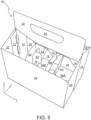
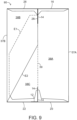
- the blank 10 is foldable to form a package 90 as illustrated in Figure 5 .
- the carton 90 can be formed by a series of sequential folding operations in a straight-line machine so that the carton 90 is not required to be rotated or inverted to complete its construction.
- the folding process is not limited to that described below and may be altered according to particular manufacturing requirements.
- Glue G or other adhesive treatment is applied to the first and second glue panels 72, 66 of the second partition structure P2 provided by the second medial panel 28.
- glue or other adhesive treatment may be applied to corresponding regions of the second side panel 24.
- Glue G or other adhesive treatment is applied to the second handle panel portion 28A.
- glue or other adhesive treatment may be applied to a corresponding region of the second handle reinforcing panel 34.
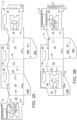
- the second medial panel 28 and the fourth end panel 26 are folded, with respect to the second side panel 24 about fold line 25, as shown in Figure 3B .
- the second medial panel 28 is brought into face contacting relationship with a portion of the second side panel 24 and the third end panel 22, the fourth end panel 26 is brought into face contacting relationship with a portion of the second side panel 24.
- the second handle panel portion 28A is brought into face contacting relationship with the second handle reinforcing panel 34.
- the first and second glue panels 72, 66 of the second partition structure P2 are secured to the second side panel 24 in face contacting relationship therewith.
- the second handle panel portion 28A is secured to the second handle reinforcing panel 34.
- Glue G or other adhesive treatment is applied to the first and second glue panels 72, 66 of the first partition structure P1 provided by the first medial panel 14. Alternatively, glue or other adhesive treatment may be applied to corresponding regions of the first side panel 18.
- Glue or other adhesive treatment is applied to the glue flap 12.
- glue or other adhesive treatment may be applied to a corresponding region of the third end panel 22.
- Glue G or other adhesive treatment is applied to the first handle panel portion 14A.
- glue or other adhesive treatment may be applied to a corresponding region of the first handle reinforcing panel 32.
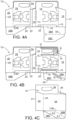
- the first medial panel 14, glue flap 12 and the first end panel 16 are folded, with respect to the first side panel 18 about fold line 17, as shown in Figure 4A .
- the first medial panel 14 is brought into face contacting relationship with a portion of the first side panel 18 and the second end panel 20.
- the first end panel 16 is brought into face contacting relationship with a portion of the first side panel 18.
- the glue flap 12 is brought into face contacting relationship with a portion of the third end panel 22.
- the first handle panel portion 14A is brought into face contacting relationship with the first handle reinforcing panel 32.
- the first handle panel portion 14A is secured to the first handle reinforcing panel 32.
- the first and second glue panels 72, 66 of the first partition structure P1 are secured to the first side panel 18 in face contacting relationship therewith.
- the glue flap 12 is secured to the third end panel 22 in face contacting relationship therewith.
- the first base panel 38A/38C is folded about fold line 39.
- the second portion 38C of first base panel 38A/38C is folded with respect to the first portion 38A of first base panel 38A/38C.
- the second portion 38C of first base panel 38A/38C is brought into face contacting relationship with the first portion 38A of first base panel 38A/38C.
- Glue or other adhesive treatment is applied to the second portion 38C of first base panel 38A/38C, as shown in Figure 4B .
- glue or other adhesive treatment may be applied to a corresponding region of the second base panel 38B.
- Glue or other adhesive treatment is applied to the first medial panel 14.
- glue or other adhesive treatment may be applied to corresponding regions of the second medial panel 28.
- the blank 10 is folded about fold line 21 to bring the first medial panel 14 into face contacting relationship with the second medial panel 28.
- the second base panel 38B is brought into face contacting relationship with the second portion 38C of first base panel 38A/38C.
- the second base panel 38B is secured to the second portion 38C of first base panel 38A/38C.
- a flat collapsed carrier is thereby formed, as shown in Figure 4C , the flat collapsed carrier can be readily shipped or distributed in the flat condition to a plant for erecting and loading with primary product containers.
- the flat collapsed carrier can be opened into a basket-style article carrier 90, as shown in Figure 5 , by separating the first and second side panels 18, 24 to form a tubular structure defined by the outer panels 16, 18, 20, 22, 24, 26.
- the outer panels 16, 18, 20, 22, 24, 26 define an interior chamber.
- the partition structures P1, P2 are automatically erected when the flat collapsed carrier is opened out or erected into the tubular form.
- the first base panel 38A/38C and second base panel 38B form a composite base panel 38A/38C/38B which is automatically erected when the flat collapsed carrier is opened out.
- the first and second medial panels 14, 28 form a partition, that is disposed medially within the interior of the carrier 90 formed by the outer panels 16, 18, 20, 22, 24, 26.
- the partition divides the interior of the carrier 90 into two separate compartments on opposing sides of the first and second medial panels 14, 28.
- the partition extends longitudinally, as indicated by the direction arrow L in Figure 5 , of the carrier 90.
- the first partition structure P1 is automatically erected to form a first plurality of cells in a first compartment disposed on a first side of the first and second medial panels 14, 28.
- the second partition structure P2 is automatically erected to form a second plurality of cells in a second compartment disposed on a second side of the first and second medial panels 14, 28.
- the first and second partition structures P1, P2 extend transversely, as indicated by the direction arrow T in Figure 5 , of the carrier 90.
- the carrier 90 may be loaded with a group of articles; in the embodiment illustrated in Figure 5 six articles (not shown) are arranged in a 3 x 2 array.
- the group of articles may be loaded through an upper end of the tubular structure formed by the outer panels 16, 18, 20, 22, 24, 26.
- Figure 6 illustrates a second embodiment and shows a blank 110 having a plurality of panels 112, 114, 116, 118, 120, 122, 124, 126, 128 arranged in a linear series hinged one to the next by fold lines 113, 115, 117, 119, 121, 123, 125, 127 respectively.
- the blank 110 comprises a plurality of outer panels 116, 118, 120, 122, 124, 126for forming a tubular structure.
- the plurality of outer panels 116, 118, 120, 122, 124, 126 comprises a first end panel 116.
- a first side panel 118 is hingedly connected to the first end panel 116 by a hinged connection in the form of a fold line 117.
- a second end panel 120 is hingedly connected to the first side panel 118 by a hinged connection in the form of a fold line 119.
- a third end panel 122 is hingedly connected to the second end panel 120 by a hinged connection in the form of a fold line 121.
- a second side panel 124 is hingedly connected to the third end panel 122 by a hinged connection in the form of a fold line 123 and a fourth end panel 126 is hingedly connected to the second side panel 124 by a hinged connection in the form of a fold line 125.
- the blank 110 comprises a first base panel 138A/138C hinged to the first side panel 118 by a hinged connection in the form of a fold line 137A.
- the first base panel 138A/138C comprises a fold line 139 extending in a longitudinal direction across the first base panel 138A/138C so as to define first and second portions 138A, 138C respectively.
- the blank 110 comprises a second base panel 138B hinged to the second side panel 124 by a hinged connection in the form of a fold line 137B.
- the first and second base panels 138A/138C, 138B are also referred to herein as end closure flaps since they close an end of the tubular structure formed by the plurality of outer panels 116, 118, 120, 122, 124, 126.
- the first base panel 138A/138C comprises a first shaped free edge E1 substantially opposing a hinged edge defined by the hinged connection between the first base panel 138A/138C and the first side panel 118.
- the first free edge E1 is shown as a cut-away corner with an edge extending between the left end of the first panel 138A/138C and the lower end of the first panel while the second free edge E2 is shown as a shaped edge extending to define a serpentine-shaped left end of the second panel 138B.
- the first free edge E1 is a generally chamfered or filleted edge which includes a first edge portion along the first free edge E1.
- the first free edge E1 is linear along at least a first edge portion thereof.
- the first edge E1 may comprise at least two linear sections divergently arranged with respect to each other.
- the linear sections are obliquely oriented with respect to the first fold line 137A and/or with respect the second fold line 139.
- the first edge E1 comprises at least two sections divergently arranged with respect to each other.
- the first edge E1 may be defined by a combination of one or more linear sections and one or more curvilinear or arcuate sections.
- the first edge E1 may optionally extend from a side edge (e.g., the left end edge as viewed in Figure 6 ) of the second portion 138C toward, and optionally all the way to, the straight distal end edge (i.e. the lower end edge as viewed in Figure 6 ) of the first base panel 138A/138C.
- the first free edge E1 may extend from a side edge (e.g., the left end edge as viewed in Figure 6 ) of the first portion 138A of the first base panel 138A/138C toward, and optionally all the way to, the straight distal end edge (i.e., the lower end edge as viewed in Figure 6 ) of the first base panel 138A/138C.
- the outermost end or extremity of the first base panel 138A/138C may be linear in shape.
- the linear outermost end of the first base panel 138A/138C may be substantially parallel to the fold line 137A and/or the fold line 139.
- the second base panel 138B comprises a second shaped free edge E2 substantially opposing a hinged edge defined by the hinged connection between the second base panel 138B and the second side panel 124.
- the second free edge is a generally chamfered or filleted edge which includes linear edge portions.
- the second free edge E2 may comprise at least two linear sections divergently arranged with respect to each other.
- the linear sections are obliquely oriented with respect to the third fold line 137B.
- the second free edge E2 comprises at least two sections divergently arranged with respect to each other.
- the second free edge E2 may be defined by a combination of one or more linear sections and one or more curvilinear or arcuate sections.
- the second free edge E2 may optionally extend from the fold line 137B toward, and optionally all the way to, the straight distal end edge or outermost end E3 of the second base panel 138B.
- the second free edge E2 may include a first linear end section E2a and a second opposed linear end section E2b. Those linear end sections E2a, E2b are located at the opposite ends of the two intermediate linear sections in the embodiment of Figure 6 .
- the first linear end section E2a emanates from the fold line 137b while the second linear end section E2b intersects with the straight distal end edge E3 of the second base panel 138B.
- the intersection of the edges E2 and E3 may be located at a point which is equidistant from the fold lines 123 and 125 or which is closer to the fold line 125 than to the fold line 123.
- the outermost end or extremity (or distal end edge) E3 of the second base panel 138B may be linear in shape.
- the linear outermost end or distal end edge E3 of the second base panel 138B may be substantially parallel to the to the fold line 137B.
- the second free edge E2 is shaped complementarily to the first free edge E1.
- the second free edge E2 is configured to tessellate or nest with the first free edge E1.
- Figure 7 illustrates a third embodiment and shows a blank 210 having a plurality of panels 212, 214, 216, 218, 220, 222, 224, 226, 228 arranged in a linear series hinged one to the next by fold lines 213, 215, 217, 219, 221, 223, 225, 227 respectively.
- the blank 210 comprises a plurality of outer panels 216, 218, 220, 222, 224, 226 for forming a tubular structure.
- the plurality of outer panels 216, 218, 220, 222, 224, 226 comprises a first end panel 216.
- a first side panel 218 is hingedly connected to the first end panel 216 by a hinged connection in the form of a fold line 217.
- a second end panel 220 is hingedly connected to the first side panel 218 by a hinged connection in the form of a fold line 219.
- a third end panel 222 is hingedly connected to the second end panel 220 by a hinged connection in the form of a fold line 221.
- a second side panel 224 is hingedly connected to the third end panel 222 by a hinged connection in the form of a fold line 223 and a fourth end panel 226 is hingedly connected to the second side panel 224 by a hinged connection in the form of a fold line 225.
- the blank 210 comprises a first base panel 238A/238C hinged to the first side panel 218 by a hinged connection in the form of a fold line 237A.
- the first base panel 238A/238C comprises a fold line 239 extending in a longitudinal direction across the first base panel 238A/238C so as to define first and second portions 238A, 238C respectively.
- the blank 210 comprises a second base panel 238B hinged to the second side panel 224 by a hinged connection in the form of a fold line 237B.
- the first and second base panels 238A/238C, 238B are also referred to herein as end closure flaps since they close an end of the tubular structure formed by the plurality of outer panels 216, 218, 220, 222, 224, 226.
- the first base panel 238A/238C comprises a first shaped free edge E1 substantially opposing a hinged edge defined by the hinged connection between the first base panel 238A/238C and the first side panel 218.
- the first free edge E1 is a generally chamfered or filleted edge which may include a non-linear edge. In the embodiment illustrated in Figure 7 , the non-linear first free edge E1 is arcuate or curvilinear.
- the first free edge E1 is concave so as to bow inwardly; the first free edge E1 defines a recess in the distal portion 238C.
- the first edge E1 may optionally extend from a side edge (e.g., the left end edge as viewed in Figure 7 ) of the second portion 238C toward, and optionally all the way to, the straight distal end edge (i.e. the lower end edge as viewed in Figure 7 ) of the first base panel 238A/238C.
- the first free edge E1 may extend from a side edge (e.g., the left end edge as viewed in Figure 7 ) of the first portion 238A of the first base panel 238A/238C toward, and optionally all the way to, the straight distal end edge (i.e., the lower end edge as viewed in Figure 7 ) of the first base panel 238A/238C.
- the outermost end or extremity of the first base panel 238A/238C is linear along at least a portion thereof.
- the outermost or extremity of the first base panel 238A/238C may be linear in shape and may be substantially parallel to the fold line 237A and/or the fold line 239.
- the second base panel 238B comprises a second shaped free edge E2 substantially opposing a hinged edge defined by the hinged connection between the second base panel 238B and the second side panel 224.
- the second free edge E2 is a generally chamfered or filleted edge which may include a non-linear edge.
- the non-linear second free edge E2 is arcuate or curvilinear.
- the second free edge E2 is convex so as to bow outwardly; the second free edge E2 defines a bulged edge which bulges away from the fold line 239.
- the second free edge E2 may optionally extend from the fold line 237B toward, and optionally all the way to, the straight distal end edge or outermost end E3 of the second base panel 238B.
- the second free edge E2 may include a linear end section E2a.
- the linear end section E2a is located at the distal end of the arcuate section of the second free edge E2 in the embodiment of Figure 7 .
- the linear end section E2a emanates from the fold line 237B.
- the second free edge E2 intersects with the straight distal end edge E3 of the second base panel 238B.
- the intersection of the edges E2 and E3 may be located at a point or corner which is equidistant from the fold lines 223 and 225 or which is closer to the fold line 225 than to the fold line 223.
- the outermost end or extremity E3 of the second base panel 238B may be linear in shape.
- the outermost end the second base panel 238B may be substantially parallel to the to the fold line 237B.
- the second free edge E2 is shaped complementarily to the first edge E1.
- the second edge E2 is configured to tessellate or nest with the first edge E1.
- Figure 8 illustrates a fourth embodiment and shows a blank 310 having a plurality of panels 312, 314, 316, 318, 320, 322, 324, 326, 328 arranged in a linear series hinged one to the next by fold lines 333, 315, 317, 319, 321, 323, 325, 327 respectively.
- the blank 310 comprises a plurality of outer panels 316, 318, 320, 322, 324, 326 for forming a tubular structure.
- the plurality of outer panels 316, 318, 320, 322, 324, 326 comprises a first end panel 316.
- a first side panel 318 is hingedly connected to the first end panel 316 by a hinged connection in the form of a fold line 317.
- a second end panel 320 is hingedly connected to the first side panel 318 by a hinged connection in the form of a fold line 319.
- a third end panel 322 is hingedly connected to the second end panel 320 by a hinged connection in the form of a fold line 321.
- the first free edge E1 may optionally extend from a side edge (e.g., the left end edge as viewed in Figure 8 ) of the second portion 338C toward, and optionally all the way to, the straight distal end edge (i.e. the lower end edge as viewed in Figure 8 ) of the first base panel 338A/338C.
- the first free edge E1 may extend from a side edge (e.g., the left end edge as viewed in Figure 8 ) of the first portion 338A of the first base panel 338A/338C toward, and optionally all the way to, the straight distal end edge (i.e., the lower end edge as viewed in Figure 8 ) of the first base panel 338A/338C.
- first and second edges E1, E2 may adopt alternative shapes which have the effect of generally removing an outer corner portion of the first and second base panels 38A/38C, 38B; 138A/138C, 138B; 238A/238C, 238B; 338A, 338C, 338B.
- This allows the blanks 10; 110; 210; 310 to be nested in an efficient manner without substantial offset between ends of the nested blanks.
- the blank 410 comprises a first base panel 438A/438C hinged to the first side panel 418 by a hinged connection in the form of a fold line 437A.
- the first base panel 438A/438C comprises a fold line 439 extending across the first base panel 438A/438C so as to define first and second portions 438A, 438C respectively.
- the blank 410 comprises a second base panel 438B hinged to the second side panel 424 by a hinged connection in the form of a fold line 437B.
- the first and second base panels 438A/438C, 438B are also referred to herein as end closure flaps since they close an end of the tubular structure formed by the plurality of outer panels 416, 418, 420, 422, 424, 426.
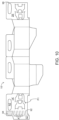
- the first and second base panels 438A/438C, 438B are engageable with one another in an overlapping relationship to form a composite base wall 438A/438C/438B of a carrier 490(see Figure 20 ).
- the first base panel 438A/438C may comprise at least one opening AP for receiving a post or pinnacle Pt of a crate Ct (see Figures 19A, 19B ).
- the blank 410 may be constructed into a carrier and inserted into a crate Ct having at least one post, Figures 19A, 19B and 20 each show a portion of a crate Ct having a plurality of receiving locations Rt for articles B. In Figures 19A and 19B some of the article receiving locations Rt are occupied by an article B and some are vacant.
- an article carrier 490 is loaded into the crate Ct such that articles B in the carrier 490 are received in a respective article receiving location Rt.
- the crate Ct is adapted to receive a plurality of article carriers 490 each having a plurality of articles B therein.
- the illustrated embodiment is adapted to receive four article carriers 490 each of which accommodates six articles B.
- the first base panel 438A/438C comprises two openings AP, each for receiving a respective post or pinnacle Pt.
- the posts Pt are configured to be located in a void between a grouping of four articles, as shown in Figure 19B .
- Each opening AP is aligned with the void between said group of four articles B.
- Each of the openings AP in the first base panel 438A/438C interrupts the fold line 439 hinging the first portion 438A to the second portion 438C.
- the post openings AP may be square or diamond shaped.
- the second base panel 438B may comprise at least one cutaway in the form of a recess RP.
- the cutaway may take the form of an aperture.
- the at least one cutaway is arranged to be aligned with a respective one of the at least one post openings AP in the first base panel 438A/438C
- the blank 410 may comprise a medial structure including a first medial panel 414 and a second medial panel 428.
- Medial panels 414, 428 are also referred to herein as intermediate panels.
- the first medial panel 414 is hingedly connected at a first end of the plurality of outer panels 416, 418, 420, 422, 424, 426, to the first end panel 416, by a hinged connection in the form of a fold line 415.
- the second medial panel 428 is hingedly connected at a second, opposing, end of the plurality of outer panels 416, 418, 420, 422, 424, 426, to the fourth end panel 426, by a hinged connection in the form of a fold line 427.
- the first medial panel 414 provides a first handle panel portion 414A.
- the second medial panel 428 provides a second handle panel portion 428A. Together the first and second medial panels 414, 428 provide a two-ply handle structure, the second ply reinforcing the first ply.
- the first handle panel portion 414A comprises a first handle opening.
- the first handle opening may be defined at least in part by a first handle aperture A2 struck from an upper portion of the first medial panel 414.
- the second handle panel portion 428A comprises a second handle opening.
- the second handle opening may be defined at least in part by a second handle aperture A3 struck from, or defined within, an upper portion of the second medial panel 228.
- the second handle opening is arranged to be disposed in registry or alignment with the first handle opening in a setup condition.
- the blank 410 comprises a securing panel in the form of a medial partition glue flap 412 hingedly connected to an end of the first medial panel 414 (said end opposes an opposing end of the first medial panel 414 to which the first end panel 416 is hingedly connected, defined by fold line 415) by a hinged connection in the form of a fold line 413.
- the fold line 413 is continuous or uninterrupted.
- the blank 410 may comprise a partition structure P1, P2 which defines or creates a plurality of cells disposed on one or both sides of the divider formed by first and second medial panels 414, 428.
- the blank 410 comprises a first partition structure P1 that defines or creates a plurality of cells disposed between the first side panel 418 and the first medial panel 414.
- the first partition structure P1 is defined in a first partition panel portion 414B provided by a lower portion of the first medial panel 414.
- the blank 410 comprises a second partition structure P2.
- the second partition structure P2 defines or creates a plurality of cells disposed between the second side panel 424 and the second medial panel 428.
- the second partition structure P2 is defined in a second partition panel portion 428B provided by a lower portion of the second medial panel 428.
- the first compartment provides an interior for receiving at least a lower portion of one or more articles.
- the second compartment provides an interior for receiving at least a lower portion of one or more articles.
- the first and second partition structures P1, P2 are substantially similar in construction, albeit the second partition structure P2 is a mirror image (in blank form) of the first partition structure P1. In this way the first and second partition structures P1, P2 are disposed substantially in registry with each other when the blank 410 is folded into a flat collapsed form.
- the first and second partition structures P1, P2 will be described in further detail by reference to the first partition structure P1.
- the first partition structure P1 comprises a first partition panel 464 struck from, or defined in, the first medial panel 414 and hingedly connected, at a first or proximal end, thereto by a hinged connection in the form of a fold line 463.
- the first partition structure P1 comprises a second partition panel 468 struck from, or defined in, the first medial panel 414 and hingedly connected, at first or a proximal end, thereto by a hinged connection in the form of a fold line 469.
- the first and second partition panels 464, 468 are dimensioned to extend, laterally, between the first medial panel 414 and the first side panel 418 in a set up condition.
- the first partition structure P1 comprises a first glue panel 472 to which the first and second partition panels 464, 468 are coupled by a respective distal end joint. Each distal end joint is defined by a respective fold line 467, 475. Fold line 467 defines an outer end of the first partition panel 464, fold line 463 defines an inner end of the first partition panel 464 a linear dimension is defined therebetween.
- the first partition panel 464 is defined by a pair of first cutlines or severance line 473.
- the second partition panel 468 is defined by a second cutline or severance line 471.
- the second partition panel 468 comprises an outer end, defined by a portion of fold line 475.
- the second cutline 471 extends across fold line 415 and into the first end panel 416 to define a connecting portion between the second partition panel 468 and the first glue panel 472, the connecting portion may be considered to be part of the first glue panel 472.
- the connecting portion may be struck from, or defined in, the first end panel 416.
- Fold line 469 defines an inner end of the second partition panel 468.
- the second partition panel 468 is separated from the first glue panel 472 along or by a portion of an upper one of the first cutlines 473.
- Each end of the cutlines 473, 471 may extend beyond a respective fold line 463, 469 and may terminate with a "J' shaped cut.
- the blank 410 may comprise at least one post or pinnacle receiving structure.
- the at least one post or pinnacle receiving structure is defined in a panel 414, 428 providing a partition structure P1, P2; the post pinnacle receiving structure is spaced apart from the partition structure P1, P2 by a portion of said panel 414, 428.
- the at least one post or pinnacle receiving structure may comprise at least one article shield GD, GD2.
- the at least one article shield GD, GD2 may protect or cushion the articles B from a post or pinnacle Pt of the crate Ct and is configured to be disposed between said post Pt and the article B.
- the at least one article shield GD, GD2 comprises at least one guard or cushioning flap 480, 482, 484.
- the guard flaps 480, 482, 484 are struck from or defined in lower portions of the first or second medial panels 414, 428.
- a cushioning flap 480, 482, 484 provided by the second medial panel 428 is disposed in face-to-face relationship with, or aligned with, one of the cushioning flaps 480, 482 provided by the first medial panel 414.
- the first medial panel 414 comprises two pairs of opposing cushioning flaps 480, 482.
- the cushioning flaps 480, 482 of each pair are hinged in opposition to each other by respective fold lines 481, 483.
- the flaps 480, 482 of each pair of cushioning flaps 480, 482 are separated from each other by a cut line or severance line.
- Each flap 480, 482 of each pair of cushioning flaps 480, 482 comprises a lower free edge.
- the lower free edges of each pair of cushioning flaps 480, 482 may define a concave recess or inverted "V" shaped notch in a lower end of the first medial panel 414.
- the notch or recess may facilitate folding of the cushioning flaps 480, 482 out of the plane of the first medial panel 414.
- the second medial panel 428 comprises one pair of opposing cushioning flaps 480, 482.
- the cushioning flaps 480, 482 of are hinged in opposition to each other by respective fold lines 481, 483.
- the cushioning flaps 480, 482 are separated from each other by a cut line or severance line.
- the cushioning flaps 480, 482 comprise or define concave recess or inverted "V" shaped notch in a lower end of the second medial panel 428.
- the second medial panel 428 comprises a further cushioning flap 484 hinged thereto by a fold line 485 and struck from a marginal side portion of the second medial panel 428.
- the further cushioning flap 484 is configured to be disposed in face-to-face relationship with, or aligned with, one of the cushioning flaps 480, 482 provided by the first medial panel 414.
- the at least one pinnacle receiving structure may comprise at least one cutaway or recess R1, R2.
- the first medial panel 414 comprises first cutaway or recess R1 in a lower end edge thereof, the cushioning flaps 480, 482 are provided adjacent to the first recess R1, the free edges of the cushioning flaps 480, 482 define portions of the first recess R1.
- the cushioning flaps 480, 482 when folded out of the plane of the first medial panel 414 may be considered to define extensions of the first recess R1.
- the first recess R1 and the cushioning flaps 480, 482 are dimensioned so as to accommodate the posts Pt of the crate Ct.
- the second medial panel 428 comprises second recess R2 in a lower end edge thereof, the cushioning flaps 480, 482, 484 are provided adjacent to the second recess R2, the free edges of the cushioning flaps 480, 482, 484 define portions of the second recess R2.
- the cushioning flaps 480, 482, 484 when folded out of the plane of the first medial panel 414 may be considered to define extensions of the second recess R2.
- the second recess R2 and the cushioning flaps 480, 482, 484 are dimensioned so as to accommodate the posts Pt of the crate Ct.
- the cushioning flaps 480, 482, 484 substantially surround the post Pt, the posts Pt may comprise a substantially diamond shaped cross section, alternative shapes may be employed such as square or four-pointed star shape.
- a cushioning flap 480, 482, 484 may be folded out of the panel of the medial panel 414, 428 to which it is hinged when the post Pt is received in the article carrier 490.
- a cushioning flap 480, 482, 484 may be folded about each of the four side walls of the post Pt.
- a pair of cushioning flaps 480, 482, 484 may be folded about one of the side walls of the post Pt. That is to say two cushioning flaps 480, 482, 484 may be disposed between the post Pt and one of the articles B received in the article carrier 490.
- the second medial panel 428 does not extend fully between the opposing ends of the carrier 490, only three cushion flaps 480, 482, 484 are provided by the second medial panel 428, one of the posts Pt received in the carrier 490 is engaged by three cushioning flaps 480, 482, 484 whereas the other of the posts Pt received in the carrier is engaged by four cushioning flaps 480, 482.
- the blank 410 may comprise a securing device for engaging the divider or intermediate wall 414/428 of the carrier 490 with the base wall 438A/438B/438C.
- the first medial panel 414 comprises a first hook H1 defined in a lower region of the first medial panel 414 and disposed adjacent to the first recess R1.
- the first hook H1 can be considered to extend into the first recess R1.
- the first hook H1 may be defined by an undercut integral with the first cutaway or recess R1. Both the first hook H1 and the first cutaway or recess R1 are defined within the first medial panel 414.
- the second medial panel 428 comprises a second hook H2 defined in a lower region of the second medial panel 428 and disposed adjacent to the second recess R2.
- the second hook H2 can be considered to extend into the second recess R2.
- the second hook H2 may be defined by an undercut integral with the second cutaway or recess R2. Both the second hook H2 and the second cutaway or recess R2 are defined within the second medial panel 428.
- the first and second hooks H1, H2 may be configured to be in face-to-face relationship with each other when the blank 410 is erected into a carrier 490, in this way the securing device is a two-ply structure.
- the first and second hooks H1, H2 may be configured to be disposed in opposition to each other in the erected carrier so as to engage opposing edges of the base wall.
- the fold lines 421, 413 together define a working crease in the carrier 490, the carrier 490 may be readily erected from, or flattened into, a flat tubular collapsed tubular structure; the first and second hooks H1, H2 may be disposed opposite said working crease of the carrier 490.
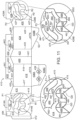
- FIG. 12 there is shown a plan view of a blank 510 according to a seventh embodiment.
- the blank 510 is substantially similar in construction to the blank of Figure 11 , albeit employing the partition structures P1, P2 of the embodiment of Figure 1 .
- the fold line 513 hinging glue flap 512 to first medial panel 514 is interrupted by a pair of apertures A1, similar to the blank 10 of Figure 1 .
- the first medial 514 comprises a first post or pinnacle receiving recess R1 in a lower edge thereof, that is to say an edge facing or adjacent to the base wall 538A/538B/538C of the carrier 590 shown in Figure 21
- Second medial 528 comprises a second post or pinnacle receiving recess R2 in a lower edge thereof, that is to say an edge facing or adjacent to the base wall 538A/538B/538C of the carrier 590 shown in Figure 21 .
- the second pinnacle receiving recess R2 is configured to be in registry with at least a portion of the first pinnacle receiving recess R1; the second pinnacle receiving recess R2 corresponds to or with a portion of the first pinnacle receiving recess R1.
- the blank 510 may comprise a securing device for engaging the divider or intermediate wall 514/528 of the carrier 590 with the base wall 538A/538B/538C.
- the first medial panel 514 comprises a pair of first hooks H1 defined in a lower region of the first medial panel 514 and disposed adjacent to the first recess R1.
- the first hooks H1 can be considered to extend into the first recess R1.
- the first hooks H1 may be defined by undercuts integral with the first cutaway or recess R1. Both the first hooks H1 and the first cutaway or recess R1 are defined within the first medial panel 514.
- the first hooks H1 of the pair of first hooks H1 are disposed in opposition to each other, and are configured to engage opposing end edges of base wall 538A/538B/538C of the carrier 590.
- the second medial panel 528 comprises a second hook H2 defined in a lower region of the second medial panel 528 and disposed adjacent to the second recess R2.
- the second hook H2 can be considered to extend into the second recess R2.
- the second hook H2 may be defined by an undercut integral with the second cutaway or recess R2. Both the second hook H2 and the second cutaway or recess R2 are defined within the second medial panel 528.
- the second hook H2 is arranged to be disposed in registry with one of the pair of first hooks H1 to form a to ply hook H1/H2.
- the two-ply hook H1/H2 may comprise in creased strength or rigidity over a single ply hook H1.
- the two-ply hook H1/H2 may be arranged to be in opposition to a working crease of the carrier 590 defined by fold lines 513/521.
- Figure 20 illustrates an internal view of a carrier 590 formed form the blank 510, the carrier 590 has been inserted into a crate Ct, articles B have been removed from the carrier 590 for illustrative purposes.
- the intermediate wall 514/528 provides first and second partition structures P1, P2 and a receiving structure R1/R2 to accommodate the posts Pt, the receiving structure R1/R2 is spaced a part from the partition structures P1, P2 by a portion of intermediate wall 514/528.
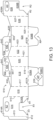
- FIG. 13 there is shown a plan view of a blank 610 according to an eighth embodiment.
- the blank 610 is adapted to accommodate a group of four articles arranged in a 2 x 2 matrix or array.
- the partition structures P1, P2 of previous embodiments have been omitted.
- the first and second medial panels 614, 628 each comprise a respective post or pinnacle receiving recess R1, R2 in a lower edge thereof, that is to say an edge facing or adjacent to the base panels 638A, 638B, 638C in a setup condition.
- the blank 610 comprises a securing device for engaging the divider or intermediate wall 614/628 of a carrier formed from the blank 610 with the base wall 638A/638B/638C.
- the first medial panel 614 comprises a pair of first hooks H1 defined in a lower region of the first medial panel 614 and disposed adjacent to a first recess R1.
- the first hooks H1 can be considered to extend into the first recess R1.
- the first hooks H1 may be defined by an undercut integral with the first cutaway or recess R1.
- the first hooks H1 and the first cutaway or recess R1 are defined entirely within the first medial panel 614.
- the second medial panel 628 comprises a second hook H2 defined in a lower region of the second medial panel 628 and disposed adjacent to a second recess R2.
- the second hook H2 can be considered to extend into the second recess R2.
- the second hook H2 may be defined by an undercut integral with the second cutaway or recess R2. Both the second hook H2 and the second cutaway or recess R2 are defined within the second medial panel 628.
- the first and second hooks H1, H2 may be configured to be in face-to-face relationship with each other when the blank 610 is erected into a carrier, in this way the securing device is a two-ply structure.
- the first and second hooks H1, H2 may be configured to be disposed in opposition to each other in the erected carrier so as to engage opposing edges of the base wall 638A/638B/638C.
- the fold lines 621, 613 together define a working crease in the carrier, the carrier may be readily erected from, or flattened into, a flat tubular collapsed tubular structure; the first and second hooks H1, H2 may be disposed opposite said working crease of the carrier.
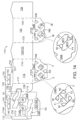
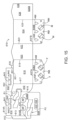
- FIG. 14 there is shown a plan view of a blank 710 according to a ninth embodiment.
- the blank 710 is adapted to accommodate a group of six articles arranged in a 2 x 3 matrix or array.
- the embodiment of Figure 14 comprises unitary end wall panel 720/722, 726, that is to say the fold lines 21, 421, 521, for example, employed in previous embodiments have been omitted.
- the fourth end panel 726 is dimensioned to extend fully between first and second side wall panels 718, 724.
- First end wall panel 716 is arranged to be disposed in face contacting relationship with a portion of the fourth end panel 726.
- a second medial panel 728 is hingedly connected to a lower edge of the first medial panel 714 by a hinged connection in the form of a fold line 729.
- the hinged connection or fold line 729 is offset with respect to lower edges of the side and end panels 716, 718, 720/722, 724, 726.
- the second medial panel 728 is configured to be folded into face-to-face relationship with the first medial panel 714, as indicated in Figure 14B by direction arrow D1.
- the second medial panel 728 is folded about fold line 729, in doing so a recess R is created in a lower edge of the intermediate panel 714/728 formed by the first and second medial panel 714, 728.
- first and second medial panel 714, 728 are interrupted by at least one cutaway in the form of an aperture AP.
- the illustrated embodiment comprises a pair of apertures AP.
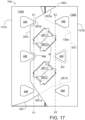
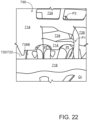
- the apertures AP form extensions RP of the recess R, these recess extensions RP are arranged to accommodate a post or pinnacle Pt of a crate Ct, as shown in Figure 22 .
- a portion of the glue panel of the second partition structure P2 may be struck from material which would otherwise form the medial partition glue flap 713.
- the first base panel 738A comprises at least one first opening configured to receive a post or pinnacle Pt of a crate Ct.
- the illustrated embodiment comprises a plurality of first post receiving openings, specifically, but not limited to, two first openings.
- the second base panel 738B comprises at least one second opening configured to receive a post or pinnacle Pt of a crate Ct.
- the second opening is arranged to be in registry with the first opening.
- the illustrated embodiment comprises a plurality of second post receiving openings, specifically, but not limited to, two second openings.
- Each of the first openings is defined, at least in part, by a pair of female tabs FT1, FT2 each hingedly connected to the first base panel 738A by a respective fold line F1, F2. Cutaways in the form of apertures define notches N1, N2 in lower or proximal regions -the lower or proximal region being disposed adjacent to the hinged connection or fold line F1, F2- of the female tabs FT1, FT2.
- the female tabs FT1, FT2 may be substantially "T" shaped.
- Each of the second openings is defined, at least in part, by a pair of male tabs MT1, MT2 each hingedly connected to the second base panel 738B by a respective fold line F3, F4. Cutaways in the form of apertures define notches N3, N3 in upper or distal regions -the upper or distal region being disposed adjacent to a free end of the male tabs MT1, MT2, the free end opposes a hinged end defined by the hinged connection or fold line F1, F2- of the female tabs FT1, FT2.
- the notches N1, N2 of the female tabs FT1, FT2 receive lug or lobes of the male tabs MT1, MT2 to secure the male and female tabs MT1, MT2, FT1, FT2 in a folded condition.
- the male and female tabs MT1, MT2, FT1, FT2 form part of a complementary locking mechanism for locking the first and second base panel 738A, 738B in an overlapping relationship with each other.
- the first base panel 738A comprises at least one handling or machine aperture AM, the first base panel 738A comprises a plurality of machine apertures AM, specifically, but not limited to, three machine apertures AM.
- the machine apertures AM are disposed adjacent or proximate to the hinged connection between first base panel 738A and the first side panel 718.
- the second base panel 738B comprises at least one handling or machine aperture AM, the second base panel 738B comprises a plurality of machine apertures AM, specifically, but not limited to, three machine apertures AM.
- the machine apertures AM are disposed adjacent or proximate to the hinged connection between second base panel 738B and the second side panel 724.
- the machine apertures AM comprise an opening at least a portion of which is substantially triangular in shape.
- the first base panel 738A comprises cutaway in the form of an aperture AD configured to be disposed in registry with one of the plurality of machine apertures AM in the second base panel 738B.
- the second base panel 738B comprises cutaway in the form of a recess RM configured to be disposed in registry with a portion of one of the plurality of machine apertures AM in the first base panel 738A.
- the first and second base panels 738A, 738B form a foldable end or base closure.
- the first base panel 738A is hinged to a tubular structure formed from the main panels 716, 718, 720/722, 724, 726 along a first fold line 737A.
- the second base panel 738A is hinged to the tubular structure formed from the main panels 716, 718, 720/722, 724, 726 along a second fold line 737B.
- the first base panel 738A comprises a first free edge EE1 opposing a hinged edge defined by the first fold line 737A.
- the second base panel 738B comprises a second free edge EE2 opposing a hinged edge defined by the second fold line 737B.
- the first base panel 738A comprises at least one first panel-interlocking element F and a row of first handling openings AM.
- the first handling openings AM are located closer to the first fold line 737A than the at least one first panel-interlocking element F.
- the second base panel 738B comprises at least one second panel-interlocking element M.
- the second base panel 738B comprises a row of second handling openings AM.
- the second handling openings AM are located closer to the second fold line 737B than the at least one second panel-interlocking element M.
- the first and second panel-interlocking elements F, M are aligned and engaged together such that the first and second base panels 737A, 737B are in face-contacting overlapping arrangement.
- the first base panel 737A has a first side edge SE1 extending between the first fold line 737A and the first free edge EE1.
- the second base panel 738B has a second side edge SE2 extending between the second fold line 737B and the second free edge EE2.
- At least a part SE1a of the first side edge SE1 is configured complementary to at least a part SE2a of the second free edge SE2.
- At least a part SE2b of the second side edge SE2 is disposed between the at least one first panel-interlocking element F and one of the first handling openings AM such that no part of the second side edge SE2 overlaps any one of the at least one first panel-interlocking element F and the first handling openings AM.
- At least part of the second free edge EE2 is disposed between the first fold line 737A and a first notional line X1-X1.
- First notional line X1-X1 is defined by a linear line in tangential contact with a forward or leading edge of each of the first handling openings AM.
- First notional line X1-X1 extends parallel to the first fold line 737A.
- Second notional line X2-X2 is defined by a linear line in tangential contact with a forward or leading edge of each of the second handling openings AM. Second notional line X2-X2 extends parallel to the second fold line 737B.
- At least a part SE1b of the first side edge SE1 is disposed between the at least one second panel-interlocking element M and one of second handling openings AM such that no part of the first side edge SE1 overlaps any one of the at least one second panel-interlocking element M and the second handling openings AM.
- FIG. 15 there is shown a plan view of a blank 810 according to a tenth embodiment.
- the embodiment of Figure 15 can be erected to form a carrier 890 as shown in Figure 18 .
- the blank 810 is substantially similar in construction to the blank 710 of Figure 14 , albeit the first base panel 838A and second base panel 838B have a different shape.
- the first base panel 838A has been shortened a recess RM replaces the aperture AD of the ninth embodiment.
- the recess RM serves the same purpose as the aperture AD providing access through the first base panel 838A for a machine tool (not shown) to enable the first and second base panel 838A, 838B to be aligned with respect to each other such that the panel locking arrangement M/F can be deployed to secure the first and second base panel 838A, 838B to each other.
- FIG. 16 there is shown a plan view of a blank 910 according to an eleventh embodiment.
- the blank 910 forms a carrier (not shown) having a plurality of main panels 916, 918, 920, 922, 924, 926 forming a tubular structure.
- the tubular structure is closed at one end by an end closure or base wall formed from a first base panel 938A/938C and a second base panel 938B.
- An intermediate wall 914/928 is provided by a pair of medial panels 914, 928.
- the intermediate wall 914/928 provides a pair of partition structures for dividing chamber on each side of the intermediate wall 914/928 into a plurality of cells.
- the blank 910 is arranged substantially as two rows or series of panels, previous embodiments were arranged substantially as single linear series.
- a first row of panels comprises a first riser panel 912 is hingedly connected to a first end panel 916 by a hinged connection in the form of a fold line 913.
- a first side panel 918 is hingedly connected to the first end panel 916 by a hinged connection in the form of a fold line 917.
- a second end panel 920 is hingedly connected to the first side panel 918 by a hinged connection in the form of a fold line 919.
- a first medial panel 914 is hingedly connected to the second end panel 920 by a hinged connection in the form of a fold line 927A.
- a second row of panels comprises a second riser panel 930 is hingedly connected to a third end panel 922 by a hinged connection in the form of a fold line 921.
- a second side panel 924 is hingedly connected to the third end panel 922 by a hinged connection in the form of a fold line 923.
- a fourth end panel 926 is hingedly connected to the second side panel 924 by a hinged connection in the form of a fold line 925.
- a second medial panel 928 is hingedly connected to the fourth end panel 922 by a hinged connection in the form of a fold line 9927B.
- the first row of panels is hingedly connected to the second row of panels; the first riser panel 912 is hingedly connected to the second riser panel 930 by a hinged connection in the form of a fold line 915A.
- the first medial panel 914 is hingedly connected to the second medial panel 928 by a hinged connection in the form of a fold line 915B.
- Fold line 915B be may be interrupted by one or more apertures to reduce its resistance to folding.
- a pair of handle reinforcing panels 932, 934 is provided between the first and second side panels 918, 924.
- a first handle reinforcing panel 932 is hingedly connected to the first medial panel 914 by a hinged connection in the form of a fold line.
- a second handle reinforcing panel 934 is hingedly connected to the second medial panel 928 by a hinged connection in the form of a fold line.
- the first handle reinforcing panel 932 is hingedly connected to the second handle reinforcing panel 934 by a hinged connection in the form of a fold line 915C.
- Fold line 915C is collinear with fold line 915A and fold line 915B.
- the blank 910 comprises a first base panel 938A/938C hinged to the first side panel 918 by a hinged connection in the form of a fold line 937A.
- the first base panel 938A/938C comprises a fold line 939 extending in a longitudinal direction across the first base panel 938A/938C so as to define first and second portions 938A, 938C respectively.
- the first and second portions 938A, 938C are also referred to herein as proximal and distal portions respectively.
- the blank 910 comprises a second base panel 938B hinged to the second side panel 924 by a hinged connection in the form of a fold line 937B.
- the first and second base panels 938A/938C, 938B are also referred to herein as end closure flaps since they close an end of the tubular structure formed by the plurality of outer panels 916, 918, 920, 922, 924, 926.
- the first and second base panels 938A/938C, 938B are engageable with one another in an overlapping relationship to form a composite base wall 938A/938C/938B of the carrier.
- the first base panel 938A/938C may comprise at least one cutaway struck from an end edge.
- the cutaway is engageable with a hook or catch H1, H2 provided by at least one of the panels 914, 928.
- the blank 910 comprises a first and second partition structure P1, P2.
- the first partition structure P1 defines or creates a plurality of cells disposed between the first side panel 918 and the first medial panel 914.
- the first partition structure P1 is defined in a first partition panel portion provided by a lower portion of the first medial panel 914.
- the blank 910 comprises a second partition structure P2.
- the second partition structure P2 defines or creates a plurality of cells disposed between the second side panel 924 and the second medial panel 428.
- the second partition structure P2 is defined in a second partition panel portion provided by a lower portion of the second medial panel 428.
- the first and second partition structures P1, P2 are substantially similar in construction, albeit the second partition structure P2 is a mirror image (in blank form) of the first partition structure P1. In this way the first and second partition structures P1, P2 are disposed substantially in registry with each other when the blank 910 is folded into a flat collapsed form.
- the first and second partition structures P1, P2 will be described in further detail by reference to the first partition structure P1.
- the first partition structure P1 comprises a first partition panel 964 struck from, or defined in, the first medial panel 914 and hingedly connected, at a first or proximal end, thereto by a hinged connection in the form of a fold line.
- the first partition structure P1 comprises a second partition panel 968 struck from, or defined in, the first medial panel 914 and hingedly connected, at first or a proximal end, thereto by a hinged connection in the form of a fold line.
- the first and second partition panels 964, 968 are dimensioned to extend, laterally, between the first medial panel 914 and the first side panel 918 in a set up condition.
- the first partition structure P1 comprises a first glue panel 972 to which the first and second partition panels 964, 968 are coupled by a respective distal end joint. Each distal end joint is defined by a respective fold line.
- the blank 910 may comprise at least one post or pinnacle receiving structure.
- the at least one post or pinnacle receiving structure is defined in a panel 914, 928 providing a partition structure P1, P2; the post pinnacle receiving structure is disposed adjacent to the respective partition structure P1, P2 in said panel 914, 928.
- the at least one post or pinnacle receiving structure may comprise at least one article guard shield GD, GD2.
- the at least one article shield GD may protect or cushion the articles B from a post or pinnacle Pt of the crate Ct and is configured to be disposed between said post Pt and the article B.
- the at least one article shield GD comprises at least one guard flap 980, 982.
- the guard flaps 980, 982 are struck from or defined in lower portions of one of the first and second medial panels 914, 928.
- a cushioning flap 980, 982 provided by the second medial panel 928 is disposed in face-to-face relationship with, or aligned with, one of the cushioning flaps 980, 982 provided by the first medial panel 914.
- the first medial panel 914 comprises a pair of opposing cushioning flaps 980, 982.
- the cushioning flaps 980, 982 are hinged in opposition to each other by respective fold lines 981, 983.
- the flaps 980, 982 of each pair of cushioning flaps 980, 982 are separated from each other by a cut line or severance line.
- Each flap 980, 982 of each pair of cushioning flaps 980, 982 comprises a lower free edge.
- the lower free edges of each pair of cushioning flaps 980, 982 may define a concave recess or inverted "V" shaped notch in a lower end of the first medial panel 914.
- the notch or recess may facilitate folding of the cushioning flaps 980, 982 out of the plane of the first medial panel 914.
- the first medial panel 914 comprises a first cutaway or recess R1 in a lower end edge thereof, the cushioning flaps 980, 982 are provided adjacent to the first recess R1, the free edges of the cushioning flaps 980, 982 define portions of the first recess R1.
- the cushioning flaps 980, 982 when folded out of the plane of the first medial panel 914 may be considered to define extensions of the first recess R1.
- the first recess R1 and the cushioning flaps 980, 982 are dimensioned so as to accommodate the posts Pt of the crate Ct.
- the second medial panel 928 comprises a second cutaway or recess R2 in a lower end edge thereof, the second cutaway or recess R2 is arranged similarly to the first cutaway or recess R1 in the first medial panel 914 and will not be described in further detail.
- the blank 910 may comprise a securing device for engaging the divider or intermediate wall 914/928 of the carrier with the base wall 938A/938B/938C.
- the second medial panel 928 comprises a second hook H2 defined in a lower region of the second medial panel 928 and disposed adjacent to the second recess R2.
- the second hook H2 can be considered to extend into the second recess R2.
- the second hook H2 may be defined by an undercut integral with the second cutaway or recess R2. Both the second hook H2 and the second cutaway or recess R2 are defined within the second medial panel 928.
- the first and second hooks H1, H2 may be configured to be in face-to-face relationship with each other when the blank 910 is erected into a carrier, in this way the securing device is a two-ply structure.
- the first and second hooks H1, H2 may be configured to be disposed in opposition to each other in the erected carrier so as to engage opposing edges of the base wall.
- the first and second opposed end walls 16/26, 20/22; 116/126, 120/122; 216/226, 220/222; 316/326, 320/322 each comprise a hinge to facilitate folding of the collapsible tubular structure 90 between a stowed condition and an erected condition.
- the collapsible article carrier 90 comprises a medial partition wall 14/28; 114/128; 214/228; 314/328 interposed parallel between first and second side panels 18, 24; 118, 124; 218, 224; 318, 324 to divide the interior into two or more article-receiving cells.
- the present disclosure provides a blank 10; 110; 210; 310; 410; 510; 710; 810 for forming an article carrier 90; 490; 590; 790; 890.
- the blank 10; 110; 210; 310; 410; 510; 710; 810 comprises a plurality of primary panels 16, 18, 20, 22, 24, 26; 116, 118, 120, 122, 124, 126; 216, 218, 220, 222, 224, 226; 316, 318, 320, 322, 324, 326; 416, 418, 420, 422, 424, 426; 516, 518, 520, 522, 524, 526; 716, 718, 720, 722, 724, 726; 816, 818, 820, 822, 824, 826; for forming walls of a tubular structure defining an interior chamber.
- the first panel 38A/38C; 138A/138C; 238A/238C; 338A, 338C; 438A/438C; 538A/538C; 738A; 838A comprises a proximal portion 38A; 138A; 238A; 338A and a distal portion 38C; 138C; 238C; 338C; 438C; 538C.
- the proximal portion 38A; 138A; 238A; 338A is hinged, along a first fold line 37A; 137A; 237A; 337A, 437A, 537A to one of the panels forming a wall of the tubular structure.
- the distal portion 38C; 138C; 238C; 338C; 438C; 538C may be hinged to the proximal portion along a second fold line 39; 139; 239; 339; 439; 539.
- the second panel 38B; 138B: 238B; 338B is hinged, along third fold line 37B; 137B; 237B; 337B, to a second one of the panels forming an opposing wall of the tubular structure.
- the second panel 38B; 138B: 238B; 338B; 438B; 538A; 738B; 838B is configured to be securable the first panel 38A/38C; 138A/138C; 238A/238C; 338A, 338C; 438A/438C; 538A/538C; 738A; 838A (optionally to the distal portion 38C; 138C; 238C; 338C; 438C; 538C) in face-contacting arrangement and in at least partial overlapping relationship therewith.
- the first 37A; 137A; 237A; 337A; 437A; 537A and third 37B; 137B; 237B; 337B; 437B; 537B fold lines are parallel to one another.
- the second fold line 39; 139; 239; 339, 439; 539 may be parallel to the first 37A; 137A; 237A; 337A; 437A; 537A and third 37B; 137B; 237B; 337B; 437B; 537B fold lines.
- the second free edge E2 is arranged to extend alongside the first free edge E1 in set up carrier 90 when in both an erected condition and a stowed condition.
- the first panel 38A/38C; 138A/138C; 238A/238C; 338A, 338C; 438A/438C; 538A/538C; 738A; 838A may comprise at least one post receiving opening AP or recess RM.
- the second panel 38B; 138B: 238B; 338B; 438B; 538A; 738B; 838B may comprise at least one post receiving opening AP or recess RM.
- the at least one post receiving opening AP may interrupt the second fold line 39; 139; 239; 339; 439; 539.
- the present disclosure provides an article carrier 790; 890 and a blank 710; 810 for forming the same; wherein the article carrier 790; 890 comprises a collapsible tubular structure and an end closure.
- the end closure comprises a first panel 738A; 838A and a second panel 738B; 838B.
- the first panel 738A; 838A is hinged to the tubular structure along a first fold line 737A; 837A and comprises an opposing first free edge EE1.
- the first panel 738A; 838A comprises at least one first panel-interlocking element F and a row of first handling openings AM.
- the row of first handling openings AM is located closer to the first fold line 737A; 837A than the at least one first panel-interlocking element F.
- the second panel 738B; 838B is hinged to the tubular structure along second fold line 737B; 837B and comprises an opposing second free edge EE2.
- the second panel 738B; 838B comprises at least one second panel-interlocking element M.
- the first and second panel-interlocking elements F, M are aligned and engaged together such that the first and second panels 738A, 738B; 838A, 838B are in face-contacting overlapping arrangement.
- the first panel 738A; 838A has a first side edge SE1 extending between the first fold line 737A; 837A and the first free edge EE1.
- the second panel 738B; 838B has a second side edge SE2 extending between the second fold line 737B; 837B and the second free edge EE2.
- At least a part SE1a of the first side edge SE1 is configured complementary to at least a part SE2a of the second free edge SE2 (see Figure 14C ).
- At least a part SE2b of the second side edge SE2 is disposed between the at least one first panel-interlocking element F and one of the first handling openings AM such that no part of the second side edge SE2 overlaps any one of the at least one first panel-interlocking element F and the first handling openings AM.
- At least part of the second free edge SE2 is disposed between the first fold line 737A; 837A and a first notional line X1-X1.
- At least part of the first free edge EE1 is disposed between second fold line 737B; 837B and a second notional line X2-X2.
- the second panel 738B; 838B comprises a row of second handling openings AM.
- the row of second handling openings AM is located closer to the second fold line 737B; 837B than the at least one second panel-interlocking element M.
- At least a part SE1b of the first side edge SE1 is disposed between the at least one second panel-interlocking element M and one of second handling openings AM such that no part of the first side edge SE1 overlaps any one of the at least one second panel-interlocking element M and the second handling openings AM.
- the present disclosure also provides an article carrier 490 and a blank 410; 910 for forming the same; wherein the article carrier 490 comprises a plurality of primary panels 416, 418, 420, 422, 424, 426; 916, 918, 920, 922, 924, 926 forming a tubular structure defining an interior of the article carrier 490.
- the carrier 490 may comprise an intermediate wall 414/428; 914/928 dividing the interior into two chambers.
- the intermediate wall 414/428; 914/928 comprises an article guard GD comprising at least one flap 480, 482, 484; 980, 982 configured to be disposed between an article B and a post Pt of a tertiary package or crate Ct receivable in the carrier 490.
- the at least one flap 480, 482, 484; 980, 982 defines at least in part an opening in the intermediate wall 414/428; 914/928 for receiving said crate post Pt.
- the present disclosure also provides an article carrier 490; 590 for packaging articles B and a blank 410; 510; 610; 910 for forming the same.
- the article carrier 490; 590 comprises a plurality of primary panels 416, 418, 420, 422, 424, 426; 516, 518, 520, 522, 524, 526; 616, 618, 620, 622, 624, 626; 916, 918, 920, 922, 924, 926 forming a tubular structure defining an interior of the article carrier 490; 590.
- the carrier 490; 590 comprises an end wall 438A/438B/438C; 538A/538B/538C; 638A/638B/638C; 938A/938B/938C closing an end of the tubular structure.
- the carrier 490; 590 may comprise an intermediate wall 414/428; 514/528; 614/628; 914/928 dividing the interior into a pair of chambers.
- the intermediate wall 414/428; 514/528; 614/628; 914/928 comprises a post receiving opening and a securing device for retaining the carrier 490; 590 in an erected condition.
- the post receiving opening is arranged to accommodate at least one post Pt of a tertiary package or crate Ct receivable in the carrier 490; 590 through the end wall 438A/438B/438C; 538A/538B/538C; 638A/638B/638C; 938A/938B/938C.
- the securing device comprises a hook or catch defined at least in part by a portion of post receiving opening.
- the securing device and the post receiving opening being defined in entirety within the intermediate wall 414/428; 514/528; 614/628; 914/928 or a panel 414, 428; 514, 528; 614, 628; 914, 928 forming the intermediate wall 414/428; 514/528; 614/628; 914/928.
- the present disclosure also provides an article carrier 490; 590 and a blank 410; 510; 610; 910 for forming the same; wherein the article carrier 490; 590 comprises a plurality of primary panels 416, 418, 420, 422, 424, 426; 516, 518, 520, 522, 524, 526; 616, 618, 620, 622, 624, 626; 916, 918, 920, 922, 924, 926 forming a tubular structure defining an interior of the article carrier 490; 590.
- the carrier 490; 590 may comprise an intermediate wall 414/428; 514/528; 614/628; 914/928 dividing the interior into a pair of chambers.
- the intermediate wall 414/428; 514/528; 614/628; 914/928 comprises a post receiving opening and at least one partition structure P1, P2.
- the at least one partition structure P1, P2 separates one of the pair of chambers into two or more article-receiving cells.
- the post receiving opening is arranged to accommodate at least one post Pt of a tertiary package or crate Ct receivable in the carrier 490; 590.
- the post receiving opening is disposed between the at least one partition structure P1, P2 and an end wall 438A/438B/438C; 538A/538B/538C; 638A/638B/638C; 938A/938B/938C closing an end of the tubular structure and is spaced apart from the at least one partition structure P1, P2 by a portion of the intermediate wall 414/428; 514/528; 614/628; 914/928.
- the end wall 438A/438B/438C; 538A/538B/538C; 638A/638B/638C; 938A/938B/938C comprises an opening for receiving said at least one crate post Pt.
- the article carrier 490; 590 forms a packaging system with a plurality of articles B and a tertiary package Ct.
- the articles B are disposed in the interior of the carrier 490; 590 and the carrier 490; 590 is disposed in the tertiary package Ct.
- the crate post Pt is received in the interior of the carrier 490; 590 and is disposed in a void defined at least in part by two or more articles B.
- the portion of the intermediate wall 414/428; 514/528; 614/628; 914/928 between the at least one partition structure P1, P2 and the post receiving opening is disposed over said at least one crate post Pt.
- the present disclosure also provides an article carrier 790; 890 and a blank 710; 810 for forming the same; wherein the article carrier 790; 890 comprises a plurality of primary panels 716, 718, 720, 722, 724, 726; 816, 818, 820, 822, 824, 826 forming a tubular structure defining an interior of the article carrier 790; 890.
- the carrier 790; 890 comprises an end wall 737A/737B; 837A/837B closing an end of the tubular structure.
- the carrier 790; 890 comprise an intermediate wall 414/428; 514/528; 614/628; 914/928 dividing the interior into a pair of chambers.
- the intermediate wall 414/428; 514/528; 614/628; 914/928 comprises a first medial panel 414; 514; 614; 914 and a second medial panel 428; 528; 628; 928, the second medial panel 428; 528; 628; 928 is hingedly connected to a first or lower edge of the first medial panel 414; 514; 614; 914 by a hinged connection.
- the first or lower edge of the first medial panel 414; 514; 614; 914 faces the end wall 737A/737B; 837A/837B.
- the first medial panel 414; 514; 614; 914 and a second medial panel 428; 528; 628; 928 comprise at least one cutaway or aperture AP interrupting the hinged connection and defining a recess in each of first and second medial panels 414, 428; 514,528; 614, 628; 914, 928.
- each of first and second medial panels 414, 428; 514,528; 614, 628; 914, 928 forms a post receiving opening between intermediate wall 414/428; 514/528; 614/628; 914/928 and the end wall 737A/737B; 837A/837B for receiving at least one post Pt of a tertiary package or crate Ct.
- the present disclosure also provides an article carrier 90 comprising a plurality of primary panels 16, 18, 20, 22, 24, 26; 116, 118, 120, 122, 124, 126; 216, 218, 220, 222, 224, 226; 316, 318, 320, 322, 324, 326 forming a tubular structure defining an interior of the article carrier 90.
- the carrier 90 may comprise a partition structure P1, P2 dividing the interior into two or more article-receiving cells.
- the partition structure P1, P2 may be formed from, or defined in, a first panel 14, 28 and comprises: a lateral partition panel 64, 68, hingedly connected at a proximal end thereof to the first panel 14, 28 by a fold line 63, 69, and a glue panel 72, 66 hingedly connected to the lateral partition panel 64, 68 by a fold line 67, 77.
- the partition structure comprises a reduced footprint, that is to say, it occupies less area of the blank.
- the partition structure may also comprise a reduced linear dimension, in the longitudinal direction x. In this way the partition structure may be struck from within the first or second medial panel.
- the partition structure may extend up to an edge of the first or second medial panel without extending beyond the edge of the first or second medial panel. In some embodiments, this has the benefit that a panel adjacent to the first or second medial panel and hinged thereto is not interrupted or broken by the first or second partition structure, this may have structural benefits or aesthetic benefits or both.
- this may be beneficial when constructing the blank into a carrier, in particular into the flat collapsed carrier, such as that illustrated in Figure 4C .
- Construction of the blank into the carrier may be more readily automated.
- the reduction in size of the partition structure may reduce the likelihood of the blank colliding with, catching upon, or otherwise unintentionally engaging with a part of a packaging machine, thus avoiding or mitigating against the blank becoming entangled, trapped, misfed or misaligned during the assembly process.
Landscapes
- Engineering & Computer Science (AREA)
- Mechanical Engineering (AREA)
- Cartons (AREA)
- Packages (AREA)
Applications Claiming Priority (5)
| Application Number | Priority Date | Filing Date | Title |
|---|---|---|---|
| US202063011803P | 2020-04-17 | 2020-04-17 | |
| US202063025618P | 2020-05-15 | 2020-05-15 | |
| US202163146868P | 2021-02-08 | 2021-02-08 | |
| EP21724850.9A EP4136039B1 (de) | 2020-04-17 | 2021-04-16 | Artikelträger |
| PCT/US2021/027748 WO2021212012A1 (en) | 2020-04-17 | 2021-04-16 | Article carrier and blank therefor |
Related Parent Applications (1)
| Application Number | Title | Priority Date | Filing Date |
|---|---|---|---|
| EP21724850.9A Division EP4136039B1 (de) | 2020-04-17 | 2021-04-16 | Artikelträger |
Publications (2)
| Publication Number | Publication Date |
|---|---|
| EP4516694A2 true EP4516694A2 (de) | 2025-03-05 |
| EP4516694A3 EP4516694A3 (de) | 2025-05-14 |
Family
ID=75888174
Family Applications (2)
| Application Number | Title | Priority Date | Filing Date |
|---|---|---|---|
| EP21724850.9A Active EP4136039B1 (de) | 2020-04-17 | 2021-04-16 | Artikelträger |
| EP24222525.8A Pending EP4516694A3 (de) | 2020-04-17 | 2021-04-16 | Artikelträger und zuschnitt dafür |
Family Applications Before (1)
| Application Number | Title | Priority Date | Filing Date |
|---|---|---|---|
| EP21724850.9A Active EP4136039B1 (de) | 2020-04-17 | 2021-04-16 | Artikelträger |
Country Status (4)
| Country | Link |
|---|---|
| US (1) | US20230174281A1 (de) |
| EP (2) | EP4136039B1 (de) |
| KR (1) | KR20230003500A (de) |
| WO (1) | WO2021212012A1 (de) |
Families Citing this family (2)
| Publication number | Priority date | Publication date | Assignee | Title |
|---|---|---|---|---|
| WO2024182576A1 (en) * | 2023-03-01 | 2024-09-06 | Graphic Packaging International, Llc | Carrier for containers |
| EP4484317A1 (de) * | 2023-06-30 | 2025-01-01 | WestRock Packaging Systems, LLC | Artikelträger und zuschnitt dafür |
Family Cites Families (32)
| Publication number | Priority date | Publication date | Assignee | Title |
|---|---|---|---|---|
| US772381A (en) * | 1903-02-07 | 1904-10-18 | Charles H Seegmiller | Folding box. |
| US1509735A (en) * | 1924-06-28 | 1924-09-23 | Richard H Laubersheimer | Box |
| US2017724A (en) * | 1933-05-03 | 1935-10-15 | Theodore L Neumann | Self-locking paper box |
| US2011232A (en) * | 1933-05-22 | 1935-08-13 | John P Kavanaugh | Folding carton |
| US2326417A (en) * | 1939-07-31 | 1943-08-10 | Lee A Fordon | Box or carton |
| US2388190A (en) * | 1943-02-22 | 1945-10-30 | Meade Hyndman | Foldable cardboard box |
| US2554677A (en) * | 1947-08-16 | 1951-05-29 | Noble Andre | Foldable box |
| US2630264A (en) * | 1949-04-19 | 1953-03-03 | Container Corp | Bottle carrier |
| US2659526A (en) * | 1951-05-19 | 1953-11-17 | Sutherland Paper Co | Automatic setup carton |
| US2974827A (en) * | 1957-08-23 | 1961-03-14 | Evelyn S Levkoff | Bottle carriers |
| US2900122A (en) * | 1957-11-04 | 1959-08-18 | Donald Z Steiner | Carton |
| US2948456A (en) * | 1959-01-08 | 1960-08-09 | Crown Zellerbach Corp | Snap lock closure for a rectangular container |
| US2991908A (en) * | 1960-04-14 | 1961-07-11 | Conescu Sidney | Bottle carrier |
| US3158286A (en) * | 1962-05-16 | 1964-11-24 | Old Dominion Box Company Inc | Carrier carton |
| US3272421A (en) * | 1964-05-11 | 1966-09-13 | Owens Illinois Inc | Self-locking carton |
| US3412894A (en) * | 1967-06-29 | 1968-11-26 | Mead Corp | Article carrier |
| US3517875A (en) * | 1968-05-21 | 1970-06-30 | Coca Cola Co | Foldable container |
| US4126266A (en) * | 1977-12-05 | 1978-11-21 | Champion International Corporation | Self erecting soap scoop and blank for same |
| US4094459A (en) * | 1977-12-12 | 1978-06-13 | Olinkraft, Inc. | Container with easy tuck-under flap for overlapping closure and method |
| US4509640A (en) * | 1980-05-28 | 1985-04-09 | Joyce Michael F | Carton with separaters, its blank and apparatus facilitating its erection for use |
| US4477017A (en) * | 1983-01-26 | 1984-10-16 | Champion International Corporation | Lock bottom carton |
| DE3623867A1 (de) * | 1985-07-17 | 1987-01-29 | Hoefer Welpa | Zuschnitt eines faecherbildenden faltkartons |
| US4838414A (en) * | 1986-12-11 | 1989-06-13 | Federal Paper Board Company, Inc. | Basket carrier and internesting blanks therefor |
| US5161732A (en) * | 1991-04-29 | 1992-11-10 | Accurate Rolal Co. Limited | Fold-out carton and blank therefor |
| US5125565A (en) * | 1991-09-24 | 1992-06-30 | G. H. Holdings Inc. | Triangular carton |
| US6386437B1 (en) * | 2000-08-14 | 2002-05-14 | International Paper Company | Container with automatically closing bottom structure |
| ATE479605T1 (de) * | 2007-01-12 | 2010-09-15 | Graphic Packaging Int Inc | Korbträger mit oben geöffnetem korb und deckel |
| TWM322385U (en) * | 2007-06-11 | 2007-11-21 | Jiao Zang Internat Entpr Co Lt | Integrated carry box |
| US7841511B2 (en) * | 2007-11-13 | 2010-11-30 | Graphic Packaging International, Inc. | Carton bottom closure |
| EP4420997A3 (de) * | 2016-09-13 | 2024-11-06 | WestRock Packaging Systems, LLC | Karton und kartonzuschnitt |
| US20230286694A1 (en) * | 2022-03-10 | 2023-09-14 | International Paper Company | Container for repeated uses |
| JP2025525163A (ja) * | 2022-08-01 | 2025-08-01 | グラフィック パッケージング インターナショナル エルエルシー | 容器用のキャリア |
-
2021
- 2021-04-16 US US17/919,472 patent/US20230174281A1/en not_active Abandoned
- 2021-04-16 EP EP21724850.9A patent/EP4136039B1/de active Active
- 2021-04-16 EP EP24222525.8A patent/EP4516694A3/de active Pending
- 2021-04-16 WO PCT/US2021/027748 patent/WO2021212012A1/en not_active Ceased
- 2021-04-16 KR KR1020227039070A patent/KR20230003500A/ko active Pending
Also Published As
| Publication number | Publication date |
|---|---|
| WO2021212012A1 (en) | 2021-10-21 |
| KR20230003500A (ko) | 2023-01-06 |
| EP4516694A3 (de) | 2025-05-14 |
| US20230174281A1 (en) | 2023-06-08 |
| EP4136039C0 (de) | 2024-12-25 |
| EP4136039B1 (de) | 2024-12-25 |
| EP4136039A1 (de) | 2023-02-22 |
Similar Documents
| Publication | Publication Date | Title |
|---|---|---|
| EP2911941B1 (de) | Verpackung mit einem riemengriff, ein riemengriff und ein zuschnitt für eine verpackung mit einem riemangriff | |
| US20190144182A1 (en) | Carton and carton blank and a handle structure therefor | |
| US11312529B2 (en) | Article carrier and blank therefor | |
| US20190144183A1 (en) | Carton and carton blank | |
| US20170197770A1 (en) | Carton and carton blank | |
| US11312552B2 (en) | Article carrier and blank therefor | |
| EP3645414B1 (de) | Karton und zuschnitt dafür | |
| EP4136039B1 (de) | Artikelträger | |
| US12162661B2 (en) | Carton and carton blank | |
| US11891226B2 (en) | Basket style carrier, shipping carton and package system | |
| EP3222552B1 (de) | Karton und zuschnitt dafür | |
| CA3095437A1 (en) | Blank for forming an article carrier | |
| EP3887277A2 (de) | Artikelträger und zuschnitt dafür | |
| US11987433B2 (en) | Article carrier and blank therefor | |
| EP4484317A1 (de) | Artikelträger und zuschnitt dafür | |
| AU2020337154A1 (en) | Article carrier and blank therfor | |
| US20250361072A1 (en) | Article carrier and blank therefor | |
| AU2019453912A1 (en) | Carton and blank therefor | |
| WO2024238100A1 (en) | Article carrier and blank therefor | |
| WO2024054657A1 (en) | Package, carrier components and blanks therefor | |
| WO2017011251A1 (en) | Article carrier and blank therefor |
Legal Events
| Date | Code | Title | Description |
|---|---|---|---|
| PUAI | Public reference made under article 153(3) epc to a published international application that has entered the european phase |
Free format text: ORIGINAL CODE: 0009012 |
|
| STAA | Information on the status of an ep patent application or granted ep patent |
Free format text: STATUS: REQUEST FOR EXAMINATION WAS MADE |
|
| 17P | Request for examination filed |
Effective date: 20241220 |
|
| AC | Divisional application: reference to earlier application |
Ref document number: 4136039 Country of ref document: EP Kind code of ref document: P |
|
| AK | Designated contracting states |
Kind code of ref document: A2 Designated state(s): AL AT BE BG CH CY CZ DE DK EE ES FI FR GB GR HR HU IE IS IT LI LT LU LV MC MK MT NL NO PL PT RO RS SE SI SK SM TR |
|
| PUAL | Search report despatched |
Free format text: ORIGINAL CODE: 0009013 |
|
| AK | Designated contracting states |
Kind code of ref document: A3 Designated state(s): AL AT BE BG CH CY CZ DE DK EE ES FI FR GB GR HR HU IE IS IT LI LT LU LV MC MK MT NL NO PL PT RO RS SE SI SK SM TR |
|
| RIC1 | Information provided on ipc code assigned before grant |
Ipc: B65D 71/58 20060101AFI20250408BHEP |