EP4516531A2 - Verfahren zur herstellung einer platte, platte, folie und verfahren zur herstellung einer folie - Google Patents
Verfahren zur herstellung einer platte, platte, folie und verfahren zur herstellung einer folie Download PDFInfo
- Publication number
- EP4516531A2 EP4516531A2 EP25151520.1A EP25151520A EP4516531A2 EP 4516531 A2 EP4516531 A2 EP 4516531A2 EP 25151520 A EP25151520 A EP 25151520A EP 4516531 A2 EP4516531 A2 EP 4516531A2
- Authority
- EP
- European Patent Office
- Prior art keywords
- foil
- printing
- printed
- water
- layer
- Prior art date
- Legal status (The legal status is an assumption and is not a legal conclusion. Google has not performed a legal analysis and makes no representation as to the accuracy of the status listed.)
- Pending
Links
Images

Classifications
-
- B—PERFORMING OPERATIONS; TRANSPORTING
- B44—DECORATIVE ARTS
- B44C—PRODUCING DECORATIVE EFFECTS; MOSAICS; TARSIA WORK; PAPERHANGING
- B44C5/00—Processes for producing special ornamental bodies
- B44C5/04—Ornamental plaques, e.g. decorative panels, decorative veneers
-
- B—PERFORMING OPERATIONS; TRANSPORTING
- B41—PRINTING; LINING MACHINES; TYPEWRITERS; STAMPS
- B41M—PRINTING, DUPLICATING, MARKING, OR COPYING PROCESSES; COLOUR PRINTING
- B41M5/00—Duplicating or marking methods; Sheet materials for use therein
- B41M5/50—Recording sheets characterised by the coating used to improve ink, dye or pigment receptivity, e.g. for ink-jet or thermal dye transfer recording
- B41M5/52—Macromolecular coatings
-
- B—PERFORMING OPERATIONS; TRANSPORTING
- B41—PRINTING; LINING MACHINES; TYPEWRITERS; STAMPS
- B41M—PRINTING, DUPLICATING, MARKING, OR COPYING PROCESSES; COLOUR PRINTING
- B41M5/00—Duplicating or marking methods; Sheet materials for use therein
- B41M5/50—Recording sheets characterised by the coating used to improve ink, dye or pigment receptivity, e.g. for ink-jet or thermal dye transfer recording
- B41M5/52—Macromolecular coatings
- B41M5/5254—Macromolecular coatings characterised by the use of polymers obtained by reactions only involving carbon-to-carbon unsaturated bonds, e.g. vinyl polymers
-
- B—PERFORMING OPERATIONS; TRANSPORTING
- B41—PRINTING; LINING MACHINES; TYPEWRITERS; STAMPS
- B41M—PRINTING, DUPLICATING, MARKING, OR COPYING PROCESSES; COLOUR PRINTING
- B41M7/00—After-treatment of prints, e.g. heating, irradiating, setting of the ink, protection of the printed stock
- B41M7/009—After-treatment of prints, e.g. heating, irradiating, setting of the ink, protection of the printed stock using thermal means, e.g. infrared radiation, heat
-
- B—PERFORMING OPERATIONS; TRANSPORTING
- B41—PRINTING; LINING MACHINES; TYPEWRITERS; STAMPS
- B41M—PRINTING, DUPLICATING, MARKING, OR COPYING PROCESSES; COLOUR PRINTING
- B41M5/00—Duplicating or marking methods; Sheet materials for use therein
- B41M5/50—Recording sheets characterised by the coating used to improve ink, dye or pigment receptivity, e.g. for ink-jet or thermal dye transfer recording
- B41M5/52—Macromolecular coatings
- B41M5/5218—Macromolecular coatings characterised by inorganic additives, e.g. pigments, clays
-
- B—PERFORMING OPERATIONS; TRANSPORTING
- B41—PRINTING; LINING MACHINES; TYPEWRITERS; STAMPS
- B41M—PRINTING, DUPLICATING, MARKING, OR COPYING PROCESSES; COLOUR PRINTING
- B41M5/00—Duplicating or marking methods; Sheet materials for use therein
- B41M5/50—Recording sheets characterised by the coating used to improve ink, dye or pigment receptivity, e.g. for ink-jet or thermal dye transfer recording
- B41M5/52—Macromolecular coatings
- B41M5/5263—Macromolecular coatings characterised by the use of polymers obtained otherwise than by reactions only involving carbon-to-carbon unsaturated bonds
- B41M5/5281—Polyurethanes or polyureas
Definitions
- the present invention relates to a method for manufacturing panels having a decorative surface, so-called decorative panels.
- the invention also relates to a method for manufacturing foil printable with inkjet for use as a decor foil in such panels and to the foil obtainable with such method.
- the obtained decor foil may be used in a laminated assembly other than a panel, such as in room-wide heterogenous vinyl flooring.
- the invention is related to a method for manufacturing panels, especially made of thermoplastic material, wherein said panels at least comprise a substrate material and a provided thereon top layer with a printed motif.
- the method of the invention could be used for manufacturing panel the top layer of which is formed from thermoplastic material, such as PVC, including at least one thermoplastic decor foil having a printed motif.
- the panels of the invention may relate to furniture panels, ceiling panels, flooring panels or similar, wherein these panels preferably comprise a substrate.
- the panels comprise a filled synthetic composite material substrate or a mineral based substrate or cement based. These latter panels are also referred to as LVT panels (Luxury Vinyl Tiles), SPC panels (Solid Polymer Composite), WPC (Wood Polymer Composite).
- the decor or pattern of such panels is printed on thermoplastic foil by means of offset or rotogravure printing.
- the obtained foil is taken up as a decor foil in a so-called LVT panel.
- a lamination of the decor foil and a transparent thermoplastic wear layer is carried out in order to form the top layer of the panel.
- the mutual connection or adherence of the decor foil and the transparent wear layer is preferably obtained through a thermal lamination process, e.g. by using one or more heated press rollers.
- the obtained top layer may then be glued or thermally laminated to the substrate.
- a press treatment or pressing operation may be used.
- thermoplastic top layer in contact with a structured press element, for example a structured press roller.
- the press element is preferably cooled, while the thermoplastic top layer is presented to the roller in a heated condition, such that the thermoplastic top layer may be cooled down and frozen while in contact with the press element, thereby taking over the negative of the structure of the press element.
- thermoplastic foil by means of an analog printing process, such as by rotogravure or offset printing, at affordable prices inevitably leads to large minimal order quantities of a particular decorative foil and restricts the attainable flexibility.
- a change of decor or pattern necessitates a standstill of the printing equipment of about 24 hours. This standstill time is needed for exchange of the printing rollers, the cleaning of the printing equipment and for adjusting the colors of the new decor or pattern to be printed.
- EP 1 044 822 , EP 1 749 676 and EP 2 274 485 disclose the use of an inkjet receiver coating to enhance the printing quality on a raw decor paper.
- Such inkjet receiver coating comprises (water) absorbing particle, especially silica, and a binder, usually a crosslinked polymer such as polyvinyl alcohol (PVA).
- PVA polyvinyl alcohol
- the absorbing particles can improve the quality of the print, they can stiffen the foil thereby interfering with the embossing of a structure in the top layer of the panel. Moreover, since the water absorbing particles have bad affinity with thermoplastic material used for the foil and for the wear layer, in particular PVC, and are inert during lamination, they can cause adhesion issues during the lamination process between the foil and the wear layer. Furthermore, the presence of water absorbing particles in the coating might cause delamination when the panel, in use, is cleaned with water since water can be attracted by the particles.
- thermoplastic layers For the thermal lamination process to be effective it is important to guarantee good adhesion between the different thermoplastic layers.
- adhesion can be affected by the kind of inks, for example UV ink can have bad adhesion to PVC, and by the presence of liquid, for example water between the layers.
- WO 2015/140682 proposes to improve the adhesion between the layer by adding an adhesion promoting layer between the thermoplastic layers.
- the present invention aims in the first place at an alternative method for manufacturing panels having a decorative surface or thermoplastic foil, for use in such panels, and seeks, in accordance with several of its preferred embodiments, to solve one or more of the problems arising in the state of the art.
- thermoplastic foil printable with an inkjet printer for use as a decor foil, in a laminate panel wherein the method at least comprises the following steps:
- the inkjet receiver coating comprises polymeric substance, also called binder, preferably a thermosetting substance.
- the binder can comprise water-based dispersion of terpolymer vinyl chloride, vinyl acetate ethylene; water-based dispersion or copolymer vinyl chloride, vinyl acetate; water-based aliphatic PU dispersion; other non-blocking water-based acrylics dispersions or a water-based styrene acrylic dispersion or combinations thereof.
- polymeric substance in said inkjet receiver coating at least or mainly polyvinyl alcohols are used.
- the inkjet receiver coating includes, a polymer selected from the group consisting of hydroxyethyl cellulose; hydroxypropyl cellulose; hydroxyethylmethyl cellulose; hydroxypropyl methyl cellulose; hydroxybutylmethyl cellulose; methyl cellulose; sodium carboxymethyl cellulose; sodium carboxymethylhydroxethyl cellulose; water soluble ethylhydroxyethyl cellulose; cellulose sulfate; vinylalcohol copolymers; polyvinyl acetate; polyvinyl acetal; polyvinyl pyrrolidone; polyacrylamide; acrylamide/acrylic acid copolymer; polystyrene, styrene copolymers; acrylic or methacrylic polymers; styrene/acrylic copolymers; ethylene-vinylacetate copolymer; vinyl-methyl ether/maleic acid copolymer; poly(2-acrylamido-2-methyl propane sulfonic
- the most preferred variants for the binder are polyvinyl acetates, ethylvinylacetates, block copolymers based on polyvinylacetate, block copolymers based on polyvinylalcohol, acrylates, latexes, polyvinyl derivaties, VCVAC derivatives, polyurethanes based on polyols and isocyanates, polyurethanes based on polycarbamates and polyaldehydes, e.g. both as a waterbaseddispersion/emulsion or a waterbased or solvent solution.
- the ink receiver coating can comprise also a crosslinking agent for the crosslinking reaction of the polymeric substance itself.
- a crosslinking agent this is preferably selected from the group comprising: aldehydes, polyaldehydes, dialdehydes, alcohols, boronic acid, borax, polyalcohols, carbamates, polycarbamates, carbonic acids, glyoxal based agent, zirconium-based agents, titanates and polycarbonic acids.
- the inkjet receiver coating can further comprise a dispersant.
- a dispersant is an oligomer or polymer which stabilize the liquid dispersions of pigment against flocculation.
- the dispersant can comprise polycarboxylates, polyphosphates, a polyionic polymer, preferably polyDADMAC (Polydiallyldimethylammonium chloride) polyamine or alumina salts.
- the inkjet receiver coating is provided with less than 10 %, more preferably less than 5% based on dry coating weight of dispersant, for example between 5 and 0.1%.
- the inkjet receiver coating can also comprise a flocculant, preferably a metal salt, preferably a cationic metal salt.
- a metal salt preferably a cationic metal salt.
- said metal salt is chosen from the list consisting of CaCl 2 , MgCl 2 , CaBr 2 , MgBr 2 , CMA (Calcium Magnesium Acetate), NH 4 Cl, Calcium Acetate, ZrCl 4 , calcium nitrate and Magnesium Acetate.
- the positive ion of the dissolved metal salt will tend to neutralize the electrosteric stabilization function of the pigment.
- the most preferred cationic metal salts are CaCl 2 , MgCl 2 , CMA, Calcium Acetate, calcium nitrate and Magnesium Acetate, as the inventors have obtained the best results with these ink reactive compounds.
- Said flocculant can also be chosen from the list consisting of sodiumaluminate, a double sulphate salt such as alum, polyaluminumchloride, polyacrylate, dicyandiamide (e.g. Floquat DI5 from SNF) and polyacrylamide.
- the flocculating agent pulls the ink pigments out of the ink dispersion. Thereby the pigments are prevented from penetration to far down into the ink receiver coating. Mainly the vehicle of the ink, e.g. the water in the case of waterbased inks, is absorbed deeper down into the ink receiver coating.
- inkjet receiver coating is provided with 20 to 60 %, based on dry coating weight of flocculating agent, in particular of metal salt.
- the inkjet receiving coating can be acidic.
- Said acid component can be either organic or inorganic.
- Preferred examples of acid component are citric acid, formic acid, lactic acid, propionic acid or a combination thereof.
- Preferably said acid component can show a pH 5, more preferably below 4,5.
- Said acid component has the function of destabilizing the ink dispersion and is generally used as an alternative to the above mentioned metal salts.
- the inkjet receiver coating may also comprise one or more of the following agents:
- said foil is provided with 0.2 to 10 g/m 2 , and preferably between 0.5 and 5 g/m 2 , dry weight of said inkjet receiver coating.
- thermoplastic foil onto which the inkjet receiver coating is applied has a base weight of 50 to 100 grams per square meter, e.g. between 60 and 80 grams per square meter.
- the thermoplastic foil can be of any material, such as polyvinylchloride (PVC) foil, polypropylene (PP) foil, polyethylene (PE) foil, polyethylene-terephthalate (PET) foil or thermoplastic polyurethane (TPU).
- PVC polyvinylchloride
- PP polypropylene
- PE polyethylene
- PET polyethylene-terephthalate
- TPU thermoplastic polyurethane
- the preferred thermoplastic material is PVC
- the preferred binder for use on such thermoplastic foils is polyurethane based, acrylate based, or polyvinyl acetate based.
- the foil is intended to be printed using water-based inks or UV curing inks or hydro-UV inks, in particular comprising pigmented inks.
- Water-based ink are a preferred choice because thanks to their flexibility they allow to improve embossment on the panel, moreover they represent a sustainable and ecological choice for the ink. It is also to be noted that by using water-based inks it is possible to reduce the risk of damaging the print heads thanks to the absence, or low quantity, of polymeric substances that can dry and clog the printhead.
- the ink can comprise a binding agent.
- binding agent are VC-VAC copolymer or polymer latexes, either acrylates or urethane dispersion or combinations thereof components.
- the inks show an amount of binding agent which is as high as possible, such that an optimum subsequent lamination with the wear layer can be obtained with an acceptable jet behavior.
- the binder can have a MFFT (Minimum Film Forming Temperature) below 60°C, more preferably below 50°C, for example 40°C or less. Such a low value of MFFT provides for an easily dryable ink so that the ink itself can be effectively fixed onto the ink receiving layer, even in absence of absorbing substances, and without excessively heating the foil.
- MFFT Minimum Film Forming Temperature
- said inkjet receiver coating is applied in one step in order to form a unique layer having the inkjet receiving coating composition.
- said inkjet receiver coating is applied in at least two partial steps, wherein respectively a first layer with a first composition and, subsequently, a second layer is applied with a second composition wherein said first and second composition may be either the same or different compositions.
- the foil obtained with the method of the invention is printable with an inkjet printer, it is not excluded that the foil eventually is printed using other techniques, such as rotogravure or offset printing. Also, in such case, the diminished dust release and the potentially better printing quality is of interest. This is especially the case when aqueous inks are being used.
- said inkjet receiving coating is a liquid substance which is deposited on said foil.
- the liquid substance is a water-based suspension of at least said binder.
- the deposition of said liquid substance of the inkjet receiver coating can be obtained in any way, possibly by means of printing, e.g. inkjet printing, but preferably by means of coating techniques, such as roller coating, e.g. by means of one or more gravure rollers, spraying, metering rollers, bead coating, scattering, slot die coating. With the latter techniques, preferably a coating is obtained that covers at least 80% of the surface of the foil. Inline measurement systems may be desirable to steer and control the weight of the inkjet receiver coating. Such technique brings down the risk of obtaining uncoated areas of the foil , which could lead to local flaws in the printed motif.
- a preferred equipment for application of the liquid substance is a rotogravure or anilox coating device.
- the deposition of the liquid substance for the ink receiving coating may be performed in a rotogravure coating line or, alternatively, on the printing equipment, immediately before the printing operation. This last case solves any possible issues with limited shelf life of the inkjet receiver coating.
- the deposition of the liquid substance is performed while the foil is still in an "endless" shape, namely taken from the roll without cutting. Such techniques allow for a more uniform application of the inkjet receiver coating.
- the printing equipment is preferably a roll-to-roll or a roll-to-sheet printer, comprising a coating device upstream of the print heads, for example a gravure coater and/or additional printing heads suitable for printing the liquid substance for the respective sublayer of the inkjet receiver coating.
- additional printing heads for example an additional row of printing heads, may have nozzles with a larger diameter than those used for the actual printing of the pattern. A resolution of 1 to 100, or even 1 to 25 dots per inch may suffice for these nozzles.
- the ink can be dried to remove water or vehicle residues thereby improving the thermal lamination on the panel.
- a drying step dedicated do each color it is possible to perform a drying step dedicated do each color.
- one drying step after a printing a group of color for example performing one drying step between printing two groups of colors.
- a drying unit is provided, for example a drying NIR (Near Infra-Red) pin, to perform one drying step between the printing units.
- the foil is placed on a heated support, for example a heated printing drum.
- the printing step can comprise one or more printing operations wherein each of said printing operations is dedicated to print one color and wherein the method comprises one or more ink drying step, wherein said drying step is performed after performing one or more respective printing operations.
- the printing operation is performed at a temperature different, preferably higher, to environment temperature, for example said printing operation is performed at a temperature below 100°C, for example below 60°C.
- the adhesion layer comprises, or is formed by, the same substance forming the binder of the ink receiving layer.
- the adhesion layer can comprise water-based dispersion of terpolymer vinyl chloride, vinyl acetate ethylene; water-based dispersion or copolymer vinyl chloride, vinyl acetate; water-based aliphatic PU dispersion; other non-blocking water-based acrylics dispersions or a water-based styrene acrylic dispersion or combinations thereof.
- Component of the adhesion layer can be self-cross linkable or the adhesion layer can comprise a crosslinker.
- the adhesion layer can comprise additives like wetting agent, biocide, leveling agent, antifoam, solvent, coloring agent like pigment.
- a second adhesion layer can be provided below the printed foil, i.e between the printed foil and the substrate. This is particularly the case when the substrate is not made of a thermoplastic material or when the substrate is made of a thermoplastic material that is different than that forming the foil.
- the second adhesion layer can be formed by the same substances forming the first adhesion layer although, according to the specification of the materials, can be formed by different substances.
- the wear layer preferably comprises a transparent or translucent sheet made of a thermoplastic material, preferably PVC.
- the wear layer can comprise hard particles to improve abrasion resistance, for example aluminum oxide particles.
- the printer is equipped with an ink recirculating system.
- the ink recirculating system comprises a recirculating capacity above 3 ml/min, more preferably above 5 ml/min, for example of 10 ml/min or more. In this way it is possible to reduce risk of damaging the print heads even in case of use of ink with low MFFT, and in case of printing at high temperature.
- the present invention also relates to thermoplastic foils that are obtained using the methods of the first aspect of the present invention.
- the invention also relates to a thermoplastic foil for inkjet printing, wherein said foil at least at one side is provided with an inkjet receiver coating having an absorbing substance content below 10%wt.
- said inkjet receiver coating is free from any water absorbing substance.
- said foil can comprise one or more of the features described above in relation to the first independent aspect.
- the invention further, in accordance with its third independent aspect, relates to a method for manufacturing a panel, wherein said panel at least comprises a substrate material and a provided thereon top layer with a printed motif, wherein said top layer is substantially formed from one or more thermoplastic foils, wherein said foils comprise a decor foil on the basis of a fil for inkjet printing in accordance with the second independent aspect and/or obtained by means of a method in accordance with the first independent aspect and/or the preferred embodiments of these aspects.
- the foil having the inkjet receiving layer of the invention may be used in a method for manufacturing panels having a decorative surface, wherein said panels at least comprise a substrate and a top layer, wherein said top layer comprises a foil having a printed motif, with as a characteristic that for providing said portion of said printed motif use is made of pigment containing inks deposited on said paper layer by means of a digital inkjet printer, and in that said ink is a water based ink and said ink comprises a binder.
- said binder comprises binding agent are VC-VAC copolymer or polymer latexes, either acrylates or urethane components dispersion or combinations thereof.
- said binder shows a MFFT below 60°C, more preferably below 50°C, for example 40°C or less.
- the step of printing is performed at a temperature above external environment temperature, for example below 100°C, preferably below 60 °C.
- the ink can be dried to remove water or vehicle residues thereby improving the thermal lamination on the panel.
- a drying step dedicated do each color More in detail it is possible that after each printing head or printing unit a drying unit is provided, for example a drying NIR (Near Infra-Red) pin, to perform one drying step between the printing units.
- a drying NIR Near Infra-Red
- the foil is placed on a heated support, for example a heated printing drum.
- the printed foil is provided with an adhesion layer as described in relation to the first independent aspect.
- the method of the third aspect of the invention preferably comprises the step of thermal laminating the printed foil, on top of the substrate.
- a wear layer is applied above the printed motif after printing, e.g. by way of a plastic thermoplastic foil or a liquid coating, preferably while the printed foil is laying on the substrate, either loosely or already connected or adhered thereto.
- the method can also comprise a step of embossing the upper surface of the panel, for example by embossing the wear layer and/or the printed foil.
- the embossing step can be before, after or during thermal lamination of the thermoplastic foils on the substrate. It is also possible that the wear layer is provided with an embossed structure.
- the foil of the invention may be a colored, pigmented and/or dyed base foil.
- a colored and/or dyed base layer enables further limiting the dry weight of deposited ink for attaining a particular pattern or color, so that that flexibility of printed foil is improved.
- the ink receiving layer on said foil to be printed is colored or pigmented with colored pigments.
- thermoplastic foil obtained in the first aspect of the invention is suitable for use as a decor foil, in a method for manufacturing floor panels, furniture panels, ceiling panels and/or wall panels.
- the printing operation can be performed directly on the panel.
- printed directly it is meant that the printing operation is performed on the support, that in this case act as a printing substrate, instead of being performed on a separate printing substrate, for example a foil.
- the expression “printed directly” doesn't exclude that on top of the substrate can be provided one or more layer before printing like, for example, the ink receiving layer.
- a blank foil is attached on top of the support and then printed so that the printed motif is printed directly on the support.
- the invention relates to a method for manufacturing a panel comprising the steps of: providing a substrate, preferably made of a thermoplastic material, providing an ink receiving layer on top the substrate, printing a décor directly on top of the substrate, preferably with an inkjet printing.
- a substrate preferably made of a thermoplastic material
- the inkjet receiving layer has an absorbing particles content below 10%wt, preferably free from absorbing particles.
- the method according to the fourth independent aspect can comprise one or more feature described in relation to the other independent aspects.
- the inkjet receiving layer is disposed in direct contact with the surface of the substrate so that the panel is substantially free from the foil.
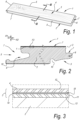
- Figure 1 illustrates a decorative panel 1 comprising a substrate 2 made of a thermoplastic material, preferably rigid PVC in the form of the so called SPC and a top layer 3 provided with a printed motif 4, in this case imitating a wood décor.
- the panel 1 can have the shape of a rectangular and oblong floor panel, with a pair of long sides 5 and a pair of short sides 6.
- the panel 1 is provided at least at the long sides 5 with coupling means 7 allowing to lock the respective sides 5 together with the sides of a similar panel both in a direction R1 perpendicular to the plane of the coupled panels, as in a direction R2 perpendicular to the coupled sides and in the plane of the coupled panels.
- such coupling means or coupling parts can basically have the shape of a tongue 8 and a groove 9, provided with additional cooperating locking means 10 allowing for said locking in the direction R2.
- the top layer 3 comprises a decorative foil 11 and a wear layer 12 provided on top of the decorative foil 11.
- the decorative foil 11 comprises a thermoplastic foil 13 for example made of PVC, and the digitally printed décor 4.
- the decorative foil 11 further comprises an inkjet receiving layer 14.
- the inkjet receiving layer comprises a binder and is free from any water absorbing substance.
- the binder preferably comprises water-based dispersion of terpolymer vinyl chloride, vinyl acetate ethylene; water-based dispersion or copolymer vinyl chloride, vinyl acetate; water-based aliphatic PU dispersion; other non-blocking water-based acrylics dispersions.
- the inkjet receiving layer further comprise a cross linker, a metal salt and other additives like dispersant, coupling agent, wetting agent or PH modifiers.
- the wear layer 12 is a transparent thermoplastic foil, preferably made of PVC.
- an adhesion layer 15 comprising water-based dispersion of terpolymer vinyl chloride, vinyl acetate ethylene; water-based dispersion or copolymer vinyl chloride, vinyl acetate; water-based aliphatic PU dispersion; other non-blocking water-based acrylics dispersions, thereby strongly improving lamination between the decorative foil and the wear layer.
- FIG. 4 shows some step of a method for manufacturing the panel 1.
- the foil 13 is then provided, on at least one surface, with the inkjet receiving layer 14, for example with a doctor blade or a sprayer, in a step S2.
- the coated foil 13 is then printed (step S3) in a single pass printer 20 using water-based ink.
- the ink comprises a binding agent having preferably a MFFT below 40°C.
- the binding agent are VC-VAC copolymer or polymer latexes, either acrylates or urethane components, dispersion or combinations thereof.
- the obtained decorative foil 11 is coiled again in a second roll 17 and then stocked, as indicated in step S4.
- the decorative foil 11 can be uncoiled from second roll 17 in a step S5 and then coated with the adhesion layer 15 in a step S6.
- the decorative foil 11 can then be cut into sheets 18, in a step S7.
- the sheets 18 are then sandwiched between a support 2 and a wear layer 12 and then thermally laminated to form the panel 1.
- Figure 5 it is shown an alternative method that differs from that of figure 4 in that after printing step S3 the decorative foil 11 is immediately coated with the adhesion layer 14 and then laminated onto the substrate 2.
- the printing line can be in line with a support manufacturing equipment, not show, for example an extruder.
- Figure 6 illustrates that the foil 13 having the inkjet receiver coating 14 may be printed by means of an inkjet printer 20, which, in this example comprises a central cylinder 21 upon which the foil 12 is partially wound and several printing units 22, each comprising one or more print heads, disposed radially around the central cylinder 21 and over the area of the foil 13 to be printed.
- the printer 20, in this example relates to a printer of the single pass type, wherein the provision of the printed motif involves a relative motion of said inkjet printer 20, more particularly the printing unit 22, and said foil 13 during printing in a printing direction D.
- the printing unit 22 and the print heads are at standstill, while the foil 13 moves during ejection of inks onto the foil 13, more precisely onto the inkjet receiver coating 14 applied to the foil 13.
- the foil 13 gets printed during a single continuous movement of the foil 13 itself relative the printer 20.
- each printing unit 22 is configured for printing only one color.
- each printing unit 22 extends above the entire width of the foil 13 to be printed.
- each printing unit is composed by a so called colorbar.
- the printer 20 is provided with a plurality of NIR pins 23 each disposed after a respective printing unit 22 so that each pin 23 immediately dries the ink just printed by the respective printing unit 22.
- the central cylinder 21 comprises a heating device 24 to heat the foil 13 during printing to further help drying of the ink.
- the printing operation is performed at a temperature above external environment temperature but, in any case, below 100°C to prevent deformation of the foil.
- each printing unit comprises an ink recirculating circuit 25 configured to recirculate a flow of ink 10 ml/min or more.
- thermoplastic foils and panel may be realized according to several variants without leaving the scope of the invention.
Landscapes
- Chemical & Material Sciences (AREA)
- Physics & Mathematics (AREA)
- Health & Medical Sciences (AREA)
- General Health & Medical Sciences (AREA)
- Thermal Sciences (AREA)
- Toxicology (AREA)
- Chemical Kinetics & Catalysis (AREA)
- Inorganic Chemistry (AREA)
- Laminated Bodies (AREA)
- Ink Jet (AREA)
- Ink Jet Recording Methods And Recording Media Thereof (AREA)
- Application Of Or Painting With Fluid Materials (AREA)
Priority Applications (1)
| Application Number | Priority Date | Filing Date | Title |
|---|---|---|---|
| EP25151520.1A EP4516531A3 (de) | 2020-10-01 | 2020-10-01 | Verfahren zur herstellung einer platte, platte, folie und verfahren zur herstellung einer folie |
Applications Claiming Priority (2)
| Application Number | Priority Date | Filing Date | Title |
|---|---|---|---|
| EP25151520.1A EP4516531A3 (de) | 2020-10-01 | 2020-10-01 | Verfahren zur herstellung einer platte, platte, folie und verfahren zur herstellung einer folie |
| EP20199647.7A EP3978261B1 (de) | 2020-10-01 | 2020-10-01 | Verfahren zur herstellung eines paneels |
Related Parent Applications (2)
| Application Number | Title | Priority Date | Filing Date |
|---|---|---|---|
| EP20199647.7A Division EP3978261B1 (de) | 2020-10-01 | 2020-10-01 | Verfahren zur herstellung eines paneels |
| EP20199647.7A Division-Into EP3978261B1 (de) | 2020-10-01 | 2020-10-01 | Verfahren zur herstellung eines paneels |
Publications (2)
| Publication Number | Publication Date |
|---|---|
| EP4516531A2 true EP4516531A2 (de) | 2025-03-05 |
| EP4516531A3 EP4516531A3 (de) | 2025-04-30 |
Family
ID=72717786
Family Applications (2)
| Application Number | Title | Priority Date | Filing Date |
|---|---|---|---|
| EP20199647.7A Active EP3978261B1 (de) | 2020-10-01 | 2020-10-01 | Verfahren zur herstellung eines paneels |
| EP25151520.1A Pending EP4516531A3 (de) | 2020-10-01 | 2020-10-01 | Verfahren zur herstellung einer platte, platte, folie und verfahren zur herstellung einer folie |
Family Applications Before (1)
| Application Number | Title | Priority Date | Filing Date |
|---|---|---|---|
| EP20199647.7A Active EP3978261B1 (de) | 2020-10-01 | 2020-10-01 | Verfahren zur herstellung eines paneels |
Country Status (4)
| Country | Link |
|---|---|
| US (2) | US12285963B2 (de) |
| EP (2) | EP3978261B1 (de) |
| PL (1) | PL3978261T3 (de) |
| WO (1) | WO2022069982A1 (de) |
Families Citing this family (2)
| Publication number | Priority date | Publication date | Assignee | Title |
|---|---|---|---|---|
| EP3978261B1 (de) * | 2020-10-01 | 2025-02-19 | Unilin, BV | Verfahren zur herstellung eines paneels |
| ES3038275T3 (en) * | 2021-10-22 | 2025-10-10 | Li&Co Ag | Decorative panel, and decorative panel covering |
Citations (11)
| Publication number | Priority date | Publication date | Assignee | Title |
|---|---|---|---|---|
| EP1044822A1 (de) | 1999-04-13 | 2000-10-18 | Technocell Dekor GmbH & Co. KG | Dekorrohpapier mit Ink-Jet-Tintenaufnahmeschicht |
| EP1749676A1 (de) | 2005-08-03 | 2007-02-07 | Jörg R. Bauer | Verfahren und Vorrichtung zum Herstellen einer insbesondere mittels eines Tintenstrahldruckverfahrens bedruckbaren Oberfläche, Papierbahn sowie Gegenstand |
| EP1857511A1 (de) | 2006-05-19 | 2007-11-21 | Agfa Graphics N.V. | Stabile nicht wässrige Tintenstrahldruckfarbe |
| EP1872959A1 (de) | 2006-06-26 | 2008-01-02 | Dante Frati | Verfahren zum Bedrucken von flachen Elementoberflächen auf Holzbasis |
| EP2274485A1 (de) | 2008-02-07 | 2011-01-19 | Hülsta-Werke Hüls GmbH & CO. KG | Papierschicht zum herstellen eines flächigen, bedruckten oder bedruckbaren bauteils |
| EP2293946A1 (de) | 2008-07-03 | 2011-03-16 | Hülsta-Werke Hüls GmbH & CO. KG | Verfahren zum bedrucken von druckpapier und mit einem dekor bedrucktes druckpapier |
| WO2011124503A2 (de) | 2010-03-30 | 2011-10-13 | Pfleiderer Holzwerkstoffe Gmbh | Verbundmaterial und verfahren zu dessen herstellung |
| EP2431190A2 (de) | 2010-09-17 | 2012-03-21 | Theodor Hymmen Verwaltungs GmbH | Verfahren zur Herstellung eines digitalbedruckten Werkstückes |
| WO2014084787A1 (en) | 2012-11-28 | 2014-06-05 | Ceraloc Innovation Ab | Method of producing a building panel using digital printing |
| WO2015118451A1 (en) | 2014-02-06 | 2015-08-13 | Unilin, Bvba | Methods for manufacturing panels having a decorative surface |
| WO2015140682A1 (en) | 2014-03-19 | 2015-09-24 | Unilin, Bvba | Floor panel for forming a floor covering and method for manufacturing such floor panels |
Family Cites Families (6)
| Publication number | Priority date | Publication date | Assignee | Title |
|---|---|---|---|---|
| AU2003220864A1 (en) * | 2002-03-01 | 2003-09-16 | C.I. Kasei Company, Limited | Decorative sheet and process for producing the same |
| US10369837B2 (en) * | 2012-04-30 | 2019-08-06 | Valinge Innovation Ab | Method for forming a decorative design on an element of a wood-based material |
| US9409382B2 (en) * | 2012-11-28 | 2016-08-09 | Valinge Innovation Ab | Method of producing a building panel |
| US10919328B2 (en) * | 2018-08-21 | 2021-02-16 | Eastman Kodak Company | Method for inkjet printing and printed article |
| JP7280551B2 (ja) * | 2019-03-18 | 2023-05-24 | 株式会社リコー | インク、インク収容容器、記録装置、及び記録方法 |
| EP3978261B1 (de) * | 2020-10-01 | 2025-02-19 | Unilin, BV | Verfahren zur herstellung eines paneels |
-
2020
- 2020-10-01 EP EP20199647.7A patent/EP3978261B1/de active Active
- 2020-10-01 PL PL20199647.7T patent/PL3978261T3/pl unknown
- 2020-10-01 EP EP25151520.1A patent/EP4516531A3/de active Pending
-
2021
- 2021-09-14 WO PCT/IB2021/058335 patent/WO2022069982A1/en not_active Ceased
- 2021-09-14 US US18/247,211 patent/US12285963B2/en active Active
-
2025
- 2025-03-27 US US19/092,675 patent/US20250249699A1/en active Pending
Patent Citations (11)
| Publication number | Priority date | Publication date | Assignee | Title |
|---|---|---|---|---|
| EP1044822A1 (de) | 1999-04-13 | 2000-10-18 | Technocell Dekor GmbH & Co. KG | Dekorrohpapier mit Ink-Jet-Tintenaufnahmeschicht |
| EP1749676A1 (de) | 2005-08-03 | 2007-02-07 | Jörg R. Bauer | Verfahren und Vorrichtung zum Herstellen einer insbesondere mittels eines Tintenstrahldruckverfahrens bedruckbaren Oberfläche, Papierbahn sowie Gegenstand |
| EP1857511A1 (de) | 2006-05-19 | 2007-11-21 | Agfa Graphics N.V. | Stabile nicht wässrige Tintenstrahldruckfarbe |
| EP1872959A1 (de) | 2006-06-26 | 2008-01-02 | Dante Frati | Verfahren zum Bedrucken von flachen Elementoberflächen auf Holzbasis |
| EP2274485A1 (de) | 2008-02-07 | 2011-01-19 | Hülsta-Werke Hüls GmbH & CO. KG | Papierschicht zum herstellen eines flächigen, bedruckten oder bedruckbaren bauteils |
| EP2293946A1 (de) | 2008-07-03 | 2011-03-16 | Hülsta-Werke Hüls GmbH & CO. KG | Verfahren zum bedrucken von druckpapier und mit einem dekor bedrucktes druckpapier |
| WO2011124503A2 (de) | 2010-03-30 | 2011-10-13 | Pfleiderer Holzwerkstoffe Gmbh | Verbundmaterial und verfahren zu dessen herstellung |
| EP2431190A2 (de) | 2010-09-17 | 2012-03-21 | Theodor Hymmen Verwaltungs GmbH | Verfahren zur Herstellung eines digitalbedruckten Werkstückes |
| WO2014084787A1 (en) | 2012-11-28 | 2014-06-05 | Ceraloc Innovation Ab | Method of producing a building panel using digital printing |
| WO2015118451A1 (en) | 2014-02-06 | 2015-08-13 | Unilin, Bvba | Methods for manufacturing panels having a decorative surface |
| WO2015140682A1 (en) | 2014-03-19 | 2015-09-24 | Unilin, Bvba | Floor panel for forming a floor covering and method for manufacturing such floor panels |
Also Published As
| Publication number | Publication date |
|---|---|
| WO2022069982A1 (en) | 2022-04-07 |
| EP3978261A1 (de) | 2022-04-06 |
| PL3978261T3 (pl) | 2025-06-02 |
| EP3978261B1 (de) | 2025-02-19 |
| US12285963B2 (en) | 2025-04-29 |
| EP4516531A3 (de) | 2025-04-30 |
| US20230364938A1 (en) | 2023-11-16 |
| US20250249699A1 (en) | 2025-08-07 |
Similar Documents
| Publication | Publication Date | Title |
|---|---|---|
| CN108495753B (zh) | 用于制造可用喷墨打印以用作装饰纸的纸的方法 | |
| US20250249699A1 (en) | Method for manufacturing a panel | |
| CN105899371B (zh) | 制造具有装饰表面的板材的方法 | |
| US20250223455A1 (en) | Method for manufacturing a panel, a panel, a foil and a method for manufacturing a foil | |
| CN115302966B (zh) | 制造用作装饰纸或箔的可喷墨打印的纸或箔的方法 | |
| US12515472B2 (en) | Method for manufacturing inkjet printable paper or foil for use as a decor paper or foil | |
| US20240001701A1 (en) | A method for manufacturing a décor paper or foil and a décor paper or foil | |
| US20240368395A1 (en) | Thermosetting resin composition for laminate panel, method for manufacturing a panel with a thermosetting resin composition and a laminate panel comprising a thermosetting resin | |
| US20240262121A1 (en) | Method for manufacturing inkjet printable paper for use as a décor paper | |
| EP4620699A1 (de) | Verfahren zur herstellung eines dekorativen blatts und dekoratives blatt | |
| EP4303360A1 (de) | Ein bedruckbares oder bedrucktes papier für dekorative elemente, dekorative elemente, die ein bedrucktes papier umfassen, und ein verfahren zur herstellung des dekorativen elements | |
| WO2025041003A1 (en) | Method of manufacturing a décor paper or a décor foil with a plurality of printed designs and corresponding indicia, a décor paper or décor foil, and a laminated panel. |
Legal Events
| Date | Code | Title | Description |
|---|---|---|---|
| PUAI | Public reference made under article 153(3) epc to a published international application that has entered the european phase |
Free format text: ORIGINAL CODE: 0009012 |
|
| STAA | Information on the status of an ep patent application or granted ep patent |
Free format text: STATUS: THE APPLICATION HAS BEEN PUBLISHED |
|
| AC | Divisional application: reference to earlier application |
Ref document number: 3978261 Country of ref document: EP Kind code of ref document: P |
|
| AK | Designated contracting states |
Kind code of ref document: A2 Designated state(s): AL AT BE BG CH CY CZ DE DK EE ES FI FR GB GR HR HU IE IS IT LI LT LU LV MC MK MT NL NO PL PT RO RS SE SI SK SM TR |
|
| REG | Reference to a national code |
Ref country code: DE Ref legal event code: R079 Free format text: PREVIOUS MAIN CLASS: B44C0005040000 Ipc: B41M0005520000 |
|
| PUAL | Search report despatched |
Free format text: ORIGINAL CODE: 0009013 |
|
| AK | Designated contracting states |
Kind code of ref document: A3 Designated state(s): AL AT BE BG CH CY CZ DE DK EE ES FI FR GB GR HR HU IE IS IT LI LT LU LV MC MK MT NL NO PL PT RO RS SE SI SK SM TR |
|
| RIC1 | Information provided on ipc code assigned before grant |
Ipc: B44C 5/04 20060101ALI20250326BHEP Ipc: B41M 7/00 20060101ALI20250326BHEP Ipc: B41M 5/52 20060101AFI20250326BHEP |
|
| P01 | Opt-out of the competence of the unified patent court (upc) registered |
Free format text: CASE NUMBER: UPC_APP_0309_4516531/2025 Effective date: 20250715 |
|
| STAA | Information on the status of an ep patent application or granted ep patent |
Free format text: STATUS: REQUEST FOR EXAMINATION WAS MADE |
|
| 17P | Request for examination filed |
Effective date: 20250926 |