EP4516367A1 - Surfsimulator - Google Patents
Surfsimulator Download PDFInfo
- Publication number
- EP4516367A1 EP4516367A1 EP23194022.2A EP23194022A EP4516367A1 EP 4516367 A1 EP4516367 A1 EP 4516367A1 EP 23194022 A EP23194022 A EP 23194022A EP 4516367 A1 EP4516367 A1 EP 4516367A1
- Authority
- EP
- European Patent Office
- Prior art keywords
- platform
- coupled
- user
- bearing
- wheels
- Prior art date
- Legal status (The legal status is an assumption and is not a legal conclusion. Google has not performed a legal analysis and makes no representation as to the accuracy of the status listed.)
- Pending
Links
Images








Classifications
-
- A—HUMAN NECESSITIES
- A63—SPORTS; GAMES; AMUSEMENTS
- A63B—APPARATUS FOR PHYSICAL TRAINING, GYMNASTICS, SWIMMING, CLIMBING, OR FENCING; BALL GAMES; TRAINING EQUIPMENT
- A63B22/00—Exercising apparatus specially adapted for conditioning the cardio-vascular system, for training agility or co-ordination of movements
- A63B22/18—Exercising apparatus specially adapted for conditioning the cardio-vascular system, for training agility or co-ordination of movements with elements, i.e. platforms, having a circulating, nutating or rotating movement, generated by oscillating movement of the user, e.g. platforms wobbling on a centrally arranged spherical support
-
- A—HUMAN NECESSITIES
- A63—SPORTS; GAMES; AMUSEMENTS
- A63B—APPARATUS FOR PHYSICAL TRAINING, GYMNASTICS, SWIMMING, CLIMBING, OR FENCING; BALL GAMES; TRAINING EQUIPMENT
- A63B22/00—Exercising apparatus specially adapted for conditioning the cardio-vascular system, for training agility or co-ordination of movements
- A63B22/16—Platforms for rocking motion about a horizontal axis, e.g. axis through the middle of the platform; Balancing drums; Balancing boards or the like
-
- A—HUMAN NECESSITIES
- A63—SPORTS; GAMES; AMUSEMENTS
- A63B—APPARATUS FOR PHYSICAL TRAINING, GYMNASTICS, SWIMMING, CLIMBING, OR FENCING; BALL GAMES; TRAINING EQUIPMENT
- A63B26/00—Exercising apparatus not covered by groups A63B1/00 - A63B25/00
- A63B26/003—Exercising apparatus not covered by groups A63B1/00 - A63B25/00 for improving balance or equilibrium
-
- A—HUMAN NECESSITIES
- A63—SPORTS; GAMES; AMUSEMENTS
- A63B—APPARATUS FOR PHYSICAL TRAINING, GYMNASTICS, SWIMMING, CLIMBING, OR FENCING; BALL GAMES; TRAINING EQUIPMENT
- A63B5/00—Apparatus for jumping
- A63B5/11—Trampolines
-
- A—HUMAN NECESSITIES
- A63—SPORTS; GAMES; AMUSEMENTS
- A63B—APPARATUS FOR PHYSICAL TRAINING, GYMNASTICS, SWIMMING, CLIMBING, OR FENCING; BALL GAMES; TRAINING EQUIPMENT
- A63B69/00—Training appliances or apparatus for special sports
- A63B69/0093—Training appliances or apparatus for special sports for surfing, i.e. without a sail; for skate or snow boarding
-
- A—HUMAN NECESSITIES
- A63—SPORTS; GAMES; AMUSEMENTS
- A63B—APPARATUS FOR PHYSICAL TRAINING, GYMNASTICS, SWIMMING, CLIMBING, OR FENCING; BALL GAMES; TRAINING EQUIPMENT
- A63B71/00—Games or sports accessories not covered in groups A63B1/00 - A63B69/00
- A63B71/02—Games or sports accessories not covered in groups A63B1/00 - A63B69/00 for large-room or outdoor sporting games
- A63B71/023—Supports, e.g. poles
- A63B2071/025—Supports, e.g. poles on rollers or wheels
-
- A—HUMAN NECESSITIES
- A63—SPORTS; GAMES; AMUSEMENTS
- A63B—APPARATUS FOR PHYSICAL TRAINING, GYMNASTICS, SWIMMING, CLIMBING, OR FENCING; BALL GAMES; TRAINING EQUIPMENT
- A63B2220/00—Measuring of physical parameters relating to sporting activity
-
- A—HUMAN NECESSITIES
- A63—SPORTS; GAMES; AMUSEMENTS
- A63B—APPARATUS FOR PHYSICAL TRAINING, GYMNASTICS, SWIMMING, CLIMBING, OR FENCING; BALL GAMES; TRAINING EQUIPMENT
- A63B2225/00—Miscellaneous features of sport apparatus, devices or equipment
- A63B2225/09—Adjustable dimensions
Definitions
- the present invention is related to the field of sporting equipment, particularly surfing simulators and trainers.
- Surfing trainers and simulators have existed to satisfy the need of many who do not have access to locations where they can regularly surf, train or otherwise develop their skills. These simulators help users develop the skills and fitness to train the surf-motion on a simulator on land, but are often lacking in many respects. None of these accurately simulate a moving wave of water, accurately simulate surfer's movement on the face of a wave, nor do they necessarily develop the skills and fitness for surfing. Existing surfing simulators range from small wiggle boards to wave pools with artificial waves.
- Wiggle boards train a user's static balance on unbalanced ground to stay in an as-balanced and upright position, basically on an imagined plumb line, as possible to not fall.
- the board on such a device sits on a roller, airbags, springs, or a motorized bull machine. Skateboards are good for surf training but tend to be dangerous as falling on a hard surface can be harmful. In addition, skateboards do not train how to "takeoff" on a wave.
- the wiggle board assumes that surfing is simply a question of good balance - it is not. As soon as a surfboard is in motion on a wave, it becomes very stable. Therefore, once this skill is mastered the wiggle board is not a very good trainer for advanced surfers.
- the apparatus comprises a platform capable of supporting a user, in some embodiments it is a continuous elastic surface such as trampoline with it's frame or similar elastic surface. In other embodiments it is firm or non-elastic platform, sometimes in the shape of a surfboard or similar riding surface.
- the apparatus has a support coupled to the platform for holding the platform. It further comprises a bearing or similar assembly coupled to the support for allowing the platform to rotate about an axis which can be displaced a distance from the user while standing atop the platform during simulation thus simulating bottom and top turns.
- the apparatus further comprises a stand coupled to the bearing for securely supporting the bearing and allowing the platform to rotate about a tilted axis without toppling the apparatus.
- the support of the apparatus can be done in various ways, such as mounting legs or other means.
- the bearing surface can also be implemented in various ways to implement captured rotation, such as the use of tracks or wheels in various implementations. This can be done mechanically in combination with gravity to maintain the integrity of the apparatus.
- the platform can be attached by an arm at one end and a fixed bearing at some distance displaced from the user to allow rotation and surf simulation, perhaps with a secondary bearing for movement of the platform.
- an adapter which allows the adaptation of a standard commercially-available trampoline to form the disclosed surfing simulator.
- surfing can refer to, but is not limited by, the following: skateboarding, snowboarding, windsurfing, kitesurfing, and stand-up surfing (or paddling).
- surfing will refer to any sport where the surfer (user, rider, kitesurfer, SUPer, etc%) riding a board (surfboard, skateboard, snowboard, etc%) or similar vehicle and is generally standing in a straddling position with his board perpendicular to his body but forward facing.
- the surfer In such a position, the surfer often rides the vehicle on an inclined surface, such as the surface of waves or swell on water, the asphalt on a hilly road or wood on a half-pipe, snow on a mountain slope or snow half-pipe.
- the surfer can either ride "regular foot” (left foot forward relative to direction of travel), or "goofy foot” (right foot forward).
- simulator and trainer will be used. For these purposes, the terms are interchangeable since the apparatus achieves objectives for both simulation and training to the actual sport of surfing.
- the objective of various embodiments of the present invention is to simulate carving rather than just balancing to stay on the board as it is for the wiggle board and similar devices.
- the objective of the present invention is to allow the user to experience the full motion of surfing in a more realistic and relevant way, especially for advanced surfers.
- These skills include simulating the sensation of going down the wave once the wave is "caught”, training the surfer how to use his dynamic balance of letting his center of gravity fall into the center of a turn on the wave face, and turning back upwards on the wave. This also includes letting the surfer's legs travel faster than the center of gravity by which the feet, and with that the board, travel faster than the center of gravity of the body is traveling down and with the wave.
- the objective of various embodiments of this invention is to not simply train the surfer to ride down the wave in a straight line, but to pivot up and down the face of the wave (or asphalt, half-pipe or snowy mountain), going into a deep bottom turn, leaning the surfer's weight on the wave facing rail of the board to drive it through the bottom turn, and back up into the lip (top) of the surface of the wave as vertical as possible.
- Described embodiments also train how to then drop down from the top of the wave, down to the bottom and back up to the lip of the wave again.
- a circular motion is used to simulate the motion on the face of the wave as the center of the user's gravity travels with the user down the face of the wave.
- the objectives of these embodiments are to allow users to experience this moment of taking off on a wave, dropping into a wave, getting onto their feet, and driving the feet through the bottom turn in a way that generates, and not loses, energy and velocity while surfing.
- the generation of energy by weight transfer is thus teachable to users using embodiments of the present invention.
- the ideal weight transfer for the particular user can be learned over time through repetition in embodiments of the present invention given that the cost of such a device would be well within reach of the average surfer.
- Surf machine 100 An embodiment of the present invention is shown as surf simulator/trainer machine 100 (hereinafter "surf machine") in Figure 1 , which a user or surfer 150 can use to develop his carving skills as set forth above.
- Surf machine 100 is comprised of a base structure, such as a platform, plane or surface 110 set on an inclined plane relative to a surface 115, the ground, floor or other solid surface.
- Surface 110 may be solid and can be made of any suitable material - wood, metal, composite or similar to provide support for additional apparatus described herein.
- consumer grade components such as trampolines and associated products commercially available to consumers with lighter gauge materials and construction that used in the commercial context such as in theme parks, playgrounds, etc...
- surface 110 might simply be a circular rail which provides the support for the additional apparatus discussed herein.
- Surface 110 is set at the incline by stand or legs 111, which in some embodiments can be fixed or in others telescoping or adjustable height, such as by spring pins. This allows the incline of surface 110 and angle of machine 100 to be user-adjustable. This user-adjustability allows training for different types of surfing conditions, for example, larger or steeper waves or other riding surfaces.
- 110 can be mounted on a surface such as a flat surface or inclined surface, such as a hill or a dune, to provide an inclined plane.
- platform 140 upon which a user can ride during simulation.
- 140 is a round or circular trampoline assembly which may be a round trampoline such as those commercially available with the modifications described herein.
- the diameter of the assembly can be roughly eight feet, but any suitable diameter in a reasonable range to simulate various wave conditions. It is contemplated that useful apparatus will have a turning radius ranging between six and sixty feet in diameter for different simulation/training scenarios.
- Various sizes can be used according to use of the simulator (e.g. ability of the user to start rotation of the apparatus, and/or size of wave to be simulated, and/or bottom turns desired to be simulated).
- Platform 140 has a typical trampoline surface 120 which is comprised of a frame 122 and an elastic surface 123 as is common in most commercially available trampolines.
- the surface 123 can be elastic through choice of elastic material only, or elastic material in combination with elastic structures such as springs, bungee cords, or the like as is known.
- the elastic nature of the elastic surface 120 simulates the elasticity and resistance on a board that a user 150 experiences when surfing on water. This allows the user 150 to "push" off the resistance and have feedback which is similar to surfing a board on water and develop the fitness for and muscle memory of doing the same.
- the surface 120 of platform 140 can be non-elastic and comprised of a solid or firm material, according to desired application.
- the platform may be a pie slice of a circle which is rotatably mounted in the manner described herein. In either the continuous or the slice embodiments, the remaining material of the platform that the user is not standing upon can act as a safety mechanism in the event that the user leans too far towards the axis of rotation and falls.
- assembly 140 further comprises a stand or support comprising legs 121 which are coupled to frame 122 to provide support for the surface 120.
- Assembly 140 is further modified in the following way. It is rotatably coupled to base structure 110 using some sort of bearing assembly so that it rotates about a central axis 141 on base structure 110 but yet does not detach from the underlying structure. Because the trampoline is round, it can be so rotatably coupled in any number of ways.
- bearing assembly 142 is comprised of wheels affixed to support legs 121 in some fashion.
- Legs 121 of assembly 140 couple to base structure 110 at axis 141, in this embodiment, using a central structure with a bearing surface to allow captured rotation of surface 120 in directions 160 (clockwise 160b or counterclockwise 160a as shown).
- the weight of assembly 140 is thus borne on bearing wheels 142 as they ride on surface 110 and assembly 140 rotates about an axis 141.
- surface 110 has a rail on its edge that captures assembly 140 by gravity and allows it to rotate upon using wheels 142 without becoming detached from the underlying structure.
- other rolling hardware and tracks or other retention mechanisms may allow such captured rotation about an axis 141, for example, a central axis with a bearing surface at axis 141, but lacking any rail.
- various embodiments of the present invention may optionally include, but not be limited to, one or more of the following in surf machine 100:
- the rotation of assembly 140 above surface 110 allows a user to simulate the takeoff and carving motions as described above.
- a user 150 can stand the edge of the elastic portion 123 of surface 120 while the machine 100 is not in motion either at the top of the device to get a "running start” or start at the bottom to "fakey” or weight transfer (as on a skateboard or snowboard half-pipe), to get the apparatus moving.
- This "fakey” back and forth weight transfer motion
- the surfer develops the proper techniques and fitness for real surfing.
- the direction of travel, counterclockwise 160a (for a goofy foot surfer) is shown in the Figure 1 for simplicity, it can be appreciated by one skilled in the art that the apparatus can be used in the clockwise 160b (regular foot) direction as well. Because the surface 120 is tilted, the surfer 150 simulates a wave or other sloped riding surface.
- axis 141 is so chosen in various embodiments and implementations of the present invention so as to simulate actual surfing, skateboarding, etc....
- the user typically desires to train for executing maneuvers such as bottom and top turns (turns on the face of a wave or incline).
- the turning radii of such turns corresponds with the distance between a user mounted or standing on the platform 140 and the axis 141.
- surf machine 100 is contemplated to be often used where the position of axis 141 is displaced from the position of the user rather than coincident. That distance, the radius of the rotational path of the user on platform 140, corresponds with the radius of the bottom or top turn desired to be simulated.
- the angle of the axis 141 (and platform 142 upon which the user is atop) simulates the angle of the wave face or other inclined plane (dirt, snow, asphalt, etc...) that the surfer desires to simulate.
- a continuous surface such as a trampoline as disclosed herein, while it is contemplated that the user will start at the edge of 140, in some simulations, the user can simply step closer towards the axis 141 to simulate tighter (smaller radius) turns. In other embodiments, other means or adjusting this turn radius is contemplated within the spirit and scope of the present invention, such as adjustable arms or similar, for various use cases.
- the fakey motion by surfer 150 on surf machine 100 can continue so that the surfer 150 can completely rotate assembly 140 while riding upon it. If the surfer 150 uses her weight correctly she can drive up to the other side of surface 110, come around, and back down. This allows additional aspects of simulating wave riding for training, for example, of riding down the face of a wave and doing cutbacks (turns at the apex and trough of the wave). This also allows the user to repeat the same motion to continuously work out and further develop skills and fitness.
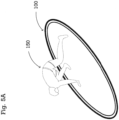
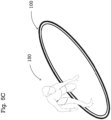
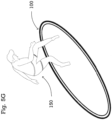
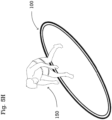
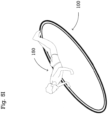
- FIGS 5A-5I show user 150 in various positions on surf machine 100 as successive points in time for a goofy-foot surfer. It is understood that a regular surfer will use the apparatus facing the opposite direction with machine 100 rotating the opposite direction (clockwise). Initially, the user 150 may be standing or laying on the apparatus to simulate paddling into the wave - Figure 5I . User 150 can be at the top of the machine relative to its tilt for this phase. The user 150 then "pops-up" or assumes a standing position as shown at the time in Figure 5A to start a surf simulation session. This puts the user 150 on top of the wave (surf machine 100) the weight is put onto the front foot, and the back leg has little to no weight, knee laying down on the machine 100's surface (simulating the board on a moving wave.
- machine 100 rotates counterclockwise approximately 90 degrees.
- the user 150 rotates 2/3 down the face of machine 100 leaning the body toward the center of the machine touching the center with the backhand as shown on Figure 5C .
- user 150 reaches the bottom of the rotation of machine 100.
- user 150 transfers weight onto his backfoot, and unweights the front foot (so that his feet almost feel like they're slipping under his body), with his upper body is still leaning in to the center of the machine at Figure 5E as he starts his progress back up the machine (wave) during rotation.
- Surf machine 100 can also include, in alternative embodiments, electrical motors and/or brakes (not shown) in order to more precisely control rotation, for example, for safety purpose, to replicate particular points on a wave, or to increase resistance for training and different wave characteristics.
- the platform 120 can rotate around a central axle.
- a counterweight or counter lever with a support ring of the same size as the platform can be used to stabilize it.
- the platform can have a mechanical brake, and/or electric motor for safety, and to provide a more accurate simulation, resisting or enhancing motion along certain axes.
- an electric motor or other sensors installed to track rotation and energy expended by the surfer, the energy output of the surfer can be measured, stored, displayed, and shared, for example, for tracking progress, for training/coaching and other purposes, such as social media.
- a kit to modify such components to achieve the objectives and implement the embodiments described herein.
- a manufacturer may desire to minimize manufacturing and distribution expenses by providing only an adapter including the necessary components which are not commercially available to users and instructions for fabricating and assembling the components to complete an apparatus along with commercially-available parts (e.g. a consumer-grade trampoline).
- all components and materials may be provided in more or less complete form.
- FIG. 2 An alternative embodiment of the present invention is shown as 200 in Figure 2 . Some details which have been described relative to Figure 1 are present, but some labelling has been omitted for clarity.
- a smaller rotating platform 210 is installed in or above surface 220 that itself can rotate on an axis 230. This makes the exercise more challenging, but also easier to 'feel' the board turn under surfer 150 and turn it on top of the platform (at the lip) to point the front foot back down again rotating clockwise around the backfoot. This can also simulate 360 degree maneuvers that are common in modern surfing.
- the platform can be circular in shape as shown, or other shapes (e.g. a surfboard shape) according to the type of training and simulation desired.
- FIG. 3 Yet another alternative embodiment is shown as surf machine 300 in Figure 3 which may be useful in a more permanent installation.
- a central post 310 is set into surface 115 such that it is securely attached via a counter-weight or concrete base 315 sufficient to withstand rotation motion of the apparatus 300 with a surfer 150 riding it.
- Attached to post 310 is an angled axis 320 as a post about which the remaining apparatus can rotate.
- a bearing 325 of an arm 330 is rotatably coupled to post 320 to allow free rotation of the arm. Arm 330 extends away from post 320 to support a platform shaped as a board 350 which allows movement about an axis 340 at the end of the arm.
- Figures 4A-4D Other alternative embodiments of the present invention are shown in Figures 4A-4D .
- 400 of Figure 4A shows an embodiment of the present invention which combines an elastic surface with a single post to allow rotation.
- 410 and 420 of Figures 4B and 4C show the effect of varying the diameter of surf machine 100 for simulating different surfing conditions.
- Figure 4D shows yet another alternative embodiment 430 which can be used with any of the previously described embodiments to provide an additional margin of safety to surfer 150.
- a support structure is solidly affixed nearby the apparatus 430 in such a way that the surfer 150 can be suspended.
- the user can wear a harness 432 suspended by support 431 to avoid injury from falls occurring during use of the surf machine.
- pads, nets, and related safety equipment can also be used in combination with any of the aforesaid apparatus.
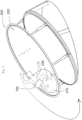
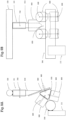
- Rolling support leg 600 may comprise an adjustable leg assembly 610 which may be used for adjusting the height of a surf machine 100.
- the leg may be coupled to support bearing assemblies 620 upon which may be mounted wheels 630. Wheels may be any of those commercially available wheels including bearings, such as skateboard or inline skate wheels.
- the wheels 630 may be captured in a track 640.
- Track 640 may form either the captured rotating base of machine 100 or the perimeter of trampoline assembly 140 to allow captured rotation.
- One skilled in the arts can configure such a component (or plurality of components) rolling support leg 600 in any number of ways to allow rotation and usage of the apparatus described herein.
- Rolling support leg 600 inserts into shortened or extended legs 121 of the frame 122 or attach directly to the frame 122.
- a pin or screw connection 650 secures the leg assembly 610 inside the trampoline or platform leg 121.
- the wheels 630 run in a circular track 640 that is either mounted on or establishing the tilted surface 110.
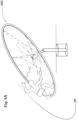
- Rolling support leg 700 may comprise an adjustable leg assembly 710 which may be used for adjusting the height of a surf machine 100.
- the leg may be coupled to support bearing assemblies 720 upon which may be mounted an upper wheel 730 and a lower wheel 730 each of which may have concave tread surface. Wheels may be any of those commercially available wheels including bearings, such as skateboard or inline skate wheels.
- the wheels 730 may be captured and run on and under a track 740.
- Track 740 may form either the captured rotating base of machine 100 or the perimeter of trampoline assembly 140 to allow captured rotation.
- the bearing assembly may have two wheels on the top or bottom to ensure better alinement with the track.
- Rolling support leg 700 inserts into shortened or extended legs 121 of the frame 122 or attach directly to the frame 122.
- a pin or screw connection 750 secures the leg assembly 710 inside the trampoline or platform leg 121.
- the wheels 730 run on a circular track 740 that is either mounted on or establishing the tilted surface 110.
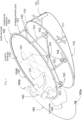
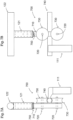
- Height adjustable leg 800 shown in Figures 8A and 8B which are an embodiment of the leg 111 between the ground, floor or other solid surface 115 and the surface of rail 110.
- Height adjustable leg 800 may comprise an adjustable leg assembly 810 which may be used for adjusting the height of surf machine 100.
- the leg may be coupled to inflatable or shock absorber assemblies 820 upon which may be mounted a rotatable connection 830 to the surface or rail 110 to allow flexible tilt relative to the ground, floor or other solid surface 115 by which the simulation of changing steepness and energy of a wave is possible.
- Figure 8A shows an extended leg setting with an inflatable or shock absorber assembly 820 which may be an airbag, electrically or mechanically driven gear, or set mechanically by a pin.
- Figure 8B shows a short leg setting with a shortened inflatable or shock absorber assembly 820 which may be an airbag, electrically or mechanically driven gear, or set mechanically by a pin.
- One skilled in the arts can configure such a component (or plurality of components) height adjustable leg 800 in any number of ways to allow tilt adjustment and usage of the apparatus described herein.
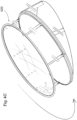
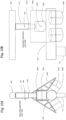
- Rolling support leg 900 may comprise an adjustable leg assembly 910 which may be used for adjusting the height of a surf machine 100.
- the leg may be coupled to support bearing assemblies 950 upon which may be mounted with a bolt in a rotatable fashion 960 a wheel assembly 970 which has two upper wheels 930 and two lower wheels 930 which form a concave V shape between each other in which the railing 740 sits.
- the wheeled leg can neither fall out nor pop up out of the railing if fitted properly.
- Wheels may be any of those commercially available wheels including bearings, such as skateboard or inline skate wheels.
- the wheels 930 may be captured and run on and under a track 740 in an angle.
- Track 740 may form either the captured rotating base of machine 100 or the perimeter of trampoline assembly 140 to allow captured rotation.
- One skilled in the art may configure such a component (or plurality of components) rolling support leg 900 in any number of ways to allow rotation and usage of the apparatus described herein.
- the bearing assembly may have two wheels on the top or bottom to ensure better alignment with the track.
- Rolling support leg 900 inserts into shortened or extended legs 121 of the frame 122 or attach directly to the frame 122.
- a pin or screw connection 750 secures the leg assembly 910 inside the trampoline or platform leg 121.
- the wheels 930 run on a circular track 740 that is either mounted on or establishing the tilted surface 110.
- Rolling support leg 1000 may comprise an adjustable leg assembly 1010 which may be used for adjusting the height of a surf machine 100.
- the leg may be coupled to support bearing assemblies 1050 upon which may be mounted upper wheels 1030 (disposed within enclosure 1020) and two sets of lower wheels 1030 each of which is angled toward each other creating a channel wherein the rail 740 will be captured.
- Wheels may be any of those commercially available wheels including bearings, such as skateboard or inline skate wheels.
- the wheels 1030 may be captured and run on and under a track 740 at an angle.
- Track 740 may form either the captured rotating base of machine 100 or the perimeter of trampoline assembly 140 to allow captured rotation.
- One skilled in the art may configure such a component (or plurality of components) rolling support leg 1000 in any number of ways to allow rotation and usage of the apparatus described herein.
- the bearing assembly may have two wheels on the top or bottom to ensure better alinement with the track.
- Rolling support leg 1000 inserts into shortened or extended legs 121 of the frame 122 or attach directly to the frame 122.
- a pin or screw connection 750 secures the leg assembly 1010 inside the trampoline or platform leg 121.
- the wheels 1030 run on a circular track 740 that is either mounted on or establishing the tilted surface 110.
Landscapes
- Health & Medical Sciences (AREA)
- General Health & Medical Sciences (AREA)
- Physical Education & Sports Medicine (AREA)
- Cardiology (AREA)
- Vascular Medicine (AREA)
- Motorcycle And Bicycle Frame (AREA)
Priority Applications (1)
| Application Number | Priority Date | Filing Date | Title |
|---|---|---|---|
| EP23194022.2A EP4516367A1 (de) | 2023-08-29 | 2023-08-29 | Surfsimulator |
Applications Claiming Priority (1)
| Application Number | Priority Date | Filing Date | Title |
|---|---|---|---|
| EP23194022.2A EP4516367A1 (de) | 2023-08-29 | 2023-08-29 | Surfsimulator |
Publications (1)
| Publication Number | Publication Date |
|---|---|
| EP4516367A1 true EP4516367A1 (de) | 2025-03-05 |
Family
ID=87863576
Family Applications (1)
| Application Number | Title | Priority Date | Filing Date |
|---|---|---|---|
| EP23194022.2A Pending EP4516367A1 (de) | 2023-08-29 | 2023-08-29 | Surfsimulator |
Country Status (1)
| Country | Link |
|---|---|
| EP (1) | EP4516367A1 (de) |
Citations (5)
| Publication number | Priority date | Publication date | Assignee | Title |
|---|---|---|---|---|
| US4880226A (en) * | 1989-02-21 | 1989-11-14 | Peter Krantz | Skiing simulator |
| US4905994A (en) * | 1985-12-06 | 1990-03-06 | Hartz Billy J | Tilting rotational recreational device |
| US5813958A (en) * | 1995-11-30 | 1998-09-29 | Tomita; Hiroaki | Rocking foot exerciser (foot rocker) |
| KR20120078286A (ko) * | 2010-12-30 | 2012-07-10 | 강두환 | 활강형 운동기구 |
| WO2015169739A1 (en) * | 2014-05-06 | 2015-11-12 | Kompan A/S | A playground equipment |
-
2023
- 2023-08-29 EP EP23194022.2A patent/EP4516367A1/de active Pending
Patent Citations (5)
| Publication number | Priority date | Publication date | Assignee | Title |
|---|---|---|---|---|
| US4905994A (en) * | 1985-12-06 | 1990-03-06 | Hartz Billy J | Tilting rotational recreational device |
| US4880226A (en) * | 1989-02-21 | 1989-11-14 | Peter Krantz | Skiing simulator |
| US5813958A (en) * | 1995-11-30 | 1998-09-29 | Tomita; Hiroaki | Rocking foot exerciser (foot rocker) |
| KR20120078286A (ko) * | 2010-12-30 | 2012-07-10 | 강두환 | 활강형 운동기구 |
| WO2015169739A1 (en) * | 2014-05-06 | 2015-11-12 | Kompan A/S | A playground equipment |
Similar Documents
| Publication | Publication Date | Title |
|---|---|---|
| US7935033B2 (en) | Simulated ski motion machine | |
| US12005335B2 (en) | Multipurpose exercise device for replicating exercise motions for sports and physical therapy | |
| US7935032B1 (en) | Exercise system | |
| US7374522B2 (en) | Exercise device having a movable platform | |
| US4953858A (en) | Sloping rotatable exerciser | |
| US5536225A (en) | Skiing simulator system combining ski training and exercise | |
| US10967220B2 (en) | Exercise device | |
| US4880226A (en) | Skiing simulator | |
| CN107519633B (zh) | 滑行运动模拟设备 | |
| CN107261458B (zh) | 用于滑行运动模拟设备的上身稳定装置 | |
| US9295879B2 (en) | Exercise device and method of using same | |
| US10761878B2 (en) | Ski genie training apparatus and methods of use | |
| WO2019011281A1 (zh) | 用于滑行运动模拟设备的底盘装置 | |
| CN107519629B (zh) | 滑行运动模拟装置 | |
| US20240017147A1 (en) | Surfing Simulator | |
| CA2668466C (en) | Off-ice edge trainer | |
| US5413545A (en) | Training device, especially for downhill skiers | |
| US20230381576A1 (en) | Pump trainer, exercise machine and methods of use | |
| WO2009112817A2 (en) | Interactive exercising system | |
| EP4516367A1 (de) | Surfsimulator | |
| CA3072522A1 (en) | Exercise device | |
| EP3628018B1 (de) | Langlaufskimaschine | |
| US10245494B1 (en) | Trick board training apparatus | |
| RU2414943C1 (ru) | Способ регулирования подъемной силы в тренажерах инерционного типа | |
| RU101932U1 (ru) | Тренажер фигуриста |
Legal Events
| Date | Code | Title | Description |
|---|---|---|---|
| PUAI | Public reference made under article 153(3) epc to a published international application that has entered the european phase |
Free format text: ORIGINAL CODE: 0009012 |
|
| STAA | Information on the status of an ep patent application or granted ep patent |
Free format text: STATUS: THE APPLICATION HAS BEEN PUBLISHED |
|
| AK | Designated contracting states |
Kind code of ref document: A1 Designated state(s): AL AT BE BG CH CY CZ DE DK EE ES FI FR GB GR HR HU IE IS IT LI LT LU LV MC ME MK MT NL NO PL PT RO RS SE SI SK SM TR |
|
| STAA | Information on the status of an ep patent application or granted ep patent |
Free format text: STATUS: THE APPLICATION IS DEEMED TO BE WITHDRAWN |